


ISO/DTS 24110
(Main)Plastics — Method of exposure to combined UV radiation and creep load
Plastics — Method of exposure to combined UV radiation and creep load
This document describes a test method for exposing specimens to artificial UV radiation in combination with a creep load. This method uses ISO 4892-3 for UV radiation exposure and ISO 899-1 for the tensile creep test. Different types of fluorescent UV lamps can be used to meet all the requirements for testing different materials. UVC lamps (IEC 60335-1) can also be used for cases agreed between the parties involved.
Plastiques — Méthode d'exposition combinée au rayonnement UV et au fluage sous charge
General Information
- Status
- Not Published
- Technical Committee
- ISO/TC 61/SC 6 - Ageing, chemical and environmental resistance
- Drafting Committee
- ISO/TC 61/SC 6/WG 3 - Various exposures
- Current Stage
- 5020 - FDIS ballot initiated: 2 months. Proof sent to secretariat
- Start Date
- 29-Dec-2025
- Completion Date
- 29-Dec-2025
Overview
ISO/DTS 24110 defines a laboratory method for exposing plastics to simultaneous UV radiation and a tensile creep load ("combined exposure"). This DTS provides procedural guidance to evaluate material performance and accelerated degradation when mechanical stress and UV irradiation act together. Note: this document is at the DTS (draft) stage and is distributed for review and comment; it is not an ISO International Standard.
Key elements of the method include the combined use of UV sources specified in ISO 4892-3 and tensile creep procedures from ISO 899-1. Test specimens are prepared in accordance with ISO 527-2 and changes in properties are assessed per ISO 4582.
Key Topics
- Principle: Simultaneous exposure of specimens to a laboratory UV radiation source and a uniaxial tensile creep load to simulate real-world ageing under combined environmental and mechanical stress.
- Apparatus: A combined test device that meets ISO 4892-1 requirements for UV exposure and accommodates uniaxial tensile creep loading (deadweight systems) per ISO 899-1.
- UV sources: Fluorescent UV lamps (e.g., UVA-340, UVA-351, UVB-313) as specified in ISO 4892-3. Low-pressure mercury UVC (254 nm) lamps may be used where agreed and in accordance with IEC 60335-1.
- Measurement devices: Radiometer and black-panel/black-standard thermometer per ISO 4892-1; extensometers (contact or contactless) as required by ISO 899-1 to record extension without influencing specimen behaviour.
- Specimen arrangements: Single specimens or multiple specimens arranged in series or parallel; maintain fixed lamp-to-specimen distance; opaque materials recommended to reduce scattering variation.
- Load selection: Applied creep load should avoid causing delayed yielding during the exposure period; load levels are determined from prior tensile tests per ISO 527-2.
- Annexes: Annex A compares UV exposure with combined creep at 10 %, 20 % and 30 % of tensile yield strength; Annex B provides example combined-exposure equipment designs.
Applications
This method is applicable to:
- Durability screening and comparative testing of plastics and polymeric components subjected to outdoor UV exposure while under mechanical load.
- Product development and material selection where combined environmental and mechanical stresses are expected (e.g., outdoor housings, structural polymer parts).
- Failure analysis and lifecycle assessment to understand interaction effects between UV radiation and creep deformation.
Practical benefits include more realistic accelerated ageing data and the ability to correlate laboratory results with field performance when both UV exposure and sustained load are relevant.
Related Standards
- ISO 527-1 / ISO 527-2 - Determination of tensile properties
- ISO 899-1:2017 - Tensile creep testing of plastics
- ISO 4892-1:2024 - General guidance and requirements for laboratory light sources
- ISO 4892-3:2024 - Fluorescent UV lamps
- ISO 4582:2025 - Assessment of changes in properties after exposure
- IEC 60335-1:2020 - Low-pressure mercury UVC lamp requirements (referenced for UVC use)
For implementers: ensure all lamp types used in a given test are identical, report any deviations or alternative radiation sources, and consult the Annexes for examples of equipment and comparative results.
ISO/DTS 24110 - Plastics — Method of exposure to combined UV radiation and creep load Released:15. 12. 2025
REDLINE ISO/DTS 24110 - Plastics — Method of exposure to combined UV radiation and creep load Released:15. 12. 2025
Get Certified
Connect with accredited certification bodies for this standard

Smithers Quality Assessments
US management systems and product certification.

DIN CERTCO
DIN Group product certification.
Sponsored listings
Frequently Asked Questions
ISO/DTS 24110 is a draft published by the International Organization for Standardization (ISO). Its full title is "Plastics — Method of exposure to combined UV radiation and creep load". This standard covers: This document describes a test method for exposing specimens to artificial UV radiation in combination with a creep load. This method uses ISO 4892-3 for UV radiation exposure and ISO 899-1 for the tensile creep test. Different types of fluorescent UV lamps can be used to meet all the requirements for testing different materials. UVC lamps (IEC 60335-1) can also be used for cases agreed between the parties involved.
This document describes a test method for exposing specimens to artificial UV radiation in combination with a creep load. This method uses ISO 4892-3 for UV radiation exposure and ISO 899-1 for the tensile creep test. Different types of fluorescent UV lamps can be used to meet all the requirements for testing different materials. UVC lamps (IEC 60335-1) can also be used for cases agreed between the parties involved.
ISO/DTS 24110 is classified under the following ICS (International Classification for Standards) categories: 83.080.01 - Plastics in general. The ICS classification helps identify the subject area and facilitates finding related standards.
ISO/DTS 24110 is available in PDF format for immediate download after purchase. The document can be added to your cart and obtained through the secure checkout process. Digital delivery ensures instant access to the complete standard document.
Standards Content (Sample)
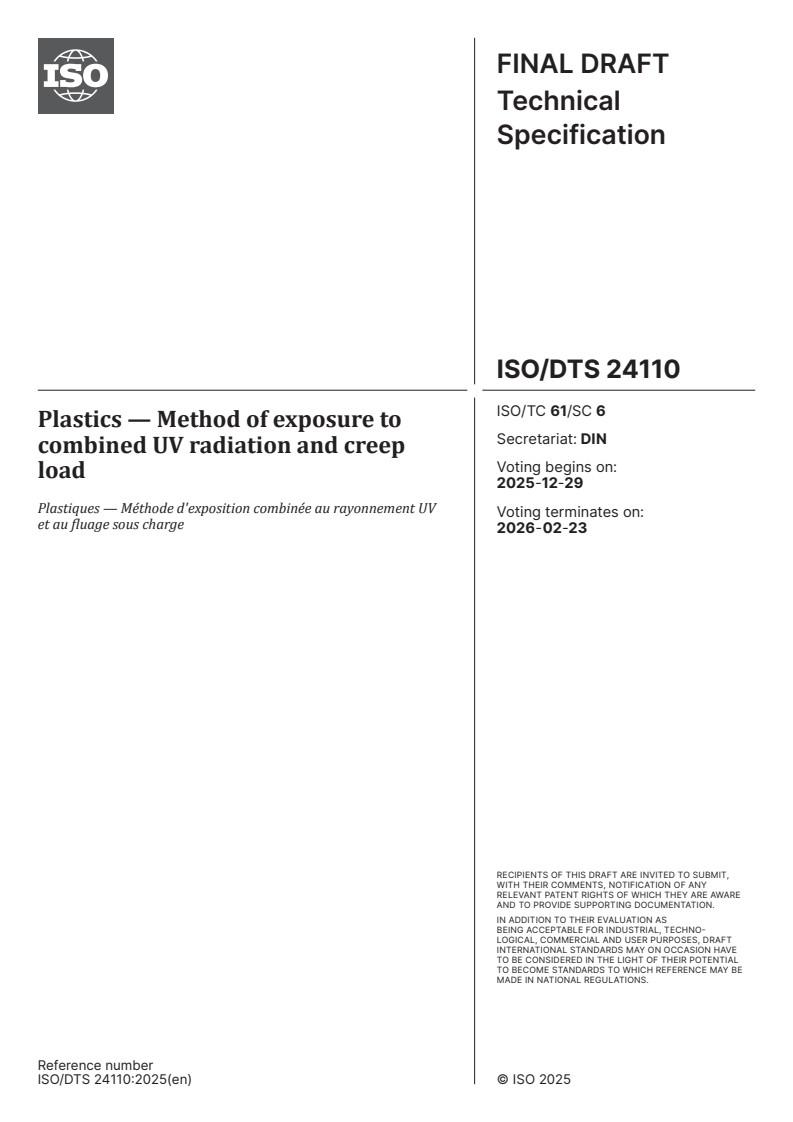
FINAL DRAFT
Technical
Specification
ISO/TC 61/SC 6
Plastics — Method of exposure to
Secretariat: DIN
combined UV radiation and creep
Voting begins on:
load
2025-12-29
Plastiques — Méthode d'exposition combinée au rayonnement UV
Voting terminates on:
et au fluage sous charge
2026-02-23
RECIPIENTS OF THIS DRAFT ARE INVITED TO SUBMIT,
WITH THEIR COMMENTS, NOTIFICATION OF ANY
RELEVANT PATENT RIGHTS OF WHICH THEY ARE AWARE
AND TO PROVIDE SUPPOR TING DOCUMENTATION.
IN ADDITION TO THEIR EVALUATION AS
BEING ACCEPTABLE FOR INDUSTRIAL, TECHNO
LOGICAL, COMMERCIAL AND USER PURPOSES, DRAFT
INTERNATIONAL STANDARDS MAY ON OCCASION HAVE
TO BE CONSIDERED IN THE LIGHT OF THEIR POTENTIAL
TO BECOME STAN DARDS TO WHICH REFERENCE MAY BE
MADE IN NATIONAL REGULATIONS.
Reference number
FINAL DRAFT
Technical
Specification
ISO/TC 61/SC 6
Plastics — Method of exposure to
Secretariat: DIN
combined UV radiation and creep
Voting begins on:
load
Plastiques — Méthode d'exposition combinée au rayonnement UV
Voting terminates on:
et au fluage sous charge
RECIPIENTS OF THIS DRAFT ARE INVITED TO SUBMIT,
WITH THEIR COMMENTS, NOTIFICATION OF ANY
RELEVANT PATENT RIGHTS OF WHICH THEY ARE AWARE
AND TO PROVIDE SUPPOR TING DOCUMENTATION.
© ISO 2025
IN ADDITION TO THEIR EVALUATION AS
All rights reserved. Unless otherwise specified, or required in the context of its implementation, no part of this publication may
BEING ACCEPTABLE FOR INDUSTRIAL, TECHNO
LOGICAL, COMMERCIAL AND USER PURPOSES, DRAFT
be reproduced or utilized otherwise in any form or by any means, electronic or mechanical, including photocopying, or posting on
INTERNATIONAL STANDARDS MAY ON OCCASION HAVE
the internet or an intranet, without prior written permission. Permission can be requested from either ISO at the address below
TO BE CONSIDERED IN THE LIGHT OF THEIR POTENTIAL
or ISO’s member body in the country of the requester.
TO BECOME STAN DARDS TO WHICH REFERENCE MAY BE
MADE IN NATIONAL REGULATIONS.
ISO copyright office
CP 401 • Ch. de Blandonnet 8
CH-1214 Vernier, Geneva
Phone: +41 22 749 01 11
Email: copyright@iso.org
Website: www.iso.org
Published in Switzerland Reference number
ii
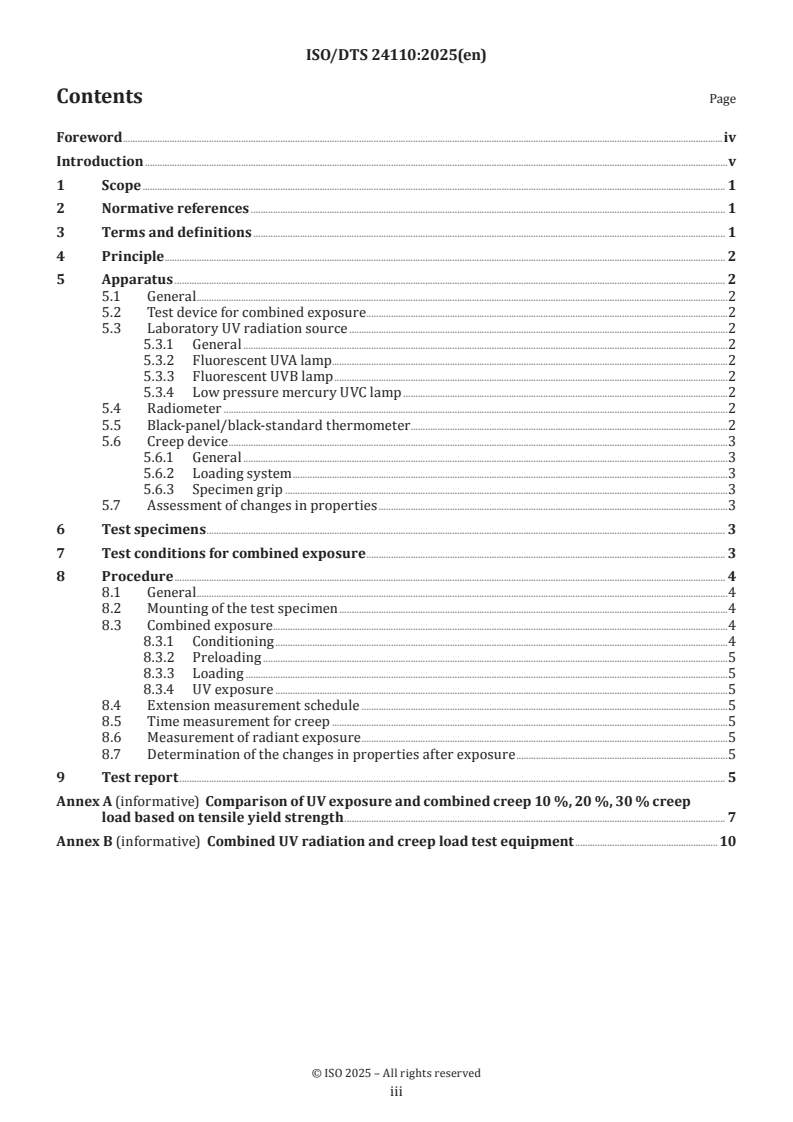
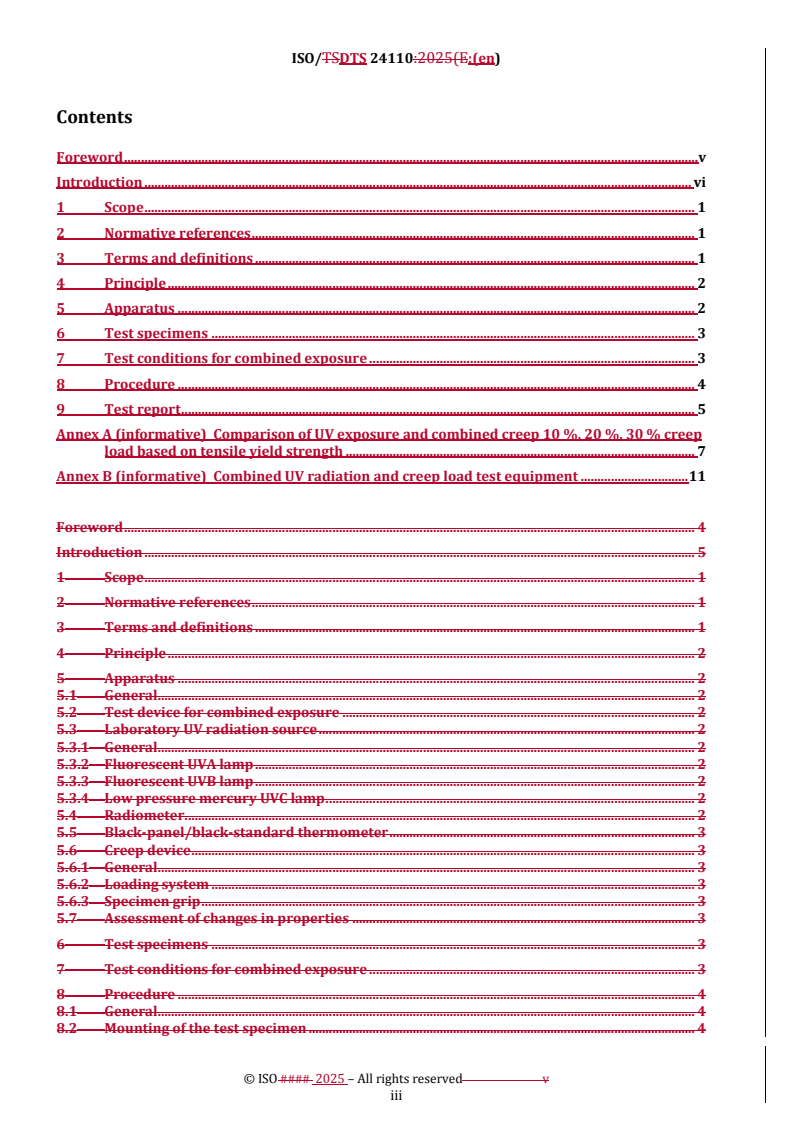
Contents Page
Foreword .iv
Introduction .v
1 Scope . 1
2 Normative references . 1
3 Terms and definitions . 1
4 Principle . 2
5 Apparatus . 2
5.1 General .2
5.2 Test device for combined exposure .2
5.3 Laboratory UV radiation source .2
5.3.1 General .2
5.3.2 Fluorescent UVA lamp.2
5.3.3 Fluorescent UVB lamp .2
5.3.4 Low pressure mercury UVC lamp .2
5.4 Radiometer .2
5.5 Black-panel/black-standard thermometer .2
5.6 Creep device .3
5.6.1 General .3
5.6.2 Loading system .3
5.6.3 Specimen grip .3
5.7 Assessment of changes in properties .3
6 Test specimens . 3
7 Test conditions for combined exposure . 3
8 Procedure . 4
8.1 General .4
8.2 Mounting of the test specimen .4
8.3 Combined exposure.4
8.3.1 Conditioning .4
8.3.2 Preloading .5
8.3.3 Loading .5
8.3.4 UV exposure .5
8.4 Extension measurement schedule .5
8.5 Time measurement for creep .5
8.6 Measurement of radiant exposure .5
8.7 Determination of the changes in properties after exposure .5
9 Test report . 5
Annex A (informative) Comparison of UV exposure and combined creep 10 %, 20 %, 30 % creep
load based on tensile yield strength . 7
Annex B (informative) Combined UV radiation and creep load test equipment .10
iii
Foreword
ISO (the International Organization for Standardization) is a worldwide federation of national standards
bodies (ISO member bodies). The work of preparing International Standards is normally carried out through
ISO technical committees. Each member body interested in a subject for which a technical committee
has been established has the right to be represented on that committee. International organizations,
governmental and non-governmental, in liaison with ISO, also take part in the work. ISO collaborates closely
with the International Electrotechnical Commission (IEC) on all matters of electrotechnical standardization.
The procedures used to develop this document and those intended for its further maintenance are described
in the ISO/IEC Directives, Part 1. In particular, the different approval criteria needed for the different types
of ISO documents should be noted. This document was drafted in accordance with the editorial rules of the
ISO/IEC Directives, Part 2 (see www.iso.org/directives).
ISO draws attention to the possibility that the implementation of this document may involve the use of (a)
patent(s). ISO takes no position concerning the evidence, validity or applicability of any claimed patent
rights in respect thereof. As of the date of publication of this document, ISO had not received notice of (a)
patent(s) which may be required to implement this document. However, implementers are cautioned that
this may not represent the latest information, which may be obtained from the patent database available at
www.iso.org/patents. ISO shall not be held responsible for identifying any or all such patent rights.
Any trade name used in this document is information given for the convenience of users and does not
constitute an endorsement.
For an explanation of the voluntary nature of standards, the meaning of ISO specific terms and expressions
related to conformity assessment, as well as information about ISO's adherence to the World Trade
Organization (WTO) principles in the Technical Barriers to Trade (TBT), see www.iso.org/iso/foreword.html.
This document was prepared by Technical Committee ISO/TC 61, Plastics, Subcommittee SC 6, Ageing,
chemical and environmental resistance.
Any feedback or questions on this document should be directed to the user’s national standards body. A
complete listing of these bodies can be found at www.iso.org/members.html.
iv
Introduction
Plastic components under UV irradiation can undergo accelerated degradation when they are exposed to
additional mechanical environmental or thermal stresses. Therefore, this document provides a test method
for simulated UV radiation effect superimposed by the mechanical load to evaluate the performance of the
material and components.
v
FINAL DRAFT Technical Specification ISO/DTS 24110:2025(en)
Plastics — Method of exposure to combined UV radiation and
creep load
1 Scope
This document describes a test method of exposing specimens to ar
...
ISO/ TC 61/SC 6/WG 3
Secretariat: DIN
Date: 2025-0912-15
Plastics — Method of exposure to combined UV radiation and creep
load
DTS stage
Warning for WDs and CDs
This document is not an ISO International Standard. It is distributed for review and comment. It is subject to change
without notice and may not be referred to as an International Standard.
Recipients of this draft are invited to submit, with their comments, notification of any relevant patent rights of which
they are aware and to provide supporting documentation.
Plastiques — Méthode d'exposition combinée au rayonnement UV et au fluage sous charge
© ISO #### – All rights reserved
ISO ####-All rights reservedISO/DTS 24110:(en)
All rights reserved. Unless otherwise specified, or required in the context of its implementation, no part of this publication
may be reproduced or utilized otherwise in any form or by any means, electronic or mechanical, including photocopying,
or posting on the internet or an intranet, without prior written permission. Permission can be requested from either ISO
at the address below or ISO’s member body in the country of the requester.
ISO copyright office
CP 401 • Ch. de Blandonnet 8
CH-1214 Vernier, Geneva
Phone: + 41 22 749 01 11
EmailE-mail: copyright@iso.org
Website: www.iso.orgwww.iso.org
Published in Switzerland
iV © ISO #### 2025 – All rights reserved
ii
ISO/TSDTS 24110:2025(E:(en)
Contents
Foreword . v
Introduction . vi
1 Scope . 1
2 Normative references . 1
3 Terms and definitions . 1
4 Principle . 2
5 Apparatus . 2
6 Test specimens . 3
7 Test conditions for combined exposure . 3
8 Procedure . 4
9 Test report . 5
Annex A (informative) Comparison of UV exposure and combined creep 10 %, 20 %, 30 % creep
load based on tensile yield strength . 7
Annex B (informative) Combined UV radiation and creep load test equipment . 11
Foreword . 4
Introduction . 5
1 Scope . 1
2 Normative references . 1
3 Terms and definitions . 1
4 Principle . 2
5 Apparatus . 2
5.1 General . 2
5.2 Test device for combined exposure . 2
5.3 Laboratory UV radiation source . 2
5.3.1 General . 2
5.3.2 Fluorescent UVA lamp . 2
5.3.3 Fluorescent UVB lamp . 2
5.3.4 Low pressure mercury UVC lamp . 2
5.4 Radiometer . 2
5.5 Black-panel/black-standard thermometer . 3
5.6 Creep device . 3
5.6.1 General . 3
5.6.2 Loading system . 3
5.6.3 Specimen grip . 3
5.7 Assessment of changes in properties . 3
6 Test specimens . 3
7 Test conditions for combined exposure . 3
8 Procedure . 4
8.1 General . 4
8.2 Mounting of the test specimen . 4
© ISO #### 2025 – All rights reserved v
iii
ISO ####-All rights reservedISO/DTS 24110:(en)
8.3 Combined exposure . 5
8.3.1 Conditioning . 5
8.3.2 Preloading . 5
8.3.3 Loading . 5
8.3.4 UV exposure . 5
8.4 Extension measurement schedule . 5
8.5 Time measurement for creep . 5
8.6 Measurement of radiant exposure . 5
8.7 Determination of the changes in properties after exposure . 5
9 Test report . 5
Annex A (informative) Comparison of UV exposure and combined creep 10 %, 20 %, 30 % creep
load based on tensile yield strength . 7
Annex B (informative) Combined UV radiation and creep load test equipment . 9
iV © ISO #### 2025 – All rights reserved
iv
ISO/TSDTS 24110:2025(E:(en)
Foreword
ISO (the International Organization for Standardization) is a worldwide federation of national standards
bodies (ISO member bodies). The work of preparing International Standards is normally carried out through
ISO technical committees. Each member body interested in a subject for which a technical committee has been
established has the right to be represented on that committee. International organizations, governmental and
non-governmental, in liaison with ISO, also take part in the work. ISO collaborates closely with the
International Electrotechnical Commission (IEC) on all matters of electrotechnical standardization.
The procedures used to develop this document and those intended for its further maintenance are described
in the ISO/IEC Directives, Part 1. In particular, the different approval criteria needed for the different types of
ISO documents should be noted. This document was drafted in accordance with the editorial rules of the
ISO/IEC Directives, Part 2 (see www.iso.org/directiveswww.iso.org/directives).
ISO draws attention to the possibility that the implementation of this document may involve the use of (a)
patent(s). ISO takes no position concerning the evidence, validity or applicability of any claimed patent rights
in respect thereof. As of the date of publication of this document, ISO had not received notice of (a) patent(s)
which may be required to implement this document. However, implementers are cautioned that this may not
represent the latest information, which may be obtained from the patent database available at
www.iso.org/patents. ISO shall not be held responsible for identifying any or all such patent rights.
Any trade name used in this document is information given for the convenience of users and does not
constitute an endorsement.
For an explanation of the voluntary nature of standards, the meaning of ISO specific terms and expressions
related to conformity assessment, as well as information about ISO's adherence to the World Trade
Organization (WTO) principles in the Technical Barriers to Trade (TBT), see
www.iso.org/iso/foreword.htmlwww.iso.org/iso/foreword.html.
This document was prepared by Technical Committee ISO/TC 61, Plastics, Subcommittee SC 6, Ageing,
chemical and environmental resistance.
Any feedback or questions on this document should be directed to the user’s national standards body. A
complete listing of these bodies can be found at www.iso.org/members.htmlwww.iso.org/members.html.
© ISO #### 2025 – All rights reserved v
v
ISO ####-All rights reservedISO/DTS 24110:(en)
Introduction
Plastic components under UV irradiation can undergo accelerated degradation when they are exposed to
additional mechanical environmental or thermal stresses. Therefore, this document provides a test method
for simulated UV radiation effect superimposed by the mechanical load to evaluate the performance of the
material and components.
iV © ISO #### 2025 – All rights reserved
vi
Plastics — Method of exposure to combined UV radiation and creep
load
1 Scope
This document describes a test method of exposing specimens to artificial UV radiation in combination with a
creep load. This method uses UV radiation source and ISO 899-1 for the tensile creep test. Fluorescent UV
lamps specified in ISO 4892-3 or UVC lamp can be used as UV radiation sources.
NOTE UVC exposure is described in IEC 60335-1.
2 Normative references
The following documents are referred to in the text in such awa way that some or all of their content
constitutes requirements of this document. For dated references, only the edition cited applies. For undated
references, the latest edition of the referenced document (including any amendments) applies.
ISO 527-1, Plastics — Determination of tensile properties — Part 1: General principles
ISO 527-2, Plastics — Determination of tensile properties — Part 2: Test cond
...
Questions, Comments and Discussion
Ask us and Technical Secretary will try to provide an answer. You can facilitate discussion about the standard in here.
Loading comments...