

ISO/TR 12470-2:2017
(Main)Fire-resistance tests — Guidance on the application and extension of results from tests conducted on fire containment assemblies and products — Part 2: Non-loadbearing elements
General Information
- Abstract
ISO/TR 12470-2:2017 explains a methodology to determine the applicability of the results of fire resistance tests to actual applications. ISO/TR 12470-2:2017 is applicable to those non-loadbearing elements for which there is an ISO standard test procedure based upon the ISO 834 series for determining the fire resistance of a representative sample of the construction proposed for use in a specific building or just for general use. These elements are: - fire resisting door assemblies (excluding lift landing doorsets): - timber; - steel; - fire resisting vertical glazing ? metal framed: NOTE The rheology of glass is such that gravity has a disproportional influence on fire glass when it is heated to high temperatures and as a consequence, it is not possible to provide generic guidance on the extended application of horizontal glazed elements. - timber framed; - linear gap sealing; - service penetration sealing. Fire resistance testing furnaces have fairly restricted size limitations and as a consequence, there is little confidence that the result obtained on an element of construction tested in accordance with the standard methods will behave in a similar manner when installed in the final building. Direct and extended applications of test results are the two possible ways to ensure that an element that is not identical to the tested construction will have an acceptable probability of obtaining the same fire rating as that of the original tested specimen. In both cases, these applications generally refer only to the fire rating that the building element can expect to reach if it, or a representative sample of it, were to be tested in a furnace according to the standard fire test conditions used in the reference test. The criteria and methodology used in evaluating ductwork and dampers is significantly different from those used to evaluate conventional separating elements and for this reason, these forms of construction are not included in the scope of this document. It is planned that a subsequent part of this document may include guidance on these elements.
- Status
- Published
- Publication Date
- 22-Nov-2017
- Technical Committee
- ISO/TC 92/SC 2 - Fire containment
- Drafting Committee
- ISO/TC 92/SC 2/WG 2 - Calculation methods
- Current Stage
- 6060 - International Standard published
- Start Date
- 23-Nov-2017
- Completion Date
- 29-Aug-2026
Buy Documents



ISO/TR 12470-2:2017 - Fire-resistance tests -- Guidance on the application and extension of results from tests conducted on fire containment assemblies and products

ISO/TR 12470-2:2017 - Fire-resistance tests — Guidance on the application and extension of results from tests conducted on fire containment assemblies and products — Part 2: Non-loadbearing elements/23/2017
Overview
ISO/TR 12470-2:2017 is a technical report from the International Organization for Standardization (ISO) that provides guidance on interpreting and applying results from fire-resistance tests of non-loadbearing building elements. The standard is particularly focused on offering a methodology for determining how results from controlled fire resistance tests based on the ISO 834 series can be reliably extended to real-world applications. This ensures that non-loadbearing fire containment assemblies and products-such as fire-resisting doors, fixed vertical glazing, linear gap sealing systems, and service penetration sealing systems-can meet safety expectations when installed in buildings, even if their construction differs slightly from test specimens.
The report recognizes the challenges created by the limited size of fire resistance testing furnaces, which may not always represent in-situ building conditions. As a result, both direct application (making straightforward modifications) and extended application (using calculations and expert judgements) are examined as legitimate ways to adapt test results to a wider range of installations and configurations.
Key Topics
Scope of Applicability
- Non-loadbearing fire-resistant elements only
- Includes fire doors (timber and steel), vertical glazing (metal and timber-framed), gap sealing, and service penetration sealing
- Excludes ductwork and dampers, which are evaluated with different criteria
Direct Application of Test Results
- Modifications permitted without further testing are defined as "direct applications"
- Rules for direct application are generally set out within the relevant test standards
Extended Application
- Uses validated calculations, computer models, or expert assessments to extrapolate results
- Designed for adaptations of tested constructions outside the scope of direct application
- Relies on expert knowledge and may depend on additional factors and parameters
Project Specific Application
- Incorporates unique building-specific conditions and engineering judgement
- May use a combination of analysis techniques for custom scenarios
Influencing Factors
- Material choices, manufacturing methods, and design variables can significantly affect fire resistance performance
- The document details how to evaluate such influences ensuring reliable safety classification
Applications
ISO/TR 12470-2:2017 serves as an essential tool for fire safety engineers, architects, test laboratories, manufacturers, and regulators in the following practical scenarios:
Building Design Compliance
Ensures that non-loadbearing fire containment products used in buildings meet the required fire resistance ratings, even when there are variations from the tested samples.Product Certification & CE Marking
Supports manufacturers during certification procedures by clearly outlining under what conditions tested results can be extended to similar products.Modification of Standard Designs
Provides a standardized approach for adapting fire-resistant assemblies to fit bespoke building requirements without compromising safety.Regulatory Guidance
Assists authorities in interpreting test results when reviewing submissions for building code compliance, especially when direct test data isn't available for every specific configuration.
Related Standards
ISO/TR 12470-2:2017 is best understood and applied in conjunction with the following standards:
ISO 834 Series - Fire-resistance tests - Elements of building construction
- The primary reference for standard fire resistance testing methodology.
ISO/TR 10295 - Fire testing of service installations
- Relevant for evaluating fire resistance concerning service penetrations.
ISO 13943 - Fire Safety Vocabulary
- Provides definitions of fire safety terminology used throughout the standard.
Professionals using ISO/TR 12470-2:2017 help ensure consistent fire safety performance of critical non-loadbearing building elements, enhancing both regulatory compliance and building occupant protection. This standard is a vital resource for interpreting fire-resistance test results and their application in construction, enabling safer, more reliable built environments.
Relations
- Consolidated By
ISO 13017:2020 - Dentistry — Magnetic attachments - Effective Date
- 06-Jun-2022
- Revised
ISO/TR 12470:1998 - Fire-resistance tests — Guidance on the application and extension of results - Effective Date
- 07-Dec-2013
Buy Documents
ISO/TR 12470-2:2017 - Fire-resistance tests -- Guidance on the application and extension of results from tests conducted on fire containment assemblies and products
ISO/TR 12470-2:2017 - Fire-resistance tests — Guidance on the application and extension of results from tests conducted on fire containment assemblies and products — Part 2: Non-loadbearing elements/23/2017
Get Certified
Connect with accredited certification bodies for this standard

CIS Institut d.o.o.
Personal Protective Equipment (PPE) certification body. Notified Body NB-2890 for EU Regulation 2016/425 PPE.

Kiwa BDA Testing
Building and construction product certification.
Kmetijski inštitut Slovenije
Agricultural Institute of Slovenia. Soil testing, plant health, agricultural product analysis.
Sponsored listings
Frequently Asked Questions
ISO/TR 12470-2:2017 is a technical report published by the International Organization for Standardization (ISO). Its full title is "Fire-resistance tests — Guidance on the application and extension of results from tests conducted on fire containment assemblies and products — Part 2: Non-loadbearing elements". This standard covers: ISO/TR 12470-2:2017 explains a methodology to determine the applicability of the results of fire resistance tests to actual applications. ISO/TR 12470-2:2017 is applicable to those non-loadbearing elements for which there is an ISO standard test procedure based upon the ISO 834 series for determining the fire resistance of a representative sample of the construction proposed for use in a specific building or just for general use. These elements are: - fire resisting door assemblies (excluding lift landing doorsets): - timber; - steel; - fire resisting vertical glazing ? metal framed: NOTE The rheology of glass is such that gravity has a disproportional influence on fire glass when it is heated to high temperatures and as a consequence, it is not possible to provide generic guidance on the extended application of horizontal glazed elements. - timber framed; - linear gap sealing; - service penetration sealing. Fire resistance testing furnaces have fairly restricted size limitations and as a consequence, there is little confidence that the result obtained on an element of construction tested in accordance with the standard methods will behave in a similar manner when installed in the final building. Direct and extended applications of test results are the two possible ways to ensure that an element that is not identical to the tested construction will have an acceptable probability of obtaining the same fire rating as that of the original tested specimen. In both cases, these applications generally refer only to the fire rating that the building element can expect to reach if it, or a representative sample of it, were to be tested in a furnace according to the standard fire test conditions used in the reference test. The criteria and methodology used in evaluating ductwork and dampers is significantly different from those used to evaluate conventional separating elements and for this reason, these forms of construction are not included in the scope of this document. It is planned that a subsequent part of this document may include guidance on these elements.
ISO/TR 12470-2:2017 explains a methodology to determine the applicability of the results of fire resistance tests to actual applications. ISO/TR 12470-2:2017 is applicable to those non-loadbearing elements for which there is an ISO standard test procedure based upon the ISO 834 series for determining the fire resistance of a representative sample of the construction proposed for use in a specific building or just for general use. These elements are: - fire resisting door assemblies (excluding lift landing doorsets): - timber; - steel; - fire resisting vertical glazing ? metal framed: NOTE The rheology of glass is such that gravity has a disproportional influence on fire glass when it is heated to high temperatures and as a consequence, it is not possible to provide generic guidance on the extended application of horizontal glazed elements. - timber framed; - linear gap sealing; - service penetration sealing. Fire resistance testing furnaces have fairly restricted size limitations and as a consequence, there is little confidence that the result obtained on an element of construction tested in accordance with the standard methods will behave in a similar manner when installed in the final building. Direct and extended applications of test results are the two possible ways to ensure that an element that is not identical to the tested construction will have an acceptable probability of obtaining the same fire rating as that of the original tested specimen. In both cases, these applications generally refer only to the fire rating that the building element can expect to reach if it, or a representative sample of it, were to be tested in a furnace according to the standard fire test conditions used in the reference test. The criteria and methodology used in evaluating ductwork and dampers is significantly different from those used to evaluate conventional separating elements and for this reason, these forms of construction are not included in the scope of this document. It is planned that a subsequent part of this document may include guidance on these elements.
ISO/TR 12470-2:2017 is classified under the following ICS (International Classification for Standards) categories: 13.220.40 - Ignitability and burning behaviour of materials and products; 13.220.50 - Fire-resistance of building materials and elements. The ICS classification helps identify the subject area and facilitates finding related standards.
ISO/TR 12470-2:2017 has the following relationships with other standards: It is inter standard links to ISO 13017:2020, ISO/TR 12470:1998. Understanding these relationships helps ensure you are using the most current and applicable version of the standard.
ISO/TR 12470-2:2017 is available in PDF format for immediate download after purchase. The document can be added to your cart and obtained through the secure checkout process. Digital delivery ensures instant access to the complete standard document.
Standards Content (Sample)
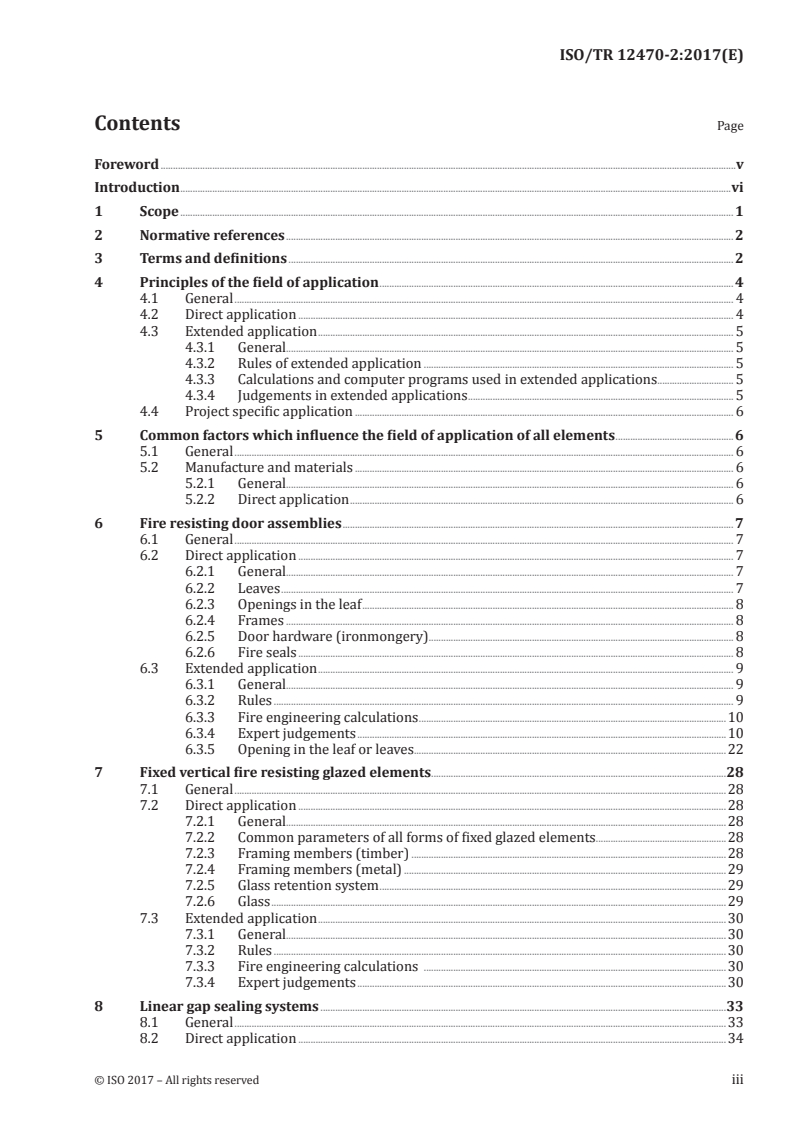
TECHNICAL ISO/TR
REPORT 12470-2
First edition
2017-11
Fire-resistance tests — Guidance
on the application and extension
of results from tests conducted on
fire containment assemblies and
products —
Part 2:
Non-loadbearing elements
Essais de résistance au feu — Recommandations pour l'application
et l'extrapolation des résultats d'essais réalisés sur les produits et
assemblages d'endiguement du feu —
Partie 2: Éléments non porteurs
Reference number
©
ISO 2017
© ISO 2017, Published in Switzerland
All rights reserved. Unless otherwise specified, no part of this publication may be reproduced or utilized otherwise in any form
or by any means, electronic or mechanical, including photocopying, or posting on the internet or an intranet, without prior
written permission. Permission can be requested from either ISO at the address below or ISO’s member body in the country of
the requester.
ISO copyright office
Ch. de Blandonnet 8 • CP 401
CH-1214 Vernier, Geneva, Switzerland
Tel. +41 22 749 01 11
Fax +41 22 749 09 47
copyright@iso.org
www.iso.org
ii © ISO 2017 – All rights reserved
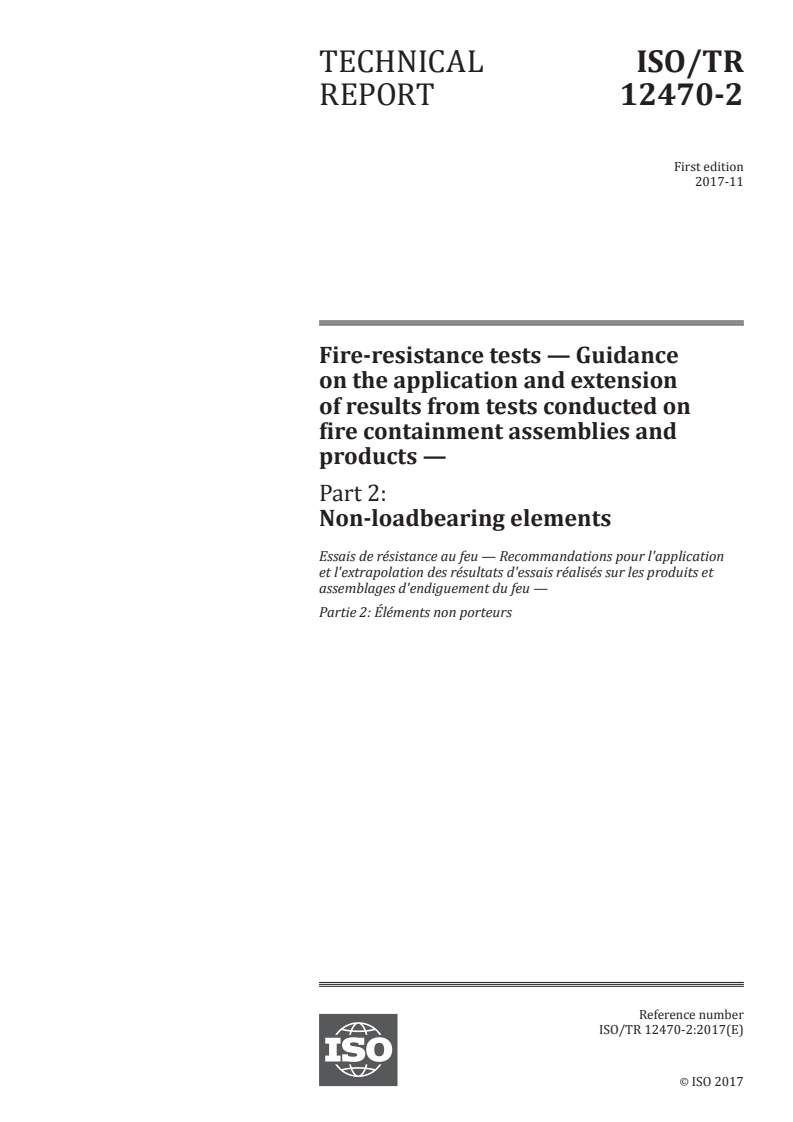
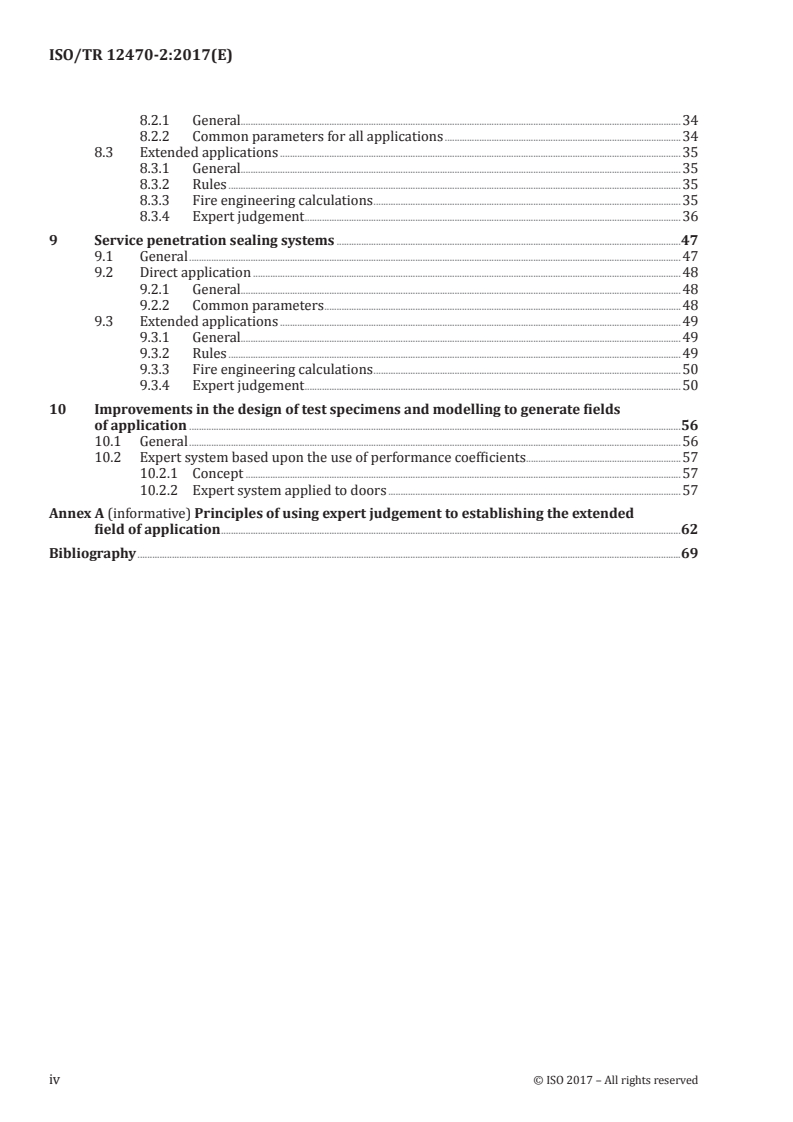
Contents Page
Foreword .v
Introduction .vi
1 Scope . 1
2 Normative references . 2
3 Terms and definitions . 2
4 Principles of the field of application . 4
4.1 General . 4
4.2 Direct application . 4
4.3 Extended application . 5
4.3.1 General. 5
4.3.2 Rules of extended application . 5
4.3.3 Calculations and computer programs used in extended applications . 5
4.3.4 Judgements in extended applications . 5
4.4 Project specific application . 6
5 Common factors which influence the field of application of all elements .6
5.1 General . 6
5.2 Manufacture and materials . 6
5.2.1 General. 6
5.2.2 Direct application . 6
6 Fire resisting door assemblies . 7
6.1 General . 7
6.2 Direct application . 7
6.2.1 General. 7
6.2.2 Leaves . 7
6.2.3 Openings in the leaf . 8
6.2.4 Frames . 8
6.2.5 Door hardware (ironmongery). 8
6.2.6 Fire seals . 8
6.3 Extended application . 9
6.3.1 General. 9
6.3.2 Rules . 9
6.3.3 Fire engineering calculations .10
6.3.4 Expert judgements .10
6.3.5 Opening in the leaf or leaves.22
7 Fixed vertical fire resisting glazed elements .28
7.1 General .28
7.2 Direct application .28
7.2.1 General.28
7.2.2 Common parameters of all forms of fixed glazed elements .28
7.2.3 Framing members (timber) .28
7.2.4 Framing members (metal) .29
7.2.5 Glass retention system .29
7.2.6 Glass .29
7.3 Extended application .30
7.3.1 General.30
7.3.2 Rules .30
7.3.3 Fire engineering calculations .30
7.3.4 Expert judgements .30
8 Linear gap sealing systems .33
8.1 General .33
8.2 Direct application .34
8.2.1 General.34
8.2.2 Common parameters for all applications .34
8.3 Extended applications .35
8.3.1 General.35
8.3.2 Rules .35
8.3.3 Fire engineering calculations .35
8.3.4 Expert judgement .36
9 Service penetration sealing systems .47
9.1 General .47
9.2 Direct application .48
9.2.1 General.48
9.2.2 Common parameters .48
9.3 Extended applications .49
9.3.1 General.49
9.3.2 Rules .49
9.3.3 Fire engineering calculations .50
9.3.4 Expert judgement .50
10 Improvements in the design of test specimens and modelling to generate fields
of application .56
10.1 General .56
10.2 Expert system based upon the use of performance coefficients.57
10.2.1 Concept .57
10.2.2 Expert system applied to doors .57
Annex A (informative) Principles of using expert judgement to establishing the extended
field of application .62
Bibliography .69
iv © ISO 2017 – All rights reserved
Foreword
ISO (the International Organization for Standardization) is a worldwide federation of national standards
bodies (ISO member bodies). The work of preparing International Standards is normally carried out
through ISO technical committees. Each member body interested in a subject for which a technical
committee has been established has the right to be represented on that committee. International
organizations, governmental and non-governmental, in liaison with ISO, also take part in the work.
ISO collaborates closely with the International Electrotechnical Commission (IEC) on all matters of
electrotechnical standardization.
The procedures used to develop this document and those intended for its further maintenance are
described in the ISO/IEC Directives, Part 1. In particular the different approval criteria needed for the
different types of ISO documents should be noted. This document was drafted in accordance with the
editorial rules of the ISO/IEC Directives, Part 2 (see www.iso.org/directives).
Attention is drawn to the possibility that some of the elements of this document may be the subject of
patent rights. ISO shall not be held responsible for identifying any or all such patent rights. Details of
any patent rights identified during the development of the document will be in the Introduction and/or
on the ISO list of patent declarations received (see www.iso.org/patents).
Any trade name used in this document is information given for the convenience of users and does not
constitute an endorsement.
For an explanation on the voluntary nature of standards, the meaning of ISO specific terms and
expressions related to conformity assessment, as well as information about ISO's adherence to the
World Trade Organization (WTO) principles in the Technical Barriers to Trade (TBT) see the following
URL: www.iso.org/iso/foreword.html.
This document was prepared by Technical Committee ISO/TC 92, Fire safety, Subcommittee SC 2, Fire
containment.
A list of all parts in the ISO/TR 12470 series can be found on the ISO website.
Introduction
Fire resistance tests on building components are necessary to establish their behaviour against pre-
determined criteria when exposed to a representative fully developed fire and to provide information
that may be used in determining the fire safety of buildings. For several decades, people have accepted,
by means of test results only, the possibility of grading the components. Now, due to the enhancement
of our knowledge and the complexity of buildings, it is necessary to be able to give a more accurate
assessment of the components used in buildings, particularly with the growth of the use of functional
approaches to designing fire safe structures.
The need to understand how the element will perform at a different size, with different levels of
restraint, etc., is vital when applying the results of the fire tests in a life safety situation, especially
those where the fire safe solution has been generated using fire safety engineering techniques rather
than code compliant solutions. This does not negate the need to predict any changes that may result
from changes to the test construction when complying with building code solutions, but these codes
may themselves provide solutions that take into account the influence or impact of changes, and indeed,
the guidance given in this document may be used by the code writers to produce such guidance.
Even with the knowledge available to assess the behaviour of a given constructional element, whatever
its design or its size, we will still be some distance away from establishing the complete behaviour of a
building in a real fire.
The philosophy of only grading elements into different fire resistance categories may not give any
indication about how the element actually behaves when heated. By studying and assessing the data
from fire resistance tests, it will be possible, using the guidance within this document, to obtain a
basic understanding of the influence of the main parameters on the element performance during fire
resistance tests.
In practice, tests give much useful information which can be used for interpolation and extrapolation of
the results.
The original version of ISO/TR 12470 was published by ISO/TC 92 in 1998. This Technical Report
provided a methodology in identifying how the results of fire resistance tests carried out in the
standard furnaces could be modified to apply to the elements as they may be used in practice. In some
cases, the results of the test may need to be reduced to reflect any increases in the degree of difficulty
that the final application represents, or alternatively, modifications/enhancements may need to be
made to the construction in order to maintain the performance level(s).
In the intervening years since the original Technical Report was prepared, a greater understanding has
developed as to what the changes are likely to be and how they may be quantified. Some of the work in
CEN (Committee European Normalisation) has aided this process and in particular, the principles given
in Annex A remained unpublished by CEN but were developed in one of the technical Work Groups
of CEN/TC 127. This revision represents the current state-of-art with respect to the objectives of the
original 1998 version of ISO/TR 12470.
In this document, all the assessments of extended application are based, on the one hand, on the
standard time/temperature conditions and, on the other hand, on isolated elements with no interaction
with the adjacent elements.
Ageing and weathering are not covered here.
This document is divided into two parts.
The first part provides the methodology for defining the field of application for loadbearing members,
both separating and non-separating. It also includes a review of the state-of-the-art and possible
improvement in the methods of testing which would make it easier to establish the field of application
for an element.
vi © ISO 2017 – All rights reserved
Guidance on direct and extended application of test results for specific non-loadbearing elements used
in buildings, and the major parameters, which would be assessed by calculation or by expert judgements
based upon the principles and discipline given in Annex A, are discussed
This document suggests expert systems which could take into account the interaction of various factors
in an assessment of the fire resistance of doors, glazing, services, service penetrations and linear gap seals
TECHNICAL REPORT ISO/TR 12470-2:2017(E)
Fire-resistance tests — Guidance on the application
and extension of results from tests conducted on fire
containment assemblies and products —
Part 2:
Non-loadbearing elements
1 Scope
This document explains a methodology to determine the applicability of the results of fire resistance
tests to actual applications.
It is applicable to those non-loadbearing elements for which there is an ISO standard test procedure
based upon the ISO 834 series for determining the fire resistance of a representative sample of the
construction proposed for use in a specific building or just for general use. These elements are:
— fire resisting door assemblies (excluding lift landing doorsets):
— timber;
— steel;
— fire resisting vertical glazing – metal framed:
NOTE The rheology of glass is such that gravity has a disproportional influence on fire glass when it
is heated to high temperatures and as a consequence, it is not possible to provide generic guidance on the
extended application of horizontal glazed elements.
— timber framed;
— linear gap sealing;
— service penetration sealing.
Fire resistance testing furnaces have fairly restricted size limitations and as a consequence, there is
little confidence that the result obtained on an element of construction tested in accordance with the
standard methods will behave in a similar manner when installed in the final building.
Direct and extended applications of test results are the two possible ways to ensure that an element
that is not identical to the tested construction will have an acceptable probability of obtaining the same
fire rating as that of the original tested specimen. In both cases, these applications generally refer only
to the fire rating that the building element can expect to reach if it, or a representative sample of it,
were to be tested in a furnace according to the standard fire test conditions used in the reference test.
The criteria and methodology used in evaluating ductwork and dampers is significantly different
from those used to evaluate conventional separating elements and for this reason, these forms of
construction are not included in the scope of this document. It is planned that a subsequent part of this
document may include guidance on these elements.
2 Normative references
The following documents are referred to in the text in such a way that some or all of their content
constitutes requirements of this document. For dated references, only the edition cited applies. For
undated references, the latest edition of the referenced document (including any amendments) applies.
ISO 834 (all parts), Fire-resistance tests — Elements of building construction
ISO/TR 10295 (all parts), Fire tests for building elements and components — Fire testing of service
installations
ISO 13943, Fire safety — Vocabulary
3 Terms and definitions
For the purposes of this document, the terms and definitions given in ISO 834 (all parts),
ISO/TR 10295 (all parts) and ISO 13943 and the following apply.
ISO and IEC maintain terminological databases for use in standardization at the following addresses:
— IEC Electropedia: available at https://www.electropedia.org/
— ISO Online browsing platform: available at https://www.iso.org/obp
3.1
direct application
application that identifies the modifications that can be made to the design of the tested element
without reducing its fire rating
Note 1 to entry: These possible modifications are based on obvious knowledge and do not need further evaluation.
In every case it is, at least, assumed that the basic material(s) used for the construction of the tested sample will
not be changed.
Note 2 to entry: Direct application defines the variation(s) in the construction and the limits of use for the
element which, without further analysis, are covered by the result of a test in accordance with ISO 834 (all parts).
Direct application is arrived at by the application of simple rules (3.4) that are known, or considered by the fire
community, to give equal fire resistance performance by the users. The rules can be applied by non- fire experts.
Note 3 to entry: Only results from one test report can be used when considering a change of an element. Any
combination and use of two or more tests reports or other technical sources should be regarded as extended
application (3.2) and hence dealt with accordingly.
3.2
extended application
application that is arrived at by the application of calculation or assessment rules (3.4) that are known,
or considered by the fire community, to give equal or improved fire resistance performance by the users
Note 1 to entry: The rules are applied by fire experts.
Note 2 to entry: This will generally require an assessment by a fire expert either in developing rules of application
for more general application by others or evaluating the results of fire engineering calculations or for making
a judgement in specific cases. In every case, it will be taken into consideration that extended application may
take into account the difference between the result of the original test and the fire resistance required for the
untested element.
2 © ISO 2017 – All rights reserved
Note 3 to entry: Extended application defines and specifies the variations in the construction and establishes
the limits of use for an element that has been tested according to the appropriate EN standard based upon an
analysis by fire experts. The extended application can use the results from one or more test reports and can be
based upon rules, calculations and expert judgement. As a result of the extended application, the fire resistance
classification of an element with respect to defined performance characteristics may be maintained, increased
or decreased when used in practice.
3.3
project specific application
application that uses a mixture of established validated calculations/computer models (if they exist and
are appropriate) together with judgements made by suitably qualified persons (normally a professional
badged engineer or a corporate member of a learned professional body)
Note 1 to entry: Because the application will, in these circumstances, require an understanding of both the
structural response and the fire dynamics of the building in question, it is inevitable that the solution will involve
an element of fire safety engineering.
3.4
rule
quantitative factor (3.9) that can be applied to the result of tests when defining the limits of application
for which justification exists as a result of research and testing
Note 1 to entry: Rules are primarily used in determining the direct application (3.1) of the result as their
application do not generally require specialist knowledge.
Note 2 to entry: It is anticipated that these rules be established by the specialist (or ad-hoc) groups preparing
the specific standards based upon public domain knowledge and developed by industry consortia or trade
associations for specific elements for which the members have appropriate interest and knowledge, particularly
in Europe initially. After some experience, the results of calculations and judgements may become rules.
3.5
calculation in support of extended application
calculation method that can be applied to one or more parameters of a tested construction and which
are based on existing physical laws or which have been empirically validated and which form part of
the process of defining the extended application (3.2)
Note 1 to entry: If this term has a definition elsewhere, then it should be used but possibly modified to include
this specific use.
3.6
expert judgement
qualitative process performed by fire experts when the complexity of the influence is beyond the
scope of rules (3.4), to establish the resultant effect of a variation in one or more parameters, on the
classification awarded
3.7
construction parameter
aspect of the design and construction of an element that may be varied and which may result in a
change in the fire resistance performance, e.g. a change in one or more of the dimensions of a stud in a
stud-framed separating elements
3.8
thermal and mechanical parameter
aspect of the conditions of a test that may vary in practice and influence the classification system given,
e.g. the pressure differential that will exist at the top of a larger element than existed at the top of the
specimen when tested
3.9
factor
one of the possible variations that may be applied to a parameter, e.g. a change in the stiffness as a
result of a dimensional change in the member or a component within the element
3.10
factor influence
one of the potential causes of a change in the fire resistance recorded by test, with respect to one or
more of the criteria, when a factor (3.9) is changed, e.g. an increase in the loadbearing capacity, R, as a
result of an increase in stiffness
4 Principles of the field of application
4.1 General
The field of application from the result of a fire resistance test has at least 3 possible components: a)
direct application, b) extended application and c) project specific application.
The process of determining the Direct Application and Extended Application of the fire resistance
rating of a tested construction normally assumes that the performance is evaluated against the
temperature/time and differential pressure conditions given in the appropriate ISO fire resistance
testing standard [based upon ISO 834 (all parts) or the national, regional equivalent], as this is generally
what is referenced in national prescriptive legislation. The variations between the tested specimen and
the “as-built” construction will therefore be restricted to
— variations in the size of the construction,
— variations in the materials and methods of construction,
— variations in the restraint and fixity, and
— variations in the load carried (if any).
In this situation, only the constructional parameters given in A.2.2 need to be taken into account.
In practice there will be a need to predict the performance of a structure when it is exposed to different
fire exposure conditions, in terms of the temperatures reached after certain durations and with
greater, or lesser pressure differentials. Generally, the parameters will be analysed by means of a fire
engineering analysis which is outside of the scope of this document, but the parameters listed in A.2.1
may be appropriate for use in an expert judgement analysis of these characteristics.
For each type of element of construction, the application of test results will be considered under three
conditions: a) direct application, b) extended application and c) project specific fields of application.
Changes in materials and methods of construction can have significant influences on the fire resistance.
Because the advice and recommendations are common to all elements, those aspects are dealt with
separately under 5.1 to avoid repetition. The user of this document should consider these aspects
in all applications of results whether direct applications, extended applications, or project specific
applications.
4.2 Direct application
The direct application will normally involve the application of “rules” that are given as part of the test
standard or in a document directly associated with the test standard. It requires no knowledge of the
process of determining the fire resistance other than an understanding of the criteria and the general
terminology.
Where there is more than one change in any proposed construction/installation, two “direct
application” rules should not be applied automatically and the two should be compared as part of an
extended application.
4 © ISO 2017 – All rights reserved
4.3 Extended application
4.3.1 General
Determining the extended application of the fire resistance is a more complex matter and will generally
need to be undertaken by “experts” who understand the mode of failure and the factors that lead to such
a failure. There are three common methods used by practitioners to establish the extended application
of the fire resistance of elements of construction and these are
— application of locally validated rules, especially within Europe,
— use of established validated calculations/computer models, where they exist, and
— use of technical judgement by suitably qualified persons.
NOTE In Europe, as part of the application of products within the context of the Construction Products
Regulations (CPR), the extended application is determined by means of Extended Application (EXAP) standards,
for use in the process of classification of products to enable CE marking. These EXAP standards cannot be used in
the context of generating a fire safe environment without further analysis.
4.3.2 Rules of extended application
These would be applied universally even by persons without expertise in fire as part of the direct
field of application of the test result for a given family or products. These rules may require cold
state calculation. The quantification of these rules would be agreed universally based upon validated
experience related to generic constructions or components. This could cover size changes, number of
joints, size of glazing, etc.
Throughout this document, the clauses covering rules frequently express the acceptable change in
terms of unquantified percentages indicated by the letter “X” and an appropriate suffix.
This allows national regulatory authorities to insert their own acceptable limits which will relate to
their established fire safety philosophy.
Authorities are encouraged to support the necessary research towards internationally harmonized
validated values.
4.3.3 Calculations and computer programs used in extended applications
These would be used by an expert in determining the field of application but will mainly be restricted
to the properties indicated below:
— non-loaded elements: this would be restricted to the calculation of temperature rise and deflection
of "simple" components and elements.
In every case, the calculations and/or models used by the experts, whatever their source (purchased
from software manufacturers or developed by the assessing body), have to be fully validated by
comparison with existing test results and by sensitivity analysis of the various parameters.
4.3.4 Judgements in extended applications
For a test result to be extrapolated to cover changes outside those for which calculations or written
rules are applicable, the result may still apply subject to some expert judgement being made. The
section on judgements highlights the matters that need to be considered and to be justified by the body
or person(s) responsible for making such judgments. Generally, components of a construction element
could be changed, provided it can be shown that this does not reduce the fire resistance. It should be
demonstrated that the interaction of a new component with other components will not adversely affect
the performance of the tested construction. When resistance time is higher than the required time, it
will generally be possible to have a greater change than with only the necessary safety level.
In order to bring greater consistency to the judgemental process, it is recommended that this process
follows the methodology given in Annex A.
4.4 Project specific application
This document has described the manner by which variations in the construction of an element which
has been designed to provide fire resistance can be accepted, or rejected, which utilizes the main
parameters of the materials and components incorporated in the proving test. However, it may be
possible in certain application to provide more generous extensions to the field of application because
it has been possible to utilize certain factors relating to the "in-use" application, e.g. significantly
enhanced restraint or an uneven distribution of the applied load. In such cases, the derived direct or
extended field of application is only valid for the specific project from which these inputs have been
derived. Because of the bespoke nature of the inputs, the field of extended application only applies to
the use of the element in question within the application for which it was designed. As a consequence,
the field of application (FoA) is known as project specific.
5 Common factors which influence the field of application of all elements
5.1 General
The advice in this clause applies to all subsequent elements and groups of elements.
5.2 Manufacture and materials
5.2.1 General
For certain applications, even small changes in either the materials or the methods of manufacturing
may result in large changes in fire resistance. For example, flush timber fire resisting door assemblies
use significant quantities of adhesives in their construction. If a urea formaldehyde adhesive is replaced
by a polyvinyl acetate (pva), the fire resistance is likely to be lower. The results from a fire resistance
test may be used to support an evaluation of the performance of a similar untested element or they
may be used to justify an element in use without any further calculations, or the application of rules, if
the manufacture of the element complies with the guidance given in 5.2.2. Where the construction is
not covered by the direct application, then the calculations or application rules need to be applied as
indicated.
Additionally, there are quality control and certification schemes in some countries. Control procedures
ensure that the untested construction is equivalent to the tested construction. Any relaxation of these
procedures may only be undertaken if it can be established that they only influence non-critical aspects
of the construction (e.g. colour, texture, etc.). Evidence of the effect should be available if the control of
the “critical” processes or materials are involved. Reduced scale fire resistance tests may be used for
this purpose subject to the changes not affecting distortion.
The information given for direct applications and extended applications has to be used for every
construction element.
5.2.2 Direct application
a) The quality control procedures are not reduced.
b) The manufacturing/construction procedures remain unchanged.
c) Constituent materials, admixtures, preservatives, flame retardants, adhesives, etc. remain
unchanged.
6 © ISO 2017 – All rights reserved
6 Fire resisting door assemblies
6.1 General
Door assemblies achieve their fire resistance as a result of a complex interaction between a number
of components; the interrelation between them being too difficult to be the subject of rules, or even
calculations. There are also many different configurations and modes of operation which further
complicate the analysis.
This clause, therefore, covers only doors with hinged or pivoted leaves. Other types of doors are not
covered due to the lack of knowledge in the public domain of their fire behaviour.
Doors made from cellulosic materials, e.g. wood, behave differently from doors made primarily of metal
and, therefore, the different guidance is appropriate as the modes of failure vary.
The results from a fire resistance test may be used to support an evaluation of the performance of
another door of the same or similar material that has hinged or pivoted leaves without any further
calculations or the application of rules or judgements if the construction complies with the guidance
given in 6.3.2. Where the construction does not comply with the direct application rules, then the fire
engineering calculations or expert judgements need to be applied as indicated in 6.3.4.
The relevant performance criteria are integrity (abbreviation is the letter “E”, measured by gap gauge,
sustained flaming or ignition of cotton pad) and insulation (abbreviation is the letter “I”, increase of
average or maximum temperature rise).
6.2 Direct application
6.2.1 General
The results of a fire resistance test are deemed to be applicable to a similar type of untested door of the
same primary material provided that all of the following are true.
6.2.2 Leaves
a) The number of leaves is not increased.
b) The mode of operation is unchanged (e.g. single swing/double swing).
c) The height and width of the leaf are not increased.
d) The thickness of the leaf is not reduced.
e) The gap dimension between leaf and frame or leaf and leaf (including a flush overpanel if fitted) are
not increased.
f) The restraint on the leaf is not decreased (see ironmongery and intumescent seals).
g) The thickness of any structural facing is not decreased.
h) The stiffness (expressed as the second moment of area) of any structural component in the leaf is
not reduced.
i) The number of connectors/spacers per leaf (or per unit area) is not increased.
j) The thermal insulation characteristics of any core, sub-facing or infill material is not decreased in
the case of an insulated door, or are unchanged for other door types.
k) The number of joints in the core is not increased.
l) For timber doors, the quality of the wood as indicated by the density and slope of grain is not
reduced.
6.2.3 Openings in the leaf
a) The area of any glazed aperture(s) is not increased.
b) The number of glazed apertures is not increased.
c) The proximity of glazed aperture(s) to any leaf edge is not decreased nor is the distance
between them.
d) The re-positioning or change of shape of any aperture does not cause the removal of any structural
component.
e) The type and thic
...
TECHNICAL ISO/TR
REPORT 12470-2
First edition
2017-11
Fire-resistance tests — Guidance
on the application and extension
of results from tests conducted on
fire containment assemblies and
products —
Part 2:
Non-loadbearing elements
Essais de résistance au feu — Recommandations pour l'application
et l'extrapolation des résultats d'essais réalisés sur les produits et
assemblages d'endiguement du feu —
Partie 2: Éléments non porteurs
Reference number
©
ISO 2017
© ISO 2017, Published in Switzerland
All rights reserved. Unless otherwise specified, no part of this publication may be reproduced or utilized otherwise in any form
or by any means, electronic or mechanical, including photocopying, or posting on the internet or an intranet, without prior
written permission. Permission can be requested from either ISO at the address below or ISO’s member body in the country of
the requester.
ISO copyright office
Ch. de Blandonnet 8 • CP 401
CH-1214 Vernier, Geneva, Switzerland
Tel. +41 22 749 01 11
Fax +41 22 749 09 47
copyright@iso.org
www.iso.org
ii © ISO 2017 – All rights reserved
Contents Page
Foreword .v
Introduction .vi
1 Scope . 1
2 Normative references . 2
3 Terms and definitions . 2
4 Principles of the field of application . 4
4.1 General . 4
4.2 Direct application . 4
4.3 Extended application . 5
4.3.1 General. 5
4.3.2 Rules of extended application . 5
4.3.3 Calculations and computer programs used in extended applications . 5
4.3.4 Judgements in extended applications . 5
4.4 Project specific application . 6
5 Common factors which influence the field of application of all elements .6
5.1 General . 6
5.2 Manufacture and materials . 6
5.2.1 General. 6
5.2.2 Direct application . 6
6 Fire resisting door assemblies . 7
6.1 General . 7
6.2 Direct application . 7
6.2.1 General. 7
6.2.2 Leaves . 7
6.2.3 Openings in the leaf . 8
6.2.4 Frames . 8
6.2.5 Door hardware (ironmongery). 8
6.2.6 Fire seals . 8
6.3 Extended application . 9
6.3.1 General. 9
6.3.2 Rules . 9
6.3.3 Fire engineering calculations .10
6.3.4 Expert judgements .10
6.3.5 Opening in the leaf or leaves.22
7 Fixed vertical fire resisting glazed elements .28
7.1 General .28
7.2 Direct application .28
7.2.1 General.28
7.2.2 Common parameters of all forms of fixed glazed elements .28
7.2.3 Framing members (timber) .28
7.2.4 Framing members (metal) .29
7.2.5 Glass retention system .29
7.2.6 Glass .29
7.3 Extended application .30
7.3.1 General.30
7.3.2 Rules .30
7.3.3 Fire engineering calculations .30
7.3.4 Expert judgements .30
8 Linear gap sealing systems .33
8.1 General .33
8.2 Direct application .34
8.2.1 General.34
8.2.2 Common parameters for all applications .34
8.3 Extended applications .35
8.3.1 General.35
8.3.2 Rules .35
8.3.3 Fire engineering calculations .35
8.3.4 Expert judgement .36
9 Service penetration sealing systems .47
9.1 General .47
9.2 Direct application .48
9.2.1 General.48
9.2.2 Common parameters .48
9.3 Extended applications .49
9.3.1 General.49
9.3.2 Rules .49
9.3.3 Fire engineering calculations .50
9.3.4 Expert judgement .50
10 Improvements in the design of test specimens and modelling to generate fields
of application .56
10.1 General .56
10.2 Expert system based upon the use of performance coefficients.57
10.2.1 Concept .57
10.2.2 Expert system applied to doors .57
Annex A (informative) Principles of using expert judgement to establishing the extended
field of application .62
Bibliography .69
iv © ISO 2017 – All rights reserved
Foreword
ISO (the International Organization for Standardization) is a worldwide federation of national standards
bodies (ISO member bodies). The work of preparing International Standards is normally carried out
through ISO technical committees. Each member body interested in a subject for which a technical
committee has been established has the right to be represented on that committee. International
organizations, governmental and non-governmental, in liaison with ISO, also take part in the work.
ISO collaborates closely with the International Electrotechnical Commission (IEC) on all matters of
electrotechnical standardization.
The procedures used to develop this document and those intended for its further maintenance are
described in the ISO/IEC Directives, Part 1. In particular the different approval criteria needed for the
different types of ISO documents should be noted. This document was drafted in accordance with the
editorial rules of the ISO/IEC Directives, Part 2 (see www.iso.org/directives).
Attention is drawn to the possibility that some of the elements of this document may be the subject of
patent rights. ISO shall not be held responsible for identifying any or all such patent rights. Details of
any patent rights identified during the development of the document will be in the Introduction and/or
on the ISO list of patent declarations received (see www.iso.org/patents).
Any trade name used in this document is information given for the convenience of users and does not
constitute an endorsement.
For an explanation on the voluntary nature of standards, the meaning of ISO specific terms and
expressions related to conformity assessment, as well as information about ISO's adherence to the
World Trade Organization (WTO) principles in the Technical Barriers to Trade (TBT) see the following
URL: www.iso.org/iso/foreword.html.
This document was prepared by Technical Committee ISO/TC 92, Fire safety, Subcommittee SC 2, Fire
containment.
A list of all parts in the ISO/TR 12470 series can be found on the ISO website.
Introduction
Fire resistance tests on building components are necessary to establish their behaviour against pre-
determined criteria when exposed to a representative fully developed fire and to provide information
that may be used in determining the fire safety of buildings. For several decades, people have accepted,
by means of test results only, the possibility of grading the components. Now, due to the enhancement
of our knowledge and the complexity of buildings, it is necessary to be able to give a more accurate
assessment of the components used in buildings, particularly with the growth of the use of functional
approaches to designing fire safe structures.
The need to understand how the element will perform at a different size, with different levels of
restraint, etc., is vital when applying the results of the fire tests in a life safety situation, especially
those where the fire safe solution has been generated using fire safety engineering techniques rather
than code compliant solutions. This does not negate the need to predict any changes that may result
from changes to the test construction when complying with building code solutions, but these codes
may themselves provide solutions that take into account the influence or impact of changes, and indeed,
the guidance given in this document may be used by the code writers to produce such guidance.
Even with the knowledge available to assess the behaviour of a given constructional element, whatever
its design or its size, we will still be some distance away from establishing the complete behaviour of a
building in a real fire.
The philosophy of only grading elements into different fire resistance categories may not give any
indication about how the element actually behaves when heated. By studying and assessing the data
from fire resistance tests, it will be possible, using the guidance within this document, to obtain a
basic understanding of the influence of the main parameters on the element performance during fire
resistance tests.
In practice, tests give much useful information which can be used for interpolation and extrapolation of
the results.
The original version of ISO/TR 12470 was published by ISO/TC 92 in 1998. This Technical Report
provided a methodology in identifying how the results of fire resistance tests carried out in the
standard furnaces could be modified to apply to the elements as they may be used in practice. In some
cases, the results of the test may need to be reduced to reflect any increases in the degree of difficulty
that the final application represents, or alternatively, modifications/enhancements may need to be
made to the construction in order to maintain the performance level(s).
In the intervening years since the original Technical Report was prepared, a greater understanding has
developed as to what the changes are likely to be and how they may be quantified. Some of the work in
CEN (Committee European Normalisation) has aided this process and in particular, the principles given
in Annex A remained unpublished by CEN but were developed in one of the technical Work Groups
of CEN/TC 127. This revision represents the current state-of-art with respect to the objectives of the
original 1998 version of ISO/TR 12470.
In this document, all the assessments of extended application are based, on the one hand, on the
standard time/temperature conditions and, on the other hand, on isolated elements with no interaction
with the adjacent elements.
Ageing and weathering are not covered here.
This document is divided into two parts.
The first part provides the methodology for defining the field of application for loadbearing members,
both separating and non-separating. It also includes a review of the state-of-the-art and possible
improvement in the methods of testing which would make it easier to establish the field of application
for an element.
vi © ISO 2017 – All rights reserved
Guidance on direct and extended application of test results for specific non-loadbearing elements used
in buildings, and the major parameters, which would be assessed by calculation or by expert judgements
based upon the principles and discipline given in Annex A, are discussed
This document suggests expert systems which could take into account the interaction of various factors
in an assessment of the fire resistance of doors, glazing, services, service penetrations and linear gap seals
TECHNICAL REPORT ISO/TR 12470-2:2017(E)
Fire-resistance tests — Guidance on the application
and extension of results from tests conducted on fire
containment assemblies and products —
Part 2:
Non-loadbearing elements
1 Scope
This document explains a methodology to determine the applicability of the results of fire resistance
tests to actual applications.
It is applicable to those non-loadbearing elements for which there is an ISO standard test procedure
based upon the ISO 834 series for determining the fire resistance of a representative sample of the
construction proposed for use in a specific building or just for general use. These elements are:
— fire resisting door assemblies (excluding lift landing doorsets):
— timber;
— steel;
— fire resisting vertical glazing – metal framed:
NOTE The rheology of glass is such that gravity has a disproportional influence on fire glass when it
is heated to high temperatures and as a consequence, it is not possible to provide generic guidance on the
extended application of horizontal glazed elements.
— timber framed;
— linear gap sealing;
— service penetration sealing.
Fire resistance testing furnaces have fairly restricted size limitations and as a consequence, there is
little confidence that the result obtained on an element of construction tested in accordance with the
standard methods will behave in a similar manner when installed in the final building.
Direct and extended applications of test results are the two possible ways to ensure that an element
that is not identical to the tested construction will have an acceptable probability of obtaining the same
fire rating as that of the original tested specimen. In both cases, these applications generally refer only
to the fire rating that the building element can expect to reach if it, or a representative sample of it,
were to be tested in a furnace according to the standard fire test conditions used in the reference test.
The criteria and methodology used in evaluating ductwork and dampers is significantly different
from those used to evaluate conventional separating elements and for this reason, these forms of
construction are not included in the scope of this document. It is planned that a subsequent part of this
document may include guidance on these elements.
2 Normative references
The following documents are referred to in the text in such a way that some or all of their content
constitutes requirements of this document. For dated references, only the edition cited applies. For
undated references, the latest edition of the referenced document (including any amendments) applies.
ISO 834 (all parts), Fire-resistance tests — Elements of building construction
ISO/TR 10295 (all parts), Fire tests for building elements and components — Fire testing of service
installations
ISO 13943, Fire safety — Vocabulary
3 Terms and definitions
For the purposes of this document, the terms and definitions given in ISO 834 (all parts),
ISO/TR 10295 (all parts) and ISO 13943 and the following apply.
ISO and IEC maintain terminological databases for use in standardization at the following addresses:
— IEC Electropedia: available at https://www.electropedia.org/
— ISO Online browsing platform: available at https://www.iso.org/obp
3.1
direct application
application that identifies the modifications that can be made to the design of the tested element
without reducing its fire rating
Note 1 to entry: These possible modifications are based on obvious knowledge and do not need further evaluation.
In every case it is, at least, assumed that the basic material(s) used for the construction of the tested sample will
not be changed.
Note 2 to entry: Direct application defines the variation(s) in the construction and the limits of use for the
element which, without further analysis, are covered by the result of a test in accordance with ISO 834 (all parts).
Direct application is arrived at by the application of simple rules (3.4) that are known, or considered by the fire
community, to give equal fire resistance performance by the users. The rules can be applied by non- fire experts.
Note 3 to entry: Only results from one test report can be used when considering a change of an element. Any
combination and use of two or more tests reports or other technical sources should be regarded as extended
application (3.2) and hence dealt with accordingly.
3.2
extended application
application that is arrived at by the application of calculation or assessment rules (3.4) that are known,
or considered by the fire community, to give equal or improved fire resistance performance by the users
Note 1 to entry: The rules are applied by fire experts.
Note 2 to entry: This will generally require an assessment by a fire expert either in developing rules of application
for more general application by others or evaluating the results of fire engineering calculations or for making
a judgement in specific cases. In every case, it will be taken into consideration that extended application may
take into account the difference between the result of the original test and the fire resistance required for the
untested element.
2 © ISO 2017 – All rights reserved
Note 3 to entry: Extended application defines and specifies the variations in the construction and establishes
the limits of use for an element that has been tested according to the appropriate EN standard based upon an
analysis by fire experts. The extended application can use the results from one or more test reports and can be
based upon rules, calculations and expert judgement. As a result of the extended application, the fire resistance
classification of an element with respect to defined performance characteristics may be maintained, increased
or decreased when used in practice.
3.3
project specific application
application that uses a mixture of established validated calculations/computer models (if they exist and
are appropriate) together with judgements made by suitably qualified persons (normally a professional
badged engineer or a corporate member of a learned professional body)
Note 1 to entry: Because the application will, in these circumstances, require an understanding of both the
structural response and the fire dynamics of the building in question, it is inevitable that the solution will involve
an element of fire safety engineering.
3.4
rule
quantitative factor (3.9) that can be applied to the result of tests when defining the limits of application
for which justification exists as a result of research and testing
Note 1 to entry: Rules are primarily used in determining the direct application (3.1) of the result as their
application do not generally require specialist knowledge.
Note 2 to entry: It is anticipated that these rules be established by the specialist (or ad-hoc) groups preparing
the specific standards based upon public domain knowledge and developed by industry consortia or trade
associations for specific elements for which the members have appropriate interest and knowledge, particularly
in Europe initially. After some experience, the results of calculations and judgements may become rules.
3.5
calculation in support of extended application
calculation method that can be applied to one or more parameters of a tested construction and which
are based on existing physical laws or which have been empirically validated and which form part of
the process of defining the extended application (3.2)
Note 1 to entry: If this term has a definition elsewhere, then it should be used but possibly modified to include
this specific use.
3.6
expert judgement
qualitative process performed by fire experts when the complexity of the influence is beyond the
scope of rules (3.4), to establish the resultant effect of a variation in one or more parameters, on the
classification awarded
3.7
construction parameter
aspect of the design and construction of an element that may be varied and which may result in a
change in the fire resistance performance, e.g. a change in one or more of the dimensions of a stud in a
stud-framed separating elements
3.8
thermal and mechanical parameter
aspect of the conditions of a test that may vary in practice and influence the classification system given,
e.g. the pressure differential that will exist at the top of a larger element than existed at the top of the
specimen when tested
3.9
factor
one of the possible variations that may be applied to a parameter, e.g. a change in the stiffness as a
result of a dimensional change in the member or a component within the element
3.10
factor influence
one of the potential causes of a change in the fire resistance recorded by test, with respect to one or
more of the criteria, when a factor (3.9) is changed, e.g. an increase in the loadbearing capacity, R, as a
result of an increase in stiffness
4 Principles of the field of application
4.1 General
The field of application from the result of a fire resistance test has at least 3 possible components: a)
direct application, b) extended application and c) project specific application.
The process of determining the Direct Application and Extended Application of the fire resistance
rating of a tested construction normally assumes that the performance is evaluated against the
temperature/time and differential pressure conditions given in the appropriate ISO fire resistance
testing standard [based upon ISO 834 (all parts) or the national, regional equivalent], as this is generally
what is referenced in national prescriptive legislation. The variations between the tested specimen and
the “as-built” construction will therefore be restricted to
— variations in the size of the construction,
— variations in the materials and methods of construction,
— variations in the restraint and fixity, and
— variations in the load carried (if any).
In this situation, only the constructional parameters given in A.2.2 need to be taken into account.
In practice there will be a need to predict the performance of a structure when it is exposed to different
fire exposure conditions, in terms of the temperatures reached after certain durations and with
greater, or lesser pressure differentials. Generally, the parameters will be analysed by means of a fire
engineering analysis which is outside of the scope of this document, but the parameters listed in A.2.1
may be appropriate for use in an expert judgement analysis of these characteristics.
For each type of element of construction, the application of test results will be considered under three
conditions: a) direct application, b) extended application and c) project specific fields of application.
Changes in materials and methods of construction can have significant influences on the fire resistance.
Because the advice and recommendations are common to all elements, those aspects are dealt with
separately under 5.1 to avoid repetition. The user of this document should consider these aspects
in all applications of results whether direct applications, extended applications, or project specific
applications.
4.2 Direct application
The direct application will normally involve the application of “rules” that are given as part of the test
standard or in a document directly associated with the test standard. It requires no knowledge of the
process of determining the fire resistance other than an understanding of the criteria and the general
terminology.
Where there is more than one change in any proposed construction/installation, two “direct
application” rules should not be applied automatically and the two should be compared as part of an
extended application.
4 © ISO 2017 – All rights reserved
4.3 Extended application
4.3.1 General
Determining the extended application of the fire resistance is a more complex matter and will generally
need to be undertaken by “experts” who understand the mode of failure and the factors that lead to such
a failure. There are three common methods used by practitioners to establish the extended application
of the fire resistance of elements of construction and these are
— application of locally validated rules, especially within Europe,
— use of established validated calculations/computer models, where they exist, and
— use of technical judgement by suitably qualified persons.
NOTE In Europe, as part of the application of products within the context of the Construction Products
Regulations (CPR), the extended application is determined by means of Extended Application (EXAP) standards,
for use in the process of classification of products to enable CE marking. These EXAP standards cannot be used in
the context of generating a fire safe environment without further analysis.
4.3.2 Rules of extended application
These would be applied universally even by persons without expertise in fire as part of the direct
field of application of the test result for a given family or products. These rules may require cold
state calculation. The quantification of these rules would be agreed universally based upon validated
experience related to generic constructions or components. This could cover size changes, number of
joints, size of glazing, etc.
Throughout this document, the clauses covering rules frequently express the acceptable change in
terms of unquantified percentages indicated by the letter “X” and an appropriate suffix.
This allows national regulatory authorities to insert their own acceptable limits which will relate to
their established fire safety philosophy.
Authorities are encouraged to support the necessary research towards internationally harmonized
validated values.
4.3.3 Calculations and computer programs used in extended applications
These would be used by an expert in determining the field of application but will mainly be restricted
to the properties indicated below:
— non-loaded elements: this would be restricted to the calculation of temperature rise and deflection
of "simple" components and elements.
In every case, the calculations and/or models used by the experts, whatever their source (purchased
from software manufacturers or developed by the assessing body), have to be fully validated by
comparison with existing test results and by sensitivity analysis of the various parameters.
4.3.4 Judgements in extended applications
For a test result to be extrapolated to cover changes outside those for which calculations or written
rules are applicable, the result may still apply subject to some expert judgement being made. The
section on judgements highlights the matters that need to be considered and to be justified by the body
or person(s) responsible for making such judgments. Generally, components of a construction element
could be changed, provided it can be shown that this does not reduce the fire resistance. It should be
demonstrated that the interaction of a new component with other components will not adversely affect
the performance of the tested construction. When resistance time is higher than the required time, it
will generally be possible to have a greater change than with only the necessary safety level.
In order to bring greater consistency to the judgemental process, it is recommended that this process
follows the methodology given in Annex A.
4.4 Project specific application
This document has described the manner by which variations in the construction of an element which
has been designed to provide fire resistance can be accepted, or rejected, which utilizes the main
parameters of the materials and components incorporated in the proving test. However, it may be
possible in certain application to provide more generous extensions to the field of application because
it has been possible to utilize certain factors relating to the "in-use" application, e.g. significantly
enhanced restraint or an uneven distribution of the applied load. In such cases, the derived direct or
extended field of application is only valid for the specific project from which these inputs have been
derived. Because of the bespoke nature of the inputs, the field of extended application only applies to
the use of the element in question within the application for which it was designed. As a consequence,
the field of application (FoA) is known as project specific.
5 Common factors which influence the field of application of all elements
5.1 General
The advice in this clause applies to all subsequent elements and groups of elements.
5.2 Manufacture and materials
5.2.1 General
For certain applications, even small changes in either the materials or the methods of manufacturing
may result in large changes in fire resistance. For example, flush timber fire resisting door assemblies
use significant quantities of adhesives in their construction. If a urea formaldehyde adhesive is replaced
by a polyvinyl acetate (pva), the fire resistance is likely to be lower. The results from a fire resistance
test may be used to support an evaluation of the performance of a similar untested element or they
may be used to justify an element in use without any further calculations, or the application of rules, if
the manufacture of the element complies with the guidance given in 5.2.2. Where the construction is
not covered by the direct application, then the calculations or application rules need to be applied as
indicated.
Additionally, there are quality control and certification schemes in some countries. Control procedures
ensure that the untested construction is equivalent to the tested construction. Any relaxation of these
procedures may only be undertaken if it can be established that they only influence non-critical aspects
of the construction (e.g. colour, texture, etc.). Evidence of the effect should be available if the control of
the “critical” processes or materials are involved. Reduced scale fire resistance tests may be used for
this purpose subject to the changes not affecting distortion.
The information given for direct applications and extended applications has to be used for every
construction element.
5.2.2 Direct application
a) The quality control procedures are not reduced.
b) The manufacturing/construction procedures remain unchanged.
c) Constituent materials, admixtures, preservatives, flame retardants, adhesives, etc. remain
unchanged.
6 © ISO 2017 – All rights reserved
6 Fire resisting door assemblies
6.1 General
Door assemblies achieve their fire resistance as a result of a complex interaction between a number
of components; the interrelation between them being too difficult to be the subject of rules, or even
calculations. There are also many different configurations and modes of operation which further
complicate the analysis.
This clause, therefore, covers only doors with hinged or pivoted leaves. Other types of doors are not
covered due to the lack of knowledge in the public domain of their fire behaviour.
Doors made from cellulosic materials, e.g. wood, behave differently from doors made primarily of metal
and, therefore, the different guidance is appropriate as the modes of failure vary.
The results from a fire resistance test may be used to support an evaluation of the performance of
another door of the same or similar material that has hinged or pivoted leaves without any further
calculations or the application of rules or judgements if the construction complies with the guidance
given in 6.3.2. Where the construction does not comply with the direct application rules, then the fire
engineering calculations or expert judgements need to be applied as indicated in 6.3.4.
The relevant performance criteria are integrity (abbreviation is the letter “E”, measured by gap gauge,
sustained flaming or ignition of cotton pad) and insulation (abbreviation is the letter “I”, increase of
average or maximum temperature rise).
6.2 Direct application
6.2.1 General
The results of a fire resistance test are deemed to be applicable to a similar type of untested door of the
same primary material provided that all of the following are true.
6.2.2 Leaves
a) The number of leaves is not increased.
b) The mode of operation is unchanged (e.g. single swing/double swing).
c) The height and width of the leaf are not increased.
d) The thickness of the leaf is not reduced.
e) The gap dimension between leaf and frame or leaf and leaf (including a flush overpanel if fitted) are
not increased.
f) The restraint on the leaf is not decreased (see ironmongery and intumescent seals).
g) The thickness of any structural facing is not decreased.
h) The stiffness (expressed as the second moment of area) of any structural component in the leaf is
not reduced.
i) The number of connectors/spacers per leaf (or per unit area) is not increased.
j) The thermal insulation characteristics of any core, sub-facing or infill material is not decreased in
the case of an insulated door, or are unchanged for other door types.
k) The number of joints in the core is not increased.
l) For timber doors, the quality of the wood as indicated by the density and slope of grain is not
reduced.
6.2.3 Openings in the leaf
a) The area of any glazed aperture(s) is not increased.
b) The number of glazed apertures is not increased.
c) The proximity of glazed aperture(s) to any leaf edge is not decreased nor is the distance
between them.
d) The re-positioning or change of shape of any aperture does not cause the removal of any structural
component.
e) The type and thic
...