


ISO/IEC 24775-1:2014
(Main)Information technology — Storage management — Part 1: Overview
Information technology — Storage management — Part 1: Overview
ISO/IEC 24775-1:2014(E) defines an interface for the secure, extensible, and interoperable management of a distributed and heterogeneous storage system. This interface uses an object-oriented, XML-based, messaging-based protocol designed to support the specific requirements of managing devices and subsystems in this storage environment. Using this protocol, this part of ISO/IEC 24775 describes the information available to a WBEM Client from an Information Technology - Storage Management compliant CIM WBEM Server. This International Standard, together with ISO/IEC 24775-2 to ISO/IEC 24775-8, replaces ISO/IEC 24775, second edition, published in 2011, and constitutes a technical revision. The significant technical changes with respect to the previous edition are listed in the INTRODUCTION.
Technologie de l'information — Management du stockage — Partie 1: Titre manque
General Information
- Status
- Withdrawn
- Publication Date
- 29-Oct-2014
- Withdrawal Date
- 29-Oct-2014
- Technical Committee
- ISO/IEC JTC 1/SC 25 - Interconnection of information technology equipment
- Current Stage
- 9599 - Withdrawal of International Standard
- Start Date
- 07-Apr-2021
- Completion Date
- 12-Feb-2026
Relations
- Consolidated By
ISO 22300:2018 - Security and resilience — Vocabulary - Effective Date
- 06-Jun-2022
- Effective Date
- 14-Oct-2020
- Effective Date
- 29-Dec-2012
Get Certified
Connect with accredited certification bodies for this standard

BSI Group
BSI (British Standards Institution) is the business standards company that helps organizations make excellence a habit.

NYCE
Mexican standards and certification body.
Sponsored listings
Frequently Asked Questions
ISO/IEC 24775-1:2014 is a standard published by the International Organization for Standardization (ISO). Its full title is "Information technology — Storage management — Part 1: Overview". This standard covers: ISO/IEC 24775-1:2014(E) defines an interface for the secure, extensible, and interoperable management of a distributed and heterogeneous storage system. This interface uses an object-oriented, XML-based, messaging-based protocol designed to support the specific requirements of managing devices and subsystems in this storage environment. Using this protocol, this part of ISO/IEC 24775 describes the information available to a WBEM Client from an Information Technology - Storage Management compliant CIM WBEM Server. This International Standard, together with ISO/IEC 24775-2 to ISO/IEC 24775-8, replaces ISO/IEC 24775, second edition, published in 2011, and constitutes a technical revision. The significant technical changes with respect to the previous edition are listed in the INTRODUCTION.
ISO/IEC 24775-1:2014(E) defines an interface for the secure, extensible, and interoperable management of a distributed and heterogeneous storage system. This interface uses an object-oriented, XML-based, messaging-based protocol designed to support the specific requirements of managing devices and subsystems in this storage environment. Using this protocol, this part of ISO/IEC 24775 describes the information available to a WBEM Client from an Information Technology - Storage Management compliant CIM WBEM Server. This International Standard, together with ISO/IEC 24775-2 to ISO/IEC 24775-8, replaces ISO/IEC 24775, second edition, published in 2011, and constitutes a technical revision. The significant technical changes with respect to the previous edition are listed in the INTRODUCTION.
ISO/IEC 24775-1:2014 is classified under the following ICS (International Classification for Standards) categories: 35.200 - Interface and interconnection equipment. The ICS classification helps identify the subject area and facilitates finding related standards.
ISO/IEC 24775-1:2014 has the following relationships with other standards: It is inter standard links to ISO 22300:2018, ISO/IEC 24775-1:2021, ISO/IEC 24775:2011. Understanding these relationships helps ensure you are using the most current and applicable version of the standard.
ISO/IEC 24775-1:2014 is available in PDF format for immediate download after purchase. The document can be added to your cart and obtained through the secure checkout process. Digital delivery ensures instant access to the complete standard document.
Standards Content (Sample)
ISO/IEC 24775-1
Edition 1.0 2014-10
INTERNATIONAL
STANDARD
colour
inside
Information technology – Storage management –
Part 1: Overview
All rights reserved. Unless otherwise specified, no part of this publication may be reproduced or utilized in any form
or by any means, electronic or mechanical, including photocopying and microfilm, without permission in writing from
either IEC or IEC's member National Committee in the country of the requester. If you have any questions about
ISO/IEC copyright or have an enquiry about obtaining additional rights to this publication, please contact the address
below or your local IEC member National Committee for further information.
IEC Central Office Tel.: +41 22 919 02 11
3, rue de Varembé Fax: +41 22 919 03 00
CH-1211 Geneva 20 info@iec.ch
Switzerland www.iec.ch
About the IEC
The International Electrotechnical Commission (IEC) is the leading global organization that prepares and publishes
International Standards for all electrical, electronic and related technologies.
About IEC publications
The technical content of IEC publications is kept under constant review by the IEC. Please make sure that you have the
latest edition, a corrigenda or an amendment might have been published.
IEC Catalogue - webstore.iec.ch/catalogue Electropedia - www.electropedia.org
The stand-alone application for consulting the entire The world's leading online dictionary of electronic and
bibliographical information on IEC International Standards, electrical terms containing more than 30 000 terms and
Technical Specifications, Technical Reports and other definitions in English and French, with equivalent terms in 14
documents. Available for PC, Mac OS, Android Tablets and additional languages. Also known as the International
iPad. Electrotechnical Vocabulary (IEV) online.
IEC publications search - www.iec.ch/searchpub IEC Glossary - std.iec.ch/glossary
The advanced search enables to find IEC publications by a More than 55 000 electrotechnical terminology entries in
variety of criteria (reference number, text, technical English and French extracted from the Terms and Definitions
committee,…). It also gives information on projects, replaced clause of IEC publications issued since 2002. Some entries
and withdrawn publications. have been collected from earlier publications of IEC TC 37,
77, 86 and CISPR.
IEC Just Published - webstore.iec.ch/justpublished
Stay up to date on all new IEC publications. Just Published IEC Customer Service Centre - webstore.iec.ch/csc
details all new publications released. Available online and If you wish to give us your feedback on this publication or
also once a month by email. need further assistance, please contact the Customer Service
Centre: csc@iec.ch.
ISO/IEC 24775-1
Edition 1.0 2014-10
INTERNATIONAL
STANDARD
colour
inside
Information technology – Storage management –
Part 1: Overview
INTERNATIONAL
ELECTROTECHNICAL
COMMISSION
PRICE CODE
D
ICS 35.200 ISBN 978-2-8322-1892-1
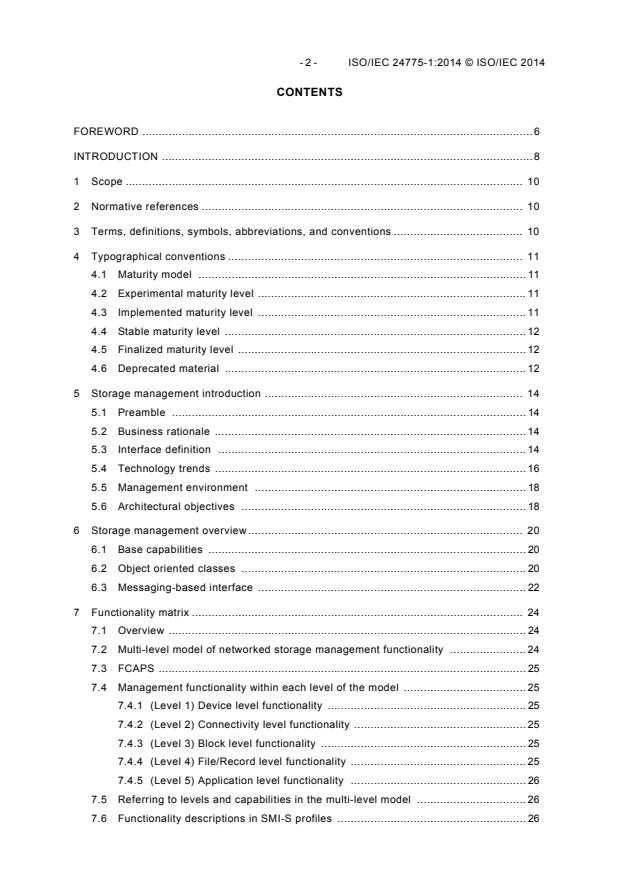
- 2 - ISO/IEC 24775-1:2014 © ISO/IEC 2014
CONTENTS
FOREWORD .6
INTRODUCTION .8
1 Scope . 10
2 Normative references . 10
3 Terms, definitions, symbols, abbreviations, and conventions . 10
4 Typographical conventions . 11
4.1 Maturity model . 11
4.2 Experimental maturity level . 11
4.3 Implemented maturity level . 11
4.4 Stable maturity level . 12
4.5 Finalized maturity level . 12
4.6 Deprecated material . 12
5 Storage management introduction . 14
5.1 Preamble .14
5.2 Business rationale . 14
5.3 Interface definition . 14
5.4 Technology trends . 16
5.5 Management environment . 18
5.6 Architectural objectives . 18
6 Storage management overview . 20
6.1 Base capabilities . 20
6.2 Object oriented classes . 20
6.3 Messaging-based interface . 22
7 Functionality matrix . 24
7.1 Overview .24
7.2 Multi-level model of networked storage management functionality . 24
7.3 FCAPS .25
7.4 Management functionality within each level of the model . 25
7.4.1 (Level 1) Device level functionality . 25
7.4.2 (Level 2) Connectivity level functionality . 25
7.4.3 (Level 3) Block level functionality . 25
7.4.4 (Level 4) File/Record level functionality . 25
7.4.5 (Level 5) Application level functionality . 26
7.5 Referring to levels and capabilities in the multi-level model . 26
7.6 Functionality descriptions in SMI-S profiles . 26
7.7 Capabilities of this version . 26
7.7.1 Device Level . 26
7.7.2 Connectivity Level . 27
7.7.3 Block Level . 27
7.7.4 File/Record Level . 28
7.7.5 Application Level . 28
8 Operational environment . 29
8.1 General .29
8.2 Using this standard . 30
8.3 Language bindings . 30
Bibliography . 32
- 4 - ISO/IEC 24775-1:2014 © ISO/IEC 2014
Figure 1 – Experimental maturity level tag . 11
Figure 2 – Implemented maturity level tag . 12
Figure 3 – Stable maturity level tag . 12
Figure 4 – Deprecated tag . 13
Figure 5 – Interface functions. 15
Figure 6 – Large SAN topology . 17
Figure 7 – Example Client Server Distribution in a SAN . 18
Figure 8 – Object model/server relationship. 21
Figure 9 – Canonical inheritance . 22
Figure 10 – Sample CIM-XML message. 23
Figure 11 – Operational environment . 30
Table 1 – Functionality matrix . 24
- 6 - ISO/IEC 24775-1:2014 © ISO/IEC 2014
INFORMATION TECHNOLOGY –
STORAGE MANAGEMENT –
Part 1: Overview
FOREWORD
1) ISO (the International Organization for Standardization) and IEC (the International Electrotechnical Commission)
form the specialized system for worldwide standardization. National bodies that are members of ISO or IEC
participate in the development of International Standards through technical committees established by the
respective organization to deal with particular fields of technical activity. ISO and IEC technical committees
collaborate in fields of mutual interest. Other international organizations, governmental and non-governmental,
in liaison with ISO and IEC, also take part in the work. In the field of information technology, ISO and IEC have
established a joint technical committee, ISO/IEC JTC 1.
2) The formal decisions or agreements of IEC and ISO on technical matters express, as nearly as possible, an
international consensus of opinion on the relevant subjects since each technical committee has representation
from all interested IEC National Committees and ISO member bodies.
3) IEC, ISO and ISO/IEC Publications have the form of recommendations for international use and are accepted by
IEC National Committees and ISO member bodies in that sense. While all reasonable efforts are made to ensure
that the technical content of IEC, ISO and ISO/IEC publications is accurate, IEC or ISO cannot be held
responsible for the way in which they are used or for any misinterpretation by any end user.
4) In order to promote international uniformity, IEC National Committees and ISO member bodies undertake to
apply IEC, ISO and ISO/IEC publications transparently to the maximum extent possible in their national and
regional publications. Any divergence between any ISO, IEC or ISO/IEC publication and the corresponding
national or regional publication should be clearly indicated in the latter.
5) ISO and IEC do not provide any attestation of conformity. Independent certification bodies provide conformity
assessment services and, in some areas, access to IEC marks of conformity. ISO or IEC are not responsible for
any services carried out by independent certification bodies.
6) All users should ensure that they have the latest edition of this publication.
7) No liability shall attach to IEC or ISO or its directors, employees, servants or agents including individual experts
and members of their technical committees and IEC National Committees or ISO member bodies for any personal
injury, property damage or other damage of any nature whatsoever, whether direct or indirect, or for costs
(including legal fees) and expenses arising out of the publication of, use of, or reliance upon, this ISO/IEC
publication or any other IEC, ISO or ISO/IEC publications.
8) Attention is drawn to the normative references cited in this publication. Use of the referenced publications is indispensable
for the correct application of this publication.
9) Attention is drawn to the possibility that some of the elements of this ISO/IEC publication may be the subject of
patent rights. ISO and IEC shall not be held responsible for identifying any or all such patent rights.
International Standard ISO/IEC 24775-1 was prepared by subcommittee 25: Interconnection of
information technology equipment, of ISO/IEC joint technical committee 1: Information
technology.
This International Standard, together with ISO/IEC 24775-2 to ISO/IEC 24775-8, replaces ISO/
IEC 24775, second edition, published in 2011, and constitutes a technical revision.
The significant technical changes with respect to the previous edition are listed in the
INTRODUCTION.
The list of all currently available parts of the ISO/IEC 24775 series, under the general title
Information technology – Storage management, can be found on the IEC web site.
This International Standard is to be used in conjunction with all other parts of this series of
standards.
This International Standard has been approved by vote of the member bodies, and the voting
results may be obtained from the address given on the second title page.
This publication has been drafted in accordance with the ISO/IEC Directives, Part 2.
IMPORTANT – The “colour inside” logo on the cover page of this publication indicates
that it contains colours which are considered to be useful for the correct
understanding of its contents. Users should therefore print this publication using a
colour printer.
- 8 - ISO/IEC 24775-1:2014 © ISO/IEC 2014
INTRODUCTION
The Overview part of the Storage Management International Standard contains informative
clauses that provide an overview of how SMI-S works. It is a useful base for understanding the
details of the standard. While the normative information of the ISO/IEC 24775 series of
standards is contained in other parts, ISO/IEC 24775-1 provides high-level introductory
material on key concepts.
ISO/IEC 24775 is subdivided into the following parts:
• Information technology – Storage management – Part 1: Overview
• Information technology – Storage management – Part 2: Common architecture
• Information technology – Storage management – Part 3: Common profiles
• Information technology – Storage management – Part 4: Block devices
• Information technology – Storage management – Part 5: Filesystems
• Information technology – Storage management – Part 6: Fabric
• Information technology – Storage management – Part 7: Host elements
• Information technology – Storage management – Part 8: Media libraries
The significant changes with respect to the second edition of ISO/IEC 24775 are listed below.
• Improved organization. The International Standard has been reorganized into eight parts
to provide more information more easily. The parts are:
• Part 1 Overview: The overview book provides a high level overview of the ISO/IEC
24775 series of standards.
• Part 2 Common Architecture: This part covers general information about the interface,
such as security and protocols.
• Part 3 Common Profiles: This part covers component profiles that extend profiles in
other books, such as target ports and job control.
• Part 4 Block Devices: This part covers storage profiles that support various forms of
disk storage.
• Part 5 Filesystems: This part covers profiles that support filesystems, such as NAS
(Network Attached Storage).
• Part 6 Fabric: This part covers profiles that deal with interconnection of host servers
and storage devices, such as switches.
• Part 7 Host Elements: This part covers profiles for storage software on host servers,
such as disk partitioning and Host Hardware RAID controllers.
• Part 8 Media Libraries: This part covers profiles that deal with removable media such as
tape libraries.
• Maturity identification. As material is added to the standard it goes through various
stages of maturity. The initial stage is Experimental, which is material that has not yet been
implemented and is subject to change. The other stages indicate the degree of
implementations. The stages are:
• Experimental: Full design review, no commercial implementations.
• Implemented: Initial implementations available, may be removed at minor revision.
• Stable: Three or more vendors have implemented the identified material, backward
compatibility assured, removed only at major revision.
• Finalized: Relies solely on Finalized content, deprecated only at major revision.
• Deprecated: Obsolete material, may be removed in future revisions.
For a more detailed explanation of each maturity level and its typographical indication, see
Clause 4 Typographical conventions.
• Expanded scope. The range of SAN components modeled by the profiles defined in the
parts has been greatly expanded.
• New profiles include:
• Part 3 Common Profiles: Serial Attached SCSI (SAS) Target Port, Serial ATA (SATA)
Target Ports, SB Target Port, SAS Initiator Ports, ATA Initiator Ports, FC-SB-x
Initiator Ports, FCoE Initiator Ports, Power Supply, Fan, Sensors, Base Server,
Media Access Device, Storage Enclosure, Software Inventory, Profile Registration,
Proxy Server System Management, Operational Power.
• Part 4 Block Devices: Block Storage Views, CKD Block Services, Erasure, Storage
Server Asymmetry, Volume Composition, Storage Element Protection, Replication
Services, Pools from Volumes, Group Masking and Mapping, Thin Provisioning.
• Part 5 Filesystems: File Export, File Server Manipulation, File Storage, Filesystem,
Filesystem Copy Services, Filesystem Performance, Filesystem Quotas, NAS
Network Port, Host Filesystem, Filesystem Remote Copy Services.
• Part 6 Fabric: Fibre Channel Security, Fabric Views, Virtual Fabrics, Switch
Partitioning, SAS Expander, N Port Virtualizer, Inter Fabric Routing.
• Part 7 Host Elements: Storage HBA, Host Hardware RAID Controller.
• Part 8 Media Libraries: Partitioned Tape Library, Virtual Tape Library, Virtual Tape
Library Copy and Library Views.
• The following experimental profiles were removed from the International Standard:
• Part 3 Common Profiles: Security, 3rd Party Authentication, Authorization,
Credential Management, Identity Management, Security Role Based Access Control
and Security Resource Ownership.
• Part 4 Block Devices: Pool Management Policy.
• The following profiles are deprecated:
• Part 3 Common Profiles: Cascading (replaced by direct use of cascading classes).
• Part 4 Block Devices: Volume Management (not replaced).
• Part 6 Fabric: Router (not replaced).
• Part 7 Host Elements: FC HBA (replaced by Storage HBA), SB Multipath
Management (not replaced).
• Part 8 Media Libraries: InterLibraryPort Connection (not replaced).
• In addition, many of the existing profiles have been enhanced.
This International Standard was prepared by the SNIA (Storage Networking Industry
Association) . The standard is often referred to as SMI-S (Storage Management Initiative
Specification).
1. Storage Networking Industry Association, 425 Market Street, Suite 1020, San Francisco, CA 94105, U.S.A.,
http://www.snia.org
- 10 - ISO/IEC 24775-1:2014 © ISO/IEC 2014
INFORMATION TECHNOLOGY –
STORAGE MANAGEMENT –
Part 1: Overview
1 Scope
This part of ISO/IEC 24775 defines an interface for the secure, extensible, and interoperable
management of a distributed and heterogeneous storage system. This interface uses an
object-oriented, XML-based, messaging-based protocol designed to support the specific
requirements of managing devices and subsystems in this storage environment. Using this
protocol, this part of ISO/IEC 24775 describes the information available to a WBEM Client from
an Information Technology – Storage Management compliant CIM WBEM Server.
2 Normative references
The following documents, in whole or in part, are normatively referenced in the document and
are indispensible for its application. For dated references, only the edition cited applies. For
undated references, the latest edition of the referenced document, including any amendments,
applies.
ISO/IEC 24775-2, Information technology – Storage management – Part 2: Common
architecture
ISO/IEC 24775-3, Information technology – Storage management – Part 3: Common profile
3 Terms, definitions, symbols, abbreviations, and conventions
For the purposes of this document, the terms, definitions, symbols, abbreviations, and
conventions given in ISO/IEC 24775-2:2014 apply.
4 Typographical conventions
4.1 Maturity model
In addition to informative and normative content, this International Standard includes guidance
about the maturity of emerging material that has completed a rigorous design review but has
limited implementation in commercial products. This material is clearly delineated as described
in Clause 4. The typographical convention is intended to provide a sense of the maturity of the
affected material, without altering its normative content. By recognizing the relative maturity of
different sections of the International Standard, an implementer should be able to make more
informed decisions about the adoption and deployment of different portions of the International
Standard in a commercial product.
This International Standard has been structured to convey both the formal requirements and
assumptions of the Information Technology – Storage Management API and its emerging
implementation and deployment lifecycle. Over time, the intent is that all content in the
International Standard will represent a mature and stable design, be verified by extensive
implementation experience, assure consistent support for backward compatibility, and rely
solely on content material that has reached a similar level of maturity. Unless explicitly labeled
with one of the subordinate maturity levels defined for this International Standard, content is
assumed to satisfy these requirements and is referred to as “Finalized”. Since much of the
evolving International Standard content in any given release will not have matured to that level,
this International Standard defines three subordinate levels of implementation maturity that
identify important aspects of the content’s increasing maturity and stability. Each subordinate
maturity level is defined by its level of implementation experience, its stability and its reliance
on other emerging standards. Each subordinate maturity level is identified by a unique
typographical tagging convention that clearly distinguishes content at one maturity model from
content at another level.
4.2 Experimental maturity level
No material is included in this International Standard unless its initial architecture has been
completed and reviewed. Some content included in this International Standard has complete
and reviewed design, but lacks implementation experience and the maturity gained through
implementation experience. This content is included in order to gain wider review and to gain
implementation experience. This material is referred to as “Experimental”. It is presented here
as an aid to implementers who are interested in likely future developments within the SMI
International Standards. The contents of an Experimental profile may change as
implementation experience is gained. There is a high likelihood that the changed content will
be included in an upcoming revision of the International Standard. Experimental material can
advance to a higher maturity level as soon as implementations are available. Figure 1 is a
sample of the typographical convention for Experimental content.
EXPERIMENTAL
Experimental content appears here.
EXPERIMENTAL
Figure 1 – Experimental maturity level tag
4.3 Implemented maturity level
Profiles for which initial implementations have been completed are classified as
“Implemented”. This indicates that at least two different vendors have implemented the profile,
including at least one provider implementation. At this maturity level, the underlying
architecture and modeling are stable, and changes in future revisions will be limited to the
correction of deficiencies identified through additional implementation experience. Should the
- 12 - ISO/IEC 24775-1:2014 © ISO/IEC 2014
material become obsolete in the future, it shall be deprecated in a minor revision of the
International Standard prior to its removal from subsequent releases. Figure 2 is a sample of
the typographical convention for Implemented content.
IMPLEMENTED
Implemented content appears here.
IMPLEMENTED
Figure 2 – Implemented maturity level tag
4.4 Stable maturity level
Once content at the Implemented maturity level has garnered additional implementation
experience, it can be tagged at the Stable maturity level. Material at this maturity level has
been implemented by three different vendors, including both a provider and a client. Should
material that has reached this maturity level become obsolete, it may only be deprecated as
part of a minor revision to the International Standard. Material at this maturity level that has
been deprecated may only be removed from the International Standard as part of a major
revision. A profile that has reached this maturity level is guaranteed to preserve backward
compatibility from one minor International Standard revision to the next. As a result, Profiles at
or above the Stable maturity level shall not rely on any content that is Experimental. Figure 3 is
a sample of the typographical convention for Implemented content.
STABLE
Stable content appears here.
STABLE
Figure 3 – Stable maturity level tag
4.5 Finalized maturity level
Content that has reached the highest maturity level is referred to as “Finalized.” In addition to
satisfying the requirements for the Stable maturity level, content at the Finalized maturity level
shall solely depend upon or refine material that has also reached the Finalized level. If
International Standard content depends upon material that is not under the control of the SNIA,
and therefore not subject to its maturity level definitions, then the external content is evaluated
by the SNIA to assure that it has achieved a comparable level of completion, stability, and
implementation experience. Should material that has reached this maturity level become
obsolete, it may only be deprecated as part of a major revision to the International Standard. A
profile that has reached this maturity level is guaranteed to preserve backward compatibility
from one minor International Standard revision to the next. Over time, it is hoped that all
International Standard content will attain this maturity level. Accordingly, there is no special
typographical convention, as there is with the other, subordinate maturity levels. Unless
content in the International Standard is marked with one of the typographical conventions
defined for the subordinate maturity levels, it should be assumed to have reached the Finalized
maturity level.
4.6 Deprecated material
Non-Experimental material can be deprecated in a subsequent revision of the International
Standard. Sections identified as “Deprecated” contain material that is obsolete and not
recommended for use in new development efforts. Existing and new implementations may still
use this material, but shall move to the newer approach as soon as possible. The maturity level
of the material being deprecated determines how long it will continue to appear in the
International Standard. Implemented content shall be retained at least until the next revision of
the specialization, while Stable and Finalized material shall be retained until the next major
revision of the International Standard. Providers shall implement the deprecated elements as
long as it appears in the International Standard in order to achieve backward compatibility.
Clients may rely on deprecated elements, but are encouraged to use non-deprecated
alternatives when possible.
Deprecated sections are documented with a reference to the last published version to include
the deprecated section as normative material and to the section in the current International
Standard with the replacement. Figure 4 contains a sample of the typographical convention for
deprecated content.
DEPRECATED
Content that has been deprecated appears here.
DEPRECATED
Figure 4 – Deprecated tag
- 14 - ISO/IEC 24775-1:2014 © ISO/IEC 2014
5 Storage management introduction
5.1 Preamble
Large Storage Systems and Storage Area Networks (SANs) are emerging as a prominent and
independent layer of IT infrastructure in enterprise class and midrange computing
environments. Examples of applications and functions driving the emergence of new storage
technology include:
• Sharing of vast storage resources between multiple systems via networks,
• LAN free backup,
• Remote, disaster tolerant, on-line mirroring of mission critical data,
• Clustering of fault tolerant applications and related systems around a single copy of data.
• Archiving requirements for sensitive business information.
• Distributed database and file systems.
To accelerate the emergence of more functional and sophisticated storage systems in the
market, the industry requires a standard management interface that allows different classes of
hardware and software products supplied by multiple vendors to reliably and seamlessly
interoperate for the purpose of monitoring and controlling resources. The SNIA Storage
Management Initiative (SMI) was created to develop this standard (SMI-Specification or SMI-
S), the definition of that interface. This standard provides for heterogeneous, functionally rich,
reliable, and secure monitoring/control of mission critical global resources in complex and
potentially broadly-distributed, multi-vendor storage topologies like SANs. As such, this
interface overcomes the deficiencies associated with legacy management systems that deter
customer uptake of more advanced storage management systems.
5.2 Business rationale
This interface is targeted at creating broad multi-vendor management interoperability and thus
increasing customer satisfaction. To that end, this standard defines an “open” and extensible
interface that allows subsystems and devices within the global context of a large storage
system to be reliably and securely managed by overlying presentation frameworks and
management systems in the context of the rapidly evolving multi-vendor market. In specific,
SAN integrators (like end-users, VARs, and SSPs) can, via this standardized management
interface, more flexibly select between multiple vendors when building the hierarchy of
software systems required to manage a large storage system independent of the underlying
hardware systems. Additionally, storage integrators can more flexibly select between alternate
hardware vendors when constructing storage configurations. Broad adoption of the standards
defined and extended in this standard will provide increased customer satisfaction and will:
• more rapidly expand the acceptance of new storage management technology like SANs
and iSCSI;
• accelerate customer acquisition of new storage management technology;
• expand the total market.
Additionally, a single common management interface allows SAN vendors and integrators to
decrease the time required to bring new more functional technology, products, and solutions to
market.
5.3 Interface definition
This management interface allows storage management systems to reliably identify, classify,
monitor, and control physical and logical resources in a storage system. The fundamental
relationship of this interface to storage management software, presentation frameworks, user
applications, SAN physical entities (i.e., devices), SAN discovery systems, and SAN logical
entities is illustrated in Figure 5.
Command Interface Graphical Interface
Application Framework
Media Data Migration
Other
Management (HSM)
Volume
Performance Capacity Planning Database System
Management
Resource
File System Backup System
Allocation
SMI-S Interface
Objects
LU LU Tape Virtual
LU Zone Host Port Other
Clone Snapshot Volume
Removable
RAIDset Switch Array Router Fabric
Media Set
Media Disk Mgmt
HBA Extender Enclosure Card
Robot Drive Appliance
Implementation
Figure 5 – Interface functions
Figure 5 illustrates that functions of the interface can be distributed across multiple devices
(i.e., Switches or Array Controllers) and/or software systems (i.e., Discovery Systems). While
the functionality of the interface is distributed within or across a storage environment, to insure
that monitoring and control operations by clients are consistent and reliable, the state of a
given resource is not certain to be valid if it is simultaneously available to clients from multiple
unsynchronized sources.
EXAMPLE A request by an SRM application and a backup engine for the bandwidth available on a given
Fibre Channel path should be coordinated by a single monitoring entity to insure information
consistency. If the SRM application and Backup engine obtain different available bandwidth
information for a given Fibre Channel path from multiple unsynchronized sources they could
function in conflict and degrade the efficiency of the environment.
Addressing this concern is the responsibility of parties configuring Storage and Network
management clients that rely on the primitives defined in the standard.
NOTE 1 Within this architecture (as depicted by Figure 5) entities like an appliance-based volume manager may
potentially act as both a client and a server to the interface.
EXAMPLE A Host-based volume manager wants to construct a large storage pool from multiple SAN
appliance based volumes, as well as volumes/LUNs originating from array controllers. In this case, the host
based volume manager needs to inspect the characteristics of the volumes on both the SAN appliance and
array controller prior to allocation. Additionally, the SAN appliance (which runs a volume manager) needs to
inspect the properties of storage devices when building its volumes. As such, the SAN appliance in this case
is both a client and server in the management environment, depending on the action being performed.
Figure 5 includes a number of strategic functional requirements for the interface. These
capabilities will be introduced to the interface implementation over time, and may not be
- 16 - ISO/IEC 24775-1:2014 © ISO/IEC 2014
present in this version of the interface. The functionalities required to fully satisfy the needs of
clients using a storage management interface include:
a) clients need to be able to obtain sufficient information to discern the topology of the SAN or
complex storage system;
b) clients need to be able to reliably identify resources that have experienced an error/fault
condition that has resulted in degraded/disabled operation;
c) clients need to be able to construct a zone of allocation around a select group of host and
storage resources;
d) clients need to be able to identify nonvolatile storage resources available to a storage
management system, to allow them to construct a storage pool of a consistent level of
performance and availability;
e) clients need to be able to identify third-party copy engines (and associated media libraries/
robots) available to a cooperating backup engine, allowing it to allocate an engine/library/
robot to a given backup task;
f) clients need to be able to dynamically allocate non-volatile storage resources;
g) each volume to be utilized is subject to strict availability and performance requirements. As
a result, the file system needs to inspect the properties of each volume prior to allocation.
h) clients need to be able to access sufficient topology and component information to allow a
Storage Resource Management (SRM) application like a performance monitor to examine
topology and line utilization, such that performance bottlenecks can be exposed and
capacity planning performed;
i) clients need to be able to employ appropriate data reporting and tracking to allow capacity
planning system to identify each storage pool in the SAN and then interact with the
manager of each pool to assess utilization statistics;
j) clients need to be provided with adequate controls for a privileged, user-written application
to restrict the use of a volume to a specific host, set of hosts, or set of controller
communications ports;
k) clients need to be assured of timely propagation of data concerning the health and
performance of the devices and subsystems in the SAN to fault isolation and analysis
systems.
Example non-goals for this interface include:
a) the ability to select a logical communications port over which to send/receive data;
b) the ability to read or write data to a volume;
c) the ability to identify and recover from data communications errors and failures;
d) the ability to log a new communications device into a network.
5.4 Technology trends
To be broadly embraced and long lived this management interface should respect and leverage
key technology trends evolving within the industry. These include:
a) Improved Connectivity: Whether available In-band (i.e., over Fibre Channel/iSCSI) or
available out-of-band (i.e., over a LAN/MAN/WAN), or available over a mix of both, virtually
all devices in a storage management environment have (or soon will have), access to a
common communications transport suitable for carrying management information content
(e.g., TCP/IP), that is used to transmit a standardized encoding (e.g., a WBEM Protocol) of
recognized semantics (e.g., CIM).
b) Increased Device Manageability: Through a common, general-purpose network transport,
provide the option to provide proxy services to provide access to (e.g., general purpose
computer system) devices via this standardized management interface.
Snaps and Clones
EXAMPLE A legacy array controller is incapable of running the software necessary to implement a
management server for this interface and uses a proxy server on a SAN appliance to communicate within
the management environment.
EXAMPLE An HBA is incapable of running the software necessary to implement a management server
for this interface and uses a proxy server on its host system to communicate within the management
environment.
c) XML Standardization: XML is providing the ability to create management protocols with an
extensible, platform independent, human readable, content describable communication
language. This streamlines the task of developing infrastructure to support his interface
and debug systems around the interface.
d) Object Independent Protocols: These protocols provide appropriate abstraction –
separating the definition of the object model from the semantics/syntax of the protocol.
Additionally, the transport-independent, content-description (i.e., markup) nature of XML
allows it to be utilized by both web-enabled application and appliances.
e) Increased SAN Complexity: SANs are being configured with diverse classes of components
and widely distributed topologies. Management clients and servers in the environment need
to anticipate being widely distributed on systems, appliances and devices throughout large
SAN topologies, while maintaining real-time distributed state for logical entities. Figure 6
provides an example of a single SAN built from multiple classes of components spanning
three physical locations (i.e., Sites A, B and C).
Site - A
Site - B
Host B1
Host A1
Host A2
Library
Router B1
Switch B1
Host An
Site - C
Switch A1
Switch A2
Host C1
Bridge A1
Host C2
Network
Bridge A2
Appliance A1
Switch C1
Appliance A2
Switch C2
Bridge C1
Bridge C2
Array A1
Array An
Appliance C1
Appliance C2
Vol A1
Vol An
Array C1
Array An
Vol C1
Vol Cn
Figure 6 – Large SAN topology
- 18 - ISO/IEC 24775-1:2014 © ISO/IEC 2014
5.5 Management environment
Clients and Servers of this interface can be widely distributed on systems, appliances, and
devices across a network that includes one or more large SAN topologies.
The configuration in Figure 7 provides an example client/server distribution using in-band TCP/
IP communications, out of band TCP/IP communications, or employing proxy services to
bridge legacy and/or proprietary communication interfaces. The device “Old Array Controller”
is incapable of appropriate communication with clients and servers in the management
environment to provide management access (i.e., a CIM Server). Access to the
communications transport that clients and servers share for communication is achieved via a
proxy service on the host computer in the upper right hand corner of Figure 7. All other clients
and servers communicate via direct access to a common communications transport.
Host
Host Host
Database Mgmt
WBEM Service
WBEM Service
WBEM Service
Volume Manager
FileSystem
FileSystem
FileSystem Legacy Array
Provider
Provider
Provider WBEM Client
Provider
Host Provider
Host Provider
Host Provider Router Provider
Management
HBA Provider HBA Provider
HBA Provider Switch Provider
Appliance
Discovery and
Directory Service
WBEM Service
Storage Area Network
Host Provider
General Purpose HBA Provider
LAN
Switch
Proprietary
Management
Management
Service Appliance
SRM
Legacy Array
Data Migration
Proprietary
Mgmt
Management
WBEM Client
Service
WBEM Service
Array Bridge to ATM
Host Provider
Router
HBA Provider
Proprietary WBEM Service WBEM Service
Media Library
Management
Array Provider Bridge Provider
Service
WBEM Service Storage Area Network
Media Library
Provider
Figure 7 – Example Client Server Distribution in a SAN
5.6 Architectural objectives
The following reflect architectural objectives of the interface. Some of these capabilities are
not present in the initial release of the interface, but are inherent in its architecture and
intended extensibility. They are intended to provide guidance concerning the present and
future direction of development of the Information Technology – Storage Management.
a) Consistency: State within a managed object and between objects remains consistent
independent of the number of clients simultaneously exerting control, the distribution of
objects in the environment, or the management action being performed.
b) Isolation: A client that needs to execute an atomic set of management actions against one
or more managed objects is able to do so in isolation of other clients, who are
simultaneously executing management actions against those sa
...
Questions, Comments and Discussion
Ask us and Technical Secretary will try to provide an answer. You can facilitate discussion about the standard in here.
Loading comments...