


ISO/IEC 23001-11:2023
(Main)Information technology — MPEG systems technologies — Part 11: Energy-efficient media consumption (green metadata)
General Information
- Abstract
This document specifies metadata for energy-efficient decoding, encoding, presentation, and selection of media.
- Status
- Published
- Publication Date
- 19-Feb-2023
- Current Stage
- 9092 - International Standard to be revised
- Start Date
- 19-Feb-2026
- Completion Date
- 11-Jul-2026

Overview - ISO/IEC 23001-11:2023 (green metadata)
ISO/IEC 23001-11:2023, "Information technology - MPEG systems technologies - Part 11: Energy-efficient media consumption (green metadata)," specifies a metadata framework that enables reduced energy use during media consumption. The standard defines formats and semantics for metadata used to reduce decoder power, display power, and to support energy-aware media selection and quality recovery after low‑power encoding. It is the third edition (2023), updating the 2019 edition with new VVC SEI messages and finer interactive signalling for encoder/decoder control.
Key topics and technical requirements
- Green metadata formats: Defines metadata structures for energy-efficient decoding, encoding, presentation, and selection of media.
- Decoder power reduction: Introduces complexity metrics (CM) metadata and decoding operation reduction request (DOR‑Req) metadata. CM helps decoders adapt operating frequency; DOR‑Req allows remote encoders to request lower-complexity encoding.
- Interactive signalling: Syntax and semantics for signalling between decoder and encoder to request or negotiate power-saving decoding operations.
- Display power reduction: Metadata (including RGB-component statistics and quality levels) for display subsystems to dynamically adapt presentation parameters and lower display energy use.
- Energy‑efficient media selection: Metadata that assists clients (e.g., adaptive streaming clients) to choose video representations that optimize the tradeoff between power savings and quality of experience (QoE).
- Quality recovery metrics: Metrics and metadata to support restoration of quality after low‑power encoding; includes syntax for AVC/HEVC and VVC SEI messages.
- Conformance and implementation guidance: Clauses and annexes for conformance, reference software, SEI syntax, implementation guidelines, and objective distortion metrics.
Practical applications and who uses this standard
- Streaming platforms and CDN providers: to offer energy‑aware bitrate/representation selection for mobile or battery‑constrained clients.
- Codec and encoder vendors: to implement DOR‑Req and CM signalling in encoders and bitstreams (AVC, HEVC, VVC).
- Decoder and SoC manufacturers: to adapt decoder frequency/power based on CM metadata for lower power consumption.
- Display and device manufacturers: to use RGB statistics and quality levels for display-adaptive power savings.
- Video conferencing and real‑time communication systems: to enable remote low‑complexity encoding for participant devices with power constraints.
- Standards engineers and researchers: for integration, conformance testing, and developing energy‑efficient media workflows.
Related standards (normative references)
- ISO/IEC 14496-10 (AVC/H.264)
- ISO/IEC 23008-2 (HEVC/H.265)
- ISO/IEC 23009-1 (DASH)
- References to VVC SEI message syntax and MPEG systems technologies in the ISO/IEC 23001 family
This standard is essential for implementing energy-efficient media consumption, enabling interoperable metadata-driven strategies across encoders, decoders, displays, and adaptive streaming clients.
Relations
- Effective Date
- 19-Aug-2023
- Effective Date
- 10-Sep-2022
- Effective Date
- 06-Jun-2022
Get Certified
Connect with accredited certification bodies for this standard

BSI Group
BSI (British Standards Institution) is the business standards company that helps organizations make excellence a habit.

NYCE
Mexican standards and certification body.
Sponsored listings
Frequently Asked Questions
ISO/IEC 23001-11:2023 is a standard published by the International Organization for Standardization (ISO). Its full title is "Information technology — MPEG systems technologies — Part 11: Energy-efficient media consumption (green metadata)". This standard covers: This document specifies metadata for energy-efficient decoding, encoding, presentation, and selection of media.
This document specifies metadata for energy-efficient decoding, encoding, presentation, and selection of media.
ISO/IEC 23001-11:2023 is classified under the following ICS (International Classification for Standards) categories: 35.040.40 - Coding of audio, video, multimedia and hypermedia information. The ICS classification helps identify the subject area and facilitates finding related standards.
ISO/IEC 23001-11:2023 has the following relationships with other standards: It is inter standard links to ISO/IEC 23001-11:2023/Amd 2:2025, ISO/IEC 23001-11:2023/Amd 1:2024, ISO/IEC 23001-11:2019. Understanding these relationships helps ensure you are using the most current and applicable version of the standard.
ISO/IEC 23001-11:2023 is available in PDF format for immediate download after purchase. The document can be added to your cart and obtained through the secure checkout process. Digital delivery ensures instant access to the complete standard document.
Standards Content (Sample)
INTERNATIONAL ISO/IEC
STANDARD 23001-11
Third edition
2023-02
Information technology — MPEG
systems technologies —
Part 11:
Energy-efficient media consumption
(green metadata)
Technologies de l'information — Technologies des systèmes MPEG —
Partie 11: Consommation des supports éconergétiques (métadonnées
vertes)
Reference number
© ISO/IEC 2023
© ISO/IEC 2023
All rights reserved. Unless otherwise specified, or required in the context of its implementation, no part of this publication may
be reproduced or utilized otherwise in any form or by any means, electronic or mechanical, including photocopying, or posting on
the internet or an intranet, without prior written permission. Permission can be requested from either ISO at the address below
or ISO’s member body in the country of the requester.
ISO copyright office
CP 401 • Ch. de Blandonnet 8
CH-1214 Vernier, Geneva
Phone: +41 22 749 01 11
Email: copyright@iso.org
Website: www.iso.org
Published in Switzerland
ii
© ISO/IEC 2023 – All rights reserved
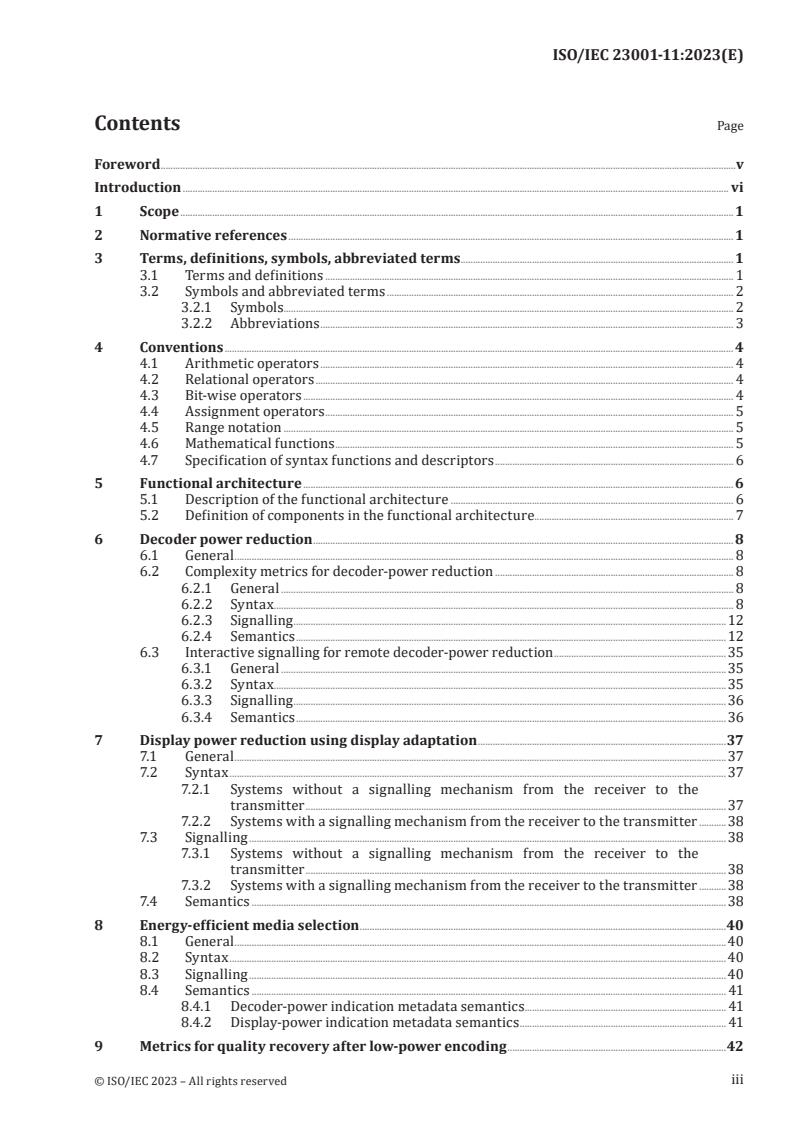
Contents Page
Foreword .v
Introduction . vi
1 Scope . 1
2 Normative references . 1
3 Terms, definitions, symbols, abbreviated terms . 1
3.1 Terms and definitions . 1
3.2 Symbols and abbreviated terms . 2
3.2.1 Symbols. 2
3.2.2 Abbreviations . 3
4 Conventions . 4
4.1 Arithmetic operators . 4
4.2 Relational operators . 4
4.3 Bit-wise operators . 4
4.4 Assignment operators . 5
4.5 Range notation . 5
4.6 Mathematical functions . 5
4.7 Specification of syntax functions and descriptors . 6
5 Functional architecture . 6
5.1 Description of the functional architecture . 6
5.2 Definition of components in the functional architecture. 7
6 Decoder power reduction . 8
6.1 General . 8
6.2 Complexity metrics for decoder-power reduction . 8
6.2.1 General . 8
6.2.2 Syntax . . 8
6.2.3 Signalling .12
6.2.4 Semantics . 12
6.3 Interactive signalling for remote decoder-power reduction . 35
6.3.1 General . 35
6.3.2 Syntax . . 35
6.3.3 Signalling . 36
6.3.4 Semantics . 36
7 Display power reduction using display adaptation .37
7.1 General . 37
7.2 Syntax . 37
7.2.1 Systems without a signalling mechanism from the receiver to the
transmitter . 37
7.2.2 Systems with a signalling mechanism from the receiver to the transmitter .38
7.3 Signalling .38
7.3.1 Systems without a signalling mechanism from the receiver to the
transmitter .38
7.3.2 Systems with a signalling mechanism from the receiver to the transmitter .38
7.4 Semantics .38
8 Energy-efficient media selection .40
8.1 General .40
8.2 Syntax .40
8.3 Signalling .40
8.4 Semantics . 41
8.4.1 Decoder-power indication metadata semantics . . 41
8.4.2 Display-power indication metadata semantics . 41
9 Metrics for quality recovery after low-power encoding .42
iii
© ISO/IEC 2023 – All rights reserved
9.1 General . 42
9.2 Syntax . 42
9.2.1 AVC and HEVC syntax . . . 42
9.2.2 VVC syntax . 42
9.3 Signalling . 42
9.4 Semantics . 43
9.4.1 AVC and HEVC Semantics . 43
9.4.2 VVC Semantics . 43
10 Conformance and reference software. 44
Annex A (normative) Supplemental Enhancement Information (SEI) syntax.45
Annex B (informative) Implementation guidelines for the usage of green metadata .51
Annex C (normative) Conformance and reference software .73
Annex D (informative) Objective distortion metrics .78
Bibliography .83
iv
© ISO/IEC 2023 – All rights reserved
Foreword
ISO (the International Organization for Standardization) and IEC (the International Electrotechnical
Commission) form the specialized system for worldwide standardization. National bodies that are
members of ISO or IEC participate in the development of International Standards through technical
committees established by the respective organization to deal with particular fields of technical
activity. ISO and IEC technical committees collaborate in fields of mutual interest. Other international
organizations, governmental and non-governmental, in liaison with ISO and IEC, also take part in the
work.
The procedures used to develop this document and those intended for its further maintenance
are described in the ISO/IEC Directives, Part 1. In particular, the different approval criteria
needed for the different types of document should be noted. This document was drafted in
accordance with the editorial rules of the ISO/IEC Directives, Part 2 (see www.iso.org/directives or
www.iec.ch/members_experts/refdocs).
Attention is drawn to the possibility that some of the elements of this document may be the subject
of patent rights. ISO and IEC shall not be held responsible for identifying any or all such patent
rights. Details of any patent rights identified during the development of the document will be in the
Introduction and/or on the ISO list of patent declarations received (see www.iso.org/patents) or the IEC
list of patent declarations received (see https://patents.iec.ch).
Any trade name used in this document is information given for the convenience of users and does not
constitute an endorsement.
For an explanation of the voluntary nature of standards, the meaning of ISO specific terms and
expressions related to conformity assessment, as well as information about ISO's adherence to
the World Trade Organization (WTO) principles in the Technical Barriers to Trade (TBT) see
www.iso.org/iso/foreword.html. In the IEC, see www.iec.ch/understanding-standards.
This document was prepared by Joint Technical Committee ISO/IEC JTC 1, Information technology,
Subcommittee SC 29, Coding of audio, picture, multimedia and hypermedia information.
This third edition cancels and replaces the second edition (ISO/IEC 23001-11:2019), which has been
technically revised.
The main changes are as follows:
— 6.2 related to complexity metrics for decoder-power reduction is amended by the specification of a
new VVC SEI message carrying complexity metrics for decoder-power reduction.
— Clause 9 related to metrics for quality recovery after low-power encoding is amended by the
specification of additional metrics for quality recovery after low-power encoding in the newly
added VVC SEI message.
— 6.3 related to interactive signalling for remote decoder-power reduction is amended by adding new
syntax elements allowing a finer control by decoder of the encoding operations.
A list of all parts in the ISO/IEC 23001 series can be found on the ISO and IEC websites.
Any feedback or questions on this document should be directed to the user’s national standards
body. A complete listing of these bodies can be found at www.iso.org/members.html and
www.iec.ch/national-committees.
v
© ISO/IEC 2023 – All rights reserved
Introduction
This document specifies the metadata (green metadata) that facilitates reduction of energy usage
during media consumption as follows:
— the format of the metadata that enables reduced decoder power consumption;
— the format of the metadata that enables reduced display power consumption;
— the format of the metadata that enables media selection for joint decoder and display power
reduction;
— the format of the metadata that enables quality recovery after low-power encoding.
This metadata facilitates reduced energy usage during media consumption without any degradation
in the quality of experience (QoE). However, it is also possible to use this metadata to get larger energy
savings, but at the expense of some QoE degradation.
The metadata for energy-efficient decoding specifies two sets of information: complexity metrics (CM)
metadata and decoding operation reduction request (DOR-Req) metadata. A decoder uses CM metadata
to vary operating frequency and thus reduce decoder power consumption. In a point-to-point video
conferencing application, the remote encoder uses the DOR-Req metadata to modify the decoding
complexity of the bitstream and thus reduce local decoder power consumption.
The metadata for energy-efficient encoding specifies quality metrics that are used by a decoder to
reduce the quality loss from low-power encoding.
The metadata for energy-efficient presentation specifies RGB-component statistics and quality levels. A
presentation subsystem uses this metadata to reduce power by adjusting display parameters, based on
the statistics, to provide a desired quality level from those provided in the metadata.
The metadata for energy-efficient media selection specifies DOR-Req parameters, RGB-component
statistics and quality levels. The client in an adaptive streaming session uses this metadata to determine
decoder and display power-saving characteristics of available video representations and to select the
representation with the optimal quality for a given power-saving.
vi
© ISO/IEC 2023 – All rights reserved
INTERNATIONAL STANDARD ISO/IEC 23001-11:2023(E)
Information technology — MPEG systems technologies —
Part 11:
Energy-efficient media consumption (green metadata)
1 Scope
This document specifies metadata for energy-efficient decoding, encoding, presentation, and selection
of media.
2 Normative references
The following documents are referred to in the text in such a way that some or all of their content
constitutes requirements of this document. For dated references, only the edition cited applies. For
undated references, the latest edition of the referenced document (including any amendments) applies.
ISO/IEC 14496-10, Information technology — Coding of audio-visual objects — Part 10: Advanced video
coding
ISO/IEC 23008-2, Information technology — High efficiency coding and media delivery in heterogeneous
environments — Part 2: High efficiency video coding
ISO/IEC 23009-1, Information technology — Dynamic adaptive streaming over HTTP (DASH) — Part 1:
Media presentation description and segment formats
ISO/IEC 23090-3, Information technology — Coded representation of immersive media — Part 3: Versatile
video coding
3 Terms, definitions, symbols, abbreviated terms
3.1 Terms and definitions
For the purposes of this document, the terms and definitions given in ISO/IEC 14496-10, ISO/IEC 23008-2,
ISO/IEC 23009-1, ISO/IEC 23090-3 and the following apply.
ISO and IEC maintain terminology databases for use in standardization at the following addresses:
— ISO Online browsing platform: available at https:// www .iso .org/ obp
— IEC Electropedia: available at https:// www .electropedia .org/
3.1.1
alpha-point deblocking instance
APDI
single filtering operation that produces either a single, filtered output p' or a single, filtered output q' ,
0 0
where p' and q' are filtered samples across a 4x4 block edge
0 0
3.1.2
deblocking filtering instance
single filtering operation that produces either a single, filtered output p' or a single, filtered output q',
where p' and q' are filtered samples across an 8x8 and 4x4 block edge for HEVC and VVC, respectively
© ISO/IEC 2023 – All rights reserved
3.1.3
decoding process
process that reads a bitstream and derives decoded pictures from it
Note 1 to entry: The decoding process is specified in ISO/IEC 14496-10, ISO/IEC 23008-2 or ISO/IEC 23090-3.
3.1.4
encoding process
process that produces a bitstream
Note 1 to entry: The bitstream shall conform to ISO/IEC 14496-10, ISO/IEC 23008-2 or ISO/IEC 23090-3.
3.1.5
no-quality-loss operating point
NQLOP
metadata-enabled operating point associated with the largest display-power reduction that can be
achieved without any quality loss (infinite PSNR)
3.1.6
non-zero block
block containing at least one non-zero transform coefficient
3.1.7
peak signal
maximum permissible RGB component in a reconstructed frame
N
Note 1 to entry: For N-bit video, peak signal is (2 – 1).
3.1.8
period
interval over which complexity-metrics metadata are applicable
3.1.9
pixel
smallest addressable element in an all-points addressable display device
3.1.10
reconstructed frames
frames obtained after applying RGB colour-space conversion and cropping to the specific decoded
picture or pictures for which display power-reduction metadata are applicable
3.1.11
RGB component
single sample representing one of the three primary colours of the RGB colour space
3.1.13
six-tap filtering
STF
single application of the 6-tap filter to generate a single filtered sample for fractional positions using
the samples at integer-sample positions
3.2 Symbols and abbreviated terms
3.2.1 Symbols
+ addition
- subtraction (as a two-argument operator) or negation (as a unary prefix operator)
* multiplication
© ISO/IEC 2023 – All rights reserved
/ integer division with truncation of the result toward zero. For example, 7 / 4 and −7 / −4
are truncated to 1 and −7 / 4 and 7 / −4 are truncated to −1
÷ division in mathematical equations where no truncation or rounding is intended
3.2.2 Abbreviations
APDI alpha-point deblocking instance
ASIC application specific integrated circuit
AVC advanced video coding – ISO/IEC 14496-10
BMFF base media file format
CM complexity metric
CMOS complementary metal oxide semiconductor
CMP cubemap projection format
CPU central processing Unit
DASH dynamic adaptive streaming over HTTP
DOR-Ratio decoding operation reduction ratio
DOR-Req decoding operation reduction request
DVFS dynamic voltage frequency scaling
ERP equi-rectangular projection format
Fps frames per second
FS fresh start
GP good picture
HEVC high efficiency video coding – ISO/IEC 23008-2
HCMP hemisphere cubemap projection format
Mbps mega bits per second
MPD media presentation description
MSD mean square difference
MV motion vector
NQLOP no-quality-loss operating point
PSNR peak signal-to-noise ratio
QoE quality of experience
RBLL remaining battery life level
RGB red, green, blue
© ISO/IEC 2023 – All rights reserved
SEI supplemental enhancement information
SP start picture
STF six-tap filtering
SSIM structural similarity index measure
VVC versatile video coding – ISO/IEC 23090-3
XSD cross-segment decoding
wPSNR weighted peak signal-to-noise ratio
WS-PSNR weighted to spherically uniform peak signal-to-noise ratio
4 Conventions
4.1 Arithmetic operators
y
x exponentiation
x/y division where no truncation or rounding is intended
division where no truncation or rounding is intended
y
summation of fi() with i taking all integer values from x up to and including y
fi()
∑
ix =
y
summation of fp() with p taking all integer location values in a block B in a picture
fp()
∑
pB in
Modulus.
x % y
Remainder of x divided by y, defined only for integers x and y with x >= 0 and y > 0
4.2 Relational operators
> greater than
>= greater than or equal to
< less than
<= less than or equal to
= = equal to
!= not equal to
When a relational operator is applied to a syntax element or variable that has been assigned the value
"na" (not applicable), the value "na" is treated as a distinct value for the syntax element or variable. The
value "na" is considered not to be equal to any other value.
4.3 Bit-wise operators
x >> y arithmetic right shift of a two's complement integer representation of x by y binary digits
© ISO/IEC 2023 – All rights reserved
This function is defined only for non-negative integer values of y. Bits shifted into the
most significant bits (MSBs) as a result of the right shift have a value equal to the MSB
of x prior to the shift operation.
x << y arithmetic left shift of a two's complement integer representation of x by y binary digits
This function is defined only for non-negative integer values of y. Bits shifted into the
least significant bits (LSBs) as a result of the left shift have a value equal to 0.
4.4 Assignment operators
= assignment operator
++ increment, i.e., x++ is equivalent to x = x + 1; when used in an array index, evaluates to
the value of the variable prior to the increment operation
− − decrement, i.e., x− − is equivalent to x = x − 1; when used in an array index, evaluates to
the value of the variable prior to the decrement operation
+= increment by amount specified, i.e., x += 3 is equivalent to x = x + 3, and x += (−3) is
equivalent to x = x + (−3)
−= decrement by amount specified, i.e., x −= 3 is equivalent to x = x − 3, and x −= (−3) is
equivalent to x = x − (−3)
4.5 Range notation
x = y.z x takes on integer values starting from y to z, inclusive, with x, y, and z being integer
numbers and z being greater than or equal to y
4.6 Mathematical functions
Mathematical functions are defined as follows:
−x , x < 0
Abs(x)= (4-1)
x , x 0≥
xx, < 256
Clip(x)= (4-2)
255, otherwise
xz; < x
Clip3( x, y, z ) = yz; > y (4-3)
z ;otherwise
Floor(x) is the greatest integer less than or equal to x (4-4)
Log10(x) returns the base-10 logarithm of x (4-5)
Round(x) = Sign(x) * Floor(Abs(x) + 0.5) (4-6)
−1, x < 0
Sign(x)= (4-7)
10, x ≥
y
x specifies x to the power of y (4-8)
© ISO/IEC 2023 – All rights reserved
power(x, y) specifies x to the power of y (4-9)
4.7 Specification of syntax functions and descriptors
The following function is used in the specification of the syntax:
read_bits( n ) reads the next n bits from the bitstream and advances the bitstream pointer by n bit
positions. When n is equal to 0, read_bits( n ) is specified to return a value equal to 0 and to not advance
the bitstream pointer.
The following descriptors specify the parsing process of each syntax element:
— u(n): unsigned integer using n bits. The parsing process for this descriptor is specified by the return
value of the function read_bits( n ) interpreted as a binary representation of an unsigned integer
with most significant bit written first.
— s(n): signed integer using n bits. The parsing process for this descriptor is specified by the return
value of the function read_bits( n ) interpreted as a two's complement integer representation with
most significant bit written first.
5 Functional architecture
5.1 Description of the functional architecture
Figure 1 shows the functional architecture utilizing green metadata. The media pre-processor is
applied to analyse and to filter the content source and a video encoder is used to encode the content to
a bitstream for delivery. The bitstream is delivered to the receiver and decoded by a video decoder with
the output rendered on a presentation subsystem that implements a display process.
Figure 1 — Functional architecture
© ISO/IEC 2023 – All rights reserved
The green metadata is extracted from either the media encoder or the media pre-processor. In both
cases, the green metadata is multiplexed or encapsulated in the conformant bitstream. Such green
metadata is used at the receiver to reduce the power consumption for video decoding and presentation.
The bitstream is packetized and delivered to the receiver for decoding and presentation. At the receiver,
the metadata extractor processes the packets and sends the green metadata to a power optimization
module for efficient power control. For instance, the power optimization module interprets the green
metadata and then applies appropriate operations to reduce the video decoder’s power consumption
when decoding the video and to reduce the presentation subsystem’s power consumption when
rendering the video. In addition, the power-optimization module can collect receiver information, such
as remaining battery capacity, and send it to the transmitter as green feedback to adapt the encoder
operations for power-consumption reduction.
The normative aspect of this document is limited to the green metadata and green feedback in Figure 1.
5.2 Definition of components in the functional architecture
green metadata generator
— Generates metadata from either the video encoder or the content pre-processor.
green metadata extractor
— Interprets the bitstream syntax information and sends it to the power optimization module in the
receiver.
green feedback generator
— Generates feedback information for the transmitter.
— Communicates with the transmitter through a feedback channel, if available, for energy-efficient
processing.
green feedback extractor
— Receives the feedback from the receiver and sends it to the power optimization module in the
transmitter.
power optimization module in the transmitter
— Collects platform statistics such as the remaining battery capacity of the device in which the
transmitter resides.
— Controls the operation of the green metadata generator, video encoder and content pre-processor.
— Processes green feedback.
power optimization module in the receiver
— Processes the green-metadata information and applies appropriate operations for power-
consumption control.
— Collects platform statistics such as remaining battery capacity of the device in which the receiver
resides.
— Sends requests to green feedback generator.
© ISO/IEC 2023 – All rights reserved
6 Decoder power reduction
6.1 General
Energy-efficient decoding is achieved with two types of metadata: complexity metrics (CMs) metadata
and decoding operation reduction request (DOR-Req) metadata. A decoder may use CMs metadata
to vary operating frequency and thus reduce decoder power consumption. In a point-to-point video
conferencing application, the remote encoder may use the DOR-Req metadata to modify the decoding
complexity of the bitstream and thus reduce local decoder power consumption.
6.2 Complexity metrics for decoder-power reduction
6.2.1 General
With respect to the functional architecture in Figure 1, the green-metadata generator provides CMs
that indicate the picture-decoding complexity of an AVC, HEVC or VVC bitstream to the decoder.
6.2.2 Syntax
The syntax for the AVC CMs is described in Table 1.
Table 1 — Syntax for the AVC CMs
Descriptor
period_type u(8)
if ( (period_type = = 2) || ( period_type = = 7 ) ) {
u(16)
num_seconds
}
else if ( (period_type = = 3) || ( period_type = = 8 ) ) {
num_pictures u(16)
}
if ( period_type = = 8 ) {
temporal_map u(8)
for ( t=0; t<8; t++ ) {
if ( (temporal_map>>t)%2 = = 1 )
num_pictures_in_temporal_layers[ t ] u(16)
}
}
if ( period_type <= 3 ) {
portion_non_zero_8x8_blocks u(8)
portion_intra_predicted_macroblocks u(8)
portion_six_tap_filterings u(8)
portion_alpha_point_deblocking_instances u(8)
}
else if ( period_type = = 4 ) {
for ( i=0; i<= num_slice_groups_minus1; i++ ) {
num_slices_minus1[ i ] u(16)
}
for ( i=0; i<= num_slice_groups_minus1; i++ ) {
for ( j=0; j<=num_slices_minus1[ i ]; j++ ) {
first_mb_in_slice[ i ][ j ] u(16)
portion_non_zero_8x8_blocks[ i ][ j ] u(8)
© ISO/IEC 2023 – All rights reserved
TTaabblle 1 e 1 ((ccoonnttiinnueuedd))
portion_intra_predicted_macroblocks[ i ][ j ] u(8)
portion_six_tap_filterings[ i ][ j ] u(8)
portion_alpha_point_deblocking_instances[ i ][ j ] u(8)
}
}
}
else if ( period_type >= 5 ) && ( period_type <= 8 ) {
u(16)
num_layers_minus1
for ( l=0; l<= num_layers_minus1; l++ ) {
picture_parameter_set_id[ l ] u(8)
priority_id[ l ] u(6)
dependency_id[ l ] u(3)
quality_id[ l ] u(4)
temporal_id[ l ] u(3)
portion_non_zero_8x8_blocks[ l ] u(8)
portion_intra_predicted_macroblocks[ l ] u(8)
portion_six_tap_filterings[ l ] u(8)
portion_alpha_point_deblocking_instances[ l ] u(8)
}
}
The syntax for the HEVC CMs is described in Table 2.
Table 2 — Syntax for the HEVC CMs
Descriptor
period_type u(8)
if ( period_type = = 2 ) {
num_seconds u(16)
}
else if ( period_type = = 3 ) {
num_pictures u(16)
}
if ( period_type <= 3 ) {
portion_non_zero_blocks_area u(8)
if ( portion_non_zero_blocks_area != 0 ) {
portion_8x8_blocks_in_non_zero_area u(8)
portion_16x16_blocks_in_non_zero_area u(8)
portion_32x32_blocks_in_non_zero_area u(8)
}
portion_intra_predicted_blocks_area u(8)
if ( portion_intra_predicted_blocks_area = = 255 ) {
portion_planar_blocks_in_intra_area u(8)
portion_dc_blocks_in_intra_area u(8)
portion_angular_hv_blocks_in_intra_area u(8)
}
else {
portion_blocks_a_c_d_n_filterings u(8)
© ISO/IEC 2023 – All rights reserved
TTaabblle 2 e 2 ((ccoonnttiinnueuedd))
portion_blocks_h_b_filterings u(8)
portion_blocks_f_i_k_q_filterings u(8)
portion_blocks_j_filterings u(8)
portion_blocks_e_g_p_r_filterings u(8)
}
portion_deblocking_instances u(8)
}
else if ( period_type = = 4 ) {
max_num_slices_tiles_minus1 u(16)
for ( t=0; t<=max_num_slices_tiles_minus1; t++ ) {
first_ctb_in_slice_or_tile[ t ] u(16)
portion_non_zero_blocks_area[ t ] u(8)
if ( portion_non_zero_blocks_area[ t ] != 0 ) {
portion_8x8_blocks_in_non_zero_area[ t ] u(8)
portion_16x16_blocks_in_non_zero_area[ t ] u(8)
portion_32x32_blocks_in_non_zero_area[ t ] u(8)
}
portion_intra_predicted_blocks_area[ t ] u(8)
if ( portion_intra_predicted_blocks_area[ t ] = = 255 ) {
portion_planar_blocks_in_intra_area[ t ] u(8)
portion_dc_blocks_in_intra_area[ t ] u(8)
portion_angular_hv_blocks_in_intra_area[ t ] u(8)
}
else {
portion_blocks_a_c_d_n_filterings[ t ] u(8)
portion_blocks_h_b_filterings[ t ] u(8)
portion_blocks_f_i_k_q_filterings[ t ] u(8)
portion_blocks_j_filterings[ t ] u(8)
portion_blocks_e_g_p_r_filterings[ t ] u(8)
}
portion_deblocking_instances[ t ] u(8)
}
}
The syntax for the VVC CMs is described in Table 3.
Table 3 — Syntax for the VVC CMs
Descriptor
period_type u(4)
granularity_type u(3)
extended_representation_flag u(1)
if ( period_type = = 2 ) {
num_seconds u(16)
}
else if ( period_type = = 3 ) {
num_pictures u(16)
}
© ISO/IEC 2023 – All rights reserved
TTaabblle 3 e 3 ((ccoonnttiinnueuedd))
if ( granularity_type = = 0 ) {
u(8)
portion_non_zero_blocks_area
portion_non_zero_transform_coefficients_area u(8)
portion_intra_predicted_blocks_area u(8)
portion_deblocking_instances u(8)
portion_alf_filtered_blocks u(8)
if ( extended_representation_flag ) {
if ( portion_non_zero_blocks_area != 0 ) {
portion_non_zero_4_8_16_blocks_area u(8)
portion_non_zero_32_64_128_blocks_area u(8)
portion_non_zero_256_512_1024_blocks_area u(8)
u(8)
portion_non_zero_2048_4096_blocks_area
}
if ( portion_intra_predicted_blocks_area < 255 ) {
portion_bi_and_gpm_predicted_blocks_area u(8)
u(8)
portion_bdof_blocks_area
}
u(8)
portion_sao_filtered_blocks
}
}
else if ( granularity_type <= 3 ) {
max_num_segments_minus1 u(16)
for ( t=0; t<=max_num_segments_minus1; t++ ) {
segment_address[ t ] u(16)
portion_non_zero_blocks_area[ t ] u(8)
u(8)
portion_non_zero_transform_coefficients_area[ t ]
portion_intra_predicted_blocks_area[ t ] u(8)
portion_deblocking_instances[ t ] u(8)
portion_alf_filtered_blocks[ t ] u(8)
if ( extended_representation_flag ) {
if ( portion_non_zero_blocks_area[ t ] != 0 ) {
portion_non_zero_4_8_16_blocks_area[ t ] u(8)
portion_non_zero_32_64_128_blocks_area[ t ] u(8)
portion_non_zero_256_512_1024_blocks_area[ t ] u(8)
portion_non_zero_2048_4096_blocks_area[ t ] u(8)
}
if ( portion_intra_predicted_blocks_area[ t ] < 255 ) {
portion_bi_and_gpm_predicted_blocks_area[ t ] u(8)
portion_bdof_blocks_area[ t ] u(8)
}
portion_sao_filtered_blocks[ t ] u(8)
}
}
}
© ISO/IEC 2023 – All rights reserved
6.2.3 Signalling
SEI messages can be used to signal green metadata in an AVC, HEVC or VVC stream. The green metadata
SEI message payload type is specified in ISO/IEC 14496-10, ISO/IEC 23008-2, and ISO/IEC 23090-3. The
complete syntax of the green metadata SEI message payload is specified in Annex A.
The message containing the CMs is transmitted at the start of an upcoming period. The next message
containing CMs is transmitted at the start of the next upcoming period. Therefore, when the upcoming
period is a picture or the interval up to the next I-slice, a message is transmitted for each picture or
interval, respectively. However, when the upcoming period is a specified time interval or a specified
number of pictures, the associated message is transmitted with the first picture in the time interval or
with the first picture in the specified number of pictures.
6.2.4 Semantics
6.2.4.1 AVC semantics
The semantics of various terms are defined below.
period_type specifies the type of upcoming period over which the complexity metrics are applicable
and is defined in the Table 4.
Table 4 — specification of period_type for AVC
Value Description
0x00 complexity metrics are applicable to a single picture
0x01 complexity metrics are applicable to all pictures in decoding order, up to (but not including)
the picture containing the next I slice
0x02 complexity metrics are applicable over a specified time interval in seconds
0x03 complexity metrics are applicable over a specified number of pictures counted in decoding
order
0x04 complexity metrics are applicable to a single picture with slice granularity
0x05 complexity metrics are applicable to a single picture with scalable layer granularity
0x06 complexity metrics are applicable to all pictures in decoding order, up to (but not including)
the picture containing the next I slice in the base layer with scalable layer granularity
0x07 complexity metrics are applicable over a specified time interval in seconds with scalable layer
granularity
0x08 complexity metrics are applicable over a specified number of pictures counted in decoding
order with scalable layer granularity
0x09–0xFF user-defined
num_seconds indicates the number of seconds over which the complexity metrics are applicable when
period_type is 2 or 7.
num_pictures indicates the number of pictures, counted in decoding order, over which the complexity
metrics are applicable when period_type is 3 or 8. When period_type is 8, this is a default number of
pictures for each temporal layer, which can be overridden using temporal_map flags.
N specifies the number of pictures in the specified period. When period_type is 0 or 4, then
picsInPeriod
N is 1. When period_type is 1, then N is determined by counting the pictures in
picsInPeriod picsInPeriod
decoding order up to (but not including) the one containing the next I slice. When period_type is 2,
then N is determined from the frame rate. When period_type is 3, then N is equal to
picsInPeriod picsInPeriod
num_pictures.
© ISO/IEC 2023 – All rights reserved
N specifies the total number of macroblocks that are coded in the specified period. It is
mbsInPeriod
determined by the following computation:
N
picsInPeriod
NN= ()n (6-1)
mbsInPeriodm∑ bsInPic
n=1
th
where N (n) is set to the value of the AVC variable PicSizeInMbs for the n picture within the
mbsInPic
specified period, where 1 <= n <= N .
picsInPeriod
temporal_map indicates which temporal layer has a different number of pictures from num_pictures in
the specified period, when period_type is 8.
th
num_pictures_in_temporal_layers[ t ] indicates the number of pictures in the specified period for the t
temporal layer when period_type is 8. When not present, it is equal to num_pictures.
th
N [ t ] specifies the number of pictures in the specified period for the t temporal
picsInPeriodForTempLayer
layer. When period_type is 5 then N [ t ] is 1. When period_type is 6, then
picsInPeriodForTempLayer
th
N [ t ] is determined by counting the pictures associated to the t temporal layer in
picsInPeriodForTempLayer
decoding order up to (but not including) the one containing the next I slice. When period_type is 7, then
th
N [ t ] is determined from the frame rate associated to the t temporal layer. When
picsInPeriodForTempLayer
period_type is 8, then N [ t ] is equal to num_pictures_in_temporal_layers[ t ].
picsInPeriodForTempLayer
portion_non_zero_8x8_blocks indicates the portion of 8x8 blocks with non-zero transform coefficients
values in the specified period and is set equal to P defined as follows:
nonZero8x8Blks
N
nonZerox88Blks
P = Floor *255 (6-2)
nonZerox88Blks
4 * N
mbsInPeriod
where N is the number of 8x8 blocks with non-zero transform coefficients values in the
nonZero8x8Blks
specified period. N is derived from portion_non_zero_8x8_blocks and N in the
nonZero8x8Blks mbsInPeriod
decoder.
portion_intra_predicted_macroblocks indicates the portion of intra-predicted macroblocks in the
specified period and is set equal to P defined as follows:
intraMbs
N
intraMbs
P =Floor *255 (6-3)
intraMbs
N
mbsInPeriod
where N is the number of intra-predicted macroblocks in the specified period. N is
intraMbs intraMbs
derived from portion_intra_predicted_macroblocks and N in the decoder.
mbsInPeriod
portion_six_tap_filterings indicates the portion of 6-tap filterings (STFs) in the specified period and is
set equal to P defined as follows:
sixTapFilt
N
sixTapFilt
P =Floor *255 (6-4)
sixTapFilt
N
maxSixTapFiltInPeriod
where N is the maximum number of STFs that can occur within the specified period
maxSixTapFiltInPeriod
and is derived from N variable as
mbsInPeriod
N = ( 1664 * N ) (6-5)
maxSixTapFiltInPeriod mbsInPeriod
and N is the number of 6-tap filterings (STFs) within the specified period. Guidance for the
sixTapFilt
counting of N can be found in Annex B. N is derived from portion_six_tap_filterings and
sixTapFilt sixTapFilt
N in the decoder.
maxSixTapFiltInPeriod
© ISO/IEC 2023 – All rights reserved
portion_alpha_point_deblocking_instances indicates the portion of alpha-point deblocking instances
(APDIs) in the specified period and is set equal to P defined as follows:
alphaPtDbfs
N
alphaPtDbfs
P =Floor *255 (6-6)
alphaPtDbfs
N
maxAlphaPtDbfsInPeriod
N is the maximum numbe
...