

ISO 9680:2026
(Main)Dentistry — Operating lights
- Abstract
This document specifies requirements and test methods for operating lights used in dental treatment and intended for illuminating the oral cavity of patients. It also contains specifications on the instructions for use, marking and packaging. This document applies to operating lights, irrespective of the technology of the light source. This document excludes auxiliary light sources and those intended for patient contact, e.g. from dental handpieces and dental headlamps, fibreoptic intraoral operating lights and operating lights which are specifically designed for use in oral surgery.
- Status
- Published
- Publication Date
- 26-May-2026
- Technical Committee
- ISO/TC 106/SC 6 - Dental equipment
- Drafting Committee
- ISO/TC 106/SC 6/WG 1 - Dental operating light
- Current Stage
- 6060 - International Standard published - 60 Publication
- Start Date
- 27-May-2026
- Due Date
- 29-Jun-2026
- Completion Date
- 29-Jun-2026
Buy Documents
ISO 9680:2026 - Dentistry — Operating lights
ISO 9680:2026 - Médecine bucco-dentaire — Luminaires opératoires
ISO 9680:2026 is an International Standard published by ISO for operating lights used in dental treatment. It specifies requirements and test methods for lights that illuminate the oral cavity of patients, and it also covers instructions for use, marking and packaging for manufacturers, test laboratories and buyers evaluating dental equipment.
What does ISO 9680:2026 specify?
ISO 9680:2026 specifies operating lights for dental treatment, regardless of the light source technology. The scope focuses on lights intended to illuminate the oral cavity, and it excludes auxiliary light sources, patient-contact light sources such as those in dental handpieces and dental headlamps, fibreoptic intraoral operating lights, and operating lights specifically designed for oral surgery.
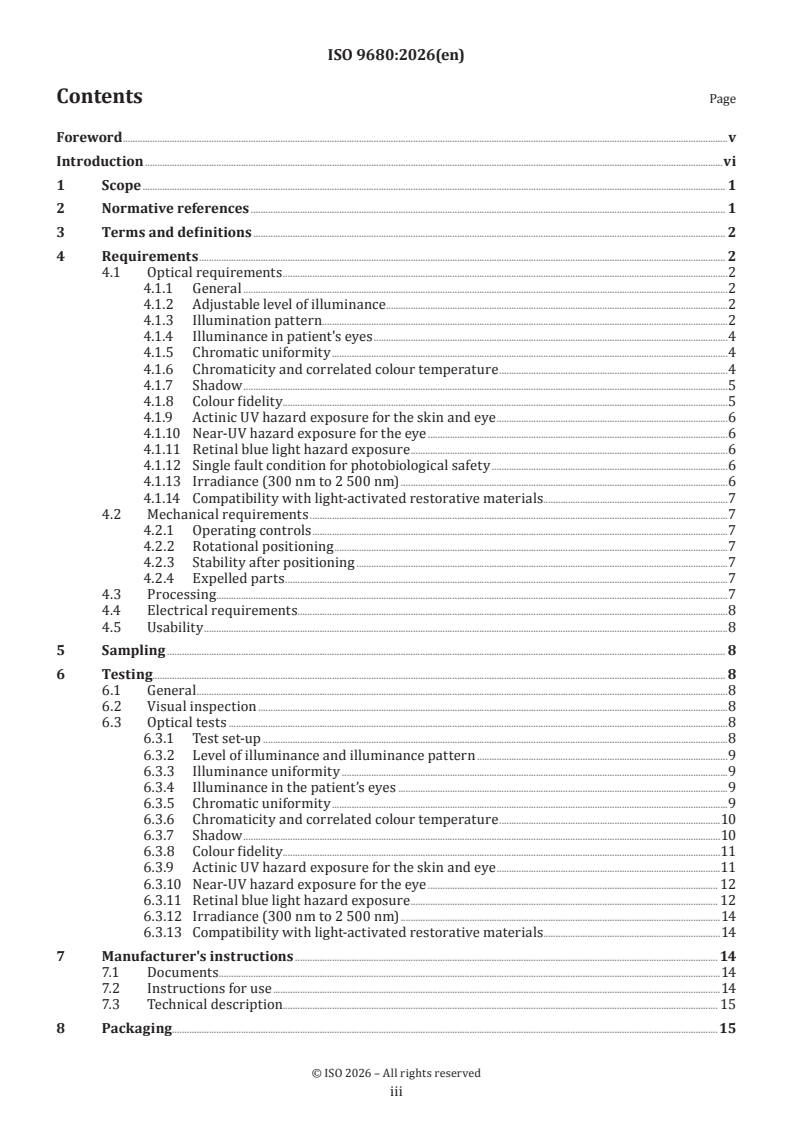
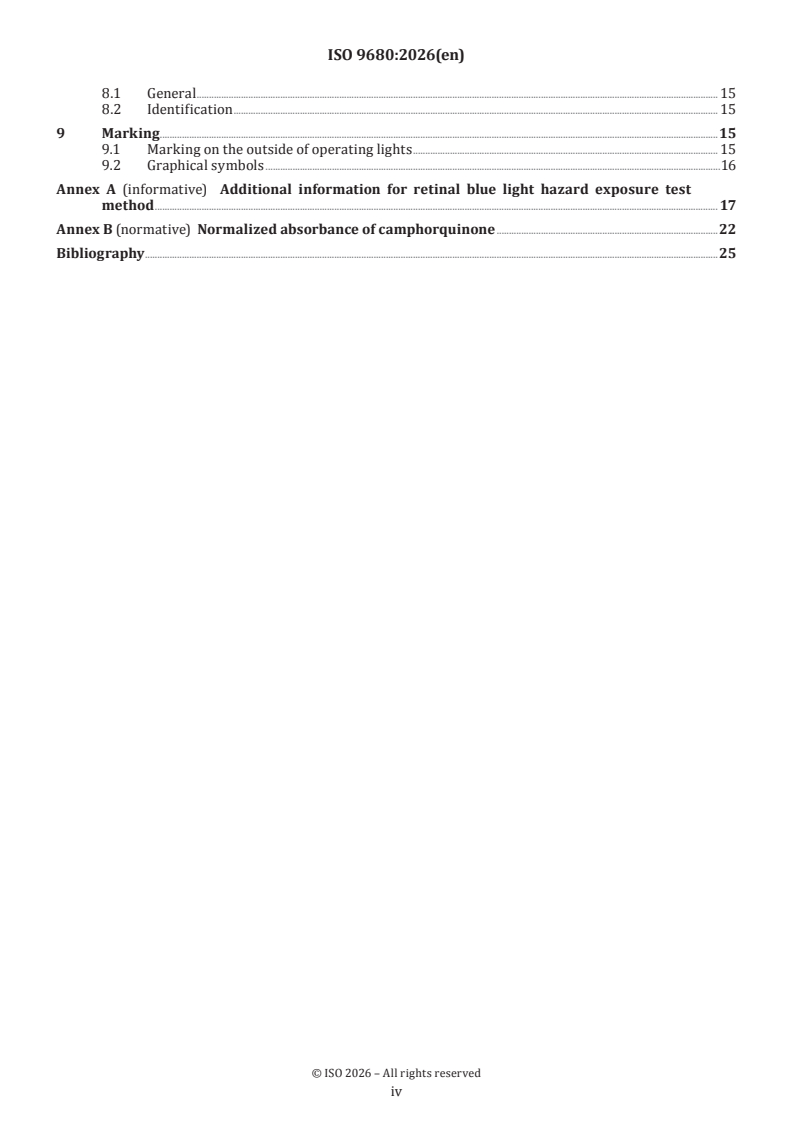
The document is organized as follows: scope, normative references, terms and definitions, requirements, sampling, testing, manufacturer’s instructions, packaging, marking, and two annexes.
| Annex | What it covers |
|---|---|
| Annex A | Additional information for the retinal blue light hazard exposure test method |
| Annex B | Normalized absorbance of camphorquinone for compatibility testing with light-activated restorative materials |
What are the key requirements of ISO 9680:2026?
ISO 9680:2026 is mainly about optical performance, photobiological safety, usability, and information supplied by the manufacturer. In practice, it tells a supplier what the operating light must do at a standardized test distance of 700 mm and what evidence to provide when the light is assessed.
Optical performance requirements
Clause 4.1 requires the illuminance to be adjustable, either continuously or in steps, and the manufacturer’s specified maximum at the highest setting must be at least 15 000 lx. The measured values at the lowest and highest settings must stay within 20% of the declared values, so the light output is not only adjustable but also consistent with the stated performance.
Clause 4.1.3 defines the illumination pattern through iso-illuminance lines and areas A and B. These controls matter because they show how wide the usable working field is and whether the central light is large enough for routine dental work.
Clause 4.1.4 limits illuminance in the patient’s eyes. This is important because the operator needs good visibility without shining excessive light into the patient’s line of sight.
Clause 4.1.5 to 4.1.8 cover chromatic uniformity, chromaticity and correlated colour temperature, shadow reduction, and colour fidelity. These requirements matter in practice because dentists need stable colour perception for diagnosis and treatment, and the light should not create strong colour shifts, harsh shadows, or poor colour rendering.
Photobiological safety and restorative materials
Clause 4.1.9 to 4.1.12 address actinic UV hazard, near-UV hazard, retinal blue light hazard, and single fault condition analysis. The operating light is assessed using the photobiological risk group framework from IEC 62471, and the single fault condition check makes sure a fault does not push the light into a higher hazard level.
Clause 4.1.13 limits irradiance over 300 nm to 2 500 nm at maximum illuminance. Clause 4.1.14 then checks compatibility with light-activated restorative materials, using camphorquinone-weighted irradiance. That matters when a light has a special setting for curing-related work, because the setting must still give enough light for use while avoiding excessive exposure that could affect materials or safety.
Mechanical, processing, electrical and usability requirements
Clause 4.2 requires operating controls to be arranged to reduce accidental activation, and it calls for graphical symbols in line with ISO 9687. It also addresses positioning, stability after positioning, and protection against expelled parts if a light source can shatter.
Clause 4.3 requires exterior touchable parts to tolerate the manufacturer’s recommended cleaning, disinfection or sterilization processes without damage to surfaces or labelling. The manufacturer must provide processing information in line with ISO 17664-1 and ISO 17664-2, and the handles should preferably be sterilizable or accept reusable sterilizable covers.
Clause 4.4 requires suitability for continuous operation, and clause 4.5 requires usability evaluation according to IEC 62366-1. In practice, this means the lamp must fit normal clinical use, be practical to clean, and be usable without unnecessary control errors.
What terms does ISO 9680:2026 define?
- Operating light - a device for illuminating the oral cavity of a patient, including a fixed base and an adjustable arm.
- Light-activated restorative material - a dental material for oral use whose polymerization is activated by light.
- Risk group classification - the photobiological safety classification used in IEC 62471 to judge whether a lamp is exempt, Risk Group 1, or higher.
- Correlated colour temperature - the colour appearance measure used to check whether the light stays within the specified colour temperature range during testing.
- General colour fidelity index, Rf - the colour fidelity measure used here to judge whether the operating light renders dental colours accurately enough for general oral-cavity illumination.
- Camphorquinone-weighted irradiance - the irradiance weighted by the normalized absorbance of camphorquinone to assess compatibility with light-activated restorative materials.
Who uses ISO 9680:2026?
ISO 9680:2026 is used by manufacturers of dental operating lights when designing products, writing instructions, and preparing technical files. It is also used by test laboratories and certification bodies when carrying out type tests for optical performance, photobiological safety, packaging, and marking.
Dentists, dental equipment planners, procurement teams, and quality managers use it to compare products and check whether an operating light is suitable for clinical use. Service and installation teams use it for assembly, mounting, electrical supply, and processing information.
What changed in ISO 9680:2026 from the previous edition?
ISO 9680:2026 is the fifth edition and it cancels and replaces ISO 9680:2021.
- Clause 4 “Classification” was deleted, and the later clauses were renumbered.
- Clause 5 “Requirements and Recommendations” was adapted into Clause 4 “Requirements” and technically updated.
- Clause 6 “Testing” was technically updated.
- Subclause 7.4 “Mechanical tests” from the previous edition was deleted.
- Clause 9 “Marking” was technically updated.
- Annex A “Transformation formulae” from the previous edition was deleted.
- A new informative Annex A was added for the retinal blue light hazard exposure test method.
- The normative and bibliographic references were updated.
- Editorial updates were made.
Which standards are used with ISO 9680:2026?
| Standard | What it contributes |
|---|---|
| ISO 1942 | Dentistry vocabulary used in the document |
| ISO 4073 | Information system for the location of dental equipment |
| ISO 9687 | Graphical symbols for dental equipment |
| ISO 14971 | Risk management for medical devices, used for expelled parts and hazard analysis |
| ISO 15223-1 | Symbols for information supplied by the manufacturer |
| ISO 17664-1 | Processing information for critical and semi-critical medical devices |
| ISO 17664-2 | Processing information for non-critical medical devices |
| ISO/CIE 19476 | Characterization of illuminance meters and luminance meters |
| ISO 21530 | Resistance to chemical disinfectants for dental equipment surfaces |
| IEC 60598-1 | General requirements and tests for luminaires |
| IEC 60601-1 | Basic safety and essential performance of medical electrical equipment |
| IEC 62366-1 | Usability engineering process for medical devices |
| IEC 62471 and IEC 62471:2006 | Photobiological safety classification and exposure calculations |
| CIE 224 | Colour Fidelity Index used for the colour fidelity requirement |
| CIE S 017 | International Lighting Vocabulary |
What does the ISO 9680:2026 document contain?
ISO 9680:2026 contains detailed optical test methods for illuminance, pattern shape, patient-eye illuminance, chromatic uniformity, chromaticity, shadow reduction, colour fidelity, UV hazards, and compatibility with light-activated restorative materials. It gives test set-ups, measurement conditions, plotting methods, and formulas for calculating hazard and compatibility values.
The document also includes manufacturer information requirements, packaging and identification rules, and marking requirements, plus figures for illumination patterns and shadow testing. Annex A provides an alternative method for retinal blue light hazard testing, and Annex B provides the camphorquinone absorbance data used in compatibility calculations.
Relations
- Effective Date
- 12-Feb-2026
- Effective Date
- 03-Dec-2022
- Effective Date
- 08-Oct-2022
Buy Documents
ISO 9680:2026 - Dentistry — Operating lights
ISO 9680:2026 - Médecine bucco-dentaire — Luminaires opératoires
Get Certified
Connect with accredited certification bodies for this standard

BSI Group
BSI (British Standards Institution) is the business standards company that helps organizations make excellence a habit.

TÜV Rheinland
TÜV Rheinland is a leading international provider of technical services.

TÜV SÜD
TÜV SÜD is a trusted partner of choice for safety, security and sustainability solutions.
Sponsored listings
Frequently Asked Questions
ISO 9680:2026 is a standard published by the International Organization for Standardization (ISO). Its full title is "Dentistry — Operating lights". This standard covers: This document specifies requirements and test methods for operating lights used in dental treatment and intended for illuminating the oral cavity of patients. It also contains specifications on the instructions for use, marking and packaging. This document applies to operating lights, irrespective of the technology of the light source. This document excludes auxiliary light sources and those intended for patient contact, e.g. from dental handpieces and dental headlamps, fibreoptic intraoral operating lights and operating lights which are specifically designed for use in oral surgery.
This document specifies requirements and test methods for operating lights used in dental treatment and intended for illuminating the oral cavity of patients. It also contains specifications on the instructions for use, marking and packaging. This document applies to operating lights, irrespective of the technology of the light source. This document excludes auxiliary light sources and those intended for patient contact, e.g. from dental handpieces and dental headlamps, fibreoptic intraoral operating lights and operating lights which are specifically designed for use in oral surgery.
ISO 9680:2026 is classified under the following ICS (International Classification for Standards) categories: 11.060.20 - Dental equipment. The ICS classification helps identify the subject area and facilitates finding related standards.
ISO 9680:2026 has the following relationships with other standards: It is inter standard links to EN ISO 9680:2026, ISO/TR 23750:2021, ISO 9680:2021. Understanding these relationships helps ensure you are using the most current and applicable version of the standard.
ISO 9680:2026 is available in PDF format for immediate download after purchase. The document can be added to your cart and obtained through the secure checkout process. Digital delivery ensures instant access to the complete standard document.
Standards Content (Sample)
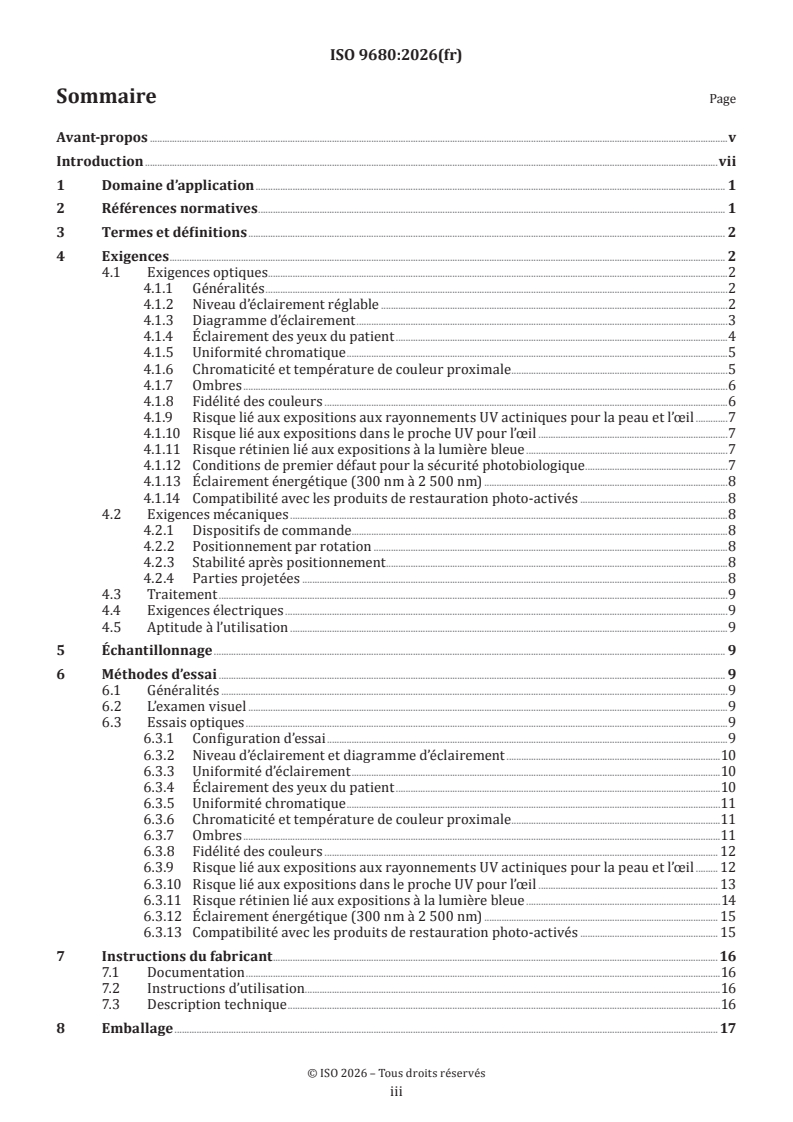
Contents
- Introduction
- 1 Scope
- 2 Normative references
- 3 Terms and definitions
- 3.1 operating light
- 3.2 light-activated restorative material
- 4 Requirements
- 4.1 Optical requirements
- 4.2 Mechanical requirements
- 4.3 Processing
- 4.4 Electrical requirements
- 4.5 Usability
- 5 Sampling
- 6 Testing
- 6.1 General
- 6.2 Visual inspection
- 6.3 Optical tests
- 7 Manufacturer's instructions
- 7.1 Documents
- 7.2 Instructions for use
- 7.3 Technical description
- 8 Packaging
- 8.1 General
- 8.2 Identification
- 9 Marking
- 9.1 Marking on the outside of operating lights
- 9.2 Graphical symbols
- Annex A
- Annex B
- Bibliography
Introduction
This document provides dentists and their staff with means to work with optimum visual ease and comfort in all zones without adversely affecting their perception of colour or causing excessive fatigue or photobiological injury.
In this document, the safety of an operating light is assessed in combination with its power supply. Such power supplies may be incorporated in dental units or dental patient chairs. Any item of equipment recommended by the manufacturer for use in conjunction with an operating light should not render the equipment unsafe nor affect its qualities adversely. [1] IEC 60598-1 has been taken into account during the preparation of this document. [2] IEC 60601-1 specifies requirements pertaining to the basic safety and essential performance of medical [3] electrical equipment and medical electrical systems. IEC 80601-2-60 specifies requirements pertaining to the basic safety and essential performance of dental units, dental patient chairs, dental handpieces and [2] [3] dental operating lights. The requirements of IEC 60601-1 and IEC 80601-2-60 that are applicable to operating lights are not duplicated in this document.
International Standard ISO 9680:2026(en) Dentistry — Operating lights
1 Scope
This document specifies requirements and test methods for operating lights used in dental treatment and intended for illuminating the oral cavity of patients. It also contains specifications on the instructions for use, marking and packaging.
This document applies to operating lights, irrespective of the technology of the light source. This document excludes auxiliary light sources and those intended for patient contact, e.g. from dental handpieces and dental headlamps, fibreoptic intraoral operating lights and operating lights which are specifically designed for use in oral surgery.
2 Normative references
The following documents are referred to in the text in such a way that some or all of their content constitutes requirements of this document. For dated references, only the edition cited applies. For undated references, the latest edition of the referenced document (including any amendments) applies. ISO 1942, Dentistry — Vocabulary ISO 4073, Dentistry — Information system on the location of dental equipment in the working area of the oral health care provider ISO 9687, Dentistry — Graphical symbols for dental equipment ISO 14971, Medical devices — Application of risk management to medical devices ISO 15223-1, Medical devices — Symbols to be used with information to be supplied by the manufacturer — Part 1: General requirements ISO 17664-1, Processing of health care products — Information to be provided by the medical device manufacturer for the processing of medical devices — Part 1: Critical and semi-critical medical devices ISO 17664-2, Processing of health care products — Information to be provided by the medical device manufacturer for the processing of medical devices — Part 2: Non-critical medical devices ISO/CIE 19476, Characterization of the performance of illuminance meters and luminance meters ISO 21530, Dentistry — Materials used for dental equipment surfaces — Determination of resistance to chemical disinfectants IEC 60598-1, Luminaires - Part 1: General requirements and tests IEC 60601-1, Medical electrical equipment - Part 1: General requirements for basic safety and essential performance IEC 62366-1, Medical devices — Part 1: Application of usability engineering to medical devices IEC 62471, Photobiological safety of lamps and lamp systems IEC 62471:2006, Photobiological safety of lamps and lamp systems CIE 224, Colour Fidelity Index for accurate scientific use CIE S 017, ILV: International Lighting Vocabulary
ISO 9680:2026(en)
3 Terms and definitions
For the purposes of this document, the terms and definitions given in ISO 1942, ISO 4073, IEC 60598-1, IEC 60601-1, CIE S 017 and the following apply.
ISO and IEC maintain terminology databases for use in standardization at the following addresses:
- IEC Electropedia: available at http:// www .electropedia .org/
- ISO Online browsing platform: available at http:// www .iso .org/ obp
3.1 operating light
device for illuminating the oral cavity of a patient, which includes a fixed base and an adjustable arm
3.2 light-activated restorative material
dental material intended for oral use that incorporates a monomer system, and the polymerization is activated by light
4 Requirements
4.1 Optical requirements
4.1.1 General
Optical requirements are specified at a distance of 700 mm. This standardized measurement distance enables comparison of manufacturer specifications for different operating lights under the same conditions. For clarity, the design of an operating light may be optimized for other distances and optical properties may be reported by the manufacturer at additional distances at their discretion.
4.1.2 Adjustable level of illuminance
The level of illuminance shall be adjustable. The adjustment of illuminance may be either continuous or in discrete levels.
The manufacturer shall provide specifications corresponding to the lowest and highest illuminance settings for the maximum illuminance on a plane perpendicular to the optical axis at a distance of 700 mm from the operating light. The manufacturer’s specification for illuminance at the highest illuminance setting shall be at least 15 000 lx. The measured maximum illuminance values at the lowest and highest illuminance settings shall be within 20% of their respective specifications. Test in accordance with 6.2 and 6.3.2.
The requirements of 4.1.2 do not apply to any operating mode(s) intended only for use while handling lightactivated restorative materials.
4.1.3 Illumination pattern
4.1.3.1 Illumination areas and illuminance levels
The illumination pattern shall be measured with the operating light adjusted to the maximum illuminance level to determine the maximum illuminance, E , and the following iso-illuminance lines in accordance v,max with 6.3.2: 0,90 × E , 0,75 × E , 0,50 × E , 0,10 × E and 1 200 lx. v,max v,max v,max v,max An area A is defined as the area bounded by the iso-illuminance line corresponding to 75 % of the maximum illuminance. The border of area A shall be on or outside of an ellipse with a horizontal axis of 50 mm and a vertical axis of 25 mm, in which the horizontal axis and vertical axis of the ellipse are aligned with the major
ISO 9680:2026(en) axis and minor axis of the illumination pattern, respectively (see Figure 1). The illuminance shall not be less than 75 % of E throughout the ellipse. Test in accordance with 6.3.2. v,max An area B is defined as the area bounded by the iso-illuminance line corresponding to 50 % of the maximum illuminance. The border of area B shall be on or outside of an ellipse with a horizontal axis of 80 mm and a vertical axis of 40 mm and with the same axes as the smaller ellipse associated with area A (see Figure 2). Test in accordance with 6.3.2.
Dimensions in millimetres Key A illumination area A Figure 1 — Example of illumination pattern which satisfies the requirement for area A Dimensions in millimetres Key B illumination area B Figure 2 — Example of illumination pattern which satisfies the requirement for area B
4.1.3.2 Illuminance uniformity
The illuminance shall decrease in intensity progressively and smoothly toward the pattern edge.
ISO 9680:2026(en) Test in accordance with 6.3.3.
4.1.4 Illuminance in patient's eyes
An area C is defined as the area bounded by the iso-illuminance line corresponding to 90 % of the maximum illuminance. The level of illuminance at all points on or above a horizontal line 60 mm above the uppermost point of area C shall not be greater than 1200 lx (see Figure 3). Test in accordance with 6.3.4.
Dimensions in millimetres Key C illumination area C Figure 3 — Example of illumination pattern which satisfies the requirement for limiting illuminance in the patient’s eyes
4.1.5 Chromatic uniformity
No perceptible chromatic variation (colour separation) of the light incident upon the measuring screen shall be visible in area A and area B.
Test in accordance with 6.3.5.
4.1.6 Chromaticity and correlated colour temperature
Over the full range of illuminance levels, the correlated colour temperature shall be in the range of 3 600 K to 6 400 K within areas A and B of the illuminance pattern. D [the perpendicular distance in the 1960 uv CIE Uniform Chromaticity Scale (u, v) between the Planckian locus and the chromaticity coordinates of the operating light] shall be within the range of −0,01 to +0,01.
For reference, the chromaticity limits in CIE (u, v) coordinates are depicted in Figure 4.
ISO 9680:2026(en) When the operating light is adjusted to the maximum illuminance level, the correlated colour temperature should be between 4 500 K and 6 400 K.
Test in accordance with 6.3.6.
The requirements of 4.1.6 do not apply to any operating modes intended only for use while handling lightactivated restorative materials. Key v 1960 CIE Uniform Chromaticity Scale v-coordinate u 1960 CIE Uniform Chromaticity Scale u-coordinate Planckian locus Chromaticity limits Figure 4 — Chromaticity limits in CIE (u, v) coordinates
4.1.7 Shadow
The darkest shadow of a disc with 20 mm diameter at a distance of 50 mm shall have a maximum diameter not greater than 12 mm.
Test in accordance with 6.3.7.
4.1.8 Colour fidelity
For general illumination of the oral cavity, the operating light shall have a general colour fidelity index, R , of f at least 85.
NOTE The importance of accurately assessing colour in dental diagnosis and treatment while using an operating [4] light supports specifying R as the measure for colour fidelity in this document even though CIE 224 indicates that f R is not intended as a universal replacement for the general colour rendering index, R , at this time. The decision to f a specify R in this document was made in consultation with CIE.
f Test in accordance with 6.3.8.
ISO 9680:2026(en) The requirements of 4.1.8 do not apply to any operating modes intended only for use while handling lightactivated restorative materials.
4.1.9 Actinic UV hazard exposure for the skin and eye
The risk group classification of the operating light for actinic ultraviolet hazard (E ) shall be Risk Group 1 s or lower, as specified in IEC 62471:2006, 6.1, when tested under the conditions specified in 6.3.9. Unless the operating light is classified as an exempt group for actinic ultraviolet hazard, the permissible exposure duration, t , per IEC 62471:2006, 4.3.1 shall be calculated in accordance with 6.3.9. max Conformity with this requirement shall be verified either by documentation (e.g. a test report by the light source manufacturer) which verifies that all of the light sources used in the operating light do not emit in the applicable wavelength range (200 nm to 400 nm), or by testing in accordance with 6.3.9.
4.1.10 Near-UV hazard exposure for the eye
The risk group classification of the operating light for near-UV hazard (E ) shall be Risk Group 1 or lower, UVA as specified in IEC 62471:2006, 6.1, when tested under the conditions specified in 6.3.10. Unless the operating light is classified as exempt group for near-UV hazard, the permissible exposure duration, t , per IEC 62471:2006, 4.3.2 shall be calculated in accordance with 6.3.10. max Conformity with this requirement shall be verified either by documentation (e.g. a test report by the light source manufacturer) which verifies that all of the light sources used in the operating light do not emit in the applicable wavelength range (315 nm to 400 nm), or by testing in accordance with 6.3.10.
4.1.11 Retinal blue light hazard exposure
The risk group classification for retinal blue light hazard (L ) per IEC 62471:2006, 6.1 shall be Risk Group 1 B or lower when tested under the conditions specified in 6.3.11. Unless the operating light is classified as exempt group for retinal blue light hazard, the permissible exposure duration, t , per IEC 62471:2006, 4.3.3 shall be calculated in accordance with 6.3.11. max Test in accordance with 6.3.11.
4.1.12 Single fault condition for photobiological safety
Analysis under single fault condition shall be applied to the requirements for actinic UV exposure for skin and eye (see 4.1.9), near-UV exposure for the eye (see 4.1.10) and retinal blue light hazard exposure (see [5] 4.1.11). The operating light shall be considered single fault safe (see IEC 60601-1:2005 , 4.7) if the risk group classification of the operating light does not exceed Risk Group 2 given in IEC 62471:2006, 6.1 under single fault condition.
NOTE 1 A single fault condition, such as a short circuit or an open circuit of any component other than a component with high-integrity characteristics or a software failure, can lead to a higher light emitting diode (LED) driving current, increased light emission and a higher photobiological risk group classification. NOTE 2 Analysis of the photobiological safety in single fault condition can be conducted based on the change in illuminance under single fault condition relative to illuminance under normal conditions if the emission spectrum in single fault condition is equivalent to the emission spectrum in normal conditions.
4.1.13 Irradiance (300 nm to 2 500 nm)
The irradiance over the wavelength range of 300 nm to 2 500 nm shall be ≤350 W/m at the maximum illuminance level at a distance of 700 mm from the operating light. Test in accordance with 6.3.12.
ISO 9680:2026(en)
4.1.14 Compatibility with light-activated restorative materials
If the operating light is equipped with a setting intended for use while handling light-activated restorative materials, the maximum illuminance in this setting shall be at least 6 500 lx and the camphorquinone-
weighted irradiance shall be less than 3,0 W/m when tested under the conditions specified in 6.3.13. The camphorquinone-weighted irradiance is the integral of the product of the operating light irradiance spectrum and the normalized absorption spectrum of camphorquinone over the wavelength range of 400 nm to 515 nm (see 6.3.13).
NOTE The photo-initiator systems of commercial dental restorative materials are currently based on one or more of the following: camphorquinone, 1-phenyl-1,2 propanedione or acylphosphine oxides. Each of these photoinitiators has a different absorbance spectrum. Since the absorbance spectrum of camphorquinone extends to longer wavelengths than the other photo-initiators, the overlap with the emission spectrum of operating lights is greatest with camphorquinone. Therefore, the camphorquinone absorbance spectrum is expected to represent the worst-case challenge for evaluating possible effects of dental operating lights on light-activated restorative materials. Test in accordance with 6.3.13.
4.2 Mechanical requirements
4.2.1 Operating controls
Operating controls shall be designed and located to minimize accidental activation. Graphical symbols for operating controls and performance shall be in accordance with ISO 9687.
4.2.2 Rotational positioning
The operating light should be capable of rotating about the x-, y- and z-axes of the Cartesian coordinate system to allow the operator maximum flexibility in positioning the operating light while preventing excessive illuminance in the patient’s eyes.
EXAMPLE 1 Rotation of the operating light about the x-, y- and z-axes of the Cartesian coordinate system can be achieved by three rotational pivot axes incorporated into the positioning arm of an operating light, even if the three rotational pivot axes are not perpendicular to one another.
EXAMPLE 2 Rotation of the operating light about the x-, y- and z-axes of the Cartesian coordinate system can be achieved by a ball-and-socket joint incorporated into the positioning arm of an operating light.
4.2.3 Stability after positioning
Operating lights should be free from apparent drift when positioned.
4.2.4 Expelled parts
The operating light shall be designed to provide protection against the effects of the shattering of its light source if it is possible for the light source to shatter. This requirement is not relevant for LED light sources. The operating light shall be designed such that particles from a shattering light source cannot impair safety. This shall be verified by appropriate risk analysis in accordance with ISO 14971.
4.3 Processing
All exterior touchable parts of the operating light shall be suitable for processing using the agents and methods recommended by the manufacturer without deterioration of surfaces or labelling. The manufacturer shall provide information on the processing for the operating light in accordance with ISO 17664-1 and ISO 17664-2, as applicable. Preferably, the handles should be sterilizable or capable of accommodating reusable, sterilizable covers.
Testing of resistance against cleaning and disinfection shall be carried out in accordance with ISO 21530.
ISO 9680:2026(en)
4.4 Electrical requirements
Operating lights shall be suitable for continuous operation. Conformity shall be verified by checking the manufacturer’s documentation.
NOTE The designation of continuous operation is relevant to determining the applicability of certain electrical [2] [3] requirements of IEC 60601-1 and IEC 80601-2-60 .
4.5 Usability
Usability evaluation shall be carried out following the process described in IEC 62366-1. Testing shall be carried out in accordance with IEC 62366-1.
5 Sampling
All type tests shall be made on one representative sample of the operating light.
6 Testing
6.1 General
All tests described in this document are type tests.
Testing shall be performed at an ambient temperature of (23 ± 2) °C. The relative humidity shall be between 30 % and 70 %.
All measurements of optical radiation shall be traceable to the International System of Units. See [6] ISO/IEC 17025:2017 , 6.5.2 for more information.
6.2 Visual inspection
Visual inspection shall be performed at normal visual acuity without magnification.
...
Contents
- Introduction
- 1 Domaine d’application
- 2 Références normatives
- 3 Termes et définitions
- 3.1 luminaire opératoire
- 3.2 produit de restauration photo-activé
- 4 Exigences
- 4.1 Exigences optiques
- 4.2 Exigences mécaniques
- 4.3 Traitement
- 4.4 Exigences électriques
- 4.5 Aptitude à l’utilisation
- 5 Échantillonnage
- 6 Méthodes d’essai
- 6.1 Généralités
- 6.2 L’examen visuel
- 6.3 Essais optiques
- 7 Instructions du fabricant
- 7.1 Documentation
- 7.2 Instructions d’utilisation
- 7.3 Description technique
- 8 Emballage
- 8.1 Généralités
- 8.2 Identification
- 9 Marquage
- 9.1 Marquage appliqué sur l’extérieur des luminaires opératoires
- 9.2 Symboles graphiques
- Annexe A
- Annexe B
- Bibliographie
Introduction
Le présent document fournit aux dentistes et à leurs équipes des moyens de travailler avec un bien-être et un confort visuels maximaux dans toutes les zones, sans affecter négativement leur perception de la couleur, ni provoquer une fatigue excessive ou des lésions photobiologiques. Dans le présent document, la sécurité d’un luminaire opératoire est évaluée conjointement avec son alimentation électrique. Ces sources d’alimentation peuvent être intégrées dans les unités dentaires ou dans les fauteuils dentaires.
Il convient que tout élément de matériel recommandé par le fabricant pour une utilisation en association avec un luminaire opératoire ne rende pas le matériel dangereux et n’affecte pas négativement ses performances. [1] L’IEC 60598-1 a été prise en compte lors de la préparation du présent document. [2] L’IEC 60601-1 spécifie les exigences relatives à la publication fondamentale de sécurité et aux performances [3] essentielles des appareils et systèmes électromédicaux. L’IEC 80601-2-60 spécifie les exigences relatives à la publication fondamentale de sécurité et aux performances essentielles des unités dentaires, des fauteuils dentaires, des pièces à main dentaires et des luminaires opératoires dentaires. Les exigences de [2] [3] l’ IEC 60601-1 et de l’IEC 80601-2-60 applicables aux luminaires opératoires ne sont pas dupliquées dans le présent document.
Norme internationale ISO 9680:2026(fr) Médecine bucco-dentaire — Luminaires opératoires
1 Domaine d’application
Le présent document spécifie les exigences et les méthodes d’essai relatives aux luminaires opératoires utilisées durant un traitement dentaire et destinées à éclairer la cavité buccale des patients. Il contient également des spécifications relatives aux instructions d’utilisation, au marquage et à l’emballage. Le présent document s’applique aux luminaires opératoires, quelle que soit la technologie de la source lumineuse.
Le présent document exclut les sources lumineuses auxiliaires et celles destinées à être en contact avec le patient, par exemple celles provenant des pièces à main dentaires et des lampes frontales dentaires, des luminaires opératoires intra-buccaux à fibre optique et des luminaires opératoires spécifiquement conçus pour une utilisation en chirurgie buccale.
2 Références normatives
Les documents suivants sont cités dans le texte de sorte qu’ils constituent, pour tout ou partie de leur contenu, des exigences du présent document. Pour les références datées, seule l’édition citée s’applique. Pour les références non datées, la dernière édition du document de référence s’applique (y compris les éventuels amendements).
ISO 1942, Médecine bucco-dentaire — Vocabulaire ISO 4073, Art dentaire — Système d'informations relatif à la localisation du matériel dentaire sur le poste de travail du prestataire de soins bucco-dentaires ISO 9687, Médecine bucco-dentaire — Symboles graphiques pour matériel dentaire ISO 14971, Dispositifs médicaux — Application de la gestion des risques aux dispositifs médicaux ISO 15223-1, Dispositifs médicaux — Symboles à utiliser avec les informations à fournir par le fabricant — Partie 1: Exigences générales ISO 17664-1, Traitement de produits de soins de santé — Informations relatives au traitement des dispositifs médicaux à fournir par le fabricant du dispositif — Partie 1: Dispositifs médicaux critiques et semi-critiques ISO 17664-2, Traitement de produits de soins de santé — Informations relatives au traitement des dispositifs médicaux à fournir par le fabricant du dispositif — Partie 2: Dispositifs médicaux non critiques ISO/CIE 19476, Caractérisation des performances des luxmètres et des luminancemètres ISO 21530, Art dentaire — Matériaux utilisés pour les surfaces du matériel dentaire — Détermination de la résistance aux désinfectants chimiques IEC 60598-1, Luminaires — Partie 1: Exigences générales et essais IEC 60601-1, Appareils électromédicaux — Partie 1: Exigences générales pour la sécurité de base et les performances essentielles IEC 62366-1, Dispositifs médicaux — Partie 1: Application de l'ingénierie de l'aptitude à l'utilisation aux dispositifs médicaux IEC 62471, Sécurité photobiologique des lampes et des appareils utilisant des lampes
ISO 9680:2026(fr) IEC 62471:2006, Sécurité photobiologique des lampes et des appareils utilisant des lampes CIE 224, Colour Fidelity Index for accurate scientific use (disponible en anglais seulement) CIE S 017, ILV: International Lighting Vocabulary
3 Termes et définitions
Pour les besoins du présent document, les termes et les définitions de l’ISO 1942, ISO 4073, IEC 60598-1, IEC 60601-1, CIE S 017 ainsi que les suivants, s’appliquent.
L’ISO et l’IEC tiennent à jour des bases de données terminologiques destinées à être utilisées en normalisation, consultables aux adresses suivantes:
- IEC Electropedia: disponible à l’adresse http:// www .electropedia .org/
- ISO Online browsing platform: disponible à l’adresse https:// www .iso .org/ obp
3.1 luminaire opératoire
dispositif destiné à éclairer la cavité buccale d’un patient, qui comprend une base fixe et un bras réglable
3.2 produit de restauration photo-activé
produit dentaire destiné à une utilisation buccale, qui intègre un système monomère dont la polymérisation est photo initiée
4 Exigences
4.1 Exigences optiques
4.1.1 Généralités
Les exigences optiques sont spécifiées à une distance de 700 mm. Cette distance de mesure normalisée permet de comparer les spécifications du fabricant pour différents luminaires opératoires dans les mêmes conditions. Pour plus de clarté, la conception d’un luminaire opératoire peut être optimisée pour d’autres distances et les propriétés optiques peuvent être consignées par le fabricant à des distances supplémentaires à sa discrétion.
4.1.2 Niveau d’éclairement réglable
Le niveau d’éclairement doit être réglable. Le réglage de l’éclairement peut s’effectuer soit en continu, soit selon des niveaux discrets.
Le fabricant doit fournir des spécifications correspondant aux réglages d’éclairement le plus faible et le plus élevé pour l’éclairement maximal sur un plan perpendiculaire à l’axe optique à une distance de 700 mm du luminaire opératoire. La spécification du fabricant pour l’éclairement au réglage le plus élevé doit être d’au moins 15 000 lx. Les valeurs d’éclairement maximales mesurées aux réglages d’éclairement le plus bas et le plus haut doivent être dans les limites de 20 % de leurs spécifications respectives. Essai effectué conformément à 6.2 et 6.3.2.
Les exigences du paragraphe 4.1.2 ne s’appliquent pas aux modes de fonctionnement destinés à être utilisés uniquement lors de la manipulation de produits de restauration photo-activés.
ISO 9680:2026(fr)
4.1.3 Diagramme d’éclairement
4.1.3.1 Zones et niveaux d’éclairement
Le diagramme d’éclairement doit être mesuré avec le luminaire opératoire réglée au niveau d’éclairement maximal afin de déterminer d’une part l’éclairement maximal, E , et d’autre part les lignes v,max d’isoéclairement suivantes, conformément à 6.3.2: 0,90 × E , 0,75 × E , 0,50 × E , 0,10 × E and v,max v,max v,max v,max 1 200 lx.
Une zone A est définie comme étant la zone délimitée par la ligne d’isoéclairement correspondant à 75 % de l’éclairement maximal. La limite de la zone A doit se trouver sur ou en dehors d’une ellipse de 50 mm d’axe horizontal et de 25 mm d’axe vertical, et dont l’axe horizontal et l’axe vertical sont respectivement alignés sur le grand axe et le petit axe du diagramme d’éclairement (voir Figure 1). L’éclairement ne doit pas être inférieur à 75 % de E dans toute l’ellipse. Essai effectué conformément à 6.3.2. v,max Une zone B est définie comme étant la zone délimitée par la ligne d’isoéclairement correspondant à 50 % de l’éclairement maximal. La limite de la zone B doit se trouver sur ou en dehors d’une ellipse de 80 mm d’axe horizontal et de 40 mm d’axe vertical, et ayant les mêmes axes que l’ellipse, plus petite, liée à la zone A (voir Figure 2). Essai effectué conformément à 6.3.2.
Dimensions en millimètres Légende A zone éclairée A Figure 1 — Exemple de diagramme d’éclairement satisfaisant aux exigences relatives à la zone A
ISO 9680:2026(fr) Dimensions en millimètres Légende B zone éclairée B Figure 2 — Exemple de diagramme d’éclairement satisfaisant aux exigences relatives à la zone B
4.1.3.2 Uniformité d’éclairement
L’éclairement doit décroître en intensité, de manière progressive et régulière, vers la périphérie du diagramme.
Essai effectué conformément à 6.3.3.
4.1.4 Éclairement des yeux du patient
Une zone C est définie comme étant la zone délimitée par la ligne d’isoéclairement correspondant à 90 % de l’éclairement maximal. Le niveau d’éclairement en tout point situé sur ou au-dessus d’une ligne horizontale se trouvant à 60 mm au-dessus du point le plus proche des yeux du patient de la zone C ne doit pas être supérieur à 1 200 lx (voir Figure 3).
Essai effectué conformément à 6.3.4.
ISO 9680:2026(fr) Dimensions en millimètres Légende C zone éclairée C Figure 3 — Exemple de diagramme d’éclairement satisfaisant aux exigences relatives à la limitation de l’éclairement des yeux du patient
4.1.5 Uniformité chromatique
Aucune variation chromatique perceptible (séparation de couleur) de la lumière incidente sur l’écran de mesure ne doit être visible ni dans la zone A, ni dans la zone B. Essai effectué conformément à 6.3.5.
4.1.6 Chromaticité et température de couleur proximale
Sur toute la plage des niveaux d’éclairement, la température de couleur proximale doit être comprise entre 3 600 K et 6 400 K dans les zones A et B du diagramme d’éclairement. D [la distance perpendiculaire dans uv l’échelle chromatique uniforme CIE 1960 (u, v) entre le lieu des corps noirs et les coordonnées chromatiques du luminaire opératoire] doit être comprise entre −0,01 et +0,01. À titre de référence, les limites de chromaticité dans les coordonnées CIE (u, v) sont représentées à la Figure 4.
Lorsque le luminaire opératoire est réglé sur le niveau d’éclairement maximal, il convient que la température de couleur proximale soit, de préférence, comprise entre 4 500 K et 6 400 K. Essai effectué conformément à 6.3.6.
Les exigences du paragraphe 4.1.6 ne s’appliquent pas aux modes de fonctionnement destinés à être utilisés uniquement lors de la manipulation de produits de restauration photo-activés.
ISO 9680:2026(fr) Légende v coordonnées v de l’échelle chromatique uniforme CIE 1960 u coordonnées u de l’échelle chromatique uniforme CIE 1960 lieu des corps noirs limites de chromaticité Figure 4 — Limites de chromaticité dans les coordonnées CIE (u, v)
4.1.7 Ombres
L’ombre la plus sombre d’un disque de 20 mm de diamètre à une distance de 50 mm doit avoir un diamètre maximal ne dépassant pas 12 mm.
Essai effectué conformément à 6.3.7.
4.1.8 Fidélité des couleurs
Pour l’éclairement général de la cavité buccale, le luminaire opératoire doit présenter un indice de fidélité des couleurs, R , d’au moins 85.
f NOTE L’importance de l’évaluation précise de la couleur dans le diagnostic et le traitement dentaires lors de l’utilisation d’un luminaire opératoire justifie la spécification de R comme mesure de la fidélité des couleurs dans le f [4] présent document, bien que la CIE 224 indique R n’est pas destiné à servir de remplacement universel pour l’indice f général de rendu des couleurs, R , à l’heure actuelle. La décision de spécifier R dans le présent document a été prise en a f consultation avec la CIE.
Essai effectué conformément à 6.3.8.
Les exigences du paragraphe 4.1.8 ne s’appliquent pas aux modes de fonctionnement destinés à être utilisés uniquement lors de la manipulation de produits de restauration photo-activés.
ISO 9680:2026(fr)
4.1.9 Risque lié aux expositions aux rayonnements UV actiniques pour la peau et l’œil
En ce qui concerne la classification relative au risque ultraviolet actinique (E ), le luminaire opératoire doit s relever tout au plus du groupe de risque 1, tel que spécifié en 6.1 de l’IEC 62471:2006, lorsqu’il est soumis à essai selon les conditions spécifiées en 6.3.9 À moins que le luminaire opératoire soit classé dans le “groupe sans risque” pour le risque ultraviolet actinique, la durée d’exposition autorisée, t , au sens de max l’IEC 62471:2006, 4.3.1, doit être calculée conformément à 6.3.9. Le respect de cette exigence doit être vérifié soit au moyen de documents (par exemple, le rapport d’essai du fabricant de la source lumineuse) attestant qu’aucune des sources lumineuses utilisées dans le luminaire opératoire n’émet dans la plage de longueurs d’onde concernée (200 nm à 400 nm), soit au moyen d’essais réalisés conformément à 6.3.9.
4.1.10 Risque lié aux expositions dans le proche UV pour l’œil
En ce qui concerne la classification relative au risque dans le proche UV (E ), le luminaire opératoire doit UVA relever tout au plus du groupe de risque 1, tel que spécifié en 6.1 de l’IEC 62471:2006, lorsqu’il est soumis à essai selon les conditions spécifiées en 6.3.10.
À moins que le luminaire opératoire soit classé dans le “groupe sans risque” pour le risque du proche UV, la durée d’exposition autorisée, t , au sens de l’IEC 62471:2006, 4.3.2, doit être calculée conformément max à 6.3.10.
Le respect de cette exigence doit être vérifié soit au moyen de documents (par exemple, le rapport d’essai du fabricant de la source lumineuse) attestant qu’aucune des sources lumineuses utilisées dans le luminaire opératoire n’émet dans la plage de longueurs d’onde concernée (315 nm à 400 nm), soit au moyen d’essais réalisés conformément à 6.3.10.
4.1.11 Risque rétinien lié aux expositions à la lumière bleue
La classification relative au risque rétinien lié à la lumière bleue (L ), au sens de l’IEC 62471:2006, 6.1, doit B correspondre tout au plus au groupe de risque 1 lorsqu’il est soumis à essai selon les conditions spécifiées en 6.3.11.
À moins que le luminaire opératoire soit classé dans le “groupe sans risque” pour le risque rétinien lié aux expositions à la lumière bleue, la durée d’exposition autorisée, t , au sens de l’IEC 62471:2006, 4.3.3, doit max être calculée conformément à 6.3.11.
Essai effectué conformément à 6.3.11.
4.1.12 Conditions de premier défaut pour la sécurité photobiologique
Une analyse en condition de premier défaut doit être effectuée pour les exigences relatives aux expositions aux rayonnements UV actiniques pour la peau et l’œil (voir 4.1.9), aux expositions dans le proche UV pour l’œil (voir 4.1.10) et au risque rétinien lié aux expositions à la lumière bleue (voir 4.1.11). Le luminaire [5] opératoire doit être considéré comme “sécurisé en premier défaut” (voir l’IEC 60601-1:2005, 4.7) si sa classification en groupe de risque n’excède pas le groupe de risque 2 indiqué dans l’IEC 62471:2006, 6.1 en condition de premier défaut.
NOTE 1 Une condition de premier défaut, telle qu’un court-circuit ou l’ouverture du circuit de tout composant, autre qu’un composant aux caractéristiques à haute fiabilité, ou une défaillance logicielle, est susceptible d’entraîner une élévation du courant d’excitation des diodes électroluminescentes (LED), une augmentation de l’éclairement et une classification plus élevée dans les groupes de risques photobiologiques. NOTE 2 L’analyse de la sécurité photobiologique en condition de premier défaut peut être réalisée sur la base de la variation de l’éclairement en condition de premier défaut par rapport à l’éclairement en conditions normales si le spectre d’émission en condition de premier défaut est équivalent au spectre d’émission en conditions normales.
ISO 9680:2026(fr)
4.1.13 Éclairement énergétique (300 nm à 2 500 nm)
L’éclairement énergétique sur la plage de longueurs d’onde comprise entre 300 nm et 2 500 nm doit
être ≤ 350 W/m au niveau d’éclairement maximal à une distance de 700 mm du luminaire opératoire. Essai effectué conformément à 6.3.12.
4.1.14 Compatibilité avec les produits de restauration photo-activés
Si le luminaire opératoire est doté d’un programme destiné à être utilisé lors de la manipulation de produits de restauration photo-activés, l’éclairement maximum du programme doit être d’au moins 6 500 lx et
l’éclairement énergétique pondéré de la camphorquinone doit être inférieur à 3,0 W/m si elle est soumise à essai dans les conditions spécifiées en 6.3.13. L’éclairement énergétique pondéré du spectre d’absorbance de la camphoroquinone correspond à l’intégrale du produit du spectre d’éclairement énergétique du luminaire opératoire par celui du spectre d’absorption normalisé de la camphoroquinone sur la plage de longueurs d’onde comprise entre 400 nm et 515 nm (voir 6.3.13).
NOTE Les systèmes photo-initiateurs des produits de restauration dentaire disponibles dans le commerce se basent actuellement sur au moins une des substances suivantes: camphoroquinone, 1-phényl-1,2-propanedione ou oxydes d’acylphosphine. Chacun de ces photo-initiateurs possède un spectre d’absorbance différent. Étant donné que le spectre d’absorbance de la camphoroquinone s’étend sur des longueurs d’onde plus longues que les autres photoinitiateurs, le chevauchement avec le spectre d’éclairement des luminaires opératoires est plus important en utilisant cette substance. Par conséquent, le spectre d’absorbance de la camphoroquinone est supposé représenter le scénario le plus défavorable pour l’évaluation des effets éventuels des luminaires opératoires dentaires sur les produits de restauration photo-activés.
Essai effectué conformément à 6.3.13.
4.2 Exigences mécaniques
4.2.1 Dispositifs de commande
Les dispositifs de commande doivent être conçus et placés de façon à réduire au minimum le risque de mise en marche accidentelle. Les symboles graphiques et les performances des organes de commande doivent être conformes à l’ISO 9687.
4.2.2 Positionnement par rotation
Il convient que le luminaire opératoire puisse tourner autour des axes x, y et z, du système de coordonnées cartésiennes afin d’offrir une flexibilité de positionnement maximale à l’opérateur, tout en évitant un éclairement excessif des yeux du patient.
EXEMPLE 1 La rotation du luminaire opératoire autour des axes x, y et z du système de coordonnées cartésiennes peut être obtenue par trois axes de pivotement de rotation intégrés au bras de positionnement d’un luminaire opératoire, même si les trois axes de pivotement de rotation ne sont pas perpendiculaires l’un à l’autre. EXEMPLE 2 La rotation du luminaire opératoire autour des axes x, y et z du système de coordonnées cartésiennes peut être réalisée par un joint à rotule intégré au bras de positionnement d’un luminaire opératoire.
4.2.3 Stabilité après positionnement
Il convient que les luminaires opératoires soient exempts de dérive apparente lorsqu’ils sont positionnés.
4.2.4 Parties projetées
Le luminaire opératoire doit être conçu pour assurer une protection contre les effets du bris de sa source lumineuse, s’il est possible que sa source lumineuse se brise. Cette exigence ne s’applique pas aux sources lumineuses à LED.
ISO 9680:2026(fr) Le luminaire opératoire doit être conçu de sorte que les éclats produits par le bris de la source lumineuse ne puissent pas compromettre la sécurité. Ce point doit être vérifié par une analyse du risque appropriée, conformément à l’ISO 14971.
...