

ISO 18944:2018
(Main)Imaging materials — Reflection colour photographic prints — Test print construction and measurement
General Information
- Abstract
This document specifies requirements and recommendations for the digital test file content, printer setups and printing procedures that are used to generate target prints for test method standards and specifications for image stability in the context of reflection colour photographic prints. Furthermore, this document defines measurement procedures of the test patches as well as how changes of colour attributes are calculated in the course of a given image stability test. Definition of the statistical procedure for data reduction and the translation of those changes into psychophysical end point levels does not belong to the scope of this document, but results obtained with the methods defined in this document can feed into the appropriate statistical evaluation and end point systems of a print life specification defined in other documents.
- Status
- Published
- Publication Date
- 17-May-2018
- Technical Committee
- ISO/TC 42 - Photography
- Current Stage
- 9092 - International Standard to be revised
- Start Date
- 29-Jul-2026
- Completion Date
- 29-Aug-2026
Buy Documents


ISO 18944:2018 - Imaging materials -- Reflection colour photographic prints -- Test print construction and measurement

ISO 18944:2018 - Imaging materials — Reflection colour photographic prints — Test print construction and measurement/18/2018
Overview
ISO 18944:2018 - Imaging materials - Reflection colour photographic prints - Test print construction and measurement - specifies how to prepare, print and measure digital test targets used to evaluate image stability of reflection colour photographic prints. The standard defines requirements for digital test file content (sRGB), printer setup and printing procedures, target print conditioning and the measurement of test patches. It also prescribes how to calculate colour and density changes during stability tests. Statistical reduction and psychophysical end-point definitions are intentionally out of scope, although results produced using ISO 18944 feed into print life specifications.
Key topics and technical requirements
- Digital test file preparation
- Use of sRGB-encoded digital test files (IEC 61966-2-1) for end-user-typical printing.
- Guidance on constructing and adapting digital files and selecting patch values.
- Printing system configuration
- Requirements for printer setup, source preparation (including conventional silver gelatin materials), and procedures to generate uniform target prints.
- Target print conditioning and holding
- Procedures for conditioning prints after printing and defined holding/measurement timing to reduce test-process-induced variation.
- Measurement procedures
- Measurement timing and environmental/geometric conditions for patch measurement (referencing ISO density and colorimetry practices).
- Attributes to measure: densitometric values for colour and neutral patches and colorimetric characterization for discoloration (D).
- Calculations of colour change
- Densitometric methods to compute percent density change in primary, secondary and neutral patches.
- Color balance shift calculations and colorimetry-based evaluation for selected patches.
- Reporting
- Requirements for test reporting to ensure reproducibility and comparability of image stability data.
Practical applications and users
ISO 18944 is used to produce reliable, reproducible test prints and measurements for:
- Materials manufacturers (photographic papers, inks, coatings)
- Test laboratories and QA teams conducting image stability and fade testing
- Conservation scientists and archives assessing long-term print permanence
- Researchers developing print life specifications and comparative stability studies
- Suppliers preparing test targets for standardised life expectancy claims
Using ISO 18944 helps ensure consistent sampling of colour space, controlled printing/measurement processes, and comparable data that can be integrated into broader print life specifications.
Related standards
Normative and related references include:
- ISO 5-3, ISO 5-4 (density measurement)
- ISO 11664-4 (CIE Lab*)
- ISO 13655 (spectral measurement)
- ISO 18913 (permanence vocabulary)
- ISO 18941 (ozone fading test)
- IEC 61966-2-1 (sRGB)
Keywords: ISO 18944, imaging materials, reflection colour photographic prints, test print construction, measurement, sRGB, image stability, densitometry, colorimetry, print life.
Relations
- Consolidated By
ISO 9612:2025 - Acoustics — Determination of occupational noise exposure — Methodology - Effective Date
- 06-Jun-2022
- Effective Date
- 20-Aug-2016
Buy Documents
ISO 18944:2018 - Imaging materials -- Reflection colour photographic prints -- Test print construction and measurement
ISO 18944:2018 - Imaging materials — Reflection colour photographic prints — Test print construction and measurement/18/2018
Frequently Asked Questions
ISO 18944:2018 is a standard published by the International Organization for Standardization (ISO). Its full title is "Imaging materials — Reflection colour photographic prints — Test print construction and measurement". This standard covers: This document specifies requirements and recommendations for the digital test file content, printer setups and printing procedures that are used to generate target prints for test method standards and specifications for image stability in the context of reflection colour photographic prints. Furthermore, this document defines measurement procedures of the test patches as well as how changes of colour attributes are calculated in the course of a given image stability test. Definition of the statistical procedure for data reduction and the translation of those changes into psychophysical end point levels does not belong to the scope of this document, but results obtained with the methods defined in this document can feed into the appropriate statistical evaluation and end point systems of a print life specification defined in other documents.
This document specifies requirements and recommendations for the digital test file content, printer setups and printing procedures that are used to generate target prints for test method standards and specifications for image stability in the context of reflection colour photographic prints. Furthermore, this document defines measurement procedures of the test patches as well as how changes of colour attributes are calculated in the course of a given image stability test. Definition of the statistical procedure for data reduction and the translation of those changes into psychophysical end point levels does not belong to the scope of this document, but results obtained with the methods defined in this document can feed into the appropriate statistical evaluation and end point systems of a print life specification defined in other documents.
ISO 18944:2018 is classified under the following ICS (International Classification for Standards) categories: 37.040.20 - Photographic paper, films and plates. Cartridges. The ICS classification helps identify the subject area and facilitates finding related standards.
ISO 18944:2018 has the following relationships with other standards: It is inter standard links to ISO 9612:2025, ISO 18944:2014. Understanding these relationships helps ensure you are using the most current and applicable version of the standard.
ISO 18944:2018 is available in PDF format for immediate download after purchase. The document can be added to your cart and obtained through the secure checkout process. Digital delivery ensures instant access to the complete standard document.
Standards Content (Sample)
INTERNATIONAL ISO
STANDARD 18944
Third edition
2018-05
Imaging materials — Reflection colour
photographic prints — Test print
construction and measurement
Matériaux pour l'image — Réflexion des impressions photographiques
en couleurs — Mesurage et construction d'une impression d'essai
Reference number
©
ISO 2018
© ISO 2018
All rights reserved. Unless otherwise specified, or required in the context of its implementation, no part of this publication may
be reproduced or utilized otherwise in any form or by any means, electronic or mechanical, including photocopying, or posting
on the internet or an intranet, without prior written permission. Permission can be requested from either ISO at the address
below or ISO’s member body in the country of the requester.
ISO copyright office
CP 401 • Ch. de Blandonnet 8
CH-1214 Vernier, Geneva
Phone: +41 22 749 01 11
Fax: +41 22 749 09 47
Email: copyright@iso.org
Website: www.iso.org
Published in Switzerland
ii © ISO 2018 – All rights reserved
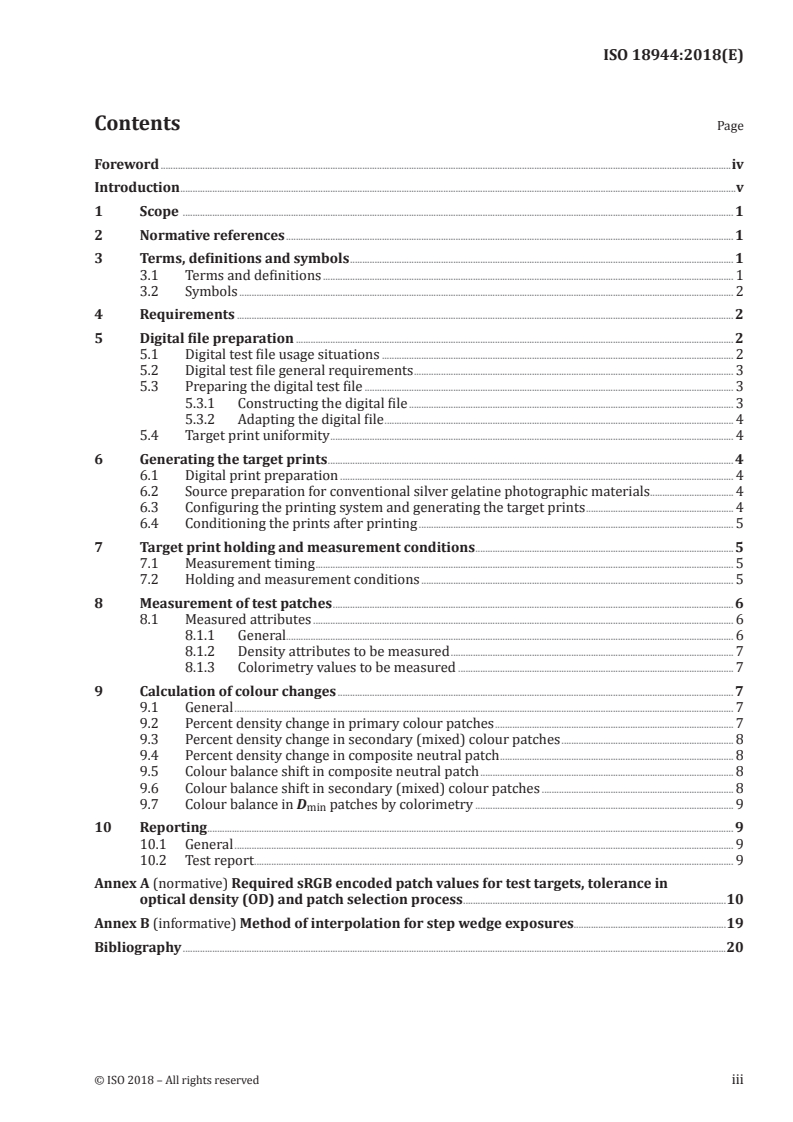
Contents Page
Foreword .iv
Introduction .v
1 Scope . 1
2 Normative references . 1
3 Terms, definitions and symbols . 1
3.1 Terms and definitions . 1
3.2 Symbols . 2
4 Requirements . 2
5 Digital file preparation . 2
5.1 Digital test file usage situations . 2
5.2 Digital test file general requirements . 3
5.3 Preparing the digital test file . 3
5.3.1 Constructing the digital file . 3
5.3.2 Adapting the digital file . 4
5.4 Target print uniformity . 4
6 Generating the target prints . 4
6.1 Digital print preparation . 4
6.2 Source preparation for conventional silver gelatine photographic materials. 4
6.3 Configuring the printing system and generating the target prints . 4
6.4 Conditioning the prints after printing . 5
7 Target print holding and measurement conditions . 5
7.1 Measurement timing . 5
7.2 Holding and measurement conditions . 5
8 Measurement of test patches . 6
8.1 Measured attributes . 6
8.1.1 General. 6
8.1.2 Density attributes to be measured . 7
8.1.3 Colorimetry values to be measured . 7
9 Calculation of colour changes . 7
9.1 General . 7
9.2 Percent density change in primary colour patches . 7
9.3 Percent density change in secondary (mixed) colour patches . 8
9.4 Percent density change in composite neutral patch . 8
9.5 Colour balance shift in composite neutral patch . 8
9.6 Colour balance shift in secondary (mixed) colour patches . 8
9.7 Colour balance in D patches by colorimetry . 9
min
10 Reporting . 9
10.1 General . 9
10.2 Test report . 9
Annex A (normative) Required sRGB encoded patch values for test targets, tolerance in
optical density (OD) and patch selection process .10
Annex B (informative) Method of interpolation for step wedge exposures.19
Bibliography .20
Foreword
ISO (the International Organization for Standardization) is a worldwide federation of national standards
bodies (ISO member bodies). The work of preparing International Standards is normally carried out
through ISO technical committees. Each member body interested in a subject for which a technical
committee has been established has the right to be represented on that committee. International
organizations, governmental and non-governmental, in liaison with ISO, also take part in the work.
ISO collaborates closely with the International Electrotechnical Commission (IEC) on all matters of
electrotechnical standardization.
The procedures used to develop this document and those intended for its further maintenance are
described in the ISO/IEC Directives, Part 1. In particular the different approval criteria needed for the
different types of ISO documents should be noted. This document was drafted in accordance with the
editorial rules of the ISO/IEC Directives, Part 2 (see www .iso .org/directives).
Attention is drawn to the possibility that some of the elements of this document may be the subject of
patent rights. ISO shall not be held responsible for identifying any or all such patent rights. Details of
any patent rights identified during the development of the document will be in the Introduction and/or
on the ISO list of patent declarations received (see www .iso .org/patents).
Any trade name used in this document is information given for the convenience of users and does not
constitute an endorsement.
For an explanation on the voluntary nature of standards, the meaning of ISO specific terms and
expressions related to conformity assessment, as well as information about ISO's adherence to the
World Trade Organization (WTO) principles in the Technical Barriers to Trade (TBT) see the following
URL: www .iso .org/iso/foreword .html.
This document was prepared by Technical Committee ISO/TC 42, Photography.
This third edition cancels and replaces the second edition (ISO 18944:2014), which has been technically
revised.
The main changes compared to the previous edition are as follows:
— the document structure has been simplified in order to be better understood by users;
— definitions for measurement condition, colour attributes measured and calculations of colour
changes have been included.
iv © ISO 2018 – All rights reserved
Introduction
This document is one of a family of International Standards on the physical properties, stability and
permanence of imaging materials.
This document provides constraints on factors pertaining to target print preparation and resulting
target print measurement which can cause a confounding test-process-induced variation in measured
colour values and densities.
The requirements in this document are intended to be used with test methods that produce test data to
be shared publicly, with the aim that test results can be duplicated in an alternate test facility.
Topics addressed include:
— digital file preparation;
— digital test file usage;
— target print uniformity;
— printing system configuration and control;
— test print conditioning;
— measurement timing and measurement conditions;
— sRGB encoded patch value for test targets and the corresponding patch selection process;
— densitometric and colorimetric calculations for colour changes.
Test target design and test print preparation are important elements in the characterization of image
stability of prints, namely changes in colour attributes such as discoloration of D as well as lightness,
min
hue and chroma changes in colour and neutral patches.
A test target realizes a specific sampling of colours from colour space that is representative for
characterization of image stability in the envisaged use case. Other important elements in that
characterization process are the definition of colour attributes the changes of which are evaluated and
the construction of a metric as well as the choice of the statistical assessment of data analysis, such
as choice of average, median or maximum changes of either individual colours or all colours. Unless a
psychovisual correlation with observer judgments have been implemented, measured changes have ad
hoc character.
In this document, the definition and the calculation of changes in colour attributes of colour and
neutral patches are expressed in terms of densitometry, whereas discoloration of D is characterized
min
colorimetrically. Changes in colour attributes evaluated with the target and definition of colour
attributes in this document are intended to feed an end point system that can be used in image life
specification under development in the series of print life specification standards. Previously, the
definitions of colour attributes were included in the various test methods which are now consolidated
into this document.
INTERNATIONAL STANDARD ISO 18944:2018(E)
Imaging materials — Reflection colour photographic prints
— Test print construction and measurement
IMPORTANT — The electronic file of this document contains colours which are considered to be
useful for the correct understanding of this document. Users should therefore consider printing
this document using a colour printer.
1 Scope
This document specifies requirements and recommendations for the digital test file content, printer
setups and printing procedures that are used to generate target prints for test method standards and
specifications for image stability in the context of reflection colour photographic prints.
Furthermore, this document defines measurement procedures of the test patches as well as how
changes of colour attributes are calculated in the course of a given image stability test.
Definition of the statistical procedure for data reduction and the translation of those changes into
psychophysical end point levels does not belong to the scope of this document, but results obtained
with the methods defined in this document can feed into the appropriate statistical evaluation and end
point systems of a print life specification defined in other documents.
2 Normative references
The following documents are referred to in the text in such a way that some or all of their content
constitutes requirements of this document. For dated references, only the edition cited applies. For
undated references, the latest edition of the referenced document (including any amendments) applies.
ISO 5-3, Photography and graphic technology — Density measurements — Part 3: Spectral conditions
ISO 5-4, Photography and graphic technology — Density measurements — Part 4: Geometric conditions for
reflection density
ISO 11664-4, Colorimetry — Part 4: CIE 1976 L*a*b* Colour space
ISO 13655, Graphic technology — Spectral measurement and colorimetric computation for graphic
arts images
ISO 18913, Imaging materials — Permanence — Vocabulary
ISO 18941, Imaging materials — Colour reflection prints — Test method for ozone gas fading stability
IEC 61966-2-1, Multimedia systems and equipment — Colour measurement and management — Part 2-1:
Colour management — Default RGB colour space — sRGB
3 Terms, definitions and symbols
3.1 Terms and definitions
For the purposes of this document, the terms and definitions given in ISO 18913 and the following apply.
ISO and IEC maintain terminological databases for use in standardization at the following addresses:
— ISO Online browsing platform: available at https: //www .iso .org/obp
— IEC Electropedia: available at http: //www .electropedia .org/
3.1.1
printing system
system to generate reflection colour photographic prints, including printing colorants, printing
equipment hardware and software, and typically the print media
3.1.2
RGB printer
printer configured to accept digital files with RGB printer-independent encoded colours and apply a
conversion to obtain printer colourant code values
3.2 Symbols
Symbol Definition
D optical density of the unprinted substrate
min
D maximum optical density aim chosen for the test
max
4 Requirements
This document specifies constraints on factors pertaining to target print preparation and resulting
target print measurement which can cause confounding test-process-induced variation of measured
colour values and densities. The requirements of this document shall be applied in image stability test
methods that are used to characterize changes of a print material due to a specific failure mode, or to
make life expectancy claims, such as time-based print lifetime claims, either comparative or absolute,
in accordance with the applicable International Standard(s) for specification of print life.
The analysis of colour changes in the course of image stability testing requires the following.
a) A definition of how test colours are sampled in colour space in a way representative for the use
case. This results in a specific design of a test target as given in this document.
b) A definition of how colour changes are determined, which represents a specific colour distance
metrics. In this document, changes in colour and neutral patches are measured densitometrically
and discoloration of D is characterized with colorimetry.
min
c) A definition of the statistics that is applied to translate the calculated colour changes into end point
levels, e.g. average, media or maximum colour change for a selection of starting density values over
all colours or per colour. The statistics are not defined in this document but are given by appropriate
specifications of print life or characterizations of single failure mode.
d) A correlation of end point levels to visual perception. The necessary establishment of (potentially
different) tolerance sets for each colour is an important limitation. Such end point levels system is
not defined in this document but is given by an appropriate specification of print life.
5 Digital file preparation
5.1 Digital test file usage situations
For general testing purposes, users of this document are free to choose whatever target patches and
starting densities they feel are appropriate for their testing needs. Applicable International Standard(s)
for specification of print life is likely to require the use of specific targets and starting densities.
The digital test file is designed to assess the stability of images printed in end-user-typical fashion. The
test file in this case is encoded in standard sRGB, as defined in IEC 61966-2-1.
2 © ISO 2018 – All rights reserved
5.2 Digital test file general requirements
Printing systems can be configured to accept digital files with colours encoded for the printer
colourants, such as sRGB. Printers that are configured to accept an RGB printer-independent encoding
can process the conversion from the input RGB to the printer colourant encoding in a proprietary
manner. These printers can be referred to as “RGB printers”. The file preparation process below
describes the necessary file treatment for RGB.
The digital test file of encoded colour values shall be constructed so that the target print contains areas
of uniform colour (i.e. patches) corresponding to each selected optical density (recommended 0,5, 1,0,
and 1,5). The size of each square colour patch area shall be large enough to cover measured area plus
positioning error. The appropriate size depends on the equipment used. Aperture size requirement
shall comply with the geometric conditions in ISO 5-4.
The digital test file shall incorporate target print patch areas of minimum density.
The digital test file shall produce target prints with individual patches having the selected optical
densities within the required “single patch” tolerance limits, or with pairs of “bracketing patches”
having the selected optical densities within the required “bracketing patch pair” tolerance limits,
according to the requirements of Annex A. In the case of a set of bracketing pair patches, the targeted
optical density value shall be obtained using interpolation of measured values of the pair patches as
described in Annex B.
No lossy image or file compression shall be applied to the target file. Digital file shall be prepared to fit
the native resolution of the printer or by scaling to size with integer numbers.
NOTE 1 A 120 dpi test file is a good starting point, as it can be scaled by integer factors to current printer
resolutions such as 600 dpi, 720 dpi and 1 440 dpi.
NOTE 2 Various lossy compression methods can result in slight changes to colour values, particularly at patch
edges. This, in turn, can result in additional undesirable mixing of colourants. At the time of publication of this
document, the tiff file format provides the means to carry raster image content in digital files with minimal host
application and operating system dependence.
NOTE 3 The digital test file can be zipped using lossless compression to minimize file size for storage.
Digital test files defined in compliance with this document can be designed and adapted for particular
1)
printing systems in any of the available image programs [such as Adobe Photoshop® ].
5.3 Preparing the digital test file
5.3.1 Constructing the digital file
The digital test file shall be encoded in sRGB as defined in IEC 61966-2-1 and use a data format that
enables control of individual pixel RGB values with the sRGB ICC profile embedded and without image
or file compression, such as TIFF.
Colourant proportions in a printed image are recognized as system-specific, dependent on image
processing, ICC profiles, halftoning, and other physical printer characteristics.
The digital test file is required to include target prints with selected optical densities in:
a) neutral patches;
NOTE Patches that are treated as neutral include white (no colourant printed), black and all values of
grey produced from R = G = B sRGB encoded patch values. Such sRGB values correspond to CIELAB values
with L* ≥ 0, and a* and b* both equal to zero.
b) cyan, magenta, and yellow-coloured patches;
1) Adobe Photoshop® is an example of a suitable product available commercially. This information is given for the
convenience of users of this document and does not constitute an endorsement by ISO of this product.
c) red, green, and blue-coloured patches;
d) D patch area (used to evaluate substrate discolouration).
min
In certain cases, the printer driver software is likely to provide an option to assign neutral code values
exclusively to the black ink. In such case, composite neutral black printed with cyan, magenta and
yellow colourants shall be used.
5.3.2 Adapting the digital file
The image content shall be encoded in sRGB as defined in IEC 61966-2-1. An sRGB digital test file shall
be constructed using the required sRGB patch values provided in Annex A, or a selected subset of those
required sRGB patch values. Whether used in whole or in part, the sRGB code values of the patches
given in Annex A shall not be changed prior to printing.
5.4 Target print uniformity
The impact of the density non-uniformity in a target print or print-to-print, which is likely to affect the
accuracies of density change measurement caused by exposure of the light, ozone, thermal, etc. should
be minimized. Replicate prints should be printed and duplicate patches can be included within a single
target print page.
6 Generating the target prints
6.1 Digital print preparation
If the printing system under test cannot accept the digital file created with the procedure described
in 5.3, convert the digital file to the highest quality (e.g. least compressed) file format that the printing
system can accept just prior to printing. Ensure that the required patch size is maintained in the
converted printable file.
6.2 Source preparation for conventional silver gelatine photographic materials
Conventional silver gelatine photographic materials can be tested. Exposures can be controlled to
produce desired print density values. Specific proportions of colourants cannot be directly controlled.
Sensitometrically-exposed specimens designed to achieve the selected optical densities in the target
prints shall be processed using the processing system of primary interest and in accordance with the
manufacturer's recommendations.
Processing chemicals and procedures can have a significant effect on the dark-keeping and light-
keeping stability of conventional silver gelatine photographic materials. For example, a chromogenic
colour negative print paper processed in a “washless” or “non-plumbed” system with a stabilizer rinse
bath instead of a water wash is likely to have stability characteristics that are different from the same
colour paper processed in chemicals requiring a final water wash or using a final water wash. Therefore,
the specific processing chemicals and procedure shall be reported, along with the name of the colour
product in any reference to the test results.
Stability data obtained from a colour material processed in certain processing chemicals shall not
be assigned as belonging to colour material processed in different chemicals, or using a different
processing procedure. Likewise, data obtained from colour materials that have been subjected to post-
processing treatments (e.g. application of lacquers, plastic laminates, or retouching colours) shall not be
assigned as belonging to colour material that has not been similarly treated, and vice versa.
6.3 Configuring the printing system and generating the target prints
When printing a test target, target prints shall be produced using driver and printer settings that are
appropriate for photo printing. The printer manufacturer recommended print mode for photo printing
4 © ISO 2018 – All rights reserved
shall be used with each printer. When multiple print mode options are available for use with the
selected photo paper, the print mode selection used shall be included in the test report.
If the colourant and substrate under test are not an OEM combination, then the closest matching media
setup provided in the driver and printer settings (e.g. “generic glossy photo paper”) shall be chosen.
As appropriate in the typical use of the printing system, ICC profiles provided by the printing system
manufacturer for the test paper and test print conditions can be used in generating target prints. In
such a case using ICC profiles, do not turn off colour management when initiating the print.
Photographic material shall be printed in accordance with the manufacturer’s recommendations. The
manufacturer’s requirements regarding colourant and print media storage and pre-conditioning and
print device operating environment shall be followed. Printed images used for test specimen shall be
collected after the printing system reaches a steady-state.
The specific printing system configuration used to generate the target print, as far as it can be
determined by the test operator, shall be reported with the test results. The digital test file, as used to
generate the digital target prints, shall be included in the test report, and the measurement plan (e.g.
single or bracketing patch measurements, use of duplicate patch pairs, and number of replicate prints)
shall be described.
6.4 Conditioning the prints after printing
Aqueous and solvent inkjet prints, and prints of any types that require curing/stabilization/dry-down
shall be conditioned for two weeks after printing, in an environment with a temperature of (23 ± 2) °C,
with a relative humidity (RH) of (50 ± 5) %. The print conditioning environment shall be ozone-free
(≤2 nl/l average concentration over any 24 h period) for ozone-sensitive target prints, as determined
in accordance with ISO 18941. During the conditioning period, the prints shall be maintained with
unrestricted airflow. Prints of any types that do not require curing/stabilization/dry-down shall be
held for 24 h. Measurements shall be conducted after conditioning or print hold. The required target
densities shall be assessed after conditioning.
7 Target print holding and measurement conditions
7.1 Measurement timing
After the required conditioning and before being subjected to image stability testing, the target prints
are measured to determine initial patch density values.
7.2 Holding and measurement conditions
The measurement environment and target print holding environment can influence measured
densities. Measurements and target print holding for measurement and next test phase preparation
shall be conducted in a controlled environment with no time constraint, or can be conducted in a less
controlled environment with a time constraint.
NOTE 1 Target print holding environment refers to the environment in which target prints are held in between
test phases, such as before and after measurement, while the target prints are not in the active test environment.
The controlled environment, in which target prints can be measured and held with no time constraint,
shall meet the following set of conditions: target prints shall be kept in dark for target print holding
and in ambient illuminance on the target print surface no greater than 200 lx for measurement process,
(23 ± 2) °C, (50 ± 10) % RH conditions, and ozone-free (≤2 nl/l average concentration over any 24 h
period) for ozone-sensitive target prints.
Ozone sensitivity shall be determined in accordance with ISO 18941 and this document. A material that
is not sensitive to ozone shall have demonstrated no measurable D or printed patch colour change
min
at ambient ozone exposure levels and measurement condition temperature and humidity, over time
periods consistent with measurement and test staging time periods.
When target print holding or target print measurement are conducted in the less controlled
environment, target prints shall be held or measured in that less controlled environment for a maximum
of 2 h for each test stage. The less controlled environment is likely to be unfiltered for ozone, and shall
have a maximum relative humidity of 75 % RH and a maximum temperature of 30 °C, with ambient
illuminance on the target print surface less than or equal to 1 000 lx.
The CIELAB colour space values of the D patch (unprinted paper) shall be obtained from
min
measurements using ISO 13655 measurement condition and M1.
NOTE 2 Consistent measurement requires a light source with a constant UV output since most samples include
optical brighteners. Measurement condition M0 allows UV output to vary which is likely to cause inconsistent
measurements unless this variance is accounted for.
Conforming to ISO 13655, calculated tristimulus values and corresponding CIELAB values of the
colourimetry of the D patch shall be computed using CIE illuminant D50 and the CIE 1931 standard
min
colourimetric observer (often referred to as the 2° standard observer).
The optical densities of the colourant patches shall be measured in accordance with ISO 5-3, with the
relative spectral power distribution of the flux incident on the specimen surface conforming to CIE
illuminant A, with a correlated colour temperature of 2 856 K ± 100 K. A UV-cut filter shall not be used.
Spectral products conforming to Status A or Status T density shall be formed as appropriate for the
material under test. Use standard reflection density as defined in ISO 5-4, allowing either annular
influx mode or annular efflux mode. Either white or black backing is allowed, but white backing is
recommended as noted in ISO 5-4, particularly for measurements of spectral data used to compute
both density and colorimetric values.
NOTE 3 The purpose of tests using this document is to characterize the fade of the systems as closely as
possible to human perception. Avoiding the use of UV cut filters is consistent with this purpose given that optical
brighteners change printed colours as seen by an observer, not only in the media white, but also in the skin tones
and in the neutral axis.
NOTE 4 When this document is used in conjunction with an image life specification standard, then either
standard status A or status T density is selected according to that specification standard.
Measurement instruments shall be calibrated in accordance with the manufacturer’s instructions.
A single measurement instrument is recommended to be used for all of the measurements taken
pertaining to a particular target print.
8 Measurement of test patches
8.1 Measured attributes
8.1.1 General
Colour and neutral patches are measured densitometrically. d is the symbol for measured density.
D is measured colorimetrically.
min
A reflective densitometer uses filters with Red, Green and Blue spectral transmission response to
measure the absorption of Red, Green and Blue light on the image patches. This corresponds to the
measurement of Cyan, Magenta and Yellow densities.
6 © ISO 2018 – All rights reserved
8.1.2 Density attributes to be measured
The following densities of the specimens shall be measured with Red (R), Green (G) and Blue (B) Status
A or Status T transmission response before and after the treatment interval.
a) dN(R) , dN(G) , dN(B)
t t t
The densities of neutral patches that have been treated for time t, where t takes on values from 0 to
the end of the test.
b) dC(R) , dM(G) , dY(B)
t t t
The densities of Cyan, Magenta and Yellow colour patches that have been treated for time t, where t
takes on values from 0 to the end of the test.
c) dR(G) , dR(B) , dG(R) , dG(B) , dB(R) , dB(G)
t t t t t t
The densities of the composite secondary R, G, B colour patches that have been treated for time t,
where t takes on values from 0 to the end of the test.
8.1.3 Colorimetry values to be measured
Colorimetry values shall be measured as CIELAB L*, a* and b*, as defined in ISO 11664-4. The following
colorimetry values of the specimens, prepared as described in Clause 5, shall be measured before and
after the treatment interval.
L* , a* , b*
t t t
The lightness, red-green, and blue-yellow colour coordinates for the unprinted areas of specimens
(paper white) that have been treated for time t, where t takes on values from 0 to the end of the test.
9 Calculation of colour changes
9.1 General
Any change in density, contrast, or stain in the course of exposure to climate stresses over time (e.g.
exposure to heat, humidity, light or air pollution) - whether due to colorant fading, changes in colorant
morphology, or discolouration of residual substances - will change the appearance of the photograph.
The most damaging change tends to be contrast balance distortions brought about by differential fading
of the three image colorants. The second most consequential change is that caused by an increase in
stain due to a discolouration of the D areas or a change in the D colour balance.
min min
Colour patches and neutral patches shall be measured at certain aim density as required by the end point
metrics for which the colour changes are determined. For example, aim density values 0,5, 1,0 and 1,5
are considered typical for photographic prints. Positions of the aim density values are identified on the
printed test target before the treatment but after completion of conditioning (see 6.4) using the single
patch or bracketing pair approach as described in A.4 and following the patch selection procedure (see
A.5.3 to A.5.6). Calculations of colour changes as defined in 9.2 to 9.6 shall be performed for selected
patches for the range of initial densities. Discoloration of D patch is expressed colorimetrically, see 9.7.
min
9.2 Percent density change in primary colour patches
a) Cyan patch: %ΔdC(R) = {[dC(R) − dC(R) ] ÷ dC(R) } × 100
t t 0 0
b) Magenta patch: %ΔdM(G) = {[dM(G) − dM(G) ] ÷ dM(G) } × 100
t t 0 0
c) Yellow patch: %ΔdY(B) = {[dY(B) − dY(B) ] ÷ dY(B) } × 100
t t 0 0
9.3 Percent density change in secondary (mixed) colour patches
a) Magenta in Red patch: %ΔdR(G) ={[dR(G) − dR(G) ] ÷ dR(G) } × 100
t t 0 0
b) Yellow in Red patch: %ΔdR(B) = {[dR(B) − dR(B) ] ÷ dR(B) } × 100
t t 0 0
c) Cyan in Green patch: %ΔdG(R) = {[dG(R) − dG(R) ] ÷ dG(R) } × 100
t t 0 0
d) Yellow in Green patch: %ΔdG(B) = {[dG(B) − dG(B) ] ÷ dG(B) }× 100
t t 0 0
e) Cyan in Blue patch: %ΔdB(R) = {[dB(R) − dB(R) ] ÷ dB(R) } × 100
t t 0 0
f) Magenta in Blue patch: %ΔdB(G) = {[dB(G) − dB(G) ] ÷ dB(G) } × 100
t t 0 0
9.4 Percent density change in composite neutral patch
a) Cyan in neutral patch: %ΔdN(R) = {[dN(R) − dN(R) ] ÷ dN(R) } × 100
t t 0 0
b) Magenta in neutral patch: %ΔdN(G) = {[dN(G) − dN(G) ] ÷ dN(G) } × 100
t t 0 0
c) Yellow in neutral patch: %ΔdN(B) = {[dN(B) − dN(B) ] ÷ dN(B) } × 100
t t 0 0
9.5 Colour balance shift in composite neutral patch
Contrast and colour balance distortions brought about by differential fading of the three image
colorants can result in significant visually degrading effects. These can be measured as shifts in colour
balance from highlights to shadows and are especially noticeable in a scale of neutrals; for example, a
shift from magenta to green due to fading of the photograph’s magenta image colorant, or from yellow
to blue or cyan to red due to fading of the yellow or cyan colorant.
Neutral colour balance shift is calculated as the difference in percent change between any two primary
colours of a neutral patch. The percent change of individual primary colours in a neutral patch is
defined in 9.4.
a) Cyan-magenta shift: %∆dN(R-G) = |%∆dN(R) − %∆dN(G) |
t t t
b) Magenta-yellow shift: %∆dN(G-B) = |%∆dN(G) − %∆dN(B) |
t t t
c) Yellow-cyan shift: %∆dN(B-R) = |%∆dN(B) − %∆dN(R) |
t t t
9.6 Colour balance shift in secondary (mixed) colour patches
Secondary colour balance shift is calculated as the difference in percent change between the two
primary colours of each secondary colour patch. The percent change of the individual primary colours
in each secondary colour patch is defined in 9.3.
a) Cyan-magenta shift in Blue patch: %∆dB(R-G) = |%∆dB(R) − %∆dB(G) |
t t t
b) Magenta-yellow shift in Red patch: %∆dR(G-B) = |%∆dR(G) − %∆dR(B) |
t t t
c) Yellow-cyan shift in Green patch: %∆dG(B-R) = |%∆dG(B) − %∆dG(R) |
t t t
8 © ISO 2018 – All rights reserved
9.7 Colour balance in D patches by colorimetry
min
Colour balance in the D patches is calculated using the following Formula (1):
min
** 2 ** 2 ** 2
ΔE* =−()LL +−()aa +−()bb (1)
ab tt0 0 t 0
where L*, a*, and b* are the colour coordinates of the D patch at the initial time 0 and at time t.
min
10 Reporting
10.1 General
Changes of the colour attributes are reported for starting densities as required by calling standards.
Without specific requirements, colour changes of the colour and neutral patches are reported for
starting densities of 0,5, 1,0 and 1,5.
10.2 Test report
In the case that a test method standard, e.g. thermal (ISO 18936), light (ISO 18937) or ozone (ISO 18941),
or print life specification standard utilizes this document for the sample print preparation or colour
change measurement, the following subjects shall be described in its reporting:
— the printing system (printer, colorants and printing substrate) as well as printer driver and printing
parameter settings used to create the test target;
— the starting densities for each colour taken in its measurement;
— the test target used in its measurement;
— the text that states “test print patches were prepared according to ISO 18944:2018 ed. 3”.
It is preferable to present the report in a table that contains the changes of the various colour attributes
(9.2 to 9.7) for that test method at actual sampling times. The table covers changes in colour attributes
at all starting densities for colour patches, neutral patches as well as the D patch. Sampling times
min
may be expressed as actual test time under actual test conditions, using a suitable unit of time such as
hours or days, or may be expressed as cumulative dose. The approach follows the stipulations of a test
method or specification standard that has called for this test target.
If the aforementioned table is used for statistical analysis for end point determination as given by a
print life specification, the values of the table may be regarded as intermediate values of the overall
analysis and do not have to be reported separately, but are reported as integral part of that analysis.
Annex A
(normative)
Required sRGB encoded patch values for test targets, tolerance in
optical density (OD) and patch selection process
A.1 General
There are two test targets described in this document: One is the sRGB linear target originally designed
for the JEITA standard CP-3901, described in A.2, and the other is the CIELAB constant hue target
uniquely designed for this document, described in A.3. Users can choose either one of two depending on
the objective of evaluation. Applicable International Standard(s) for specification of print life is likely to
specify the test target used for the standard(s).
The sRGB linear target produces relatively pure colours with high chroma and is best suited to
understanding the stability of individual colorants, either alone or in combination. The CIELAB constant
hue target produces less pure colours that better represent actual photographic images. The CIELAB
constant hue target is also better able to produce higher density colour patches, although it does so by
reducing the chroma of such colours.
Downloadable and printable test targets for CIELAB constant hue and sRGB linear test targets are
prepared in the form of PDF files. The user can download the files from the following website: http:
//standards .iso .org/iso/18944/ed -3/en.
A.2 sRGB code values for sRGB linear target
The sRGB code values described in Table A.1 are selected for the sRGB linear target. Each hue of blue,
red, green, cyan, magenta, yellow or neutral has 17 tone patches with the interval of 16 code values
(including white of R = 255, G = 255, B = 255).
Each hue angle is defined in the sRGB space, which is generally adopted as input signals in most of the
digital camera and computer graphics which usually take relatively larger colour gamut than average
printers. Since the locus of each tone patch of R, G, B, C, M and Y traces the gamut edge of the sRGB space,
the reproducible colour gamut with this target, constrained by the gamut compressions in printer
drivers, can be expanded with future progress in printing technologies. Therefore, this target has an
opportunity to evaluate colour degradations for the outer edges of printer gamut, generally showing
larger colour changes than inside. In contrast, there is no opportunity to evaluate degradations for
expanded colours reproduced by a future printer in case of the CIELAB constant
...
INTERNATIONAL ISO
STANDARD 18944
Third edition
2018-05
Imaging materials — Reflection colour
photographic prints — Test print
construction and measurement
Matériaux pour l'image — Réflexion des impressions photographiques
en couleurs — Mesurage et construction d'une impression d'essai
Reference number
©
ISO 2018
© ISO 2018
All rights reserved. Unless otherwise specified, or required in the context of its implementation, no part of this publication may
be reproduced or utilized otherwise in any form or by any means, electronic or mechanical, including photocopying, or posting
on the internet or an intranet, without prior written permission. Permission can be requested from either ISO at the address
below or ISO’s member body in the country of the requester.
ISO copyright office
CP 401 • Ch. de Blandonnet 8
CH-1214 Vernier, Geneva
Phone: +41 22 749 01 11
Fax: +41 22 749 09 47
Email: copyright@iso.org
Website: www.iso.org
Published in Switzerland
ii © ISO 2018 – All rights reserved
Contents Page
Foreword .iv
Introduction .v
1 Scope . 1
2 Normative references . 1
3 Terms, definitions and symbols . 1
3.1 Terms and definitions . 1
3.2 Symbols . 2
4 Requirements . 2
5 Digital file preparation . 2
5.1 Digital test file usage situations . 2
5.2 Digital test file general requirements . 3
5.3 Preparing the digital test file . 3
5.3.1 Constructing the digital file . 3
5.3.2 Adapting the digital file . 4
5.4 Target print uniformity . 4
6 Generating the target prints . 4
6.1 Digital print preparation . 4
6.2 Source preparation for conventional silver gelatine photographic materials. 4
6.3 Configuring the printing system and generating the target prints . 4
6.4 Conditioning the prints after printing . 5
7 Target print holding and measurement conditions . 5
7.1 Measurement timing . 5
7.2 Holding and measurement conditions . 5
8 Measurement of test patches . 6
8.1 Measured attributes . 6
8.1.1 General. 6
8.1.2 Density attributes to be measured . 7
8.1.3 Colorimetry values to be measured . 7
9 Calculation of colour changes . 7
9.1 General . 7
9.2 Percent density change in primary colour patches . 7
9.3 Percent density change in secondary (mixed) colour patches . 8
9.4 Percent density change in composite neutral patch . 8
9.5 Colour balance shift in composite neutral patch . 8
9.6 Colour balance shift in secondary (mixed) colour patches . 8
9.7 Colour balance in D patches by colorimetry . 9
min
10 Reporting . 9
10.1 General . 9
10.2 Test report . 9
Annex A (normative) Required sRGB encoded patch values for test targets, tolerance in
optical density (OD) and patch selection process .10
Annex B (informative) Method of interpolation for step wedge exposures.19
Bibliography .20
Foreword
ISO (the International Organization for Standardization) is a worldwide federation of national standards
bodies (ISO member bodies). The work of preparing International Standards is normally carried out
through ISO technical committees. Each member body interested in a subject for which a technical
committee has been established has the right to be represented on that committee. International
organizations, governmental and non-governmental, in liaison with ISO, also take part in the work.
ISO collaborates closely with the International Electrotechnical Commission (IEC) on all matters of
electrotechnical standardization.
The procedures used to develop this document and those intended for its further maintenance are
described in the ISO/IEC Directives, Part 1. In particular the different approval criteria needed for the
different types of ISO documents should be noted. This document was drafted in accordance with the
editorial rules of the ISO/IEC Directives, Part 2 (see www .iso .org/directives).
Attention is drawn to the possibility that some of the elements of this document may be the subject of
patent rights. ISO shall not be held responsible for identifying any or all such patent rights. Details of
any patent rights identified during the development of the document will be in the Introduction and/or
on the ISO list of patent declarations received (see www .iso .org/patents).
Any trade name used in this document is information given for the convenience of users and does not
constitute an endorsement.
For an explanation on the voluntary nature of standards, the meaning of ISO specific terms and
expressions related to conformity assessment, as well as information about ISO's adherence to the
World Trade Organization (WTO) principles in the Technical Barriers to Trade (TBT) see the following
URL: www .iso .org/iso/foreword .html.
This document was prepared by Technical Committee ISO/TC 42, Photography.
This third edition cancels and replaces the second edition (ISO 18944:2014), which has been technically
revised.
The main changes compared to the previous edition are as follows:
— the document structure has been simplified in order to be better understood by users;
— definitions for measurement condition, colour attributes measured and calculations of colour
changes have been included.
iv © ISO 2018 – All rights reserved
Introduction
This document is one of a family of International Standards on the physical properties, stability and
permanence of imaging materials.
This document provides constraints on factors pertaining to target print preparation and resulting
target print measurement which can cause a confounding test-process-induced variation in measured
colour values and densities.
The requirements in this document are intended to be used with test methods that produce test data to
be shared publicly, with the aim that test results can be duplicated in an alternate test facility.
Topics addressed include:
— digital file preparation;
— digital test file usage;
— target print uniformity;
— printing system configuration and control;
— test print conditioning;
— measurement timing and measurement conditions;
— sRGB encoded patch value for test targets and the corresponding patch selection process;
— densitometric and colorimetric calculations for colour changes.
Test target design and test print preparation are important elements in the characterization of image
stability of prints, namely changes in colour attributes such as discoloration of D as well as lightness,
min
hue and chroma changes in colour and neutral patches.
A test target realizes a specific sampling of colours from colour space that is representative for
characterization of image stability in the envisaged use case. Other important elements in that
characterization process are the definition of colour attributes the changes of which are evaluated and
the construction of a metric as well as the choice of the statistical assessment of data analysis, such
as choice of average, median or maximum changes of either individual colours or all colours. Unless a
psychovisual correlation with observer judgments have been implemented, measured changes have ad
hoc character.
In this document, the definition and the calculation of changes in colour attributes of colour and
neutral patches are expressed in terms of densitometry, whereas discoloration of D is characterized
min
colorimetrically. Changes in colour attributes evaluated with the target and definition of colour
attributes in this document are intended to feed an end point system that can be used in image life
specification under development in the series of print life specification standards. Previously, the
definitions of colour attributes were included in the various test methods which are now consolidated
into this document.
INTERNATIONAL STANDARD ISO 18944:2018(E)
Imaging materials — Reflection colour photographic prints
— Test print construction and measurement
IMPORTANT — The electronic file of this document contains colours which are considered to be
useful for the correct understanding of this document. Users should therefore consider printing
this document using a colour printer.
1 Scope
This document specifies requirements and recommendations for the digital test file content, printer
setups and printing procedures that are used to generate target prints for test method standards and
specifications for image stability in the context of reflection colour photographic prints.
Furthermore, this document defines measurement procedures of the test patches as well as how
changes of colour attributes are calculated in the course of a given image stability test.
Definition of the statistical procedure for data reduction and the translation of those changes into
psychophysical end point levels does not belong to the scope of this document, but results obtained
with the methods defined in this document can feed into the appropriate statistical evaluation and end
point systems of a print life specification defined in other documents.
2 Normative references
The following documents are referred to in the text in such a way that some or all of their content
constitutes requirements of this document. For dated references, only the edition cited applies. For
undated references, the latest edition of the referenced document (including any amendments) applies.
ISO 5-3, Photography and graphic technology — Density measurements — Part 3: Spectral conditions
ISO 5-4, Photography and graphic technology — Density measurements — Part 4: Geometric conditions for
reflection density
ISO 11664-4, Colorimetry — Part 4: CIE 1976 L*a*b* Colour space
ISO 13655, Graphic technology — Spectral measurement and colorimetric computation for graphic
arts images
ISO 18913, Imaging materials — Permanence — Vocabulary
ISO 18941, Imaging materials — Colour reflection prints — Test method for ozone gas fading stability
IEC 61966-2-1, Multimedia systems and equipment — Colour measurement and management — Part 2-1:
Colour management — Default RGB colour space — sRGB
3 Terms, definitions and symbols
3.1 Terms and definitions
For the purposes of this document, the terms and definitions given in ISO 18913 and the following apply.
ISO and IEC maintain terminological databases for use in standardization at the following addresses:
— ISO Online browsing platform: available at https: //www .iso .org/obp
— IEC Electropedia: available at http: //www .electropedia .org/
3.1.1
printing system
system to generate reflection colour photographic prints, including printing colorants, printing
equipment hardware and software, and typically the print media
3.1.2
RGB printer
printer configured to accept digital files with RGB printer-independent encoded colours and apply a
conversion to obtain printer colourant code values
3.2 Symbols
Symbol Definition
D optical density of the unprinted substrate
min
D maximum optical density aim chosen for the test
max
4 Requirements
This document specifies constraints on factors pertaining to target print preparation and resulting
target print measurement which can cause confounding test-process-induced variation of measured
colour values and densities. The requirements of this document shall be applied in image stability test
methods that are used to characterize changes of a print material due to a specific failure mode, or to
make life expectancy claims, such as time-based print lifetime claims, either comparative or absolute,
in accordance with the applicable International Standard(s) for specification of print life.
The analysis of colour changes in the course of image stability testing requires the following.
a) A definition of how test colours are sampled in colour space in a way representative for the use
case. This results in a specific design of a test target as given in this document.
b) A definition of how colour changes are determined, which represents a specific colour distance
metrics. In this document, changes in colour and neutral patches are measured densitometrically
and discoloration of D is characterized with colorimetry.
min
c) A definition of the statistics that is applied to translate the calculated colour changes into end point
levels, e.g. average, media or maximum colour change for a selection of starting density values over
all colours or per colour. The statistics are not defined in this document but are given by appropriate
specifications of print life or characterizations of single failure mode.
d) A correlation of end point levels to visual perception. The necessary establishment of (potentially
different) tolerance sets for each colour is an important limitation. Such end point levels system is
not defined in this document but is given by an appropriate specification of print life.
5 Digital file preparation
5.1 Digital test file usage situations
For general testing purposes, users of this document are free to choose whatever target patches and
starting densities they feel are appropriate for their testing needs. Applicable International Standard(s)
for specification of print life is likely to require the use of specific targets and starting densities.
The digital test file is designed to assess the stability of images printed in end-user-typical fashion. The
test file in this case is encoded in standard sRGB, as defined in IEC 61966-2-1.
2 © ISO 2018 – All rights reserved
5.2 Digital test file general requirements
Printing systems can be configured to accept digital files with colours encoded for the printer
colourants, such as sRGB. Printers that are configured to accept an RGB printer-independent encoding
can process the conversion from the input RGB to the printer colourant encoding in a proprietary
manner. These printers can be referred to as “RGB printers”. The file preparation process below
describes the necessary file treatment for RGB.
The digital test file of encoded colour values shall be constructed so that the target print contains areas
of uniform colour (i.e. patches) corresponding to each selected optical density (recommended 0,5, 1,0,
and 1,5). The size of each square colour patch area shall be large enough to cover measured area plus
positioning error. The appropriate size depends on the equipment used. Aperture size requirement
shall comply with the geometric conditions in ISO 5-4.
The digital test file shall incorporate target print patch areas of minimum density.
The digital test file shall produce target prints with individual patches having the selected optical
densities within the required “single patch” tolerance limits, or with pairs of “bracketing patches”
having the selected optical densities within the required “bracketing patch pair” tolerance limits,
according to the requirements of Annex A. In the case of a set of bracketing pair patches, the targeted
optical density value shall be obtained using interpolation of measured values of the pair patches as
described in Annex B.
No lossy image or file compression shall be applied to the target file. Digital file shall be prepared to fit
the native resolution of the printer or by scaling to size with integer numbers.
NOTE 1 A 120 dpi test file is a good starting point, as it can be scaled by integer factors to current printer
resolutions such as 600 dpi, 720 dpi and 1 440 dpi.
NOTE 2 Various lossy compression methods can result in slight changes to colour values, particularly at patch
edges. This, in turn, can result in additional undesirable mixing of colourants. At the time of publication of this
document, the tiff file format provides the means to carry raster image content in digital files with minimal host
application and operating system dependence.
NOTE 3 The digital test file can be zipped using lossless compression to minimize file size for storage.
Digital test files defined in compliance with this document can be designed and adapted for particular
1)
printing systems in any of the available image programs [such as Adobe Photoshop® ].
5.3 Preparing the digital test file
5.3.1 Constructing the digital file
The digital test file shall be encoded in sRGB as defined in IEC 61966-2-1 and use a data format that
enables control of individual pixel RGB values with the sRGB ICC profile embedded and without image
or file compression, such as TIFF.
Colourant proportions in a printed image are recognized as system-specific, dependent on image
processing, ICC profiles, halftoning, and other physical printer characteristics.
The digital test file is required to include target prints with selected optical densities in:
a) neutral patches;
NOTE Patches that are treated as neutral include white (no colourant printed), black and all values of
grey produced from R = G = B sRGB encoded patch values. Such sRGB values correspond to CIELAB values
with L* ≥ 0, and a* and b* both equal to zero.
b) cyan, magenta, and yellow-coloured patches;
1) Adobe Photoshop® is an example of a suitable product available commercially. This information is given for the
convenience of users of this document and does not constitute an endorsement by ISO of this product.
c) red, green, and blue-coloured patches;
d) D patch area (used to evaluate substrate discolouration).
min
In certain cases, the printer driver software is likely to provide an option to assign neutral code values
exclusively to the black ink. In such case, composite neutral black printed with cyan, magenta and
yellow colourants shall be used.
5.3.2 Adapting the digital file
The image content shall be encoded in sRGB as defined in IEC 61966-2-1. An sRGB digital test file shall
be constructed using the required sRGB patch values provided in Annex A, or a selected subset of those
required sRGB patch values. Whether used in whole or in part, the sRGB code values of the patches
given in Annex A shall not be changed prior to printing.
5.4 Target print uniformity
The impact of the density non-uniformity in a target print or print-to-print, which is likely to affect the
accuracies of density change measurement caused by exposure of the light, ozone, thermal, etc. should
be minimized. Replicate prints should be printed and duplicate patches can be included within a single
target print page.
6 Generating the target prints
6.1 Digital print preparation
If the printing system under test cannot accept the digital file created with the procedure described
in 5.3, convert the digital file to the highest quality (e.g. least compressed) file format that the printing
system can accept just prior to printing. Ensure that the required patch size is maintained in the
converted printable file.
6.2 Source preparation for conventional silver gelatine photographic materials
Conventional silver gelatine photographic materials can be tested. Exposures can be controlled to
produce desired print density values. Specific proportions of colourants cannot be directly controlled.
Sensitometrically-exposed specimens designed to achieve the selected optical densities in the target
prints shall be processed using the processing system of primary interest and in accordance with the
manufacturer's recommendations.
Processing chemicals and procedures can have a significant effect on the dark-keeping and light-
keeping stability of conventional silver gelatine photographic materials. For example, a chromogenic
colour negative print paper processed in a “washless” or “non-plumbed” system with a stabilizer rinse
bath instead of a water wash is likely to have stability characteristics that are different from the same
colour paper processed in chemicals requiring a final water wash or using a final water wash. Therefore,
the specific processing chemicals and procedure shall be reported, along with the name of the colour
product in any reference to the test results.
Stability data obtained from a colour material processed in certain processing chemicals shall not
be assigned as belonging to colour material processed in different chemicals, or using a different
processing procedure. Likewise, data obtained from colour materials that have been subjected to post-
processing treatments (e.g. application of lacquers, plastic laminates, or retouching colours) shall not be
assigned as belonging to colour material that has not been similarly treated, and vice versa.
6.3 Configuring the printing system and generating the target prints
When printing a test target, target prints shall be produced using driver and printer settings that are
appropriate for photo printing. The printer manufacturer recommended print mode for photo printing
4 © ISO 2018 – All rights reserved
shall be used with each printer. When multiple print mode options are available for use with the
selected photo paper, the print mode selection used shall be included in the test report.
If the colourant and substrate under test are not an OEM combination, then the closest matching media
setup provided in the driver and printer settings (e.g. “generic glossy photo paper”) shall be chosen.
As appropriate in the typical use of the printing system, ICC profiles provided by the printing system
manufacturer for the test paper and test print conditions can be used in generating target prints. In
such a case using ICC profiles, do not turn off colour management when initiating the print.
Photographic material shall be printed in accordance with the manufacturer’s recommendations. The
manufacturer’s requirements regarding colourant and print media storage and pre-conditioning and
print device operating environment shall be followed. Printed images used for test specimen shall be
collected after the printing system reaches a steady-state.
The specific printing system configuration used to generate the target print, as far as it can be
determined by the test operator, shall be reported with the test results. The digital test file, as used to
generate the digital target prints, shall be included in the test report, and the measurement plan (e.g.
single or bracketing patch measurements, use of duplicate patch pairs, and number of replicate prints)
shall be described.
6.4 Conditioning the prints after printing
Aqueous and solvent inkjet prints, and prints of any types that require curing/stabilization/dry-down
shall be conditioned for two weeks after printing, in an environment with a temperature of (23 ± 2) °C,
with a relative humidity (RH) of (50 ± 5) %. The print conditioning environment shall be ozone-free
(≤2 nl/l average concentration over any 24 h period) for ozone-sensitive target prints, as determined
in accordance with ISO 18941. During the conditioning period, the prints shall be maintained with
unrestricted airflow. Prints of any types that do not require curing/stabilization/dry-down shall be
held for 24 h. Measurements shall be conducted after conditioning or print hold. The required target
densities shall be assessed after conditioning.
7 Target print holding and measurement conditions
7.1 Measurement timing
After the required conditioning and before being subjected to image stability testing, the target prints
are measured to determine initial patch density values.
7.2 Holding and measurement conditions
The measurement environment and target print holding environment can influence measured
densities. Measurements and target print holding for measurement and next test phase preparation
shall be conducted in a controlled environment with no time constraint, or can be conducted in a less
controlled environment with a time constraint.
NOTE 1 Target print holding environment refers to the environment in which target prints are held in between
test phases, such as before and after measurement, while the target prints are not in the active test environment.
The controlled environment, in which target prints can be measured and held with no time constraint,
shall meet the following set of conditions: target prints shall be kept in dark for target print holding
and in ambient illuminance on the target print surface no greater than 200 lx for measurement process,
(23 ± 2) °C, (50 ± 10) % RH conditions, and ozone-free (≤2 nl/l average concentration over any 24 h
period) for ozone-sensitive target prints.
Ozone sensitivity shall be determined in accordance with ISO 18941 and this document. A material that
is not sensitive to ozone shall have demonstrated no measurable D or printed patch colour change
min
at ambient ozone exposure levels and measurement condition temperature and humidity, over time
periods consistent with measurement and test staging time periods.
When target print holding or target print measurement are conducted in the less controlled
environment, target prints shall be held or measured in that less controlled environment for a maximum
of 2 h for each test stage. The less controlled environment is likely to be unfiltered for ozone, and shall
have a maximum relative humidity of 75 % RH and a maximum temperature of 30 °C, with ambient
illuminance on the target print surface less than or equal to 1 000 lx.
The CIELAB colour space values of the D patch (unprinted paper) shall be obtained from
min
measurements using ISO 13655 measurement condition and M1.
NOTE 2 Consistent measurement requires a light source with a constant UV output since most samples include
optical brighteners. Measurement condition M0 allows UV output to vary which is likely to cause inconsistent
measurements unless this variance is accounted for.
Conforming to ISO 13655, calculated tristimulus values and corresponding CIELAB values of the
colourimetry of the D patch shall be computed using CIE illuminant D50 and the CIE 1931 standard
min
colourimetric observer (often referred to as the 2° standard observer).
The optical densities of the colourant patches shall be measured in accordance with ISO 5-3, with the
relative spectral power distribution of the flux incident on the specimen surface conforming to CIE
illuminant A, with a correlated colour temperature of 2 856 K ± 100 K. A UV-cut filter shall not be used.
Spectral products conforming to Status A or Status T density shall be formed as appropriate for the
material under test. Use standard reflection density as defined in ISO 5-4, allowing either annular
influx mode or annular efflux mode. Either white or black backing is allowed, but white backing is
recommended as noted in ISO 5-4, particularly for measurements of spectral data used to compute
both density and colorimetric values.
NOTE 3 The purpose of tests using this document is to characterize the fade of the systems as closely as
possible to human perception. Avoiding the use of UV cut filters is consistent with this purpose given that optical
brighteners change printed colours as seen by an observer, not only in the media white, but also in the skin tones
and in the neutral axis.
NOTE 4 When this document is used in conjunction with an image life specification standard, then either
standard status A or status T density is selected according to that specification standard.
Measurement instruments shall be calibrated in accordance with the manufacturer’s instructions.
A single measurement instrument is recommended to be used for all of the measurements taken
pertaining to a particular target print.
8 Measurement of test patches
8.1 Measured attributes
8.1.1 General
Colour and neutral patches are measured densitometrically. d is the symbol for measured density.
D is measured colorimetrically.
min
A reflective densitometer uses filters with Red, Green and Blue spectral transmission response to
measure the absorption of Red, Green and Blue light on the image patches. This corresponds to the
measurement of Cyan, Magenta and Yellow densities.
6 © ISO 2018 – All rights reserved
8.1.2 Density attributes to be measured
The following densities of the specimens shall be measured with Red (R), Green (G) and Blue (B) Status
A or Status T transmission response before and after the treatment interval.
a) dN(R) , dN(G) , dN(B)
t t t
The densities of neutral patches that have been treated for time t, where t takes on values from 0 to
the end of the test.
b) dC(R) , dM(G) , dY(B)
t t t
The densities of Cyan, Magenta and Yellow colour patches that have been treated for time t, where t
takes on values from 0 to the end of the test.
c) dR(G) , dR(B) , dG(R) , dG(B) , dB(R) , dB(G)
t t t t t t
The densities of the composite secondary R, G, B colour patches that have been treated for time t,
where t takes on values from 0 to the end of the test.
8.1.3 Colorimetry values to be measured
Colorimetry values shall be measured as CIELAB L*, a* and b*, as defined in ISO 11664-4. The following
colorimetry values of the specimens, prepared as described in Clause 5, shall be measured before and
after the treatment interval.
L* , a* , b*
t t t
The lightness, red-green, and blue-yellow colour coordinates for the unprinted areas of specimens
(paper white) that have been treated for time t, where t takes on values from 0 to the end of the test.
9 Calculation of colour changes
9.1 General
Any change in density, contrast, or stain in the course of exposure to climate stresses over time (e.g.
exposure to heat, humidity, light or air pollution) - whether due to colorant fading, changes in colorant
morphology, or discolouration of residual substances - will change the appearance of the photograph.
The most damaging change tends to be contrast balance distortions brought about by differential fading
of the three image colorants. The second most consequential change is that caused by an increase in
stain due to a discolouration of the D areas or a change in the D colour balance.
min min
Colour patches and neutral patches shall be measured at certain aim density as required by the end point
metrics for which the colour changes are determined. For example, aim density values 0,5, 1,0 and 1,5
are considered typical for photographic prints. Positions of the aim density values are identified on the
printed test target before the treatment but after completion of conditioning (see 6.4) using the single
patch or bracketing pair approach as described in A.4 and following the patch selection procedure (see
A.5.3 to A.5.6). Calculations of colour changes as defined in 9.2 to 9.6 shall be performed for selected
patches for the range of initial densities. Discoloration of D patch is expressed colorimetrically, see 9.7.
min
9.2 Percent density change in primary colour patches
a) Cyan patch: %ΔdC(R) = {[dC(R) − dC(R) ] ÷ dC(R) } × 100
t t 0 0
b) Magenta patch: %ΔdM(G) = {[dM(G) − dM(G) ] ÷ dM(G) } × 100
t t 0 0
c) Yellow patch: %ΔdY(B) = {[dY(B) − dY(B) ] ÷ dY(B) } × 100
t t 0 0
9.3 Percent density change in secondary (mixed) colour patches
a) Magenta in Red patch: %ΔdR(G) ={[dR(G) − dR(G) ] ÷ dR(G) } × 100
t t 0 0
b) Yellow in Red patch: %ΔdR(B) = {[dR(B) − dR(B) ] ÷ dR(B) } × 100
t t 0 0
c) Cyan in Green patch: %ΔdG(R) = {[dG(R) − dG(R) ] ÷ dG(R) } × 100
t t 0 0
d) Yellow in Green patch: %ΔdG(B) = {[dG(B) − dG(B) ] ÷ dG(B) }× 100
t t 0 0
e) Cyan in Blue patch: %ΔdB(R) = {[dB(R) − dB(R) ] ÷ dB(R) } × 100
t t 0 0
f) Magenta in Blue patch: %ΔdB(G) = {[dB(G) − dB(G) ] ÷ dB(G) } × 100
t t 0 0
9.4 Percent density change in composite neutral patch
a) Cyan in neutral patch: %ΔdN(R) = {[dN(R) − dN(R) ] ÷ dN(R) } × 100
t t 0 0
b) Magenta in neutral patch: %ΔdN(G) = {[dN(G) − dN(G) ] ÷ dN(G) } × 100
t t 0 0
c) Yellow in neutral patch: %ΔdN(B) = {[dN(B) − dN(B) ] ÷ dN(B) } × 100
t t 0 0
9.5 Colour balance shift in composite neutral patch
Contrast and colour balance distortions brought about by differential fading of the three image
colorants can result in significant visually degrading effects. These can be measured as shifts in colour
balance from highlights to shadows and are especially noticeable in a scale of neutrals; for example, a
shift from magenta to green due to fading of the photograph’s magenta image colorant, or from yellow
to blue or cyan to red due to fading of the yellow or cyan colorant.
Neutral colour balance shift is calculated as the difference in percent change between any two primary
colours of a neutral patch. The percent change of individual primary colours in a neutral patch is
defined in 9.4.
a) Cyan-magenta shift: %∆dN(R-G) = |%∆dN(R) − %∆dN(G) |
t t t
b) Magenta-yellow shift: %∆dN(G-B) = |%∆dN(G) − %∆dN(B) |
t t t
c) Yellow-cyan shift: %∆dN(B-R) = |%∆dN(B) − %∆dN(R) |
t t t
9.6 Colour balance shift in secondary (mixed) colour patches
Secondary colour balance shift is calculated as the difference in percent change between the two
primary colours of each secondary colour patch. The percent change of the individual primary colours
in each secondary colour patch is defined in 9.3.
a) Cyan-magenta shift in Blue patch: %∆dB(R-G) = |%∆dB(R) − %∆dB(G) |
t t t
b) Magenta-yellow shift in Red patch: %∆dR(G-B) = |%∆dR(G) − %∆dR(B) |
t t t
c) Yellow-cyan shift in Green patch: %∆dG(B-R) = |%∆dG(B) − %∆dG(R) |
t t t
8 © ISO 2018 – All rights reserved
9.7 Colour balance in D patches by colorimetry
min
Colour balance in the D patches is calculated using the following Formula (1):
min
** 2 ** 2 ** 2
ΔE* =−()LL +−()aa +−()bb (1)
ab tt0 0 t 0
where L*, a*, and b* are the colour coordinates of the D patch at the initial time 0 and at time t.
min
10 Reporting
10.1 General
Changes of the colour attributes are reported for starting densities as required by calling standards.
Without specific requirements, colour changes of the colour and neutral patches are reported for
starting densities of 0,5, 1,0 and 1,5.
10.2 Test report
In the case that a test method standard, e.g. thermal (ISO 18936), light (ISO 18937) or ozone (ISO 18941),
or print life specification standard utilizes this document for the sample print preparation or colour
change measurement, the following subjects shall be described in its reporting:
— the printing system (printer, colorants and printing substrate) as well as printer driver and printing
parameter settings used to create the test target;
— the starting densities for each colour taken in its measurement;
— the test target used in its measurement;
— the text that states “test print patches were prepared according to ISO 18944:2018 ed. 3”.
It is preferable to present the report in a table that contains the changes of the various colour attributes
(9.2 to 9.7) for that test method at actual sampling times. The table covers changes in colour attributes
at all starting densities for colour patches, neutral patches as well as the D patch. Sampling times
min
may be expressed as actual test time under actual test conditions, using a suitable unit of time such as
hours or days, or may be expressed as cumulative dose. The approach follows the stipulations of a test
method or specification standard that has called for this test target.
If the aforementioned table is used for statistical analysis for end point determination as given by a
print life specification, the values of the table may be regarded as intermediate values of the overall
analysis and do not have to be reported separately, but are reported as integral part of that analysis.
Annex A
(normative)
Required sRGB encoded patch values for test targets, tolerance in
optical density (OD) and patch selection process
A.1 General
There are two test targets described in this document: One is the sRGB linear target originally designed
for the JEITA standard CP-3901, described in A.2, and the other is the CIELAB constant hue target
uniquely designed for this document, described in A.3. Users can choose either one of two depending on
the objective of evaluation. Applicable International Standard(s) for specification of print life is likely to
specify the test target used for the standard(s).
The sRGB linear target produces relatively pure colours with high chroma and is best suited to
understanding the stability of individual colorants, either alone or in combination. The CIELAB constant
hue target produces less pure colours that better represent actual photographic images. The CIELAB
constant hue target is also better able to produce higher density colour patches, although it does so by
reducing the chroma of such colours.
Downloadable and printable test targets for CIELAB constant hue and sRGB linear test targets are
prepared in the form of PDF files. The user can download the files from the following website: http:
//standards .iso .org/iso/18944/ed -3/en.
A.2 sRGB code values for sRGB linear target
The sRGB code values described in Table A.1 are selected for the sRGB linear target. Each hue of blue,
red, green, cyan, magenta, yellow or neutral has 17 tone patches with the interval of 16 code values
(including white of R = 255, G = 255, B = 255).
Each hue angle is defined in the sRGB space, which is generally adopted as input signals in most of the
digital camera and computer graphics which usually take relatively larger colour gamut than average
printers. Since the locus of each tone patch of R, G, B, C, M and Y traces the gamut edge of the sRGB space,
the reproducible colour gamut with this target, constrained by the gamut compressions in printer
drivers, can be expanded with future progress in printing technologies. Therefore, this target has an
opportunity to evaluate colour degradations for the outer edges of printer gamut, generally showing
larger colour changes than inside. In contrast, there is no opportunity to evaluate degradations for
expanded colours reproduced by a future printer in case of the CIELAB constant
...