

ISO/IEC 18014-1:2008/Amd 1:2025
(Amendment)Information technology — Security techniques — Time-stamping services — Part 1: Framework — Amendment 1
General Information
- Abstract
- Status
- Published
- Publication Date
- 12-Jun-2025
- Current Stage
- 6060 - International Standard published
- Start Date
- 13-Jun-2025
- Due Date
- 26-Oct-2025
- Completion Date
- 13-Jun-2025

Overview
ISO/IEC 18014-1:2008/Amd 1:2025 is an amendment to the international standard addressing information technology security techniques specifically for time-stamping services. This amendment updates the framework established in the original ISO/IEC 18014-1:2008 standard, emphasizing the importance of cryptographic methods to ensure integrity and trustworthiness in time-stamping mechanisms.
Time-stamping services play a critical role in verifying the existence of data at a particular moment, providing proof against unauthorized modifications and ensuring non-repudiation in digital transactions. This amendment focuses on maintaining and advancing the security and robustness of these services through the lifecycle of cryptographic algorithms.
Key Topics
Cryptographic Binding
The amendment introduces a formal definition of cryptographic binding-a technique that irrevocably links two pieces of data using cryptography, enabling verification without necessarily knowing the original data. This forms the foundation of reliable time-stamping.Algorithm Vulnerabilities and Renewal
Both Time-Stamp Authorities (TSAs) and requestors are responsible for monitoring vulnerabilities in cryptographic algorithms used in the secure timestamping process. The document mandates prompt replacement or renewal actions upon detection or anticipation of weaknesses in signature algorithms, hash functions, or TSA timestamp algorithms.Time-Stamp Token Renewal
The amendment elaborates on the renewal of time-stamp tokens using multiple hash functions to enhance assurance. Renewals ensure that even if earlier algorithms weaken, the time-stamped data's existence proof remains credible through subsequent stronger algorithms.Responsibility and Proactive Security Measures
The TSA and requestor must proactively identify weakening cryptographic functions and take measures before such vulnerabilities can affect timestamp validity. This includes renewing hash values using stronger functions to maintain collision and preimage resistance.Security Lifecycle Management
Emphasizes ongoing security assessments and algorithm upgrades, highlighting that cryptographic algorithms may become vulnerable over time due to advances in cryptanalysis or computing power.
Applications
ISO/IEC 18014-1:2008/Amd 1:2025 is highly applicable in sectors requiring legal and regulatory compliance with data integrity and non-repudiation standards:
Digital Signatures and Electronic Contracts
Ensures that digital evidence of signing time remains trustworthy over the data's lifetime, crucial for legal enforceability.Document Management Systems
Provides a framework for securely timestamping documents, proving their existence at a certain date for auditing and compliance.Blockchain and Distributed Ledger Technologies
Supports systems needing reliable and cryptographically sound timestamping of transactions or records.Cybersecurity and Data Protection
Enhances timestamping services that underpin secure logs, digital certificates, and identity management systems by ensuring continued cryptographic strength.Regulated Industries
Vital in finance, healthcare, and government sectors where precise timing and proof of data integrity impact regulatory compliance.
Related Standards
ISO/IEC 18014 Series
This amendment is part of the broader ISO 18014 series focusing on time-stamping services. Users are encouraged to review all parts of the series to understand comprehensive requirements and guidelines.ISO/IEC 27001 and ISO/IEC 27002
Information security management standards that complement timestamping by addressing broader security controls and risk management practices.ISO/IEC 19790
Focuses on security requirements for cryptographic modules, relevant for both TSA implementations and cryptographic operations involved in timestamping.ISO/IEC Directives
Procedures and editorial rules guiding the creation and maintenance of ISO/IEC standards, supporting consistent and globally accepted documentation practices.
Keywords: ISO/IEC 18014-1 amendment, time-stamping services, cryptographic binding, security techniques, timestamp token renewal, hash function security, timestamp authority, digital signatures, information technology standards, cybersecurity, data integrity verification.
Relations
- Effective Date
- 29-Oct-2022
Get Certified
Connect with accredited certification bodies for this standard

BSI Group
BSI (British Standards Institution) is the business standards company that helps organizations make excellence a habit.

Bureau Veritas
Bureau Veritas is a world leader in laboratory testing, inspection and certification services.

DNV
DNV is an independent assurance and risk management provider.
Sponsored listings
Frequently Asked Questions
ISO/IEC 18014-1:2008/Amd 1:2025 is a standard published by the International Organization for Standardization (ISO). Its full title is "Information technology — Security techniques — Time-stamping services — Part 1: Framework — Amendment 1". This standard covers: Information technology — Security techniques — Time-stamping services — Part 1: Framework — Amendment 1
Information technology — Security techniques — Time-stamping services — Part 1: Framework — Amendment 1
ISO/IEC 18014-1:2008/Amd 1:2025 is classified under the following ICS (International Classification for Standards) categories: 35.030 - IT Security. The ICS classification helps identify the subject area and facilitates finding related standards.
ISO/IEC 18014-1:2008/Amd 1:2025 has the following relationships with other standards: It is inter standard links to ISO/IEC 18014-1:2008. Understanding these relationships helps ensure you are using the most current and applicable version of the standard.
ISO/IEC 18014-1:2008/Amd 1:2025 is available in PDF format for immediate download after purchase. The document can be added to your cart and obtained through the secure checkout process. Digital delivery ensures instant access to the complete standard document.
Standards Content (Sample)
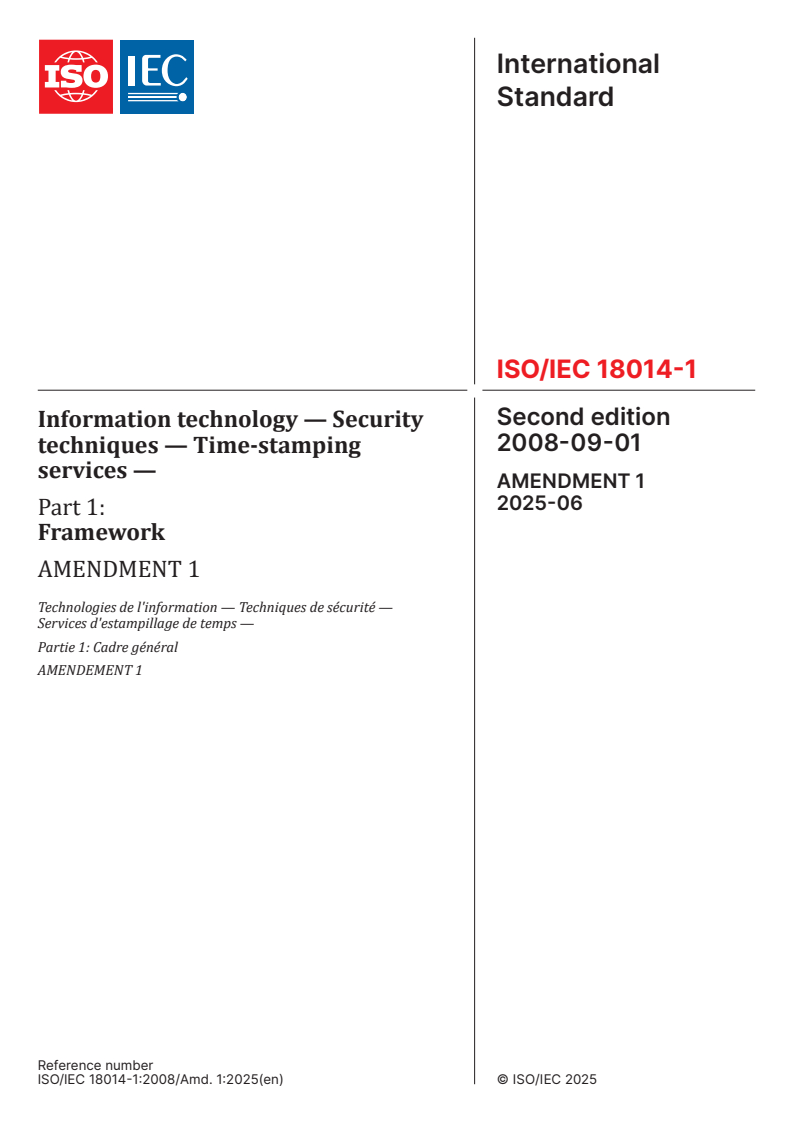
International
Standard
ISO/IEC 18014-1
Second edition
Information technology — Security
2008-09-01
techniques — Time-stamping
services —
AMENDMENT 1
2025-06
Part 1:
Framework
AMENDMENT 1
Technologies de l'information — Techniques de sécurité —
Services d'estampillage de temps —
Partie 1: Cadre général
AMENDEMENT 1
Reference number
ISO/IEC 18014-1:2008/Amd. 1:2025(en) © ISO/IEC 2025
ISO/IEC 18014-1:2008/Amd. 1:2025(en)
© ISO/IEC 2025
All rights reserved. Unless otherwise specified, or required in the context of its implementation, no part of this publication may
be reproduced or utilized otherwise in any form or by any means, electronic or mechanical, including photocopying, or posting on
the internet or an intranet, without prior written permission. Permission can be requested from either ISO at the address below
or ISO’s member body in the country of the requester.
ISO copyright office
CP 401 • Ch. de Blandonnet 8
CH-1214 Vernier, Geneva
Phone: +41 22 749 01 11
Email: copyright@iso.org
Website: www.iso.org
Published in Switzerland
© ISO/IEC 2025 – All rights reserved
ii
ISO/IEC 18014-1:2008/Amd. 1:2025(en)
Foreword
ISO (the International Organization for Standardization) and IEC (the International Electrotechnical
Commission) form the specialized system for worldwide standardization. National bodies that are
members of ISO or IEC participate in the development of International Standards through technical
committees established by the respective organization to deal with particular fields of technical activity.
ISO and IEC technical committees collaborate in fields of mutual interest. Other international organizations,
governmental and non-governmental, in liaison with ISO and IEC, also take part in the work.
The procedures used to develop this document and those intended for its further maintenance are described
in the ISO/IEC Directives, Part 1. In particular, the different approval criteria needed for the different types
of document should be noted. This document was drafted in accordance with the editorial rules of the ISO/
IEC Directives, Part 2 (see www.iso.org/directives or www.iec.ch/members_experts/refdocs).
ISO and IEC draw attention to the possibility that the implementation of this document may involve the
use of (a) patent(s). ISO and IEC take no position concerning the evidence, validity or applicability of any
claimed patent rights in respect thereof. As of the date of publication of this document, ISO and IEC had not
received notice of (a) patent(s) which may be required to implement this document. However, implementers
are cautioned that this may not represent the latest information, which may be obtained from the patent
database available at www.iso.org/patents and https://patents.iec.ch. ISO and IEC shall not be held
responsible for identifying any or all such patent rights.
Any trade name used in this document is information given for the convenience of users and does not
constitute an endorsement.
For an explanation of the voluntary nature of standards, the meaning of ISO specific terms and expressions
related to conformity assessment, as well as information about ISO's adherence to the World Trade
Organization (WTO) principles in the Technical Barriers to Trade (TBT) see www.iso.org/iso/foreword.html.
In the IEC, see www.iec.ch/understanding-standards.
This document was prepared by Technical Committee ISO/IEC JTC 1, Information technology, Subcommittee
SC 27, Information security, cyber security and privacy protection.
A list of all parts in the ISO 18014 series can be found on the ISO website.
Any feedback or questions on this document should be directed to the user’s national standards
body. A complete listing of these bodies can be found at www.iso.org/members.html and
www.iec.ch/national-committees.
© ISO/IEC 2025 – All rights reserved
iii
ISO/IEC 18014-1:2008/Amd. 1:2025(en)
Information technology — Security techniques — Time-
stamping services —
Part 1:
Framework
AMENDMENT 1
Clause 3, Terms and definitions
Add the fo
...