


ISO/IEC TR 6114:2023
(Main)Cybersecurity — Security considerations throughout the product life cycle
Cybersecurity — Security considerations throughout the product life cycle
This document describes security considerations throughout the product life cycle (SCLC), which is a framework that spans the entire information and communications technology (ICT) product life cycle. The aim of the framework is to align the industry and bring greater transparency to customers at every point on the ICT product life cycle. This document describes the following items for suppliers, end users (consumers), intermediaries of the ICT supply chain, service providers, and regulators: — definition of phases in the ICT product life cycle from concept to retirement; — threat vectors possible in each phase of the life cycle; — potential controls against those threat vectors. The target audiences of this document are suppliers and consumers of ICT products, including all participants throughout the supply chain such as silicon chip designers, fabricators, product assemblers, logistics providers, service providers, and information security organizations. Clauses 5 to 11 target an organization’s strategic and risk management teams. This document provides an end-to-end view of the threats in each phase to help the organization shape their plans, procedures and policies.
Cybersécurité — Considérations relatives à la sécurité tout au long du cycle de vie du produit
General Information
- Status
- Published
- Publication Date
- 09-Oct-2023
- Current Stage
- 6060 - International Standard published
- Start Date
- 10-Oct-2023
- Due Date
- 03-Nov-2023
- Completion Date
- 10-Oct-2023
Overview
ISO/IEC TR 6114:2023 - Cybersecurity - Security considerations throughout the product life cycle - provides a framework for security throughout the ICT product life cycle (SCLC). Published by ISO/IEC JTC 1/SC 27, this technical report maps threats and potential controls across all life‑cycle phases, from concept through development, sourcing/manufacture, transport, utilization/support, and retirement. The goal is to increase transparency and help suppliers, customers and regulators understand and mitigate supply‑chain and product integrity risks.
Key topics and requirements
ISO/IEC TR 6114:2023 organizes security considerations into actionable topics without prescribing a single implementation. Key technical topics include:
- Life‑cycle phase definitions - clear phase breakdown (Concept, Development, Source & Manufacture, Transport, Utilization & Support, Retirement) to align stakeholders.
- Threat modeling across phases - identification of likely threat vectors such as workflow/toolchain tampering, unauthorized operations, integrity faults, theft/loss, and insertion of malicious or counterfeit components.
- Phase‑specific controls - suggested mitigations against threats like attacks on development tools, malicious firmware/hardware/software, falsified test results, spoofed devices, and incomplete data removal at retirement.
- Strategic and risk focus - Clauses 5–11 are aimed at an organization’s strategic and risk management teams to shape policies, procedures and planning.
- Informative annexes - mappings and detailed examples for hardware, software, data threats, software tampering and use of tagalongs to support practical assessments.
Practical applications
This report is designed for organizations seeking an end‑to‑end security view of ICT products and their supply chains. Typical uses:
- Building or improving a product security program aligned to life‑cycle phases.
- Conducting supply‑chain risk assessments and threat‑modelling workshops.
- Specifying procurement requirements or supplier assurance clauses.
- Informing incident response and secure retirement/data sanitization procedures.
- Guiding security reviews for development pipelines, manufacturing, shipping and field support.
Who should use ISO/IEC TR 6114:2023
- ICT suppliers (chip designers, fabricators, assemblers)
- Logistics and manufacturing partners
- Service providers and integrators
- End users and procurement teams
- Regulators and policy makers
- Information security, risk and compliance teams
Related standards
ISO/IEC TR 6114:2023 complements other ISO/IEC information security and cybersecurity guidance produced by JTC 1/SC 27 and can be used alongside organizational security management frameworks to improve supply‑chain transparency and product integrity.
Keywords: ISO/IEC TR 6114:2023, SCLC, product life cycle security, ICT supply chain security, threat vectors, lifecycle controls, product integrity, supply chain transparency.
Get Certified
Connect with accredited certification bodies for this standard

BSI Group
BSI (British Standards Institution) is the business standards company that helps organizations make excellence a habit.

Bureau Veritas
Bureau Veritas is a world leader in laboratory testing, inspection and certification services.

DNV
DNV is an independent assurance and risk management provider.
Sponsored listings
Frequently Asked Questions
ISO/IEC TR 6114:2023 is a technical report published by the International Organization for Standardization (ISO). Its full title is "Cybersecurity — Security considerations throughout the product life cycle". This standard covers: This document describes security considerations throughout the product life cycle (SCLC), which is a framework that spans the entire information and communications technology (ICT) product life cycle. The aim of the framework is to align the industry and bring greater transparency to customers at every point on the ICT product life cycle. This document describes the following items for suppliers, end users (consumers), intermediaries of the ICT supply chain, service providers, and regulators: — definition of phases in the ICT product life cycle from concept to retirement; — threat vectors possible in each phase of the life cycle; — potential controls against those threat vectors. The target audiences of this document are suppliers and consumers of ICT products, including all participants throughout the supply chain such as silicon chip designers, fabricators, product assemblers, logistics providers, service providers, and information security organizations. Clauses 5 to 11 target an organization’s strategic and risk management teams. This document provides an end-to-end view of the threats in each phase to help the organization shape their plans, procedures and policies.
This document describes security considerations throughout the product life cycle (SCLC), which is a framework that spans the entire information and communications technology (ICT) product life cycle. The aim of the framework is to align the industry and bring greater transparency to customers at every point on the ICT product life cycle. This document describes the following items for suppliers, end users (consumers), intermediaries of the ICT supply chain, service providers, and regulators: — definition of phases in the ICT product life cycle from concept to retirement; — threat vectors possible in each phase of the life cycle; — potential controls against those threat vectors. The target audiences of this document are suppliers and consumers of ICT products, including all participants throughout the supply chain such as silicon chip designers, fabricators, product assemblers, logistics providers, service providers, and information security organizations. Clauses 5 to 11 target an organization’s strategic and risk management teams. This document provides an end-to-end view of the threats in each phase to help the organization shape their plans, procedures and policies.
ISO/IEC TR 6114:2023 is classified under the following ICS (International Classification for Standards) categories: 35.030 - IT Security. The ICS classification helps identify the subject area and facilitates finding related standards.
ISO/IEC TR 6114:2023 is available in PDF format for immediate download after purchase. The document can be added to your cart and obtained through the secure checkout process. Digital delivery ensures instant access to the complete standard document.
Standards Content (Sample)
TECHNICAL ISO/IEC TR
REPORT 6114
First edition
2023-10
Cybersecurity — Security
considerations throughout the
product life cycle
Cybersécurité — Considérations relatives à la sécurité tout au long du
cycle de vie du produit
Reference number
© ISO/IEC 2023
© ISO/IEC 2023
All rights reserved. Unless otherwise specified, or required in the context of its implementation, no part of this publication may
be reproduced or utilized otherwise in any form or by any means, electronic or mechanical, including photocopying, or posting on
the internet or an intranet, without prior written permission. Permission can be requested from either ISO at the address below
or ISO’s member body in the country of the requester.
ISO copyright office
CP 401 • Ch. de Blandonnet 8
CH-1214 Vernier, Geneva
Phone: +41 22 749 01 11
Email: copyright@iso.org
Website: www.iso.org
Published in Switzerland
ii
© ISO/IEC 2023 – All rights reserved
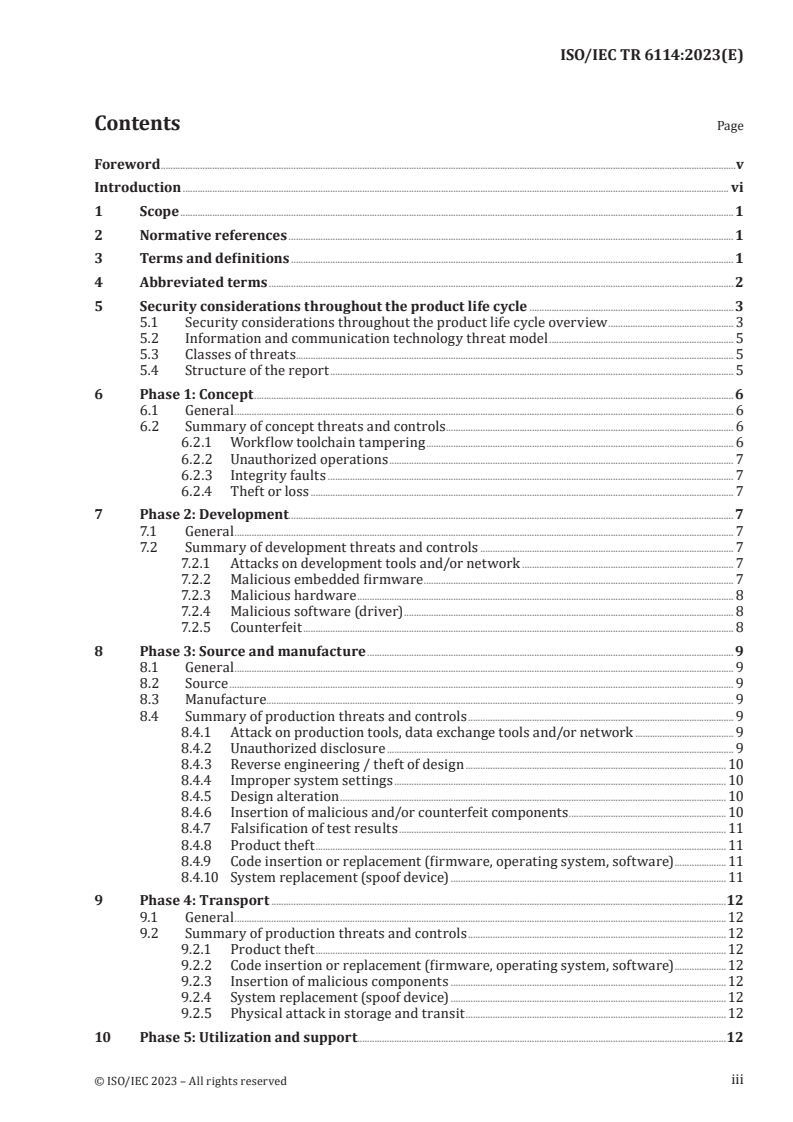
Contents Page
Foreword .v
Introduction . vi
1 Scope . 1
2 Normative references . 1
3 Terms and definitions . 1
4 Abbreviated terms . 2
5 Security considerations throughout the product life cycle . 3
5.1 Security considerations throughout the product life cycle overview . 3
5.2 Information and communication technology threat model . 5
5.3 Classes of threats. 5
5.4 Structure of the report . 5
6 Phase 1: Concept .6
6.1 General . 6
6.2 Summary of concept threats and controls . 6
6.2.1 Workflow toolchain tampering . 6
6.2.2 Unauthorized operations . 7
6.2.3 Integrity faults . 7
6.2.4 Theft or loss . 7
7 Phase 2: Development. 7
7.1 General . 7
7.2 Summary of development threats and controls . 7
7.2.1 Attacks on development tools and/or network . 7
7.2.2 Malicious embedded firmware . 7
7.2.3 Malicious hardware . 8
7.2.4 Malicious software (driver) . 8
7.2.5 Counterfeit . 8
8 Phase 3: Source and manufacture . 9
8.1 General . 9
8.2 Source . 9
8.3 Manufacture. 9
8.4 Summary of production threats and controls . 9
8.4.1 Attack on production tools, data exchange tools and/or network . 9
8.4.2 Unauthorized disclosure . 9
8.4.3 Reverse engineering / theft of design . 10
8.4.4 Improper system settings . 10
8.4.5 Design alteration . 10
8.4.6 Insertion of malicious and/or counterfeit components . 10
8.4.7 Falsification of test results . 11
8.4.8 Product theft . 11
8.4.9 Code insertion or replacement (firmware, operating system, software) . 11
8.4.10 System replacement (spoof device) . 11
9 Phase 4: Transport .12
9.1 General .12
9.2 Summary of production threats and controls .12
9.2.1 Product theft . 12
9.2.2 Code insertion or replacement (firmware, operating system, software) .12
9.2.3 Insertion of malicious components .12
9.2.4 System replacement (spoof device) .12
9.2.5 Physical attack in storage and transit .12
10 Phase 5: Utilization and support .12
iii
© ISO/IEC 2023 – All rights reserved
10.1 General .12
10.2 Provision . 13
10.3 Utilization . 13
10.4 Support . 13
10.5 Summary of utilization threats and controls . 13
10.5.1 Unknown provenance . 13
10.5.2 Spoofed system (replaced system) . 13
10.5.3 Undetected tampering . 14
10.5.4 Build data store tampering . 14
10.5.5 Non-current device/product (firmware, operation system, application,
drivers) . 14
10.5.6 Unauthorized changes (firmware, operating system, software) . 14
10.5.7 Unauthorized component swap . 14
10.5.8 Insertion or replacement with malicious component .15
10.5.9 Product data store tampering . 15
11 Phase 6: Retirement .15
11.1 General . 15
11.2 Summary of retirement threats and controls . 15
11.2.1 Inaccurate hardware return . 15
11.2.2 Incomplete data removal . 16
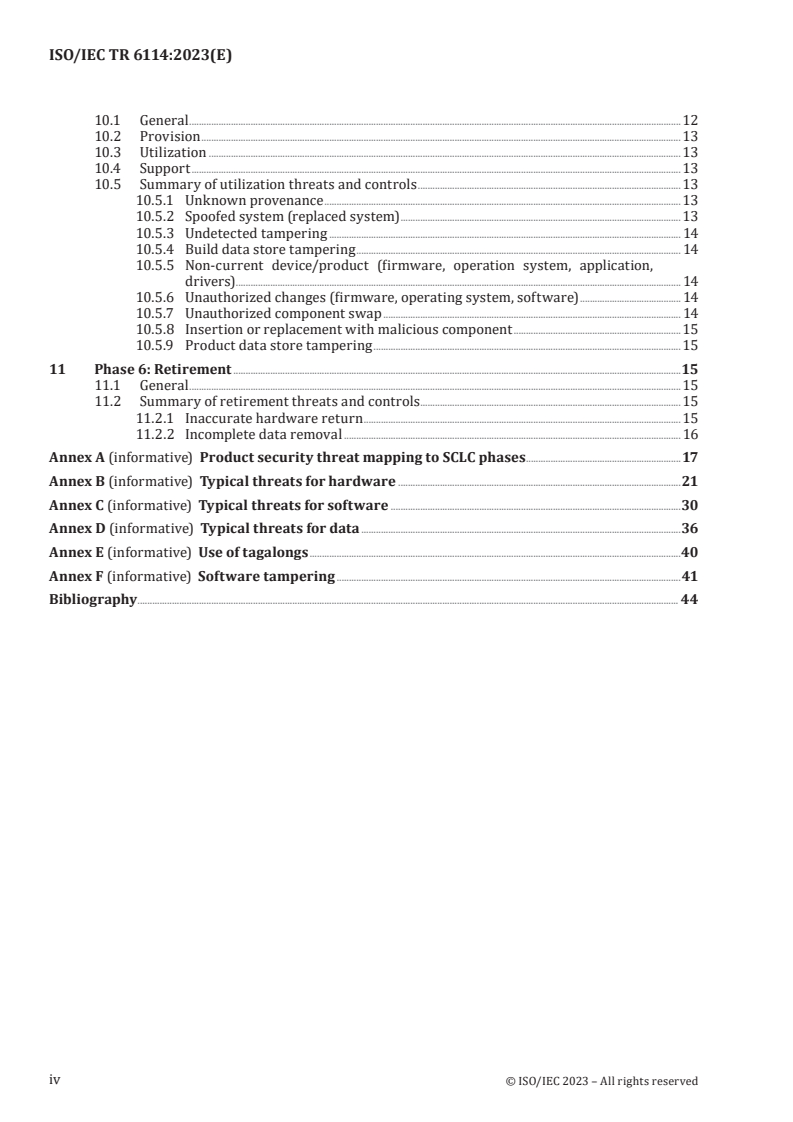
Annex A (informative) Product security threat mapping to SCLC phases .17
Annex B (informative) Typical threats for hardware .21
Annex C (informative) Typical threats for software .30
Annex D (informative) Typical threats for data .36
Annex E (informative) Use of tagalongs .40
Annex F (informative) Software tampering .41
Bibliography . 44
iv
© ISO/IEC 2023 – All rights reserved
Foreword
ISO (the International Organization for Standardization) and IEC (the International Electrotechnical
Commission) form the specialized system for worldwide standardization. National bodies that are
members of ISO or IEC participate in the development of International Standards through technical
committees established by the respective organization to deal with particular fields of technical
activity. ISO and IEC technical committees collaborate in fields of mutual interest. Other international
organizations, governmental and non-governmental, in liaison with ISO and IEC, also take part in the
work.
The procedures used to develop this document and those intended for its further maintenance
are described in the ISO/IEC Directives, Part 1. In particular, the different approval criteria
needed for the different types of document should be noted. This document was drafted in
accordance with the editorial rules of the ISO/IEC Directives, Part 2 (see www.iso.org/directives or
www.iec.ch/members_experts/refdocs).
ISO and IEC draw attention to the possibility that the implementation of this document may involve the
use of (a) patent(s). ISO and IEC take no position concerning the evidence, validity or applicability of
any claimed patent rights in respect thereof. As of the date of publication of this document, ISO and IEC
had not received notice of (a) patent(s) which may be required to implement this document. However,
implementers are cautioned that this may not represent the latest information, which may be obtained
from the patent database available at www.iso.org/patents and https://patents.iec.ch. ISO and IEC shall
not be held responsible for identifying any or all such patent rights.
Any trade name used in this document is information given for the convenience of users and does not
constitute an endorsement.
For an explanation of the voluntary nature of standards, the meaning of ISO specific terms and
expressions related to conformity assessment, as well as information about ISO's adherence to
the World Trade Organization (WTO) principles in the Technical Barriers to Trade (TBT) see
www.iso.org/iso/foreword.html. In the IEC, see www.iec.ch/understanding-standards.
This document was prepared by Joint Technical Committee ISO/IEC JTC 1, Information technology,
Subcommittee SC 27, Information security, cybersecurity and privacy protection.
Any feedback or questions on this document should be directed to the user’s national standards
body. A complete listing of these bodies can be found at www.iso.org/members.html and
www.iec.ch/national-committees.
v
© ISO/IEC 2023 – All rights reserved
Introduction
The globalization of technology design, development, manufacturing, and distribution has created
an environment of complicated supply chains with limited transparency. This presents an incredible
challenge for the industry and highlights a growing need to ensure product integrity for all stages of
the information and communications technology (ICT) product life cycle.
The call for assurance across the supply chain landscape has evolved over several decades. More
recently, policy makers around the world have begun to focus on supply chain risks in new ways: from
policies considering supply chain security risks for government procurement to various initiatives
adding security considerations such as trust and transparency in the supply chain for ICT.
Vendors have been doing their part as well. Over the past several years, ICT suppliers have taken
important steps towards increasing supply chain transparency. These steps include sourcing conflict-
[1]
free minerals, and implementing a set of policies, procedures and tools at factories to improve
security consideration throughout the supply chain by validating where and when each component of
an ICT product was manufactured.
These are important first steps, however they primarily focus on the production stage, just one stage of
the ICT product life cycle. In today’s complex environment, hardware platform providers are expected
to enable a full range of tools and solutions that improve security consideration across the entire life
cycle, from design and sourcing to secure retirement.
Security considerations throughout the product life cycle (SCLC) establish an end to end framework
that can be applied to the multi-year life cycle of ICT products to comprehend and address potential
risks for improved transparency and higher levels of security assurances. By enabling transparency
and assurances across the ICT product life cycle, supply chain owners can improve platform integrity,
resilience and security. The life cycle phases are both iterative and recursive in nature.
vi
© ISO/IEC 2023 – All rights reserved
TECHNICAL REPORT ISO/IEC TR 6114:2023(E)
Cybersecurity — Security considerations throughout the
product life cycle
1 Scope
This document describes security considerations throughout the product life cycle (SCLC), which is a
framework that spans the entire information and communications technology (ICT) product life cycle.
The aim of the framework is to align the industry and bring greater transparency to customers at every
point on the ICT product life cycle.
This document describes the following items for suppliers, end users (consumers), intermediaries of
the ICT supply chain, service providers, and regulators:
— definition of phases in the ICT product life cycle from concept to retirement;
— threat vectors possible in each phase of the life cycle;
— potential controls against those threat vectors.
The target audiences of this document are suppliers and consumers of ICT products, including all
participants throughout the supply chain such as silicon chip designers, fabricators, product assemblers,
logistics providers, service providers, and information security organizations. Clauses 5 to 11 target an
organization’s strategic and risk management teams. This document provides an end-to-end view of the
threats in each phase to help the organization shape their plans, procedures and policies.
2 Normative references
The following documents are referred to in the text in such a way that some or all of their content
constitutes requirements of this document. For dated references, only the edition cited applies. For
undated references, the latest edition of the referenced document (including any amendments) applies.
ISO/IEC/IEEE 15288, Systems and software engineering — System life cycle processes
ISO/IEC/IEEE 24748-1:2018, Systems and software engineering — Life cycle management — Part 1:
Guidelines for life cycle management
3 Terms and definitions
For the purposes of this document, the terms and definitions given in ISO/IEC/IEEE 15288,
ISO/IEC/IEEE 24748-1:2018, and the following apply.
ISO and IEC maintain terminology databases for use in standardization at the following addresses:
— ISO Online browsing platform: available at https:// www .iso .org/ obp
— IEC Electropedia: available at https:// www .electropedia .org/
3.1
digital signature
data appended to, or a cryptographic transformation of, a data unit that allows the recipient of the data
unit to verify the source and integrity of the data unit
[SOURCE: ISO/IEC 9798-3:2019, 3.3]
© ISO/IEC 2023 – All rights reserved
3.2
code scanner
program source code and binary file security analysis tool
3.3
hardware trojan
malicious program or hardware that masquerades as a benign application
4 Abbreviated terms
ASIC application specific integrated circuit
BOM bill of materials
CPU central processing unit
DRM digital rights management
DSP digital signal processor
ERP enterprise resource planning
FPGA field programmable gate array
FW firmware
HDL hardware description language
HW hardware
IC integrated circuit
ICT information and communication technology
ISV independent software vender
OEM original equipment manufacture
OSAT outsourced semiconductor assembly and test
OS operating system
PUF physically unclonable function
SaaS software as a service
SDL security development life cycle
SoC system on chip
SW software
VHDL very high-speed integrated circuit hardware description language
© ISO/IEC 2023 – All rights reserved
SOURCE ISO/IEC/IEEE 24748-1:2018, reproduced with the permission of the authors.
Figure 1 — ICT system life cycle
5 Security considerations throughout the product life cycle
5.1 Security considerations throughout the product life cycle overview
Security considerations throughout the product life cycle (SCLC) is a framework to describe the
ICT products life cycle from security assurance and manufacturing perspectives (see Figure 1). The
concept of SCLC can be applied to hardware products and software such as microcode, firmware,
and other software to support the hardware. SCLC consists of six common product life cycle phases
which are shown in Figure 2 with typical threat vectors. The names of the phases are derived from
ISO/IEC/IEEE 24748-1 and processes unique to SCLC have been added. It is important to note that each
phase exists for individual components, sub-systems and end products. It is both possible and highly
likely that some of the phases are executed more than once for an individual component (e.g. integrated
circuits go through wafer fabrication, sorting, assembly and final test. Those facilities, if separate,
introduce multiple build/transfer phases).
ISO/IEC/IEEE 15288 defines the life cycle of a system by four process groups which are 1) agreement
process, 2) organizational project-enabling process, 3) technical management process and 4) technical
process. Since this document describes the life cycle from a different perspective, that is, the “product
life cycle”, there is no conflict or inconsistency between ISO/IEC/IEEE 15288 and this document.
[3]
Another systems approach to security is the NIST SP 800-160V1 that aligns with this approach.
© ISO/IEC 2023 – All rights reserved
SOURCE ISO/IEC/IEEE 24748-1:2018, reproduced with the permission of the authors.
Figure 2 — ICT Product life cycle and threat vectors
Figure 3 shows a relationship of technical processes in ISO/IEC/IEEE 15288 and SCLC phases.
© ISO/IEC 2023 – All rights reserved
Figure 3 — Mapping technical processes of ISO/IEC/IEEE 15288 and SCLC life cycle phases
5.2 Information and communication technology threat model
Security threats against ICT products exist not only in the utilization/support phase but in all six phases
[4]
shown in Figure 2. Each phase has different threat vectors, but some vectors such as theft occur in
multiple phases. This means responsible parties are expected to apply proper measures in each phase
for each threat vector applicable.
From Clause 6 to Clause 11, the key characteristics of each ICT product’s life cycle phase and typical
threat vectors are described.
5.3 Classes of threats
There are multiple classes of security threats. The first type is an attack that targets unintentional
vulnerability, such as ICT product security vulnerability in the manufacturing process or in the physical
storage and transportation processes. The second type is an intentional attack by insider personnel
who can access the process and change or replace tools, products, or components. The focus of this
document is to identify and protect ICT products from the first type of threats. However, the methods
described in this document can also be used to mitigate the risks of the second type of threats. In many
cases, additional protection measures are necessary, such as employee/personnel management and
access control in all phases for all stakeholders who participate in the product life cycle.
5.4 Structure of the report
Clauses 6 to 11 give an overview of each phase, threats, and controls. Additionally, Annexes A, B, C
and D provide specific best practice procedures and controls for practitioners that they can implement
within their operation to mitigate against potential threats.
© ISO/IEC 2023 – All rights reserved
6 Phase 1: Concept
6.1 General
In the concept phase, user needs are identified, and system concepts are described and evaluated.
In addition to the user needs, companies are expected to consider regulatory controls and security
objectives to establish a comprehensive set of requirements to be met in development.
Given the complexity of ICT products, many companies combine internal design, third party design
and open source design to deliver a single component on a system that can comprise hundreds of
components. For example, the system on a chip (SoC) component can contain hardware blocks sourced
from many third parties, as well as blocks designed by the product manufacturer. This complexity
introduces additional risks as unneeded features from external components that are incorporated into
the end product, possibly creating a vulnerability that can be attacked. For this reason, the product
flows back through the concept phase to add additional security control requirements based upon
decisions made in development.
It is best practice for ICT product organizations to adopt a security development life cycle (SDL) process
that conforms to ISO/IEC 27034-1. This process ensures the identification of unique threats at the start
of the concept phase and turns those into a set of requirements to be met during the development phase.
Additionally, SDL requires the training of the engineers, designers and architects that work on how to
best maintain a secure system, thereby increasing the security of the product.
SCLC in the concept phase addresses the questions:
— What is in the products function?
— Does the product contain anything additional that can be used against the owner/operator of the
ICT product?
In 6.2, possible threat vectors and mitigations in this phase are described.
6.2 Summary of concept threats and controls
6.2.1 Workflow toolchain tampering
Management of the software tools used in support of the concept phase is critical to mitigating attacks
to the tool that can alter the design or allow feature requirements to be stolen. These tools often support
integration with third-party plugins, such as those from outside tool vendors or even from the original
tool provider. If the plugins are not properly verified/certified, they can contain malicious elements.
Additionally, installation of these modules can be subject to man-in-the-middle (MITM) attacks during
transit over the network or in the build of the tool software by the software provider. The modules
require sufficient verification before installation into the concept toolchain. It is essential to implement
a practice for managing design tools and keeping them up to date and secure. Best practice ensures
these plugins have been digitally signed and licensed by a reputable producer, are regularly scanned
by source code scanners (static and dynamic) and have an internal team responsible for securing the
design tools. Moving to a SaaS workflow toolchain vendor properly skilled in secure life cycle practices
and verified by an independent third party can also be an effective way to improve controls on the
toolchain. However, this comes with risks, as the SaaS providers are a likely target of attack due to
the multitude of customers in one spot. The ICT product developer is responsible for securing their
workflow toolchain and for assessing their own internal security controls against that of a SaaS
provider to determine the best way to implement their workflow toolchain.
In cases where the network used in the concept phase is not a closed network, attacks can be launched
against these networks from external adversaries in the hopes of obtaining or modifying sensitive
design files. Such attacks can be supported by an insider threat that installs malware or a virus on
critical security systems, allowing for easier access and attacks against target platforms. Refer to
ISO/IEC 27032 for guidance on building and maintaining secure networks, as this issue is the same for
any ICT entity that runs a private network.
© ISO/IEC 2023 – All rights reserved
6.2.2 Unauthorized operations
The unauthorized invocation of data operations for creating, reading, updating/modifying or deleting
data in the concept phase can impact the development of the product, its components or sub systems.
For example, a security feature developed in concept phase, but which has been deleted/rejected or
changed and which influences the product design and build to not include a security feature necessary
to protect the product in operation or add a backdoor into the product for future attacks once in
operation.
6.2.3 Integrity faults
The integrity faults can occur by unintentional modification or destruction of data due to technical
or operational errors, faults or failures occurring within a product, or related to supporting the
product’s concept phase. Like unauthorized operations, this can lead to a manipulation or exclusion
of requirements for the development phase, thereby altering the function of the ICT product. These
faults can get caught in development if the appropriate test cases are in place to validate the correct
requirements. However, if they are not caught, or caught too late in the life cycle, additional costs are
incurred as the product is looped back into the development phase to remove the vulnerability.
6.2.4 Theft or loss
The absence, removal or destruction of a data asset, or unauthorized data access due to actions taken
by a malicious actor, or by environmental hazards can occur within the concept phase.
7 Phase 2: Development
7.1 General
This is the second phase of the ICT product life cycle, where engineering design and development are
conducted. Example processes are prototype design and evaluation, engineering sample development
and manufacturing, threat analysis, manufacturing tool development and production operation
planning.
7.2 Summary of development threats and controls
7.2.1 Attacks on development tools and/or network
The same security threats and prevention mechanisms described in 6.2.1 can be applied to this phase.
7.2.2 Malicious embedded firmware
Hardware that has any intelligence requires firmware, so the hardware knows how to operate.
Firmware typically sits in non-volatile memory and is not authenticated prior to execution making it
vulnerable to attack through alterations. This characteristic of firmware makes firmware susceptible
to attack at many stages in the SCLC. This subclause deals with malicious firmware during the design
and creation of firmware by the original designer. It is important to note that manufacturers of ICT
products can take the firmware from the hardware manufacturer and change it for their unique need
or ignore it all together and replace it with their own firmware or that of another third party.
Due to the fluidity of firmware from the original product designer throughout the supply chain, it is
important for firmware to be maintained and tracked with good source code management tools and
version control processes. Firmware not only changes within the supply chain, prior to provisioning,
but it is not uncommon for it to change throughout phase 5 and even into phase 6. Firmware changes in
the utilization phase typically occur to address performance and security updates in the hardware that
were not discovered in validation.
© ISO/IEC 2023 – All rights reserved
In design, all firmware can include a process for adding a digital signature to the firmware prior to
distribution so the ICT process can verify the signature and only load the firmware if the signature
is valid. The signature ensures the firmware has not been tampered with in phase 2. Combining this
process with the security design life cycle practices can improve confidence in the validity of the
firmware.
7.2.3 Malicious hardware
Malicious hardware (HW) can be introduced by an internal or external source adding additional
circuitry into a design that performs a function other than what was specified in the product
requirements. Best practices to mitigate the implementation of malicious HW are the implementation
of peer code reviews and the utilization of code scanners. Additionally, characterizing the normal
behaviour of the HW enables the implementation of test cases that test for abnormal behaviours.
Malicious HW results in additional circuitry added to the design. The hardware performs all the
functionality to meet the design requirements but has additional circuitry that can activate only after
a specific condition exists (number of executions, amount of time since power on, etc.). It is almost
statistically impossible to exhaustively test with every possible input vector. The types of hardware
trojans are broad, but it is technically possible to send data back to an unauthorized party. Another
hardware trojan can invoke a destructive action or prevent any action during the operation of the
product.
7.2.4 Malicious software (driver)
Software drivers and firmware typically come from the hardware supplier, but there are instances
where these are provided by a third party. This can be done when a single software driver is controlling
components from multiple hardware manufacturers, and it requires the integration of multiple sets of
software into a single signed software module. This software is susceptible to the same design threats
for software implemented internally, like the insertion of hidden functionality. To mitigate this threat,
when selecting suppliers it is important to consider the SDL and supply chain controls followed by
the supplier. Additionally, validation results can be made available as part of the product delivery to
ensure that there can be independent verification of code scans results and test results and to ensure
no abnormal behaviour. Requiring only signed software as a standard practice enables software
traceability directly back to the signing organization and possible verification that no manipulation
has occurred. Performing static code scans of each version of software provided will give an additional
internally verifiable result to the state of the software provided.
Malicious software can also occur from software tampering. Some common types of software
tampering mechanisms are described in Annex F.
7.2.5 Counterfeit
Counterfeit components can appear to operate within the requirements established by stakeholders,
but can suffer from substandard materials and insufficient quality controls and validation, leading to
unpredictable life. This can lead to higher failure rates, inoperability within the required environment
(heat, moisture, vibration, etc.) and the inability to hold the product manufacturer accountable.
One best practice which can be implemented in the supply chain is to buy only from distributors that
are authorized (by the manufacturer of the component). Another best practice is to perform routine
audits of the suppliers on their security practices to prevent counterfeit parts from entering their
supply chain. Audits can include observation of supply chain practices, destructive tests on components
and verification of validation results.
© ISO/IEC 2023 – All rights reserved
8 Phase 3: Source and manufacture
8.1 General
This is the phase where the materials and components are manufactured into ICT products. There
are many threats in the production process that can impact the performance of the product or expose
intellectual property for theft. Like other phases, phase 3 requires an implementation of good practices
in information technology processes as well as supply chain processes, to ensure consistency.
8.2 Source
Source is the acquisition of goods or services from a third party, which contributes to the ICT component
or product. This is the phase to prepare necessary materials and tools for the production. The materials
include not only raw materials, components, software, but also services like storage, building and
validation. Companies typically implement a comprehensive sourcing strategy that includes establishing
security criteria in addition to their corporate responsibility and quality criteria to be used in the
selection of the supplier. The parties responsible for supply chain assurance and information security
define the criteria. This means the criteria can be used to align supplier expectations with the goals to
prevent threat vectors occurring at earlier points of the life cycle. Additionally, controls through audits
or quantifiable assurance (documented proof) can be added as part of the criteria for supplier selection
and ongoing monitoring.
8.3 Manufacture
Manufacture is the phase to integrate final products from the materials prepared in the previous
source phase. During the integration and at the completion of the manufacturing, a series of tests and
evaluation can be applied. In some cases, middle products can be transferred from one facility to the
other. In that case, phase 4 protection is applied. At the end of the manufacturing, it is important to
configure the products as “end of manufacturing” state, which disables all manufacturing interfaces
such as debug and test ports.
8.4 Summary of production threats and controls
8.4.1 Attack on production tools, data exchange tools and/or network
The same security threats and prevention mechanisms described in 6.2.1 can be applied to this phase.
In ICT product manufacturing, most fabrication equipment is very sophisticated, and the equipment
is serviced by the equipment manufacturer’s technicians. There are two methods of maintenance. The
first method is through the network, in which case access controls are expected to be very tight and
typically are opened and closed by the builder rather than leaving a business-to-business connection
open for someone to take advantage of the open connection to affect the performance of the equipment.
Alternatively, technicians can come into the factory to service equipment. In this case, the technician
can be supervised or electronically monitored while in the factory to protect assets from theft,
manipulation, or insertion of foreign materials into the build process.
8.4.2 Unauthorized disclosure
Most of the design files used in the creation of components are only shared under the strictest of non-
disclosure agreements (NDAs). However, violations of these NDAs, either intentional or unintentional,
are not always reported by the violating party. This expands the insider threat potential beyond just
the manufacturer to include every supplier or vendor that is given sensitive information about the
manufacturer’s products. Methods to minimize accidental or purposeful disclosure include:
— applying digital rights management (DRM) to design files with policy settings that restrict
viewing files unless specifically granted by the owner of the file, thereby limiting physical access to the
manufacturing floor;
© ISO/IEC 2023 – All rights reserved
— training technicians and engineers on how to properly handle information and designs they
readily use to perform their jobs.
8.4.3 Reverse engineering / theft of design
Any design that can be created can also be reverse engineered. Even if an attacker cannot gain direct
access to the design files, extraction of the synthesized files (processed designs) can allow for possible
reverse engineering of critical design secrets. This can include cryptographic keys stored within the
products. Detection of a stolen design can be enabled by obfuscating the cryptographic key by dispersing
it throughout the circuitry (vs. having fuses in sequential placement) or having the algorithm generate
a unique hash based upon the unique chip design and including this as part of the key.
8.4.4 Improper system settings
Final validation of finished products can include steps to ensure proper system state before it leaves
the manufacturing facility. System settings that are open in manufacturing to enable the correct
configuration of an ICT product are expected to be locked prior to leaving the end of the manufacturing
line.
8.4.5 Design alteration
Alteration of the design can occur during a number of stages by various actors. It is possible for a supplier
to suggest a seemingly innocuous change that actually provides the ability to induce an undefined state
of execution in the system. An integrator can also make a covert change to the design files provided as
part of an integration effort, and a substitute component can be swapped out due to supply shortages or
in an effort to save costs.
To mitigate impact by suppliers, a contractual agreement can be implemented to ensure that every
change to a material goes through a formal engineering change order (ECO) process and all parties
can weigh in on the change and determine the impact before the change is implemented. All material
testing performed by the su
...
Questions, Comments and Discussion
Ask us and Technical Secretary will try to provide an answer. You can facilitate discussion about the standard in here.
Loading comments...