


ISO 17593:2007
(Main)Clinical laboratory testing and in vitro medical devices — Requirements for in vitro monitoring systems for self-testing of oral anticoagulant therapy
Clinical laboratory testing and in vitro medical devices — Requirements for in vitro monitoring systems for self-testing of oral anticoagulant therapy
ISO 17593:2007 specifies requirements for in vitro measuring systems for self-monitoring of vitamin-K antagonist therapy, including performance, quality assurance and user training and procedures for the verification and validation of performance by the intended users under actual and simulated conditions of use. ISO 17593:2007 pertains solely to prothrombin time measuring systems used by individuals for monitoring their own vitamin-K antagonist therapy, and which report results as international normalized ratios (INR). ISO 17593:2007 is applicable to manufacturers of such systems and those other organizations (e.g., regulatory authorities and conformity assessment bodies) having the responsibility for assessing the performance of these systems. ISO 17593:2007 does not pertain to in vitro measuring systems for coagulation quantities assessing vitamin-K antagonist therapy used by physicians or healthcare providers, provide a comprehensive evaluation of all possible factors that could affect the performance of these systems, or address the medical aspects of oral anticoagulation therapy.
Laboratoires d'analyses de biologie médicale et dispositifs médicaux de diagnostic in vitro — Exigences relatives aux systèmes d'autosurveillance des traitements par anti-coagulant oraux
General Information
- Status
- Withdrawn
- Publication Date
- 16-Apr-2007
- Drafting Committee
- ISO/TC 212/WG 3 - In vitro diagnostic products
- Current Stage
- 9599 - Withdrawal of International Standard
- Start Date
- 11-Mar-2022
- Completion Date
- 12-Feb-2026
Relations
- Effective Date
- 23-Apr-2020

Get Certified
Connect with accredited certification bodies for this standard

BSI Group
BSI (British Standards Institution) is the business standards company that helps organizations make excellence a habit.

TÜV Rheinland
TÜV Rheinland is a leading international provider of technical services.

TÜV SÜD
TÜV SÜD is a trusted partner of choice for safety, security and sustainability solutions.
Sponsored listings
Frequently Asked Questions
ISO 17593:2007 is a standard published by the International Organization for Standardization (ISO). Its full title is "Clinical laboratory testing and in vitro medical devices — Requirements for in vitro monitoring systems for self-testing of oral anticoagulant therapy". This standard covers: ISO 17593:2007 specifies requirements for in vitro measuring systems for self-monitoring of vitamin-K antagonist therapy, including performance, quality assurance and user training and procedures for the verification and validation of performance by the intended users under actual and simulated conditions of use. ISO 17593:2007 pertains solely to prothrombin time measuring systems used by individuals for monitoring their own vitamin-K antagonist therapy, and which report results as international normalized ratios (INR). ISO 17593:2007 is applicable to manufacturers of such systems and those other organizations (e.g., regulatory authorities and conformity assessment bodies) having the responsibility for assessing the performance of these systems. ISO 17593:2007 does not pertain to in vitro measuring systems for coagulation quantities assessing vitamin-K antagonist therapy used by physicians or healthcare providers, provide a comprehensive evaluation of all possible factors that could affect the performance of these systems, or address the medical aspects of oral anticoagulation therapy.
ISO 17593:2007 specifies requirements for in vitro measuring systems for self-monitoring of vitamin-K antagonist therapy, including performance, quality assurance and user training and procedures for the verification and validation of performance by the intended users under actual and simulated conditions of use. ISO 17593:2007 pertains solely to prothrombin time measuring systems used by individuals for monitoring their own vitamin-K antagonist therapy, and which report results as international normalized ratios (INR). ISO 17593:2007 is applicable to manufacturers of such systems and those other organizations (e.g., regulatory authorities and conformity assessment bodies) having the responsibility for assessing the performance of these systems. ISO 17593:2007 does not pertain to in vitro measuring systems for coagulation quantities assessing vitamin-K antagonist therapy used by physicians or healthcare providers, provide a comprehensive evaluation of all possible factors that could affect the performance of these systems, or address the medical aspects of oral anticoagulation therapy.
ISO 17593:2007 is classified under the following ICS (International Classification for Standards) categories: 11.100.20 - Biological evaluation of medical devices. The ICS classification helps identify the subject area and facilitates finding related standards.
ISO 17593:2007 has the following relationships with other standards: It is inter standard links to ISO 17593:2022. Understanding these relationships helps ensure you are using the most current and applicable version of the standard.
ISO 17593:2007 is available in PDF format for immediate download after purchase. The document can be added to your cart and obtained through the secure checkout process. Digital delivery ensures instant access to the complete standard document.
Standards Content (Sample)
INTERNATIONAL ISO
STANDARD 17593
First edition
2007-04-15
Clinical laboratory testing and in vitro
medical devices — Requirements for in
vitro monitoring systems for self-testing
of oral anticoagulant therapy
Laboratoires d'analyses de biologie médicale et dispositifs médicaux de
diagnostic in vitro — Exigences relatives aux systèmes
d'autosurveillance des traitements par anti-coagulant oraux
Reference number
©
ISO 2007
PDF disclaimer
This PDF file may contain embedded typefaces. In accordance with Adobe's licensing policy, this file may be printed or viewed but
shall not be edited unless the typefaces which are embedded are licensed to and installed on the computer performing the editing. In
downloading this file, parties accept therein the responsibility of not infringing Adobe's licensing policy. The ISO Central Secretariat
accepts no liability in this area.
Adobe is a trademark of Adobe Systems Incorporated.
Details of the software products used to create this PDF file can be found in the General Info relative to the file; the PDF-creation
parameters were optimized for printing. Every care has been taken to ensure that the file is suitable for use by ISO member bodies. In
the unlikely event that a problem relating to it is found, please inform the Central Secretariat at the address given below.
© ISO 2007
All rights reserved. Unless otherwise specified, no part of this publication may be reproduced or utilized in any form or by any means,
electronic or mechanical, including photocopying and microfilm, without permission in writing from either ISO at the address below or
ISO's member body in the country of the requester.
ISO copyright office
Case postale 56 • CH-1211 Geneva 20
Tel. + 41 22 749 01 11
Fax + 41 22 749 09 47
E-mail copyright@iso.org
Web www.iso.org
Published in Switzerland
ii © ISO 2007 – All rights reserved
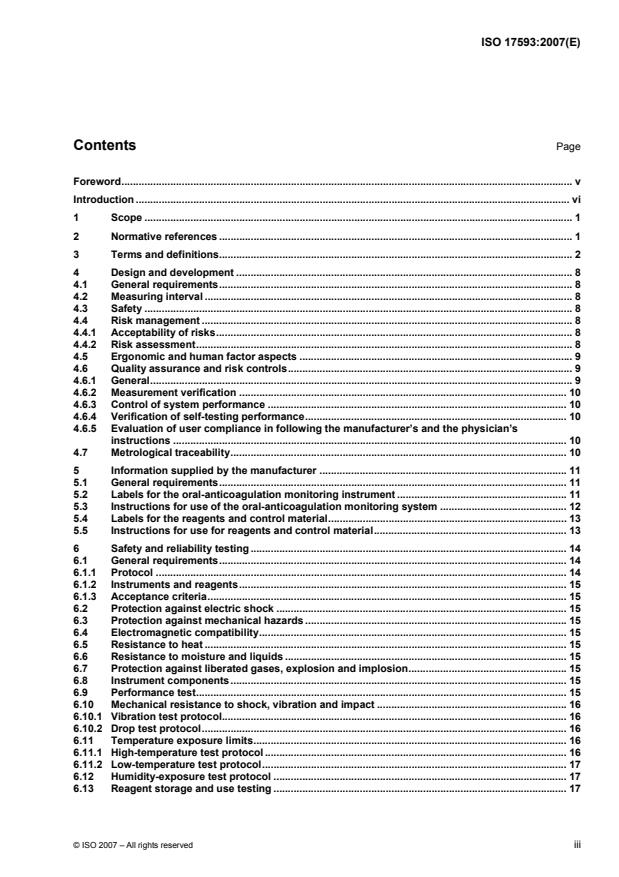
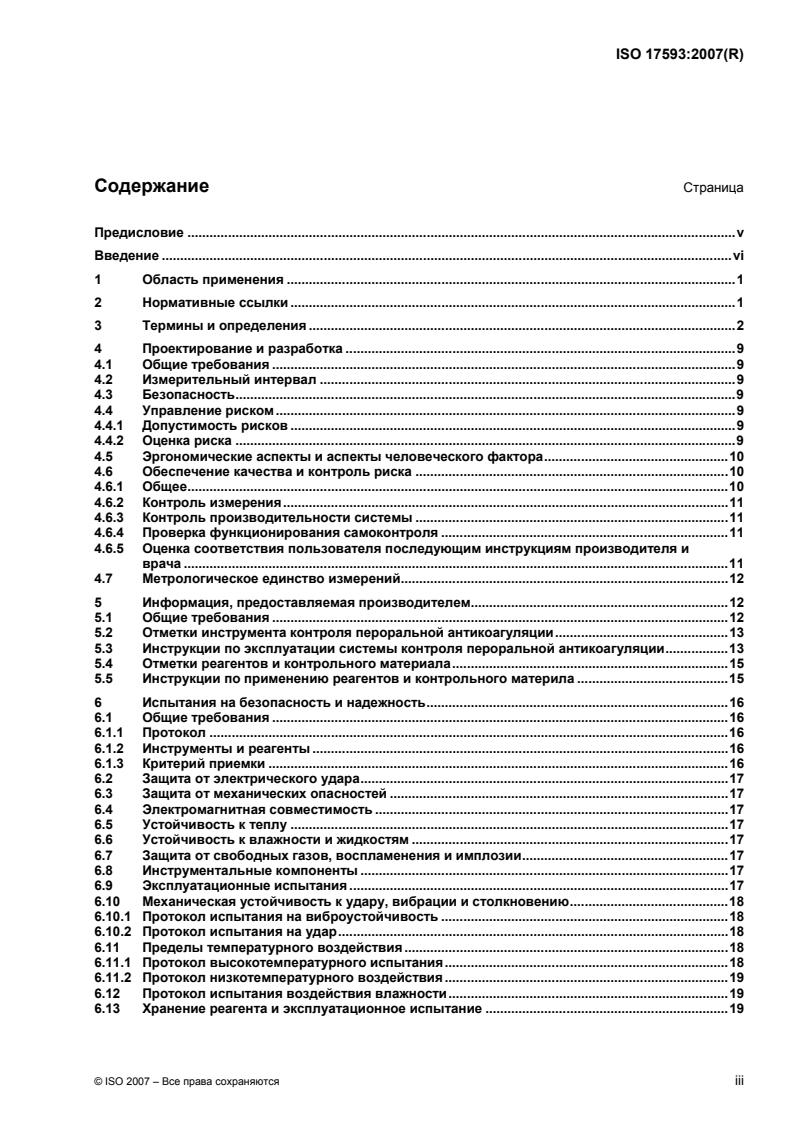
Contents Page
Foreword. v
Introduction . vi
1 Scope . 1
2 Normative references . 1
3 Terms and definitions. 2
4 Design and development . 8
4.1 General requirements. 8
4.2 Measuring interval . 8
4.3 Safety . 8
4.4 Risk management . 8
4.4.1 Acceptability of risks. 8
4.4.2 Risk assessment. 8
4.5 Ergonomic and human factor aspects . 9
4.6 Quality assurance and risk controls. 9
4.6.1 General. 9
4.6.2 Measurement verification . 10
4.6.3 Control of system performance . 10
4.6.4 Verification of self-testing performance. 10
4.6.5 Evaluation of user compliance in following the manufacturer’s and the physician’s
instructions . 10
4.7 Metrological traceability. 10
5 Information supplied by the manufacturer . 11
5.1 General requirements. 11
5.2 Labels for the oral-anticoagulation monitoring instrument . 11
5.3 Instructions for use of the oral-anticoagulation monitoring system . 12
5.4 Labels for the reagents and control material. 13
5.5 Instructions for use for reagents and control material. 13
6 Safety and reliability testing . 14
6.1 General requirements. 14
6.1.1 Protocol . 14
6.1.2 Instruments and reagents. 15
6.1.3 Acceptance criteria. 15
6.2 Protection against electric shock . 15
6.3 Protection against mechanical hazards .15
6.4 Electromagnetic compatibility. 15
6.5 Resistance to heat . 15
6.6 Resistance to moisture and liquids . 15
6.7 Protection against liberated gases, explosion and implosion. 15
6.8 Instrument components. 15
6.9 Performance test. 15
6.10 Mechanical resistance to shock, vibration and impact . 16
6.10.1 Vibration test protocol. 16
6.10.2 Drop test protocol. 16
6.11 Temperature exposure limits. 16
6.11.1 High-temperature test protocol . 16
6.11.2 Low-temperature test protocol. 17
6.12 Humidity-exposure test protocol . 17
6.13 Reagent storage and use testing . 17
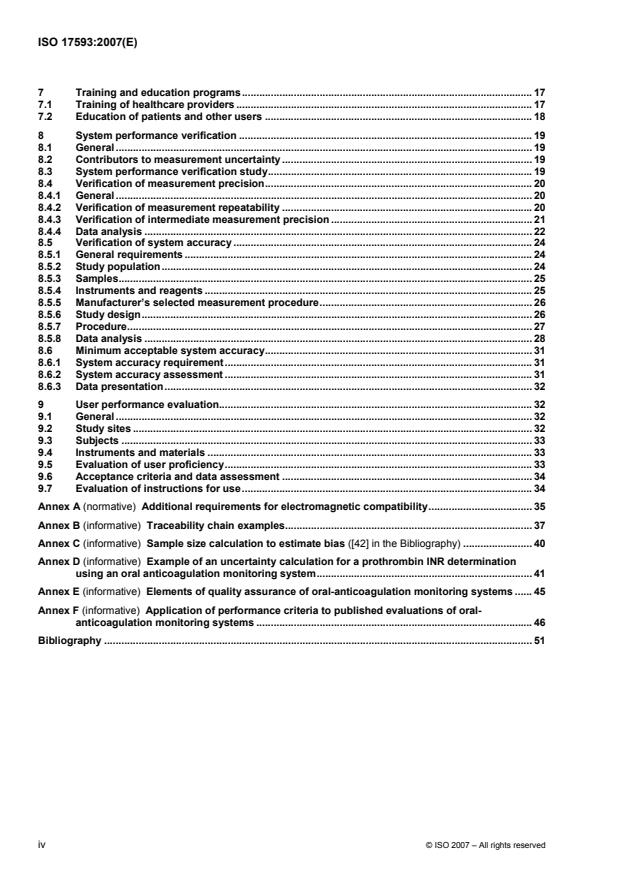
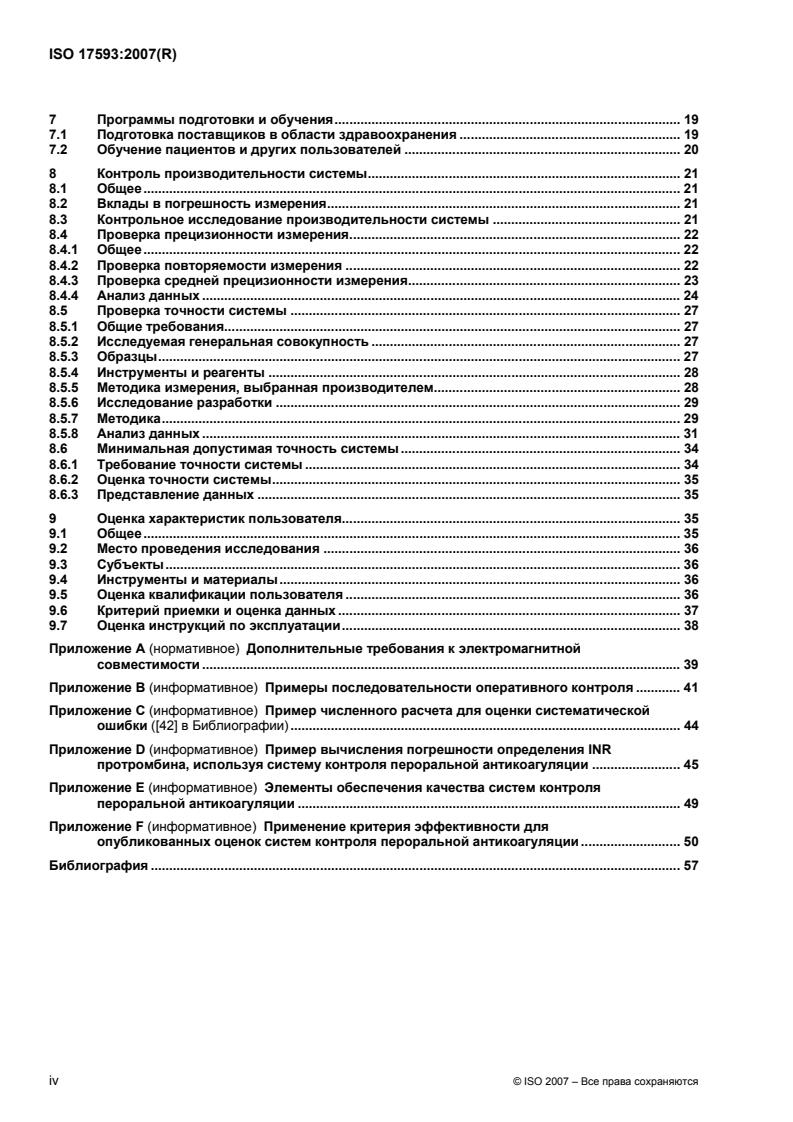
7 Training and education programs. 17
7.1 Training of healthcare providers . 17
7.2 Education of patients and other users . 18
8 System performance verification . 19
8.1 General . 19
8.2 Contributors to measurement uncertainty . 19
8.3 System performance verification study. 19
8.4 Verification of measurement precision. 20
8.4.1 General . 20
8.4.2 Verification of measurement repeatability .20
8.4.3 Verification of intermediate measurement precision . 21
8.4.4 Data analysis . 22
8.5 Verification of system accuracy . 24
8.5.1 General requirements . 24
8.5.2 Study population. 24
8.5.3 Samples. 25
8.5.4 Instruments and reagents . 25
8.5.5 Manufacturer’s selected measurement procedure. 26
8.5.6 Study design. 26
8.5.7 Procedure. 27
8.5.8 Data analysis . 28
8.6 Minimum acceptable system accuracy. 31
8.6.1 System accuracy requirement. 31
8.6.2 System accuracy assessment . 31
8.6.3 Data presentation. 32
9 User performance evaluation. 32
9.1 General . 32
9.2 Study sites . 32
9.3 Subjects . 33
9.4 Instruments and materials . 33
9.5 Evaluation of user proficiency. 33
9.6 Acceptance criteria and data assessment . 34
9.7 Evaluation of instructions for use. 34
Annex A (normative) Additional requirements for electromagnetic compatibility. 35
Annex B (informative) Traceability chain examples. 37
Annex C (informative) Sample size calculation to estimate bias ([42] in the Bibliography) . 40
Annex D (informative) Example of an uncertainty calculation for a prothrombin INR determination
using an oral anticoagulation monitoring system. 41
Annex E (informative) Elements of quality assurance of oral-anticoagulation monitoring systems . 45
Annex F (informative) Application of performance criteria to published evaluations of oral-
anticoagulation monitoring systems . 46
Bibliography . 51
iv © ISO 2007 – All rights reserved
Foreword
ISO (the International Organization for Standardization) is a worldwide federation of national standards bodies
(ISO member bodies). The work of preparing International Standards is normally carried out through ISO
technical committees. Each member body interested in a subject for which a technical committee has been
established has the right to be represented on that committee. International organizations, governmental and
non-governmental, in liaison with ISO, also take part in the work. ISO collaborates closely with the
International Electrotechnical Commission (IEC) on all matters of electrotechnical standardization.
International Standards are drafted in accordance with the rules given in the ISO/IEC Directives, Part 2.
The main task of technical committees is to prepare International Standards. Draft International Standards
adopted by the technical committees are circulated to the member bodies for voting. Publication as an
International Standard requires approval by at least 75 % of the member bodies casting a vote.
Attention is drawn to the possibility that some of the elements of this document may be the subject of patent
rights. ISO shall not be held responsible for identifying any or all such patent rights.
ISO 17593 was prepared by Technical Committee ISO/TC 212, Clinical laboratory testing and in vitro
diagnostic test systems.
Introduction
Oral-anticoagulation monitoring systems are in vitro diagnostic medical devices that measure prothrombin
time in fresh, unmodified human blood samples. Prothrombin time is an indicator of the ability of blood to clot.
In vitro diagnostic medical devices for self-testing of oral-anticoagulation therapy are used predominantly by
individuals who have heart valve replacements, or who are suffering from atrial fibrillation or deep vein
thrombosis. Patients must maintain the level of anticoagulant in the blood high enough to reduce thrombin
formation, yet low enough to avoid excessive bleeding. An oral-anticoagulation monitoring system allows the
user to monitor anticoagulation therapy and take action to control the level of anticoagulant present in the
blood.
This International Standard applies to oral-anticoagulation monitoring systems to be used by lay persons. The
primary objectives are to establish requirements for oral-anticoagulation monitoring systems that will enable
lay users to achieve acceptable performance, and to specify procedures for manufacturers and other
interested parties to demonstrate conformance of such systems to this standard.
Performance criteria for oral-anticoagulation monitoring systems were established, based on the state-of-the-
art, which has been shown to offer significant benefit to patients [68], [69]. The criteria are given in terms of
“system accuracy”, because metrological terms commonly used in International Standards (e.g., trueness and
measurement uncertainty) would not be familiar to lay users. System accuracy, which is affected by
systematic bias and random effects (and is inversely related to measurement uncertainty), describes the
degree to which the individual results produced by an oral-anticoagulation monitoring system agree with
correct INR values when the system is used as intended by lay persons.
In setting the performance criteria, it is assumed that users will be properly selected and will receive the
necessary training, that the device will be properly maintained, and that operating and control procedures will
be followed in accordance with the manufacturer’s instructions for use. It is also assumed that manufacturers
will anticipate and mitigate the effects of reasonably foreseeable misuse, including reasonably foreseeable
deviations from recommended maintenance, operating and control procedures by the intended users.
Requirements that are unique to self-testing with oral-anticoagulation monitoring systems, including specific
content of information supplied by the manufacturer, are addressed in this International Standard. General
requirements that apply to all in vitro diagnostic medical devices and are covered by other standards (e.g.,
IEC 61010, ISO 13485, ISO 14971 and ISO 18113) are incorporated by reference, where appropriate. In
addition, national regulations may apply.
vi © ISO 2007 – All rights reserved
INTERNATIONAL STANDARD ISO 17593:2007(E)
Clinical laboratory testing and in vitro medical devices —
Requirements for in vitro monitoring systems for self-testing of
oral anticoagulant therapy
1 Scope
This International Standard specifies requirements for in vitro measuring systems for self-monitoring of
vitamin-K antagonist therapy, including performance, quality assurance and user training and procedures for
the verification and validation of performance by the intended users under actual and simulated conditions of
use.
This International Standard pertains solely to prothrombin time measuring systems used by individuals for
monitoring their own vitamin-K antagonist therapy, and which report results as international normalized ratios
(INR).
This International Standard is applicable to manufacturers of such systems and those other organizations (e.g.,
regulatory authorities and conformity assessment bodies) having the responsibility for assessing the
performance of these systems.
This International Standard does not
⎯ pertain to in vitro measuring systems for coagulation quantities assessing vitamin-K antagonist therapy
used by physicians or healthcare providers,
⎯ provide a comprehensive evaluation of all possible factors that could affect the performance of these
systems, or
⎯ address the medical aspects of oral-anticoagulation therapy.
2 Normative references
The following referenced documents are indispensable for the application of this document. For dated
references, only the edition cited applies. For undated references, the latest edition of the referenced
document (including any amendments) applies.
ISO 13485, Medical devices — Quality management systems — Requirements for regulatory purposes
ISO 14971, Medical devices — Application of risk management to medical devices
ISO 15198, Clinical laboratory medicine — In vitro diagnostic medical devices — Validation of user quality
control procedures by the manufacturer
ISO 17511, In vitro diagnostic medical devices — Measurement of quantities in biological samples —
Metrological traceability of values assigned to calibrators and control materials
1)
ISO 18113-1:— , Clinical laboratory testing and in vitro diagnostic medical systems — Information supplied
by the manufacturer (labelling) — Part 1: Terms, definitions and general requirements
1)
ISO 18113-4:— , Clinical laboratory testing and in vitro diagnostic medical systems — Information supplied
by the manufacturer (labelling) — Part 4: In vitro diagnostic reagents for self-testing
1)
ISO 18113-5:— , Clinical laboratory testing and in vitro diagnostic medical systems — Information supplied
by the manufacturer (labelling) — Part 5: In vitro diagnostic instruments for self-testing
IEC 60068-2-64:1993, Environmental testing — Part 2: Test methods — Test Fh: Vibration, broad-band
random (digital control) and guidance
IEC 61010-1:2001, Safety requirements for electrical equipment for measurement, control and laboratory
use — Part 1: General requirements
IEC 61010-2-101:2002, Safety requirements for electrical equipment for measurement, control and laboratory
use — Part 2-101: Particular requirements for in vitro diagnostic (IVD) medical equipment
IEC 61000-4-2, Electromagnetic compatibility (EMC) — Part 4-2: Testing and measurement techniques —
Electrostatic discharge immunity test
IEC 61000-4-3, Electromagnetic compatibility (EMC) — Part 4-3: Testing and measurement techniques —
Radiated, radio-frequency, electromagnetic field immunity test
IEC 61326, Electrical equipment for measurement, control and laboratory use — EMC requirements
EN 13532:2002, General requirements for in vitro diagnostic medical devices for self-testing
EN 13612, Performance evaluation of in vitro diagnostic medical devices
EN 13640, Stability testing of in vitro diagnostic reagents
WHO Technical Report Series, No. 889, 1999, Annex 3 — Guidelines for thromboplastins and plasma used to
control oral-anticoagulant therapy
3 Terms and definitions
For the purposes of this document, the terms and definitions in ISO 18113-1 and the following apply.
3.1
accuracy of measurement
closeness of agreement between a measurement result and the accepted reference value
NOTE 1 The term “measurement accuracy”, when applied to a set of test results, involves a combination of random
components and a common systematic error or bias component. (VIM:1993)
NOTE 2 For oral-anticoagulation monitoring systems, accuracy is measured by the extent to which measurements of
blood samples from different patients agree with INR values traceable to a thromboplastin International Reference
Preparation (IRP).
NOTE 3 Adapted from ISO 3534-1:2006, 3.11.
1) To be published.
2 © ISO 2007 – All rights reserved
3.2
bias of measurement
difference between the expectation of the test results and an accepted reference value
[ISO 5725-1:1994, 3.8]
NOTE Bias is a measure of trueness. [VIM:1993]
3.3
blood
circulating intravascular tissue of the body, consisting of suspended formed elements and fluid plasma and
suspended formed elements
NOTE In this International Standard, the term refers to fresh, nonanticoagulated blood.
3.4
capillary blood sample
blood collected after puncturing minute vessels that connect the arterioles and venules
NOTE Often obtained by pricking a fingertip; capillary blood is usually collected without additives, such as
anticoagulants or preservatives. Therefore, it is inherently unstable.
3.5
control material
substance, material or article intended by the manufacturer to be used to verify the performance
characteristics of an in vitro diagnostic medical device
NOTE 1 Adapted from EN 375:2001, 3.5.
NOTE 2 Control materials for anticoagulation monitoring may be reactive or nonreactive. A reactive control material
participates in a reaction with the reagent components. A nonreactive control does not react with the reagent components,
but may provide control functionality through other means, e.g., a simulation of the reaction (see physical control).
3.6
control interval
statistically justified values specified as acceptable measured values obtained using a given control material
3.7
healthcare provider
individual authorized to deliver health care to a patient
NOTE In this International Standard, a healthcare provider is an individual, such as a doctor, nurse, technician,
technical specialist or appropriate assistant, that provides instruction to a self-testing patient.
3.8
integrated functional control
control material that is inherent in a reagent component of a measuring system, intended by the manufacturer
to verify the performance of the measuring system
NOTE The integrated functional control is run concurrently with a patient measurement, includes a reactive
component and provides a functional check of the measurement procedure. The integrated control results must be within
a predefined measurement interval for the measured value to be displayed.
3.9
international normalized ratio
INR
patient’s prothrombin time measurement result, which has been standardized for the potency of the
thromboplastin used in the measurement procedure and expressed relative to a normal population average
[30]
NOTE For a discussion of the use of INR, see Poller, et al. .
3.10
international reference preparation
IRP
reference calibrator maintained by the World Health Organization
NOTE The IRP for thromboplastin is directly calibrated for potency against the original British comparative
thromboplastin preparations used in the establishment of the INR system.
3.11
intermediate precision of measurement
measurement precision under conditions intermediate between reproducibility conditions and repeatability
conditions
[5]
NOTE 1 The concept of intermediate levels of precision is described in ISO 5725-3:1994 .
NOTE 2 Quantitative measures of intermediate precision depend on the stipulated conditions.
NOTE 3 Intermediate precision provides an indication of the variability that will be experienced by a user during typical
use.
3.12
intermediate precision conditions
conditions where independent measurement results are obtained with the same measurement method on
identical samples in the same location, but where other variables, such as operators, equipment, calibration,
environmental conditions and/or time intervals, differ
3.13
international sensitivity index
ISI
factor that allows the conversion of a patient’s prothrombin time measurement result to international
normalized ratio values
[30]
NOTE For a discussion of the use of ISI and INR, see Poller, et al. .
3.14
lay person
individual without formal training in a relevant field or discipline
NOTE 1 Adapted from the definition of “lay user” in EN 376:2002.
NOTE 2 For the purposes of this International Standard, a lay person is a user of an oral-anticoagulation monitoring
device who does not have specific medical, scientific or technical knowledge related to oral-anticoagulation monitoring.
3.15
manufacturer’s working calibrator
working measurement standard
standard that is used routinely at the manufacturer's laboratory to calibrate or check material measures,
measuring instruments or reference materials
NOTE 1 Adapted from ISO 17511:2003.
NOTE 2 This applies to a thromboplastin preparation used by the manufacturer during the preparation of a PT reagent
mixture.
NOTE 3 The assigned value of the manufacturer’s working calibrator is metrologically traceable to that of the IRP.
3.16
manufacturer’s selected measurement procedure
measurement procedure that is calibrated by one or more primary or secondary calibrators and validated for
its intended use
NOTE ISO 17511:2003, 4.2.2 f), shows the manufacturer’s selected measurement procedure in the traceability chain.
4 © ISO 2007 – All rights reserved
3.17
manufacturer’s standing measurement procedure
measurement procedure that is calibrated by one or more of the manufacturer’s working calibrators or higher
types of calibrator and validated for its intended use
NOTE ISO 17511:2003, 4.2.2 h) shows the manufacturer’s standing measurement procedure in the traceability chain.
3.18
measurement procedure
set of operations, described specifically, used in the performance of particular measurements according to a
given method
[VIM:1993, 2.5]
3.19
measuring interval
set of values of measurands for which the bias and imprecision are intended to lie within specified limits
NOTE 1 This represents the interval of examination results over which the performance characteristics have been
validated by the manufacturer.
NOTE 2 Adapted from VIM:1993, 5.4.
3.20
metrological traceability
property of the result of a measurement or the value of a standard whereby it can be related to stated
references, usually national or international standards, through an unbroken chain of comparisons all having
stated uncertainties
[VIM:1993, 6.10]
3.21
physical control system
control device that does not include chemically reactive components and that is intended by the manufacturer
to verify the performance of the instrument
NOTE 1 The physical control system may be in the form of an electronic device that provides a simulated reaction.
NOTE 2 The physical control result must be within predefined limits, in order for the measuring system to be
considered properly functional.
3.22
precision of measurement
closeness of agreement between independent measurement results obtained under stipulated conditions
NOTE 1 Adapted from ISO 3534-2:2006.
NOTE 2 The degree of precision is expressed numerically by the statistical measures of imprecision of measurements,
such as standard deviation and coefficient of variation, that are inversely related to precision. Quantitative measures of
precision depend on the stipulated conditions.
NOTE 3 Precision of a given measurement procedure is subdivided according to the specified precision conditions.
Particular sets of extreme conditions are termed “repeatability” (3.26) and “reproducibility” (3.28).
3.23
prothrombin time
PT
time required to clot a blood sample once exposed to a thromboplastin reagent material
3.24
prothrombin time measuring system
measuring system that records the time required for a sample to clot after being exposed to a thromboplastin
or tissue-factor derived reagent
NOTE The system includes the reagent plus the instrument used to record the clotting time.
3.25
reagent
part of the in vitro diagnostic medical device that produces a signal via a chemical or electrochemical reaction,
which allows the quantity to be detected and its value measured in a sample
3.26
repeatability of measurement
precision of measurement under repeatability conditions
NOTE Adapted from ISO 3534-2:2006.
3.27
repeatability conditions
conditions where independent measurement results are obtained with the same method of measurement on
identical samples in the same laboratory by the same operator using the same equipment within short
intervals of time
NOTE 1 Adapted from ISO 3534-2:2006.
NOTE 2 Essentially unchanging conditions, intended to represent conditions resulting in minimum variability of
measurement results.
NOTE 3 For the purposes of this International Standard, “laboratories” should be interpreted as “locations”.
3.28
reproducibility of measurement
precision of measurement under reproducibility conditions
NOTE Adapted from ISO 3534-2:2006.
3.29
reproducibility conditions
conditions where measurement results are obtained with the same method of measurement on identical
samples in different laboratories with different operators using different equipment
NOTE 1 Completely changed conditions are intended to represent conditions resulting in maximum variability of test
results.
NOTE 2 For the purposes of this International Standard, “laboratories” should be interpreted as “locations”.
NOTE 3 Adapted from ISO 3534-2:2006.
3.30
secondary reference measurement procedure
measurement procedure that is calibrated by one or more primary calibrators
NOTE The measurement procedure for prothrombin time measurements is sometimes referred to as a “secondary
standard procedure”.
3.31
system accuracy
closeness of agreement of a set of representative measurement results from a measuring system and their
respective reference values
6 © ISO 2007 – All rights reserved
NOTE 1 The term accuracy of measurement, when applied to a set of measurement results, involves a combination of
random error components and a common systematic error or bias component.
NOTE 2 Reference values are assigned by a measurement procedure traceable to a reference measurement
procedure of higher order.
NOTE 3 System accuracy may be expressed as the interval that encompasses 95 % of the differences observed
between the results of the system being evaluated and their reference values. This interval also includes measurement
uncertainty from the measurement procedure used to assign the reference values.
NOTE 4 Adapted from ISO 15197:2003, 3.24.
3.32
trueness of measurement
closeness of agreement between the average value obtained from a large series of measurement results and
an accepted reference value
NOTE 1 A measure of trueness is bias (3.2).
NOTE 2 Adapted from ISO 3534-2:2006.
3.33
type test
test of one or more samples of equipment (or parts of equipment) made to a particular design, to show that
the design and construction meet one or more requirements of the applicable standard
NOTE 1 Statistical sampling is not required for a type test.
NOTE 2 Adapted from IEC 61326:2002.
3.34
user compliance
ability and willingness of the user of a measuring system to adhere to and operate within the defined
specifications of a measurement procedure
3.35
venous blood sample
blood collected after directly puncturing a vein, usually with a needle and syringe, or another collection device
NOTE Venous blood may be collected without additives such as anticoagulants or preservatives, and if so, will be
inherently unstable; venous blood may also be collected in containers containing additives or preservatives with the intent
to stabilize specific components.
3.36
volume fraction of erythrocytes in blood
proportion of packed cells in a blood sample
NOTE 1 Expressed either as a fraction, often given as a percentage (conventional) of the SI unit.
NOTE 2 Sometimes referred to as “haematocrit”, after the instrument originally used to estimate the volume fraction of
erythrocytes in blood.
4 Design and development
4.1 General requirements
The requirements specified in ISO 13485 apply.
The requirements specified in EN 13532 apply to evaluation of the performance of the oral-anticoagulation
monitoring system.
NOTE Clauses 6 and 8 describe design verification activities, which are intended to provide assurance that the
product has the capability of meeting precision, trueness, safety and reliability specifications. Clause 9 describes design
validation activities, which are intended to provide assurance that the device meets the user requirements.
4.2 Measuring interval
The measuring interval of the system shall be at least 1,0 to 6,0 INR.
4.3 Safety
The requirements specified in IEC 61010-1 and IEC 61010-2-101 apply.
4.4 Risk management
4.4.1 Acceptability of risks
The manufacturer shall decide upon the acceptability of potential risks from knowledge of factors including,
but not limited to, the following:
a) intended use of the product;
b) users’ skills and limitations:
c) protection against unintentional change of settings (e.g., units reported);
d) likely deviations from recommended maintenance, operating and control procedures;
e) influence of interfering substances.
[25]
NOTE Guidelines for evaluating potentially interfering substances are found in CLSI document EP7 .
4.4.2 Risk assessment
The requirements specified in ISO 14971 apply.
In performing risk assessment, the manufacturer shall consider
a) severity of the consequences of an undetected failure (e.g., potential harm to the patient),
b) probability of occurrence of a mistake (e.g., insufficient sample volume or incorrect reagent unit
placement), and
c) probability of the system failing to detect the mistake (e.g., deficient internal instrument sensors).
NOTE 1 This International Standard does not specify levels of risk acceptability.
NOTE 2 Guidelines for identifying potential hazards from the use of “unit use devices” are found in CLSI document
[27]
EP18 .
NOTE 3 Risk management includes risk analysis, risk evaluation, risk reduction and risk control.
8 © ISO 2007 – All rights reserved
4.5 Ergonomic and human factor aspects
The design of the oral-anticoagulation monitoring system shall take into consideration relevant ergonomic and
human factors including, but not limited to, the following.
a) User aspects:
⎯ selection;
⎯ training;
⎯ compliance.
b) Use environment:
⎯ temperature;
⎯ humidity.
c) System properties:
⎯ shock resistance;
⎯ stability of reagents.
d) User interface:
⎯ ease of operation;
⎯ ease of maintenance;
⎯ protection from typical “wear and tear” that might be encountered in the use environment;
⎯ readability of reported results;
⎯ fault conditions and error messages;
⎯ unambiguous messages to the user (e.g., “low battery” or “low result”) rather than only “low”;
⎯ user verification of proper system function.
4.6 Quality assurance and risk controls
4.6.1 General
Quality assurance of oral anticoagulation monitoring systems consists of multiple elements. See Annex E for
descriptions of the various elements of quality assurance that may apply.
The manufacturer shall provide device-specific risk control measures, as required by the risk management
plan. The requirements specified in ISO 14971 apply.
The risk control measures, including any limitations, shall be described in the instructions for use and the
training program as appropriate.
Risk control measures shall address the education and training of users and healthcare providers (see
Clause 7), as well as the following elements.
4.6.2 Measurement verification
Each measurement reported by the oral-anticoagulation monitoring system shall be verified internally by the
measuring system.
The nature and extent of internal verification to be performed by the measuring system shall be determined by
the results of the risk analysis.
NOTE It is desirable that the use of out-of-date reagents be prevented.
4.6.3 Control of system performance
The manufacturer shall provide a control procedure and instructions for the use of control materials.
The control procedure shall be validated. The requirements specified in ISO 15198 apply.
Control material may consist of a liquid control, an integrated control or a combination of both.
If a physical control is used (e.g., a check strip), the manufacturer shall provide instructions for when a
physical control shall be run on the instrument.
Before each measurement of a blood sample, a measurement verification shall be made by a monitor self-
check, using an internal or external physical control system.
Control measurements using liquid control materials shall be performed each time a new package of reagents
is used, when an unexpected result occurs, and as required by local regulations. Alternatively, liquid controls
may be replaced by an integrated functional control.
Actions to be taken when controls are out-of-range shall be given in the instructions for use.
4.6.4 Verification of self-testing performance
The manufacturer shall recommend a procedure for users to verify the acceptability of self-testing results.
Verification may be based on a comparison between results obtained by the user and a healthcare provider at
specified intervals. An interval of six months or less is recommended. With new self-testers, more frequent
intervals may be necessary to verify the technique, e.g. monthly.
4.6.5 Evaluation of user compliance in following the manufacturer’s and the physician’s
instructions
The manufacturer shall recommend, in the instructions for use for the healthcare professional, suitable
procedures for monitoring and evaluating user compliance with the manufacturer’s and the physician’s
instructions.
4.7 Metrological traceability
The requirements specified in ISO 17511 shall apply to the manufacturer’s process for calibrating the oral-
anticoagulation monitoring devices.
The measurement results of the manufacturer’s selected and/or standing measurement procedure shall be
traceable to those of the WHO manual tilt-tube measurement procedure using an International Reference
Preparation (IRP) of thromboplastin ([44] in the Bibliography).
NOTE 1 The WHO tilt-tube measurement procedure uses fresh, citrated plasma, whereas devices for self-testing use
fresh, untreated blood. Calibration of the devices involves parallel measurement of fresh plasma and blood from the same
patients. In this case, the blood samples are the calibrator.
10 © ISO 2007 – All rights reserved
If the manufacturer’s standing measurement procedure uses blood, then calibration of the procedure against
the WHO IRP and tilt-tube method shall occur through parallel measurement of blood and plasma. Calibration
of the end-user’s routine measurement procedure shall use blood.
If the manufacturer’s standing measurement procedure uses plasma, then plasma shall be used to calibrate
the procedure against the WHO IRP and tilt-tube method. Parallel measurement of plasma and blood shall
occur during calibration of the end-user’s routine measurement procedure (e.g., using the same lot of
reagents).
The traceability chain should include as few steps as practical, to minimize combined standard measurement
uncertainty.
NOTE 2 An example of a traceability chain for a typical factory-calibrated oral-anticoagulation monitoring system is
shown in Annex B, Figure B.1. The illustration of a full traceability c
...
МЕЖДУНАРОДНЫЙ ISO
СТАНДАРТ 17593
Первое издание
2007-04-15
Клинические лабораторные
исследования и in vitro медицинские
устройства. Требования к in vitro
системам контроля для самоконтроля
пероральной антикоагуляционной
терапии
Clinical laboratory testing and in vitro medical devices — Requirements
for in vitro monitoring systems for self-testing of oral anticoagulant
therapy
Ответственность за подготовку русской версии несёт GOST R
(Российская Федерация) в соответствии со статьёй 18.1 Устава ISO
Ссылочный номер
©
ISO 2007
Отказ от ответственности при работе в PDF
Настоящий файл PDF может содержать интегрированные шрифты. В соответствии с условиями лицензирования, принятыми
фирмой Adobe, этот файл можно распечатать или смотреть на экране, но его нельзя изменить, пока не будет получена
лицензия на интегрированные шрифты и они не будут установлены на компьютере, на котором ведется редактирование. В
случае загрузки настоящего файла заинтересованные стороны принимают на себя ответственность за соблюдение
лицензионных условий фирмы Adobe. Центральный секретариат ISO не несет никакой ответственности в этом отношении.
Adobe - торговый знак фирмы Adobe Systems Incorporated.
Подробности, относящиеся к программным продуктам, использованные для создания настоящего файла PDF, можно найти в
рубрике General Info файла; параметры создания PDF были оптимизированы для печати. Были приняты во внимание все
меры предосторожности с тем, чтобы обеспечить пригодность настоящего файла для использования комитетами-членами
ISO. В редких случаях возникновения проблемы, связанной со сказанным выше, просьба проинформировать Центральный
секретариат по адресу, приведенному ниже.
ДОКУМЕНТ ЗАЩИЩЕН АВТОРСКИМ ПРАВОМ
Все права сохраняются. Если не указано иное, никакую часть настоящей публикации нельзя копировать или использовать в
какой-либо форме или каким-либо электронным или механическим способом, включая фотокопии и микрофильмы, без
предварительного письменного согласия ISO по адресу ниже или представительства ISO в соответствующей стране.
ISO copyright office
Case postale 56 • CH-1211 Geneva 20
Tel. + 41 22 749 01 11
Fax + 41 22 749 09 47
E-mail copyright@iso.org
Web www.iso.org
Опубликовано в Швейцарии
ii © ISO 2007 – Все права сохраняются
Содержание Страница
Предисловие .v
Введение .vi
1 Область применения .1
2 Нормативные ссылки .1
3 Термины и определения .2
4 Проектирование и разработка .9
4.1 Общие требования .9
4.2 Измерительный интервал .9
4.3 Безопасность.9
4.4 Управление риском.9
4.4.1 Допустимость рисков .9
4.4.2 Оценка риска .9
4.5 Эргономические аспекты и аспекты человеческого фактора.10
4.6 Обеспечение качества и контроль риска .10
4.6.1 Общее.10
4.6.2 Контроль измерения.11
4.6.3 Контроль производительности системы .11
4.6.4 Проверка функционирования самоконтроля .11
4.6.5 Оценка соответствия пользователя последующим инструкциям производителя и
врача .11
4.7 Метрологическое единство измерений.12
5 Информация, предоставляемая производителем.12
5.1 Общие требования .12
5.2 Отметки инструмента контроля пероральной антикоагуляции.13
5.3 Инструкции по эксплуатации системы контроля пероральной антикоагуляции.13
5.4 Отметки реагентов и контрольного материала.15
5.5 Инструкции по применению реагентов и контрольного материла .15
6 Испытания на безопасность и надежность.16
6.1 Общие требования .16
6.1.1 Протокол .16
6.1.2 Инструменты и реагенты .16
6.1.3 Критерий приемки .16
6.2 Защита от электрического удара.17
6.3 Защита от механических опасностей .17
6.4 Электромагнитная совместимость .17
6.5 Устойчивость к теплу .17
6.6 Устойчивость к влажности и жидкостям .17
6.7 Защита от свободных газов, воспламенения и имплозии.17
6.8 Инструментальные компоненты .17
6.9 Эксплуатационные испытания .17
6.10 Механическая устойчивость к удару, вибрации и столкновению.18
6.10.1 Протокол испытания на виброустойчивость .18
6.10.2 Протокол испытания на удар.18
6.11 Пределы температурного воздействия .18
6.11.1 Протокол высокотемпературного испытания.18
6.11.2 Протокол низкотемпературного воздействия .19
6.12 Протокол испытания воздействия влажности.19
6.13 Хранение реагента и эксплуатационное испытание .19
7 Программы подготовки и обучения. 19
7.1 Подготовка поставщиков в области здравоохранения . 19
7.2 Обучение пациентов и других пользователей . 20
8 Контроль производительности системы. 21
8.1 Общее. 21
8.2 Вклады в погрешность измерения. 21
8.3 Контрольное исследование производительности системы . 21
8.4 Проверка прецизионности измерения. 22
8.4.1 Общее. 22
8.4.2 Проверка повторяемости измерения . 22
8.4.3 Проверка средней прецизионности измерения. 23
8.4.4 Анализ данных . 24
8.5 Проверка точности системы . 27
8.5.1 Общие требования. 27
8.5.2 Исследуемая генеральная совокупность . 27
8.5.3 Образцы. 27
8.5.4 Инструменты и реагенты . 28
8.5.5 Методика измерения, выбранная производителем. 28
8.5.6 Исследование разработки . 29
8.5.7 Методика. 29
8.5.8 Анализ данных . 31
8.6 Минимальная допустимая точность системы . 34
8.6.1 Требование точности системы . 34
8.6.2 Оценка точности системы. 35
8.6.3 Представление данных . 35
9 Оценка характеристик пользователя. 35
9.1 Общее. 35
9.2 Место проведения исследования . 36
9.3 Субъекты. 36
9.4 Инструменты и материалы. 36
9.5 Оценка квалификации пользователя . 36
9.6 Критерий приемки и оценка данных . 37
9.7 Оценка инструкций по эксплуатации. 38
Приложение A (нормативное) Дополнительные требования к электромагнитной
совместимости . 39
Приложение B (информативное) Примеры последовательности оперативного контроля . 41
Приложение C (информативное) Пример численного расчета для оценки систематической
ошибки ([42] в Библиографии). 44
Приложение D (информативное) Пример вычисления погрешности определения INR
протромбина, используя систему контроля пероральной антикоагуляции . 45
Приложение E (информативное) Элементы обеспечения качества систем контроля
пероральной антикоагуляции . 49
Приложение F (информативное) Применение критерия эффективности для
опубликованных оценок систем контроля пероральной антикоагуляции . 50
Библиография . 57
iv © ISO 2007 – Все права сохраняются
Предисловие
Международная организация по стандартизации (ISO) является всемирной федерацией национальных
организаций по стандартизации (комитетов-членов ISO). Разработка международных стандартов
обычно осуществляется техническими комитетами ISO. Каждый комитет-член, заинтересованный в
деятельности, для которой был создан технический комитет, имеет право быть представленным в этом
комитете. Международные правительственные и неправительственные организации, имеющие связи с
ISO, также принимают участие в работах. Что касается стандартизации в области электротехники, то
ISO работает в тесном сотрудничестве с Международной электротехнической комиссией (IEC).
Проекты международных стандартов разрабатываются в соответствии с правилами Директив ISO/IEC,
Часть 2.
Основная задача технических комитетов заключается в подготовке международных стандартов.
Проекты международных стандартов, принятые техническими комитетами, рассылаются комитетам-
членам на голосование. Их опубликование в качестве международных стандартов требует одобрения
не менее 75 % комитетов-членов, принимающих участие в голосовании.
Следует иметь в виду, что некоторые элементы настоящего международного стандарта могут быть
объектом патентных прав. ISO не может нести ответственность за идентификацию какого-либо одного
или всех патентных прав.
ISO 17593 был подготовлен Техническим комитетом ISO/TC 212, Клинические лабораторные
исследования и in vitro диагностические испытательные системы.
Введение
Системы контроля пероральной антикоагуляции являются in vitro диагностическими медицинскими
устройствами, которые измеряют протромбиновое время в свежих, неизмененных образцах
человеческой крови. Протромбиновое время является показателем способности крови к свертыванию.
In vitro диагностические медицинские устройства для самоконтроля пероральной антикоагулянтной
терапии используются преимущественно лицами, которые имеют замещенные сердечные клапаны или
страдают мерцательной аритмией или глубоким тромбозом вен. Пациенты должны поддерживать
уровень антикоагулянта в крови достаточно высоким для уменьшения образования тромбина, и, в то
же время, достаточно низким для предотвращения чрезмерного кровотечения. Система контроля
антикоагуляции позволяет пользователю контролировать антикоагуляционную терапию и
предпринимать действия для контроля уровня антикоагулянта, присутствующего в крови.
Данный международный стандарт применяется к системам контроля пероральной антикоагуляции,
используемым непрофессионалами. Основными задачами являются определение требований для
систем контроля пероральной антикоагуляции, которые позволят пользователям-непрофессионалам
добиваться приемлемого функционирования, и определение процедур для производителей и других
заинтересованных сторон для демонстрации соответствия таких систем данному стандарту.
Критерий эффективности для систем контроля пероральной антикоагуляции установлен и основан на
предполагаемой реальной существенной пользе для пациента, которая была показа [68], [69].
Критерий определен в терминах “точность системы”, так как метрологические термины, обычно
используемые в международных стандартах (например, точность и погрешность измерения) не
должны быть знакомы пользователям-непрофессионалам. Точность системы, которая зависит от
систематической ошибки и случайных эффектов (и связана обратной зависимостью с погрешностью
измерения), определяет уровень, которому соответствуют отдельные результаты, полученные
системой контроля пероральной антикоагуляции, с правильными INR значениями, при использовании
системы, как предполагалось, непрофессионалами.
При установке критерия эффективности предполагается, что пользователи будут подобраны
надлежащим образом и получат необходимую подготовку, что устройство будет установлено должным
образом, и что процедуры работы и контроля будут соответствовать инструкциям по применению
производителя. Также предполагается, что производители будут предупреждать и уменьшать
эффекты достаточно предсказуемого неправильного применения, включая умеренно предсказуемые
отклонения от рекомендованной эксплуатации, процедур работы и контроля предназначенными
пользователями.
Требования, которые относятся исключительно к самоконтролю с помощью систем контроля
пероральной антикоагуляции, включая содержание информации, предоставляемой производителем,
рассматриваются в данном международном стандарте. Общие требования, которые применяются ко
всем in vitro диагностическим медицинским устройствам, и охваченные другими стандартами
(например, IEC 61010, ISO 13485, ISO 14971 и ISO 18113) объединены ссылкой, где это возможно.
Кроме того, могут применяться национальные нормативные документы.
vi © ISO 2007 – Все права сохраняются
МЕЖДУНАРОДНЫЙ СТАНДАРТ ISO 17593:2007(R)
Клинические лабораторные исследования и in vitro
медицинские устройства. Требования к in vitro системам
контроля для самоконтроля пероральной антикоагулянтной
терапии
1 Область применения
Данный международный стандарт определяет требования к in vitro системам измерения для
самоконтроля терапии, противодействующей витамину К, включая рабочие характеристики, гарантию
качества и подготовку пользователей и методику верификации и валидации функционирования
предназначенными пользователями при действительных и искусственных условиях применения.
Данный международный стандарт относится исключительно к системам измерения протромбинового
времени, используемым пользователями для контроля их собственной терапии, противодействующей
витамину K, и представляющим результаты как международные нормированные соотношения
(international normalized ratios, INR).
Данный международный стандарт подходит для производителей таких систем и других организаций
(например, контролирующие органы и соответствующие оценочные организации), ответственных за
оценку функционирования таких систем.
Данный международный стандарт не
⎯ имеет отношения к in vitro системам измерения для количественной оценки коагуляции терапии,
противодействующей витамину K, применяемой врачами или поставщиками в области
здравоохранения,
⎯ предусматривает всесторонней оценки всех возможных факторов, которые могут действовать на
функционирование этих систем, или
⎯ обращает внимания на медицинские аспекты пероральной антикоагуляционной терапии.
2 Нормативные ссылки
Ссылка на следующие документы обязательна при использовании данного документа. Для жестких
ссылок применяются только указанное по тексту издание. Для плавающих ссылок необходимо
использовать самое последнее издание нормативного ссылочного документа (включая любые
изменения).
ISO 13485, Медицинские устройства. Системы менеджмента качества. Требования к целям
регулирования
ISO 14971, Медицинские устройства. Применение менеджмента риска для медицинских устройств
ISO 15198, Клиническая лабораторная медицина. In vitro диагностические медицинские устройства.
Валидация пользовательских процедур контроля качества производителем
ISO 17511, In vitro диагностические медицинские устройства. Измерение количества в
биологических образцах. Метрологическое единство измерений величин, установленных для
калибраторов и контрольных материалов
1)
ISO 18113-1:— , Клинические лабораторные исследования и in vitro диагностические медицинские
системы. Информация, предоставляемая производителем (маркировка). Часть 1. Термины,
определения и общие требования
1)
ISO 18113-4:— , Клинические лабораторные исследования и in vitro диагностические медицинские
системы. Информация, предоставляемая производителем (маркировка). Часть 4. In vitro
диагностические реагенты для самоконтроля
1)
ISO 18113-5:— , Клинические лабораторные исследования и in vitro диагностические медицинские
системы. Информация, предоставляемая производителем (маркировка). Часть 5. In vitro
диагностические инструменты для самоконтроля
IEC 60068-2-64:1993, Климатические испытания. Часть 2. Методы испытаний. Испытание Fh:
Вибрация, широкополосный случайный диапазон (цифровое управление) и руководство
IEC 61010-1:2001, Требования техники безопасности к электрическому оборудованию для измерения,
контроля и лабораторного применения. Часть 1. Общие требования
IEC 61010-2-101:2002, Требования техники безопасности к электрическому оборудованию для
измерения, контроля и лабораторного применения. Часть 2-101. Частные требования к in vitro
диагностическому (in vitro diagnostic, IVD) медицинскому оборудованию
IEC 61000-4-2, Электромагнитная совместимость (Electromagnetic compatibility, EMC). Часть 4-2.
Испытательные и измерительные методики. Испытание защиты от электрического разряда
IEC 61000-4-3, Электромагнитная совместимость (Electromagnetic compatibility, EMC). Часть 4-3.
Испытательные и измерительные методики. Испытание защиты от излучаемого,
высокочастотного электромагнитного поля
IEC 61326, Электрическое оборудование для измерения, контроля и лабораторного применения.
Требования к электромагнитной совместимости (Electromagnetic compatibility, EMC)
EN 13532:2002, Общие требования для in vitro диагностических медицинских устройств для
самоконтроля
EN 13612, Оценка производительности in vitro диагностических медицинских устройств
EN 13640, Исследование устойчивости in vitro диагностических реагентов
Серия технических отчетов WHO, No. 889, 1999, Приложение 3. Рекомендации для тромбопластин и
плазме, используемым для контроля пероральной антикоагуляционной терапии
3 Термины и определения
В рамках данного документа применяются термины и определения ISO 18113-1 и следующие.
3.1
точность измерения
accuracy of measurement
точность соответствия между результатом измерения и общепринятым эталонным значением
1) Опубликовано.
2 © ISO 2007 – Все права сохраняются
ПРИМЕЧАНИЕ 1 Термин “точность измерения”, когда он применяется к установленным результатам измерения,
включает в себя сочетание случайных компонентов и общей систематической ошибки или составной части
систематической ошибки. (VIM:1993)
ПРИМЕЧАНИЕ 2 Для систем контроля пероральной антикоагуляции точность измеряется степенью совпадения
измерений образцов крови от различных пациентов с INR значениями, определенными для международных
эталонных (International Reference Preparation, IRP) тромбопластин.
ПРИМЕЧАНИЕ 3 Адаптировано из ISO 3534-1:2006, 3.11.
3.2
систематическая ошибка измерения
bias of measurement
разность между математическим ожиданием результатов измерения и общепринятым эталонным значением
[ISO 5725-1:1994, 3.8]
ПРИМЕЧАНИЕ Систематическая ошибка является мерой точности. [VIM:1993]
3.3
кровь
blood
циркулирующая внутрисосудистая ткань тела, состоящая из взвешенных форменных элементов и
жидкой плазмы
ПРИМЕЧАНИЕ В данном международном стандарте термин относятся к чистой, некоагулированной крови.
3.4
образец капиллярной крови
capillary blood sample
кровь, собранная после прокола мелких сосудов, которые соединяют артерии и вены
ПРИМЕЧАНИЕ Часто получается с помощью прокола пальца; капиллярная кровь обычно собирается без
добавок, таких как антикоагулянты или антиферментаторы. Поэтому она, по сути, является нестабильной.
3.5
контрольный материал
control material
вещество, материал или изделие, предназначенное производителем для применения при проверке
рабочих характеристик in vitro диагностического медицинского устройства
ПРИМЕЧАНИЕ 1 Адаптировано из EN 375:2001, 3.5.
ПРИМЕЧАНИЕ 2 Контрольные материалы для контроля антикоагуляции могут быть химически активными и
неактивными. Химически активный материал вступает в реакцию с компонентами реагентов. Неактивный
контрольный материал не вступает в реакцию с компонентами реагентов, но может обеспечивать контроль
функционирования через другие методики, например, имитация реакции (см. физический контроль).
3.6
контрольный интервал
control interval
статистически обоснованное значение, определенное как приемлемое измеренное значение,
полученное, используя заданный контрольный материал
3.7
поставщик в области здравоохранения
healthcare provider
субъект, уполномоченный оказывать медицинскую помощь пациенту
ПРИМЕЧАНИЕ В данном международном стандарте поставщиком в области здравоохранения является
субъект, такой как доктор, медицинская сестра, техник, технический специалист или соответствующий ассистент,
который предоставляет инструкцию по самоконтролю пациента.
3.8
комплексный функциональный контроль
integrated functional control
контрольный материал, свойственный компоненту реагента измерительной системы,
предусмотренный производителем для контроля функционирования измерительной системы
ПРИМЕЧАНИЕ Комплексный функциональный контроль запускается одновременно с измерением пациента,
содержащим в себе химически активный компонент, и обеспечивает функциональный контроль методики
измерения. Результаты комплексного контроля должны быть в пределах предопределенного интервала
измерения для отображаемой измеряемой величины.
3.9
международное нормализованное соотношение
international normalized ratio
INR
результат измерения протромбинового времени пациента, который был стандартизован по
эффективности тромбопластин, используемых в процессе измерения и выражен относительно
нормального среднего по совокупности
[30]
ПРИМЕЧАНИЕ Для обсуждения применения INR, см. Poller, et al. .
3.10
международный эталонный препарат
international reference preparation
IRP
эталонный калибратор, установленный всемирной организацией здравоохранения
ПРИМЕЧАНИЕ IRP для тромбопластин откалиброван непосредственно по эффективности по отношению к
оригинальным Британским сравнительным препаратам тромбопластин, применяемым для создания INR систем.
3.11
средняя сходимость измерений
intermediate precision of measurement
сходимость измерений при условиях средних между воспроизводимыми условиями и повторяемыми
условиями
[5]
ПРИМЕЧАНИЕ 1 Принцип усреднения уровней точности описан в ISO 5725-3:1994 .
ПРИМЕЧАНИЕ 2 Количественные показатели средней точности зависят от оговоренных условий.
ПРИМЕЧАНИЕ 3 Средняя точность позволяет показать изменчивость, которую будет испытывать пользователь в
процессе обычного применения.
3.12
условия средней сходимости
intermediate precision conditions
условия, при которых результаты независимых измерений получены одним и тем же методом
измерения на одинаковых образцах в одинаковом расположении, но при которых другие переменные,
такие как операторы, оборудование, калибровка, внешние условия и/или интервалы времени
отличаются
3.13
международный коэффициент чувствительности
international sensitivity index
ISI
коэффициент, который позволяет преобразовать результат измерения протромбинового времени
пациента в показатели международного нормализованного соотношения
[30]
ПРИМЕЧАНИЕ Для обсуждения применения ISI и INR, см. Poller, et al. .
4 © ISO 2007 – Все права сохраняются
3.14
непрофессионал
lay person
субъект без формальной подготовки в соответствующей сфере деятельности или дисциплине
ПРИМЕЧАНИЕ 1 Адаптировано из определения “пользователь непрофессионал” в EN 376:2002.
ПРИМЕЧАНИЕ 2 В рамках данного международного стандарта непрофессионалом является пользователь
устройства контроля пероральной антикоагуляции, который не имеет специальных медицинских, научных или
технических знаний, связанных с контролем пероральной антикоагуляции.
3.15
рабочий калибратор производителя
стандарт рабочего измерения
manufacturer’s working calibrator
working measurement standard
стандарт, который применяется регулярно лабораторией производителя для калибровки
вещественных мер, измерительных инструментов или эталонных материалов
ПРИМЕЧАНИЕ 1 Адаптировано из ISO 17511:2003.
ПРИМЕЧАНИЕ 2 Данный стандарт применяется для подготовки тромбопластин, используемых производителем
в процессе подготовки смеси PT реагентов.
ПРИМЕЧАНИЕ 3 Заданный показатель рабочего калибратора производителя является метрологически
регистрируемым для IRP.
3.16
методика измерения, выбранная производителем
manufacturer’s selected measurement procedure
методика измерения, которая откалибрована одним или более основными или вторичными
калибраторами и утвержденная для предназначенного применения
ПРИМЕЧАНИЕ ISO 17511:2003, 4.2.2 f), отображает методику, выбранную производителем, в виде
последовательной цепочки.
3.17
методика постоянного измерения производителя
manufacturer’s standing measurement procedure
методика измерения, которая откалибрована одним или более рабочими калибраторами
производителя или высшими типами калибраторов и утвержденная для ее предназначенного
применения
ПРИМЕЧАНИЕ ISO 17511:2003, 4.2.2 h) отображает методику постоянного измерения производителя в виде
последовательной цепочки.
3.18
методика измерения
measurement procedure
набор операций, специально описанных и применяемых при выполнении частных требований в
соответствии с заданным методом
[VIM:1993, 2.5]
3.19
измерительный интервал
measuring interval
набор значений измерений, для которых систематическая ошибка и погрешность должны находиться
внутри определенных пределов
ПРИМЕЧАНИЕ 1 Данный термин отображает интервал результатов исследования, около которого
производителем были утверждены рабочие характеристики.
ПРИМЕЧАНИЕ 2 Адаптировано из VIM:1993, 5.4.
3.20
метрологическое единство измерений
metrological traceability
характеристика результата измерения или значение стандарта, посредством которого может быть
организована установленная связь, обычно национальные или международные стандарты, через
непрерывную цепочку сопоставлений всех имеющихся установленных погрешностей
[VIM:1993, 6.10]
3.21
система физического контроля
physical control system
контролиирующее устройство, которое не содержит химически активных компонентов и которое
предназначено производителем для верификации функционирования инструмента
ПРИМЕЧАНИЕ 1 Система физического контроля может быть представлена в форме электронного устройства,
которое обеспечивает имитацию реакции.
ПРИМЕЧАНИЕ 2 Результаты физического контроля должны быть внутри предписанных пределов для того,
чтобы измерительная система считалась функционирующей надлежащим образом.
3.22
сходимость измерений
precision of measurement
точность соответствия между независимыми результатами измерений, полученными при оговоренных
условиях
ПРИМЕЧАНИЕ 1 Адаптировано из ISO 3534-2:2006.
ПРИМЕЧАНИЕ 2 Уровень точности выражается численно с помощью статистических характеристик погрешности
измерений, таких как среднеквадратическое отклонение и коэффициент изменчивости, которая связана обратно
пропорционально с точностью. Количественные характеристики точности зависят от оговоренных условий.
ПРИМЕЧАНИЕ 3 Точность определенной методики измерения подразделяется в соответствии с установленной
точностью условий. Конкретные классы предельных условий называются “повторяемость" (3.26) и
“воспроизводимость” (3.28).
3.23
протромбиновое время
prothrombin time
PT
время, требуемое для свертывания образца крови, подвергнутого однократному воздействию
тромбопластины материала реагента
3.24
система измерения протромбинового времени
prothrombin time measuring system
измерительная система, которая регистрирует время, требуемое образцу для свертывания после
воздействия тромбопластины или тканевого фактора вторичного реагента
ПРИМЕЧАНИЕ Система включает в себя реагент плюс инструмент, применяемый для регистрации времени
свертывания.
3.25
реагент
reagent
часть in vitro диагностического медицинского устройства, которое генерирует сигнал с помощью
химической или электрохимической реакции, который позволяет определять количество и величину,
измеряемую в образце
6 © ISO 2007 – Все права сохраняются
3.26
повторяемость измерения
repeatability of measurement
точность измерений при повторяемых условиях
ПРИМЕЧАНИЕ Адаптировано из ISO 3534-2:2006.
3.27
повторяемые условия
repeatability conditions
условия, при которых результаты независимых измерений получены одним и тем же методом
измерения на идентичных образцах в одной лаборатории одним оператором, используя одинаковое
оборудование в короткие интервалы времени
ПРИМЕЧАНИЕ 1 Адаптировано из ISO 3534-2:2006.
ПРИМЕЧАНИЕ 2 Неизменные по существу условия предназначены для представления условий, приводящих к
минимальной изменчивости результатов измерений.
ПРИМЕЧАНИЕ 3 В рамках данного международного стандарта, “лаборатории” должны восприниматься как
“местоположение”.
3.28
воспроизводимость измерения
reproducibility of measurement
точность измерения при воспроизводимых условиях
ПРИМЕЧАНИЕ Адаптировано из ISO 3534-2:2006.
3.29
воспроизводимые условия
reproducibility conditions
условия, при которых результаты измерения получены одним и тем же методом измерения на
идентичных образцах в различных лабораториях различными операторами, используя различное
оборудование
ПРИМЕЧАНИЕ 1 Полностью измененные условия предназначены для представления условий, приводящих к
максимальной изменчивости результатов испытания.
ПРИМЕЧАНИЕ 2 В рамках данного международного стандарта, “лаборатории” должны восприниматься как
“местоположение”.
ПРИМЕЧАНИЕ 3 Адаптировано из ISO 3534-2:2006.
3.30
вторичный эталон методики измерения
secondary reference measurement procedure
методика измерения, которая откалибрована с помощью одного или более основных калибраторов
ПРИМЕЧАНИЕ Методика измерения для измерений протромбинового времени иногда рассмотривается как
“вторичная стандартная методика”.
3.31
точность системы
system accuracy
точность соответствия набора типичных результатов измерения измерительной системы и их
соответствующих эталонных значений
ПРИМЕЧАНИЕ 1 Когда термин точность измерения применяется к набору результатов измерений, он включает в
себя сочетание компонентов случайной ошибки и общей систематической ошибки или компонента
систематической ошибки.
ПРИМЕЧАНИЕ 2 Эталонные значения установлены с помощью методики измерения, регистрируемой для
эталонной методики измерения высшего порядка.
ПРИМЕЧАНИЕ 3 Точность системы может быть представлена как интервал, которой охватывает 95 % различий
между вычисленными результатами для системы и их эталонными значениями. Данный интервал также включает
в себя погрешность измерения методики измерения, используемой для определения эталонных значений.
ПРИМЕЧАНИЕ 4 Адаптировано из ISO 15197:2003, 3.24.
3.32
истинность измерений
trueness of measurement
точность соответствия между усредненным значением, полученным из больших серий результатов
измерений и общепринятым эталонным значением
ПРИМЕЧАНИЕ 1 Мерой точности является систематическая ошибка (3.2).
ПРИМЕЧАНИЕ 2 Адаптировано из ISO 3534-2:2006.
3.33
испытание типа
type test
испытание одного или более образцов оборудования (или частей оборудования), имеющего особою
конструкцию, чтобы показать проект и конструкция удовлетворяют одному или более требованиям
соответствующего стандарта
ПРИМЕЧАНИЕ 1 Статистическая выборка не требуется для типового испытания
ПРИМЕЧАНИЕ 2 Адаптировано из IEC 61326:2002.
3.34
соответствие пользователя
user compliance
умение и готовность пользователя измерительной системы придерживаться и работать в рамках
определенных технических требований методики измерения
3.35
образец венозной крови
venous blood sample
кровь, собранная после непосредственного прокола вены, обычно с помощью иглы и шприца или
другим устройством забора крови
ПРИМЕЧАНИЕ Венозная кровь может быть собрана без добавок, таких как антикоагулянты или консерванты, и
таким образом, по сути, будет нестабильной; венозная кровь также может быть собрана в контейнеры,
содержащие добавки и консерванты, предназначенные для стабилизации специальных компонентов.
3.36
объемная доля эритроцитов в крови
volume fraction of erythrocytes in blood
соотношение уплотненных клеток в образце крови
ПРИМЕЧАНИЕ 1 Выражается либо как фракция, часто задается как процент (условный) в единицах СИ.
ПРИМЕЧАНИЕ 2 Иногда называется “гематокрит”, благодаря инструменту первоначально использовавшемуся
для оценки объемной фракции эритроцитов в крови.
8 © ISO 2007 – Все права сохраняются
4 Проектирование и разработка
4.1 Общие требования
Применяются требования, определенные в ISO 13485.
Требования, определенные в EN 13532 применяются для оценки функционирования системы контроля
пероральной антикоагуляции.
ПРИМЕЧАНИЕ Разделы 6 и 8 определяют деятельность по проверке правильности проектных решений,
которая предназначена для обеспечения гарантии того, что продукт способен удовлетворять требованиям по
сходимости, истинности, безопасности и надежности. Раздел 9 определяет деятельность по подтверждению
корректности конструкции, которое предназначена для обеспечения гарантии того, что устройство удовлетворяет
требованиям пользователя.
4.2 Измерительный интервал
Измерительный интервал системы должен быть, по меньшей мере, от 1,0 до 6,0 INR.
4.3 Безопасность
Применяются требования, определенные в IEC 61010-1 и IEC 61010-2-101.
4.4 Управление риском
4.4.1 Допустимость рисков
Производитель должен принимать решение о допустимости потенциальных рисков на основе знаний о
факторах, включающих, но не ограничивающихся следующими:
a) намеченное применение продукта;
b) квалификация пользователя и ограничения:
c) защита от непреднамеренного изменения настроек (например, единицы представления);
d) вероятные отклонения от рекомендованного технического обслуживания, методик работы и
контроля;
e) действие мешающих веществ.
[25]
ПРИМЕЧАНИЕ Рекомендации по оценке потенциально мешающих веществ установлены в CLSI документе EP7 .
4.4.2 Оценка риска
Применяются требования, определенные в ISO 14971.
При выполнении оценки риска производитель должен принимать во внимание
a) тяжесть последствий необнаруженной неисправности (например, потенциальный вред для
пациента),
b) вероятность появления ошибки (например, недостаточный объем образца или неправильное
размещение комплекта реактивов), и
c) вероятность отказа системы в определении ошибки (например, дефектные внутренние
инструментальные датчики).
ПРИМЕЧАНИЕ 1 Данный международный стандарт не определяет уровни допустимости рисков.
ПРИМЕЧАНИЕ 2 Рекомендации для определения потенциальных опасностей от применения “блока применения
устройств” установлены в CLSI документе EP18 [27].
ПРИМЕЧАНИЕ 3 Управление риском включает в себя анализ риска, оценку риска, уменьшение риска и контроль
риска.
4.5 Эргономические аспекты и аспекты человеческого фактора
При разработке системы контроля пероральной антикоагуляции должны быть приняты во внимание
важные эргономический и человеческий факторы, включающие, но не ограничивающиеся следующими
a) Пользовательские аспекты:
⎯ отбор;
⎯ подготовка;
⎯ соответствие.
b) Условия использования:
⎯ температура;
⎯ влажность.
c) Свойства системы:
⎯ ударопрочность;
⎯ стабильность реагентов.
d) Пользовательский интерфейс:
⎯ удобство работы;
⎯ удобство технического обслуживания;
⎯ защита от обычного “износа”, с которым можно столкнуться в условиях использования;
⎯ удобочитаемость представленных результатов;
⎯ условия отказа и сообщения об ошибке;
⎯ однозначные сообщения для пользователя (например, “низкий заряд батареи” или “низкий
результат”) лучше, чем просто “низкий”;
⎯ проверка пользователем надлежащей работы системы.
4.6 Обеспечение качества и контроль риска
4.6.1 Общие положения
Обеспечение качества систем контроля пероральной антикоагуляции состоит из многих элементов.
См. Приложение E для описания различных элементов обеспечения качества, которые могут
применяться.
10 © ISO 2007 – Все права сохраняются
Производитель должен обеспечить методы контроля риска, зависящие от устройства, что требуется
планом управления риском. Применятся требования, определенные в ISO 14971.
Метод контроля риска, включая любые ограничения, должен быть описан в инструкциях по
применению и соответствующих обучающих программах, если применимо.
Метод контроля риска должен учитывать обучение и подготовку пользователей и поставщиков в
области здравоохранения (см. Раздел 7), так же как и ниже следующие элементы.
4.6.2 Контроль измерения
Каждое измерение, полученное системой контроля пероральной антикоагуляции, должно быть
внутренне проверено измерительной системой.
Характер и степень внутреннего контроля, выполняемого измерительной системой, должны
определяться результатами анализа степени риска.
ПРИМЕЧАНИЕ Это означает, что предотвращается применение устаревших реагентов.
4.6.3 Контроль производительности системы
Производитель должен предоставить методику контроля и инструкцию по применению контрольных
материалов.
Должна быть утвержденная методика контроля. Применяются требования, определенные в ISO 15198.
Контрольный материал
...
Questions, Comments and Discussion
Ask us and Technical Secretary will try to provide an answer. You can facilitate discussion about the standard in here.
Loading comments...