

ISO 1496-2:2018
(Main)Series 1 freight containers — Specification and testing — Part 2: Thermal containers
General Information
- Abstract
This document gives the basic specifications and testing requirements for ISO series 1 thermal containers for international exchange and for conveyance of goods by road, rail and sea, including interchange between these forms of transport.
- Status
- Published
- Publication Date
- 22-Nov-2018
- Technical Committee
- ISO/TC 104/SC 2 - Specific purpose containers
- Drafting Committee
- ISO/TC 104/SC 2/WG 1 - Thermal containers
- Current Stage
- 9093 - International Standard confirmed
- Start Date
- 25-Mar-2024
- Completion Date
- 29-Aug-2026
Buy Documents
ISO 1496-2:2018 - Series 1 freight containers -- Specification and testing
ISO 1496-2:2018 - Series 1 freight containers — Specification and testing — Part 2: Thermal containers/23/2018
Overview - ISO 1496-2:2018 (Thermal containers)
ISO 1496-2:2018 defines the specification and testing requirements for Series 1 thermal freight containers used in international intermodal transport (road, rail and sea). The sixth edition updates design, performance and test procedures to reflect modern mechanical refrigeration units (MRUs) and adds energy, airflow and high-ambient-temperature tests. The standard ensures thermal containers meet minimum safety, interchangeability and performance requirements for global freight operations.
Key technical topics and requirements
- Scope and classification: Applies to ISO Series 1 thermal containers intended for international exchange and multimodal conveyance.
- Dimensions and ratings: Standardized external/internal dimensions, corner fittings and structural ratings to guarantee interchangeability.
- Design requirements: Rules for base, end and sidewall structures, door openings, sanitary/taint‑free construction and floor/load-line provisions.
- Optional features: Specifications for fork-lift pockets, gooseneck tunnels, drains, water connections, picture frames, modified/controlled atmospheres, ventilation and humidity control, and air circulation.
- Testing program:
- Test No. 13 - Airtightness test
- Test No. 14 - Heat leakage test (revised heat‑leakage calculation and procedure)
- Test No. 15 a/b/c - Performance, functionality and energy consumption when cooled by an MRU (includes −18 °C/+38 °C cooling capacity and a 50 °C ambient functionality test)
- Test No. 16 - Strength of mounting devices for removable equipment
- Electrical aspects: Requirements for container electrical equipment, standard voltages, remote condition monitoring and connector/plug specifications (normative annexes for plugs/sockets).
- Annexes: Normative and informative annexes cover water connections, electrical power supplies, measurement points, MRU mounting, polyurethane foam ageing and related practical guidance.
Practical applications and who uses it
ISO 1496-2 is used by:
- Container manufacturers to design and certify thermal containers for international trade
- Refrigeration unit (MRU) suppliers to verify performance integration and energy tests
- Logistics providers, shipping lines and intermodal operators to specify compliant containers for cold-chain transport
- Testing laboratories and conformity assessment bodies executing airtightness, heat‑leakage and MRU performance tests
- Regulators and port authorities ensuring safety, sanitary integrity and interoperability for refrigerated cargo
Practical benefits include improved cold-chain reliability, predictable energy consumption data, standardized fittings for intermodal interchange, and documented test methods for procurement and compliance.
Related standards
- ISO 1496 series (other parts for Series 1 container types)
- ISO 668 (referenced for dimensional and classification details)
- Relevant IEC/ISO guidance for electrical and safety interoperability
Keywords: ISO 1496-2, thermal containers, freight containers, ISO standard, testing requirements, MRU, heat leakage, airtightness, energy consumption, intermodal transport.
Relations
- Effective Date
- 20-Sep-2014
Buy Documents
ISO 1496-2:2018 - Series 1 freight containers -- Specification and testing
ISO 1496-2:2018 - Series 1 freight containers — Specification and testing — Part 2: Thermal containers/23/2018
Get Certified
Connect with accredited certification bodies for this standard

BRCGS (Brand Reputation Compliance Global Standards)
Global food safety and quality standards owner.
Sponsored listings
Frequently Asked Questions
ISO 1496-2:2018 is a standard published by the International Organization for Standardization (ISO). Its full title is "Series 1 freight containers — Specification and testing — Part 2: Thermal containers". This standard covers: This document gives the basic specifications and testing requirements for ISO series 1 thermal containers for international exchange and for conveyance of goods by road, rail and sea, including interchange between these forms of transport.
This document gives the basic specifications and testing requirements for ISO series 1 thermal containers for international exchange and for conveyance of goods by road, rail and sea, including interchange between these forms of transport.
ISO 1496-2:2018 is classified under the following ICS (International Classification for Standards) categories: 55.180.10 - General purpose containers. The ICS classification helps identify the subject area and facilitates finding related standards.
ISO 1496-2:2018 has the following relationships with other standards: It is inter standard links to ISO 1496-2:2008. Understanding these relationships helps ensure you are using the most current and applicable version of the standard.
ISO 1496-2:2018 is associated with the following European legislation: EU Directives/Regulations: 2018-01-1387. When a standard is cited in the Official Journal of the European Union, products manufactured in conformity with it benefit from a presumption of conformity with the essential requirements of the corresponding EU directive or regulation.
ISO 1496-2:2018 is available in PDF format for immediate download after purchase. The document can be added to your cart and obtained through the secure checkout process. Digital delivery ensures instant access to the complete standard document.
Standards Content (Sample)
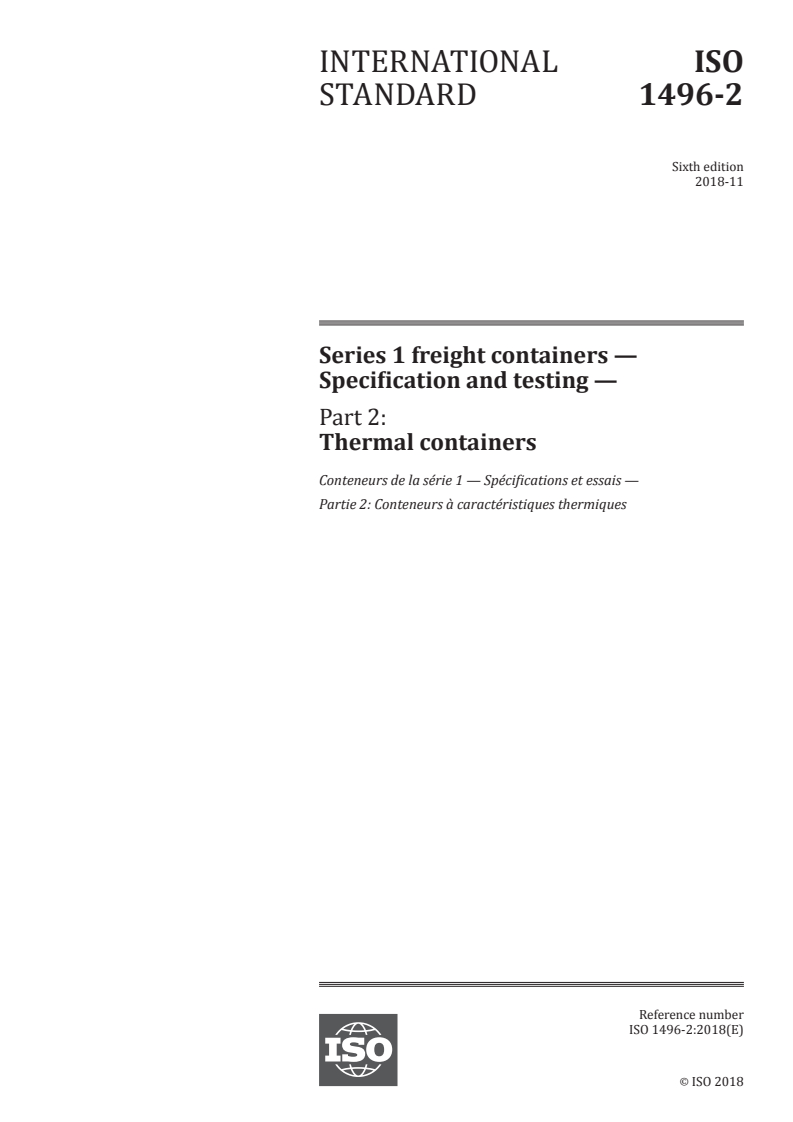
INTERNATIONAL ISO
STANDARD 1496-2
Sixth edition
2018-11
Series 1 freight containers —
Specification and testing —
Part 2:
Thermal containers
Conteneurs de la série 1 — Spécifications et essais —
Partie 2: Conteneurs à caractéristiques thermiques
Reference number
©
ISO 2018
© ISO 2018
All rights reserved. Unless otherwise specified, or required in the context of its implementation, no part of this publication may
be reproduced or utilized otherwise in any form or by any means, electronic or mechanical, including photocopying, or posting
on the internet or an intranet, without prior written permission. Permission can be requested from either ISO at the address
below or ISO’s member body in the country of the requester.
ISO copyright office
CP 401 • Ch. de Blandonnet 8
CH-1214 Vernier, Geneva
Phone: +41 22 749 01 11
Fax: +41 22 749 09 47
Email: copyright@iso.org
Website: www.iso.org
Published in Switzerland
ii © ISO 2018 – All rights reserved
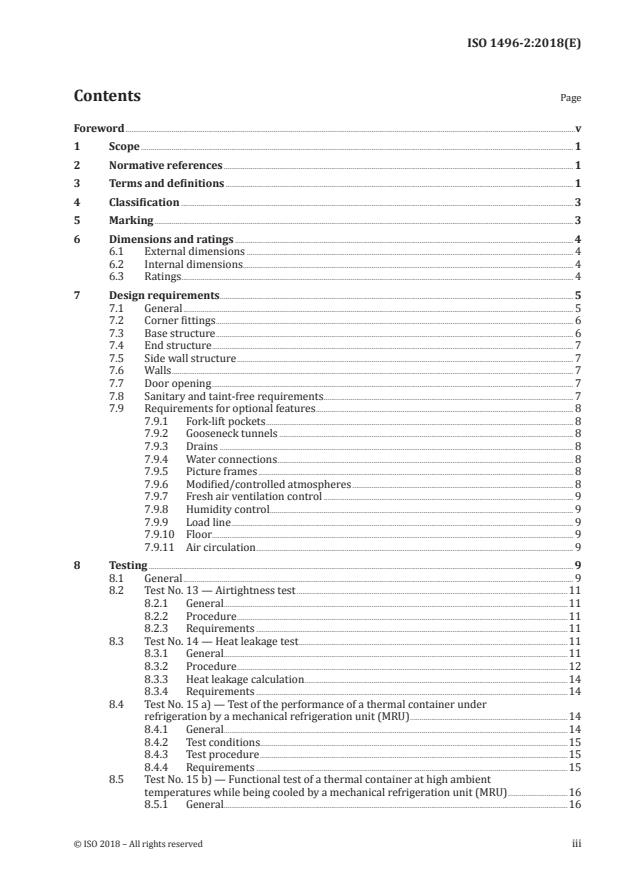
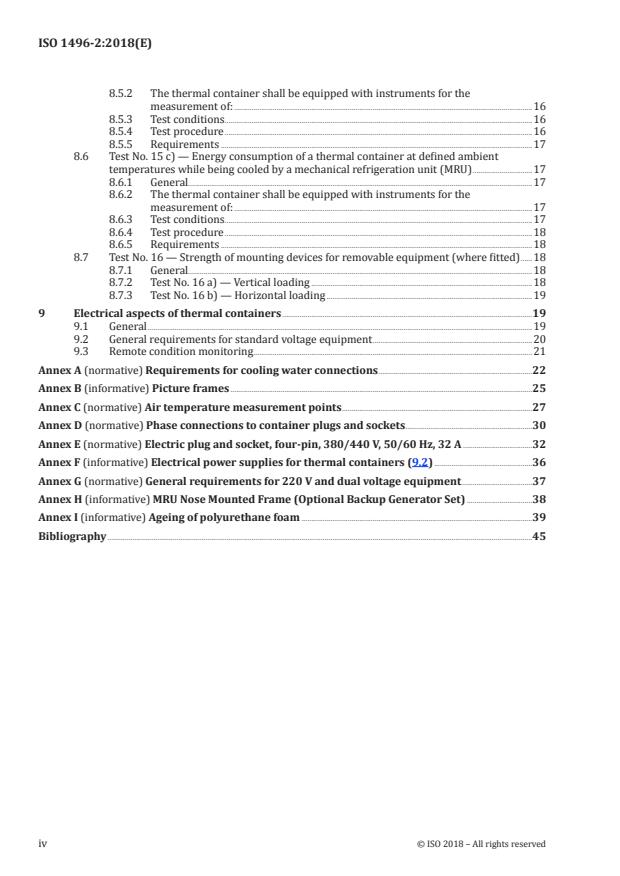
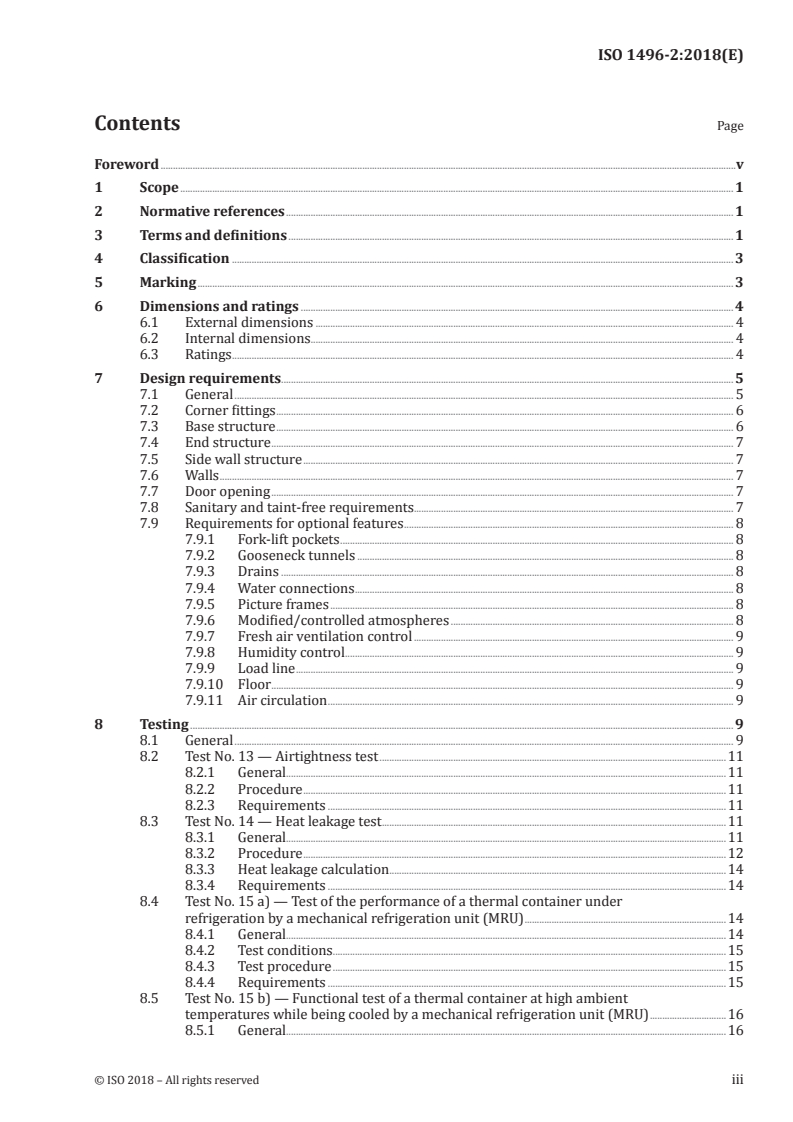
Contents Page
Foreword .v
1 Scope . 1
2 Normative references . 1
3 Terms and definitions . 1
4 Classification . 3
5 Marking . 3
6 Dimensions and ratings . 4
6.1 External dimensions . 4
6.2 Internal dimensions. 4
6.3 Ratings . 4
7 Design requirements . 5
7.1 General . 5
7.2 Corner fittings . 6
7.3 Base structure . 6
7.4 End structure . 7
7.5 Side wall structure . 7
7.6 Walls . 7
7.7 Door opening . 7
7.8 Sanitary and taint-free requirements. 7
7.9 Requirements for optional features . 8
7.9.1 Fork-lift pockets . 8
7.9.2 Gooseneck tunnels . 8
7.9.3 Drains . 8
7.9.4 Water connections . 8
7.9.5 Picture frames . 8
7.9.6 Modified/controlled atmospheres . 8
7.9.7 Fresh air ventilation control . 9
7.9.8 Humidity control . 9
7.9.9 Load line . 9
7.9.10 Floor . . 9
7.9.11 Air circulation . 9
8 Testing . 9
8.1 General . 9
8.2 Test No. 13 — Airtightness test .11
8.2.1 General.11
8.2.2 Procedure .11
8.2.3 Requirements .11
8.3 Test No. 14 — Heat leakage test .11
8.3.1 General.11
8.3.2 Procedure .12
8.3.3 Heat leakage calculation .14
8.3.4 Requirements .14
8.4 Test No. 15 a) — Test of the performance of a thermal container under
refrigeration by a mechanical refrigeration unit (MRU) .14
8.4.1 General.14
8.4.2 Test conditions.15
8.4.3 Test procedure .15
8.4.4 Requirements .15
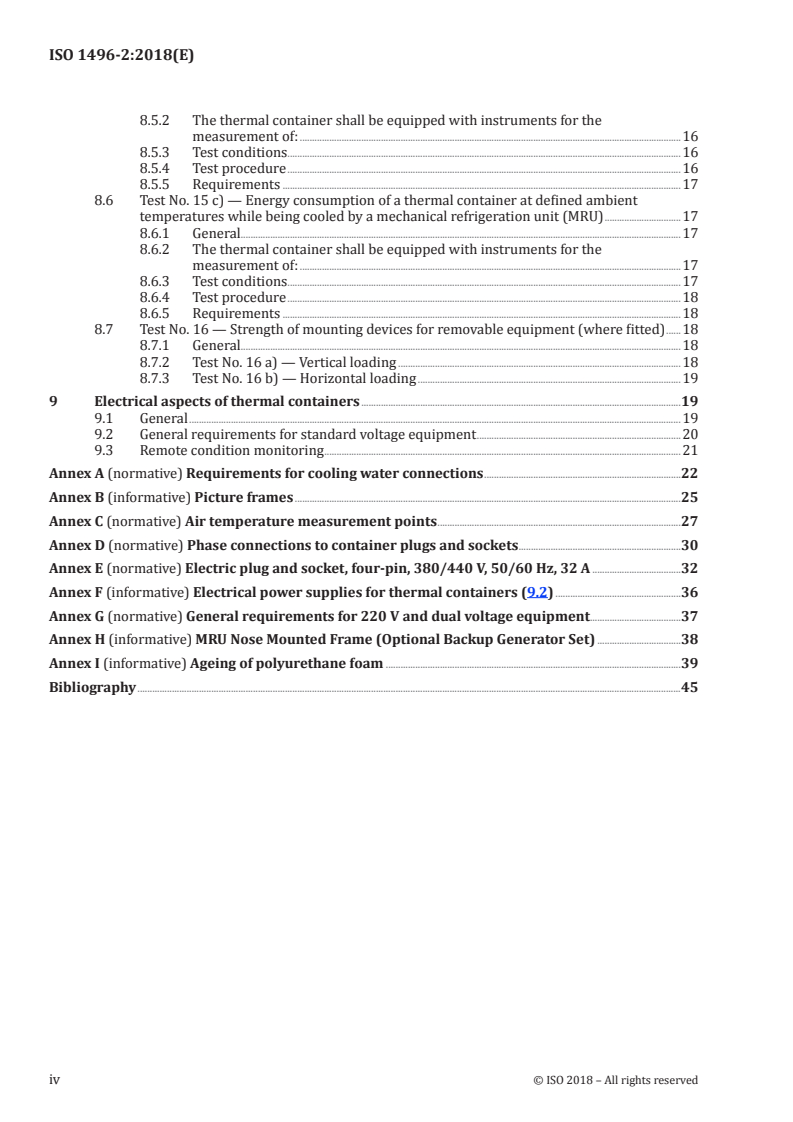
8.5 Test No. 15 b) — Functional test of a thermal container at high ambient
temperatures while being cooled by a mechanical refrigeration unit (MRU) .16
8.5.1 General.16
8.5.2 The thermal container shall be equipped with instruments for the
measurement of: .16
8.5.3 Test conditions.16
8.5.4 Test procedure .16
8.5.5 Requirements .17
8.6 Test No. 15 c) — Energy consumption of a thermal container at defined ambient
temperatures while being cooled by a mechanical refrigeration unit (MRU) .17
8.6.1 General.17
8.6.2 The thermal container shall be equipped with instruments for the
measurement of: .17
8.6.3 Test conditions.17
8.6.4 Test procedure .18
8.6.5 Requirements .18
8.7 Test No. 16 — Strength of mounting devices for removable equipment (where fitted) .18
8.7.1 General.18
8.7.2 Test No. 16 a) — Vertical loading .18
8.7.3 Test No. 16 b) — Horizontal loading .19
9 Electrical aspects of thermal containers .19
9.1 General .19
9.2 General requirements for standard voltage equipment .20
9.3 Remote condition monitoring .21
Annex A (normative) Requirements for cooling water connections .22
Annex B (informative) Picture frames .25
Annex C (normative) Air temperature measurement points .27
Annex D (normative) Phase connections to container plugs and sockets .30
Annex E (normative) Electric plug and socket, four-pin, 380/440 V, 50/60 Hz, 32 A .32
Annex F (informative) Electrical power supplies for thermal containers (9.2) .36
Annex G (normative) General requirements for 220 V and dual voltage equipment.37
Annex H (informative) MRU Nose Mounted Frame (Optional Backup Generator Set) .38
Annex I (informative) Ageing of polyurethane foam .39
Bibliography .45
iv © ISO 2018 – All rights reserved
Foreword
ISO (the International Organization for Standardization) is a worldwide federation of national standards
bodies (ISO member bodies). The work of preparing International Standards is normally carried out
through ISO technical committees. Each member body interested in a subject for which a technical
committee has been established has the right to be represented on that committee. International
organizations, governmental and non-governmental, in liaison with ISO, also take part in the work.
ISO collaborates closely with the International Electrotechnical Commission (IEC) on all matters of
electrotechnical standardization.
The procedures used to develop this document and those intended for its further maintenance are
described in the ISO/IEC Directives, Part 1. In particular, the different approval criteria needed for the
different types of ISO documents should be noted. This document was drafted in accordance with the
editorial rules of the ISO/IEC Directives, Part 2 (see www .iso .org/directives).
Attention is drawn to the possibility that some of the elements of this document may be the subject of
patent rights. ISO shall not be held responsible for identifying any or all such patent rights. Details of
any patent rights identified during the development of the document will be in the Introduction and/or
on the ISO list of patent declarations received (see www .iso .org/patents).
Any trade name used in this document is information given for the convenience of users and does not
constitute an endorsement.
For an explanation of the voluntary nature of standards, the meaning of ISO specific terms and
expressions related to conformity assessment, as well as information about ISO's adherence to the
World Trade Organization (WTO) principles in the Technical Barriers to Trade (TBT) see www .iso
.org/iso/foreword .html.
This document was prepared by Technical Committee ISO/TC 104, Freight containers, SC 2, Specific
purpose containers.
Any feedback or questions on this document should be directed to the user’s national standards body. A
complete listing of these bodies can be found at www .iso .org/members .html.
This sixth edition cancels and replaces the fifth edition (ISO 1496-2:2008) which has been technically
revised. The main changes compared to the previous edition are as follows:
— an easy reference for containers dimensions has been included in Table 1;
— the −18 °C/+38 °C cooling capacity test has been reinstated;
— the 50 °C ambient functionality test has been added;
— energy consumption tests have been added;
— an airflow requirement has been added;
— integrated front containers has been added;
— a clip on MRU units has been removed;
— a floor height and load line requirement has been added;
— design temperatures have been changed to reflect modern MRU’s;
— tests described in ISO 1496-1 have been removed and referenced;
— new Annexes H and I have been added;
— the old annex D has been removed and referenced to ISO 668;
— the test procedure for heat leakage has been revised;
— the heat-leakage rate for 1CCC has been included in Table 2.
A list of all parts in the ISO 1496 series can be found on the ISO website.
vi © ISO 2018 – All rights reserved
INTERNATIONAL STANDARD ISO 1496-2:2018(E)
Series 1 freight containers — Specification and testing —
Part 2:
Thermal containers
1 Scope
This document gives the basic specifications and testing requirements for ISO series 1 thermal
containers for international exchange and for conveyance of goods by road, rail and sea, including
interchange between these forms of transport.
2 Normative references
The following documents are referred to in the text in such a way that some or all of their content
constitutes requirements of this document. For dated references, only the edition cited applies. For
undated references, the latest edition of the referenced document (including any amendments) applies.
ISO 668, Series 1 freight containers — Classification, dimensions and ratings
ISO 1496-1, Series 1 freight containers — Specification and testing
ISO 1161, Series 1 freight containers — Corner fittings — Specification
ISO 6346, Freight containers — Coding, identification and marking
ISO Guide 51, Safety aspects — Guidelines for their inclusion in standards
IEC 60309-2, Plugs, socket-outlets and couplers for industrial purposes — Part 2: Dimensional
interchangeability requirements for pin and contact-tube accessories
3 Terms and definitions
For the purposes of this standard, the terms and definitions given in ISO Guide 51, ISO 668, ISO 1161,
ISO 6346, ISO 1496-1, IEC-60309-2 and the following apply.
ISO and IEC maintain terminological databases for use in standardization at the following addresses:
— ISO Online browsing platform: available at https: //www .iso .org/obp
— IEC Electropedia: available at http: //www .electropedia .org/
3.1
thermal container
insulated container
freight container having insulating walls, doors, floor and roof designed to delay the rate of heat
transmission between the inside and the outside of the container
3.2
refrigeration container
thermal container served by a unit using a means of cooling such as liquefied
gases, with or without evaporation control (ERU)
3.3
picture frame
opening in one end of a thermal container to accommodate an integral refrigeration unit
3.4
built-in front mechanically refrigerating and heated container
thermal container with built-in recess for a refrigeration and heating unit
3.5
heated container
thermal container with a heat producing unit
3.6
controlled atmosphere
modified atmosphere
system installed in a thermal container served by a refrigeration unit, capable of generating and/or
maintaining gas concentration levels different to those of the air outside the container
3.7
removable equipment
power-generating unit or other equipment designed to be attached or detached from a thermal
container
3.8
internally
totally within the external dimensional envelope of the container as defined in ISO 668
3.9
externally
partially or totally outside the external dimensional envelope of the container as defined
in ISO 668
Note 1 to entry: It is implicit in this definition that a unit located externally needs to be removable or retractable
to facilitate transport in certain modes.
3.10
batten
member protruding from the inside walls of the container to hold the cargo away from the wall to
provide an air passage
Note 1 to entry: The member may be integral with the wall, fastened to the wall or added during cargo loading.
3.11
bulkhead
partition providing a plenum chamber and/or air passage for either return or supply air
Note 1 to entry: The partition may be an integral part of the unit or a separate member.
3.12
load line
mark on the interior surface of a thermal container above which cargo should not be stowed
3.13
T-floor
section of floor, usually in aluminium, in the profile of the letter “T” for supporting cargo and
distributing air
2 © ISO 2018 – All rights reserved
3.14
fresh air vent
adjustable orifice to allow a supply of outside air into a mechanical refrigeration container
Note 1 to entry: A mechanical refrigeration container is a thermal container served by a mechanical refrigeration
unit (MRU).
3.15
floor drain
self-sealing floor orifice to allow the expulsion of condensate
3.16
vacuum valve
valve to prevent the development of excessive air pressure differential between inside and outside of
the thermal container
3.17
defrost drain
orifice for discharging condensate from the cooling coil
3.18
pin mounting
mounting system using two vertical pins engaging in sockets built into the front header
3.19
lower mounting point
threaded receptacle to which the lower two corners of the removable equipment are fastened
3.20
new thermal container
new insulated container
freight container having insulating walls, doors, floor and roof that has been manufactured within the
previous 7 days and with maximum heat-leakage rate, U , following Table 2
max
3.21
high ambient temperature
temperature above 50 °C at which the MRU is expected to operate without functional restrictions
3.22
aged thermal container
thermal container with aged polyurethane foam and with a heat-leakage rate, U value, 20 % higher
than the U value given in Table 2
max
4 Classification
The container types covered by this document are classified as shown in Table 2, in which the maximum
allowable new thermal container heat-leakage rates are specified.
5 Marking
The marking of thermal containers shall be in accordance with ISO 6346. Load line marking shall be in
accordance with 7.9.9. In addition, thermal containers given a modified/controlled atmosphere shall be
marked in accordance with 7.9.6. Marking symbols can be found in ISO 7010. Thermal containers with
fresh air ventilation control shall be marked in accordance with 7.9.7.
6 Dimensions and ratings
6.1 External dimensions
The overall external dimensions and tolerances of the thermal containers covered by this document
shall be in accordance with ISO 668. No part of the container shall project beyond these specified
overall external dimensions.
For reference purposes, the dimensions are given in Table 1.
Table 1 — Thermal container reference dimensions
Nominal length Nominal height
ft ft
9’ 6” 8’ 6” 8’ 0” <8’ 0”
45 1EEE 1EE — —
40 1AAA 1AA 1A 1AX
30 1BBB 1BB 1B 1BX
20 1CCC 1CC 1C 1CX
10 — 1DD 1D 1DX
NOTE All units have a nominal width of 8 ft.
6.2 Internal dimensions
Internal dimensions of thermal containers shall be measured from inner faces of battens, bulkheads,
T-floor, etc., where fitted.
The minimum internal dimensions for ISO series 1 thermal containers are specified in Table 3.
6.3 Ratings
The values of the rating, R, of the maximum gross mass of the container are those given in ISO 668.
Table 2 — Classification of thermal containers
1 2,3.4
Maximum heat-leakage rate for new thermal containers Operational
Detailed
U temperatures
max
Description
type, code
W/K Inside Outside
1D,
1C, 1B, 1A,
(ISO 6346) 1CCC 1BBB 1AAA 1EE 1EEE °C °C
1CC 1BB 1AA
1DD
Refrigerating
H5/HM (expendable refrig- 13 22 24 31 33 40 42 44 46 −30 +50
erant)
Eutectic, remote
+30 −30
H8/HX mechanical refrig- 13 22 24 31 33 40 42 44 46
−30 +50
eration
Mechanically re-
R0/RA 13 22 24 31 33 40 42 44 46 −30 +50
frigerating
+30 −30
Mechanically refrig-
R1/RB 13 22 24 31 33 40 42 44 46
erating and heated
−30 +50
R7/RW Heated 13 22 24 31 33 40 42 44 46 +30 −30
1 2
The values of U for insulated containers (type 1AAA) are better than a coefficient of heat transfer of 0,4 W/(m ⋅K).
max
Enclosed electrical components in the control box shall not fail up to temperatures of +85 °C.
Materials shall be capable of withstanding surface temperatures −30 °C to +80 °C.
In case MRU is not designed for −30 °C, the lowest design temperature specified by the manufacturer may be selected instead
4 © ISO 2018 – All rights reserved
Table 2 (continued)
1 2,3.4
Maximum heat-leakage rate for new thermal containers Operational
Detailed
U temperatures
max
Description
type, code
W/K Inside Outside
1D,
1C, 1B, 1A,
(ISO 6346) 1CCC 1BBB 1AAA 1EE 1EEE °C °C
1CC 1BB 1AA
1DD
Built-in front
+30 −30
R5/RM mechanically refrig- 13 22 24 31 33 40 42 44 46
−30 +50
erating and heated
Mechanically
R2/RD refrigerating, self- 13 22 24 31 33 40 42 44 46 −30 +50
powered
Refrigerating and
+30 −30
R3/RG heated, self-pow- 13 22 24 31 33 40 42 44 46
−30 +50
ered
Heated, self-pow-
R8/RX 13 22 24 31 33 40 42 44 46 +30 −30
ered
Refrigerating and/
or heated, with
H0/HA removable equip- 13 22 24 31 33 40 42 44 46
ment, unit located
externally
Refrigerating and/
or heated, with
H1/HB removable equip- 13 22 24 31 33 40 42 44 46
ment, unit located
internally
1 2
The values of U for insulated containers (type 1AAA) are better than a coefficient of heat transfer of 0,4 W/(m ⋅K).
max
Enclosed electrical components in the control box shall not fail up to temperatures of +85 °C.
Materials shall be capable of withstanding surface temperatures −30 °C to +80 °C.
In case MRU is not designed for −30 °C, the lowest design temperature specified by the manufacturer may be selected instead
Table 3 — Minimum internal dimensions
Dimensions in millimetres
1,2
Minimum height
1,2 2 1,2
Minimum length Minimum width Minimum height
(no gooseneck
(with gooseneck
Detailed type
tunnel)
= Nominal = Nominal
tunnel)
code
container container
= Nominal container
(ISO 6346)
external length external width = Nominal container
external height
minus minus external height minus
minus
H0/HA, R0/RA,
R1/RB, R5/RM, 690
R7/RW
220 345 385
H1/HB, R2/RD,
R3/RG, R8/RX
H0/HA 440
Some of the length and height dimensions specified will necessarily be used for air circulation.
Containers internal dimensions can deviate from above minimums due to operational or other requirements.
7 Design requirements
7.1 General
All thermal containers shall comply with the following requirements.
The strength requirements for containers are given in ISO 1496-1 (these requirements are applicable
to all thermal containers except where otherwise stated). They apply to containers as complete units,
except as described in 8.1.
The strength requirements for corner fittings (see also 7.2) are specified in ISO 1161.
The thermal container shall be capable of withstanding the loads and loadings specified in Clause 8.
As the effects of loads encountered under any dynamic operating condition should only approach, but
not exceed, the effects of the corresponding test loads, it is implicit that the capabilities of thermal
containers as indicated in ISO 1496-1 and demonstrated by the tests described in Clause 8 shall not be
exceeded in any mode of operation.
Any closure in a container which, if unsecured, can lead to a hazardous situation shall be provided with
an adequate securing system having external indication of the positive securement of that closure in
the appropriate operation position. In particular, doors should be capable of being securely fastened in
the open or closed position.
The walls, doors, floors and roof of the thermal container shall be insulated in such a manner as to
balance, as far as is practicable, the heat transfer through each of them, although the roof insulation
may be increased to compensate for solar radiation.
7.2 Corner fittings
All containers shall be equipped with top and bottom corner fittings. The requirements and positioning
of the corner fittings shall be in accordance with ISO 1161. The upper faces of the top corner fittings shall
protrude above the top of the container by a minimum of 6 mm (see 7.3.4). The “top of the container”
means the highest level of the cover of the container.
However, if reinforced zones or doubler plates are provided to afford protection to the roof in the
vicinity of the top corner fittings, such plates and their securements shall not protrude above the upper
faces of the top corner fittings. These plates shall not extend more than 750 mm from either end of the
container but may extend the full width.
7.3 Base structure
7.3.1 All containers shall be capable of being supported by their bottom corner fittings alone.
7.3.2 All containers, other than 1D, shall also be capable of being supported by load-transfer areas in
their base structure alone.
Consequently, these containers shall have end transverse members and sufficient intermediate load-
transfer areas (or a flat underside) of sufficient strength to enable vertical load transfer to or from the
longitudinal members of a carrying vehicle. Such longitudinal members are assumed to lie within the
two 375 mm wide zones defined by the dashed lines in ISO 668:2013, Figure B.1.
The lower faces of the load-transfer areas, including those of the end transverse members, shall be in
+50,
one plane located 12,5 mm mm above the plane of the lower faces of the bottom corner fittings and
−15,
bottom side rail. Apart from the bottom corner fittings and bottom side rails, no part of the container
shall project below this plane. However, doubler plates may be provided in the vicinity of the bottom
corner fittings to afford protection to the understructure.
Such plates shall not extend more than 550 mm from the outer end and not more than 470 mm from
the side faces of the bottom corner fittings, and their lower faces shall be at least 5 mm above the lower
faces of the bottom corner fittings of the container.
Containers having all their intermediate transverse members spaced 1 000 mm apart or less (or having
a flat underside) shall be deemed to comply with the requirements given in 7.3.2.
6 © ISO 2018 – All rights reserved
Requirements for containers not having transverse members spaced 1 000 mm apart or less (and not
having a flat underside) are given in ISO 1496-1.
7.3.3 For 1D containers, the level of the underside of the base structure is not specified, except as
implied in 7.3.4.
7.3.4 For all containers under dynamic conditions, or the static equivalent thereof, with the container
having a load uniformly distributed over the floor in such a way that the combined mass of the container
and test load is equal to 1,8 R, no part of the base of the container shall deflect more than 6 mm below the
base plane (lower faces of the bottom corner fittings).
7.3.5 The base structure shall be designed to withstand all forces, particularly lateral forces, induced
by the cargo in service. This is particularly important where provisions are made for securing the cargo
to the base structure of the container.
7.4 End structure
For all thermal containers other than 1D, the sideways deflection of the top of the container with
respect to the bottom of the container, at the time it is under full transverse rigidity test conditions,
shall not cause the sum of the changes in length of the two diagonals to exceed 60 mm.
It should be taken into consideration that the rigidity of the end structure of a container fitted with an
internally located refrigeration unit is not necessarily equal to the sum of rigidities of container and
unit, but is also dependent on the way in which the unit is fitted.
7.5 Side wall structure
For all thermal containers other than 1D, the longitudinal deflection of the top of the container with
respect to the bottom of the container when under full longitudinal rigidity test conditions shall not
exceed 25 mm.
7.6 Walls
Where openings are provided in end or side walls, the ability of these walls to withstand tests No. 5
and 6 shall not be impaired.
7.7 Door opening
Each thermal container shall be provided with a door opening at least at one end.
The usable width shall correspond with the appropriate minimum internal dimension given in Table 3.
The usable height shall be as close as practicable to the appropriate minimum internal dimension given
in Table 3.
7.8 Sanitary and taint-free requirements
Attention is drawn to the need for the proper choice of materials for the thermal container and any
refrigeration/heating units to prevent adverse effects in cargo, especially foodstuffs.
The interior surface and container structure shall be so constructed as to facilitate cleaning, and the
structure and the insulation shall not be functionally affected by cleaning methods, for example steam
cleaning and detergents normally used.
No pockets shall exist inside the container that cannot be reached by conventional cleaning methods.
If drains are fitted, provision shall be made to ensure that cleaning water can drain from the inside of
the container.
7.9 Requirements for optional features
7.9.1 Fork-lift pockets
7.9.1.1 Fork-lift pockets used for handling 1CC, 1C and 1D thermal containers in the loaded or unloaded
condition may be provided as optional features.
Fork-lift pockets may be provided on 1AAA, 1AA, 1A, 1BBB, 1BB and 1B thermal containers for handling
in unloaded condition only.
7.9.1.2 Where a set of fork-lift pockets has been fitted as in 7.9.1.1, a second set of fork-lift pockets may,
in addition, be provided on 1CC and 1C containers for empty handling only.
The(se) additional pocket(s) provided accordance with 7.9.1.1, which can, in fact, be one pocket paired
with an existing pocket, should be centred as closely as possible about the centre of gravity of the empty
container.
7.9.1.3 The fork-lift pockets, where provided, shall meet the dimensional requirements specified in
ISO 1496-1 and shall pass completely through the base structure of the container so that lifting devices
can be inserted from either side. It is not necessary for the base of the fork-lift pockets to be the full width
of the container, but it shall be located in the vicinity of each end of the fork pockets.
7.9.2 Gooseneck tunnels
Gooseneck tunnels shall be provided as mandatory features in 1AAA thermal containers and may be
provided as optional features in thermal containers 1AA, 1A, 1BB and 1B. The dimensional requirements
are specified in ISO 668 and, in addition, all other parts of the base structure shall be as specified in 7.3.
7.9.3 Drains
Cargo space drains which operate when carrying cargo shall be protected by fittings which open
automatically above normal internal operating pressure. Drains, when fitted, shall be provided with a
sealing mechanism.
7.9.4 Water connections
For units requiring water connections, the inlet and outlet interfaces shall be in accordance with
Annex A.
Water-cooled MRU’s shall either be self-draining or incorporate the facility to drain the unit to prevent
the water from freezing.
The water inlet and outlet connections shall be located at the machinery end of the container so that, to
an observer facing that end, they appear in the lower right-hand quarter.
7.9.5 Picture frames
Where containers are designed for bolted in refrigeration unit (integral units), Annex B should be
referred to.
7.9.6 Modified/controlled atmospheres
Thermal containers that are manufactured to operate with a modified or controlled atmosphere, which
can be injurious to health until appropriately vented, shall be so marked alongside each point of access.
8 © ISO 2018 – All rights reserved
7.9.7 Fresh air ventilation control
Where automated fresh air ventilation control is provided, this fact shall be clearly marked near the
ventilation inlet(s).
7.9.8 Humidity control
Where humidity control to provide reduced humidity is provided by means of reheating only, there are
no additional requirements. Where humidity control incorporates addition of water as liquid or vapour,
instructions shall be provided for cleaning and disinfecting all water reservoirs.
7.9.9 Load line
Thermal containers with an air circulation system should have a load line clearly marked to ensure
return of air to the MRU. It is recommended that the load line be at least 100 mm from the roof for
40’ container and 70 mm for a 20’ container.
7.9.10 Floor
Thermal containers with an air circulation system should have a method for distributing air in the floor
but not definitively a T-floor. The floor shall have a minimum height as indicated in Table 4.
Table 4 — Container floor heights
Minimum floor height
Container designation
mm
55 1EEE 1EE — —
55 1AAA 1AA 1A 1AX
45 1BBB 1BB 1B 1BX
35 1CCC 1CC 1C 1CX
30 — 1DD 1D 1DX
7.9.11 Air circulation
MRU air circulation should be capable of at least 50 container volume air changes each hour whilst
operating on a 50 Hz power supply, taking the container volume from Table 3. It is not a requirement for
fan operation to be continuous.
Airflow measurement should comply with the provisions of ISO 5801.
8 Testing
8.1 General
8.1.1 Unless otherwise stated, thermal containers conforming to the design requirements specified in
Clause 7 shall, in addition, be capable of withstanding the tests specified in 8.2 to 8.7, as applicable.
The refrigeration and/or heating equipment (for example components, framework, panelling, battens,
ductwork, bulkheads) need not necessarily be in place when the container is tested, except where so
specified for a particular test. But if any of the main parts or frameworks of the refrigeration and/or
heating equipment is not in position for any structural test, the ability of that part or framework to
withstand the appropriate proportion of any relevant cargo loading and/or the forces or accelerations
to which the container and equipment may be subjected in the service for which it was designed shall
be established independently.
If parts of the refrigeration and/or heating equipment which contribute to the strength or integrity
of the container in service are not in position for structural testing, substitute framework and/or
panelling may be used, provided that it is secured in the same manner as the equipment and does not
provide greater strength than the original parts.
The test for heat leakage (Test No. 14) shall be used to measure the heat leakage rate from the container,
which determines its class. The tests described in 8.16, 8.17 and 8.18 [Tests No. 15 a), 15 b) and 15 c)]
establish a standard method for testing the performance of mechanical refrigeration units, when used
in conjunction with a container of known class.
The tests for weatherproofness (Test No. 12), for airtightness (Test No. 13), for heat leakage (Test No. 14)
and for performance under refrigeration (Test No. 15) shall be carried out in sequence after completion
of Tests No. 1 to 11.
8.1.2 The test loads or loadings within the thermal container shall be uniformly distributed.
8.1.3 The test loads or loadings specified in all of the following tests are minimum requirements.
8.1.4 The dimensional requirements to which reference is made in the requirements subclause after
each test are those specified in:
a) ISO 668; and
b) ISO 1161.
8.1.5 Tests No. 1 to 12 shall be carried out in accordance with ISO 1496-1.
8.1.5.1 Test No. 1 — Stacking.
8.1.5.2 Test No. 2 — Lifting from appropriate four top corner and intermediate fittings.
8.1.5.3 Test No. 3 — Lifting from the four bottom corner and intermediate fittings.
8.1.5.4 Test No. 4 — Restraint (longitudinal).
8.1.5.5 Test No. 5 — Strength of end walls.
8.1.5.6 Test No. 6 — Strength of side walls.
8.1.5.7 Test No. 7 — Strength of the roof.
8.1.5.8 Test No. 8 — Floor strength.
8.1.5.9 Test No. 9 — Rigidity (transverse).
8.1.5.10 Test No. 10 — Rigidity (longitudinal).
8.1.5.11 Test No. 11 — Lifting from fork-lift pockets (where provided).
8.1.5.12 Test No. 12 — Weatherproofness.
The MRU is to be included in the weathertight test.
10 © ISO 2018 – All rights reserved
8.2 Test No. 13 — Airtightness test
8.2.1 General
This test shall be carried out after all structural tests have been completed and prior to the heat leakage
test (Test No. 14). The temperatures inside and outside the thermal container shall be stabilized within
3 K of each other and shall both be within the range 15 °C to 25 °C.
8.2.2 Procedure
The thermal container shall be in its normal operating condition and shall be closed in the normal
manner. The refrigeration and/or heating equipment shall be in place, except that where the container
is designed for use with removable equipment and the container has closures at the interface(s), the
equipment shall not be in position and the closures shall be shut. All drain openings shall be closed.
An air supply through a metering device and a suitable manometer shall be connected to the thermal
container by a leak-proof connection. The manometer shall not be part of the air supply system. The
flow-measuring device shall be accurate to ±3 % of the measured flowrate, and the manometer on the
container shall be accurate to ±5 %. Air shall be admitted to the container to raise the internal pressure
to 250 Pa ± 10 Pa and the air supply regulated to maintain
...
INTERNATIONAL ISO
STANDARD 1496-2
Sixth edition
2018-11
Series 1 freight containers —
Specification and testing —
Part 2:
Thermal containers
Conteneurs de la série 1 — Spécifications et essais —
Partie 2: Conteneurs à caractéristiques thermiques
Reference number
©
ISO 2018
© ISO 2018
All rights reserved. Unless otherwise specified, or required in the context of its implementation, no part of this publication may
be reproduced or utilized otherwise in any form or by any means, electronic or mechanical, including photocopying, or posting
on the internet or an intranet, without prior written permission. Permission can be requested from either ISO at the address
below or ISO’s member body in the country of the requester.
ISO copyright office
CP 401 • Ch. de Blandonnet 8
CH-1214 Vernier, Geneva
Phone: +41 22 749 01 11
Fax: +41 22 749 09 47
Email: copyright@iso.org
Website: www.iso.org
Published in Switzerland
ii © ISO 2018 – All rights reserved
Contents Page
Foreword .v
1 Scope . 1
2 Normative references . 1
3 Terms and definitions . 1
4 Classification . 3
5 Marking . 3
6 Dimensions and ratings . 4
6.1 External dimensions . 4
6.2 Internal dimensions. 4
6.3 Ratings . 4
7 Design requirements . 5
7.1 General . 5
7.2 Corner fittings . 6
7.3 Base structure . 6
7.4 End structure . 7
7.5 Side wall structure . 7
7.6 Walls . 7
7.7 Door opening . 7
7.8 Sanitary and taint-free requirements. 7
7.9 Requirements for optional features . 8
7.9.1 Fork-lift pockets . 8
7.9.2 Gooseneck tunnels . 8
7.9.3 Drains . 8
7.9.4 Water connections . 8
7.9.5 Picture frames . 8
7.9.6 Modified/controlled atmospheres . 8
7.9.7 Fresh air ventilation control . 9
7.9.8 Humidity control . 9
7.9.9 Load line . 9
7.9.10 Floor . . 9
7.9.11 Air circulation . 9
8 Testing . 9
8.1 General . 9
8.2 Test No. 13 — Airtightness test .11
8.2.1 General.11
8.2.2 Procedure .11
8.2.3 Requirements .11
8.3 Test No. 14 — Heat leakage test .11
8.3.1 General.11
8.3.2 Procedure .12
8.3.3 Heat leakage calculation .14
8.3.4 Requirements .14
8.4 Test No. 15 a) — Test of the performance of a thermal container under
refrigeration by a mechanical refrigeration unit (MRU) .14
8.4.1 General.14
8.4.2 Test conditions.15
8.4.3 Test procedure .15
8.4.4 Requirements .15
8.5 Test No. 15 b) — Functional test of a thermal container at high ambient
temperatures while being cooled by a mechanical refrigeration unit (MRU) .16
8.5.1 General.16
8.5.2 The thermal container shall be equipped with instruments for the
measurement of: .16
8.5.3 Test conditions.16
8.5.4 Test procedure .16
8.5.5 Requirements .17
8.6 Test No. 15 c) — Energy consumption of a thermal container at defined ambient
temperatures while being cooled by a mechanical refrigeration unit (MRU) .17
8.6.1 General.17
8.6.2 The thermal container shall be equipped with instruments for the
measurement of: .17
8.6.3 Test conditions.17
8.6.4 Test procedure .18
8.6.5 Requirements .18
8.7 Test No. 16 — Strength of mounting devices for removable equipment (where fitted) .18
8.7.1 General.18
8.7.2 Test No. 16 a) — Vertical loading .18
8.7.3 Test No. 16 b) — Horizontal loading .19
9 Electrical aspects of thermal containers .19
9.1 General .19
9.2 General requirements for standard voltage equipment .20
9.3 Remote condition monitoring .21
Annex A (normative) Requirements for cooling water connections .22
Annex B (informative) Picture frames .25
Annex C (normative) Air temperature measurement points .27
Annex D (normative) Phase connections to container plugs and sockets .30
Annex E (normative) Electric plug and socket, four-pin, 380/440 V, 50/60 Hz, 32 A .32
Annex F (informative) Electrical power supplies for thermal containers (9.2) .36
Annex G (normative) General requirements for 220 V and dual voltage equipment.37
Annex H (informative) MRU Nose Mounted Frame (Optional Backup Generator Set) .38
Annex I (informative) Ageing of polyurethane foam .39
Bibliography .45
iv © ISO 2018 – All rights reserved
Foreword
ISO (the International Organization for Standardization) is a worldwide federation of national standards
bodies (ISO member bodies). The work of preparing International Standards is normally carried out
through ISO technical committees. Each member body interested in a subject for which a technical
committee has been established has the right to be represented on that committee. International
organizations, governmental and non-governmental, in liaison with ISO, also take part in the work.
ISO collaborates closely with the International Electrotechnical Commission (IEC) on all matters of
electrotechnical standardization.
The procedures used to develop this document and those intended for its further maintenance are
described in the ISO/IEC Directives, Part 1. In particular, the different approval criteria needed for the
different types of ISO documents should be noted. This document was drafted in accordance with the
editorial rules of the ISO/IEC Directives, Part 2 (see www .iso .org/directives).
Attention is drawn to the possibility that some of the elements of this document may be the subject of
patent rights. ISO shall not be held responsible for identifying any or all such patent rights. Details of
any patent rights identified during the development of the document will be in the Introduction and/or
on the ISO list of patent declarations received (see www .iso .org/patents).
Any trade name used in this document is information given for the convenience of users and does not
constitute an endorsement.
For an explanation of the voluntary nature of standards, the meaning of ISO specific terms and
expressions related to conformity assessment, as well as information about ISO's adherence to the
World Trade Organization (WTO) principles in the Technical Barriers to Trade (TBT) see www .iso
.org/iso/foreword .html.
This document was prepared by Technical Committee ISO/TC 104, Freight containers, SC 2, Specific
purpose containers.
Any feedback or questions on this document should be directed to the user’s national standards body. A
complete listing of these bodies can be found at www .iso .org/members .html.
This sixth edition cancels and replaces the fifth edition (ISO 1496-2:2008) which has been technically
revised. The main changes compared to the previous edition are as follows:
— an easy reference for containers dimensions has been included in Table 1;
— the −18 °C/+38 °C cooling capacity test has been reinstated;
— the 50 °C ambient functionality test has been added;
— energy consumption tests have been added;
— an airflow requirement has been added;
— integrated front containers has been added;
— a clip on MRU units has been removed;
— a floor height and load line requirement has been added;
— design temperatures have been changed to reflect modern MRU’s;
— tests described in ISO 1496-1 have been removed and referenced;
— new Annexes H and I have been added;
— the old annex D has been removed and referenced to ISO 668;
— the test procedure for heat leakage has been revised;
— the heat-leakage rate for 1CCC has been included in Table 2.
A list of all parts in the ISO 1496 series can be found on the ISO website.
vi © ISO 2018 – All rights reserved
INTERNATIONAL STANDARD ISO 1496-2:2018(E)
Series 1 freight containers — Specification and testing —
Part 2:
Thermal containers
1 Scope
This document gives the basic specifications and testing requirements for ISO series 1 thermal
containers for international exchange and for conveyance of goods by road, rail and sea, including
interchange between these forms of transport.
2 Normative references
The following documents are referred to in the text in such a way that some or all of their content
constitutes requirements of this document. For dated references, only the edition cited applies. For
undated references, the latest edition of the referenced document (including any amendments) applies.
ISO 668, Series 1 freight containers — Classification, dimensions and ratings
ISO 1496-1, Series 1 freight containers — Specification and testing
ISO 1161, Series 1 freight containers — Corner fittings — Specification
ISO 6346, Freight containers — Coding, identification and marking
ISO Guide 51, Safety aspects — Guidelines for their inclusion in standards
IEC 60309-2, Plugs, socket-outlets and couplers for industrial purposes — Part 2: Dimensional
interchangeability requirements for pin and contact-tube accessories
3 Terms and definitions
For the purposes of this standard, the terms and definitions given in ISO Guide 51, ISO 668, ISO 1161,
ISO 6346, ISO 1496-1, IEC-60309-2 and the following apply.
ISO and IEC maintain terminological databases for use in standardization at the following addresses:
— ISO Online browsing platform: available at https: //www .iso .org/obp
— IEC Electropedia: available at http: //www .electropedia .org/
3.1
thermal container
insulated container
freight container having insulating walls, doors, floor and roof designed to delay the rate of heat
transmission between the inside and the outside of the container
3.2
refrigeration container
thermal container served by a unit using a means of cooling such as liquefied
gases, with or without evaporation control (ERU)
3.3
picture frame
opening in one end of a thermal container to accommodate an integral refrigeration unit
3.4
built-in front mechanically refrigerating and heated container
thermal container with built-in recess for a refrigeration and heating unit
3.5
heated container
thermal container with a heat producing unit
3.6
controlled atmosphere
modified atmosphere
system installed in a thermal container served by a refrigeration unit, capable of generating and/or
maintaining gas concentration levels different to those of the air outside the container
3.7
removable equipment
power-generating unit or other equipment designed to be attached or detached from a thermal
container
3.8
internally
totally within the external dimensional envelope of the container as defined in ISO 668
3.9
externally
partially or totally outside the external dimensional envelope of the container as defined
in ISO 668
Note 1 to entry: It is implicit in this definition that a unit located externally needs to be removable or retractable
to facilitate transport in certain modes.
3.10
batten
member protruding from the inside walls of the container to hold the cargo away from the wall to
provide an air passage
Note 1 to entry: The member may be integral with the wall, fastened to the wall or added during cargo loading.
3.11
bulkhead
partition providing a plenum chamber and/or air passage for either return or supply air
Note 1 to entry: The partition may be an integral part of the unit or a separate member.
3.12
load line
mark on the interior surface of a thermal container above which cargo should not be stowed
3.13
T-floor
section of floor, usually in aluminium, in the profile of the letter “T” for supporting cargo and
distributing air
2 © ISO 2018 – All rights reserved
3.14
fresh air vent
adjustable orifice to allow a supply of outside air into a mechanical refrigeration container
Note 1 to entry: A mechanical refrigeration container is a thermal container served by a mechanical refrigeration
unit (MRU).
3.15
floor drain
self-sealing floor orifice to allow the expulsion of condensate
3.16
vacuum valve
valve to prevent the development of excessive air pressure differential between inside and outside of
the thermal container
3.17
defrost drain
orifice for discharging condensate from the cooling coil
3.18
pin mounting
mounting system using two vertical pins engaging in sockets built into the front header
3.19
lower mounting point
threaded receptacle to which the lower two corners of the removable equipment are fastened
3.20
new thermal container
new insulated container
freight container having insulating walls, doors, floor and roof that has been manufactured within the
previous 7 days and with maximum heat-leakage rate, U , following Table 2
max
3.21
high ambient temperature
temperature above 50 °C at which the MRU is expected to operate without functional restrictions
3.22
aged thermal container
thermal container with aged polyurethane foam and with a heat-leakage rate, U value, 20 % higher
than the U value given in Table 2
max
4 Classification
The container types covered by this document are classified as shown in Table 2, in which the maximum
allowable new thermal container heat-leakage rates are specified.
5 Marking
The marking of thermal containers shall be in accordance with ISO 6346. Load line marking shall be in
accordance with 7.9.9. In addition, thermal containers given a modified/controlled atmosphere shall be
marked in accordance with 7.9.6. Marking symbols can be found in ISO 7010. Thermal containers with
fresh air ventilation control shall be marked in accordance with 7.9.7.
6 Dimensions and ratings
6.1 External dimensions
The overall external dimensions and tolerances of the thermal containers covered by this document
shall be in accordance with ISO 668. No part of the container shall project beyond these specified
overall external dimensions.
For reference purposes, the dimensions are given in Table 1.
Table 1 — Thermal container reference dimensions
Nominal length Nominal height
ft ft
9’ 6” 8’ 6” 8’ 0” <8’ 0”
45 1EEE 1EE — —
40 1AAA 1AA 1A 1AX
30 1BBB 1BB 1B 1BX
20 1CCC 1CC 1C 1CX
10 — 1DD 1D 1DX
NOTE All units have a nominal width of 8 ft.
6.2 Internal dimensions
Internal dimensions of thermal containers shall be measured from inner faces of battens, bulkheads,
T-floor, etc., where fitted.
The minimum internal dimensions for ISO series 1 thermal containers are specified in Table 3.
6.3 Ratings
The values of the rating, R, of the maximum gross mass of the container are those given in ISO 668.
Table 2 — Classification of thermal containers
1 2,3.4
Maximum heat-leakage rate for new thermal containers Operational
Detailed
U temperatures
max
Description
type, code
W/K Inside Outside
1D,
1C, 1B, 1A,
(ISO 6346) 1CCC 1BBB 1AAA 1EE 1EEE °C °C
1CC 1BB 1AA
1DD
Refrigerating
H5/HM (expendable refrig- 13 22 24 31 33 40 42 44 46 −30 +50
erant)
Eutectic, remote
+30 −30
H8/HX mechanical refrig- 13 22 24 31 33 40 42 44 46
−30 +50
eration
Mechanically re-
R0/RA 13 22 24 31 33 40 42 44 46 −30 +50
frigerating
+30 −30
Mechanically refrig-
R1/RB 13 22 24 31 33 40 42 44 46
erating and heated
−30 +50
R7/RW Heated 13 22 24 31 33 40 42 44 46 +30 −30
1 2
The values of U for insulated containers (type 1AAA) are better than a coefficient of heat transfer of 0,4 W/(m ⋅K).
max
Enclosed electrical components in the control box shall not fail up to temperatures of +85 °C.
Materials shall be capable of withstanding surface temperatures −30 °C to +80 °C.
In case MRU is not designed for −30 °C, the lowest design temperature specified by the manufacturer may be selected instead
4 © ISO 2018 – All rights reserved
Table 2 (continued)
1 2,3.4
Maximum heat-leakage rate for new thermal containers Operational
Detailed
U temperatures
max
Description
type, code
W/K Inside Outside
1D,
1C, 1B, 1A,
(ISO 6346) 1CCC 1BBB 1AAA 1EE 1EEE °C °C
1CC 1BB 1AA
1DD
Built-in front
+30 −30
R5/RM mechanically refrig- 13 22 24 31 33 40 42 44 46
−30 +50
erating and heated
Mechanically
R2/RD refrigerating, self- 13 22 24 31 33 40 42 44 46 −30 +50
powered
Refrigerating and
+30 −30
R3/RG heated, self-pow- 13 22 24 31 33 40 42 44 46
−30 +50
ered
Heated, self-pow-
R8/RX 13 22 24 31 33 40 42 44 46 +30 −30
ered
Refrigerating and/
or heated, with
H0/HA removable equip- 13 22 24 31 33 40 42 44 46
ment, unit located
externally
Refrigerating and/
or heated, with
H1/HB removable equip- 13 22 24 31 33 40 42 44 46
ment, unit located
internally
1 2
The values of U for insulated containers (type 1AAA) are better than a coefficient of heat transfer of 0,4 W/(m ⋅K).
max
Enclosed electrical components in the control box shall not fail up to temperatures of +85 °C.
Materials shall be capable of withstanding surface temperatures −30 °C to +80 °C.
In case MRU is not designed for −30 °C, the lowest design temperature specified by the manufacturer may be selected instead
Table 3 — Minimum internal dimensions
Dimensions in millimetres
1,2
Minimum height
1,2 2 1,2
Minimum length Minimum width Minimum height
(no gooseneck
(with gooseneck
Detailed type
tunnel)
= Nominal = Nominal
tunnel)
code
container container
= Nominal container
(ISO 6346)
external length external width = Nominal container
external height
minus minus external height minus
minus
H0/HA, R0/RA,
R1/RB, R5/RM, 690
R7/RW
220 345 385
H1/HB, R2/RD,
R3/RG, R8/RX
H0/HA 440
Some of the length and height dimensions specified will necessarily be used for air circulation.
Containers internal dimensions can deviate from above minimums due to operational or other requirements.
7 Design requirements
7.1 General
All thermal containers shall comply with the following requirements.
The strength requirements for containers are given in ISO 1496-1 (these requirements are applicable
to all thermal containers except where otherwise stated). They apply to containers as complete units,
except as described in 8.1.
The strength requirements for corner fittings (see also 7.2) are specified in ISO 1161.
The thermal container shall be capable of withstanding the loads and loadings specified in Clause 8.
As the effects of loads encountered under any dynamic operating condition should only approach, but
not exceed, the effects of the corresponding test loads, it is implicit that the capabilities of thermal
containers as indicated in ISO 1496-1 and demonstrated by the tests described in Clause 8 shall not be
exceeded in any mode of operation.
Any closure in a container which, if unsecured, can lead to a hazardous situation shall be provided with
an adequate securing system having external indication of the positive securement of that closure in
the appropriate operation position. In particular, doors should be capable of being securely fastened in
the open or closed position.
The walls, doors, floors and roof of the thermal container shall be insulated in such a manner as to
balance, as far as is practicable, the heat transfer through each of them, although the roof insulation
may be increased to compensate for solar radiation.
7.2 Corner fittings
All containers shall be equipped with top and bottom corner fittings. The requirements and positioning
of the corner fittings shall be in accordance with ISO 1161. The upper faces of the top corner fittings shall
protrude above the top of the container by a minimum of 6 mm (see 7.3.4). The “top of the container”
means the highest level of the cover of the container.
However, if reinforced zones or doubler plates are provided to afford protection to the roof in the
vicinity of the top corner fittings, such plates and their securements shall not protrude above the upper
faces of the top corner fittings. These plates shall not extend more than 750 mm from either end of the
container but may extend the full width.
7.3 Base structure
7.3.1 All containers shall be capable of being supported by their bottom corner fittings alone.
7.3.2 All containers, other than 1D, shall also be capable of being supported by load-transfer areas in
their base structure alone.
Consequently, these containers shall have end transverse members and sufficient intermediate load-
transfer areas (or a flat underside) of sufficient strength to enable vertical load transfer to or from the
longitudinal members of a carrying vehicle. Such longitudinal members are assumed to lie within the
two 375 mm wide zones defined by the dashed lines in ISO 668:2013, Figure B.1.
The lower faces of the load-transfer areas, including those of the end transverse members, shall be in
+50,
one plane located 12,5 mm mm above the plane of the lower faces of the bottom corner fittings and
−15,
bottom side rail. Apart from the bottom corner fittings and bottom side rails, no part of the container
shall project below this plane. However, doubler plates may be provided in the vicinity of the bottom
corner fittings to afford protection to the understructure.
Such plates shall not extend more than 550 mm from the outer end and not more than 470 mm from
the side faces of the bottom corner fittings, and their lower faces shall be at least 5 mm above the lower
faces of the bottom corner fittings of the container.
Containers having all their intermediate transverse members spaced 1 000 mm apart or less (or having
a flat underside) shall be deemed to comply with the requirements given in 7.3.2.
6 © ISO 2018 – All rights reserved
Requirements for containers not having transverse members spaced 1 000 mm apart or less (and not
having a flat underside) are given in ISO 1496-1.
7.3.3 For 1D containers, the level of the underside of the base structure is not specified, except as
implied in 7.3.4.
7.3.4 For all containers under dynamic conditions, or the static equivalent thereof, with the container
having a load uniformly distributed over the floor in such a way that the combined mass of the container
and test load is equal to 1,8 R, no part of the base of the container shall deflect more than 6 mm below the
base plane (lower faces of the bottom corner fittings).
7.3.5 The base structure shall be designed to withstand all forces, particularly lateral forces, induced
by the cargo in service. This is particularly important where provisions are made for securing the cargo
to the base structure of the container.
7.4 End structure
For all thermal containers other than 1D, the sideways deflection of the top of the container with
respect to the bottom of the container, at the time it is under full transverse rigidity test conditions,
shall not cause the sum of the changes in length of the two diagonals to exceed 60 mm.
It should be taken into consideration that the rigidity of the end structure of a container fitted with an
internally located refrigeration unit is not necessarily equal to the sum of rigidities of container and
unit, but is also dependent on the way in which the unit is fitted.
7.5 Side wall structure
For all thermal containers other than 1D, the longitudinal deflection of the top of the container with
respect to the bottom of the container when under full longitudinal rigidity test conditions shall not
exceed 25 mm.
7.6 Walls
Where openings are provided in end or side walls, the ability of these walls to withstand tests No. 5
and 6 shall not be impaired.
7.7 Door opening
Each thermal container shall be provided with a door opening at least at one end.
The usable width shall correspond with the appropriate minimum internal dimension given in Table 3.
The usable height shall be as close as practicable to the appropriate minimum internal dimension given
in Table 3.
7.8 Sanitary and taint-free requirements
Attention is drawn to the need for the proper choice of materials for the thermal container and any
refrigeration/heating units to prevent adverse effects in cargo, especially foodstuffs.
The interior surface and container structure shall be so constructed as to facilitate cleaning, and the
structure and the insulation shall not be functionally affected by cleaning methods, for example steam
cleaning and detergents normally used.
No pockets shall exist inside the container that cannot be reached by conventional cleaning methods.
If drains are fitted, provision shall be made to ensure that cleaning water can drain from the inside of
the container.
7.9 Requirements for optional features
7.9.1 Fork-lift pockets
7.9.1.1 Fork-lift pockets used for handling 1CC, 1C and 1D thermal containers in the loaded or unloaded
condition may be provided as optional features.
Fork-lift pockets may be provided on 1AAA, 1AA, 1A, 1BBB, 1BB and 1B thermal containers for handling
in unloaded condition only.
7.9.1.2 Where a set of fork-lift pockets has been fitted as in 7.9.1.1, a second set of fork-lift pockets may,
in addition, be provided on 1CC and 1C containers for empty handling only.
The(se) additional pocket(s) provided accordance with 7.9.1.1, which can, in fact, be one pocket paired
with an existing pocket, should be centred as closely as possible about the centre of gravity of the empty
container.
7.9.1.3 The fork-lift pockets, where provided, shall meet the dimensional requirements specified in
ISO 1496-1 and shall pass completely through the base structure of the container so that lifting devices
can be inserted from either side. It is not necessary for the base of the fork-lift pockets to be the full width
of the container, but it shall be located in the vicinity of each end of the fork pockets.
7.9.2 Gooseneck tunnels
Gooseneck tunnels shall be provided as mandatory features in 1AAA thermal containers and may be
provided as optional features in thermal containers 1AA, 1A, 1BB and 1B. The dimensional requirements
are specified in ISO 668 and, in addition, all other parts of the base structure shall be as specified in 7.3.
7.9.3 Drains
Cargo space drains which operate when carrying cargo shall be protected by fittings which open
automatically above normal internal operating pressure. Drains, when fitted, shall be provided with a
sealing mechanism.
7.9.4 Water connections
For units requiring water connections, the inlet and outlet interfaces shall be in accordance with
Annex A.
Water-cooled MRU’s shall either be self-draining or incorporate the facility to drain the unit to prevent
the water from freezing.
The water inlet and outlet connections shall be located at the machinery end of the container so that, to
an observer facing that end, they appear in the lower right-hand quarter.
7.9.5 Picture frames
Where containers are designed for bolted in refrigeration unit (integral units), Annex B should be
referred to.
7.9.6 Modified/controlled atmospheres
Thermal containers that are manufactured to operate with a modified or controlled atmosphere, which
can be injurious to health until appropriately vented, shall be so marked alongside each point of access.
8 © ISO 2018 – All rights reserved
7.9.7 Fresh air ventilation control
Where automated fresh air ventilation control is provided, this fact shall be clearly marked near the
ventilation inlet(s).
7.9.8 Humidity control
Where humidity control to provide reduced humidity is provided by means of reheating only, there are
no additional requirements. Where humidity control incorporates addition of water as liquid or vapour,
instructions shall be provided for cleaning and disinfecting all water reservoirs.
7.9.9 Load line
Thermal containers with an air circulation system should have a load line clearly marked to ensure
return of air to the MRU. It is recommended that the load line be at least 100 mm from the roof for
40’ container and 70 mm for a 20’ container.
7.9.10 Floor
Thermal containers with an air circulation system should have a method for distributing air in the floor
but not definitively a T-floor. The floor shall have a minimum height as indicated in Table 4.
Table 4 — Container floor heights
Minimum floor height
Container designation
mm
55 1EEE 1EE — —
55 1AAA 1AA 1A 1AX
45 1BBB 1BB 1B 1BX
35 1CCC 1CC 1C 1CX
30 — 1DD 1D 1DX
7.9.11 Air circulation
MRU air circulation should be capable of at least 50 container volume air changes each hour whilst
operating on a 50 Hz power supply, taking the container volume from Table 3. It is not a requirement for
fan operation to be continuous.
Airflow measurement should comply with the provisions of ISO 5801.
8 Testing
8.1 General
8.1.1 Unless otherwise stated, thermal containers conforming to the design requirements specified in
Clause 7 shall, in addition, be capable of withstanding the tests specified in 8.2 to 8.7, as applicable.
The refrigeration and/or heating equipment (for example components, framework, panelling, battens,
ductwork, bulkheads) need not necessarily be in place when the container is tested, except where so
specified for a particular test. But if any of the main parts or frameworks of the refrigeration and/or
heating equipment is not in position for any structural test, the ability of that part or framework to
withstand the appropriate proportion of any relevant cargo loading and/or the forces or accelerations
to which the container and equipment may be subjected in the service for which it was designed shall
be established independently.
If parts of the refrigeration and/or heating equipment which contribute to the strength or integrity
of the container in service are not in position for structural testing, substitute framework and/or
panelling may be used, provided that it is secured in the same manner as the equipment and does not
provide greater strength than the original parts.
The test for heat leakage (Test No. 14) shall be used to measure the heat leakage rate from the container,
which determines its class. The tests described in 8.16, 8.17 and 8.18 [Tests No. 15 a), 15 b) and 15 c)]
establish a standard method for testing the performance of mechanical refrigeration units, when used
in conjunction with a container of known class.
The tests for weatherproofness (Test No. 12), for airtightness (Test No. 13), for heat leakage (Test No. 14)
and for performance under refrigeration (Test No. 15) shall be carried out in sequence after completion
of Tests No. 1 to 11.
8.1.2 The test loads or loadings within the thermal container shall be uniformly distributed.
8.1.3 The test loads or loadings specified in all of the following tests are minimum requirements.
8.1.4 The dimensional requirements to which reference is made in the requirements subclause after
each test are those specified in:
a) ISO 668; and
b) ISO 1161.
8.1.5 Tests No. 1 to 12 shall be carried out in accordance with ISO 1496-1.
8.1.5.1 Test No. 1 — Stacking.
8.1.5.2 Test No. 2 — Lifting from appropriate four top corner and intermediate fittings.
8.1.5.3 Test No. 3 — Lifting from the four bottom corner and intermediate fittings.
8.1.5.4 Test No. 4 — Restraint (longitudinal).
8.1.5.5 Test No. 5 — Strength of end walls.
8.1.5.6 Test No. 6 — Strength of side walls.
8.1.5.7 Test No. 7 — Strength of the roof.
8.1.5.8 Test No. 8 — Floor strength.
8.1.5.9 Test No. 9 — Rigidity (transverse).
8.1.5.10 Test No. 10 — Rigidity (longitudinal).
8.1.5.11 Test No. 11 — Lifting from fork-lift pockets (where provided).
8.1.5.12 Test No. 12 — Weatherproofness.
The MRU is to be included in the weathertight test.
10 © ISO 2018 – All rights reserved
8.2 Test No. 13 — Airtightness test
8.2.1 General
This test shall be carried out after all structural tests have been completed and prior to the heat leakage
test (Test No. 14). The temperatures inside and outside the thermal container shall be stabilized within
3 K of each other and shall both be within the range 15 °C to 25 °C.
8.2.2 Procedure
The thermal container shall be in its normal operating condition and shall be closed in the normal
manner. The refrigeration and/or heating equipment shall be in place, except that where the container
is designed for use with removable equipment and the container has closures at the interface(s), the
equipment shall not be in position and the closures shall be shut. All drain openings shall be closed.
An air supply through a metering device and a suitable manometer shall be connected to the thermal
container by a leak-proof connection. The manometer shall not be part of the air supply system. The
flow-measuring device shall be accurate to ±3 % of the measured flowrate, and the manometer on the
container shall be accurate to ±5 %. Air shall be admitted to the container to raise the internal pressure
to 250 Pa ± 10 Pa and the air supply regulated to maintain
...