

ISO 20854:2019
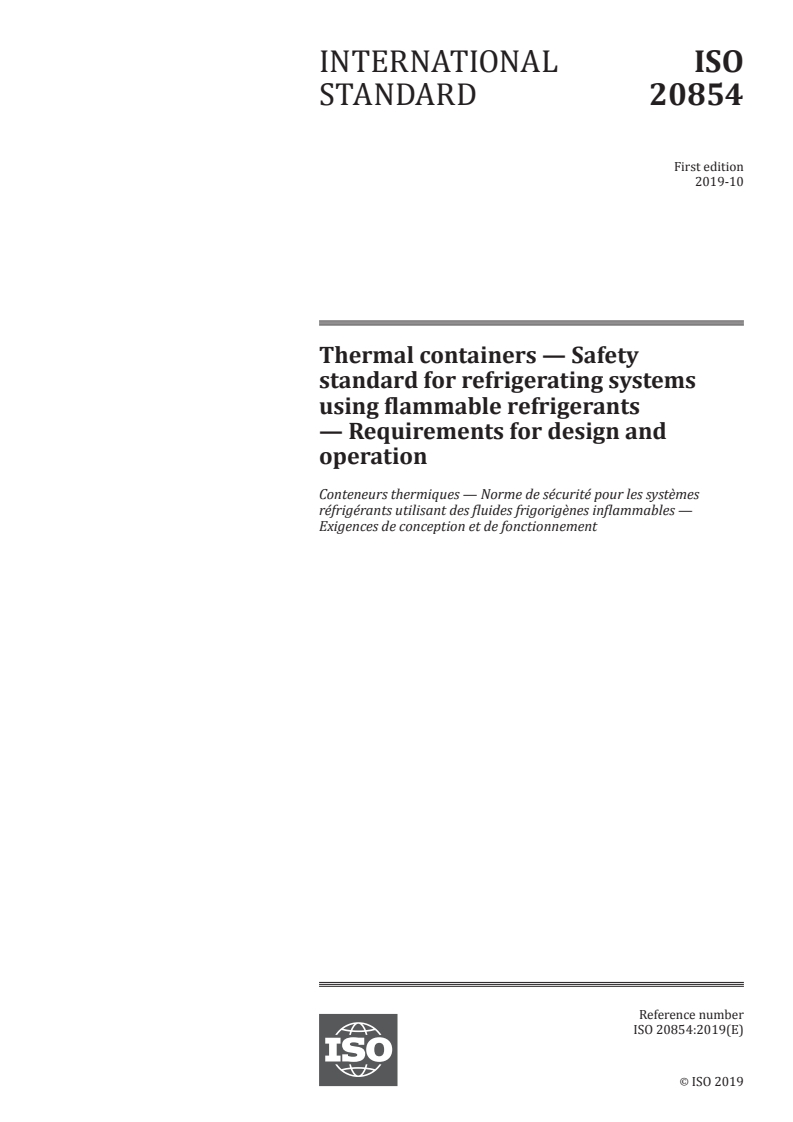
(Main)Thermal containers — Safety standard for refrigerating systems using flammable refrigerants — Requirements for design and operation
General Information
- Abstract
This document describes the design of the mechanical refrigeration unit (MRU) and operation of container refrigerating systems in all anticipated operational modes and locations. It describes the industry's best practices for the safe operation of flammable refrigerants in refrigerating systems used in thermal freight containers operated on board ships, in terminals, on road, on rail and on land. This document addresses the use of flammable refrigerants with classifications defined in ISO 817, defined as 2L, 2 and 3, except R717 (Ammonia). This document describes an operational mode risk assessment (OMRA) which uses methods such as HAZOP (Hazard and operability analysis), FMEA (Failure mode and effects analysis), or FTA (Fault tree analysis) or combination of methods. This document specifies requirements for the validation and consideration of possible safety concepts and protective devices within the OMRA process, including charge release tests, simulation, and function tests of the associated protective equipment. It defines test requirements for shock, impact, and vibration. A validation procedure is given to demonstrate that risks from hazardous events are investigated and their severity and frequency are meaningfully reduced, with the aim of achieving tolerable risk values. The obligations of the manufacturer, the container owner as well as the responsible operator are described, as well as how stakeholders can investigate and mitigate risks associated with the use of flammable refrigerants. Finally, this document describes the requirements of service and maintenance when working with flammable refrigerants. This document is restricted to refrigerating systems integrated with or mounted on ISO thermal containers according to ISO 1496-2. It provides minimum requirements for reducing the risk associated with the use of flammable refrigerants. The scope is limited to container refrigerating systems operated in conjunction with the carriage of refrigerated cargo as operating reefer (OR) or when used as a non-operating reefer (NOR) or when empty for positioning — while in intermodal transit. Static land-based continuous operations are excluded.
- Status
- Published
- Publication Date
- 22-Oct-2019
- Technical Committee
- ISO/TC 104/SC 2 - Specific purpose containers
- Drafting Committee
- ISO/TC 104/SC 2/WG 1 - Thermal containers
- Current Stage
- 9093 - International Standard confirmed
- Start Date
- 17-Jun-2025
- Completion Date
- 29-Aug-2026
Buy Documents
ISO 20854:2019 - Thermal containers -- Safety standard for refrigerating systems using flammable refrigerants -- Requirements for design and operation
REDLINE ISO 20854:2019 - Thermal containers — Safety standard for refrigerating systems using flammable refrigerants — Requirements for design and operation Released:10/23/2019
ISO 20854:2019 - Thermal containers — Safety standard for refrigerating systems using flammable refrigerants — Requirements for design and operation/23/2019
Overview
ISO 20854:2019 - Thermal containers - Safety standard for refrigerating systems using flammable refrigerants - Requirements for design and operation - provides minimum safety requirements and industry best practices for the design, validation and operation of refrigerating systems mounted on or integrated with ISO thermal containers (per ISO 1496-2). The standard focuses on safe use of flammable refrigerants (classes 2L, 2 and 3 from ISO 817, excluding R717/Ammonia) in container refrigerating units (MRUs) used in intermodal transit: on board ships, in terminals, on road and on rail. Static land-based continuous operations are explicitly excluded.
Key topics and technical requirements
- Design and safety concept: Requirements for MRU mechanical design, component selection, piping, assemblies and external fire relief devices to reduce leak and ignition risks.
- Operational Mode Risk Assessment (OMRA): Mandates risk assessment using methods such as HAZOP, FMEA, FTA (or combinations) to identify hazardous events across all anticipated operational modes and locations.
- Validation and testing: Specifies validation procedures and tests for protective devices including charge release tests, simulation, functional tests, and type testing for vibration, shock and impact.
- Control and mitigation mechanisms: Guidance on ventilation strategies, refrigerant detectors, alarm systems, shut-off devices, separation and dilution methods to achieve tolerable risk levels.
- Service, maintenance and training: Manufacturer, container owner and operator obligations for safe servicing, maintenance, documentation, marking, certification and personnel training.
- Operational guidance: Requirements for safe operation in open-air, well-ventilated and non-well-ventilated environments; procedures for door opening, packing/unpacking, alarms and accident response.
- Scope limits: Applies to refrigerating systems used as operating reefers (OR), non-operating reefers (NOR) or empty for positioning during intermodal transit.
Practical applications and users
ISO 20854:2019 is intended for:
- MRU designers and manufacturers specifying components, enclosures and protective devices for flammable refrigerants.
- Container owners and logistics operators who operate reefers on ships, terminals, road and rail.
- Shipyards, terminal operators and maintenance providers implementing service, repair and testing procedures.
- Safety engineers and risk assessors conducting OMRA, HAZOP, FMEA or FTA analyses for container refrigerating systems.
Adopting ISO 20854:2019 helps organizations manage flammable refrigerant risks, meet regulatory expectations, and increase operational safety during intermodal transport of refrigerated cargo.
Related standards
- ISO 817 - Refrigerant classification by safety group
- ISO 1496-2 - Specifications for thermal containers (basis for application scope)
Keywords: ISO 20854:2019, thermal containers, flammable refrigerants, MRU, OMRA, HAZOP, FMEA, FTA, ISO 817, ISO 1496-2, refrigerating systems, vibration test, charge release test.
Buy Documents
ISO 20854:2019 - Thermal containers -- Safety standard for refrigerating systems using flammable refrigerants -- Requirements for design and operation
REDLINE ISO 20854:2019 - Thermal containers — Safety standard for refrigerating systems using flammable refrigerants — Requirements for design and operation Released:10/23/2019
ISO 20854:2019 - Thermal containers — Safety standard for refrigerating systems using flammable refrigerants — Requirements for design and operation/23/2019
Get Certified
Connect with accredited certification bodies for this standard

BRCGS (Brand Reputation Compliance Global Standards)
Global food safety and quality standards owner.
Sponsored listings
Frequently Asked Questions
ISO 20854:2019 is a standard published by the International Organization for Standardization (ISO). Its full title is "Thermal containers — Safety standard for refrigerating systems using flammable refrigerants — Requirements for design and operation". This standard covers: This document describes the design of the mechanical refrigeration unit (MRU) and operation of container refrigerating systems in all anticipated operational modes and locations. It describes the industry's best practices for the safe operation of flammable refrigerants in refrigerating systems used in thermal freight containers operated on board ships, in terminals, on road, on rail and on land. This document addresses the use of flammable refrigerants with classifications defined in ISO 817, defined as 2L, 2 and 3, except R717 (Ammonia). This document describes an operational mode risk assessment (OMRA) which uses methods such as HAZOP (Hazard and operability analysis), FMEA (Failure mode and effects analysis), or FTA (Fault tree analysis) or combination of methods. This document specifies requirements for the validation and consideration of possible safety concepts and protective devices within the OMRA process, including charge release tests, simulation, and function tests of the associated protective equipment. It defines test requirements for shock, impact, and vibration. A validation procedure is given to demonstrate that risks from hazardous events are investigated and their severity and frequency are meaningfully reduced, with the aim of achieving tolerable risk values. The obligations of the manufacturer, the container owner as well as the responsible operator are described, as well as how stakeholders can investigate and mitigate risks associated with the use of flammable refrigerants. Finally, this document describes the requirements of service and maintenance when working with flammable refrigerants. This document is restricted to refrigerating systems integrated with or mounted on ISO thermal containers according to ISO 1496-2. It provides minimum requirements for reducing the risk associated with the use of flammable refrigerants. The scope is limited to container refrigerating systems operated in conjunction with the carriage of refrigerated cargo as operating reefer (OR) or when used as a non-operating reefer (NOR) or when empty for positioning — while in intermodal transit. Static land-based continuous operations are excluded.
This document describes the design of the mechanical refrigeration unit (MRU) and operation of container refrigerating systems in all anticipated operational modes and locations. It describes the industry's best practices for the safe operation of flammable refrigerants in refrigerating systems used in thermal freight containers operated on board ships, in terminals, on road, on rail and on land. This document addresses the use of flammable refrigerants with classifications defined in ISO 817, defined as 2L, 2 and 3, except R717 (Ammonia). This document describes an operational mode risk assessment (OMRA) which uses methods such as HAZOP (Hazard and operability analysis), FMEA (Failure mode and effects analysis), or FTA (Fault tree analysis) or combination of methods. This document specifies requirements for the validation and consideration of possible safety concepts and protective devices within the OMRA process, including charge release tests, simulation, and function tests of the associated protective equipment. It defines test requirements for shock, impact, and vibration. A validation procedure is given to demonstrate that risks from hazardous events are investigated and their severity and frequency are meaningfully reduced, with the aim of achieving tolerable risk values. The obligations of the manufacturer, the container owner as well as the responsible operator are described, as well as how stakeholders can investigate and mitigate risks associated with the use of flammable refrigerants. Finally, this document describes the requirements of service and maintenance when working with flammable refrigerants. This document is restricted to refrigerating systems integrated with or mounted on ISO thermal containers according to ISO 1496-2. It provides minimum requirements for reducing the risk associated with the use of flammable refrigerants. The scope is limited to container refrigerating systems operated in conjunction with the carriage of refrigerated cargo as operating reefer (OR) or when used as a non-operating reefer (NOR) or when empty for positioning — while in intermodal transit. Static land-based continuous operations are excluded.
ISO 20854:2019 is classified under the following ICS (International Classification for Standards) categories: 55.180.10 - General purpose containers. The ICS classification helps identify the subject area and facilitates finding related standards.
ISO 20854:2019 is available in PDF format for immediate download after purchase. The document can be added to your cart and obtained through the secure checkout process. Digital delivery ensures instant access to the complete standard document.
Standards Content (Sample)
INTERNATIONAL ISO
STANDARD 20854
First edition
2019-10
Thermal containers — Safety
standard for refrigerating systems
using flammable refrigerants
— Requirements for design and
operation
Conteneurs thermiques — Norme de sécurité pour les systèmes
réfrigérants utilisant des fluides frigorigènes inflammables —
Exigences de conception et de fonctionnement
Reference number
©
ISO 2019
© ISO 2019
All rights reserved. Unless otherwise specified, or required in the context of its implementation, no part of this publication may
be reproduced or utilized otherwise in any form or by any means, electronic or mechanical, including photocopying, or posting
on the internet or an intranet, without prior written permission. Permission can be requested from either ISO at the address
below or ISO’s member body in the country of the requester.
ISO copyright office
CP 401 • Ch. de Blandonnet 8
CH-1214 Vernier, Geneva
Phone: +41 22 749 01 11
Fax: +41 22 749 09 47
Email: copyright@iso.org
Website: www.iso.org
Published in Switzerland
ii © ISO 2019 – All rights reserved
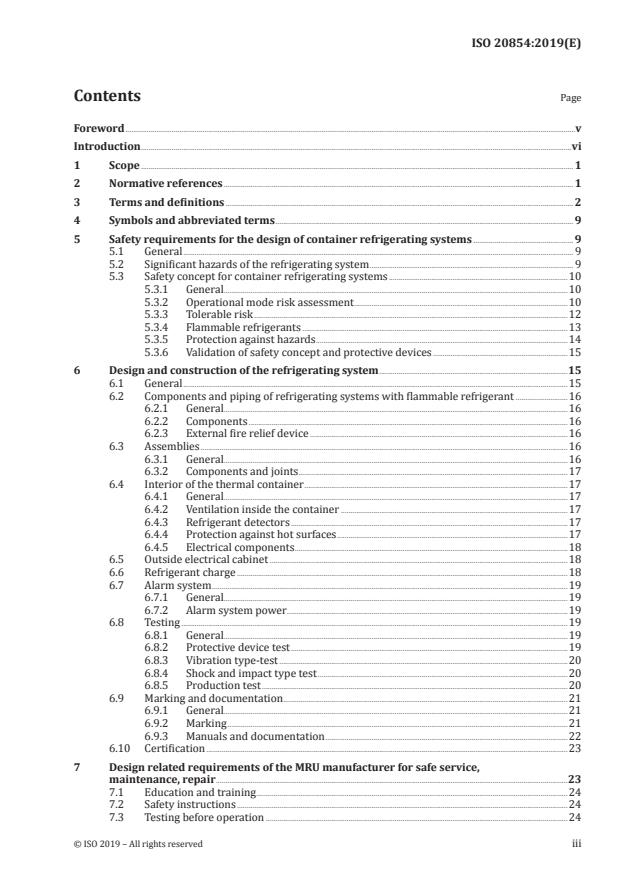
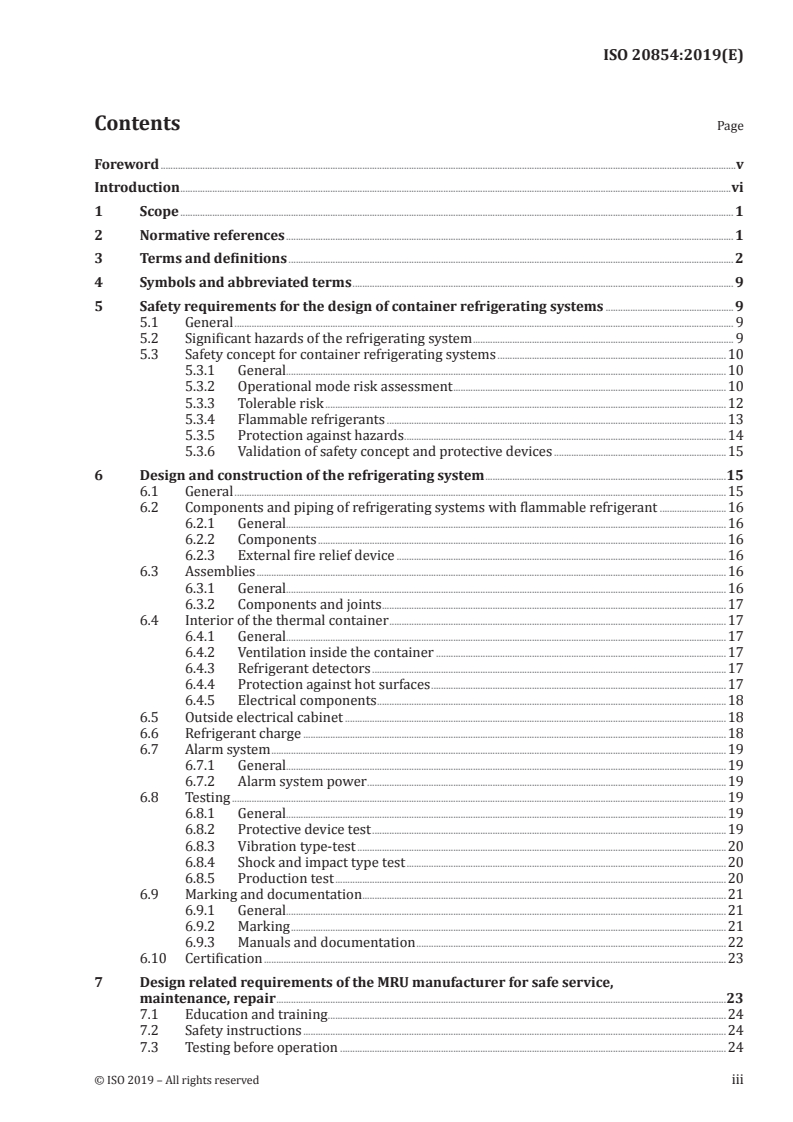
Contents Page
Foreword .v
Introduction .vi
1 Scope . 1
2 Normative references . 1
3 Terms and definitions . 2
4 Symbols and abbreviated terms . 9
5 Safety requirements for the design of container refrigerating systems .9
5.1 General . 9
5.2 Significant hazards of the refrigerating system . 9
5.3 Safety concept for container refrigerating systems .10
5.3.1 General.10
5.3.2 Operational mode risk assessment .10
5.3.3 Tolerable risk .12
5.3.4 Flammable refrigerants .13
5.3.5 Protection against hazards .14
5.3.6 Validation of safety concept and protective devices .15
6 Design and construction of the refrigerating system .15
6.1 General .15
6.2 Components and piping of refrigerating systems with flammable refrigerant .16
6.2.1 General.16
6.2.2 Components .16
6.2.3 External fire relief device .16
6.3 Assemblies .16
6.3.1 General.16
6.3.2 Components and joints . .17
6.4 Interior of the thermal container .17
6.4.1 General.17
6.4.2 Ventilation inside the container .17
6.4.3 Refrigerant detectors .17
6.4.4 Protection against hot surfaces .17
6.4.5 Electrical components . .18
6.5 Outside electrical cabinet .18
6.6 Refrigerant charge .18
6.7 Alarm system .19
6.7.1 General.19
6.7.2 Alarm system power .19
6.8 Testing .19
6.8.1 General.19
6.8.2 Protective device test .19
6.8.3 Vibration type-test .20
6.8.4 Shock and impact type test .20
6.8.5 Production test .20
6.9 Marking and documentation .21
6.9.1 General.21
6.9.2 Marking .21
6.9.3 Manuals and documentation .22
6.10 Certification .23
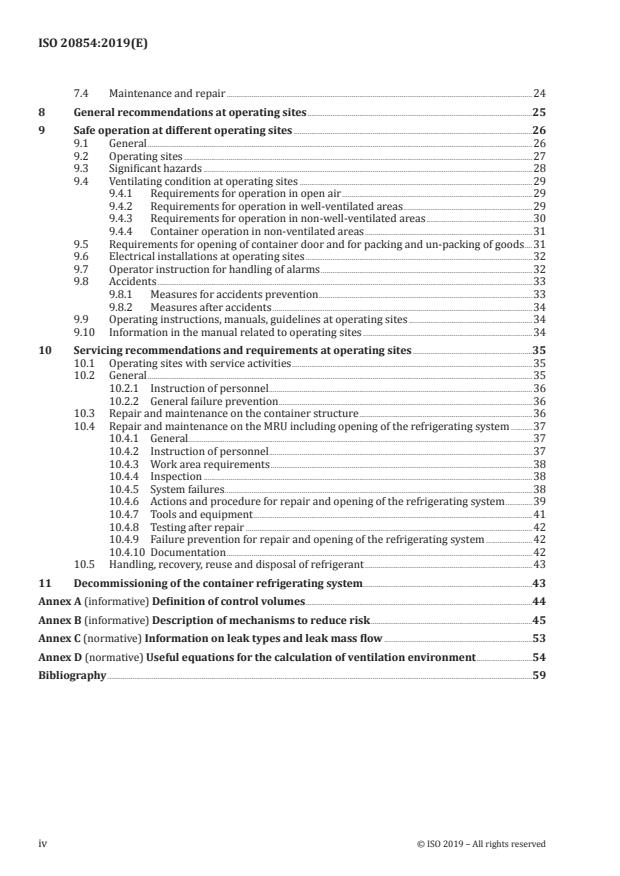
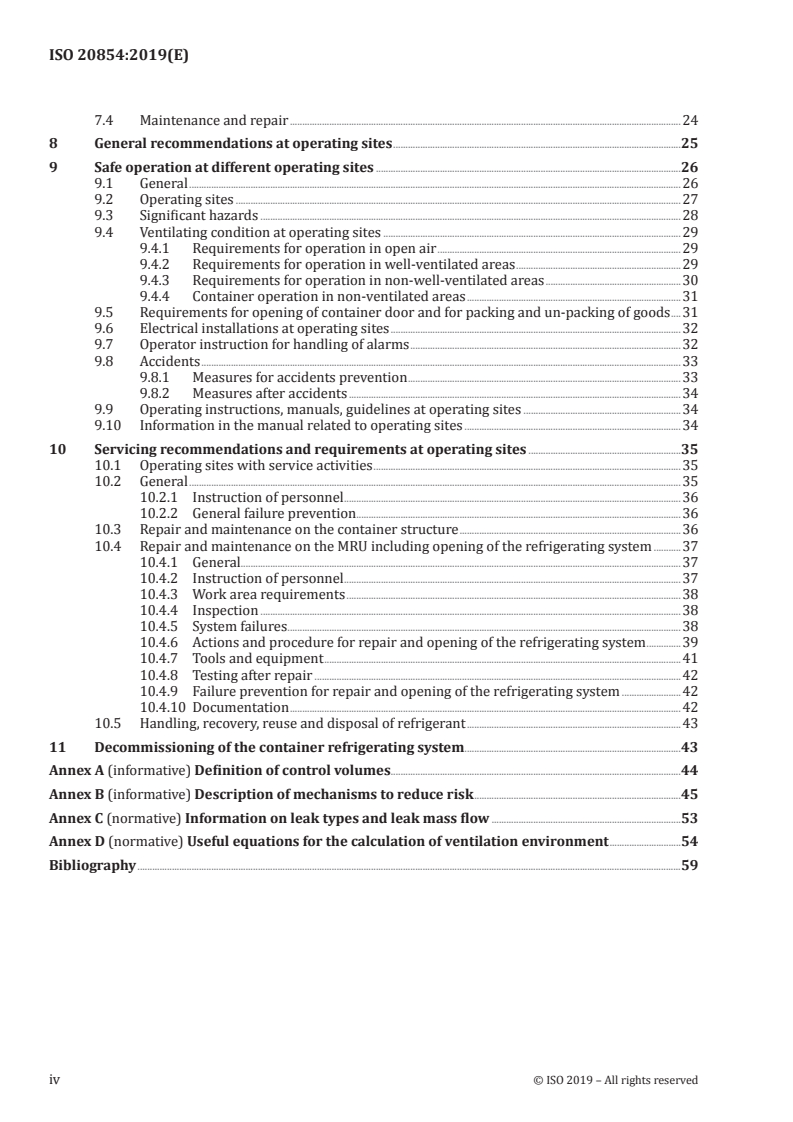
7 Design related requirements of the MRU manufacturer for safe service,
maintenance, repair .23
7.1 Education and training .24
7.2 Safety instructions .24
7.3 Testing before operation .24
7.4 Maintenance and repair .24
8 General recommendations at operating sites .25
9 Safe operation at different operating sites .26
9.1 General .26
9.2 Operating sites .27
9.3 Significant hazards .28
9.4 Ventilating condition at operating sites .29
9.4.1 Requirements for operation in open air .29
9.4.2 Requirements for operation in well-ventilated areas .29
9.4.3 Requirements for operation in non-well-ventilated areas .30
9.4.4 Container operation in non-ventilated areas .31
9.5 Requirements for opening of container door and for packing and un-packing of goods .31
9.6 Electrical installations at operating sites .32
9.7 Operator instruction for handling of alarms .32
9.8 Accidents .33
9.8.1 Measures for accidents prevention .33
9.8.2 Measures after accidents .34
9.9 Operating instructions, manuals, guidelines at operating sites .34
9.10 Information in the manual related to operating sites .34
10 Servicing recommendations and requirements at operating sites .35
10.1 Operating sites with service activities .35
10.2 General .35
10.2.1 Instruction of personnel .36
10.2.2 General failure prevention .36
10.3 Repair and maintenance on the container structure .36
10.4 Repair and maintenance on the MRU including opening of the refrigerating system .37
10.4.1 General.37
10.4.2 Instruction of personnel .37
10.4.3 Work area requirements .38
10.4.4 Inspection .38
10.4.5 System failures .38
10.4.6 Actions and procedure for repair and opening of the refrigerating system .39
10.4.7 Tools and equipment .41
10.4.8 Testing after repair .42
10.4.9 Failure prevention for repair and opening of the refrigerating system .42
10.4.10 Documentation .42
10.5 Handling, recovery, reuse and disposal of refrigerant .43
11 Decommissioning of the container refrigerating system .43
Annex A (informative) Definition of control volumes .44
Annex B (informative) Description of mechanisms to reduce risk .45
Annex C (normative) Information on leak types and leak mass flow .53
Annex D (normative) Useful equations for the calculation of ventilation environment .54
Bibliography .59
iv © ISO 2019 – All rights reserved
Foreword
ISO (the International Organization for Standardization) is a worldwide federation of national standards
bodies (ISO member bodies). The work of preparing International Standards is normally carried out
through ISO technical committees. Each member body interested in a subject for which a technical
committee has been established has the right to be represented on that committee. International
organizations, governmental and non-governmental, in liaison with ISO, also take part in the work.
ISO collaborates closely with the International Electrotechnical Commission (IEC) on all matters of
electrotechnical standardization.
The procedures used to develop this document and those intended for its further maintenance are
described in the ISO/IEC Directives, Part 1. In particular, the different approval criteria needed for the
different types of ISO documents should be noted. This document was drafted in accordance with the
editorial rules of the ISO/IEC Directives, Part 2 (see www .iso .org/directives).
Attention is drawn to the possibility that some of the elements of this document may be the subject of
patent rights. ISO shall not be held responsible for identifying any or all such patent rights. Details of
any patent rights identified during the development of the document will be in the Introduction and/or
on the ISO list of patent declarations received (see www .iso .org/patents).
Any trade name used in this document is information given for the convenience of users and does not
constitute an endorsement.
For an explanation of the voluntary nature of standards, the meaning of ISO specific terms and
expressions related to conformity assessment, as well as information about ISO's adherence to the
World Trade Organization (WTO) principles in the Technical Barriers to Trade (TBT) see www .iso
.org/iso/foreword .html.
This document was prepared by Technical Committee ISO/TC 104, Freight containers, SC 2, Specific
purpose containers.
Any feedback or questions on this document should be directed to the user’s national standards body. A
complete listing of these bodies can be found at www .iso .org/members .html.
Introduction
This document has been developed to enable the use of flammable refrigerants in refrigerated thermal
containers. This document enables container owners and operators to understand and validate the
risks associated with operating refrigerating equipment using previously non-acceptable flammable
refrigerants. The goal is to achieve an acceptable level of safety for container refrigerating systems
using flammable refrigerants as for container refrigerating systems using non-flammable refrigerants.
The background for initiating the development of this document was the foreseeable impact of
global and national regulations on hydrofluorocarbons (HFCs) currently used in thermal containers.
Hydrofluorocarbons are listed in the Kigali Amendment to the Montreal Protocol from 2016 due to the
high global warming potential (GWP) of HFCs and a phase down in the use and availability of R134a,
R404A and, for low temperature, R23, is expected in intermodal transport refrigeration.
This document is intended to complement ISO 1496-2 but not to replace existing standards such as the
ISO 5149 series. It provides minimum requirements for the design of a refrigerating system and follows
a risk-based approach to reduce, but not eliminate, the risks to persons, assets and the environment.
The working group, which developed this document consisted of representatives from refrigerating
system manufacturers, refrigerated container box manufacturers, shipping lines, classification
societies, equipment owners and other interested industry experts.
vi © ISO 2019 – All rights reserved
INTERNATIONAL STANDARD ISO 20854:2019(E)
Thermal containers — Safety standard for refrigerating
systems using flammable refrigerants — Requirements for
design and operation
1 Scope
This document describes the design of the mechanical refrigeration unit (MRU) and operation of
container refrigerating systems in all anticipated operational modes and locations.
It describes the industry's best practices for the safe operation of flammable refrigerants in refrigerating
systems used in thermal freight containers operated on board ships, in terminals, on road, on rail and
on land.
This document addresses the use of flammable refrigerants with classifications defined in ISO 817,
defined as 2L, 2 and 3, except R717 (Ammonia).
This document describes an operational mode risk assessment (OMRA) which uses methods such as
HAZOP (Hazard and operability analysis), FMEA (Failure mode and effects analysis), or FTA (Fault tree
analysis) or combination of methods.
This document specifies requirements for the validation and consideration of possible safety concepts
and protective devices within the OMRA process, including charge release tests, simulation, and
function tests of the associated protective equipment. It defines test requirements for shock, impact,
and vibration. A validation procedure is given to demonstrate that risks from hazardous events are
investigated and their severity and frequency are meaningfully reduced, with the aim of achieving
tolerable risk values.
The obligations of the manufacturer, the container owner as well as the responsible operator are
described, as well as how stakeholders can investigate and mitigate risks associated with the use of
flammable refrigerants.
Finally, this document describes the requirements of service and maintenance when working with
flammable refrigerants.
This document is restricted to refrigerating systems integrated with or mounted on ISO thermal
containers according to ISO 1496-2. It provides minimum requirements for reducing the risk associated
with the use of flammable refrigerants.
The scope is limited to container refrigerating systems operated in conjunction with the carriage of
refrigerated cargo as operating reefer (OR) or when used as a non-operating reefer (NOR) or when
empty for positioning — while in intermodal transit. Static land-based continuous operations are
excluded.
2 Normative references
The following documents are referred to in the text in such a way that some or all of their content
constitutes requirements of this document. For dated references, only the edition cited applies. For
undated references, the latest edition of the referenced document (including any amendments) applies.
ISO 817, Refrigerants — Designation system
ISO 1496-2, Freight containers — Specification and testing — Thermal containers
ISO 5149 (all parts), Refrigerating systems and heat pumps — Safety and environmental requirements
ISO 14903, Refrigerating systems and heat pumps — Qualification of tightness of components and joints
IEC 60068-2-6, Environmental testing — Part 2-6: Tests — Test Fc: Vibration (sinusoidal)
IEC 60068-2-75, Environmental testing — Part 2-75: Tests — Test Eh: Hammer tests
IEC 60079-10-1, Explosive atmospheres — Part 10-1: Classification of areas — Explosive gas atmospheres
IEC 60079-14, Explosive atmospheres — Part 14: Electrical installations, design, selection and erection
IEC 60079-15, Explosive atmospheres — Part 15: Equipment protection by type of equipment “n”
IEC 60335-2-40, Household and similar electrical appliances — Safety — Part 2-40: Particular requirements
for electrical heat pump, air-conditioners and dehumidifiers
EN 1127-1, Explosive atmospheres — Explosion prevention and protection — Part 1: Basic concepts and
methodology
EN 14624, Performance of portable leak detectors and of room monitors for halogenated refrigerants
3 Terms and definitions
For the purposes of this document, the following terms and definitions apply.
ISO and IEC maintain terminological databases for use in standardization at the following addresses:
— ISO Online browsing platform: available at https: //www .iso .org/obp
— IEC Electropedia: available at http: //www .electropedia .org/
3.1
alarm system
system constituting all electrical and electronic parts of the refrigerating system which monitor
the correct function of the protective device(s) and/or give a warning in case of malfunctioning or
refrigerant leakage
3.2
hazardous area
area in which a flammable or toxic atmosphere is present, or may be expected to be present, in
quantities such as to require special precautions for construction, installation or use of apparatus
[SOURCE: IEC -60079 -10 -1: 2015, 3.3.1, modified — In the definition, the word "explosive" has been
replaced with "flammable and toxic".]
3.2.1
non-hazardous area
area in which a flammable or toxic atmosphere is not expected to be present in quantities such as to
require special precautions for construction, installation and use of equipment
[SOURCE: IEC -60079 -10 -1: 2015, 3.3.2, modified — In the definition, the word "explosive" has been
replaced with "flammable and toxic".]
3.2.2
temporary hazardous area
area which can be defined as a hazardous area for a short period of time as a consequence of an
abnormal or accidental type leak
3.3
authorized service facility
service facility that is authorized by the manufacturer to repair and to maintain the container
refrigerating system
2 © ISO 2019 – All rights reserved
3.4
condenser section
space of the container where all outside parts of the refrigeration circuit including condenser fan
are located
Note 1 to entry: The condenser section is not a confined space.
Note 2 to entry: The condenser section corresponds to control volume II (see Annex A).
3.5
container refrigerating system
mechanically refrigerated container with a vapour compression refrigeration cycle using refrigerant as
a working fluid
3.6
control volume
theoretical volume representing the space in which a flammable atmosphere can occur as a consequence
of a refrigerant leak
Note 1 to entry: It can be delimited by the internal or external space of a container, and/or by specific component
compartments.
Note 2 to entry: A description of control volumes is included in Annex A.
3.7
durably technically tight
sealed equipment with enhanced tightness which is equal or less than that of fugitive emissions
accomplished by enhanced maintenance and supervision
Note 1 to entry: Clauses 8, 9 and especially Clause 10 provide information on design aspects and operational
aspects to maintain tightness, permanently ensured by means of enhanced maintenance and supervision.
Note 2 to entry: Additional information can be found in EN 1127:2011, Annex B.
Note 3 to entry: ISO 5149-2 provides information on “sealed systems” and IEC 60335-2-40 on “enhanced
tightness”.
3.8
evaporator space
space inside the container containing the evaporator and air ducts
Note 1 to entry: The evaporator space corresponds to control volume III (see Annex A).
3.9
flammable atmosphere
mixture with air, under atmospheric conditions, of flammable substances in the form of gas or vapour,
which after ignition, permits self-sustained flame propagation
Note 1 to entry: For example, a mixture of flammable refrigerant fluid with air under atmospheric conditions.
[SOURCE: IEC 60079-10-1:2015, 3.2]
1)
3.10 flammable limit/explosive limit
3.10.1
LFL
lower flammable limit
minimum concentration of the refrigerant that is capable of propagating a flame through a homogeneous
mixture of the refrigerant and air under the specified test conditions at 23,0 °C and 101,3 kPa
[SOURCE: ISO 817:2018, 3.1.24, modified — Notes 1 and 2 have been omitted.]
3.10.2
UFL
upper flammable limit
concentration of flammable gas or vapour in air, above which the gas atmosphere is not flammable
[SOURCE: IEC -60079 -10 -1: 2015, 3.6.13, modified — In the definition, the words "or mist" have been
removed after "vapour". Also, at the end, after "above which", "an explosive gas atmosphere will not be
formed" has been changed to " the gas atmosphere is not flammable".]
3.11
flammable refrigerant
refrigerant with a classification of class 2L, 2 or 3 in compliance with ISO 817 classification, refrigerants
excluding ammonia
3.11.1
AIT
auto-ignition temperature
lowest temperature of a substance at or above which a chemical can spontaneously ignite in a normal
test atmosphere, without an external source of ignition, such as a flame or spark
Note 1 to entry: Refer to the manufacturer’s safety data sheet (SDS) of the chemical used.
[SOURCE: ISO 5149-1:2014, 3.7.7, modified — Note 1 to entry has been added.]
3.11.2
RTT
reaction threshold temperature
lowest temperature of a substance at or above which a chemical can be decomposed spontaneously in a
normal atmosphere, in the presence of an external source of ignition, such as an open flame, hot surface
or spark
Note 1 to entry: As an estimation, the following values may be used: RTT = AIT – 100 °C.
est
3.12
flammable substance
substance in the form of gas, vapour, liquid, or mixtures of these, able to propagate a flame from an
ignition source
3.13
fresh air exchange mechanism
mechanism that opens the fresh air ducting to allow ventilation
1) The flammability limits are function of temperature and humidity. For refrigerants flammability, ISO 817:2014
defines test conditions of 50 % relative humidity at 23,0 °C and 101,3 kPa for burning velocity and LFL/UFL
measurements. The effect of a reduced lower flammable limit and an increased upper flammable limit at higher
operational humidity and temperature levels can be taken into account in the operational mode risk assessment.
4 © ISO 2019 – All rights reserved
3.14
fugitive emission
small release of refrigerant from pressurized equipment which does not result in malfunction of the
cooling process in its typical operation time
Note 1 to entry: Fugitive emissions result from corrosion or shortcoming of components or joints which are
durably technically tight during intermodal operation and do not result to a malfunction and/or need for repair
on the refrigerating system in a period of months to years.
Note 2 to entry: Annex C gives information on leak type, size, frequencies and leak rates.
Note 3 to entry: For additional information, see IEC 60079-10-1:2015, C.4.6.
3.15
inside component
component of the refrigerating system which is located inside the internal dimensional envelope of the
container
3.16
intended use
use in accordance with information provided with the container refrigerating system, or, in the absence
of such information, by generally understood patterns of usage
Note 1 to entry: Intended use of a container refrigerating system is the carriage of cargo under temperature
control and when the unit is not operating i.e. used as NOR (non-operating reefer) or waiting empty for loading
and/or repositioning — while in intermodal transit.
[SOURCE: ISO Guide 51, 3.6, modified — The words "a product or system" have been replaced with " the
container refrigerating system" and Note 1 to entry has been added.]
3.16.1
normal operation
condition where the equipment is operating within its design parameters
Note 1 to entry: Failures (such as the breakdown of components or ruptures) which involve shut-down and urgent
repair are not considered to be part of normal operation.
Note 2 to entry: Normal operation includes start-up and shut-down conditions.
Note 3 to entry: Normal operation can include occurrence of fugitive emissions. Normal operation does not
include larger leaks. Normal operation of the container refrigerating system requires a certain minimum
refrigerant charge. Larger leaks result in system failure.
[SOURCE: IEC 60079-10-1:2015, 3.7.1]
3.16.2
special use
use of a container refrigerating system for cooling and storage of goods in stationary and temporary
land operation — not permanently imported
Note 1 to entry: Local regulations and guidelines can apply to the use of a container refrigerating system as
permanent storage place of cargo.
3.16.3
reasonably foreseeable misuse
use of the container or container refrigerating system in a way not intended by the supplier, but which
can result from readily predictable human behaviour
[SOURCE: ISO Guide 51:2017, 3.7, modified — The words "a product or system" have been replaced with
"the container or container refrigerating system" and Notes 1 and 2 to entry have been omitted.]
3.17
non-occupied space
space inside the container which is not occupied for a significant period of time by person(s)
Note 1 to entry: For unpacking and packing of goods, the container doors are open, see 9.5.
3.18
operating site
site or location of operation in which a container refrigerating system can be operated, repaired, or
stored during the intended use
3.19
operational mode
combination of type of operation (such as transport mode and storage location) and state of operation
(such normal operation, power ON, power OFF, empty container, packed container) in a container
refrigerating system
EXAMPLE The container is located in a terminal, on a truck and with power on and empty.
3.20
operational mode risk assessment
OMRA
overall process comprising a risk analysis and risk evaluation of a container refrigerating system in
different operational modes
3.21
outside part
component of the refrigerating system which is located outside the insulated walls and inside the
external dimensional envelope
3.22
packing
stuffing
action of filling cargo/goods into the container within designed capacity
Note 1 to entry: After packing, the container is loaded with goods.
3.23
PTI
pre-trip inspection
inspection and testing of a container refrigerating system including checking for structural damage
and assurance that the refrigerating system is operating according to the specifications
Note 1 to entry: A PTI can be carried out before a container is released for a new trip or after a repair.
3.24
power supply
condition where a connection to the three-phase power supply is present
3.25
refrigerant leak detection mechanism
mechanism which can recognize a refrigerant leakage or charge losses of the container refrigerating
system
3.26
refrigerating system repair operation
service or maintenance of a refrigerating system in which the container refrigeration system pipework
or components is or will be opened
3.27
repair shop
place in a terminal or service facility where container refrigerating systems are serviced and repaired
6 © ISO 2019 – All rights reserved
3.28
responsible operator
MRU operator
person or entity that has operational control of the container including the MRU at any particular time
including, but not limited to, repair and storage depots, terminals, transport operators, shippers and
consignees
3.29
safety principle
set of provisions which, together, ensure safe design and safe operation of a container refrigerating system
3.30
shut-off device
normally closed device separating parts of the refrigerating system to reduce the maximum amount of
refrigerant that can be leaked into a control volume
3.31
service access point
connection used to service the refrigerating system, that enables the refrigerant circuit to be charged,
discharged, evacuated and pressure checked
3.32
service facility
building or installation where maintenance and repair of container refrigerating systems is carried out
3.33
smallest inside free volume
remaining inside volume when the cargo compartment is packed to the maximum allowed volume
Note 1 to entry: This volume includes the T-floor space.
3.34
T-floor
specially designed floor with longitudinal channels to allow air to pass underneath the cargo
3.35
terminal
intermodal facility that allows the transport and transfer of containers between different transport
modes
Note 1 to entry: In a terminal, intermodal containers are also loaded/unloaded, stored, operated, maintained,
packed/unpacked.
3.36
toxic atmosphere
mixture of air, under atmospheric conditions, with toxic substances in the form of gas or vapour which
can be harmful or lethal to humans
Note 1 to entry: For example, a mixture of toxic refrigerant fluid or decomposition products with air under
atmospheric conditions.
Note 2 to entry: A toxic substance is understood to be a substance in the form of gas, vapour, liquid, or mixtures of
these, which can be harmful or lethal, or can impair a person’s ability to escape due to acute or chronic exposure
by contact, inhalation, or ingestion.
3.37
unit end
front end where the refrigerating system is placed
3.38
unpacking
unstuffing
action of emptying the container
Note 1 to entry: After unpacking, the container is empty.
3.39
ventilation environment
environment capable of diluting releases of hazardous substances in normal operation to a non-
hazardous concentration
3.39.1
open air
any unenclosed space, possibly but not necessarily roofed with, as a minimum, natural ventilation
Note 1 to entry: The ventilation environment “open air” refers to or represents areas or operating sites such as
PTI, inspection, roofed repair areas, on vessel deck, truck and rail.
[SOURCE: ISO 5149-1:2014, 3.2.7, modified — The words "with, as a minimum, natural ventilation" and
Note 1 to entry have been added.]
3.39.2
well-ventilated
area which is naturally or mechanically ventilated
Note 1 to entry: The ventilation environment “well-ventilated” refers or represent areas or operating sites such
as vessel cargo hold, workshops, system repair areas.
3.39.3
non-well-ventilated
area other than open air or well-ventilated
Note 1 to entry: The ventilation environment “non-well-ventilated” should be considered if an artificial or forced
ventilation system is not in operation (due to power failures or other type of malfunction).
Note 2 to entry: For release rate and accumulation time of hazardous substances in non-well-ventilated areas or
operating sites see Annex C.
3.40
ventilation mechanism
means which promotes the replacement of an air volume
3.41
ventilation
movement of air and its replacement with fresh air, i.e. without dangerous substances
3.41.1
natural ventilation
movement of air and its replacement with fresh air due to effects of natural mixing, air movement, or
temperature gradients
Note 1 to entry: For open air ventilation is normally based on an assumed minimum wind speed of 0,15 m/s
for obstructed areas and 0,3 m/s for unobstructed areas, which will be present virtually continuously (see
IEC 60079-10-1:2015, Table C.1).
3.41.2
artificial ventilation
forced ventilation
movement of air and its replacement with fresh air provided by artificial means
8 © ISO 2019 – All rights reserved
3.42
zone
hazardous area classification based upon the frequency of the occurrence and duration of an explosive
atmosphere
[SOURCE: IEC -60079 -10 -1: 2015, 3.3.2]
3.42.1
zone 2
area in which an explosive gas atmosphere is not likely to occur but, if it does occur, for example as a
result of accidental type release of refrigerant, it can be defined as a temporary hazardous area
[SOURCE: IEC -60079 -10 -1: 2015, 3.3.6, modified — The words "in normal operation" have been removed;
the end part after "if it does occur" has been changed; and Note 1 to entry has been omitted.]
3.42.2
extent of zone
distance in any direction from the source of release to where a gas/air mixture will be diluted by air to
a concentration below the lower flammable limit
[SOURCE: IEC -60079 -10 -1: 2015, 3.3.7]
4 Symbols and abbreviated terms
FEU Forty-foot equivalent unit
MRU Mechanical refrigeration unit (the terms “MRU” and “unit” are considered to be synony-
mous at this document)
SOI Source of ignition
SDS Safety datasheet for chemicals
5 Safety requirements for the design of container refrigerating systems
5.1 General
The safety requirements described in this clause cover the whole assembly of a container refrigerating
system using flammable refrigerants: the refrigerating system and the container box and as well as the
various operational modes.
5.2 Significant hazards of the refrigerating system
A container refrigerating system shall be designed to achieve the level of tightness as specified
in ISO 5149-2 for sealed systems. ISO 14903 shall apply as it specifies qualification of tightness of
components and joints for refrigerating systems and heat pumps.
In addition, the MRU design shall be such that a high degree of tightness can be maintained throughout
its life with correct maintenance. According to EN 1127, a refrigerating system is classified as a durably
technically tight system or as a sealed system with enhanced tightness accomplished by leak tight
design and manufacturing procedures for components, joints and connections, implemented service
procedures for maintenance and operation including inspection and monitoring of leak tightness.
An MRU is regarded as durably technically tight system or as a sealed system with enhanced tightness, if:
— it is constructed such that it remains technically tight due to its design, as described in this clause
and Clause 6; and
— its technical tightness is permanently ensured by means of maintenance and supervision, as
described in Clauses 8 and 10.
An MRU with a durably technically tight or sealed system construction with enhanced tightness does
not create any hazardous areas in its surroundings while in normal operation.
For the purpose of risk evaluation, refrigerant leaks are to be taken into account.
Therefore, this document addresses the hazards associated with:
— fugitive emissions during normal operation; and
— releases due to failure of joints or components, accident, improper handling and improper service.
The main hazards associated with the leakage of flammable refrigerants resulting to a temporary
hazardous area include:
— fire and flame propagation: ignited leaking refrigerant;
— explosion: accumulation of leaked refrigerant leading to a flammable concentration and ignition in
a confined space;
— toxicity as described in ISO 817;
— toxicity deriving from decomposition products in case of refrigerant r
...
Deleted: /FDIS
Deleted: /FDIS
ISO TC 104/SC 2 N496
Thermal containers — Safety standard for refrigerating systems using flammable
refrigerants – Requirements for design and operation
© ISO 2019 – All rights reserved i
Deleted: /FDIS
© ISO 2019, Published in Switzerland
All rights reserved. Unless otherwise specified, no part of this publication may be reproduced or
utilised otherwise in any form or by any means, electronic or mechanical, including photocopying,
or posting on the internet or an intranet, without prior written permission. Permission can be
requested from either ISO at the address below or ISO’s member body in the country of the
requester.
ISO copyright office
Ch. de Blandonnet 8 • CP 401
CH‐1214 Vernier, Geneva, Switzerland
Tel. + 41 22 749 01 11
Fax + 41 22 749 09 47
copyright@iso.org
www.iso.org
ii © ISO 2019 – All rights reserved
Deleted: /FDIS
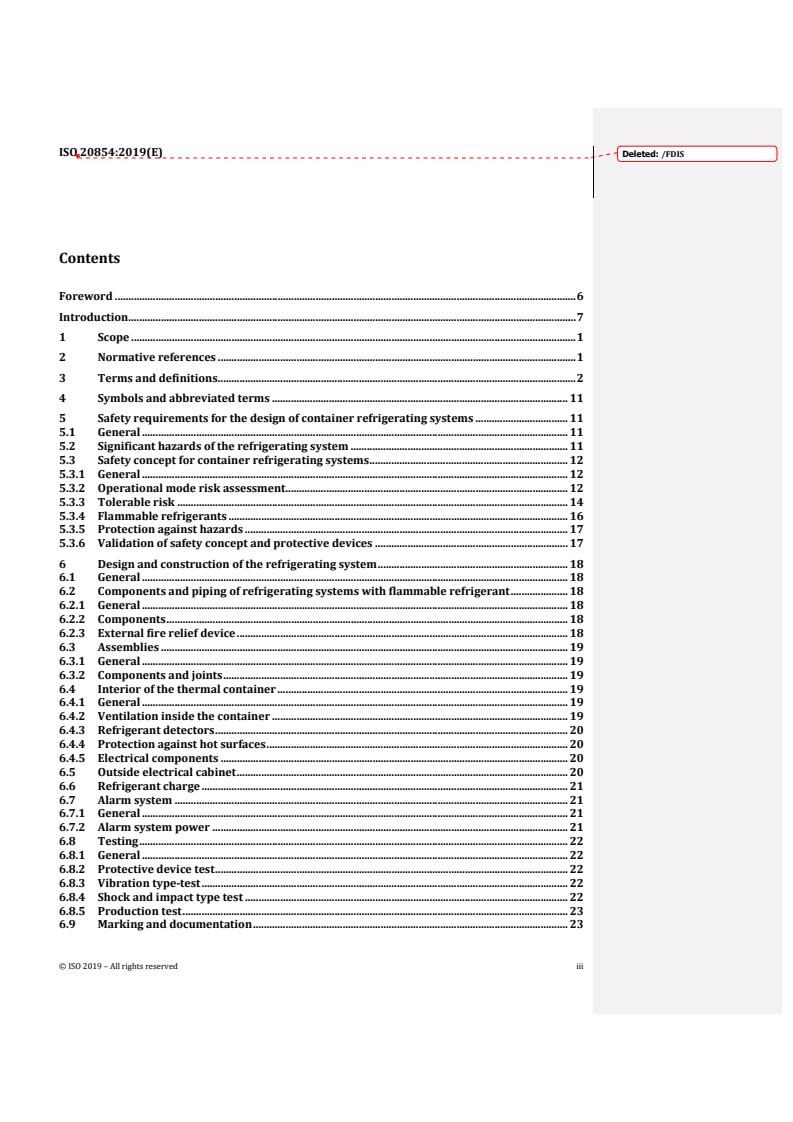
Contents
Foreword . 6
Introduction. 7
1 Scope . 1
2 Normative references . 1
3 Terms and definitions . 2
4 Symbols and abbreviated terms . 11
5 Safety requirements for the design of container refrigerating systems . 11
5.1 General . 11
5.2 Significant hazards of the refrigerating system . 11
5.3 Safety concept for container refrigerating systems . 12
5.3.1 General . 12
5.3.2 Operational mode risk assessment . 12
5.3.3 Tolerable risk . 14
5.3.4 Flammable refrigerants . 16
5.3.5 Protection against hazards . 17
5.3.6 Validation of safety concept and protective devices . 17
gn and construction of the refrigerating system . 18
6 Desi
6.1 General . 18
6.2 Components and piping of refrigerating systems with flammable refrigerant . 18
6.2.1 General . 18
6.2.2 Components . 18
6.2.3 External fire relief device . 18
6.3 Assemblies . 19
6.3.1 General . 19
6.3.2 Components and joints . 19
6.4 Interior of the thermal container . 19
6.4.1 General . 19
6.4.2 Ventilation inside the container . 19
6.4.3 Refrigerant detectors . 20
6.4.4 Protection against hot surfaces . 20
6.4.5 Electrical components . 20
6.5 Outside electrical cabinet . 20
6.6 Refrigerant charge . 21
stem . 21
6.7 Alarm sy
6.7.1 General . 21
6.7.2 Alarm system power . 21
6.8 Testing . 22
6.8.1 General . 22
6.8.2 Protective device test . 22
6.8.3 Vibration type-test . 22
6.8.4 Shock and impact type test . 22
6.8.5 Production test . 23
6.9 Marking and documentation . 23
© ISO 2019 – All rights reserved iii
Deleted: /FDIS
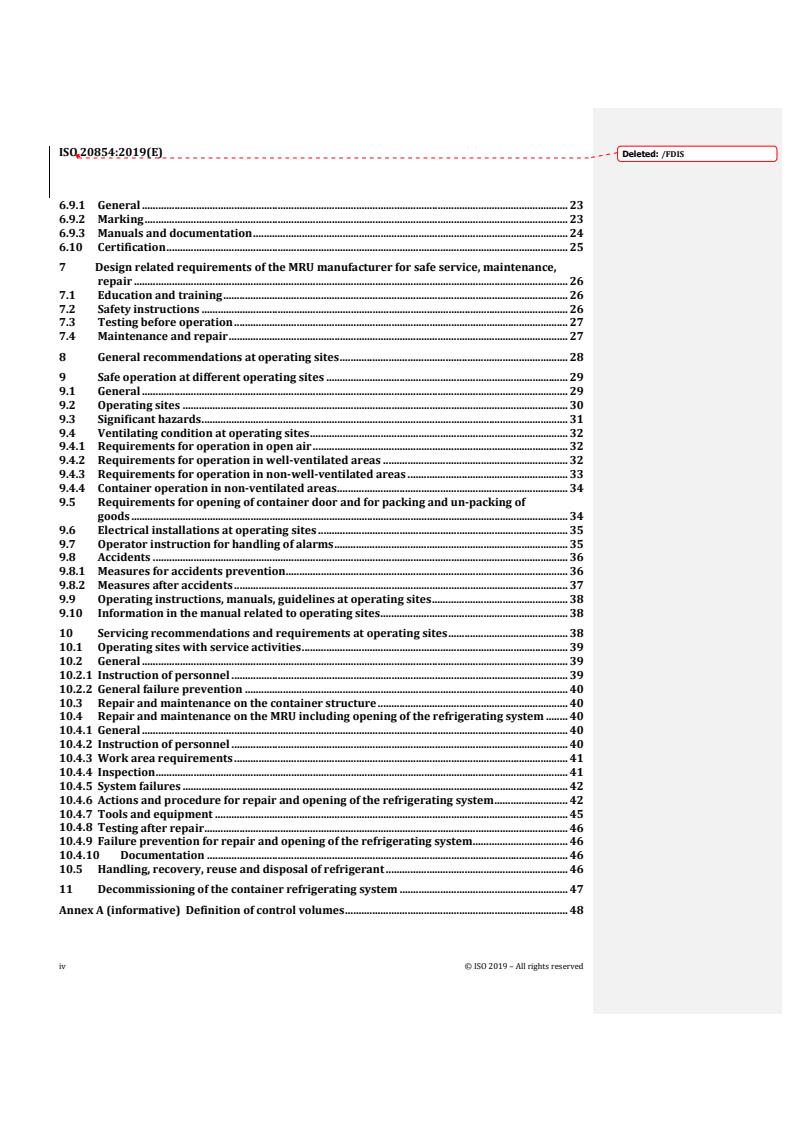
6.9.1 General . 23
6.9.2 Marking . 23
6.9.3 Manuals and documentation . 24
6.10 Certification . 25
7 Design related requirements of the MRU manufacturer for safe service, maintenance,
repair . 26
7.1 Education and training . 26
7.2 Safety instructions . 26
7.3 Testing before operation . 27
7.4 Maintenance and repair . 27
8 General recommendations at operating sites . 28
9 Safe operation at different operating sites . 29
9.1 General . 29
9.2 Operating sites . 30
9.3 Significant hazards . 31
9.4 Ventilating condition at operating sites . 32
9.4.1 Requirements for operation in open air . 32
9.4.2 Requirements for operation in well-ventilated areas . 32
9.4.3 Requirements for operation in non-well-ventilated areas . 33
9.4.4 Container operation in non-ventilated areas . 34
9.5 Requirements for opening of container door and for packing and un-packing of
goods . 34
9.6 Electrical installations at operating sites . 35
9.7 Operator instruction for handling of alarms . 35
9.8 Accidents . 36
9.8.1 Measures for accidents prevention. 36
9.8.2 Measures after accidents . 37
9.9 Operating instructions, manuals, guidelines at operating sites . 38
9.10 Information in the manual related to operating sites. 38
10 Servicing recommendations and requirements at operating sites . 38
10.1 Operating sites with service activities . 39
10.2 General . 39
10.2.1 Instruction of personnel . 39
10.2.2 General failure prevention . 40
10.3 Repair and maintenance on the container structure . 40
10.4 Repair and maintenance on the MRU including opening of the refrigerating system . 40
10.4.1 General . 40
10.4.2 Instruction of personnel . 40
10.4.3 Work area requirements . 41
10.4.4 Inspection . 41
10.4.5 System failures . 42
10.4.6 Actions and procedure for repair and opening of the refrigerating system . 42
10.4.7 Tools and equipment . 45
10.4.8 Testing after repair . 46
10.4.9 Failure prevention for repair and opening of the refrigerating system . 46
10.4.10 Documentation . 46
10.5 Handling, recovery, reuse and disposal of refrigerant . 46
11 Decommissioning of the container refrigerating system . 47
Annex A (informative) Definition of control volumes . 48
iv © ISO 2019 – All rights reserved
Deleted: /FDIS
Annex B (informative) Description of mechanisms to reduce risk . 49
B.1 General . 49
B.2 Separation mechanism . 49
B.3 Ventilation mechanism . 50
B.3.1 General . 50
B.3.2 Outside ventilation mechanism . 50
B.3.3 Inside ventilation mechanism . 50
B.4 Refrigerant detection . 51
B.5 Alarm system . 51
B.5.1 Types of alarm . 51
B.5.2 Visible and audible refrigerant leak alarm . 52
B.5.3 Actions by the alarm system . 53
B.6 Shut-off devices . 53
B.7 Examples of alternative systems . 53
Annex C (normative) Information on leak types and leak mass flow . 57
Annex D (normative) Useful equations for the calculation of ventilation environment . 59
D.1 General . 59
D.2 Dilution of a flammable substance release with air . 59
D.3 Additional examples . 61
D.3.1 Small volume in open air situation . 61
volume in a well-ventilated area . 61
D.3.2 A small
D.3.3 A non-well-ventilated area . 62
D.3.4 A Non-ventilated enclosure . 63
Bibliography . 64
© ISO 2019 – All rights reserved v
Deleted: /FDIS
Foreword
ISO (the International Organization for Standardization) is a worldwide federation of national
standards bodies (ISO member bodies). The work of preparing International Standards is normally
carried out through ISO technical committees. Each member body interested in a subject for which a
technical committee has been established has the right to be represented on that committee.
International organizations, governmental and non‐governmental, in liaison with ISO, also take part in
the work. ISO collaborates closely with the International Electrotechnical Commission (IEC) on all
matters of electrotechnical standardization.
The procedures used to develop this document and those intended for its further maintenance are
described in the ISO/IEC Directives, Part 1. In particular, the different approval criteria needed for the
different types of ISO documents should be noted. This document was drafted in accordance with the
editorial rules of the ISO/IEC Directives, Part 2 (see www.iso.org/directives).
Attention is drawn to the possibility that some of the elements of this document may be the subject of
patent rights. ISO shall not be held responsible for identifying any or all such patent rights. Details of
any patent rights identified during the development of the document will be in the Introduction and/or
on the ISO list of patent declarations received (see www.iso.org/patents).
Any trade name used in this document is information given for the convenience of users and does not
constitute an endorsement.
For an explanation of the voluntary nature of standards, the meaning of ISO specific terms and
expressions related to conformity assessment, as well as information about ISO's adherence to the
World Trade Organization (WTO) principles in the Technical Barriers to Trade (TBT)
see www.iso.org/iso/foreword.html.
This document was prepared by Technical Committee ISO/TC 104, Freight containers, SC 2, Specific
purpose containers.
Any feedback or questions on this document should be directed to the user’s national standards body. A
complete listing of these bodies can be found at www.iso.org/members.html.
vi © ISO 2019 – All rights reserved
Deleted: /FDIS
Introduction
This document has been developed to enable the use of flammable refrigerants in refrigerated thermal
containers. This document enables container owners and operators to understand and validate the
risks associated with operating refrigerating equipment using previously non‐acceptable flammable
refrigerants. The goal is to achieve an acceptable level of safety for container refrigerating systems
using flammable refrigerants as for container refrigerating systems using non‐flammable refrigerants.
The background for initiating the development of this document was the foreseeable impact of global
and national regulations on hydrofluorocarbons (HFCs) currently used in thermal containers.
Hydrofluorocarbons are listed in the Kigali Amendment to the Montreal Protocol from 2016 due to the
high global warming potential (GWP) of HFCs and a phase down in the use and availability of R134a,
R404A and, for low temperature, R23, is expected in intermodal transport refrigeration.
This document is intended to complement ISO 1496‐2 but not to replace existing standards such as the
ISO 5149 series. It provides minimum requirements for the design of a refrigerating system and follows Deleted: it
a risk‐based approach to reduce, but not eliminate, the risks to persons, assets and the environment.
The working group, which developed this document consisted of representatives from refrigerating
system manufacturers, refrigerated container box manufacturers, shipping lines, classification societies,
equipment owners and other interested industry experts.
© ISO 2019 – All rights reserved vii
Deleted: /FDIS
Thermal containers — Safety standard for refrigerating systems
using flammable refrigerants – Requirements for design and
operation
1 Scope
This document describes the design of the mechanical refrigeration unit (MRU) and operation of
container refrigerating systems in all anticipated operational modes and locations.
It describes the industry's best practices for the safe operation of flammable refrigerants in
refrigerating systems used in thermal freight containers operated on board ships, in terminals, on road,
on rail and on land.
This document addresses the use of flammable refrigerants with classifications defined in ISO 817,
defined as 2L, 2 and 3, except R717 (Ammonia).
This document describes an operational mode risk assessment (OMRA) which uses methods such as
HAZOP (Hazard and operability analysis), FMEA (Failure mode and effects analysis), or FTA (Fault tree
analysis) or combination of methods.
This document specifies requirements for the validation and consideration of possible safety concepts
and protective devices within the OMRA process, including charge release tests, simulation, and
function tests of the associated protective equipment. It defines test requirements for shock, impact,
and vibration. A validation procedure is given to demonstrate that risks from hazardous events are
investigated and their severity and frequency are meaningfully reduced, with the aim of achieving
tolerable risk values.
The obligations of the manufacturer, the container owner as well as the responsible operator are
described, as well as how stakeholders can investigate and mitigate risks associated with the use of
flammable refrigerants.
Finally, this document describes the requirements of service and maintenance when working with
flammable refrigerants.
This document is restricted to refrigerating systems integrated with or mounted on ISO thermal
containers according to ISO 1496‐2. It provides minimum requirements for reducing the risk associated
with the use of flammable refrigerants.
The scope is limited to container refrigerating systems operated in conjunction with the carriage of
refrigerated cargo as operating reefer (OR) or when used as a non‐operating reefer (NOR) or when
empty for positioning — while in intermodal transit. Static land‐based continuous operations are
excluded.
2 Normative references
The following documents are referred to in the text in such a way that some or all of their content
constitutes requirements of this document. For dated references, only the edition cited applies. For
undated references, the latest edition of the referenced document (including any amendments) applies.
ISO 817, Refrigerants — Designation system
© ISO 2019 – All rights reserved 1
Deleted: /FDIS
ISO 1496‐2, Freight containers — Specification and testing — Thermal containers
ISO 5149 (all parts), Refrigerating systems and heat pumps — Safety and environmental requirements
ISO 14903, Refrigerating systems and heat pumps — Qualification of tightness of components and joints
IEC 60068‐2‐6, Environmental testing — Part 2-6: Tests — Test Fc: Vibration (sinusoidal)
IEC 60068‐2‐75, Environmental testing — Part 2-75: Tests — Test Eh: Hammer tests
IEC 60079‐10‐1, Explosive atmospheres — Part 10-1: Classification of areas — Explosive gas atmospheres
IEC 60079‐14, Explosive atmospheres — Part 14: Electrical installations, design, selection and erection
IEC 60079‐15, Explosive atmospheres — Part 15: Equipment protection by type of equipment “n”
IEC 60335‐2‐40, Household and similar electrical appliances — Safety — Part 2-40: Particular
requirements for electrical heat pump, air-conditioners and dehumidifiers
EN 1127‐1, Explosive atmospheres — Explosion prevention and protection — Part 1: Basic concepts and
methodology
EN 14624, Performance of portable leak detectors and of room monitors for halogenated refrigerants
3 Terms and definitions
For the purposes of this document, the following terms and definitions apply.
ISO and IEC maintain terminological databases for use in standardization at the following addresses:
— ISO Online browsing platform: available at https://www.iso.org/obp
— IEC Electropedia: available at http://www.electropedia.org/
3.1
alarm system
system constituting all electrical and electronic parts of the refrigerating system which monitor the
correct function of the protective device(s) and/or give a warning in case of malfunctioning or
refrigerant leakage
3.2
hazardous area
area in which a flammable or toxic atmosphere is present, or may be expected to be present, in
quantities such as to require special precautions for construction, installation or use of apparatus
[SOURCE: IEC‐60079‐10‐1:2015, 3.3.1, modified — In the definition, the word "explosive" has been
replaced with "flammable and toxic".]
3.2.1
non-hazardous area
area in which a flammable or toxic atmosphere is not expected to be present in quantities such as to
require special precautions for construction, installation and use of equipment
2 © ISO 2019 – All rights reserved
Deleted: /FDIS
[SOURCE: IEC‐60079‐10‐1:2015, 3.3.2, modified — In the definition, the word "explosive" has been
replaced with "flammable and toxic".]
3.2.2
temporary hazardous area
area which can be defined as a hazardous area for a short period of time as a consequence of an
abnormal or accidental type leak
3.3
authorized service facility
service facility that is authorized by the manufacturer to repair and to maintain the container
refrigerating system
3.4
condenser section
space of the container where all outside parts of the refrigeration circuit including condenser fan are
located
Note 1 to entry: The condenser section is not a confined space.
Note 2 to entry: The condenser section corresponds to control volume II (see Annex A).
3.5
container refrigerating system
mechanically refrigerated container with a vapour compression refrigeration cycle using refrigerant as
a working fluid
3.6
control volume
theoretical volume representing the space in which a flammable atmosphere can occur as a
consequence of a refrigerant leak
Note 1 to entry: It can be delimited by the internal or external space of a container, and/or by specific component
compartments.
Note 2 to entry: A description of control volumes is included in Annex A.
3.7
durably technically tight
sealed equipment with enhanced tightness which is equal or less than that of fugitive emissions
accomplished by enhanced maintenance and supervision
Note 1 to entry: Clauses 8, 9 and especially Clause 10 provide information on design aspects and operational
aspects to maintain tightness, permanently ensured by means of enhanced maintenance and supervision.
Note 2 to entry: Additional information can be found in EN 1127:2011, Annex B.
Note 3 to entry: ISO 5149‐2 provides information on “sealed systems” and IEC 60335‐2‐40 on “enhanced
tightness”.
3.8
evaporator space
space inside the container containing the evaporator and air ducts
© ISO 2019 – All rights reserved 3
Deleted: /FDIS
Note 1 to entry: The evaporator space corresponds to control volume III (see Annex A).
3.9
flammable atmosphere
mixture with air, under atmospheric conditions, of flammable substances in the form of gas or vapour,
which after ignition, permits self‐sustained flame propagation
Note 1 to entry: For example, a mixture of flammable refrigerant fluid with air under atmospheric conditions.
[SOURCE: IEC 60079‐10‐1:2015, 3.2] Formatted: English (U.K.)
4 © ISO 2019 – All rights reserved
Deleted: /FDIS
3.10 flammable limit/explosive limit
3.10.1
LFL
lower flammable limit
minimum concentration of the refrigerant that is capable of propagating a flame through a
homogeneous mixture of the refrigerant and air under the specified test conditions at 23,0 °C and
101,3 kPa
[SOURCE: ISO 817:2018, 3.1.24, modified — Notes 1 and 2 have been omitted.]
3.10.2
UFL
upper flammable limit
concentration of flammable gas or vapour in air, above which the gas atmosphere is not flammable
[SOURCE: IEC‐60079‐10‐1:2015, 3.6.13, modified — In the definition, the words "or mist" have been
removed after "vapour". Also, at the end, after "above which", "an explosive gas atmosphere will not be
formed" has been changed to " the gas atmosphere is not flammable".]
3.11
flammable refrigerant
refrigerant with a classification of class 2L, 2 or 3 in compliance with ISO 817 classification, refrigerants
excluding ammonia
3.11.1
AIT
auto-ignition temperature
lowest temperature of a substance at or above which a chemical can spontaneously ignite in a normal
test atmosphere, without an external source of ignition, such as a flame or spark
Note 1 to entry: Refer to the manufacturer’s safety data sheet (SDS) of the chemical used.
[SOURCE: ISO 5149‐1:2014, 3.7.7, modified — Note 1 to entry has been added.]
3.11.2
RTT
reaction threshold temperature
lowest temperature of a substance at or above which a chemical can be decomposed spontaneously in a
normal atmosphere, in the presence of an external source of ignition, such as an open flame, hot surface
or spark
Note 1 to entry: As an estimation, the following values may be used: RTT = AIT – 100 °C.
est Formatted: Note, Line spacing:
single, Adjust space between Latin and
Asian text, Adjust space between Asian
3.12
text and numbers
flammable substance
The flammability limits are function of temperature and humidity. For refrigerants flammability, ISO 817:2014 defines test
conditions of 50 % relative humidity at 23,0 °C and 101,3 kPa for burning velocity and LFL/UFL measurements. The effect
of a reduced lower flammable limit and an increased upper flammable limit at higher operational humidity and temperature
levels can be taken into account in the operational mode risk assessment.
© ISO 2019 – All rights reserved 5
Deleted: /FDIS
substance in the form of gas, vapour, liquid, or mixtures of these, able to propagate a flame from an
ignition source
3.13
fresh air exchange mechanism
mechanism that opens the fresh air ducting to allow ventilation
3.14
fugitive emission
small release of refrigerant from pressurized equipment which does not result in malfunction of the
cooling process in its typical operation time
Note 1 to entry: Fugitive emissions result from corrosion or shortcoming of components or joints which are
durably technically tight during intermodal operation and do not result to a malfunction and/or need for repair on
the refrigerating system in a period of months to years.
Note 2 to entry: Annex C gives information on leak type, size, frequencies and leak rates.
Note 3 to entry: For additional information, see IEC 60079‐10‐1:2015, C.4.6.
3.15
inside component
component of the refrigerating system which is located inside the internal dimensional envelope of the
container
3.16
intended use
use in accordance with information provided with the container refrigerating system, or, in the absence
of such information, by generally understood patterns of usage
Note 1 to entry: Intended use of a container refrigerating system is the carriage of cargo under temperature
control and when the unit is not operating i.e. used as NOR (non‐operating reefer) or waiting empty for loading
and/or repositioning — while in intermodal transit.
[SOURCE: ISO Guide 51, 3.6, modified — The words "a product or system" have been replaced with " the
container refrigerating system" and Note 1 to entry has been added.]
3.16.1
normal operation
condition where the equipment is operating within its design parameters
Note 1 to entry: Failures (such as the breakdown of components or ruptures) which involve shut‐down and urgent
repair are not considered to be part of normal operation.
Note 2 to entry: Normal operation includes start‐up and shut‐down conditions.
Note 3 to entry: Normal operation can include occurrence of fugitive emissions. Normal operation does not
include larger leaks. Normal operation of the container refrigerating system requires a certain minimum
refrigerant charge. Larger leaks result in system failure.
[SOURCE: IEC 60079‐10‐1:2015, 3.7.1]
3.16.2
special use
6 © ISO 2019 – All rights reserved
Deleted: /FDIS
use of a container refrigerating system for cooling and storage of goods in stationary and temporary
land operation — not permanently imported
Note 1 to entry: Local regulations and guidelines can apply to the use of a container refrigerating system as
permanent storage place of cargo.
3.16.3
reasonably foreseeable misuse
use of the container or container refrigerating system in a way not intended by the supplier, but which
can result from readily predictable human behaviour
[SOURCE: ISO Guide 51:2017, 3.7, modified — The words "a product or system" have been replaced
with "the container or container refrigerating system" and Notes 1 and 2 to entry have been omitted.]
3.17
non-occupied space
space inside the container which is not occupied for a significant period of time by person(s)
Note 1 to entry: For unpacking and packing of goods, the container doors are open, see 9.5.
3.18
operating site
site or location of operation in which a container refrigerating system can be operated, repaired, or
stored during the intended use
3.19
operational mode
combination of type of operation (such as transport mode and storage location) and state of operation
(such normal operation, power ON, power OFF, empty container, packed container) in a container
refrigerating system
EXAMPLE The container is located in a terminal, on a truck and with power on and empty.
3.20
operational mode risk assessment
OMRA
overall process comprising a risk analysis and risk evaluation of a container refrigerating system in
different operational modes
3.21
outside part
component of the refrigerating system which is located outside the insulated walls and inside the
external dimensional envelope
3.22
packing
stuffing
action of filling cargo/goods into the container within designed capacity
Note 1 to entry: After packing, the container is loaded with goods.
3.23
PTI
pre-trip inspection
© ISO 2019 – All rights reserved 7
Deleted: /FDIS
inspection and testing of a container refrigerating system including checking for structural damage and
assurance that the refrigerating system is operating according to the specifications
Note 1 to entry: A PTI can be carried out before a container is released for a new trip or after a repair.
3.24
power supply
condition where a connection to the three‐phase power supply is present
3.25
refrigerant leak detection mechanism
mechanism which can recognize a refrigerant leakage or charge losses of the container refrigerating
system
3.26
refrigerating system repair operation
service or maintenance of a refrigerating system in which the container refrigeration system pipework
or components is or will be opened
3.27
repair shop
place in a terminal or service facility where container refrigerating systems are serviced and repaired
3.28
responsible operator
MRU operator
person or entity that has operational control of the container including the MRU at any particular time
including, but not limited to, repair and storage depots, terminals, transport operators, shippers and
consignees
3.29
safety principle
set of provisions which, together, ensure safe design and safe operation of a container refrigerating
system
3.30
shut-off device
normally closed device separating parts of the refrigerating system to reduce the maximum amount of
refrigerant that can be leaked into a control volume
3.31
service access point
connection used to service the refrigerating system, that enables the refrigerant circuit to be charged,
discharged, evacuated and pressure checked
3.32
service facility
building or installation where maintenance and repair of container refrigerating systems is carried out
3.33
smallest inside free volume
remaining inside volume when the cargo compartment is packed to the maximum allowed volume
8 © ISO 2019 – All rights reserved
Deleted: /FDIS
Note 1 to entry: This volume includes the T‐floor space.
3.34
T-floor
specially designed floor with longitudinal channels to allow air to pass underneath the cargo
3.35
terminal
intermodal facility that allows the transport and transfer of containers between different transport
modes
Note 1 to entry: In a terminal, intermodal containers are also loaded/unloaded, stored, operated, maintained,
packed/unpacked.
3.36
toxic atmosphere
mixture of air, under atmospheric conditions, with toxic substances in the form of gas or vapour which
can be harmful or lethal to humans
Note 1 to entry: For example, a mixture of toxic refrigerant fluid or decomposition products with air under
atmospheric conditions.
Note 2 to entry: A toxic substance is understood to be a substance in the form of gas, vapour, liquid, or mixtures of
these, which can be harmful or lethal, or can impair a person’s ability to escape due to acute or chronic exposure
by contact, inhalation, or ingestion.
3.37
unit end
front end where the refrigerating system is placed
3.38
unpacking
unstuffing
action of emptying the container
Note 1 to entry: After unpacking, the container is empty.
3.39
ventilation environment
environment capable of diluting releases of hazardous substances in normal operation to a non‐
hazardous concentration
3.39.1
open air
any unenclosed space, possibly but not necessarily roofed with, as a minimum, natural ventilation
Note 1 to entry: The ventilation environment “open air” refers to or represents areas or operating sites such as
PTI, inspection, roofed repair areas, on vessel deck, truck and rail.
[SOURCE: ISO 5149‐1:2014, 3.2.7, modified — The words "with, as a minimum, natural ventilation" and
Note 1 to entry have been added.]
3.39.2
well-ventilated
© ISO 2019 – All rights reserved 9
Deleted: /FDIS
area which is naturally or mechanically ventilated
Note 1 to entry: The ventilation environment “well‐ventilated” refers or represent areas or operating sites such as
vessel cargo hold, workshops, system repair areas.
3.39.3
non-well-ventilated
area other than open air or well‐ventilated
Note 1 to entry: The ventilation environment “non‐well‐ventilated” should be considered if an artificial or forced
ventilation system is not in operation (due to power failures or other type of malfunction).
Note 2 to entry: For release rate and accumulation time of hazardous substances in non‐well‐ventilated areas or
operating sites see Annex C.
3.40
ventilation mechanism
means which promotes the replacement of an air volume
3.41
ventilation
movement of air and its replacement with fresh air, i.e. without dangerous substances
3.41.1
natural ventilation
movement of air and its replacement with fresh air due to effects of natural mixing, air movement, or
temperature gradients
Note 1 to entry: For open air ventilation is normally based on an assumed minimum wind speed of 0,15 m/s for
obstructed areas and 0,3 m/s for unobstructed areas, which will be present virtually continuously (see IEC 60079‐
10‐1:2015, Table C.1).
3.41.2
artificial ventilation
forced ventilation
movement of air and its replacement with fresh air provided by artificial means
3.42
zone
hazardous area classification based upon the frequency of the occurrence and duration of an explosive
atmosphere
[SOURCE: IEC‐60079‐10‐1:2015, 3.3.2]
3.42.1
zone 2
area in which an explosive gas atmosphere is not likely to occur but, if it does occur, for example as a
result of accidental type release of refrigerant, it can be defined as a temporary hazardous area
[SOURCE: IEC‐60079‐10‐1:2015, 3.3.6, modified — The words "in normal operation" have been
removed; the end part after "if it does occur" has been changed; and Note 1 to entry has been omitted.]
3.42.2
extent of zone
10 © ISO 2019 – All rights reserved
Deleted: /FDIS
distance in any direction from the source of release to where a gas/air mixture will be diluted by air to a
concentration below the lower flammable limit
[SOURCE: IEC‐60079‐10‐1:2015, 3.3.7]
4 Symbols and abbreviated terms
FEU Forty‐foot equivalent unit
MRU Mechanical refrigeration unit (the terms “MRU” and “unit” are considered to be synonymous
at this document)
SOI Source of ignition
SDS Safety datasheet for chemicals
5 Safety requirements for the design of container refrigerating systems
5.1 General
The safety requirements described in this clause cover the whole assembly of a container refrigerating
system using flammable refrigerants: the refrigerat
...
INTERNATIONAL ISO
STANDARD 20854
First edition
2019-10
Thermal containers — Safety
standard for refrigerating systems
using flammable refrigerants
— Requirements for design and
operation
Conteneurs thermiques — Norme de sécurité pour les systèmes
réfrigérants utilisant des fluides frigorigènes inflammables —
Exigences de conception et de fonctionnement
Reference number
©
ISO 2019
© ISO 2019
All rights reserved. Unless otherwise specified, or required in the context of its implementation, no part of this publication may
be reproduced or utilized otherwise in any form or by any means, electronic or mechanical, including photocopying, or posting
on the internet or an intranet, without prior written permission. Permission can be requested from either ISO at the address
below or ISO’s member body in the country of the requester.
ISO copyright office
CP 401 • Ch. de Blandonnet 8
CH-1214 Vernier, Geneva
Phone: +41 22 749 01 11
Fax: +41 22 749 09 47
Email: copyright@iso.org
Website: www.iso.org
Published in Switzerland
ii © ISO 2019 – All rights reserved
Contents Page
Foreword .v
Introduction .vi
1 Scope . 1
2 Normative references . 1
3 Terms and definitions . 2
4 Symbols and abbreviated terms . 9
5 Safety requirements for the design of container refrigerating systems .9
5.1 General . 9
5.2 Significant hazards of the refrigerating system . 9
5.3 Safety concept for container refrigerating systems .10
5.3.1 General.10
5.3.2 Operational mode risk assessment .10
5.3.3 Tolerable risk .12
5.3.4 Flammable refrigerants .13
5.3.5 Protection against hazards .14
5.3.6 Validation of safety concept and protective devices .15
6 Design and construction of the refrigerating system .15
6.1 General .15
6.2 Components and piping of refrigerating systems with flammable refrigerant .16
6.2.1 General.16
6.2.2 Components .16
6.2.3 External fire relief device .16
6.3 Assemblies .16
6.3.1 General.16
6.3.2 Components and joints . .17
6.4 Interior of the thermal container .17
6.4.1 General.17
6.4.2 Ventilation inside the container .17
6.4.3 Refrigerant detectors .17
6.4.4 Protection against hot surfaces .17
6.4.5 Electrical components . .18
6.5 Outside electrical cabinet .18
6.6 Refrigerant charge .18
6.7 Alarm system .19
6.7.1 General.19
6.7.2 Alarm system power .19
6.8 Testing .19
6.8.1 General.19
6.8.2 Protective device test .19
6.8.3 Vibration type-test .20
6.8.4 Shock and impact type test .20
6.8.5 Production test .20
6.9 Marking and documentation .21
6.9.1 General.21
6.9.2 Marking .21
6.9.3 Manuals and documentation .22
6.10 Certification .23
7 Design related requirements of the MRU manufacturer for safe service,
maintenance, repair .23
7.1 Education and training .24
7.2 Safety instructions .24
7.3 Testing before operation .24
7.4 Maintenance and repair .24
8 General recommendations at operating sites .25
9 Safe operation at different operating sites .26
9.1 General .26
9.2 Operating sites .27
9.3 Significant hazards .28
9.4 Ventilating condition at operating sites .29
9.4.1 Requirements for operation in open air .29
9.4.2 Requirements for operation in well-ventilated areas .29
9.4.3 Requirements for operation in non-well-ventilated areas .30
9.4.4 Container operation in non-ventilated areas .31
9.5 Requirements for opening of container door and for packing and un-packing of goods .31
9.6 Electrical installations at operating sites .32
9.7 Operator instruction for handling of alarms .32
9.8 Accidents .33
9.8.1 Measures for accidents prevention .33
9.8.2 Measures after accidents .34
9.9 Operating instructions, manuals, guidelines at operating sites .34
9.10 Information in the manual related to operating sites .34
10 Servicing recommendations and requirements at operating sites .35
10.1 Operating sites with service activities .35
10.2 General .35
10.2.1 Instruction of personnel .36
10.2.2 General failure prevention .36
10.3 Repair and maintenance on the container structure .36
10.4 Repair and maintenance on the MRU including opening of the refrigerating system .37
10.4.1 General.37
10.4.2 Instruction of personnel .37
10.4.3 Work area requirements .38
10.4.4 Inspection .38
10.4.5 System failures .38
10.4.6 Actions and procedure for repair and opening of the refrigerating system .39
10.4.7 Tools and equipment .41
10.4.8 Testing after repair .42
10.4.9 Failure prevention for repair and opening of the refrigerating system .42
10.4.10 Documentation .42
10.5 Handling, recovery, reuse and disposal of refrigerant .43
11 Decommissioning of the container refrigerating system .43
Annex A (informative) Definition of control volumes .44
Annex B (informative) Description of mechanisms to reduce risk .45
Annex C (normative) Information on leak types and leak mass flow .53
Annex D (normative) Useful equations for the calculation of ventilation environment .54
Bibliography .59
iv © ISO 2019 – All rights reserved
Foreword
ISO (the International Organization for Standardization) is a worldwide federation of national standards
bodies (ISO member bodies). The work of preparing International Standards is normally carried out
through ISO technical committees. Each member body interested in a subject for which a technical
committee has been established has the right to be represented on that committee. International
organizations, governmental and non-governmental, in liaison with ISO, also take part in the work.
ISO collaborates closely with the International Electrotechnical Commission (IEC) on all matters of
electrotechnical standardization.
The procedures used to develop this document and those intended for its further maintenance are
described in the ISO/IEC Directives, Part 1. In particular, the different approval criteria needed for the
different types of ISO documents should be noted. This document was drafted in accordance with the
editorial rules of the ISO/IEC Directives, Part 2 (see www .iso .org/directives).
Attention is drawn to the possibility that some of the elements of this document may be the subject of
patent rights. ISO shall not be held responsible for identifying any or all such patent rights. Details of
any patent rights identified during the development of the document will be in the Introduction and/or
on the ISO list of patent declarations received (see www .iso .org/patents).
Any trade name used in this document is information given for the convenience of users and does not
constitute an endorsement.
For an explanation of the voluntary nature of standards, the meaning of ISO specific terms and
expressions related to conformity assessment, as well as information about ISO's adherence to the
World Trade Organization (WTO) principles in the Technical Barriers to Trade (TBT) see www .iso
.org/iso/foreword .html.
This document was prepared by Technical Committee ISO/TC 104, Freight containers, SC 2, Specific
purpose containers.
Any feedback or questions on this document should be directed to the user’s national standards body. A
complete listing of these bodies can be found at www .iso .org/members .html.
Introduction
This document has been developed to enable the use of flammable refrigerants in refrigerated thermal
containers. This document enables container owners and operators to understand and validate the
risks associated with operating refrigerating equipment using previously non-acceptable flammable
refrigerants. The goal is to achieve an acceptable level of safety for container refrigerating systems
using flammable refrigerants as for container refrigerating systems using non-flammable refrigerants.
The background for initiating the development of this document was the foreseeable impact of
global and national regulations on hydrofluorocarbons (HFCs) currently used in thermal containers.
Hydrofluorocarbons are listed in the Kigali Amendment to the Montreal Protocol from 2016 due to the
high global warming potential (GWP) of HFCs and a phase down in the use and availability of R134a,
R404A and, for low temperature, R23, is expected in intermodal transport refrigeration.
This document is intended to complement ISO 1496-2 but not to replace existing standards such as the
ISO 5149 series. It provides minimum requirements for the design of a refrigerating system and follows
a risk-based approach to reduce, but not eliminate, the risks to persons, assets and the environment.
The working group, which developed this document consisted of representatives from refrigerating
system manufacturers, refrigerated container box manufacturers, shipping lines, classification
societies, equipment owners and other interested industry experts.
vi © ISO 2019 – All rights reserved
INTERNATIONAL STANDARD ISO 20854:2019(E)
Thermal containers — Safety standard for refrigerating
systems using flammable refrigerants — Requirements for
design and operation
1 Scope
This document describes the design of the mechanical refrigeration unit (MRU) and operation of
container refrigerating systems in all anticipated operational modes and locations.
It describes the industry's best practices for the safe operation of flammable refrigerants in refrigerating
systems used in thermal freight containers operated on board ships, in terminals, on road, on rail and
on land.
This document addresses the use of flammable refrigerants with classifications defined in ISO 817,
defined as 2L, 2 and 3, except R717 (Ammonia).
This document describes an operational mode risk assessment (OMRA) which uses methods such as
HAZOP (Hazard and operability analysis), FMEA (Failure mode and effects analysis), or FTA (Fault tree
analysis) or combination of methods.
This document specifies requirements for the validation and consideration of possible safety concepts
and protective devices within the OMRA process, including charge release tests, simulation, and
function tests of the associated protective equipment. It defines test requirements for shock, impact,
and vibration. A validation procedure is given to demonstrate that risks from hazardous events are
investigated and their severity and frequency are meaningfully reduced, with the aim of achieving
tolerable risk values.
The obligations of the manufacturer, the container owner as well as the responsible operator are
described, as well as how stakeholders can investigate and mitigate risks associated with the use of
flammable refrigerants.
Finally, this document describes the requirements of service and maintenance when working with
flammable refrigerants.
This document is restricted to refrigerating systems integrated with or mounted on ISO thermal
containers according to ISO 1496-2. It provides minimum requirements for reducing the risk associated
with the use of flammable refrigerants.
The scope is limited to container refrigerating systems operated in conjunction with the carriage of
refrigerated cargo as operating reefer (OR) or when used as a non-operating reefer (NOR) or when
empty for positioning — while in intermodal transit. Static land-based continuous operations are
excluded.
2 Normative references
The following documents are referred to in the text in such a way that some or all of their content
constitutes requirements of this document. For dated references, only the edition cited applies. For
undated references, the latest edition of the referenced document (including any amendments) applies.
ISO 817, Refrigerants — Designation system
ISO 1496-2, Freight containers — Specification and testing — Thermal containers
ISO 5149 (all parts), Refrigerating systems and heat pumps — Safety and environmental requirements
ISO 14903, Refrigerating systems and heat pumps — Qualification of tightness of components and joints
IEC 60068-2-6, Environmental testing — Part 2-6: Tests — Test Fc: Vibration (sinusoidal)
IEC 60068-2-75, Environmental testing — Part 2-75: Tests — Test Eh: Hammer tests
IEC 60079-10-1, Explosive atmospheres — Part 10-1: Classification of areas — Explosive gas atmospheres
IEC 60079-14, Explosive atmospheres — Part 14: Electrical installations, design, selection and erection
IEC 60079-15, Explosive atmospheres — Part 15: Equipment protection by type of equipment “n”
IEC 60335-2-40, Household and similar electrical appliances — Safety — Part 2-40: Particular requirements
for electrical heat pump, air-conditioners and dehumidifiers
EN 1127-1, Explosive atmospheres — Explosion prevention and protection — Part 1: Basic concepts and
methodology
EN 14624, Performance of portable leak detectors and of room monitors for halogenated refrigerants
3 Terms and definitions
For the purposes of this document, the following terms and definitions apply.
ISO and IEC maintain terminological databases for use in standardization at the following addresses:
— ISO Online browsing platform: available at https: //www .iso .org/obp
— IEC Electropedia: available at http: //www .electropedia .org/
3.1
alarm system
system constituting all electrical and electronic parts of the refrigerating system which monitor
the correct function of the protective device(s) and/or give a warning in case of malfunctioning or
refrigerant leakage
3.2
hazardous area
area in which a flammable or toxic atmosphere is present, or may be expected to be present, in
quantities such as to require special precautions for construction, installation or use of apparatus
[SOURCE: IEC -60079 -10 -1: 2015, 3.3.1, modified — In the definition, the word "explosive" has been
replaced with "flammable and toxic".]
3.2.1
non-hazardous area
area in which a flammable or toxic atmosphere is not expected to be present in quantities such as to
require special precautions for construction, installation and use of equipment
[SOURCE: IEC -60079 -10 -1: 2015, 3.3.2, modified — In the definition, the word "explosive" has been
replaced with "flammable and toxic".]
3.2.2
temporary hazardous area
area which can be defined as a hazardous area for a short period of time as a consequence of an
abnormal or accidental type leak
3.3
authorized service facility
service facility that is authorized by the manufacturer to repair and to maintain the container
refrigerating system
2 © ISO 2019 – All rights reserved
3.4
condenser section
space of the container where all outside parts of the refrigeration circuit including condenser fan
are located
Note 1 to entry: The condenser section is not a confined space.
Note 2 to entry: The condenser section corresponds to control volume II (see Annex A).
3.5
container refrigerating system
mechanically refrigerated container with a vapour compression refrigeration cycle using refrigerant as
a working fluid
3.6
control volume
theoretical volume representing the space in which a flammable atmosphere can occur as a consequence
of a refrigerant leak
Note 1 to entry: It can be delimited by the internal or external space of a container, and/or by specific component
compartments.
Note 2 to entry: A description of control volumes is included in Annex A.
3.7
durably technically tight
sealed equipment with enhanced tightness which is equal or less than that of fugitive emissions
accomplished by enhanced maintenance and supervision
Note 1 to entry: Clauses 8, 9 and especially Clause 10 provide information on design aspects and operational
aspects to maintain tightness, permanently ensured by means of enhanced maintenance and supervision.
Note 2 to entry: Additional information can be found in EN 1127:2011, Annex B.
Note 3 to entry: ISO 5149-2 provides information on “sealed systems” and IEC 60335-2-40 on “enhanced
tightness”.
3.8
evaporator space
space inside the container containing the evaporator and air ducts
Note 1 to entry: The evaporator space corresponds to control volume III (see Annex A).
3.9
flammable atmosphere
mixture with air, under atmospheric conditions, of flammable substances in the form of gas or vapour,
which after ignition, permits self-sustained flame propagation
Note 1 to entry: For example, a mixture of flammable refrigerant fluid with air under atmospheric conditions.
[SOURCE: IEC 60079-10-1:2015, 3.2]
1)
3.10 flammable limit/explosive limit
3.10.1
LFL
lower flammable limit
minimum concentration of the refrigerant that is capable of propagating a flame through a homogeneous
mixture of the refrigerant and air under the specified test conditions at 23,0 °C and 101,3 kPa
[SOURCE: ISO 817:2018, 3.1.24, modified — Notes 1 and 2 have been omitted.]
3.10.2
UFL
upper flammable limit
concentration of flammable gas or vapour in air, above which the gas atmosphere is not flammable
[SOURCE: IEC -60079 -10 -1: 2015, 3.6.13, modified — In the definition, the words "or mist" have been
removed after "vapour". Also, at the end, after "above which", "an explosive gas atmosphere will not be
formed" has been changed to " the gas atmosphere is not flammable".]
3.11
flammable refrigerant
refrigerant with a classification of class 2L, 2 or 3 in compliance with ISO 817 classification, refrigerants
excluding ammonia
3.11.1
AIT
auto-ignition temperature
lowest temperature of a substance at or above which a chemical can spontaneously ignite in a normal
test atmosphere, without an external source of ignition, such as a flame or spark
Note 1 to entry: Refer to the manufacturer’s safety data sheet (SDS) of the chemical used.
[SOURCE: ISO 5149-1:2014, 3.7.7, modified — Note 1 to entry has been added.]
3.11.2
RTT
reaction threshold temperature
lowest temperature of a substance at or above which a chemical can be decomposed spontaneously in a
normal atmosphere, in the presence of an external source of ignition, such as an open flame, hot surface
or spark
Note 1 to entry: As an estimation, the following values may be used: RTT = AIT – 100 °C.
est
3.12
flammable substance
substance in the form of gas, vapour, liquid, or mixtures of these, able to propagate a flame from an
ignition source
3.13
fresh air exchange mechanism
mechanism that opens the fresh air ducting to allow ventilation
1) The flammability limits are function of temperature and humidity. For refrigerants flammability, ISO 817:2014
defines test conditions of 50 % relative humidity at 23,0 °C and 101,3 kPa for burning velocity and LFL/UFL
measurements. The effect of a reduced lower flammable limit and an increased upper flammable limit at higher
operational humidity and temperature levels can be taken into account in the operational mode risk assessment.
4 © ISO 2019 – All rights reserved
3.14
fugitive emission
small release of refrigerant from pressurized equipment which does not result in malfunction of the
cooling process in its typical operation time
Note 1 to entry: Fugitive emissions result from corrosion or shortcoming of components or joints which are
durably technically tight during intermodal operation and do not result to a malfunction and/or need for repair
on the refrigerating system in a period of months to years.
Note 2 to entry: Annex C gives information on leak type, size, frequencies and leak rates.
Note 3 to entry: For additional information, see IEC 60079-10-1:2015, C.4.6.
3.15
inside component
component of the refrigerating system which is located inside the internal dimensional envelope of the
container
3.16
intended use
use in accordance with information provided with the container refrigerating system, or, in the absence
of such information, by generally understood patterns of usage
Note 1 to entry: Intended use of a container refrigerating system is the carriage of cargo under temperature
control and when the unit is not operating i.e. used as NOR (non-operating reefer) or waiting empty for loading
and/or repositioning — while in intermodal transit.
[SOURCE: ISO Guide 51, 3.6, modified — The words "a product or system" have been replaced with " the
container refrigerating system" and Note 1 to entry has been added.]
3.16.1
normal operation
condition where the equipment is operating within its design parameters
Note 1 to entry: Failures (such as the breakdown of components or ruptures) which involve shut-down and urgent
repair are not considered to be part of normal operation.
Note 2 to entry: Normal operation includes start-up and shut-down conditions.
Note 3 to entry: Normal operation can include occurrence of fugitive emissions. Normal operation does not
include larger leaks. Normal operation of the container refrigerating system requires a certain minimum
refrigerant charge. Larger leaks result in system failure.
[SOURCE: IEC 60079-10-1:2015, 3.7.1]
3.16.2
special use
use of a container refrigerating system for cooling and storage of goods in stationary and temporary
land operation — not permanently imported
Note 1 to entry: Local regulations and guidelines can apply to the use of a container refrigerating system as
permanent storage place of cargo.
3.16.3
reasonably foreseeable misuse
use of the container or container refrigerating system in a way not intended by the supplier, but which
can result from readily predictable human behaviour
[SOURCE: ISO Guide 51:2017, 3.7, modified — The words "a product or system" have been replaced with
"the container or container refrigerating system" and Notes 1 and 2 to entry have been omitted.]
3.17
non-occupied space
space inside the container which is not occupied for a significant period of time by person(s)
Note 1 to entry: For unpacking and packing of goods, the container doors are open, see 9.5.
3.18
operating site
site or location of operation in which a container refrigerating system can be operated, repaired, or
stored during the intended use
3.19
operational mode
combination of type of operation (such as transport mode and storage location) and state of operation
(such normal operation, power ON, power OFF, empty container, packed container) in a container
refrigerating system
EXAMPLE The container is located in a terminal, on a truck and with power on and empty.
3.20
operational mode risk assessment
OMRA
overall process comprising a risk analysis and risk evaluation of a container refrigerating system in
different operational modes
3.21
outside part
component of the refrigerating system which is located outside the insulated walls and inside the
external dimensional envelope
3.22
packing
stuffing
action of filling cargo/goods into the container within designed capacity
Note 1 to entry: After packing, the container is loaded with goods.
3.23
PTI
pre-trip inspection
inspection and testing of a container refrigerating system including checking for structural damage
and assurance that the refrigerating system is operating according to the specifications
Note 1 to entry: A PTI can be carried out before a container is released for a new trip or after a repair.
3.24
power supply
condition where a connection to the three-phase power supply is present
3.25
refrigerant leak detection mechanism
mechanism which can recognize a refrigerant leakage or charge losses of the container refrigerating
system
3.26
refrigerating system repair operation
service or maintenance of a refrigerating system in which the container refrigeration system pipework
or components is or will be opened
3.27
repair shop
place in a terminal or service facility where container refrigerating systems are serviced and repaired
6 © ISO 2019 – All rights reserved
3.28
responsible operator
MRU operator
person or entity that has operational control of the container including the MRU at any particular time
including, but not limited to, repair and storage depots, terminals, transport operators, shippers and
consignees
3.29
safety principle
set of provisions which, together, ensure safe design and safe operation of a container refrigerating system
3.30
shut-off device
normally closed device separating parts of the refrigerating system to reduce the maximum amount of
refrigerant that can be leaked into a control volume
3.31
service access point
connection used to service the refrigerating system, that enables the refrigerant circuit to be charged,
discharged, evacuated and pressure checked
3.32
service facility
building or installation where maintenance and repair of container refrigerating systems is carried out
3.33
smallest inside free volume
remaining inside volume when the cargo compartment is packed to the maximum allowed volume
Note 1 to entry: This volume includes the T-floor space.
3.34
T-floor
specially designed floor with longitudinal channels to allow air to pass underneath the cargo
3.35
terminal
intermodal facility that allows the transport and transfer of containers between different transport
modes
Note 1 to entry: In a terminal, intermodal containers are also loaded/unloaded, stored, operated, maintained,
packed/unpacked.
3.36
toxic atmosphere
mixture of air, under atmospheric conditions, with toxic substances in the form of gas or vapour which
can be harmful or lethal to humans
Note 1 to entry: For example, a mixture of toxic refrigerant fluid or decomposition products with air under
atmospheric conditions.
Note 2 to entry: A toxic substance is understood to be a substance in the form of gas, vapour, liquid, or mixtures of
these, which can be harmful or lethal, or can impair a person’s ability to escape due to acute or chronic exposure
by contact, inhalation, or ingestion.
3.37
unit end
front end where the refrigerating system is placed
3.38
unpacking
unstuffing
action of emptying the container
Note 1 to entry: After unpacking, the container is empty.
3.39
ventilation environment
environment capable of diluting releases of hazardous substances in normal operation to a non-
hazardous concentration
3.39.1
open air
any unenclosed space, possibly but not necessarily roofed with, as a minimum, natural ventilation
Note 1 to entry: The ventilation environment “open air” refers to or represents areas or operating sites such as
PTI, inspection, roofed repair areas, on vessel deck, truck and rail.
[SOURCE: ISO 5149-1:2014, 3.2.7, modified — The words "with, as a minimum, natural ventilation" and
Note 1 to entry have been added.]
3.39.2
well-ventilated
area which is naturally or mechanically ventilated
Note 1 to entry: The ventilation environment “well-ventilated” refers or represent areas or operating sites such
as vessel cargo hold, workshops, system repair areas.
3.39.3
non-well-ventilated
area other than open air or well-ventilated
Note 1 to entry: The ventilation environment “non-well-ventilated” should be considered if an artificial or forced
ventilation system is not in operation (due to power failures or other type of malfunction).
Note 2 to entry: For release rate and accumulation time of hazardous substances in non-well-ventilated areas or
operating sites see Annex C.
3.40
ventilation mechanism
means which promotes the replacement of an air volume
3.41
ventilation
movement of air and its replacement with fresh air, i.e. without dangerous substances
3.41.1
natural ventilation
movement of air and its replacement with fresh air due to effects of natural mixing, air movement, or
temperature gradients
Note 1 to entry: For open air ventilation is normally based on an assumed minimum wind speed of 0,15 m/s
for obstructed areas and 0,3 m/s for unobstructed areas, which will be present virtually continuously (see
IEC 60079-10-1:2015, Table C.1).
3.41.2
artificial ventilation
forced ventilation
movement of air and its replacement with fresh air provided by artificial means
8 © ISO 2019 – All rights reserved
3.42
zone
hazardous area classification based upon the frequency of the occurrence and duration of an explosive
atmosphere
[SOURCE: IEC -60079 -10 -1: 2015, 3.3.2]
3.42.1
zone 2
area in which an explosive gas atmosphere is not likely to occur but, if it does occur, for example as a
result of accidental type release of refrigerant, it can be defined as a temporary hazardous area
[SOURCE: IEC -60079 -10 -1: 2015, 3.3.6, modified — The words "in normal operation" have been removed;
the end part after "if it does occur" has been changed; and Note 1 to entry has been omitted.]
3.42.2
extent of zone
distance in any direction from the source of release to where a gas/air mixture will be diluted by air to
a concentration below the lower flammable limit
[SOURCE: IEC -60079 -10 -1: 2015, 3.3.7]
4 Symbols and abbreviated terms
FEU Forty-foot equivalent unit
MRU Mechanical refrigeration unit (the terms “MRU” and “unit” are considered to be synony-
mous at this document)
SOI Source of ignition
SDS Safety datasheet for chemicals
5 Safety requirements for the design of container refrigerating systems
5.1 General
The safety requirements described in this clause cover the whole assembly of a container refrigerating
system using flammable refrigerants: the refrigerating system and the container box and as well as the
various operational modes.
5.2 Significant hazards of the refrigerating system
A container refrigerating system shall be designed to achieve the level of tightness as specified
in ISO 5149-2 for sealed systems. ISO 14903 shall apply as it specifies qualification of tightness of
components and joints for refrigerating systems and heat pumps.
In addition, the MRU design shall be such that a high degree of tightness can be maintained throughout
its life with correct maintenance. According to EN 1127, a refrigerating system is classified as a durably
technically tight system or as a sealed system with enhanced tightness accomplished by leak tight
design and manufacturing procedures for components, joints and connections, implemented service
procedures for maintenance and operation including inspection and monitoring of leak tightness.
An MRU is regarded as durably technically tight system or as a sealed system with enhanced tightness, if:
— it is constructed such that it remains technically tight due to its design, as described in this clause
and Clause 6; and
— its technical tightness is permanently ensured by means of maintenance and supervision, as
described in Clauses 8 and 10.
An MRU with a durably technically tight or sealed system construction with enhanced tightness does
not create any hazardous areas in its surroundings while in normal operation.
For the purpose of risk evaluation, refrigerant leaks are to be taken into account.
Therefore, this document addresses the hazards associated with:
— fugitive emissions during normal operation; and
— releases due to failure of joints or components, accident, improper handling and improper service.
The main hazards associated with the leakage of flammable refrigerants resulting to a temporary
hazardous area include:
— fire and flame propagation: ignited leaking refrigerant;
— explosion: accumulation of leaked refrigerant leading to a flammable concentration and ignition in
a confined space;
— toxicity as described in ISO 817;
— toxicity deriving from decomposition products in case of refrigerant r
...