

ISO/TS 16843-4:2017
(Main)Health informatics — Categorial structures for representation of acupuncture — Part 4: Meridian and collateral channels
General Information
- Abstract
ISO/TS 16843-4:2017 specifies the categorial structure within the subject field of meridian and collateral by defining a set of domain constraints of sanctioned characteristics, each composed of a semantic link and an applicable characterizing category in order to represent the concept of meridian and collateral.
- Status
- Published
- Publication Date
- 06-Dec-2017
- Technical Committee
- ISO/TC 215 - Health informatics
- Current Stage
- 9092 - International Standard to be revised
- Start Date
- 29-Jun-2025
- Completion Date
- 29-Aug-2026
Buy Documents

ISO/TS 16843-4:2017 - Health informatics -- Categorial structures for representation of acupuncture

ISO/TS 16843-4:2017 - Health informatics — Categorial structures for representation of acupuncture — Part 4: Meridian and collateral channels/7/2017
Overview
ISO/TS 16843-4:2017 establishes a formal categorial structure for representing meridian and collateral concepts in acupuncture within health informatics. The technical specification defines a minimal set of domain constraints that combine characterizing categories and semantic links to represent meridians, collateral channels and their relationships. The standard addresses gaps in reporting and data interoperability by making semantic associations explicit and enabling consistent description of acupuncture interventions.
Key Topics
Characterizing categories: The document lists categories used to describe meridian and collateral, including:
- Meridian and collateral
- Course of the meridian
- Meridian qi
- Body and orifices
- Physiology functions
- Viscera and bowels
- Pathological process-TM
- Fourteen meridians
- Twelve meridians
- Anatomical landmark
Semantic links: Standardized directed relations between concepts are specified so that meaning is machine interpretable and consistent. Key links include:
- Belong to (e.g., acupuncture points belong to a meridian)
- Regulate (relation to physiology functions and pathological processes)
- Location of (positioning relative to anatomical landmarks)
- Traverse (meridian qi traversing meridian structures)
- Connected to (attachments between meridians, collaterals, body structures)
- Correspond to (relationships between meridians and viscera/bowels)
Categorial structures diagram: Clause 6 and Figure 1 describe the diagrammatic model that links characterizing categories to meridian and collateral concepts.
Applications
This specification supports practical use cases where consistent, semantic representation of acupuncture concepts is required:
- Standardized clinical reporting: Improves the completeness and comparability of meridian/collateral descriptions in clinical trials and case reports.
- Interoperability: Enables exchange of acupuncture data between health information systems and terminological resources by using defined categories and links.
- Data synthesis and research: Makes semantic associations explicit to reduce heterogeneity across studies and facilitate meta-analysis and secondary use of clinical data.
- Terminology and ontology development: Provides a formal basis for mapping traditional medicine concepts to broader health informatics vocabularies.
Related Standards
- ISO/TS 16843-1 (Acupuncture points)
- ISO/TS 16843-2 (Needling)
- ISO/TS 16277-1 and ISO/TS 17938 (Traditional medicine categorial structures and semantic networks)
- ISO 17115 and ISO 1087-1 (terminology guidance)
This specification is primarily a semantic and structural framework; it does not alter clinical practice but improves how meridian and collateral information is represented, exchanged, and analysed in health informatics contexts.
Buy Documents
ISO/TS 16843-4:2017 - Health informatics -- Categorial structures for representation of acupuncture
ISO/TS 16843-4:2017 - Health informatics — Categorial structures for representation of acupuncture — Part 4: Meridian and collateral channels/7/2017
Get Certified
Connect with accredited certification bodies for this standard

BSI Group
BSI (British Standards Institution) is the business standards company that helps organizations make excellence a habit.

NYCE
Mexican standards and certification body.
Sponsored listings
Frequently Asked Questions
ISO/TS 16843-4:2017 is a technical specification published by the International Organization for Standardization (ISO). Its full title is "Health informatics — Categorial structures for representation of acupuncture — Part 4: Meridian and collateral channels". This standard covers: ISO/TS 16843-4:2017 specifies the categorial structure within the subject field of meridian and collateral by defining a set of domain constraints of sanctioned characteristics, each composed of a semantic link and an applicable characterizing category in order to represent the concept of meridian and collateral.
ISO/TS 16843-4:2017 specifies the categorial structure within the subject field of meridian and collateral by defining a set of domain constraints of sanctioned characteristics, each composed of a semantic link and an applicable characterizing category in order to represent the concept of meridian and collateral.
ISO/TS 16843-4:2017 is classified under the following ICS (International Classification for Standards) categories: 35.240.80 - IT applications in health care technology. The ICS classification helps identify the subject area and facilitates finding related standards.
ISO/TS 16843-4:2017 is available in PDF format for immediate download after purchase. The document can be added to your cart and obtained through the secure checkout process. Digital delivery ensures instant access to the complete standard document.
Standards Content (Sample)
TECHNICAL ISO/TS
SPECIFICATION 16843-4
First edition
2017-12
Health informatics — Categorial
structures for representation of
acupuncture —
Part 4:
Meridian and collateral channels
Informatique de santé — Structures catégoriques pour la
représentation de l'acupuncture —
Partie 4: Les méridiens et leurs collatéraux
Reference number
©
ISO 2017
© ISO 2017, Published in Switzerland
All rights reserved. Unless otherwise specified, no part of this publication may be reproduced or utilized otherwise in any form
or by any means, electronic or mechanical, including photocopying, or posting on the internet or an intranet, without prior
written permission. Permission can be requested from either ISO at the address below or ISO’s member body in the country of
the requester.
ISO copyright office
Ch. de Blandonnet 8 • CP 401
CH-1214 Vernier, Geneva, Switzerland
Tel. +41 22 749 01 11
Fax +41 22 749 09 47
copyright@iso.org
www.iso.org
ii © ISO 2017 – All rights reserved
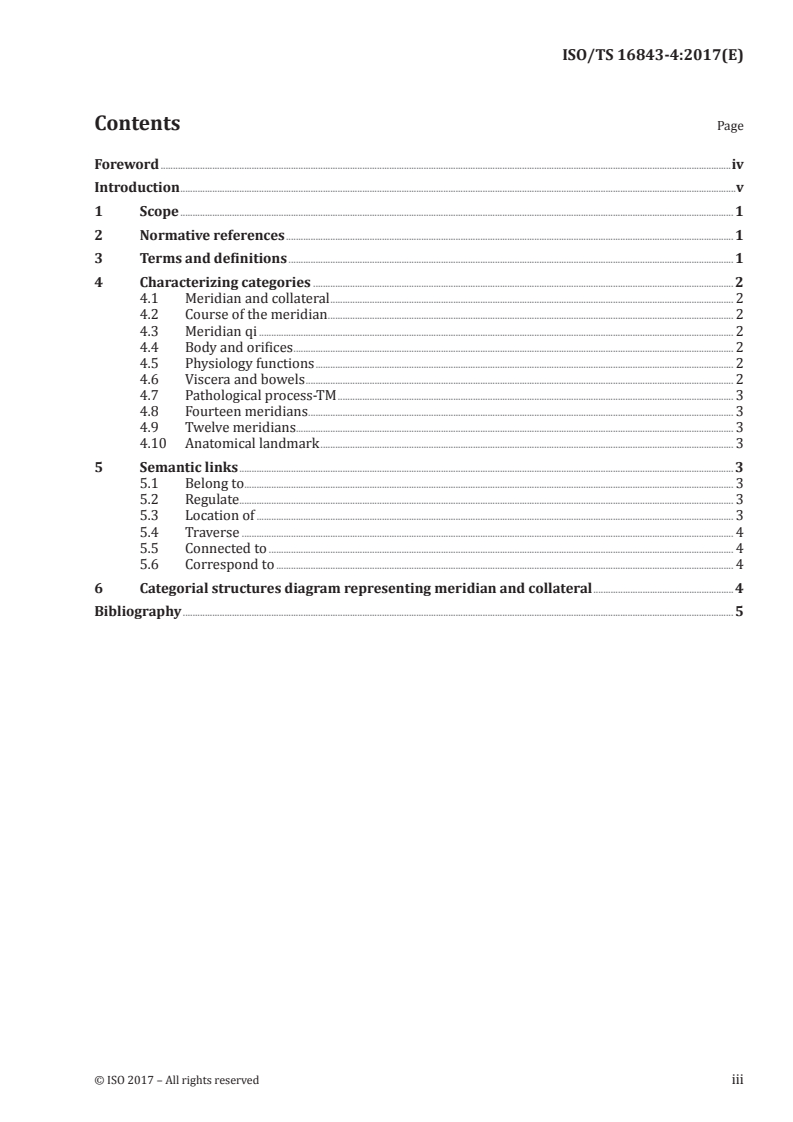
Contents Page
Foreword .iv
Introduction .v
1 Scope . 1
2 Normative references . 1
3 Terms and definitions . 1
4 Characterizing categories . 2
4.1 Meridian and collateral . 2
4.2 Course of the meridian . 2
4.3 Meridian qi . 2
4.4 Body and orifices . 2
4.5 Physiology functions . 2
4.6 Viscera and bowels . 2
4.7 Pathological process-TM . 3
4.8 Fourteen meridians . 3
4.9 Twelve meridians. 3
4.10 Anatomical landmark . 3
5 Semantic links . 3
5.1 Belong to . 3
5.2 Regulate . . 3
5.3 Location of . 3
5.4 Traverse . 4
5.5 Connected to . 4
5.6 Correspond to . 4
6 Categorial structures diagram representing meridian and collateral .4
Bibliography . 5
Foreword
ISO (the International Organization for Standardization) is a worldwide federation of national standards
bodies (ISO member bodies). The work of preparing International Standards is normally carried out
through ISO technical committees. Each member body interested in a subject for which a technical
committee has been established has the right to be represented on that committee. International
organizations, governmental and non-governmental, in liaison with ISO, also take part in the work.
ISO collaborates closely with the International Electrotechnical Commission (IEC) on all matters of
electrotechnical standardization.
The procedures used to develop this document and those intended for its further maintenance are
described in the ISO/IEC Directives, Part 1. In particular the different approval criteria needed for the
different types of ISO documents should be noted. This document was drafted in accordance with the
editorial rules of the ISO/IEC Directives, Part 2 (see www.iso.org/directives).
Attention is drawn to the possibility that some of the elements of this document may be the subject of
patent rights. ISO shall not be held responsible for identifying any or all such patent rights. Details of
any patent rights identified during the development of the document will be in the Introduction and/or
on the ISO list of patent declarations received (see www.iso.org/patents).
Any trade name used in this document is information given for the convenience of users and does not
constitute an endorsement.
For an explanation on the voluntary nature of standards, the meaning of ISO specific terms and
expressions related to conformity assessment, as well as information about ISO's adherence to the
World Trade Organization (WTO) principles in the Technical Barriers to Trade (TBT) see the following
URL: www.iso.org/iso/foreword.html.
This document was prepared by Technical Committee ISO/TC 215, Health informatics.
iv © ISO 2017 – All rights reserved
Introduction
Acupuncture therapy is widely practiced as a part of complementary and alternative medicine in many
countries, both eastern and western.
A guideline for reporting acupuncture intervention in clinical trial is already provided, and a large
number of clinical trials have been conducted to assess the efficiency of acupuncture therapy. However,
the descriptions of meridian and collateral, as an acupuncture intervention in clinical reports, tend
to be insufficient for the interpretation of heterogeneity among trials, often causing difficulties in
synthesizing data in the meta-analysis. This arises from three reasons: firstly, appropriate information
structure of meridian and collateral is not formulated; secondly, peculiar conce
...
TECHNICAL ISO/TS
SPECIFICATION 16843-4
First edition
2017-12
Health informatics — Categorial
structures for representation of
acupuncture —
Part 4:
Meridian and collateral channels
Informatique de santé — Structures catégoriques pour la
représentation de l'acupuncture —
Partie 4: Les méridiens et leurs collatéraux
Reference number
©
ISO 2017
© ISO 2017, Published in Switzerland
All rights reserved. Unless otherwise specified, no part of this publication may be reproduced or utilized otherwise in any form
or by any means, electronic or mechanical, including photocopying, or posting on the internet or an intranet, without prior
written permission. Permission can be requested from either ISO at the address below or ISO’s member body in the country of
the requester.
ISO copyright office
Ch. de Blandonnet 8 • CP 401
CH-1214 Vernier, Geneva, Switzerland
Tel. +41 22 749 01 11
Fax +41 22 749 09 47
copyright@iso.org
www.iso.org
ii © ISO 2017 – All rights reserved
Contents Page
Foreword .iv
Introduction .v
1 Scope . 1
2 Normative references . 1
3 Terms and definitions . 1
4 Characterizing categories . 2
4.1 Meridian and collateral . 2
4.2 Course of the meridian . 2
4.3 Meridian qi . 2
4.4 Body and orifices . 2
4.5 Physiology functions . 2
4.6 Viscera and bowels . 2
4.7 Pathological process-TM . 3
4.8 Fourteen meridians . 3
4.9 Twelve meridians. 3
4.10 Anatomical landmark . 3
5 Semantic links . 3
5.1 Belong to . 3
5.2 Regulate . . 3
5.3 Location of . 3
5.4 Traverse . 4
5.5 Connected to . 4
5.6 Correspond to . 4
6 Categorial structures diagram representing meridian and collateral .4
Bibliography . 5
Foreword
ISO (the International Organization for Standardization) is a worldwide federation of national standards
bodies (ISO member bodies). The work of preparing International Standards is normally carried out
through ISO technical committees. Each member body interested in a subject for which a technical
committee has been established has the right to be represented on that committee. International
organizations, governmental and non-governmental, in liaison with ISO, also take part in the work.
ISO collaborates closely with the International Electrotechnical Commission (IEC) on all matters of
electrotechnical standardization.
The procedures used to develop this document and those intended for its further maintenance are
described in the ISO/IEC Directives, Part 1. In particular the different approval criteria needed for the
different types of ISO documents should be noted. This document was drafted in accordance with the
editorial rules of the ISO/IEC Directives, Part 2 (see www.iso.org/directives).
Attention is drawn to the possibility that some of the elements of this document may be the subject of
patent rights. ISO shall not be held responsible for identifying any or all such patent rights. Details of
any patent rights identified during the development of the document will be in the Introduction and/or
on the ISO list of patent declarations received (see www.iso.org/patents).
Any trade name used in this document is information given for the convenience of users and does not
constitute an endorsement.
For an explanation on the voluntary nature of standards, the meaning of ISO specific terms and
expressions related to conformity assessment, as well as information about ISO's adherence to the
World Trade Organization (WTO) principles in the Technical Barriers to Trade (TBT) see the following
URL: www.iso.org/iso/foreword.html.
This document was prepared by Technical Committee ISO/TC 215, Health informatics.
iv © ISO 2017 – All rights reserved
Introduction
Acupuncture therapy is widely practiced as a part of complementary and alternative medicine in many
countries, both eastern and western.
A guideline for reporting acupuncture intervention in clinical trial is already provided, and a large
number of clinical trials have been conducted to assess the efficiency of acupuncture therapy. However,
the descriptions of meridian and collateral, as an acupuncture intervention in clinical reports, tend
to be insufficient for the interpretation of heterogeneity among trials, often causing difficulties in
synthesizing data in the meta-analysis. This arises from three reasons: firstly, appropriate information
structure of meridian and collateral is not formulated; secondly, peculiar conce
...