

ISO 162:1985
(Main)Cinematography — Head gaps and sound records for three-, four-, or six-track magnetic sound records on 35 mm and single-track on 17,5 mm motion-picture film containing no picture — Positions and width dimensions
General Information
- Abstract
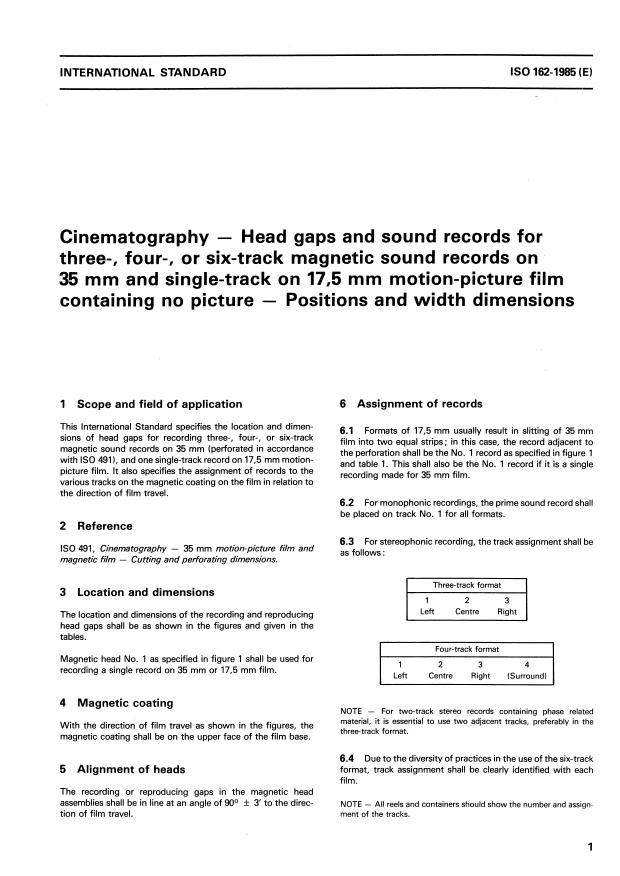
This International Standard specifies the location and dimensions of head gaps for recording three-, four-, or six-track magnetic sound records on 35 mm (perforated in accordance with ISO 491), and one single-track record on 17,5 mm motionpicture film. It also specifies the assignment of records to the various tracks on the magnetic coating on the film in relation to the direction of film travel.
- Status
- Published
- Publication Date
- 21-Aug-1985
- Technical Committee
- ISO/TC 36 - Cinematography
- Drafting Committee
- ISO/TC 36/WG 3 - Audio technology
- Current Stage
- 9093 - International Standard confirmed
- Start Date
- 10-Jul-2023
- Completion Date
- 29-Aug-2026
Buy Documents

ISO 162:1985 - Cinematography — Head gaps and sound records for three-, four-, or six-track magnetic sound records on 35 mm and single-track on 17,5 mm motion-picture film containing no picture — Positions and width dimensions Released:8/22/1985

ISO 162:1985 - Cinématographie — Entrefers et enregistrements sonores sur trois, quatre ou six pistes magnétiques sonores sur film cinématographique de 35 mm et sur une seule piste sur film cinématographique de 17,5 mm sans image — Emplacements et largeurs Released:8/22/1985


ISO 162:1985 - Cinématographie — Entrefers et enregistrements sonores sur trois, quatre ou six pistes magnétiques sonores sur film cinématographique de 35 mm et sur une seule piste sur film cinématographique de 17,5 mm sans image — Emplacements et largeurs Released:8/22/1985
Overview
ISO 162:1985 specifies the location and width dimensions of head gaps for magnetic sound recording on motion-picture film. It covers three-, four- and six-track formats on 35 mm film (perforated per ISO 491) and a single-track format on 17.5 mm film. The standard also defines track assignment rules relative to the direction of film travel and practical guidance to ensure consistent recording and playback.
This standard is essential for manufacturers of magnetic heads, film laboratories, archivists and post-production facilities working with magnetic sound records on motion-picture film.
Key Topics
- Track formats covered: three-, four-, six-track on 35 mm; single-track on 17.5 mm.
- Head gap location and width: the standard defines precise positions and width dimensions (presented in figures and tables within the document) to ensure compatibility between recording and playback equipment.
- Track assignment:
- For monophony, the first recorded track is placed on track no. 1 across formats.
- For stereophonic layouts the standard specifies assignment conventions (e.g., left/center/right in three-track formats; four-track arrangements include an ambience channel). For six-track formats the assignment should be clearly indicated for each film due to varied practices.
- Head alignment: recording and playback head gaps must be aligned at 90° ± 3' to the film travel direction to maintain accurate azimuth and minimize crosstalk.
- Magnetic coating orientation: the magnetic coating must face up (surface magnetic side up) with respect to the indicated direction of film travel.
- 17.5 mm origin: 17.5 mm formats typically result from splitting 35 mm film; when split, the track adjacent to the perforation is designated track 1.
- Interchangeability note: metric dimensions in the tables are based on metric practice and may not be exact conversions; assemblies built to either system should be interchangeable for practical applications.
Applications
- Ensures compatibility between recorders and reproducers in theatrical and archival workflows.
- Guides manufacturers of magnetic heads and film sound equipment on head-gap placement and alignment tolerances.
- Supports film preservation and restoration by standardizing track assignment and orientation to avoid misinterpretation of recorded channels.
- Useful for post-production houses and dubbing facilities that handle multi-track magnetic film formats.
Related Standards
- ISO 491 - Cinematography: 35 mm film dimensions and perforation (referenced for perforation alignment).
- This edition replaces earlier ISO documents and consolidates technical revisions for consistent worldwide practice.
For implementation, consult the full ISO 162:1985 document for the detailed figures and tables that define exact head-gap positions and width dimensions.
Relations
- Effective Date
- 15-Apr-2008
- Effective Date
- 15-Apr-2008
- Effective Date
- 15-Apr-2008
Buy Documents
ISO 162:1985 - Cinematography — Head gaps and sound records for three-, four-, or six-track magnetic sound records on 35 mm and single-track on 17,5 mm motion-picture film containing no picture — Positions and width dimensions Released:8/22/1985
ISO 162:1985 - Cinématographie — Entrefers et enregistrements sonores sur trois, quatre ou six pistes magnétiques sonores sur film cinématographique de 35 mm et sur une seule piste sur film cinématographique de 17,5 mm sans image — Emplacements et largeurs Released:8/22/1985
ISO 162:1985 - Cinématographie — Entrefers et enregistrements sonores sur trois, quatre ou six pistes magnétiques sonores sur film cinématographique de 35 mm et sur une seule piste sur film cinématographique de 17,5 mm sans image — Emplacements et largeurs Released:8/22/1985
Frequently Asked Questions
ISO 162:1985 is a standard published by the International Organization for Standardization (ISO). Its full title is "Cinematography — Head gaps and sound records for three-, four-, or six-track magnetic sound records on 35 mm and single-track on 17,5 mm motion-picture film containing no picture — Positions and width dimensions". This standard covers: This International Standard specifies the location and dimensions of head gaps for recording three-, four-, or six-track magnetic sound records on 35 mm (perforated in accordance with ISO 491), and one single-track record on 17,5 mm motionpicture film. It also specifies the assignment of records to the various tracks on the magnetic coating on the film in relation to the direction of film travel.
This International Standard specifies the location and dimensions of head gaps for recording three-, four-, or six-track magnetic sound records on 35 mm (perforated in accordance with ISO 491), and one single-track record on 17,5 mm motionpicture film. It also specifies the assignment of records to the various tracks on the magnetic coating on the film in relation to the direction of film travel.
ISO 162:1985 is classified under the following ICS (International Classification for Standards) categories: 37.060.20 - Motion picture films. Cartridges. The ICS classification helps identify the subject area and facilitates finding related standards.
ISO 162:1985 has the following relationships with other standards: It is inter standard links to ISO 162:1975, ISO 1753:1975, ISO 360:1975. Understanding these relationships helps ensure you are using the most current and applicable version of the standard.
ISO 162:1985 is available in PDF format for immediate download after purchase. The document can be added to your cart and obtained through the secure checkout process. Digital delivery ensures instant access to the complete standard document.
Standards Content (Sample)
.
Norme internationale
INTERNATIONAL ORGANIZATION FOR STANDARDIZATION.MEX~YHAPO~HAR OPI-AHM3AUMR l-l0 CTAHAAPTM3A~Wl~ORGANISATION INTERNATIONALE DE NORMALISATION
Entrefers et enregistrements sonores
Cinématographie -
sur trois, quatre ou six pistes magnétiques sonores sur
film cinématographique de 35 mm et sur une seule piste
sur film cinématographique de 17,5 mm sans image -
Emplacements et largeurs
- four-, or six-track magnetic sound records on 35 mm and single-
Cinema tograph y Head gaps and sound records for three-,
Positions and width dimensions
track on 17,5 mm motion-picture film containing no picture -
Deuxième édition - 1985-08-15
Réf. no : ISO 162-1985 (F)
CDU 778.534.425 : 771.531.351
enregistrement magnétique, instrument
Descripteurs : cinématographie, film cinématographique, enregistrement du son, reproduction sonore,
enregistreur, tête magnétique, position, dimension.
cn
Prix basé sur 2 pages
Avant-propos
L’ISO (Organisation internationale de normalisation) est une féderation mondiale
d’organismes nationaux de normalisation (comités membres de I’ISO). L’élaboration
des Normes internationales est confiée aux comités techniques de I’ISO. Chaque
comité membre intéressé par une étude a le droit de faire partie du comité technique
créé a cet effet. Les organisations internationales, gouvernementales et non gouverne-
mentales, en liaison avec I’ISO, participent également aux travaux.
Les projets de Normes internationales adoptés par les comités techniques sont soumis
aux comités membres pour approbation, avant leur acceptation comme Normes inter-
nationales par le Conseil de I’ISO. Les Normes internationales sont approuvées confor-
mément aux procédures de I’ISO qui requiérent l’approbation de 75 % au moins des
comités membres votants.
La Norme internationale ISO l-62 a été élaborée par le comité technique ISO/TC 36,
Cinématographie.
’ La Norme internationale ISO 162 a été pour la Premiere fois publiée en 1975. Cette
deuxiéme édition annule et remplace la première édition, I’ISO 360 et I’ISO 1753, dont
elle constitue une révision technique.
0 Organisation internationale de normalisation, 1985
Imprimé en Suisse
ISO 162-1985 (F)
NORME INTERNATIONALE
Entrefers et enregistrements sonores
Cinématographie -
sur trois, quatre ou six pistes magnétiques sonores sur
film cinématographique de 35 mm et sur une seule piste
sur film cinématographique de 17,5 mm sans image -
Emplacements et largeurs
6 Affectation des enregistrements
1 Objet et domaine d’application
La présente Norme internationale spécifie l’emplacement et les
6.1 Les formats 17,5 mm résultent généralement du fendage
dimensions des entrefers pour l’enregistrement sur trois, quatre
en longueur et en deux parties égales d’un film de 35 mm;
ou six pistes magnétiques sonores sur film cinématographique
l’enregistrement situé près de la perforation étant dans ce cas
de 35 mm (perforé conformément à VIS0 491) et sur une seule
l’enregistrement no 1 ainsi que spécifié dans la figure 1 et dans
piste sur film cinématographique de 17,5 mm. Elle spécifie éga-
le tableau 1. Cet enregistrement est également le no 1 s’il s’agit
lement l’affectation des enregistrements pour les différentes
...
.
Norme internationale
INTERNATIONAL ORGANIZATION FOR STANDARDIZATION.MEX~YHAPO~HAR OPI-AHM3AUMR l-l0 CTAHAAPTM3A~Wl~ORGANISATION INTERNATIONALE DE NORMALISATION
Entrefers et enregistrements sonores
Cinématographie -
sur trois, quatre ou six pistes magnétiques sonores sur
film cinématographique de 35 mm et sur une seule piste
sur film cinématographique de 17,5 mm sans image -
Emplacements et largeurs
- four-, or six-track magnetic sound records on 35 mm and single-
Cinema tograph y Head gaps and sound records for three-,
Positions and width dimensions
track on 17,5 mm motion-picture film containing no picture -
Deuxième édition - 1985-08-15
Réf. no : ISO 162-1985 (F)
CDU 778.534.425 : 771.531.351
enregistrement magnétique, instrument
Descripteurs : cinématographie, film cinématographique, enregistrement du son, reproduction sonore,
enregistreur, tête magnétique, position, dimension.
cn
Prix basé sur 2 pages
Avant-propos
L’ISO (Organisation internationale de normalisation) est une féderation mondiale
d’organismes nationaux de normalisation (comités membres de I’ISO). L’élaboration
des Normes internationales est confiée aux comités techniques de I’ISO. Chaque
comité membre intéressé par une étude a le droit de faire partie du comité technique
créé a cet effet. Les organisations internationales, gouvernementales et non gouverne-
mentales, en liaison avec I’ISO, participent également aux travaux.
Les projets de Normes internationales adoptés par les comités techniques sont soumis
aux comités membres pour approbation, avant leur acceptation comme Normes inter-
nationales par le Conseil de I’ISO. Les Normes internationales sont approuvées confor-
mément aux procédures de I’ISO qui requiérent l’approbation de 75 % au moins des
comités membres votants.
La Norme internationale ISO l-62 a été élaborée par le comité technique ISO/TC 36,
Cinématographie.
’ La Norme internationale ISO 162 a été pour la Premiere fois publiée en 1975. Cette
deuxiéme édition annule et remplace la première édition, I’ISO 360 et I’ISO 1753, dont
elle constitue une révision technique.
0 Organisation internationale de normalisation, 1985
Imprimé en Suisse
ISO 162-1985 (F)
NORME INTERNATIONALE
Entrefers et enregistrements sonores
Cinématographie -
sur trois, quatre ou six pistes magnétiques sonores sur
film cinématographique de 35 mm et sur une seule piste
sur film cinématographique de 17,5 mm sans image -
Emplacements et largeurs
6 Affectation des enregistrements
1 Objet et domaine d’application
La présente Norme internationale spécifie l’emplacement et les
6.1 Les formats 17,5 mm résultent généralement du fendage
dimensions des entrefers pour l’enregistrement sur trois, quatre
en longueur et en deux parties égales d’un film de 35 mm;
ou six pistes magnétiques sonores sur film cinématographique
l’enregistrement situé près de la perforation étant dans ce cas
de 35 mm (perforé conformément à VIS0 491) et sur une seule
l’enregistrement no 1 ainsi que spécifié dans la figure 1 et dans
piste sur film cinématographique de 17,5 mm. Elle spécifie éga-
le tableau 1. Cet enregistrement est également le no 1 s’il s’agit
lement l’affectation des enregistrements pour les différentes
...