

ISO/IEC 27035-2:2023
(Main)Information technology — Information security incident management — Part 2: Guidelines to plan and prepare for incident response
General Information
- Abstract
This document provides guidelines to plan and prepare for incident response and to learn lessons from incident response. The guidelines are based on the “plan and prepare” and “learn lessons” phases of the information security incident management phases model presented in ISO/IEC 27035-1:2023, 5.2 and 5.6. The major points within the “plan and prepare” phase include: — information security incident management policy and commitment of top management; — information security policies, including those relating to risk management, updated at both organizational level and system, service and network levels; — information security incident management plan; — Incident Management Team (IMT) establishment; — establishing relationships and connections with internal and external organizations; — technical and other support (including organizational and operational support); — information security incident management awareness briefings and training. The “learn lessons” phase includes: — identifying areas for improvement; — identifying and making necessary improvements; — Incident Response Team (IRT) evaluation. The guidance given in this document is generic and intended to be applicable to all organizations, regardless of type, size or nature. Organizations can adjust the guidance given in this document according to their type, size and nature of business in relation to the information security risk situation. This document is also applicable to external organizations providing information security incident management services.
- Status
- Published
- Publication Date
- 12-Feb-2023
- Drafting Committee
- ISO/IEC JTC 1/SC 27/WG 4 - Security controls and services
- Current Stage
- 6060 - International Standard published
- Start Date
- 13-Feb-2023
- Due Date
- 08-Jul-2023
- Completion Date
- 13-Feb-2023
Buy Documents

ISO/IEC 27035-2:2023 - Information technology — Information security incident management — Part 2: Guidelines to plan and prepare for incident response Released:10/11/2022

REDLINE ISO/IEC 27035-2:2023 - Information technology — Information security incident management — Part 2: Guidelines to plan and prepare for incident response Released:10/11/2022

ISO/IEC 27035-2:2023 - Information technology — Information security incident management — Part 2: Guidelines to plan and prepare for incident response Released:2/13/2023
Overview
ISO/IEC 27035-2:2023 - "Information technology - Information security incident management - Part 2: Guidelines to plan and prepare for incident response" provides practical, generic guidance for organizations to plan, prepare and learn from information security incidents. It focuses on the “plan and prepare” and “learn lessons” phases of the incident management lifecycle defined in ISO/IEC 27035-1:2023. The standard is applicable to organizations of any type or size and to external providers of incident management services.
Key topics and technical requirements
ISO/IEC 27035-2:2023 covers the essential elements required to build an effective incident response capability, including:
- Governance and policy
- Information security incident management policy and top management commitment
- Alignment with organizational information security and risk-management policies
- Incident management planning
- Creation of an Information Security Incident Management Plan and linked documentation
- Incident classification scale, forms and documented processes
- Organizational roles
- Establishment of an Incident Management Team (IMT) and Incident Response Team (IRT) with defined roles, responsibilities and competency requirements
- Relationships and support
- Internal and external stakeholder engagement (legal, HR, vendors, law enforcement)
- Technical, operational and third‑party support arrangements
- Capability development
- Awareness briefings, training programs, exercises and testing of the incident management plan
- Monitoring, metrics and governance of incident response capability
- Learn lessons
- Post-incident review, identification of improvements, IRT evaluation and updates to policies and controls
- Practical adjuncts
- Guidance on legal/regulatory considerations, example forms, and approaches to categorization, evaluation and prioritization
Practical applications - who should use it
ISO/IEC 27035-2:2023 is intended for:
- Security managers designing or improving an incident response program
- IT and SOC teams building operational IRT capabilities and playbooks
- Risk and compliance officers aligning incident processes with governance and legal requirements
- Third‑party incident response service providers and managed security service providers (MSSPs)
- Executive leadership seeking to ensure organizational readiness and incident governance
Benefits include improved detection-to-response times, clearer escalation paths, consistent incident classification, and structured post‑incident learning to reduce recurrence.
Related standards
- ISO/IEC 27035-1:2023 - incident management lifecycle and concepts (companion to Part 2)
- Complementary guidance: ISO/IEC 27001 and ISO/IEC 27002 for broader information security management and controls
Keywords: ISO/IEC 27035-2:2023, information security incident management, incident response planning, Incident Management Team, Incident Response Team, lessons learned, incident classification, security incident handling.
Relations
- Effective Date
- 23-Apr-2020
Buy Documents
ISO/IEC 27035-2:2023 - Information technology — Information security incident management — Part 2: Guidelines to plan and prepare for incident response Released:10/11/2022
REDLINE ISO/IEC 27035-2:2023 - Information technology — Information security incident management — Part 2: Guidelines to plan and prepare for incident response Released:10/11/2022
ISO/IEC 27035-2:2023 - Information technology — Information security incident management — Part 2: Guidelines to plan and prepare for incident response Released:2/13/2023
Get Certified
Connect with accredited certification bodies for this standard

BSI Group
BSI (British Standards Institution) is the business standards company that helps organizations make excellence a habit.

Bureau Veritas
Bureau Veritas is a world leader in laboratory testing, inspection and certification services.

DNV
DNV is an independent assurance and risk management provider.
Sponsored listings
Frequently Asked Questions
ISO/IEC 27035-2:2023 is a standard published by the International Organization for Standardization (ISO). Its full title is "Information technology — Information security incident management — Part 2: Guidelines to plan and prepare for incident response". This standard covers: This document provides guidelines to plan and prepare for incident response and to learn lessons from incident response. The guidelines are based on the “plan and prepare” and “learn lessons” phases of the information security incident management phases model presented in ISO/IEC 27035-1:2023, 5.2 and 5.6. The major points within the “plan and prepare” phase include: — information security incident management policy and commitment of top management; — information security policies, including those relating to risk management, updated at both organizational level and system, service and network levels; — information security incident management plan; — Incident Management Team (IMT) establishment; — establishing relationships and connections with internal and external organizations; — technical and other support (including organizational and operational support); — information security incident management awareness briefings and training. The “learn lessons” phase includes: — identifying areas for improvement; — identifying and making necessary improvements; — Incident Response Team (IRT) evaluation. The guidance given in this document is generic and intended to be applicable to all organizations, regardless of type, size or nature. Organizations can adjust the guidance given in this document according to their type, size and nature of business in relation to the information security risk situation. This document is also applicable to external organizations providing information security incident management services.
This document provides guidelines to plan and prepare for incident response and to learn lessons from incident response. The guidelines are based on the “plan and prepare” and “learn lessons” phases of the information security incident management phases model presented in ISO/IEC 27035-1:2023, 5.2 and 5.6. The major points within the “plan and prepare” phase include: — information security incident management policy and commitment of top management; — information security policies, including those relating to risk management, updated at both organizational level and system, service and network levels; — information security incident management plan; — Incident Management Team (IMT) establishment; — establishing relationships and connections with internal and external organizations; — technical and other support (including organizational and operational support); — information security incident management awareness briefings and training. The “learn lessons” phase includes: — identifying areas for improvement; — identifying and making necessary improvements; — Incident Response Team (IRT) evaluation. The guidance given in this document is generic and intended to be applicable to all organizations, regardless of type, size or nature. Organizations can adjust the guidance given in this document according to their type, size and nature of business in relation to the information security risk situation. This document is also applicable to external organizations providing information security incident management services.
ISO/IEC 27035-2:2023 is classified under the following ICS (International Classification for Standards) categories: 35.030 - IT Security. The ICS classification helps identify the subject area and facilitates finding related standards.
ISO/IEC 27035-2:2023 has the following relationships with other standards: It is inter standard links to ISO/IEC 27035-2:2016. Understanding these relationships helps ensure you are using the most current and applicable version of the standard.
ISO/IEC 27035-2:2023 is available in PDF format for immediate download after purchase. The document can be added to your cart and obtained through the secure checkout process. Digital delivery ensures instant access to the complete standard document.
Standards Content (Sample)
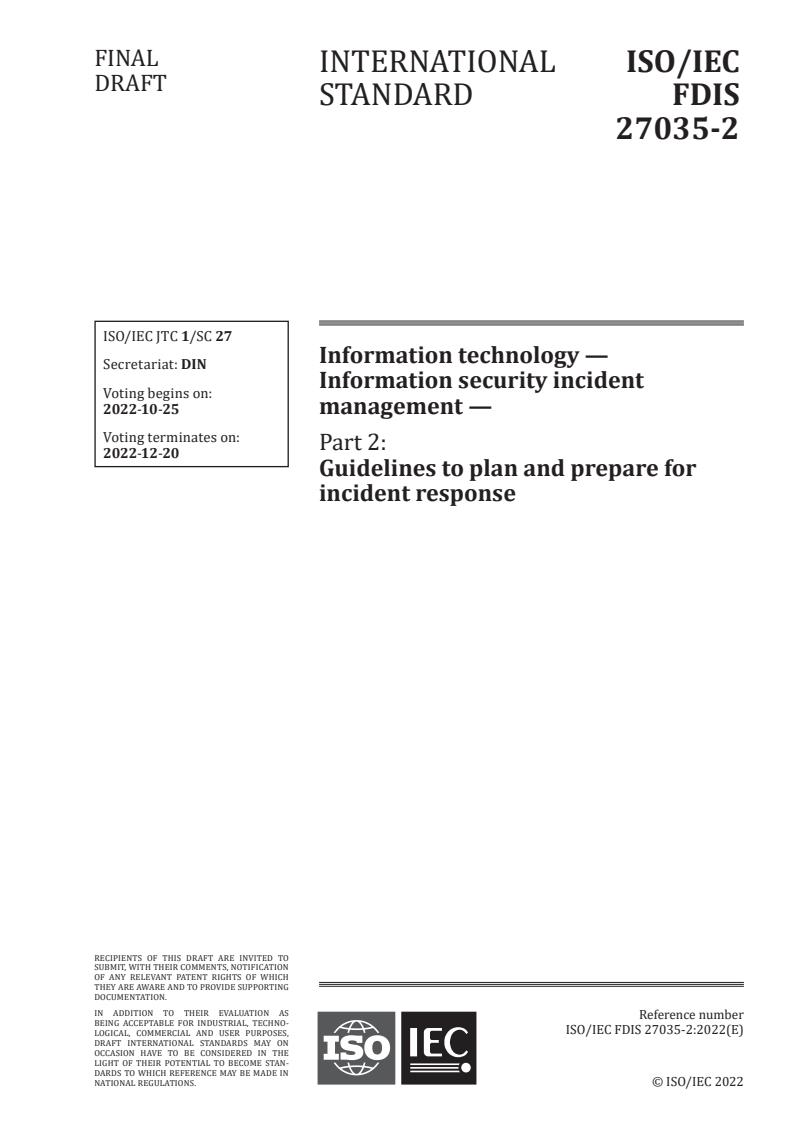
FINAL
INTERNATIONAL ISO/IEC
DRAFT
STANDARD FDIS
27035-2
ISO/IEC JTC 1/SC 27
Information technology —
Secretariat: DIN
Information security incident
Voting begins on:
2022-10-25 management —
Voting terminates on:
Part 2:
2022-12-20
Guidelines to plan and prepare for
incident response
RECIPIENTS OF THIS DRAFT ARE INVITED TO
SUBMIT, WITH THEIR COMMENTS, NOTIFICATION
OF ANY RELEVANT PATENT RIGHTS OF WHICH
THEY ARE AWARE AND TO PROVIDE SUPPOR TING
DOCUMENTATION.
IN ADDITION TO THEIR EVALUATION AS
Reference number
BEING ACCEPTABLE FOR INDUSTRIAL, TECHNO-
ISO/IEC FDIS 27035-2:2022(E)
LOGICAL, COMMERCIAL AND USER PURPOSES,
DRAFT INTERNATIONAL STANDARDS MAY ON
OCCASION HAVE TO BE CONSIDERED IN THE
LIGHT OF THEIR POTENTIAL TO BECOME STAN-
DARDS TO WHICH REFERENCE MAY BE MADE IN
NATIONAL REGULATIONS. © ISO/IEC 2022
ISO/IEC FDIS 27035-2:2022(E)
FINAL
INTERNATIONAL ISO/IEC
DRAFT
STANDARD FDIS
27035-2
ISO/IEC JTC 1/SC 27
Information technology —
Secretariat: DIN
Information security incident
Voting begins on:
management —
Voting terminates on:
Part 2:
Guidelines to plan and prepare for
incident response
© ISO/IEC 2022
All rights reserved. Unless otherwise specified, or required in the context of its implementation, no part of this publication may
be reproduced or utilized otherwise in any form or by any means, electronic or mechanical, including photocopying, or posting on
the internet or an intranet, without prior written permission. Permission can be requested from either ISO at the address below
or ISO’s member body in the country of the requester.
RECIPIENTS OF THIS DRAFT ARE INVITED TO
ISO copyright office
SUBMIT, WITH THEIR COMMENTS, NOTIFICATION
OF ANY RELEVANT PATENT RIGHTS OF WHICH
CP 401 • Ch. de Blandonnet 8
THEY ARE AWARE AND TO PROVIDE SUPPOR TING
CH-1214 Vernier, Geneva
DOCUMENTATION.
Phone: +41 22 749 01 11
IN ADDITION TO THEIR EVALUATION AS
Reference number
Email: copyright@iso.org
BEING ACCEPTABLE FOR INDUSTRIAL, TECHNO
ISO/IEC FDIS 270352:2022(E)
Website: www.iso.org
LOGICAL, COMMERCIAL AND USER PURPOSES,
DRAFT INTERNATIONAL STANDARDS MAY ON
Published in Switzerland
OCCASION HAVE TO BE CONSIDERED IN THE
LIGHT OF THEIR POTENTIAL TO BECOME STAN
DARDS TO WHICH REFERENCE MAY BE MADE IN
ii
© ISO/IEC 2022 – All rights reserved
NATIONAL REGULATIONS. © ISO/IEC 2022
ISO/IEC FDIS 27035-2:2022(E)
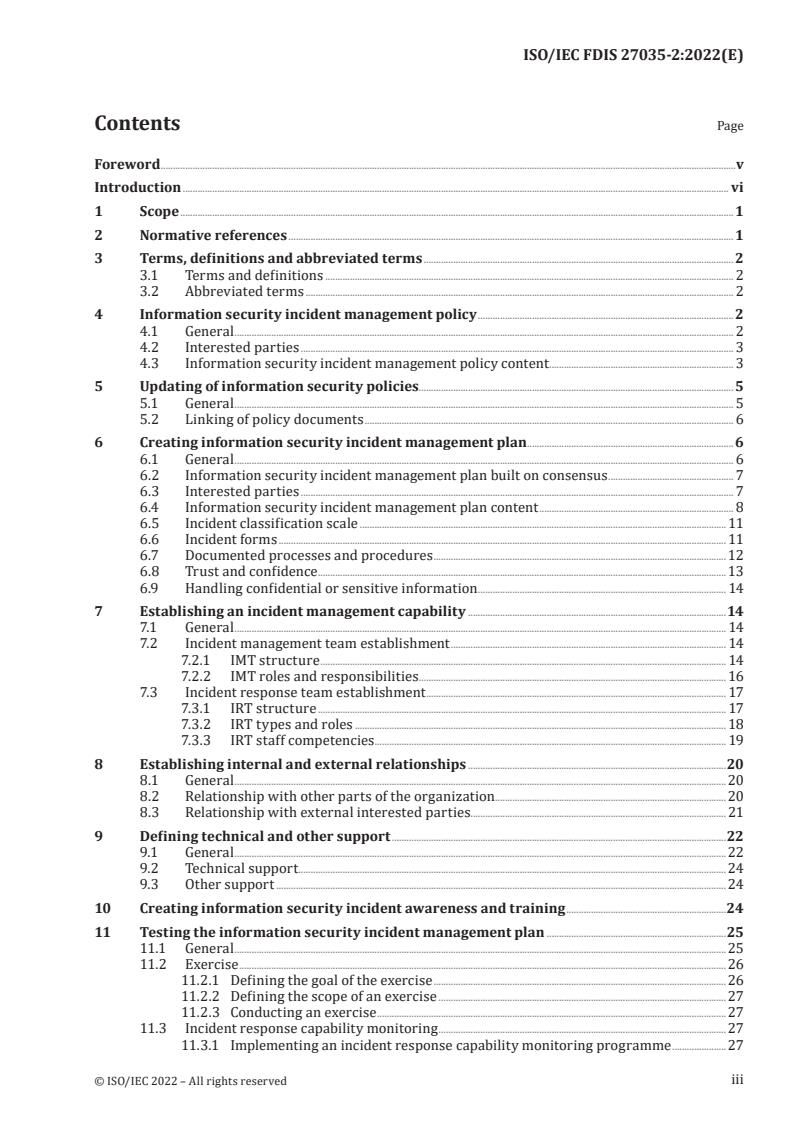
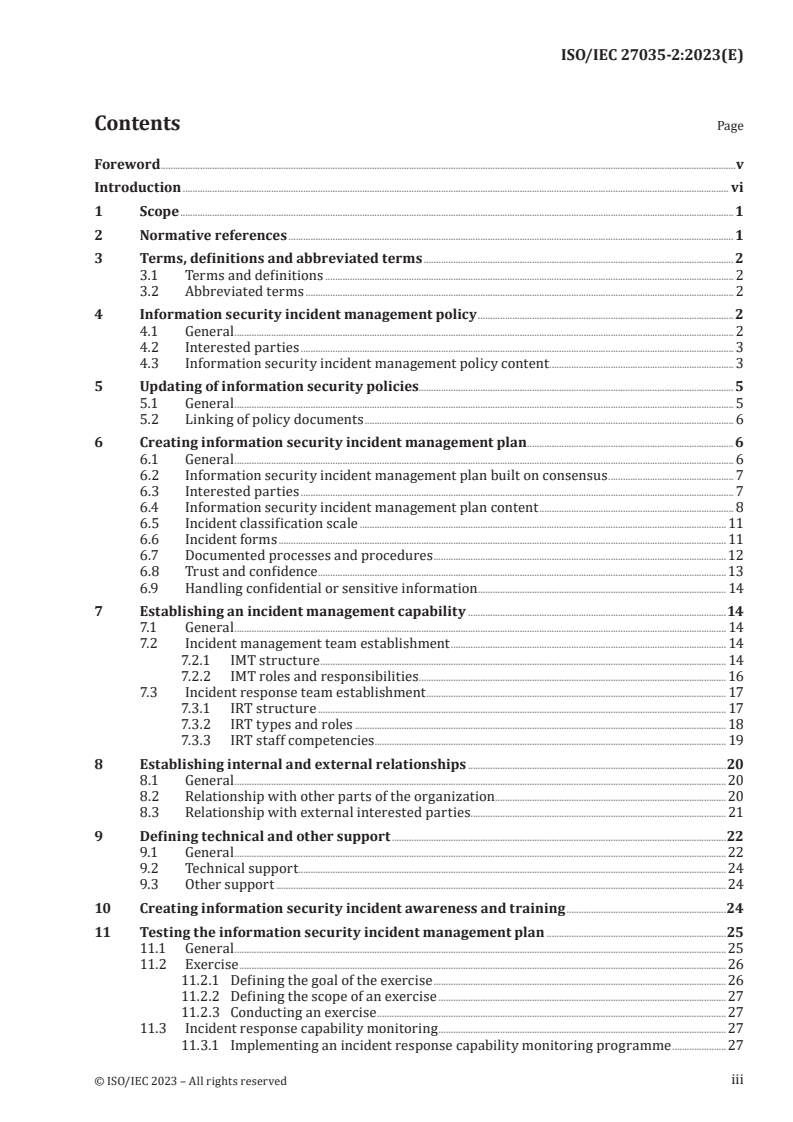
Contents Page
Foreword .v
Introduction . vi
1 Scope . 1
2 Normative references . 1
3 Terms, definitions and abbreviated terms . 2
3.1 Terms and definitions . 2
3.2 Abbreviated terms . 2
4 Information security incident management policy . 2
4.1 General . 2
4.2 Interested parties . 3
4.3 Information security incident management policy content . 3
5 Updating of information security policies. 5
5.1 General . 5
5.2 Linking of policy documents . 6
6 Creating information security incident management plan . 6
6.1 General . 6
6.2 Information security incident management plan built on consensus . 7
6.3 Interested parties . 7
6.4 Information security incident management plan content . 8
6.5 Incident classification scale . 11
6.6 Incident forms . 11
6.7 Documented processes and procedures .12
6.8 Trust and confidence .13
6.9 Handling confidential or sensitive information . 14
7 Establishing an incident management capability .14
7.1 General . 14
7.2 Incident management team establishment . 14
7.2.1 IMT structure . 14
7.2.2 IMT roles and responsibilities . 16
7.3 Incident response team establishment . 17
7.3.1 IRT structure . 17
7.3.2 IRT types and roles . 18
7.3.3 IRT staff competencies . . 19
8 Establishing internal and external relationships .20
8.1 General . 20
8.2 Relationship with other parts of the organization . 20
8.3 Relationship with external interested parties. 21
9 Defining technical and other support .22
9.1 General .22
9.2 Technical support . . 24
9.3 Other support . 24
10 Creating information security incident awareness and training .24
11 Testing the information security incident management plan .25
11.1 General . 25
11.2 Exercise . 26
11.2.1 Defining the goal of the exercise . 26
11.2.2 Defining the scope of an exercise . 27
11.2.3 Conducting an exercise . 27
11.3 Incident response capability monitoring . 27
11.3.1 Implementing an incident response capability monitoring programme . 27
iii
© ISO/IEC 2022 – All rights reserved
ISO/IEC FDIS 27035-2:2022(E)
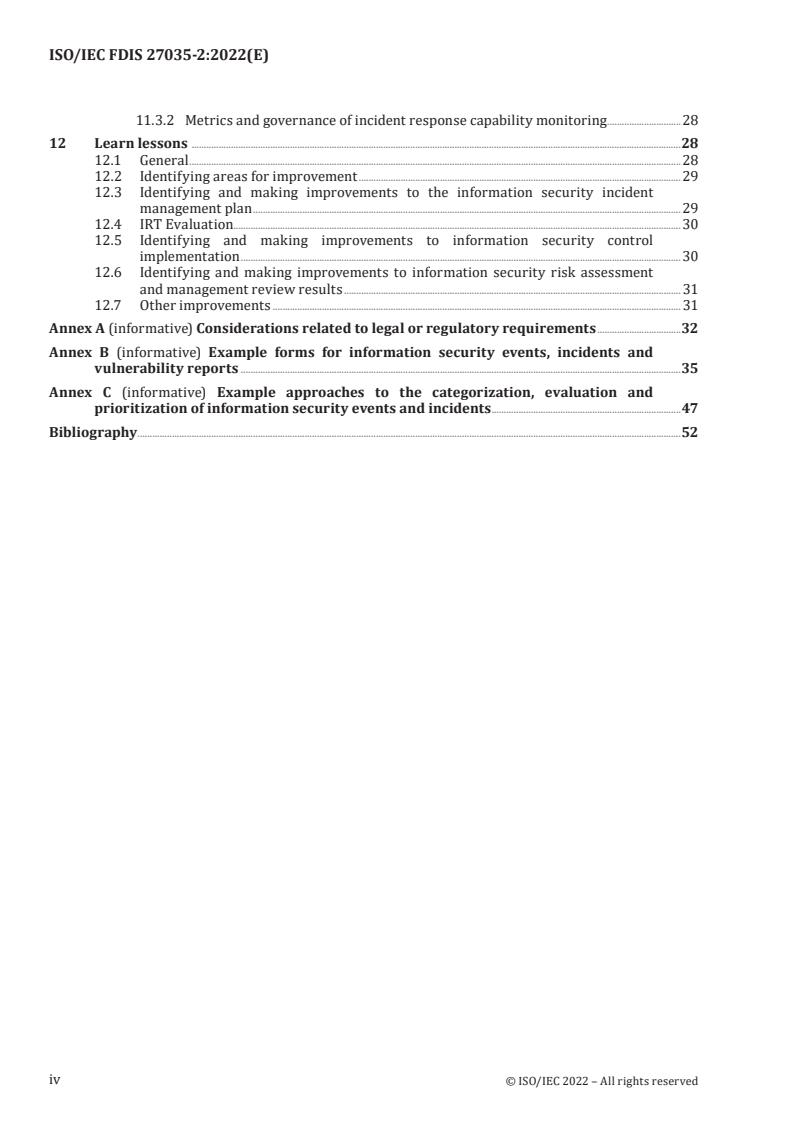
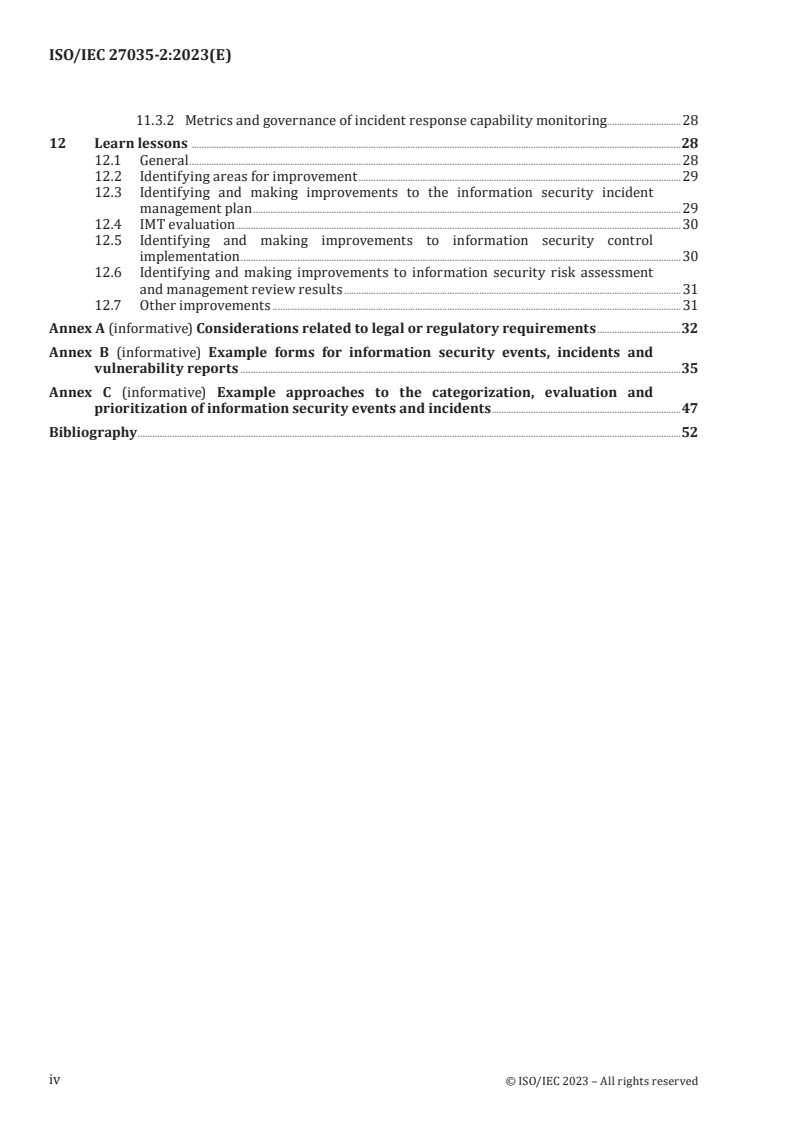
11.3.2 Metrics and governance of incident response capability monitoring .28
12 Learn lessons .28
12.1 General .28
12.2 Identifying areas for improvement .29
12.3 Identifying and making improvements to the information security incident
management plan .29
12.4 IRT Evaluation.30
12.5 Identifying and making improvements to information security control
implementation .30
12.6 Identifying and making improvements to information security risk assessment
and management review results . 31
12.7 Other improvements . 31
Annex A (informative) Considerations related to legal or regulatory requirements .32
Annex B (informative) Example forms for information security events, incidents and
vulnerability reports .35
Annex C (informative) Example approaches to the categorization, evaluation and
prioritization of information security events and incidents .47
Bibliography .52
iv
© ISO/IEC 2022 – All rights reserved
ISO/IEC FDIS 27035-2:2022(E)
Foreword
ISO (the International Organization for Standardization) and IEC (the International Electrotechnical
Commission) form the specialized system for worldwide standardization. National bodies that are
members of ISO or IEC participate in the development of International Standards through technical
committees established by the respective organization to deal with particular fields of technical
activity. ISO and IEC technical committees collaborate in fields of mutual interest. Other international
organizations, governmental and nongovernmental, in liaison with ISO and IEC, also take part in the
work.
The procedures used to develop this document and those intended for its further maintenance
are described in the ISO/IEC Directives, Part 1. In particular, the different approval criteria
needed for the different types of document should be noted. This document was drafted in
accordance with the editorial rules of the ISO/IEC Directives, Part 2 (see www.iso.org/directives or
www.iec.ch/members_experts/refdocs).
Attention is drawn to the possibility that some of the elements of this document may be the subject
of patent rights. ISO and IEC shall not be held responsible for identifying any or all such patent
rights. Details of any patent rights identified during the development of the document will be in the
Introduction and/or on the ISO list of patent declarations received (see www.iso.org/patents) or the IEC
list of patent declarations received (see https://patents.iec.ch).
Any trade name used in this document is information given for the convenience of users and does not
constitute an endorsement.
For an explanation of the voluntary nature of standards, the meaning of ISO specific terms and
expressions related to conformity assessment, as well as information about ISO's adherence to
the World Trade Organization (WTO) principles in the Technical Barriers to Trade (TBT) see
www.iso.org/iso/foreword.html. In the IEC, see www.iec.ch/understandingstandards.
This document was prepared by Technical Committee ISO/IEC JTC 1, Information technology,
Subcommittee SC 27, Information security, cybersecurity and privacy protection.
This second edition cancels and replaces the first edition (ISO/IEC 27035-2:2016), which has been
technically revised.
The main changes are as follows:
— the title has been modified;
— new roles including incident management team and incident coordinator and their responsibilities
have been added;
— content related to vulnerability management has been modified;
— content on a recommended process for organizations has been added in 6.7;
— Clause 7 structure has been reorganized;
— C.3 has been replaced by a single paragraph;
— bibliography has been updated;
— document has been aligned with the ISO/IEC Directives Part 2, 2021.
A list of all parts in the ISO/IEC 27035 series can be found on the ISO and IEC websites.
Any feedback or questions on this document should be directed to the user’s national standards
body. A complete listing of these bodies can be found at www.iso.org/members.html and
www.iec.ch/nationalcommittees.
v
© ISO/IEC 2022 – All rights reserved
ISO/IEC FDIS 27035-2:2022(E)
Introduction
This document focuses on information security incident management which is identified in
ISO/IEC 27000 as one of the critical success factors for the information security management system.
There can be a large gap between an organization’s plan for an incident and an organization's
preparedness for an incident. Therefore, this document addresses the development of procedures to
increase the confidence of an organization’s actual readiness to respond to an information security
incident. This is achieved by addressing the policies and plans associated with incident management,
as well as the process for establishing the incident response team and improving its performance over
time by adopting lessons learned and by evaluation.
vi
© ISO/IEC 2022 – All rights reserved
FINAL DRAFT INTERNATIONAL STANDARD ISO/IEC FDIS 27035-2:2022(E)
Information technology — Information security incident
management —
Part 2:
Guidelines to plan and prepare for incident response
1 Scope
This document provides guidelines to plan and prepare for incident response and to learn lessons from
incident response. The guidelines are based on the “plan and prepare” and “learn lessons” phases of the
1)
information security incident management phases model presented in ISO/IEC 27035-1:— , 5.2 and
5.6.
The major points within the “plan and prepare” phase include:
— information security incident management policy and commitment of top management;
— information security policies, including those relating to risk management, updated at both
organizational level and system, service and network levels;
— information security incident management plan;
— Incident Management Team (IMT) establishment;
— establishing relationships and connections with internal and external organizations;
— technical and other support (including organizational and operational support);
— information security incident management awareness briefings and training.
The “learn lessons” phase includes:
— identifying areas for improvement;
— identifying and making necessary improvements;
— Incident Response Team (IRT) evaluation.
The guidance given in this document is generic and intended to be applicable to all organizations,
regardless of type, size or nature. Organizations can adjust the guidance given in this document
according to their type, size and nature of business in relation to the information security risk situation.
This document is also applicable to external organizations providing information security incident
management services.
2 Normative references
The following documents are referred to in the text in such a way that some or all of their content
constitutes requirements of this document. For dated references, only the edition cited applies. For
undated references, the latest edition of the referenced document (including any amendments) applies.
ISO/IEC 27000, Information technology — Security techniques — Information security management
systems — Overview and vocabulary
1) Under preparation. Stage at the time of publication: ISO/IEC/FDIS 270351:2022.
© ISO/IEC 2022 – All rights reserved
ISO/IEC FDIS 27035-2:2022(E)
1)
ISO/IEC 270351:— , Information technology — Information security incident management — Part 1:
Principles and process
3 Terms, definitions and abbreviated terms
3.1 Terms and definitions
For the purposes of this document, the terms and definitions given in ISO/IEC 27000 and ISO/IEC 27035-1
apply.
ISO and IEC maintain terminology databases for use in standardization at the following addresses:
— ISO Online browsing platform: available at https:// www .iso .org/ obp
— IEC Electropedia: available at https:// www .electropedia .org/
3.2 Abbreviated terms
CERT computer emergency response team
CSIRT computer security incident response team
IMT Incident Management Team
IRT Incident Response Team
PoC Point of Contact
4 Information security incident management policy
4.1 General
1)
NOTE Clause 4, in its entirety, links to ISO/IEC 27035-1:— , 5.2 a).
An organization's information security incident management policy should provide the formally
documented principles and intentions used to direct decisionmaking. Supporting processes and
procedures ensures consistent application of the policy.
Any information security incident management policy should be part of the information security
strategy for an organization. It should also support the existing mission of its parent organization and
be in line with already existing policies and procedures.
An organization should implement an information security incident management policy that outlines
the processes, responsible persons, authority and reporting lines when an information security event/
incident occurs. The policy should be reviewed regularly to ensure it reflects the latest organizational
structure, processes, and technology that can affect incident management. The policy should also
outline any awareness and training initiatives within the organization that are related to incident
management (see Clause 10).
An organization should document its policy for managing information security events, incidents and
vulnerabilities as a free-standing document, as part of its overall information security management
2)
system policy (see ISO/IEC 27001:— , 5.2), or as part of its information security policies (see
ISO/IEC 27002:2022, 5.1). The size, structure and business nature of an organization and the extent of
its information security incident management programme are deciding factors in determining which
of these options to adopt. An organization should direct its information security incident management
policy at every person having legitimate access to its information systems and related locations.
2) Under preparation. Stage at the time of publication ISO/IEC FDIS 27001:2022.
© ISO/IEC 2022 – All rights reserved
ISO/IEC FDIS 27035-2:2022(E)
Before the information security incident management policy is formulated, the organization should
identify the following regarding its information security incident management:
a) principles, objectives and purpose;
b) the scope, including not only which parts of the organization it applies to, but also what information
it applies to e.g. hardcopy, electronic, verbal;
c) internal and external interested parties;
d) specific incident types and vulnerabilities that are controlled, responded to and resolved;
e) any specific roles that are involved;
f) benefits to the whole organization and to its departments;
g) understanding of its legal and regulatory environment;
h) dependencies including alignment to risk management;
i) skills and competency requirements.
4.2 Interested parties
A successful information security incident management policy should be created and implemented
as an enterprisewide process. To that end, all interested parties or their representatives should be
involved in the development of the policy from the initial planning stages through to the implementation
of any process or response team. This may include legal advisors, public relations and marketing staff,
departmental managers, security staff, ICT responsible persons, upper-level management, and, in some
cases, even facilities and human resources staff.
An organization should ensure that its information security incident management policy is approved by
top management.
Ensuring continued management commitment is vital for the acceptance of a structured approach to
information security incident management. It is important that personnel recognize an event, know
what to do and understand the benefits of the approach by the organization. It is also important that
management is supportive of the information security incident management policy to ensure that the
organization commits to resourcing and maintaining an incident management capability.
The information security incident management policy should be made available to every employee and
contractor. It should also be addressed in information security awareness briefings and training.
4.3 Information security incident management policy content
The information security incident management policy should be high-level. Detailed information and
step-by-step instructions should be included in the series of documents that make up the information
security incident management plan, which is outlined in Clause 6.
An organization should ensure that its information security incident management policy content
addresses, but is not limited to, the following topics:
a) the purpose, objectives and the scope (to whom it applies and under what circumstances) of the
policy;
b) policy owner and review cycle;
c) the importance of information security incident management to the organization, top management's
commitment to it and the related plan documentation;
d) a definition of security incident;
© ISO/IEC 2022 – All rights reserved
ISO/IEC FDIS 27035-2:2022(E)
e) a description of the type of security incidents or categories (or a reference to another document
which describes this in more depth);
f) a description of how incidents should be reported, including what to report, the mechanisms used
for reporting, where and to whom to report;
g) a high-level overview or visualization of the incident management process flow (showing the basic
steps for handling a security incident) encompassing detection and reporting, assessment and
decision, response and lessons learned;
h) a requirement for post information security incident resolution activities, including learning from
and improving the process, following the resolution of information security incidents;
i) if appropriate, also a summary of reporting and handling vulnerabilities that are related to incident
(although this can be a separate document);
j) a defined set of roles, responsibilities, and decision-making authority for each phase of the
information security incident management process and related activities (including reporting and
handling vulnerabilities that are related to incident if appropriate);
k) a reference to the document describing the event and incident classification, severity ratings (if
used) and related terms;
l) an overview of the IMT, encompassing the IMT organizational structure, key roles, responsibilities,
and authority, along with summary of duties including, but not limited to:
1) reporting and notification requirements related to incidents that have been confirmed,
2) dealing with enquiries, instigating follow-up, and resolving incidents,
3) liaising with the external organizations (when necessary),
4) requirement and rationale for ensuring all information security incident management activities
performed by the IRT are properly logged for later analysis;
m) requirements for establishing/terminating IRTs to respond to specific incidents which have
different scopes and expertise depending on the incident. Several IRTs may exist, depending on the
aspect of business that is affected by the incident;
n) a requirement that components across the organization work in collaboration to detect, analyse,
and respond to information security incidents;
o) a description of any oversight or governance structure and its authority and duties, if applicable;
p) links to organizations providing specific external support such as forensics teams, legal counsel,
other IT operations, etc;
q) a summary of the legal and regulatory compliance requirements or mandates associated with
information security incident management activities (for more details, see Annex A).
There are other related policies or procedures that support the information security incident
management policy and can also be established as part of the preparation phase, if they are not already
existent and are appropriate for the organization. These include, but are not limited to, the following:
— An information security incident management plan, described in Clause 6;
— A continuous monitoring policy for specific ICT systems stating that such activity is conducted
by the organization and describing the basic monitoring tasks. Continuous monitoring ensures
preservation of electronic evidence in case it is required for legal prosecution or internal disciplinary
action;
© ISO/IEC 2022 – All rights reserved
ISO/IEC FDIS 27035-2:2022(E)
— Authority granting the IRT access to the outputs of this monitoring or the ability to request logs
as needed from other parts of the organization (this can also be put in the information security
incident management policy);
— Information sharing, disclosure and communication policies which outline how and when
information related to incident management activities can be shared by whom and with whom.
Information should be kept confidential and only disclosed according to the relevant legislation. In
many instances, legislation requires affected parties to be notified should any personal identifiable
information be compromised. Apart from the legal requirements, it is expected that information
also follows any organizational requirements for disclosure, according to the classification policy
and according to ISO/IEC 27002:2022, 5.14. It may be important to share information in the course
of incident handling when a third party is involved or modified. The scope, circumstances and
purpose of this information sharing are described, or referenced, in the appropriate policies and
procedures. An example of information disclosure guidance and markings is the use of traffic light
protocol (TLP) (see ISO/IEC 27010);
— Information storage and handling policies which require records, data, and other information
related to investigations to be stored securely and handled in a manner commensurate with their
sensitivity. If the organization has a document labelling or classification schema, this policy is also
important to information security incident management activities and personnel;
— An IRT charter that specifies in more detail what the IRT does and the authority under which it
operates;
— At a minimum, the charter should include a mission statement, a definition of the IRT's scope,
and details of the IRT's top management sponsor, the IRT authority, contact information for the
IRT, its list of services and core activities, its scope of authority and operation, its purpose and
goals; along with a discussion of any governance structure;
— The goals and purposes of the team are especially important and require clear, unambiguous
definition;
— The scope of an IRT normally covers all of the organization's information systems, ICT services
and networks. In some cases, an organization can require the scope to be different (either
larger or narrower), in which case, it should be clearly documented what is in, and what is out
of, scope;
— Examples of IRT authority include searching and confiscating personal belongings, detaining
people and monitoring communications, where possible.
— An overview of the information security incident management awareness and training programme.
This should include any training mandates, policies, or requirements for staff related employee
awareness training and incident management training for the IMT members.
5 Updating of information security policies
5.1 General
1)
NOTE Clause 5, in its entirety, links to ISO/IEC 27035-1:— , 5.2 b).
An organization should include information security incident management content in its information
security policies at the organizational level, as well as on specific ICT system, service and network
levels and relate this content to the incident management policy. The integration should aim to:
a) describe why information security incident management, particularly an information security
incident reporting and handling plan, is important;
b) indicate top management's commitment to the need for proper preparation and response to
information security incidents, i.e. to the information security incident management plan;
© ISO/IEC 2022 – All rights reserved
ISO/IEC FDIS 27035-2:2022(E)
c) ensure consistency across the various policies;
d) ensure planned, systematic and composed responses to information security incidents, thus
minimizing the adverse consequences of incidents;
e) align with the organization’s risk management policies and practices.
For guidance on information security risk assessment and management, see ISO/IEC 27005. Policy
documents should be reviewed regularly and updated when necessary. This should be a consequence of
the “learn lessons” phase. See also ISO/IEC 27002:2022, 5.1.
5.2 Linking of policy documents
An organization should update and maintain its organizational information security and risk
management policies, and specific system, service or network information security policies in tandem
to ensure they remain consistent and current. These organizational-level policies should refer explicitly
to the information security incident management policy and associated plans.
The organizational-level policies should include the requirement that appropriate review mechanisms
are established. These review mechanisms should ensure that information from the detection,
monitoring, resolution of and learning from information security incidents and from dealing with
reported information security vulnerabilities is used as input to the process designed to maintain
continuing effectiveness of the policies.
6 Creating information security incident management plan
6.1 General
1)
NOTE 1 Clause 6, in its entirety, links to ISO/IEC 27035-1:— , 5.2 c).
The aim of an information security incident management plan is to document the activities and
procedures for dealing with information security events, incidents and related vulnerabilities
discovered during an incident analysis and response, and to communicate them. The plan stems from
and is based on the information security incident management policy.
Overall, the documentation of the plan should encompass multiple documents including the forms,
procedures and organizational elements. It should also include support tools for the detection and
reporting of, assessment and decision making related to, responses to and learning lessons from
information security incidents.
The plan may include a high-level outline of the basic flow of incident management activities to provide
structure and pointers to the various detailed components of the plan. These components provide
the step-by-step instructions for incident handlers to follow using specific tools, following specific
workflows or handling specific types of incidents based on the situation.
The information security incident management plan comes into effect whenever an information
security event is detected or information security vulnerability is reported.
An organization should use the plan as a guide for:
a) detecting events and abnormal situations and reporting them;
b) responding to information security events;
c) determining whether information security events become information security incidents;
d) managing information security incidents to conclusion;
e) handling information security vulnerabilities discovered while responding to an incident;
© ISO/IEC 2022 – All rights reserved
ISO/IEC FDIS 27035-2:2022(E)
NOTE 2 Security vulnerabilities are reported to the incident coordinator who redirects them to the team
responsible for vulnerability management.
f) requirements for reporting;
g) requirements for recording information (including its format) during the whole incident
management process;
h) rules and circumstances under which information sharing with internal and external groups or
organizations can take place;
i) identifying lessons that can be learned, and any improvements to the plan and/or security in
general that are required.
Planning and preparation of an incident management plan should be undertaken by the process owner,
with a clear goal or set of goals for incident response within a defined scope based on the information
security incident management policy.
6.2 Information security incident management plan built on consensus
This document recommends the development of an information security incident management policy.
However, where there is no guiding policy or standard, prevailing law, or other authoritative source,
the incident management planning process should be based on consensus to ensure effective operation,
communication, and relationships with external organizations.
Terms and definitions should be normalized between the organization and partner organizations
where relevant. This includes names and identifiers for organizations and teams, information assets
and business processes. Where terminology is difficult or prone to misinterpretation, the incident
management plan should include standard terms and definitions in a glossary.
Roles and relationships with external IRTs and other response organizations, as well as response
activity structures and boundaries should be defined by the incident management process owner.
Responsibilities of interested parties can overlap and should be adjusted by consensus in the incident
management planning process. Where there is overlap on incident response decision boundaries, the
plan should identify a responsible party.
Interested parties and external IRTs often have disparate metrics. Planning participants should
evaluate the available metrics contributed by their respective parties or external organizations and
either agree by consensus on particular set(s) of existing metrics or agree to link the disparate metrics
using a reversible mapping. Regardless of approach, the plan should select or connect quantitative
metrics so that their scopes are identical and select or connect qualitative metrics with definitive
equivalence.
6.3 Interested parties
An organization should ensure that the information security incident management plan is acknowledged
by all personnel and associated contractors, ICT service providers, telecommunication providers and
outsourcing companies, thus covering the following responsibilities:
a) detecting and reporting information security events (this is the responsibility of any permanent or
contracted personnel in an organization and its companies);
b) assessing and responding to information security events and incidents, being involved in the post-
incident resolution activities of learning, and improving information security and the information
security incident management plan itself (this is the responsibility of interested parties including
the PoC (point of contact), the incident coordinator, the IRT, management, public relations personnel
and legal representatives);
c) dealing with information security vulnerabilities (this is the responsibility of skilled members
from vulnerability management).
© ISO/IEC 2022 – All rights reserved
ISO/IEC FDIS 27035-2:2022(E)
The plan should also take into account any third-party users. Consideration should be given to
information security incidents and associated vulnerabilities reported from third party organizations,
government and commercial information security incident and vulnerability information provision
organizations.
If interested parties are expected to be actively involved in handling information security incidents,
then a clear division of roles and responsibilities should be made and everyone made aware of them.
Division of roles should be accompanied with the agreed incident handoff protocol so that information
is exchanged in an expedient manner. If appropriate and possible, the incident handoff and information
exchange should be automated to speed up the process. This kind of scenario can arise if some of the
organization or IRT capabilities are outsourced to a third party. Examples include when the organization
uses cloud systems run by the third party, or when the third party performs digital forensics for the
organization, or when the organization works with a service provider in handling incidents.
6.4 Information security incident management plan content
Key decision-making criteria and processes to support expected management phases should be defined
and reviewed before the planning and preparation process. This requires available policy, formal or
informal understanding of assets and controls, and contribution from participants and management
support.
The content of the information security incident management plan should give an overview, as well
as specifying detailed activities. As noted above, the plan documentation should encompass multiple
documents including the forms, procedures, organizational elements and support tools.
The detailed activities, procedures and information should consider the following.
a) Plan and prepare.
1) A standardized approach to information security event/incident categorization and
classification, to enable the provision of consistent results. In any event, the decision should
be based on the actual or projected adverse consequences on the organization's business
operations, harm to individuals/other organizations and associated guidance;
NOTE Annex C shows example approaches to the categorization and classification of information
security events and incidents.
2) An information security incident register structured for the exchange of information is likely
to provide the capability to share reports/alerts, compare results, improve alert information
and enable a more accurate view of the threats to, and vulnerabilities of information systems.
The actual format and use of the incident register depend on the organization’s requirements.
For example, a very small organization may use documents, while a complex organization may
use more sophisticated technology such as relational databases and application tools;
3) Guidance for deciding whether escalation is required during each relevant process, and to
whom, and associated procedures. Based on the guidance provided in the information security
incident management plan, the incident coordinator should know under which circumstances
it is necessary to escalate matters and to whom it should be escalated. In addition, there are
unforeseen circumstances when this may be necessary. For example, a minor information
security incident can evolve to a significant or a crisis situation if not handled properly or a
minor information security incident not followed up timely can become a major information
security incident;
4) Procedures to be followed to ensure that all information security incident response acti
...
© ISO/IEC 2022 – All rights reserved
Style Definition: Base_Text: Tab stops: 19.85 pt, Left +
ISO/IEC JTC 1/SC 27/WG 4 N
39.7 pt, Left + 59.55 pt, Left + 79.4 pt, Left + 99.25 pt,
Left + 119.05 pt, Left + 138.9 pt, Left + 158.75 pt, Left +
Date: 2022-06-1109-22
178.6 pt, Left + 198.45 pt, Left
Style Definition: List Continue 1
ISO/IEC DIS FDIS 27035--2:2022(E)
Style Definition: List Continue 5: Font: Indent: Hanging:
20.15 pt, Don't add space between paragraphs of the same
ISO/IEC JTC 1/SC 27/WG 4
style, Line spacing: At least 12 pt
Style Definition: List Number: Indent: Left: 0 pt, Hanging:
ISO/IEC JTC 1/SC 27/WG 4
20 pt, No bullets or numbering
Style Definition: List Number 1: Tab stops: Not at 20.15 pt
Secretariat: ILNAS
Style Definition: RefNorm
Style Definition: MTEquationSection: Not Hidden
Information technology — Information security incident management — Part 2:
Style Definition: TOC Heading
Guidelines to plan and prepare for incident response
Style Definition: Body Text_Center
Style Definition: Code: Tab stops: 16.15 pt, Left + 32.6
pt, Left + 48.75 pt, Left + 65.2 pt, Left + 81.35 pt, Left +
97.8 pt, Left + 113.95 pt, Left + 130.4 pt, Left + 146.55
pt, Left + 162.75 pt, Left
Style Definition: Dimension_100
Style Definition: Figure Graphic
Style Definition: Figure subtitle
Style Definition: List Continue 2 (-): Indent: Left: 19.5 pt,
Hanging: 40.5 pt, Space After: 12 pt
未处理的提及
Style Definition:
Formatted: Font color: Black
Formatted: Font color: Black
Formatted: Font color: Black
Formatted: Font: Not Bold
Formatted: Font color: Black
Formatted: Font: 12 pt, Font color: Black
© ISO/IEC 2022 – All rights reserved
ISO/IEC FDIS 27035-2:2022(E)
Formatted
All rights reserved. Unless otherwise specified, or required in the context of its implementation,
no part of this publication may be reproduced or utilized otherwise in any form or by any means,
electronic or mechanical, including photocopying, or posting on the internet or an intranet,
without prior written permission. Permission can be requested from either ISO at the address
below or ISO's member body in the country of the requester.
ISO Copyright Office
CP 401 • CH-1214 Vernier, Geneva
Phone: + 41 22 749 01 11
Email: copyright@iso.org
Website: www.iso.org
Published in Switzerland.
Formatted: Left, Space Before: 18 pt, Line spacing:
Exactly 12 pt
Formatted Table
Formatted: Font: 11 pt, Not Bold, English (United Kingdom)
Formatted: Space Before: 18 pt, Line spacing: Exactly 12
pt
© ISO/IEC 2022 – All rights reservediii iii© ISO 2022 – All rights reserved
ISO/IEC FDIS 27035-2:2022(E)
Formatted: Font: Not Bold
Contents Page
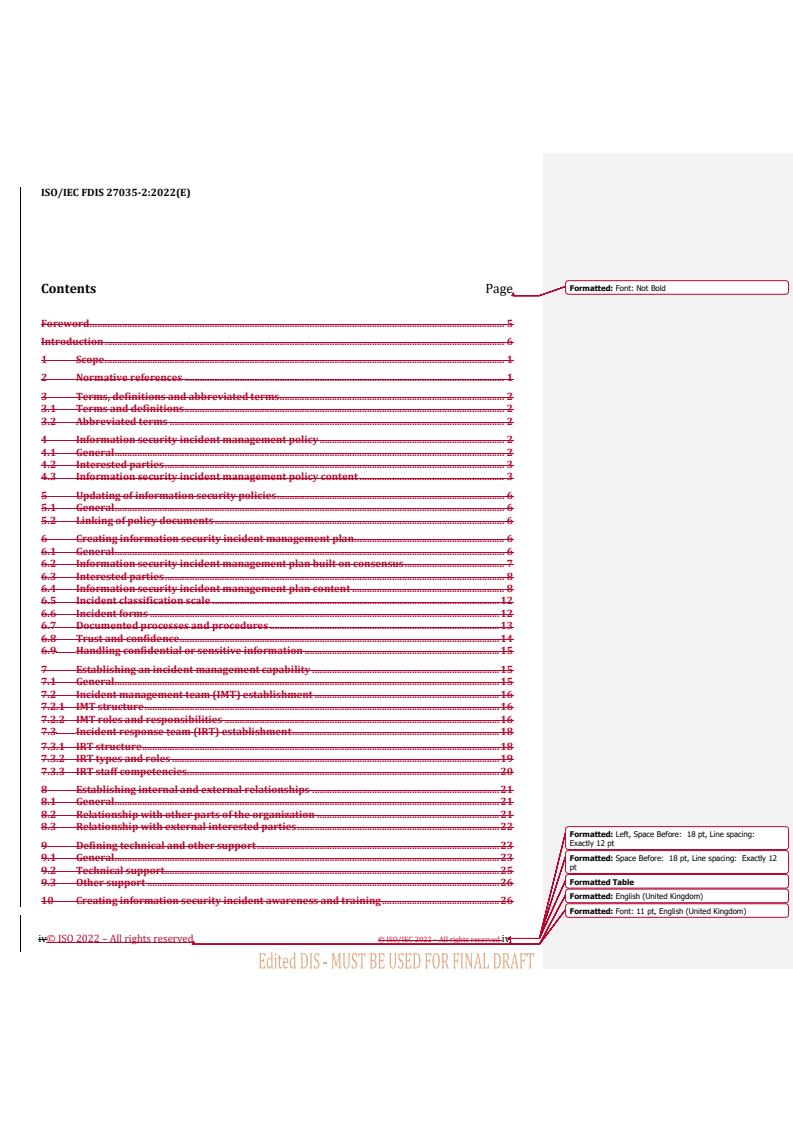
Foreword . 5
Introduction . 6
1 Scope . 1
2 Normative references . 1
3 Terms, definitions and abbreviated terms . 2
3.1 Terms and definitions . 2
3.2 Abbreviated terms . 2
4 Information security incident management policy . 2
4.1 General . 2
4.2 Interested parties . 3
4.3 Information security incident management policy content . 3
5 Updating of information security policies . 6
5.1 General . 6
5.2 Linking of policy documents . 6
6 Creating information security incident management plan . 6
6.1 General . 6
6.2 Information security incident management plan built on consensus . 7
6.3 Interested parties . 8
6.4 Information security incident management plan content . 8
6.5 Incident classification scale . 12
6.6 Incident forms . 12
6.7 Documented processes and procedures . 13
6.8 Trust and confidence . 14
6.9 Handling confidential or sensitive information . 15
7 Establishing an incident management capability . 15
7.1 General . 15
7.2 Incident management team (IMT) establishment . 16
7.2.1 IMT structure . 16
7.2.2 IMT roles and responsibilities . 16
7.3 Incident response team (IRT) establishment . 18
7.3.1 IRT structure . 18
7.3.2 IRT types and roles . 19
7.3.3 IRT staff competencies . 20
8 Establishing internal and external relationships . 21
8.1 General . 21
8.2 Relationship with other parts of the organization . 21
8.3 Relationship with external interested parties . 22
Formatted: Left, Space Before: 18 pt, Line spacing:
Exactly 12 pt
9 Defining technical and other support . 23
Formatted: Space Before: 18 pt, Line spacing: Exactly 12
9.1 General . 23
pt
9.2 Technical support . 25
Formatted Table
9.3 Other support . 26
Formatted: English (United Kingdom)
10 Creating information security incident awareness and training . 26
Formatted: Font: 11 pt, English (United Kingdom)
iv© ISO 2022 – All rights reserved © ISO/IEC 2022 – All rights reserved iv
ISO/IEC FDIS 27035-2:2022(E)
11 Testing the information security incident management plan . 27
11.1 General . 27
11.2 Exercise . 28
11.2.1 Defining the goal of the exercise . 28
11.2.2 Defining the scope of an exercise . 28
11.2.3 Conducting an exercise . 29
11.3 Incident response capability monitoring . 29
11.3.1 Implementing an incident response capability monitoring programme . 29
11.3.2 Metrics and governance of incident response capability monitoring . 30
12 Lessons learned . 30
12.1 General . 30
12.2 Identifying areas for improvement . 31
12.3 Identifying and making improvements to the information security incident
management plan . 31
12.4 IRT Evaluation . 32
12.5 Identifying and making improvements to information security control
implementation . 33
12.6 Identifying and making improvements to information security risk assessment and
management review results . 33
12.7 Other improvements . 33
Annex A (informative) Considerations related to legal or regulatory requirements . 35
A.1 Introduction . 35
A.2 Data protection and privacy of personal information . 35
A.3 Record keeping . 35
A.4 Controls to ensure fulfilment of commercial contractual obligations . 35
A.5 Legal issues related to policies and procedures . 36
A.6 Disclaimers are checked for legal validity . 36
A.7 Contracts with external support personnel . 36
A.8 Non-disclosure agreements . 36
A.9 Law enforcement requirements . 36
A.10 Liability aspects . 36
A.11 Specific regulatory requirements . 37
A.12 Prosecutions, or internal disciplinary procedures. 37
A.13 Legal aspects . 37
A.14 Acceptable use policy . 37
Annex B (informative) Example forms for information security events, incidents and
vulnerability reports . 38
B.1 Introduction . 38
B.2 Example items in records . 38
B.2.1 Example items of the record for information security event . 38
B.2.2 Example items of the record for information security incident . 39
B.2.3 Example items of the record for information security vulnerability . 40
B.3 How to use forms . 40
B.3.1 Format of date and time . 40
B.3.2 Notes for completion . 40
B.4 Example forms . 42
B.4.1 Example form for information security event report . 42
B.4.2 Example form for information security incident report . 43
Formatted: Left, Space Before: 18 pt, Line spacing:
Exactly 12 pt
B.4.3 Example form for information security vulnerability report . 49
Formatted Table
Annex C (informative) Example approaches to the categorization, evaluation and
Formatted: Font: 11 pt, Not Bold, English (United Kingdom)
prioritization of information security events and incidents . 50
C.1 Introduction . 50 Formatted: Space Before: 18 pt, Line spacing: Exactly 12
pt
© ISO/IEC 2022 – All rights reservedv v© ISO 2022 – All rights reserved
ISO/IEC FDIS 27035-2:2022(E)
C.2 Categorization of information security incidents . 50
C.3 Evaluation and prioritization of information security incidents . 56
Bibliography. 57
Foreword . viii
Introduction . x
1 Scope . 1
2 Normative references . 2
3 Terms, definitions and abbreviated terms . 2
3.1 Terms and definitions . 2
3.2 Abbreviated terms . 2
4 Information security incident management policy . 2
4.1 General . 2
4.2 Interested parties . 3
4.3 Information security incident management policy content . 4
5 Updating of information security policies . 6
5.1 General . 6
5.2 Linking of policy documents . 7
6 Creating information security incident management plan . 7
6.1 General . 7
6.2 Information security incident management plan built on consensus . 8
6.3 Interested parties . 8
6.4 Information security incident management plan content . 9
6.5 Incident classification scale . 13
6.6 Incident forms . 13
6.7 Documented processes and procedures . 13
6.8 Trust and confidence . 15
6.9 Handling confidential or sensitive information . 15
7 Establishing an incident management capability . 16
7.1 General . 16
7.2 Incident management team establishment . 16
7.2.1 IMT structure . 16
7.2.2 IMT roles and responsibilities . 18
7.3 Incident response team establishment . 20
7.3.1 IRT structure . 20
7.3.2 IRT types and roles . 21
7.3.3 IRT staff competencies . 23
8 Establishing internal and external relationships . 24
8.1 General . 24
8.2 Relationship with other parts of the organization . 24
8.3 Relationship with external interested parties . 25
9 Defining technical and other support . 26
9.1 General . 26
Formatted: Left, Space Before: 18 pt, Line spacing:
9.2 Technical support . 28
Exactly 12 pt
9.3 Other support . 28
Formatted: Space Before: 18 pt, Line spacing: Exactly 12
10 Creating information security incident awareness and training . 28 pt
Formatted Table
11 Testing the information security incident management plan . 30
Formatted: English (United Kingdom)
11.1 General . 30
11.2 Exercise . 30
Formatted: Font: 11 pt, English (United Kingdom)
vi© ISO 2022 – All rights reserved © ISO/IEC 2022 – All rights reserved vi
ISO/IEC FDIS 27035-2:2022(E)
11.2.1 Defining the goal of the exercise . 30
11.2.2 Defining the scope of an exercise . 31
11.2.3 Conducting an exercise . 31
11.3 Incident response capability monitoring . 32
11.3.1 Implementing an incident response capability monitoring programme . 32
11.3.2 Metrics and governance of incident response capability monitoring . 32
12 Learn lessons . 33
12.1 General . 33
12.2 Identifying areas for improvement . 33
12.3 Identifying and making improvements to the information security incident
management plan . 34
12.4 IRT Evaluation . 34
12.5 Identifying and making improvements to information security control
implementation . 35
12.6 Identifying and making improvements to information security risk assessment and
management review results . 36
12.7 Other improvements . 36
Annex A (informative) Considerations related to legal or regulatory requirements . 37
Annex B (informative) Example forms for information security events, incidents and
vulnerability reports . 41
Annex C (informative) Example approaches to the categorization, evaluation and
prioritization of information security events and incidents . 59
Bibliography. 66
Formatted: Left, Space Before: 18 pt, Line spacing:
Exactly 12 pt
Formatted Table
Formatted: Font: 11 pt, Not Bold, English (United Kingdom)
Formatted: Space Before: 18 pt, Line spacing: Exactly 12
pt
© ISO/IEC 2022 – All rights reservedvii vii© ISO 2022 – All rights reserved
ISO/IEC FDIS 27035-2:2022(E)
Formatted: Line spacing: At least 15.5 pt
Foreword
ISO (the International Organization for Standardization) is aand IEC (the International Formatted: English (United Kingdom)
Electrotechnical Commission) form the specialized system for worldwide federation of national
Formatted: Don't adjust space between Latin and Asian
text, Don't adjust space between Asian text and numbers
standardsstandardization. National bodies (that are members of ISO member bodies). The work of
preparingor IEC participate in the development of International Standards is normally carried out
Formatted: English (United Kingdom)
through ISO technical committees. Each member body interested in a subject for which a technical
Formatted: English (United Kingdom)
committee has been established has the right to be represented on that committee. Internationalby the
Formatted: English (United Kingdom)
respective organization to deal with particular fields of technical activity. ISO and IEC technical
Formatted: English (United Kingdom)
committees collaborate in fields of mutual interest. Other international organizations, governmental
Formatted: English (United Kingdom)
and non-governmental, in liaison with ISO and IEC, also take part in the work. ISO collaborates closely
Formatted: English (United Kingdom)
with the International Electrotechnical Commission (IEC) on all matters of electrotechnical
standardization.
Formatted: English (United Kingdom)
Formatted: English (United Kingdom)
The procedures used to develop this document and those intended for its further maintenance are
Formatted: English (United Kingdom)
described in the ISO/IEC Directives, Part 1. In particular, the different approval criteria needed for the
Formatted: English (United Kingdom)
different types of ISO documentsdocument should be noted. This document was drafted in accordance
Formatted: English (United Kingdom)
with the editorial rules of the ISO/IEC Directives, Part 2 (see
www.iso.org/directiveswww.iso.org/directives or www.iec.ch/members_experts/refdocs). Formatted: English (United Kingdom)
Formatted: English (United Kingdom)
Attention is drawn to the possibility that some of the elements of this document may be the subject of
patent rights. ISO and IEC shall not be held responsible for identifying any or all such patent rights. Formatted: English (United Kingdom)
Details of any patent rights identified during the development of the document will be in the
Introduction and/or on the ISO list of patent declarations received (see
www.iso.org/patentswww.iso.org/patents) or the IEC list of patent declarations received (see
Formatted: English (United Kingdom)
https://patents.iec.ch).
Any trade name used in this document is information given for the convenience of users and does not
constitute an endorsement. Formatted: English (United Kingdom)
For an explanation of the voluntary nature of standards, the meaning of ISO specific terms and
expressions related to conformity assessment, as well as information about ISO's adherence to the
Formatted: English (United Kingdom)
World Trade Organization (WTO) principles in the Technical Barriers to Trade (TBT), see
Formatted: std_publisher
www.iso.org/iso/foreword.html) see www.iso.org/iso/foreword.html. In the IEC, see
Formatted: std_docNumber
www.iec.ch/understanding-standards.
Formatted: English (United Kingdom)
This document was prepared by Technical Committee ISO/IEC JTC 1, Information technology,
Formatted: Don't keep with next, Don't adjust space
Subcommittee SC 27, Information security, cybersecurity and privacy protection. between Latin and Asian text, Don't adjust space between
Asian text and numbers
This second edition cancels and replaces the first edition (ISO/IEC 27035-2:2016), which has been Formatted: Font: Cambria, English (United Kingdom)
technically revised.
Formatted: List Continue 1, Don't adjust space between
Latin and Asian text, Don't adjust space between Asian text
and numbers, Tab stops: 19.85 pt, Left + 39.7 pt, Left +
The main changes are as follows:
59.55 pt, Left + 79.4 pt, Left + 99.25 pt, Left + 119.05 pt,
Left + 138.9 pt, Left + 158.75 pt, Left + 178.6 pt, Left +
— the title has been modified; 198.45 pt, Left
Formatted: cite_sec
— new roles including incident management team and incident coordinator and their
Formatted: Left, Space Before: 18 pt, Line spacing:
responsibilities have been added;
Exactly 12 pt
Formatted: Space Before: 18 pt, Line spacing: Exactly 12
— content related to vulnerability management has been modified;
pt
Formatted Table
— content on a recommended process for organizations has been added in 6.7;
Formatted: English (United Kingdom)
Formatted: Font: 11 pt, English (United Kingdom)
viii© ISO 2022 – All rights reserved © ISO/IEC 2022 – All rights reserved viii
ISO/IEC FDIS 27035-2:2022(E)
— Clause 7 structure has been reorganized; Formatted: cite_sec
Formatted: cite_sec
— Annex C.3 has been replaced by a single paragraph;
Formatted: cite_sec
— bibliography has been updated;
— document has been aligned with the ISO/IEC Directives Part 2, 2021.
A list of all parts in the ISO/IEC 27035 series can be found on the ISO and IEC websites.
Any feedback or questions on this document should be directed to the user’s national standards body. Formatted: English (United Kingdom)
A complete listing of these bodies can be found at
Formatted: Don't adjust space between Latin and Asian
text, Don't adjust space between Asian text and numbers
www.iso.org/members.htmlwww.iso.org/members.html and www.iec.ch/national-committees.
Formatted: English (United Kingdom)
Formatted: Left, Space Before: 18 pt, Line spacing:
Exactly 12 pt
Formatted Table
Formatted: Font: 11 pt, Not Bold, English (United Kingdom)
Formatted: Space Before: 18 pt, Line spacing: Exactly 12
pt
© ISO/IEC 2022 – All rights reservedix ix© ISO 2022 – All rights reserved
ISO/IEC FDIS 27035-2:2022(E)
Introduction
This document focuses on information security incident management which is identified in Formatted: Default Paragraph Font
ISO/IEC 27000 as one of the critical success factors for the information security management system.
There can be a large gap between an organization’s plan for an incident and an organization's
preparedness for an incident. Therefore, this document addresses the development of procedures to
increase the confidence of an organization’s actual readiness to respond to an information security
incident. This is achieved by addressing the policies and plans associated with incident management,
as well as the process for establishing the incident response team and improving its performance over
time by adopting lessons learned and by evaluation.
Formatted: Left, Space Before: 18 pt, Line spacing:
Exactly 12 pt
Formatted: Space Before: 18 pt, Line spacing: Exactly 12
pt
Formatted Table
Formatted: English (United Kingdom)
Formatted: Font: 11 pt, English (United Kingdom)
x© ISO 2022 – All rights reserved © ISO/IEC 2022 – All rights reserved x
Final Draft International StandardFINAL DRAFT ISO/IEC FDIS 27035-2:2022(E)
Formatted: Line spacing: Exactly 11 pt
INTERNATIONAL STANDARD
Formatted Table
Information technology — Information security incident
management — Part 2: Guidelines to plan and prepare for
incident response
Information technology — Information security incident
management — Part 2: Guidelines to plan and prepare for
incident response
1 Scope
This document provides guidelines to plan and prepare for incident response and to learn lessons
from incident response. The guidelines are based on the “plan and prepare” and “learn lessons
learned”” phases of the information security incident management phases model presented in
ISO/IEC 27035--1:— , 5.2 and 5.6. Formatted: Default Paragraph Font
Formatted: std_year
The major points within the “plan and prepare” phase include:
Formatted: Default Paragraph Font
— information security incident management policy and commitment of top management;
Formatted: cite_section
Formatted: Tab stops: 19.85 pt, Left + 39.7 pt, Left +
— information security policies, including those relating to risk management, updated at both
59.55 pt, Left + 79.4 pt, Left + 99.25 pt, Left + 119.05 pt,
organizational level and system, service and network levels;
Left + 138.9 pt, Left + 158.75 pt, Left + 178.6 pt, Left +
198.45 pt, Left
— information security incident management plan;
— Incident Management Team (IMT) establishment;
— establishing relationships and connections with internal and external organizations;
— technical and other support (including organizational and operational support);
Formatted: Body Text
Formatted: Tab stops: 19.85 pt, Left + 39.7 pt, Left +
— information security incident management awareness briefings and training.
59.55 pt, Left + 79.4 pt, Left + 99.25 pt, Left + 119.05 pt,
Left + 138.9 pt, Left + 158.75 pt, Left + 178.6 pt, Left +
198.45 pt, Left
The “learn lessons learned” phase includes:
Formatted: Don't adjust space between Latin and Asian
— identifying areas for improvement;
text, Don't adjust space between Asian text and numbers
Formatted: Font: 11 pt, English (United Kingdom)
— identifying and making necessary improvements;
Formatted: Left, Space Before: 18 pt, Line spacing:
Exactly 12 pt
— Incident Response Team (IRT) evaluation.
Formatted: Space Before: 18 pt, Line spacing: Exactly 12
pt
Formatted Table
Under preparation. Stage at the time of publication: ISO/IEC/DISFDIS 27035-1:2022.
Formatted: Font: 11 pt, English (United Kingdom)
Formatted: Font: 11 pt, Not Bold, English (United Kingdom)
© ISO/IEC 2021 2022 – All rights reserved 1
ISO/IEC FDIS 27035-2:2022(E)
The guidance given in this document is generic and intended to be applicable to all organizations,
regardless of type, size or nature. Organizations can adjust the guidance given in this document
according to their type, size and nature of business in relation to the information security risk
situation. This document is also applicable to external organizations providing information security
incident management services.
Formatted: Don't adjust space between Latin and Asian
text, Don't adjust space between Asian text and numbers
2 Normative references
Formatted: Tab stops: 19.85 pt, Left + 39.7 pt, Left +
59.55 pt, Left + 79.4 pt, Left + 99.25 pt, Left + 119.05 pt,
The following documents are referred to in the text in such a way that some or all of their content
Left + 138.9 pt, Left + 158.75 pt, Left + 178.6 pt, Left +
198.45 pt, Left
constitutes requirements of this document. For dated references, only the edition cited applies. For
Formatted: Default Paragraph Font
undated references, the latest edition of the referenced document (including any amendments)
applies. Formatted: std_year
Formatted: Don't adjust space between Latin and Asian
ISO/IEC 27000, Information technology — Security techniques — Information security management
text, Don't adjust space between Asian text and numbers
systems — Overview and vocabulary
Formatted: Default Paragraph Font
2 1)
Formatted: English (United Kingdom)
ISO/IEC 27035--1:— , , Information technology — Information security incident management — Part
1: Principles and process
Formatted: Font: Cambria, 11 pt, English (United Kingdom)
Formatted: No underline, Font color: Auto, English (United
Kingdom)
3 Terms, definitions and abbreviated terms
Formatted: Don't adjust space between Latin and Asian
text, Don't adjust space between Asian text and numbers,
Tab stops: 19.85 pt, Left + 39.7 pt, Left + 59.55 pt, Left +
3.1 Terms and definitions
79.4 pt, Left + 99.25 pt, Left + 119.05 pt, Left + 138.9 pt,
Left + 158.75 pt, Left + 178.6 pt, Left + 198.45 pt, Left
Formatted: English (United Kingdom)
Formatted: Default Paragraph Font, English (United
For the purposes of this document, the terms and definitions given in ISO/IEC 27000 and
Kingdom)
ISO/IEC 27035--1 apply.
Formatted: No underline, Font color: Auto, English (United
Kingdom)
ISO and IEC maintain terminology databases for use in standardization at the following addresses:
Formatted: English (United Kingdom)
— ISO Online browsing platform: available at https://www.iso.org/obp
Formatted: Default Paragraph Font, English (United
Kingdom)
— IEC Electropedia: available at https://www.electropedia.org/
Formatted: Body Text
Formatted: Body Text
3.2 Abbreviated terms
Formatted: Body Text
CERT computer emergency response team Formatted: Body Text
Formatted: Body Text
CSIRT computer security incident response team
Formatted: Tab stops: 19.85 pt, Left + 39.7 pt, Left +
IMT Incident Management Team
59.55 pt, Left + 79.4 pt, Left + 99.25 pt, Left + 119.05 pt,
Left + 138.9 pt, Left + 158.75 pt, Left + 178.6 pt, Left +
IRT Incident Response Team
198.45 pt, Left
Formatted: Default Paragraph Font
PoC Point of Contact
Formatted: std_year
Formatted: cite_section
4 Information security incident management policy
Formatted: Font: 11 pt, English (United Kingdom)
Formatted: Left, Space Before: 18 pt, Line spacing:
4.1 General
Exactly 12 pt
3 1) Formatted Table
NOTE Clause 4, in its entirety, links to ISO/IEC 27035--1:— , , 5.2 a).
Formatted: English (United Kingdom)
Formatted: Space Before: 18 pt, Line spacing: Exactly 12
pt
Under preparation. Stage at the time of publication: ISO/IEC/DIS 27035-1:2022.
Formatted: Font: 11 pt, English (United Kingdom)
Formatted: Font: 11 pt, English (United Kingdom)
2 © ISO/IEC 2022 – All rights reserved
ISO/IEC FDIS 27035-2:2022(E)
Formatted: Right
An organizationorganization's information security incident management policy should provide the
formally documented principles and intentions used to direct decision-making. Supporting processes
and procedures ensures consistent application of the policy.
Any information security incident management policy should be part of the information security
strategy for an organization. It should also support the existing mission of its parent organization and
be in line with already existing policies and procedures.
An organization should implement an information security incident management policy that outlines
the processes, responsible persons, authority and reporting lines when an information security
event/incident occurs. The policy should be reviewed regularly to ensure it reflects the latest
organizational structure, processes, and technology that can affect incident management. The policy
should also outline any awareness and training initiatives within the organization that isare related to
incident management (see Clause 10).
An organization should document its policy for managing information security events, incidents and Formatted: Footnote re, Adjust space between Latin and
Asian text, Adjust space between Asian text and numbers
vulnerabilities as a free-standing document, as part of its overall information security management
system policy (see ISO/IEC 27001:2013:— , 5.2), or as part of its information security policies (see Formatted: Body Text Char
ISO/IEC 27002:2022, 5.1). The size, structure and business nature of an organization and the extent of
its information security incident management programprogramme are deciding factors in determining
which of these options to adopt. An organization should direct its information security incident
management policy at every person having legitimate access to its information systems and related
locations.
Before the information security incident management policy is formulated, the organization should
identify the following regarding its information security incident management:
a) principles, objectives and purpose; Formatted: Tab stops: 19.85 pt, Left + 39.7 pt, Left +
59.55 pt, Left + 79.4 pt, Left + 99.25 pt, Left + 119.05 pt,
Left + 138.9 pt, Left + 158.75 pt, Left + 178.6 pt, Left +
b) the scope, including not only which parts of the organization it applies to, but also what
198.45 pt, Left
information it applies to e.g. hardcopy, electronic, verbal;
c) internal and external interested parties;
d) specific incident types and vulnerabilities that are controlled, responded to and resolved;
e) any specific roles that are involved;
f) benefits to the whole organizat
...
INTERNATIONAL ISO/IEC
STANDARD 27035-2
Second edition
2023-02
Information technology —
Information security incident
management —
Part 2:
Guidelines to plan and prepare for
incident response
Technologies de l'information — Gestion des incidents de sécurité de
l'information —
Partie 2: Lignes directrices pour planifier et préparer une réponse aux
incidents
Reference number
© ISO/IEC 2023
© ISO/IEC 2023
All rights reserved. Unless otherwise specified, or required in the context of its implementation, no part of this publication may
be reproduced or utilized otherwise in any form or by any means, electronic or mechanical, including photocopying, or posting on
the internet or an intranet, without prior written permission. Permission can be requested from either ISO at the address below
or ISO’s member body in the country of the requester.
ISO copyright office
CP 401 • Ch. de Blandonnet 8
CH-1214 Vernier, Geneva
Phone: +41 22 749 01 11
Email: copyright@iso.org
Website: www.iso.org
Published in Switzerland
ii
© ISO/IEC 2023 – All rights reserved
Contents Page
Foreword .v
Introduction . vi
1 Scope . 1
2 Normative references . 1
3 Terms, definitions and abbreviated terms . 2
3.1 Terms and definitions . 2
3.2 Abbreviated terms . 2
4 Information security incident management policy . 2
4.1 General . 2
4.2 Interested parties . 3
4.3 Information security incident management policy content . 3
5 Updating of information security policies. 5
5.1 General . 5
5.2 Linking of policy documents . 6
6 Creating information security incident management plan . 6
6.1 General . 6
6.2 Information security incident management plan built on consensus . 7
6.3 Interested parties . 7
6.4 Information security incident management plan content . 8
6.5 Incident classification scale . 11
6.6 Incident forms . 11
6.7 Documented processes and procedures .12
6.8 Trust and confidence .13
6.9 Handling confidential or sensitive information . 14
7 Establishing an incident management capability .14
7.1 General . 14
7.2 Incident management team establishment . 14
7.2.1 IMT structure . 14
7.2.2 IMT roles and responsibilities . 16
7.3 Incident response team establishment . 17
7.3.1 IRT structure . 17
7.3.2 IRT types and roles . 18
7.3.3 IRT staff competencies . . 19
8 Establishing internal and external relationships .20
8.1 General . 20
8.2 Relationship with other parts of the organization . 20
8.3 Relationship with external interested parties. 21
9 Defining technical and other support .22
9.1 General .22
9.2 Technical support . . 24
9.3 Other support . 24
10 Creating information security incident awareness and training .24
11 Testing the information security incident management plan .25
11.1 General . 25
11.2 Exercise . 26
11.2.1 Defining the goal of the exercise . 26
11.2.2 Defining the scope of an exercise . 27
11.2.3 Conducting an exercise . 27
11.3 Incident response capability monitoring . 27
11.3.1 Implementing an incident response capability monitoring programme . 27
iii
© ISO/IEC 2023 – All rights reserved
11.3.2 Metrics and governance of incident response capability monitoring .28
12 Learn lessons .28
12.1 General .28
12.2 Identifying areas for improvement .29
12.3 Identifying and making improvements to the information security incident
management plan .29
12.4 IMT evaluation . 30
12.5 Identifying and making improvements to information security control
implementation .30
12.6 Identifying and making improvements to information security risk assessment
and management review results . 31
12.7 Other improvements . 31
Annex A (informative) Considerations related to legal or regulatory requirements .32
Annex B (informative) Example forms for information security events, incidents and
vulnerability reports .35
Annex C (informative) Example approaches to the categorization, evaluation and
prioritization of information security events and incidents .47
Bibliography .52
iv
© ISO/IEC 2023 – All rights reserved
Foreword
ISO (the International Organization for Standardization) and IEC (the International Electrotechnical
Commission) form the specialized system for worldwide standardization. National bodies that are
members of ISO or IEC participate in the development of International Standards through technical
committees established by the respective organization to deal with particular fields of technical
activity. ISO and IEC technical committees collaborate in fields of mutual interest. Other international
organizations, governmental and non-governmental, in liaison with ISO and IEC, also take part in the
work.
The procedures used to develop this document and those intended for its further maintenance
are described in the ISO/IEC Directives, Part 1. In particular, the different approval criteria
needed for the different types of document should be noted. This document was drafted in
accordance with the editorial rules of the ISO/IEC Directives, Part 2 (see www.iso.org/directives or
www.iec.ch/members_experts/refdocs).
Attention is drawn to the possibility that some of the elements of this document may be the subject
of patent rights. ISO and IEC shall not be held responsible for identifying any or all such patent
rights. Details of any patent rights identified during the development of the document will be in the
Introduction and/or on the ISO list of patent declarations received (see www.iso.org/patents) or the IEC
list of patent declarations received (see https://patents.iec.ch).
Any trade name used in this document is information given for the convenience of users and does not
constitute an endorsement.
For an explanation of the voluntary nature of standards, the meaning of ISO specific terms and
expressions related to conformity assessment, as well as information about ISO's adherence to
the World Trade Organization (WTO) principles in the Technical Barriers to Trade (TBT) see
www.iso.org/iso/foreword.html. In the IEC, see www.iec.ch/understanding-standards.
This document was prepared by Technical Committee ISO/IEC JTC 1, Information technology,
Subcommittee SC 27, Information security, cybersecurity and privacy protection.
This second edition cancels and replaces the first edition (ISO/IEC 27035-2:2016), which has been
technically revised.
The main changes are as follows:
— the title has been modified;
— new roles including incident management team and incident coordinator and their responsibilities
have been added;
— content related to vulnerability management has been modified;
— content on a recommended process for organizations has been added in 6.7;
— Clause 7 structure has been reorganized;
— C.3 has been replaced by a single paragraph;
— bibliography has been updated.
A list of all parts in the ISO/IEC 27035 series can be found on the ISO and IEC websites.
Any feedback or questions on this document should be directed to the user’s national standards
body. A complete listing of these bodies can be found at www.iso.org/members.html and
www.iec.ch/national-committees.
v
© ISO/IEC 2023 – All rights reserved
Introduction
This document focuses on information security incident management which is identified in
ISO/IEC 27000 as one of the critical success factors for the information security management system.
There can be a large gap between an organization’s plan for an incident and an organization's
preparedness for an incident. Therefore, this document addresses the development of procedures to
increase the confidence of an organization’s actual readiness to respond to an information security
incident. This is achieved by addressing the policies and plans associated with incident management,
as well as the process for establishing the incident response team and improving its performance over
time by adopting lessons learned and by evaluation.
vi
© ISO/IEC 2023 – All rights reserved
INTERNATIONAL STANDARD ISO/IEC 27035-2:2023(E)
Information technology — Information security incident
management —
Part 2:
Guidelines to plan and prepare for incident response
1 Scope
This document provides guidelines to plan and prepare for incident response and to learn lessons from
incident response. The guidelines are based on the “plan and prepare” and “learn lessons” phases of the
information security incident management phases model presented in ISO/IEC 27035-1:2023, 5.2 and
5.6.
The major points within the “plan and prepare” phase include:
— information security incident management policy and commitment of top management;
— information security policies, including those relating to risk management, updated at both
organizational level and system, service and network levels;
— information security incident management plan;
— Incident Management Team (IMT) establishment;
— establishing relationships and connections with internal and external organizations;
— technical and other support (including organizational and operational support);
— information security incident management awareness briefings and training.
The “learn lessons” phase includes:
— identifying areas for improvement;
— identifying and making necessary improvements;
— Incident Response Team (IRT) evaluation.
The guidance given in this document is generic and intended to be applicable to all organizations,
regardless of type, size or nature. Organizations can adjust the guidance given in this document
according to their type, size and nature of business in relation to the information security risk situation.
This document is also applicable to external organizations providing information security incident
management services.
2 Normative references
The following documents are referred to in the text in such a way that some or all of their content
constitutes requirements of this document. For dated references, only the edition cited applies. For
undated references, the latest edition of the referenced document (including any amendments) applies.
ISO/IEC 27000, Information technology — Security techniques — Information security management
systems — Overview and vocabulary
ISO/IEC 27035-1:2023, Information technology — Information security incident management — Part 1:
Principles and process
© ISO/IEC 2023 – All rights reserved
3 Terms, definitions and abbreviated terms
3.1 Terms and definitions
For the purposes of this document, the terms and definitions given in ISO/IEC 27000 and ISO/IEC 27035-1
apply.
ISO and IEC maintain terminology databases for use in standardization at the following addresses:
— ISO Online browsing platform: available at https:// www .iso .org/ obp
— IEC Electropedia: available at https:// www .electropedia .org/
3.2 Abbreviated terms
CERT computer emergency response team
CSIRT computer security incident response team
IMT Incident Management Team
IRT Incident Response Team
PoC Point of Contact
4 Information security incident management policy
4.1 General
NOTE Clause 4, in its entirety, links to ISO/IEC 27035-1:2023, 5.2 a).
An organization's information security incident management policy should provide the formally
documented principles and intentions used to direct decision-making. Supporting processes and
procedures ensures consistent application of the policy.
Any information security incident management policy should be part of the information security
strategy for an organization. It should also support the existing mission of its parent organization and
be in line with already existing policies and procedures.
An organization should implement an information security incident management policy that outlines
the processes, responsible persons, authority and reporting lines when an information security event/
incident occurs. The policy should be reviewed regularly to ensure it reflects the latest organizational
structure, processes, and technology that can affect incident management. The policy should also
outline any awareness and training initiatives within the organization that are related to incident
management (see Clause 10).
An organization should document its policy for managing information security events, incidents and
vulnerabilities as a free-standing document, as part of its overall information security management
system policy (see ISO/IEC 27001:2022, 5.2), or as part of its information security policies (see
ISO/IEC 27002:2022, 5.1). The size, structure and business nature of an organization and the extent of
its information security incident management programme are deciding factors in determining which
of these options to adopt. An organization should direct its information security incident management
policy at every person having legitimate access to its information systems and related locations.
Before the information security incident management policy is formulated, the organization should
identify the following regarding its information security incident management:
a) principles, objectives and purpose;
© ISO/IEC 2023 – All rights reserved
b) the scope, including not only which parts of the organization it applies to, but also what information
it applies to e.g. hardcopy, electronic, verbal;
c) internal and external interested parties;
d) specific incident types and vulnerabilities that are controlled, responded to and resolved;
e) any specific roles that are involved;
f) benefits to the whole organization and to its departments;
g) understanding of its legal and regulatory environment;
h) dependencies including alignment to risk management;
i) skills and competency requirements.
4.2 Interested parties
A successful information security incident management policy should be created and implemented
as an enterprise-wide process. To that end, all interested parties or their representatives should be
involved in the development of the policy from the initial planning stages through to the implementation
of any process or response team. This may include legal advisors, public relations and marketing staff,
departmental managers, security staff, ICT responsible persons, upper-level management, and, in some
cases, even facilities and human resources staff.
An organization should ensure that its information security incident management policy is approved by
top management.
Ensuring continued management commitment is vital for the acceptance of a structured approach to
information security incident management. It is important that personnel recognize an event, know
what to do and understand the benefits of the approach by the organization. It is also important that
management is supportive of the information security incident management policy to ensure that the
organization commits to resourcing and maintaining an incident management capability.
The information security incident management policy should be made available to every employee and
contractor. It should also be addressed in information security awareness briefings and training.
4.3 Information security incident management policy content
The information security incident management policy should be high-level. Detailed information and
step-by-step instructions should be included in the series of documents that make up the information
security incident management plan, which is outlined in Clause 6.
An organization should ensure that its information security incident management policy content
addresses, but is not limited to, the following topics:
a) the purpose, objectives and the scope (to whom it applies and under what circumstances) of the
policy;
b) policy owner and review cycle;
c) the importance of information security incident management to the organization, top management's
commitment to it and the related plan documentation;
d) a definition of security incident;
e) a description of the type of security incidents or categories (or a reference to another document
which describes this in more depth);
f) a description of how incidents should be reported, including what to report, the mechanisms used
for reporting, where and to whom to report;
© ISO/IEC 2023 – All rights reserved
g) a high-level overview or visualization of the incident management process flow (showing the basic
steps for handling a security incident) encompassing detection and reporting, assessment and
decision, response and lessons learned;
h) a requirement for post information security incident resolution activities, including learning from
and improving the process, following the resolution of information security incidents;
i) if appropriate, also a summary of reporting and handling vulnerabilities that are related to the
incident (although this can be a separate document);
j) a defined set of roles, responsibilities, and decision-making authority for each phase of the
information security incident management process and related activities (including reporting and
handling vulnerabilities that are related to the incident if appropriate);
k) a reference to the document describing the event and incident classification, severity ratings (if
used) and related terms;
l) an overview of the IMT, encompassing the IMT organizational structure, key roles, responsibilities,
and authority, along with summary of duties including, but not limited to:
1) reporting and notification requirements related to incidents that have been confirmed,
2) dealing with enquiries, instigating follow-up, and resolving incidents,
3) liaising with the external organizations (when necessary),
4) requirement and rationale for ensuring all information security incident management activities
performed by the IRT are properly logged for later analysis;
m) requirements for establishing/terminating IRTs to respond to specific incidents which have
different scopes and expertise depending on the incident. Several IRTs may exist, depending on the
aspect of business that is affected by the incident;
n) a requirement that components across the organization work in collaboration to detect, analyse,
and respond to information security incidents;
o) a description of any oversight or governance structure and its authority and duties, if applicable;
p) links to organizations providing specific external support such as forensics teams, legal counsel,
other IT operations, etc;
q) a summary of the legal and regulatory compliance requirements or mandates associated with
information security incident management activities (for more details, see Annex A).
There are other related policies or procedures that support the information security incident
management policy and can also be established as part of the preparation phase, if they are not already
existent and are appropriate for the organization. These include, but are not limited to, the following:
— An information security incident management plan, described in Clause 6;
— A continuous monitoring policy for specific ICT systems stating that such activity is conducted
by the organization and describing the basic monitoring tasks. Continuous monitoring ensures
preservation of electronic evidence in case it is required for legal prosecution or internal disciplinary
action;
— Authority granting the IRT access to the outputs of this monitoring or the ability to request logs
as needed from other parts of the organization (this can also be put in the information security
incident management policy);
— Information sharing, disclosure and communication policies which outline how and when
information related to incident management activities can be shared by whom and with whom.
Information should be kept confidential and only disclosed according to the relevant legislation. In
many instances, legislation requires affected parties to be notified should any personal identifiable
© ISO/IEC 2023 – All rights reserved
information be compromised. Apart from the legal requirements, it is expected that information
also follows any organizational requirements for disclosure, according to the classification policy
and according to ISO/IEC 27002:2022, 5.14. It may be important to share information in the course of
incident handling when a third party is involved or affected. The scope, circumstances and purpose
of this information sharing are described, or referenced, in the appropriate policies and procedures.
An example of information disclosure guidance and markings is the use of traffic light protocol
(TLP) (see ISO/IEC 27010);
— Information storage and handling policies which require records, data, and other information
related to investigations to be stored securely and handled in a manner commensurate with their
sensitivity. If the organization has a document labelling or classification schema, this policy is also
important to information security incident management activities and personnel;
— An IMT charter that specifies in more detail what the IMT does and the authority under which it
operates;
— At a minimum, the charter should include a mission statement, a definition of the IMT's scope,
and details of the IMT's top management sponsor, the IMT authority, contact information for the
IMT, its list of services and core activities, its scope of authority and operation, its purpose and
goals; along with a discussion of any governance structure;
— The goals and purposes of the team are especially important and require clear, unambiguous
definition;
— The scope of an IMT normally covers all of the organization's information systems, ICT services
and networks. In some cases, an organization can require the scope to be different (either
larger or narrower), in which case, it should be clearly documented what is in, and what is out
of, scope;
— Examples of IMT authority include searching and confiscating personal belongings, detaining
people and monitoring communications, where possible.
— An overview of the information security incident management awareness and training programme.
This should include any training mandates, policies, or requirements for staff-related employee
awareness training and incident management training for the IMT members.
5 Updating of information security policies
5.1 General
NOTE Clause 5, in its entirety, links to ISO/IEC 27035-1:2023, 5.2 b).
An organization should include information security incident management content in its information
security policies at the organizational level, as well as on specific ICT system, service and network
levels and relate this content to the incident management policy. The integration should aim to:
a) describe why information security incident management, particularly an information security
incident reporting and handling plan, is important;
b) indicate top management's commitment to the need for proper preparation and response to
information security incidents, i.e. to the information security incident management plan;
c) ensure consistency across the various policies;
d) ensure planned, systematic and composed responses to information security incidents, thus
minimizing the adverse consequences of incidents;
e) align with the organization’s risk management policies and practices.
© ISO/IEC 2023 – All rights reserved
For guidance on information security risk assessment and management, see ISO/IEC 27005. Policy
documents should be reviewed regularly and updated when necessary. This should be a consequence of
the “learn lessons” phase. See also ISO/IEC 27002:2022, 5.1.
5.2 Linking of policy documents
An organization should update and maintain its organizational information security and risk
management policies, and specific system, service or network information security policies in tandem
to ensure they remain consistent and current. These organizational-level policies should refer explicitly
to the information security incident management policy and associated plans.
The organizational-level policies should include the requirement that appropriate review mechanisms
are established. These review mechanisms should ensure that information from the detection,
monitoring, resolution of and learning from information security incidents and from dealing with
reported information security vulnerabilities is used as input to the process designed to maintain
continuing effectiveness of the policies.
6 Creating information security incident management plan
6.1 General
NOTE 1 Clause 6, in its entirety, links to ISO/IEC 27035-1:2023, 5.2 c).
The aim of an information security incident management plan is to document the activities and
procedures for dealing with information security events, incidents and related vulnerabilities
discovered during an incident analysis and response, and to communicate them. The plan stems from
and is based on the information security incident management policy.
Overall, the documentation of the plan should encompass multiple documents including the forms,
procedures and organizational elements. It should also include support tools for the detection and
reporting of, assessment and decision making related to, responses to and learning lessons from
information security incidents.
The plan may include a high-level outline of the basic flow of incident management activities to provide
structure and pointers to the various detailed components of the plan. These components provide
the step-by-step instructions for incident handlers to follow using specific tools, following specific
workflows or handling specific types of incidents based on the situation.
The information security incident management plan comes into effect whenever an information
security event is detected or information security vulnerability is reported.
An organization should use the plan as a guide for:
a) detecting events and abnormal situations and reporting them;
b) responding to information security events;
c) determining whether information security events become information security incidents;
d) managing information security incidents to conclusion;
e) handling information security vulnerabilities discovered while responding to an incident;
NOTE 2 Security vulnerabilities are reported to the incident coordinator who redirects them to the team
responsible for vulnerability management.
f) requirements for reporting;
g) requirements for recording information (including its format) during the whole incident
management process;
© ISO/IEC 2023 – All rights reserved
h) rules and circumstances under which information sharing with internal and external groups or
organizations can take place;
i) identifying lessons that can be learned, and any improvements to the plan and/or security in
general that are required.
Planning and preparation of an incident management plan should be undertaken by the process owner,
with a clear goal or set of goals for incident response within a defined scope based on the information
security incident management policy.
6.2 Information security incident management plan built on consensus
This document recommends the development of an information security incident management policy.
However, where there is no guiding policy or standard, prevailing law, or other authoritative source,
the incident management planning process should be based on consensus to ensure effective operation,
communication, and relationships with external organizations.
Terms and definitions should be normalized between the organization and partner organizations
where relevant. This includes names and identifiers for organizations and teams, information assets
and business processes. Where terminology is difficult or prone to misinterpretation, the incident
management plan should include standard terms and definitions in a glossary.
Roles and relationships with external IRTs and other response organizations, as well as response
activity structures and boundaries should be defined by the incident management process owner.
Responsibilities of interested parties can overlap and should be adjusted by consensus in the incident
management planning process. Where there is overlap on incident response decision boundaries, the
plan should identify a responsible party.
Interested parties and external IRTs often have disparate metrics. Planning participants should
evaluate the available metrics contributed by their respective parties or external organizations and
either agree by consensus on particular set(s) of existing metrics or agree to link the disparate metrics
using a reversible mapping. Regardless of approach, the plan should select or connect quantitative
metrics so that their scopes are identical and select or connect qualitative metrics with definitive
equivalence.
6.3 Interested parties
An organization should ensure that the information security incident management plan is acknowledged
by all personnel and associated contractors, ICT service providers, telecommunication providers and
outsourcing companies, thus covering the following responsibilities:
a) detecting and reporting information security events (this is the responsibility of any permanent or
contracted personnel in an organization and its companies);
b) assessing and responding to information security events and incidents, being involved in the post-
incident resolution activities of learning, and improving information security and the information
security incident management plan itself (this is the responsibility of interested parties including
the PoC (point of contact), the incident coordinator, the IRT, management, public relations personnel
and legal representatives);
c) dealing with information security vulnerabilities (this is the responsibility of skilled members
from vulnerability management).
The plan should also take into account any third-party users. Consideration should be given to
information security incidents and associated vulnerabilities reported from third party organizations,
government and commercial information security incident and vulnerability information provision
organizations.
If interested parties are expected to be actively involved in handling information security incidents,
then a clear division of roles and responsibilities should be made and everyone made aware of them.
© ISO/IEC 2023 – All rights reserved
Division of roles should be accompanied with the agreed incident handoff protocol so that information
is exchanged in an expedient manner. If appropriate and possible, the incident handoff and information
exchange should be automated to speed up the process. This kind of scenario can arise if some of the
organization or IRT capabilities are outsourced to a third party. Examples include when the organization
uses cloud systems run by the third party, or when the third party performs digital forensics for the
organization, or when the organization works with a service provider in handling incidents.
6.4 Information security incident management plan content
Key decision-making criteria and processes to support expected management phases should be defined
and reviewed before the planning and preparation process. This requires available policy, formal or
informal understanding of assets and controls, and contribution from participants and management
support.
The content of the information security incident management plan should give an overview, as well
as specifying detailed activities. As noted above, the plan documentation should encompass multiple
documents including the forms, procedures, organizational elements and support tools.
The detailed activities, procedures and information should consider the following.
a) Plan and prepare.
1) A standardized approach to information security event/incident categorization and
classification, to enable the provision of consistent results. In any event, the decision should
be based on the actual or projected adverse consequences on the organization's business
operations, harm to individuals/other organizations and associated guidance;
NOTE Annex C shows example approaches to the categorization and classification of information
security events and incidents.
2) An information security incident register structured for the exchange of information is likely
to provide the capability to share reports/alerts, compare results, improve alert information
and enable a more accurate view of the threats to, and vulnerabilities of information systems.
The actual format and use of the incident register depend on the organization’s requirements.
For example, a very small organization may use documents, while a complex organization may
use more sophisticated technology such as relational databases and application tools;
3) Guidance for deciding whether escalation is required during each relevant process, and to
whom, and associated procedures. Based on the guidance provided in the information security
incident management plan, the incident coordinator should know under which circumstances
it is necessary to escalate matters and to whom it should be escalated. In addition, there are
unforeseen circumstances when this may be necessary. For example, a minor information
security incident can evolve to a significant or a crisis situation if not handled properly or a
minor information security incident not followed up timely can become a major information
security incident;
4) Procedures to be followed to ensure that all information security incident response activities
are properly logged and that log analysis is conducted by designated personnel;
5) Procedures and mechanisms to ensure that the change control regime is maintained covering
information security event, incident and related vulnerability tracking and information
security report updates, and updates to the plan itself;
6) Procedures for information security evidence recording, safeguarding and analysis;
7) Procedures for handover to law enforcement when a crime occurs;
8) On ICT systems, procedures and guidance on using intrusion detection systems (IDS) and
intrusion prevention systems (IPS), ensuring that associated legal and regulatory aspects
have been addressed. Guidance should include discussion of the advantages and disadvantages
© ISO/IEC 2023 – All rights reserved
of undertaking attacker surveillance activities. Further information on IDS is contained in
ISO/IEC 27039;
9) Guidance and procedures associated with the technical and organizational controls and
mechanisms that are established, implemented and operated in order to prevent information
security incident occurrences and to reduce their likelihood, and to deal with information
security incidents as they occur;
10) Material for the information security event, incident and vulnerability management awareness
and training programme;
11) Procedures and specifications for the testing of the information security incident management
plan;
12) Organizational s
...