

ISO/IEC 30106-1:2016
(Main)Information technology — Object oriented BioAPI — Part 1: Architecture
General Information
- Abstract
ISO/IEC 30106-1:2016 specifies an architecture for a set of interfaces which define the OO BioAPI. Components defined in this part of ISO/IEC 30106 include a framework, Biometric Service Providers (BSPs), Biometric Function Providers (BFPs) and a component registry. NOTE Each of these components have an equivalent component specified in ISO/IEC 19784‑1 as the OO BioAPI is intended to be an OO interpretation of this part of ISO/IEC 30106. For this reason, this part of ISO/IEC 30106 is conceptually equivalent to ISO/IEC 19784‑1. Concepts present in this part of ISO/IEC 30106 (for example, BioAPI_Unit and component registry) have the same meaning as in ISO/IEC 19784‑1. While the conceptual equivalence of this part of ISO/IEC 30106 will be maintained with ISO/IEC 19784‑1, there are differences in the parameters passed between functions and the sequence of function calls. These differences exist to take advantage of the features provided by Object Oriented Programming Languages.
- Status
- Published
- Publication Date
- 22-Mar-2016
- Technical Committee
- ISO/IEC JTC 1/SC 37 - Biometrics
- Drafting Committee
- ISO/IEC JTC 1/SC 37 - Biometrics
- Current Stage
- 9060 - Close of review
- Completion Date
- 02-Dec-2031

Overview
ISO/IEC 30106-1:2016 - "Information technology - Object oriented BioAPI - Part 1: Architecture" defines the architecture for an object‑oriented BioAPI (OO BioAPI). The standard specifies a framework and the interfaces for Biometric Service Providers (BSPs), Biometric Function Providers (BFPs) and a component registry, enabling structured, interoperable biometric application development in object‑oriented languages (e.g., Java, C#/.NET). ISO/IEC 30106-1 is conceptually equivalent to the C‑based BioAPI (ISO/IEC 19784‑1) but adapts parameters and call sequences to leverage object‑oriented programming features.
Key Topics and Technical Requirements
- OO BioAPI architecture and framework: Defines the hierarchical object model for applications, BSPs and encapsulated BioAPI_Unit functionality.
- BSP and BFP interfaces: Specifies how service providers and function providers expose biometric services to applications within an OO paradigm.
- Component registry: Mechanisms for discovery, instantiation and management of BSPs/BFPs and BioAPI units.
- BioAPI_Unit concept: Retains conceptual equivalence with ISO/IEC 19784‑1 while remaining encapsulated within BSPs (applications do not access units directly).
- Implementation guidelines: Best practices for developing BSPs, BFPs, framework components and applications, including GUI considerations and error handling (exceptions for unimplemented methods).
- CBEFF patron formats & BIR structures: Defines Simple and Complex Biometric Information Record (BIR) patron formats to support biometric data exchange (see CBEFF references).
- UML and data models: Class diagrams and relationships for BIR, UnitSchema, BFPSchema, BSPSchema, FrameworkSchema and application-related structures.
- Constants and error codes: Standardized biometric types, subtypes and error handling codes to ensure consistent behavior across implementations.
Practical Applications and Who Uses It
- Biometric system architects and software developers building OO biometric applications (Java, C#, .NET).
- BSP and BFP vendors creating modular biometric components for application servers, embedded devices and web services.
- Integrators and solution providers implementing interoperable biometric stacks that must interoperate with legacy C BioAPI components (bridging strategies enabled).
- Developers targeting small devices and application servers who prefer an OO API for improved productivity and maintainability.
- Organizations requiring standardized biometric data exchange using CBEFF/BIR formats.
Related Standards
- ISO/IEC 19784‑1 - BioAPI (C‑based) - conceptual equivalent and basis for interoperability.
- ISO/IEC 19785‑1, 19785‑3 - CBEFF Data Element and Patron Format specifications referenced for BIR structures.
- ISO/IEC 2382‑37 - Biometrics vocabulary used for terminology consistency.
ISO/IEC 30106-1 is essential for developers and vendors aiming to adopt a standard, object‑oriented biometric API that improves interoperability, reusability and ease of integration in modern OO environments.
Relations
- Effective Date
- 18-Dec-2021
Get Certified
Connect with accredited certification bodies for this standard

BSI Group
BSI (British Standards Institution) is the business standards company that helps organizations make excellence a habit.

NYCE
Mexican standards and certification body.
Sponsored listings
Frequently Asked Questions
ISO/IEC 30106-1:2016 is a standard published by the International Organization for Standardization (ISO). Its full title is "Information technology — Object oriented BioAPI — Part 1: Architecture". This standard covers: ISO/IEC 30106-1:2016 specifies an architecture for a set of interfaces which define the OO BioAPI. Components defined in this part of ISO/IEC 30106 include a framework, Biometric Service Providers (BSPs), Biometric Function Providers (BFPs) and a component registry. NOTE Each of these components have an equivalent component specified in ISO/IEC 19784‑1 as the OO BioAPI is intended to be an OO interpretation of this part of ISO/IEC 30106. For this reason, this part of ISO/IEC 30106 is conceptually equivalent to ISO/IEC 19784‑1. Concepts present in this part of ISO/IEC 30106 (for example, BioAPI_Unit and component registry) have the same meaning as in ISO/IEC 19784‑1. While the conceptual equivalence of this part of ISO/IEC 30106 will be maintained with ISO/IEC 19784‑1, there are differences in the parameters passed between functions and the sequence of function calls. These differences exist to take advantage of the features provided by Object Oriented Programming Languages.
ISO/IEC 30106-1:2016 specifies an architecture for a set of interfaces which define the OO BioAPI. Components defined in this part of ISO/IEC 30106 include a framework, Biometric Service Providers (BSPs), Biometric Function Providers (BFPs) and a component registry. NOTE Each of these components have an equivalent component specified in ISO/IEC 19784‑1 as the OO BioAPI is intended to be an OO interpretation of this part of ISO/IEC 30106. For this reason, this part of ISO/IEC 30106 is conceptually equivalent to ISO/IEC 19784‑1. Concepts present in this part of ISO/IEC 30106 (for example, BioAPI_Unit and component registry) have the same meaning as in ISO/IEC 19784‑1. While the conceptual equivalence of this part of ISO/IEC 30106 will be maintained with ISO/IEC 19784‑1, there are differences in the parameters passed between functions and the sequence of function calls. These differences exist to take advantage of the features provided by Object Oriented Programming Languages.
ISO/IEC 30106-1:2016 is classified under the following ICS (International Classification for Standards) categories: 35.040 - Information coding; 35.240.15 - Identification cards. Chip cards. Biometrics. The ICS classification helps identify the subject area and facilitates finding related standards.
ISO/IEC 30106-1:2016 has the following relationships with other standards: It is inter standard links to ISO/IEC 30106-1:2016/Amd 1:2019. Understanding these relationships helps ensure you are using the most current and applicable version of the standard.
ISO/IEC 30106-1:2016 is available in PDF format for immediate download after purchase. The document can be added to your cart and obtained through the secure checkout process. Digital delivery ensures instant access to the complete standard document.
Standards Content (Sample)
INTERNATIONAL ISO/IEC
STANDARD 30106-1
First edition
2016-03-15
Information technology — Object
oriented BioAPI —
Part 1:
Architecture
Technologies de l’information — Objet orienté BioAPI —
Partie 1: Architecture
Reference number
©
ISO/IEC 2016
© ISO/IEC 2016, Published in Switzerland
All rights reserved. Unless otherwise specified, no part of this publication may be reproduced or utilized otherwise in any form
or by any means, electronic or mechanical, including photocopying, or posting on the internet or an intranet, without prior
written permission. Permission can be requested from either ISO at the address below or ISO’s member body in the country of
the requester.
ISO copyright office
Ch. de Blandonnet 8 • CP 401
CH-1214 Vernier, Geneva, Switzerland
Tel. +41 22 749 01 11
Fax +41 22 749 09 47
copyright@iso.org
www.iso.org
ii © ISO/IEC 2016 – All rights reserved
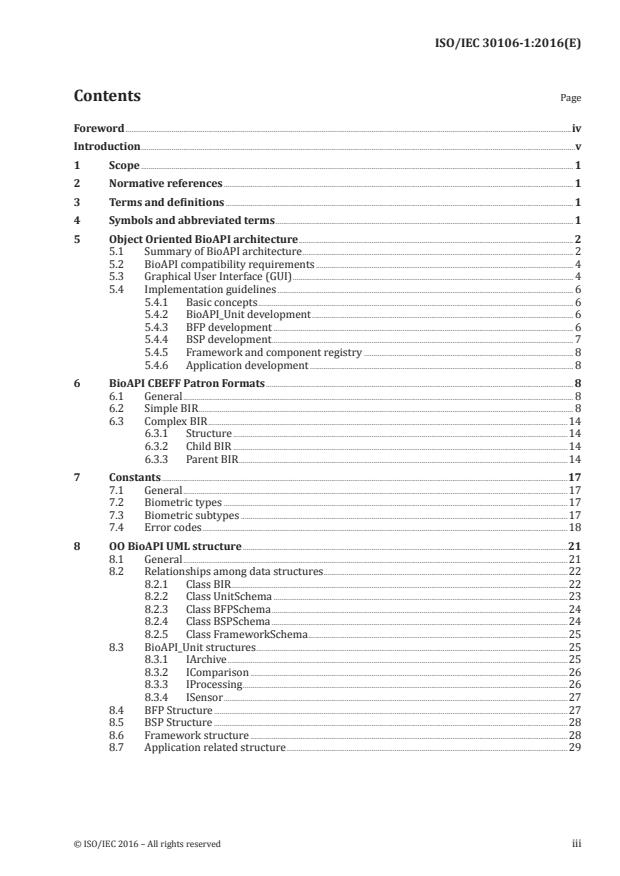
Contents Page
Foreword .iv
Introduction .v
1 Scope . 1
2 Normative references . 1
3 Terms and definitions . 1
4 Symbols and abbreviated terms . 1
5 Object Oriented BioAPI architecture . 2
5.1 Summary of BioAPI architecture . 2
5.2 BioAPI compatibility requirements . 4
5.3 Graphical User Interface (GUI) . 4
5.4 Implementation guidelines . 6
5.4.1 Basic concepts . 6
5.4.2 BioAPI_Unit development . 6
5.4.3 BFP development . 6
5.4.4 BSP development . 7
5.4.5 Framework and component registry . 8
5.4.6 Application development . 8
6 BioAPI CBEFF Patron Formats . 8
6.1 General . 8
6.2 Simple BIR . 8
6.3 Complex BIR .14
6.3.1 Structure .14
6.3.2 Child BIR .14
6.3.3 Parent BIR .14
7 Constants .17
7.1 General .17
7.2 Biometric types .17
7.3 Biometric subtypes .17
7.4 Error codes .18
8 OO BioAPI UML structure .21
8.1 General .21
8.2 Relationships among data structures .22
8.2.1 Class BIR .22
8.2.2 Class UnitSchema .23
8.2.3 Class BFPSchema .24
8.2.4 Class BSPSchema .24
8.2.5 Class FrameworkSchema .25
8.3 BioAPI_Unit structures .25
8.3.1 IArchive .25
8.3.2 IComparison .26
8.3.3 IProcessing .26
8.3.4 ISensor .27
8.4 BFP Structure .27
8.5 BSP Structure .28
8.6 Framework structure .28
8.7 Application related structure .29
© ISO/IEC 2016 – All rights reserved iii
Foreword
ISO (the International Organization for Standardization) and IEC (the International Electrotechnical
Commission) form the specialized system for worldwide standardization. National bodies that are
members of ISO or IEC participate in the development of International Standards through technical
committees established by the respective organization to deal with particular fields of technical
activity. ISO and IEC technical committees collaborate in fields of mutual interest. Other international
organizations, governmental and non-governmental, in liaison with ISO and IEC, also take part in the
work. In the field of information technology, ISO and IEC have established a joint technical committee,
ISO/IEC JTC 1.
The procedures used to develop this document and those intended for its further maintenance are
described in the ISO/IEC Directives, Part 1. In particular the different approval criteria needed for
the different types of document should be noted. This document was drafted in accordance with the
editorial rules of the ISO/IEC Directives, Part 2 (see www.iso.org/directives).
Attention is drawn to the possibility that some of the elements of this document may be the subject
of patent rights. ISO and IEC shall not be held responsible for identifying any or all such patent
rights. Details of any patent rights identified during the development of the document will be in the
Introduction and/or on the ISO list of patent declarations received (see www.iso.org/patents).
Any trade name used in this document is information given for the convenience of users and does not
constitute an endorsement.
For an explanation on the meaning of ISO specific terms and expressions related to conformity
assessment, as well as information about ISO’s adherence to the WTO principles in the Technical
Barriers to Trade (TBT) see the following URL: Foreword - Supplementary information
The committee responsible for this document is ISO/IEC JTC 1, Information technology, SC 37, Biometrics.
ISO/IEC 30106 consists of the following parts, under the general title Information technology — BioAPI
for object oriented programming languages:
— Part 1: Architecture
— Part 2: Java implementation
— Part 3: C# implementation
iv © ISO/IEC 2016 – All rights reserved
Introduction
The existing versions of BioAPI (ANSI version-INCITS 358 and ISO/IEC 19784-1) specify an application
programming interface expressed in the C language. The use of a portable language like C ensures
the BioAPI is accessible across multiple computing platforms and application domains. BioAPI is an
appropriate fit for applications written in C and is adequate for applications written in C++.
Unfortunately, a function-based language like C does not map easily to the object oriented domain where
this issue may be answered with an object oriented (OO) version of BioAPI. As noted, the function-
based nature of a C API does not map easily to the object oriented paradigm (i.e. languages such as C#
and Java). In particular, the use of a C API from within an object oriented application is unnatural and
requires programming constructs which introduce complexity to the development of an application.
Development of a OO version of BioAPI aims to increase the productivity of software practitioners who
who wish to use the BioAPI whilst remaining in the object oriented domain.
A standard object oriented version of BioAPI allows, in case of Java, BSPs that are intended for loading
into a Java-based application server to perform verification and/or identification operations. In those
application servers, use of the OO BioAPI is more natural when developing a framework and BSPs than
the C version of BioAPI.
Another area in which a standard OO version of BioAPI would be useful is that of small computing
devices based on an object oriented language (OOL), where (as on the large application servers
mentioned above) an OO BioAPI framework and OO BSPs would fit better than their C counterparts.
This part of ISO/IEC 30106 is expected to have the following impact:
— enable creation of BioAPI applications by developers more comfortable with Object Oriented
Languages;
— create a market of standard OO BSP components which target OO environments such as Java
application servers, Java applets, small Java devices, .NET servers, .NET applications, web services;
— increase the level of adoption of BioAPI by decreasing the barrier of entry for OO developers. This
includes providing access to C based BSPs (as if they were OO BSPs) through special versions of the
BioAPI framework, bridging a standard OO BioAPI framework to a standard C BioAPI framework.
© ISO/IEC 2016 – All rights reserved v
INTERNATIONAL STANDARD ISO/IEC 30106-1:2016(E)
Information technology — Object oriented BioAPI —
Part 1:
Architecture
1 Scope
This part of ISO/IEC 30106 specifies an architecture for a set of interfaces which define the OO BioAPI.
Components defined in this part of ISO/IEC 30106 include a framework, Biometric Service Providers
(BSPs), Biometric Function Providers (BFPs) and a component registry.
NOTE Each of these components have an equivalent component specified in ISO/IEC 19784-1 as the OO
BioAPI is intended to be an OO interpretation of this part of ISO/IEC 30106.
For this reason, this part of ISO/IEC 30106 is conceptually equivalent to ISO/IEC 19784-1. Concepts
present in this part of ISO/IEC 30106 (for example, BioAPI_Unit and component registry) have the same
meaning as in ISO/IEC 19784-1. While the conceptual equivalence of this part of ISO/IEC 30106 will be
maintained with ISO/IEC 19784-1, there are differences in the parameters passed between functions
and the sequence of function calls. These differences exist to take advantage of the features provided
by Object Oriented Programming Languages.
2 Normative references
The following documents, in whole or in part, are normatively referenced in this document and are
indispensable for its application. For dated references, only the edition cited applies. For undated
references, the latest edition of the referenced document (including any amendments) applies.
ISO/IEC 2382-37, Information technology — Vocabulary — Part 37: Biometrics
ISO/IEC 19784-1:2006, Information technology — Biometric Application Programming Interface — Part
1: BioAPI Specification
ISO/IEC 19785-1:2015, Information technology — Common Biometric Exchange Formats Framework —
Part 1: Data Element Specification
ISO/IEC 19785-3:2015, Information technology — Common Biometric Exchange Formats Framework —
Part 3: Patron format specifications
3 Terms and definitions
For the purposes of this document, the terms and definitions in ISO 2382-37, ISO/IEC 19784-1, and
ISO/IEC 19785 (all parts) apply.
4 Symbols and abbreviated terms
For the purposes of this document, the symbols and abbreviated terms defined in ISO/IEC 19784-1,
ISO/IEC 19785 (all parts) and the following apply.
API Application Programming Interface
BDB Biometric Data Block
BFP Biometric (OO) Function Provider
© ISO/IEC 2016 – All rights reserved 1
BIR Biometric Information Record
BSP Biometric Service Provider
CBEFF Common Biometric Exchange Formats Framework
FMR False Match Rate
FPI Function Provider Interface
GUI Graphical User Interface
ID Identity/Identification/Identifier
MOC Match on Card
OOBioAPI Object Oriented BioAPI
PID Product ID
SB Security Block
NOTE This term and abbreviation is imported from ISO/IEC 19785-1.
SBH Standard Biometric Header
NOTE This term and abbreviation is imported from ISO/IEC 19785-1.
SPI Service Provider Interface
UUID Universally Unique Identifier
5 Object Oriented BioAPI architecture
5.1 Summary of BioAPI architecture
Object Oriented BioAPI shall be defined in a way that allows both structured development of applications
and services, as well as interoperability between application and BSPs, and among BSPs. Therefore, the
definition has to be done respecting the hierarchical structure of BioAPI (19784-1). In few words, an
application shall be developed using an OO BioAPI that allows the instantiation of a BSP, which is based
on the instantiation of one or several BioAPI_Units. The BSP can host more than one BioAPI_Unit of each
category, and several units of each type can be used at any time, no presenting any kind of limitation
on the units to be used in a BSP. This makes it necessary for all methods to provide the reference to the
unit to be used in each of the operations.
An application is not permitted to directly access BioAPI_Units. Therefore, this part of ISO/IEC 30106
does not define a BioAPI_Unit interface, but only an object oriented hierarchical interface/class
model that may ease the implementation of the BSP. The BSP shall inherit all public methods and data
structures for each BioAPI_Unit the BSP encapsulates. It is the responsibility of the BSP’s implementation
to determine which functions of the BioAPI_Unit are offered to clients of the BSP. Note, an exception
should be returned for any BSP interface method that is not implemented in the BSP. This is represented
in Figure 1.
Programming an application, which interacts directly with a BSP, introduces practical considerations
for the application designer. One such consideration is dealing with third-party suppliers who provide
biometric components for use in applications. For example, a supplier of sensors may desire to include
support for their entire family of sensors as a single entity (e.g. a library). To achieve this, the supplier
may consider implementing the library as a single BSP, but may choose to not implement monolithic
methods (i.e. aggregated functionality such as Enrol, which does in one single call the capture, the
processing of the sample, the creation of the biometric reference and even the archiving). Without
monolithic methods, the BSP forces the application to take responsibility for the implementation
of monolithic style functionality. This situation means the BSP may pass biometric data back to the
application so the application may perform processing. The application may then need to pass this data
on to another BSP for additional processing. In some contexts, the passing of data out to an application
may simply be inefficient, in other contexts this may be a security concern. A possible solution for this
inconvenience is to allow the hypothetical sensor BSP to interact directly with other BSPs, rather than
involving the application in the management of this communication. To achieve this, the biometric
2 © ISO/IEC 2016 – All rights reserved
product provider may create an entity (e.g. a library) containing several BioAPI_Units of the same kind.
This is called a Biometric Function Provider (BFP) and exhibits the following characteristics.
— The BFP shall only host BioAPI_Units of the same category.
— The BFP is meant to allow that a BSP is linked to one of its BioAPI_Units, in order to complete or
adapt the functionality of the BSP.
— The BFP shall not provide functionality directly to the application, but only link to the BSP. The BSP
communicates with the BFP on behalf of the application. The BSP is responsible for providing the
BFP’s functionality to the application.
The above mentioned situation also solves a problem from developers’ point of view, which deals with
simplicity in developing applications. If an application may require to use BioAPI_Units from different
providers (e.g. a sensor from one provider and processing, comparison and archive BioAPI_Units from
other provider), then it will have to load two different BSPs, calling each of the methods independently.
As mentioned earlier, this has the inconvenience that it won’t be possible to call a monolithic method,
such as Verify(), which performs the data capture, the processing, extraction of the biometric reference
from the database, the comparison and taking the decision, all within the same single call. Then, the
application programmer will have to know which individual methods have to be called from each of
the BSPs, in order to get the same functionality. To summarize, a level of abstraction and efficiency is
achieved through the use of BFPs to segregate functionality into discrete sets. Each BFP aggregates a
set of functionality provided by a product supplier (through a BioAPI_Unit). These BFPs are used by
a BSP, where the BSP combines functionality from each BFP to offer monolithic methods for use by a
client. The client application may then call the monolithic methods in the BSP without concern for the
underlying implementation offered by a product supplier.
Another consideration for an application designer is the concern about security in regards to certain
operations. Biometric data is typically sensitive personal data and some implementations of OO BioAPI
may require the client application is not capable of directly accessing this data (ie: BIRs). By taking
advantage of BFPs, and the abstraction facilities they offer, the possibility of tampering by malware or
malicious users at the application level is removed. By using BFPs, all sensitive data will be handled at
a level no higher than the BSP level. This means no BIR will be accessible to the application, not only
simplifying application development, but eases concerns in relation to security.
The BFP shall not be accessed directly by the application. BioAPI calls are created to allow the
application to know the BioAPI_Units that are contained in the BFPs so that the application may later
request one BSP to include one of those BioAPI_Units of the BFP. This is done through a component
registry and the procedure is further described in 5.4.
All the above ideas shall be implemented to allow the dynamic selection of components to be used by
the application, but with no a-priori knowledge from the application developer. This is achieved by
the inclusion of a common framework, which shall be installed in the system where the application
is expected to be running. Then, the application shall request the framework for the list of the BSPs
and BFPs installed, select the BSPs (with the requested selection of BioAPI_Units from BFPs) to be
instantiated dynamically by the framework, and then accessing their methods and data structures
through the framework. The application shall never be allowed to access the BSPs directly. This is
summarized in Figure 1.
© ISO/IEC 2016 – All rights reserved 3
Figure 1 — Generic structure of a framework-based application
BSPs may be accessed by several applications at the same time, and it may also happen that BioAPI_
Units in the BFPs are also accessed by several BSPs at the same time. It is up to the implementation
of the framework the way that this implemented (e.g. this may be done by queuing requests from the
different sources, or by responding to occurring events).
For those developers that are familiar with ISO/IEC 19784, it is important to provide a relationship
about the interfaces there defined and the different layers that compose these International Standards.
The correspondence between both International Standards is given in Table 1.
Table 1 — Correspondence between ISO/IEC 30106 and ISO/IEC 19784 interfaces
Interface in ISO/IEC 30106 Interface in ISO/IEC 19784
IFramework API
IBSP SPI
IBFP SFPI
Along the ISO/IEC 30106 series, the Unit level will be also specified, not as for specifying a different
interface, but for structuring in a hierarchical way the support for each of the categories of BioAPI_
Units at the IBSP or IBFP interfaces.
5.2 BioAPI compatibility requirements
This part of ISO/IEC 30106 is defined as compatible with BioAPI version 3.0 (ISO/IEC 19784-1.revision
1), but the framework may be developed as to allow the cross compatibility with previous versions
of BioAPI, as to allow BioAPI 2.x compliant BSPs and BFPs to be used in an ISO/IEC 30106 compliant
application.
There is no provision to allow Object Oriented BSPs to be used in an ISO/IEC 19784-compliant
framework and application.
5.3 Graphical User Interface (GUI)
A BSP may handle by itself, the interaction between the user and the system. For example, a BSP with
a sensor BioAPI_Unit may address all the interaction by the displaying messages, illuminating LEDs
4 © ISO/IEC 2016 – All rights reserved
and/or activating sounds at the sensor itself. Such kind of interaction may include providing feedback
to the user on
— the finger to be placed at the sensor,
— how to improve the location of the sample in the sensor (e.g. alignment of the biometric characteristic
in relation to the sensor active area),
— whether the acquisition has been done in a correct way, or
— whether the biometric comparison has led to a positive or negative decision.
But in certain cases, it may be requested that such interaction is handled by the application using such
BSP, showing all messages and illustrations in the computer screen. This may also be handled by the
BSP itself, but this can lead to certain kinds of inconveniences such as the following:
— the BSP graphical user interface may not be adaptable to the different sizes and resolutions that the
application screen is using;
— the feedback provided has to follow the same look and feel as the main application, including the use
of service provider logos;
— the feedback has to be adaptable to the language of the user being identified, or where the system is
deployed.
In those cases, it is recommended in order to avoid re-programming the BSP or increasing the
complexity of the BSP, the interaction is handled by the application itself. As the feedback depends on
the specific step that the BSP is executing, and those steps are mostly controlled by the BSP (i.e. most
BSP functions are offered to the application as monolithic methods), then the way to solve this is by
using callback functions.
Callback functions shall be developed for each step where a BSP is required to either interact with, or
provide feedback to, a user. Naturally, the application shall provide a set of functions the BSP’s callbacks
will map to, which the BSP will call within the context of the original method call.
Therefore, if the BSP allows the use of callback functions for handling the GUI, the following development
actions shall be taken, for each of the processes requiring such interaction (e.g. Capture).
— The application shall implement all GUI related functions for such process. These functions are of
the following kinds:
— Select Function: to show the interaction with the user at the beginning or the end of the whole
process.
EXAMPLE At the beginning the process, the following message may be provided: “Capture process for
the index finger of the right hand”. And at the end of the process, the message to be given could be: “Acquisition
finished. Thank you!”. Therefore, the callback function shall know if it is being called at the beginning of the
process, or at the end. Also, the callback function can also provide the BSP with information about a user
action, such as cancelling the capture process. All this information flow is provided in parameters of the
callback function.
— State Function: Sometimes the BSP process may take several internal steps, which can be
designed as different states. Therefore, the state function will provide feedback depending on
whether a certain internal step is to be started or finished. This leads to the need for the State
Function to know which internal step is being processed, and that information will be provided
as parameters to the callback function. Also, feedback provided by the user will be passed to the
BSP by the parameters involved, such as cancelling the whole process.
— Progress Function: In some other cases, it may be necessary to provide the user with real time
feedback on the progression of the process.
EXAMPLE A system may be showing in the screen the live image of the fingerprint or face within the
acquisition process. In such case, a Progress callback function may be implemented to show the data stream.
© ISO/IEC 2016 – All rights reserved 5
— Once the callback functions have been implemented for the process, the application shall report
the BSP about the callback functions to be used, before calling the process. This will be done by
subscribing the BSP to those selected GUI events, and the relevant callback functions.
— Once subscribed, the application can call the process (e.g. Capture).
— Finally, when the process has been completed, the application can unsubscribe the BSP from the
previously subscribed events.
NOTE Further information can be found in ISO/IEC 19784-1.
5.4 Implementation guidelines
5.4.1 Basic concepts
A common scenario for BioAPI’s implementation is one where a framework is developed. A BioAPI
framework provides a further abstraction, on top of BSPs and BFPs, allowing an application developer
to use biometric components (BSPs or BFPs) without concern for their underlying implementation. In a
framework approach, it is the responsibility of the application developer to determine which functions
offered by BSPs or BFPs are available to an end-user.
In an Object Oriented BioAPI implementation, three developer roles are involved in the use of this
part of ISO/IEC 30106. The following points provide guidance on which clauses are applicable to each
developer role:
— Developers providing services (ie: BSPs or BFPs) for access by biometric applications, will find 5.4.2,
5.4.3 and 5.4.4 are applicable
— Framework developers involved with integrating the framework into a system and making BSPs
and BPFs accessible to such systems will find 5.4.5 applicable
— Application developers who directly use third party BSPs will find 5.4.6 is applicable to this group
of developers.
5.4.2 BioAPI_Unit development
BSPs and BFPs will implement BioAPI_Units. They shall be developed including all properties and
methods defined in this International Standard. If when implementing a certain BioAPI_Unit, the
developer does not want to provide a certain functionality, then, the following indications shall be
followed.
— For each of the methods, including the overloading of them, that are not to be supported, the method
shall be programmed and published, but containing only the throw of a BioAPIException indicating
that such function is not supported.
— Whatever public property is involved only in the non-supported functionality, its value shall be set
to NULL.
— The UnitSchema shall provide an accurate information on the functionality supported by the
BioAPI_Unit.
It is necessary to remark that the implementation of BioAPI_Units is entirely proprietary and is strictly
supported and implemented by BioAPI_BSP developer.
5.4.3 BFP development
As it was mentioned in 5.1, a Biometric Function Provider (i.e. BFP), is a set of BioAPI_Units of the same
category (i.e. either archive, comparison, processing or sensor), that are provided for the BSPs, so that
6 © ISO/IEC 2016 – All rights reserved
a BSP can use one of such BioAPI_Units, either by its own decision, or by request of the application. This
relationship is implemented in the following way:
a) The application loads the BSP by calling the BSPLoad method.
b) When executing the BSPLoad() method it is recommended the BSP determines which BSPs are
included in the Component Registry. The Component Registry also defines the set of BioAPI_Units
contained in each BSP. Probing for this information is achieved by calling the callback function
BFPEnumerationCallback(). Calling BFPEnumerationCallback() will result in the return of
BFPSchemas.
1) For every BioAPI_Unit the BSP reads its UnitSchema structure to discover whether the BioAPI_
Unit is compatible with the BSP and therefore a supported BioAPI_Unit.
2) The BSP retains an internal register of supported BioAPI_Units and the BFP to which each
belongs. The BSP also assigns a unique identifier, called UnitID, to each supported BioAPI_Unit.
c) After loading the BSP the application may interrogate the BSP about the supported BioAPI_Units in
order to discover which BioAPI_Units are available. This is done be calling the QueryUnits() method.
d) The application shall be able to use any BioAPI_Unit of those offered by the BSP. The BioAPI_Unit can
be offered by two means (this is applicable to each of the four BioAPI_Unit categories, i.e. archive,
comparison, processing and sensor):
1) The BSP already contains the BioAPI_Unit to be used.
2) The BioAPI_Unit selected is not integrated in the BSP, but it is provided to the BSP by a
compatible BFP automatically linked by the BSP during its loading process.
e) Once the link between the BSP and all offered BioAPI_Units is stated, the application can use those
BioAPI_Units by calling each of the relevant methods, indicating the UnitID selected.
In addition, the developer shall include also those methods needed for the installation, de-installation
and the dynamic instantiation of the available methods and properties. Also, the dynamic relationship
between BSPs and BioAPI_Units into BFPs shall be covered.
Finally, when developing a BFP, all indications about the support for the implementation BioAPI_Units
shall be followed (see 5.4.2).
5.4.4 BSP development
When developing a BSP, all methods defined for a BSP in this part of ISO/IEC 30106 shall be implemented,
including methods related to non-included BioAPI_Units. It may also happen that a BSP does not offer
detailed functionality for its BioAPI_Units and only provides the use of monolithic methods to the
application (e.g. due to security concerns). For these cases, the following rules shall apply.
— Unless the BSP does not want to publish the detailed functionality of a BioAPI_Unit, the BSP methods
that are related to BioAPI_Unit methods shall only contain the call to the method of the referenced
BioAPI_Unit, returning the value returned by such method.
— If a method does not want to publish the detail functionality of one of its BioAPI_Units, then the non-
supported method shall throw a BioAPIException indicating the non-supported functionality. Also,
if there are properties related only to non-supported methods, its value shall be set to NULL. And
finally, the BSPSchema shall denote this lack of functionality.
— For those cases where the BSP is not going to support the selection of new BioAPI_Units from BFPs,
and that category of BioAPI_Unit is not included in the BSP, then, the relevant methods shall be
implemented throwing the BioAPIException indicating the lack of that functionality.
— In case the BSP accepts the selection of new BioAPI_Units, and when loaded it discovers the existence
of supported BioAPI_Units that cover that functionality, the BSP shall update its BSPSchema in
© ISO/IEC 2016 – All rights reserved 7
order to notify that functionality, and shall have a rule to allow the selection of any of the available
BioAPI_Units.
— If a certain method within the BSP requires the previous link between the BSP and a BFP BioAPI_
Unit, it shall be developed in a way that, if not BioAPI_Unit selection has been done, it throws the
function not supported BioAPIException, and if the BioAPI_Unit selection has already occurred, it
calls the selected BioAPI_Unit method forwarding the request from the application.
In addition, the developer shall include also those methods needed for the installation, de-installation
and the dynamic instantiation of the available methods and properties. Also, the dynamic relationship
between BSPs and BioAPI_Units into BFPs shall be covered.
5.4.5 Framework and component registry
The development of the framework is also related to the development of the component registry, which
shall be implemented in a way that a dynamic and non-volatile listing of the installed BSPs and BFPs is
stored. Also, the framework shall guarantee that an interoperable installation procedure is available
for the platform where it is being executed and that the application has all BSPs and BFPs discovery
mechanisms available.
5.4.6 Application development
An application developer shall be aware of the operations and options offered by the Framework,
as well as which BSPs and BioAPI_Units are available via the Framework. The application developer
shall ensure the application responds appropriately to exceptions raised by the Framework, whether
the exceptions indicate called functionality is not available or some other exception has occurred. It is
recommended, for simplicity of the application’s code, the application developer uses the highest level
methods available in the Bio API call stack (e.g. those in which all the biometric data is handled within
the BSP and not circulated through the application).
To assist the application developer in determining the features and functions provided by the
Framework, the following methods are available.
— Even before loading a BSP, the application can ask the Framework about which BSPs and BFPs are
installed, by calling the methods EnumBSPs() and EnumBFPs() respectively.
— Also, the application can obtain further information about the BFPs, by calling QueryBFPs() method.
6 BioAPI CBEFF Patron Formats
6.1 General
Object Oriented BioAPI is able to use biometric data coded as Self-Identifying BIRs, either Simple BIRs
or Complex BIRs, following the structure and definition of CBEFF (i.e. ISO/IEC 19785). Therefore, this
Clause describes both, the Simple BIR and the Complex BIR data structures in binary format.
This patron format may be expanded by using other type of coded, such as a Self-Identifying TLV coding,
as long as they are defined in the latest revision of ISO/IEC 19785-3.
6.2 Simple BIR
The data elements of a Simple BIR are provided in the following table. It is stated which elements from
those described in ISO/IEC 19785 are mandatory or not.
8 © ISO/IEC 2016 – All rights reserved
Table 2 — CBEFF data elements of the patron format for a Simple BIR
b
CBEFF data element name Field name Length and Abstract values and Encodings
a
optionality
The following fields shall
occur at most once
CBEFF_BIR_self_id_owner BirSelfIdOwner 2, mandatory 1.65535 (for SC37 30106-x Simple:
257)
CBEFF_BIR_self_id_type BirSelfIdType 2, mandatory 1.65535 (for SC37 30106-x Simple: 9)
The complete length in bytes of the
not a standard CBEFF
BIRLength 4, mandatory whole BIR, including header and SB
data element
(if applicable)
CBEFF_version cbeffVersion 1, mandatory Major ‘3’ and Minor ‘0’: 0x000030
CBEFF_patron_header_ patronHeaderVersion 1, mandatory 1
versi on
CBEFF_BDB_format_owner bdbFormatOwner 2, mandatory 0.65535
CBEFF_BDB_format_type bdbFormatType 2, mandatory 0.65535
NO ENCRYPTION: 0
CBEFF_BDB_encryption_op-
tions bdbEncryption 1; mandatory ENCRYPTION: 1
CBEFF_BIR_integrity_option birIntegrity 1, mandatory
NO INTEGRITY: 0 INTEGRITY: 1
s
CBEFF_subheader_count numChildren 1, mandatory 0
© ISO/IEC 2016 – All rights reserved 9
Table 2 (continued)
b
CBEFF data element name Field name Length and Abstract values and Encodings
a
optionality
not a standard CBEFF data fieldPresence 4, mandatory A 32-bit field containing one bit for each
element optional field in the patron format. The
bit value ‘1’ means that the correspond-
ing field is present in the BIR instance.
Bit position (0=least significant,
31=least significant) and correspond-
ing optional field (those not defined yet
shall be set to ‘0’):
0. bdbBiometricType
1. bdbBiometricSubtype
2. bdbCaptureDeviceOwner and
Type
3. bdbFeatureExtractionAlgOwn-
er and Type
4. bdbComparisonAlgOwner and
Type
5. bdbCompressionAlgOwner
and Type
6. bdbPADTechniqueOwner and
Type
7. bdbChallengeResponse
8. bdbCreationDate
9. bdbIndex
10. bdbProcessedLevel
11. bdbProductOwner and Type
12. bdbPurpose
13. bdbQuality
14. bdbOwner and Type
15. bdbValidityPeriod
16. birCreationDate
17. birCreator
18. birIndex
19. birPayload
20. birPointer
21. birValidityPeriod
22. sbFormatOwner and Type
10 © ISO/IEC 2016 – All rights reserved
Table 2 (continued)
b
CBEFF data element name Field name Length and Abstract values and Encodings
a
optionality
CBEFF_BDB_biometric_type bdbBiometricType 4 This encoding is a 4 octet bitmap. NO
VALUE AVAILABLE is encoded as all 0
bits. If MULTIPLE BIOMETRIC TYPES is
set, other bits may also be set to enu-
merate the types contained in the BDB.
NO VALUE AVAILABLE: X’00 00 00’
MULTIPLE BIOMETRIC TYPES: X’00 00
01’ FACE: X’00 00 02’ VOICE: X’00 00 04’
FINGER: X’00 00 08’ IRIS: X’00 00 10’
RETINA: X’00 00 20’ HAND GEOMETRY:
X’00 00 40’ SIGNATURE OR SIGN: X’00
00 80’ KEYSTROKE: X’00 01 00’ LIP
MOVEMENT: X’00 02 00’ GAIT: X’00
10 00’ VEIN: X’00 20 00’ DNA: X’00 40
00’ EAR: X’00 80 00’ FOOT: X’01 00 00’
SCENT: X’02 00 00’
CBEFF_BDB_biometric_ bdbBiometricSubtype 1 This encoding is a 1 octet bitmap. Combi-
subt ype nations of abstract values are permitted
(by ORing the encodings for those values)
when the abstract value encoded in
CBEFF_BDB_biometric_type represents
a biometric technology that can create
a BDB where multiple subtypes are sup-
ported. NO VALUE AVAILABLE: b’0000
0000’ LEFT: b’0000 0001’ RIGHT:
b’0000 0010’ LEFT THUMB: b’0000
0101’ LEFT INDEX FINGER: b’0000
1001’ LEFT MIDDLE FINGER: b’0001
0001’ LEFT RING FINGER: b’0010 0001’
LEFT LITTLE FINGER: b’0100 0001’
RIGHT THUMB: b’0000 0110’ RIGHT
INDEX FINGER: b’0000 1010’ RIGHT
MIDDLE FINGER: b’0001 0010’ RIGHT
RING FINGER: b’0010 0010’ RIGHT LIT-
TLE FINGER: b’0100 0010’ LEFT PALM:
b’1000 0101’ LEFT BACK OF HAND:
b’1000 1001’ LEFT WRIST: b’1001 0001’
RIGHT PALM: b’1000 0110’ RIGHT
BACK OF HAND: b’1000 1010’ RIGHT
WRIST: b’1001 0010’
CBEFF_BDB_capture_de- bdbCaptureDevice- 2 0.65535, being 0 – NO VALUE AVAILA-
...