


ISO/FDIS 1035
(Main)Hot-rolled steel bars — Dimensions, shape, masses and tolerances
Hot-rolled steel bars — Dimensions, shape, masses and tolerances
Specifies dimensions and tolerances of metric series hot-rolled steel round bars. A table shows diameters, sectional areas and masses per unit length.
Barres en acier laminées à chaud — Dimensions, formes, masses et tolérances
General Information
- Status
- Not Published
- Technical Committee
- ISO/TC 17/SC 3 - Steels for structural purposes
- Current Stage
- 5020 - FDIS ballot initiated: 2 months. Proof sent to secretariat
- Start Date
- 06-Feb-2026
- Completion Date
- 06-Feb-2026
Relations
- Effective Date
- 01-Jun-2024
- Effective Date
- 01-Jun-2024
- Effective Date
- 01-Jun-2024
- Effective Date
- 01-Jun-2024
Overview
ISO/FDIS 1035:2026 establishes internationally harmonized requirements for the dimensions, shape, mass, and tolerances of hot-rolled steel bars in the metric series. Developed by the International Organization for Standardization (ISO), this standard covers round, square, flat, hexagonal, and octagonal steel bars widely used in construction, manufacturing, and engineering applications. The standard details precise measurement tables for diameters, sectional areas, and masses per unit length, ensuring uniformity in global steel bar production and supply chains.
Key Topics
Product Forms Covered:
- Round bars: 5.5 mm – 400 mm diameter
- Square bars: 5.5 mm – 300 mm side length
- Flat bars: 3 mm – 60 mm thickness, 10 mm – 200 mm width
- Hexagonal bars: 8 mm – 70 mm across flats
- Octagonal bars: 16 mm – 40 mm across flats
Dimensional Requirements:
- Nominal dimensions and allowable tolerances for various bar forms
- Mass per unit length tables for simplified ordering and inventory control
Tolerances and Precision Classes:
- Tolerance classes for dimensions (normal, fine, superfine)
- Tolerances on width, thickness, length, and straightness
- Ovality, out-of-squareness, and out-of-section controls to maintain product integrity
Designation and Identification:
- Clear marking requirements
- Designation system including bar type, relevant standard number, dimensions, tolerance class, quality standard, and steel grade
Supplier-Customer Agreements:
- Custom dimensions and tolerances permissible by mutual agreement
- Flexibility to specify tighter or different tolerances for specialized applications
Applications
Hot-rolled steel bars standardized by ISO/FDIS 1035 are essential in numerous sectors where reliability, safety, and interchangeability are critical. Key applications include:
- Construction industry: Reinforcement bars, structural components, and frameworks benefit from standardized sizes and tolerances for predictable performance and compliance with building codes.
- Mechanical engineering: Precision-machined parts use bars with tightly controlled cross-sections and straightness to achieve consistent part quality.
- Manufacturing: Producers of automotive components, machinery, and equipment rely on standard dimensions for process optimization and compatibility across supply chains.
- Metal fabrication and further processing: Fabricators can confidently specify, purchase, or stock steel bars knowing the products will meet internationally agreed dimensions and mass requirements.
Using bars that conform to ISO 1035 delivers cost and efficiency advantages, reduces material waste, simplifies procurement, and supports international trade in steel products.
Related Standards
For optimal compliance and compatibility, users of ISO/FDIS 1035 may refer to the following related ISO standards:
- ISO 6929: Steel products - Vocabulary. Defines key terms for steel products, supporting consistent communication in documentation and procurement.
- ISO 630-2: Structural steels - Part 2: Technical delivery conditions for structural steels. Guides quality and properties for specified steel grades.
- Other ISO and national standards: Users should verify requirements in project specifications or regional codes for any additional product or testing standards applicable to hot-rolled steel bars.
By adhering to ISO/FDIS 1035, manufacturers, suppliers, and end users ensure compatibility, quality, and safety in hot-rolled steel bars across international projects. This standard is a critical resource for quality management and engineering professionals seeking reliable, standardized structural and engineering steels.


ISO/FDIS 1035 - Hot-rolled steel bars — Dimensions, shape, masses and tolerances Released:23. 01. 2026
REDLINE ISO/FDIS 1035 - Hot-rolled steel bars — Dimensions, shape, masses and tolerances Released:23. 01. 2026
Get Certified
Connect with accredited certification bodies for this standard

Element Materials Technology
Materials testing and product certification.

Inštitut za kovinske materiale in tehnologije
Institute of Metals and Technology. Materials testing, metallurgical analysis, NDT.
Sponsored listings
Frequently Asked Questions
ISO/FDIS 1035 is a draft published by the International Organization for Standardization (ISO). Its full title is "Hot-rolled steel bars — Dimensions, shape, masses and tolerances". This standard covers: Specifies dimensions and tolerances of metric series hot-rolled steel round bars. A table shows diameters, sectional areas and masses per unit length.
Specifies dimensions and tolerances of metric series hot-rolled steel round bars. A table shows diameters, sectional areas and masses per unit length.
ISO/FDIS 1035 is classified under the following ICS (International Classification for Standards) categories: 77.140.60 - Steel bars and rods. The ICS classification helps identify the subject area and facilitates finding related standards.
ISO/FDIS 1035 has the following relationships with other standards: It is inter standard links to ISO 1035-1:1980, ISO 1035-2:1980, ISO 1035-4:1982, ISO 1035-3:1980. Understanding these relationships helps ensure you are using the most current and applicable version of the standard.
ISO/FDIS 1035 is available in PDF format for immediate download after purchase. The document can be added to your cart and obtained through the secure checkout process. Digital delivery ensures instant access to the complete standard document.
Standards Content (Sample)
FINAL DRAFT
International
Standard
ISO/TC 17/SC 3
Hot-rolled steel bars — Dimensions,
Secretariat: AFNOR
shape, masses and tolerances
Voting begins on:
Barres en acier laminées à chaud — Dimensions, formes, masses 2026-02-06
et tolérances
Voting terminates on:
2026-04-03
RECIPIENTS OF THIS DRAFT ARE INVITED TO SUBMIT,
WITH THEIR COMMENTS, NOTIFICATION OF ANY
RELEVANT PATENT RIGHTS OF WHICH THEY ARE AWARE
AND TO PROVIDE SUPPOR TING DOCUMENTATION.
IN ADDITION TO THEIR EVALUATION AS
BEING ACCEPTABLE FOR INDUSTRIAL, TECHNO
LOGICAL, COMMERCIAL AND USER PURPOSES, DRAFT
INTERNATIONAL STANDARDS MAY ON OCCASION HAVE
TO BE CONSIDERED IN THE LIGHT OF THEIR POTENTIAL
TO BECOME STAN DARDS TO WHICH REFERENCE MAY BE
MADE IN NATIONAL REGULATIONS.
Reference number
FINAL DRAFT
International
Standard
ISO/TC 17/SC 3
Hot-rolled steel bars — Dimensions,
Secretariat: AFNOR
shape, masses and tolerances
Voting begins on:
Barres en acier laminées à chaud — Dimensions, formes, masses
et tolérances
Voting terminates on:
RECIPIENTS OF THIS DRAFT ARE INVITED TO SUBMIT,
WITH THEIR COMMENTS, NOTIFICATION OF ANY
RELEVANT PATENT RIGHTS OF WHICH THEY ARE AWARE
AND TO PROVIDE SUPPOR TING DOCUMENTATION.
© ISO 2026
IN ADDITION TO THEIR EVALUATION AS
All rights reserved. Unless otherwise specified, or required in the context of its implementation, no part of this publication may
BEING ACCEPTABLE FOR INDUSTRIAL, TECHNO
LOGICAL, COMMERCIAL AND USER PURPOSES, DRAFT
be reproduced or utilized otherwise in any form or by any means, electronic or mechanical, including photocopying, or posting on
INTERNATIONAL STANDARDS MAY ON OCCASION HAVE
the internet or an intranet, without prior written permission. Permission can be requested from either ISO at the address below
TO BE CONSIDERED IN THE LIGHT OF THEIR POTENTIAL
or ISO’s member body in the country of the requester.
TO BECOME STAN DARDS TO WHICH REFERENCE MAY BE
MADE IN NATIONAL REGULATIONS.
ISO copyright office
CP 401 • Ch. de Blandonnet 8
CH-1214 Vernier, Geneva
Phone: +41 22 749 01 11
Email: copyright@iso.org
Website: www.iso.org
Published in Switzerland Reference number
ii
Contents Page
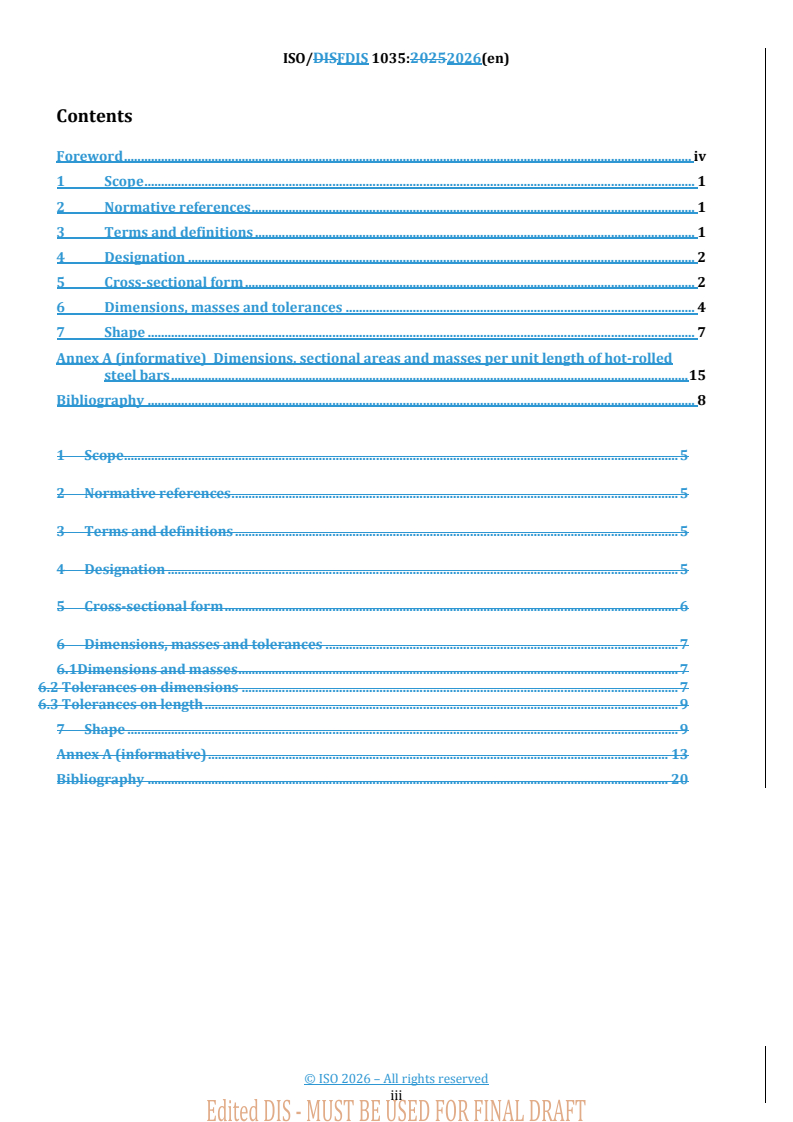
Foreword .iv
1 Scope . 1
2 Normative references . 1
3 Terms and definitions . 1
4 Designation . 1
5 Cross-sectional form . 2
6 Dimensions, masses and tolerances . . 3
6.1 Dimensions and masses.3
6.2 Tolerances on dimensions .4
7 Shape . 5
Annex A (informative) Dimensions, sectional areas and masses per unit length of hot-rolled
steel bars .10
Bibliography . 19
iii
Foreword
ISO (the International Organization for Standardization) is a worldwide federation of national standards
bodies (ISO member bodies). The work of preparing International Standards is normally carried out through
ISO technical committees. Each member body interested in a subject for which a technical committee
has been established has the right to be represented on that committee. International organizations,
governmental and non-governmental, in liaison with ISO, also take part in the work. ISO collaborates closely
with the International Electrotechnical Commission (IEC) on all matters of electrotechnical standardization.
The procedures used to develop this document and those intended for its further maintenance are described
in the ISO/IEC Directives, Part 1. In particular, the different approval criteria needed for the different types
of ISO document should be noted. This document was drafted in accordance with the editorial rules of the
ISO/IEC Directives, Part 2 (see www.iso.org/directives).
ISO draws attention to the possibility that the implementation of this document may involve the use of (a)
patent(s). ISO takes no position concerning the evidence, validity or applicability of any claimed patent
rights in respect thereof. As of the date of publication of this document, ISO had not received notice of (a)
patent(s) which may be required to implement this document. However, implementers are cautioned that
this may not represent the latest information, which may be obtained from the patent database available at
www.iso.org/patents. ISO shall not be held responsible for identifying any or all such patent rights.
Any trade name used in this document is information given for the convenience of users and does not
constitute an endorsement.
For an explanation of the voluntary nature of standards, the meaning of ISO specific terms and expressions
related to conformity assessment, as well as information about ISO's adherence to the World Trade
Organization (WTO) principles in the Technical Barriers to Trade (TBT), see www.iso.org/iso/foreword.html.
This document was prepared by Technical Committee ISO/TC 17, Steels, Subcommittee SC 3, Steels for
structural purposes.
This first edition of ISO 1035 cancels and replaces ISO 1035-1:1980, ISO 1035-2:1980, ISO 1035-3:1980 and
ISO 1035-4:1982, which have been technically revised.
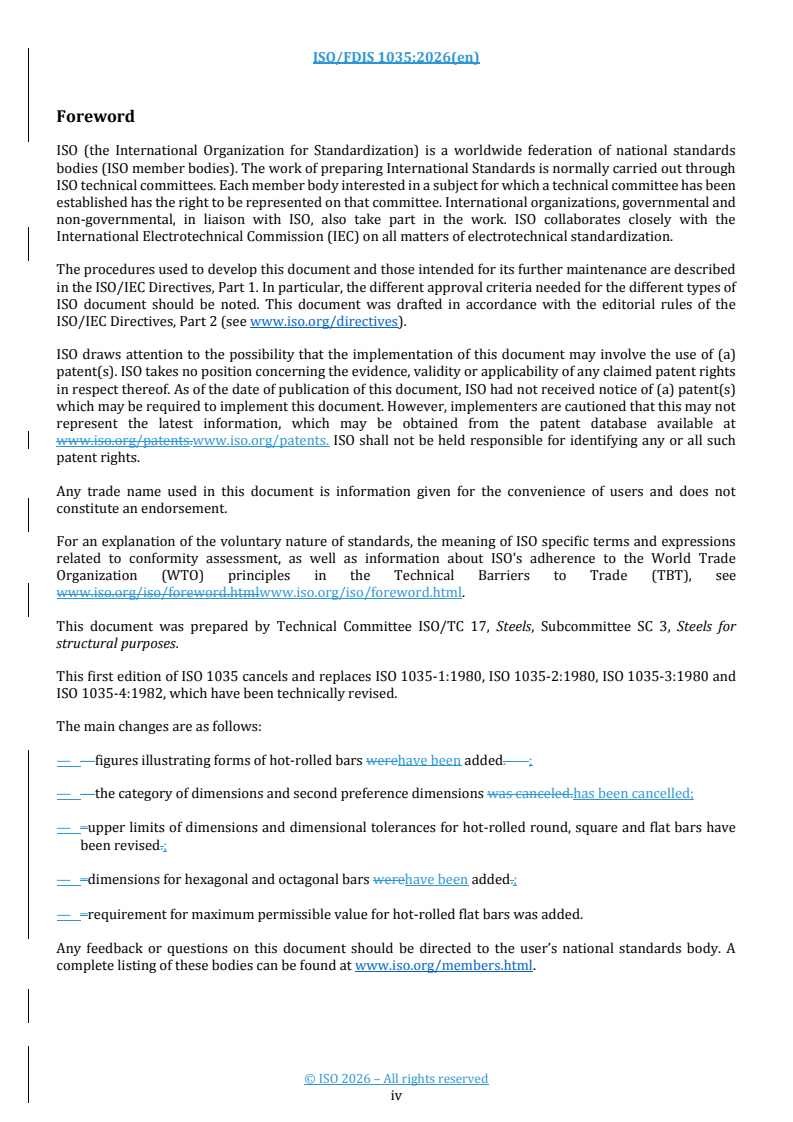
The main changes are as follows:
— figures illustrating forms of hot-rolled bars have been added;
— the category of dimensions and second preference dimensions has been cancelled;
— upper limits of dimensions and dimensional tolerances for hot-rolled round, square and flat bars have
been revised;
— dimensions for hexagonal and octagonal bars have been added;
— requirement for maximum permissible value for hot-rolled flat bars was added.
Any feedback or questions on this document should be directed to the user’s national standards body. A
complete listing of these bodies can be found at www.iso.org/members.html.
iv
FINAL DRAFT International Standard ISO/FDIS 1035:2026(en)
Hot-rolled steel bars — Dimensions, shape, masses and
tolerances
1 Scope
This document specifies dimensions, shape, mass and tolerances of metric series hot-rolled steel bars.
This document is applicable to:
a) hot-rolled round bars with diameter of 5,5 mm up to 400 mm;
b) hot-rolled square bars with side length of 5,5 mm up to 300 mm;
c) hot-rolled flat bars with thickness of 3 mm up to 60 mm and width of 10 mm up to 200 mm;
d) hot-rolled hexagonal bars with distance across opposite flats of 8 mm up to 70 mm;
e) hot-rolled octagonal bars with distance across opposite flats of 16 mm up to 40 mm.
NOTE Wide flats can be covered under flat bars for practical reasons.
2 Normative references
The following documents are referred to in the text in such a way that some or all of their content constitutes
requirements of this document. For dated references, only the edition cited applies. For undated references,
the latest edition of the referenced document (including any amendments) applies.
ISO 6929, Steel products — Vocabulary
3 Terms and definitions
For the purposes of this document, the terms and definitions given in ISO 6929 apply.
ISO and IEC maintain terminological databases for use in standardization at the following addresses:
— ISO Online browsing platform: available at https:// www .iso .org/ obp
— IEC Electropedia: available at https:// www .electropedia .org/
4 Designation
The designation of hot-rolled steel bars shall comprise:
— the term round bar, square bar, flat bar, hexagonal or octagonal bar;
— the number of the standard, i.e. ISO 1035;
— the nominal dimension(s) in mm and the tolerance classes;
— the number of the quality standard and the steel name of the ordered steel.
EXAMPLE
Round bar ISO 1035-50 N×6000L0
Steel ISO 630-2 S355D
5 Cross-sectional form
5.1 Cross-sectional forms of hot-rolled round bars and square bars are shown in Figure 1.
a) b)
Key
d diameter
a side length
Figure 1 — Cross-sectional forms of hot-rolled round bars and square bars
5.2 Cross-sectional form of hot-rolled flat bars is shown in Figure 2.
Key
w width
t thickness
Figure 2 — Cross-sectional form of hot-rolled flat bars
5.3 Cross-sectional forms of hot-rolled hexagonal and octagonal bars are shown in Figure 3.
a) b)
Key
S distance across flats
Figure 3 — Cross-sectional forms of hot-rolled hexagonal and octagonal bars
6 Dimensions, masses and tolerances
6.1 Dimensions and masses
6.1.1 The preferred dimensions and masses per unit length of hot-rolled round bars are given in Table A.1.
6.1.2 The preferred dimensions and masses per unit length of hot-rolled square bars are given in Table A.2.
6.1.3 The preferred dimensions and masses per unit length of hot-rolled flat bars are given in Table A.3.
6.1.4 The preferred dimensions, sectional areas and masses per unit length of hot-rolled hexagonal and
octagonal bars are given in Table A.4.
6.1.5 Upon agreement between the supplier and purchaser, steel bars may be delivered in other dimensions
unlisted in Annex A, and it shall be indicated in the contract.
6.2 Tolerances on dimensions
6.2.1 The tolerances on diameter for round bars and side length for square bars shall be as specified
in Table 1. The class of dimensional tolerance shall be indicated in the contract. If no tolerance class is
requested, the tolerance class is N.
Table 1 — Tolerances on diameter for round bars and side length for square bars
Tolerance on diameters or side lengths for classes
Nominal diameters or side lengths
mm
mm
N F S
5,5-15 ±0,40 ±0,30 ±0,20
>15-25 ±0,50 ±0,40 ±0,25
>25-35 ±0,60 ±0,50 ±0,30
>35-50 ±0,80 ±0,60 ±0,40
>50-80 ±1,00 ±0,80 ±0,50
>80-100 ±1,30 ±1,00 ±0,90
>100-120 ±1,60 ±1,30 ±1,20
>120-160 ±2,00 ±1,60 ±1,40
>160-200 ±2,50 ±2,00 ±1,60
>200-280 ±3,00 ±2,50 ±2,00
>280-310 ±4,00 ±3,00 ±2,50
>310-380 ±5,00 ±4,00 ±3,00
>380-400 ±6,00 ±5,00 ±4,00
Note: N=normal, F=fine, S=superfine.
6.2.2 The tolerances on width and thickness of hot-rolled steel flat bars shall be as specified in Table 2 and
Table 3.
6.2.3 Tolerances of thickness and width shall not apply for the part of out-of-squareness.
Table 2 — Tolerances on width for hot-rolled flat bars
Nominal widths Tolerances on width
mm mm
10-50 ±0,80
>50-75 ±1,20
>75-100 ±1,50
>100-125 ±2,00
>125-150 ±2,50
>150-200 To be agreed between the supplier and purchaser
Table 3 — Tolerances on thickness for hot-rolled flat bars
Tolerances on thicknesses for nominal widths (w)
Nominal thicknesses
mm
mm
w≤50 50
3-20 ±0,40 ±0,50
To be agreed between the supplier and
>20-40 ±0,80 ±1,00
purchaser
>40-60 — ±1,50
6.2.4 The distance across flats and tolerances of hot-rolled hexagonal and octagonal bars shall be in
accordance with Table 4. The class of tolerances shall be indicated in the contract.
Table 4 — Distance across flats and tolerances for hot-rolled hexagonal and octagonal bars
Tolerance for classes
Distance across flats
mm
mm
N F
8-15 ±0,40 ±0,30
>15-25 ±0,50 ±0,40
>25-35 ±0,60 ±0,50
>35-50 ±0,80 ±0,60
>50-70 ±1,00 ±0,80
6.2.5 The tolerances on length shall be as specified in Table 5. If no tolerance class is requested, the
tolerance class is L1.
Table 5 — Tolerances on length
Tolerances on length for class
mm
Nominal lengths
L0 L1 L2 L3 L4
0 0 0
a c
All ±200
b b b
+100 +50 +25
a
The length of the bar is left to the choice of the manufacturer, it shall be not less than 3 000 mm. If agreed between the
purchaser and the manufacturer, other dimensions and tolerances may be used.
b
When agreed at the time of ordering, the bars can be supplied with symmetrical “±” tolerances. In this case, the total
tolerance range shall be the same as specified for the relevant “+” tolerances (for example ±25 mm instead of 0 +50 mm. Possible
short-length may appear, their percentage and minimum length has to be agreed on during the order.
c
Tighter tolerances in cases where cold cutting is possible might be agreed at the time of enquiry and order.
6.2.6 Upon agreement between the supplier and purchaser, other dimensional tolerances of steel bars
may be used and it shall be indicated in the contract.
7 Shape
7.1 The permissible ovality for all diameters of round bars, measured as the difference between the
maximum and minimum diameters of the same cross-section, shall not exceed 75 % of the total tolerance
specified on the diameter according to Table 1. If agreed between the purchaser and the manufacturer, other
ovality may be used.
7.2 The permissible out-of-squareness for all side lengths of square bars, measured as the difference of
the distance between
...
ISO/DISFDIS 1035:2025(en)
ISO /TC 17/SC3SC 3
Secretariat: AFNOR
Date:2025-09-29 2026-01-23
Hot-rolled steel bars — Dimensions, shape, masses and tolerances
Barres en acier laminées à chaud — Dimensions, formes, masses et tolérances
FDIS stage
All rights reserved. Unless otherwise specified, or required in the context of its implementation, no part of this publication
may be reproduced or utilized otherwise in any form or by any means, electronic or mechanical, including photocopying,
or posting on the internet or an intranet, without prior written permission. Permission can be requested from either ISO
at the address below or ISO’s member body in the country of the requester.
ISO copyright office
CP 401 • Ch. de Blandonnet 8
CH-1214 Vernier, Geneva
Phone: + 41 22 749 01 11
EmailE-mail: copyright@iso.org
Website: www.iso.orgwww.iso.org
Published in Switzerland
ii
ISO/DISFDIS 1035:20252026(en)
Contents
Foreword . iv
1 Scope . 1
2 Normative references . 1
3 Terms and definitions . 1
4 Designation . 2
5 Cross-sectional form . 2
6 Dimensions, masses and tolerances . 4
7 Shape . 7
Annex A (informative) Dimensions, sectional areas and masses per unit length of hot-rolled
steel bars . 15
Bibliography . 8
1 Scope . 5
2 Normative references . 5
3 Terms and definitions . 5
4 Designation . 5
5 Cross-sectional form . 6
6 Dimensions, masses and tolerances . 7
6.1Dimensions and masses . 7
6.2 Tolerances on dimensions . 7
6.3 Tolerances on length . 9
7 Shape . 9
Annex A (informative) . 13
Bibliography . 20
iii
Foreword
ISO (the International Organization for Standardization) is a worldwide federation of national standards
bodies (ISO member bodies). The work of preparing International Standards is normally carried out through
ISO technical committees. Each member body interested in a subject for which a technical committee has been
established has the right to be represented on that committee. International organizations, governmental and
non-governmental, in liaison with ISO, also take part in the work. ISO collaborates closely with the
International Electrotechnical Commission (IEC) on all matters of electrotechnical standardization.
The procedures used to develop this document and those intended for its further maintenance are described
in the ISO/IEC Directives, Part 1. In particular, the different approval criteria needed for the different types of
ISO document should be noted. This document was drafted in accordance with the editorial rules of the
ISO/IEC Directives, Part 2 (see www.iso.org/directives).
ISO draws attention to the possibility that the implementation of this document may involve the use of (a)
patent(s). ISO takes no position concerning the evidence, validity or applicability of any claimed patent rights
in respect thereof. As of the date of publication of this document, ISO had not received notice of (a) patent(s)
which may be required to implement this document. However, implementers are cautioned that this may not
represent the latest information, which may be obtained from the patent database available at
www.iso.org/patents.www.iso.org/patents. ISO shall not be held responsible for identifying any or all such
patent rights.
Any trade name used in this document is information given for the convenience of users and does not
constitute an endorsement.
For an explanation of the voluntary nature of standards, the meaning of ISO specific terms and expressions
related to conformity assessment, as well as information about ISO's adherence to the World Trade
Organization (WTO) principles in the Technical Barriers to Trade (TBT), see
www.iso.org/iso/foreword.htmlwww.iso.org/iso/foreword.html.
This document was prepared by Technical Committee ISO/TC 17, Steels, Subcommittee SC 3, Steels for
structural purposes.
This first edition of ISO 1035 cancels and replaces ISO 1035-1:1980, ISO 1035-2:1980, ISO 1035-3:1980 and
ISO 1035-4:1982, which have been technically revised.
The main changes are as follows:
— —figures illustrating forms of hot-rolled bars werehave been added. ;
— —the category of dimensions and second preference dimensions was canceled.has been cancelled;
— —upper limits of dimensions and dimensional tolerances for hot-rolled round, square and flat bars have
been revised.;
— —dimensions for hexagonal and octagonal bars werehave been added.;
— —requirement for maximum permissible value for hot-rolled flat bars was added.
Any feedback or questions on this document should be directed to the user’s national standards body. A
complete listing of these bodies can be found at www.iso.org/members.html.
iv
DRAFT International Standard ISO/DIS 1035:2025(en)
Hot-rolled steel bars — Dimensions, shape, masses and
tolerances
1 Scope
This document specifies dimensions, shape, mass and tolerances of metric series hot-rolled steel bars.
This document is applicable to:
a) a) hot-rolled round bars with diameter of 5,5 mm up to 400 mm;
b) b) hot-rolled square bars with side length of 5,5 mm up to 300 mm;
c) c) hot-rolled flat bars with thickness of 3 mm up to 60 mm and width of 10 mm up to
200 mm;
d) d) hot-rolled hexagonal bars with distance across opposite flats of 8 mm up to 70 mm;
e) e) hot-rolled octagonal bars with distance across opposite flats of 16 mm up to 40 mm.
NOTE Wide flats maycan be covered under flat bars for practical reasons.
2 Normative references
The following documents are referred to in the text in such a way that some or all of their content
constitutes requirements of this document. For dated references, only the edition cited applies. For
undated references, the latest edition of the referenced document (including any amendments)
applies.
ISO 6929, Steel products — Vocabulary
3 Terms and definitions
For the purposes of this document, the terms and definitions given in ISO 6929 apply.
ISO and IEC maintain terminological databases for use in standardization at the following addresses:
— — ISO Online browsing platform: available at
https://www.iso.org/obphttps://www.iso.org/obp
ISO/DIS 1035:2025(en)
— — IEC Electropedia: available at https://www.electropedia.org/https://www.electropedia.org/
4 Designation
The designation of hot-rolled steel bars shall comprise:
— — the term round bar, square bar, flat bar, hexagonal or octagonal bar;
— — the number of the standard, i.e. ISO 1035;
— — the nominal dimension(s) in mm and the tolerance classes;
— — the number of the quality standard and the steel name of the ordered steel.
EXAMPLE:
Round bar ISO 1035-50 N×6000L0
Steel ISO 630-2 S355D
5 Cross-sectional form
5.1 5.1 Cross-sectional forms of hot-rolled round bars and square bars are shown in
Figure 1.0.
a) b)
ISO/DIS 1035:2025(en)
Key
d diameter
a side length
Figure 1 — Cross-sectional forms of hot-rolled round bars and square bars
5.2 5.2 Cross-sectional form of hot-rolled flat bars is shown in Figure 2.0.
Key
w width
t thickness
Figure 2 — Cross-sectional form of hot-rolled flat bars
5.3 5.3 Cross-sectional forms of hot-rolled hexagonal and octagonal bars are shown in
Figure 3.0.
ISO/DIS 1035:2025(en)
a) b)
Key
S distance across flats
Figure 3 — Cross-sectional forms of hot-rolled hexagonal and octagonal bars
6 Dimensions, masses and tolerances
6.1 Dimensions and masses
6.1.1 6.1.1 The preferred dimensions and masses per unit length of hot-rolled round bars are
given in Table A.1.0.
6.1.2 6.1.2 The preferred dimensions and masses per unit length of hot-rolled square bars are
given in Table A.2.0.
6.1.3 6.1.3 The preferred dimensions and masses per unit length of hot-rolled flat bars are given
in Table A.3.0.
ISO/DIS 1035:2025(en)
6.1.4 6.1.4 The preferred dimensions, sectional areas and masses per unit length of hot-rolled
hexagonal and octagonal bars are given in Table A.4.0.
6.1.5 6.1.5 Upon agreement between the supplier and purchaser, steel bars may be delivered in
other dimensions unlisted in Annex A,Annex A, and it shall be indicated in the contract.
6.2 Tolerances on dimensions
6.2.1 6.2.1 The tolerances on diameter for round bars and side length for square bars shall be as
specified in Table 1.0. The class of dimensional tolerance shall be indicated in the contract. If no
tolerance class is requested, the tolerance class is N.
Table 1 — Tolerances on diameter for round bars and side length for square bars
Tolerance on diameters or side lengths for classes
Nominal diameters or side
lengths mm
mm
N F S
5,5-15 ±0,40 ±0,30 ±0,20
>15-25 ±0,50 ±0,40 ±0,25
>25-35 ±0,60 ±0,50 ±0,30
>35-50 ±0,80 ±0,60 ±0,40
>50-80 ±1,00 ±0,80 ±0,50
>80-100 ±1,30 ±1,00 ±0,90
>100-120 ±1,60 ±1,30 ±1,20
>120-160 ±2,00 ±1,60 ±1,40
>160-200 ±2,50 ±2,00 ±1,60
>200-280 ±3,00 ±2,50 ±2,00
>280-310 ±4,00 ±3,00 ±2,50
>310-380 ±5,00 ±4,00 ±3,00
>380-400 ±6.,00 ±5.,00 ±4.,00
Note: N=normal, F=fine, S=superfine.
6.2.2 6.2.2 The tolerances on width and thickness of hot-rolled steel flat bars shall be as specified
in Table 20 and Table 3.0.
6.2.3 6.2.3 Tolerances of thickness and width shall not apply for the part of out-of-squareness.
Table 2 — Tolerances on width for hot-rolled flat bars
Nominal widths Tolerances on width
mm mm
10-50 ±0,80
>50-75 ±1,20
>75-100 ±1,50
ISO/DIS 1035:2025(en)
Nominal widths Tolerances on width
mm mm
>100-125 ±2,00
>125-150 ±2,50
>150-200 To be agreed between the supplier and purchaser
Table 3 — Tolerances on thickness for hot-rolled flat bars
Tolerances on thicknesses for nominal widths (w)
Nominal
mm
thicknesses
mm
w≤50 50
3-20 ±0,40 ±0,50
To be agreed between the supplier
>20-40 ±0,80 ±1,00
and purchaser
>40-60 — ±1,50
6.2.4 6.2.4 The distance across flats and tolerances of hot-rolled hexagonal and octagonal bars
shall be in accordance with Table 4.0. The class of tolerances shall be indicated in the contract.
Table 4 — Distance across flats and tolerances for hot-rolled hexagonal and octagonal bars
Tolerance for classes
Distance across flats
mm
mm
N F
8-15 ±0,40 ±0,30
>15-25 ±0,50 ±0,40
>25-35 ±0,60 ±0,50
>35-50 ±0,80 ±0,60
>50-70 ±1,00 ±0,80
6.2.5 6.2.5 The tolerances on length shall be as specified in Table 5.0. If no tolerance class is
requested, the tolerance class is L1.
Table 5 — Tolerances on length
Tolerances on length for class
mm
Nominal lengths
L0 L1 L2 L3 L4
0 0 0
a c
All ±200
b b b
+100 +50 +25
a The length of the bar is left to the choice of the manufacturer, it shall be not less than 3 000 mm. If agreed between the
purchaser and the manufacturer, other dimensions and tolerances may be used.
ISO/DIS 1035:2025(en)
Tolerances on length for class
mm
Nominal lengths
L0 L1 L2 L3 L4
b When agreed at the time of ordering, the bars can be supplied with symmetrical “±” tolerances. In this case, the total
tolerance range shall be the same as specified for the relevant “+” tolerances (for example ±25 mm instead of 0 +50 mm.
Possible short-length may appear, their percentage and minimum length has to be agreed on during the order.
c Tighter tolerances in cases where cold cutting is possible might be agreed at the time of enquiry and order.
6.2.6 6.2.6 Upon agreement between the supplier and purchaser, other dimensional tolerances of
steel bars may be used and it shall be indicated in the contract.
7 Shape
7.1 7.1 The permissible ovality for all diameters of round bars, measured as the difference
between the maximum and minimum diameters of the same cross-section, shall not exceed 75 % of
the total tolerance specified on the diameter according to Table 1.0. If agreed between the purchaser
and the manufacturer, other ovality may be used.
7.2 7.2 The permissible out-of-squareness for all side lengths of square bars, measured as the
difference of the distance between parallel faces of the same cross-section, shall not exceed 75 % of
the total tolerance specified on the nominal width of side in Table 1.0. If agreed between the
purchaser and the manufacturer, other out-of-square may be used. The out-of-squareness of square
bars are shown in Figure 40 a), b), c) and d).
ISO/DIS 1035:2025(en)
a) b)
ISO/DIS 1035:2025(en)
c) d)
Figure 4 — Out-of-squareness of hot-rolled square bars
7.3 7.3 The permissible out-of-section for all distances across flats of hexagonal and octagonal
bars, measured as the maximum difference in the distance across
...
Questions, Comments and Discussion
Ask us and Technical Secretary will try to provide an answer. You can facilitate discussion about the standard in here.
Loading comments...