


ISO 12418-2:2012
(Main)Plastics — Post-consumer poly(ethylene terephthalate) (PET) bottle recyclates — Part 2: Preparation of test specimens and determination of properties
Plastics — Post-consumer poly(ethylene terephthalate) (PET) bottle recyclates — Part 2: Preparation of test specimens and determination of properties
ISO 12418-2:2012 specifies the test methods to be used in determining the properties of post-consumer poly(ethylene terephthalate) (PET) bottle recyclates.
Plastiques — Recyclats de bouteilles en poly(téréphtalate d'éthylène) (PET) post-consommation — Partie 2: Préparation des éprouvettes et détermination des propriétés
General Information
- Status
- Published
- Publication Date
- 20-Aug-2012
- Technical Committee
- ISO/TC 61/SC 9 - Thermoplastic materials
- Drafting Committee
- ISO/TC 61/SC 9 - Thermoplastic materials
- Current Stage
- 9060 - Close of review
- Completion Date
- 02-Dec-2028
Relations
- Effective Date
- 09-Feb-2026
Overview
ISO 12418-2:2012 - Plastics - Post-consumer poly(ethylene terephthalate) (PET) bottle recyclates - Part 2: Preparation of test specimens and determination of properties - defines the test methods and sample preparation procedures used to determine the physical and chemical properties of post-consumer PET recyclates (flakes, pellets or powder). It is Part 2 of the ISO 12418 series and is intended to support consistent quality assessment, reporting and acceptance of recycled PET for further processing.
Key topics and technical requirements
- Scope and purpose: Specifies which test methods to use when characterizing post-consumer PET bottle recyclates and the information suppliers should provide (e.g., certificate of analysis, sampling method, number of replicates).
- Mandatory characteristics: Includes form, colour, maximum flake/pellet size, intrinsic viscosity (IV) (ISO 1628-5 with specified solvent), contamination levels (labels, PVC, polyolefins) determined by the Annex A procedure, water content (ISO 15512:2008 Method B) and bulk density (Annex B).
- Impurity determination (Annex A): Visual separation and heat-treatment at 220 °C for 1 h to identify labels, PVC (carbonized), and polyolefins/adhesives (yellowish), with results reported in mg/kg.
- Bulk density (Annex B): Fill a container of known volume, level and weigh to calculate kg/m3 from three determinations.
- Melt volume‑flow rate (MVR) (Annex C, informative): Follows ISO 1133 guidance - drying PET at 160 °C for 4 h, test temperature 280 °C, specified die sizes, preforming and charging procedures; includes a log(MVR) ↔ IV conversion note (specific correlations recommended for each recyclate source).
- Residual alkalinity (Annex D, informative): Potentiometric method by stirring 100 g sample in 500 ml distilled water for 10 min and measuring pH.
- Reporting and traceability: Test reports must reference ISO 12418-2, include sample identification, test conditions, results and date.
Applications
- Quality control and acceptance testing of post-consumer PET for mechanical recycling and reprocessing.
- Supplier–purchaser specifications and batch certification (certificate of analysis).
- Laboratory standard operating procedures for materials testing.
- Regulatory compliance and recycling program validation where consistent characterization of PET recyclates is required.
Who should use this standard
- PET recyclers and material suppliers
- Plastics processors and converters using recycled PET
- Quality assurance and testing laboratories
- Procurement/specification engineers and standards writers
- Regulatory bodies and sustainability auditors
Related standards
- ISO 12418-1 (designation system and basis for specifications)
- ISO 1628-1 / ISO 1628-5 (intrinsic viscosity)
- ISO 1133 (MVR / melt flow)
- ISO 15512 (water content)
- ISO 472, ISO 15270, EN 15348
Keywords: ISO 12418-2, PET recyclates, post-consumer PET, intrinsic viscosity, MVR, bulk density, contamination testing, test methods, plastic recycling.
Get Certified
Connect with accredited certification bodies for this standard

Smithers Quality Assessments
US management systems and product certification.

DIN CERTCO
DIN Group product certification.
Sponsored listings
Frequently Asked Questions
ISO 12418-2:2012 is a standard published by the International Organization for Standardization (ISO). Its full title is "Plastics — Post-consumer poly(ethylene terephthalate) (PET) bottle recyclates — Part 2: Preparation of test specimens and determination of properties". This standard covers: ISO 12418-2:2012 specifies the test methods to be used in determining the properties of post-consumer poly(ethylene terephthalate) (PET) bottle recyclates.
ISO 12418-2:2012 specifies the test methods to be used in determining the properties of post-consumer poly(ethylene terephthalate) (PET) bottle recyclates.
ISO 12418-2:2012 is classified under the following ICS (International Classification for Standards) categories: 83.080.20 - Thermoplastic materials. The ICS classification helps identify the subject area and facilitates finding related standards.
ISO 12418-2:2012 has the following relationships with other standards: It is inter standard links to EN 15348:2024. Understanding these relationships helps ensure you are using the most current and applicable version of the standard.
ISO 12418-2:2012 is available in PDF format for immediate download after purchase. The document can be added to your cart and obtained through the secure checkout process. Digital delivery ensures instant access to the complete standard document.
Standards Content (Sample)
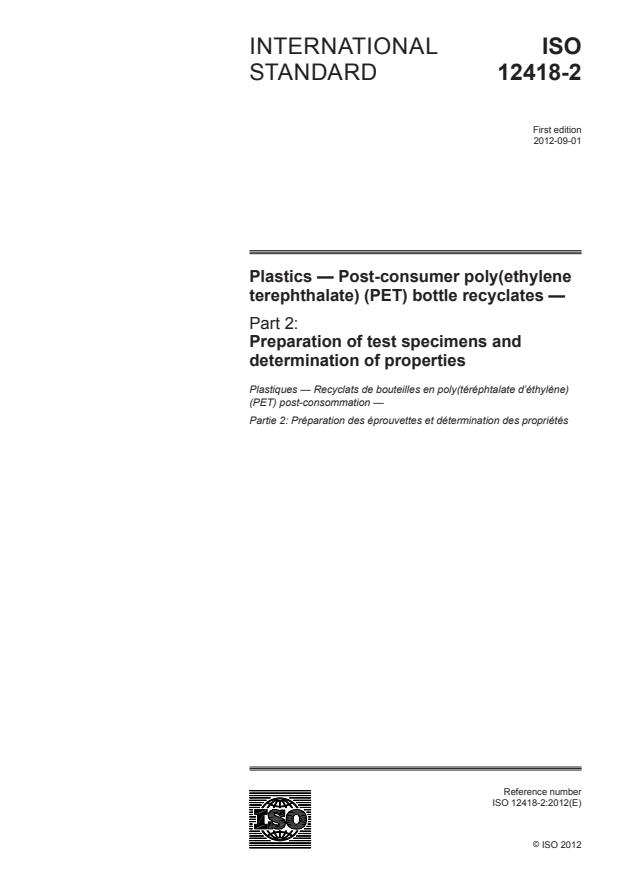
INTERNATIONAL ISO
STANDARD 12418-2
First edition
2012-09-01
Plastics — Post-consumer poly(ethylene
terephthalate) (PET) bottle recyclates —
Part 2:
Preparation of test specimens and
determination of properties
Plastiques — Recyclats de bouteilles en poly(téréphtalate d’éthylène)
(PET) post-consommation —
Partie 2: Préparation des éprouvettes et détermination des propriétés
Reference number
©
ISO 2012
All rights reserved. Unless otherwise specified, no part of this publication may be reproduced or utilized in any form or by any means,
electronic or mechanical, including photocopying and microfilm, without permission in writing from either ISO at the address below or ISO’s
member body in the country of the requester.
ISO copyright office
Case postale 56 • CH-1211 Geneva 20
Tel. + 41 22 749 01 11
Fax + 41 22 749 09 47
E-mail copyright@iso.org
Web www.iso.org
Published in Switzerland
ii © ISO 2012 – All rights reserved
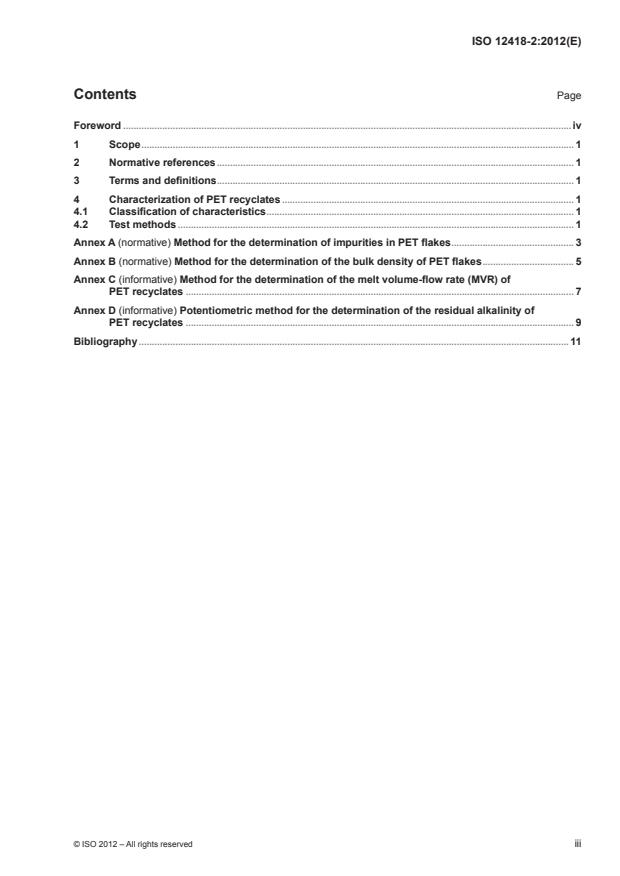
Contents Page
Foreword .iv
1 Scope . 1
2 Normative references . 1
3 Terms and definitions . 1
4 Characterization of PET recyclates . 1
4.1 Classification of characteristics . 1
4.2 Test methods . 1
Annex A (normative) Method for the determination of impurities in PET flakes . 3
Annex B (normative) Method for the determination of the bulk density of PET flakes . 5
Annex C (informative) Method for the determination of the melt volume-flow rate (MVR) of
PET recyclates . 7
Annex D (informative) Potentiometric method for the determination of the residual alkalinity of
PET recyclates . 9
Bibliography . 11
Foreword
ISO (the International Organization for Standardization) is a worldwide federation of national standards bodies
(ISO member bodies). The work of preparing International Standards is normally carried out through ISO
technical committees. Each member body interested in a subject for which a technical committee has been
established has the right to be represented on that committee. International organizations, governmental and
non-governmental, in liaison with ISO, also take part in the work. ISO collaborates closely with the International
Electrotechnical Commission (IEC) on all matters of electrotechnical standardization.
International Standards are drafted in accordance with the rules given in the ISO/IEC Directives, Part 2.
The main task of technical committees is to prepare International Standards. Draft International Standards
adopted by the technical committees are circulated to the member bodies for voting. Publication as an
International Standard requires approval by at least 75 % of the member bodies casting a vote.
Attention is drawn to the possibility that some of the elements of this document may be the subject of patent
rights. ISO shall not be held responsible for identifying any or all such patent rights.
ISO 12418-2 was prepared by Technical Committee ISO/TC 61, Plastics, Subcommittee SC 9, Thermoplastic
materials.
ISO 12418 consists of the following parts, under the general title Plastics — Post-consumer poly(ethylene
terephthalate) (PET) bottle recyclates:
— Part 1: Designation system and basis for specifications
— Part 2: Preparation of test specimens and determination of properties
iv © ISO 2012 – All rights reserved
INTERNATIONAL STANDARD ISO 12418-2:2012(E)
Plastics — Post-consumer poly(ethylene terephthalate) (PET)
bottle recyclates —
Part 2:
Preparation of test specimens and determination of properties
1 Scope
This part of ISO 12418 specifies the test methods to be used in determining the properties of post-consumer
poly(ethylene terephthalate) (PET) bottle recyclates.
2 Normative references
The following referenced documents are indispensable for the application of this document. For dated
references, only the edition cited applies. For undated references, the latest edition of the referenced document
(including any amendments) applies.
ISO 472, Plastics — Vocabulary
ISO 1628-1, Plastics — Determination of the viscosity of polymers in dilute solution using capillary viscometers —
Part 1: General principles
ISO 1628-5, Plastics — Determination of the viscosity of polymers in dilute solution using capillary viscometers —
Part 5: Thermoplastic polyester (TP) homopolymers and copolymers
ISO 15270, Plastics — Guidelines for the recovery and recycling of plastics waste
ISO 15512:2008, Plastics — Determination of water content
EN 15348:2007, Plastics — Recycled plastics — Characterization of poly(ethylene terephthalate) (PET) recyclates
3 Terms and definitions
For the purposes of this document, the terms and definitions given in ISO 472 and ISO 15270 apply.
4 Characterization of PET recyclates
4.1 Classification of characteristics
The characteristics of PET recyclates are classified into two types, given in Table 1, as follows:
— those which are required for all recyclates (i.e. mandatory characteristics);
— customer specifications (these are optional).
4.2 Test methods
The characteristics shall be determined using the test methods given in Table 1. A certificate of analysis,
including the test results for each batch of recyclate, the sampling method and the number of replicates, shall
be provided by the supplier to the purchaser on request.
NOTE The sampling method and the number of replicates are important in determining the quality of the material.
Quality levels can vary within the batch and from batch to batch, depending on the source of the recyclate.
Table 1 — Characterization of PET recyclates
Characteristics Unit Test method Notes
Mandatory items
Form Visual examination Flakes, pellets or powder
Colour Visual examination Natural or coloured
Maximum flake size mm Determined by the size of the screen
in the grinder
Maximum pellet size mm Determined by the die opening of
the pelletizer and measured by ruler
or callipers
Intrinsic viscosity (IV) dl/g ISO 1628-5 in combination Solvent shall be a mixture of phenol
with ISO 1628-1 and 1,1,2,2-tetrachloroethane (6:4)
(including its Amendment
ISO 1628-1:2009/Amd 1)
Contamination due to labels mg/kg Annex A Only for flakes
and other visible contaminants
Contamination due to mg/kg Annex A Only for flakes
poly(vinyl chloride)
Contamination due to poly- mg/kg Annex A Only for flakes
olefins, and including adhesive
Water content % ISO 15512:2008, method B
Bulk density kg/m Annex B
Optional items
Melt volume-flow rate (MVR) cm /10 min Annex C
Alkalinity pH Annex D Only for flakes
Filterability 10 MPa/h/cm EN 15348:2007, Annex F
Other tests may be carried out by agreement between the purchaser and the supplier. If they are, the results
of such tests shall be reported.
2 © ISO 2012 – All rights reserved
Annex A
(normative)
Method for the determination of impurities in PET flakes
A.1 General
This annex specifies a method for the determination of the content of the following impurities in flakes of
PET recyclates:
— pieces of label and other visible contaminants;
— poly (vinyl chloride) (PVC);
— polyolefins (POs), and including adhesive.
A.2 Principle
A weighed test portion of the recyclate is spread evenly over the bottom of a shallow tray.
The pieces of label and other visible contaminants are picked out using tweezers and weighed. The test
portion, still in the tray, is then placed in a forced air circulation oven at 220 °C for 1 h.
During this heat treatment, the PVC in the test portion becomes discoloured and can be detected visually. The
polyolefins in the test portion melt and turn yellow. The adhesive is also yellowed and might be indistinguishable
from the polyolefins.
A.3 Apparatus
A.3.1 Oven, with forced air circulation, capable of being maintained at 220 °C.
A.3.2 Technical balance, capable of weighing to the nearest 0,1 g.
A.3.3 Analytical balance, capable of weighing to the nearest 0,000 1 g.
A.3.4 Spatula, made of wood or metal.
A.3.5 Tweezers.
A.3.6 Tray, made of aluminium or enamelled ironware, with a bottom of surface area not less than 0,05 m .
A.4 Procedure
Weigh out, to the nearest 0,1 g, approximately 100 g of flakes and record the mass (m ). Spread the flakes
evenly over the bottom of the metal tray.
Stir the flakes slowly in the tray with a spatula and pick out the pieces of label and other visible contaminants
using tweezers. Continue this procedure for not less than 30 min. Weigh the pieces of label and other visible
contaminants picked out (m ), using an analytical balance.
Put the tray containing the remaining material into an oven, preheated to 220 °C, and leave it at that temperature
for 1 h. Remove the tray, allow to cool and inspect the material for not less than 30 min, as follows:
a) Pick out the black carbonized particles (PVC). Weigh the particles picked out (m ), using an analytical balance.
b) Pick out the yellowish particles (POs and adhesive). If they are stuck to PET flakes, separate them. Weigh
the particles picked out (m ), using an analytical balance.
A.5 Expression of results
A.5.1 The content of label and other visible contaminants, expressed in mg/kg, is given by the following formula:
m ×10
Content of label and other visible contaminants = (A.1)
m
where
m is the mass of label and other visible contaminants, in g;
m is the initial mass of the test portion, in g.
A.5.2 The PVC content, expressed in mg/kg, is given by the following formula:
m ×10
PVC content = (A.2)
m
where
m is the mass of the discoloured (black) particles, in g;
m is the initial mass of the test portion, in g.
A.5.3 The PO content (which will include any adhesive present), expressed in mg/kg, is given by the
following formula:
m ×10
PO content = (A.3)
m
where
m is the mass of the yellowish particles, in g;
m is the initial mass of the test portion, in g.
...
Questions, Comments and Discussion
Ask us and Technical Secretary will try to provide an answer. You can facilitate discussion about the standard in here.
Loading comments...