

ISO/IEC 19794-11:2013
(Main)Information technology — Biometric data interchange formats — Part 11: Signature/sign processed dynamic data
General Information
- Abstract
For the purpose of biometric comparison, ISO/IEC 19794-11:2013 specifies a data interchange format for processed signature/sign behavioural data extracted from a time series, captured using devices such as digitizing tablets, pen-based computing devices, or advanced pen systems. The data interchange format is generic, in that it may be applied and used in a wide range of application areas where handwritten signs or signature/signs are involved. No application-specific requirements or features are addressed in ISO/IEC 19794-11:2013. ISO/IEC 19794-11:2013 contains definitions of relevant terms, a description of what data is extracted, and a data format for containing the data, together with advice on whether a set of user's signature/sign is suitable for identification purposes using ISO/IEC 19794-11:2013. It is advisable that stored and transmitted biometric data is time-stamped and that cryptographic techniques be used to protect their authenticity, integrity, and confidentiality; however, such provisions are beyond the scope of ISO/IEC 19794-11:2013.
- Status
- Published
- Publication Date
- 31-Jan-2013
- Technical Committee
- ISO/IEC JTC 1/SC 37 - Biometrics
- Drafting Committee
- ISO/IEC JTC 1/SC 37/WG 3 - Biometric data interchange formats
- Current Stage
- 9093 - International Standard confirmed
- Start Date
- 06-Sep-2024
- Completion Date
- 29-Aug-2026

Overview
ISO/IEC 19794-11:2013 defines a biometric data interchange format for processed signature/sign dynamic data used in biometric comparison and signature verification. Targeted at data extracted from time-series input (digitizing tablets, pen-based devices, advanced pen systems), the standard specifies what behavioral features are recorded and how they are packaged into a biometric interchange record. It is a segmentation-based format (significant dynamic events) that complements sample-point formats such as ISO/IEC 19794-7.
Key topics and technical requirements
- Data scope: Processed signature/sign behavioural data derived from time-series capture (no application-specific rules).
- Dynamic-event data: Mandatory capture of X, Y coordinates, pressure (F), time (T) and event type for each significant event: pen-down, pen-up, and turning point.
- Signature/sign representation: Each representation begins with pen-down and ends with pen-up; representations are recorded as a header plus a sequence of dynamic-event data and overall feature data.
- Coordinate system & byte order: Uses a 2D Cartesian writing-plane coordinate system (X increases to the right, Y increases upward). Multi-byte quantities use big-endian byte order (most significant byte first).
- Interoperability & extensibility: Includes a set of mandatory features for interoperability and supports proprietary/extensions (regulated similarly to ISO/IEC 19794-7).
- Conformance: Records and systems must meet structural and value-relationship requirements defined in Clause 8; Annex A provides conformance testing methodology.
- Packaging & registration: Can be embedded in CBEFF-compliant BIRs; format owner and type identifiers are registered (ISO/IEC JTC 1/SC 37, format type id 16).
- Encoding guidance: Annex B provides an ASN.1 specification and Packed Encoding Rules to assist implementation.
- Security note: Time-stamping and cryptographic protection are recommended but are outside the standard’s scope.
Applications and who uses it
- Signature verification and authentication systems that compare behavioral features rather than raw sample streams.
- Biometric vendors and device manufacturers (digitizing tablets, smart pens) implementing interoperable data export/import.
- System integrators and security architects building identity verification, e-signature, banking, and document-signing solutions.
- Forensic examiners and researchers analyzing dynamic signature features while maintaining portability.
The format is useful where compact, feature-oriented signature data is needed for analysis across different algorithms while preserving interoperability.
Related standards
- ISO/IEC 19794-1 (Framework)
- ISO/IEC 19794-7 (Signature/sign time series data - sample-point format)
- ISO/IEC 19785-2 (CBEFF registration procedures)
Keywords: ISO/IEC 19794-11:2013, biometric data interchange formats, signature processed dynamic data, dynamic-event data, pen-down pen-up turning point, CBEFF, ASN.1, signature verification.
Relations
- Effective Date
- 08-May-2021
Get Certified
Connect with accredited certification bodies for this standard

BSI Group
BSI (British Standards Institution) is the business standards company that helps organizations make excellence a habit.

NYCE
Mexican standards and certification body.
Sponsored listings
Frequently Asked Questions
ISO/IEC 19794-11:2013 is a standard published by the International Organization for Standardization (ISO). Its full title is "Information technology — Biometric data interchange formats — Part 11: Signature/sign processed dynamic data". This standard covers: For the purpose of biometric comparison, ISO/IEC 19794-11:2013 specifies a data interchange format for processed signature/sign behavioural data extracted from a time series, captured using devices such as digitizing tablets, pen-based computing devices, or advanced pen systems. The data interchange format is generic, in that it may be applied and used in a wide range of application areas where handwritten signs or signature/signs are involved. No application-specific requirements or features are addressed in ISO/IEC 19794-11:2013. ISO/IEC 19794-11:2013 contains definitions of relevant terms, a description of what data is extracted, and a data format for containing the data, together with advice on whether a set of user's signature/sign is suitable for identification purposes using ISO/IEC 19794-11:2013. It is advisable that stored and transmitted biometric data is time-stamped and that cryptographic techniques be used to protect their authenticity, integrity, and confidentiality; however, such provisions are beyond the scope of ISO/IEC 19794-11:2013.
For the purpose of biometric comparison, ISO/IEC 19794-11:2013 specifies a data interchange format for processed signature/sign behavioural data extracted from a time series, captured using devices such as digitizing tablets, pen-based computing devices, or advanced pen systems. The data interchange format is generic, in that it may be applied and used in a wide range of application areas where handwritten signs or signature/signs are involved. No application-specific requirements or features are addressed in ISO/IEC 19794-11:2013. ISO/IEC 19794-11:2013 contains definitions of relevant terms, a description of what data is extracted, and a data format for containing the data, together with advice on whether a set of user's signature/sign is suitable for identification purposes using ISO/IEC 19794-11:2013. It is advisable that stored and transmitted biometric data is time-stamped and that cryptographic techniques be used to protect their authenticity, integrity, and confidentiality; however, such provisions are beyond the scope of ISO/IEC 19794-11:2013.
ISO/IEC 19794-11:2013 is classified under the following ICS (International Classification for Standards) categories: 35.040 - Information coding; 35.240.15 - Identification cards. Chip cards. Biometrics. The ICS classification helps identify the subject area and facilitates finding related standards.
ISO/IEC 19794-11:2013 has the following relationships with other standards: It is inter standard links to ISO/IEC 19794-11:2013/Amd 1:2014. Understanding these relationships helps ensure you are using the most current and applicable version of the standard.
ISO/IEC 19794-11:2013 is available in PDF format for immediate download after purchase. The document can be added to your cart and obtained through the secure checkout process. Digital delivery ensures instant access to the complete standard document.
Standards Content (Sample)
INTERNATIONAL ISO/IEC
STANDARD 19794-11
First edition
2013-02-15
Information technology — Biometric data
interchange formats —
Part 11:
Signature/sign processed dynamic data
Technologies de l'information — Formats d'échange de données
biométriques —
Partie 11: Données dynamiques traitées de signature/signe
Reference number
©
ISO/IEC 2013
© ISO/IEC 2013
All rights reserved. Unless otherwise specified, no part of this publication may be reproduced or utilized in any form or by any means,
electronic or mechanical, including photocopying and microfilm, without permission in writing from either ISO at the address below or
ISO's member body in the country of the requester.
ISO copyright office
Case postale 56 CH-1211 Geneva 20
Tel. + 41 22 749 01 11
Fax + 41 22 749 09 47
E-mail copyright@iso.org
Web www.iso.org
Published in Switzerland
ii © ISO/IEC 2013 – All rights reserved
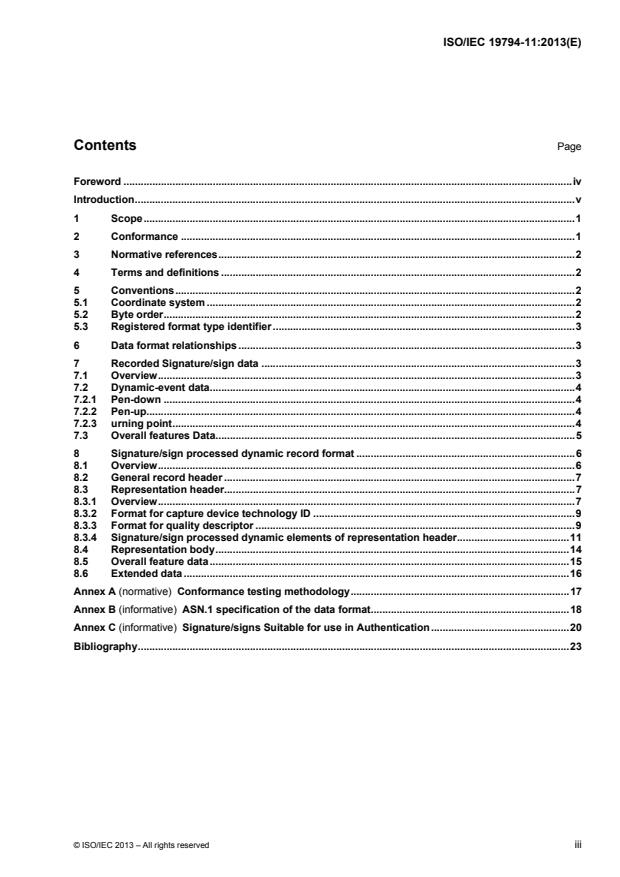
Contents Page
Foreword . iv
Introduction . v
1 Scope . 1
2 Conformance . 1
3 Normative references . 2
4 Terms and definitions . 2
5 Conventions . 2
5.1 Coordinate system . 2
5.2 Byte order . 2
5.3 Registered format type identifier . 3
6 Data format relationships . 3
7 Recorded Signature/sign data . 3
7.1 Overview . 3
7.2 Dynamic-event data . 4
7.2.1 Pen-down . 4
7.2.2 Pen-up. 4
7.2.3 urning point . 4
7.3 Overall features Data . 5
8 Signature/sign processed dynamic record format . 6
8.1 Overview . 6
8.2 General record header . 7
8.3 Representation header . 7
8.3.1 Overview . 7
8.3.2 Format for capture device technology ID . 9
8.3.3 Format for quality descriptor . 9
8.3.4 Signature/sign processed dynamic elements of representation header . 11
8.4 Representation body . 14
8.5 Overall feature data . 15
8.6 Extended data . 16
Annex A (normative) Conformance testing methodology . 17
Annex B (informative) ASN.1 specification of the data format . 18
Annex C (informative) Signature/signs Suitable for use in Authentication . 20
Bibliography . 23
© ISO/IEC 2013 – All rights reserved iii
Foreword
ISO (the International Organization for Standardization) and IEC (the International Electrotechnical
Commission) form the specialized system for worldwide standardization. National bodies that are members of
ISO or IEC participate in the development of International Standards through technical committees
established by the respective organization to deal with particular fields of technical activity. ISO and IEC
technical committees collaborate in fields of mutual interest. Other international organizations, governmental
and non-governmental, in liaison with ISO and IEC, also take part in the work. In the field of information
technology, ISO and IEC have established a joint technical committee, ISO/IEC JTC 1.
International Standards are drafted in accordance with the rules given in the ISO/IEC Directives, Part 2.
The main task of the joint technical committee is to prepare International Standards. Draft International
Standards adopted by the joint technical committee are circulated to national bodies for voting. Publication as
an International Standard requires approval by at least 75 % of the national bodies casting a vote.
Attention is drawn to the possibility that some of the elements of this document may be the subject of patent
rights. ISO and IEC shall not be held responsible for identifying any or all such patent rights.
ISO/IEC 19794-11 was prepared by Joint Technical Committee ISO/IEC JTC 1, Information technology,
Subcommittee SC 37, Biometrics.
ISO/IEC 19794 consists of the following parts, under the general title Information technology — Biometric data
interchange formats:
Part 1: Framework
Part 2: Finger minutiae data
Part 3: Finger pattern spectral data
Part 4: Finger image data
Part 5: Face image data
Part 6: Iris image data
Part 7: Signature/sign time series data
Part 8: Finger pattern skeletal data
Part 9: Vascular image data
Part 10: Hand geometry silhouette data
Part 11: Signature/sign processed dynamic data
Part 13: Voice data
Part 14: DNA data
iv © ISO/IEC 2013 – All rights reserved
Introduction
There are several commercial implementations of signature/sign verification based on the analysis of the
dynamic features of signing. This part of ISO/IEC 19794 specifies an interchange format using signature/sign
dynamic features that can be used to provide signature/sign verification. This data format enables
interoperability without compromising any developers’ Intellectual Property Rights.
A group of features are identified that are mandatory across all compliant implementations in order to ensure
interoperability but the biometric interchange record format also supports proprietary data. The use of
proprietary data is regulated in a similar manner to that used in ISO/IEC 19794-7, ensuring that comparable
performance is achieved between the mandatory and proprietary features.
The features recorded represent significant dynamic events during the signing process, and thus represent an
intelligent compression of the ISO/IEC 19794-7 format. From these other features can be calculated or
estimated. Furthermore, using the significant events 19794-7 format can be extrapolated, and therefore other
signature/sign feature data can be calculated or estimated.
The biometric interchange record format is a sequence of signature/sign representations, preceded by a
general header that is common to all representations. Each signature/sign representation is recorded as a
representation header followed by a sequence of Dynamic-event data for each signature/sign dynamic event.
In addition to the Dynamic-event data recorded for each signature/sign dynamic event, additional data is
recorded representing overall features of the signature/sign representation. It should be noted that all
recorded data for the signature/sign representation is recorded before any transformations are applied (e.g.
rotation or time warping). The data recorded is either raw data or derived from the raw data.
This part of ISO/IEC 19794 does not specify the analysis to be undertaken by any particular comparison
algorithms. The signature/sign features recorded in the data format can be used for analysis by many different
comparison algorithms.
The format described is based on features (segmentation based on dynamic events) instead of sample points
as described in ISO/IEC 19794-7.
The format defined in this part of ISO/IEC 19794 has the version number 1.0.
Annex A is normative and is intended to specify elements of conformance testing methodology, test assertions,
and and test procedures ass applicable to this part of ISO/IEC 19794.
Annex B is informative and formally specifies the biometric interchange record format using the ASN.1 (see
ISO/IEC 8824) notation and the ASN.1 Packed Encoding Rules (see ISO/IEC 8825-2), enabling the use of
ASN.1 tools to assist implementation.
Annex C is informative. It gives guidance on the suitability of signature/sign for secure comparison purposes
using the features recorded in the biometric interchange record format defined in this part of ISO/IEC 19794.
Annex C identifies three indicators of signature/sign suitability: quantity of data, complexity of signature/sign,
and consistency of signature/sign. Annex C suggests measurements that can be made in accessing these
indicators, but does not quantify suitable measurements or provide any structure for recording the indicators.
© ISO/IEC 2013 – All rights reserved v
INTERNATIONAL STANDARD ISO/IEC 19794-11:2013(E)
Information technology — Biometric data interchange
formats —
Part 11:
Signature/sign processed dynamic data
1 Scope
For the purpose of biometric comparison, this part of ISO/IEC 19794 specifies a data interchange format for
processed signature/sign behavioural data extracted from a time series, captured using devices such as
digitizing tablets, pen-based computing devices, or advanced pen systems.
The data interchange format is generic, in that it may be applied and used in a wide range of application areas
where handwritten signs or signature/signs are involved. No application-specific requirements or features are
addressed in this part of ISO/IEC 19794.
This part of ISO/IEC 19794 contains definitions of relevant terms, a description of what data is extracted, and
a data format for containing the data, together with advice on whether a set of user's signature/sign is suitable
for identification purposes using this part of ISO/IEC 19794.
It is advisable that stored and transmitted biometric data is time-stamped and that cryptographic techniques be
used to protect their authenticity, integrity, and confidentiality; however, such provisions are beyond the scope
of this part of ISO/IEC 19794.
2 Conformance
A biometric data record conforms to this part of ISO/IEC 19794 if it satisfies all of the normative requirements
related to:
A) Its data structure, data values and the relationships between its data elements, as specified in Clause 8 of
this part of ISO/IEC 19794.
B) The relationship between its data values and the input biometric data from which the biometric data
record was generated, as specified in Clause 8 of this part of ISO/IEC 19794.
A system that produces biometric data records is conformant to this part of ISO/IEC 19794 if all biometric data
records that it outputs conform to this part of ISO/IEC 19794 (as defined above). A system does not need to
be capable of producing biometric data records that cover all possible aspects of this part of ISO/IEC 19794,
but only those that are claimed to be supported by the system.
A system that uses biometric data records is conformant to this part of ISO/IEC 19794 if it can read, and use
for the purpose intended by that system, all biometric data records that conform to this part of ISO/IEC 19794
(as defined above). A system does not need to be capable of using biometric data records that cover all
possible aspects of this part of ISO/IEC 19794, but only those that are claimed to be supported by the system.
© ISO/IEC 2013 – All rights reserved 1
3 Normative references
The following referenced documents are indispensable for the application of this document. For dated
references, only the edition cited applies. For undated references, the latest edition of the referenced
document (including any amendments) applies.
ISO/IEC 19785-2, Information technology — Common Biometric Exchange Formats Framework — Part 2:
Procedures for the operation of the Biometric Registration Authority
ISO/IEC 19794-1, Information technology — Biometric data interchange formats — Part 1: Framework
4 Terms and definitions
For the purposes of this document the terms and definitions given in ISO/IEC 19794-1 and the following apply.
4.1
dynamic event
either a pen-up, pen-down, or turning point event
4.2
pen-down
event from which on the pen tip is touching the writing plane
4.3
dynamic-event data
data that records pen position, pressure and time for a given signature/sign dynamic event
4.4
pen-up
event from which on the pen tip is not touching the writing plane, after a pen-down event
4.5
signature/sign representation
data recorded from a single signature/sign
NOTE A signature/sign representation always starts with a pen-down event and ends with a pen-up event, but
there can be more pen-up and pen-down events within the signature/sign representation.
4.6
turning point
event from which the sign of the inclination derived from adjacent samples of either X, Y or F channel changes
5 Conventions
5.1 Coordinate system
The coordinate system used to express the pen position shall be a two-dimensional Cartesian coordinate
system. The x-axis shall be the horizontal axis of the writing plane, with the x coordinates increasing to the
right starting at 0. The y-axis shall be the vertical axis of the writing plane, with y coordinates increasing
upwards starting at 0.
5.2 Byte order
The more significant bytes of any multi-byte quantity are stored at lower addresses in memory than (and are
transmitted before) less significant bytes.
2 © ISO/IEC 2013 – All rights reserved
Within a byte, the bits are numbered from 8 to 1, where bit 8 is the ‘most significant bit’ (MSB) and bit 1 the
‘least significant bit’ (LSB).
5.3 Registered format type identifier
The data records specified in this part of ISO/IEC 19794 may be embedded in a CBEFF- (ISO/IEC 19785-1)
compliant biometric information record (BIR). This clause lists the BDB (biometric data block) format owner
identifier and the BDB format type identifier that shall be used if embedded in a CBEFF BIR. This identifier is
registered with IBIA, the CBEFF Registration Authority (see ISO/IEC 19785-2).
The format owner of the formats defined in ISO/IEC 19794 is ISO/IEC JTC 1/SC 37. The format owner
identifier is 257 (0101Hex). Table 1 lists the format type identifier for the format defined in this part of
ISO/IEC 19794.
Table 1 — Format type identifiers
CBEFF BDB format type Short name Full object identifier
identifier
16 (0010) signature-sign-processed- {iso(1) registration-authority(1)
Hex
dynamic cbeff(19785) biometric-
organization(0) jtc1-sc37(257)
bdbs(0) signature-sign-
processed-dynamic(16)}
6 Data format relationships
The processed data format described in this part of ISO/IEC 19794 may not be the final format used by
dynamic signature/sign analysis algorithms for signature/sign feature analysis. The format is a segmentation
based signature data format with sufficient information to derive signature/sign features for a variety of
algorithms. Its use is shown in the flowchart in Figure 1.
Signature/si
Internal
Intermediate
19794-7 19794-11
feature gn feature
stored data processing
stored data
analysis
data
sign/signature
data
Figure 1 — Data format flowchart
7 Recorded Signature/sign data
7.1 Overview
By recording dynamic-event data at significant signature/sign dynamic events of: Pen-down, Pen-up, and
Turning point, these can be combined into larger segments and/or extrapolated into the whole signing
sequence for any feature analysis to be applied.
© ISO/IEC 2013 – All rights reserved 3
Signature/sign data will be recorded as a sequence of Dynamic-event data for each significant dynamic event,
followed by an overall feature data set.
7.2 Dynamic-event data
Whenever a dynamic signature event occurs:
a) Pen-down
b) Pen-up
c) Turning point
The X, Y coordinates, pressure F, time T, and type of event shall be recorded.
7.2.1 Pen-down
Pen-down is an event from which the pen tip is touching on the writing plane. Pen-down is detected when the
following change of F channel occurs.
F = 0 and F > 0
n-1 n
7.2.2 Pen-up
Pen-up is an event from which the pen tip is leaving from the writing plane. Pen-up is detected when the
following change of F channel occurs.
F > 0 and F = 0
n-1 n
7.2.3 Turning point
A turning point is an event in which the sign of the inclination derived from adjacent samples of either X, Y or F
channel changes, where Q denotes either X or Y of F channel. Two types of turning points are defined as
follows,
Type-1: Changing from positive to zero or negative, in this type the turning point of Q channel shall satisfy the
following conditions,
sign(Q Q ) sign(Q Q ) positive, and
n n1
n1 n2
sign(Q Q ) sign(Q Q ) zero or negative
n2 n1 n1 n
or
sign(Q Q ) sign(Q Q ) zero, and
n n1
n1 n2
sign(Q Q ) sign(Q Q ) negative
n2 n1 n1 n
where Q is the turning point of Q channel.
n
Type-2: Changing from negative to zero or positive, in this type the turning point of Q channel shall satisfy the
following conditions,
sign(Q Q ) sign(Q Q ) negative, and
n n1
n1 n2
sign(Q Q ) sign(Q Q ) zero or positive
n2 n1 n1 n
or
4 © ISO/IEC 2013 – All rights reserved
sign(Q Q ) sign(Q Q ) zero, and
n n1
n1 n2
sign(Q Q ) sign(Q Q ) positive
n2 n1 n1 n
where Q is the turning point of Q channel.
n
Before calculating the sign of the inclination derived from adjacent samples, X, Y and F channels should be
smoothed using a moving average filter of M points as follows (M shall be an odd number),
M1
Q Q
i im
M
M1
m
,where Q is the i-th sample of Q channel.
i
The unit of measurement of X and Y is millimetres (mm) and the unit of measurement of F is Newtons (N), and
the unit of measurement of T is milliseconds (ms). To restore the actual values, the integer values given in the
BDIR body are to be divided by a scaling value given in the Representation Header. By choosing appropriate
scaling values, different resolutions can be expressed for several applications.
7.3 Overall features Data
Other parameters that need to be recorded for overall signature/sign dynamic analysis are:
a) Total time
Total time T is defined as the time difference between the first recorded time to the last recorded
time of a signature/sign.
The unit of measurement is milliseconds (ms).
To restore the actual value, the integer value given in the Total Time field is to be divided by a T
Scaling Value given in the Representation Header.
b) Total number of points aquired TNP (this is a function of time and the sampling time capacities of
the digitiser)
The total number of points measured is defined as the total number of coordinates recorded for a
signature/sign as an integer.
c) Mean values
X – Mean value of X values
mean
Y – Mean value of Y values
mean
F – Mean value of pressure (F) values
mean
X , Y and F are the arithmetic mean of the X, Y, and F values while the pen is in contact
mean mean mean
with the digitizer.
The unit of measurement for X , and Y is millimetres (mm). The unit of measurement of
mean mean
F is Newtons (N).
mean
To restore the actual value, the integer value given in the X and Y Mean Values field are to be
divided by respectively by X and Y Scaling Value given in the Representation Header.
© ISO/IEC 2013 – All rights reserved 5
d) Standard deviation values
S – Standard deviation X value
x
S – Standard deviation Y value
y
S – Standard deviation F value
f
S , S and S are the standard deviation of the X, Y and F values.
x y f
v m
Where
S
n
v=values of X , Y, or F
m=arithmetic mean of X, Y or F
n=number of values
The unit of measurement for S and S is millimetres (mm).
x y
The unit of measurement for S is Newtons (N).
f
To restore the actual value, the integer value given in the X and Y Standard deviation values field
are to be divided by respectively by X and Y Scaling Value given in the Representation Header.
e) Correlation coefficient
Rxy – 1000 x (1+correlation coefficient of all (X,Y) data to 3 significant digits). This will always be
positive.
n x y x y
i i i i
i i i
Where the correlation coefficient of all XY data
R
2 2
2 2
n x x n y y
i i i i
ii ii
n = number of values
8 Signature/sign processed dynamic record format
8.1 Overview
This part of ISO/IEC 19794 standard defines the composition of the signature/sign processed dynamic record.
Each record shall pertain to a single subject and shall contain a signature/sign processed dynamic record
(consisting of one or more representations). The organization of the record format is as follows:
a) A single fixed-length (15-byte) general record header containing information about the overall record;
and
b) A representation body containing a single signature/sign processed dynamic record for each
signature/sign representation, consisting of:
i) A variable-length header containing data pertaining to a single signature/sign representation
ii) Dynamic-event data and overall feature data pertaining to a single signature/sign
representation
iii) Optional extended data (as described in clause 8.7).
6 © ISO/IEC 2013 – All rights reserved
8.2 General record header
The structure of the General Record Header shall be defined inTable 2.
Table 2 — Signature/sign processed dynamic data block header
General record header Length Comments
field
Format Identifier 4 Bytes The format identifier shall be recorded in four
bytes. The format identifier shall consist of three
characters "SPD" followed by a zero byte as a
NULL string terminator.
Version number 4 Bytes The number for the version of that part of
ISO/IEC 19794 used for constructing the BDIR
shall be placed in four bytes. This version number
shall consist of three ASCII numerals followed by a
zero byte as a NULL string terminator. The first
and second character will represent the major
version number and the third character will
represent the minor revision number. The version
number shall be “010” – Version 1 revision 0.
Length of record 4 Bytes The length (in bytes) of the entire BDIR shall be
recorded in four bytes. This count shall be the total
length of the BDIR including the general record
header and one or more representation records.
Number of 2 Bytes The total number of representation records
representations contained in the BDIR shall be recorded in two
bytes. A minimum of one representation is
required.
Certification flag 1 byte The one-byte certification flag shall indicate
whether each representation header includes a
certification block. Its value shall be 00Hex to
indicate that no representation contains a
certification block.
NOTE The certification flag has been added for
upward compatibility with later versions of the format in
which representation headers may contain certification
blocks.
8.3 Representation header
8.3.1 Overview
The fields of the representation header shall be those defined in Table 3 and Table 6.
© ISO/IEC 2013 – All rights reserved 7
Table 3 — Common elements of the representation header
Name Length Harmonized text for record format definitions
Representation 4 bytes Denotes the length in bytes of the representation header including the representation
Length header fields.
Capture date 9 bytes The capture date and time field shall indicate when the capture of this representation
and time started in Coordinated Universal Time (UTC). The capture date and time field shall
consist of 9 bytes. Its value shall be encoded in the form given in ISO/IEC 19794-1.
Capture device 1 byte The capture device technology ID shall be encoded in one byte. This field shall indicate
technology the class of capture device technology used to acquire the captured biometric sample. A
identifier value of 00Hex indicates unknown or unspecified technology. See Table 4 — for the list
of possible values.
Capture device 2 bytes The capture device vendor identifier shall identify the biometric organisation that owns
vendor identifier the product that created the BDIR. The capture device algorithm vendor identifier shall be
encoded in two bytes carrying a CBEFF biometric organization identifier (registered by
IBIA or other approved registration authority). A value of all zeros shall indicate that the
capture device vendor is unreported.
Capture device 2 bytes The capture device type identifier shall identify the product type that created the BDIR. It
type identifier shall be assigned by the registered product owner or other approved registration
authority. Registered product types shall include all valid combinations of writing tablet
and pen as a single product where applicable. A value of all zeros shall indicate that the
capture device type is unreported. If the capture device vendor identifier is 0000 , then
Hex
also the capture device type identifier shall be 0000 .
Hex
Quality record 1 to n A quality record shall consist of a length field followed by zero or more quality blocks. The
bytes length field shall consist of one byte. It shall represent the number of quality blocks as an
unsigned integer.
Each quality block shall consist of
– a quality score,
– a quality algorithm vendor identifier, and
– a quality algorithm identifier.
A quality score should express the predicted comparison performance of a
representation. A quality score shall be encoded in one byte as an unsigned integer.
Allowed values are
– 0 to 100 with higher values indicating better quality,
– 255, i.e. ff , for indicating that an attempt to calculate a quality score failed.
Hex
The quality algorithm vendor identifier shall identify the provider of the quality algorithm.
The quality algorithm vendor identifier shall be encoded in two bytes carrying a CBEFF
biometric organization identifier (registered by IBIA or other approved registration
authority). A value of all zeros shall indicate that the qualit
...