

ISO 12606:1997
(Main)Cinematography — Care and preservation of magnetic audio recordings for motion pictures and television
General Information
- Abstract
This International Standard recommends storage conditions for stabilization and preservation of magnetic audio recordings for motion-picture and television production. It recommends the desirable storage conditions for magnetic audio recordings, as they may remain in library or vault storage between periods of intermittent reproduction or duplication. It describes the care and handling of magnetic media intended to be introduced into, or removed from, storage.
- Status
- Published
- Publication Date
- 11-Jun-1997
- Technical Committee
- ISO/TC 36 - Cinematography
- Drafting Committee
- ISO/TC 36/WG 3 - Audio technology
- Current Stage
- 9060 - Close of review
- Completion Date
- 04-Jun-2029
Overview
ISO 12606:1997 - "Cinematography - Care and preservation of magnetic audio recordings for motion pictures and television" - prescribes recommended storage, handling and conditioning practices to stabilize and preserve magnetic audio media used in motion-picture and television production. The standard addresses vault and library storage between periods of intermittent reproduction or duplication and gives practical guidance to minimize long‑term loss of audio integrity.
Key topics and technical requirements
- Storage classification
- Medium‑term storage: conditions intended to preserve recordings for a minimum of about 10 years.
- Extended‑term storage: conditions for recordings of permanent value (long‑term archival).
- Environmental control
- Recommends specific temperature and relative‑humidity ranges and alternative correlated environments for extended‑term storage to slow chemical degradation and physical distortion.
- Advises minimizing temperature and humidity cycling and controlling airborne particulates and gaseous pollutants.
- Magnetic field limits
- Limits external DC and AC field exposure to avoid magnetic corruption (document gives guidance such as ~50 oersted DC and ~10 oersted AC as levels of concern).
- Physical handling and preparation
- Prefer vertical roll orientation, protective enclosures (coated steel, aluminum, polyester, polyethylene, polypropylene, or acid‑free paperboard), and uniform winding (rewind irregular rolls before storage).
- Store rolls tail‑out and rewind to head‑out before use; inspect/rewind prior to storage to relieve stress.
- Chemical and physical degradation
- Identifies hydrolysis of polymer binders, oxidation of magnetic particles, plastic flow, shrinkage and dimensional changes driven by moisture and temperature as prime hazards.
- Conditioning and transition rules
- Media entering or leaving low‑temperature storage must be pre‑conditioned to avoid condensation (e.g., allow equilibration in packaging; limit gradients such as 10 °C/h or 10 % R.H./h and allow ~24 h before opening).
- Reproduction preparation
- Verify transport alignment, cleanliness, demagnetize magnetic heads, calibrate equipment and create working copies for repeated use.
- Preservation action
- If deterioration is detected, make the best possible copy immediately.
Applications and users
- Archivists and audiovisual preservation specialists managing film and tape libraries or vaults
- Post‑production and restoration facilities preparing media for long‑term storage or reissue
- Broadcast and motion‑picture studios defining archival policies and environmental specifications
- Facilities managers designing storage vaults or selecting protective enclosures and monitoring regimes
Related standards
- ISO 12606 references ANSI IT9.11 (storage recommendations for processed photographic films) for parallel guidance on temperature/humidity control and contamination mitigation.
Keywords: ISO 12606:1997, magnetic audio recordings preservation, cinematography archives, magnetic corruption, print‑through, vault storage, audio tape storage, humidity control, demagnetization, archival handling.
Frequently Asked Questions
ISO 12606:1997 is a standard published by the International Organization for Standardization (ISO). Its full title is "Cinematography — Care and preservation of magnetic audio recordings for motion pictures and television". This standard covers: This International Standard recommends storage conditions for stabilization and preservation of magnetic audio recordings for motion-picture and television production. It recommends the desirable storage conditions for magnetic audio recordings, as they may remain in library or vault storage between periods of intermittent reproduction or duplication. It describes the care and handling of magnetic media intended to be introduced into, or removed from, storage.
This International Standard recommends storage conditions for stabilization and preservation of magnetic audio recordings for motion-picture and television production. It recommends the desirable storage conditions for magnetic audio recordings, as they may remain in library or vault storage between periods of intermittent reproduction or duplication. It describes the care and handling of magnetic media intended to be introduced into, or removed from, storage.
ISO 12606:1997 is classified under the following ICS (International Classification for Standards) categories: 37.060.20 - Motion picture films. Cartridges. The ICS classification helps identify the subject area and facilitates finding related standards.
ISO 12606:1997 is available in PDF format for immediate download after purchase. The document can be added to your cart and obtained through the secure checkout process. Digital delivery ensures instant access to the complete standard document.
Standards Content (Sample)
INTERNATIONAL IS0
STANDARD 12606
First edition
1997-06-l 5
Cinematography - Care and preservation
of magnetic audio recordings for motion
pictures and television
Cidma tographie - Soins et prkseivation des enregistrements sonores
magnktiques pour la cin&matographie et la tMvision
Reference number
IS0 12606:1997(E)
IS8 12606: 1997(E)
Foreword
IS0 (the international Organization for Standardization) is a worldwide
federation of national standards bodies (IS0 member bodies). The work of
preparing International Standards is normally carried out through IS0
technical committees. Each member body interested in a subject for which
a technical committee has been established has the right to be represented
on that committee. International organizations, governmental and non-
governmental, in liaison with ISO, also take part in the work. IS0
collaborates closely with the International Electrotechnical Commission
(IEC) on all matters of electrotechnical standardization.
Draft International Standards adopted by the technical committees are
circulated to the member bodies for voting. Publication as an International
Standard requires approval by at least 75 % of the member bodies casting
a vote.
International Standard IS0 12606 was prepared by Technical Committee
ISO/TC 36, Cinematography.
Annexes A and B of this International Standard are for information only.
0 IS0 1997
All rights reserved. Unless otherwise specified, no part of this publication may be reproduced
or utilized in any form or by any means, electronic or mechanical, including photocopying and
microfilm, without permission in writing from the publisher.
international Organization for Standardization
Case postale 56 l CH-1211 Geneve 20 l Switzerland
Internet central @ iso.ch
c=ch; a=400net; p=iso; o=isocs; s=central
x.400
Printed in Switzerland
II
INTERNATIONAL STANDARD @ IS0
IS0 12606:1997(E)
Cinematography - Care and preservation of magnetic
audio recordings for motion pictures and television
1 Scope
This International Standard recommends storage conditions for stabilization and preservation of magnetic audio
recordings for motion-picture and television production.
It recommends the desirable storage conditions for magnetic audio recordings, as they may remain in library or
vault storage between periods of intermittent reproduction or duplication.
It describes the care and handling of magnetic media intended to be introduced into, or removed from, storage.
2 Normative reference
The following standard contains provisions which, through reference in this text, constitute provisions of this
International Standard. At the time of publication, the edition indicated was valid. All standards are subject to
revision and parties to agreements based on this International Standard are encouraged to investigate the
possibility of applying the most recent edition of the standard indicated below. Members of IEC and IS0
maintain registers of currently valid International Standards.
ANWNAPM IT9. I I - 1993 : American National Standardfor Imaging Media - Processed Safety Photographic
Films - Storage.
3 Storage hazards and concerns
Useful and acceptable reproduction of records removed from inactive storage requires attention to, and
precautions against, all three of the following hazards: chemical degradation, physical distortion, and magnetic
corruption [2,3, 10, 11,231. Analog and digital recordings are on media with the same susceptibilities to
chemical degradation and physical distortion. They do respond somewhat differently to magnetic corruption
effects. The recommendations for storage conditions minimize each of these risks.
4 Summation of storage recommendations
4.1 Desired useful life of the recordings
4.1.1 Medium-term storage conditions
Storage conditions suitable for the preservation of recorded information for a minimum of ten years.
4.1.2 Extended-term storage conditions
Storage conditions suitable for the preservation of recorded information having a permanent value.
4.2 Recommended storage environments
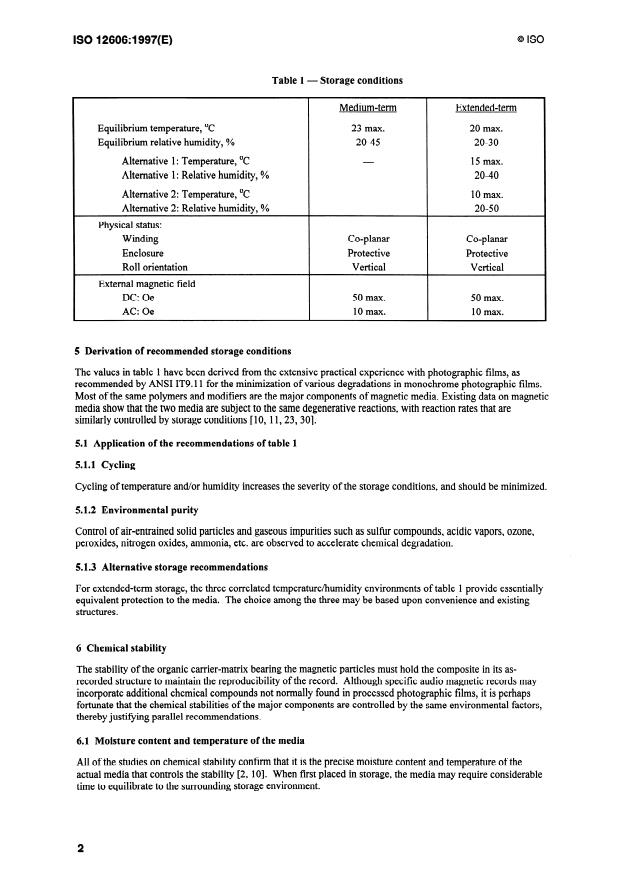
Atmospheric temperature and humidity conditions for magnetic media storage are summarized and tabulated in
table 1.
@ IS0
IS0 12606:1997(E)
Table 1 - Storage conditions
Extended-term
Medium-term
Equilibrium temperature, ‘C 23 max. 20 max.
20-45 20-30
Equilibrium relative humidity, %
15 max.
Alternative 1: Temperature, ‘C
Alternative 1: Relative humidity, % 20-40
Alternative 2: Temperature, ‘C 10 max.
Alternative 2: Relative humidity, % 20-50
Physical status:
Co-planar Co-planar
Winding
Enclosure Protective Protective
Roll orientation Vertical Vertical
External magnetic field
50 max. 50 max.
DC: Oe
AC: Oe 10 max. 10 max.
5 Derivation of recommended storage conditions
The values in table 1 have been derived from the extensive practical experience with photographic films, as
recommended by ANSI IT9.11 for the minimization of various degradations in monochrome photographic films.
Most of the same polymers and modifiers are the major components of magnetic media. Existing data on magnetic
media show that the two media are subject to the same degenerative reactions, with reaction rates that are
similarly controlled by storage conditions [ 10, 11,23,30].
5.1 Application of the recommendations of table 1
5.1.1 Cycling
Cycling of temperature and/or humidity increases the severity of the storage conditions, and should be minimized.
5.1.2 Environmental purity
Control of air-entrained solid particles and gaseous impurities such as sulfur compounds, acidic vapors, ozone,
peroxides, nitrogen oxides, ammonia, etc. are observed to accelerate chemical degradation.
5.1.3 Alternative storage recommendations
For extended-term storage, the three correlated temperature/humidity environments of table 1 provide essentially
equivalent protection to the media. The choice among the three may be based upon convenience and existing
structures.
6 Chemical stability
The stability of the organic carrier-matrix bearing the magnetic particles must hold the composite in its as-
recorded structure to maintain the reproducibility of the record. Although specific audio magnetic records may
incorporate additional chemical compounds not normally found in processed photographic films, it is perhaps
fortunate that the chemical stabilities of the major components are controlled by the same environmental factors,
thereby justifying parallel recommendations.
6.1 Moisture content and temperature of the media
All of the studies on chemical stability confirm that it is the precise moisture content and temperature of the
actual media that controls the stability [2, lo]. When fast placed in storage, the media may require considerable
time to equilibrate to the surrounding storage environment.
@ IS0
IS0 12606:1997(E)
6.1.1 Equilibration rates
A compact roll of tape or film can achieve temperature equilibrium with its environment rather quickly, but can
achieve moisture equilibrium only by the slow molecular diffusion of moisture into or out of the face of the roll,
all the way to the midplane of the tape or film [32].
6.1.2 Media enclosures
Media in storage should be in a protective enclosure or in a cassette. Such enclosed recordings will require even
more time to achieve a different equilibrium relative humidity.
6.2 Nature of chemical instabilities
6.2.1 Polymeric hydrolysis
A major chemical degradation mechanism for most of the organic compounds present, both in photographic
films and in magnetic recording media, is hydrolysis paced by the moisture content and temperature of the
medium and possibly also catalyzed by some industrial pollutantsl) [3,4, 10,28,29].
6.2.2 Magnetic particle chemical stability
The inorganic magnetic materials in the media may include oxides of extended thermodynamic stability, or
metallic elements potentially subject to oxidation which is also facilitated by increased moisture content and/or
increased temperature [23,26,27, 301.
6.3 Optimum extended-term storage
Inasmuch as the rate effects of temperature and of equilibrium relative humidity (i.e. actual moisture content of
the media itself) upon chemical degradation are cooperative, it is desirable, when maximum useful life of the
recordings is important, to attempt reconditioning of the media before storage and to store at the lower range of
recommended relative humidities and temperatures.
7 Magnetic corruption
Magnetic recording is a reversible process and the magnetic pattern representing information in a record remains
capable of alteration by subsequent exposure to an appropriate magnetic field.
7.1 Environmental effects on magnetic corruption
All mechanisms contributing to magnetic corruption increase in activity and significance with increasing
temperature.
7.1.1 Temperature effect
The temperature recommendations of table 1 have been chosen for minimizing chemical degradation over
several years storage. Elevated temperatures limited to several weeks, or even days, however, can induce
magnetic corruption, and should also be avoided.
7.1.2 Thermal energy effects
Randomized distribution of thermal energy among the particles over time can, with some probability, assist
additional particles to change their magnetic sense, possibly even as directed by the juxtapositioned fields of the
recording itself
1) The actual moisture content of the media, either photographic or magnetic, increases with increasing partial pressure of
water in the atmosphere (the absolute humidity), and decreases with increasing temperature of the medium. For most
materials of interest over temperature ranges near “room temperature,” this relationship, by pure chance, correlates
approximately with relative humidity of the atmosphere. Thus ANSI IT9. 11 and related guides recommend equilibrium
relative humidity ranges.
@ IS0
IS0 12606:1997(E)
7.1.3 Magnetic field effect
External magnetic fields provide an additional potential for magnetic corruption of the recordings?)
7.1.3.1 External DC fields with a magnitude no greater than 50 oersteds (4 kA/m), acting upon audio magnetic
records in storage, have generally shown no degrading effect upon analog or digital recordings.9
7.1.3.2 External AC fields are capable of assisting a larger number of particles to change magnetization sense,
and therefore the somewhat lower AC field level of 10 oersteds (800 A/m) should be observed.
7.1.3.3 External fields not only increase the level of the noise floor, but also increase the print-through effect
(see 7.2.1). An external AC field has been shown to be particularly effective in accelerating growth in the level
of the printed signal.
7.1.4 External magnetic fields
External magnetic fields are most frequently observed near motors and transformers (e.g. commercial building
elevator installations). Most of these installations are localized and therefore the field intensity falls off rapidly
with separation; a few feet of separation from the source may provide protection. External fields of a more
unanticipated nature may be produced by audio speakers, by cabinet latches, by magnetized tools, etc.
7.2 Analog recording mode
Analog audio recordings strive for a signal-to-noi .se ratio of 60 dB-80 dB and are therefore most sensitive to
low-level corrupted information.
7.2.1 Print-through is a significant problem in the storage of analog magnetic audio recordings. The imprinting
field that is acting upon the most susceptible particles is coming from the adjacent layer of the recording itself.
The “added noise” is thus not random but recognizable music or dialog, and therefore most distracting.
7.3 Digital recording mode
Digital audio recordings provide quality reproductions from magnetic signal-to-noise ratios of about 20 dB.
Accordingly, the reputed insensitivity of digital recordings to magnetic corruption has some foundation, but
since digital systems usually take advantage of higher information densities, and work close to the limiting ratio,
the margin may not be as great as is generally assumed.
8 Physical distortion
Reproduction of magnetic recordings (as well as the original recording process itself) requires consistent,
intimate contact of the magnetic head with the media surface. Physical distortions interfere with achieving this
requirement and thus degrade the reproduction.
8.1 Plastic flow
The deformation thresholds for plastic materials such as magnetic recording media are greatly dependent upon
time. The yield point stress, beyond which nonelastic and irrecoverable deformation occurs, will be nearly as
high as the break stress for suddenly applied shock loads and may be nearly zero for stresses maintained over a
period of years.
8.2 Quality of roll winding
.ave resul ted inan
Since the prior use of the recording may h irregularly wound roll, a full-length rewind is
desirable to provide a uni form roll before storage.
2) The earth’s magnetic field is of the order of one oersted (80 A/m) and is below the level of concern.
3) Magnetic flux meters reading in this range have recently become commercially available at prices an audio archive could
consider. Most meters read in gauss (technically the field induced in the meter’s sensor). This is numerically equal to the
value in oersteds (technically the applied field) because of the design of the meter.
@ IS0
IS0 12606:1997(E)
8.3 Tail-out storage
Magnetic records are preferentially wound tail-out for storage and should be rewound to head-out orientation
immediately before use.
8.3.1 Inspection rewinding
Rewinding in itself is somewhat beneficial in relieving physical stresses andin countering some of the magnetic
corruption.
8.4 Dimensional changes
The plastic materials in magnetic recording media show a dimensional increase with the absorption of moisture,
as well as with the increase in temperature, potentially inducing pl
...