

ISO/PRF 8178-5
(Main)Reciprocating internal combustion engines — Exhaust emission measurement — Part 5: Test fuels
- Abstract
This document specifies fuels whose use is recommended for performing the exhaust emission test cycles given in ISO 8178-4. It is applicable to reciprocating internal combustion engines for mobile, transportable and stationary installations excluding engines for vehicles primarily designed for road use. This document is applicable to engines used, e.g. earth-moving machines and generating sets, and for other applications.
- Status
- Not Published
- Technical Committee
- ISO/TC 70/SC 8 - Exhaust gas emission measurement
- Drafting Committee
- ISO/TC 70/SC 8/WG 6 - Test bed measurement
- Current Stage
- 5020 - Proof sent to secretariat or FDIS ballot initiated: 8 weeks - 50 Approval
- Start Date
- 27-Oct-2026
Buy Documents
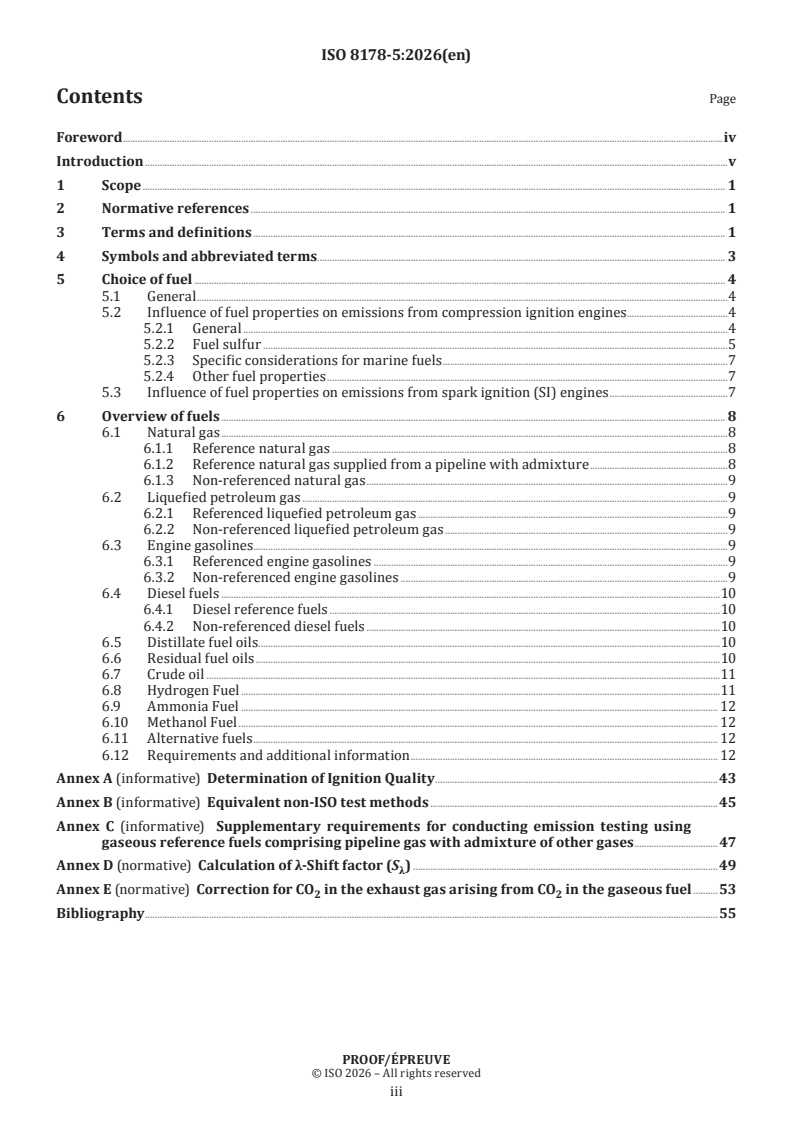
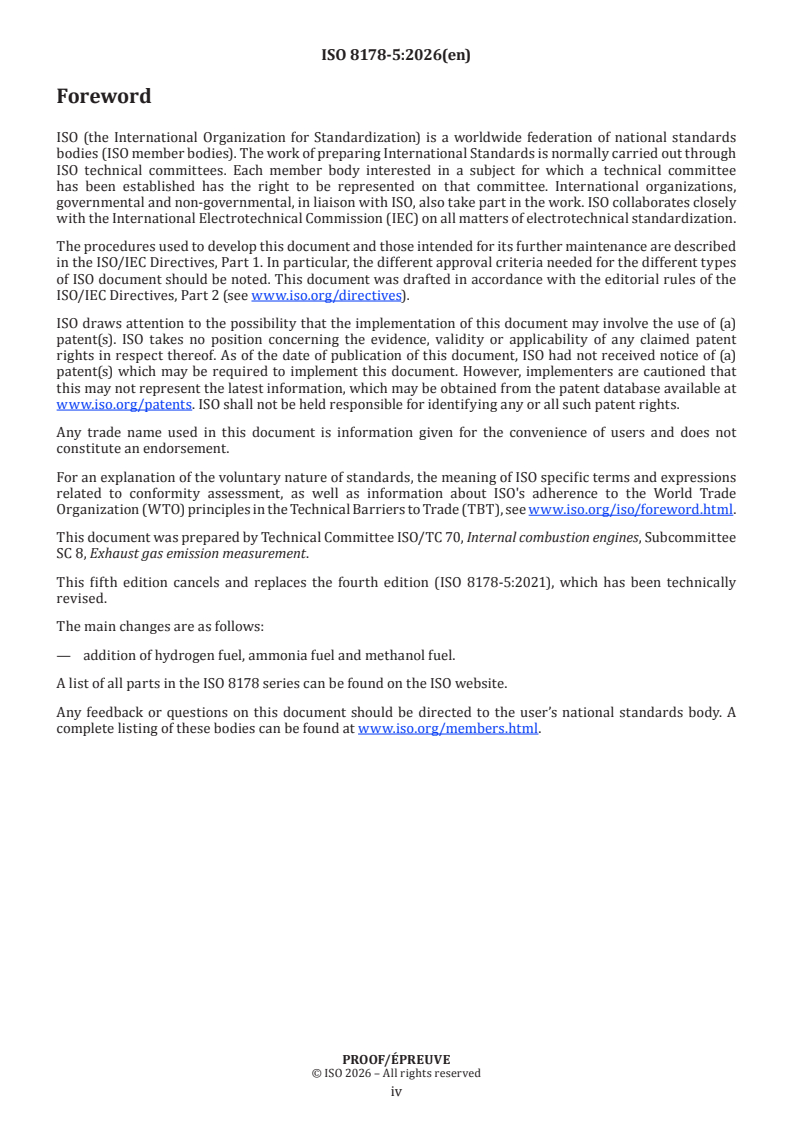
ISO/PRF 8178-5 - Reciprocating internal combustion engines — Exhaust emission measurement — Part 5: Test fuels
REDLINE ISO/PRF 8178-5 - Reciprocating internal combustion engines — Exhaust emission measurement — Part 5: Test fuels
ISO/PRF 8178-5 - Moteurs alternatifs à combustion interne — Mesurage des émissions de gaz d'échappement — Partie 5: Carburants d'essai
ISO/PRF 8178-5 is an ISO standard on exhaust emission measurement for reciprocating internal combustion engines. It specifies the test fuels recommended for the emission test cycles in ISO 8178-4, for mobile, transportable and stationary engines other than vehicles primarily designed for road use.
The document is aimed at engine manufacturers, test laboratories, certification teams, and fuel suppliers that need a common fuel basis for emission testing and reporting. In practice, it tells users which fuels to use, what to measure, and what to report so that emission results can be interpreted consistently.
What does ISO/PRF 8178-5 specify?
ISO/PRF 8178-5 specifies fuels whose use is recommended when performing the exhaust emission test cycles given in ISO 8178-4. It applies to reciprocating internal combustion engines for mobile, transportable and stationary installations, excluding engines for vehicles primarily designed for road use.
ISO/PRF 8178-5 is written for a wide range of applications, including earth-moving machines, generating sets, marine engines and other uses. The document is organized into six clauses and five annexes, with the annexes covering calculation and test-support topics.
| Annex | What it covers |
|---|---|
| Annex A | Determination of ignition quality |
| Annex B | Equivalent non-ISO test methods |
| Annex C | Supplementary requirements for emission testing using gaseous reference fuels comprising pipeline gas with admixture of other gases |
| Annex D | Calculation of λ-Shift factor (Sλ) |
| Annex E | Correction for CO in the exhaust gas arising from CO in the gaseous fuel |
What are the key requirements of ISO/PRF 8178-5?
ISO/PRF 8178-5 focuses on choosing an appropriate fuel, measuring its properties, and reporting those properties with the emission result. It also sets out how to handle special fuels and how to correct calculations when the fuel itself affects the measured emissions.
Fuel choice and reporting
Clause 5 says that, where feasible, reference fuels should be used for certification. The standard also notes that reference fuels reflect commercial fuels in different countries, so emission results from different reference fuels are not usually directly comparable. In practice, this means a lab or buyer should not treat all “reference” fuels as interchangeable.
Clause 5 also requires the analytical data for all fuels, reference and non-reference, to be determined and reported with the emission results. For non-reference fuels, the document points to universal analytical data sheets in tables such as Table 7, Table 11, Table 19, Table 23, Table 25, Table 29, Table 30, Table 33, Table 35 and Table 37. This matters because the fuel composition can change the emission result and the calculation method.
Fuel properties that affect emissions
Clause 5.2 and Clause 5.3 explain that fuel properties can have a significant effect on emissions and fuel consumption. For compression ignition engines, the document points to sulfur and other fuel characteristics, and for spark-ignition engines it highlights octane number, methane number, sulfur, metal-containing additives, oxygenates, olefins, benzene and volatility.
For practical use, this means the fuel specification is not just paperwork - it can affect knock, catalyst performance, exhaust aftertreatment, combustion temperature and even engine durability. If a fuel is outside the engine’s intended operating range, the test result may change because of the fuel, not only because of the engine.
Special fuel families
Clause 6 gives an overview of the fuel families covered by the standard, including natural gas, liquefied petroleum gas, engine gasolines, diesel fuels, distillate fuel oils, residual fuel oils, crude oil, hydrogen fuel, ammonia fuel, methanol fuel and alternative fuels. For many of these families, the document distinguishes between reference fuels and non-reference fuels.
Hydrogen fuel is treated as a reference fuel in the grades identified in the document, and the emission test report shall state the fuel specification used. Ammonia fuel and methanol fuel are also included, with selected grades and the corresponding reporting requirements. In practice, this helps users match the fuel to the engine technology and keep the test report traceable.
Calculations and corrections linked to the fuel
Clause 5 requires calculation of fuel-specific factors in accordance with ISO 8178-4:2026, Annex G, when applicable. If exhaust mass flow measurement, or combustion air flow measurement with fuel consumption measurement, is not possible, Clause 5 calls for elemental analysis of the fuel so that exhaust mass flow can be calculated from emission concentrations.
Annex D gives the calculation of the λ-Shift factor (Sλ), which relates a fuel blend’s oxygen demand to that of pure methane. Annex E gives the correction for CO in the exhaust gas arising from CO in gaseous fuel, including the treatment for transient cycles and discrete-mode NRSC. These annexes matter when the fuel itself changes the calculation basis and the emission result needs to be corrected accordingly.
Gaseous blends and test validity
Annex C gives supplementary requirements for emission testing using gaseous reference fuels comprising pipeline gas with admixture of other gases. It requires gas composition analysis by gas chromatography according to ISO 6974, or another method with similar accuracy and repeatability, and gas flow measurement by a mass-based flowmeter.
Clause C.5 and C.6 tie the blend composition to the calculation of methane number (MN) and the λ-Shift factor. The test blend must stay within the permitted range for the relevant reference fuel, and the blend control settings must be maintained through the test. In practice, the lab has to control and document the blend, not just measure the engine output.
Reporting and declarations
Clause 6.12 requires International Standards to be used for fuel-property determination where they exist. It also requires any supplementary additives used during the test to be declared, and any water addition to the engine intake air to be declared and included in the emission calculation.
For a buyer, test lab or quality manager, this is the part that keeps the result auditable. The fuel used, any additives, and any intake-air water addition all become part of the emission record.
What terms does ISO/PRF 8178-5 define?
- Carbon residue - the residue left after controlled thermal decomposition under restricted oxygen; it is used to indicate how much material may remain after burning.
- Cetane index - a calculated number that estimates the cetane number of a product from density and distillation data.
- Cetane number - the conventional scale for ignition quality of diesel fuel under standardized conditions; a higher number means shorter ignition delay.
- Liquefied petroleum gas (LPG) - a mixture of light hydrocarbons, mainly propane, propene, butanes and butenes, that can be stored and handled as a liquid under moderate pressure.
- Natural gas (NG) - a gaseous hydrocarbon mixture mainly made up of methane, usually with ethane, propane and other gases.
- Methane number - a rating of the knocking characteristics of a fuel gas, analogous to octane number for petrol.
- Octane number - a conventional scale for knock resistance in spark-ignition engines.
- Oxygenate - an oxygen-containing organic compound that may be used as a fuel or fuel supplement, such as an alcohol or ether.
Who uses ISO/PRF 8178-5?
ISO/PRF 8178-5 is used by organizations that run or assess emission tests on reciprocating internal combustion engines. That includes engine manufacturers, emission laboratories, certification and type-approval teams, fuel suppliers, and technical buyers who need to specify a test fuel.
The standard is relevant across off-road and non-road engine sectors, including earth-moving machines, generating sets, marine engines and other mobile, transportable or stationary installations. It is also useful for quality managers who need the fuel properties documented alongside the emission result.
What changed in ISO/PRF 8178-5 from the previous edition?
ISO/PRF 8178-5 cancels and replaces ISO 8178-5:2021. The foreword states that this fifth edition was technically revised, with the main change being the addition of hydrogen fuel, ammonia fuel and methanol fuel.
Which standards are used with ISO/PRF 8178-5?
| Reference | What it contributes |
|---|---|
| ISO 4259-1 | Precision data and interpretation of test result precision |
| ISO 6974 (all parts) | Natural gas composition and uncertainty by gas chromatography |
| ISO 6976 | Calculation of calorific values, density, relative density and Wobbe indices from gas composition |
| ISO 8178-1:2026 | Test-bed measurement systems for gaseous and particulate emissions |
| ISO 8178-4:2026 | Steady-state and transient test cycles for different engine applications |
| ISO 8216-1 | Classification categories for marine fuels |
| ISO 8217 | Specifications of marine fuels |
| ISO 14687:2025 | Hydrogen fuel quality specification |
| ASTM D4815 | Determination of oxygenated compounds in reformulated fuels |
| ASTM D8221 | Calculated methane number of gaseous fuels |
| EN 228 | Requirements and test methods for unleaded petrol |
| EN 15376 | Ethanol as a blending component for petrol |
| EN 15489 | Water content in ethanol |
| EN 16726 | Quality of gas in Group H infrastructure |
ISO 8178-1 and ISO 8178-4 are the key companion parts of the same series. ISO 8178-1 provides the test-bed measurement system context, while ISO 8178-4 provides the test cycles and calculation framework that ISO/PRF 8178-5 supports with fuel specifications.
What does the ISO/PRF 8178-5 document contain?
ISO/PRF 8178-5 contains the fuel classification and specification tables for the different fuel families used in emission testing. The document includes tables for natural gas, LPG, engine gasolines, diesel fuels, distillate fuel oils, residual fuel oils, crude oil, hydrogen fuel, ammonia fuel and methanol fuel, plus universal analytical data sheets for reporting measured properties.
It also contains practical guidance on how fuel properties influence emissions, especially for compression ignition and spark ignition engines. The annexes provide calculation methods and supporting procedures, including ignition quality, gaseous blend handling, λ-Shift factor calculation and correction of CO emissions arising from CO in gaseous fuel.
For a test laboratory, the most useful parts are the property tables, the reporting sheets and the annex formulas. For a buyer or quality manager, the most useful parts are the fuel family descriptions and the declaration requirements that have to accompany the emission report.
Relations
- Effective Date
- 16-Dec-2023
Buy Documents
ISO/PRF 8178-5 - Reciprocating internal combustion engines — Exhaust emission measurement — Part 5: Test fuels
REDLINE ISO/PRF 8178-5 - Reciprocating internal combustion engines — Exhaust emission measurement — Part 5: Test fuels
ISO/PRF 8178-5 - Moteurs alternatifs à combustion interne — Mesurage des émissions de gaz d'échappement — Partie 5: Carburants d'essai
Get Certified
Connect with accredited certification bodies for this standard

DNV
DNV is an independent assurance and risk management provider.

Lloyd's Register
Lloyd's Register is a global professional services organisation specialising in engineering and technology.
DNV Energy Systems
Energy and renewable energy certification.
Sponsored listings
Frequently Asked Questions
ISO/PRF 8178-5 is a draft published by the International Organization for Standardization (ISO). Its full title is "Reciprocating internal combustion engines — Exhaust emission measurement — Part 5: Test fuels". This standard covers: This document specifies fuels whose use is recommended for performing the exhaust emission test cycles given in ISO 8178-4. It is applicable to reciprocating internal combustion engines for mobile, transportable and stationary installations excluding engines for vehicles primarily designed for road use. This document is applicable to engines used, e.g. earth-moving machines and generating sets, and for other applications.
This document specifies fuels whose use is recommended for performing the exhaust emission test cycles given in ISO 8178-4. It is applicable to reciprocating internal combustion engines for mobile, transportable and stationary installations excluding engines for vehicles primarily designed for road use. This document is applicable to engines used, e.g. earth-moving machines and generating sets, and for other applications.
ISO/PRF 8178-5 is classified under the following ICS (International Classification for Standards) categories: 13.040.50 - Transport exhaust emissions; 27.020 - Internal combustion engines. The ICS classification helps identify the subject area and facilitates finding related standards.
ISO/PRF 8178-5 has the following relationships with other standards: It is inter standard links to ISO 8178-5:2021. Understanding these relationships helps ensure you are using the most current and applicable version of the standard.
ISO/PRF 8178-5 is available in PDF format for immediate download after purchase. The document can be added to your cart and obtained through the secure checkout process. Digital delivery ensures instant access to the complete standard document.
Standards Content (Sample)
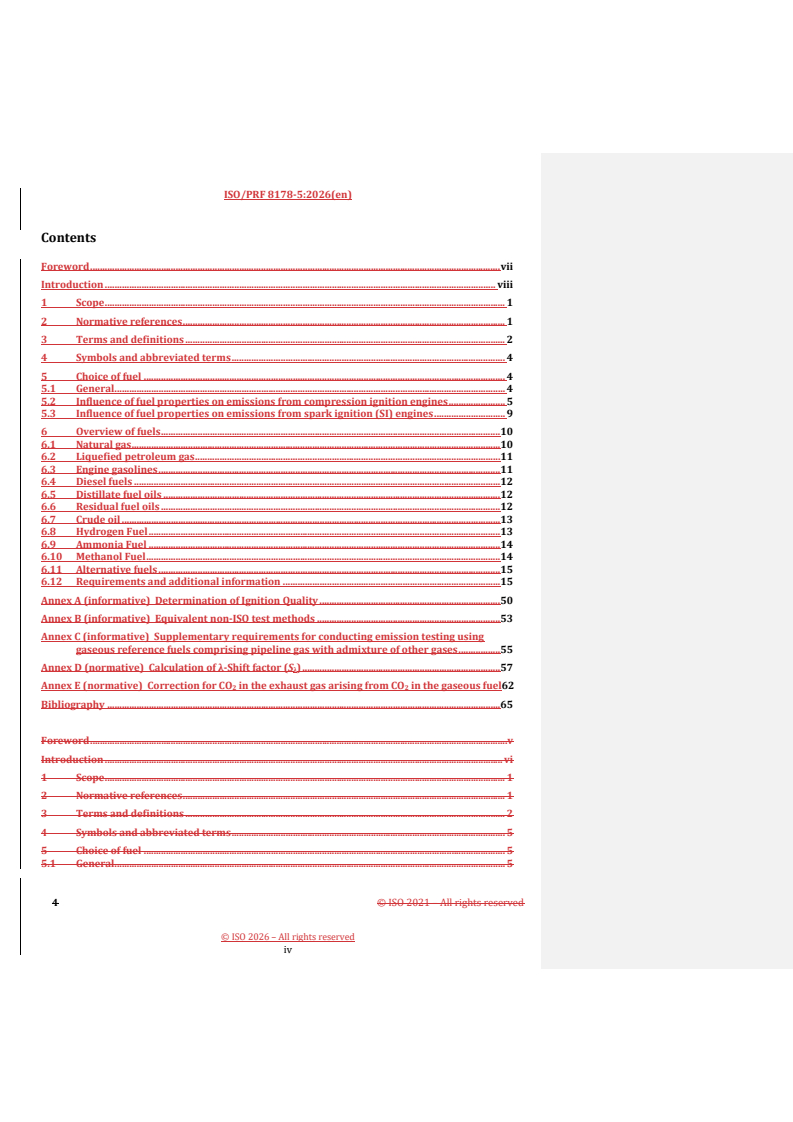
Contents
- Introduction
- 1 Scope
- 2 Normative references
- 3 Terms and definitions
- 3.1 carbon residue
- 3.2 cetane index
- 3.3 cetane number
- 3.4 crude oil
- 3.5 diesel fuel
- 3.6 liquefied petroleum gas
- 3.7 octane number
- 3.8 oxygenate
- 3.9 natural gas
- 3.10 methane number
- 4 Symbols and abbreviated terms
- 5 Choice of fuel
- 5.1 General
- 5.2 Influence of fuel properties on emissions from compression ignition engines
- 5.3 Influence of fuel properties on emissions from spark ignition (SI) engines
- 6 Overview of fuels
- 6.1 Natural gas
- 6.2 Liquefied petroleum gas
- 6.3 Engine gasolines
- 6.4 Diesel fuels
- 6.5 Distillate fuel oils
- 6.6 Residual fuel oils
- 6.7 Crude oil
- 6.8 Hydrogen Fuel
- 2 Gaseous hydrogen; internal combustion engine stationary applications
- 6.9 Ammonia Fuel
- 6.10 Methanol Fuel
- 6.11 Alternative fuels
- 6.12 Requirements and additional information
- Annex A
- Annex B
- Annex C
- Annex D
- Annex E
- 2 CO2i, fuel
- 2 CO2i, fuel
- Bibliography
Introduction
In comparison with engines for on-road applications, engines for off-road use are made in a much wider range of power output and configurations and are used in a great number of different applications. Since fuel properties vary widely from country to country a broad range of different fuels are listed in this document — both reference fuels and commercial fuels.
Reference fuels are usually representative of specific commercial fuels but with considerably tighter specifications. Their use is primarily recommended for test bed measurements described in ISO 8178-1. For measurements typically at sites where emissions with commercial fuels, whether listed or not in this document, are to be determined, uniform analytical data sheets (see Clause 5) are recommended for the determination of the fuel properties to be declared with the exhaust emission results. PROOF/ÉPREUVE
International Standard ISO 8178-5:2026(en) Reciprocating internal combustion engines — Exhaust emission measurement — Part 5:
Test fuels
1 Scope
This document specifies fuels whose use is recommended for performing the exhaust emission test cycles given in ISO 8178-4.
This document is applicable to reciprocating internal combustion engines for mobile, transportable and stationary installations excluding engines for vehicles primarily designed for road use. This document is applicable to engines used, e.g. earth-moving machines and generating sets, marine and for other applications.
2 Normative references
The following documents are referred to in the text in such a way that some or all of their content constitutes requirements of this document. For dated references, only the edition cited applies. For undated references, the latest edition of the referenced document (including any amendments) applies. ISO 4259 (all parts), Petroleum and related products — Precision of measurement methods and results ISO 6974 (all parts), Natural gas – Determination of composition and associated uncertainty by gas chromatography ISO 8178-4:2026, Reciprocating internal combustion engines — Exhaust emission measurement — Part 4:
Steady-state and transient test cycles for different engine applications ISO 8216-1, Products from petroleum, synthetic and renewable sources — Fuels (class F) classification — Part 1:
Categories of marine fuels ISO 8217, Products from petroleum, synthetic and renewable sources — Fuels (class F) — Specifications of marine fuels ISO 14687:2025, Hydrogen fuel quality — Product specification ASTM D8221, Standard Practice for Determining the Calculated Methane Number (MNC) of Gaseous Fuels Used in Internal Combustion Engines EN 228, Automotive fuels – unleaded petrol – Requirements and test methods EN 15376, Automotive fuels – ethanol as a blending component for petrol – Requirements and test methods EN 15489, Ethanol as a blending component for petrol – Determination of water content – Karl Fischer coulometric titration method EN 16726, Gas infrastructure - Quality of gas - Group H
3 Terms and definitions
For the purposes of this document, the following terms and definitions apply. PROOF/ÉPREUVE
ISO 8178-5:2026(en) ISO and IEC maintain terminological databases for use in standardization at the following addresses:
- ISO Online browsing platform: available at https:// www .iso .org/ obp - IEC Electropedia: available at https:// www .electropedia .org/ NOTE The standards listed in the tables in Annex B also contain applicable definitions.
3.1 carbon residue
residue remaining after controlled thermal decomposition of a product under a restricted supply of oxygen (air) Note 1 to entry: The historical methods of Conradson and Ramsbottom have largely been replaced by the carbon residue (micro) method.
[SOURCE: ISO 1998-2:1998, 2.50.001]
3.2 cetane index
number, calculated to represent the approximate cetane number (3.3) of a product from its density and distillation characteristics Note 1 to entry: The formula used for calculation is reproduced from statistical analysis of a very large representative sample of world-wide diesel fuels, on which cetane number and distillation data are known, and thus is subject to change at 5 to10 year intervals. The current formula is given in ISO 4264. It is not applicable to fuels containing an ignition-improving additive.
[SOURCE: ISO 1998-2:1998, 2.30.111]
3.3 cetane number
number on a conventional scale, indicating the ignition quality of a diesel fuel (3.5) under standardized conditions Note 1 to entry: It is expressed as the percentage by volume of hexadecane (cetane) in a reference mixture having the same ignition delay as the fuel for analysis. The higher the cetane number, the shorter the delay. [SOURCE: ISO 1998-2:1998, 2.30.110]
3.4 crude oil
naturally occurring form of petroleum, mainly occurring in a porous underground formation such as sandstone Note 1 to entry: Crude oil is a hydrocarbon mixture, generally in a liquid state, which may also include compounds of sulfur, nitrogen, oxygen, metals and other elements.
[SOURCE: ISO 1998-1:1998, 1.05.005, modified — Note 1 to entry has been added.]
3.5 diesel fuel
gas-oil that has been specially formulated for use in medium and high-speed diesel engines, mostly used in the transportation market Note 1 to entry: It is often referred to as “automotive diesel fuel”. [SOURCE: ISO 1998-1:1998, 1.20.131, modified — alternative term "automotive gas-oil" has been removed.] PROOF/ÉPREUVE
ISO 8178-5:2026(en)
3.6 liquefied petroleum gas
LPG mixture of light hydrocarbons, consisting predominantly of propane, propene, butanes and butenes, that may be stored and handled in the liquid phase under moderate conditions of pressure and at ambient temperature [SOURCE: ISO 1998-1:1998, 1.15.080, modified — abbreviated term has been added.]
3.7 octane number
number on a conventional scale expressing the knock-resistance of a fuel for spark-ignition engines Note 1 to entry: It is determined in test engines by comparison with reference fuels. There are several methods of test; consequently, the octane number should be accompanied by reference to the method used. [SOURCE: ISO 1998-2:1998, 2.30.100]
3.8 oxygenate
oxygen containing organic compound which may be used as a fuel or fuel supplement, such as various alcohols and ethers
3.9 natural gas
NG complex gaseous mixture of hydrocarbons, primarily methane, but generally includes ethane, propane and higher hydrocarbons, and some non-combustible gases such as nitrogen and carbon dioxide [SOURCE: ISO 14532:2014, 2.1.1.1, modified — Note 1 to entry has been removed.]
3.10 methane number
rating indicating the knocking characteristics of a fuel gas Note 1 to entry: It is comparable to the octane number for petrol. One expression of the methane number is the volume percentage of methane in a methane-hydrogen mixture, that in a test engine under standard conditions has the same tendency to knock as the fuel gas to be examined.
[SOURCE: ISO 14532:2014, 2.6.6.1]
4 Symbols and abbreviated terms
The symbols and abbreviated terms used in this document are listed in Table 1 are identical to those given in ISO 8178-4:2026, Clause 4. Those which are essential for this document are repeated below in order to facilitate comprehension.
Table 1 — General symbols Symbol Definition Unit A/F stoichiometric air to fuel ratio — st λ excess air factor (in kilogrammes dry air per kilogramme of fuel) kg/kg H absolute humidity of the intake air (g water/kg dry air) g/kg a p total atmospheric pressure kPa b p water vapor pressure after cooling bath kPa r
q H O volume flow rate m /s vH2O 2 a At reference conditions (T = 273,15 K and p = 101,325 kPa).
PROOF/ÉPREUVE
ISO 8178-5:2026(en)
5 Choice of fuel
5.1 General
Where feasible, reference fuels should be used for certification of engines. Reference fuels reflect the characteristics of commercially available fuels in different countries and are therefore different in their properties. Since fuel composition influences exhaust emissions, emission results with different reference fuels are not usually comparable. For lab-to-lab comparison of emissions even the properties of the specified reference fuel are recommended to be matched as far as possible. This can theoretically best be accomplished by using fuels from the same batch. For all fuels (reference fuels and others), the analytical data shall be determined and reported with the results of the exhaust measurement.
For non-reference fuels, the data to be determined are listed in the following tables:
- Table 7 (Universal analytical data sheet — Natural gas);
- Table 11 (Universal analytical data sheet — Liquefied petroleum gas);
- Table 19 (Universal analytical data sheet — Engine gasolines);
- Table 23 (Universal analytical data sheet — Diesel fuels);
- Table 25 (Universal analytical data sheet — Distillate fuel oils);
- Table 29 (Universal analytical data sheet — Residual fuel oils);
- Table 30 (Universal analytical data sheet — Crude oil);
- Table 33 (Universal analytical data sheet – Hydrogen fuel);
- Table 35 (Universal analytical data sheet – Ammonia fuel);
- Table 37 (Universal analytical data sheet – Methanol fuel).
If exhaust mass flow measurement, or combustion air flow measurement in combination with fuel consumption measurement, is not possible, an elemental analysis of the fuel shall be carried out. In such cases, the exhaust mass flow can be calculated using the concentration measurement results of the exhaust emission and using the calculation methods given in ISO 8178-4:2026, Annex G. In cases where the fuel analysis is not available, hydrogen and carbon mass fractions can be obtained by calculation. The recommended methods are given in ISO 8178-4:2026, M.2.2, M.2.3 and M.2.4. Emissions and exhaust gas flow calculations depend on the fuel composition. The calculation of the fuel specific factors, if applicable, shall be done in accordance with ISO 8178-4:2026, Annex G. NOTE For non-ISO test methods equivalent to those of International Standards mentioned in this document, see Annex B.
5.2 Influence of fuel properties on emissions from compression ignition engines
5.2.1 General
Fuel quality has a significant effect on engine emissions. Certain fuel parameters have a more or less pronounced influence on the emissions level. A short overview on the most influencing parameters is given in 5.2.2 to 5.2.4.
PROOF/ÉPREUVE
ISO 8178-5:2026(en)
5.2.2 Fuel sulfur
Sulfur naturally occurs in crude oil. The sulfur still contained in the fuel after the refining process is oxidized during the combustion process in the engine to SO , which is the primary source of sulfur emission from the
engine. Part of the SO is further oxidized to sulfate (SO ) in the engine exhaust system, the dilution tunnel, 2 4 or by an exhaust aftertreatment system. Sulfate will react with the water present in the exhaust to form sulfuric acid with associated water that will condense and finally be measured as part of the particulate emission (PM).
Consequently, fuel sulfur has a significant influence on the PM emission. The mass of sulfates emitted from an engine depends on the following parameters:
- fuel consumption of the engine (BSFC);
- fuel sulfur content (FSC);
- S ⇒ SO conversion rate (CR);
- weight increase by water absorption standardized to H SO ·6,651H O. 2 4 2 Fuel consumption and fuel sulfur content are measurable parameters, whereas the conversion rate can only be predicted, since it can vary from engine to engine. Typically, the conversion rate is approximately 2 % for engines without aftertreatment systems. Formula (1) has been applied for estimating the sulfur impact on PM:
X E FSC Se 6,795 296 (1) PM fuel 1,,000 000 100 where S is the brake specific contribution of fuel sulfur to PM, expressed in grams per kilowatt-hour (g/ PM kWh); e is the brake specific fuel consumption, expressed in grams per kilowatt-hour (g/kWh); fuel X is the fuel sulfur content, expressed in milligrams per kilogram (mg/kg); FSC E is the S ⇒ SO conversion rate, expressed in percent %;
6,795 296 is the mass-based conversion factor of S converted to H SO including associated water 2 4 This is based on the assumption that 1,221 6 grams of water is associated with each gram of H SO because 2 4 of the dew point temperature of 9,5 °C in the weighing environment. The relationship between fuel sulfur content and sulfate emission is shown in Figure 1 for an engine without aftertreatment and a S to SO conversion rate of 2 %.
Many aftertreatment systems contain an oxidation catalyst as an integral part of the overall aftertreatment system. The major purpose of the oxidation catalyst is to enhance specific chemical reactions necessary for the proper function of the aftertreatment system. Since the oxidation catalyst will also oxidize a considerable amount of SO to SO , the aftertreatment system is likely to produce a high amount of additional particulates 2 4 in the presence of fuel sulfur. When using such aftertreatment systems, the conversion rate can drastically increase to about 30 % to 70 % depending on the efficiency of the catalytic converter. This will have a major impact on the PM emission, as shown in Figure 2.
PROOF/ÉPREUVE
ISO 8178-5:2026(en) Key X sulfur content, in mg/kg Y sulfur PM, in g/kWh Figure 1 — Relationship between fuel sulfur and sulfate emission for engines without aftertreatment Key X sulfur content, in mg/kg Y sulfur PM, in g/kWh 1 70 % conversion 2 30 % conversion Figure 2 — Relationship between fuel sulfur and sulfate emission for engines with aftertreatment PROOF/ÉPREUVE
ISO 8178-5:2026(en)
5.2.3 Specific considerations for marine fuels
For marine fuels (distillate and residual fuel oils), sulfur and nitrogen have a significant impact on PM and NO emissions, respectively.
Typically, the sulfur content is higher than that for onroad or nonroad diesel fuels by a factor of approximately 10, as shown in Table 23. Even without any aftertreatment system, the PM sulfur level will be approximately 0,4 g/kWh for a 2 % sulfur fuel. In addition, the high ash, vanadium and sediment fractions will significantly contribute to the total PM emission. As a consequence, the inherent engine PM emission, which is mainly soot, is only a very small fraction of the total PM emission. In the application of aftertreatment systems, 5.2.2 should be carefully considered.
The average nitrogen content of residual fuel oil is currently around 0,4 %, but steadily increasing. In some cases, nitrogen contents between 0,8 % and 1,0 % have been reported. Assuming a 55 % conversion rate at a nitrogen level of 0,8 % will increase the NO emission of the engine by more than 2 g/kWh. This is a
significant portion of the total NO emission and shall therefore be carefully considered.
5.2.4 Other fuel properties
There are other fuel parameters that have a significant influence on emissions and fuel consumption of an engine. Contrary to the sulfur influence, their magnitude is less predictable and unambiguous, but there is always a general trend that is valid for all engines. The most important of these parameters are the cetane number (CN), density, poly-aromatic content, total aromatics content and distillation characteristics. Their influence is briefly summarized below.
For NO , total aromatics is the predominant parameter whereas the effect of poly-aromatics and density
is less significant. This can be explained by an increase of the flame temperature with higher aromatics content during combustion, which results in an increased NO emission. For PM, density and poly-aromatics
are the most significant fuel parameters. In general, NO will be reduced by 4 % if aromatics are reduced
from 30 % to 10 %. A similar reduction is possible for PM when reducing poly-aromatics from 9 % to 1 %. Increasing the CN will improve engine cold start and therefore white smoke emission. It has also a favourable influence on NO emission particularly at low loads, where reductions of up to 9 % can be achieved if CN is
increased from 50 to 58, and fuel consumption with improvements of up to 3 % for the same CN range.
5.3 Influence of fuel properties on emissions from spark ignition (SI) engines
Fuel parameters that have a significant influence on emissions and fuel consumption of an SI engine include octane number, sulfur level, metal-containing additives, oxygenates, olefins and benzene. Engines are designed and calibrated for a certain octane value or methane number. When a customer uses gasoline with an octane level lower than that required, or accordingly, a natural gas with a lower methane number, knocking can result which could lead to severe engine damage. Engines equipped with knock sensors can handle lower octane or methane number levels by retarding the spark timing and/or taking other measures. By this the emissions of the engine are changed. As mentioned above, sulfur naturally occurs in crude oil. If the sulfur is not removed during the refining process, it will contaminate the fuel. Sulfur has a significant impact on engine emissions by reducing the efficiency of catalysts. Sulfur also adversely affects heated exhaust gas oxygen sensors. Consequently, high sulfur levels will significantly increase HC and NO emissions. Also, lean burn technologies, which require
NO aftertreatment technologies, are extremely sensitive to sulfur.
Metal-containing additives usually form ash and can therefore adversely affect the operation of catalysts and other components, such as oxygen sensors, in an irreversible way that increases emissions. For example, MMT (methylcyclopentadienyl manganese tricarbonyl) is a manganese-based compound marketed as an octane-enhancing fuel additive for gasoline. The combustion products of MMT coat internal engine components, such as spark plugs, can potentially cause misfire which leads to increased emissions, increased fuel consumption and poor engine performance. They also accumulate and partly plug the catalyst causing an increased fuel consumption in addition to reduced emission control. PROOF/ÉPREUVE
ISO 8178-5:2026(en) Oxygenated organic compounds, such as ethanol, are often added to gasoline to increase octane, to extend gasoline supplies, or to induce a lean shift in engine stoichiometry to reduce carbon monoxide emissions. The leaner operation reduces carbon monoxide emissions, especially with carbureted engines without electronic feedback-controlled fuel systems. However increased O levels beyond that for which an open
loop engine has been calibrated will typically increase NO emissions and combustion temperatures which
can lead to premature engine failure.
Olefins are unsaturated hydrocarbons and, in many cases, are also good octane components of gasoline. However, olefins in gasoline can lead to gum and deposit formation and increased emissions of reactive (i.e. ozone-forming) hydrocarbons and toxic compounds.
Benzene is a naturally occurring constituent of crude oil and is also a product of catalytic reforming that produces high octane gasoline streams. It is also a known human carcinogen. The control of benzene levels in gasoline is the most direct way to limit evaporative and exhaust emissions of benzene from SI engines. Proper volatility of gasoline is critical to the operation of SI engines with respect to both performance and emissions. Volatility is characterized by two measurements, vapour pressure and distillation.
6 Overview of fuels
6.1 Natural gas
6.1.1 Reference natural gas
The referenced natural gases whose use is recommended for certification purposes are the following:
a) EU referenced fuels: see Table 3 and Table 4; b) USA certification test fuel: see Table 5; c) Japanese certification test fuel: see Table 6.
...
Contents
- Introduction
- 1 Scope
- 2 Normative references
- 3 Terms and definitions
- 4 Symbols and abbreviated terms
- 5 Choice of fuel
- 5.1 General
- 5.2 Influence of fuel properties on emissions from compression ignition engines
- 5.3 Influence of fuel properties on emissions from spark ignition (SI) engines
- 6 Overview of fuels
- 6.1 Natural gas
- 6.2 Liquefied petroleum gas
- 6.3 Engine gasolines
- 6.4 Diesel fuels
- 6.5 Distillate fuel oils
- 6.6 Residual fuel oils
- 6.7 Crude oil
- 6.8 Hydrogen Fuel
- 2 Gaseous hydrogen; internal combustion engine stationary applications
- 6.9 Ammonia Fuel
- 6.10 Methanol Fuel
- 6.11 Alternative fuels
- 6.12 Requirements and additional information
- Annex A
- Annex B
- Annex C
- Annex D
- 1 × [ ]+ 2× [ ]+ 3× [ ]+ 4× [ ]+ …]]
- 4 × [ ] +4× [ ]+ …
- 4 × [ ] +4× [ ] +6× [ ]+ …8 × [ ]
- Annex E
- Bibliography
Introduction
In comparison with engines for on-road applications, engines for off-road use are made in a much wider range of power output and configurations and are used in a great number of different applications. Since fuel properties vary widely from country to country a broad range of different fuels are listed in this document — both reference fuels and commercial fuels.
Reference fuels are usually representative of specific commercial fuels but with considerably tighter specifications. Their use is primarily recommended for test bed measurements described in ISO 8178-1. For measurements typically at sites where emissions with commercial fuels, whether listed or not in this document, are to be determined, uniform analytical data sheets (see Clause 5)5) are recommended for the determination of the fuel properties to be declared with the exhaust emission results.
DRAFT International Standard ISO/DIS 8178-5:2026(en)
Reciprocating internal combustion engines — Exhaust emissionsemission measurement — — Part 5:
Test fuels
1 Scope
This document specifies fuels whose use is recommended for performing the exhaust emission test cycles given in ISO 8178-4.
This document is applicable to reciprocating internal combustion engines for mobile, transportable and stationary installations excluding engines for vehicles primarily designed for road use. This document is applicable to engines used, e.g. earth-moving machines and generating sets, marine and for other applications.
2 Normative references
The following documents are referred to in the text in such a way that some or all of their content constitutes requirements of this document. For dated references, only the edition cited applies. For undated references, the latest edition of the referenced document (including any amendments) applies. ISO 4259-1, (all parts), Petroleum and related products –— Precision of measurement methods and results – Part 1: Determination of precision data in relation to methods of test ISO 6974 (all parts), Natural gas – Determination of composition and associated uncertainty by gas chromatography ISO 6976, Natural gas — Calculation of calorific values, density, relative density and Wobbe indices from composition ISO 8178-1:2026, Reciprocating internal combustion engines — Exhaust emission measurement — Part 1: Testbed measurement systems of gaseous and particulate emissions ISO 8178-ISO 8178-4:2026, Reciprocating internal combustion engines — Exhaust emission measurement — Part 4: Steady-state and transient test cycles for different engine applications ISO 8216--1, Products from petroleum, synthetic and renewable sources — Fuels (class F) classification — Part 1: Categories of marine fuels ISO 8217, Products from petroleum, synthetic and renewable sources — Fuels (class F) — Specifications of marine fuels ISO 14687:2025, Hydrogen fuel quality –— Product specification ASTM D4815, A method for the determination of oxygenated compounds in reformulated fuels ASTM D8221, Standard Practice for Determining the Calculated Methane Number (MNC) of Gaseous Fuels Used in Internal Combustion Engines
ISO/PRF 8178-5:2026(en) EN 228, Automotive fuels – unleaded petrol – Requirements and test methods EN 15376, Automotive fuels – ethanol as a blending component for petrol – Requirements and test methods EN 15489, Ethanol as a blending component for petrol – Determination of water content – Karl Fischer coulometric titration method EN 16726, Gas infrastructure - Quality of gas - Group H
3 Terms and definitions
For the purposes of this document, the following terms and definitions apply. ISO and IEC maintain terminological databases for use in standardization at the following addresses:
- — ISO Online browsing platform: available at https://www.iso.org/obphttps://www.iso.org/obp - — IEC Electropedia: available at https://www.electropedia.org/https://www.electropedia.org/ NOTE See any applicable definitions contained in theThe standards listed in the tables in Annex BAnnex B also contain applicable definitions.
3.1 3.1 carbon residue residue remaining after controlled thermal decomposition of a product under a restricted supply of oxygen (air) Note 1 to entry: The historical methods of Conradson and Ramsbottom have largely been replaced by the carbon residue (micro) method.
[SOURCE: ISO 1998-2:1998, 2.50.001] 3.2 3.2 cetane index number, calculated to represent the approximate cetane number (3.3)(3.3) of a product from its density and distillation characteristics Note 1 to entry: The formula used for calculation is reproduced from statistical analysis of a very large representative sample of world-wide diesel fuels, on which cetane number and distillation data are known, and thus is subject to change at 5 to10 year intervals. The current formula is given in ISO 4264. It is not applicable to fuels containing an ignitionimproving additive. [SOURCE: ISO 1998-2:1998, 2.30.111] 3.3 3.3 cetane number number on a conventional scale, indicating the ignition quality of a diesel fuel (3.5)(3.5) under standardized conditions Note 1 to entry: It is expressed as the percentage by volume of hexadecane (cetane) in a reference mixture having the same ignition delay as the fuel for analysis. The higher the cetane number, the shorter the delay. [SOURCE: ISO 1998-2:1998, 2.30.110]
ISO/DISPRF 8178-5:2026(en) 3.4 3.4 crude oil naturally occurring form of petroleum, mainly occurring in a porous underground formation such as sandstone Note 1 to entry: Crude oil is a hydrocarbon mixture, generally in a liquid state, which may also include compounds of sulfur, nitrogen, oxygen, metals and other elements.
[SOURCE: ISO 1998-1:1998, 1.05.005, modified — Note 1 to entry has been added.] 3.5 3.5 diesel fuel gas-oil that has been specially formulated for use in medium and high-speed diesel engines, mostly used in the transportation market Note 1 to entry: It is often referred to as “automotive diesel fuel”. [SOURCE: ISO 1998-1:1998, 1.20.131, modified — The alternative term "automotive gas-oil" has been removed.] 3.6 3.6 liquefied petroleum gas LPG mixture of light hydrocarbons, consisting predominantly of propane, propene, butanes and butenes, that may be stored and handled in the liquid phase under moderate conditions of pressure and at ambient temperature [SOURCE: ISO 1998-1:1998, 1.15.080, modified — The abbreviated term has been added.] 3.7 3.7 octane number number on a conventional scale expressing the knock-resistance of a fuel for spark-ignition engines Note 1 to entry: It is determined in test engines by comparison with reference fuels. There are several methods of test; consequently, the octane number should be accompanied by reference to the method used. [SOURCE: ISO 1998-2:1998, 2.30.100] 3.8 3.8 oxygenate oxygen containing organic compound which may be used as a fuel or fuel supplement, such as various alcohols and ethers 3.9 3.9 natural gas NG complex gaseous mixture of hydrocarbons, primarily methane, but generally includes ethane, propane and higher hydrocarbons, and some non-combustible gases such as nitrogen and carbon dioxide [SOURCE: ISO 14532:2014, 2.1.1.1, modified — Note 1 to entry has been removed.] 3.10 3.10 methane number rating indicating the knocking characteristics of a fuel gas
ISO/PRF 8178-5:2026(en) Note 1 to entry: It is comparable to the octane number for petrol. One expression of the methane number is the volume percentage of methane in a methane-hydrogen mixture, that in a test engine under standard conditions has the same tendency to knock as the fuel gas to be examined.
[SOURCE: ISO 14532:2014, 2.6.6.1]
4 Symbols and abbreviated terms
The symbols and abbreviated terms used in this document are listed in Table 1Table 1 are identical to those given in ISO 8178-4:2026, Clause 4. Those which are essential for this document are repeated below in order to facilitate comprehension.
Table 1 — General symbols Symbol Definition Unit A/F stoichiometric air to fuel ratio — st λ excess air factor (in kilogrammes dry air per kilogramme of fuel) kg/kg Deleted Cells Ha absolute humidity of the intake air (g water/kg dry air) g/kg pb total atmospheric pressure kPa p water vapor pressure after cooling bath kPa r
qvH2O H2O volume flow rate m /s a At reference conditions (T = 273,15 K and p = 101,325 kPa).
5 Choice of fuel
5.1 General
Where feasible, reference fuels should be used for certification of engines. Reference fuels reflect the characteristics of commercially available fuels in different countries and are therefore different in their properties. Since fuel composition influences exhaust emissions, emission results with different reference fuels are not usually comparable. For lab-to-lab comparison of emissions even the properties of the specified reference fuel are recommended to be matched as far as possible. This can theoretically best be accomplished by using fuels from the same batch. For all fuels (reference fuels and others), the analytical data shall be determined and reported with the results of the exhaust measurement.
For non-reference fuels, the data to be determined are listed in the following tables:
- — Table 7Table 7 (Universal analytical data sheet — Natural gas);
- — Table 11Table 11 (Universal analytical data sheet — Liquefied petroleum gas);
- — Table 19Table 19 (Universal analytical data sheet — Engine gasolines);
- — Table 23Table 23 (Universal analytical data sheet — Diesel fuels);
- — Table 25Table 25 (Universal analytical data sheet — Distillate fuel oils);
ISO/DISPRF 8178-5:2026(en) - — Table 29Table 29 (Universal analytical data sheet — Residual fuel oils); - — Table 30Table 30 (Universal analytical data sheet — Crude oil); - — Table 33Table 33 (Universal analytical data sheet – Hydrogen fuel); - — Table 35Table 35 (Universal analytical data sheet – Ammonia fuel); - — Table 37Table 37 (Universal analytical data sheet – Methanol fuel). If exhaust mass flow measurement, or combustion air flow measurement in combination with fuel consumption measurement, is not possible, an elemental analysis of the fuel shall be carried out. In such cases, the exhaust mass flow can be calculated using the concentration measurement results of the exhaust emission and using the calculation methods given in ISO 8178-4:2026, Annex G. In cases where the fuel analysis is not available, hydrogen and carbon mass fractions can be obtained by calculation. The recommended methods are given in ISO 8178-4:2026, M.2.2, M.2.3 and M.2.4. Emissions and exhaust gas flow calculations depend on the fuel composition. The calculation of the fuel specific factors, if applicable, shall be done in accordance with ISO 8178-4:2026, Annex G. NOTE For non-ISO test methods equivalent to those of International Standards mentioned in this document, see Annex B.Annex B.
5.2 Influence of fuel properties on emissions from compression ignition engines
5.2.1 General
Fuel quality has a significant effect on engine emissions. Certain fuel parameters have a more or less pronounced influence on the emissions level. A short overview on the most influencing parameters is given in 5.2.2 to 5.2.4.5.2.2 to 5.2.4.
5.2.2 Fuel sulfur
Sulfur naturally occurs in crude oil. The sulfur still contained in the fuel after the refining process is oxidized during the combustion process in the engine to SO2, which is the primary source of sulfur emission from the engine. Part of the SO is further oxidized to sulfate (SO ) in the engine exhaust system, the dilution tunnel, or 2 4 by an exhaust aftertreatment system. Sulfate will react with the water present in the exhaust to form sulfuric acid with associated water that will condense and finally be measured as part of the particulate emission (PM). Consequently, fuel sulfur has a significant influence on the PM emission. The mass of sulfates emitted from an engine depends on the following parameters:
- — fuel consumption of the engine (BSFC);
- — fuel sulfur content (FSC);
- — S ⇒ SO conversion rate (CR);
- — weight increase by water absorption standardized to H SO ·6,651H O. 2 4 2 Fuel consumption and fuel sulfur content are measurable parameters, whereas the conversion rate can only be predicted, since it can vary from engine to engine. Typically, the conversion rate is approximately 2 % for engines without aftertreatment systems. Formula (1)Error! Reference source not found. has been applied for estimating the sulfur impact on PM:
ISO/PRF 8178-5:2026(en) X E FSC Se= 6,795 296 (1) PM fuel 1,,000 000 100 𝑋 𝐸 FSC 𝑆 =𝑒 × × × 6,795 296 (1) PM fuel 1,000,000 100 where SPM is the brake specific contribution of fuel sulfur to PM, expressed in grams per kilowatt-hour (g/kWh); e is the brake specific fuel consumption, expressed in grams per kilowatt-hour (g/kWh); fuel X is the fuel sulfur content, expressed in milligrams per kilogram (mg/kg); FSC E is the S ⇒ SO4 conversion rate, expressed in percent %; 6,795 296 is the mass-based conversion factor of S converted to H2SO4 including associated water This is based on the assumption that 1,221 6 grams of water is associated with each gram of H SO because of 2 4 the dew point temperature of 9,5 °C in the weighing environment. The relationship between fuel sulfur content and sulfate emission is shown in Figure 1Figure 1 for an engine without aftertreatment and a S to SO conversion rate of 2 %.
Many aftertreatment systems contain an oxidation catalyst as an integral part of the overall aftertreatment system. The major purpose of the oxidation catalyst is to enhance specific chemical reactions necessary for the proper function of the aftertreatment system. Since the oxidation catalyst will also oxidize a considerable amount of SO to SO , the aftertreatment system is likely to produce a high amount of additional particulates 2 4 in the presence of fuel sulfur. When using such aftertreatment systems, the conversion rate can drastically increase to about 30 % to 70 % depending on the efficiency of the catalytic converter. This will have a major impact on the PM emission, as shown in Figure 2.Figure 2 .
ISO/DISPRF 8178-5:2026(en)
Key X sulfur content, in mg/kg Y sulfur PM, in g/kWh Figure 1 — Relationship between fuel sulfur and sulfate emission for engines without aftertreatment
ISO/PRF 8178-5:2026(en)
Key X sulfur content, in mg/kg Y sulfur PM, in g/kWh 1 70 % conversion 2 30 % conversion Figure 2 — Relationship between fuel sulfur and sulfate emission for engines with aftertreatment
ISO/DISPRF 8178-5:2026(en)
5.2.3 Specific considerations for marine fuels
For marine fuels (distillate and residual fuel oils), sulfur and nitrogen have a significant impact on PM and NO
emissions, respectively.
Typically, the sulfur content is higher than that for onroad or nonroad diesel fuels by a factor of approximately 10, as shown in Table 23.Table 23 . Even without any aftertreatment system, the PM sulfur level will be approximately 0,4 g/kWh for a 2 % sulfur fuel. In addition, the high ash, vanadium and sediment fractions will significantly contribute to the total PM emission. As a consequence, the inherent engine PM emission, which is mainly soot, is only a very small fraction of the total PM emission. In the application of aftertreatment systems, 5.2.25.2.2 should be carefully considered.
The average nitrogen content of residual fuel oil is currently around 0,4 %, but steadily increasing. In some cases, nitrogen contents between 0,8 % and 1,0 % have been reported. Assuming a 55 % conversion rate at a nitrogen level of 0,8 % will increase the NO emission of the engine by more than 2 g/kWh. This is a significant
portion of the total NOx emission and shall therefore be carefully considered.
5.2.4 Other fuel properties
There are other fuel parameters that have a significant influence on emissions and fuel consumption of an engine. Contrary to the sulfur influence, their magnitude is less predictable and unambiguous, but there is always a general trend that is valid for all engines. The most important of these parameters are the cetane number (CN), density, poly-aromatic content, total aromatics content and distillation characteristics. Their influence is briefly summarized below.
For NO , total aromatics is the predominant parameter whereas the effect of poly-aromatics and density is less
significant. This can be explained by an increase of the flame temperature with higher aromatics content during combustion, which results in an increased NO emission. For PM, density and poly-aromatics are the
most significant fuel parameters. In general, NOx will be reduced by 4 % if aromatics are reduced from 30 % to 10 %. A similar reduction is possible for PM when reducing poly-aromatics from 9 % to 1 %. Increasing the CN will improve engine cold start and therefore white smoke emission. It has also a favourable influence on NO emission particularly at low loads, where reductions of up to 9 % can be achieved if CN is
increased from 50 to 58, and fuel consumption with improvements of up to 3 % for the same CN range.
5.3 Influence of fuel properties on emissions from spark ignition (SI) engines
Fuel parameters that have a significant influence on emissions and fuel consumption of an SI engine include octane number, sulfur level, metal-containing additives, oxygenates, olefins and benzene. Engines are designed and calibrated for a certain octane value or methane number. When a customer uses gasoline with an octane level lower than that required, or accordingly, a natural gas with a lower methane number, knocking can result which could lead to severe engine damage. Engines equipped with knock sensors can handle lower octane or methane number levels by retarding the spark timing and/or taking other measures. By this the emissions of the engine are changed.
As mentioned above, sulfur naturally occurs in crude oil. If the sulfur is not removed during the refining process, it will contaminate the fuel. Sulfur has a significant impact on engine emissions by reducing the efficiency of catalysts. Sulfur also adversely affects heated exhaust gas oxygen sensors. Consequently, high sulfur levels will significantly increase HC and NOx emissions. Also, lean burn technologies, which require NOx aftertreatment technologies, are extremely sensitive to sulfur. Metal-containing additives usually form ash and can therefore adversely affect the operation of catalysts and other components, such as oxygen sensors, in an irreversible way that increases emissions. For example, MMT (methylcyclopentadienyl manganese tricarbonyl) is a manganese-based compound marketed as an octane-
ISO/PRF 8178-5:2026(en) enhancing fuel additive for gasoline. The combustion products of MMT coat internal engine components, such as spark plugs, can potentially cause misfire which leads to increased emissions, increased fuel consumption and poor engine performance. They also accumulate and partly plug the catalyst causing an increased fuel consumption in addition to reduced emission control.
Oxygenated organic compounds, such as ethanol, are often added to gasoline to increase octane, to extend gasoline supplies, or to induce a lean shift in engine stoichiometry to reduce carbon monoxide emissions. The leaner operation reduces carbon monoxide emissions, especially with carbureted engines without electronic feedback-controlled fuel systems. However increased O levels beyond that for which an open loop engine has
been calibrated will typically increase NO emissions and combustion temperatures which can lead to
premature engine failure.
Olefins are unsaturated hydrocarbons and, in many cases, are also good octane components of gasoline. However, olefins in gasoline can lead to gum and deposit formation and increased emissions of reactive (i.e. ozone-forming) hydrocarbons and toxic compounds.
...
Contents
- Introduction
- 1 Domaine d'application
- 2 Références normatives
- 3 Termes et définitions
- 3.1 résidu de carbone
- 3.2 indice de cétane
- 3.3 indice de cétane
- 3.4 pétrole brut
- 3.5 carburant diesel
- 3.6 gaz de pétrole liquéfiés
- 3.7 indice d'octane
- 3.8 oxydant
- 3.9 gaz naturel
- 3.10 indice de méthane
- 4 Symboles et abréviations
- 5 Choix du carburant
- 5.1 Généralités
- 5.2 Influence des propriétés du carburant sur les émissions des moteurs à allumage par
- 5.3 Influence des propriétés du carburant sur les émissions des moteurs à allumage
- 6 Vue d'ensemble des carburants
- 6.1 Gaz naturels
- 6.2 Gaz de pétrole liquéfiés
- 6.3 Essences pour automobiles
- 6.4 Carburants pour moteurs diesel
- 6.5 Carburants de type distillat
- 6.6 Carburants résiduels
- 6.7 Pétrole brut
- 6.8 Carburant hydrogène
- 2 Hydrogène gazeux; applications fixes à moteur à combustion interne
- 6.9 Carburant ammoniac
- 6.10 Carburant méthanol
- 6.11 Carburants de substitution
- 6.12 Exigences et informations additionnelles
- Annexe E de la norme
- Annexe A
- Annexe B
- Annexe C
- Annexe D
- Annexe E
- 2 CO2 carburant CO2 carburant
- Bibliographie
Introduction
En comparaison avec les moteurs pour applications routières, les moteurs pour applications non routières sont réalisés dans une gamme beaucoup plus large de puissances de sortie et de configurations et sont utilisés dans un grand nombre d'applications différentes.
Étant donné que les propriétés des carburants diffèrent de manière importante d'un pays à l'autre, une grande variété de carburants différents est énumérée dans le présent document — que ce soit des carburants de références ou des carburants du commerce.
Les carburants de référence sont généralement représentatifs des carburants du commerce spécifiques, mais avec des spécifications considérablement plus strictes. Il est avant tout recommandé de les utiliser pour les mesurages au banc d’essai spécifiés dans l'ISO 8178-1. En ce qui concerne les mesurages sur site permettant de déterminer les émissions de gaz d´échappement avec des carburants du commerce, que ces données soient incluses ou non dans le présent document, il est recommandé d'utiliser des feuilles de données analytiques uniformes (voir Article 5) pour définir les propriétés des carburants en fonction des résultats d´émissions de gaz. PROOF/ÉPREUVE
Norme internationale ISO 8178-5:2026(fr) Moteurs alternatifs à combustion interne — Mesurage des émissions de gaz d'échappement — Partie 5:
Carburants d'essai
1 Domaine d'application
Le présent document spécifie les carburants dont l'utilisation est recommandée pour effectuer les cycles d'essai des émissions de gaz d´échappement fournis dans l'ISO 8178-4. Il est applicable aux moteurs alternatifs à combustion interne pour les installations mobiles, transportables ou fixes, à l'exclusion des moteurs de véhicules conçus originellement pour des applications routières. Le présent document est applicable aux moteurs utilisés, par exemple, sur les engins de terrassement et les groupes électrogènes, les applications marines et pour d'autres applications.
2 Références normatives
Les documents suivants sont cités dans le texte de sorte qu’ils constituent, pour tout ou partie de leur contenu, des exigences du présent document. Pour les références datées, seule l’édition citée s’applique. Pour les références non datées, la dernière édition du document de référence s’applique (y compris les éventuels amendements).
ISO 4259 (toutes les parties), Produits pétroliers et connexes — Fidélité des méthodes de mesure et de leurs résultats ISO 6583:2024, Méthanol comme carburant pour les applications marines — Exigences générales et spécifications ISO 6974 (toutes les parties), Gaz naturel — Détermination de la composition et l’incertitude associée par chromatographie en phase gazeuse ISO 8178-4:2026, Moteurs alternatifs à combustion interne — Mesurage des émissions de gaz d’échappement — Partie 4: Cycles d’essai à l’état stable et transitoires pour différentes applications des moteurs ISO 8216-1, Produits d’origine pétrolière, synthétique ou renouvelable — Classification des combustibles (classe F) — Partie 1: Catégories des combustibles pour la marine ISO 8217, Produits d’origine pétrolière, synthétique ou renouvelable — Combustibles (classe F) — Spécifications des combustibles pour la marine ISO/FDIS 14687, Qualité du carburant hydrogène — Spécification de produit ASTM D 8221-18, Standard Practice for Determining the Calculated Methane Number (MNC) of Gaseous Fuels Used in Internal Combustion Engines EN 228, Carburants pour automobiles — Essence sans plomb — Exigences et méthodes d’essai EN 15376, Carburants pour automobiles — Ethanol comme base de mélange à l’essence — Exigences et méthodes d’essais EN 15489, Éthanol comme base de mélange à l’essence — Détermination de la teneur en eau— Méthode de titrage coulométrique Karl Fischer PROOF/ÉPREUVE
ISO 8178-5:2026(fr) EN 16726, Infrastructures gazières — Qualité du gaz — Groupe H
3 Termes et définitions
Pour les besoins du présent document, les termes et définitions suivants s'appliquent. L’ISO et l’IEC tiennent à jour des bases de données terminologiques destinées à être utilisées en normalisation, consultables aux adresses suivantes:
- ISO Online browsing platform: disponible à l’adresse https:// www .iso .org/ obp - IEC Electropedia: disponible à l’adresse https:// www .electropedia .org/ NOTE Les définitions applicables figurant dans les normes sont citées dans les tableaux de l’Annexe B.
3.1 résidu de carbone
résidu restant après décomposition thermique contrôlée d'un produit sous une alimentation limitée d'oxygène (air) Note 1 à l'article: Les méthodes historiques Conradson et Ramsbottom sont largement remplacées par la méthode micro de résidu de carbone.
[SOURCE: ISO 1998-2:1998, 2.50.001]
3.2 indice de cétane
nombre donnant approximativement l'indice de cétane (3.3) d'un produit, calculé à partir de sa masse volumique et de ses caractéristiques de distillation Note 1 à l'article: La formule utilisée pour ce calcul est tirée de l'analyse statistique d'un très grand nombre de carburants diesel représentatifs de la production mondiale, et pour lesquels les données d'indice de cétane et de distillation sont connues. De ce fait la formule peut nécessiter une révision tous les cinq à dix ans. La formule actuelle est donnée dans l'ISO 4264. Elle n’est pas applicable aux carburants contenant un additif d'amélioration du cétane. [SOURCE: ISO 1998-2:1998, 2.30.111]
3.3 indice de cétane
nombre d'une échelle conventionnelle, indiquant l'aptitude d'un combustible pour moteur du type diesel (3.5), à s'enflammer dans des conditions normalisées Note 1 à l'article: Il est exprimé par le pourcentage en volume d'hexadécane (cétane) dans un mélange de référence présentant le même délai d'allumage que le combustible à analyser. L'indice de cétane est d'autant plus élevé que le délai d'allumage est court.
[SOURCE: ISO 1998-2:1998, 2.30.110]
3.4 pétrole brut
pétrole naturel se trouvant principalement dans des couches souterraines poreuses telles que les grès Note 1 à l'article: Le pétrole brut est un mélange d'hydrocarbures, généralement à l´état liquide, pouvant également contenir des composés de soufre, dazote, doxygène, de métaux ainsi que d'autres éléments. [SOURCE: ISO 1998-1:1998, 1.05.005, modifié — la Note 1 à l'article a été ajoutée.]
3.5 carburant diesel
gas-oil qui a été spécialement formulé pour l'utilisation dans les moteurs diesel à vitesse moyenne ou rapide, surtout pour le transport Note 1 à l'article: La note s'applique seulement à la langue anglaise. PROOF/ÉPREUVE
ISO 8178-5:2026(fr) [SOURCE: ISO 1998-1:1998, 1.20.131, modifié — le terme alternatif «gas-oil auto» a été supprimé.]
3.6 gaz de pétrole liquéfiés
GPL mélange d'hydrocarbures légers, composé principalement de propane, propène, butanes et butènes, qui peut être stocké et manipulé en phase liquide sous pression modérée et à température ambiante [SOURCE: ISO 1998-1:1998, 1.15.080, modifié — le terme abrégé a été ajouté.]
3.7 indice d'octane
nombre d'une échelle conventionnelle, exprimant la résistance à la détonation des carburants pour moteurs à allumage commandé Note 1 à l'article: Il est déterminé dans des moteurs d'essais par comparaison avec des carburants de référence. Plusieurs méthodes d'essai étant utilisées, il convient que l'indice d'octane soit accompagné de la référence à la méthode utilisée.
[SOURCE: ISO 1998-2:1998, 2.30.100]
3.8 oxydant
composant organique contenant de l'oxygène et pouvant être utilisé comme carburant ou additif, comme divers alcools et éthers
3.9 gaz naturel
GN mélange complexe d'hydrocarbures, composé principalement de méthane, mais comprenant généralement aussi, de l'éthane, du propane, des hydrocarbures supérieurs, et quelques gaz non combustibles tels que l'azote et le dioxyde de carbone [SOURCE: ISO 14532:2014, 2.1.1.1, modifié — La Note 1 à l'article a été supprimée.]
3.10 indice de méthane
indice indiquant les caractéristiques de cliquetis d'un gaz combustible Note 1 à l'article: Il est comparable à l'indice d'octane pour l'essence. Une expression de l'indice de méthane est le pourcentage en volume de méthane dans un mélange méthane-hydrogène, qui dans un moteur d'essai sous des conditions normalisées, a la même tendance à cliqueter que le gaz combustible à examiner. [SOURCE: ISO 14532:2014, 2.6.6.1]
4 Symboles et abréviations
Les symboles et abréviations utilisés dans le présent document sont listés dans le Tableau 1 et sont identiques à ceux indiqués dans l'ISO 8178-4:2026, Article 4. Ceux qui sont essentiels au présent document sont répétés ci-après, afin d'en faciliter la compréhension.
PROOF/ÉPREUVE
ISO 8178-5:2026(fr) Tableau 1 — Symboles généraux Symbole Définition Unité A/F rapport air/carburant stœchiométrique — st λ facteur d’excès d’air (en kilogrammes d’air sec par kilogramme kg/kg de carburant) H humidité absolue de l'air d'admission (g d'eau/kg d'air sec) g/kg a p pression atmosphérique totale kPa b p pression de vapeur d'eau après le bain de refroidissement KPa r
q débit volumétrique H O m /s vH2O 2 a Aux conditions de référence (T = 273,15 K et p = 101,325 kPa).
5 Choix du carburant
5.1 Généralités
Dans la mesure du possible, il convient d'utiliser des carburants de référence pour la certification des moteurs.
Les carburants de référence reflètent les caractéristiques des carburants disponibles dans le commerce dans divers pays et qui ont donc des propriétés différentes. Étant donné que la composition du carburant a une influence sur les émissions de gaz d´échappement, les émissions correspondant à des carburants de référence différents ne sont pas généralement comparables. Pour les comparaisons interlaboratoires, il est recommandé que les propriétés des carburants de référence spécifiés soient aussi identiques que possible. En théorie, la meilleure manière d'y parvenir est d'utiliser des carburants du même lot. Pour tous les carburants (carburants de référence ou autres), les données analytiques doivent être définies et jointes au rapport de mesure des gaz d´échappement.
Pour les carburants qui ne sont pas de référence, les données à déterminer sont énumérées dans les tableaux suivants:
- Tableau 7 (Fiche de données analytiques générales — Gaz naturels);
- Tableau 11 (Fiche de données analytiques générales — Gaz de pétrole liquéfiés);
- Tableau 19 (Fiche de données analytiques générales — Essences pour moteur);
- Tableau 23 (Fiche de données analytiques générales — Carburants pour moteurs diesel);
- Tableau 25 (Fiche de données analytiques générales — Carburants de type distillat);
- Tableau 29 (Fiche de données analytiques générales — Carburants résiduels);
- Tableau 30 (Fiche de données analytiques générales — Pétrole brut);
- Tableau 33 (Fiche de données analytiques générales — Carburant hydrogène);
- Tableau 35 (Fiche de données analytiques générales — Carburant ammoniac);
- Tableau 37 (Fiche de données analytiques générales — Carburant méthanol). Une analyse élémentaire du carburant doit être effectuée lorsque le débit-masse des gaz d´échappement ou du débit de l'air de combustion en même temps que la consommation de carburant n'est pas possible. Dans ce cas, il est possible de calculer le débit-masse des gaz d'échappement à l'aide des résultats des mesurages de la concentration des gaz d´échappement et des méthodes de calcul spécifiées dans l'ISO 8178-4:2026, Annexe G. À défaut de disposer de l'analyse du carburant, les fractions massiques d'hydrogène et de carbone peuvent être obtenues par calcul. Les méthodes recommandées sont données dans l'ISO 8178-4:2026, Annexe M: M.2.2, M.2.3 et M.2.4.
PROOF/ÉPREUVE
ISO 8178-5:2026(fr) Les calculs des émissions et du débit des gaz d'échappement dépendent de la composition du carburant. Le calcul des facteurs spécifiques du carburant, si nécessaire, doit être réalisé conformément à l'ISO 8178-4:2026, Annexe G.
NOTE Pour les méthodes d'essai non ISO équivalentes à celles des Normes internationales ISO mentionnées dans le présent document, se reporter à l'Annexe B.
5.2 Influence des propriétés du carburant sur les émissions des moteurs à allumage par
compression
5.2.1 Généralités
La qualité du carburant a une influence significative sur les émissions des moteurs. Certains paramètres du carburant ont une incidence plus ou moins marquée sur le niveau des émissions. Un léger aperçu des paramètres les plus influents est donné dans 5.2.2 à 5.2.4.
5.2.2 Soufre du carburant
Le soufre est naturellement présent dans le pétrole brut. Le soufre résiduel présent dans le carburant après le procédé de raffinage est oxydé au cours du procédé de combustion en SO , qui constitue la principale
source d'émission de soufre du moteur. Une partie du SO est ensuite oxydée en sulfate (SO ) dans le 2 4 système d'échappement du moteur, le tunnel de dilution ou par un système de traitement postcombustion des gaz d'échappement. Le sulfate réagit avec l'eau présente dans les gaz d'échappement pour former de l'acide sulfurique associé à de l’eau qui se condense et qui est finalement mesuré comme partie intégrante des émissions de particules (PM).
Par conséquent, la teneur en soufre du carburant a une influence significative sur les émissions de particules (PM).
La masse des sulfates émis par un moteur dépend des paramètres suivants:
- la consommation de carburant du moteur (BSFC);
- la teneur en soufre du carburant (FSC);
- le taux de conversion S ⇒ SO (CR);
- l'augmentation de poids par absorption d'eau normalisée à H SO ·6,651H O. 2 4 2 La consommation de carburant et la teneur en soufre du carburant sont des paramètres mesurables; le taux de conversion pour sa part ne peut qu'être estimé dans la mesure où il peut varier d'un moteur à l'autre. En général, le taux de conversion est d'environ 2 % pour des moteurs sans système de traitement postcombustion. La Formule (1) a été appliquée pour estimer l'effet du soufre sur l'émission de particules PM:
X E FSC Se 6,795 296 (1) PM fuel 1,,000 000 100 où S est la contribution spécifique du soufre contenu du carburant au frein au PM, exprimée en PM grammes par kilowatt-heure (g/kWh); e est la consommation spécifique de carburant au frein, exprimée en grammes par kilowattfuel heure (g/kWh); X est la teneur en soufre du carburant, exprimée en milligrammes par kilogramme (mg/kg); FSC E est le taux de conversion S ⇒ SO , exprimé en pour cent (%);
6,795 296 est le facteur de conversion massique du S converti en H SO y compris l'eau associée. 2 4 Ceci est fondé sur l'hypothèse selon laquelle 1,221 6 grammes d'eau est associée à chaque gramme de H SO 2 4 du fait de la température du point de rosée de 9,5 °C dans l'environnement de pesée. PROOF/ÉPREUVE
ISO 8178-5:2026(fr) Le rapport entre la teneur en soufre du carburant et l'émission de sulfates est illustré à la Figure 1 pour un moteur sans traitement postcombustion et un taux de conversion de S à SO de 2 %.
De nombreux systèmes de traitement postcombustion comportent un catalyseur d'oxydation faisant partie intégrante du système. Le catalyseur d'oxydation a pour principal objet d'améliorer les réactions chimiques spécifiques nécessaires au bon fonctionnement du système de traitement postcombustion. Dans la mesure où le catalyseur d'oxydation convertit une quantité importante de SO en SO , le système de traitement 2 4 postcombustion est susceptible de produire une grande quantité de particules supplémentaires en présence de soufre dans le carburant. Lors de l’utilisation de ce genre de systèmes de traitement postcombustion, le taux de conversion peut augmenter de manière conséquente, passant de 30 % à 70 % selon le rendement du pot catalytique. Cela aura un effet important sur les émissions de particules PM, tel qu'illustré à la Figure 2. Légende X teneur en soufre du carburant, exprimée en mg/kg Y PM soufre, exprimé en g/kWh Figure 1 — Relation entre la teneur en soufre du carburant et l'émission de sulfates pour des moteurs sans traitement postcombustion PROOF/ÉPREUVE
ISO 8178-5:2026(fr) Légende X teneur en soufre du carburant, exprimée en mg/kg Y PM soufre, exprimé en g/kWh 1 conversion à 70 % 2 conversion à 30 % Figure 2 — Relation entre la teneur en soufre du carburant et l'émission de sulfates pour des moteurs avec traitement postcombustion
5.2.3 Considérations spécifiques aux carburants marins
Pour les carburants marins (carburants de type distillat et résiduels), le soufre et l'azote ont un impact respectif important sur les émissions de particules (PM) et les émissions de NO .
En général, la teneur en soufre est plus élevée que pour les carburants diesel routiers ou non routiers d'un facteur d'environ 10, tel qu'illustré dans le Tableau 23. Même sans système de traitement postcombustion, la teneur en soufre dans l'émission de particules est d'environ 0,4 g/kWh pour un carburant contenant 2 % de soufre. De plus, les fractions importantes de cendres, de vanadium et de sédiments contribuent de manière significative à l'émission de particules totale. Par conséquent, l'émission de particules propre au moteur, constituée principalement de suie, ne représente qu'une très petite fraction de l'émission de particules totale. Lors de l'application de systèmes de traitement postcombustion des gaz d'échappement, il convient que les spécifications du 5.2.2 soient soigneusement prises en compte. La teneur moyenne en azote des carburants résiduels est généralement d'environ 0,4 % mais augmente de façon constante. Dans certains cas, des teneurs en azote comprises entre 0,8 et 1,0 % ont été rapportées. En supposant un taux de conversion de 55 % pour une teneur en azote de 0,8 %, l'émission de NO du moteur
augmentera de plus de 2 g/kWh. Cela représente une portion significative de l'émission totale de NO et doit
par conséquent être bien prise en compte.
5.2.4 Autres propriétés des carburants
Il existe d'autres paramètres de carburants qui ont une influence significative sur les émissions et la consommation de carburant d'un moteur. Contrairement à l'influence du soufre, leur importance est moins prévisible et non ambiguë, mais il existe toujours une tendance générale à les considérer comme valables pour tous les moteurs. Les plus importants de ces paramètres sont l'indice de cétane (CN), la densité, la teneur en aromatiques polycycliques, la teneur totale en aromatiques et les caractéristiques de distillation. Leur influence est brièvement résumée ci-après.
PROOF/ÉPREUVE
ISO 8178-5:2026(fr) Pour les NO , les aromatiques totaux constituent le paramètre prédominant alors que l'effet des aromatiques
polycycliques et de la densité est moins significatif. Cela peut s'expliquer par une augmentation de la température de flamme avec une teneur élevée en aromatiques au cours de la combustion ce qui entraîne une augmentation des émissions de NO . En ce qui concerne les émissions de particules PM, la densité et les
aromatiques polycycliques constituent les paramètres du carburant les plus importants. En général, les NO
sont réduits de 4 % si les aromatiques sont réduits de 30 % à 10 %. Une réduction similaire est possible pour les émissions de particules PM en réduisant les aromatiques polycycliques de 9 % à 1 %. L'augmentation de l'indice de cétane CN améliore le démarrage à froid du moteur et par conséquent les émissions de fumées blanches. Cela a également une influence bénéfique sur les émissions de NO ,
notamment à faibles charges, lorsqu'une réduction jusqu'à 9 % peut être obtenue en augmentant l'indice de cétane CN de 50 à 58 et sur la consommation de carburant affichant des améliorations jusqu'à 3 % pour la même plage d'indice de cétane.
...