

ISO 4510-2:1996
(Main)Earth-moving machinery — Service tools — Part 2: Mechanical pullers and pushers
General Information
- Abstract
Gives guidance for the types, general requirements and main nominal dimensions of mechanical pullers (used for pulling gears and bearings), attachments and adaptors used for carrying out repair work.
- Status
- Published
- Publication Date
- 05-Nov-1996
- Current Stage
- 9093 - International Standard confirmed
- Start Date
- 06-Mar-2023
- Completion Date
- 29-Aug-2026
Buy Documents
ISO 4510-2:1996 - Earth-moving machinery — Service tools — Part 2: Mechanical pullers and pushers Released:11/6/1996
ISO 4510-2:1996 - Engins de terrassement — Outils d'entretien et de dépannage — Partie 2: Extracteurs mécaniques par traction et par pression Released:11/6/1996
Overview
ISO 4510-2:1996 - Earth-moving machinery - Service tools - Part 2: Mechanical pullers and pushers provides guidance on the types, general requirements and main nominal dimensions of mechanical pullers, pushers, attachments and adaptors used in repair and maintenance of earth‑moving machinery. This second edition (1996) replaces the 1986 edition and includes figures, dimensional tables and an informative Annex A with application examples.
Key topics and technical requirements
- Scope and types: Defines mechanical pullers (2‑jaw, 3‑jaw, combinations), push‑pullers, internal and external pulling attachments, pulling adaptors (male/female threads) and step‑plate adaptors. Illustrations are provided in figures 1–9.
- Design principles: Components must allow free movement and minimum clearance between parts to ensure safe, effective operation.
- Forcing screw and head:
- Forcing screw pressure end must have a 60° conical point to align load with the shaft centre.
- Screw heads or nuts shall be square or hexagonal sized to accept standard wrenches (refer to ISO 4510‑1).
- Grip and safety: Jaw gripping ends must prevent slippage for all settings within puller capacity.
- Adaptors & protection:
- Pulling adaptors (male/female threads) are specified for compatibility with push‑pullers (table of thread sizes included).
- Step plate adaptors protect shaft centres from distortion and are used where extreme pressure is applied or when shafts are hollow/no centre hole.
- Dimensions and capacity: Main nominal dimensions for jaw tips, knife‑edges, push‑puller legs, adaptor threads and step‑plate diameters are given in tables (tables 1–5). Note: dimensions are metric; inch equivalents are permitted only where required for local conditions.
- Informative annex: Annex A shows practical assembly/disassembly examples and manufacturer notes on accommodation of jaws, slots and step areas.
Practical applications
ISO 4510-2 is used to:
- Specify appropriate mechanical pullers and pushers for repair tasks on excavators, loaders, graders and similar earth‑moving equipment.
- Guide design decisions where machine designers must choose tool‑compatible dimensions (e.g., bearing recesses, threaded holes).
- Provide maintenance teams with standard references for selecting pullers, internal/external attachments and adaptors during bearing, gear and shaft removal or installation.
Who should use this standard
- Machine manufacturers and designers (to ensure serviceability)
- Maintenance engineers and field service technicians
- Tool and accessory manufacturers (to design compatible pullers/adaptors)
- Equipment owners preparing operation and maintenance manuals
Related standards
- ISO 4510‑1:1987 - Common maintenance and adjustment tools
- ISO 6165 - Earth‑moving machinery - Basic types - Vocabulary
- ISO 6750:1984 - Operation and maintenance - Format and content of manuals
Keywords: ISO 4510-2:1996, earth‑moving machinery, service tools, mechanical pullers and pushers, pulling attachments, adaptors, maintenance, repair, dimensions.
Relations
- Effective Date
- 15-Apr-2008
Buy Documents
ISO 4510-2:1996 - Earth-moving machinery — Service tools — Part 2: Mechanical pullers and pushers Released:11/6/1996
ISO 4510-2:1996 - Engins de terrassement — Outils d'entretien et de dépannage — Partie 2: Extracteurs mécaniques par traction et par pression Released:11/6/1996
Frequently Asked Questions
ISO 4510-2:1996 is a standard published by the International Organization for Standardization (ISO). Its full title is "Earth-moving machinery — Service tools — Part 2: Mechanical pullers and pushers". This standard covers: Gives guidance for the types, general requirements and main nominal dimensions of mechanical pullers (used for pulling gears and bearings), attachments and adaptors used for carrying out repair work.
Gives guidance for the types, general requirements and main nominal dimensions of mechanical pullers (used for pulling gears and bearings), attachments and adaptors used for carrying out repair work.
ISO 4510-2:1996 is classified under the following ICS (International Classification for Standards) categories: 53.100 - Earth-moving machinery. The ICS classification helps identify the subject area and facilitates finding related standards.
ISO 4510-2:1996 has the following relationships with other standards: It is inter standard links to ISO 4510-2:1986. Understanding these relationships helps ensure you are using the most current and applicable version of the standard.
ISO 4510-2:1996 is available in PDF format for immediate download after purchase. The document can be added to your cart and obtained through the secure checkout process. Digital delivery ensures instant access to the complete standard document.
Standards Content (Sample)
IS0
INTERNATIONAL
4510-2
STANDARD
Second edition
1996-l I-1 5
Earth-moving machinery -
Service tools -
Part 2:
Mechanical pullers and pushers
Engins de terrassement - Outils d ‘en tretjen et de dgpannage -
Partie 2: Extracteurs mkaniques par traction et par pression
Reference number
IS0 45102:1996(E)
IS0 4510-2:1996(E)
Foreword
IS0 (the international Organization for Standardization) is a worldwide fed-
eration of national standards bodies (IS0 member bodies). The work of
preparing International Standards is normally carried out through IS0
technical committees. Each member body interested in a subject for
which a technical committee has been established has the right to be
represented on that committee. International organizations, governmental
and non-governmental, in liaison with ISO, also take part in the work. IS0
collaborates closely with the International Electrotechnical Commission
(IEC) on all matters of electrotechnical standardization.
Draft International Standards adopted by the technical committees are
circulated to the member bodies for voting. Publication as an International
Standard requires approval by at least 75 % of the member bodies casting
a vote.
International Standard IS0 4510-2 was prepared by Technical Committee
ISOFC 127, Earth-moving machinery, Subcommittee SC 3, Operation and
maintenance.
This second edition cancels and replaces the first edition
(IS0 4510-2:1986), which has been technically revised.
IS0 4510 consists of the following parts, under the general title Earth-
moving machinery - Service tools:
Part 1: Common maintenance and adjustment tools
- Part 2: Mechanical pullers and pushers
Annex A of this part of IS0 4510 is for information only.
0 IS0 1996
All rights reserved. Unless otherwise specified, no part of this publication may be
reproduced or utilized in any form or by any means, electronic or mechanical, including
photocopying and microfilm, without permission in writing from the publisher.
International Organization for Standardization
Case Postale 56 l CH-1211 Geneve 20 l Switzerland
Printed in Switzerland
II
IS0 4510=2:1996(E)
INTERNATIONAL STANDARD @ IS0
Earth-moving machinery - Service tools -
Part 2: .
Mechanical pullers and pushers
II Scope
This part of IS0 4510 specifies for guidance the types, general requirements and main nominal dimensions of mechanical
pullers, attachments and adaptors used for carrying out repair work.
This part of IS0 4510 includes mechanical pullers and push pullers, pulling attachments and adaptors which are
commonly used for pulling gears and bearings mounted on the types of earth-moving machinery defined in
IS0 6165.
Machine manufacturers should consider
- the usage of these pullers and pushers for carrying out repair work (see for example notes in figures A.l, A.4
and A.5);
- choosing dimensions for machine design from tables 1 to 4, and
- specifying, in suitable manuals as described in IS0 6750, the type of tools to be used for carrying out repair
work.
2 Normative references
The following standards contain provisions which, through reference in this text, constitute provisions of this part
of IS0 4510. At the time of publication, the editions indicated were valid. All standards are subject to revision, and
parties to agreements based on this part of IS0 4510 are encouraged to investigate the possibility of applying the
most recent editions of the standards indicated below. Members of IEC and IS0 maintain registers of currently
valid International Standards.
IS0 451 O-l : 1987, Earth-moving machinery - Service took - Part 1: Common maintenance and adjustment tools.
IS0 6165:- 1), Earth-moving machinery - Basic types - Vocabulary.
.
IS0 6750: 1984, Earth-moving machinery - Operation and maintenance
- Format and content of manuals.
1) To be published. (Revision of IS0 6165:1987)
@ IS0
IS0 4510=2:1996(E)
3 Types of pullers, attachments and adaptors
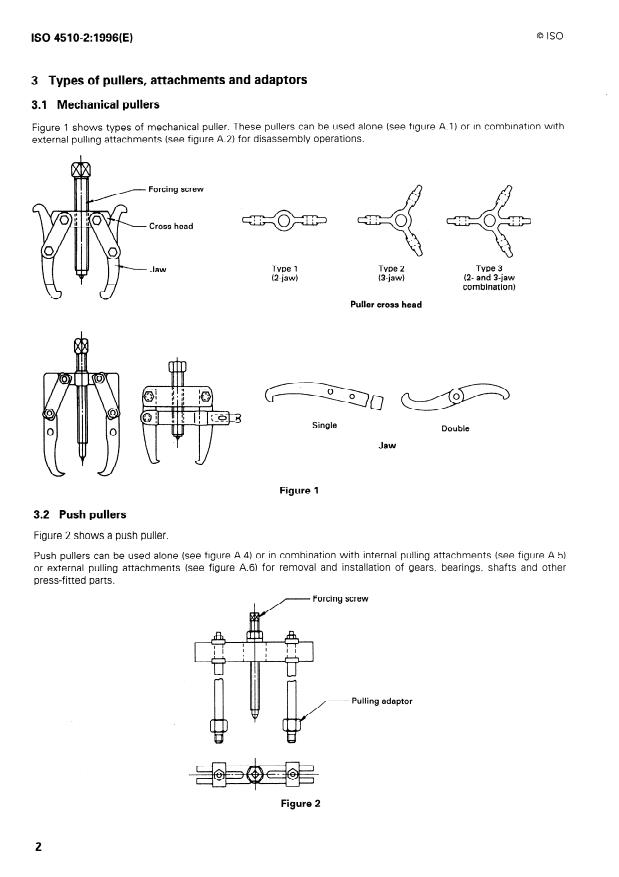
3.1 Mechanical pullers
Figure 1 shows types of mechanical puller. These pullers can be used alone (see figure A.l) or in combination with
external pulling attachments (see figure A.2) for disassembly operations.
Forcing screw
. .
. .
1 I
I 1 I I I I I I
=g$=::=, 0 0
Cross head
I
c
w
F
r
Jaw Type 3
TYPe 1 Type 2
(2-jaw) (3-jaw) (2- and 3-jaw
combination)
Puller cross head
Single
Double
Jaw
Figure 1
3.2 Push pullers
Figure 2 shows a push puller.
Push pullers can be used a’lone (see figure A.4) or in combination with internal pulling attachments (see figure A.5)
or external pulling attachments (see figure A.6) for removal and installation of gears, bearings, shafts and other
press-fitted parts.
, /- Forcing screw
Pulli
ng adaptor
Figure 2
@ IS0
IS0 4510-2:1996(E)
3.3 Pulling attachments
Internal pulling attachments [see figure 3a)I can be used alone (see figure A.3) or in combination with push pullers
(see figure A.5) for removal of bearing cups, oil seals, bushes and other parts from blind holes without damage.
External pulling attachments [see figure 3b)l are used in combination with pullers (see figure A.2) or push pullers
(see figure A.6) to remove the bearing outer race and other parts where space does not permit the jaws to fit di-
rectly behind the parts to be removed.
Knife-edge
Jaw
a) Internal
b) External
Figure 3
3.4 Pulling adaptor, male and female thread
Pulling adaptors (see figure 4 and figure 2) are used at the ends of the legs of push pullers.
Female thread
/-
1 - I\
\
I
I I/
-- -
Male thread
Figure 4
3.5 Step plate adaptor
Step plate adaptors (see figure 5) are used to protect shaft centres from distortion when extreme pressure is ap-
plied through the puller screw. These adaptors are also used between the end of the puller screw and the hollow
shaft (see figures A.2, A.4 and A.6).
--
‘0 t -
\o
/- -
>
Figure 5
@ IS0
IS0 4510-2:1996(E)
4 General requirements
4.1 Pullers and attachments shall be designed to allow free movement and minimum clearance between the
parts.
4.2 The head of the forcing screw and/or its nuts, which are tightened during repair work
...
ISO
NORME
4510-2
INTERNATIONALE
Deuxième édition
1996-11-15
Engins de terrassement -
Outils d’entretien et de dépannage -
Partie 2:
Extracteurs mécaniques par traction et par
pression
Earth-movng machinery - Service tools -
Part 2: Mechanical pullers and pushers
Numéro de référence
KO 4510-2:1996(F)
ISO 4510=2:1996(F)
Avant-propos
L’ISO (Organisation internationale de normalisation) est une fédération
mondiale d’organismes nationaux de normalisation (comités membres de
I’ISO). L’élaboration des Normes internationales est en général confiée aux
comites techniques de I’ISO. Chaque comite membre intéressé par une
étude a le droit de faire partie du comité technique créé à cet effet. Les
organisations internationales, gouvernementales et non gouvernemen-
tales, en liaison avec I’ISO participent également aux travaux. L’ISO colla-
bore étroitement avec la Commission électrotechnique internationale (CEI)
en ce qui concerne la normalisation électrotechnique.
Les projets de Normes internationales adoptés par les comités techniques
sont soumis aux comités membres pour vote. Leur publication comme
Normes internationales requiert l’approbation de 75 % au moins des co-
mités membres votants.
La Norme internationale ISO 4510-2 a été élaborée par le comité technique
ISO/TC 127, Engins de terrassement, sous-comité SC 3, Emploi et
entre tien.
Cette deuxième édition annule et remplace la première édition
(ISO 451 O-2:1 986), dont elle constitue une révision technique.
L’ISO 4510 comprend les parties suivantes, présentées sous le titre
général Engins de terrassement - Outils d’entretien et de dépannage:
- Partie 1: Outils courants pour l’entretien et les réglages
- Partie 2: Extracteurs mécaniques par traction et par pression
L’annexe A de la présente partie de I’ISO 4510 est donnée uniquement à
titre d’information.
0 ISO 1996
Droits de reproduction réservés. Sauf prescription différente, aucune partie de cette publi-
cation ne peut être reproduite ni utilisée sous quelque forme que ce soit et par aucun pro-
cédé, électronique ou mécanique, y compris la photocopie et les microfilms, sans l’accord
écrit de l’éditeur.
Organisation internationale de normalisation
Case postale 56 l CH-l 211 Genève 20 l Suisse
Imprimé en Suisse
NORME INTERNATIONALE @ ISO ISO 4510=2:1996(F)
Engins de terrassement - Outils d’entretien et de dépannage -
Partie 2:
Extracteurs mécaniques par traction et par pression
1 Domaine d’application
La présente partie de I’ISO 4510 fixe, sous forme de directives générales, les types, les exigences et les dimensions
principales des extracteurs mécaniques utilisés pour les travaux de réparation, ainsi que de leurs accessoires et
adaptateurs.
La présente partie de I’ISO 4510 traite des extracteurs mécaniques agissant par traction ou par pression, des
accessoires d’extraction et des adaptateurs communément employés pour le démontage des pignons dentés et
des roulements montés sur les types d’engins de terrassement définis dans I’ISO 6165.
Lors de la conception des engins, il convient que les constructeurs
- tiennent compte de l’utilisation des extracteurs par traction ou par pression pour les travaux de réparation (par
exemple, voir les notes des figures A.1, A.4 et A.5);
- choisissent des dimensions compatibles dans les tableaux 1 à 4; et
- spécifient dans les manuels appropriés décrits dans I’ISO 6750, le type d’outils à employer pour les travaux de
réparation.
2 Références normatives
Les normes suivantes contiennent des dispositions qui, par suite de la référence qui en est faite, constituent des
dispositions valables pour la présente partie de I’ISO 4510. Au moment de la publication, les éditions indiquées
étaient en vigueur. Toute norme est sujette à révision et les parties prenantes des accords fondés sur la présente
partie de I’ISO 4510 sont invitées à rechercher la possibilité d’appliquer les éditions les plus récentes des normes
indiquées ci-après. Les membres de la CEI et de I’ISO possèdent le registre des Normes internationales en vigueur
à un moment donné.
ISO 451 O-l : 1987, Engins de terrassement - Outils d’entretien et de dépannage - Partie 1: Outils courants pour
l’entre tien et les réglages.
ISO 6165:- 1), Engins de terrassement - Principaux types - Vocabulaire.
ISO 6750: 1984, Engins de terrassement - Emploi et entretien
- Présentation et contenu des manuels
techniques.
1) À publier. (Révision de I’ISO 6165:1987)
@ ISO
ISO 4510=2:1996(F)
3 Types d’extracteurs, d’accessoires et d’adaptateurs
Extracteurs mécaniques par traction
3.1
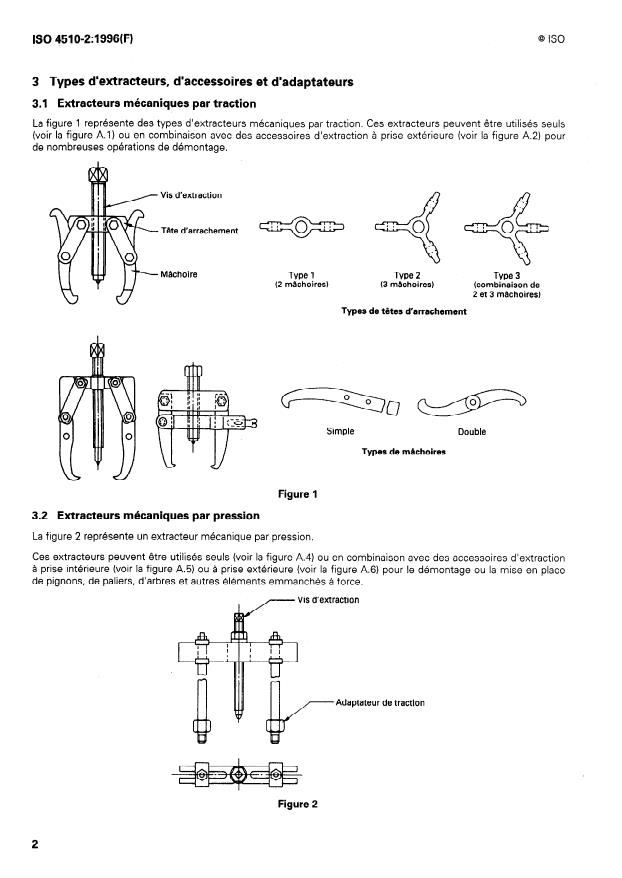
La figure 1 représente des types d’extracteurs mécaniques par traction. Ces extracteurs peuvent être utilisés seuls
(voir la figure A.1) ou en combinaison avec des accessoires d’extraction à prise extérieure (voir la figure A.2) pour
de nombreuses opérations de démontage.
Vis d’extraction
T&e d’arrachement
Machoire
Type 1 Type 2 Type 3
(3 machoires) (combinaison de
(2 mâchoires)
2 et 3 mâchoires)
Types de têtes d’arrachement
Simple
Double
Types de mkhoires
Figure 1
3.2 Extracteurs mécaniques par pression
La figure 2 représente un extracteur mécanique par pression.
Ces extracteurs peuvent être utilisés seuls (voir la figure A.4) ou en combinaison avec des accessoires d’extraction
à prise intérieure (voir la figure A.51 ou à prise extérieure (voir la figure A.6) pour le démontage ou la mise en place
de pignons, de paliers, d’arbres et autres éléments emmanchés à force.
/- Vis d’extraction
I
Adaptateur de traction
Figure 2
ISO 4510=2:1996(F)
@ ISO
3.3 Accessoires d’extraction
Les accessoires d’extraction à prise intérieure [voir la figure 3a)I peuvent être utilisés seuls (voir la figure A.31 ou en
combinaison avec des extracteurs par pression (voir la figure A.51 pour le démontage sans dommage des arbres de
godets, des joints d’étanchéité à I’huile, des bagues et autres éléments situés dans des trous borgnes.
Les accessoires de traction à prise extérieure [voir la figure 3b)] sont utilisés en combinaison avec des extracteurs
par traction (voir la figure A.2) ou des extracteurs par pression (voir la figure A.6) pour démonter la bague extérieure
de roulements et les éléments pour lesquels l’espace ne permet pas aux mâchoires de l’extracteur par traction de
s’adapter directement derrière les éléments à démonter.
Couteau
Mâchoire
a) Prise intérieure b) Prise extdrieure
Figure 3
3.4 Adaptateurs de traction, à filetage mâle et femelle
Les adaptateurs de traction (voir la figure 4 et la figure 2) sont utilisés comme embouts de pied des extracteurs par
pression.
/- Taraudage
-p\ _
I
-- -
/
L Filetage
Figure 4
3.5 Disque à gradin
Les disques à gradin (voir la figure 5) sont utilisés pour protéger le centre des arbres des déformations provoquées
par une pression extrême appliquée par l’intermédiaire de la vis. Ces adaptateurs sont également utilisés entre
l’extrémité de la vis d’extraction et un arbre creux (voir les figures A.2, A.4 et A.6).
--
‘0 7 -
a
/- -
L
Figure 5
Q ISO
ISO 4510=2:1996(F)
4 Exigences générales
4.1 Les extracteurs et l
...