

ISO/IEC 9995-9:2016/Amd 1:2019
(Amendment)Information technology — Keyboard layouts for text and office systems — Part 9: Multi-lingual, multiscript keyboard layouts — Amendment 1
General Information
- Abstract
- Status
- Withdrawn
- Publication Date
- 23-Sep-2019
- Technical Committee
- ISO/IEC JTC 1/SC 35 - User interfaces
- Current Stage
- 9599 - Withdrawal of International Standard
- Start Date
- 23-Jan-2026
- Completion Date
- 29-Aug-2026
Buy Documents




ISO/IEC 9995-9:2016/Amd 1:2019 - Information technology — Keyboard layouts for text and office systems — Part 9: Multi-lingual, multiscript keyboard layouts — Amendment 1/5/2021
Overview
ISO/IEC 9995-9:2016/Amd 1:2019 is an important international standard published by ISO and IEC that pertains to keyboard layouts for text and office systems, specifically focusing on multi-lingual, multiscript keyboard layouts. This amendment updates and refines the 2016 first edition of Part 9 in the ISO/IEC 9995 series, which provides guidelines and specifications for designing keyboard layouts that support multiple languages and scripts on a single system.
The standard is maintained by the Joint Technical Committee ISO/IEC JTC 1, Subcommittee SC 35, which specializes in user interfaces. Amendment 1 includes corrections and enhancements to Unicode character mappings and references to the updated Unicode standard ISO/IEC 10646:2017, ensuring that keyboard layouts remain compatible with the latest international text encoding practices.
Key Topics
- Multi-lingual Keyboard Layouts: Guidance on integrating multiple language character sets and scripts into a unified keyboard layout to support diverse language input needs.
- Multiscript Support: Specifications for supporting different writing systems and scripts (e.g., Latin, Cyrillic, Georgian) on a single keyboard to enable seamless multilingual typing.
- Unicode Compliance: Updates aligning the standard with the Unicode character set as defined in ISO/IEC 10646:2017, facilitating international interoperability and consistent character representation.
- Character Mapping Corrections: Specific amendments to Unicode code points in Annexes B and C to enhance accuracy in key assignments, such as updates to currency symbols and historic signs.
- Technical Consistency: Inclusion of corrections for previously published tables and clarifications to improve the precision of multi-lingual keyboard configurations.
Applications
- Global Software Development: Developers of word processing, office suites, and operating systems incorporate this standard to implement keyboard layouts that enable users to input multiple languages effectively on a single device.
- Hardware Keyboard Design: Keyboard manufacturers use these guidelines to design physical and virtual keyboards compatible with multiple languages and scripts, optimizing for international markets.
- Localization and Internationalization: Organizations responsible for creating software and documentation in multiple languages rely on ISO/IEC 9995-9 to ensure consistent, user-friendly multilingual input.
- Accessibility Solutions: The standard supports the creation of accessible keyboards for diverse language communities, enhancing digital inclusion.
- Standardized Multilingual Communication: Facilitates interoperability in multinational environments where multiple scripts must coexist, such as in governmental, educational, and corporate sectors.
Related Standards
- ISO/IEC 9995 Series: The broader series addresses various aspects of keyboard layout design including physical keyboard organization, symbolic assignments, and function key definitions.
- ISO/IEC 10646:2017: This Unicode standard defines the universal character set used for digital text encoding, which ISO/IEC 9995-9 references for consistent character representation.
- ISO/IEC 9995-1 to 8: Complementary parts cover fundamental keyboard concepts, alphanumeric and numeric key arrangements, and symbol positioning used in conjunction with multi-lingual layouts.
- ISO/IEC Directives, Part 1 and Part 2: Provide structural and editorial rules followed in drafting and maintaining the ISO/IEC 9995 series.
- Technical Barriers to Trade (TBT) guidelines by the World Trade Organization (WTO), which the standard aligns with to promote international trade harmonization through voluntary and consensus-based standardization.
Keywords: multi-lingual keyboard layouts, multiscript keyboards, ISO/IEC 9995-9 amendment, Unicode keyboard standard, international keyboard layouts, multilingual text input, keyboard design standards, ISO/IEC 10646 compliance, multilingual user interface, global software localization.
Relations
- Effective Date
- 26-Nov-2021
- Effective Date
- 03-Feb-2024
Buy Documents
ISO/IEC 9995-9:2016/Amd 1:2019 - Information technology — Keyboard layouts for text and office systems — Part 9: Multi-lingual, multiscript keyboard layouts — Amendment 1/5/2021
Get Certified
Connect with accredited certification bodies for this standard

BSI Group
BSI (British Standards Institution) is the business standards company that helps organizations make excellence a habit.

NYCE
Mexican standards and certification body.
Sponsored listings
Frequently Asked Questions
ISO/IEC 9995-9:2016/Amd 1:2019 is a standard published by the International Organization for Standardization (ISO). Its full title is "Information technology — Keyboard layouts for text and office systems — Part 9: Multi-lingual, multiscript keyboard layouts — Amendment 1". This standard covers: Information technology — Keyboard layouts for text and office systems — Part 9: Multi-lingual, multiscript keyboard layouts — Amendment 1
Information technology — Keyboard layouts for text and office systems — Part 9: Multi-lingual, multiscript keyboard layouts — Amendment 1
ISO/IEC 9995-9:2016/Amd 1:2019 is classified under the following ICS (International Classification for Standards) categories: 35.180 - IT Terminal and other peripheral equipment. The ICS classification helps identify the subject area and facilitates finding related standards.
ISO/IEC 9995-9:2016/Amd 1:2019 has the following relationships with other standards: It is inter standard links to ISO/IEC 9995-9:2016, ISO/IEC 9995-9:2026. Understanding these relationships helps ensure you are using the most current and applicable version of the standard.
ISO/IEC 9995-9:2016/Amd 1:2019 is available in PDF format for immediate download after purchase. The document can be added to your cart and obtained through the secure checkout process. Digital delivery ensures instant access to the complete standard document.
Standards Content (Sample)
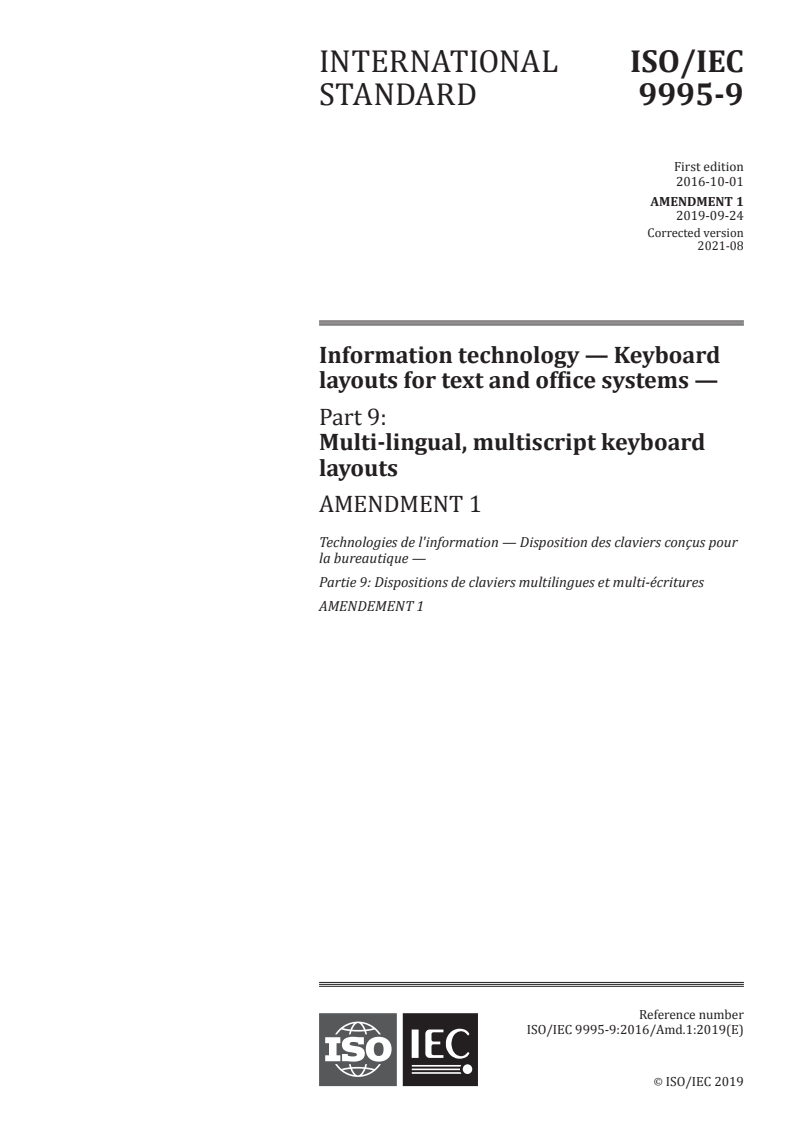
INTERNATIONAL ISO/IEC
STANDARD 9995-9
First edition
2016-10-01
AMENDMENT 1
2019-09-24
Corrected version
2021-08
Information technology — Keyboard
layouts for text and office systems —
Part 9:
Multi-lingual, multiscript keyboard
layouts
AMENDMENT 1
Technologies de l'information — Disposition des claviers conçus pour
la bureautique —
Partie 9: Dispositions de claviers multilingues et multi-écritures
AMENDEMENT 1
Reference number
ISO/IEC 9995-9:2016/Amd.1:2019(E)
©
ISO/IEC 2019
ISO/IEC 9995-9:2016/Amd.1:2019(E)
© ISO/IEC 2019
All rights reserved. Unless otherwise specified, or required in the context of its implementation, no part of this publication may
be reproduced or utilized otherwise in any form or by any means, electronic or mechanical, including photocopying, or posting
on the internet or an intranet, without prior written permission. Permission can be requested from either ISO at the address
below or ISO’s member body in the country of the requester.
ISO copyright office
CP 401 • Ch. de Blandonnet 8
CH-1214 Vernier, Geneva
Phone: +41 22 749 01 11
Email: copyright@iso.org
Website: www.iso.org
Published in Switzerland
ii © ISO/IEC 2019 – All rights reserved
ISO/IEC 9995-9:2016/Amd.1:2019(E)
Foreword
ISO (the International Organization for Standardization) and IEC (the International Electrotechnical
Commission) form the specialized system for worldwide standardization. National bodies that are
members of ISO or IEC participate in the development of International Standards through technical
committees established by the respective organization to deal with particular fields of technical
activity. ISO and IEC technical committees collaborate in fields of mutual interest. Other international
organizations, governmental and non-governmental, in liaison with ISO and IEC, also take part in the
work.
The procedures used to develop this document and those intended for its further maintenance are
described in the ISO/IEC Directives, Part 1. In particular, the different approval criteria needed for
the different types of document should be noted. This document was drafted in accordance with the
editorial rules of the ISO/IEC Directives, Part 2 (see www .iso .org/ directives).
Attention is drawn to the possibility that some of the elements of this document may be the subject
of patent rights. ISO and IEC shall not be held responsible for identifying any or all such patent
rights. Details of any patent rights identified during the development of the document will be in the
Introduction and/or on the ISO list of patent declarations received (see www .iso .org/ patents) or the IEC
list of patent declarations received (see http:// patents .iec .ch).
Any trade name used in this document is information given for the convenience of users and does not
constitute an endorsem
...
INTERNATIONAL ISO/IEC
STANDARD 9995-9
First edition
2016-10-01
AMENDMENT 1
2019-09-24
Corrected version
2021-08
Information technology — Keyboard
layouts for text and office systems —
Part 9:
Multi-lingual, multiscript keyboard
layouts
AMENDMENT 1
Technologies de l'information — Disposition des claviers conçus pour
la bureautique —
Partie 9: Dispositions de claviers multilingues et multi-écritures
AMENDEMENT 1
Reference number
ISO/IEC 9995-9:2016/Amd.1:2019(E)
©
ISO/IEC 2019
ISO/IEC 9995-9:2016/Amd.1:2019(E)
© ISO/IEC 2019
All rights reserved. Unless otherwise specified, or required in the context of its implementation, no part of this publication may
be reproduced or utilized otherwise in any form or by any means, electronic or mechanical, including photocopying, or posting
on the internet or an intranet, without prior written permission. Permission can be requested from either ISO at the address
below or ISO’s member body in the country of the requester.
ISO copyright office
CP 401 • Ch. de Blandonnet 8
CH-1214 Vernier, Geneva
Phone: +41 22 749 01 11
Email: copyright@iso.org
Website: www.iso.org
Published in Switzerland
ii © ISO/IEC 2019 – All rights reserved
ISO/IEC 9995-9:2016/Amd.1:2019(E)
Foreword
ISO (the International Organization for Standardization) and IEC (the International Electrotechnical
Commission) form the specialized system for worldwide standardization. National bodies that are
members of ISO or IEC participate in the development of International Standards through technical
committees established by the respective organization to deal with particular fields of technical
activity. ISO and IEC technical committees collaborate in fields of mutual interest. Other international
organizations, governmental and non-governmental, in liaison with ISO and IEC, also take part in the
work.
The procedures used to develop this document and those intended for its further maintenance are
described in the ISO/IEC Directives, Part 1. In particular, the different approval criteria needed for
the different types of document should be noted. This document was drafted in accordance with the
editorial rules of the ISO/IEC Directives, Part 2 (see www .iso .org/ directives).
Attention is drawn to the possibility that some of the elements of this document may be the subject
of patent rights. ISO and IEC shall not be held responsible for identifying any or all such patent
rights. Details of any patent rights identified during the development of the document will be in the
Introduction and/or on the ISO list of patent declarations received (see www .iso .org/ patents) or the IEC
list of patent declarations received (see http:// patents .iec .ch).
Any trade name used in this document is information given for the convenience of users and does not
constitute an endorsem
...