

ISO 9454-1:2016
(Main)Soft soldering fluxes — Classification and requirements — Part 1: Classification, labelling and packaging
General Information
- Abstract
ISO 9454-1:2016 specifies a coding system for the classification of fluxes intended for use with soft solders, according to their active fluxing ingredients, together with requirements for labelling and packaging.
- Status
- Published
- Publication Date
- 01-Feb-2016
- Technical Committee
- ISO/TC 44/SC 12 - Soldering materials
- Drafting Committee
- ISO/TC 44/SC 12 - Soldering materials
- Current Stage
- 9093 - International Standard confirmed
- Start Date
- 07-Sep-2026
- Completion Date
- 12-Sep-2026
Buy Documents
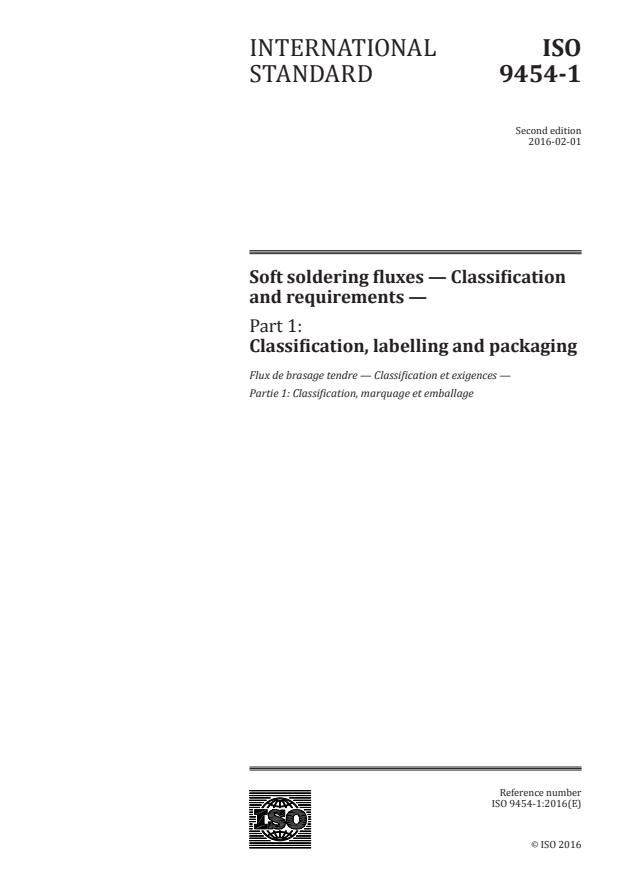
ISO 9454-1:2016 - Soft soldering fluxes — Classification and requirements — Part 1: Classification, labelling and packaging Released:2/2/2016
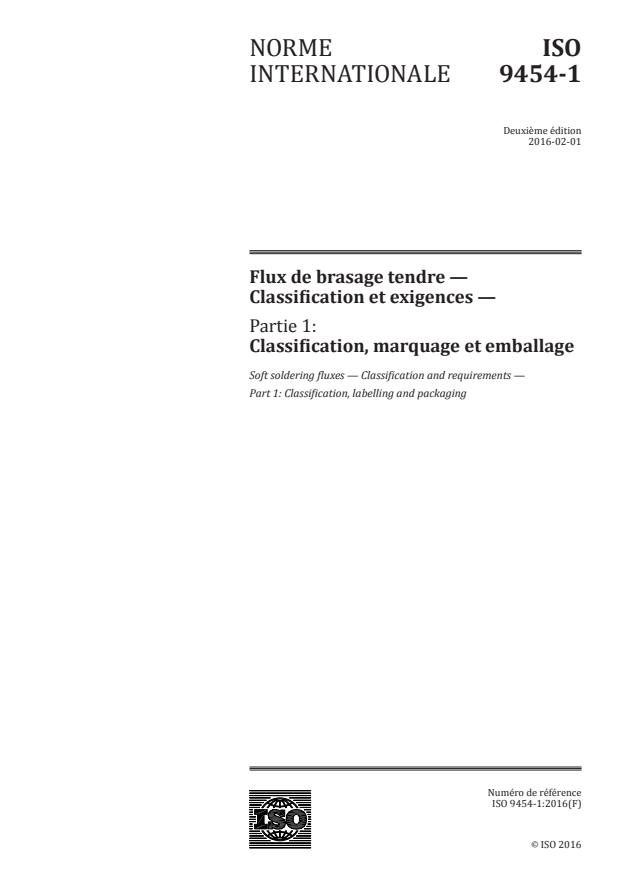
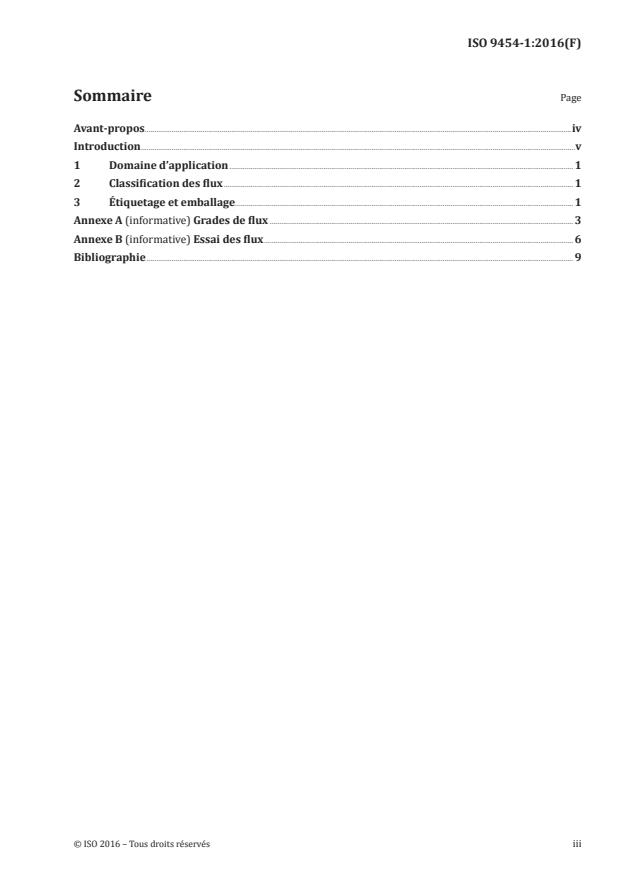
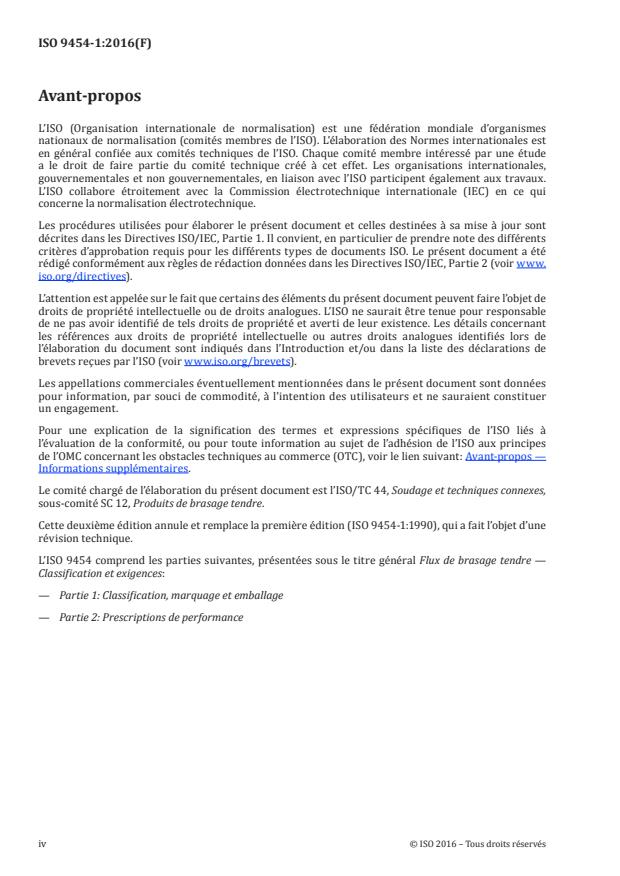
ISO 9454-1:2016 - Flux de brasage tendre — Classification et exigences — Partie 1: Classification, marquage et emballage Released:2/2/2016
Overview
ISO 9454-1:2016 defines a standardized coding system and basic requirements for soft soldering fluxes, focusing on classification, labelling and packaging. It applies to fluxes used with soft solders and provides a uniform way to identify fluxes by their main active ingredients and halide content. The standard also sets minimum labelling and packaging information to support traceability, safety and regulatory compliance.
Key Topics and Requirements
- Flux classification (coding system): Fluxes are encoded according to their main ingredients (e.g., rosin, modified resins, organic, inorganic, amines, metal-chloride based). The code incorporates activation chemistry and halide level. Example codes given in the standard:
- 3311 - phosphoric‑acid‑activated inorganic flux with halide < 0.01% (by mass)
- 1131 - non‑halide activated rosin (colophony) flux
- Halide content categories: Guidance and grades use halide thresholds (examples in Annex A): <0.01%, <0.15%, 0.15–2.0%, >2.0%. These influence suitability for electronics, precision soldering, metal goods, etc.
- Labelling requirements: Flux containers must carry:
- Supplier name and address
- Product name
- Reference to ISO 9454-1 and the flux classification code
- Batch number and date of manufacture
- Any legal safety information applicable Labels and materials must be resistant to the flux.
- Packaging requirements: Containers must be chemically compatible and resistant to the flux they contain.
- Hazard & selection considerations: The Introduction and warnings emphasize health, corrosiveness, residue removal and service-life impact when selecting fluxes.
- Testing guidance: Annex B maps flux classifications to relevant test methods from the ISO 9455 series (flux test methods) - e.g., halide determination, copper mirror, acidity, non‑volatile matter, wetting and flux efficacy tests.
Applications - Who Uses ISO 9454-1:2016
- Flux manufacturers - to classify products, label correctly and meet purchaser requirements.
- Electronics and PCB assemblers - to select low‑halide or rosin fluxes suitable for electronic assemblies.
- Soldering process engineers & quality teams - for specification, procurement and QA of flux materials.
- Plumbing, HVAC and metalwork - to choose appropriate inorganic or chloride‑based fluxes for pipe and fittings.
- Test laboratories & compliance officers - to relate test methods (ISO 9455 series) to flux classes and verify labelling/packaging.
- Purchasers and specifiers - to ensure correct flux grade for performance and safety needs.
Related Standards
- ISO 9454-2 - Soft soldering fluxes - Performance requirements (companion document)
- ISO 9455 series - Test methods for soft soldering fluxes (Parts 1,2,3,5,6,8,9,10,11,13,14,16 referenced)
ISO 9454-1:2016 helps ensure consistent flux classification, safe labelling and appropriate packaging, promoting interoperability, reliable procurement and safer soldering operations across electronics and metal-joining industries.
Relations
- Effective Date
- 09-Feb-2026
- Effective Date
- 09-Feb-2026
- Effective Date
- 09-Feb-2026
- Effective Date
- 09-Feb-2026
- Effective Date
- 09-Feb-2026
- Effective Date
- 12-Feb-2026
- Consolidates
ISO 22314:2006 - Plastics — Glass-fibre-reinforced products — Determination of fibre length - Effective Date
- 06-Jun-2022
- Effective Date
- 04-Dec-2010
Buy Documents
ISO 9454-1:2016 - Soft soldering fluxes — Classification and requirements — Part 1: Classification, labelling and packaging Released:2/2/2016
ISO 9454-1:2016 - Flux de brasage tendre — Classification et exigences — Partie 1: Classification, marquage et emballage Released:2/2/2016
Get Certified
Connect with accredited certification bodies for this standard

DVS-ZERT GmbH
German welding certification society.
CARES (UK Certification Authority for Reinforcing Steels)
UK certification for reinforcing steels and construction.
EWF/IIW (European/International Welding Federation)
International welding personnel certification.
Sponsored listings
Frequently Asked Questions
ISO 9454-1:2016 is a standard published by the International Organization for Standardization (ISO). Its full title is "Soft soldering fluxes — Classification and requirements — Part 1: Classification, labelling and packaging". This standard covers: ISO 9454-1:2016 specifies a coding system for the classification of fluxes intended for use with soft solders, according to their active fluxing ingredients, together with requirements for labelling and packaging.
ISO 9454-1:2016 specifies a coding system for the classification of fluxes intended for use with soft solders, according to their active fluxing ingredients, together with requirements for labelling and packaging.
ISO 9454-1:2016 is classified under the following ICS (International Classification for Standards) categories: 25.160.50 - Brazing and soldering. The ICS classification helps identify the subject area and facilitates finding related standards.
ISO 9454-1:2016 has the following relationships with other standards: It is inter standard links to EN ISO 12224-1:2024, EN ISO 9455-13:2017, EN ISO 9455-16:2019, EN ISO 9455-17:2024, EN ISO 9455-11:2017, EN ISO 9454-1:2016, ISO 22314:2006, ISO 9454-1:1990. Understanding these relationships helps ensure you are using the most current and applicable version of the standard.
ISO 9454-1:2016 is available in PDF format for immediate download after purchase. The document can be added to your cart and obtained through the secure checkout process. Digital delivery ensures instant access to the complete standard document.
Standards Content (Sample)
INTERNATIONAL ISO
STANDARD 9454-1
Second edition
2016-02-01
Soft soldering fluxes — Classification
and requirements —
Part 1:
Classification, labelling and packaging
Flux de brasage tendre — Classification et exigences —
Partie 1: Classification, marquage et emballage
Reference number
©
ISO 2016
© ISO 2016, Published in Switzerland
All rights reserved. Unless otherwise specified, no part of this publication may be reproduced or utilized otherwise in any form
or by any means, electronic or mechanical, including photocopying, or posting on the internet or an intranet, without prior
written permission. Permission can be requested from either ISO at the address below or ISO’s member body in the country of
the requester.
ISO copyright office
Ch. de Blandonnet 8 • CP 401
CH-1214 Vernier, Geneva, Switzerland
Tel. +41 22 749 01 11
Fax +41 22 749 09 47
copyright@iso.org
www.iso.org
ii © ISO 2016 – All rights reserved
Contents Page
Foreword .iv
Introduction .v
1 Scope . 1
2 Classification of fluxes . 1
3 Labelling and packaging . 1
Annex A (informative) Grades of fluxes . 3
Annex B (informative) Testing of fluxes . 6
Bibliography . 9
Foreword
ISO (the International Organization for Standardization) is a worldwide federation of national standards
bodies (ISO member bodies). The work of preparing International Standards is normally carried out
through ISO technical committees. Each member body interested in a subject for which a technical
committee has been established has the right to be represented on that committee. International
organizations, governmental and non-governmental, in liaison with ISO, also take part in the work.
ISO collaborates closely with the International Electrotechnical Commission (IEC) on all matters of
electrotechnical standardization.
The procedures used to develop this document and those intended for its further maintenance are
described in the ISO/IEC Directives, Part 1. In particular the different approval criteria needed for the
different types of ISO documents should be noted. This document was drafted in accordance with the
editorial rules of the ISO/IEC Directives, Part 2 (see www.iso.org/directives).
Attention is drawn to the possibility that some of the elements of this document may be the subject of
patent rights. ISO shall not be held responsible for identifying any or all such patent rights. Details of
any patent rights identified during the development of the document will be in the Introduction and/or
on the ISO list of patent declarations received (see www.iso.org/patents).
Any trade name used in this document is information given for the convenience of users and does not
constitute an endorsement.
For an explanation on the meaning of ISO specific terms and expressions related to conformity
assessment, as well as information about ISO’s adherence to the WTO principles in the Technical
Barriers to Trade (TBT) see the following URL: Foreword - Supplementary information.
The committee responsible for this document is ISO/TC 44, Welding and allied processes, Subcommittee
SC 12, Soldering materials.
This second edition cancels and replaces the first edition (ISO 9454-1:1990), which has been
technically revised.
ISO 9454 consists of the following parts, under the general title Soft soldering fluxes — Classification and
requirements:
— Part 1: Classification, labelling and packaging
— Part 2: Performance requirements
iv © ISO 2016 – All rights reserved
Introduction
Fluxes assist molten solder to wet metal surfaces to be joined by removing oxides and related
contaminations from the solder and surfaces of the parts during soldering. Fluxes also protect surfaces
from oxidation an assist wetting of the basis metals by molten solder.
Care is necessary when selecting a flux for a particular application, in order to ensure an adequate
service life of the assembly Factors such as the ease of residue removal, corrosiveness, possible health
and safety hazards and the efficacy of the flux should all be considered.
INTERNATIONAL STANDARD ISO 9454-1:2016(E)
Soft soldering fluxes — Classification and requirements —
Part 1:
Classification, labelling and packaging
WARNING — This part of ISO 9454‑1 deals with products which might be hazardous to health,
or which might cause other hazards such as corrosion, fire, etc., if adequate precautions are not
taken. It refers only to the technical suitability of substances and in no way absolves the testing
laboratory, the supplier, or the user from legal obligations relating to health and safety at any
stage of flux manufacture or use.
1 Scope
This part of ISO 9454-1 specifies a coding system for the classification of fluxes intended for use with
soft solders, according to their active fluxing ingredients, together with requirements for labelling
and packaging.
2 Classification of fluxes
Fluxes specified in this part ISO 9454-1 have been classified in terms of their main ingredients and
shall be encoded in accordance with Table 1.
For example, a phosphoric acid activated inorganic, flux with a halide content <0,01 % by mass, shall be
encoded 3311, a non-halide activated rosin flux shall be encoded 1131.
3 Labelling and packaging
Fluxes supplied according to this part of ISO 9454-1 shall be packed in suitable containers, resistant to
the flux they contain, and shall carry a label bearing the following information:
a) supplier’s name and address;
b) name of the product;
c) reference to this part of ISO 9454, i.e. ISO 9454-1, and the flux classification code according to Table 1;
d) batch number;
e) date of manufacture;
f) details of any legal requirements concerning aspects of safety.
Labels shall be made of material resistant to the flux in the container.
Additional labelling requirements may be agreed upon between the supplier and the purchaser in
accordance with the rules and regulations of the country or countries in question.
Table 1 — Classification of soft soldering fluxes according to their main ingredients
Flux type Flux basis Flux activation Halide content
% (by mass)
1 1 rosin (non-modified
colophony)
resin
1 no activator added
resin (modified colophony or
synthetic)
2 halide activated
3 non-halide activated
1 water-soluble
1 <0,01
organic (low or
2 non-water-soluble
2 <0,15
non-resin flux)
3 0,15 to 2,0
3 1 salts in aqueous solution 1 with ammonium chloride
4 >2,0
inorganic 2 salts in organic formulation 2 without ammonium chloride
1 with phosphoric acid
3 acids
2 without phosphoric acid
amines and/or ammonium
4 alkalis 1
carbonates
2 © ISO 2016 – All rights reserved
Annex A
(informative)
Grades of fluxes
Table A.1 indicates, for guidance, the various grades of fluxes and only refers to halide content. Flux
selection can also be done from different points of view.
...
NORME ISO
INTERNATIONALE 9454-1
Deuxième édition
2016-02-01
Flux de brasage tendre —
Classification et exigences —
Partie 1:
Classification, marquage et emballage
Soft soldering fluxes — Classification and requirements —
Part 1: Classification, labelling and packaging
Numéro de référence
©
ISO 2016
DOCUMENT PROTÉGÉ PAR COPYRIGHT
© ISO 2016, Publié en Suisse
Droits de reproduction réservés. Sauf indication contraire, aucune partie de cette publication ne peut être reproduite ni utilisée
sous quelque forme que ce soit et par aucun procédé, électronique ou mécanique, y compris la photocopie, l’affichage sur
l’internet ou sur un Intranet, sans autorisation écrite préalable. Les demandes d’autorisation peuvent être adressées à l’ISO à
l’adresse ci-après ou au comité membre de l’ISO dans le pays du demandeur.
ISO copyright office
Ch. de Blandonnet 8 • CP 401
CH-1214 Vernier, Geneva, Switzerland
Tel. +41 22 749 01 11
Fax +41 22 749 09 47
copyright@iso.org
www.iso.org
ii © ISO 2016 – Tous droits réservés
Sommaire Page
Avant-propos .iv
Introduction .v
1 Domaine d’application . 1
2 Classification des flux . 1
3 Étiquetage et emballage. 1
Annexe A (informative) Grades de flux . 3
Annexe B (informative) Essai des flux . 6
Bibliographie . 9
Avant-propos
L’ISO (Organisation internationale de normalisation) est une fédération mondiale d’organismes
nationaux de normalisation (comités membres de l’ISO). L’élaboration des Normes internationales est
en général confiée aux comités techniques de l’ISO. Chaque comité membre intéressé par une étude
a le droit de faire partie du comité technique créé à cet effet. Les organisations internationales,
gouvernementales et non gouvernementales, en liaison avec l’ISO participent également aux travaux.
L’ISO collabore étroitement avec la Commission électrotechnique internationale (IEC) en ce qui
concerne la normalisation électrotechnique.
Les procédures utilisées pour élaborer le présent document et celles destinées à sa mise à jour sont
décrites dans les Directives ISO/IEC, Partie 1. Il convient, en particulier de prendre note des différents
critères d’approbation requis pour les différents types de documents ISO. Le présent document a été
rédigé conformément aux règles de rédaction données dans les Directives ISO/IEC, Partie 2 (voir www.
iso.org/directives).
L’attention est appelée sur le fait que certains des éléments du présent document peuvent faire l’objet de
droits de propriété intellectuelle ou de droits analogues. L’ISO ne saurait être tenue pour responsable
de ne pas avoir identifié de tels droits de propriété et averti de leur existence. Les détails concernant
les références aux droits de propriété intellectuelle ou autres droits analogues identifiés lors de
l’élaboration du document sont indiqués dans l’Introduction et/ou dans la liste des déclarations de
brevets reçues par l’ISO (voir www.iso.org/brevets).
Les appellations commerciales éventuellement mentionnées dans le présent document sont données
pour information, par souci de commodité, à l’intention des utilisateurs et ne sauraient constituer
un engagement.
Pour une explication de la signification des termes et expressions spécifiques de l’ISO liés à
l’évaluation de la conformité, ou pour toute information au sujet de l’adhésion de l’ISO aux principes
de l’OMC concernant les obstacles techniques au commerce (OTC), voir le lien suivant: Avant-propos —
Informations supplémentaires.
Le comité chargé de l’élaboration du présent document est l’ISO/TC 44, Soudage et techniques connexes,
sous-comité SC 12, Produits de brasage tendre.
Cette deuxième édition annule et remplace la première édition (ISO 9454-1:1990), qui a fait l’objet d’une
révision technique.
L’ISO 9454 comprend les parties suivantes, présentées sous le titre général Flux de brasage tendre —
Classification et exigences:
— Partie 1: Classification, marquage et emballage
— Partie 2: Prescriptions de performance
iv © ISO 2016 – Tous droits réservés
Introduction
Les flux favorisent le mouillage des surfaces métalliques à assembler en éliminant de la brasure et de
la surface des pièces les oxydes et autres polluants qui peuvent gêner le brasage. Les flux protègent
également les surfaces de l’oxydation et favorisent le mouillage du métal de base par la brasure en fusion.
Le choix du flux doit se faire avec soin, en fonction de l’application envisagée, de manière à garantir
une durée de vie suffisante de l’assemblage en service. Des facteurs tels que la facilité d’élimination
des résidus, le pouvoir corrosif, les risques éventuels encourus en matière d’hygiène et de sécurité et
l’efficacité du flux sont à prendre en compte.
NORME INTERNATIONALE ISO 9454-1:2016(F)
Flux de brasage tendre — Classification et exigences —
Partie 1:
Classification, marquage et emballage
AVERTISSEMENT — La présente partie de l’ISO 9454-1 traite de produits qui peuvent être
dangereux pour la santé ou peuvent engendrer des risques d’autres natures (corrosion, incendie,
etc.), si des précautions appropriées ne sont pas prises lors de leur utilisation. Elle ne prend en
considération que l’aptitude technique à l’emploi des substances et ne dispense en aucun cas le
laboratoire d’essai, le fournisseur ou l’utilisateur, des obligations que lui impose la loi en matière
d’hygiène et de sécurité à tous les stades de la fabrication ou de l’utilisation de ces flux.
1 Domaine d’application
La présente partie de l’ISO 9454 prescrit une classification codée des flux utilisables en brasage tendre,
en fonction des ingrédients actifs qu’ils contiennent, conjointement avec les caractéristiques pour
l’étiquetage et l’emballage.
2 Classification des flux
Les flux figurant dans la présente partie de l’ISO 9454 ont été classés en fonction de leurs ingrédients
principaux et doivent être codés comme indiqué au Tableau 1.
Par exemple, un flux pâteux inorganique activé à l’acide phosphorique doit être codé 3311, un flux
liquide activé non halogéné doit être codé 1131.
3 Étiquetage et emballage
Les flux livrés conformément à la présente partie de l’ISO 9454 doivent être emballés dans des
conteneurs appropriés, résistant au flux qu’ils contiennent, et doivent porter une étiquette sur laquelle
figurent les informations suivantes:
a) le nom et l’adresse du fournisseur;
b) le nom du produit;
c) le numéro de la présente partie de l’ISO 9454 (ISO 9454-1) et le code de classification du flux
conformément au Tableau 1;
d) le numéro de lot;
e) la date de fabrication;
f) le détail de la législation éventuelle en matière de sécurité.
Les étiquettes doivent être en un matériau résistant au flux du conteneur.
Des prescriptions d’étiquetage complémentaires peuvent être convenues entre le fournisseur et
l’acheteur conformément aux règles et réglementations du ou des pays en question.
Tableau 1 — Classification des flux de brasage tendre en fonction de leurs ingrédients principaux
Teneur en halogé-
Type de flux Base de flux Activation du flux nure
% (en masse)
1 1 résine (colophane)
Résineux 2 résine (modifiée ou syn-
1 Pas d’agent activant
thétique)
2 Agent activant halogéné
1 soluble dans l’eau
3 Agent activant non halogéné
Organique (faible
ou flux non-rési- 2 non soluble dans l’eau
1 < 0,01
neux)
2 < 0,15
3 1 sels
3 0,15 - 2,0
en solution aqueuse 1 Avec chlorure d’ammonium
Inorganique
4 > 2,0
2 sels 2 Sans chlorure d’ammonium
en formulation organique
1 Avec acide phosphorique
3 Acides
2 Sans acide phosphorique
1 Amines et/ou carbonates d’ammo-
4 Bases
nium
2 © ISO 2016 – Tous droits réservés
Annexe A
(informative)
Grades de flux
Le Tableau A.1 donne, à titre indicatif, les différents grades de flux et se réfère uniquement aux
halogénures. Le choix des flux peut également être réalisé à partir de différents points de vue.
Tableau A.1 — Guide d’ut
...