


ISO/IEC 23009-1:2019
(Main)Information technology — Dynamic adaptive streaming over HTTP (DASH) — Part 1: Media presentation description and segment formats
Information technology — Dynamic adaptive streaming over HTTP (DASH) — Part 1: Media presentation description and segment formats
This document primarily specifies formats for the Media Presentation Description and Segments for dynamic adaptive streaming delivery of MPEG media over HTTP. It is applicable to streaming services over the Internet.
Technologies de l'information — Diffusion en flux adaptatif dynamique sur HTTP (DASH) — Partie 1: Description de la présentation et formats de remise des médias
General Information
- Status
- Withdrawn
- Publication Date
- 10-Dec-2019
- Current Stage
- 9599 - Withdrawal of International Standard
- Start Date
- 02-Aug-2022
- Completion Date
- 12-Feb-2026
Relations
- Effective Date
- 06-Jun-2022
- Effective Date
- 23-Apr-2020

Get Certified
Connect with accredited certification bodies for this standard

BSI Group
BSI (British Standards Institution) is the business standards company that helps organizations make excellence a habit.

NYCE
Mexican standards and certification body.
Sponsored listings
Frequently Asked Questions
ISO/IEC 23009-1:2019 is a standard published by the International Organization for Standardization (ISO). Its full title is "Information technology — Dynamic adaptive streaming over HTTP (DASH) — Part 1: Media presentation description and segment formats". This standard covers: This document primarily specifies formats for the Media Presentation Description and Segments for dynamic adaptive streaming delivery of MPEG media over HTTP. It is applicable to streaming services over the Internet.
This document primarily specifies formats for the Media Presentation Description and Segments for dynamic adaptive streaming delivery of MPEG media over HTTP. It is applicable to streaming services over the Internet.
ISO/IEC 23009-1:2019 is classified under the following ICS (International Classification for Standards) categories: 35.040.40 - Coding of audio, video, multimedia and hypermedia information. The ICS classification helps identify the subject area and facilitates finding related standards.
ISO/IEC 23009-1:2019 has the following relationships with other standards: It is inter standard links to ISO/IEC 23009-1:2022, ISO/IEC 23009-1:2019. Understanding these relationships helps ensure you are using the most current and applicable version of the standard.
ISO/IEC 23009-1:2019 is available in PDF format for immediate download after purchase. The document can be added to your cart and obtained through the secure checkout process. Digital delivery ensures instant access to the complete standard document.
Standards Content (Sample)
INTERNATIONAL ISO/IEC
STANDARD 23009-1
Fourth edition
2019-12
Information technology — Dynamic
adaptive streaming over HTTP
(DASH) —
Part 1:
Media presentation description and
segment formats
Technologies de l'information — Diffusion en flux adaptatif
dynamique sur HTTP (DASH) —
Partie 1: Description de la présentation et formats de remise des médias
Reference number
©
ISO/IEC 2019
© ISO/IEC 2019
All rights reserved. Unless otherwise specified, or required in the context of its implementation, no part of this publication may
be reproduced or utilized otherwise in any form or by any means, electronic or mechanical, including photocopying, or posting
on the internet or an intranet, without prior written permission. Permission can be requested from either ISO at the address
below or ISO’s member body in the country of the requester.
ISO copyright office
CP 401 • Ch. de Blandonnet 8
CH-1214 Vernier, Geneva
Phone: +41 22 749 01 11
Fax: +41 22 749 09 47
Email: copyright@iso.org
Website: www.iso.org
Published in Switzerland
ii © ISO/IEC 2019 – All rights reserved
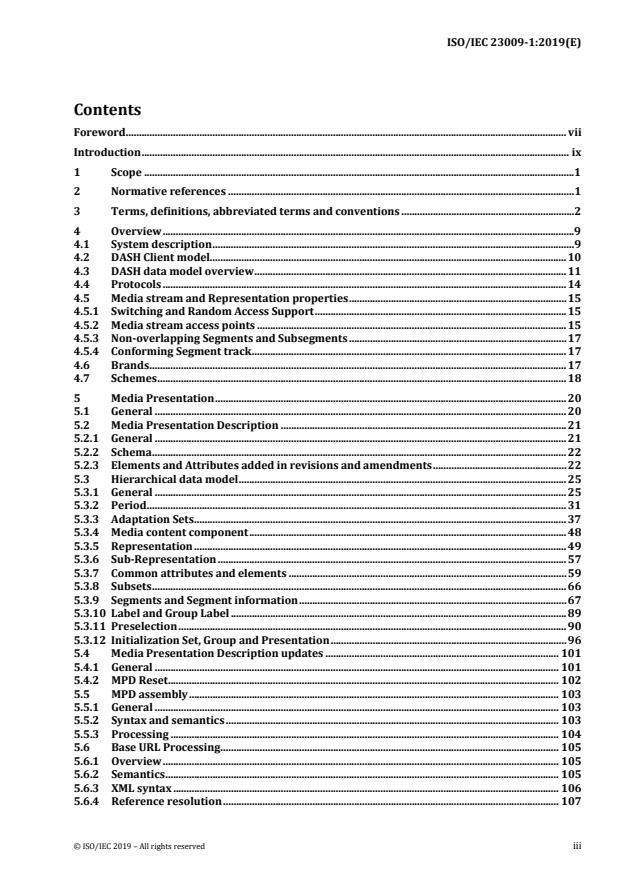
Contents
Foreword . vii
Introduction . ix
1 Scope .1
2 Normative references .1
3 Terms, definitions, abbreviated terms and conventions .2
4 Overview .9
4.1 System description .9
4.2 DASH Client model. 10
4.3 DASH data model overview . 11
4.4 Protocols . 14
4.5 Media stream and Representation properties . 15
4.5.1 Switching and Random Access Support . 15
4.5.2 Media stream access points . 15
4.5.3 Non-overlapping Segments and Subsegments . 17
4.5.4 Conforming Segment track . 17
4.6 Brands . 17
4.7 Schemes . 18
5 Media Presentation . 20
5.1 General . 20
5.2 Media Presentation Description . 21
5.2.1 General . 21
5.2.2 Schema . 22
5.2.3 Elements and Attributes added in revisions and amendments . 22
5.3 Hierarchical data model . 25
5.3.1 General . 25
5.3.2 Period . 31
5.3.3 Adaptation Sets . 37
5.3.4 Media content component . 48
5.3.5 Representation . 49
5.3.6 Sub-Representation . 57
5.3.7 Common attributes and elements . 59
5.3.8 Subsets . 66
5.3.9 Segments and Segment information . 67
5.3.10 Label and Group Label . 89
5.3.11 Preselection . 90
5.3.12 Initialization Set, Group and Presentation . 96
5.4 Media Presentation Description updates . 101
5.4.1 General . 101
5.4.2 MPD Reset . 102
5.5 MPD assembly . 103
5.5.1 General . 103
5.5.2 Syntax and semantics . 103
5.5.3 Processing . 104
5.6 Base URL Processing . 105
5.6.1 Overview . 105
5.6.2 Semantics . 105
5.6.3 XML syntax . 106
5.6.4 Reference resolution . 107
© ISO/IEC 2019 – All rights reserved iii
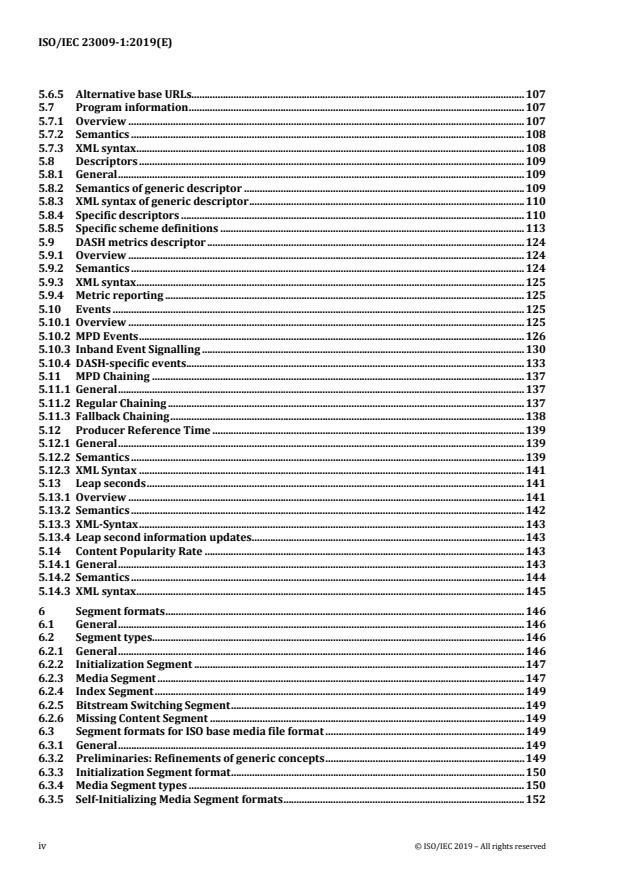
5.6.5 Alternative base URLs. 107
5.7 Program information . 107
5.7.1 Overview . 107
5.7.2 Semantics . 108
5.7.3 XML syntax . 108
5.8 Descriptors . 109
5.8.1 General . 109
5.8.2 Semantics of generic descriptor . 109
5.8.3 XML syntax of generic descriptor . 110
5.8.4 Specific descriptors . 110
5.8.5 Specific scheme definitions . 113
5.9 DASH metrics descriptor . 124
5.9.1 Overview . 124
5.9.2 Semantics . 124
5.9.3 XML syntax . 125
5.9.4 Metric reporting . 125
5.10 Events . 125
5.10.1 Overview . 125
5.10.2 MPD Events . 126
5.10.3 Inband Event Signalling . 130
5.10.4 DASH-specific events. 133
5.11 MPD Chaining . 137
5.11.1 General . 137
5.11.2 Regular Chaining . 137
5.11.3 Fallback Chaining . 138
5.12 Producer Reference Time . 139
5.12.1 General . 139
5.12.2 Semantics . 139
5.12.3 XML Syntax . 141
5.13 Leap seconds . 141
5.13.1 Overview . 141
5.13.2 Semantics . 142
5.13.3 XML-Syntax . 143
5.13.4 Leap second information updates . 143
5.14 Content Popularity Rate . 143
5.14.1 General . 143
5.14.2 Semantics . 144
5.14.3 XML syntax . 145
6 Segment formats . 146
6.1 General . 146
6.2 Segment types . 146
6.2.1 General . 146
6.2.2 Initialization Segment . 147
6.2.3 Media Segment . 147
6.2.4 Index Segment . 149
6.2.5 Bitstream Switching Segment . 149
6.2.6 Missing Content Segment . 149
6.3 Segment formats for ISO base media file format . 149
6.3.1 General . 149
6.3.2 Preliminaries: Refinements of generic concepts . 149
6.3.3 Initialization Segment format . 150
6.3.4 Media Segment types . 150
6.3.5 Self-Initializing Media Segment formats . 152
iv © ISO/IEC 2019 – All rights reserved
6.4 Segment formats for MPEG-2 transport streams . 153
6.4.1 General . 153
6.4.2 Preliminaries: Refinements of generic concepts . 153
6.4.3 Initialization Segment types and formats . 154
6.4.4 Media Segment types and formats. 155
6.4.5 Bitstream Switching Segment . 156
6.4.6 Index Segment. 156
6.4.7 Boxes used with MPEG-2 TS Index Segments . 158
7 Combined semantics of MPD and Segment formats . 159
7.1 Overview . 159
7.2 General . 160
7.2.1 Media Presentation timeline . 160
7.2.2 Segment Index. 161
7.2.3 Segment alignment. 161
7.2.4 Subsegment alignment . 161
7.3 Media Presentation based on the ISO base media file format . 161
7.3.1 General . 161
7.3.2 Media presentation timeline . 162
7.3.3 Authoring Rules for specific MPD attributes . 162
7.3.4 Sub-Representations . 163
7.3.5 Segment Timeline without Segment Index . 163
7.4 Media Presentation based on MPEG-2 TS . 163
7.4.1 General . 163
7.4.2 Media presentation timeline . 164
7.4.3 Authoring rules for specific MPD attributes . 164
7.4.4 Sub-Representations . 165
8 Profiles. 165
8.1 Definition . 165
8.2 Full profile . 167
8.2.1 General . 167
8.2.2 Media Presentation Description constraints . 167
8.2.3 Segment format constraints . 167
8.3 ISO Base media file format On Demand profile . 167
8.3.1 General . 167
8.3.2 Media Presentation Description constraints . 167
8.3.3 Segment format constraints . 168
8.4 ISO Base media file format live profile . 169
8.4.1 General . 169
8.4.2 Media Presentation Description constraints . 169
8.4.3 Segment format constraints . 170
8.5 ISO Base media file format main profile . 170
8.5.1 General . 170
8.5.2 Media Presentation Description constraints . 170
8.5.3 Segment format constraints . 171
8.6 MPEG-2 TS main profile . 171
8.6.1 General . 171
8.6.2 Media Presentation Description constraints . 172
8.6.3 Segment format constraints . 172
8.6.4 Comments and recommendations . 172
8.7 MPEG-2 TS simple profile . 173
8.7.1 General . 173
8.7.2 Media Presentation Description constraints . 173
© ISO/IEC 2019 – All rights reserved v
8.7.3 Segment format constraints . 173
8.7.4 Recommendations . 174
8.8 ISO Base media file format extended live profile . 174
8.8.1 General . 174
8.8.2 Media Presentation Description constraints . 174
8.8.3 Segment format constraints . 175
8.8.4 Inband Events . 175
8.9 ISO Base media file format extended On Demand profile . 175
8.9.1 General . 175
8.9.2 Media Presentation Description constraints . 176
8.9.3 Segment format constraints . 177
8.10 ISO Base media file format common profile . 177
8.10.1 General . 177
8.10.2 Media Presentation Description constraints . 177
8.10.3 Segment format constraints . 178
8.11 ISO Base media file format broadcast TV profile . 178
8.11.1 General . 178
8.11.2 Media Presentation Description constraints . 178
8.11.3 Segment format constraints . 180
8.11.4 MPD Updates and Inband Event Streams . 180
Annex A (informative) Example DASH Client behaviour . 181
Annex B (normative) MPD schema . 191
Annex C (normative) MIME type registration for MPD . 192
Annex D (normative) DASH Metrics . 196
Annex E (normative) Byte range requests with regular HTTP GET methods . 204
Annex F (informative) Guidelines for extending DASH with other delivery formats . 206
Annex G (informative) MPD Examples and MPD Usage . 208
Annex H (normative) Spatial Relationship Description . 236
Annex I (normative) Flexible Insertion of URL Parameters . 248
Annex J (informative) Open GOP resolution change . 262
Annex K (normative) DASH Service Description . 263
Bibliography . 274
vi © ISO/IEC 2019 – All rights reserved
Foreword
ISO (the International Organization for Standardization) and IEC (the International Electrotechnical
Commission) form the specialized system for worldwide standardization. National bodies that are
members of ISO or IEC participate in the development of International Standards through technical
committees established by the respective organization to deal with particular fields of technical activity.
ISO and IEC technical committees collaborate in fields of mutual interest. Other international
organizations, governmental and non-governmental, in liaison with ISO and IEC, also take part in the
work.
The procedures used to develop this document and those intended for its further maintenance are
described in the ISO/IEC Directives, Part 1. In particular, the different approval criteria needed for the
different types of document should be noted. This document was drafted in accordance with the editorial
rules of the ISO/IEC Directives, Part 2 (see www.iso.org/directives).
Attention is drawn to the possibility that some of the elements of this document may be the subject of
patent rights. ISO and IEC shall not be held responsible for identifying any or all such patent rights. Details
of any patent rights identified during the development of the document will be in the Introduction and/or
on the ISO list of patent declarations received (see www.iso.org/patents) or the IEC list of patent
declarations received (see http://patents.iec.ch).
Any trade name used in this document is information given for the convenience of users and does not
constitute an endorsement.
For an explanation of the voluntary nature of standards, the meaning of ISO specific terms and
expressions related to conformity assessment, as well as information about ISO's adherence to the World
Trade Organization (WTO) principles in the Technical Barriers to Trade (TBT)
see www.iso.org/iso/foreword.html.
This document was prepared by Joint Technical Committee ISO/IEC JTC 1, Information technology,
Subcommittee SC 29, Coding of audio, picture, multimedia and hypermedia information.
This fourth edition cancels and replaces the third edition (ISO/IEC 23009-1:2019), which has been
technically revised. The main changes compared to the previous edition are as follows:
— the concept Service Description was added in order to enable signalling by the service provider on
how the service is expected to be consumed;
— Initialization Sets, Groups and Presentations were added in order to simplify playback of Media
Presentations across Period boundaries;
— leap second information was added to support the DASH Client in timing calculations when leap
seconds occur;
— the producer reference time was added in order to allow signalling and mapping of media time to
wall-clock time including the time of capture, encoding or other application defined context;
— the content popularity rate was added to indicate a level of popularity of the containing entity (i.e.,
the Adaptation Set, Representation or Preselection) within the Media Presentation;
— exact signalling and placement of content in a Period was added in order to simplify client operation
in case of gaps and overlaps at Period boundaries;
© ISO/IEC 2019 – All rights reserved vii
— the concept of failover content was added in order to signal time sections in the Media Presentation
or specific Representations that are not representing the main content, but a failover version for
example in error cases;
— the support of the use of the Segment Timeline for low-latency DASH content was enabled;
— the concept of Preselections was extended in order to define conformance and playback rules for
Representations from different Adaptation Sets within one Preselection; other clarifications on
events were added;
— the ability to signal forced subtitles, easyreader and karaoke in the DASH Role scheme was added;
— a descriptor to indicate that the quality ranking associated to Representations is equivalent and
comparable across Adaptation Sets was added;
— the ability that DASH inband events can be added to a Period with a presentation time offset avoiding
the necessity to rewrite the event times in the media stream was added, as well as other clarifications
on Events;
— a segment type that permits to signal that content is missing, but also provides sufficient information
the media duration of the missing content was added;
— detailed recommendations and guidelines on how location and reference resolution for DASH
resources, i.e. MPDs and Segments, can be performed based on information in the MPD and HTTP
headers were added;
— DASH metrics were updated to support device information and to support specific keys for start and
stop reasons.
A list of all parts in the ISO/IEC 23009 series can be found on the ISO website.
Any feedback or questions on this document should be directed to the user’s national standards body. A
complete listing of these bodies can be found at www.iso.org/members.html.
viii © ISO/IEC 2019 – All rights reserved
Introduction
Dynamic adaptive streaming over HTTP (DASH) is intended to support a media-streaming model for
delivery of media content in which control lies primarily with the client. Clients may request data using
the HTTP protocol from standard web servers that have no DASH-specific capabilities. Consequently, this
document focuses not on client or server procedures but on the data formats used to provide a DASH
Media Presentation.
The International Organization for Standardization (ISO) and International Electrotechnical Commission
(IEC) draw attention to the fact that it is claimed that compliance with this document may involve the use
of patents.
ISO and IEC take no position concerning the evidence, validity and scope of these patent rights.
The holders of these patent rights have assured ISO and IEC that they are willing to negotiate licences
under reasonable and non-discriminatory terms and conditions with applicants throughout the world. In
this respect, the statements of the holders of these patent rights are registered with ISO and IEC.
Information may be obtained from the patent database available at www.iso.org/patents.
Attention is drawn to the possibility that some of the elements of this document may be the subject of
patent rights other than those identified in the patent database. ISO and IEC shall not be held responsible
for identifying any or all such patent rights.
© ISO/IEC 2019 – All rights reserved ix
INTERNATIONAL STANDARD ISO/IEC 23009-1:2019(E)
Information technology — Dynamic adaptive streaming over
HTTP (DASH) — Part 1: Media presentation description and
segment formats
1 Scope
This document primarily specifies formats for the Media Presentation Description and Segments for
dynamic adaptive streaming delivery of MPEG media over HTTP. It is applicable to streaming services
over the Internet.
2 Normative references
The following documents are referred to in the text in such a way that some or all of their content
constitutes requirements of this document. For dated references, only the edition cited applies. For
undated references, the latest edition of the referenced document (including any amendments) applies.
ISO/IEC 13818-1, Information technology — Generic coding of moving pictures and associated audio
information — Part 1: Systems
ISO/IEC 14496-12:— , Information technology — Coding of audio-visual objects — Part 12: ISO base
media file format
ISO/IEC 23091-3, Information technology — Coding-independent code points — Part 3: Audio
IETF RFC 1738, Uniform Resource Locators
IETF RFC 2397, The “data” URL scheme
IETF RFC 3629, UTF-8, a transformation format of ISO 10646
IETF RFC 3986:2005, Uniform Resource Identifier (URI): Generic Syntax
IETF RFC 4122, A Universally Unique IDentifier (UUID) URN Namespace
IETF RFC 4337, MIME Type Registration for MPEG-4
IETF RFC 4648, The Base16, Base32, and Base64 Data Encodings
IETF RFC 5234, Augmented BNF for Syntax Specifications: ABNF
IETF RFC 5261, An Extensible Markup Language (XML) Patch Operations Framework Utilizing XML Path
Language (XPath) Selectors
6th edition under preparation. Stage at time of publication: ISO/IEC FDIS 14496-12:2019.
© ISO/IEC 2019 – All rights reserved
IETF RFC 5646, Tags for Identifying Languages
IETF RFC 6381:2011, The ′Codecs′ and ′Profiles′ Parameters for “Bucket” Media Types
IETF RFC 6838:2013, Media Type Specifications and Registration Procedures
IETF RFC 7231:2014, Hypertext Transfer Protocol (HTTP/1.1): Semantics and Content
IETF RFC 7233:2014, Hypertext Transfer Protocol (HTTP/1.1): Range Requests
IETF RFC 8141:2017, URN Syntax
HTML 4.01 Specification, W3C Recommendation, 24 December 1999
W3C XML, Extensible Markup Language (XML) 1.0 (Fifth Edition), W3C Recommendation, 26 November
W3C XLINK, XML Linking Language (XLink) Version 1.1, W3C Recommendation, 06 May 2010
W3C Media Fragments URI 1.0 (basic), W3C Recommendation, 25 September 2012
United States Code Title 47 CFR 79.103, Electronic Code of Federal Regulations: Closed caption decoder
requirements for apparatus, https://www.ecfr.gov/cgi-bin/text-idx?node=se47.4.79_1103
SMPTE ST 2067-2, SMPTE Standard — Interoperable Master Format — Core Constraints
3 Terms, definitions, abbreviated terms and conventions
3.1 Terms and definitions
For the purposes of this document, the following terms and definitions apply.
ISO and IEC maintain terminological databases for use in standardization at the following addresses:
— ISO Online browsing platform: available at https://www.iso.org/obp
— IEC Electropedia: available at http://www.electropedia.org/
3.1.1
access unit
unit of a media stream (3.1.29) with an assigned Media Presentation time
3.1.2
accessibility
degree to which a media content or certain media content components (3.1.22) are available to as many
people as possible
3.1.3
Adaptation Set
set of interchangeable encoded versions of one or several media content components (3.1.22)
3.1.4
asset
content including media and metadata together with the rights to use the content by the content
provider
© ISO/IEC 2019 – All rights reserved
3.1.5
associated Representation
Representation (3.1.38) which provides supplemental or descriptive information for at least one other
Representation
3.1.6
available Segment
Segment (3.1.39) that is accessible at its assigned HTTP-URL (3.1.17) and a possibly assigned byte range
that is the request with an HTTP GET results in a reply of the Segment and 2xx status code
3.1.7
Bitstream Switching Segment
Segment (3.1.39) that if present contains essential data to switch to the Representation (3.1.38) it is
assigned to
3.1.8
complementary Representation
Representation (3.1.38) which complements at least one dependent Representation (3.1.12)
3.1.9
continuous media
media with an inherent notion of time
EXAMPLES Speech, audio, video, timed text or timed metadata.
3.1.10
DASH metric
metric computed by the DASH Client and uniquely identified by a key
3.1.11
data URL
URL with a fixed scheme “data”
3.1.12
dependent Representation
Representation (3.1.38) for which Segments (3.1.39) from its complementary Representations (3.1.8) are
necessary for presentation and/or decoding of the contained media content components (3.1.22)
3.1.13
earliest presentation time
smallest presentation time (3.1.36) of any access unit (3.1.1) of a Media Segment (3.1.28) or Subsegment
(3.1.49) for a media stream (3.1.29)
3.1.14
event
aperiodic sparse media-time related auxiliary information to the DASH Client or to an application
3.1.15
event stream
sequence of related events (3.1.14)
3.1.16
group
collection of Adaptation Sets (3.1.3) that are not expected to be presented simultaneously
© ISO/IEC 2019 – All rights reserved
3.1.17
HTTP-URL
URL with a fixed scheme of “http” or “https”
3.1.18
Index Segment
Segment (3.1.39) that primarily contains indexing information for Media Segments (3.1.28)
3.1.19
Initialization Segment
Segment (3.1.39) containing metadata that is necessary to present the media streams (3.1.29)
encapsulated in Media Segments (3.1.28)
3.1.20
Main Adaptation Set
Adaptation Set (3.1.3) in a Preselection (3.1.35) that contains the Initialization Segment (3.1.19) for the
complete experience
3.1.21
media content
single media content period (3.1.24) or contiguous sequence of media content periods
3.1.22
media content component
single continuous component of the media content (3.1.21) with an assigned media content component
type (3.1.23)
3.1.23
media content component type
single type of media content (3.1.21)
EXAMPLES Audio, video, or text.
3.1.24
media content period
set of media content components (3.1.22) that have a common timeline as well as relationships on how
they can be presented
3.1.25
Media Presentation
collection of data that establishes a bounded or unbounded presentation of media content (3.1.21)
3.1.26
Media Presentation Description
MPD
formalized description for a Media Presentation (3.1.25) for the purpose of providing a streaming
service
3.1.27
Media Presentation timeline
concatenation of the timeline of all Periods (3.1.34) which itself is common to all Representations
(3.1.38) in the Period
© ISO/IEC 2019 – All rights reserved
3.1.
...
Questions, Comments and Discussion
Ask us and Technical Secretary will try to provide an answer. You can facilitate discussion about the standard in here.
Loading comments...