

ISO 19064-2:2020
(Main)Plastics — Styrene-acrylonitrile (SAN) moulding and extrusion materials — Part 2: Preparation of test specimens and determination of properties
General Information
- Abstract
This document specifies the methods of preparation of test specimens and the test methods to be used in determining the properties of styrene-acrylonitrile (SAN) moulding and extrusion materials. It gives the requirements for handling the test material and for conditioning both the test material before moulding and the specimens before testing. This document gives procedures and conditions for the preparation of test specimens and procedures for measuring properties of the materials from which these specimens are made. It lists properties and test methods which are suitable and necessary to characterize SAN moulding and extrusion materials. The properties have been selected from the general test methods in ISO 10350-1. Other test methods in wide use for, or of particular significance to, these moulding and extrusion materials are also included in this document, as are the designatory properties specified in ISO 19064-1. The methods of specimen preparation and conditioning, the specimen dimensions and the test procedures specified in this document are used in order to obtain reproducible and comparable test results. Values determined are not always identical to those obtained using specimens of different dimensions or prepared using different procedures.
- Status
- Published
- Publication Date
- 10-Mar-2020
- Technical Committee
- ISO/TC 61/SC 9 - Thermoplastic materials
- Drafting Committee
- ISO/TC 61/SC 9/WG 7 - Styrene polymers
- Current Stage
- 9092 - International Standard to be revised
- Start Date
- 09-Dec-2025
- Completion Date
- 29-Aug-2026
Buy Documents


ISO 19064-2:2020 - Plastics -- Styrene-acrylonitrile (SAN) moulding and extrusion materials
ISO 19064-2:2020 - Plastics — Styrene-acrylonitrile (SAN) moulding and extrusion materials — Part 2: Preparation of test specimens and determination of properties/11/2020

ISO 19064-2:2020 - Plastiques -- Matériaux a base de styrene-acrylonitrile (SAN) pour moulage et extrusion
ISO 19064-2:2020 - Plastiques — Matériaux à base de styrène-acrylonitrile (SAN) pour moulage et extrusion — Partie 2: Préparation des éprouvettes et détermination des propriétés/11/2020
Overview - ISO 19064-2:2020 (SAN test specimens & properties)
ISO 19064-2:2020 specifies how to prepare test specimens and determine properties of styrene‑acrylonitrile (SAN) moulding and extrusion materials. The standard defines handling, drying and conditioning requirements, specimen preparation routes (injection or compression moulding), target processing conditions and the suite of test methods appropriate to characterize SAN materials. It aligns test selection and reporting with ISO 10350‑1 to ensure reproducible, comparable data for material specification and quality control.
Key topics and technical requirements
- Specimen preparation methods: Injection‑moulding (see ISO 294‑1 / ISO 294‑3) or compression‑moulding (see ISO 293). The standard requires consistent preparation procedure for comparable results.
- Target processing conditions (examples):
- Injection moulding: melt temperature 240 ± 3 °C, mould temperature 60 ± 3 °C, injection velocity 200 ± 100 mm/s (see ISO 294 series for tolerances).
- Compression moulding: target parameters (including moulding temperature ~200 °C and cooling rate) are given; refer to the standard for full table values.
- Conditioning of specimens:
- MFR specimens: 4 h at (80 ± 2) °C then stored in a desiccator per ISO 19064‑1.
- Electrical strength: ≥ 24 h at (23 ± 2) °C and (50 ± 5) % RH (IEC 60243‑1).
- Oxygen index: 24 h at (23 ± 2) °C and (50 ± 5) % RH; if mass change > 0.1 %, additional conditioning per ISO 4589‑2.
- Other properties: at least 16 h at (23 ± 2) °C and (50 ± 10) % RH.
- Properties and test methods included: rheological (MFR / MVR - ISO 1133‑1), mechanical (tensile ISO 527‑2, flexural ISO 178, Charpy/Izod ISO 179/ISO 180), thermal (Vicat ISO 306, DSC ISO 11357), density (ISO 1183), burning behaviour/oxygen index (ISO 4589), residual monomer analyses (ISO 2561, ISO 4581), plus electrical/dielectric tests (IEC 62631 series).
- Data comparability: Procedures, specimen dimensions and conditioning are specified to obtain reproducible and comparable test results. Results may differ if specimens or procedures vary.
Applications and who uses ISO 19064-2
- Material manufacturers: to characterize SAN grades and validate product specifications.
- Quality control and test laboratories: to perform standardized, comparable tests for acceptance and release.
- Product designers & OEMs: to select appropriate SAN materials for moulded or extruded components (mechanical, thermal or electrical requirements).
- Procurement and specification writers: to reference harmonized test methods in contracts and technical datasheets.
- Regulatory and certification bodies: to evaluate material performance against standardized methods.
Related standards
- ISO 19064‑1 (designation system and basis for specifications)
- ISO 10350‑1 (presentation of single‑point data)
- ISO 294‑1 / ISO 294‑3 (injection moulding of test specimens)
- ISO 293 (compression moulding)
- ISO 1133‑1 (MFR / MVR)
- ISO 527‑2, ISO 178, ISO 4589, ISO 1183, ISO 11357, IEC 62631 series
Keywords: ISO 19064-2, SAN, styrene‑acrylonitrile, test specimens, moulding and extrusion materials, conditioning, injection moulding, compression moulding, MFR, mechanical properties, ISO 10350-1.
Relations
- Effective Date
- 12-Feb-2026
- Effective Date
- 23-Apr-2020
Buy Documents
ISO 19064-2:2020 - Plastics -- Styrene-acrylonitrile (SAN) moulding and extrusion materials
ISO 19064-2:2020 - Plastics — Styrene-acrylonitrile (SAN) moulding and extrusion materials — Part 2: Preparation of test specimens and determination of properties/11/2020
ISO 19064-2:2020 - Plastiques -- Matériaux a base de styrene-acrylonitrile (SAN) pour moulage et extrusion
ISO 19064-2:2020 - Plastiques — Matériaux à base de styrène-acrylonitrile (SAN) pour moulage et extrusion — Partie 2: Préparation des éprouvettes et détermination des propriétés/11/2020
Get Certified
Connect with accredited certification bodies for this standard

DIN CERTCO
DIN Group product certification.

Smithers Quality Assessments
US management systems and product certification.
Sponsored listings
Frequently Asked Questions
ISO 19064-2:2020 is a standard published by the International Organization for Standardization (ISO). Its full title is "Plastics — Styrene-acrylonitrile (SAN) moulding and extrusion materials — Part 2: Preparation of test specimens and determination of properties". This standard covers: This document specifies the methods of preparation of test specimens and the test methods to be used in determining the properties of styrene-acrylonitrile (SAN) moulding and extrusion materials. It gives the requirements for handling the test material and for conditioning both the test material before moulding and the specimens before testing. This document gives procedures and conditions for the preparation of test specimens and procedures for measuring properties of the materials from which these specimens are made. It lists properties and test methods which are suitable and necessary to characterize SAN moulding and extrusion materials. The properties have been selected from the general test methods in ISO 10350-1. Other test methods in wide use for, or of particular significance to, these moulding and extrusion materials are also included in this document, as are the designatory properties specified in ISO 19064-1. The methods of specimen preparation and conditioning, the specimen dimensions and the test procedures specified in this document are used in order to obtain reproducible and comparable test results. Values determined are not always identical to those obtained using specimens of different dimensions or prepared using different procedures.
This document specifies the methods of preparation of test specimens and the test methods to be used in determining the properties of styrene-acrylonitrile (SAN) moulding and extrusion materials. It gives the requirements for handling the test material and for conditioning both the test material before moulding and the specimens before testing. This document gives procedures and conditions for the preparation of test specimens and procedures for measuring properties of the materials from which these specimens are made. It lists properties and test methods which are suitable and necessary to characterize SAN moulding and extrusion materials. The properties have been selected from the general test methods in ISO 10350-1. Other test methods in wide use for, or of particular significance to, these moulding and extrusion materials are also included in this document, as are the designatory properties specified in ISO 19064-1. The methods of specimen preparation and conditioning, the specimen dimensions and the test procedures specified in this document are used in order to obtain reproducible and comparable test results. Values determined are not always identical to those obtained using specimens of different dimensions or prepared using different procedures.
ISO 19064-2:2020 is classified under the following ICS (International Classification for Standards) categories: 83.080.20 - Thermoplastic materials. The ICS classification helps identify the subject area and facilitates finding related standards.
ISO 19064-2:2020 has the following relationships with other standards: It is inter standard links to EN ISO 19064-2:2020, ISO 4894-2:1995. Understanding these relationships helps ensure you are using the most current and applicable version of the standard.
ISO 19064-2:2020 is available in PDF format for immediate download after purchase. The document can be added to your cart and obtained through the secure checkout process. Digital delivery ensures instant access to the complete standard document.
Standards Content (Sample)
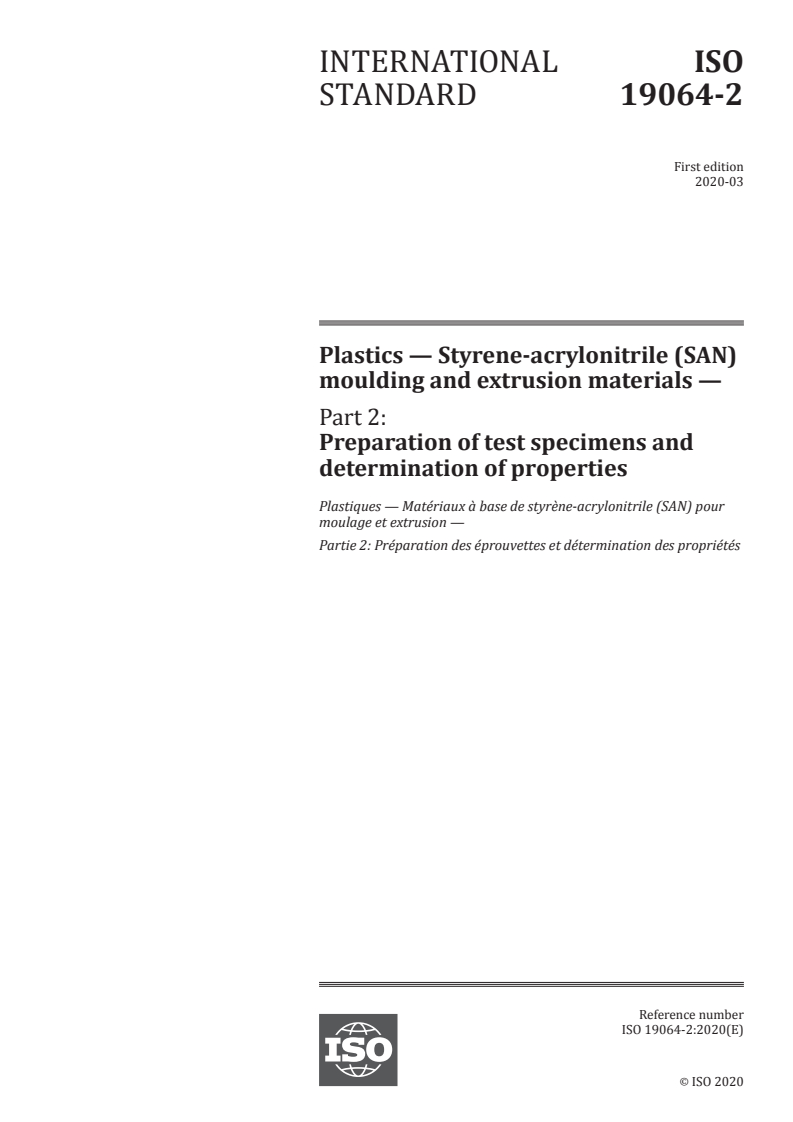
INTERNATIONAL ISO
STANDARD 19064-2
First edition
2020-03
Plastics — Styrene-acrylonitrile (SAN)
moulding and extrusion materials —
Part 2:
Preparation of test specimens and
determination of properties
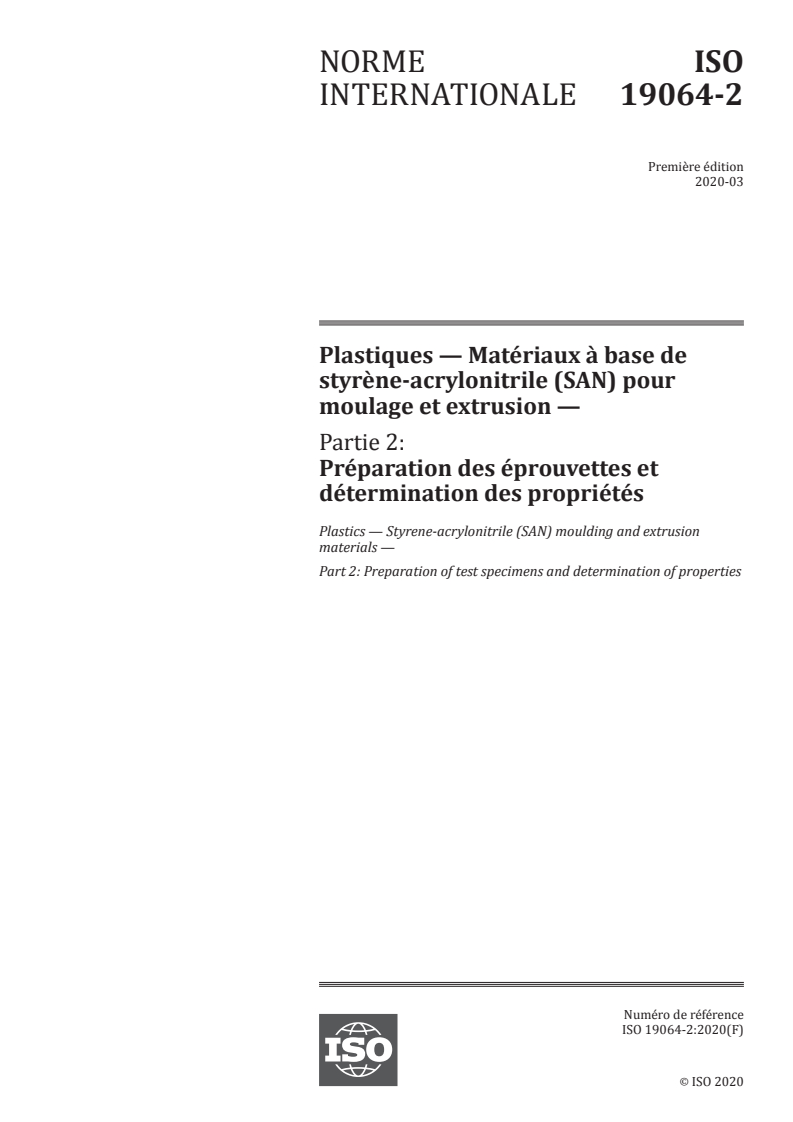
Plastiques — Matériaux à base de styrène-acrylonitrile (SAN) pour
moulage et extrusion —
Partie 2: Préparation des éprouvettes et détermination des propriétés
Reference number
©
ISO 2020
© ISO 2020
All rights reserved. Unless otherwise specified, or required in the context of its implementation, no part of this publication may
be reproduced or utilized otherwise in any form or by any means, electronic or mechanical, including photocopying, or posting
on the internet or an intranet, without prior written permission. Permission can be requested from either ISO at the address
below or ISO’s member body in the country of the requester.
ISO copyright office
CP 401 • Ch. de Blandonnet 8
CH-1214 Vernier, Geneva
Phone: +41 22 749 01 11
Fax: +41 22 749 09 47
Email: copyright@iso.org
Website: www.iso.org
Published in Switzerland
ii © ISO 2020 – All rights reserved
Contents Page
Foreword .iv
Introduction .v
1 Scope . 1
2 Normative references . 1
3 Terms and definitions . 3
4 Preparation of test specimens . 3
4.1 General . 3
4.2 Treatment of the material before moulding . 3
4.3 Injection moulding . 3
4.4 Compression moulding . 3
5 Conditioning of test specimens . 4
6 Determination of properties . 4
Annex A (normative) Determination of the bound-acrylonitrile content in the continuous phase .7
Foreword
ISO (the International Organization for Standardization) is a worldwide federation of national standards
bodies (ISO member bodies). The work of preparing International Standards is normally carried out
through ISO technical committees. Each member body interested in a subject for which a technical
committee has been established has the right to be represented on that committee. International
organizations, governmental and non-governmental, in liaison with ISO, also take part in the work.
ISO collaborates closely with the International Electrotechnical Commission (IEC) on all matters of
electrotechnical standardization.
The procedures used to develop this document and those intended for its further maintenance are
described in the ISO/IEC Directives, Part 1. In particular the different approval criteria needed for the
different types of ISO documents should be noted. This document was drafted in accordance with the
editorial rules of the ISO/IEC Directives, Part 2 (see www .iso .org/ directives).
Attention is drawn to the possibility that some of the elements of this document may be the subject of
patent rights. ISO shall not be held responsible for identifying any or all such patent rights. Details of
any patent rights identified during the development of the document will be in the Introduction and/or
on the ISO list of patent declarations received (see www .iso .org/ patents).
Any trade name used in this document is information given for the convenience of users and does not
constitute an endorsement.
For an explanation on the voluntary nature of standards, the meaning of ISO specific terms and
expressions related to conformity assessment, as well as information about ISO's adherence to the
World Trade Organization (WTO) principles in the Technical Barriers to Trade (TBT) see the following
URL: www .iso .org/ iso/ foreword .html.
This document was prepared by Technical Committee ISO/TC 61, Plastics, Subcommittee SC 9,
Thermoplastic materials, in collaboration with the European Committee for Standardization (CEN)
Technical Committee CEN/TC 249, Plastics, in accordance with the Agreement on technical cooperation
between ISO and CEN (Vienna Agreement).
This first edition of ISO 19064-2 cancels and replaces ISO 4894-2:1995, which has been technically
revised.
The main changes compared to the previous edition are as follows:
— the normative references in Clause 2 have been updated;
— ISO 3167 has been replaced by ISO 20753;
— IEC 60093 has been replaced by IEC 62631-3-1 and IEC 62631-3-2;
— IEC 60250 has been replaced by IEC 62631-2-1;
— ISO 1183 has been replaced by ISO 1183-1, ISO 1183-2 and ISO 1183-3.
A list of all parts in the ISO 19064 series can be found on the ISO website.
Any feedback or questions on this document should be directed to the user’s national standards body. A
complete listing of these bodies can be found at www .iso .org/ members .html.
iv © ISO 2020 – All rights reserved
Introduction
There are many methods for testing properties of plastics. For some, the data obtained by different
standards are not comparable. Even when the same standards have been used, they often allow the
adoption of a wide range of alternative test conditions, and the data obtained are not necessarily
comparable. The purpose of this document is to specify methods and conditions of test to be used for the
acquisition and presentation of data to ensure that valid comparisons between Styrene-acrylonitrile
(SAN) materials can be made.
INTERNATIONAL STANDARD ISO 19064-2:2020(E)
Plastics — Styrene-acrylonitrile (SAN) moulding and
extrusion materials —
Part 2:
Preparation of test specimens and determination of
properties
1 Scope
This document specifies the methods of preparation of test specimens and the test methods to be used
in determining the properties of styrene-acrylonitrile (SAN) moulding and extrusion materials. It gives
the requirements for handling the test material and for conditioning both the test material before
moulding and the specimens before testing.
This document gives procedures and conditions for the preparation of test specimens and procedures
for measuring properties of the materials from which these specimens are made. It lists properties and
test methods which are suitable and necessary to characterize SAN moulding and extrusion materials.
The properties have been selected from the general test methods in ISO 10350-1. Other test methods in
wide use for, or of particular significance to, these moulding and extrusion materials are also included
in this document, as are the designatory properties specified in ISO 19064-1.
The methods of specimen preparation and conditioning, the specimen dimensions and the test
procedures specified in this document are used in order to obtain reproducible and comparable test
results. Values determined are not always identical to those obtained using specimens of different
dimensions or prepared using different procedures.
2 Normative references
The following documents are referred to in the text in such a way that some or all of their content
constitutes requirements of this document. For dated references, only the edition cited applies. For
undated references, the latest edition of the referenced document (including any amendments) applies
ISO 62, Plastics — Determination of water absorption
ISO 75-1, Plastics — Determination of temperature of deflection under load — Part 1: General test method
ISO 75-2, Plastics — Determination of temperature of deflection under load — Part 2: Plastics and ebonite
ISO 178, Plastics — Determination of flexural properties
ISO 179-1, Plastics — Determination of Charpy impact properties — Part 1: Non-instrumented impact test
ISO 179-2, Plastics — Determination of Charpy impact properties — Part 2: Instrumented impact test
ISO 180, Plastics — Determination of Izod impact strength
ISO 293, Plastics — Compression moulding of test specimens of thermoplastic materials
ISO 294-1, Plastics — Injection moulding of test specimens of thermoplastic materials — Part 1: General
principles, and moulding of multipurpose and bar test specimens
ISO 294-3, Plastics — Injection moulding of test specimens of thermoplastic materials — Part 3: Small plates
ISO 306, Plastics — Thermoplastic materials — Determination of Vicat softening temperature (VST)
ISO 527-2, Plastics — Determination of tensile properties — Part 2: Test conditions for moulding and
extrusion plastics
ISO 527-4, Plastics — Determination of tensile properties — Part 4: Test conditions for isotropic and
orthotropic fibre-reinforced plastic composites
ISO 899-1, Plastics — Determination of creep behaviour — Part 1: Tensile creep
ISO 1133-1, Plastics — Determination of the melt mass-flow rate (MFR) and melt volume-flow rate (MVR)
of thermoplastics — Part 1: Standard method
ISO 1183-1, Plastics — Methods for determining the density of non-cellular plastics — Part 1: Immersion
method, liquid pycnometer method and titration method
ISO 1183-2, Plastics — Methods for determining the density of non-cellular plastics — Part 2: Density
gradient column method
ISO 1183-3, Plastics — Methods for determining the density of non-cellular plastics — Part 3: Gas
pyknometer method
ISO 1656, Rubber, raw natural, and rubber latex, natural — Determination of nitrogen content
ISO 2561, Plastics — Determination of residual styrene monomer in polystyrene (PS) and impact-resistant
polystyrene (PS-I) by gas chromatography
ISO 2818, Plastics — Preparation of test specimens by machining
ISO 4581, Plastics — Styrene/acrylonitrile copolymers — Determination of residual acrylonitrile monomer
content — Gas chromatography method
ISO 4589-2, Plastics — Determination of burning behaviour by oxygen index — Part 2: Ambient-
temperature test
ISO 4589-3, Plastics — Determination of burning behaviour by oxygen index — Part 3: Elevated-
temperature test
ISO 8256, Plastics — Determination of tensile-impact strength
ISO 10350-1, Plastics — Acquisition and presentation of comparable single-point data — Part 1: Moulding
materials
ISO 11357-1, Plastics — Differential scanning calorimetry (DSC) — Part 1: General principles
ISO 11357-2, Plastics — Differential scanning calorimetry (DSC) — Part 2: Determination of glass transition
temperature and glass transition step height
ISO 19064-1, Plastics — Styrene/acrylonitrile (SAN) moulding and extrusion materials — Part 1:
Designation system and basis for specifications
ISO 20753, Plastics
...
INTERNATIONAL ISO
STANDARD 19064-2
First edition
2020-03
Plastics — Styrene-acrylonitrile (SAN)
moulding and extrusion materials —
Part 2:
Preparation of test specimens and
determination of properties
Plastiques — Matériaux à base de styrène-acrylonitrile (SAN) pour
moulage et extrusion —
Partie 2: Préparation des éprouvettes et détermination des propriétés
Reference number
©
ISO 2020
© ISO 2020
All rights reserved. Unless otherwise specified, or required in the context of its implementation, no part of this publication may
be reproduced or utilized otherwise in any form or by any means, electronic or mechanical, including photocopying, or posting
on the internet or an intranet, without prior written permission. Permission can be requested from either ISO at the address
below or ISO’s member body in the country of the requester.
ISO copyright office
CP 401 • Ch. de Blandonnet 8
CH-1214 Vernier, Geneva
Phone: +41 22 749 01 11
Fax: +41 22 749 09 47
Email: copyright@iso.org
Website: www.iso.org
Published in Switzerland
ii © ISO 2020 – All rights reserved
Contents Page
Foreword .iv
Introduction .v
1 Scope . 1
2 Normative references . 1
3 Terms and definitions . 3
4 Preparation of test specimens . 3
4.1 General . 3
4.2 Treatment of the material before moulding . 3
4.3 Injection moulding . 3
4.4 Compression moulding . 3
5 Conditioning of test specimens . 4
6 Determination of properties . 4
Annex A (normative) Determination of the bound-acrylonitrile content in the continuous phase .7
Foreword
ISO (the International Organization for Standardization) is a worldwide federation of national standards
bodies (ISO member bodies). The work of preparing International Standards is normally carried out
through ISO technical committees. Each member body interested in a subject for which a technical
committee has been established has the right to be represented on that committee. International
organizations, governmental and non-governmental, in liaison with ISO, also take part in the work.
ISO collaborates closely with the International Electrotechnical Commission (IEC) on all matters of
electrotechnical standardization.
The procedures used to develop this document and those intended for its further maintenance are
described in the ISO/IEC Directives, Part 1. In particular the different approval criteria needed for the
different types of ISO documents should be noted. This document was drafted in accordance with the
editorial rules of the ISO/IEC Directives, Part 2 (see www .iso .org/ directives).
Attention is drawn to the possibility that some of the elements of this document may be the subject of
patent rights. ISO shall not be held responsible for identifying any or all such patent rights. Details of
any patent rights identified during the development of the document will be in the Introduction and/or
on the ISO list of patent declarations received (see www .iso .org/ patents).
Any trade name used in this document is information given for the convenience of users and does not
constitute an endorsement.
For an explanation on the voluntary nature of standards, the meaning of ISO specific terms and
expressions related to conformity assessment, as well as information about ISO's adherence to the
World Trade Organization (WTO) principles in the Technical Barriers to Trade (TBT) see the following
URL: www .iso .org/ iso/ foreword .html.
This document was prepared by Technical Committee ISO/TC 61, Plastics, Subcommittee SC 9,
Thermoplastic materials, in collaboration with the European Committee for Standardization (CEN)
Technical Committee CEN/TC 249, Plastics, in accordance with the Agreement on technical cooperation
between ISO and CEN (Vienna Agreement).
This first edition of ISO 19064-2 cancels and replaces ISO 4894-2:1995, which has been technically
revised.
The main changes compared to the previous edition are as follows:
— the normative references in Clause 2 have been updated;
— ISO 3167 has been replaced by ISO 20753;
— IEC 60093 has been replaced by IEC 62631-3-1 and IEC 62631-3-2;
— IEC 60250 has been replaced by IEC 62631-2-1;
— ISO 1183 has been replaced by ISO 1183-1, ISO 1183-2 and ISO 1183-3.
A list of all parts in the ISO 19064 series can be found on the ISO website.
Any feedback or questions on this document should be directed to the user’s national standards body. A
complete listing of these bodies can be found at www .iso .org/ members .html.
iv © ISO 2020 – All rights reserved
Introduction
There are many methods for testing properties of plastics. For some, the data obtained by different
standards are not comparable. Even when the same standards have been used, they often allow the
adoption of a wide range of alternative test conditions, and the data obtained are not necessarily
comparable. The purpose of this document is to specify methods and conditions of test to be used for the
acquisition and presentation of data to ensure that valid comparisons between Styrene-acrylonitrile
(SAN) materials can be made.
INTERNATIONAL STANDARD ISO 19064-2:2020(E)
Plastics — Styrene-acrylonitrile (SAN) moulding and
extrusion materials —
Part 2:
Preparation of test specimens and determination of
properties
1 Scope
This document specifies the methods of preparation of test specimens and the test methods to be used
in determining the properties of styrene-acrylonitrile (SAN) moulding and extrusion materials. It gives
the requirements for handling the test material and for conditioning both the test material before
moulding and the specimens before testing.
This document gives procedures and conditions for the preparation of test specimens and procedures
for measuring properties of the materials from which these specimens are made. It lists properties and
test methods which are suitable and necessary to characterize SAN moulding and extrusion materials.
The properties have been selected from the general test methods in ISO 10350-1. Other test methods in
wide use for, or of particular significance to, these moulding and extrusion materials are also included
in this document, as are the designatory properties specified in ISO 19064-1.
The methods of specimen preparation and conditioning, the specimen dimensions and the test
procedures specified in this document are used in order to obtain reproducible and comparable test
results. Values determined are not always identical to those obtained using specimens of different
dimensions or prepared using different procedures.
2 Normative references
The following documents are referred to in the text in such a way that some or all of their content
constitutes requirements of this document. For dated references, only the edition cited applies. For
undated references, the latest edition of the referenced document (including any amendments) applies
ISO 62, Plastics — Determination of water absorption
ISO 75-1, Plastics — Determination of temperature of deflection under load — Part 1: General test method
ISO 75-2, Plastics — Determination of temperature of deflection under load — Part 2: Plastics and ebonite
ISO 178, Plastics — Determination of flexural properties
ISO 179-1, Plastics — Determination of Charpy impact properties — Part 1: Non-instrumented impact test
ISO 179-2, Plastics — Determination of Charpy impact properties — Part 2: Instrumented impact test
ISO 180, Plastics — Determination of Izod impact strength
ISO 293, Plastics — Compression moulding of test specimens of thermoplastic materials
ISO 294-1, Plastics — Injection moulding of test specimens of thermoplastic materials — Part 1: General
principles, and moulding of multipurpose and bar test specimens
ISO 294-3, Plastics — Injection moulding of test specimens of thermoplastic materials — Part 3: Small plates
ISO 306, Plastics — Thermoplastic materials — Determination of Vicat softening temperature (VST)
ISO 527-2, Plastics — Determination of tensile properties — Part 2: Test conditions for moulding and
extrusion plastics
ISO 527-4, Plastics — Determination of tensile properties — Part 4: Test conditions for isotropic and
orthotropic fibre-reinforced plastic composites
ISO 899-1, Plastics — Determination of creep behaviour — Part 1: Tensile creep
ISO 1133-1, Plastics — Determination of the melt mass-flow rate (MFR) and melt volume-flow rate (MVR)
of thermoplastics — Part 1: Standard method
ISO 1183-1, Plastics — Methods for determining the density of non-cellular plastics — Part 1: Immersion
method, liquid pycnometer method and titration method
ISO 1183-2, Plastics — Methods for determining the density of non-cellular plastics — Part 2: Density
gradient column method
ISO 1183-3, Plastics — Methods for determining the density of non-cellular plastics — Part 3: Gas
pyknometer method
ISO 1656, Rubber, raw natural, and rubber latex, natural — Determination of nitrogen content
ISO 2561, Plastics — Determination of residual styrene monomer in polystyrene (PS) and impact-resistant
polystyrene (PS-I) by gas chromatography
ISO 2818, Plastics — Preparation of test specimens by machining
ISO 4581, Plastics — Styrene/acrylonitrile copolymers — Determination of residual acrylonitrile monomer
content — Gas chromatography method
ISO 4589-2, Plastics — Determination of burning behaviour by oxygen index — Part 2: Ambient-
temperature test
ISO 4589-3, Plastics — Determination of burning behaviour by oxygen index — Part 3: Elevated-
temperature test
ISO 8256, Plastics — Determination of tensile-impact strength
ISO 10350-1, Plastics — Acquisition and presentation of comparable single-point data — Part 1: Moulding
materials
ISO 11357-1, Plastics — Differential scanning calorimetry (DSC) — Part 1: General principles
ISO 11357-2, Plastics — Differential scanning calorimetry (DSC) — Part 2: Determination of glass transition
temperature and glass transition step height
ISO 19064-1, Plastics — Styrene/acrylonitrile (SAN) moulding and extrusion materials — Part 1:
Designation system and basis for specifications
ISO 20753, Plastics
...
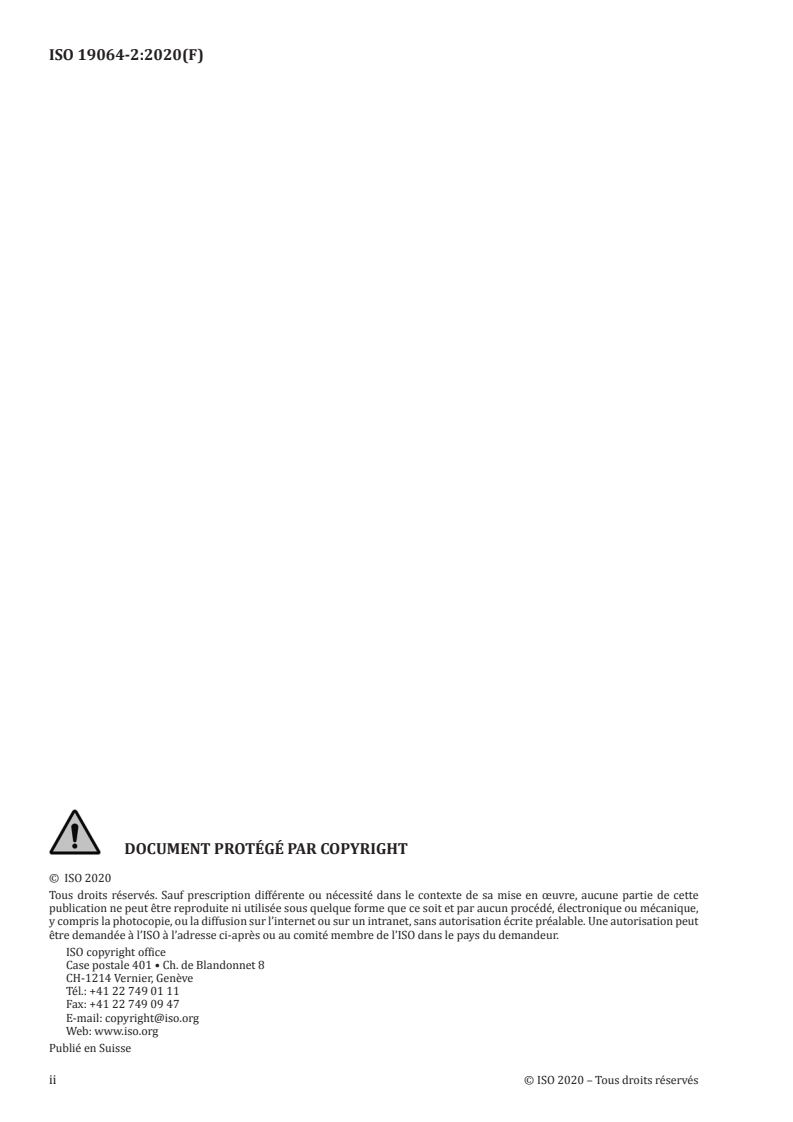
NORME ISO
INTERNATIONALE 19064-2
Première édition
2020-03
Plastiques — Matériaux à base de
styrène-acrylonitrile (SAN) pour
moulage et extrusion —
Partie 2:
Préparation des éprouvettes et
détermination des propriétés
Plastics — Styrene-acrylonitrile (SAN) moulding and extrusion
materials —
Part 2: Preparation of test specimens and determination of properties
Numéro de référence
©
ISO 2020
DOCUMENT PROTÉGÉ PAR COPYRIGHT
© ISO 2020
Tous droits réservés. Sauf prescription différente ou nécessité dans le contexte de sa mise en œuvre, aucune partie de cette
publication ne peut être reproduite ni utilisée sous quelque forme que ce soit et par aucun procédé, électronique ou mécanique,
y compris la photocopie, ou la diffusion sur l’internet ou sur un intranet, sans autorisation écrite préalable. Une autorisation peut
être demandée à l’ISO à l’adresse ci-après ou au comité membre de l’ISO dans le pays du demandeur.
ISO copyright office
Case postale 401 • Ch. de Blandonnet 8
CH-1214 Vernier, Genève
Tél.: +41 22 749 01 11
Fax: +41 22 749 09 47
E-mail: copyright@iso.org
Web: www.iso.org
Publié en Suisse
ii © ISO 2020 – Tous droits réservés
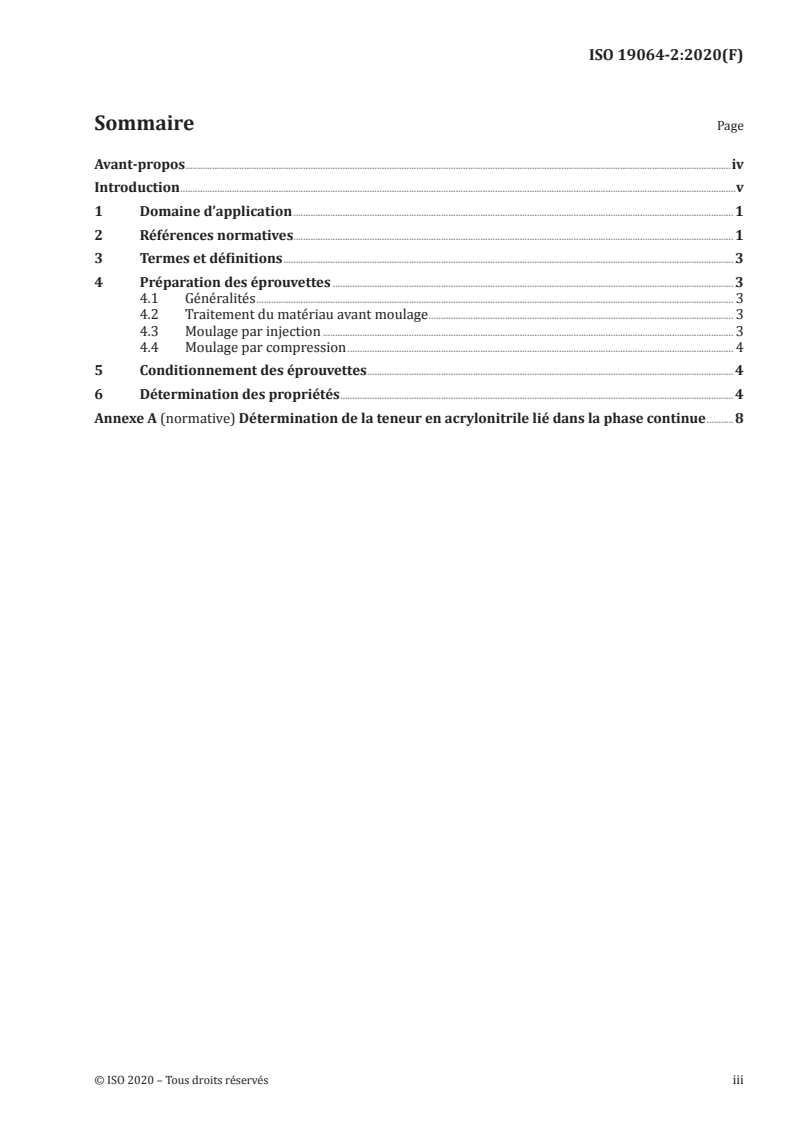
Sommaire Page
Avant-propos .iv
Introduction .v
1 Domaine d’application . 1
2 Références normatives . 1
3 Termes et définitions . 3
4 Préparation des éprouvettes . 3
4.1 Généralités . 3
4.2 Traitement du matériau avant moulage . 3
4.3 Moulage par injection . 3
4.4 Moulage par compression . 4
5 Conditionnement des éprouvettes . 4
6 Détermination des propriétés . 4
Annexe A (normative) Détermination de la teneur en acrylonitrile lié dans la phase continue .8
Avant-propos
L’ISO (Organisation internationale de normalisation) est une fédération mondiale d’organismes
nationaux de normalisation (comités membres de l’ISO). L’élaboration des Normes internationales est
en général confiée aux comités techniques de l’ISO. Chaque comité membre intéressé par une étude
a le droit de faire partie du comité technique créé à cet effet. Les organisations internationales,
gouvernementales et non gouvernementales, en liaison avec l’ISO participent également aux travaux.
L’ISO collabore étroitement avec la Commission électrotechnique internationale (IEC) en ce qui
concerne la normalisation électrotechnique.
Les procédures utilisées pour élaborer le présent document et celles destinées à sa mise à jour sont
décrites dans les Directives ISO/IEC, Partie 1. Il convient, en particulier, de prendre note des différents
critères d’approbation requis pour les différents types de documents ISO. Le présent document a été
rédigé conformément aux règles de rédaction données dans les Directives ISO/IEC, Partie 2 (voir www
.iso .org/ directives).
L’attention est attirée sur le fait que certains des éléments du présent document peuvent faire l’objet de
droits de propriété intellectuelle ou de droits analogues. L’ISO ne saurait être tenue pour responsable
de ne pas avoir identifié de tels droits de propriété et averti de leur existence. Les détails concernant
les références aux droits de propriété intellectuelle ou autres droits analogues identifiés lors de
l’élaboration du document sont indiqués dans l’Introduction et/ou dans la liste des déclarations de
brevets reçues par l’ISO (voir www .iso .org/ brevets).
Les appellations commerciales éventuellement mentionnées dans le présent document sont données
pour information, par souci de commodité, à l’intention des utilisateurs et ne sauraient constituer un
engagement.
Pour une explication de la nature volontaire des normes, la signification des termes et expressions
spécifiques de l’ISO liés à l’évaluation de la conformité, ou pour toute information au sujet de l’adhésion
de l’ISO aux principes de l’Organisation mondiale du commerce (OMC) concernant les obstacles
techniques au commerce (OTC), voir le lien suivant: www .iso .org/ iso/ fr/ avant -propos .html.
Le présent document a été élaboré par le comité technique ISO/TC 61, Plastiques, sous-comité SC 9,
Matériaux thermoplastiques, en collaboration avec le comité technique CEN/TC 249, Plastiques, du
Comité européen de normalisation (CEN) conformément à l'Accord de coopération technique entre l'ISO
et le CEN (Accord de Vienne).
Cette première édition de l’ISO 19064-2 annule et remplace l’ISO 4894-2:1995, qui a fait l’objet d’une
révision technique.
Les principales modifications par rapport à l’édition précédente sont les suivantes:
— les références normatives de l’Article 2 ont été mises à jour;
— l’ISO 3167 a été remplacée par l’ISO 20753;
— l’IEC 60093 a été remplacée par l’IEC 62631-3-1 et l’IEC 62631-3-2;
— l’IEC 60250 a été remplacée par l’IEC 62631-2-1;
— l’ISO 1183 a été remplacée par l’ISO 1183-1, l’ISO 1183-2 et l’ISO 1183-3.
Une liste de toutes les parties de la série ISO 19064 est disponible sur le site web de l’ISO.
Il convient que l’utilisateur adresse tout retour d’information ou toute question concernant le présent
document à l’organisme national de normalisation de son pays. Une liste exhaustive desdits organismes
se trouve à l’adresse www .iso .org/ fr/ members .html.
iv © ISO 2020 – Tous droits réservés
Introduction
De nombreuses méthodes permettent de déterminer les propriétés des plastiques. Pour certaines
d’entre elles, les données obtenues en utilisant des normes différentes ne sont pas comparables.
Les données obtenues ne sont pas forcément comparables, même lorsque les mêmes normes ont été
utilisées, car il est souvent possible d’adopter un large éventail de conditions d’essai différentes. Le
présent document a pour objet de spécifier les méthodes et conditions d’essai à utiliser pour l’acquisition
et la présentation des données, afin de garantir que des comparaisons valables peuvent être effectuées
entre les matériaux à base de styrène-acrylonitrile (SAN).
NORME INTERNATIONALE ISO 19064-2:2020(F)
Plastiques — Matériaux à base de styrène-acrylonitrile
(SAN) pour moulage et extrusion —
Partie 2:
Préparation des éprouvettes et détermination des
propriétés
1 Domaine d’application
Le présent document spécifie les méthodes de préparation des éprouvettes et les méthodes d’essai à
utiliser pour déterminer les propriétés des matériaux à base de styrène-acrylonitrile (SAN) pour
moulage et extrusion. Il donne les exigences relatives à la manipulation du matériau d’essai et au
conditionnement du matériau d’essai avant moulage et des éprouvettes avant essai.
Le présent document donne les modes opératoires et les conditions nécessaires à la préparation des
éprouvettes, ainsi que les modes opératoires de mesure des propriétés des matériaux à partir desquels
les éprouvettes sont obtenues. Il liste les propriétés et méthodes d’essai qui sont utiles et nécessaires
pour caractériser les matériaux pour moulage et extrusion à base de SAN.
Les propriétés ont été sélectionnées parmi les méthodes d’essai générales de l’ISO 10350-1. D’autres
méthodes d’essai largement utilisées ou qui revêtent une importance particulière pour ces matériaux
pour moulage et extrusion sont aussi incluses dans l’ISO 19064-1.
Les méthodes de préparation et de conditionnement, les dimensions d’éprouvette ainsi que les modes
opératoires d’essai spécifiés dans le présent document sont utilisés dans le but d’obtenir des résultats
d’essai reproductibles et comparables. Les valeurs déterminées ne sont pas toujours identiques à
celles obtenues en utilisant des éprouvettes de dimensions différentes ou préparées selon des modes
opératoires différents.
2 Références normatives
Les documents suivants cités dans le texte constituent, pour tout ou partie de leur contenu, des
exigences du présent document. Pour les références datées, seule l’édition citée s’applique. Pour les
références non datées, la dernière édition du document de référence s’applique (y compris les éventuels
amendements).
ISO 62, Plastiques — Détermination de l'absorption d'eau
ISO 75-1, Plastiques — Détermination de la température de fléchissement sous charge — Partie 1: Méthode
d’essai générale
ISO 75-2, Plastiques — Détermination de la température de fléchissement sous charge — Partie 2:
Plastiques et ébonite
ISO 178, Plastiques — Détermination des propriétés en flexion
ISO 179-1, Plastiques — Détermination des caractéristiques au choc Charpy — Partie 1: Essai de choc non
instrumenté
ISO 179-2, Plastiques — Détermination des caractéristiques au choc Charpy — Partie 2: Essai de choc
instrumenté
ISO 180, Plastiques — Détermination de la résistance au choc Izod
ISO 293, Plastiques — Moulage par compression des éprouvettes en matières thermoplastiques
ISO 294-1, Plastiques — Moulage par injection des éprouvettes de matériaux thermoplastiques — Partie 1:
Principes généraux, et moulage des éprouvettes à usages multiples et des barreaux
ISO 294-3, Plastiques — Moulage par injection des éprouvettes de matériaux thermoplastiques —
Partie 3: Plaques de petites dimensions
ISO 306, Plastiques — Matières thermoplastiques — Détermination de la température de ramollissement
Vicat (VST)
ISO 527-2, Plastiques — Détermination des propriétés en traction — Partie 2: Conditions d'essai des
plastiques pour moulage et extrusion
ISO 527-4, Plastiques — Détermination des propriétés en traction — Partie 4: Conditions d'essai pour les
composites plastiques renforcés de fibres isotropes et orthotropes
ISO 899-1, Plastiques — Détermination du comportement au fluage — Partie 1: Fluage en traction
ISO 1133-1, Plastiques — Détermination de l'indice de fluidité à chaud des thermoplastiques, en masse
(MFR) et en volume (MVR) — Partie 1: Méthode normale
ISO 1183-1, Plastiques — Méthodes de détermination de la masse volumique des plastiques non alvéolaires —
Partie 1: Méthode par immersion, méthode du pycnomètre en milieu liquide et méthode par titrage
ISO 1183-2, Plastiques — Méthodes de détermination de la masse volumique des plastiques non
alvéolaires — Partie 2: Méthode de la colonne à gradient de masse volumique
ISO 1183-3, Plastiques — Méthodes pour déterminer la masse volumique des plastiques non alvéolaires —
Partie 3: Méthode utilisant un pycnomètre à gaz
ISO 1656, Caoutchouc brut naturel et latex de caoutchouc naturel — Dosage de l'azote
ISO 2561, Plastiques — Détermination du styrène monomère résiduel dans le polystyrène (PS) et le
polystyrène résistant au choc (PS-I) par chromatographie en phase gazeuse
ISO 2818, Plastiques — Préparation des éprouvettes par usinage
ISO 4581, Plastiques — Copolymères styrène/acrylonitrile — Dosage de l'acrylonitrile monomère
résiduel — Méthode par chromatographie en phase gazeuse
ISO 4589-2, Plastiques — Détermination du comportement au feu au moyen de l'indice d'oxygène — Partie
2: Essai à la température ambiante
ISO 4589-3, Plastiques — Détermination du comportement au feu au moyen de l'indice d'oxygène — Partie
3: Essai à haute température
ISO 8256, Plastiques — Détermination de la résistance au choc-traction
ISO 10350-1, Plastiques — Acquisition et présentation de caractéristiques intrinsèques comparables —
Partie 1: Matériaux pour moulage
ISO 11357-1, Plastiques — Analyse calorimétrique différentielle (DSC) — Partie 1: Principes généraux
ISO 11357-2, Plastiques — Analyse calorimétrique différentielle (DSC) — Partie 2: Détermination de la
température de transition vitreuse et de la hauteur de palier de transition vitreuse
ISO 19064-1, Plastiques — Matériaux à base de styrène-acrylonitrile (SAN) pour moulage et extrusion —
Partie 1: Système de désignation et base de spécification
ISO 20753, Plastiques — Éprouvettes
2 © ISO 2020 – Tous droits réservés
IEC 60112, Méthode de détermination des indices de résistance et de tenue au cheminement des matériaux
isolants solides
IEC 60243-1, Rigidité diélectrique des matériaux isolants — Méthodes d’essai — Partie 1: Essais aux
fréquences industrielles
IEC 60296, Fluides pour applications électrotechniques — Huiles minérales isolantes neuves pour
transformateurs et appareillages de connexion
IEC 60695-11-10, Essais relatifs aux r
...
NORME ISO
INTERNATIONALE 19064-2
Première édition
2020-03
Plastiques — Matériaux à base de
styrène-acrylonitrile (SAN) pour
moulage et extrusion —
Partie 2:
Préparation des éprouvettes et
détermination des propriétés
Plastics — Styrene-acrylonitrile (SAN) moulding and extrusion
materials —
Part 2: Preparation of test specimens and determination of properties
Numéro de référence
©
ISO 2020
DOCUMENT PROTÉGÉ PAR COPYRIGHT
© ISO 2020
Tous droits réservés. Sauf prescription différente ou nécessité dans le contexte de sa mise en œuvre, aucune partie de cette
publication ne peut être reproduite ni utilisée sous quelque forme que ce soit et par aucun procédé, électronique ou mécanique,
y compris la photocopie, ou la diffusion sur l’internet ou sur un intranet, sans autorisation écrite préalable. Une autorisation peut
être demandée à l’ISO à l’adresse ci-après ou au comité membre de l’ISO dans le pays du demandeur.
ISO copyright office
Case postale 401 • Ch. de Blandonnet 8
CH-1214 Vernier, Genève
Tél.: +41 22 749 01 11
Fax: +41 22 749 09 47
E-mail: copyright@iso.org
Web: www.iso.org
Publié en Suisse
ii © ISO 2020 – Tous droits réservés
Sommaire Page
Avant-propos .iv
Introduction .v
1 Domaine d’application . 1
2 Références normatives . 1
3 Termes et définitions . 3
4 Préparation des éprouvettes . 3
4.1 Généralités . 3
4.2 Traitement du matériau avant moulage . 3
4.3 Moulage par injection . 3
4.4 Moulage par compression . 4
5 Conditionnement des éprouvettes . 4
6 Détermination des propriétés . 4
Annexe A (normative) Détermination de la teneur en acrylonitrile lié dans la phase continue .8
Avant-propos
L’ISO (Organisation internationale de normalisation) est une fédération mondiale d’organismes
nationaux de normalisation (comités membres de l’ISO). L’élaboration des Normes internationales est
en général confiée aux comités techniques de l’ISO. Chaque comité membre intéressé par une étude
a le droit de faire partie du comité technique créé à cet effet. Les organisations internationales,
gouvernementales et non gouvernementales, en liaison avec l’ISO participent également aux travaux.
L’ISO collabore étroitement avec la Commission électrotechnique internationale (IEC) en ce qui
concerne la normalisation électrotechnique.
Les procédures utilisées pour élaborer le présent document et celles destinées à sa mise à jour sont
décrites dans les Directives ISO/IEC, Partie 1. Il convient, en particulier, de prendre note des différents
critères d’approbation requis pour les différents types de documents ISO. Le présent document a été
rédigé conformément aux règles de rédaction données dans les Directives ISO/IEC, Partie 2 (voir www
.iso .org/ directives).
L’attention est attirée sur le fait que certains des éléments du présent document peuvent faire l’objet de
droits de propriété intellectuelle ou de droits analogues. L’ISO ne saurait être tenue pour responsable
de ne pas avoir identifié de tels droits de propriété et averti de leur existence. Les détails concernant
les références aux droits de propriété intellectuelle ou autres droits analogues identifiés lors de
l’élaboration du document sont indiqués dans l’Introduction et/ou dans la liste des déclarations de
brevets reçues par l’ISO (voir www .iso .org/ brevets).
Les appellations commerciales éventuellement mentionnées dans le présent document sont données
pour information, par souci de commodité, à l’intention des utilisateurs et ne sauraient constituer un
engagement.
Pour une explication de la nature volontaire des normes, la signification des termes et expressions
spécifiques de l’ISO liés à l’évaluation de la conformité, ou pour toute information au sujet de l’adhésion
de l’ISO aux principes de l’Organisation mondiale du commerce (OMC) concernant les obstacles
techniques au commerce (OTC), voir le lien suivant: www .iso .org/ iso/ fr/ avant -propos .html.
Le présent document a été élaboré par le comité technique ISO/TC 61, Plastiques, sous-comité SC 9,
Matériaux thermoplastiques, en collaboration avec le comité technique CEN/TC 249, Plastiques, du
Comité européen de normalisation (CEN) conformément à l'Accord de coopération technique entre l'ISO
et le CEN (Accord de Vienne).
Cette première édition de l’ISO 19064-2 annule et remplace l’ISO 4894-2:1995, qui a fait l’objet d’une
révision technique.
Les principales modifications par rapport à l’édition précédente sont les suivantes:
— les références normatives de l’Article 2 ont été mises à jour;
— l’ISO 3167 a été remplacée par l’ISO 20753;
— l’IEC 60093 a été remplacée par l’IEC 62631-3-1 et l’IEC 62631-3-2;
— l’IEC 60250 a été remplacée par l’IEC 62631-2-1;
— l’ISO 1183 a été remplacée par l’ISO 1183-1, l’ISO 1183-2 et l’ISO 1183-3.
Une liste de toutes les parties de la série ISO 19064 est disponible sur le site web de l’ISO.
Il convient que l’utilisateur adresse tout retour d’information ou toute question concernant le présent
document à l’organisme national de normalisation de son pays. Une liste exhaustive desdits organismes
se trouve à l’adresse www .iso .org/ fr/ members .html.
iv © ISO 2020 – Tous droits réservés
Introduction
De nombreuses méthodes permettent de déterminer les propriétés des plastiques. Pour certaines
d’entre elles, les données obtenues en utilisant des normes différentes ne sont pas comparables.
Les données obtenues ne sont pas forcément comparables, même lorsque les mêmes normes ont été
utilisées, car il est souvent possible d’adopter un large éventail de conditions d’essai différentes. Le
présent document a pour objet de spécifier les méthodes et conditions d’essai à utiliser pour l’acquisition
et la présentation des données, afin de garantir que des comparaisons valables peuvent être effectuées
entre les matériaux à base de styrène-acrylonitrile (SAN).
NORME INTERNATIONALE ISO 19064-2:2020(F)
Plastiques — Matériaux à base de styrène-acrylonitrile
(SAN) pour moulage et extrusion —
Partie 2:
Préparation des éprouvettes et détermination des
propriétés
1 Domaine d’application
Le présent document spécifie les méthodes de préparation des éprouvettes et les méthodes d’essai à
utiliser pour déterminer les propriétés des matériaux à base de styrène-acrylonitrile (SAN) pour
moulage et extrusion. Il donne les exigences relatives à la manipulation du matériau d’essai et au
conditionnement du matériau d’essai avant moulage et des éprouvettes avant essai.
Le présent document donne les modes opératoires et les conditions nécessaires à la préparation des
éprouvettes, ainsi que les modes opératoires de mesure des propriétés des matériaux à partir desquels
les éprouvettes sont obtenues. Il liste les propriétés et méthodes d’essai qui sont utiles et nécessaires
pour caractériser les matériaux pour moulage et extrusion à base de SAN.
Les propriétés ont été sélectionnées parmi les méthodes d’essai générales de l’ISO 10350-1. D’autres
méthodes d’essai largement utilisées ou qui revêtent une importance particulière pour ces matériaux
pour moulage et extrusion sont aussi incluses dans l’ISO 19064-1.
Les méthodes de préparation et de conditionnement, les dimensions d’éprouvette ainsi que les modes
opératoires d’essai spécifiés dans le présent document sont utilisés dans le but d’obtenir des résultats
d’essai reproductibles et comparables. Les valeurs déterminées ne sont pas toujours identiques à
celles obtenues en utilisant des éprouvettes de dimensions différentes ou préparées selon des modes
opératoires différents.
2 Références normatives
Les documents suivants cités dans le texte constituent, pour tout ou partie de leur contenu, des
exigences du présent document. Pour les références datées, seule l’édition citée s’applique. Pour les
références non datées, la dernière édition du document de référence s’applique (y compris les éventuels
amendements).
ISO 62, Plastiques — Détermination de l'absorption d'eau
ISO 75-1, Plastiques — Détermination de la température de fléchissement sous charge — Partie 1: Méthode
d’essai générale
ISO 75-2, Plastiques — Détermination de la température de fléchissement sous charge — Partie 2:
Plastiques et ébonite
ISO 178, Plastiques — Détermination des propriétés en flexion
ISO 179-1, Plastiques — Détermination des caractéristiques au choc Charpy — Partie 1: Essai de choc non
instrumenté
ISO 179-2, Plastiques — Détermination des caractéristiques au choc Charpy — Partie 2: Essai de choc
instrumenté
ISO 180, Plastiques — Détermination de la résistance au choc Izod
ISO 293, Plastiques — Moulage par compression des éprouvettes en matières thermoplastiques
ISO 294-1, Plastiques — Moulage par injection des éprouvettes de matériaux thermoplastiques — Partie 1:
Principes généraux, et moulage des éprouvettes à usages multiples et des barreaux
ISO 294-3, Plastiques — Moulage par injection des éprouvettes de matériaux thermoplastiques —
Partie 3: Plaques de petites dimensions
ISO 306, Plastiques — Matières thermoplastiques — Détermination de la température de ramollissement
Vicat (VST)
ISO 527-2, Plastiques — Détermination des propriétés en traction — Partie 2: Conditions d'essai des
plastiques pour moulage et extrusion
ISO 527-4, Plastiques — Détermination des propriétés en traction — Partie 4: Conditions d'essai pour les
composites plastiques renforcés de fibres isotropes et orthotropes
ISO 899-1, Plastiques — Détermination du comportement au fluage — Partie 1: Fluage en traction
ISO 1133-1, Plastiques — Détermination de l'indice de fluidité à chaud des thermoplastiques, en masse
(MFR) et en volume (MVR) — Partie 1: Méthode normale
ISO 1183-1, Plastiques — Méthodes de détermination de la masse volumique des plastiques non alvéolaires —
Partie 1: Méthode par immersion, méthode du pycnomètre en milieu liquide et méthode par titrage
ISO 1183-2, Plastiques — Méthodes de détermination de la masse volumique des plastiques non
alvéolaires — Partie 2: Méthode de la colonne à gradient de masse volumique
ISO 1183-3, Plastiques — Méthodes pour déterminer la masse volumique des plastiques non alvéolaires —
Partie 3: Méthode utilisant un pycnomètre à gaz
ISO 1656, Caoutchouc brut naturel et latex de caoutchouc naturel — Dosage de l'azote
ISO 2561, Plastiques — Détermination du styrène monomère résiduel dans le polystyrène (PS) et le
polystyrène résistant au choc (PS-I) par chromatographie en phase gazeuse
ISO 2818, Plastiques — Préparation des éprouvettes par usinage
ISO 4581, Plastiques — Copolymères styrène/acrylonitrile — Dosage de l'acrylonitrile monomère
résiduel — Méthode par chromatographie en phase gazeuse
ISO 4589-2, Plastiques — Détermination du comportement au feu au moyen de l'indice d'oxygène — Partie
2: Essai à la température ambiante
ISO 4589-3, Plastiques — Détermination du comportement au feu au moyen de l'indice d'oxygène — Partie
3: Essai à haute température
ISO 8256, Plastiques — Détermination de la résistance au choc-traction
ISO 10350-1, Plastiques — Acquisition et présentation de caractéristiques intrinsèques comparables —
Partie 1: Matériaux pour moulage
ISO 11357-1, Plastiques — Analyse calorimétrique différentielle (DSC) — Partie 1: Principes généraux
ISO 11357-2, Plastiques — Analyse calorimétrique différentielle (DSC) — Partie 2: Détermination de la
température de transition vitreuse et de la hauteur de palier de transition vitreuse
ISO 19064-1, Plastiques — Matériaux à base de styrène-acrylonitrile (SAN) pour moulage et extrusion —
Partie 1: Système de désignation et base de spécification
ISO 20753, Plastiques — Éprouvettes
2 © ISO 2020 – Tous droits réservés
IEC 60112, Méthode de détermination des indices de résistance et de tenue au cheminement des matériaux
isolants solides
IEC 60243-1, Rigidité diélectrique des matériaux isolants — Méthodes d’essai — Partie 1: Essais aux
fréquences industrielles
IEC 60296, Fluides pour applications électrotechniques — Huiles minérales isolantes neuves pour
transformateurs et appareillages de connexion
IEC 60695-11-10, Essais relatifs aux r
...