


ISO 10993-6
(Main)Biological evaluation of medical devices — Part 6: Tests for local effects after implantation
Biological evaluation of medical devices — Part 6: Tests for local effects after implantation
Évaluation biologique des dispositifs médicaux — Partie 6: Essais concernant les effets locaux après implantation
General Information
- Status
- Not Published
- Technical Committee
- ISO/TC 194 - Biological and clinical evaluation of medical devices
- Drafting Committee
- ISO/TC 194 - Biological and clinical evaluation of medical devices
- Current Stage
- 6000 - International Standard under publication
- Start Date
- 20-Dec-2025
- Completion Date
- 12-Feb-2026
Relations
- Effective Date
- 12-Feb-2026
- Effective Date
- 06-Jun-2022
Overview
ISO 10993-6:2025 - "Biological evaluation of medical devices - Part 6: Tests for local effects after implantation" defines requirements and methods for preclinical implantation testing to assess local tissue responses to medical devices, materials and tissue-engineered products. The standard focuses on characterizing local effects (integration, degradation, absorption) at anatomically relevant implantation sites using appropriate animal models and controls. This is the fourth edition (FDIS 2025) of Part 6 in the ISO 10993 biocompatibility series.
Key Topics and Requirements
- Scope and purpose: Specifies implantation test methods for solid and non-solid materials (porous materials, gels, pastes, powders, particulates), absorbable or non-absorbable, and TEMPs. It is not intended to evaluate mechanical performance or replace systemic toxicity, carcinogenicity, teratogenicity or mutagenicity testing.
- Sample preparation: Test and control samples must be in final finished state and documented per ISO 10993-12. Use of smaller compositionally representative coupons is allowed where justified.
- Controls: Guidance on selection of comparative controls (materials with established clinical history) and reference controls (well-characterized inert materials) to support interpretation of local effects.
- Animal models and welfare: Selection of species, implantation site and test periods, surgical conditions and humane endpoints must comply with animal welfare requirements and ISO 10993-2.
- Test methods and sites: Normative annexes provide methods for implantation in subcutaneous tissue, muscle, bone and neural tissue, with informative annexes for peripheral nerve contact and microscopic scoring systems.
- Evaluation and reporting: Detailed requirements for macroscopic and microscopic evaluation, timepoints, histological procedures, and comprehensive test reports (laboratory, sample, animal and retrieval data).
- Quality systems: Studies should be performed in accredited facilities under GLP or recognized quality assurance systems.
Applications and Users
ISO 10993-6 is essential for:
- Medical device manufacturers performing biocompatibility risk assessment for implanted devices or materials.
- Preclinical researchers designing implantation studies and histopathological evaluation.
- Regulatory affairs and quality teams preparing documentation for submissions (including alignment with EU MDR requirements referenced in Annex ZA).
- Notified bodies and test laboratories assessing local tissue compatibility.
Practical uses include evaluating tissue responses to implants, choosing appropriate controls and test sites, designing study protocols that minimize animal use, and supporting regulatory submissions with robust preclinical data.
Related Standards
- ISO 10993-1 (general principles)
- ISO 10993-2 (animal welfare)
- ISO 10993-4 (blood interactions)
- ISO 10993-9 (degradation products framework)
- ISO 10993-12 (sample preparation)
- ISO 10993-16 (toxicokinetics)
Keywords: ISO 10993-6, biological evaluation, implantation tests, local effects after implantation, medical device biocompatibility, preclinical implantation testing.

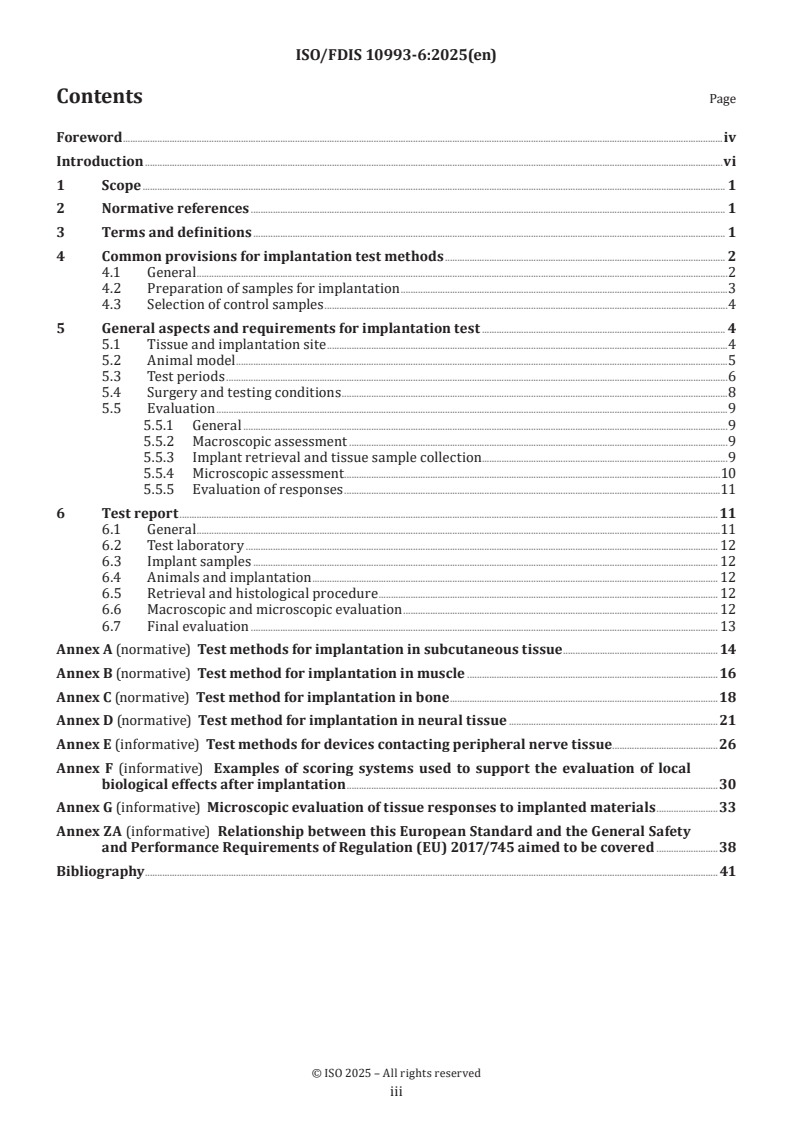
ISO/FDIS 10993-6 - Biological evaluation of medical devices — Part 6: Tests for local effects after implantation Released:10/10/2025
REDLINE ISO/FDIS 10993-6 - Biological evaluation of medical devices — Part 6: Tests for local effects after implantation Released:10/10/2025

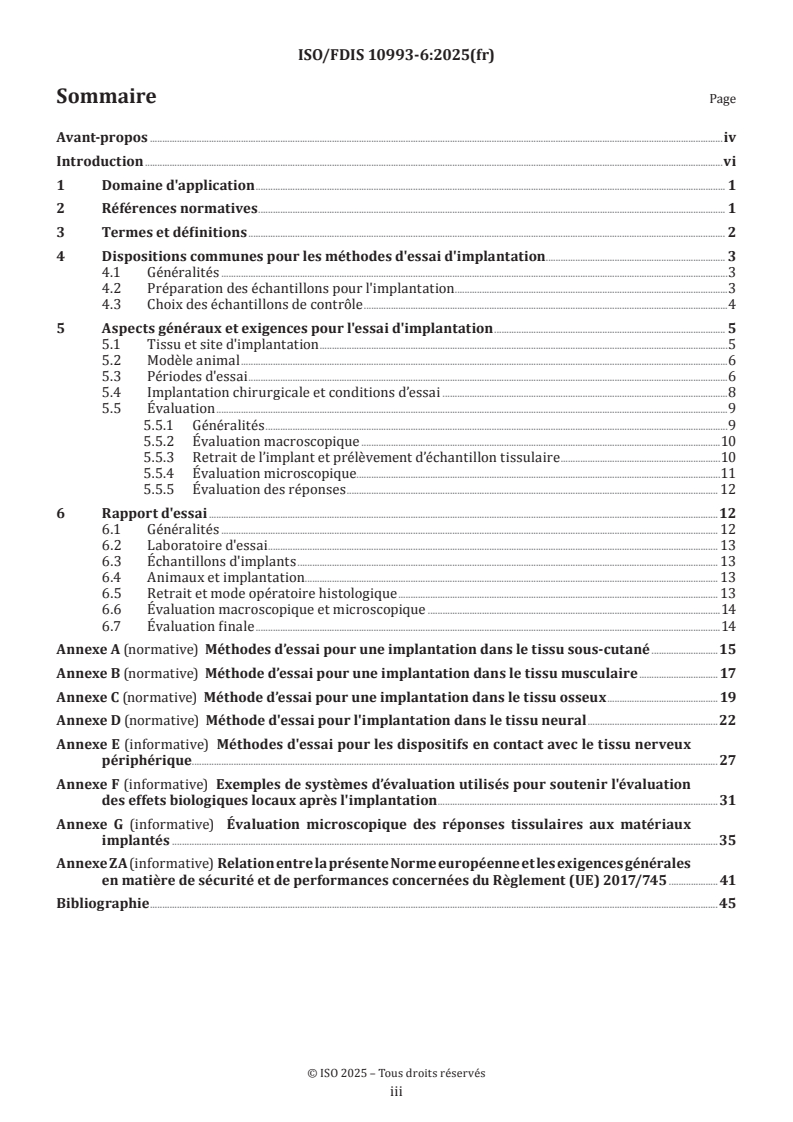
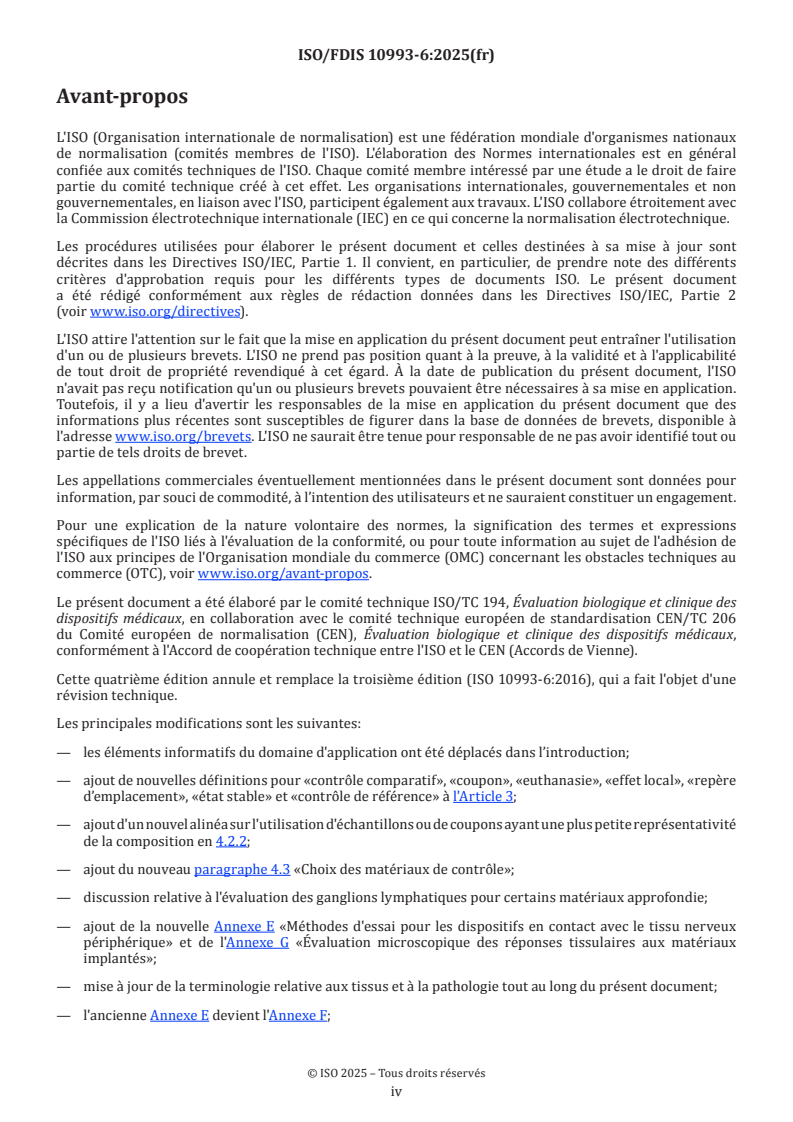
ISO 10993-6 - Évaluation biologique des dispositifs médicaux — Partie 6: Essais concernant les effets locaux après implantation Released:15. 12. 2025
Get Certified
Connect with accredited certification bodies for this standard

BSI Group
BSI (British Standards Institution) is the business standards company that helps organizations make excellence a habit.

TÜV Rheinland
TÜV Rheinland is a leading international provider of technical services.

TÜV SÜD
TÜV SÜD is a trusted partner of choice for safety, security and sustainability solutions.
Sponsored listings
Frequently Asked Questions
ISO 10993-6 is a draft published by the International Organization for Standardization (ISO). Its full title is "Biological evaluation of medical devices — Part 6: Tests for local effects after implantation". This standard covers: Biological evaluation of medical devices — Part 6: Tests for local effects after implantation
Biological evaluation of medical devices — Part 6: Tests for local effects after implantation
ISO 10993-6 is classified under the following ICS (International Classification for Standards) categories: 11.100.20 - Biological evaluation of medical devices. The ICS classification helps identify the subject area and facilitates finding related standards.
ISO 10993-6 has the following relationships with other standards: It is inter standard links to FprEN ISO 10993-6, ISO 10993-6:2016. Understanding these relationships helps ensure you are using the most current and applicable version of the standard.
ISO 10993-6 is available in PDF format for immediate download after purchase. The document can be added to your cart and obtained through the secure checkout process. Digital delivery ensures instant access to the complete standard document.
Standards Content (Sample)
FINAL DRAFT
International
Standard
ISO/FDIS 10993-6
ISO/TC 194
Biological evaluation of medical
Secretariat: DIN
devices —
Voting begins on:
2025-10-24
Part 6:
Tests for local effects after
Voting terminates on:
2025-12-19
implantation
Évaluation biologique des dispositifs médicaux —
Partie 6: Essais concernant les effets locaux après implantation
RECIPIENTS OF THIS DRAFT ARE INVITED TO SUBMIT,
WITH THEIR COMMENTS, NOTIFICATION OF ANY
RELEVANT PATENT RIGHTS OF WHICH THEY ARE AWARE
AND TO PROVIDE SUPPOR TING DOCUMENTATION.
IN ADDITION TO THEIR EVALUATION AS
BEING ACCEPTABLE FOR INDUSTRIAL, TECHNO-
ISO/CEN PARALLEL PROCESSING LOGICAL, COMMERCIAL AND USER PURPOSES, DRAFT
INTERNATIONAL STANDARDS MAY ON OCCASION HAVE
TO BE CONSIDERED IN THE LIGHT OF THEIR POTENTIAL
TO BECOME STAN DARDS TO WHICH REFERENCE MAY BE
MADE IN NATIONAL REGULATIONS.
Reference number
ISO/FDIS 10993-6:2025(en) © ISO 2025
FINAL DRAFT
ISO/FDIS 10993-6:2025(en)
International
Standard
ISO/FDIS 10993-6
ISO/TC 194
Biological evaluation of medical
Secretariat: DIN
devices —
Voting begins on:
Part 6:
Tests for local effects after
Voting terminates on:
implantation
Évaluation biologique des dispositifs médicaux —
Partie 6: Essais concernant les effets locaux après implantation
RECIPIENTS OF THIS DRAFT ARE INVITED TO SUBMIT,
WITH THEIR COMMENTS, NOTIFICATION OF ANY
RELEVANT PATENT RIGHTS OF WHICH THEY ARE AWARE
AND TO PROVIDE SUPPOR TING DOCUMENTATION.
© ISO 2025
IN ADDITION TO THEIR EVALUATION AS
All rights reserved. Unless otherwise specified, or required in the context of its implementation, no part of this publication may
BEING ACCEPTABLE FOR INDUSTRIAL, TECHNO-
ISO/CEN PARALLEL PROCESSING
LOGICAL, COMMERCIAL AND USER PURPOSES, DRAFT
be reproduced or utilized otherwise in any form or by any means, electronic or mechanical, including photocopying, or posting on
INTERNATIONAL STANDARDS MAY ON OCCASION HAVE
the internet or an intranet, without prior written permission. Permission can be requested from either ISO at the address below
TO BE CONSIDERED IN THE LIGHT OF THEIR POTENTIAL
or ISO’s member body in the country of the requester.
TO BECOME STAN DARDS TO WHICH REFERENCE MAY BE
MADE IN NATIONAL REGULATIONS.
ISO copyright office
CP 401 • Ch. de Blandonnet 8
CH-1214 Vernier, Geneva
Phone: +41 22 749 01 11
Email: copyright@iso.org
Website: www.iso.org
Published in Switzerland Reference number
ISO/FDIS 10993-6:2025(en) © ISO 2025
ii
ISO/FDIS 10993-6:2025(en)
Contents Page
Foreword .iv
Introduction .vi
1 Scope . 1
2 Normative references . 1
3 Terms and definitions . 1
4 Common provisions for implantation test methods . 2
4.1 General .2
4.2 Preparation of samples for implantation .3
4.3 Selection of control samples .4
5 General aspects and requirements for implantation test . 4
5.1 Tissue and implantation site .4
5.2 Animal model .5
5.3 Test periods .6
5.4 Surgery and testing conditions .8
5.5 Evaluation .9
5.5.1 General .9
5.5.2 Macroscopic assessment .9
5.5.3 Implant retrieval and tissue sample collection .9
5.5.4 Microscopic assessment .10
5.5.5 Evaluation of responses .11
6 Test report .11
6.1 General .11
6.2 Test laboratory . 12
6.3 Implant samples . 12
6.4 Animals and implantation . 12
6.5 Retrieval and histological procedure . 12
6.6 Macroscopic and microscopic evaluation . 12
6.7 Final evaluation . 13
Annex A (normative) Test methods for implantation in subcutaneous tissue . 14
Annex B (normative) Test method for implantation in muscle .16
Annex C (normative) Test method for implantation in bone .18
Annex D (normative) Test method for implantation in neural tissue .21
Annex E (informative) Test methods for devices contacting peripheral nerve tissue .26
Annex F (informative) Examples of scoring systems used to support the evaluation of local
biological effects after implantation .30
Annex G (informative) Microscopic evaluation of tissue responses to implanted materials .33
Annex ZA (informative) Relationship between this European Standard and the General Safety
and Performance Requirements of Regulation (EU) 2017/745 aimed to be covered .38
Bibliography . 41
iii
ISO/FDIS 10993-6:2025(en)
Foreword
ISO (the International Organization for Standardization) is a worldwide federation of national standards
bodies (ISO member bodies). The work of preparing International Standards is normally carried out through
ISO technical committees. Each member body interested in a subject for which a technical committee
has been established has the right to be represented on that committee. International organizations,
governmental and non-governmental, in liaison with ISO, also take part in the work. ISO collaborates closely
with the International Electrotechnical Commission (IEC) on all matters of electrotechnical standardization.
The procedures used to develop this document and those intended for its further maintenance are described
in the ISO/IEC Directives, Part 1. In particular, the different approval criteria needed for the different types
of ISO document should be noted. This document was drafted in accordance with the editorial rules of the
ISO/IEC Directives, Part 2 (see www.iso.org/directives).
ISO draws attention to the possibility that the implementation of this document may involve the use of (a)
patent(s). ISO takes no position concerning the evidence, validity or applicability of any claimed patent
rights in respect thereof. As of the date of publication of this document, ISO had not received notice of (a)
patent(s) which may be required to implement this document. However, implementers are cautioned that
this may not represent the latest information, which may be obtained from the patent database available at
www.iso.org/patents. ISO shall not be held responsible for identifying any or all such patent rights.
Any trade name used in this document is information given for the convenience of users and does not
constitute an endorsement.
For an explanation of the voluntary nature of standards, the meaning of ISO specific terms and expressions
related to conformity assessment, as well as information about ISO's adherence to the World Trade
Organization (WTO) principles in the Technical Barriers to Trade (TBT), see www.iso.org/iso/foreword.html.
This document was prepared by Technical Committee ISO/TC 194, Biological and clinical evaluation of medical
devices, in collaboration with the European Committee for Standardization (CEN) Technical Committee CEN/
TC 206, Biological and clinical evaluation of medical devices, in accordance with the Agreement on technical
cooperation between ISO and CEN (Vienna Agreement).
This fourth edition cancels and replaces the third edition (ISO 10993-6:2016), which has been technically
revised.
The main changes are as follows:
— informative elements of the scope have been moved to the introduction;
— new definitions for “comparative control”, “coupon”, “euthanasia”, “local effect”, “location marker”,
“steady-state” and “reference control” have been added to Clause 3;
— a new paragraph on the use of smaller compositionally representative samples or coupons has been
added to 4.2.2;
— a new subclause 4.3 “Selection of control materials” has been added;
— the discussion of assessment of lymph nodes for certain materials has been expanded;
— a new Annex E “Test methods for devices contacting peripheral nerve tissue” and Annex G “Microscopic
evaluation of tissue responses to implanted materials” have been added;
— tissue and pathological terminology has been updated throughout this document;
— the old Annex E has become Annex F;
— bibliographical entries have been updated;
— this document has been revised editorially.
A list of all parts in the ISO 10993 series can be found on the ISO website.
iv
ISO/FDIS 10993-6:2025(en)
Any feedback or questions on this document should be directed to the user’s national standards body. A
complete listing of these bodies can be found at www.iso.org/members.html.
v
ISO/FDIS 10993-6:2025(en)
Introduction
The objective of the implantation test methods is to characterize the local tissue response after implantation
of a medical device or material (test sample) including integration, degradation, or absorption in an
appropriate animal model.
The test sample is implanted into an anatomical site appropriate for the evaluation of the local effects of the
medical device (or portion of) in an animal.
The medical device or material local effects are evaluated by a comparison of the tissue response caused
by a test sample to that caused by comparative or reference control samples used in medical devices whose
clinical acceptability and biocompatibility characteristics have been established.
Careful study design can include other relevant end points to reduce the number of animals used to evaluate
safety and efficacy while accomplishing all study objectives. Additionally, a long-term systemic toxicity study
that is designed to incorporate the methods, end points, additional timepoints and outcomes of implantation
testing can satisfy the requirements of this document and ISO 10993-11.
vi
FINAL DRAFT International Standard ISO/FDIS 10993-6:2025(en)
Biological evaluation of medical devices —
Part 6:
Tests for local effects after implantation
1 Scope
This document specifies requirements for implantation test methods for preclinical assessment of the local
effects after implantation of medical devices or materials intended for use in medical devices. In order to
evaluate local tissue responses from medical devices that are intended to be used where skin or mucosal
tissue is breached, this document is applicable when required.
This document is applicable to medical device or materials that require implantation evaluation and can be
solid or non-solid (such as porous materials, liquids, gels, pastes, powders, and particulates), absorbable,
degradable, non- absorbable, or can be tissue-engineered medical products (TEMPs).
These implantation tests are not intended to evaluate or determine the performance of the test sample in
terms of mechanical loading or functional performance. This document also does not provide guidance on
methods and study design to satisfy requirements for systemic toxicity, carcinogenicity, teratogenicity or
mutagenicity. However, the study designs can be modified to also assess other biological effects.
2 Normative references
The following documents are referred to in the text in such a way that some or all of their content constitutes
requirements of this document. For dated references, only the edition cited applies. For undated references,
the latest edition of the referenced document (including any amendments) applies.
ISO 10993-1, Biological evaluation of medical devices — Part 1: Requirements and general principles for the
evaluation of biological safety within a risk management process
ISO 10993-2, Biological evaluation of medical devices — Part 2: Animal welfare requirements
ISO 10993-4, Biological evaluation of medical devices — Part 4: Selection of tests for interactions with blood
ISO 10993-9, Biological evaluation of medical devices — Part 9: Framework for identification and quantification
of potential degradation products
ISO 10993-12, Biological evaluation of medical devices — Part 12: Sample preparation and reference materials
ISO 10993-16, Biological evaluation of medical devices — Part 16: Toxicokinetic study design for degradation
products and leachables
3 Terms and definitions
For the purposes of this document, the terms and definitions given in in ISO 10993-1, ISO 10993-2,
ISO 10993-4, ISO 10993-9, ISO 10993-12, ISO 10993-16 and the following apply.
ISO and IEC maintain terminology databases for use in standardization at the following addresses:
— ISO Online browsing platform: available at https:// www .iso .org/ obp
— IEC Electropedia: available at https:// www .electropedia .org/
ISO/FDIS 10993-6:2025(en)
3.1
absorb
action of a non-endogenous (foreign) material or substance, or its decomposition products passing through
or being assimilated by cells and tissue over time
3.2
comparative control
medical device or material with a history of safe clinical use that is used as a point of comparison for a new
medical device seeking regulatory approval
3.3
coupon
multiple smaller compositionally representative portions of a more complex or larger device that together
contain all materials, surface finishes, and processing as the final, finished device
3.4
degradation product
intermediate or final substance which results from the physical, metabolic, or chemical decomposition of a
material or substance
[SOURCE: ISO/TS 37137-1:2021, 3.2, modified — “and/or” has been changed to “or” and “agent” has been
replaced by “substance”.]
3.5
degrade
physically, metabolically, and/or chemically decompose a material or substance
[SOURCE: ISO/TS 37137-1:2021, 3.3]
3.6
euthanasia
humane killing of an animal by a method causing minimal physical and mental suffering
[SOURCE: ISO 10993-2:2022, 3.5]
3.7
local effect
tissue response to an implanted test sample that can be seen with gross pathology and histopathology at the
site of test sample administration or implantation
3.8
location marker
inert, non-absorbable material or process used to mark the location in tissue of an implanted material
3.9
steady-state
biologically stable condition wherein change in the test system’s cellular activity, morphology or features is
no longer detected over a period of time
3.10
reference control
material with known properties considered to be generally inert in terms of biological local tissue effects
and has been established in a historical basis within a pharmacopeia or similar standard
4 Common provisions for implantation test methods
4.1 General
The ISO 10993 series requires animal testing to be avoided unless the required data cannot be obtained by
other means. Prior to choosing to pursue implantation studies, consideration to the type of data required,
ISO/FDIS 10993-6:2025(en)
the appropriate method and approach to implantation studies should be given to ensure that the data
collected covers the concerns for biological reactivity. It is important that the study be planned in sufficient
detail such that all relevant information can be extracted from the use of each animal and each study plan or
protocol according to ISO 10993-2, ISO 10993-11 and ISO 10993-16. The implantation tests shall be planned
and documented in the study documentation, including the information on the selected test methods, test
samples, test animals, implantation sites, test duration, measurement frequencies, assessment methods
and evaluation. When relevant vertical standards exist, refer to those as guidance for biological specific
evaluation (e.g. ISO 15798, ISO 11979-5, ISO 7405, ISO 14708 series, ISO 5840 series).
All animal studies shall be performed in a facility approved by a nationally recognized organization and in
accordance with all appropriate regulations dealing with laboratory animal welfare to conform with the
requirements of ISO 10993-2. These studies shall be performed under Good Laboratory Practices or other
recognized, quality assurance systems. While pilot implant studies can or cannot be conducted under Good
Laboratory Practices, the test facility should have an adequate quality system.
The provisions of this clause shall apply to the test methods specified in Annex A, Annex B, Annex C and
Annex D.
4.2 Preparation of samples for implantation
4.2.1 Test and control samples shall be in a final finished state as described in ISO 10993-12 (unless used
in a pilot study). The implant size and shape shall be documented and justified. For certain devices, clinically
relevant dosing can be considered. A justification should be provided to demonstrate mimicking a clinically
relevant dose in the implantation study.
Test samples for various implant sites are described in Annex A, Annex B, Annex C, and Annex D. Physical
properties (such as form, density, hardness, surface porosity and texture), geometrical characteristics (form,
shape and size), and composition can influence the character of the tissue response to the test material and
shall be recorded and taken into account when the response is characterized. Comparative control samples
should be matched as closely as reasonably possible for physical properties and geometrical (form and
shape) characteristics. Otherwise, a reference control (well characterized material with a well characterized
response) can be used, such as high density polyethylene (HDPE).
Additional control samples may be included in the study to help interpret tissue reactions [e.g. in case of
combination drugs, an additional control such as a placebo device (without drug) can be considered].
4.2.2 Each implant shall be manufactured, processed, cleaned of contaminants, and sterilized by the
method intended for the final product and this shall be confirmed in the study documentation. After final
preparation and sterilization, the implant samples shall be handled aseptically and in such a way as to
ensure that they are not damaged or contaminated in any way prior to or during implantation.
The use of smaller test samples or test coupons that are consistent with the requirements as described in
ISO 10993-12 can be relevant if the medical device to be tested cannot be tested as is, due to size or complex
geometry. The test samples or test coupons shall contain all tissue-contacting materials and surface finishes
as in the final, finished medical device. For medical devices comprising two or more different materials,
implanted test samples should be of similar composition, surface finish and include each individual material
to the final product. Alternatively, with multiple materials it can be necessary to implant several coupons
together, each containing a subset of device materials. The potential for synergies and interactions of
different materials in the final product should be considered in the choice of test sample.
NOTE Refer to the respective annexes for guidance on the number of test and control samples for each material
and implantation period.
4.2.3 For materials used as scaffolds for tissue-engineered medical products, it can be appropriate not
to use the final preparation pre-populated with cells or proteins, as the immune reaction of the animal
to human cellular or protein components of such products and the reaction of the cells to the animal can
interfere with the resulting local tissue response, making it difficult to interpret.
ISO/FDIS 10993-6:2025(en)
NOTE 1 Implantation in an appropriate immune-deficient animal, can be an option to avoid the xenograft responses,
if justified.
NOTE 2 Products with living cells are not considered medical devices in all jurisdictions.
4.2.4 For multicomponent material device designed to be cured prior to placement, the components
shall be mixed before use and allowed to set before implantation. However, materials that are designed to
polymerize in situ (e.g. bone cements, many dental materials, tissue sealants and glues) shall be introduced
in a manner such that in situ polymerization occurs. The procedure used shall be justified and documented.
4.3 Selection of control samples
The process of implanting any material in tissue induces some degree of cellular response. In the evaluation
of material local effects after implantation, the choice of control samples is important in determining
the acceptability of the observed tissue reaction to the test sample. Evaluation should be performed by
comparing the tissue reaction to that of a similar material (comparative control) whose clinical acceptability
and biocompatibility characteristics have been established. The geometrical and physical characteristics
such as shape, size, curvature and especially the surface condition (including porosity and texture) of the
article control(s), should be as similar to that of the implant test samples as is practical. Any deviations
shall be explained, justified and recorded. If no appropriate comparative control is available, a reference
control can be used. For further guidance, see ISO 10993-12. For example, reference materials as specified in
ISO 10993-12:2021, Table A.1, negative control can provide a good control for solid, smooth, non-absorbable
materials. Conversely, the reaction can likely be different if it is used to compare against a non-absorbable or
degradable hernia mesh due to the differing physical form characteristics. Ideally, a commercially available
material should be used as a comparative control so the tissue reaction is similar to what has been clinically
proven. For non-absorbable medical devices or materials, a comparative control shall be used made of a
stable non-absorbable comparative material (see Annex A, Annex B, Annex C and Annex D).
Since absorbable materials encounter changing tissue responses as degradation proceeds at rates that differ
based on composition, processing and sterilization techniques, similar absorbable comparative medical
device or material controls should be considered.
The absorption rate of the control material or medical device should be similar to the test material or medical
device (for more information, see ISO/TS 37137-1). Alternatively, a non-absorbable comparative control can
be used, if justified (e.g. there are no clinically relevant absorbable controls). If a comparative control is used,
typically reference materials as specified in ISO 10993-12:2021, Annex A are also implanted into the animal
for comparison and serving as a procedural control yielding a total of three separate articles included in the
study. For novel materials or medical devices, if a commercially available comparative material or medical
device does not exist, the choice of a control that is as close as possible is preferred. The nature of any
adverse inflammatory response or high reactivity rating or similar histopathological evaluation conclusion
should be discussed in the context of the control article chosen. The choice of control shall be documented
and justified. If no control or a sham control is used, this also shall be documented and justified.
5 General aspects and requirements for implantation test
5.1 Tissue and implantation site
5.1.1 The test sample shall be implanted into or onto the tissues most relevant to the intended clinical use
of the material. The justification for the choice of sample numbers, tissue, implantation sites and test period
shall be documented. Test methods for various implantation sites are given in Annex A, Annex B, Annex C
and Annex D. If other implantation sites are chosen, the general scientific principles behind the test methods
described in Annex A, Annex B, Annex C and Annex D shall still be adhered to and a justification be provided
for selecting an anatomical location that does not align with the use of the device.
NOTE For some devices, there are vertical standards prescribing specific implant studies to evaluate local tissue
responses, e.g. for intraocular lens implant (see ISO 11979-5) and dental devices (see ISO 7405). The studies described
in the standards can be used to satisfy the requirements in ISO 10993-6.
ISO/FDIS 10993-6:2025(en)
5.1.2 For absorbable materials, the implantation site shall be marked in a manner suitable for identification
of the site at the end of the designated time periods, taking into consideration the growth and aging of the
implanted animal(s). The use of a non-invasive permanent skin marker or a template marking the placement
of the sample is recommended as a single application for short-term study intervals only. This method of
marking can come off as skin exfoliates and requires remarking as often as needed to maintain the marked
site. Additionally, in many laboratory animals, the loose highly mobile skin limits the precision of marking
sites that are deeper than skin. In most circumstances, a location marker comprising an appropriate non-
absorbable inert or biocompatible material (e.g. HDPE 1 mm by 2 mm by 5 mm, polypropylene suture, gold
band, clips) may be used to identify the location of the implant site. These location markers should be far
enough away from each implant site to not induce changes in the local tissue reaction to the implanted
material. If this is not possible, i.e. the marker of the implanted material is adjacent to or on the edge of the
implanted material, then the tissue reaction to this marker should not be included in the evaluation of the
tissue reaction to the implanted material.
5.1.3 A sham surgical procedure can be used to evaluate the impact of the procedure on the tissue involved;
in these cases, the specific justification shall be provided. If a sham surgical procedure is performed, the
same implantation procedure that is used for the test or control should be used for the sham procedure.
5.2 Animal model
5.2.1 All aspects of animal care and accommodation shall be performed in accordance with ISO 10993-2.
5.2.2 Animals are used to evaluate local effects following implantation and are described as animal
models in the context of this document. In general, small laboratory animals such as mice, rats, guinea-pigs
or rabbits are preferred. The use of larger animals such as dogs, sheep, goats or pigs may be justified based
upon special scientific considerations of the test sample under study, length of study in relation to animal
life expectancy, or if needed to accommodate implant size, with whole device testing or applicable sham
defect size.
5.2.3 Select an animal species in line with the principles set out in ISO 10993-2, giving due consideration
to the size of the implant test samples, the number of implants per animal, the intended duration of the
test in relation to the expected lifespan of the animals, as well as potential species' differences regarding
biological responses. The number of animals and implant sites within should be the minimum to account for
site to site and animal to animal variability.
5.2.4 For short-term testing, animals such as rodents or rabbits are commonly used. For long-term
testing, animals such as rodents, rabbits, dogs, sheep, goats, pigs, and other animals with a relatively long
life expectancy are suitable.
5.2.5 Before starting an animal study with degradable materials, relevant information from in vitro
degradation studies should be considered for estimating relevant retrieval timing. For absorbable materials,
a pilot study in rodents can be considered to determine the expected rate of degradation and the implantation
duration needed to reach the steady-state before embarking on studies in larger animals.
[23]
NOTE Guidance regarding in vitro degradation characterization can be found in ISO 13781 and ASTM F1635
[25]
for hydrolysable polymeric constructs and in ASTM F3268 for absorbable metallic constructs. General guidance
regarding the linkage of in vitro observations with the determination of relevant in vivo retrieval intervals can be
found in ISO/TS 17137. Additional, guidance on selection of implantation time points for absorbable materials can be
found in ISO/TS 37137-1.
5.2.6 The samples of test and control materials shall be implanted under the same conditions in animals of
the same species and of the same age, sex, and strain in corresponding anatomical sites. The number and size
of implants inserted into an animal depends on the size of the species and the anatomical location. Whenever
possible, the control and the test samples should be implanted into the same animal unless systemic toxicity
end points are also evaluated in the study. In cases where both implantation and systemic toxicity end points
are assessed, control and test samples shall be implanted into separate animals. Guidance on evaluation for
systemic toxicity can be found in ISO 10993-11.
ISO/FDIS 10993-6:2025(en)
5.2.7 When a neuroimplantation study (see Annex D) is conducted, control and test samples shall not be
placed in the same animal. Histological assessments should follow best practices for processing and analysis
of central nervous system tissues (see Annex D and Reference [70]) or peripheral nervous tissues (see
Annex E and Reference [70]).
5.3 Test periods
5.3.1 The test period shall be determined by the likely clinical exposure time or be continued until or
beyond when a steady-state with respect to the biological response has been reached. The time points
selected, along with the explanation and justification for their selection, shall be recorded.
5.3.2 The local biological response to implanted materials depends both on the properties of the materials
and on the response to the associated trauma of surgery. The tissue configuration in the vicinity of an
implant changes with the time elapsed after surgery. During the first two weeks after implantation, the
reaction due to the surgical procedure itself can be difficult to distinguish from the tissue reaction evoked by
the implant. The time to reach a steady-state can be tissue- and device design-dependent. A justification for
the time point selected for assessment in a specific tissue (i.e. muscle, bone) shall be documented. In muscle
and connective tissue, depending on the species, the design of the device and the severity of the surgical
trauma, a steady-state can be seen in the tissue-implant interface (including the microscopic maturation
of immature fibrous tissue and associated remodelling) that can take 9 weeks to 12 weeks but can occur
earlier. Implantation in bone tissue can need longer observation periods before a steady-state is reached.
5.3.3 For non-absorbable materials, the short-term responses are normally assessed from 1 week to
4 weeks and the long-term responses in tests exceeding 12 weeks. Additional intervals can be needed to
characterize the response relative to the clinical use of the device.
5.3.4 For absorbable materials, the test period shall be related to the estimated degradation time of
the test product at a clinically relevant implantation site. When determining the time points for sample
evaluation, an estimation of the degradation time shall be made. This can be accomplished in vitro by real-
time or accelerated degradation studies or in certain circumstances by mathematical modelling. In general,
study duration should extend up to or beyond the point of complete absorption. The evaluation period for
absorbable materials will depend in part on the degradation rate of the materials. Study intervals should
span a significant portion of the degradation time frame for the implant, and shall include, as a minimum,
the following time points:
a) Early time frame (where there is no or minimal degradation) — For absorbable materials, usually a
study interval of between 1 week to 4 weeks post-implantation should be used to assess the early tissue
response.
If a device completely absorbs within four weeks of implantation, a short-term implant study may be
considered as an evaluation point; additional durations may be omitted from the implantation studies.
b) Mid time frame (when degradation is taking place) — Subsequent study intervals for absorbable
devices should be guided by the degradation profile of the specific absorbable material. The target
interval should allow assessment of histological response when the tissue response is expected to be
most pronounced (e.g. substantial structural disruption or fragmentation of the device is most likely
to occur). Implants with longer-term degradation profiles can require multiple assessment time points,
with intervals targeted in accordance with the expected pattern of degradation.
When a device with multiple materials with differing absorption rates is implanted, implant intervals
reflecting the degradation profile of those components should be included.
ISO/FDIS 10993-6:2025(en)
c) Late time frame (when the implant is essentially absorbed) — This interval is targeted to observe when
minimal amounts of the absorbable component remain at the implant site with a steady-state of the
tissue reaction.
Gross and microscopic evaluation after complete implant absorption is highly desirable. However, in the
absence of complete absorption, the overall data collected should be sufficient to allow characterization
of the local effects after implantation if:
— the affected tissue’s response, structure and function have achieved an acceptable steady-state
condition, and
— the absorbable material or its degradation products are minimally visible during light microscopic
evaluation.
NOTE In vivo degradation can occur over a long period of time, sometimes more than one year. Additional animals
to extend the observation period (intervals “to-be-determined” group) can be beneficial if the implant has not been
completely absorbed within the expected investigational time period.
In those situations when the material is not fully absorbed within the late time frame, an appropriate
scientific justification can be included for ending the study, and if feasible, the pathologist may approximate
the percentage (%) of degradation in the report’s narrative for the final period during late degradation.
Long-term studies that span a significant portion of the degradation time frame for the implant are
recommended. Implantation of in vitro pre-degraded material (for instance, up to 50 % weight loss or 50 %
loss of mechanical strength) can be considered on a case-by-case basis in order to more rapidly observe late
stage events after implantation. However, these studies do not replace studies that characterize the real-
time in vivo degradation profile of the absorbable device.
5.3.5 Characterization of an absorbable device’s degradation process is not necessarily applicable to the
evaluation of the local effects of the same absorbable material when used in combination: for example with
a drug as a carrier for drug release, as a scaffold for tissue-engineered medical products, or as a surface
coating for non-absorbable implants. Since combinations of devices with drugs or cells can introduce new
issues, the appropriate regulatory authorities should be consulted regarding study designs for absorbable
combination products.
5.3.6 Although this document does not address the issues of systemic toxicity given in ISO 10993-11, it is
recommended that the information required to meet this document can be obtained from an appropriately
designed systemic toxicity studies using implantation.
5.3.7 For long-term studies, examples of generally accepted observation periods for non-absorbable
materials are given in Table 1. Animals should be euthanized at each time point, in line with ISO 10993-2.
Serial harvest under general anaesthesia with recovery can be acceptable under special circumstances,
which shall be documented and justified.
ISO/FDIS 10993-6:2025(en)
Table 1 — Possible test periods for long-term implantation of non-absorbable materials
a
Implantation period in weeks
Species
13 26 52 78 104
Mice X X X — —
Rats X X X — —
Guinea-pigs X X X — —
Rabbits X X X X X
Dogs X X X X X
Sheep X X X X X
Goats X X X X X
Pigs X X X X X
a
These implantation periods are commonly used; however, other periods can be applicable
based on the specific characteristics of the test material. Depending on the intended use of the test
material, not all implantation periods are necessary.
5.4 Surgery and testing conditions
5.4.1 Surgery shall be performed under general anaesthesia. If another type of anaesthesia is used,
this shall be justified and shall be in accordance with ISO 10993-2. The specific insertion or implantation
procedures for subcutaneous, intramuscular, bone, or neural implantation are described in Annex A,
Annex B, Annex C and Annex D, respectively.
5.4.2 The number of implants per animal and the number of animals per observation period are described
in Annex A, Annex B, Annex C and Annex D. If other implantation sites are chosen, the general scientific
principles behind the test methods described in Annex A, Annex B, Annex C and Annex D shall still be adhered
to and a justification be provided for establishing the number of implants per animal and the number of
animals per observation period. A sufficient number of test and control samples shall be implanted to ensure
that the final number of samples to be evaluated will give valid results.
5.4.3 The surgical technique can profoundly influence the result of any implantation procedure. Surgery
shall be carried out under aseptic conditions and in a manner that minimizes trauma at the implant site.
Remove the hair from the surgical area by clipping, shaving, other mechanical means or depilatories.
Disinfect the exposed area of skin with an appropriate antiseptic. Ensure that the implants or wound
surfaces do not come in contact with the hair. After surgery, close the wound using either sutures or wound
clips, taking precautions to maintain aseptic conditions. Use of antibiotics should be justified.
5.4.4 The health of the animals shall be monitored, observed and recorded at regular intervals daily
during the study. Following surgery, each animal shall be observed at a minimum daily during the test
period, and observed for any development of clinical signs that can necessitate veterinary intervention or
early euthanasia. Any abnormal findings shall be recorded and discussed for their potential influence on the
results obtained and described in the test reports.
5.4.5 Body weight measurements shall be taken and recorded. The frequency of the measurements should
be planned at study-relevant intervals. The use of post-operative analgesics shall be in accordance with the
requirements of ISO 10993-2.
5.4.6 At the end of the experimental period, euthanize the animals in accordance with curre
...
ISO/FDIS 10993-6:2025(en)
ISO/TC 194
Secretariat: DIN
Date: 2025-03-0408-13
Biological evaluation of medical devices — —
Part 6:
Tests for local effects after implantation
Évaluation biologique des dispositifs médicaux —
Partie 6: Essais concernant les effets locaux après implantation
FDIS stage
ISO/FDIS 10993-6:2025(en)
All rights reserved. Unless otherwise specified, or required in the context of its implementation, no part of this publication
may be reproduced or utilized otherwise in any form or by any means, electronic or mechanical, including photocopying,
or posting on the internet or an intranet, without prior written permission. Permission can be requested from either ISO
at the address below or ISO’s member body in the country of the requester.
ISO copyright office
CP 401 • Ch. de Blandonnet 8
CH-1214 Vernier, Geneva
Phone: + 41 22 749 01 11
EmailE-mail: copyright@iso.org
Website: www.iso.org
Published in Switzerland
ii
ISO/FDIS 10993-6:2025(en)
Contents
Foreword . iv
Introduction . vi
1 Scope . 1
2 Normative references . 1
3 Terms and definitions . 1
4 Common provisions for implantation test methods . 3
4.1 General. 3
4.2 Preparation of samples for implantation . 3
4.3 Selection of control samples . 4
5 General aspects and requirements for implantation test . 5
5.1 Tissue and implantation site . 5
5.2 Animal model . 5
5.3 Test periods . 6
5.4 Surgery and testing conditions . 9
5.5 Evaluation . 10
6 Test report . 13
6.1 General. 13
6.2 Test laboratory . 13
6.3 Implant samples . 13
6.4 Animals and implantation . 13
6.5 Retrieval and histological procedure . 14
6.6 Macroscopic and microscopic evaluation . 14
6.7 Final evaluation . 14
Annex A (normative) Test methods for implantation in subcutaneous tissue . 15
Annex B (normative) Test method for implantation in muscle . 17
Annex C (normative) Test method for implantation in bone . 19
Annex D (normative) Test method for implantation in neural tissue . 22
Annex E (informative) Test methods for devices contacting peripheral nerve tissue . 27
Annex F (informative) Examples of scoring systems used to support the evaluation of local
biological effects after implantation . 31
Annex G (informative) Microscopic evaluation of tissue responses to implanted materials. 35
Annex ZA (informative) Relationship between this European Standard and the General Safety
and Performance Requirements of Regulation (EU) 2017/745 aimed to be covered . 40
Bibliography . 43
iii
ISO/FDIS 10993-6:2025(en)
Foreword
ISO (the International Organization for Standardization) is a worldwide federation of national standards
bodies (ISO member bodies). The work of preparing International Standards is normally carried out through
ISO technical committees. Each member body interested in a subject for which a technical committee has been
established has the right to be represented on that committee. International organizations, governmental and
non-governmental, in liaison with ISO, also take part in the work. ISO collaborates closely with the
International Electrotechnical Commission (IEC) on all matters of electrotechnical standardization.
The procedures used to develop this document and those intended for its further maintenance are described
in the ISO/IEC Directives, Part 1. In particular, the different approval criteria needed for the different types of
ISO documentsdocument should be noted. This document was drafted in accordance with the editorial rules
of the ISO/IEC Directives, Part 2 (see www.iso.org/directives).
Attention is drawnISO draws attention to the possibility that some of the elementsimplementation of this
document may beinvolve the subjectuse of (a) patent(s). ISO takes no position concerning the evidence,
validity or applicability of any claimed patent rights in respect thereof. As of the date of publication of this
document, ISO had not received notice of (a) patent(s) which may be required to implement this document.
However, implementers are cautioned that this may not represent the latest information, which may be
obtained from the patent database available at www.iso.org/patents. ISO shall not be held responsible for
identifying any or all such patent rights. Details of any patent rights identified during the development of the
document will be in the Introduction and/or on the ISO list of patent declarations received (see ).
Any trade name used in this document is information given for the convenience of users and does not
constitute an endorsement.
For an explanation of the voluntary nature of standards, the meaning of ISO specific terms and expressions
related to conformity assessment, as well as information about ISO's adherence to the World Trade
Organization (WTO) principles in the Technical Barriers to Trade (TBT), see www.iso.org/iso/foreword.html.
This document was prepared by Technical Committee ISO/TC 194, Biological and clinical evaluation of medical
devices, in collaboration with the European Committee for Standardization (CEN) Technical Committee
CEN/TC 206, BiocompatibilityBiological and clinical evaluation of medical and dental materials and devices, in
accordance with the Agreement on technical cooperation between ISO and CEN (Vienna Agreement).
This fourth edition cancels and replaces the third edition (ISO 10993-6:2016), which has been technically
revised.
The main changes are as follows:
— — Informativeinformative elements of the scope have been moved to the introduction;
— — Newnew definitions for “comparative control”, “coupon”, “euthanasia”, “local effectseffect”, “location
marker”, “steady-state” and “reference control” have been added to 3clause 3;;
— — Newa new paragraph on the use of smaller compositionally representative samples or coupons has
been added to 4.2.24.2.2;;
— — New 4.3a new subclause 4.3 “Selection of control materials” has been added;
— — Expandedthe discussion of assessment of lymph nodes for certain materials has been expanded;
— — New Annex Ea new Annex E “Test methods for devices contacting peripheral nerve tissue” and
Annex GAnnex G “Microscopic evaluation of tissue responses to implanted materials” have been added;
iv
ISO/FDIS 10993-6:2025(en)
— — Updated tissue and pathological terminology has been updated throughout this document;
— the old Annex E has become Annex F— The old Annex E was moved to Annex F;
— — Updated;
— bibliographical entries in the bibliographyhave been updated;
— — Documentthis document has been revised editorially.
A list of all parts in the ISO 10993 series can be found on the ISO website.
Any feedback or questions on this document should be directed to the user’s national standards body. A
complete listing of these bodies can be found at www.iso.org/members.html.
v
ISO/FDIS 10993-6:2025(en)
Introduction
The objective of the implantation test methods is to characterize the local tissue response after implantation
of a medical device or material (test sample) including integration, degradation, or absorption in an
appropriate animal model.
The test sample is implanted into an anatomical site appropriate for the evaluation of the local effects of the
medical device (or portion of) in an animal.
The medical device or material local effects are evaluated by a comparison of the tissue response caused by a
test sample to that caused by comparative or reference control samples used in medical devices whose clinical
acceptability and biocompatibility characteristics have been established.
Careful study design can include other relevant endpointsend points to reduce the number of animals used to
evaluate safety and efficacy while accomplishing all study objectives. Additionally, a long-term systemic
toxicity study that is designed to incorporate the methods, endpointsend points, additional timepoints and
outcomes of implantation testing mightcan satisfy the requirements of this document and ISO 10993-11.
vi
ISO/FDIS 10993-6:2025(en)
Biological evaluation of medical devices — —
Part 6:
Tests for local effects after implantation
1 Scope
This document specifies requirements for implantation test methods for preclinical assessment of the local
effects after implantation of medical devices or materials intended for use in medical devices. In order to
evaluate local tissue responses from medical devices that are intended to be used where skin or mucosal tissue
is breached, this document is applicable when required.
This document is applicable to medical device or materials that require implantation evaluation and can be
solid or non-solid (such as porous materials, liquids, gels, pastes, powders, and particulates), absorbable,
degradable, non- absorbable, or can be tissue-engineered medical products (TEMPs).
These implantation tests are not intended to evaluate or determine the performance of the test sample in
terms of mechanical loading or functional performance. This document also does not provide guidance on
methods and study design to satisfy requirements for systemic toxicity, carcinogenicity, teratogenicity or
mutagenicity. However, the study designs can be modified to also assess other biological effects.
2 Normative references
The following documents are referred to in the text in such a way that some or all of their content constitutes
requirements of this document. For dated references, only the edition cited applies. For undated references,
the latest edition of the referenced document (including any amendments) applies.
ISO 10993--1, Biological evaluation of medical devices — Part 1: Requirements and general principles for the
evaluation of biological safety within a risk management process
ISO 10993--2, Biological evaluation of medical devices — Part 2: Animal welfare requirements
ISO 10993--4, Biological evaluation of medical devices — Part 4: Selection of tests for interactions with blood
ISO 10993-9, Biological evaluation of medical devices — Part 9: Framework for identification and quantification
of potential degradation products
ISO 10993--12, Biological evaluation of medical devices — Part 12: Sample preparation and reference materials
ISO 10993--16, Biological evaluation of medical devices — Part 16: Toxicokinetic study design for degradation
products and leachables
3 Terms and definitions
For the purposes of this document, the terms and definitions given in in ISO 10993--1, ISO 10993--2, ISO
10993-4, ISO 10993-9, ISO 10993--12, ISO 10993--16 and the following apply.
ISO and IEC maintain terminologicalterminology databases for use in standardization at the following
addresses:
— — ISO Online browsing platform: available at https://www.iso.org/obp
— — IEC Electropedia: available at https://www.electropedia.org/
ISO/FDIS 10993-6:2025(en)
3.1 3.1
absorb
action of a non-endogenous (foreign) material or substance, or its decomposition products passing through
or being assimilated by cells and tissue over time
3.2 3.2
comparative control
medical device or material with a history of safe clinical use that may beis used as a point of comparison for a
new medical device seeking regulatory approval
3.3 3.3
coupon
multiple smaller compositionally representative portions of a more complex and/or larger device that
together contain all materials, surface finishes, and processing as the final, finished device 3.4
3.4 3.4
degradation product
intermediate or final substance which results from the physical, metabolic, or chemical decomposition of a
material or substance
[SOURCE: ISO/TS 37137-1:2021, 3.2, modified –— “and/or” has been changed to “or” and “agent” has been
replaced by “substance”.]
3.5 3.5
degrade
physically, metabolically, and/or chemically decompose a material or substance
[SOURCE: ISO/TS 37137-1:2021, 3.3]
3.6 3.6
euthanasia
humane killing of an animal by a method causing a minimum ofminimal physical and mental suffering
[SOURCE: ISO 10993-2:2022, 3.5]
3.7 3.7
local effect
tissue response to an implanted test sample that can be seen with gross pathology and histopathology at the
site of test sample administration or implantation
3.8 3.8
location marker
inert, non-absorbable material or process used to mark the location in tissue of an implanted material
3.9 3.9
steady-state
biologically stable condition wherein change in the test system’s cellular activity, morphology, or features is
no longer detected over a period of time
ISO/FDIS 10993-6:2025(en)
3.10 3.10
reference control
material with known properties considered to be generally inert in terms of biological local tissue effects and
has been established in a historical basis within a pharmacopeia or similar standard
4 Common provisions for implantation test methods
4.1 General
The ISO 10993 series requires animal testing to be avoided unless the required data cannot be obtained by
other means. Prior to choosing to pursue implantation studies, consideration to the type of data required, the
appropriate method and approach to implantation studies should be given to ensure that the data collected
covers the concerns for biological reactivity. It is important that the study be planned in sufficient detail such
that all relevant information can be extracted from the use of each animal and each study plan or protocol
(seeaccording to ISO 10993--2, ISO 10993--11 and ISO 10993--16). . The implantation tests shall be planned
and documented in the study documentation, including the information on the selected test methods, test
samples, test animals, implantation sites, test duration, measurement frequencies, assessment methods and
evaluation. When relevant vertical standards exist, refer to those as guidance for biological specific evaluation
(e.g.,. ISO 15798, ISO 11979-5, ISO 7405, ISO 14708 series, ISO 5840 series).
All animal studies shall be performed in a facility approved by a nationally recognized organization and in
accordance with all appropriate regulations dealing with laboratory animal welfare to complyconform with
the requirements of ISO 10993--2. These studies shall be performed under Good Laboratory Practices or other
recognized, quality assurance systems. While pilot implant studies can or cannot be conducted under Good
Laboratory Practices, the test facility should have an adequate quality system.
The provisions of this clause shall apply to the test methods specified in Annex A, Annex B, Annex C and
Annex DAnnex A, Annex B, Annex C, Annex D.
4.2 Preparation of samples for implantation
4.2.1 4.2.1 Test and control samples shall be in a final finished state as described in ISO 10993--12 (unless
used in a pilot study). The implant size and shape shall be documented and justified. For certain devices,
clinically relevant dosing can be considered. A justification should be provided to demonstrate mimicking a
clinically relevant dose in the implantation study.
Test samples for various implant sites are described in Annex A, Annex B, Annex CAnnex A, Annex B, Annex C,,
and Annex DAnnex D. Physical properties (such as form, density, hardness, surface porosity and texture),
geometrical characteristics (form, shape and size), and composition can influence the character of the tissue
response to the test material and shall be recorded and taken into account when the response is characterized.
Comparative control samples should be matched as closely as reasonably possible for physical properties and
geometrical (form and shape) characteristics. Otherwise, a reference control (well characterized material with
a well characterized response) can be used, such as High Density Polyethylenehigh density polyethylene
(HDPE).
Additional control samples may be included in the study to help interpret tissue reactions ([e.g.,. in case of
combination drugs, an additional control such as a placebo device (without drug) shouldcan be considered).].
4.2.2 4.2.2 Each implant shall be manufactured, processed, cleaned of contaminants, and sterilized by the
method intended for the final product and this shall be confirmed in the study documentation. After final
preparation and sterilization, the implant samples shall be handled aseptically and in such a way as to ensure
that they are not damaged or contaminated in any way prior to or during implantation.
ISO/FDIS 10993-6:2025(en)
The use of smaller test samples or test coupons that are consistent with the requirements as described in ISO
10993-12 can be relevant if the medical device to be tested cannot be tested as is, due to size or complex
geometry. The test samples or test coupons shall contain all tissue-contacting materials and surface finishes
as in the final, finished medical device. For medical devices comprising two or more different materials,
implanted test samples should be of similar composition, surface finish, and include each individual material
to the final product. Alternatively, with multiple materials it can be necessary to implant several coupons
together, each containing a subset of device materials. The potential for synergies and interactions of different
materials in the final product should be considered in the choice of test sample.
NOTE Refer to the respective annexes for guidance on the number of test and control samples for each material and
implantation period.
4.2.3 4.2.3 For materials used as scaffolds for tissue-engineered medical products, it can be appropriate
not to use the final preparation pre-populated with cells or proteins, as the immune reaction of the animal to
human cellular or protein components of such products and the reaction of the cells to the animal can interfere
with the resulting local tissue response, making it difficult to interpret.
NOTE 1 Implantation in an appropriate immune-deficient animal, can be an option to avoid the xenograft responses,
if justified.
NOTE 2 Products with living cells are not considered medical devices in all jurisdictions.
4.2.4 4.2.4 For multicomponent material device designed to be cured prior to placement, the components
shall be mixed before use and allowed to set before implantation. However, materials that are designed to
polymerize in situ (e.g.,. bone cements, many dental materials, tissue sealants and glues) shall be introduced
in a manner such that in situ polymerization occurs. The procedure used shall be justified and documented.
4.3 Selection of control samples
The process of implanting any material in tissue induces some degree of cellular response. In the evaluation
of material local effects after implantation, the choice of control samples is important in determining the
acceptability of the observed tissue reaction to the test sample. Evaluation should be performed by comparing
the tissue reaction to that of a similar material (comparative control) whose clinical acceptability and
biocompatibility characteristics have been established. The geometrical and physical characteristics such as
shape, size, curvature, and especially the surface condition (including porosity and texture) of the article
control(s), should be as similar to that of the implant test samples as is practical. Any deviations shall be
explained, justified and recorded by the manufacturer. If no appropriate comparative control is available, a
reference control can be used. For further guidance, see ISO 10993-12. For example, reference materials as
specified in ISO 10993-12:2021, Annex A (Table A.1, negative control) can provide a good control for solid,
smooth, non-absorbable materials. Conversely, the reaction couldcan likely be different if it is used to compare
against a non-absorbable or degradable hernia mesh due to the differing physical form characteristics. Ideally,
a commercially available material should be used as a comparative control so the tissue reaction is similar to
what has been clinically proven. For non-absorbable medical devices or materials, a comparative control shall
be used made of a stable non-absorbable comparative material (see Annex A, Annex BAnnex A, Annex B,
Annex C, Annex C and Annex DAnnex D).).
Since absorbable materials encounter changing tissue responses as degradation proceeds at rates that differ
based on composition, processing, and sterilization techniques, similar absorbable comparative medical
device or material controls should be considered.
The absorption rate of the control material or medical device should be similar to the test material or medical
device (for more information, see ISO/TS 37137-1). Alternatively, a non-absorbable comparative control can
be used, if justified (e.g.,. there are no clinically relevant absorbable controls). If a comparative control is used,
typically reference materials as specified in ISO 10993-12:2021, Annex A are also implanted into the animal
for comparison and serving as a procedural control yielding a total of 3three separate articles included in the
study. For novel materials or medical devices, if a commercially available comparative material or medical
ISO/FDIS 10993-6:2025(en)
device does not exist, the choice of a control that is as close as possible is preferred. The nature of any adverse
inflammatory response or high reactivity rating or similar histopathological evaluation conclusion should be
discussed in the context of the control article chosen. The choice of control shall be documented and justified.
If no control or a sham control is used, this also shall be documented and justified.
5 General aspects and requirements for implantation test
5.1 Tissue and implantation site
5.1.1 5.1.1 The test sample shall be implanted into or onto the tissues most relevant to the intended
clinical use of the material. The justification for the choice of sample numbers, tissue, implantation sites and
test period shall be documented. Test methods for various implantation sites are given in Annex A,
Annex BAnnex A, Annex B, Annex C, Annex C and Annex DAnnex D. If other implantation sites are chosen,
the general scientific principles behind the test methods described in Annex A, Annex BAnnex A, Annex B,
Annex C, Annex C and Annex DAnnex D shall still be adhered to and a justification be provided for selecting
an anatomical location that does not align with the use of the device.
NOTE For some devices, there are vertical standards prescribing specific implant studies to evaluate local tissue
responses, e.g.,. for intraocular lens implant (see ISO 11979-5) and dental devices (see ISO 7405). The studies described
in the standards can be used to satisfy the requirements in ISO 10993--6.
5.1.2 5.1.2 For absorbable materials, the implantation site shall be marked in a manner suitable for
identification of the site at the end of the designated time periods, taking into consideration the growth and
aging of the implanted animal(s). The use of a non-invasive permanent skin marker or a template marking the
placement of the sample is recommended as a single application for short-term study intervals only. This
method of marking can come off as skin exfoliates and requires remarking as often as needed to maintain the
marked site. Additionally, in many laboratory animals, the loose highly mobile skin limits the precision of
marking sites that are deeper than skin. In most circumstances, a location marker comprised ofcomprising
an appropriate non-absorbable inert or biocompatible material (e.g.,. HDPE 1 mm by 2 mm by 5 mm,
polypropylene suture, gold band, clips) may be used to identify the location of the implant site. These location
markers should be far enough away from each implant site to not induce changes in the local tissue reaction
to the implanted material. If this is not possible, i.e.,. the marker of the implanted material is adjacent to or on
the edge of the implanted material, then the tissue reaction to this marker should not be included in the
evaluation of the tissue reaction to the implanted material.
5.1.3 5.1.3 A sham surgical procedure couldcan be used to evaluate the impact of the procedure on the
tissue involved; in these cases, the specific justification shall be provided. If a sham surgical procedure is
performed, the same implantation procedure that is used for the test or control should be used for the sham
procedure.
5.2 Animal model
5.2.1 5.2.1 All aspects of animal care and accommodation shall be performed in accordance with
ISO 10993--2.
5.2.2 5.2.2 Animals are used to evaluate local effects following implantation and are described as animal
models in the context of this document. In general, small laboratory animals such as mice, rats, guinea-pigs, or
rabbits are preferred. The use of larger animals such as dogs, sheep, goats, or pigs may be justified based upon
special scientific considerations of the test sample under study, length of study in relation to animal life
expectancy, or if needed to accommodate implant size, with whole device testing or applicable sham defect
size.
5.2.3 5.2.3 Select an animal species in line with the principles set out in ISO 10993--2, giving due
consideration to the size of the implant test samples, the number of implants per animal, the intended duration
of the test in relation to the expected lifespan of the animals, as well as potential species' differences regarding
biological responses. The number of animals and implant sites within should be the minimum to account for
site to site and animal to animal variability.
ISO/FDIS 10993-6:2025(en)
5.2.4 5.2.4 For short-term testing, animals such as rodents or rabbits are commonly used. For long-term
testing, animals such as rodents, rabbits, dogs, sheep, goats, pigs, and other animals with a relatively long life
expectancy are suitable.
5.2.5 5.2.5 Before starting an animal study with degradable materials, relevant information from in vitro
degradation studies should be considered for estimating relevant retrieval timing. For absorbable materials,
a pilot study in rodents can be considered to determine the expected rate of degradation and the implantation
duration needed to reach the steady-state before embarking on studies in larger animals.
[ ]
NOTE Guidance regarding in vitro degradation characterization can be found in ISO 13781 and ASTM F1635 0 for
[ ]
hydrolysable polymeric constructs[24] and in ASTM F3268 0 for absorbable metallic constructs.[26]. General guidance
regarding the linkage of in vitro observations with the determination of relevant in vivo retrieval intervals can be found
in ISO/TS 17137. Additional, guidance on selection of implantation time points for absorbable materials can be found in
ISO/TS 37137-1.
5.2.6 5.2.6 The samples of test and control materials shall be implanted under the same conditions in
animals of the same species and of the same age, sex, and strain in corresponding anatomical sites. The number
and size of implants inserted into an animal depends on the size of the species and the anatomical location.
Whenever possible, the control and the test samples should be implanted into the same animal unless systemic
toxicity endpointsend points are also evaluated in the study. In cases where both implantation and systemic
toxicity endpointsend points are assessed, control and test samples shall be implanted into separate animals.
Guidance on evaluation for systemic toxicity can be found in ISO 10993-11.
5.2.7 5.2.7 When a neuroimplantation study (see Annex DAnnex D)) is conducted, control and test
samples shall not be placed in the same animal. Histological assessments should follow best practices for
processing and analysis of central nervous system tissues (see Annex DAnnex D and Reference [0[71])]) or
peripheral nervous tissues (see Annex EAnnex E and Reference [0[71]).]).
5.3 Test periods
5.3.1 5.3.1 The test period shall be determined by the likely clinical exposure time or be continued until
or beyond when a steady-state with respect to the biological response has been reached. The time points
selected, along with the explanation and justification for their selection, shall be recorded by the
manufacturer.
5.3.2 5.3.2 The local biological response to implanted materials depends both on the properties of the
materials and on the response to the associated trauma of surgery. The tissue configuration in the vicinity of
an implant changes with the time elapsed after surgery. During the first two weeks after implantation, the
reaction due to the surgical procedure itself can be difficult to distinguish from the tissue reaction evoked by
the implant. The time to reach a steady-state can be tissue- and device design-dependent. A justification for
the time point selected for assessment in a specific tissue (i.e.,. muscle, bone) shall be documented. In muscle
and connective tissue, depending on the species, the design of the device, and the severity of the surgical
trauma, a steady-state can be seen in the tissue-implant interface (including the microscopic maturation of
immature fibrous tissue and associated remodelling) maythat can take 9 weeks to 12 weeks but maycan occur
earlier. Implantation in bone tissue can need longer observation periods before a steady-state is reached.
5.3.3 5.3.3 For non-absorbable materials, the short-term responses are normally assessed from 1 week
up to 4 weeks and the long-term responses in tests exceeding 12 weeks. Additional intervals can be needed
to characterize the response relative to the clinical use of the device.
5.3.4 5.3.4 For absorbable materials, the test period shall be related to the estimated degradation time of
the test product at a clinically relevant implantation site. When determining the time points for sample
evaluation, an estimation of the degradation time shall be made. This can be accomplished in vitro by real-
time or accelerated degradation studies or in certain circumstances by mathematical modelling. In general,
study duration should extend up to or beyond the point of complete absorption. The evaluation period for
absorbable materials will depend in part on the degradation rate of the materials. Study intervals should span
a significant portion of the degradation time frame for the implant, and shall include, as a minimum, the
following time points:
ISO/FDIS 10993-6:2025(en)
a) a) Early time frame (where there is no or minimal degradation) — For absorbable materials,
usually a study interval of between 1 week andto 4 weeks post-implantation should be used to assess the
early tissue response.
If a device completely absorbs within 4 four weeks of implantation, a short-term implant study may be
considered as an evaluation point; additional durations may be omitted from the implantation studies.
b) b) Mid time frame (when degradation is taking place) — Subsequent study intervals for
absorbable devices should be guided by the degradation profile of the specific absorbable material. The
target interval should allow assessment of histological response when the tissue response is expected to
be most pronounced (e.g.,. substantial structural disruption or fragmentation of the device is most likely
to occur). Implants with longer-term degradation profiles can require multiple assessment time points,
with intervals targeted in accordance with the expected pattern of degradation.
When a device with multiple materials with differing absorption rates is implanted, implant intervals
reflecting the degradation profile of those components should be included.
c) c) Late time frame (when the implant is essentially absorbed) — This interval is targeted to
observe when minimal amounts of the absorbable component remain at the implant site with a steady-
state of the tissue reaction.
Gross and microscopic evaluation after complete implant absorption is highly desirable. However, in the
absence of complete absorption, the overall data collected should be sufficient to allow characterization
of the local effects after implantation if:
— — the affected tissue’s response, structure, and function have achieved an acceptable steady-state
condition, and
— — the absorbable material or its degradation products are minimally visible during light microscopic
evaluation.
NOTE In vivo degradation can occur over a long period of time, sometimes more than one year. Additional animals
to extend the observation period (intervals “to-be-determined” group) can be beneficial if the implant has not been
completely absorbed within the expected investigational time period.
In those situations when the material is not fully absorbed within the late time frame, an appropriate scientific
justification can be included for ending the study, and if feasible, the pathologist may approximate the
percentage (%) of degradation in the report’s narrative for the final period during late degradation.
Long-term studies that span a significant portion of the degradation time frame for the implant are
recommended. Implantation of in vitro pre-degraded material (for instance, up to 50 % weight loss or 50 %
loss of mechanical strength) can be considered on a case-by-case basis in order to more rapidly observe late
stage events after implantation. However, these studies do not replace studies that characterize the real-time
in vivo degradation profile of the absorbable device.
5.3.5 5.3.5 Characterization of an absorbable device’s degradation process mayis not benecessarily
applicable to the evaluation of the local effects of the same absorbable material when used in combination: for
example with a drug as a carrier for drug release, as a scaffold for tissue-engineered medical products, or as a
surface coating for non-absorbable implants. Since combinations of devices with drugs or cells can introduce
new issues, the appropriate regulatory authorities should be consulted regarding study designs for absorbable
combination products.
5.3.6 5.3.6 Although this document does not address the issues of systemic toxicity given in ISO 10993--
11, it is recommended that the information required to meet this document can be obtained from an
appropriately designed systemic toxicity studies using implantation.
ISO/FDIS 10993-6:2025(en)
5.3.7 5.3.7 For long-term studies, examples of generally accepted observation periods for non-absorbable
materials are given in Table 1Table 1. Animals should be euthanized at each time point, in line with
ISO 10993--2. Serial harvest under general anaesthesia with recovery can be acceptable under special
circumstances, which shall be documented and justified.
ISO/FDIS 10993-6:2025(en)
Table 1 — Possible test periods for long-term implantation of non-absorbable materials
a
Implantation period in weeks
Species
13 26 52 78 104
Mice X X X — —
Rats X X X — —
Guinea-pigs X X X — —
Rabbits X X X X X
Dogs X X X X X
Sheep X X X X X
Goats X X X X X
Pigs X X X X X
a
These implantation periods are commonly used; however, other periods maycan be applicable
based on the specific characteristics of the test material. Depending on the intended use of the test
material, not all implantation periods may beare necessary.
5.4 Surgery and testing conditions
5.4.1 5.4.1 Surgery shall be performed under general anaesthesia. If another type of anaesthesia is used,
this shall be justified and shall be in complianceaccordance with ISO 10993--2. The specific insertion or
implantation procedures for subcutaneous, intramuscular, bone, or neural implantation are described in
Annex A, Annex BAnnex A, Annex B, Annex C, Annex C and Annex DAnnex D,, respectively.
5.4.2 5.4.2 The number of implants per animal and the number of animals per observation period are
described in Annex A, Annex BAnnex A, Annex B, Annex C, Annex C and Annex DAnnex D. If other
implantation sites are chosen, the general scientific principles behind the test methods described in Annex A,
Annex BAnnex A, Annex B, Annex C, Annex C and Annex DAnnex D shall still be adhered to and a justification
be provided for establishing the number of implants per animal and the number of animals per observation
period. A sufficient number of test and control samples shall be implanted to ensure that the final number of
samples to be evaluated will give valid results.
5.4.3 5.4.3 The surgical technique can profoundly influence the result of any implantation procedure.
Surgery shall be carried out under aseptic conditions and in a manner that minimizes trauma at the implant
site. Remove the hair from the surgical area by clipping, shaving, other mechanical means or depilatories.
Disinfect the exposed area of skin with an appropriate antiseptic. Ensure that the implants or wound surfaces
do not come in contact with the hair. After surgery, close the wound using either sutures or wound clips, taking
precautions to maintain aseptic conditions. Use of antibiotics should be justified.
5.4.4 5.4.4 The health of the animals shall be monitored, observed and recorded at regular intervals daily
during the study. Following surgery, each animal shall be observed at a minimum daily during the test period,
and observed for any development of clinical signs that can necessitate veterinary intervention or early
euthanasia. Any abnormal findings shall be recorded and discussed for their potential influence on the results
obtained and described in the test reports.
5.4.5 5.4.5 Body -weight measurements shall be taken and recorded. The frequency of the measurements
should be planned at study-relevant intervals. The use of post-operative analgesics shall be in lineaccordance
with the requirements of ISO 10993--2.
5.4.6 5.4.6 At the end of the experimental period, euthanize the animals according to in accordance with
current acceptable methods of euthanasia (see Reference [0 [61]), in line]), and in accordance with the
principles set out in ISO 10993--2.
ISO/FDIS 10993-6:2025(en)
5.5 Evaluation
5.5.1 General
Evaluate the biological response by documenting the clinical pathology data (if available), macroscopic and
histopathological responses as a function of time. Compare the responses to the test sample to the responses
obtained at the control sample or sham operated sites. Carry out comparison of the test and control implants
at equivalent locations. Differences in the types of tissue responses should be clearly stated because similar
total numerical scores do not inherently mean the tissues responses were similar between implant types.
NOTE Examples of scoring systems that are given in Annex FAnnex F and in the Bibliography can be
informative and can be used by the pathologist to select appropriate tissue features and criteria to be scored
by the assessment. However, the example schemes portrayed in Annex FAnnex F alone may notcan be
sufficientinsufficient to characterize pathological findings, especially those that indicate more thorough
examination of the tissue response is warranted, and the schemes should not be considered as the only
appropriate method for evaluation of tissue responses.
For each of the implant intervals, a sufficient number of test and control samples shall be evaluated as defined
in Annex A, Annex BAnnex A, Annex B, Annex C,, Annex C and Annex DAnnex D. If other implantation sites are
chosen, the general scientific principles behind the test methods described in Annex A, Annex BAnnex A,
Annex B, Annex C, Annex C and Annex DAnnex D shall still be adhered to and a justification be provided for
establishing the number of implants to be evaluated. The test and control samples shall be evaluated using at
least three different animals, if a sufficient number can be implanted in each animal. In rare instances, using
only two animals can be permissible (i.e.,. for a wound healing study with multiple implant sites on each
animal). In all cases, the number of samples per animal shall be documented and justified.
If some implant sites are not available for evaluation or in the case of animal loss, in exceptional circu
...
PROJET FINAL
Norme
internationale
ISO/FDIS 10993-6
ISO/TC 194
Évaluation biologique des
Secrétariat: DIN
dispositifs médicaux —
Début de vote:
2025-10-24
Partie 6:
Essais concernant les effets locaux
Vote clos le:
2025-12-19
après implantation
Biological evaluation of medical devices —
Part 6: Tests for local effects after implantation
LES DESTINATAIRES DU PRÉSENT PROJET SONT
INVITÉS À PRÉSENTER, AVEC LEURS OBSERVATIONS,
NOTIFICATION DES DROITS DE PROPRIÉTÉ DONT ILS
AURAIENT ÉVENTUELLEMENT CONNAISSANCE ET À
FOURNIR UNE DOCUMENTATION EXPLICATIVE.
OUTRE LE FAIT D’ÊTRE EXAMINÉS POUR
ÉTABLIR S’ILS SONT ACCEPTABLES À DES FINS
INDUSTRIELLES, TECHNOLOGIQUES ET COM-MERCIALES,
AINSI QUE DU POINT DE VUE DES UTILISATEURS, LES
PROJETS DE NORMES
TRAITEMENT PARALLÈLE ISO/CEN
INTERNATIONALES DOIVENT PARFOIS ÊTRE CONSIDÉRÉS
DU POINT DE VUE DE LEUR POSSI BILITÉ DE DEVENIR DES
NORMES POUVANT
SERVIR DE RÉFÉRENCE DANS LA RÉGLEMENTATION
NATIONALE.
Numéro de référence
ISO/FDIS 10993-6:2025(fr) © ISO 2025
PROJET FINAL
ISO/FDIS 10993-6:2025(fr)
Norme
internationale
ISO/FDIS 10993-6
ISO/TC 194
Évaluation biologique des
Secrétariat: DIN
dispositifs médicaux —
Début de vote:
Partie 6: 2025-10-24
Essais concernant les effets locaux
Vote clos le:
2025-12-19
après implantation
Biological evaluation of medical devices —
Part 6: Tests for local effects after implantation
LES DESTINATAIRES DU PRÉSENT PROJET SONT
INVITÉS À PRÉSENTER, AVEC LEURS OBSERVATIONS,
NOTIFICATION DES DROITS DE PROPRIÉTÉ DONT ILS
AURAIENT ÉVENTUELLEMENT CONNAISSANCE ET À
FOURNIR UNE DOCUMENTATION EXPLICATIVE.
DOCUMENT PROTÉGÉ PAR COPYRIGHT
OUTRE LE FAIT D’ÊTRE EXAMINÉS POUR
ÉTABLIR S’ILS SONT ACCEPTABLES À DES FINS
© ISO 2025 INDUSTRIELLES, TECHNOLOGIQUES ET COM-MERCIALES,
AINSI QUE DU POINT DE VUE DES UTILISATEURS, LES
Tous droits réservés. Sauf prescription différente ou nécessité dans le contexte de sa mise en œuvre, aucune partie de cette
PROJETS DE NORMES
TRAITEMENT PARALLÈLE ISO/CEN
INTERNATIONALES DOIVENT PARFOIS ÊTRE CONSIDÉRÉS
publication ne peut être reproduite ni utilisée sous quelque forme que ce soit et par aucun procédé, électronique ou mécanique,
DU POINT DE VUE DE LEUR POSSI BILITÉ DE DEVENIR DES
y compris la photocopie, ou la diffusion sur l’internet ou sur un intranet, sans autorisation écrite préalable. Une autorisation peut
NORMES POUVANT
être demandée à l’ISO à l’adresse ci-après ou au comité membre de l’ISO dans le pays du demandeur.
SERVIR DE RÉFÉRENCE DANS LA RÉGLEMENTATION
NATIONALE.
ISO copyright office
Case postale 401 • Ch. de Blandonnet 8
CH-1214 Vernier, Genève
Tél.: +41 22 749 01 11
E-mail: copyright@iso.org
Web: www.iso.org
Publié en Suisse Numéro de référence
ISO/FDIS 10993-6:2025(fr) © ISO 2025
ii
ISO/FDIS 10993-6:2025(fr)
Sommaire Page
Avant-propos .iv
Introduction .vi
1 Domaine d'application . 1
2 Références normatives . 1
3 Termes et définitions . 2
4 Dispositions communes pour les méthodes d'essai d'implantation . 3
4.1 Généralités .3
4.2 Préparation des échantillons pour l'implantation .3
4.3 Choix des échantillons de contrôle .4
5 Aspects généraux et exigences pour l'essai d'implantation . 5
5.1 Tissu et site d'implantation .5
5.2 Modèle animal .6
5.3 Périodes d'essai .6
5.4 Implantation chirurgicale et conditions d’essai .8
5.5 Évaluation .9
5.5.1 Généralités .9
5.5.2 Évaluation macroscopique .10
5.5.3 Retrait de l’implant et prélèvement d’échantillon tissulaire .10
5.5.4 Évaluation microscopique . .11
5.5.5 Évaluation des réponses . 12
6 Rapport d'essai .12
6.1 Généralités . 12
6.2 Laboratoire d'essai . 13
6.3 Échantillons d'implants . 13
6.4 Animaux et implantation . . 13
6.5 Retrait et mode opératoire histologique . 13
6.6 Évaluation macroscopique et microscopique .14
6.7 Évaluation finale .14
Annexe A (normative) Méthodes d’essai pour une implantation dans le tissu sous-cutané .15
Annexe B (normative) Méthode d’essai pour une implantation dans le tissu musculaire . 17
Annexe C (normative) Méthode d’essai pour une implantation dans le tissu osseux . 19
Annexe D (normative) Méthode d'essai pour l'implantation dans le tissu neural .22
Annexe E (informative) Méthodes d'essai pour les dispositifs en contact avec le tissu nerveux
périphérique . .27
Annexe F (informative) Exemples de systèmes d’évaluation utilisés pour soutenir l'évaluation
des effets biologiques locaux après l'implantation .31
Annexe G (informative) Évaluation microscopique des réponses tissulaires aux matériaux
implantés .35
Annexe ZA (informative) Relation entre la présente Norme européenne et les exigences générales
en matière de sécurité et de performances concernées du Règlement (UE) 2017/745 . 41
Bibliographie .45
iii
ISO/FDIS 10993-6:2025(fr)
Avant-propos
L'ISO (Organisation internationale de normalisation) est une fédération mondiale d'organismes nationaux
de normalisation (comités membres de l'ISO). L'élaboration des Normes internationales est en général
confiée aux comités techniques de l'ISO. Chaque comité membre intéressé par une étude a le droit de faire
partie du comité technique créé à cet effet. Les organisations internationales, gouvernementales et non
gouvernementales, en liaison avec l'ISO, participent également aux travaux. L'ISO collabore étroitement avec
la Commission électrotechnique internationale (IEC) en ce qui concerne la normalisation électrotechnique.
Les procédures utilisées pour élaborer le présent document et celles destinées à sa mise à jour sont
décrites dans les Directives ISO/IEC, Partie 1. Il convient, en particulier, de prendre note des différents
critères d'approbation requis pour les différents types de documents ISO. Le présent document
a été rédigé conformément aux règles de rédaction données dans les Directives ISO/IEC, Partie 2
(voir www.iso.org/directives).
L'ISO attire l'attention sur le fait que la mise en application du présent document peut entraîner l'utilisation
d'un ou de plusieurs brevets. L'ISO ne prend pas position quant à la preuve, à la validité et à l'applicabilité
de tout droit de propriété revendiqué à cet égard. À la date de publication du présent document, l'ISO
n'avait pas reçu notification qu'un ou plusieurs brevets pouvaient être nécessaires à sa mise en application.
Toutefois, il y a lieu d'avertir les responsables de la mise en application du présent document que des
informations plus récentes sont susceptibles de figurer dans la base de données de brevets, disponible à
l'adresse www.iso.org/brevets. L'ISO ne saurait être tenue pour responsable de ne pas avoir identifié tout ou
partie de tels droits de brevet.
Les appellations commerciales éventuellement mentionnées dans le présent document sont données pour
information, par souci de commodité, à l’intention des utilisateurs et ne sauraient constituer un engagement.
Pour une explication de la nature volontaire des normes, la signification des termes et expressions
spécifiques de l'ISO liés à l'évaluation de la conformité, ou pour toute information au sujet de l'adhésion de
l'ISO aux principes de l'Organisation mondiale du commerce (OMC) concernant les obstacles techniques au
commerce (OTC), voir www.iso.org/avant-propos.
Le présent document a été élaboré par le comité technique ISO/TC 194, Évaluation biologique et clinique des
dispositifs médicaux, en collaboration avec le comité technique européen de standardisation CEN/TC 206
du Comité européen de normalisation (CEN), Évaluation biologique et clinique des dispositifs médicaux,
conformément à l'Accord de coopération technique entre l'ISO et le CEN (Accords de Vienne).
Cette quatrième édition annule et remplace la troisième édition (ISO 10993-6:2016), qui a fait l'objet d'une
révision technique.
Les principales modifications sont les suivantes:
— les éléments informatifs du domaine d'application ont été déplacés dans l’introduction;
— ajout de nouvelles définitions pour «contrôle comparatif», «coupon», «euthanasie», «effet local», «repère
d’emplacement», «état stable» et «contrôle de référence» à l'Article 3;
— ajout d'un nouvel alinéa sur l'utilisation d'échantillons ou de coupons ayant une plus petite représentativité
de la composition en 4.2.2;
— ajout du nouveau paragraphe 4.3 «Choix des matériaux de contrôle»;
— discussion relative à l'évaluation des ganglions lymphatiques pour certains matériaux approfondie;
— ajout de la nouvelle Annexe E «Méthodes d'essai pour les dispositifs en contact avec le tissu nerveux
périphérique» et de l'Annexe G «Évaluation microscopique des réponses tissulaires aux matériaux
implantés»;
— mise à jour de la terminologie relative aux tissus et à la pathologie tout au long du présent document;
— l'ancienne Annexe E devient l'Annexe F;
iv
ISO/FDIS 10993-6:2025(fr)
— mise à jour des entrées bibliographiques;
— le présent document a fait l'objet d'une révision éditoriale.
Une liste de toutes les parties de la série ISO 10993 se trouve sur le site web de l'ISO.
Il convient que l'utilisateur adresse tout retour d'information ou toute question concernant le présent
document à l'organisme national de normalisation de son pays. Une liste exhaustive desdits organismes se
trouve à l'adresse www.iso.org/fr/members.html.
v
ISO/FDIS 10993-6:2025(fr)
Introduction
L'objectif des méthodes d'essai d'implantation est de caractériser la réponse tissulaire locale après
l'implantation d'un dispositif médical ou d'un matériau (échantillon pour essai), y compris l'intégration, la
dégradation ou l'absorption dans un modèle animal approprié.
L'échantillon pour essai est implanté dans un site anatomique adapté à l'évaluation des effets locaux du
dispositif médical (ou d'une partie de celui-ci) sur un animal.
Les effets locaux du dispositif médical ou du matériau sont évalués par comparaison de la réponse tissulaire
provoquée par un échantillon pour essai à celle causée par des échantillons de contrôle comparatif ou
de référence utilisés dans des dispositifs médicaux dont l'acceptabilité clinique et les caractéristiques de
biocompatibilité ont été établies.
Une conception d’étude soignée peut inclure d'autres paramètres pertinents permettant de réduire le
nombre d'animaux utilisés pour évaluer la sécurité et l'efficacité tout en réalisant tous les objectifs de l'étude.
De plus, une étude de toxicité systémique à long terme, conçue pour intégrer les méthodes, les paramètres,
les délais supplémentaires et les résultats des essais d'implantation, peut satisfaire aux exigences du présent
document et de l'ISO 10993-11.
vi
PROJET FINAL Norme internationale ISO/FDIS 10993-6:2025(fr)
Évaluation biologique des dispositifs médicaux —
Partie 6:
Essais concernant les effets locaux après implantation
1 Domaine d'application
Le présent document spécifie les exigences relatives aux méthodes d'essai d'implantation pour l'évaluation
préclinique des effets locaux après l'implantation de dispositifs médicaux ou de matériaux destinés à être
utilisés dans des dispositifs médicaux. Afin d'évaluer les réponses tissulaires locales à des dispositifs
médicaux destinés à être utilisés en cas de lésion de la peau ou des muqueuses, le présent document
s'applique si nécessaire.
Le présent document s'applique aux dispositifs médicaux/matériaux qui nécessitent une évaluation de
l'implantation et qui peuvent être solides ou non solides (tels que des matériaux poreux, des liquides, des
gels, des pâtes, des poudres et des particules), absorbables, dégradables ou non absorbables, ou qui peuvent
être des produits médicaux issus de l’ingénierie tissulaire (TEMPs).
Ces essais d'implantation ne sont pas destinés à évaluer ou à déterminer la performance de l'échantillon
d'essai en termes de charge mécanique ou de performance fonctionnelle. Le présent document ne fournit
pas non plus de recommandations sur les méthodes et la conception des études permettant de satisfaire
aux exigences relatives à la toxicité systémique, à la cancérogénicité, à la tératogénicité ou à la mutagénicité.
Cependant, les conceptions d’étude peuvent être modifiées afin d'évaluer d'autres effets biologiques.
2 Références normatives
Les documents suivants sont cités dans le texte de sorte qu’ils constituent, pour tout ou partie de leur
contenu, des exigences du présent document. Pour les références datées, seule l’édition citée s’applique. Pour
les références non datées, la dernière édition du document de référence s'applique (y compris les éventuels
amendements).
ISO 10993-1, Évaluation biologique des dispositifs médicaux — Partie 1: Exigences et principes généraux pour
l’évaluation de la sécurité biologique au sein d’un processus de gestion des risques
ISO 10993-2, Évaluation biologique des dispositifs médicaux — Partie 2: Exigences relatives à la protection des
animaux
ISO 10993-4, Évaluation biologique des dispositifs médicaux — Partie 4: Choix des essais pour les interactions
avec le sang
ISO 10993-9, Évaluation biologique des dispositifs médicaux — Partie 9: Cadre pour l'identification et la
quantification des produits potentiels de dégradation
ISO 10993-12, Évaluation biologique des dispositifs médicaux — Partie 12: Préparation des échantillons et
matériaux de référence
ISO 10993-16, Évaluation biologique des dispositifs médicaux — Partie 16: Conception des études toxicocinétiques
des produits de dégradation et des substances relargables
ISO/FDIS 10993-6:2025(fr)
3 Termes et définitions
Pour les besoins du présent document, les termes et définitions donnés dans l'ISO 10993-1, l'ISO 10993-2,
l'ISO 10993-4, l'ISO 10993-9, l'ISO 10993-12, l'ISO 10993-16 ainsi que les suivants s'appliquent.
L'ISO et l'IEC tiennent à jour des bases de données terminologiques destinées à être utilisées en normalisation,
consultables aux adresses suivantes:
— ISO Online browsing platform: disponible à l'adresse https:// www .iso .org/ obp
— IEC Electropedia: disponible à l'adresse https:// www .electropedia .org/
3.1
résorber(se)
action d'un matériau ou d'une substance exogène (étrangère), ou de leurs produits de décomposition, qui
traversent des cellules et un tissu, ou sont assimilés par ces derniers au cours du temps
3.2
contrôle comparatif
dispositif médical ou matériau ayant des antécédents d'utilisation clinique sûre et étant utilisé comme point
de comparaison pour un nouveau dispositif médical en vue d'obtenir une approbation réglementaire
3.3
coupon
parties multiples plus petites représentatives du point de vue de la composition, d'un dispositif plus complexe
ou plus grand, qui contiennent l’ensemble de tous les matériaux, les finitions de surface et le traitement du
dispositif final et définitif
3.4
produit de dégradation
substance intermédiaire ou finale résultant de la décomposition physique, métabolique ou chimique d'un
matériau ou d'une substance
[SOURCE: ISO/TS 37137-1:2021, 3.2, modifié — «et/ou» est devenu «ou» et «agent» a été remplacé par
«substance».]
3.5
dégrader
décomposer un matériau ou une substance de manière physique, métabolique et/ou chimique
[SOURCE: ISO/TS 37137-1:2021, 3.3]
3.6
euthanasie
mise à mort de façon humaine d’un animal par une méthode causant le minimum de souffrance physique et
mentale
[SOURCE: ISO 10993-2:2022, 3.5]
3.7
effet local
réponse tissulaire à un échantillon pour essai implanté qui peut être observée par examen macroscopique et
par histopathologie sur le site d’administration ou d’implantation de l'échantillon pour essai
3.8
repère d’emplacement
matériau ou processus inerte et non absorbable utilisé pour marquer l'emplacement dans le tissu d'un
matériau implanté
ISO/FDIS 10993-6:2025(fr)
3.9
état stable
condition de stabilité biologique dans laquelle plus aucune modification de l'activité, de la morphologie ou
des caractéristiques cellulaires du système d'essai n'est détectée au cours d'une période donnée
3.10
contrôle de référence
matériau ayant des propriétés connues considéré comme généralement inerte en termes d'effets biologiques
locaux sur les tissus et ayant été établi sur une base historique dans le cadre d'une pharmacopée ou d'une
norme similaire
4 Dispositions communes pour les méthodes d'essai d'implantation
4.1 Généralités
La série ISO 10993 exige d'éviter les essais sur les animaux, sauf si les données requises ne peuvent pas
être obtenues par d'autres moyens. Avant de choisir de réaliser des études d'implantation, il convient
de réfléchir au type de données nécessaires, à la méthode et à l'approche appropriées pour les études
d'implantation afin de s'assurer que les données recueillies couvrent les préoccupations liées à la réactivité
biologique. Il est important que l'étude soit planifiée de manière suffisamment détaillée pour que toutes les
informations pertinentes puissent être extraites de l'utilisation de chaque animal et de chaque protocole
d'étude conformément à l'ISO 10993-2, l'ISO 10993-11 et l'ISO 10993-16. Les essais d'implantation doivent
être planifiés et documentés dans la documentation de l'étude, y compris les informations sur les méthodes
d'essai, les échantillons pour essai, les modèles animaux, les sites d'implantation, la durée des essais, les
fréquences de mesure, les méthodes d'évaluation et l'évaluation choisis. Lorsque des normes verticales
pertinentes existent, se référer à celles qui constituent des recommandations pour l'évaluation biologique
spécifique (par exemple, l'ISO 15798, l'ISO 11979-5, l'ISO 7405, la série des ISO 14708, la série des ISO 5840).
Toutes les études sur les animaux doivent être réalisées dans une installation approuvée par un organisme
reconnu au niveau national et conformément à toutes les réglementations appropriées traitant du bien-être
des animaux de laboratoire afin de satisfaire aux exigences de l'ISO 10993-2. Ces études doivent être menées
conformément aux bonnes pratiques de laboratoire ou à d’autres systèmes d’assurance qualité reconnus.
Bien que les études pilotes sur les implants puissent ou non être réalisées dans le cadre des bonnes pratiques
de laboratoire, il convient que l'installation d'essai dispose d'un système qualité adéquat.
Les dispositions du présent paragraphe doivent s'appliquer aux méthodes d'essai spécifiées dans l'Annexe A,
l'Annexe B, l'Annexe C et l'Annexe D.
4.2 Préparation des échantillons pour l'implantation
4.2.1 Les échantillons pour essai et de contrôle doivent être dans un état final et définitif comme décrit
dans l'ISO 10993-12 (à moins qu'ils ne soient utilisés dans le cadre d'une étude pilote). La dimension et la
forme de l'implant doivent être documentées et justifiées. Pour certains dispositifs, un dosage cliniquement
pertinent peut être envisagé. Il convient de fournir une justification pour démontrer que l’on reproduit une
dose cliniquement pertinente dans l'étude d'implantation.
Les échantillons d'essai pour les différents sites d'implantation sont décrits à l'Annexe A, à l'Annexe B, à
l'Annexe C, et à l'Annexe D. Les propriétés physiques (comme la forme, la densité, la dureté, la porosité de
surface et la texture), les caractéristiques géométriques (forme et taille) et la composition peuvent influencer
le caractère de la réponse tissulaire au matériau d'essai et doivent être enregistrées et prises en compte
lorsque la réponse est caractérisée. Il convient que les échantillons de contrôle comparatifs correspondent
aussi étroitement que possible aux propriétés physiques et aux caractéristiques géométriques (forme).
Sinon, un contrôle de référence (matériau bien caractérisé avec une réponse bien caractérisée) peut être
utilisé, tel que le polyéthylène haute densité (PEHD).
D'autres échantillons de contrôle peuvent être inclus dans l'étude pour aider à interpréter les réactions
tissulaires [par exemple, dans le cas d’une association de médicaments, un contrôle supplémentaire tel
qu'un dispositif de type placebo (sans médicament) peut être envisagé].
ISO/FDIS 10993-6:2025(fr)
4.2.2 Chaque implant doit être fabriqué, traité, nettoyé des contaminants et stérilisé selon la méthode
prévue pour le produit final, ce qui doit être confirmé dans la documentation d'étude. Après la préparation
et la stérilisation finales, les échantillons à implanter doivent être manipulés aseptiquement et de manière à
éviter tout endommagement et toute contamination avant et pendant l’implantation.
L'utilisation d'échantillons pour essai ou de coupons d'essai plus petits et conformes aux exigences décrites
dans l'ISO 10993-12 peut être pertinente si le dispositif médical à soumettre à essai ne peut l’être tel quel, en
raison de sa taille ou de sa géométrie complexe. Les échantillons pour essai ou les coupons d'essai doivent
contenir tous les matériaux en contact avec les tissus et toutes les finitions de surface du dispositif médical
final et définitif. Pour les dispositifs médicaux comportant deux matériaux différents ou plus, il convient que
les échantillons pour essai implantés soient de composition et de finition de surface similaires et incluent
chaque matériau individuel dans le produit final. Par ailleurs, dans le cas de matériaux multiples, il peut
être nécessaire d'implanter plusieurs coupons ensemble, chacun contenant un sous-ensemble de matériaux
du dispositif. Il convient de prendre en compte le potentiel de synergies et d'interactions des différents
matériaux dans le produit final dans le choix de l'échantillon pour essai.
NOTE Se référer aux annexes correspondantes pour obtenir des recommandations sur le nombre d'échantillons
pour essai et de contrôle pour chaque matériau et chaque période d'implantation.
4.2.3 Pour les matériaux utilisés comme échafaudages pour les produits médicaux issus de l’ingénierie
tissulaire, il peut être approprié de ne pas utiliser la préparation finale préremplie avec des cellules ou des
protéines, car la réaction immunitaire de l'animal aux composants cellulaires ou protéiques humains de ces
produits et la réaction des cellules à l'animal peuvent interférer avec la réponse tissulaire locale résultante,
ce qui rend difficile l'interprétation.
NOTE 1 L'implantation chez un animal immunodéprimé approprié peut être une option pour éviter les réponses
des xénogreffes, si cela est justifié.
NOTE 2 Les produits contenant des cellules vivantes ne sont pas considérés comme des dispositifs médicaux dans
toutes les juridictions.
4.2.4 Pour un dispositif multicomposant conçu pour être durci avant le placement, les composants
doivent être mélangés avant utilisation et être mis en place avant l'implantation. Cependant, les matériaux
conçus pour polymériser in situ (par exemple, les ciments osseux, de nombreux matériaux dentaires, les
scellants tissulaires et les colles) doivent être introduits de sorte que la polymérisation in situ se produise.
La procédure utilisée doit être justifiée et documentée.
4.3 Choix des échantillons de contrôle
Le processus d'implantation de tout matériau dans les tissus induit un certain degré de réponse cellulaire.
Lors de l'évaluation des effets locaux du matériau après l'implantation, le choix des échantillons de contrôle
est important pour déterminer l'acceptabilité de la réaction tissulaire observée à l’égard de l'échantillon
d'essai. Il convient d'effectuer l'évaluation en comparant la réaction tissulaire à celle d'un matériau
similaire (contrôle comparatif) dont les caractéristiques d'acceptabilité clinique et de biocompatibilité ont
été établies. Il convient que les caractéristiques géométriques et physiques telles que la forme, la taille, la
courbure et particulièrement l'état de surface (y compris la porosité et la texture) du ou des articles de
contrôle soient aussi similaires que possible à celles des échantillons pour essai de l'implant. Tout écart doit
être expliqué, justifié et consigné. Si aucun contrôle comparatif approprié n'est disponible, un contrôle de
référence peut être utilisé. Voir l'ISO 10993-12 pour des préconisations supplémentaires. Par exemple, les
matériaux de référence spécifiés dans l'ISO 10993-12:2021, Tableau A.1, «Témoin négatif» peuvent fournir
de bons contrôles pour les matériaux solides, lisses et non absorbables. Inversement, la réaction peut
vraisemblablement être différente si l’évaluation est utilisée pour faire une comparaison avec un treillis
pour hernie non absorbable ou dégradable, en raison des caractéristiques de forme physique différentes.
Idéalement, il conviendrait d'utiliser comme contrôle comparatif un matériau disponible dans le commerce,
de sorte que la réaction tissulaire soit similaire à ce qui a été cliniquement démontré. Pour les dispositifs
médicaux ou matériaux non absorbables, un contrôle comparatif constitué d'un matériau comparatif stable
non assimilable doit être utilisé (voir l'Annexe A, l'Annexe B, l'Annexe C et l'Annexe D).
ISO/FDIS 10993-6:2025(fr)
Étant donné que les matériaux absorbables sont confrontés à des réactions tissulaires changeantes au fur
et à mesure que la dégradation progresse à des vitesses qui diffèrent selon la composition, le traitement et
les techniques de stérilisation, il convient d'envisager des contrôles comparatifs de dispositif médical ou de
matériau similaires pour les matériaux absorbables.
Il convient que la vitesse d'absorption du matériau de contrôle ou du dispositif médical soit similaire à
celle du matériau d'essai ou du dispositif médical (pour plus d'informations, voir l'ISO/TS 37137-1). Sinon,
un contrôle comparatif non absorbable peut être utilisé, si cela est justifié (par exemple, s’il n'existe aucun
contrôle absorbable cliniquement pertinent). Si un contrôle comparatif est utilisé, des matériaux de référence,
tels que spécifiés dans l'ISO 10993-12:2021, Annexe A, sont également implantés dans l'animal à des fins de
comparaison et servent de contrôles des modes opératoires, ce qui donne un total de trois articles distincts
inclus dans l'étude. Pour les nouveaux matériaux ou dispositifs médicaux, s'il n'existe pas de matériau ou de
dispositif médical comparatif disponible dans le commerce, le choix d'un contrôle aussi proche que possible
est préférable. Il convient de discuter de la nature de toute réaction inflammatoire indésirable, de tout
taux de réactivité élevé ou de toute conclusion d'évaluation histopathologique similaire dans le contexte
du contrôle choisi. Le choix du contrôle doit être documenté et justifié. Si aucun contrôle ou aucun contrôle
traité par placebo n'est utilisé, cela doit également être documenté et justifié.
5 Aspects généraux et exigences pour l'essai d'implantation
5.1 Tissu et site d'implantation
5.1.1 L'échantillon d'essai doit être implanté dans ou sur les tissus les plus pertinents pour l'utilisation
clinique prévue du matériau. La justification du choix du nombre d'échantillons, des tissus, des sites
d'implantation et de la période d'essai doit être documentée. Les méthodes d'essai pour les différents
sites d'implantation sont données à l'Annexe A, à l'Annexe B, à l'Annexe C et à l'Annexe D. Si d'autres sites
d'implantation sont choisis, les principes scientifiques généraux sous-jacents aux méthodes d'essai décrites
à l'Annexe A, à l'Annexe B, à l'Annexe C et à l'Annexe D doivent toujours être respectés et une justification doit
être fournie pour le choix d'un emplacement anatomique qui ne correspond pas à l'utilisation du dispositif.
NOTE Pour certains dispositifs, des normes verticales prescrivent des études spécifiques d'implant pour
évaluer les réponses tissulaires locales, par exemple, pour l'implant intraoculaire (voir ISO 11979-5) et les dispositifs
dentaires (voir ISO 7405). Les études décrites dans ces normes peuvent être utilisées pour satisfaire aux exigences de
l'ISO 10993-6.
5.1.2 Pour les matériaux absorbables, le site d'implantation doit être marqué d'une manière adaptée
à l'identification du site à la fin des périodes désignées, en tenant compte de la croissance et de l'âge de
l'animal ou des animaux subissant l'implantation. Il est recommandé d’utiliser un repère cutané au marqueur
permanent non invasif ou un gabarit pour repérer l’emplacement de l’échantillon pour une seule application
pour des intervalles d'étude à court terme uniquement. Cette méthode de marquage peut s’estomper avec
l’exfoliation de la peau et doit être renouvelée aussi souvent que nécessaire pour maintenir le site marqué. De
plus, chez de nombreux animaux de laboratoire, la peau lâche et très mobile limite la précision du marquage
des sites qui sont plus profonds que la peau. Dans la plupart des cas, un repère d'emplacement constitué d'un
matériau inerte ou biocompatible approprié non absorbable (par exemple: PEHD de 1 mm x 2 mm x 5 mm,
suture en polypropylène, bande en or, attaches) peut être utilisé comme repère de l'emplacement du site
d'implantation. Il convient que ces repères d'emplacement soient suffisamment éloignés de chaque site
d'implantation pour ne pas induire de changements au niveau de la réaction tissulaire locale au matériau
implanté. Si cela n'est pas possible, c'est-à-dire que le repère du matériau implanté est adjacent ou sur le bord
du matériau implanté, il convient alors de ne pas inclure la réaction tissulaire à ce repère dans l'évaluation
de la réaction tissulaire au matériau implanté.
5.1.3 Une intervention chirurgicale non accompagnée d’implantation peut être utilisée afin d’évaluer
l’impact du mode opératoire sur le tissu impliqué; dans ces cas, une justification spécifique doit être fournie.
Si une intervention chirurgicale non accompagnée d’implantation est réalisée, il convient d'utiliser, pour
celle-ci, le même mode opératoire d'implantation pour l'essai ou le contrôle.
ISO/FDIS 10993-6:2025(fr)
5.2 Modèle animal
5.2.1 Tous les aspects des soins aux animaux et de l'hébergement doivent être réalisés conformément à
l'ISO 10993-2.
5.2.2 Les animaux sont utilisés afin d’évaluer les effets locaux à la suite de l'implantation et sont décrits
comme des modèles animaux dans le contexte du présent document. En général, les petits animaux de
laboratoire comme les souris, les rats, les cobayes ou les lapins sont privilégiés. L’utilisation d’animaux de
plus grande taille tels que des chiens, des moutons, des chèvres ou des porcs peut être justifiée sur la base
de considérations scientifiques particulières de l'échantillon pour essai étudié, la longueur de l'étude étant
liée à l'espérance de vie de l'animal, ou si nécessaire pour s'adapter à la taille de l'implant, avec des essais
complets du dispositif ou une taille des défauts de l'implantation factice applicable.
5.2.3 Choisir une espèce animale conformément aux principes énoncés dans l'ISO 10993-2, en tenant
compte de la taille de l'implant d’essai, du nombre d'implants par animal, de la durée prévue de l'essai par
rapport à la durée de vie prévue des animaux, ainsi que des différences potentielles entre les espèces en ce
qui concerne les réponses biologiques. Il convient que le nombre d'animaux et de sites d'implantation soit le
minimum pour tenir compte de la variabilité d'un site à l'autre et d'un animal à l'autre.
5.2.4 Pour les essais à court terme, des animaux tels que des rongeurs ou des lapins sont couramment
utilisés. Pour des essais à long terme, on utilise des animaux comme les rongeurs, le lapin, le chien, le mouton,
la chèvre, le porc ou d’autres animaux dont l’espérance de vie est relativement longue.
5.2.5 Avant de commencer une étude sur l’animal avec des matériaux dégradables, il convient d’examiner
les informations pertinentes obtenues par des études de dégradation in vitro pour estimer le délai de
récupération approprié. Pour les matériaux absorbables, une étude pilote sur des rongeurs peut être
considérée afin de déterminer la vitesse de dégradation attendue et la durée d'implantation nécessaire pour
atteindre l'état stable avant de mener des études sur des animaux de plus grande taille.
NOTE Les recommandations relatives à la caractérisation de la dégradation in vitro peuvent être trouvées dans
[23] [25]
l'ISO 13781 et l'ASTM F1635 pour les constructions en polymères hydrolysables et dans l'ASTM F3268 pour les
constructions métalliques absorbables. Des recommandations générales concernant le lien entre les observations in
vitro et la détermination des délais de récupération in vivo pertinents peuvent être trouvées dans l'ISO/TS 17137.
Des recommandations supplémentaires sur le choix des intervalles de temps d'implantation pour les matériaux
absorbables peuvent être trouvées dans l'ISO/TS 37137-1.
5.2.6 Les échantillons de matériaux d’essai et de contrôle doivent être implantés dans les mêmes
conditions sur des animaux de la même espèce et de même âge, sexe et souche, dans des sites anatomiques
similaires. Le nombre et la taille des implants insérés dans un animal dépendent de la taille de l’espèce et de
l’emplacement anatomique. Dans la mesure du possible, il convient que le contrôle et les échantillons pour
essai soient implantés dans le même animal, à moins que les paramètres de toxicité systémique ne soient
également évalués dans l'étude. Dans les cas où les paramètres d’implantation et de toxicité systémique
sont évalués, les échantillons de contrôle et pour essai doivent être implantés sur des animaux distincts.
Des recommandations relatives à l'évaluation de la toxicité systémique peuvent être trouvées dans
l'ISO 10993-11.
5.2.7 Lorsqu'une étude de neuroimplantation (voir Annexe D) est menée, les échantillons de contrôle
et pour essai ne doivent pas être placés sur le même animal. Il convient que les évaluations histologiques
suivent les meilleures pratiques de traitement et d'analyse des tissus du système nerveux central (voir
Annexe D et Référence [70]) ou des tissus nerveux périphériques (voir Annexe E et Référence [70]).
5.3 Périodes d'essai
5.3.1 La période d'essai doit être déterminée par le temps d'exposition clinique probable ou être prolongée
jusqu'au moment où un état d'équilibre relatif à la réponse biologique a été atteint. Les différents temps de
prélèvement, ainsi que l'explication et la justification de leur choix, doivent être consignés.
ISO/FDIS 10993-6:2025(fr)
5.3.2 La réponse biologique locale aux matériaux implantés dépend à la fois des propriétés des matériaux
et de la réponse au traumatisme chirurgical associé. La configuration tissulaire à proximité d’un implant
évolue en fonction du temps écoulé depuis l’implantation chirurgicale. Au cours des deux premières semaines
qui suivent l’implantation, la réaction à l’intervention chirurgicale proprement dite peut être difficile à
distinguer de la réaction tissulaire induite par l’implant. Le temps nécessaire pour atteindre un état stable
peut être fonction des tissus et de la conception du dispositif. Une justification du délai sélectionné pour
l'évaluation dans un tissu spécifique (par exemple le muscle, l’os) doit être documentée. Dans les muscles et
les tissus conjonctifs, en fonction de l'espèce, de la conception du dispositif et de la gravité du traumatisme
chirurgical, un état stable peut être observé dans l'interface tissu-implant (y compris la maturation
microscopique du tissu fibreux immature et le remodelage associé) et peut prendre 9 à 12 semaines mais
peut survenir plus tôt. En cas d’implantation dans le tissu osseux, des durées d’observation plus longues
peuvent être nécessaires avant de parvenir à un état de stabilité.
5.3.3 Pour les matériaux non absorbables, les réponses à court terme sont normalement évaluées
entre 1 semaine et 4 semaines; les réponses à long terme sont évaluées dans des essais qui
dépassent 12 semaines. Des délais supplémentaires peuvent être nécessaires pour caractériser la réponse
par rapport à l'utilisation clinique du dispositif.
5.3.4 Pour les matériaux absorbables, la période d'essai doit être liée à la durée de dégradation estimée
du produit d'essai sur un site d'implantation cliniquement pertinent. Une estimation de la durée de la
dégradation doit être effectuée lors de la détermination des différents temps de prélèvement pour évaluer
l’échantillon. Cette estimation peut être effectuée in vitro par des études de dégradation en temps réel ou
accéléré ou, dans certaines circonstances, par une modélisation mathématique. De manière générale, il
convient que la durée de l'étude s’étende jusqu'au moment de l'absorption complète ou au-delà. La période
d'évaluation des matériaux absorbables dépend en partie de la vitesse de dégradation des matériaux. Il
convient que les intervalles d'étude s'étendent sur une portion significative de la durée de dégradation de
l'implant. Les intervalles d'étude doivent inclure, au minimum, les périodes suivantes:
a) intervalle initial (lorsqu'il n'y a pas de dégradation ou une dégradation minime) — Pour les matériaux
absorbables, il convient généralement d'utiliser un intervalle d'étude de 1 à 4 semaines après
l'implantation pour évaluer la réponse tissulaire précoce.
Si un dispositif est complètement absorbé dans les quatre semaines suivant l'implantation, une étude
d'implant à court terme peut être considérée comme un point d'évaluation; les durées supplémentaires
peuvent être omises dans les études d'implantation;
b) intervalle intermédiaire (lorsque la dégradation se produit) — Pour les dispositifs absorbables,
il convient que les intervalles d'étude venant ensuite soient guidés par le profil de dégradation du
matériau absorbable spécifique. Il convient que l'intervalle cible permette une évaluation de la réponse
histologique lorsqu'une réponse tissulaire plus prononcée est attendue (par exemple, lorsqu'une
importante perturbation structurelle ou une fragmentation du dispositif sont fortement susceptibles
de se produire). Les implants possédant des profils de dégradation à long terme peuvent nécessiter
plusieurs points d'évaluation dans le temps, avec des intervalles ciblés conformément au modèle de
dégradation prévu.
Lorsqu'un dispositif à matériaux multiples possédant des taux d'absorption différents est implanté, il
convient d'inclure des intervalles reflétant le profil de dégradation de chaque composant;
c) intervalle final (lorsque l'implant est essentiellement absorbé) — Cet intervalle est destiné à
l'observation lorsqu'il reste des quantités minimales du composant absorbable sur le site d'implantati
...
Questions, Comments and Discussion
Ask us and Technical Secretary will try to provide an answer. You can facilitate discussion about the standard in here.
Loading comments...