


ISO/IEC 9594-5:2008
(Main)Information technology — Open Systems Interconnection — The Directory: Protocol specifications — Part 5:
Information technology — Open Systems Interconnection — The Directory: Protocol specifications — Part 5:
ISO/IEC 9594-5:2008 specifies the Directory Access Protocol, the Directory System Protocol, the Directory Information Shadowing Protocol, and the Directory Operational Binding Management Protocol fulfilling the abstract services specified in ISO/IEC 9594-3, ISO/IEC 9594-4, ISO/IEC 9594-9, and ISO/IEC 9594-2.
Technologies de l'information — Interconnexion de systèmes ouverts (OSI) — L'annuaire: Spécifications du protocole — Partie 5:
General Information
- Status
- Withdrawn
- Publication Date
- 14-Dec-2008
- Withdrawal Date
- 14-Dec-2008
- Current Stage
- 9599 - Withdrawal of International Standard
- Start Date
- 25-Feb-2014
- Completion Date
- 14-Feb-2026
Relations
- Effective Date
- 31-Aug-2013
- Effective Date
- 18-Dec-2008
Get Certified
Connect with accredited certification bodies for this standard

BSI Group
BSI (British Standards Institution) is the business standards company that helps organizations make excellence a habit.

NYCE
Mexican standards and certification body.
Sponsored listings
Frequently Asked Questions
ISO/IEC 9594-5:2008 is a standard published by the International Organization for Standardization (ISO). Its full title is "Information technology — Open Systems Interconnection — The Directory: Protocol specifications — Part 5:". This standard covers: ISO/IEC 9594-5:2008 specifies the Directory Access Protocol, the Directory System Protocol, the Directory Information Shadowing Protocol, and the Directory Operational Binding Management Protocol fulfilling the abstract services specified in ISO/IEC 9594-3, ISO/IEC 9594-4, ISO/IEC 9594-9, and ISO/IEC 9594-2.
ISO/IEC 9594-5:2008 specifies the Directory Access Protocol, the Directory System Protocol, the Directory Information Shadowing Protocol, and the Directory Operational Binding Management Protocol fulfilling the abstract services specified in ISO/IEC 9594-3, ISO/IEC 9594-4, ISO/IEC 9594-9, and ISO/IEC 9594-2.
ISO/IEC 9594-5:2008 is classified under the following ICS (International Classification for Standards) categories: 35.100.70 - Application layer. The ICS classification helps identify the subject area and facilitates finding related standards.
ISO/IEC 9594-5:2008 has the following relationships with other standards: It is inter standard links to ISO/IEC 9594-5:2014, ISO/IEC 9594-5:2005. Understanding these relationships helps ensure you are using the most current and applicable version of the standard.
ISO/IEC 9594-5:2008 is available in PDF format for immediate download after purchase. The document can be added to your cart and obtained through the secure checkout process. Digital delivery ensures instant access to the complete standard document.
Standards Content (Sample)
INTERNATIONAL ISO/IEC
STANDARD 9594-5
Sixth edition
2008-12-15
Information technology — Open Systems
Interconnection — The Directory:
Protocol specifications
Technologies de l'information — Interconnexion de systèmes ouverts
(OSI) — L'annuaire: Spécifications du protocole
Reference number
©
ISO/IEC 2008
PDF disclaimer
This PDF file may contain embedded typefaces. In accordance with Adobe's licensing policy, this file may be printed or viewed but
shall not be edited unless the typefaces which are embedded are licensed to and installed on the computer performing the editing. In
downloading this file, parties accept therein the responsibility of not infringing Adobe's licensing policy. The ISO Central Secretariat
accepts no liability in this area.
Adobe is a trademark of Adobe Systems Incorporated.
Details of the software products used to create this PDF file can be found in the General Info relative to the file; the PDF-creation
parameters were optimized for printing. Every care has been taken to ensure that the file is suitable for use by ISO member bodies. In
the unlikely event that a problem relating to it is found, please inform the Central Secretariat at the address given below.
© ISO/IEC 2008
All rights reserved. Unless otherwise specified, no part of this publication may be reproduced or utilized in any form or by any means,
electronic or mechanical, including photocopying and microfilm, without permission in writing from either ISO at the address below or
ISO's member body in the country of the requester.
ISO copyright office
Case postale 56 • CH-1211 Geneva 20
Tel. + 41 22 749 01 11
Fax + 41 22 749 09 47
E-mail copyright@iso.org
Web www.iso.org
Published by ISO in 2009
Published in Switzerland
ii © ISO/IEC 2008 – All rights reserved
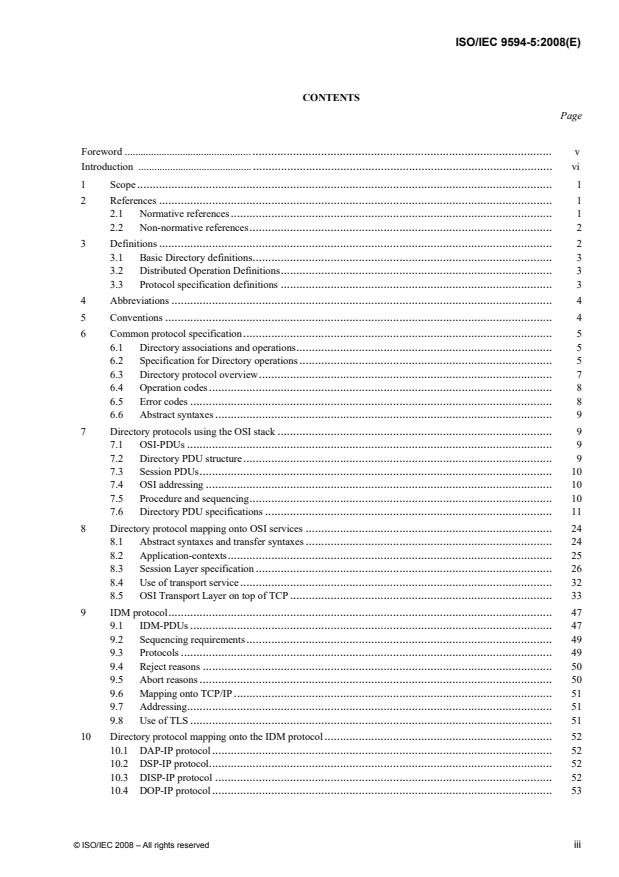
CONTENTS
Page
Foreword . v
Introduction . vi
1 Scope. 1
2 References . 1
2.1 Normative references. 1
2.2 Non-normative references. 2
3 Definitions . 2
3.1 Basic Directory definitions. 3
3.2 Distributed Operation Definitions. 3
3.3 Protocol specification definitions . 3
4 Abbreviations . 4
5 Conventions . 4
6 Common protocol specification. 5
6.1 Directory associations and operations. 5
6.2 Specification for Directory operations . 5
6.3 Directory protocol overview. 7
6.4 Operation codes. 8
6.5 Error codes . 8
6.6 Abstract syntaxes . 9
7 Directory protocols using the OSI stack . 9
7.1 OSI-PDUs . 9
7.2 Directory PDU structure. 9
7.3 Session PDUs. 10
7.4 OSI addressing . 10
7.5 Procedure and sequencing. 10
7.6 Directory PDU specifications . 11
8 Directory protocol mapping onto OSI services . 24
8.1 Abstract syntaxes and transfer syntaxes . 24
8.2 Application-contexts. 25
8.3 Session Layer specification . 26
8.4 Use of transport service. 32
8.5 OSI Transport Layer on top of TCP . 33
9 IDM protocol. 47
9.1 IDM-PDUs . 47
9.2 Sequencing requirements. 49
9.3 Protocols . 49
9.4 Reject reasons . 50
9.5 Abort reasons . 50
9.6 Mapping onto TCP/IP . 51
9.7 Addressing. 51
9.8 Use of TLS . 51
10 Directory protocol mapping onto the IDM protocol. 52
10.1 DAP-IP protocol. 52
10.2 DSP-IP protocol. 52
10.3 DISP-IP protocol . 52
10.4 DOP-IP protocol. 53
© ISO/IEC 2008 – All rights reserved iii
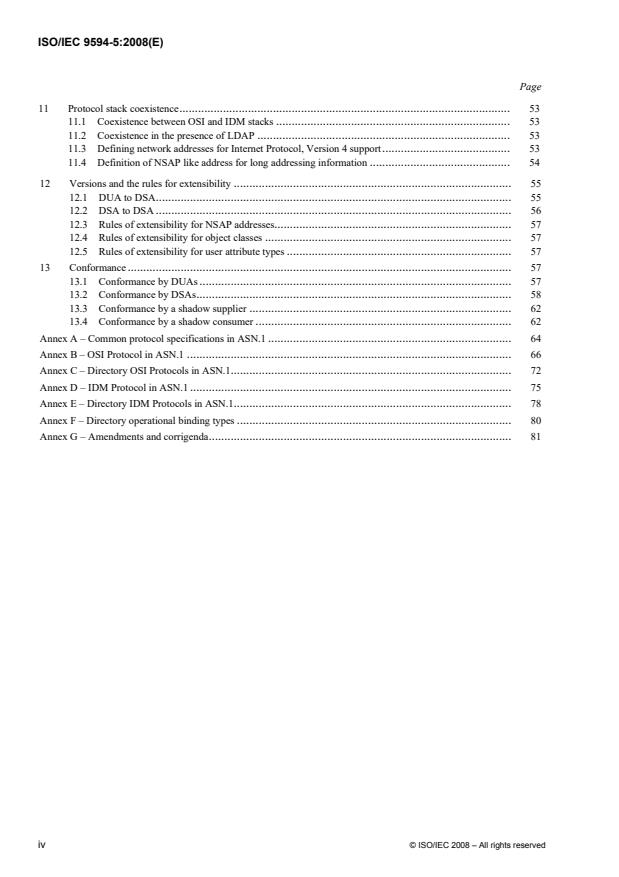
Page
11 Protocol stack coexistence. 53
11.1 Coexistence between OSI and IDM stacks . 53
11.2 Coexistence in the presence of LDAP . 53
11.3 Defining network addresses for Internet Protocol, Version 4 support. 53
11.4 Definition of NSAP like address for long addressing information . 54
12 Versions and the rules for extensibility . 55
12.1 DUA to DSA. 55
12.2 DSA to DSA . 56
12.3 Rules of extensibility for NSAP addresses. 57
12.4 Rules of extensibility for object classes . 57
12.5 Rules of extensibility for user attribute types . 57
13 Conformance. 57
13.1 Conformance by DUAs . 57
13.2 Conformance by DSAs. 58
13.3 Conformance by a shadow supplier . 62
13.4 Conformance by a shadow consumer . 62
Annex A – Common protocol specifications in ASN.1 . 64
Annex B – OSI Protocol in ASN.1 . 66
Annex C – Directory OSI Protocols in ASN.1. 72
Annex D – IDM Protocol in ASN.1 . 75
Annex E – Directory IDM Protocols in ASN.1. 78
Annex F – Directory operational binding types . 80
Annex G – Amendments and corrigenda. 81
iv © ISO/IEC 2008 – All rights reserved
Foreword
ISO (the International Organization for Standardization) and IEC (the International Electrotechnical
Commission) form the specialized system for worldwide standardization. National bodies that are members of
ISO or IEC participate in the development of International Standards through technical committees
established by the respective organization to deal with particular fields of technical activity. ISO and IEC
technical committees collaborate in fields of mutual interest. Other international organizations, governmental
and non-governmental, in liaison with ISO and IEC, also take part in the work. In the field of information
technology, ISO and IEC have established a joint technical committee, ISO/IEC JTC 1.
International Standards are drafted in accordance with the rules given in the ISO/IEC Directives, Part 2.
The main task of the joint technical committee is to prepare International Standards. Draft International
Standards adopted by the joint technical committee are circulated to national bodies for voting. Publication as
an International Standard requires approval by at least 75 % of the national bodies casting a vote.
Attention is drawn to the possibility that some of the elements of this document may be the subject of patent
rights. ISO and IEC shall not be held responsible for identifying any or all such patent rights.
Subcommittee SC 6, Telecommunications and information exchange between systems, in collaboration with
ITU-T. The identical text is published as ITU-T Rec. X.519 (11/2008).
This sixth edition cancels and replaces the fifth edition (ISO/IEC 9594-5:2005), which has been technically
revised.
ISO/IEC 9594 consists of the following parts, under the general title Information technology — Open Systems
Interconnection — The Directory:
⎯ Part 1: Overview of concepts, models and services
⎯ Part 2: Models
⎯ Part 3: Abstract service definition
⎯ Part 4: Procedures for distributed operation
⎯ Part 5: Protocol specifications
⎯ Part 6: Selected attribute types
⎯ Part 7: Selected object classes
⎯ Part 8: Public-key and attribute certificate frameworks
⎯ Part 9: Replication
⎯ Part 10: Use of systems management for administration of the Directory
© ISO/IEC 2008 – All rights reserved v
Introduction
This Recommendation | International Standard, together with the other Recommendations | International Standards, has
been produced to facilitate the interconnection of information processing systems to provide directory services. A set of
such systems, together with the directory information that they hold, can be viewed as an integrated whole, called the
Directory. The information held by the Directory, collectively known as the Directory Information Base (DIB), is
typically used to facilitate communication between, with or about objects such as application entities, people, terminals
and distribution lists.
The Directory plays a significant role in Open Systems Interconnection, whose aim is to allow, with a minimum of
technical agreement outside of the interconnection standards themselves, the interconnection of information processing
systems:
– from different manufacturers;
– under different managements;
– of different levels of complexity; and
– of different ages.
This Recommendation | International Standard specifies the application service elements and application contexts for
two protocols – the Directory Access Protocol (DAP) and the Directory System Protocol (DSP). The DAP provides for
access to the Directory to retrieve or modify Directory information. The DSP provides for the chaining of requests to
retrieve or modify Directory information to other parts of the distributed Directory System where the information may
be held.
In addition, this Recommendation | International Standard specifies the application service elements and application
contexts for the Directory Information Shadowing Protocol (DISP) and the Directory Operational Binding Management
Protocol (DOP). The DISP provides for the shadowing of information held in one DSA to another DSA. The DOP
provides for the establishment, modification and termination of bindings between pairs of DSAs for the administration
of relationships between the DSAs (such as for shadowing or hierarchical relationships).
This Recommendation | International Standard provides the foundation frameworks upon which industry profiles can be
defined by other standards groups and industry forums. Many of the features defined as optional in these frameworks
may be mandated for use in certain environments through profiles. This sixth edition technically revises and enhances,
but does not replace, the fifth edition of this Recommendation | International Standard. Implementations may still claim
conformance to the fifth edition. However, at some point, the fifth edition will not be supported (i.e., reported defects
will no longer be resolved). It is recommended that implementations conform to this sixth edition as soon as possible.
This sixth edition specifies versions 1 and 2 of the Directory protocols.
The first and second editions specified only version 1. Most of the services and protocols specified in this edition are
designed to function under version 1. However some enhanced services and protocols, e.g., signed errors, will not
function unless all Directory entities involved in the operation have negotiated version 2. Whichever version has been
negotiated, differences between the services and between the protocols defined in the six editions, except for those
specifically assigned to version 2, are accommodated using the rules of extensibility defined in this edition of ITU-T
Rec. X.519 | ISO/IEC 9594-5.
Annex A, which is an integral part of this Recommendation | International Standard, provides the ASN.1 module for the
common specifications for the Directory protocols.
Annex B, which is an integral part of this Recommendation | International Standard, provides the ASN.1 module for the
OSI protocol specification.
Annex C, which is an integral part of this Recommendation | International Standard, provides the ASN.1 module for the
Directory OSI protocols.
Annex D, which is an integral part of this Recommendation | International Standard, provides the ASN.1 module for the
IDM protocol specification.
Annex E, which is an integral part of this Recommendation | International Standard, provides the ASN.1 module for the
Directory IDM protocols.
Annex F, which is an integral part of this Recommendation | International Standard, provides the ASN.1 module which
contains all the ASN.1 object identifiers assigned to identify operational binding types in this series of
Recommendations | International Standards.
Annex G, which is not an integral part of this Recommendation | International Standard, lists the amendments and
defect reports that have been incorporated to form this edition of this Recommendation | International Standard.
vi © ISO/IEC 2008 – All rights reserved
INTERNATIONAL STANDARD
ITU-T RECOMMENDATION
Information technology – Open Systems Interconnection –
The Directory: Protocol specifications
1 Scope
This Recommendation | International Standard specifies the Directory Access Protocol, the Directory System Protocol,
the Directory Information Shadowing Protocol, and the Directory Operational Binding Management Protocol fulfilling
the abstract services specified in ITU-T Rec. X.511 | ISO/IEC 9594-3, ITU-T Rec. X.518 | ISO/IEC 9594-4, ITU-T
Rec. X.525 | ISO/IEC 9594-9, and ITU-T Rec. X.501 | ISO/IEC 9594-2.
2 References
2.1 Normative references
The following Recommendations and International Standards contain provisions which, through reference in this text,
constitute provisions of this Recommendation | International Standard. At the time of publication, the editions indicated
were valid. All Recommendations and Standards are subject to revision, and parties to agreements based on this
Recommendation | International Standard are encouraged to investigate the possibility of applying the most recent
edition of the Recommendations and Standards listed below. Members of IEC and ISO maintain registers of currently
valid International Standards. The Telecommunication Standardization Bureau of the ITU maintains a list of currently
valid ITU-T Recommendations.
2.1.1 Identical Recommendations | International Standards
– ITU-T Recommendation X.200 (1994) | ISO/IEC 7498-1:1994, Information technology – Open Systems
Interconnection – Basic Reference Model: The basic model.
– ITU-T Recommendation X.213 (2001) | ISO/IEC 8348:2002, Information technology – Open Systems
Interconnection – Network service definition.
– ITU-T Recommendation X.214 (1995) | ISO/IEC 8072:1996, Information technology – Open Systems
Interconnection – Transport service definition.
– ITU-T Recommendation X.500 (2008) | ISO/IEC 9594-1:2008, Information technology – Open Systems
Interconnection – The Directory: Overview of concepts, models and services.
– ITU-T Recommendation X.501 (2008) | ISO/IEC 9594-2:2008, Information technology – Open Systems
Interconnection – The Directory: Models.
– ITU-T Recommendation X.509 (2008) | ISO/IEC 9594-8:2008, Information technology – Open Systems
Interconnection – The Directory: Public-key and attribute certificate frameworks.
– ITU-T Recommendation X.511 (2008) | ISO/IEC 9594-3:2008, Information technology – Open Systems
Interconnection – The Directory: Abstract service definition.
– ITU-T Recommendation X.518 (2008) | ISO/IEC 9594-4:2008, Information technology – Open Systems
Interconnection – The Directory: Procedures for distributed operation.
– ITU-T Recommendation X.520 (2008) | ISO/IEC 9594-6:2008, Information technology – Open Systems
Interconnection – The Directory: Selected attribute types.
– ITU-T Recommendation X.521 (2008) | ISO/IEC 9594-7:2008, Information technology – Open Systems
Interconnection – The Directory: Selected object classes.
– ITU-T Recommendation X.525 (2008) | ISO/IEC 9594-9:2008, Information technology – Open Systems
Interconnection – The Directory: Replication.
– ITU-T Recommendation X.530 (2008) | ISO/IEC 9594-10:2008, Information technology – Open Systems
Interconnection – The Directory: Use of systems management for administration of the Directory.
ITU-T Rec. X.519 (11/2008) 1
– ITU-T Recommendation X.680 (2008) | ISO/IEC 8824-1:2008, Information technology – Abstract
Syntax Notation One (ASN.1): Specification of basic notation.
– ITU-T Recommendation X.681 (2008) | ISO/IEC 8824-2:2008, Information technology – Abstract
Syntax Notation One (ASN.1): Information object specification.
– ITU-T Recommendation X.682 (2008) | ISO/IEC 8824-3:2008, Information technology – Abstract
Syntax Notation One (ASN.1): Constraint specification.
– ITU-T Recommendation X.683 (2008) | ISO/IEC 8824-4:2008, Information technology – Abstract
Syntax Notation One (ASN.1): Parameterization of ASN.1 specifications.
– ITU-T Recommendation X.690 (2008) | ISO/IEC 8825-1:2008, Information technology – ASN.1
encoding rules: Specification of Basic Encoding Rules (BER), Canonical Encoding Rules (CER) and
Distinguished Encoding Rules (DER).
2.1.2 ISO/IEC Standards
– ISO/IEC 10646:2003, Information technology – Universal Multiple-Octet Coded Character Set (UCS).
2.1.3 Other references
– ITU-T Recommendation E.164 (2005), The international public telecommunication numbering plan.
– ITU-T Recommendation X.121 (2000), International numbering plan for public data networks.
– IETF RFC 2025 (1996), The Simple Public-Key GSS-API Mechanism (SPKM).
– IETF RFC 793 (1981), Transmission Control Protocol – DARPA Internet Program – Protocol
Specification.
– IETF RFC 1738 (1994), Uniform Resource Locators (URL).
– IETF RFC 2246 (1999), The TLS Protocol Version 1.0.
– IETF RFC 4511 (2006), Lightweight Directory Access Protocol (LDAP): The Protocol.
– IETF RFC 3546 (2003), Transport Layer Security (TLS) Extensions.
– IETF RFC 3986 (2005), Uniform Resource Identifier (URI): Generic Syntax.
2.2 Non-normative references
– ITU-T Recommendation X.217 (1995) | ISO/IEC 8649:1996, Information technology – Open Systems
Interconnection – Service definition for the Association Control Service Element.
– ITU-T Recommendation X.224 (1995) | ISO/IEC 8073:1997, Information technology – Open Systems
Interconnection – Protocol for providing the connection-mode transport service.
– ITU-T Recommendation X.225 (1995) | ISO/IEC 8327-1:1996, Information technology – Open Systems
Interconnection – Connection-oriented Session protocol: Protocol specification.
– ITU-T Recommendation X.226 (1994) | ISO/IEC 8823-1:1994, Information technology – Open Systems
Interconnection – Connection-oriented Presentation protocol: Protocol specification.
– ITU-T Recommendation X.227 (1995) | ISO/IEC 8650-1:1996, Information technology – Open Systems
Interconnection – Connection-oriented protocol for the Association Control Service Element: Protocol
specification.
– ITU-T Recommendation X.881 (1994) | ISO/IEC 13712-2:1995, Information technology – Remote
Operations: OSI realizations – Remote Operations Service Element (ROSE) service definition.
– IETF RFC 1006 (1987), ISO Transport Service on top of the TCP Version: 3.
– IETF RFC 1277 (1991), Encoding Network Addresses to Support Operation over Non-OSI Lower
Layers.
– IETF RFC 2126 (1997), ISO Transport Service on top of TCP (ITOT).
3 Definitions
For the purposes of this Recommendation | International Standard, the following definitions apply:
2 ITU-T Rec. X.519 (11/2008)
3.1 Basic Directory definitions
The following terms are defined in ITU-T Rec. X.501 | ISO/IEC 9594-2:
a) the Directory;
b) (Directory) user;
c) Directory System Agent (DSA);
d) Directory User Agent (DUA).
3.2 Distributed Operation Definitions
The following terms are defined in ITU-T Rec. X.518 | ISO/IEC 9594-4:
a) chaining;
b) referral.
3.3 Protocol specification definitions
The following terms are defined in this Recommendation | International Standard.
NOTE – The terms defined in this subclause are generalized definitions to cover both the OSI and the TCP/IP case, except
exceptions as indicated.
3.3.1 abstract syntax: The specification of a data types and/or data values by using notation rules which are
independent of the encoding technique used to represent them.
3.3.2 application-association: A cooperative relationship between two application-entities established by the Bind
operation.
3.3.3 application-context: (OSI only definition) A set of rules shared in common by two application-entities in
order to support an application-association.
3.3.4 application-context-name: An ASN.1 object identifier that identifies (names) an application-context.
3.3.5 Application Layer: The top layer of the OSI seven layer model representing the semantics of the
communication.
3.3.6 application-entity: A representation of the external behaviour of an application process in the form of its
communication capabilities.
3.3.7 application-entity title: The Directory distinguished name of an application-entity, and in particular, an
application-entity representing a Directory application process.
3.3.8 application process: A process within a system which performs information processing for a particular
purpose, in particular processing Directory operations.
3.3.9 Bind operation: An operation type used for establishing an application-association.
3.3.10 Directory operation: An operation type for exchange of Directory information.
3.3.11 directory protocol-data-unit: A unit of data for a Directory protocol consisting of control information and in
the general case also application data as specified by Directory operations.
NOTE 1 – A Directory PDU in the OSI environment includes all the protocol elements of the OSI Presentation Layer and if
relevant, protocol elements of ACSE in addition to the Directory-specific protocol elements.
NOTE 2 – The term "application-protocol-data-unit (APDU)" is a unit of data defined by an OSI application protocol. This term
is not used for edition 5 and subsequent editions of these Directory Specifications. However, the abbreviation may appear in
certain ASN.1 elements.
3.3.12 initiator: The application process that initiates an application-association by issuing a Bind request.
3.3.13 local matter: A decision made by a system concerning its behaviour that is not subject to the requirements of
these Directory Specifications.
3.3.14 operation: An exchange between two application processes to perform a particular task. It consists of a
request from one application-process to the other one and the return of zero or more responses (result and/or errors). An
operation implies a certain process to be performed by the application process receiving the request.
3.3.15 protocol-data-unit: Comprised of the presentation protocol elements or the ACSE protocol elements of a
Directory protocol-data-unit.
ITU-T Rec. X.519 (11/2008) 3
3.3.16 Presentation Layer: The sixth layer of the OSI Reference Model.
3.3.17 protocol error: An unrecognized or unexpected protocol-data-unit or a protocol-data-unit with an unexpected
or invalid parameter is received.
3.3.18 responder: The application-process that receives a Bind request and either accepts or refuses the application-
association.
NOTE – Initiator and responder are defined with respect to a single transport-connection. The initiator is also the application
process that initiated the transport-connection (see 8.4). A DSA can be both an initiator and responder simultaneously.
3.3.19 session layer: The fifth layer of the OSI Reference Model.
3.3.20 session-protocol-data-unit: (OSI only definition) A unit of data at the OSI Session Layer consisting of
control information and in the general case also carries a Directory protocol-data-unit.
4 Abbreviations
For the purposes of this Recommendation | International Standard, the following abbreviations apply:
AC Application Context
ACSE Association Control Service Element
AE application-entity
AFI Authority and Format Identifier
APDU application-protocol-data-unit
DAP Directory Access Protocol
DISP Directory Information Shadowing Protocol
DOP Directory Operational Binding Management Protocol
DSA Directory System Agent
DSP Directory System Protocol
DSP Domain Specific Part
DUA Directory User Agent
IDI Initial Domain Identifier
IDM Internet Directly Mapped
IPv4 Internet Protocol, Version 4
IPv6 Internet Protocol, Version 6
ITOT ISO Transport Service on top of TCP
LDAP Lightweight Directory Access Protocol
NSAP Network-Service-Access-Point
PDU protocol-data-unit
PPDU presentation-protocol-data-unit
SPDU session-protocol-data-unit
TCP/IP Transmission Control Protocol/Internet Protocol
TPDU transport-protocol-data-unit
TPKT Transport Packet
TSDU transport-service-data-unit
URI Uniform Resource Identifier
5 Conventions
The term "Directory Specification" (as in "this Directory Specification") shall be taken to mean ITU-T Rec. X.519 |
ISO/IEC 9594-5. The term "Directory Specifications" shall be taken to mean the X.500-series Recommendations and all
parts of ISO/IEC 9594.
4 ITU-T Rec. X.519 (11/2008)
This Directory Specification uses the term first edition systems to refer to systems conforming to the first edition of the
Directory Specifications, i.e., the 1988 edition of the series of CCITT X.500 Recommendations and the
ISO/IEC 9594:1990 edition.
This Directory Specification uses the term second edition systems to refer to systems conforming to the second edition
of the Directory Specifications, i.e., the 1993 edition of the series of ITU-T X.500 Recommendations and the ISO/IEC
9594:1995 edition.
This Directory Specification uses the term third edition systems to refer to systems conforming to the third edition of the
Directory Specifications, i.e., the 1997 edition of the series of ITU-T X.500 Recommendations and the
ISO/IEC 9594:1998 edition.
This Directory Specification uses the term fourth edition systems to refer to systems conforming to the fourth edition of
the Directory Specifications, i.e., the 2001 editions of ITU-T Recs X.500, X.501, X.511, X.518, X.519, X.520, X.521,
X.525, and X.530, the 2000 edition of ITU-T Rec. X.509, and parts 1-10 of the ISO/IEC 9594:2001 edition.
This Directory Specification uses the term fifth edition systems to refer to systems conforming to the fifth edition of the
Directory Specifications, i.e., the 2005 edition of the series of ITU-T X.500 Recommendations and the ISO/IEC
9594:2005 edition.
This Directory Specification uses the term sixth edition systems to refer to systems conforming to the sixth edition of the
Directory Specifications, i.e., the 2008 edition of the series of ITU-T X.500 Recommendations and the ISO/IEC
9594:2008 edition.
This Directory Specification presents ASN.1 notation in the bold Helvetica typeface. When ASN.1 types and values are
referenced in normal text, they are differentiated from normal text by presenting them in the bold Helvetica typeface.
The names of procedures, typically referenced when specifying the semantics of processing, are differentiated from
normal text by displaying them in bold Times. Access control permissions are presented in italicized Times.
If the items in a list are numbered (as opposed to using "–" or letters), then the items shall be considered steps in a
procedure.
6 Common protocol specification
6.1 Directory associations and operations
The protocols for these Directory Specifications are described as a set of operations. An operation is defined in terms of
a request sent from one system to another system expecting this other system to process the request, and if applicable,
returns one or more replies constituting the result. An operation can either be a Bind operation or an operation invoked
to access Directory information (a Directory operation).
If exception conditions are encountered, one or more errors may be returned instead of or in addition to possible results.
NOTE 1 – The currently defined operations will return either one or more results or a single error.
Directory protocols defined by these Directory Specifications may use an OSI protocol stack, a TCP/IP protocol stack
or both. The specification provided by this clause is independent of the particular protocol stack. The OSI specific
specification is given in clauses 7 and 8, while the TCP/IP specific specification is given in clauses 9 and 10.
A process within a system that processes Directory operations is called an application process. An application-entity is
the reflection of the external behaviour of an application process.
Before Directory operations can be invoked between two Directory application processes, an application-association
has to be established between the corresponding application-entities. An application-association is a cooperative
relationship between two application-entities formed by exchange of control information within the request and result of
a Bind operation and by the use of a common underlying service.
NOTE 2 – This is a modified definition of application-association as given by ITU-T Rec. X.217 | ISO/IEC 8649, and is intended
to cover both the use of an underlying OSI protocol stack and an underlying TCP/IP stack.
An application-association is terminated using an unbind exchange. The unbinding of an application-association is not
defined as an operation.
6.2 Specification for Directory operations
These Directory Specifications specify several operation types. An operation type is specified by the OPERATION
ASN.1 information object class. Possible errors associated with an operation type are defined by the ERRORS ASN.1
information object class.
ITU-T Rec. X.519 (11/2008) 5
OPERATION ::= CLASS {
&ArgumentType OPTIONAL,
&ResultType OPTIONAL,
&Errors ERROR OPTIONAL,
&operationCode Code UNIQUE OPTIONAL }
WITH SYNTAX {
[ARGUMENT &ArgumentType]
[RESULT &ResultType]
[ERRORS &Errors]
[CODE &operationCode] }
ERROR ::= CLASS {
&ParameterType,
&errorCode Code UNIQUE OPTIONAL }
WITH SYNTAX {
PARAMETER &ParameterType
[CODE &errorCode] }
Code ::= CHOICE {
local INTEGER,
global OBJECT IDENTIFIER }
The OPERATION information object class is a convenient way to express the syntax of Directory requests, results and
errors for a particular operation type.
This ASN.1 information object class has the following fields:
a) The &ArgumentType field specifies an open data type for the request part of an operation.
b) The &ResultType field specifies an open data type for one or more replies constituting the result of the
request. If this field is absent, there is no result associated with the operation.
c) The &Errors field specifies one or more errors that can occur as the result of processing the request. If
this field is absent, there is no error associated with the operation.
d) The &operationCode field specifies the type of Directory operation to be performed. This field is absent
for the Bind operation. See 6.4 for currently defined operation codes.
Directory operations may in principle be performed in two different modes:
a) if a Directory operation shall be completed before a new Directory operation may be invoked, the mode
of operation is synchronous; or
b) if several operations may be in progress at the same time, the mode of operation is asynchronous.
If all Directory operations defined for a particular type of application-association:
a) consist of both a request and one or more results and/or errors; and
b) only are allowed to be invoked by a designated system,
such operation may be executed in either synchronous or asynchronous mode. Otherwise, the mode of operation is
always asynchronous.
The OPERATION information object class does not in itself imply any sequencing. A Directory request may have no
result and/or error, or a request may have several results and/or errors. However, it does tie together a request with
possible responses (results and errors) by carrying the same operation code and the same invoke id (see below).
However, specification of a particular operation type may dictate sequencing restrictions.
An error is a report of the unsuccessful performance of an operation. An error is represented by the ERROR ASN.1
Information Object Class. The different fields are described below:
a) the &ParameterType field specifies the data type of the parameter of the error specifying the nature of
the error; and
b) the &errorCode field specifies the code that identifies the error (see 6.5 for the defined error codes).
Although not reflected by the OPERATION or the ERRORS information object classes, each invocation of a Directory
operation is assigned an InvokeId, which is carried in the protocol. This makes it possible to indicate to what Directory
operation a particular request, result or error belongs. The definition of the InvokeId is as follows:
InvokeId ::= CHOICE {
present INTEGER,
absent NULL }
6 ITU-T Rec. X.519 (11/2008)
If an operation type does not specify an &operationCode, operations of this type cannot have InvokeId assigned.
6.3 Directory protocol overview
6.3.1 Use of underlying services
When two application processes from different open systems interact, the application-association is realized as an
Application Layer protocol using either an OSI or a TCP/IP underlying service.
Details on the use of the OSI service are given in clause 8, while the details on the use of the TCP/IP service are given
in clause 10.
The OSI Transport Layer may either be supported using the service as defined in ITU-T Rec. X.214 | ISO/IEC 8072 or
by using the specification in 8.5. In this latter case, the OSI upper layer protocols stack are placed on the top of a
TCP/IP protocol stack.
6.3.2 The Directory Access Protocol (DAP)
Before a DUA and a DSA from different open systems can interact, a Bind operation has to be invoked between them to
establish an application-association supporting a Directory protocol called the Directory Access Protocol (DAP).
The Bind operation (directoryBind) for establishing a DAP application-association is defined in clause 8 of ITU-T
Rec. X.511 | ISO/IEC 9594-3.
This edition and all previous editions of the Directory Specifications only allow a DUA to invoke a Bind operation and
to initiate subsequent Directory operations. If the OSI underlying stack is used, Directory operations may be invoked
either in synchronous mode or in asynchronous mode. If the TCP/IP underlying stack is used, Directory operations are
always invoked in asynchronous mode.
All Directory operations require either a single reply or a single error to be returned.
6.3.3 The Directory System Protocol (DSP)
Before a pair of DSAs from different open systems can interact, a Bind operation has to be invoked between them to
establish an application-association supporting a Directory protocol called the Directory System Protocol (DSP).
The Bind operation (dSABind) for establishing a DSP application association is defined in clause 11 of ITU-T
Rec. X.518 | ISO/IEC 9594-4.
Either DSA may invoke a Bind operation. Both the initiating and responding DSA may invoke subsequent Directory
operations. Directory operations are always invoked in asynchronous mode on the DSP.
All Directory operations require either a single reply or a single error to be returned.
6.3.4 The Directory Information Shadowing Protocol (DISP)
Before a pair of DSAs from different open systems can interact for the purpose of exchanging shadowing information, a
Bind operation has to be invoked between them to establish an application-association supporting a Directory protocol
called the Directory Information Shadowing Protocol (DISP).
The Bind operation (dSAShadowBind) for establishing a DISP application-association is defined in clause 7.4.1 of
ITU-T Rec. X.525 | ISO/IEC 9594-9.
If the OSI underlying stack is used, the mode of operation is synchronous or asynchronous depending on the
application-context selected for the Bind operation. If the TCP/IP underlying stack is used, Directory operations are
always invoked in asynchronous mode.
All Directory operations require either a single reply or a single error to be returned.
6.3.5 The Directory Operational Binding Management Protocol (DOP)
Before a pair of DSAs from different open systems can interact for the purpose of maintaining operational bindings, a
Bind operation has to be invoked to establish an application-association supporting a Directory protocol called the
Directory Operational Binding Management Protocol (DOP).
The DSA that may assume the role of initiator of the Bind operation depends on the DSA roles assigned for the
operational binding(s) to be managed using the Directory operations on the application-association. Only the initiator
may invoke Directory operations. More than one operational binding type may only be managed within this application-
association if the DSA roles for the distinct types are compatible (e.g., a DSA assumes Role A for each binding type).
All Directory operations require either a single reply or a single error to be returned.
ITU-T Rec. X.519 (11/2008) 7
6.4 Operation codes
6.4.1 Operation codes for DAP and DSP
The following operation codes are used in the DAP and the DSP:
id-opcode-read Code ::= local : 1
id-opcode-compare Code ::= local : 2
id-opcode-abandon Code ::= local : 3
id-opcode-list Code ::= local : 4
id-opcode-search Code ::= local : 5
id-opcode-addEntry Code ::= local : 6
id-opcode-removeEntry Code ::= local : 7
id-opcode-modifyEntry Code ::= local : 8
id-opcode-modifyDN Code ::= local : 9
The use of these operation codes is specified in ITU-T Rec. X.511 | ISO/IEC 9594-3.
6.4.2 Operation codes for DISP
The following operation codes are used in the DISP.
id-opcode-requestShadowUpdate Code ::= local : 1
id-opcode-updateShadow Code ::= local : 2
id-opcode-coordinateShadowUpdate Code ::= local : 3
The use of these operation codes is specified in ITU-T Rec. X.525 | ISO/IEC 9594-9.
6.4.3 Operation codes for DOP
The following operation codes are used in the DOP.
id-op-establishOperationalBinding Code ::= local : 100
id-op-modifyOperationalBinding Code ::= local : 102
id-op-terminateOp
...
Questions, Comments and Discussion
Ask us and Technical Secretary will try to provide an answer. You can facilitate discussion about the standard in here.
Loading comments...