


ISO 12745:2008
(Main)Copper, lead and zinc ores and concentrates — Precision and bias of mass measurement techniques
Copper, lead and zinc ores and concentrates — Precision and bias of mass measurement techniques
ISO 12745:2008 provides guidelines to test for bias over a wide range of mass measurement techniques, to estimate the precision for each technique and to calculate the precision for wet mass when estimated by applying one of those techniques. The guidelines are based on the application of statistical tests to verify that a mass measurement technique is unbiased, to estimate the variance as the most basic measure for its precision and to check the linearity of a static scale over its working range. Calibration methods and performance tests for compliance with applicable regulations generate test results that can be used to quantify precision and bias for each of these mass measurement techniques and to verify linearity for static weighing devices. The guidelines apply to mass measurement techniques used to estimate the wet mass for cargoes or shipments of mineral concentrate as the basis for freight and insurance charges and for preliminary payments or for final settlements between trading partners.
Minerais et concentrés de cuivre, de plomb et de zinc — Justesse et erreurs systématiques des techniques de pesée
General Information
- Status
- Published
- Publication Date
- 28-Sep-2008
- Technical Committee
- ISO/TC 183 - Copper, lead, zinc and nickel ores and concentrates
- Drafting Committee
- ISO/TC 183/WG 9 - Sampling of copper, lead and zinc concentrates
- Current Stage
- 9093 - International Standard confirmed
Relations
- Effective Date
- 15-Apr-2008
Overview
ISO 12745:2008 - "Copper, lead and zinc ores and concentrates - Precision and bias of mass measurement techniques" provides guidance to quantify precision and bias for mass measurement methods used to determine the wet mass of mineral concentrates. The standard supports statistically based testing and calibration of measurement techniques used as the commercial basis for freight and insurance charges, preliminary payments and final settlements between trading partners.
Key topics and requirements
- Scope: Applies to mass measurement techniques for copper, lead and zinc ores and concentrates, including draft surveys, belt scales, weighbridges, hopper scales, gantry scales and platform scales.
- Statistical approach: Uses statistical tests (e.g., Student’s t-test), variance estimation and confidence intervals to:
- Verify that a mass measurement technique is unbiased
- Estimate the variance and precision (standard deviation, relative standard deviation/CV)
- Determine bias detection limits and probable bias ranges
- Check linearity of static scales across their working range
- Calibration & performance testing: Calibration methods and performance tests produce data to quantify precision and bias. Annex D supplies a step‑by‑step procedure for static scale testing; other annexes include tables, statistics and draft survey guidance.
- Static scale requirement: Application of static scales requires at least one certified weight ≥ 1 tonne be available (or brought in) and suitable for the scale per manufacturer guidance. A set of certified weights across the working range simplifies calibration and linearity checks.
- Normative references: Builds on ISO 3534-1, ISO 3534-2 (statistics vocabularies) and ISO 5725-1 (accuracy of measurement methods).
Applications and users
ISO 12745:2008 is practical for organizations and roles that rely on accurate mass determination of mineral concentrates:
- Mining companies and concentrate producers
- Port operators and terminal surveyors
- Ship operators and marine surveyors conducting draft surveys
- Traders, commodity inspectors and independent survey firms resolving commercial disputes
- Calibration laboratories and metrology teams testing static and dynamic weighing devices
- Freight, insurance and finance teams assessing measurement risk for payments and settlements
By quantifying precision and bias, the standard helps stakeholders assess measurement uncertainty, detect systematic errors, and reduce commercial risk in mineral concentrate shipments.
Related standards
- ISO 3534-1:2006 - Statistics - Vocabulary and symbols, Part 1
- ISO 3534-2:2006 - Statistics - Vocabulary and symbols, Part 2
- ISO 5725-1:1994 - Accuracy (trueness and precision) of measurement methods and results - Part 1
Keywords: ISO 12745:2008, mass measurement, precision and bias, wet mass, mineral concentrates, draft surveys, belt scales, weighbridges, calibration, statistical tests.
Get Certified
Connect with accredited certification bodies for this standard

Bureau Veritas Chile
Bureau Veritas certification services in Chile.
Bureau Veritas Peru
Bureau Veritas certification services in Peru.
BVQI Peru
Bureau Veritas certification in Peru.
Sponsored listings
Frequently Asked Questions
ISO 12745:2008 is a standard published by the International Organization for Standardization (ISO). Its full title is "Copper, lead and zinc ores and concentrates — Precision and bias of mass measurement techniques". This standard covers: ISO 12745:2008 provides guidelines to test for bias over a wide range of mass measurement techniques, to estimate the precision for each technique and to calculate the precision for wet mass when estimated by applying one of those techniques. The guidelines are based on the application of statistical tests to verify that a mass measurement technique is unbiased, to estimate the variance as the most basic measure for its precision and to check the linearity of a static scale over its working range. Calibration methods and performance tests for compliance with applicable regulations generate test results that can be used to quantify precision and bias for each of these mass measurement techniques and to verify linearity for static weighing devices. The guidelines apply to mass measurement techniques used to estimate the wet mass for cargoes or shipments of mineral concentrate as the basis for freight and insurance charges and for preliminary payments or for final settlements between trading partners.
ISO 12745:2008 provides guidelines to test for bias over a wide range of mass measurement techniques, to estimate the precision for each technique and to calculate the precision for wet mass when estimated by applying one of those techniques. The guidelines are based on the application of statistical tests to verify that a mass measurement technique is unbiased, to estimate the variance as the most basic measure for its precision and to check the linearity of a static scale over its working range. Calibration methods and performance tests for compliance with applicable regulations generate test results that can be used to quantify precision and bias for each of these mass measurement techniques and to verify linearity for static weighing devices. The guidelines apply to mass measurement techniques used to estimate the wet mass for cargoes or shipments of mineral concentrate as the basis for freight and insurance charges and for preliminary payments or for final settlements between trading partners.
ISO 12745:2008 is classified under the following ICS (International Classification for Standards) categories: 73.060.99 - Other metalliferous minerals. The ICS classification helps identify the subject area and facilitates finding related standards.
ISO 12745:2008 has the following relationships with other standards: It is inter standard links to ISO 12745:1996. Understanding these relationships helps ensure you are using the most current and applicable version of the standard.
ISO 12745:2008 is available in PDF format for immediate download after purchase. The document can be added to your cart and obtained through the secure checkout process. Digital delivery ensures instant access to the complete standard document.
Standards Content (Sample)
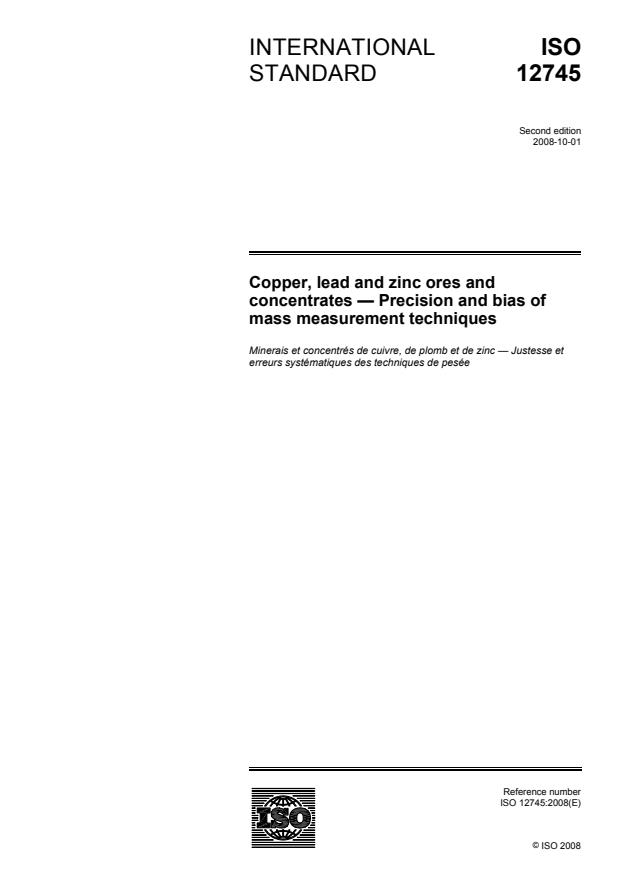
INTERNATIONAL ISO
STANDARD 12745
Second edition
2008-10-01
Copper, lead and zinc ores and
concentrates — Precision and bias of
mass measurement techniques
Minerais et concentrés de cuivre, de plomb et de zinc — Justesse et
erreurs systématiques des techniques de pesée
Reference number
©
ISO 2008
PDF disclaimer
This PDF file may contain embedded typefaces. In accordance with Adobe's licensing policy, this file may be printed or viewed but
shall not be edited unless the typefaces which are embedded are licensed to and installed on the computer performing the editing. In
downloading this file, parties accept therein the responsibility of not infringing Adobe's licensing policy. The ISO Central Secretariat
accepts no liability in this area.
Adobe is a trademark of Adobe Systems Incorporated.
Details of the software products used to create this PDF file can be found in the General Info relative to the file; the PDF-creation
parameters were optimized for printing. Every care has been taken to ensure that the file is suitable for use by ISO member bodies. In
the unlikely event that a problem relating to it is found, please inform the Central Secretariat at the address given below.
© ISO 2008
All rights reserved. Unless otherwise specified, no part of this publication may be reproduced or utilized in any form or by any means,
electronic or mechanical, including photocopying and microfilm, without permission in writing from either ISO at the address below or
ISO's member body in the country of the requester.
ISO copyright office
Case postale 56 • CH-1211 Geneva 20
Tel. + 41 22 749 01 11
Fax + 41 22 749 09 47
E-mail copyright@iso.org
Web www.iso.org
Published in Switzerland
ii © ISO 2008 – All rights reserved
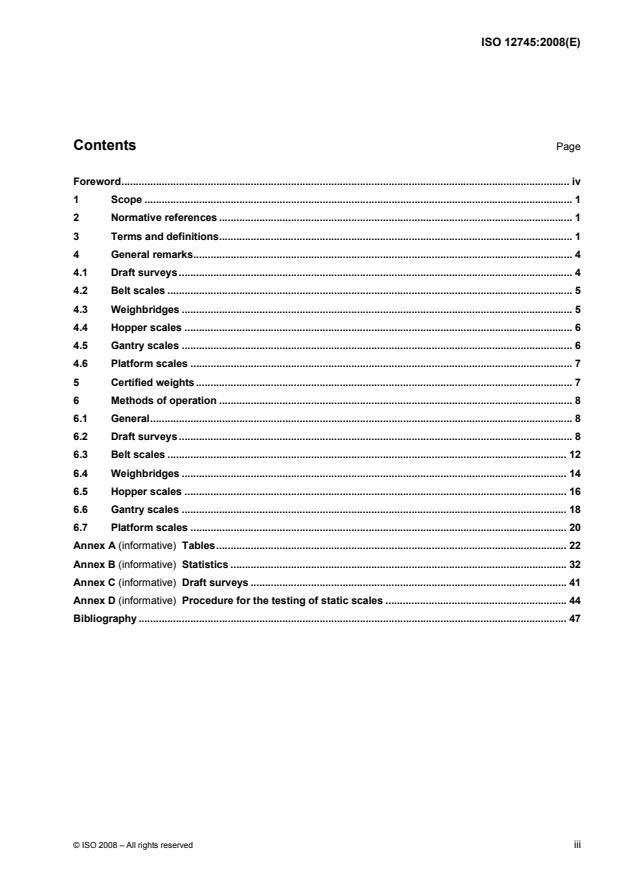
Contents Page
Foreword. iv
1 Scope . 1
2 Normative references . 1
3 Terms and definitions. 1
4 General remarks. 4
4.1 Draft surveys . 4
4.2 Belt scales . 5
4.3 Weighbridges . 5
4.4 Hopper scales . 6
4.5 Gantry scales . 6
4.6 Platform scales . 7
5 Certified weights. 7
6 Methods of operation . 8
6.1 General. 8
6.2 Draft surveys . 8
6.3 Belt scales . 12
6.4 Weighbridges . 14
6.5 Hopper scales . 16
6.6 Gantry scales . 18
6.7 Platform scales . 20
Annex A (informative) Tables. 22
Annex B (informative) Statistics .32
Annex C (informative) Draft surveys . 41
Annex D (informative) Procedure for the testing of static scales . 44
Bibliography . 47
Foreword
ISO (the International Organization for Standardization) is a worldwide federation of national standards bodies
(ISO member bodies). The work of preparing International Standards is normally carried out through
ISO technical committees. Each member body interested in a subject for which a technical committee has
been established has the right to be represented on that committee. International organizations, governmental
and non-governmental, in liaison with ISO, also take part in the work. ISO collaborates closely with the
International Electrotechnical Commission (IEC) on all matters of electrotechnical standardization.
International Standards are drafted in accordance with the rules given in the ISO/IEC Directives, Part 2.
The main task of technical committees is to prepare International Standards. Draft International Standards
adopted by the technical committees are circulated to the member bodies for voting. Publication as an
International Standard requires approval by at least 75 % of the member bodies casting a vote.
Attention is drawn to the possibility that some of the elements of this document may be the subject of patent
rights. ISO shall not be held responsible for identifying any or all such patent rights.
ISO 12745 was prepared by Technical Committee ISO/TC 183, Copper, lead, zinc and nickel ores and
concentrates.
This second edition cancels and replaces the first edition (ISO 12745:1996), which has been technically
revised.
iv © ISO 2008 – All rights reserved
INTERNATIONAL STANDARD ISO 12745:2008(E)
Copper, lead and zinc ores and concentrates — Precision and
bias of mass measurement techniques
1 Scope
This International Standard provides guidelines to test for bias over a wide range of mass measurement
techniques, to estimate the precision for each technique and to calculate the precision for wet mass when
estimated by applying one of those techniques.
The guidelines are based on the application of statistical tests to verify that a mass measurement technique is
unbiased, to estimate the variance as the most basic measure for its precision and to check the linearity of a
static scale over its working range. Calibration methods and performance tests for compliance with applicable
regulations generate test results that can be used to quantify precision and bias for each of these mass
measurement techniques and to verify linearity for static weighing devices.
The guidelines apply to mass measurement techniques used to estimate the wet mass for cargoes or
shipments of mineral concentrate as the basis for freight and insurance charges and for preliminary payments
or for final settlements between trading partners.
The application of static scales requires that at least one certified weight with a mass of no less than one (1)
tonne be either available on location or brought in for calibration purposes, and that this certified weight be
applicable to the scale in accordance with the manufacturer’s recommendations. A set of certified weights
covering the entire working range of a weighing device simplifies the process of verifying its state of calibration,
estimating its precision as a function of applied load and testing its linearity over the working range.
2 Normative references
The following referenced documents are indispensable for the application of this document. For dated
references, only the edition cited applies. For undated references, the latest edition of the referenced
document (including any amendments) applies.
ISO 3534-1:2006, Statistics — Vocabulary and symbols — Part 1: General statistical terms and terms used in
probability
ISO 3534-2:2006, Statistics — Vocabulary and symbols — Part 2: Applied statistics
ISO 5725-1:1994, Accuracy (trueness and precision) of measurement methods and results — Part 1: General
principle and definitions
3 Terms and definitions
For the purposes of this document, the following terms and definitions apply.
NOTE 1 In authoritative textbooks on applied statistics the use of the sigma squared (σ ) symbol is restricted to
unknown population variances for which a measurement procedure gives an estimate only. By contrast, the symbol s
applies to variances of samples, and thus to finite sets of measurements. Standard methods on sampling of bulk materials
often apply sigma-symbols (σ or σ) indiscriminately.
NOTE 2 Following are definitions for the most relevant concepts and terms in mass measurement technology. They
are presented to clarify the difference between this standard method, which quantifies the risk of losing and the probability
of gaining in commercial transactions, and other methods that deal with mass measurement techniques from the
perspective of regulatory agencies.
3.1
accuracy
generic term that implies closeness of agreement between an observed mass and its unknown true value
NOTE Accuracy is an abstract concept that cannot be quantified, but a lack of accuracy can be measured and
quantified in terms of a bias or systematic error.
3.2
bias
difference between the expectation of the test result and an accepted reference value
NOTE This definition is only valid if the accepted reference value is known with absolute certainty (International Units
of Mass and Length). Given that most accepted reference values are known within finite confidence limits, the difference
between the expectation of a test result and an accepted reference value is only a bias if the expectation of the test result
1)
falls outside the confidence limits of an accepted reference value.
3.3
belt scale
mass measurement device that continuously integrates and records as a cumulative mass, the load on a belt
while it passes the suspended scale section in a conveyor belt
NOTE Belt scales are continuous mass measurement devices that are calibrated by applying a load such as a
calibrated chain on the belt above the scale section (dynamic), or a certified weight suspended from the scale’s frame
(static), for a specified integration period, or by measuring with the belt scale a quantity of material whose mass is
measured with a static scale (material-run method).
3.4
bias detection limit
BDL
measure for the power or sensitivity of Student’s t-test to detect a bias or systematic error between applied
and observed loads
3.5
coefficient of variation
CV
measure for random variations in a mass measurement technique, numerically equal to the standard deviation
as a percentage of the observed mass
3.6
confidence interval
Cl
interval within which a predetermined percentage of the differences between all possible measurements and
their mean is expected to cluster
3.7
confidence range
CR
range within which a predetermined percentage of all possible measurements is expected to cluster
NOTE In science and engineering 95 % confidence intervals and ranges are most frequently used.
1) For example, the mass of the lot is generally determined once only so that the measured value is not the expectation
of the test result. In this International Standard a bias is the statistically significant difference between independent
estimates of the wet mass of the lot (loading versus discharge, static versus dynamic scales) and mass measurements
should be traceable to National Prototype Kilograms, and thus to the International Unit of Mass, through the shortest
possible calibration hierarchy.
2 © ISO 2008 – All rights reserved
3.8
correlation coefficient
r
measure for the degree of association or interdependence between a set of certified weights and observed
loads
3.9
draft survey
mass measurement technique that is based on converting the difference between a vessel’s displacement
under different loads into a mass on the basis of its draft tables while taking into account the density and
temperature of water and ballast, and changes in ballast and supplies
NOTE Draft surveys are based on Archimedes’s Principle which states that a floating body displaces its own mass.
The wet mass of a cargo or shipment can be measured by converting changes in draft, trim, ballast and consumable
supplies into mass on the basis of the vessel’s draft table.
3.10
precision
generic term for the cumulative effect of random variations in a mass measurement technique
NOTE Precision is a generic qualifier, e.g. “a high degree of precision”, “the precision is poor or low” or “the precision
characteristics are excellent”, are valid statements albeit without quantitative implications.
3.11
probable bias range
PBR
limits within which a measured bias is expected to fall at predetermined probabilities, either for a type I risk
only or for type I and II risks
3.12
relative standard deviation
s
r
measure for random variations in a mass measurement technique, numerically equal to the standard deviation
divided by the observed mass
3.13
standard deviation
s
measure for random variations in a mass measurement technique, numerically equal to the square root of the
variance
3.14
static scale
mass measurement device that converts into a mass a static load on a weighbridge or on a platform, inside a
hopper or suspended from a gantry scale
NOTE Static scales are batch mass measurement devices that are calibrated either with a single certified weight or
with a set, and less frequently with a calibrated hydraulic press. Static scales may have automatic zero adjustment so that
the sum of the differences between tare and gross loads can be used to generate a cumulative mass. Dual hopper scales
allow a virtually continuous mass flow during loading and discharge operations without sacrificing the accuracy and
precision characteristics of the static scale.
3.15
Student’s t-value
t
ratio between the difference for the means for sets of applied and observed loads and the standard deviation
for the mean difference
3.16
type I risk
α
risk of rejecting the hypothesis that the means for sets of applied and observed loads are compatible when
their mean difference is, in fact, statistically identical to zero
3.17
type II risk
β
risk of accepting the hypothesis that the means for sets of applied and observed loads are compatible when
their mean difference is, in fact, statistically different from zero
3.18
variance
s
measure for random variations in a mass measurement technique, numerically equal to the sum of squared
deviations from the mean for a set of measurements divided by the number of measurements in the set
minus 1 (divided by the degrees of freedom)
NOTE In textbooks on applied statistics the term “mean squared deviation from the mean” is often used in reference
to the variance.
4 General remarks
International and national handbooks on weighing devices define uncertainties in mass measurement
techniques in different ways. In some handbooks the use of the term “error” is restricted to a bias or
systematic error while others refer to “maximum permissible risks”, which appears synonymous with
“tolerances”, as a measure for random variations in a mass measurement technique.
Unless “maximum permissible errors” or “tolerances” are, by definition, equal to 95 % or 99 % confidence
intervals, neither can be converted into a variance as the most basic measure for the precision of a
measurement process. However, an unbiased estimate for the variance of the wet mass of a cargo or
shipment of mineral concentrate is required before the precision for its dry mass and the masses of contained
metals can be calculated and reported in terms of 95 % confidence intervals and ranges as a measure for the
risk that trading partners encounter.
Annex D provides information for a step-by-step procedure for the testing of static scales.
4.1 Draft surveys
The difference between a vessel’s displacements, either before and after loading or before and after
discharge, is converted into a wet mass on the basis of its draft table. Corrections are applied for changes in
ballast and consumables such as fuel, potable water and supplies. Average densities of water, in ballast tanks
and in proximity to the vessel during draft surveys, are measured and taken into account when converting a
difference between the vessel’s displacements under different load conditions into a mass.
External factors, such as wind velocity and stratified salinity, limit the precision of draft surveys. Deformation of
vessels, while in a partially loaded condition, adds another element of uncertainty that may translate into a
bias. Displacement surveys for single cargo spaces are invariably less precise than displacement surveys for
full cargoes. The highest degree of precision can be obtained when a vessel is surveyed at loading in a light
(without ballast) and completely loaded condition, or at discharge in a completely loaded and light (without
ballast) condition.
Moisture migration during the voyage would cause discrepancies between surveys at loading and discharge if
drained water were removed with the bilge pumps. In such cases the wet mass measured at discharge may
well be significantly lower than the wet mass at loading but the dry masses at loading and discharge are
expected to be compatible. Oxidation often causes a small increase in mass that is difficult to estimate due to
the highly variable degree of precision for draft surveys.
4 © ISO 2008 – All rights reserved
Generally, precision estimates in terms of coefficients of variation range from a low of 0,5 % to a high of 2,5 %.
The lowest coefficients of variation were observed by comparing draft surveys at loading and discharge. If the
marine surveyor at discharge has knowledge of the vessel’s bill of lading (B/L), the draft surveys at the ports
[1]
of discharge and loading are no longer statistically independent .
Draft surveys at loading are based on consensus between an officer of the vessel, a marine surveyor
representing the shipper, and sometimes a marine surveyor representing the buyer. Under such conditions
the precision of the draft surveys at loading cannot possibly be estimated. Only in the case that two or more
qualified marine surveyors each complete their own draft surveys for the vessel, at the same time but
independently, can the precision of this mass measurement technique be estimated in an unbiased manner.
The precision for a draft survey can also be estimated if the wet mass of a cargo or shipment is measured with
a static scale with known precision characteristics, provided that it be located in close proximity to the vessel
to ensure that loss of moisture and mechanical loss do not cause a bias. Unlike linearity for static mass
measurement devices linearity for draft surveys cannot be defined in a meaningful manner due to the
differences in the deformation of vessels over a wide range of loading conditions.
Annex C provides an example of a displacement calculation for a draft survey.
4.2 Belt scales
A belt scale is a continuous (dynamic) mass measurement device that integrates the variable load on a
suspended belt section over long periods of time. Precision and bias for belt scales depend on numerous
factors not the least of which is the environment in which they operate. A belt scale can be calibrated with a
chain that is trailed on the belt over the scale’s mechanism with a static weight that is suspended from the
scale’s frame, or with a quantity of material whose wet mass is measured with a static scale. Despite its
[2]
relatively short time basis, the material-run test is the most reliable calibration procedure for dynamic scales .
A belt scale in series with a hopper scale integrated in a conveyor belt system can be calibrated, and its
precision estimated, by comparing paired wet masses (static versus dynamic). Many applications would
benefit from a pair of belt scales in series. Particles that become wedged between the conveyor’s frame and
the suspended frame of a belt scale cause discrepancies between paired measurements. Identification of
anomalous differences permits corrective action to be taken. Removal of spillage from a belt scale’s
mechanism at regular intervals reduces drift, and thus the probability of a bias occurring.
A precision of 0,4 % in terms of a coefficient of variation has been observed for advanced belt scales under
optimum conditions but under adverse conditions the coefficient of variation may well exceed 3,5 %. Reliable
and realistic estimates for the precision of belt scales under routine conditions are obtained by measuring and
monitoring variances between observed spans prior to each calibration. Frequent calibrations ensure that belt
scales will generate unbiased estimates for wet mass. The central limit theorem implies that continuous
weighing with dynamic scales gives a significantly lower precision for wet mass than batch weighing with static
scales does.
Under routine conditions the linearity of belt scales is difficult to measure. Manufacturers of load cells test the
linearity of response over 4 mA to 20 mA ranges. However, linearity under test conditions does not
necessarily ensure linear responses to applied loads under routine conditions. Nonetheless, deviations from
linearity are not likely to add more uncertainties to this mass measurement technique than other sources of
variability such as belt tension and stiffness, stickiness of wet material or wind forces.
4.3 Weighbridges
The wet mass of cargoes or shipments of mineral concentrate is often measured by weighing trucks or
wagons in empty and loaded condition at mines or ports, and in loaded and empty condition at ports or
smelters. The precision for wet mass that is measured with a static scale such as a weighbridge, is perfectly
acceptable for settlement purposes. The variance component that the measurement of wet mass contributes
to the variance for contained metal is significantly lower than those for the measurement of moisture and
[3]
metal contents .
The suspended mass of the scale’s beam and its support structure is only a small part of gross loads. As a
result, the variance for tare loads is significantly lower than the variance for gross loads which implies that the
variance for the net wet mass of a single unit is largely determined by the variance for its gross load. After
each cycle the weighbridge is zero adjusted, either automatically or manually, to eliminate drift.
Regulatory agencies may use one or more wagons of certified weight to calibrate weighbridges. Each wagon
gives only one calibration point so that deviations from linearity are impossible to detect. By placing two
wagons on a weighbridge a set of three [3] calibration points is obtained to provide useful but limited
information on its linearity. The most effective test for linearity is based on addition or subtraction of a set of
certified weighs that covers the working range of a weighbridge. Equally effective but more time consuming is
alternately adding a single certified weight with a mass of 1 t to 2 t and a quantity of material until the
weighbridge is tested in increments of 5 t to 10 t over its working range.
Precision parameters for weighbridges can be measured and monitored by weighing in duplicate once per
shift, a truck or a wagon. After the gross weight of a randomly selected truck or wagon is measured in the
usual manner, it is removed from the weighbridge. Next, the zero is checked and adjusted if required, and
then the unit is moved on to the weighbridge and weighed again. The mean for sets of four or more absolute
differences between duplicates can be used to calculate the variance for a single test result at gross loads. In
terms of a coefficient of variation the precision for a weighbridge at gross loads generally ranges from 0,1 %
up to 0,5 %.
The precision can also be estimated by placing on the weighbridge, in addition to the gross load, a test mass
of five times up to ten times the scale’s readability or sensitivity. Measurements with and without this test
mass are recorded and the variance for gross loads calculated from a set of six data points up to 12 data
points. Such estimates tend to be marginally but not significantly lower than the precision between duplicates
that are generated by first weighing, and then removing and reweighing a loaded truck or wagon.
This procedure can be repeated without a load on the scale. A test mass is placed on the scale and its mass
recorded. Next, the test mass is removed, and the zero adjusted if required. This process is repeated no less
than six times, and the variance at near-zero loads calculated.
4.4 Hopper scales
The wet mass of cargoes or shipments can also be determined with a single hopper scale or with a pair of
parallel hopper scales. Upon completion of each discharge cycle a hopper scale is often automatically zero
adjusted so that a bias caused by build-up of wet material and dislodgement at random times is eliminated.
Otherwise, tare loads for each weighing cycle should be recorded to allow for changes in accumulated mass.
A hopper scale is calibrated by suspending from its frame a set of certified weights with a mass of 1 t to 2 t
each to cover its entire working range. It is possible but more time-consuming to calibrate a hopper scale with
a single certified weight of 1 t to 2 t by alternatively adding a quantity of material, recording the applied mass,
suspending the certified weight and recording the applied load again.
The precision can be estimated by placing on the hopper scale a test mass of five times up to ten times a
scale’s readability or sensitivity, recording measurements with and without this test mass, and calculating the
variance for a single weighing cycle from six test results up to 12 test results. This check can be repeated after
the discharge cycle to determine whether the precision is a function of load. In terms of a coefficient of
variation the precision at gross loads generally ranges from 0,1 % up to 0,25 %.
Even though the hopper’s suspended mass in the loaded condition adds most to the variance for net wet
mass, its suspended mass in the empty condition is large enough to add to the variance for the net wet mass
measured during each weighing cycle.
4.5 Gantry scales
The wet mass of cargoes or shipments of concentrates in bulk can be determined with a gantry scale. This
mass measurement device is also zero adjusted, either manually or automatically, after each load is
discharged. The wet mass contained in a fully loaded clamshell bucket is of the same order of magnitude as
its suspended mass and support structure so that the variances for tare and gross loads both contribute to the
variance for the net wet mass of each weighing cycle.
6 © ISO 2008 – All rights reserved
Only a single certified weight is required on location to maintain a gantry scale in a proper state of calibration.
The precision of a gantry scale can be estimated by placing on the loaded clamshell a test mass of five times
up to ten times its readability or sensitivity, recording measurements with and without this test mass and
calculating the variance for single weighing cycles from sets of six test results up to 12 test results. It is
possible to estimate the precision of a gantry scale with partially loaded clamshells. However, only during
removal of the lowest stratum in a cargo space will partial loads be encountered so that neither the precision
for partial loads nor the linearity of the gantry scale are matters of much concern.
In terms of a coefficient of variation the precision of gantry scales at gross loads generally ranges from 0,15 %
up to 0,4 %. The variance for the net wet mass of single grabs is equal to the sum of the variances at gross
and tare loads.
4.6 Platform scales
The wet mass of shipments of contained mineral concentrate can be measured by weighing bulk bags or
other containers on a platform scale, either in the empty and the loaded condition at mines, or in the loaded
and the empty condition at smelters. Platform scales are often used to measure the wet mass of valuable
mineral concentrates so that a proper state of calibration is extremely important.
The suspended mass of the scale’s beam and its support structure is only a small part of the suspended mass
at gross loads. As a result, the variance for the tare mass is significantly lower than the variance for the gross
mass. The variance for the net wet mass of a container is equal to the sum of the high variance for the gross
mass and the low variance for the tare mass which implies that the variance for the wet mass of a shipment is
largely determined by the variance for the gross mass of containers. Unless gross masses differ substantially
from the certified weight required to calibrate a platform scale, the linearity of this mass measurement device
is not a matter of concern.
The precision of platform scales (near zero and at rated capacity) can be estimated by placing a test mass of
five times up to ten times its readability or sensitivity on its platform, recording measurements with and without
this test mass and calculating the variance for single weighing cycles from sets of six replicate test results up
to 12 replicate test results. In terms of a coefficient of variation the precision for platform scales ranges from
0,05 % up to 0,2 % at gross loads. The variance for the net wet mass is equal to the sum of the variances at
gross and tare loads.
5 Certified weights
The traceability of certified weights to the International Unit of Mass through National Prototype Kilograms and
a hierarchy of verifiable calibrations is of critical importance. The integrity of certified weights can be ensured
by storing them in a clean and dry environment, preferably on platforms or pallets, by covering them with
tarpaulins to avoid corrosion and accumulation of dirt and by handling them carefully to avoid mechanical
damage.
Based on how a traceable mass is compared with a draft survey or a measurement with a belt scale, or how a
certified weight is compared with test results for a static mass measurement device, calibration methods can
be divided into four categories, namely:
— a single certified weight of appropriate mass;
— a set of certified weights to cover a typical working range;
— a single, but preferably two wagons of certified weight;
— a mass traceable to a properly calibrated static scale.
Weighbridges (including in-motion and coupled-in-motion weighing devices) can also be calibrated with
hydraulic pressure gauges. The use of a hydraulic pressure gauge adds to the calibration hierarchy a link that
is based on a completely different technology.
6 Methods of operation
6.1 General
Precision and bias for mass measurement devices and techniques can be estimated and monitored as a
function of time. Calibration data for static and dynamic scales not only generate information on bias but also
reliable precision estimates for mass measurements. Calibrations require more time than simple precision
checks with a test mass, therefore a case can be made that precision checks be carried out at regular
intervals, and that precision be monitored on control charts. Sudden changes in precision may be indicative of
mechanical failures or malfunctioning electronics, and require testing for conformance with the manufacturer’s
specifications.
Testing for bias, estimating precision and checking linearity are based on applied statistics, and in particular
on Student’s t-test, Fisher’s F-test (analysis of variance) and correlation-regression analysis.
Annex B reviews tests and formulae required to calculate relevant parameters.
6.2 Draft surveys
Precision and bias of draft surveys can be estimated and monitored by comparing wet masses that are
determined at loading and discharge, by comparing wet masses determined by draft survey (either at loading
or at discharge) or with a properly calibrated static weighing device in close proximity to the port of loading or
discharge. The vessel’s bill of lading, which is almost invariably based on a draft survey at the port of loading,
should not be disclosed to the marine surveyor at discharge until the draft survey is completed. Otherwise, the
precision between draft surveys at loading and discharge cannot be estimated in an unbiased manner.
6.2.1 Draft surveys at loading and discharge
An example of draft surveys at loading and discharge can be found Table A.1, which lists a set of ten paired
wet masses that are determined by draft surveys at loading and discharge. Each shipment was loaded into a
single cargo space so that these results are typical for draft surveys of partially loaded vessels. Table 1 lists
the statistical parameters for this paired data set.
Table 1 — Precision and bias between draft surveys
Parameter Symbol Value
x (L)
4 111,2
Mean – load (t)
x (D) 4 106,9
Mean – discharge (t)
Mean difference (t) − 4,3
∆ x
Mean difference (%) − 0,1
∆ x
2 2
Variance of differences (t ) s (∆x) 1 410,92
Coefficient of variation (%) CV 0,91
Student’s t-value t 0,361
Bias detection limits:
Type I risk only (%) BDL(I) ± 0,7
Type I & II risks (%) BDL(I & II)
± 1,2
The variance of differences of 1 410,92 t is the most basic measure for the precision between draft surveys at
loading and discharge, while the coefficient of variation of 0,91 % is a more transparent measure for precision.
The question is whether this estimate for the precision between draft surveys is unbiased, and thus whether
draft surveys at loading and discharge are statistically independent.
8 © ISO 2008 – All rights reserved
If the marine surveyor at the port of discharge were to have prior knowledge of the vessel’s bill of lading, the
draft survey at discharge would no longer be statistically independent which implies that the coefficient of
variation of 0,91 % is not expected to be an unbiased estimate for the precision between draft surveys at
loading and discharge. Therefore, the vessel’s bill of lading should be kept confidential until the draft survey at
discharge is completed to ensure that the wet mass measured at the port of discharge is also an unbiased
estimate for the unknown true mass.
If the draft surveys at loading and discharge were equally precise, the variance for a single draft survey would
be:
1410,92
= 705,46 t
for standard deviation of:
705,46 = 26,56 t
and a coefficient of variation of:
26,56 × 100
= 0,65%
⎡⎤
4 111,2 + 4 106,9 2
()
⎣⎦
Means of 4 111,2 t and 4 106,2 t are used to calculate the coefficient of variation. In this case the means are
statistically identical but the mean of statistically different means can still be used to calculate the coefficient of
variation. However, numerically it is not the most reliable precision estimate.
Because such a large set of variables interact in this mass measurement technique, the probability that
displacement surveys at loading and discharge are equally precise is remote. Subclause 6.2.2 shows that this
variance of differences of 1 410,92 t is not an unbiased estimate for the precision between draft surveys at
loading and at discharge.
The calculated t-value of 0,361 for a mean difference of 4,3 t does not exceed the tabulated value of
t = 2,262 which implies that means of 4 111,2 t at loading and 4 106,9 t at discharge are statistically
0,95;9
identical. Hence, each draft survey appears to generate an unbiased estimate for the unknown true wet mass
of the shipment in question. The probability of this t-value of 0,361 being caused by random variations falls
between 20 % and 30 % so that the closeness of agreement is not suspect.
BDLs of ± 0,7 % or ± 27 t for the type I risk only, and ± 1,2 % or ± 49 t for type I and II risks, are different
measures for the sensitivity or power of Student’s t-test to detect a bias. BDLs are also measures for
symmetrical risks of losing and probabilities of gaining if the settlements between trading partners were based
on measuring the wet mass of shipments by draft surveys.
Based on a standard deviation of 26,56 t for a single displacement survey and a tabulated t-value of:
t = 2,262, the 95 % confidence interval (95 % Cl) for a cargo or shipment with a wet mass of 4 109 t is:
0,95;9
2,262 × 26,56 = ± 60 t
For a 95 % confidence range (95 % CR) from 4 109 − 60 = 4 049 t up to 4 109 + 60 = 4 169 t. Table 2 lists
precision estimates based on the mean of means of 4 109 t and a variance of 705,46 t .
Table 2 — Precision for wet mass by draft survey
Parameter Symbol Value
M
w
Mean (t)
4 109
s (M )
705,46
Variance (t )
w
Standard deviation (t) 26,56
s(M )
w
0,65
Coefficient of variation (%)
CV
a
95 % Confidence interval (t) 95 % of Cl ± 60,1
95 % Confidence interval (%) 95 % of Cl ± 1,5
95 % Confidence range:
lower limit (t) 95 % of CRL 4 049
upper limit (t) 95 % of CRU 4 169
a
Based on t × s(M ).
0,95;9 w
If the long-term coefficient of variation were 0,8 %, the 95 % confidence interval for a wet mass of 4 109 t
would be:
1,96××4 109 0,8
=± 64,4 t
for a 95% confidence range from 4 109 − 64,4 = 4 045 t up to 4 109 + 64,4 = 4 173 t. The z-value of 1,96 from
the normal or Gaussian distribution is often rounded to 2 which would change the 95 % confidence interval
from ± 64 t to ± 66 t, a difference that is well within the precision of this mass measurement technique.
The precision estimates in Table 2 are only valid if the variance of differences is unbiased and if the draft
surveys at loading and discharge are equally precise. The question whether the draft surveys at loading and
discharge are indeed equally precise could be solved by estimating the precision at loading and at discharge
from statistically independent draft surveys. In other words, were two or more marine surveyors to measure
independently a vessel’s draft in the light and loaded condition, a set of no less than four duplicate or replicate
draft surveys, on similar vessels and under comparable conditions, would be required to estimate the
precision of draft surveys at a particular port.
The question whether a variance of differences is an unbiased estimate for the precision between draft
surveys at loading and discharge can be solved by comparing the results of draft surveys with wet masses
measured with a static scale. In draft surveys wet masses measured with a static scale at discharge are
compared with wet masses estimated with a weighbridge at discharge.
6.2.2 Draft survey versus weighbridge
A comparison of wet masses by draft surveys and with a weighbridge can be found in Table A.2, which lists a
set of ten pairs of wet masses for the same shipments that were also reported in Table A.1. In this case wet
masses that were measured by draft surveys at the port of discharge are compared with wet masses that
were measured with a weighbridge for trucks at the smelter.
The set of paired mass measurements is tested for bias by calculating the t-value for the mean difference, the
variance of differences and the number of paired data in the set. In this example the variance of differences is
a measure for the precision between mass measurement techniques with vastly different precision
characteristics. Under such conditions the variance of difference is virtually identical to the variance for the
least precise mass measurement technique (draft surveys at discharge).
Table 3 lists the most relevant statistics for this set.
10 © ISO 2008 – All rights reserved
Table 3 — Precision and bias between different techniques
Parameter Symbol Value
x (D)
Mean – draft survey (t) 4 106,9
x (W)
Mean – weighbridge (t) 4 134,3
Mean difference (t) + 27,4
∆ x
Mean difference (%) + 0,7
∆ x
2 2
Variance of differences (t ) s (∆x) 13 243
2,8
Coefficient of variation (%) CV
Student’s t-value t 0,753
Bias detection limits:
Type I risk only (%) BDL(I) ± 2,0
Type I & II risks (%) BDL(I & II)
± 3,6
The coefficient of variation of 2,8 % is a measure for the precision between draft surveys at discharge and wet
masses determined with a weighbridge at the smelter. In 6.2.1 the precision between draft surveys at loading
and discharge in terms of a coefficient of variation came out at 0,91 %. The question whether coefficients of
variation of 2,8 % and 0,91 % are compatible can be solved by comparing the calculated F-ratio of
13 243
= 9,39
1410,92
(the variance between draft surveys at discharge and wet masses measured with a weighbridge at a smelter,
divided by the variance between draft surveys at loading and discharge) with tabulated values of
F = 3,18 and F = 5,35. The calculated value of 9,39 exceeds tabulated values at the 95 % and
0,95;9,9 0,99;9,9
99 % probability levels. Hence, the probability that coefficients of variation of 2,8 % and 0,91 % are statistically
identical is much less than 1 %.
Thus it would appear that knowledge of the vessel’s bill of lading before the draft survey at discharge is
completed, results in statistical dependencies between draft surveys at loading and discharge. Therefore, the
coefficient of variation of 0,91 % is a biased estimate for the precision between draft surveys and the
coefficient of variation of 2,8 % is a better estimate for the precision of single draft surveys for partially loaded
vessels.
The weighbridge’s precision is expected to add significantly less than
1 410,92
= 705,46 t
2 2
to the variance of differences of 13 243 t so that a variance of 13 243 − 705,46 ≈ 12 500 t would be a better
estimate for the precision of a single draft survey than the variation of 705,46 t . In terms of a coefficient of
variation the precision for draft surveys for a single cargo space would then be
12 500
...
Questions, Comments and Discussion
Ask us and Technical Secretary will try to provide an answer. You can facilitate discussion about the standard in here.
Loading comments...