

ISO 11456:2025
(Main)Copper and zinc sulfide concentrates — Determination of silver content — Acid digestion and flame atomic absorption spectrometric or inductively coupled plasma optical emission spectrometric method
General Information
- Abstract
This document specifies an acid digestion and flame atomic absorption spectrometric (AAS) method, or inductively coupled plasma optical emission spectrometric (ICP-OES) method for the determination of the mass fraction of silver in copper and zinc sulfide concentrates. The method is applicable to concentrates having silver contents in the following ranges. — copper concentrates: 10 g/t to 800 g/t ; — zinc concentrates: 10 g/t to 800 g/t
- Status
- Published
- Publication Date
- 21-Oct-2025
- Technical Committee
- ISO/TC 183 - Copper, lead, zinc and nickel ores and concentrates
- Drafting Committee
- ISO/TC 183 - Copper, lead, zinc and nickel ores and concentrates
- Current Stage
- 6060 - International Standard published
- Start Date
- 22-Oct-2025
- Due Date
- 23-Nov-2025
- Completion Date
- 22-Oct-2025
Buy Documents
ISO 11456:2025 - Copper and zinc sulfide concentrates — Determination of silver content — Acid digestion and flame atomic absorption spectrometric or inductively coupled plasma optical emission spectrometric method Released:22. 10. 2025
Overview
ISO 11456:2025 is an international standard developed by the International Organization for Standardization (ISO) that specifies reliable methods for the determination of silver content in copper and zinc sulfide concentrates. This standard outlines procedures using either acid digestion and flame atomic absorption spectrometry (AAS) or inductively coupled plasma optical emission spectrometry (ICP-OES). The methodology is applicable to copper and zinc concentrates containing silver mass fractions ranging from 10 g/t to 800 g/t.
Ensuring precise determination of silver content is critical for quality control, regulatory compliance, and economic valuation in the mining, metallurgy, and materials testing industries.
Key Topics
- Scope: Applicable to the analysis of copper and zinc sulfide concentrates with silver concentrations from 10 to 800 grams per tonne (g/t).
- Analytical Methods:
- Acid digestion: Decomposition of samples using specific acid mixtures for complete dissolution of silver-bearing compounds.
- Flame AAS and ICP-OES: Quantitative analysis methods for measuring silver content, each with guidelines for calibration and instrument optimization.
- Sample Preparation: Detailed instructions for obtaining laboratory samples, preparation of test samples, and procedures for dealing with acid-insoluble residues.
- Calibration and Standards: Preparation of calibration and matrix-matched standards for both AAS and ICP-OES, ensuring accuracy and traceability.
- Instrument Parameters:
- Proper setup and optimization of measurement wavelengths for AAS (328.1 nm) and ICP-OES.
- Utilization of internal standards (e.g., yttrium) for enhanced result reliability.
- Quality Control: Use of blank tests, certified reference materials, and interlaboratory precision and trueness checks to maintain analytical quality.
- Safety and Compliance: Emphasis on adherence to health, safety, and regulatory requirements due to the use of hazardous chemicals during analysis.
Applications
ISO 11456:2025 is used extensively in industries where accurate silver determination in metal concentrates is necessary. Key application areas include:
- Mining and Metallurgy: Facilitates the valuation and grade control of ore shipments by providing standardized procedures for silver content analysis in both copper and zinc sulfide concentrates.
- Quality Assurance Laboratories: Supports routine analysis and verification of concentrate composition in commercial and research laboratories.
- Regulatory Compliance: Assists organizations in meeting national and international quality, environmental, and trade regulations by employing validated analytical methods.
- Process Optimization: Enables process engineers and metallurgists to monitor and optimize extraction and refining processes based on accurate silver measurements.
- Contractual Settlements: Provides a recognized basis for silver content determination in concentrate sale and purchase agreements, reducing potential disputes.
Related Standards
Several international standards complement ISO 11456:2025 in the field of analytical chemistry for metal concentrates:
- ISO 648: Laboratory glassware - Single-volume pipettes
- ISO 1042: Laboratory glassware - One-mark volumetric flasks
- ISO 3696: Water for analytical laboratory use - Specification and test methods
- ISO 4787: Laboratory glass and plastic ware - Volumetric instruments - Methods for testing of capacity and for use
- ISO 8466-2: Water quality - Calibration strategy for non-linear calibration functions
- ISO 9599: Determination of hygroscopic moisture in sulfide concentrates
- ISO 12743: Sampling procedures for metal and moisture content in concentrates
For organizations and laboratories involved in trace metal analysis, mining, and material quality assessment, adhering to ISO 11456:2025 ensures accuracy, comparability, and global acceptance of analytical results related to silver content in copper and zinc sulfide concentrates.
Buy Documents
ISO 11456:2025 - Copper and zinc sulfide concentrates — Determination of silver content — Acid digestion and flame atomic absorption spectrometric or inductively coupled plasma optical emission spectrometric method Released:22. 10. 2025
Get Certified
Connect with accredited certification bodies for this standard

Bureau Veritas Chile
Bureau Veritas certification services in Chile.
Bureau Veritas Peru
Bureau Veritas certification services in Peru.
BVQI Peru
Bureau Veritas certification in Peru.
Sponsored listings
Frequently Asked Questions
ISO 11456:2025 is a standard published by the International Organization for Standardization (ISO). Its full title is "Copper and zinc sulfide concentrates — Determination of silver content — Acid digestion and flame atomic absorption spectrometric or inductively coupled plasma optical emission spectrometric method". This standard covers: This document specifies an acid digestion and flame atomic absorption spectrometric (AAS) method, or inductively coupled plasma optical emission spectrometric (ICP-OES) method for the determination of the mass fraction of silver in copper and zinc sulfide concentrates. The method is applicable to concentrates having silver contents in the following ranges. — copper concentrates: 10 g/t to 800 g/t ; — zinc concentrates: 10 g/t to 800 g/t
This document specifies an acid digestion and flame atomic absorption spectrometric (AAS) method, or inductively coupled plasma optical emission spectrometric (ICP-OES) method for the determination of the mass fraction of silver in copper and zinc sulfide concentrates. The method is applicable to concentrates having silver contents in the following ranges. — copper concentrates: 10 g/t to 800 g/t ; — zinc concentrates: 10 g/t to 800 g/t
ISO 11456:2025 is classified under the following ICS (International Classification for Standards) categories: 73.060.99 - Other metalliferous minerals. The ICS classification helps identify the subject area and facilitates finding related standards.
ISO 11456:2025 is available in PDF format for immediate download after purchase. The document can be added to your cart and obtained through the secure checkout process. Digital delivery ensures instant access to the complete standard document.
Standards Content (Sample)
International
Standard
ISO 11456
First edition
Copper and zinc sulfide
2025-10
concentrates — Determination of
silver content — Acid digestion
and flame atomic absorption
spectrometric or inductively
coupled plasma optical emission
spectrometric method
Concentrés sulfurés de cuivre et de zinc — Dosage de l'argent
— Méthode par digestion acide et spectrométrie d'absorption
atomique dans la flamme ou spectroscopie d’émission optique
par plasma à couplage inductif
Reference number
© ISO 2025
All rights reserved. Unless otherwise specified, or required in the context of its implementation, no part of this publication may
be reproduced or utilized otherwise in any form or by any means, electronic or mechanical, including photocopying, or posting on
the internet or an intranet, without prior written permission. Permission can be requested from either ISO at the address below
or ISO’s member body in the country of the requester.
ISO copyright office
CP 401 • Ch. de Blandonnet 8
CH-1214 Vernier, Geneva
Phone: +41 22 749 01 11
Email: copyright@iso.org
Website: www.iso.org
Published in Switzerland
ii
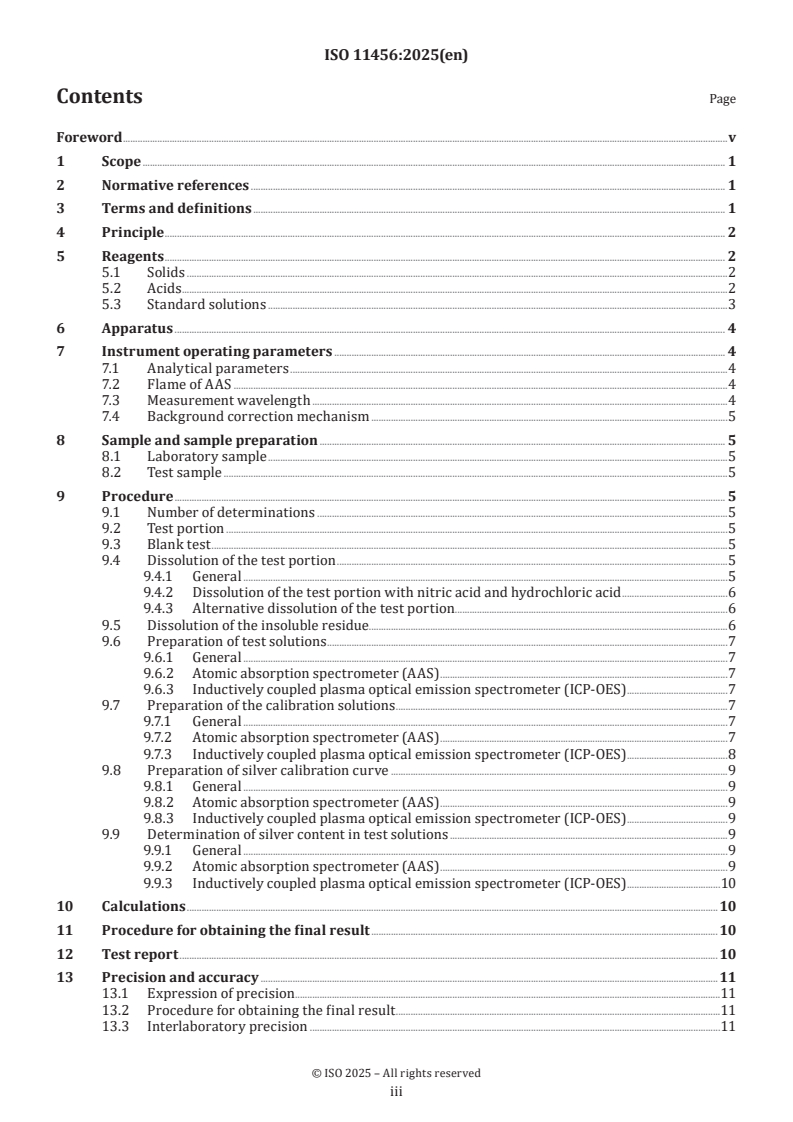
Contents Page
Foreword .v
1 Scope . 1
2 Normative references . 1
3 Terms and definitions . 1
4 Principle . 2
5 Reagents . 2
5.1 Solids .2
5.2 Acids .2
5.3 Standard solutions .3
6 Apparatus . 4
7 Instrument operating parameters . 4
7.1 Analytical parameters .4
7.2 Flame of AAS .4
7.3 Measurement wavelength .4
7.4 Background correction mechanism .5
8 Sample and sample preparation . 5
8.1 Laboratory sample .5
8.2 Test sample .5
9 Procedure . 5
9.1 Number of determinations .5
9.2 Test portion .5
9.3 Blank test .5
9.4 Dissolution of the test portion .5
9.4.1 General .5
9.4.2 Dissolution of the test portion with nitric acid and hydrochloric acid .6
9.4.3 Alternative dissolution of the test portion .6
9.5 Dissolution of the insoluble residue .6
9.6 Preparation of test solutions . .7
9.6.1 General .7
9.6.2 Atomic absorption spectrometer (AAS) .7
9.6.3 Inductively coupled plasma optical emission spectrometer (ICP-OES) .7
9.7 Preparation of the calibration solutions .7
9.7.1 General .7
9.7.2 Atomic absorption spectrometer (AAS) .7
9.7.3 Inductively coupled plasma optical emission spectrometer (ICP-OES) .8
9.8 Preparation of silver calibration curve .9
9.8.1 General .9
9.8.2 Atomic absorption spectrometer (AAS) .9
9.8.3 Inductively coupled plasma optical emission spectrometer (ICP-OES) .9
9.9 Determination of silver content in test solutions .9
9.9.1 General .9
9.9.2 Atomic absorption spectrometer (AAS) .9
9.9.3 Inductively coupled plasma optical emission spectrometer (ICP-OES) .10
10 Calculations .10
11 Procedure for obtaining the final result . 10
12 Test report . 10
13 Precision and accuracy .11
13.1 Expression of precision .11
13.2 Procedure for obtaining the final result .11
13.3 Interlaboratory precision .11
iii
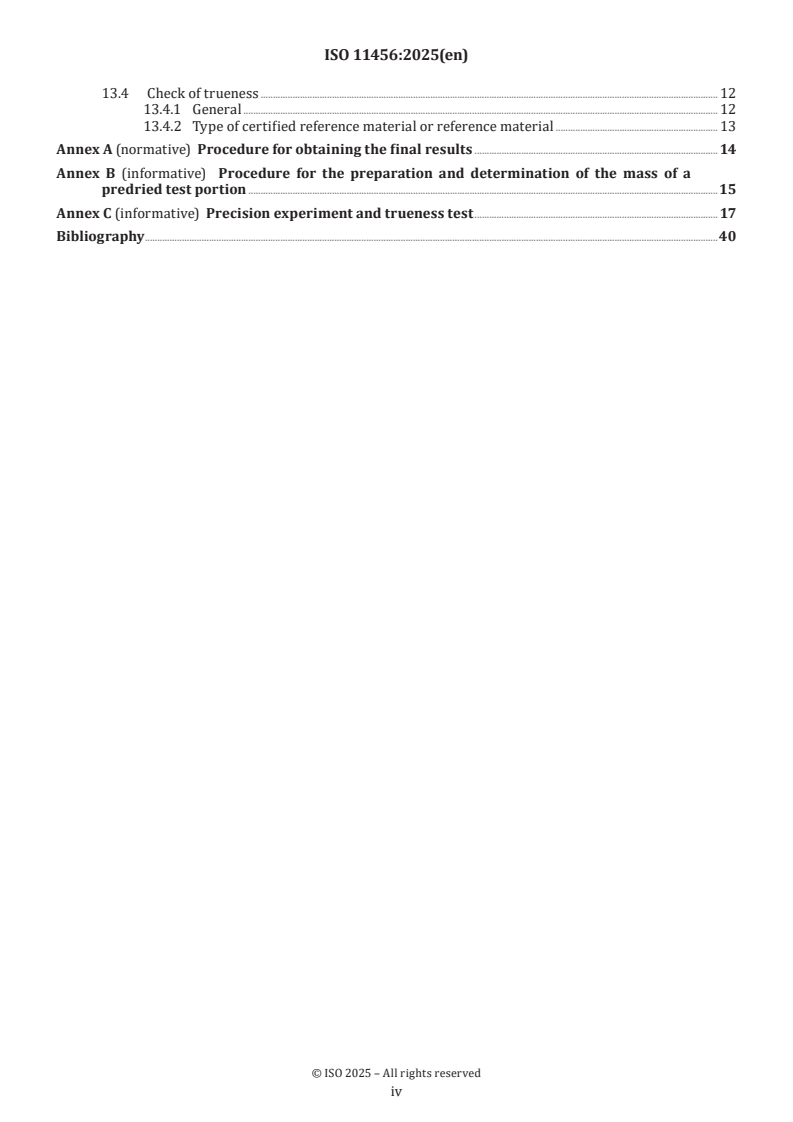
13.4 Check of trueness . 12
13.4.1 General . 12
13.4.2 Type of certified reference material or reference material . 13
Annex A (normative) Procedure for obtaining the final results . 14
Annex B (informative) Procedure for the preparation and determination of the mass of a
predried test portion .15
Annex C (informative) Precision experiment and trueness test . 17
Bibliography .40
iv
Foreword
ISO (the International Organization for Standardization) is a worldwide federation of national standards
bodies (ISO member bodies). The work of preparing International Standards is normally carried out through
ISO technical committees. Each member body interested in a subject for which a technical committee
has been established has the right to be represented on that committee. International organizations,
governmental and non-governmental, in liaison with ISO, also take part in the work. ISO collaborates closely
with the International Electrotechnical Commission (IEC) on all matters of electrotechnical standardization.
The procedures used to develop this document and those intended for its further maintenance are described
in the ISO/IEC Directives, Part 1. In particular, the different approval criteria needed for the different types
of ISO document should be noted. This document was drafted in accordance with the editorial rules of the
ISO/IEC Directives, Part 2 (see www.iso.org/directives).
ISO draws attention to the possibility that the implementation of this document may involve the use of (a)
patent(s). ISO takes no position concerning the evidence, validity or applicability of any claimed patent
rights in respect thereof. As of the date of publication of this document, ISO had not received notice of (a)
patent(s) which may be required to implement this document. However, implementers are cautioned that
this may not represent the latest information, which may be obtained from the patent database available at
www.iso.org/patents. ISO shall not be held responsible for identifying any or all such patent rights.
Any trade name used in this document is information given for the convenience of users and does not
constitute an endorsement.
For an explanation of the voluntary nature of standards, the meaning of ISO specific terms and expressions
related to conformity assessment, as well as information about ISO’s adherence to the World Trade
Organization (WTO) principles in the Technical Barriers to Trade (TBT), see www.iso.org/iso/foreword.html.
This document was prepared by Technical Committee ISO/TC 183, Copper, lead, zinc and nickel ores and
concentrates.
Any feedback or questions on this document should be directed to the user’s national standards body. A
complete listing of these bodies can be found at www.iso.org/members.html.
v
International Standard ISO 11456:2025(en)
Copper and zinc sulfide concentrates — Determination of
silver content — Acid digestion and flame atomic absorption
spectrometric or inductively coupled plasma optical emission
spectrometric method
WARNING — This document can involve hazardous materials and equipment. It is the responsibility
of the user of this document to establish appropriate health and safety practices and determine the
applicability of regulatory limitations prior to use.
1 Scope
This document specifies an acid digestion and flame atomic absorption spectrometric (AAS) method, or
inductively coupled plasma optical emission spectrometric (ICP-OES) method for the determination of the
mass fraction of silver in copper and zinc sulfide concentrates.
The method is applicable to concentrates having silver contents in the following ranges.
— copper concentrates: 10 g/t to 800 g/t ;
— zinc concentrates: 10 g/t to 800 g/t
2 Normative references
The following documents are referred to in the text in such a way that some or all of their content constitutes
requirements of this document. For dated references, only the edition cited applies. For undated references,
the latest edition of the referenced document (including any amendments) applies.
ISO 648, Laboratory glassware — Single-volume pipettes
ISO 1042, Laboratory glassware — One-mark volumetric flasks
ISO 3696, Water for analytical laboratory use — Specification and test methods
ISO 4787, Laboratory glass and plastic ware — Volumetric instruments — Methods for testing of capacity and for use
ISO 8466-2, Water quality — Calibration and evaluation of analytical methods and estimation of performance
characteristics — Part 2: Calibration strategy for non-linear second-order calibration functions
ISO 9599, Copper, lead, zinc and nickel sulfide concentrates — Determination of hygroscopic moisture content of
the analysis sample — Gravimetric method
ISO 12743, Copper, lead, zinc and nickel concentrates — Sampling procedures for determination of metal and
moisture content
3 Terms and definitions
No terms and definitions are listed in this document.
ISO and IEC maintain terminology databases for use in standardization at the following addresses:
— ISO Online browsing platform: available at https:// www .iso .org/ obp
— IEC Electropedia: available at https:// www .electropedia .org/
4 Principle
The test portion is decomposed by acid digestion using nitric and hydrochloric acids. Silver is determined by
comparison against matrix-matched standards using AAS or ICP-OES.
5 Reagents
During the analysis only reagents of analytical grade and grade 2 water of ISO 3696 shall be used.
5.1 Solids
5.1.1 Silver metal (≥99,99 %).
5.1.2 Copper metal (≥99,99 %), (<0,000 05 % silver).
Care should be taken when choosing the copper metal, because normal copper cathode contains about
0,001 % of silver.
5.1.3 Zinc metal (≥99,99 %), (<0,000 05 % silver).
5.1.4 Iron metal (≥99,99 %), (<0,000 05 % silver).
5.1.5 Yttrium oxide (Y O , ≥ 99,99 %).
2 3
5.2 Acids
5.2.1 Nitric acid (ρ = 1,38 g/ml).
5.2.2 Nitric acid, dilute (1 + 1).
Slowly add 500 ml of nitric acid (5.2.1) to 500 ml of water while stirring.
5.2.3 Hydrochloric acid (ρ = 1,16 g/ml).
5.2.4 Hydrochloric acid, dilute (1 + 1).
Slowly add 250 ml of hydrochloric acid (5.2.3) to 250 ml of water while stirring.
5.2.5 Hydrochloric acid, dilute (1 + 3).
Slowly add 250 ml of hydrochloric acid (5.2.3) to 750 ml of water while stirring.
5.2.6 Sulfuric acid (ρ = 1,84 g/ml).
5.2.7 Sulfuric acid, dilute (1 + 1).
Slowly add 100 ml of sulfuric acid (5.2.6) to 100 ml of water while stirring. The addition of sulfuric acid to
water generates heat and shall be performed with adequate precautions.
5.2.8 Perchloric acid (ρ = 1,77 g/ml).
5.2.9 Hydrofluoric acid (ρ = 1,13 g/ml).
5.3 Standard solutions
5.3.1 Primary silver standard (1 000 mg/l).
Weigh 1,000 g of silver metal (5.1.1) into a 300 ml beaker. Add 50 ml of dilute nitric acid (5.2.2) and 50 ml
of water and swirl to mix. Heat gently until nitrogen oxides are generated. Cool to room temperature.
Quantitatively transfer this solution into a 1 000 ml volumetric flask, dilute to the mark with water and mix.
Store in an amber-coloured glass container.
Alternatively, purchase a suitable high-quality prepared standard solution.
NOTE There are the reference solutions with the metrological traceability secured.
5.3.2 Working silver standard A (100 mg/l).
Pipette 20 ml of primary silver standard (5.3.1) into a 200 ml volumetric flask containing 100 ml of
hydrochloric acid (5.2.3) and 50 ml of water and mix well. Allow to the solution to cool and then dilute to the
mark with water and mix. Store in an amber-coloured glass container.
This solution should be freshly prepared. If any turbidity is present, then remake this standard.
5.3.3 Working silver standard B (10 mg/l).
Pipette 5 ml of primary silver standard (5.3.1) into a 500 ml volumetric flask containing 250 ml of dilute
hydrochloric acid (5.2.4) and mix well. Allow to the solution to cool and then dilute to the mark with water
and mix. Store in an amber-coloured glass container.
This solution should be freshly prepared. If any turbidity is present, then remake this standard.
5.3.4 Copper matrix/interference standard solution (25,0 mg/ml).
Dissolve 5,00 g of copper metal (5.1.2) with 50 ml of dilute nitric acid (5.2.2). Heat and evaporate to
approximately 25 ml to remove nitrogen oxides. Transfer to a 200 ml volumetric flask and add 100 ml of
dilute hydrochloric acid (5.2.4). Then fill up with water nearly to the mark, mix and cool to room temperature.
Then fill up exactly to the mark and mix again.
5.3.5 Zinc matrix/interference standard solution (25,0 mg/ml).
Dissolve 5,00 g of zinc metal (5.1.3) with 50 ml of dilute hydrochloric acid (5.2.4). Transfer to a 200 ml
volumetric flask and add 50 ml of dilute hydrochloric acid (5.2.4). Then fill up with water nearly to the mark,
mix and cool to room temperature. Then fill up to the mark and mix again.
5.3.6 Iron matrix/interference standard solution (25,0 mg/ml).
Dissolve 5,00 g of iron metal (5.1.4) with 50 ml of dilute hydrochloric acid (5.2.4). Heat gently until the
reaction is complete. Add 5 ml of nitric acid (5.2.1) and heat. Transfer to a 200 ml volumetric flask and add
50 ml of dilute hydrochloric acid (5.2.4). Then fill up with water nearly to the mark, mix and cool to room
temperature. Then fill up to the mark and mix again.
5.3.7 Primary yttrium standard (1 000 mg/l).
Weigh 1,270 g of yttrium trioxide (5.1.5) into a 300 ml beaker. Add 50 ml of dilute nitric acid (5.2.2). Heat
gently. Cool to room temperature. Quantitatively transfer this solution into a 1 000 ml volumetric flask,
dilute to the mark with water and mix well.
5.3.8 Yttrium internal standard solution (100 mg/l).
Pipette 20 ml of primary yttrium standard (5.3.7) into a 200 ml volumetric flask containing 100 ml of
hydrochloric acid (5.2.3) and 50 ml of water. Allow the solution to cool. Dilute to volume with water and mix well.
6 Apparatus
Use laboratory glassware and equipment that is free of silver and chloride contamination.
6.1 Analytical balance, sensitivity to 0,1 mg.
6.2 Laboratory hotplate with temperature controller.
6.3 Normal laboratory glassware, which shall conform to ISO 648 and ISO 1042 and shall be used in
accordance with ISO 4787.
6.4 Polytetrafluoroethylene beaker, 200 ml capacity.
6.5 Insoluble filter paper, an ash content of a mass fraction of 0,01 % or less and a nominal particle
retention of 25 μm or less.
6.6 Atomic absorption spectrometer (AAS).
6.7 Inductively coupled plasma optical emission spectrometer (ICP-OES).
7 Instrument operating parameters
7.1 Analytical parameters
A variety of AAS and ICP-OES are available and the manufacturer’s instructions supplied with the instrument
provide adequate information for their operation. Refer to the manufacturer’s instructions for optimizing
AAS and ICP-OES. The instrument should be optimized to give maximum sensitivity and as near as practical
to a linear relationship between absorbance or emission intensity and concentration.
7.2 Flame of AAS
When using the AAS, use an air-acetylene (oxidizing) flame.
7.3 Measurement wavelength
The recommended measurement wavelengths are as follows:
— AAS: 328,1 nm.
— ICP-OES: Silver 328,068 nm.
— Yttrium: 371,030 nm or 324,228 nm.
The wavelength resolution of the ICP-OES differs depending on the type of device. Therefore, interference
should be checked for in advance and an appropriate measurement wavelength should be selected. Higher
order spectral lines may be selected in a device that can measure higher order spectral lines. When a suitable
emission line without interference cannot be selected, the interference amount shall be suitably corrected.
The ICP-OES measuring wavelength with an emission intensity suitable for the intended range of
determination should be selected from the measuring wavelengths of the respective element. In this case,
the detection limit, measuring accuracy, etc. should be sufficiently investigated.
There are two types of observation methods in ICP-OES from the emission part, which are the radial view
method and the axial view method, and both may be used. However, the axial observation method has a
narrower linear range of the calibration curve and more interferences than the radial view method.
7.4 Background correction mechanism
When using the AAS, a background correction mechanism shall be used. On the other hand, when using the
ICP-OES, a background correction mechanism may be used.
8 Sample and sample preparation
8.1 Laboratory sample
Laboratory samples shall be taken and prepared in accordance with the procedures described in ISO 12743.
8.2 Test sample
Prepare an air-equilibrated test sample and a hygroscopic moisture test sample in accordance with ISO 9599.
NOTE A test sample is not required if pre-dried test portions are used, see Annex B.
9 Procedure
9.1 Number of determinations
Carry out the determination at least in duplicate, as far as possible under repeatability conditions, on each
test sample.
NOTE Repeatability conditions exist where mutually independent test results are obtained with the same
method on identical test material in the same laboratory by the same operator using the same equipment within short
intervals of time.
9.2 Test portion
Taking multiple increments, extract approximately 1,0 g from the test sample and weigh to the nearest
0,1 mg. At the same time as the test portions are being weighed for analysis, weigh test portions for the
determination of hygroscopic moisture in accordance with ISO 9599.
Alternatively, the method specified in Annex B may be used to prepare pre-dried test portions directly from
the laboratory sample.
Obtain an approximate content for the copper, zinc and iron in the sample as required in 9.7.3.
Estimate the content for the copper, zinc, and iron in the sample by ICP-OES, AAS, XRF, titration, etc.
9.3 Blank test
Carry out a blank test in parallel with the analysis using the same quantities of all reagents but omitting the
sample. The result of silver, in µg, in the blank test will be subtracted from the result of samples.
The purpose of the blank test is to check the atmosphere used in the test, apparatus contamination and
reagent purity.
9.4 Dissolution of the test portion
9.4.1 General
Decompose the test portion in accordance with 9.4.2 or 9.4.3.
9.4.2 Dissolution of the test portion with nitric acid and hydrochloric acid
Quantitatively transfer the test portion into a 300 ml beaker. Add cautiously 20 ml of dilute nitric acid (5.2.2).
Cover with a watch glass and leave the sample at room temperature for 30 min. Then place the beaker on
the hotplate and heat slowly from room temperature to 90 °C. After the test portion is decomposed, increase
the temperature of the hotplate to approximately 120 °C and expel oxides of nitrogen. Rinse the watch glass
with a small amount of water and collect the washing solutions to the dissolved solutions. Remove the watch
glass, increase the temperature of the hotplate to approximately 150 °C and evaporate to approximately
10 ml. Add 5 ml of hydrochloric acid (5.2.3), heat gently at a hotplate temperature of 120 °C to 150 °C and
evaporate until the liquid volume is 1 ml to 2 ml. Remove the beaker from the hotplate.
NOTE 1 Rapid heating can cause the free sulfur to deposit, the free sulfur holding some of the silver ions.
In the case of free sulfur, which is deposited during gentle heating, dissolution should be carried out as
described in 9.4.3.
NOTE 2 Silver oxide can form if heating is continued to the point of dryness of the solution. Silver oxide is difficult
to dissolve by the procedure described in 9.5.
Cover with watch glass again. Cool and cautiously add 20 ml of dilute hydrochloric acid (5.2.5). Heat the
solution to boiling, then cool to room temperature. Rinse the watch glass with dilute hydrochloric acid (5.2.5)
and collect the washing solutions to the dissolved solutions, then remove the watch glass. Filter the solution
through an insoluble filter paper (6.5) into a clean volumetric flask that is specified in 9.6. Thoroughly wash
the 300 ml beaker used to digest the test portion and filter paper with dilute hydrochloric acid (5.2.5) and
collect the washing solutions into the same volumetric flask.
If acid-insoluble material is present, then treat this residue as described in 9.5, otherwise proceed to 9.6.
9.4.3 Alternative dissolution of the test portion
Quantitatively transfer the test portion into a 300 ml beaker. Add cautiously 20 ml of dilute nitric acid (5.2.2).
Cover with a watch glass and place the beaker on the hotplate and heat gently until all nitrogen oxides are
expelled. Cautiously add 5 ml of perchloric acid (5.2.8). Continue heating until dense fumes of perchloric acid
condense and drain down the sides of the beaker. Remove the watch glass and evaporate to dryness, then
remove the beaker from the hotplate immediately.
Ensure that the temperature of the hotplate is between 200 °C and 220 °C.
NOTE Silver oxide can form if heating is continued even after the point of dryness of the solution. Silver oxide is
difficult to dissolve by the procedure described in 9.5.
Cover with watch glass again. Cool and cautiously add 20 ml of dilute hydrochloric acid (5.2.5). Heat the
solution to boiling, then cool to room temperature. Rinse the watch glass with dilute hydrochloric acid (5.2.5)
and collect the washing solutions to the dissolved solutions, then remove the watch glass. Filter the solution
through an insoluble filter paper (6.5) into a clean volumetric flask that is specified in 9.6. Thoroughly wash
the 300 ml beaker used to digest the test portion and filter paper with dilute hydrochloric acid (5.2.5) and
collect the washing solutions into the same volumetric flask.
If acid-insoluble material is present, then treat this residue as described in 9.5, otherwise proceed to 9.6.
9.5 Dissolution of the insoluble residue
Quantitatively, transfer the acid-insoluble residue into a 200 ml polytetrafluoroethylene beaker (6.4) with
a small quantity of water. Add 5 ml of nitric acid (5.2.1), 5 ml of dilute sulfuric acid (5.2.7) and 3 ml to 5 ml
of hydrofluoric acid (5.2.9). Heat the solution until enough white sulfuric acid gas is evolved to remove the
silicon dioxide, then allow to cool. Add 20 ml of dilute hydrochloric acid (5.2.5) and cover the beaker with a
watch glass. Heat the solution to boiling, then cool to room temperature. Rinse the watch glass and collect
the washing solutions to the dissolved solutions.
If the insoluble material remains after this treatment, filter through an insoluble filter paper (6.5). Then
wash the insoluble material and the filter paper with dilute hydrochloric acid (5.2.5), and collect the filtrate
and the washing solution to the dissolved solutions. Reject insoluble material and the filter paper.
In cases where the absence of silver in the acid-insoluble residue is confirmed, the procedure of dissolution
of the insoluble residue may be omitted.
Proceed to 9.6.
9.6 Preparation of test solutions
9.6.1 General
Prepare the test solutions in accordance with 9.6.2 or 9.6.3.
9.6.2 Atomic absorption spectrometer (AAS)
Quantitatively transfer the solution from 9.4.2 or 9.4.3 and 9.5 to volumetric flask of the volume specified
in Table 1. Dilute to about 3/4 with dilute hydrochloric acid (5.2.5). Allow the solution to cool to room
temperature, then dilute to the mark with dilute hydrochloric acid (5.2.5) and mix well.
Table 1 — Volume of test solution for AAS
Silver content of Volume of
sample volumetric flask
g/t ml
< 400 200
400 to 800 500
9.6.3 Inductively coupled plasma optical emission spectrometer (ICP-OES)
Quantitatively transfer the solution from 9.4.2 or 9.4.3 and 9.5 to a 200 ml volumetric flask and pipette
5,00 ml yttrium standard internal solution (5.3.8). Dilute to about 3/4 with dilute hydrochloric acid (5.2.5).
Allow the solution to cool to room temperature, then dilute to the mark with dilute hydrochloric acid (5.2.5)
and mix well.
9.7 Preparation of the calibration solutions
9.7.1 General
Prepare the calibration solutions in accordance with 9.7.2 or 9.7.3.
9.7.2 Atomic absorption spectrometer (AAS)
Using working silver standard B (5.3.3), prepare a series of calibration solutions as per Table 2. Transfer
the appropriate volumes of working standard solutions using pipettes, into each 200 ml volumetric flasks
containing the following:
a) Sufficient matrix/interference standard to match the major element in the concentrate being measured.
For copper sulfide concentrates, use the copper matrix/interference standard (5.3.4). For zinc sulfide
concentrates, use the zinc matrix/interference standard (5.3.5).
b) Sufficient iron matrix/interference standard (5.3.6) to match the iron content of the samples.
Dilute to the mark with dilute hydrochloric acid (5.2.5) and mix well.
In cases where silver is determined using AAS, if the interference from the matrix has not appeared, the
addition of the matrix/interference standard may be omitted.
The linearity of the calibration curve of the AAS differs depending on the type of device. Therefore, the
linearity should be confirmed in advance, taking into consideration the concentration range of the analytical
sample. Depending on the result, the number and the concentration of the calibration solutions in Table 2
may be changed.
Table 2 — Example of calibration solutions for AAS
Volume of Silver Concentration range of silver in concentrate
working silver mass g/t
standard B
< 200 200 to < 400 400 to 800
(5.3.3)
Concentration of silver
ml μg
μg/ml
0 0 0 — —
2 20 0,10 — —
5 50 0,25 — —
10 100 0,50 — —
15 150 0,75 0,75 0,30
20 200 1,00 1,00 0,40
25 250 — 1,25 0,50
30 300 — 1,50 0,60
35 350 — 1,75 0,70
40 400 — 2,0 0,80
9.7.3 Inductively coupled plasma optical emission spectrometer (ICP-OES)
Using working silver standard A (5.3.2) and working silver standard B (5.3.3), prepare a series of calibration
solutions as per Table 3. Transfer the appropriate volumes of working standard solutions using pipettes, into
each 200 ml volumetric flasks containing the following:
a) Sufficient matrix/interference standard to match the major element in the concentrate being measured.
For copper sulfide concentrates, use the copper matrix/interference standard (5.3.4). For zinc sulfide
concentrates, use the zinc matrix/interference standard (5.3.5).
b) Sufficient iron matrix/interference standard (5.3.6) to match the iron content of the samples.
Pipette 5,00 ml yttrium standard internal solution (5.3.8). Ddilute to the mark with dilute hydrochloric acid
(5.2.5) and mix well.
The linearity of the calibration curve of the ICP-OES differs depending on the type of device. Therefore, the
linearity should be confirmed in advance, taking into consideration the concentration range of the analytical
sample. Depending on the result, the number and the concentration of the calibration solutions in Table 3
may be changed.
Table 3 — Example of calibration solutions for ICP-OES
Volume of Volume of Silver Concentration
working silver working silver mass of silver
standard A standard B
(5.3.2) (5.3.3)
ml ml μg μg/ml
— 0 0 0
— 2 20 0,10
— 5 50 0,25
— 10 100 0,50
— 20 200 1,00
TTaabblle 3 e 3 ((ccoonnttiinnueuedd))
Volume of Volume of Silver Concentration
working silver working silver mass of silver
standard A standard B
(5.3.2) (5.3.3)
ml ml μg μg/ml
4 — 400 2,00
7 — 700 3,50
10 — 1 000 5,00
9.8 Preparation of silver calibration curve
9.8.1 General
Prepare the silver calibration curve in accordance with 9.8.2 or 9.8.3.
9.8.2 Atomic absorption spectrometer (AAS)
Set up the AAS (6.6) in accordance with Clause 7.
Adjust the instrument read-out scale to zero. Atomize the calibration solutions as prepared in 9.7.2 into
the air-acetylene flame of an AAS and record the absorbance of silver. Manually or electronically plot the
relationship between the absorbance and the mass of silver (in μg) as a calibration curve.
Use ISO 8466-2 to determine the acceptability of the calibration curve.
9.8.3 Inductively coupled plasma optical emission spectrometer (ICP-OES)
Set up the ICP-OES (6.7) in accordance with Clause 7.
Atomize the calibration solutions as prepared in 9.7.3 into the argon plasma of an ICP-OES and measure
the emission intensities of silver and yttrium. Manually or electronically plot the relationship between the
emission intensity ratio of silver to yttrium intensities and the mass of silver (in μg) as a calibration curve.
The solution introduction unit should be rinsed with dilute hydrochloric acid (5.2.5) after each calibration
solution measurement.
Use ISO 8466-2 to determine the acceptability of the calibration curve.
9.9 Determination of silver content in test solutions
9.9.1 General
Determine the silver content in test solutions in accordance with 9.9.2 or 9.9.3.
9.9.2 Atomic absorption spectrometer (AAS)
Immediately after calibrating the AAS, determine the silver content in the test solutions from 9.6.2.
Adjust the instrument read-out scale to zero. Atomize the test solutions as prepared in 9.6.2 into the air-
acetylene flame of an AAS and record the absorbance of silver.
The calibration curve can vary due to long-term continuous operation of AAS or the accumulated number
of measurements. In such a case, for accurate determination, the calibration curve should be corrected by
measuring the solution for correction of calibration curve at constant intervals or every certain number of
measurements.
If more than 10 μg of silver is found for the blank test, this shall be investigated and the results for the
samples shall not be reported.
9.9.3 Inductively coupled plasma optical emission spectrometer (ICP-OES)
Immediately after calibrating the ICP-OES, determine the silver content in the test solutions from 9.6.3.
Atomize the test solutions as prepared in 9.6.3 into argon plasma of an ICP-OES and record the emission
intensity ratio of silver to yttrium intensities. The solution introduction unit should be rinsed with dilute
hydrochloric acid (5.2.5) after each test solution measurement.
The calibration curve can vary due to long-term continuous operation of ICP-OES or the accumulated number
of measurements. In such a case, for accurate determination, the calibration curve should be corrected by
measuring the solution for correction of calibration curve at constant intervals or every certain number of
measurements.
If more than 10 μg of silver is found for the blank test, this shall be investigated and the results for the
samples shall not be reported.
10 Calculations
Calculate the silver content of the sample (W ) in accordance with Formula (1):
Ag
Wg()/*tF=−()VF//200 MK* (1)
Ag EE blank
where
F is the mass of silver found in the test solutions, in μg (see 9.9);
E
F is the mass of silver found in the blank test, in μg (see 9.3);
E blank
V is the final volume of the test solutions, in ml (see 9.6);
200 is the final minimum volume of the test solutions, in ml (see 9.6);
M is the mass of the test portion, in g (see 9.2);
K is the hygroscopic moisture conversion factor determined as shown by Formula (2):
K = (2)
100−H
()
where
H is the hygroscopic moisture content of the sample determined by ISO 9599.
If pre-dried test samples are used (in accordance with Annex B), H = 0.
11 Procedure for obtaining the final result
Process the duplicate results for each test portion of the sample in accordance with the chart in Annex A and
repeat the determination for a sample as necessary.
12 Test report
Once all the requirements in Clause 11 have been achieved, the result can be reported.
The test report shall contain the following information:
a) identification of the sample;
b) a reference to this document, i.e. ISO 11456;
c) silver content of the sample, expressed as g/t;
d) date on which the test was carried out;
e) any occurrences noticed during the determination which can have had an influence on the results.
13 Precision and accuracy
13.1 Expression of precision
The precision of this analytical method is expressed by Formulae (3) and (4):
sa=+Xb (3)
r
sc=+Xd (4)
R
where
X is the concentration of silver, in g/t, in the sample;
s is the repeatability standard deviation, in g/t;
r
s is the reproducibility standard deviation, in g/t;
R
a, b, c, d are shown in Table 4.
Table 4 — Coefficients by each method
Decomposition Measurement a b c d
HNO – HCl ICP-OES 0,008 1 0,413 6 0,050 9 2,651 0
HNO – HCl AAS 0,011 1 0,321 8 0,042 1 1,350 8
HNO – HClO ICP-OES 0,010 0 0,456 0 0,048 9 3,110 4
3 4
HNO – HClO AAS 0,007 5 0,784 4 0,027 1 3,429 1
3 4
13.2 Procedure for obtaining the final result
Calculate the following quantities from the duplicate results X and X (g/t) and process in accordance with
1 2
the chart in Annex A:
— Mean of duplicates, as shown by Formula (5):
()XX+
x = (5)
— Repeatability standard deviation, as shown by Formula (6):
sa=+Xb (6)
r
— Repeatability limit, as shown by Formula (7):
rs=28, (7)
r
13.3 Interlaboratory precision
Interlaboratory precision is used to determine the agreement between the results reported by two (or more)
laboratories. The assumption is that all laboratories followed the same procedure.
Calculate the following quantities:
— Mean of final results, as shown by Formula (8):
μμ+
()
μ = (8)
12,
— Reproducibility standard deviation, as shown by Formula (9):
sc=+μ d (9)
R 12,
— Repeatability standard deviation, as shown by Formula (10):
sa=+μ b (10)
r 12,
— Permissible tolerance, as shown by Formula (11):
ss+
Rr
P=28, (11)
— Range, as shown by Formula (12):
E=−μμ (12)
where
μ is the final result, in g/t, reported by laboratory 1;
μ is the final result, in g/t, reported by laboratory 2.
If E is equal to or less than P, the final results are in agreement.
13.4 Check of trueness
13.4.1 General
The trueness of the analytical method can be checked by applying it to a certified reference material (CRM).
When the precision has been confirmed, the final laboratory result can be compared with the certified value,
A . There are two possibilities as shown by Formulae (13) and (14):
c
μ −≤AC (13)
CC
If this condition exists, the difference between the reported result and the certified value is statistically
insignificant.
μ −>AC (14)
CC
If this condition exists, the difference between the reported result and the certified value is statistically
significant.
where
μ is the final result, in g/t, of the certified reference material;
c
A is the certified value, in g/t, of the certified reference material;
C
C is a quantity, in g/t, depending on the type of certified reference material used as defined in 13.4.2.2.
13.4.2 Type of certified reference material or reference material
13.4.2.1 General
Reference materials used for this purpose should be prepared and certified in accordance with ISO 33405.
13.4.2.2 Reference material certifi
...