

ISO/TS 15855:2025
(Main)Copper, lead and zinc sulfide concentrates — Step-by-step procedure for the testing of static scales
General Information
- Abstract
This document specifies simple procedures to check the performance and calibration status of static scales. The test sequence is applicable to routine applications, generating results which can be used to calculate explicit scale performance parameters (precision, bias and linearity) in accordance with the relevant formulae shown in ISO 12745.
- Status
- Published
- Publication Date
- 22-Jan-2025
- Technical Committee
- ISO/TC 183 - Copper, lead, zinc and nickel ores and concentrates
- Drafting Committee
- ISO/TC 183 - Copper, lead, zinc and nickel ores and concentrates
- Current Stage
- 6060 - International Standard published
- Start Date
- 23-Jan-2025
- Due Date
- 23-Nov-2025
- Completion Date
- 23-Jan-2025
Overview
ISO/TS 15855:2025 is a technical specification developed by ISO that establishes a step-by-step procedure for testing static scales used in measuring copper, lead, and zinc sulfide concentrates. This standard supports routine verification of scale performance, focusing on precision, bias, and linearity in weighing equipment such as weighbridges, hopper scales, and platform scales. The procedures align with the analytical formulas specified in ISO 12745, offering operators a reliable methodology to validate the accuracy and calibration of static scales critical to commercial transactions involving mineral concentrates.
Key Topics
Scope and Purpose: ISO/TS 15855:2025 defines simple, practical procedures for conducting performance checks and calibration status tests on static scales used in sulfide concentrate weighing.
Precision Testing: Detailed procedures provide guidance on replicate weighing tests to determine scale precision across different types of scales:
- Weighbridges: Precision assessed by repeated weighings of trucks or rail wagons in multiple positions.
- Hopper Scales: Precision measured using test masses relative to scale sensitivity.
- Platform Scales: Precision established through replicate weighings of bags or similar loads in varied positions.
Calibration Testing: The standard outlines two calibration methods to assess scale bias and linearity:
- Single Certified Test Weight Method: Uses one certified weight or equivalent to test calibration points at zero, half, and near full scale capacity.
- Multiple Certified Test Weights Method: Employs incremental additions and removals of a set of certified weights covering the entire scale range to generate calibration data points.
Frequency of Testing: The document discusses the operational frequency of scale testing, recommending routine performance checks prior to commercial consignments while noting variability in practice based on risk and scale reliability.
Compliance and Reference: The procedures are fully aligned with ISO 12745:2008, ensuring consistency in terminology, testing principles, and formulae for result calculation.
Applications
ISO/TS 15855:2025 is vital for industries involved in the production, processing, and commercial trading of copper, lead, and zinc sulfide concentrates. Its practical stepwise methodologies aid:
- Mining Operations: Ensures accurate weighing during extraction and concentrate handling, minimizing commercial disputes.
- Processing Plants: Provides scale testing protocols to maintain measurement integrity in material input and output stages.
- Logistics and Transport: Facilitates precise weighbridge checks critical for freight and customs declarations involving heavy loads.
- Quality Assurance: Assists regulatory compliance and internal quality control through documented scale performance verification.
- Automated Weighing Systems: Supports routine calibration and performance assessments in semi-automated and fully automated weighing installations.
By following ISO/TS 15855:2025, organizations reduce risk related to inaccurate mass measurements and improve trust among commercial partners.
Related Standards
- ISO 12745:2008 – Precision and bias of mass measurement techniques for copper, lead, and zinc ores and concentrates, providing foundational measurement principles referenced directly in ISO/TS 15855.
- ISO/IEC Directives, Part 1 and Part 2 – Guide the editorial and development process of ISO standards, ensuring consistency and reliability.
- National and Regional Weighing Standards – Local regulations may complement this specification for mandatory calibration intervals and certification requirements.
- ISO/TC 183 Technical Committee – The governing body developing standards related to copper, lead, zinc, and nickel ores and concentrates.
Keywords: ISO/TS 15855:2025, static scale testing, calibration procedure, weighbridge precision, hopper scale calibration, platform scale testing, copper lead zinc concentrates, mass measurement accuracy, scale bias and linearity, mineral concentrate weighing standards.
Relations
- Effective Date
- 12-Apr-2025
- Effective Date
- 06-Jun-2022
Get Certified
Connect with accredited certification bodies for this standard

Bureau Veritas Chile
Bureau Veritas certification services in Chile.
Bureau Veritas Peru
Bureau Veritas certification services in Peru.
BVQI Peru
Bureau Veritas certification in Peru.
Sponsored listings
Frequently Asked Questions
ISO/TS 15855:2025 is a technical specification published by the International Organization for Standardization (ISO). Its full title is "Copper, lead and zinc sulfide concentrates — Step-by-step procedure for the testing of static scales". This standard covers: This document specifies simple procedures to check the performance and calibration status of static scales. The test sequence is applicable to routine applications, generating results which can be used to calculate explicit scale performance parameters (precision, bias and linearity) in accordance with the relevant formulae shown in ISO 12745.
This document specifies simple procedures to check the performance and calibration status of static scales. The test sequence is applicable to routine applications, generating results which can be used to calculate explicit scale performance parameters (precision, bias and linearity) in accordance with the relevant formulae shown in ISO 12745.
ISO/TS 15855:2025 is classified under the following ICS (International Classification for Standards) categories: 73.060.99 - Other metalliferous minerals. The ICS classification helps identify the subject area and facilitates finding related standards.
ISO/TS 15855:2025 has the following relationships with other standards: It is inter standard links to ISO 16958:2026, ISO/TR 15855:2001. Understanding these relationships helps ensure you are using the most current and applicable version of the standard.
ISO/TS 15855:2025 is available in PDF format for immediate download after purchase. The document can be added to your cart and obtained through the secure checkout process. Digital delivery ensures instant access to the complete standard document.
Standards Content (Sample)
Technical
Specification
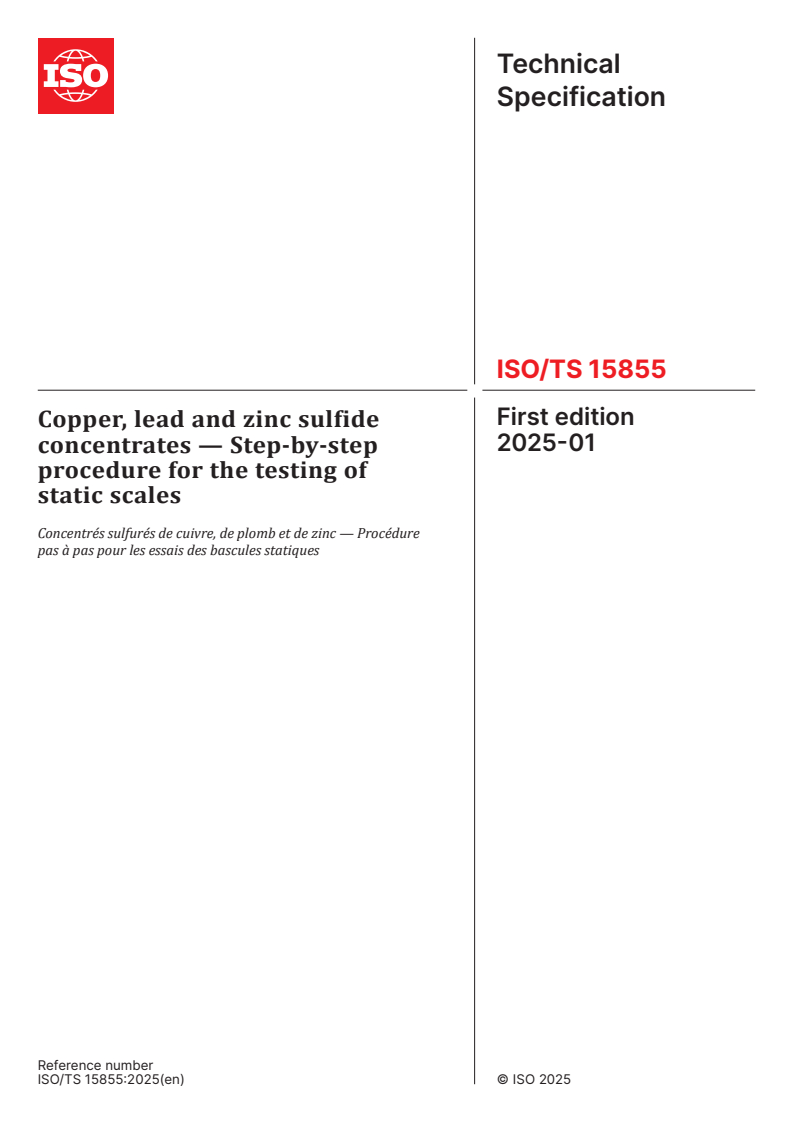
ISO/TS 15855
First edition
Copper, lead and zinc sulfide
2025-01
concentrates — Step-by-step
procedure for the testing of
static scales
Concentrés sulfurés de cuivre, de plomb et de zinc — Procédure
pas à pas pour les essais des bascules statiques
Reference number
© ISO 2025
All rights reserved. Unless otherwise specified, or required in the context of its implementation, no part of this publication may
be reproduced or utilized otherwise in any form or by any means, electronic or mechanical, including photocopying, or posting on
the internet or an intranet, without prior written permission. Permission can be requested from either ISO at the address below
or ISO’s member body in the country of the requester.
ISO copyright office
CP 401 • Ch. de Blandonnet 8
CH-1214 Vernier, Geneva
Phone: +41 22 749 01 11
Email: copyright@iso.org
Website: www.iso.org
Published in Switzerland
ii
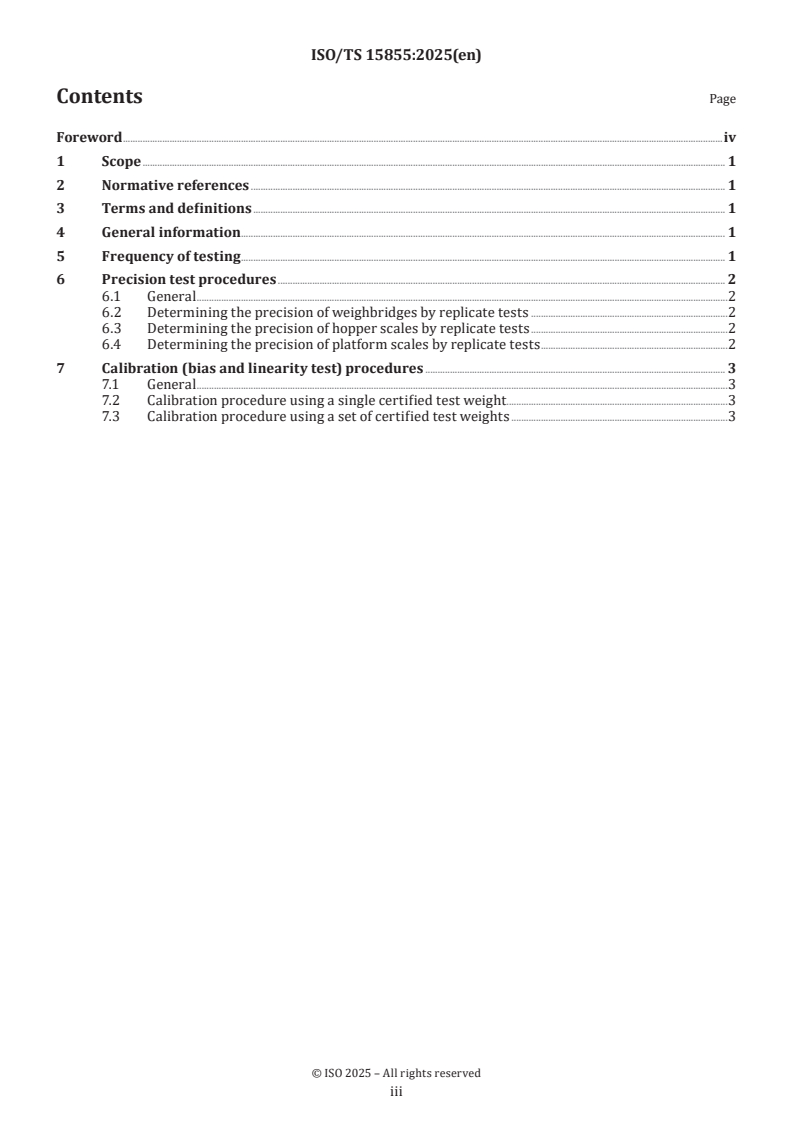
Contents Page
Foreword .iv
1 Scope . 1
2 Normative references . 1
3 Terms and definitions . 1
4 General information . 1
5 Frequency of testing . . 1
6 Precision test procedures . 2
6.1 General .2
6.2 Determining the precision of weighbridges by replicate tests .2
6.3 Determining the precision of hopper scales by replicate tests .2
6.4 Determining the precision of platform scales by replicate tests .2
7 Calibration (bias and linearity test) procedures . 3
7.1 General .3
7.2 Calibration procedure using a single certified test weight .3
7.3 Calibration procedure using a set of certified test weights .3
iii
Foreword
ISO (the International Organization for Standardization) is a worldwide federation of national standards
bodies (ISO member bodies). The work of preparing International Standards is normally carried out through
ISO technical committees. Each member body interested in a subject for which a technical committee
has been established has the right to be represented on that committee. International organizations,
governmental and non-governmental, in liaison with ISO, also take part in the work. ISO collaborates closely
with the International Electrotechnical Commission (IEC) on all matters of electrotechnical standardization.
The procedures used to develop this document and those intended for its further maintenance are described
in the ISO/IEC Directives, Part 1. In particular, the different approval criteria needed for the different types
of ISO document should be noted. This document was drafted in accordance with the editorial rules of the
ISO/IEC Directives, Part 2 (see www.iso.org/directives).
ISO draws attention to the possibility that the implementation of this document may involve the use of (a)
patent(s). ISO takes no position concerning the evidence, validity or applicability of any claimed patent
rights in respect thereof. As of the date of publication of this document, ISO had not received notice of (a)
patent(s) which may be required to implement this document. However, implementers are cautioned that
this may not represent the latest information, which may be obtained from the patent database available at
www.iso.org/patents. ISO shall not be held responsible for identifying any or all such patent rights.
Any trade name used in this document is information given for the convenience of users and does not
constitute an endorsement.
For an explanation of the voluntary nature of standards, the meaning of ISO specific terms and expressions
related to conformity assessment, as well as information about ISO’s adherence to the World Trade
Organization (WTO) principles in the Technical Barriers to Trade (TBT), see www.iso.org/iso/foreword.html.
This document was prepared by Technical Committee ISO/TC 183, Copper, lead, zinc and nickel ores and
concentrates.
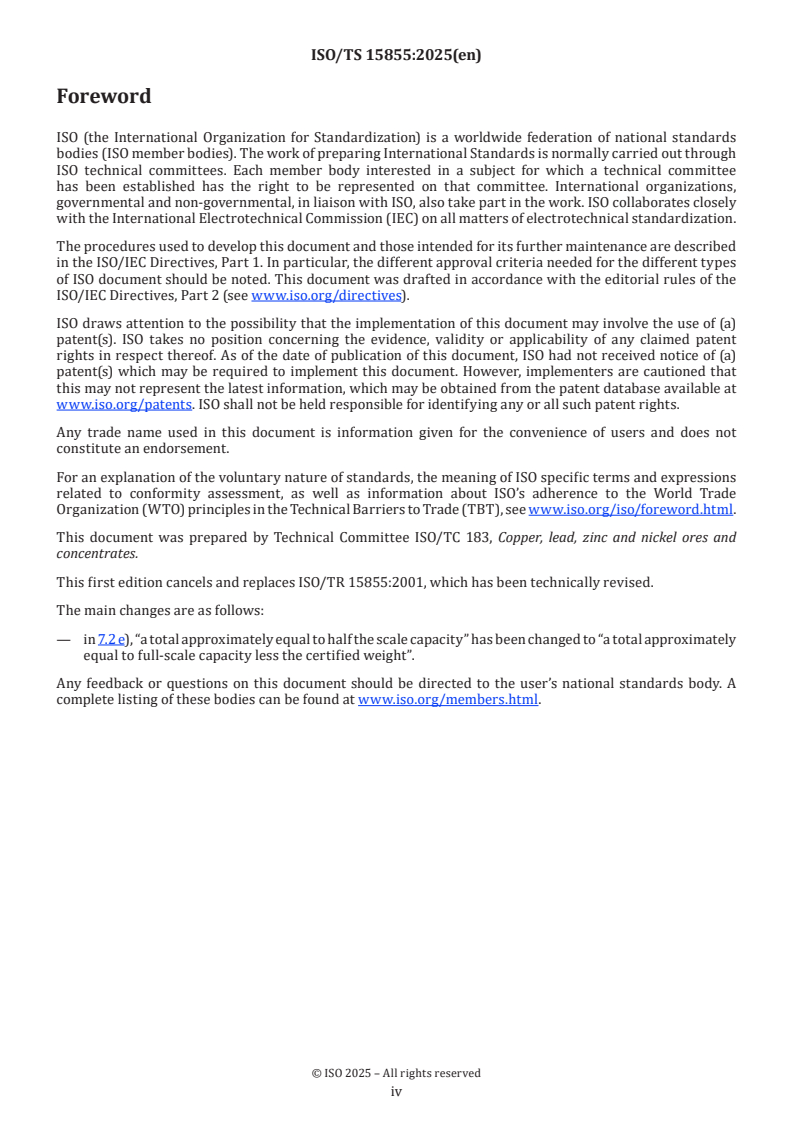
This first edition cancels and replaces ISO/TR 15855:2001, which has been technically revised.
The main changes are as follows:
— in 7.2 e), “a total approximately equal to half the scale capacity” has been changed to “a total approximately
equal to full-scale capacity less the certified weight”.
Any feedback or questions on this document should be directed to the user’s national standards body. A
complete listing of these bodies can be found at www.iso.org/members.html.
iv
Technical Specification ISO/TS 15855:2025(en)
Copper, lead and zinc sulfide concentrates — Step-by-step
procedure for the testing of static scales
1 Scope
This document specifies simple procedures to check the performance and calibration status of static scales.
The test sequence is applicable to routine applications, generating results which can be used to calculate
explicit scale performance parameters (precision, bias and linearity) in accordance with the relevant
formulae shown in ISO 12745.
2 Normative references
The following documents are referred to in the text in such a way that some or all of their content constitutes
requirements of this document. For dated references, only the edition cited applies. For undated references,
the latest edition of the referenced document (including any amendments) applies.
ISO 12745:2008, Copper, lead and zinc ores and concentrates — Precision and bias of mass measurement
techniques
3 Terms and definitions
For the purposes of this document, the terms and definitions given in ISO 12745:2008 apply.
ISO and IEC maintain terminology d
...