


ISO 5401:2024
(Main)Audit data collection — Customs and indirect tax extension
Audit data collection — Customs and indirect tax extension
This document specifies the functional requirements that build on ISO 21378 for audits in the areas of customs duties and indirect taxes [e.g. value-added tax (VAT) and excise duties]. It addresses how tax auditors obtain audit data for these audits, including data element formats and to some extent content requirements. In practice, this document applies to virtually every step in the whole process in the supply chain and covers both goods, services and works. It includes domestic transactions, cross-border transactions (import and export) and can cover both third-party and intercompany transactions or even movements of goods within the same company. This document does not describe when an event is taxable nor how to calculate tax or customs duties as this is legislation-specific and the situation can vary from country to country or even within the same country. This document covers standard exchange of the data related to taxable operations/activities by businesses to perform controls and audits more effectively and efficiently through automated tests. This document focuses on the characteristics related to taxability and the related formalities of the indirect tax and customs duties regulations. It includes the result of a tax calculation, the relevant underlying parameters which can be processed by ERP-systems and/or indirect tax/customs duties systems, and data needed to comply with indirect tax and customs duties legislation and formalities. This document is not designed to collect audit data from the regulators like tax and/or customs authorities.
Titre manque
General Information
- Status
- Published
- Publication Date
- 23-Apr-2024
- Technical Committee
- ISO/TC 295 - Audit data services
- Drafting Committee
- ISO/TC 295 - Audit data services
- Current Stage
- 6060 - International Standard published
- Start Date
- 24-Apr-2024
- Due Date
- 01-Jun-2024
- Completion Date
- 24-Apr-2024
Overview
ISO 5401:2024 - "Audit data collection - Customs and indirect tax extension" is an ISO standard that extends ISO 21378 to address audit data needs specific to customs duties and indirect taxes (for example VAT, GST, excise duties). It specifies functional requirements, data element formats and content characteristics that help tax and customs auditors obtain consistent, machine-processable audit data from business systems (ERP and tax/customs systems). ISO 5401 focuses on exchanging business-sourced data related to taxable operations and formalities - not on determining taxability or calculating tax amounts (those remain legislation-specific).
Key technical topics and requirements
- Extension to ISO 21378: builds on the eight core business modules from ISO 21378 (BAS, GL, SAL, AR, PUR, AP, INV, PPE) and adds targeted tables and characteristics for indirect tax and customs audits.
- Module/table design: defines seven level‑2 tables and associated fields (example entries appearing in the standard include BAS_Selection_Period, GL_Details_Characteristics, SAL_Invoices_Details_CHAR, PUR_Invoices_Details_CHAR, INV_Product_CHAR, INV_Transaction_CHAR, INV_Transaction_Associated_DOC).
- Characteristics-based model: introduces a mechanism to add tax/customs characteristics (properties/attributes) that capture the parameters relevant to tax calculations, customs formalities and compliance testing.
- Data formats and datatypes: specifies representation and datatype rules to enable automated extraction and processing by ERP and indirect tax/customs systems.
- Scope of data: covers goods, services and works across domestic and cross‑border transactions, including third‑party, intercompany and intra‑company movements.
- Leveling concept: uses ISO 21378’s level 1/2 approach to indicate which fields/tables are mandatory or optional depending on audit scope and system availability.
- Guidance annexes: includes informative annexes with guidance for using the extension in customs and indirect tax audit contexts.
Practical applications & who uses it
- Tax and customs auditors performing compliance audits and automated controls.
- Audit firms conducting indirect tax reviews or customs reconciliations.
- ERP and tax software vendors implementing export/data‑dump formats to support audit requests.
- Corporate tax, customs and compliance teams preparing standardized audit datasets for authorities or external auditors.
- IT professionals and integrators designing data extracts to feed automated tests and analytics.
Benefits include improved interoperability, faster automated testing, clearer selection criteria (e.g., selection periods), and consistent exchange of tax-relevant parameters between businesses and auditors.
Related standards
- ISO 21378:2019 - Audit data collection (base standard)
- World Customs Organization (WCO) data/commodity classification guidance (referenced as relevant where applicable)
Keywords: ISO 5401:2024, audit data collection, customs audit, indirect tax audit, VAT, GST, excise duties, ERP data exchange, ISO 21378, audit data standard, tax audit automation.

Get Certified
Connect with accredited certification bodies for this standard

BSI Group
BSI (British Standards Institution) is the business standards company that helps organizations make excellence a habit.

Bureau Veritas
Bureau Veritas is a world leader in laboratory testing, inspection and certification services.

DNV
DNV is an independent assurance and risk management provider.
Sponsored listings
Frequently Asked Questions
ISO 5401:2024 is a standard published by the International Organization for Standardization (ISO). Its full title is "Audit data collection — Customs and indirect tax extension". This standard covers: This document specifies the functional requirements that build on ISO 21378 for audits in the areas of customs duties and indirect taxes [e.g. value-added tax (VAT) and excise duties]. It addresses how tax auditors obtain audit data for these audits, including data element formats and to some extent content requirements. In practice, this document applies to virtually every step in the whole process in the supply chain and covers both goods, services and works. It includes domestic transactions, cross-border transactions (import and export) and can cover both third-party and intercompany transactions or even movements of goods within the same company. This document does not describe when an event is taxable nor how to calculate tax or customs duties as this is legislation-specific and the situation can vary from country to country or even within the same country. This document covers standard exchange of the data related to taxable operations/activities by businesses to perform controls and audits more effectively and efficiently through automated tests. This document focuses on the characteristics related to taxability and the related formalities of the indirect tax and customs duties regulations. It includes the result of a tax calculation, the relevant underlying parameters which can be processed by ERP-systems and/or indirect tax/customs duties systems, and data needed to comply with indirect tax and customs duties legislation and formalities. This document is not designed to collect audit data from the regulators like tax and/or customs authorities.
This document specifies the functional requirements that build on ISO 21378 for audits in the areas of customs duties and indirect taxes [e.g. value-added tax (VAT) and excise duties]. It addresses how tax auditors obtain audit data for these audits, including data element formats and to some extent content requirements. In practice, this document applies to virtually every step in the whole process in the supply chain and covers both goods, services and works. It includes domestic transactions, cross-border transactions (import and export) and can cover both third-party and intercompany transactions or even movements of goods within the same company. This document does not describe when an event is taxable nor how to calculate tax or customs duties as this is legislation-specific and the situation can vary from country to country or even within the same country. This document covers standard exchange of the data related to taxable operations/activities by businesses to perform controls and audits more effectively and efficiently through automated tests. This document focuses on the characteristics related to taxability and the related formalities of the indirect tax and customs duties regulations. It includes the result of a tax calculation, the relevant underlying parameters which can be processed by ERP-systems and/or indirect tax/customs duties systems, and data needed to comply with indirect tax and customs duties legislation and formalities. This document is not designed to collect audit data from the regulators like tax and/or customs authorities.
ISO 5401:2024 is classified under the following ICS (International Classification for Standards) categories: 03.120.20 - Product and company certification. Conformity assessment. The ICS classification helps identify the subject area and facilitates finding related standards.
ISO 5401:2024 is available in PDF format for immediate download after purchase. The document can be added to your cart and obtained through the secure checkout process. Digital delivery ensures instant access to the complete standard document.
Standards Content (Sample)
International
Standard
ISO 5401
First edition
Audit data collection — Customs
2024-04
and indirect tax extension
Reference number
© ISO 2024
All rights reserved. Unless otherwise specified, or required in the context of its implementation, no part of this publication may
be reproduced or utilized otherwise in any form or by any means, electronic or mechanical, including photocopying, or posting on
the internet or an intranet, without prior written permission. Permission can be requested from either ISO at the address below
or ISO’s member body in the country of the requester.
ISO copyright office
CP 401 • Ch. de Blandonnet 8
CH-1214 Vernier, Geneva
Phone: +41 22 749 01 11
Email: copyright@iso.org
Website: www.iso.org
Published in Switzerland
ii
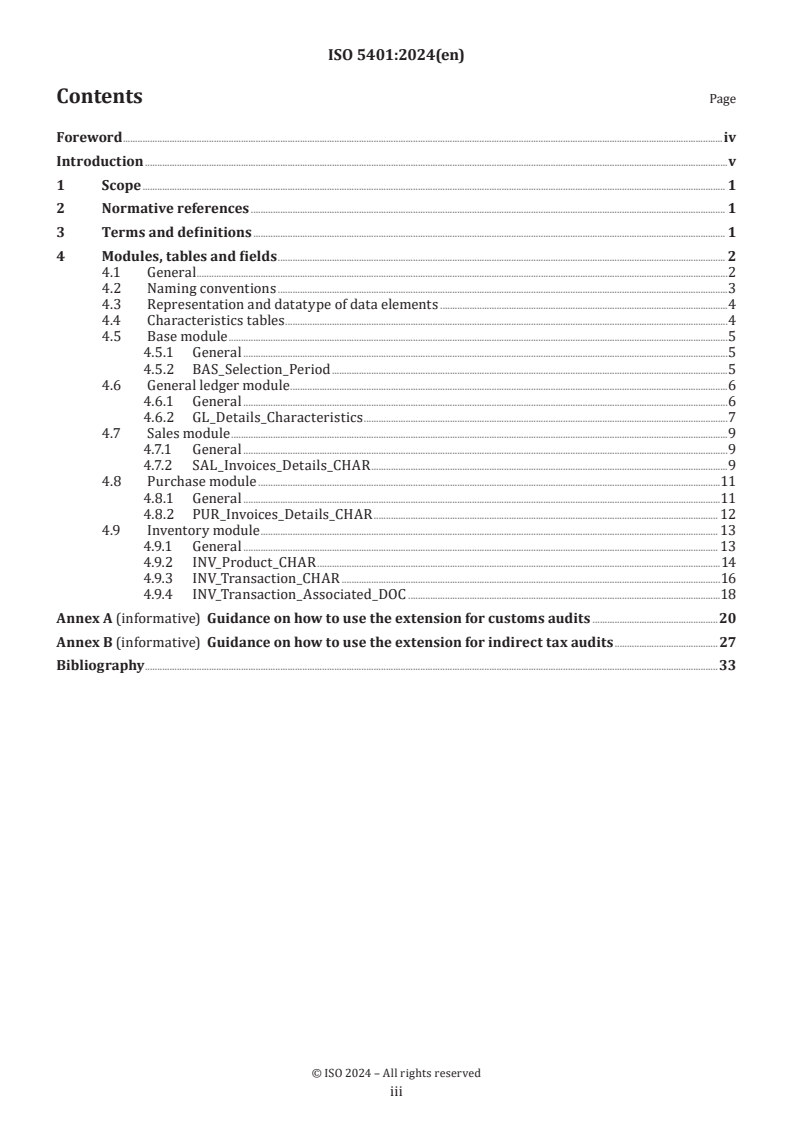
Contents Page
Foreword .iv
Introduction .v
1 Scope . 1
2 Normative references . 1
3 Terms and definitions . 1
4 Modules, tables and fields . 2
4.1 General .2
4.2 Naming conventions .3
4.3 Representation and datatype of data elements .4
4.4 Characteristics tables .4
4.5 Base module .5
4.5.1 General .5
4.5.2 BAS_Selection_Period .5
4.6 General ledger module .6
4.6.1 General .6
4.6.2 GL_Details_Characteristics .7
4.7 Sales module .9
4.7.1 General .9
4.7.2 SAL_Invoices_Details_CHAR .9
4.8 Purchase module .11
4.8.1 General .11
4.8.2 PUR_Invoices_Details_CHAR . 12
4.9 Inventory module . 13
4.9.1 General . 13
4.9.2 INV_Product_CHAR .14
4.9.3 INV_Transaction_CHAR .16
4.9.4 INV_Transaction_Associated_DOC .18
Annex A (informative) Guidance on how to use the extension for customs audits .20
Annex B (informative) Guidance on how to use the extension for indirect tax audits .27
Bibliography .33
iii
Foreword
ISO (the International Organization for Standardization) is a worldwide federation of national standards
bodies (ISO member bodies). The work of preparing International Standards is normally carried out through
ISO technical committees. Each member body interested in a subject for which a technical committee
has been established has the right to be represented on that committee. International organizations,
governmental and non-governmental, in liaison with ISO, also take part in the work. ISO collaborates closely
with the International Electrotechnical Commission (IEC) on all matters of electrotechnical standardization.
The procedures used to develop this document and those intended for its further maintenance are described
in the ISO/IEC Directives, Part 1. In particular, the different approval criteria needed for the different types
of ISO document should be noted. This document was drafted in accordance with the editorial rules of the
ISO/IEC Directives, Part 2 (see www.iso.org/directives).
ISO draws attention to the possibility that the implementation of this document may involve the use of (a)
patent(s). ISO takes no position concerning the evidence, validity or applicability of any claimed patent
rights in respect thereof. As of the date of publication of this document, ISO had not received notice of (a)
patent(s) which may be required to implement this document. However, implementers are cautioned that
this may not represent the latest information, which may be obtained from the patent database available at
www.iso.org/patents. ISO shall not be held responsible for identifying any or all such patent rights.
Any trade name used in this document is information given for the convenience of users and does not
constitute an endorsement.
For an explanation of the voluntary nature of standards, the meaning of ISO specific terms and expressions
related to conformity assessment, as well as information about ISO's adherence to the World Trade
Organization (WTO) principles in the Technical Barriers to Trade (TBT), see www.iso.org/iso/foreword.html.
This document was prepared by Technical Committee ISO/TC 295, Audit data services.
Any feedback or questions on this document should be directed to the user’s national standards body. A
complete listing of these bodies can be found at www.iso.org/members.html.
iv
Introduction
ISO 21378, the audit data collection standard, establishes common definitions of accounting data elements
and provides the information necessary to extract relevant audit data. ISO 21378 primarily focuses on the
access of audit data. It helps bridge the gap between the various participants in the audit process, consisting
of auditors, auditees, software developers and IT professionals by creating a mechanism to express
information common to accounting in a way which is independent of accounting and enterprise resource
planning (ERP) systems. ISO 21378 serves as a basis for data extraction in the areas of general ledger,
accounts receivable, sales, accounts payable, purchasing, inventory (including both inventory and movement
data), and property, plant, and equipment. ISO 21378 focuses on financial audits (financial statements).
This document concerns tax and customs audits relating to the accuracy and completeness of reported
indirect taxes and customs duties conducted by or on behalf of governments. A tax or customs audit is
the process where the auditor seeks to obtain audit information in an expert, structured, systematic,
independent, and documented manner with the aim of answering the question of whether the subject to the
audit meets defined regulations, guidelines and criteria.
Indirect taxes and/or customs duties audits require the same data set, or subsets thereof, as financial
audits. Therefore, it makes sense to use the ISO 21378 for these types of audits. However, due to the specific
characteristics of customs duties and indirect taxes (e.g. VAT, GST, sales tax, service tax, etc.) additional data
is required to achieve the audit goals.
This document aims to address two challenges, namely the wide variety of laws and regulations prevailing
globally, and the variety of methods used by ERP systems with respect to data attributes. At the same time,
this document offers a relative limited extension to ISO 21378, and can be implemented without changing it.
This document introduces a mechanism to add characteristics to ISO 21378. Needs of data can obviously
vary by audit type, country, and other factors. The mechanism makes it possible to unlock the ERP-data
requested by the auditor in that the data dump for indirect tax audits can differ in that for customs duties
audits or financial audits.
First of all, the mechanism is designed as a vehicle for data exchange. However, globally or widely accepted
values for defined characteristics should be used where applicable. For example, other ISO standards or the
World Customs Organization (WCO) standards may be practicable.
If these are lacking or not applicable, then values from a less comprehensive or hierarchical lower level may
be used. For example, those which are practice in a specific region or country (e.g., European Union, African
Union, India, China). If there is no shared understanding of certain values, then the auditee should explain to
the auditor the actual meaning in case the semantics are missing.
This document provides auditors with an additional tool to assess whether the auditee has fulfilled its
indirect tax obligations and customs duties in accordance with applicable legislation. It allows auditors to
determine if the auditee has paid the correct amount of tax and customs duties, in a timely manner, and has
filed all the necessary returns.
v
International Standard ISO 5401:2024(en)
Audit data collection — Customs and indirect tax extension
1 Scope
This document specifies the functional requirements that build on ISO 21378 for audits in the areas
of customs duties and indirect taxes [e.g. value-added tax (VAT) and excise duties]. It addresses how tax
auditors obtain audit data for these audits, including data element formats and to some extent content
requirements.
In practice, this document applies to virtually every step in the whole process in the supply chain and covers
both goods, services and works.
It includes domestic transactions, cross-border transactions (import and export) and can cover both third-
party and intercompany transactions or even movements of goods within the same company. This document
does not describe when an event is taxable nor how to calculate tax or customs duties as this is legislation-
specific and the situation can vary from country to country or even within the same country.
This document covers standard exchange of the data related to taxable operations/activities by businesses
to perform controls and audits more effectively and efficiently through automated tests. This document
focuses on the characteristics related to taxability and the related formalities of the indirect tax and customs
duties regulations. It includes the result of a tax calculation, the relevant underlying parameters which can
be processed by ERP-systems and/or indirect tax/customs duties systems, and data needed to comply with
indirect tax and customs duties legislation and formalities.
This document is not designed to collect audit data from the regulators like tax and/or customs authorities.
2 Normative references
The following documents are referred to in the text in such a way that some or all of their content constitutes
requirements of this document. For dated references, only the edition cited applies. For undated references,
the latest edition of the referenced document (including any amendments) applies.
ISO 21378:2019, Audit data collection
3 Terms and definitions
For the purposes of this document, the terms and definitions given in ISO 21378 and the following apply.
ISO and IEC maintain terminology databases for use in standardization at the following addresses:
— ISO Online browsing platform: available at https:// www .iso .org/ obp
— IEC Electropedia: available at http:// www .electropedia .org/
3.1
indirect tax
tax levied and collected by an intermediary on goods and services before they reach the consumer, who
ultimately pays the tax as part of the market price of the goods or services purchased
3.2
consumption tax
indirect tax (3.1) on the purchase of a good or service which can take the form of sales taxes, tariffs, excise,
and other taxes on consumed goods and services
3.3
VAT
value-added tax
tax collected at all stages of the processes of production and distribution of goods and services, accumulation
of the tax being prevented by allowing businesses to deduct the tax which incurs on their inputs from the
tax collected on their outputs
Note 1 to entry: For readability, this document uses the term VAT, but other types of taxes, such as good and services
tax (GST) and sales tax, are explicitly included. In some cases, this document refers to a particular tax, such as GST or
sales tax.
Note 2 to entry: A refund can occur in numerous countries, where it will not always be an option in others.
3.4
customs duties
tax imposed on imports and exports of goods
3.5
indirect tax audit
audit, assessment, or other examination relating to indirect taxes (3.1) by any tax authority or any judicial or
administrative proceedings relating to indirect taxes
3.6
customs duties audit
structured examination to measure and improve the traders’ compliance, after customs has released the
cargo, of the relevant commercial data, sales contracts, financial and non-financial records, physical stock
and other assets of traders
3.7
characteristic
property or attribute of a document, product or transaction
3.8
jurisdiction
practical authority granted to a legal body to administer justice, as defined by the kind of case, and the
location of the issue
3.9
period
short or long part of the time with a beginning and end, whether or not specified, which is considered a unity
because of its specific character, a typical phenomenon or a characteristic event within it
3.10
subset
group of elements which all belong to a given set
3.11
works
combination of both goods and services elements within construction and infra structure projects
4 Modules, tables and fields
4.1 General
ISO 21378 covers eight major business modules of accounting and ERP systems, including:
— base (BAS);
— general ledger (GL);
— sales (SAL);
— accounts receivable (AR);
— purchase (PUR);
— accounts payable (AP);
— inventory (INV);
— property plant and equipment (PPE).
These modules relate to major business processes including the areas of purchase, sales, inventory, fixed
assets with the aim to identify and to specify data elements and file formats needed for auditing.
An overview of the business modules and select business events that demonstrate interaction points
between the modules are shown in ISO 21378:2019, Figure 1.
From a customs and indirect tax perspective, there is a need to support data exchange of relevant characteristics
on taxable transactions and related import duties, excise duties, VAT and similar consumption taxes.
The standard formulated in this document is an extension on ISO 21378. This document contains additional
tables to the base module (BAS), general ledger module (GL), sales module (SAL), purchase module (PUR)
and inventory module (INV) of ISO 21378, to determine selection criteria and selection period, and add
necessary characteristics.
This document defines seven tables. These tables all have a level 2 indication. ISO 21378 recognizes level
1 and level 2 tables. The designation difference is based on the use of the information by auditors. Level 1
tables are defined as tables containing information the auditor should leverage when auditing. However,
depending on the system, this information will possibly not be available, and therefore cannot be exchanged.
The level 2 table designation indicates that these tables contain information that the auditor can leverage if
the scope of the audit requires this type of data.
Within each table, fields are also labelled as level 1 or level 2. Similar to the table designations, level 1 fields
are defined as fields containing information the auditor should leverage when auditing and where the data
are available within the system. The level 2 field designation indicates that these fields contain information
that the auditor can leverage if the scope of the audit requires this type of data.
There are situations where level 2 tables contain level 1 fields. This scenario indicates that this type of
information will possibly not be needed in some audit situations. However, if the data in the table are deemed
to be required by the auditor, the level 1 fields within the level 2 table shall be included as they are key fields
for the use of the information.
4.2 Naming conventions
The naming conventions aim to help readers to have a clear understanding of each table and data element.
They also conform to the requirements of major accounting and ERP systems and databases.
For used naming conventions in this document, see ISO 21378.
For used abbreviated terms, see ISO 21378.
Additional abbreviated terms used in this document are listed in Table 1.
Table 1 — Abbreviated terms
Abbreviation Full Name
ADC Audit data collection
APAC Asian Pacific countries
AT Austria
BE Belgium
CA Canada
CHAR Characteristic
CUST Customs
DE Denmark
DOC Document
DMS Document management system
ERP Enterprise resource planning
ES Spain
EU European Union
GB Great Britain
GEN General
GST Good and services tax
HST Harmonized sales tax
NL Netherlands
PERC Percentage
PST Provincial sales tax
TARIC TARif Intégré Communautaire
USA United States of America
UN United Nations
VAT Value-added tax
WCO World Customs Organisation
4.3 Representation and datatype of data elements
Representation specifications and datatype specifications of the data elements defined in this document can
be found in ISO 21378.
4.4 Characteristics tables
The characteristic tables are used as an extension mechanism if the auditor needs additional information
for a table to be audited. Additional information means that the information is not specified already in the
existing tables of ISO 21378.
A characteristic is a property or attribute of a document, product or transaction. The characteristics are
important for the audit to be carried out. Which characteristics are relevant depends on the type of audit,
the region, the country, or the type of auditor. Because different audits are possible, in a multitude of regions,
countries and for different supervisory authorities, it is impossible to establish a globally standardized list
of characteristics. Auditors and auditees shall therefore jointly establish a list of permitted and required
characteristics.
Examples of characteristic are:
— goods/service/works indicator;
— jurisdiction identifier;
— tax point date;
— size of the business of the taxpayer;
— status of the product;
— gross weight minus the tare weight of the packaging;
— commodity code according to the tariff of the goods used; commodity code is also referred as TARIC code;
— alcohol percentage.
Characteristics can be standardized at world level, region level or country level. This is outside the scope of
this document.
4.5 Base module
4.5.1 General
The base (BAS) module of ISO 21378 contains basic information that is used across multiple modules. Its
content includes data related to the data collection, customers, suppliers, tax types, currency etc. Other
modules (e.g. GL, SAL, PUR, INV) shall be used in conjunction with this module.
4.5.2 BAS_Selection_Period
In the case of indirect tax audits or customs duties audits, it cannot be necessary or even permitted to receive
the data of the entire audit data collection (ADC) from auditees. In that case, customs and tax authorities
shall receive a self-defined subset of the entire ADC in accordance with the scope of the audit. In general, it
shall be able to derive subsets of the overall ADC that are predetermined and tailored to the purpose of the
control data.
To reference the selection criteria for compiling the subset, and to define the selection period, table BAS_
Selection_Period (Table 2) is added to the base module in this document.
The selection criteria and dates that shall fall within the selection period, should be determined by mutual
agreement between the auditor and the auditee.
BAS_Selection_Period is an extension to table BAS_Profile. BAS_Profile contains the proprietary data that
led to the dataset. The fields Profile_Number and Profile_Name are therefore a name/reference of the
auditee itself.
For a subset of ADC, all definitions, rules, and agreements that apply to the entire ADC also shall apply to
that subset, unless a deviation from ISO 21378 is specified in this document.
The unique identifier for the applied selection criteria, the selection period start date and end date that
apply to the selected tables and selected fields are contained in Table 2. Table 2 is level 2.
Table 2 — BAS_Selection_Period
Rep-
Da-
No. Name resenta- Description Level
tatype
tion
Unique identifier that refers to the se-
lection criteria for selecting tables and
fields. The permitted values of Selec-
tion_ID and the associated selection
1 Selection_ID String %75s 1
criteria should be determined by mutual
agreement between the auditor and the
auditee.
EXAMPLE: “ADC Customs NL”
Start date of the selected period (YYYY-
2 Selection_Start_Date Date %10s MM-DD). The start time is always 1
"00:00:00".
End date of the selected period (YYYY-
3 Selection_End_Date Date %10s MM-DD). The end time is always 1
"23:59:59".
Guidance on how to use Table 2 can be found in Annex A.
4.6 General ledger module
4.6.1 General
The general ledger (GL) module in ISO 21378 is used to record the financial impacts of business processes.
In most ERP systems and accounting packages, the GL is the module where transactional-level data are
accumulated, summarized, stored and staged for reporting. Additionally, the closing entries for both periods
and year-end are contained within these tables.
In the case of indirect tax audits, it can be necessary to add characteristic information upon the general
ledger detail information because:
— taxpayers can book certain indirect tax events only in the general ledger of their ERP system and not in
other modules;
— there are adjustments due to non-deductibility that cannot be attributed to an individual transaction but
are a periodic adjustment that is only recorded in the general ledger.
The characteristics should be delivered on the applicable granular level, which is at GL_Details line level.
To exchange characteristic information, table GL_Details_Characteristics (Table 3) is added to the GL module
in this document.
Figure 1 shows the relation between a GL_Details and its GL_Details_Characteristics.
Key
Components Connections and lines
tables within the customs and indirect tax
table in customs and indirect tax extension
extension
table in ISO 21378 reference relationship
L1 table containing information that the auditor should leverage when auditing
L2 table containing information that the auditor can leverage if the scope of the audit requires this type of data
Figure 1 — Table relation diagram of GL module
4.6.2 GL_Details_Characteristics
Additional characteristics that apply to GL_Details lines are contained in Table 3. Examples include VAT
status, jurisdiction identifier, tax point date, size of the business of the taxpayer etc. Table 3 is level 2.
Table 3 — GL_Details_Characteristics
Da- Rep-
No. Name Description Level
tatype resentation
Unique identifier for the journal entry.
1 Journal_ID String %100s 1
Shall match the Journal_ID in the GL_
Details table.
Type of characteristic in relation to the
GL_Details line. The permitted values
of Characteristic_Type should be deter-
2 Characteristic_Type String %60s 1
mined by mutual agreement between
the auditor and the auditee.
EXAMPLE NL_VATSTATUS
The sequence number of a characteris-
tic or group of related characteristics
within the same Journal_ID.
3 Characteristic_Sequence_Number String %60s 1
The sequence number is mandatory if
there are multiple characteristics of
the same type within the same Jour-
nal_ID.
Code of measurement of the value of
the characteristic, if applicable.
4 Characteristic_UOM_Code String %80s 1
Shall match the UOM_Code in the BAS_
Measurement_Unit table. EXAMPLE
PERC, KG
The value of the characteristic on
basis of the Characteristic UOM Code.
EXAMPLE
5 Characteristic_Value String %1000s 1
— 0.125 in case of alcohol percentage
of 12,5 percent.
— L in case of low-rated VAT product.
The value of the characteristic as
recorded in the source system of the
organization to be audited, on basis of
the Characteristic UOM Code.
6 System_Characteristic_Value String %1000s 1
EXAMPLE
— 0.125 in case of alcohol percentage
of 12,5 percent.
— 1 in case of low-rated VAT product.
The primary key and reference identifiers, with the related referenced fields and tables, for GL_Details_
Characteristics are listed in Table 4.
Table 4 — Identifiers in GL_Details_Characteristics
Identi-
No. Name Referenced field Referenced table
fier
PK/
1 Journal_ID Journal_ID GL_Details
REF
2 Characteristic_Type PK not applicable not applicable
3 Characteristic_Sequence_Number PK not applicable not applicable
PK/
4 Characteristic_UOM_Code UOM_Code BAS_Measurement_Unit
REF
Guidance on how to use Table 3 and Table 4 can be found in Annex B.
4.7 Sales module
4.7.1 General
The SAL module of ISO 21378 is intended to encompass data collection and basic analysis of the sales process.
In the case of indirect tax audits, it can be necessary to add characteristic information upon invoices.
The characteristics should be delivered on the applicable granular level, which is at invoice level and invoice
line level.
To exchange characteristic information, table SAL_Invoices_Details_CHAR (Table 5) is added to the SAL
module in this document.
Figure 2 shows the relation between a SAL_Invoices_Generated, SAL_Invoices_Generated_Details and its
SAL_Invoices_Details_CHAR.
Key
Components Connections and lines
tables within the customs and indirect tax
table in customs and indirect tax extension
extension
table in ISO 21378 reference relationship
L1 table containing information that the auditor should leverage when auditing
L2 table containing information that the auditor can leverage if the scope of the audit requires this type of data
Figure 2 — Table relation diagram of SAL module
4.7.2 SAL_Invoices_Details_CHAR
Additional characteristics that apply to SAL_Invoices_Generated and SAL_Invoices_Generated_Details are
contained in Table 5. Examples include VAT status, jurisdiction identifier, tax point date, size of the business
of the taxpayer etc. Table 5 is level 2.
Table 5 — SAL_Invoices_Details_CHAR
Da- Rep-
No. Name Description Level
tatype resentation
Unique identifier for the invoice.
The same ID shall be used for all tables
1 Invoice_ID String %60s with invoice data. 1
Shall match the Invoice_ID in the SAL_
Invoices_Generated table.
Unique identifier for the invoice line.
If not empty, it shall match the Invoice_
2 Invoice_Line_ID String %60s 1
Line_ID in the SAL_Invoices_Generat-
ed_Details table.
Type of characteristic in relation to the
invoice or invoice line. The permitted
values of Characteristic_Type should
3 Characteristic_Type String %60s 1
be determined by mutual agreement
between the auditor and the auditee.
EXAMPLE NL_VATSTATUS
The sequence number of a character-
istic or group of related characteris-
tics within the same Invoice_ID and
Invoice_Line_ID combination.
4 Characteristic_Sequence_Number String %60s 1
The sequence number is mandatory
if there are multiple characteristics
of the same type within the same In-
voice_ID and Invoice_Line_ID combi-
nation.
Code of measurement of the value of
the characteristic, if applicable.
5 Characteristic_UOM_Code String %80s 1
Shall match the UOM_Code in the BAS_
Measurement_Unit table. EXAMPLE
PERC, KG
The value of the characteristic on
basis of the Characteristic UOM Code.
EXAMPLE
6 Characteristic_Value String %1000s 1
— 0.125 in case of alcohol percentage
of 12,5 percent.
— L in case of low-rated VAT product.
The value of the characteristic as
recorded in the source system of the
organization to be audited, on basis of
the Characteristic UOM Code.
7 System_Characteristic_Value String %1000s 1
EXAMPLE
— 0.125 in case of alcohol percentage
of 12,5 percent.
— 1 in case of low-rated VAT product.
The primary key and reference identifiers, with the related referenced fields and tables, for SAL_Invoices_
Details_CHAR are listed in Table 6.
Table 6 — Identifiers in SAL_Invoices_Details_CHAR
Identi-
No. Name Referenced field Referenced table
fier
PK/
1 Invoice_ID Invoice_ID SAL_Invoices_Generated
REF
PK
2 Invoice_Line_ID Invoice_Line_ID SAL_Invoices_Generated_Details
REF
3 Characteristic_Type PK not applicable not applicable
4 Characteristic_Sequence_Number PK not applicable not applicable
PK/
5 Characteristic_UOM_Code UOM_Code BAS_Measurement_Unit
REF
Guidance on how to use Table 5 and Table 6 can be found in Annex B.
4.8 Purchase module
4.8.1 General
The PUR module of ISO 21378 is intended to encompass data collection and basic analysis of the purchase
process. In the case of indirect tax audits, it can be necessary to add characteristic information upon invoices.
The characteristics should be delivered on the applicable granular level, which is at invoice level and invoice
line level. To exchange the characteristic information, table PUR_Invoices_Details_CHAR (Table 7) is added
to the PUR module in this document.
Figure 3 shows the relation between a PUR_Invoices_Received, PUR_Invoices_Received_Details and its PUR_
Invoices_Details_CHAR.
Key
Components Connections and lines
tables within the customs and indirect tax
table in customs and indirect tax extension
extension
table in ISO 21378 reference relationship
L1 table containing information that the auditor should leverage when auditing
L2 table containing information that the auditor can leverage if the scope of the audit requires this type of data
Figure 3 — Table relation diagram of PUR module
4.8.2 PUR_Invoices_Details_CHAR
Additional characteristics that apply to PUR_Invoices_Received and PUR_Invoices_Received_Details are
contained in Table 7. Examples include VAT status, jurisdiction identifier, tax point date, size of the business
of the taxpayer etc. Table 7 is level 2.
Table 7 — PUR_Invoices_Details_CHAR
Da- Rep-
No. Name Description Level
tatype resentation
Unique identifier for the received
invoices.
The same ID shall be used for all tables
1 Invoice_ID String %60s 1
with invoice data.
Shall match the Invoice_ID in the PUR_
Invoices_Received table.
Unique identifier for the received
invoice line.
2 Invoice_Line_ID String %60s 1
If not empty, it shall match the Invoice_
Line_ID in the PUR_Invoices_Received_
Details table.
Type of characteristic in relation to the
invoice or invoice line. The permitted
values of Characteristic_Type should
3 Characteristic_Type String %60s 1
be determined by mutual agreement
between the auditor and the auditee.
EXAMPLE NL_VATITEMSTATUS
The sequence number of a character-
istic or group of related characteris-
tics within the same Invoice_ID and
Invoice_Line_ID combination.
4 Characteristic_Sequence_Number String %60s 1
The sequence number is mandatory
if there are multiple characteristics
of the same type within the same In-
voice_ID and Invoice_Line_ID combi-
nation.
Code of measurement of the value of
the characteristic, if applicable.
5 Characteristic_UOM_Code String %80s 1
Shall match the UOM_Code in the BAS_
Measurement_Unit table. EXAMPLE
PERC, KG
The value of the characteristic on
basis of the Characteristic UOM Code.
EXAMPLE
6 Characteristic_Value String %1000s 1
— 0.125 in case of alcohol percentage
of 12,5 percent.
— L in case of low-rated VAT product.
The value of the characteristic as
recorded in the source system of the
organization to be audited, on basis of
the Characteristic UOM Code.
7 System_Characteristic_Value String %1000s 1
EXAMPLE
— 0.125 in case of alcohol percentage
of 12,5 percent.
— 1 in case of low-rated VAT product.
The primary key and reference identifiers, with the related referenced fields and tables, for PUR_Invoices_
Details_CHAR are listed in Table 8.
Table 8 — Identifiers in PUR_Invoices_Details_CHAR
Identi-
No. Name Referenced field Referenced table
fier
PK/
1 Invoice_ID Invoice_ID PUR_Invoices_Received
REF
PK/
2 Invoice_Line_ID Invoice_Line_ID PUR_Invoices_Received_Details
REF
3 Characteristic_Type PK not applicable not applicable
4 Characteristic_Sequence_Number PK not applicable not applicable
PK/
5 Characteristic_UOM_Code UOM_Code BAS_Measurement_Unit
REF
Guidance on how to use Table 7 and Table 8 can be found in Annex B.
4.9 Inventory module
4.9.1 General
Inventory (INV) is one of several business processes related to the supply chain. The INV module of ISO 21378
is intended to encompass data collection and basic analysis of the inventory process (i.e. raw and auxiliary
materials, work in progress and finished goods).
In the case of customs audits, it can be necessary to add characteristic information upon inventory products
and inventory transactions. The characteristics should be delivered on the applicable granular level, which
is at inventory product level for individual items, and when possible, on product/serial level or product/lot
level and inventory transaction level. To exchange the characteristic information, table INV_Product_CHAR
(Table 9) and table INV_Transaction_CHAR (Table 11) are added to the INV module in this document.
Also, in case of customs audits, it can be necessary to add reference information to customs related
documents associated to inventory transactions. To exchange the document reference information, table
INV_Transaction_Associated_DOC (Table 13) is added to the INV module in this document.
Figure 4 shows the relation between an INV_Transaction and INV_Transaction_CHAR, INV_Transaction and
INV_Transaction_Associated_DOC, INV_Product and INV_Product_CHAR.
Key
Components Connections and lines
tables within the customs and indirect tax
table in customs and indirect tax extension
extension
table in ISO 21378 reference relationship
L1 table containing information that the auditor should leverage when auditing
L2 table containing information that the auditor can leverage if the scope of the audit requires this type of data
Figure 4 — Table relation diagram of INV module
4.9.2 INV_Product_CHAR
Additional inventory product characteristics that apply from a certain start date and time until a certain
end date and time are contained in Table 9. Examples include net weight, country of origin, legal indicator,
alcohol percentage. Table 9 is level 2.
Table 9 — INV_Product_CHAR
Da- Rep-
No. Name Description Level
tatype resentation
The unique identifier for the invento-
ry item. Typically, auto generated by
1 Inventory_Product_ID String %75s the system. Shall match the Inven- 1
tory_Product_ID in the INV_Product
table.
Type of characteristic of the product.
The permitted values of Character-
istic_Type should be determined
2 Characteristic_Type String %60s by mutual agreement between the 1
auditor and the auditee.
EXAMPLE EU_COMCODE, GEN_AL-
CPERC
The sequence number of a character-
istic or group of related characteris-
tics within the same Inventory_Prod-
uct_ID.
3 Characteristic_Sequence_Number String %60s 1
The sequence number is mandatory
if there are multiple characteristics
of the same type within the same
Inventory_Product_ID.
Code of measurement of the value of
the product characteristic, if appli-
cable.
4 Characteristic_UOM_Code String %80s 1
Shall match the UOM_Code in the
BAS_Measurement_Unit table. EXAM-
PLE PERC, KG
Start date from which the product
5 Start_Date Date %10s 1
characteristic value became valid.
Start time on the start date from
6 Start_Time Time %8s which the product characteristic 1
value became valid.
End date until which the product
7 End_Date Date %10s 1
characteristic value was valid.
End time on the end date until which
8 End_Time Time %8s the product characteristic value was 1
valid.
The value of the product character-
istic on basis of the Characteristic
UOM Code according to the Standard
Characteristics table (to be devel-
oped). EXAMPLE
9 Characteristic_Value String %1000s 1
— 0.125 in case of alcohol percent-
age of 12,5 percent,
— L in case of low-rated VAT prod-
uct.
The value of the product characteris-
tic as recorded in the source system
of the organization to be audited, on
basis of the Characteristic UOM Code.
EXAMPLE
10 System_Characteristic_Value String %1000s 1
— 0.125 in case of alcohol percent-
age of 12,5 percent.
— 1 in case of low-rated VAT prod-
uct.
The primary key and reference identifiers, with the related referenced fields and tables, for INV_Product_
CHAR are listed in Table 10.
Table 10 — Identifiers in INV_Product_CHAR
No. Name Identifier Referenced field Referenced table
1 Inventory_Product_ID PK/REF Inventory_Product_ID INV_Product
2 Characteristic_Type PK not applicable not applicable
3 Characteristic_Sequence_Number PK not applicable not applicable
4 Characteristic_UOM_Code PK/REF UOM_Code BAS_Measurement_Unit
5 Start_Date PK not applicable not applicable
6 Start_Time PK not applicable not applicable
Guidance on how to use Table 9 and Table 10 can be found in Annex A.
4.9.3 INV_Transaction_CHAR
Additional inventory product characteristics that apply to the moment of the transaction are contained in
Table 11. Examples include net weight, country of origin, legal indicator, alcohol percentage. Table 11 is level 2.
Table 11 — INV_Transaction_CHAR
Da- Rep-
No. Name Description Level
tatype resentation
The unique identifier for the picking
ticket, shipping notice, or other docu-
ment created upon or associated with
1 Transaction_Document_ID String %100s movement. Typically, auto generated 1
by the system. Shall match the Trans-
action_Document_ID in the INV_Trans-
action table.
The unique identifier for the line
number for a document other than a
customer order, or supplier purchase
order. Typically, auto generated by
2 Transaction_Document_Line_ID String %100s 1
the system. Shall match the Trans-
action_Document_Line_ID related to
the Transaction_Document_ID in the
INV_Transaction table.
Standardized type of characteristic of
the product in the transaction.
The permitted values of Character-
istic_Type should be determined by
mutual agreement between the auditor
3 Characteristic_Type String %60s 1
and the auditee.
EXAMPLE
NL_VATSTATUS
EU_COMCODE
GEN_ALCPERC
The sequence number of a characteris-
tic or group of related characteristics
within the same Transaction_Docu-
ment_ID and Transaction_Document_
Line_ID combination.
4 Characteristic_Sequence_Number String %60s 1
The sequence number is mandatory if
there are multiple characteristics of
the same type within the same Trans-
action_Document_ID and Transaction_
Document_Line_ID combination.
The standardized code of measure-
ment of the value of the transaction
characteristic, if applicable. Shall
5 Characteristic_UOM_Code String %80s 1
match the UOM_Code in the BAS_Meas-
urement_Unit table. EX
...
Questions, Comments and Discussion
Ask us and Technical Secretary will try to provide an answer. You can facilitate discussion about the standard in here.
Loading comments...