


ISO/TR 12765:1998
(Main)Measurement of fluid flow in closed conduits — Methods using transit-time ultrasonic flowmeters
Measurement of fluid flow in closed conduits — Methods using transit-time ultrasonic flowmeters
Mesure de débit des fluides dans les conduites fermées — Méthodes utilisant des débitmètres à ultrasons à temps de transit
General Information
- Status
- Withdrawn
- Publication Date
- 16-Dec-1998
- Withdrawal Date
- 16-Dec-1998
- Technical Committee
- ISO/TC 30/SC 5 - Velocity and mass methods
- Drafting Committee
- ISO/TC 30/SC 5 - Velocity and mass methods
- Current Stage
- 9599 - Withdrawal of International Standard
- Start Date
- 25-Mar-2003
- Completion Date
- 14-Feb-2026

Get Certified
Connect with accredited certification bodies for this standard

BSMI (Bureau of Standards, Metrology and Inspection)
Taiwan's standards and inspection authority.
Sponsored listings
Frequently Asked Questions
ISO/TR 12765:1998 is a technical report published by the International Organization for Standardization (ISO). Its full title is "Measurement of fluid flow in closed conduits — Methods using transit-time ultrasonic flowmeters". This standard covers: Measurement of fluid flow in closed conduits — Methods using transit-time ultrasonic flowmeters
Measurement of fluid flow in closed conduits — Methods using transit-time ultrasonic flowmeters
ISO/TR 12765:1998 is classified under the following ICS (International Classification for Standards) categories: 17.120.10 - Flow in closed conduits. The ICS classification helps identify the subject area and facilitates finding related standards.
ISO/TR 12765:1998 is available in PDF format for immediate download after purchase. The document can be added to your cart and obtained through the secure checkout process. Digital delivery ensures instant access to the complete standard document.
Standards Content (Sample)
TECHNICAL ISO/TR
REPORT 12765
First edition
1998-12-15
Measurement of fluid flow in closed
conduits — Methods using transit-time
ultrasonic flowmeters
Mesure de débit des fluides dans les conduites fermées — Méthodes
utilisant des débitmètres à ultrasons à temps de transit
A
Reference number
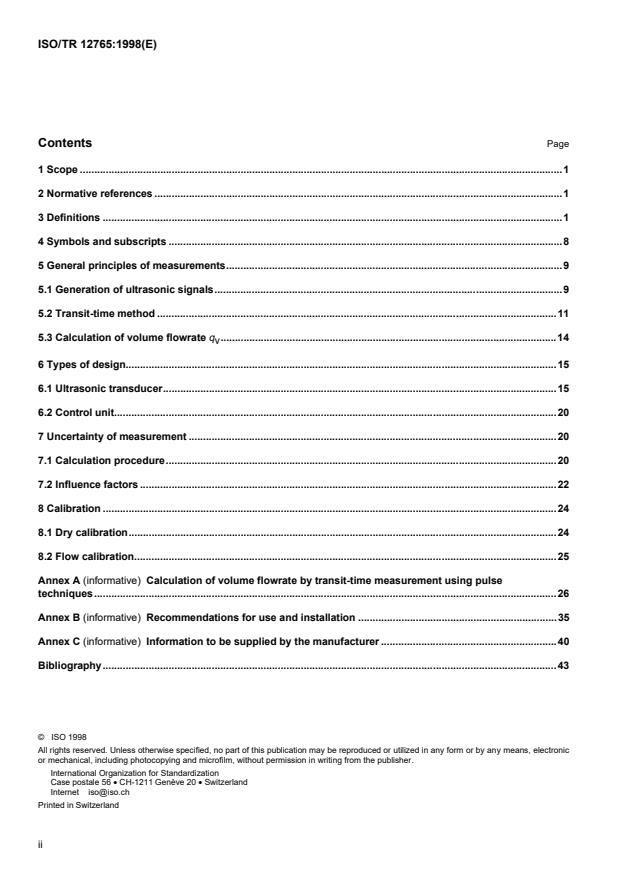
Contents Page
1 Scope .1
2 Normative references .1
3 Definitions .1
4 Symbols and subscripts .8
5 General principles of measurements.9
5.1 Generation of ultrasonic signals.9
5.2 Transit-time method .11
5.3 Calculation of volume flowrate q .14
v
6 Types of design.15
6.1 Ultrasonic transducer.15
6.2 Control unit.20
7 Uncertainty of measurement .20
7.1 Calculation procedure.20
7.2 Influence factors .22
8 Calibration .24
8.1 Dry calibration.24
8.2 Flow calibration.25
Annex A (informative) Calculation of volume flowrate by transit-time measurement using pulse
techniques.26
Annex B (informative) Recommendations for use and installation .35
Annex C (informative) Information to be supplied by the manufacturer .40
Bibliography.43
© ISO 1998
All rights reserved. Unless otherwise specified, no part of this publication may be reproduced or utilized in any form or by any means, electronic
or mechanical, including photocopying and microfilm, without permission in writing from the publisher.
International Organization for Standardization
Case postale 56 • CH-1211 Genève 20 • Switzerland
Internet iso@iso.ch
Printed in Switzerland
ii
© ISO
Foreword
ISO (the International Organization for Standardization) is a worldwide federation of national standards bodies (ISO
member bodies). The work of preparing International Standards is normally carried out through ISO technical
committees. Each member body interested in a subject for which a technical committee has been established has
the right to be represented on that committee. International organizations, governmental and non-governmental, in
liaison with ISO, also take part in the work. ISO collaborates closely with the International Electrotechnical
Commission (IEC) on all matters of electrotechnical standardization.
The main task of technical committees is to prepare International Standards, but in exceptional circumstances a
technical committee may propose the publication of a Technical Report of one of the following types:
type 1, when the required support cannot be obtained for the publication of an International Standard, despite
repeated efforts;
type 2, when the subject is still under technical development or where for any other reason there is the future
but not immediate possibility of an agreement on an International Standard;
type 3, when a technical committee has collected data of a different kind from that which is normally published
as an International Standard (“state of the art”, for example).
Technical Reports of types 1 and 2 are subject to review within three years of publication, to decide whether they
can be transformed into International Standards. Technical Reports of type 3 do not necessarily have to be
reviewed until data they provide are considered to be no longer valid or useful.
ISO/TR 12765, which is a Technical Report of type 2, was prepared by Technical Committee ISO/TC 30,
Measurement of fluid flow in closed conduits.
This document is being isssued in the type 2 Technical Report series of publications (according to subclause
G.4.2.2 of part 1 of the ISO/IEC Directives, 1992) as a “prospective standard for a provisional application” in the
field of ultrasonic flowmeters because there is an urgent need for guidance on how standards in this field should be
used to meet an identified need.
This document is not to be regarded as an “International Standard”. It is proposed for provisional application so that
information and experience of its use in practice may be gathered. Comments on the content of this document
should be sent to the ISO Central Secretariat.
A review of this type 2 Technical Report will be carried out not later than three years after its publication with the
options of: extension for another three years; conversion into an International Standard; or withdrawal.
Annexes A, B and C of this Technical Report are for information only.
iii
TECHNICAL REPORT © ISO ISO/TR 12765:1998(E)
Measurement of fluid flow in closed conduits — Methods
using transit-time ultrasonic flowmeters
1 Scope
This Technical Report gives guidance on the principles and main design features of ultrasonic flowmeters based on
the measurement of the difference in transit time for volume flowrate measurement of fluids. It covers their
operation, performance and calibration. It primarily covers wetted transducers but briefly refers to clamp-on
transducer arrangements.
Annex A of this Technical Report shows the calculation of volume flowrate by transit-time measurement using pulse
techniques.
Annex B covers the recommendations for use and installation.
Annex C gives a list of information to be supplied by the manufacturers.
2 Normative references
The following standards contain provisions which, through reference in this text, constitute provisions of this
Technical Report. At the time of publication, the editions indicated were valid. All standards are subject to revision,
and parties to agreements based on this International Standard are encouraged to investigate the possibility of
applying the most recent editions of the standards indicated below. Members of IEC and ISO maintain registers of
currently valid International Standards.
ISO 4006:1991, Measurement of fluid flow in closed conduits — Vocabulary and symbols.
ISO 4185:1980, Measurement of liquid flow in closed conduits — Weighting method.
ISO 8316:1987, Measurement of liquid flow in closed conduits — Method by collection of the liquid in a volumetric
tank.
ISO 9300:1990, Measurement of gas flow by means of critical flow Venture nozzles.
ISO 9951:1993, Measurement of gas flow in closed conduits — Turbine meters.
International Vocabulary of Basic and General Terms in Metrology (VIM), BIPM, IEC, IFCC, ISO, IUPAC, IUPAP,
OIML, 1993.
3 Definitions
For the purposes of this Technical Report, the definitions given in the International Vocabulary of Basic and General
Terms in Metrology (VIM), ISO 4006 and the following definitions apply.
© ISO
3.1
transit-time difference method
time-of-flight method
method of flowrate measurement in which the average fluid velocity along the acoustic path v is determined from
the transit-time difference of two ultrasonic signals, one travelling upstream and one downstream, over the same
distance in the flowing fluid
3.2
leading-edge method
method of flowrate measurement in which the transit times of ultrasonic pulses are measured based on triggering at
a predetermined amplitude level of the received signal
See Figure 1.
Key
1 Trigger point at leading edge
Figure 1 — Principle of transit-time measurement using leading-edge method
3.3
pulse-repetition frequency method
sing-around method
frequency-difference method
method of flowrate measurement used in ultrasonic flowmeters whereby two independent streams of pulses are
transmitted in opposite directions, each pulse being emitted immediately after the detection of the preceding pulse in
the stream, and the difference between the pulse-repetition frequencies in the two directions is measured
NOTE The difference between the pulse-repetition frequencies in the two directions is a function of the fluid velocity.
3.4
phase control method
lambda-locked-loop method
method of flowrate measurement in which a measure of the average fluid velocity along the acoustic path v is
derived from the difference in frequency of sound with the same wavelength travelling in opposite directions through
the flowing fluid
3.5
zero-crossing method
method of flowrate measurement in which transit times of ultrasonic pulses are measured using the first (or another
predetermined) "zero-crossing" of the received signal following the first half alternance
See Figure 2.
© ISO
Key
1 Trigger point at zero crossing
Figure 2 — Principle of transit-time measurement using zero-crossing method
3.6
multi-path method
method of flowrate measurement in which the average fluid velocity over a number of different paths is determined
3.7
simultaneous pulse method
method of flow measurement by which the transit times and transit-time difference are determined from signals
which are transmitted simultaneously upstream and downstream over the same acoustic path
3.8
phase shift method
method of flow measurement in which the average fluid velocity along the acoustic path v is determined from the
phase shift of ultrasonic signals in a fluid flow
3.9
ultrasonic flowmeter
USM
flowmeter which generates ultrasonic signals and receives them again after they have been influenced by the flow
in such a way that the observed result can be used as a measure of the flowrate
NOTE An ultrasonic flowmeter normally consists of the ultrasonic transducers and equipment which evaluates the flowrate
measurement from the emitted and received ultrasonic signals and converts these signals to a standard output signal
proportional to the flowrate
3.10
flowrate integrator
device for volume measurement by time-integration of volume flowrate
3.11
ultrasonic transducer
element that converts acoustic energy into electrical signals and/or vice versa
NOTE Ultrasonic transducers used in transit-time flowmeters usually work as both transmitter and receiver.
3.12
clamp-on arrangement
arrangement by which the transducers are attached to the outside wall of the conduit in which the flowrate is to be
measured
© ISO
3.13
meter tube
specially fabricated section of conduit containing the ultrasonic transducers and conforming in all respects to the
specification of the standard
3.14
measurement section
section of conduit consisting of the meter tube, the inlet section and the outlet section
3.15
acoustic path
actual path of the ultrasonic signal between both transducers
3.16
path length
L
p
length of acoustic path, in fluid at rest, from the faces of both transducers
See Figure 3 a) and b).
3.17
interrogation length
L
length of that part of the acoustic path, in fluid at rest, inside the conduit
See Figure 3 a) and b).
3.18
interrogation distance
d
projection of the interrogation length on the line parallel to the axis of the conduit or of the flow
See Figure 3 a) and b).
3.19
inclination angle
f
angle between the axes of the ultrasonic transducers and a line parallel to the axis of the conduit
See Figure 3 a).
3.20
phase angle
phase position of an oscillation
3.21
propagation velocity
c
velocity of acoustic signals relative to an observer at rest
3.22
velocity of sound
c
velocity of acoustic signals in the fluid at rest
3.23
average fluid velocity along the acoustic path
v
fluid velocity in the plane which is formed by the acoustic path and the direction of flow
© ISO
3.24
mean axial fluid velocity
v
A
ratio of the volume flowrate (q ) [the integral over a cross-section of the meter tube of the axial components of the
v
local fluid velocities (v)] to the area of the measurement cross-section (A)
3.25
velocity distribution correction factor
k
h
ratio of the mean axial fluid velocity v in the meter run to the average axial flow velocity v along the acoustic path
A
3.26
ultrasonic pulse
signal generated by finite-duration electrical excitation of an ultrasonic transducer
3.27
continuous-wave ultrasound
signal generated by continuous electrical excitation of an ultrasonic transducer
3.28
transit time
t
time needed by an ultrasonic pulse to traverse the acoustic path
3.29
transit-time difference
Dt
difference between the transit times of the ultrasonic signals propagated upstream and downstream
© ISO
Key
1 Receiver/emitter
2 Emitter/receiver
a) Diagonal-direct beam meter
Figure 3 — Arrangements of single-path beam meter (wetted transducers)
© ISO
b) Diagonal-reflected indirect beam meter
Figure 3 — Arrangements of single-path beam meter (wetted transducers)
© ISO
4 Symbols and subscripts
Table 1 — Symbols
1)
Quantity Symbol Dimensions Corresponding
SI unit
2 2
Cross-sectional area A L m
–1
Propagation velocity in the flowing fluid c LT m/s
–1
Velocity of sound in fluid at rest c LT m/s
Inside diameter of pipe D Lm
Interrogation distance d Lm
–1 –1
Frequency f T s
2)
Relative uncertainty E
3)
Absolute uncertainty e
2)
Integer i
2)
Velocity distribution correction factor k
h
Interrogation length L Lm
Path length L Lm
p
2)
Integer m
2)
Integers (1, 2, 3, .) n
3 –1 3
Volume flowrate q L T m /s
v
2)
Reynolds number (related to D) Re
D
Transit time t Ts
Transit-time difference Dt Ts
–1
Local velocity of the fluid v LT m/s
–1
Average fluid velocity along the acoustic path v LT m/s
–1
Mean axial fluid velocity v LT m/s
A
2)
Weight of measurement w
i
2)
Phase angle g rad
Wavelength of an ultrasonic oscillation l Lm
2)
Inclination angle rad
f
–1 –1
Cyclic frequency w T rad·s
–3 3
Density of the fluid r ML kg/m
1) M = mass, L = length, T = time.
2) Dimensionless quantity.
3) The dimension of this parameter is the dimension of the quantity to which it relates.
Table 2 — Subscripts
1 upstream
2 downstream
© ISO
5 General principles of measurements
The basic principle used by the ultrasonic flowmeters described in this Technical Report is that sound travelling with
the fluid flow will travel faster than sound travelling against the flow. The transit times and the time difference are
functions of the fluid velocity. The measurement can be made either by measuring transit times directly or by using
frequency or phase measurement. Ultrasonic flowmeters are inherently bidirectional.
Volume flowrate (q ) is determined by the product of the cross-sectional area (A) and the mean axial fluid velocity
v
v .
A
5.1 Generation of ultrasonic signals
The ultrasonic signals required for the flow measurement are generated and received by ultrasonic transducers
(e.g. using piezoelectric crystals).
Piezoelectric transducers employ crystals or ceramics which are sent into vibration when alternating voltage is
applied to their terminals. The vibrating element thus generates longitudinal pressure waves (sound waves) in the
fluid. Sound waves incident on such piezoelectric elements will produce electric signals at their terminals, as the
piezoelectric effect is reversible.
The acoustic properties of the transducer (beam pattern, resonance frequency, bandwidth, etc.) depend strongly on
the construction of the transducer. Figure 4 shows a possible transducer design, and the beam pattern of a
transducer is shown in Figure 5.
© ISO
Key
1 Possible matching layer 6 Wires
2 Piezoelectric element 7 Possible pressure seal
3 Transducer housing 8 Mounting flange
4 Backing material 9 Plug for transducer cable
5 O-ring seal
NOTE The transducer housing material can be metal, plastics etc. depending on the application.
Figure 4 — Possible design of a piezoelectric transducer
© ISO
NOTE 1 The transducer employs a matching layer as in Figure 4.
NOTE 2 One division of the radial scale in the polar diagram corresponds to 10 dB.
Figure 5 — Measured beam pattern of a transducer with an outer diameter of 2 cm at an operating
frequency of 162 kHz
5.2 Transit-time method
5.2.1 Direct transit-time method
The propagation velocity c will be the sum of the velocity of sound c and the fluid velocity component v cosf in the
direction of the acoustic path [see Figure 3 a) and b)].
cc=±v cosf . . . (1)
If ultrasonic transducers are mounted flush with the inside of the meter tube [see Figure 8 b)], ultrasonic signals can
propagate downstream and upstream in the flowing fluid. The upstream and downstream transit times of the
ultrasonic pulses in the fluid flow are given by
L
t= . . . (2)
cv− cosf
L
= . . . (3)
t
cv+ cosf
© ISO
11 2v cosf
−= . . . (4)
tt L
where
d
cosf = . . . (5)
L
L Dt
v= . . . (6)
2d tt
Dtt=−t . . . (7)
If the transducers are set back from the pipe wall, the interrogation length (L) is replaced by the path length (L ).
p
The transit times (t ) and (t ) are defined as the signal transit times over L
1 2 p.
L
p Dt
v= . . . (8)
2d tt
Equation (8) compensates directly the time which the signal spends in the pockets, under the assumption that the
velocity of sound in the stationary fluid is the same as in the flowing fluid (see annex A.3).
The following equations (10), (14) and (15c) are for flush-mounted transducers. For retracted transducers, L shall
be changed to L [see equation (8)].
p
5.2.2 Pulse repetition method (sing-around method)
Instead of the direct transit times (t ) and (t ) above, in the case of the pulse-repetition frequency method the
1 2
frequencies (f ) and (f ) are measured. The frequencies occur when an ultrasonic pulse reaching the receiver
1 2
triggers a new signal at the emitter.
11 Dt
ff−= − = . . . (9)
tt tt
21 12
Instead of equation (7) it follows that
L
v=−()ff . . . (10)
2d
5.2.3 Phase shift methods
5.2.3.1 Phase difference methods
Instead of the direct measurement of the signal transit times, the phase angles g and g of two continuous signals
1 2
with the cyclic frequency
w = 2p f . . . (11)
can be used to determine t and t (see Figure 6):
1 2
g = w t = 2p f t . . . (12)
1 1 1
g = w t = 2p f t . . . (13)
2 2 2
© ISO
Key
1 Signal upstream
2 Signal downstream
Figure 6 — Phases of the ultrasonic signals upstream and downstream
From equations (12) and (13) and equation (6) it follows that
gg−
Lfp
v= . . . (14)
gg
d
5.2.3.2 Phase control method
The constant frequency (f) can be replaced in both directions by variable frequencies (f ) and (f ). Through phase
1 2
control it is possible to have signals in both directions with constant wavelengths at identical phase g = g = 2pm
1 2
(m preferably an integer).
In this case the transit times will be
m m Dt 1
t==t = (ff− ) . . . (15)
1 2 21
f f tt m
1 212
Instead of equation (6) it follows that
L
v=−()ff . . . (15a)
2md
Since the "lambda-locked-loop" sets l = L/m, it follows that
l L
v=−()ff . . . (15b)
2d
The wavelength l depends on the instantaneous velocity of sound in the fluid at rest (c ) as well as the flow velocity.
Even if the "lambda-locked-loop" is broken (e.g. by loss of signal or change in the direction of signal transmission),
© ISO
the loop may be re-established with a different number of cycles, i.e. a different m. Provided m is the same in both
transmission directions, l can be determined from l =cf where ff=+()f 2.
0 12
Thus
cL
v=−()ff . . . (15c)
2 fd
5.3 Calculation of volume flowrate q
v
5.3.1 Using diametrical paths only
The volume flowrate q is determined by
v
qA= v . . . (16)
v A
In the transit time method, only the average fluid velocity along the acoustic path v is determined.
In order to determine the mean axial fluid velocity v over the cross-section (A) and therefore the volume flowrate
A
(q ), the velocity distribution correction factor (k ) must be known. The factor k is a result of the velocity profile in
v h h
the meter tube and is given by
v
A
k = . . . (17)
h
v
thus leading to
qk= Av . . . (18)
v h
The value k is a function of the Reynolds number (Re ) (see Figure 7) and can be calculated approximately for
h D
fully developed velocity distribution in an axi-symmetric nonswirling flow (see annex A.4). k cannot be defined
h
without ambiguity for the transition from laminar to turbulent flow. Diametrical meters employing dynamic profile
correction require values for bore roughness, diameter and viscosity to be assumed in order that Re and hence k
D h
can be evaluated on the basis of the measured v.
If the conditions deviate from above, a flow calibration would be necessary (see 7.2).
5.3.2 Using multiple paths in parallel planes
When v is measured in different parallel planes (using multi-path arrangement of acoustic paths) v can be
A
evaluated using suitable integration techniques over the cross-sectional area A (see 6.2.2 and annex A.4). For
example, with a set of transit times (t ) and (t ) measured upstream and downstream in n parallel planes and the
1i 2i
resulting v the volume flowrate may be calculated using
i
n
qA= wv . . . (19)
v ∑ ii
i=1
where the velocities v are measured at the planes i (i = 1 to i = n) and w depends on the integration technique
i i
used (see annex A.4).
Multi-path arrangements help to reduce the errors in the estimation of flow velocity due to flow profile.
© ISO
6 Types of design
The present status of ultrasonic flowmeters is characterized by the following features.
a) Meter tube and ultrasonic transducers (primary device) with specified arrangement of acoustic paths and
specified method for attaching the transducers to the conduit;
b) control unit (secondary device) for signal processing, which comprises all or part of the necessary electronics.
The control unit comprises the electronic equipment required to operate the transducers and make the
measurements, means for processing the measured data, and for the display, output and/or recording of the
results.
Key
1 Circular cross-section
2 Rectangular cross-section
3 Laminar flow
4 Turbulent flow
Figure 7 — Approximate value for k depending on Re
h D
6.1 Ultrasonic transducer
6.1.1 Arrangement of the transducers
A minimum of two ultrasonic transducers are applied in an ultrasonic flowmeter using the transit-time method.
The transducers will be either inserted into the conduit in contact with the fluid or, for liquid measurements only,
attached to the outside wall of the conduit (clamp-on arrangement) (see Figure 8).
Ultrasonic transducers inserted into the conduit are mounted either at an oblique angle or normal to the conduit wall.
In any case the angle between the axial flow direction and the straight line(s) running between the transducers is
never 90°. The transducers may protrude into the conduit or be set back into the conduit wall.
© ISO
a) Transducer in contact with the fluid (retracted)
b) Transducer in contact with the fluid (flush)
c) Transducer mounted outside the conduit (clamp-on arrangement)
d) Transducer intruding into flow path
Figure 8 — Typical transducer arrangements
© ISO
6.1.2 Single-path arrangement
The acoustic transmission between the transducers can be either direct or indirect. Using the inner conduit wall as a
reflector [see Figure 9 a), b) and c)] helps to increase the acoustic path length.
This implies that the transducers are mounted either on the same or "opposite" sides of the conduit [see Figure 9 a), b)
and c)].
In a single-path meter with direct transmission, the transducers can be located along a tilted diameter or a tilted
chord [see Figure 9 d) and e)]. For small conduits, the transducers may be mounted axially as shown in Figure 9 f).
a) Direct transmission
b) Indirect transmission (reflected by the conduit wall) (V-path)
c) Indirect transmission (reflected by the conduit wall) (W-path)
d) Tilted diameter
© ISO
e) Tilted chord
f) Axially mounted transducers
Figure 9 — Single-path arrangements
6.1.3 Multi-path arrangement
A multi-path meter is normally based on direct transmission along two or more tilted chords or diameters. The
transducers can be arranged in many different ways in order to minimize the sensitivity to swirl and other disturbed
flow profiles. Examples [see Figure 10 a) to d)] include:
single-plane arrangement;
symmetric criss-cross arrangement;
asymmetric criss-cross arrangement;
twin-pair arrangement.
The criss-cross arrangement eases the mechanical arrangement in configurations employing a large number of
paths.
A multi-path meter can also be based on a spaced acoustic path network (see annex A.6).
a) Single plane
© ISO
b) Symmetric criss-cross
c) Asymmetric criss-cross
d) Twin-pair
Figure 10 — Multi-path arrangements
6.1.4 Design of transducuers
The following criteria are, among others, significant in the design of the transducers:
acoustic and mechanical adaption to the conduit as well as the fluid;
for transducers in contact with the fluid, selection of a mechanical mounting with a minimum acoustic coupling
from the transducers to the conduit wall;
for clamp-on arrangements, good acoustic coupling from the transducers to the conduit wall;
possibility of mounting and removal under operating conditions;
suitability for the required temperature and pressure ranges;
moisture protection;
© ISO
corrosion protection;
safety requirements.
The transducers are critical components in a flowmeter and their performance affects the accuracy of the ultrasonic
flowmeter.
If the physical characteristics of transducers change with time, the signal-to-noise ratio could deteriorate. The
transducers should undergo strictly quality control in the manufacturing process. Indications of possible changes in
performance of the transducers should be provided by the manufacturer.
6.1.5 Interconnecting cables
Any interconnecting cable length between the transducer and the control units is an important consideration, and
both the maximum length and data to determine the resulting time delay (see 6.2.4) in such cables should be
defined by the manufacturer.
6.2 Control unit
6.2.1 Operation of transducers
Paired transducers may be excited simultaneously or alternately with one or more transmissions in each direction.
The acoustic frequency, pulse length and pulse repetition rate may vary mainly depending on the flowing fluid
and path length (L ). Each transducer pair in a multi-path configuration may operate independently, or multiplexed
p
operation may be used.
In a multi-path meter, transit-time measurements for each path are performed before the mean axial fluid velocity
v is determined.
A
6.2.2 Processing of data
The processing section, in addition to estimating the volume flowrate from measured transit times, should be
capable of rejecting invalid measurements, noise etc. The indicated volume flowrate may be the result of one or
more individual fluid velocity determinations.
6.2.3 Displays and outputs
Most ultrasonic flowmeters have several outputs available, either as standard or optional features. Displays may
show flowrate, integrated fluid volume and/or directions of flow, and may be analog or digital. Signal outputs may
include one or more of the following: current, voltage, digital output and a pulse rate proportional to flowrate. These
outputs may or may not be electrically isolated. Control units may also include alarms and diagnostic facilities.
7 Uncertainty of measurement
The sources of uncertainty include:
the uncertainty associated with the flow and the velocity distribution correction factor (k ) or the weight of
h
measurement (w );
i
the uncertainties associated with geometrical parameters of the meter tube;
the uncertainties associated with the time measurement.
Calculation procedure
7.1
7.1.1 Measurement of volume flowrate using single-path arrangement
The measured average fluid velocity along an acoustic path is given by equation (7). The volume flowrate is given
by equation (18). Combining both for a conduit of inner diameter D, with A = pD /4 leads to
© ISO
pDL t
qk= D . . . (20)
v h
42d tt
The relative uncertainty in q is obtained by determining the total differential of the equation and dividing it by q :
v v
dk
dq ddD Ldd 1
v h 2 2
=+22+ − + ()ttdd−t t . . . (21)
2 11 2
q k D L dt()−t tt
v
h 12 12
The squares of the components are added to obtain
22 2 2 2 22 22
EE=+44E+E+E+ ()tE+t E . . . (22)
qk D L d 2t 1t
v h 2 12
()tt−
where
E is the relative uncertainty in the measured volume flowrate;
q
v
E is the relative uncertainty in the velocity distribution correction factor:
k
h
E is the relative uncertainty in the pipe diameter (area);
D
E is the relative uncertainty in the interrogation distance;
d
E is the relative uncertainty in the interrogation length;
L
E is the relative uncertainty in the transit time t ;
t 1
E is the relative uncertainty in the transit time t .
t 2
In the derivation above it is assumed, that all parameters are independent and hence their uncertainties may be
squared and added to obtain the square of the resulting relative uncertainty.
7.1.2 Measurement of volume flowrate using multi-path arrangement
The volume flowrate (q ) can be obtained by measurements on several paths by approximate integration, given by
v
equation (19). In this case the combination of equation (19) with equation (7) leads to
n
p LDt
i i
qD= w . . . (23)
vi
∑
42dtt
i 12ii
i=1
The relative uncertainty in q is obtained by determining the total differential of equation (23) and dividing it by q :
v v
n
2 2
δq 2δD δδw Lδd (ttδ−tδt)
v i i i 2ii11i 2i
=+ +2 − + . . . (24)
∑
q D w L d ()tt− (tt)
v i i i 12ii 1i2i
i=1
The squares of the components, assumed independent, are added to obtain
n
22 2 2 2 2 2
EE=+44E+E+E+ ()tE+t E . . . (25)
qD w L d 2i2 1i2
∑
v ii i
2 t t
1 2
()tt− i i
12ii
i=1
where the components of the relative uncertainties are defined in the same way as stated in 7.1.1 and E are the
w
i
relative uncertainties in w .
i
© ISO
7.2 Influence factors
7.2.1 Factors related to disturbed flow
Disturbed flow causes uncertainty in measurement of v and calculation of v .
A
The uncertainty is influenced by:
flow around the transducer;
the existence of transverse flow components (swirling flow);
the shape of the axial velocity profile;
pulsations.
The uncertainty can be reduced by:
increasing the length of upstream and downstream straight pipes;
using flow conditioners;
using multipath meter with integration techniques suited for the actual conditions;
carrying out flow calibrations under conditions similar to actual conditions.
7.2.2 Factors related to geometry
Errors in D and L cause constant percentage error in the volume flowrate and velocity, respectively, of twice the
percentage error in D and L. Errors in d cause constant percentage error in velocity of the same value as the
percentage error in d.
The uncertainty is influenced by:
method of determination of D and roundness;
measurement accuracy;
expansion of measurement section due to pressure and temperature.
The uncertainty can be reduced by:
a proper method for determining D (see 8.1.1);
precise machining of the roundness of the meter tube;
use of accurate devices for geometrical measurements;
compensation for measurement section expansion due to temperature and pressure effects;
carrying out flow calibration under conditions similar to actual conditions.
7.2.3 Factors related to signal detection
Velocity measurements can be influenced considerably when the acoustic signal gets corrupted. The signal
detection then becomes increasingly difficult, which can lead to errors in transit-time measurement and hence to
reduction in the accuracy of measurement. It can also lead to inconsistencies in the recognition of the correct timing
point due to changes in received amplitude, distorted waveform or noise. Corrupted signals, however, may be
rejected using appropriate validity tests. The following three sources of signal corruption can be encountered:
electrical problems, flow-induced problems and acoustic problems.
© ISO
More specifically:
electrical noise;
secondary flow (cross- and swirling flow):
multiple phases in the measurement section;
contaminants on the transducers and around the transducer area;
extreme density gradients in the measuring section;
excessive turbulence;
excessive environmental noise (flow-generated or from external sources such as control valves);
self-generated noise;
installation close downstream of supercritical valves.
Generally the problems are best identified by sufficient self-diagnostics, self-checking features and alarm status
indications. Flow-induced problems are best overcome with careful location of the measurement section and control
of fluid conditions.
Acoustic problems are best solved by providing a high signal-to-noise ratio. Random background noise (electrical,
flow-induced, acoustic) will generally average out. Self-generated noise may be more difficult to detect and may not
average out, thus causing timing errors in transit-time measurements.
7.2.4 Factors relating to measurement and processing of time
The uncertainties in t , t and Dt are influenced by:
1 2
signal detection technique;
method of time measurement (transit time, frequency shift);
time resolution;
non-fluid time estimates, including time delay along cables, electronics, transducers and pipewall;
internal computational precision;
influence of ambient condition on electronics;
flow-induced timing errors (turbulence, swirl and pulsation);
time delays in transducer pockets.
The uncertainties can be reduced by:
insulating meter tube to avoid temperature gradients;
zero checks at actual operating conditions.
© ISO
8 Calibration
8.1 Dry calibration
8.1.1 Geometrical parameters
For high accuracy, the value of D should be the mean of the internal diameter over the length of meter tube. The
internal mean diameter should be the arithmetic mean of measurements of at least twelve diameters, namely four
diameters positioned at approximately equal angles to each other, distributed in each of three cross-sections evenly
distributed over the length of meter tube containing all transducers. No diameter shall differ by more than 0,3 %
from the average of the twelve diameters.
8.1.2 Timing and time delay
The time delays can be measured for a certain set of electronics and transducers.
One method among others is to mount two transducers in a test cell. The distance between the transducers is
accurately measured. The test cell is filled with a fluid in which the velocity of sound is known. In this test cell a zero-
flow condition is present.
NOTE A change in delay time does not cause a zero error, but an exchange of transducers can introduce a zero error due
to change in orientation or change in transducer frequency.
The actual transit time of the signals in the fluid can be calculated by the equations (2) and (3). The transit times for
"upstream" (t ) and "downstream" (t ) signals are equal (zero-flow) and can thus be calculated. The ultrasonic
1 2
measurement system gives the transit times (t ¢) and (t ¢) that include the time delay in the electronics, transducers,
1 2
cables, etc. These time delays are easily calculated from the difference of t ¢ – t and t ¢ – t .
1 1 2 2
This method requires accurate knowledge of the velocity of sound in the fluid filling the test cell. Any errors in the
velocity of sound affect the flowmeter performance. This causes a systematic shift of the performance curve, since
errors in the velocity of sound cause a systematic offset in the applied time delays. The same method can be used
for testing transducers and in the field as a check on the initial calibration.
NOTE It should be stated that this test requires thermal equilibrium, a very well known fluid (especially for gases) precise
linear measurement, etc.
Another method for determining the time delay in the electronic cables and transducers is given below. The method
requires a setup where the transit times of a pair of transducers can be measured at two different path lengths, (L )
a
and (L ) at still conditions. The measurements should be performed under the same ambient conditions for both
b
path lengths. The USM will measure the transit times (t ¢) and (t ¢) that include for both equal lengths an equal time
a b
delay, t .
d
′
tt=+t . . . (26)
aa d
′
tt=+t . . . (27)
bb d
The transit times (t ) and (t ) in the fluid are equal to L /c and L /c . Provided the distances L and L are known
a b a 0 b 0 a b
accurately, equations (27) and (28) have two unknowns, namely c and t . This set can be solved explicitly so that
0 d
the time delay t and c can be calculated using:
d 0
()′ ′
tL−t L
b aa b
t= . . . (28)
d
()
LL−
a b
()LL−
a b
c= . . . (29)
′ ′
()tt−
a b
This method does not require the knowledge of the velocity of sound in the fluid, since it is calculated.
© ISO
8.1.3 Velocity distribution
8.1.3.1 k -factor
h
The k -factor can be calculated, based on the Reynolds number, the assumed flow profile and the integration
h
technique used. However, errors in the correction factor may cause nonlinearity and/or systematic error. These
errors are not considered in dry calibration.
8.1.3.2 Weight of measurement
In a multi-path arrangement, the number of chords, chord positioning and the integration technique used reduce the
measurement uncertainty considerably and also the effect of changes in the flow profile (see Table A.1).
8.2 Flow calibration
In some cases a flow calibration is dictated by application, requirements or legal metrology. Any flow calibration has
a degree of uncertainty, depending on the fluid, methods of calibration and the type of calibration facility. Two
principal methods of flow calibration are used to test meter performance:
laboratory flow calibration;
field flow calibration (not commonly used for gases).
A flow calibration can be used to reduce uncertainties still prevailing after a dry calibration.
Usually the flow calibration results in a set of systematic errors, as function of flowrates, that can be used to correct
meter output. The calibration should be performed in such a way to ensure that the test rig does not influence the
test results and at conditions as close as possible to the envisaged installation. As a minimum, the manufacturer's
reference to the installation conditions shall be observed.
8.2.1 Laboratory flow calibration
To improve the accuracy, the calibration should be conducted according to good laboratory practice and in
accordance with methods recognized by International Standards (e.g. ISO 4185, ISO 8316, ISO 9300). The
calibration should be made over a statistically significant number of runs and over a range of flowrates (for gases
see ISO 9951).
The calibration accuracy of the flowmeter is determined by the random and systematic errors in the measurement of
the volume flowrate and by the random and systematic errors associated with the measurements in the laboratory.
8.2.2 Field flow calibration
The effects of the actual installation in the field on the meter factor can be corrected with a field calibration or by
properly simulated field conditions in a laboratory. The calibration should be performed at a Reynolds number as
close as possible to the Reynolds number encountered in the actual application.
© ISO
Annex A
(informative)
Calculation of volume flowrate by transit-time measurement using pulse
techniques
A.1 Transit-time measurement techniques
It is necessary to measure the transit time for an acoustic pulse travelling from an emitter to a receiver. Each
transducer is required to serve both as an emitter and a receiver if the transit time is to be measured in both
directions, i.e. downstream and upstream.
Direct measurement of acoustic transit times can be carried out in different ways in the flowmeter electronics. The
basic principles are, however, common to all the techniques and will be summarized in the following without going
into the details of how the detection techniques are incorporated using various electronic design strategies.
Pulse techniques employed for direct transit-time measurement are based on emitting and receiving acoustic pulses
and measuring the time between pulse emission and pulse reception. Figure A.1 illustrates the emitted and received
pulses, as an example where the transit time is taken as the time interval between the third zero-crossing in the
emitted pulse and third zero-crossing in the received pulse. The problem, which in essence is addressed by virtually
all the detection techniques, is to identify one or several predetermined zero-crossings or periods in the received
pulse. This is not straightforward due to the limited bandwidth of the acoustic transducers and the modulation of
...
Questions, Comments and Discussion
Ask us and Technical Secretary will try to provide an answer. You can facilitate discussion about the standard in here.
Loading comments...