

ISO/TS 11665-13:2017
(Main)Measurement of radioactivity in the environment — Air: radon 222 — Part 13: Determination of the diffusion coefficient in waterproof materials: membrane two-side activity concentration test method
General Information
- Abstract
ISO/TS 11665-13:2017 specifies the different methods intended for assessing the radon diffusion coefficient in waterproofing materials such as bitumen or polymeric membranes, coatings or paints, as well as assumptions and boundary conditions that shall be met during the test. ISO/TS 11665-13:2017 is not applicable for porous materials, where radon diffusion depends on porosity and moisture content.
- Status
- Withdrawn
- Publication Date
- 12-Oct-2017
- Technical Committee
- ISO/TC 85/SC 2 - Radiological protection
- Drafting Committee
- ISO/TC 85/SC 2 - Radiological protection
- Current Stage
- 9599 - Withdrawal of International Standard
- Start Date
- 03-Dec-2025
- Completion Date
- 29-Aug-2026
Buy Documents
ISO/TS 11665-13:2017 - Measurement of radioactivity in the environment — Air: radon 222 — Part 13: Determination of the diffusion coefficient in waterproof materials: membrane two-side activity concentration test method/13/2017
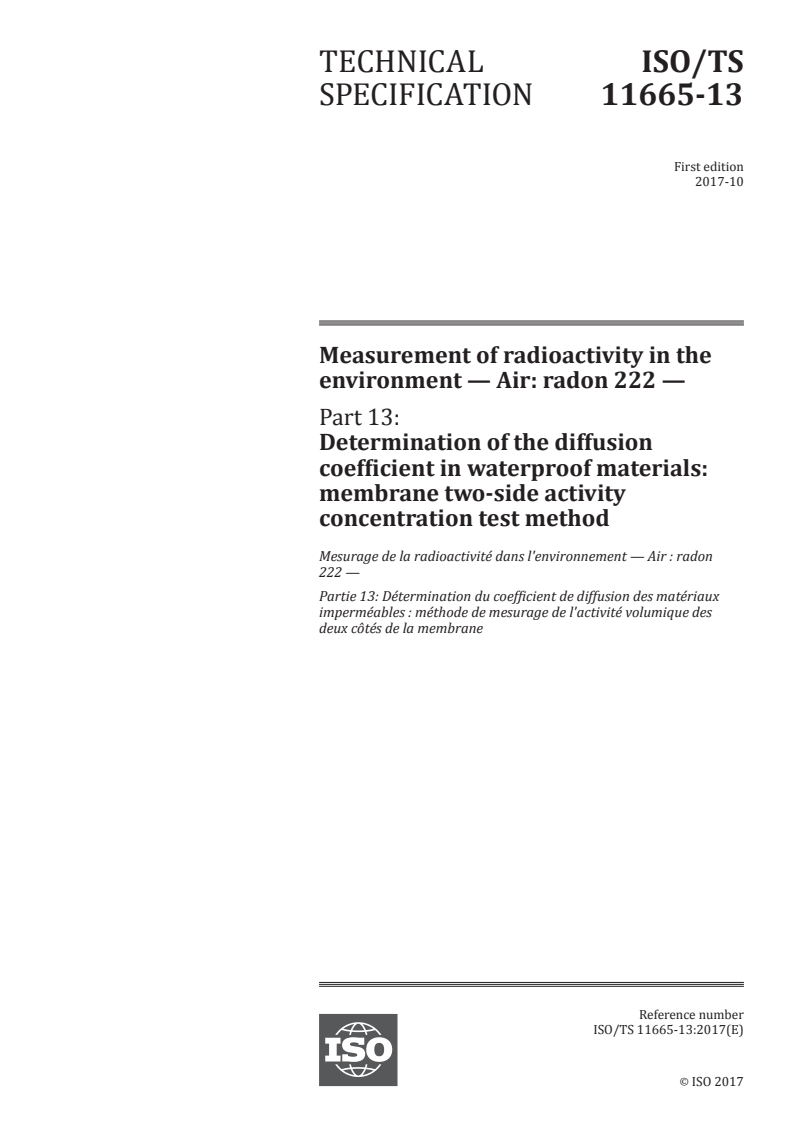
ISO/TS 11665-13:2017 - Measurement of radioactivity in the environment — Air: radon 222 — Part 13: Determination of the diffusion coefficient in waterproof materials: membrane two-side activity concentration test method Released:10/13/2017
Overview
ISO/TS 11665-13:2017 provides a standardized laboratory method for determining the radon diffusion coefficient in waterproofing materials (membranes, coatings, paints). Known as the membrane two‑side activity concentration test method, it defines test principles, measuring‑system configuration, sample preparation, boundary conditions and the expression of results. The technical specification is intended for non‑porous, monolayer or multilayer waterproof materials; it is explicitly not applicable to porous materials where porosity and moisture dominate radon transport.
Key topics and technical requirements
- Purpose: Quantify the radon diffusion coefficient (D) and related parameters (equivalent diffusion coefficient, diffusion length, diffusive exhalation rate) to assess barrier performance against radon-222.
- Test principle: Measure radon activity concentrations on both sides of a membrane sample and apply analytical/numerical methods to derive D.
- Methods described:
- Method A - non‑stationary (transient) radon diffusion analysis;
- Method B - stationary radon diffusion during steady‑state conditions;
- Method C - stationary conditions established with ventilation of the receiver container.
- Measuring system: Components and configuration requirements for source and receiver chambers, detectors, sealing and radon‑tight mounting of samples.
- Sample handling: Preparation, fixing of samples in the test device and rules for multilayer materials to determine an equivalent diffusion coefficient.
- Quality & metrology: Procedures for radon‑tightness testing, assessment of leakage, estimation of uncertainty, decision thresholds and detection limits (per ISO 11929 and GUM principles).
- Reporting: Required test report content, influence quantities, and calibration/quality‑management expectations for test laboratories.
Practical applications
- Assessing performance of radon‑proof insulation used in foundations and building envelopes.
- Providing input values for building codes and regulations that set maximum allowable radon diffusion coefficients for waterproof membranes.
- Certification and quality control for manufacturers of bitumen and polymeric membranes, coatings and paints intended to reduce indoor radon.
- Supporting radon mitigation design by radon‑mitigation contractors, building physicists and environmental health professionals who require validated diffusion coefficients for modeling indoor radon transport.
Who uses this standard
- Accredited testing and calibration laboratories
- Material manufacturers and R&D teams
- Building code authorities and regulators
- Radon mitigation specialists, indoor air quality consultants and architects
Related standards
- ISO 11665‑1, ‑5, ‑6 (radon origins and activity concentration measurement methods)
- ISO/TS 11665‑12 (related methods for material testing)
- ISO 11929 (detection limits for ionizing radiation)
- ISO 80000‑10 and ISO/IEC Guide 98‑3 (units and uncertainty of measurement)
Keywords: ISO/TS 11665-13, radon diffusion coefficient, radon measurement, waterproofing materials, membrane test method, radon‑proof insulation, diffusion length, radon exhalation.
Relations
- Effective Date
- 07-Jan-2025
Buy Documents
ISO/TS 11665-13:2017 - Measurement of radioactivity in the environment — Air: radon 222 — Part 13: Determination of the diffusion coefficient in waterproof materials: membrane two-side activity concentration test method/13/2017
ISO/TS 11665-13:2017 - Measurement of radioactivity in the environment — Air: radon 222 — Part 13: Determination of the diffusion coefficient in waterproof materials: membrane two-side activity concentration test method Released:10/13/2017
Get Certified
Connect with accredited certification bodies for this standard

BSMI (Bureau of Standards, Metrology and Inspection)
Taiwan's standards and inspection authority.
CIS Institut d.o.o.
Personal Protective Equipment (PPE) certification body. Notified Body NB-2890 for EU Regulation 2016/425 PPE.

Kiwa BDA Testing
Building and construction product certification.
Sponsored listings
Frequently Asked Questions
ISO/TS 11665-13:2017 is a technical specification published by the International Organization for Standardization (ISO). Its full title is "Measurement of radioactivity in the environment — Air: radon 222 — Part 13: Determination of the diffusion coefficient in waterproof materials: membrane two-side activity concentration test method". This standard covers: ISO/TS 11665-13:2017 specifies the different methods intended for assessing the radon diffusion coefficient in waterproofing materials such as bitumen or polymeric membranes, coatings or paints, as well as assumptions and boundary conditions that shall be met during the test. ISO/TS 11665-13:2017 is not applicable for porous materials, where radon diffusion depends on porosity and moisture content.
ISO/TS 11665-13:2017 specifies the different methods intended for assessing the radon diffusion coefficient in waterproofing materials such as bitumen or polymeric membranes, coatings or paints, as well as assumptions and boundary conditions that shall be met during the test. ISO/TS 11665-13:2017 is not applicable for porous materials, where radon diffusion depends on porosity and moisture content.
ISO/TS 11665-13:2017 is classified under the following ICS (International Classification for Standards) categories: 13.040.01 - Air quality in general; 17.240 - Radiation measurements. The ICS classification helps identify the subject area and facilitates finding related standards.
ISO/TS 11665-13:2017 has the following relationships with other standards: It is inter standard links to ISO/TS 11665-13:2025. Understanding these relationships helps ensure you are using the most current and applicable version of the standard.
ISO/TS 11665-13:2017 is available in PDF format for immediate download after purchase. The document can be added to your cart and obtained through the secure checkout process. Digital delivery ensures instant access to the complete standard document.
Standards Content (Sample)
TECHNICAL ISO/TS
SPECIFICATION 11665-13
First edition
2017-10
Measurement of radioactivity in the
environment — Air: radon 222 —
Part 13:
Determination of the diffusion
coefficient in waterproof materials:
membrane two-side activity
concentration test method
Mesurage de la radioactivité dans l'environnement — Air : radon
222 —
Partie 13: Détermination du coefficient de diffusion des matériaux
imperméables : méthode de mesurage de l'activité volumique des
deux côtés de la membrane
Reference number
©
ISO 2017
© ISO 2017, Published in Switzerland
All rights reserved. Unless otherwise specified, no part of this publication may be reproduced or utilized otherwise in any form
or by any means, electronic or mechanical, including photocopying, or posting on the internet or an intranet, without prior
written permission. Permission can be requested from either ISO at the address below or ISO’s member body in the country of
the requester.
ISO copyright office
Ch. de Blandonnet 8 • CP 401
CH-1214 Vernier, Geneva, Switzerland
Tel. +41 22 749 01 11
Fax +41 22 749 09 47
copyright@iso.org
www.iso.org
ii © ISO 2017 – All rights reserved
Contents Page
Foreword .iv
Introduction .v
1 Scope . 1
2 Normative references . 1
3 Terms, definitions and symbols . 1
3.1 Terms and definitions . 1
3.2 Symbols . 5
4 Principle of the test method . 6
5 Measuring system . 6
5.1 Components of the measuring system . 6
5.2 Configuration of the measuring system . 7
6 Test methods . 9
6.1 General information . 9
6.2 Method A — Determining the radon diffusion coefficient during the phase of non-
stationary radon diffusion . 9
6.3 Method B — Determining the radon diffusion coefficient during the phase of
stationary radon diffusion .10
6.4 Method C — Determining the radon diffusion coefficient during the phase of
stationary radon diffusion established during ventilation of the receiver container .11
7 General application procedures .12
7.1 Preparation of samples .12
7.2 Fixing the samples in the measuring device.13
7.3 Test of radon-tightness, assessment of the radon leakage rate of the receiver container .13
7.4 Determining the radon diffusion coefficient according to method A .13
7.5 Determining the radon diffusion coefficient according to method B .14
7.6 Determining the radon diffusion coefficient according to method C .15
7.7 General requirements for performing the tests .16
8 Influence quantities .18
9 Expression of results .18
9.1 Relative uncertainty .18
9.2 Decision threshold and detection limit .19
9.3 Limits of the confidence interval .19
10 Quality management and calibration of the test device .19
11 Test report .20
Annex A (informative) Determining the radon diffusion coefficient during the phase of
stationary radon diffusion according to method C .21
Annex B (informative) Determining the radon diffusion coefficient during the phase of non-
stationary radon diffusion .27
Bibliography .36
Foreword
ISO (the International Organization for Standardization) is a worldwide federation of national standards
bodies (ISO member bodies). The work of preparing International Standards is normally carried out
through ISO technical committees. Each member body interested in a subject for which a technical
committee has been established has the right to be represented on that committee. International
organizations, governmental and non-governmental, in liaison with ISO, also take part in the work.
ISO collaborates closely with the International Electrotechnical Commission (IEC) on all matters of
electrotechnical standardization.
The procedures used to develop this document and those intended for its further maintenance are
described in the ISO/IEC Directives, Part 1. In particular the different approval criteria needed for the
different types of ISO documents should be noted. This document was drafted in accordance with the
editorial rules of the ISO/IEC Directives, Part 2 (see www.iso.org/directives).
Attention is drawn to the possibility that some of the elements of this document may be the subject of
patent rights. ISO shall not be held responsible for identifying any or all such patent rights. Details of
any patent rights identified during the development of the document will be in the Introduction and/or
on the ISO list of patent declarations received (see www.iso.org/patents).
Any trade name used in this document is information given for the convenience of users and does not
constitute an endorsement.
For an explanation on the voluntary nature of standards, the meaning of ISO specific terms and
expressions related to conformity assessment, as well as information about ISO's adherence to the
World Trade Organization (WTO) principles in the Technical Barriers to Trade (TBT) see the following
URL: www.iso.org/iso/foreword.html.
This document was prepared by Technical Committee ISO/TC 85, Nuclear energy, nuclear technologies
and radiological protection, Subcommittee SC 2, Radiological protection.
A list of all parts in the ISO 11665 series can be found on the ISO website.
iv © ISO 2017 – All rights reserved
Introduction
Radon isotopes 222, 219 and 220 are radioactive gases produced by the disintegration of radium
isotopes 226, 223 and 224, which are decay products of uranium-238, uranium-235 and thorium-232,
respectively, and are all found in the earth's crust. Solid elements, also radioactive, followed by stable
[5]
lead are produced by radon disintegration .
When disintegrating, radon emits alpha particles and generates solid decay products, which are also
radioactive (polonium, bismuth, lead, etc.). The potential effects on human health of radon lie in its solid
decay products rather than the gas itself. Whether or not they are attached to atmospheric aerosols,
radon decay products can be inhaled and deposited in the bronchopulmonary tree to varying depths
according to their size.
[7]
Radon is today considered to be the main source of human exposure to natural radiation. UNSCEAR
suggests that, at the worldwide level, radon accounts for around 52 % of global average exposure to
natural radiation. The radiological impact of isotope 222 (48 %) is far more significant than isotope 220
(4 %), while isotope 219 is considered negligible. For this reason, references to radon in this document
refer only to radon-222.
Radon activity concentration can vary from one to more orders of magnitude over time and space.
Exposure to radon and its decay products varies tremendously from one area to another, as it depends
on the amount of radon emitted by the soil, weather conditions, and on the degree of containment in the
areas where individuals are exposed.
As radon tends to concentrate in enclosed spaces like houses, the main part of the population exposure
is due to indoor radon. Soil gas is recognized as the most important source of residential radon through
infiltration pathways. Other sources are described in other parts of ISO 11665 and ISO 13164 series for
[2]
water .
Radon enters into buildings via diffusion mechanism caused by the all-time existing difference between
radon activity concentrations in the underlying soil and inside the building, and via convection
mechanism inconstantly generated by a difference in pressure between the air in the building and the
air contained in the underlying soil. Indoor radon activity concentration depends on radon activity
concentration in the underlying soil, the building structure, the equipment (chimney, ventilation
systems, among others), the environmental parameters of the building (temperature, pressure, etc.)
and the occupants’ lifestyle.
−3
To limit the risk to individuals, a national reference level of 100 Bq·m is recommended by the World
[8] −3
Health Organization . Wherever this is not possible, this reference level should not exceed 300 Bq·m .
This recommendation was endorsed by the European Community Member States that shall establish
national reference levels for indoor radon activity concentrations. The reference levels for the annual
−3[9]
average activity concentration in air shall not be higher than 300 Bq·m .
To reduce the risk to the overall population, building codes should be implemented that require radon
prevention measures in buildings under construction and radon mitigating measures in existing
buildings. Radon measurements are needed because building codes alone cannot guarantee that radon
concentrations are below the reference level.
When a building requires protection against radon from the soil, radon-proof insulation (based on
membranes, coatings or paints) placed between the soil and the indoors may be used as a stand-alone
radon prevention/remediation strategy or in combination with other techniques such as passive or
active soil depressurization. Radon-proof insulation functions at the same time as the waterproof
insulation.
Radon diffusion coefficient is a parameter that determines the barrier properties of waterproof
materials against the diffusive transport of radon. Applicability of the radon diffusion coefficient for
radon-proof insulation can be prescribed by national building standards and codes. Requirements for
radon-proof insulation as regards the durability, mechanical and physical properties and the maximum
design value of the radon diffusion coefficient can also be prescribed by national building standards
and codes.
As no reference standards and reference materials are currently available for these types of materials
and related values of radon diffusion coefficient, the metrological requirement regarding the
determination of the performance of the different methods described in ISO/TS 11665-12 and this
[3]
document, as required by ISO/IEC 17025 , cannot be directly met.
NOTE The origin of radon-222 and its short-lived decay products in the atmospheric environment and the
measurement methods are described in ISO 11665-1.
vi © ISO 2017 – All rights reserved
TECHNICAL SPECIFICATION ISO/TS 11665-13:2017(E)
Measurement of radioactivity in the environment — Air:
radon 222 —
Part 13:
Determination of the diffusion coefficient in waterproof
materials: membrane two-side activity concentration
test method
1 Scope
This document specifies the different methods intended for assessing the radon diffusion coefficient
in waterproofing materials such as bitumen or polymeric membranes, coatings or paints, as well as
assumptions and boundary conditions that shall be met during the test.
This document is not applicable for porous materials, where radon diffusion depends on porosity and
moisture content.
2 Normative references
The following documents are referred to in the text in such a way that some or all of their content
constitutes requirements of this document. For dated references, only the edition cited applies. For
undated references, the latest edition of the referenced document (including any amendments) applies.
ISO 11665-1, Measurement of radioactivity in the environment — Air: radon-222 — Part 1: Origins of radon
and its short-lived decay products and associated measurement methods
ISO 11665-5, Measurement of radioactivity in the environment — Air: radon-222 — Part 5: Continuous
measurement method of the activity concentration
ISO 11665-6, Measurement of radioactivity in the environment — Air: radon-222 — Part 6: Spot
measurement method of the activity concentration
ISO 11929, Determination of the characteristic limits (decision threshold, detection limit and limits of the
confidence interval) for measurements of ionizing radiation — Fundamentals and application
ISO 80000-10, Quantities and units — Part 10: Atomic and nuclear physics
ISO/IEC Guide 98-3, Uncertainty of measurement — Part 3: Guide to the expression of uncertainty in
measurement (GUM:1995)
3 Terms, definitions and symbols
3.1 Terms and definitions
For the purposes of this document, the terms and definitions given in ISO 11665-1 and ISO 80000-10
and the following apply.
ISO and IEC maintain terminological databases for use in standardization at the following addresses:
— IEC Electropedia: available at http://www.electropedia.org/
— ISO Online browsing platform: available at https://www.iso.org/obp
3.1.1
material
product according to a certain technical specifications which is the object of the test
3.1.2
sample (of material)
certain amount of material chosen from the production batch for determination of the radon diffusion
coefficient
3.1.3
radon diffusion coefficient
D
radon activity permeating due to molecular diffusion through unit area of a monolayer material of unit
thickness per unit time at unit radon activity concentration gradient on the boundaries of this material
3.1.4
equivalent radon diffusion coefficient
D
eqv
radon diffusion coefficient of the multilayer material that numerically equals to the radon diffusion
coefficient of a homogeneous material of the same thickness as the layered material through which
radon penetrates in the same amount as through the layered material
3.1.5
radon diffusion length
l
distance crossed by radon due to diffusion in which activity is reduced by “e” times because of decay
Note 1 to entry: Numeric “е” is the natural logarithm, equal to about 2,72.
Note 2 to entry: Radon diffusion length is expressed by the relationship given in the following formula:
1/2
l = (D/λ) (1)
where
l is the radon diffusion length, in metres;
D is the radon diffusion coefficient of the sample, in square metres per second;
λ is the radon decay constant, in per second.
3.1.6
diffusive radon surface exhalation rate
E
value of the activity concentration of radon atoms that leave a material per unit surface per unit time
Note 1 to entry: For the purpose of this document, only the diffusion transport through the sample is taken into
account. The diffusive radon exhalation rate is given by the following formula (Fick's law):
∂Cx()
Ex()=−D (2)
∂x
2 © ISO 2017 – All rights reserved
where
E(x) is the distribution function along the axis "x" of the radon exhalation rate in the sample, in
Becquerel per square metre per second;
C(x) is the distribution function along the axis "x" of the radon activity concentration in the sam-
ple, in Becquerel per cubic metre;
D is the radon diffusion coefficient of the sample, in square metre per second;
x is the coordinate on axis "x" (the axis is directed along radon transport and perpendicular to
the sample surface), in metre.
3.1.7
non-stationary radon diffusion
time-dependent radon diffusion through the sample when the radon activity concentration within the
sample is changing (in dependence on time, distance from the surface exposed to radon and the radon
activity concentration in the source container) and the radon surface exhalation rate from the sample
into the receiver container is also changing
Note 1 to entry: One-dimensional non-stationary radon diffusion is described by the partial differential equation:
∂ Cx( ,t) ∂Cx( ,t)
D⋅ −⋅λ Cx( ,t)= (3)
∂x ∂t
where
D is the radon diffusion coefficient of the sample, in square metre per second;
C(x,t) is the function changing in time along the axis "x" of radon activity concentration in the
sample, in Becquerel per cubic metre;
x is the coordinate on axis "x" (the axis is directed along radon transport and perpendicular
to the sample surface), in metre;
λ is the radon decay constant, in per second.
Note 2 to entry: Non-stationary radon diffusion occurs during the time when radon activity concentration in the
source container is not steady and in the time interval that immediately follows the moment when the steady
concentration in the source container is established.
3.1.8
stationary radon diffusion
time-independent radon diffusion through the sample; stationary radon diffusion is characterized by
a stable (time-independent) radon distribution within the sample and consequently by a stable radon
surface exhalation rate from the sample into the receiver container (long term test methods)
Note 1 to entry: One-dimensional stationary radon diffusion is described by the differential equation:
∂ Cx()
D⋅ −⋅λ Cx()=0 (4)
∂x
where
D is the radon diffusion coefficient of the sample, in square metre per second;
C(x) is the distribution function along the axis "x" of the radon activity concentration in the sam-
ple, in Becquerel per cubic metre;
x is the coordinate on axis "x" (the axis is directed along radon transport and perpendicular to
the sample surface), in metre;
λ is the radon decay constant, in per second.
3.1.9
decisive measurement of radon activity concentrations
measurement of the time courses of radon activity concentrations in the source and receiver containers
used for calculating the radon diffusion coefficient
Note 1 to entry: The duration of the decisive measurement can be shorter or the same as the duration of the test.
3.1.10
decisive volume of the container
V
volume of the container used to calculate the radon diffusion coefficient
3.1.11
decisive sample area
S
s
material sample area used to calculate the radon diffusion coefficient
3.1.12
minimum duration of the decisive measurement for non-stationary radon diffusion
period of time in the frame of the decisive measurement of radon activity concentrations in the source
and receiver containers taken during the phase of non-stationary diffusion ensuring the uncertainty of
the radon diffusion coefficient assessment lower than ±20 %
3.1.13
minimum duration of the decisive measurement for stationary radon diffusion
period of time in the frame of the decisive measurement of radon activity concentrations in the source
and receiver containers taken during the phase of stationary diffusion ensuring the uncertainty of the
radon diffusion coefficient assessment lower than ±20 %
3.1.14
minimum radon activity concentration in the source container
concentration of radon in the source container which for the particular sample characterized by the
d/l ratio ensures values of radon activity concentration in the receiver container measurable with
uncertainty lower than 10 %
3.1.15
radon transfer coefficient
radon transport in thin boundary layer of air near the surface of the sample
Note 1 to entry: In this boundary, layer radon activity concentration on the surface of the sample equalizes with
radon activity concentration in the surrounding air.
−1
Note 2 to entry: For waterproof materials, the default value of the radon transfer coefficient is 0,1 m·s
3.1.16
standard uncertainty of a variable
X
standard deviation of a variable X
4 © ISO 2017 – All rights reserved
3.1.17
relative uncertainty of a variable X
u(X) = k·s(X)/EX
where
EX is the expected value of a variable X;
k is the shrinkage factor (k = 1,96 by default for 95 % confidence interval).
3.2 Symbols
For the purposes of this document, the symbols given in ISO 11665-1 and the following apply.
λ radon decay constant, in per second
λ radon leakage rate characterizing the ventilation of the receiver container, in per second
V
C radon activity concentration in the sample, in Becquerel per cubic metre
C radon activity concentration in a particular container of the measuring device, in Becquerel per
a
cubic metre
C radon activity concentration on the surface of the sample, in Becquerel per cubic metre
s
C radon activity concentration in the receiver container, in Becquerel per cubic metre
rc
C radon activity concentration in the source container, in Becquerel per cubic metre
sc
D radon diffusion coefficient of the monolayer sample, in square metre per second
D equivalent radon diffusion coefficient of the multilayer sample, in square metre per second
eqv
d thickness of the sample, in metre
E diffusive radon surface exhalation rate, in Becquerel per square metre per second
E diffusive radon surface exhalation rate from the sample to the receiver container, in Becquerel
rc
per square metre per second
h radon transfer coefficient, in metre per second
l radon diffusion length, in metre
S decisive area of the sample, in square metre
s
t time, in second
Δt duration of the considered time step between time t and t , in second
i−1 i
V decisive volume of the receiver container, in cubic metre
x distance within the tested sample measured from the surface of the sample exposed to radon,
in metre
u(X) relative uncertainty of a variable X, in relative units
s(X) standard uncertainty of a variable X, in same units as variable X
4 Principle of the test method
The sample of the tested material is placed between the air-tight source and the receiver containers,
and the joint is carefully sealed.
Radon activity concentration in both containers shall be measured using continuous or spot
measurement methods as specified in ISO 11665-5 and ISO 11665-6.
By means of the radon source with stable radon production rate, the radon activity concentration in
−3 −3
the source container is kept on a high level (usually within the range 1 MBq·m to 100 MBq·m ). The
radon that diffuses through the sample is monitored using calibrated radon monitor in the receiver
container.
Using an appropriate mathematical process (either analytical or numerical), the radon diffusion
coefficient is afterwards calculated from the time-dependent courses of the radon activity
concentrations measured in the source and receiver containers, and the area and thickness of the
tested sample. In case of multilayer samples, the above described principle results in determination of
the equivalent radon diffusion coefficient D .
eqv
5 Measuring system
5.1 Components of the measuring system
The measuring system for determining the radon diffusion coefficient in the waterproof materials shall
comprise the following components:
a) at least two air-tight containers (source and receiver), each with a minimum air volume of
−3 3
0,5 × 10 m or when the spot measurement method for radon activity concentration is going to be
used, the minimum air volume should be at least 10 times larger than the total volume of spot samples
taken from each of the containers during the test performance, and made from metal materials (for
−4
example, aluminium, stainless steel, etc.) of a thickness at least 5 × 10 m that effectively eliminates
radon transport between the air inside and outside the containers; each container shall be equipped
−3 2
with a test area of at least 5 × 10 m surrounded by flanges for fixing the tested material; the
minimum width of the flanges shall be 0,01 m and their arrangement shall eliminate the transport of
radon from the source container to the receiver container; each container shall be further equipped
with an appropriate number of valves intended for ventilating the containers, for measuring the
pressure differences between the containers, for extracting air samples for control measurements of
radon activity concentration and for connecting to the radon source;
b) a measuring instrument capable of determining the thickness of the tested sample with accuracy
±0,01 mm (maximum standard relative uncertainty of measurement 5 %);
c) a source of radon with stable radon production rate capable of creating a radon activity
−3 −3
concentration in the source container within the range 1 MBq·m to 100 MBq·m ;
−3 3 −3 3
d) an air-tight flow pump with the range of air flow rates 6 × 10 m /h to 30 × 10 m /h that is used
in some measurement methods in a closed circuit with a radon source and a source container;
e) a calibrated measuring device for monitoring the radon activity concentration in the receiver
container with standard relative uncertainty 10 % and a dynamic measuring range from
−3 −3
500 Bq·m to 1,0 MBq·m ;
f) a calibrated measuring device for monitoring the radon activity concentration in the source
container with standard relative uncertainty 10 % and a dynamic measuring range from
−3 −3
10 kBq·m to 100,0 MBq·m ;
g) a measuring instrument for determining the relative pressure difference between the air volume in
the source container and the air volume in the receiver container with standard relative uncertainty
of 10 % and a dynamic measuring range from 1 Pa to 150 Pa;
6 © ISO 2017 – All rights reserved
h) suitable sensors and a data storage system capable of continuously monitoring the temperature
and relative humidity of air, atmospheric pressure and radon activity concentration in the place
where the measuring device is positioned.
5.2 Configuration of the measuring system
In the simplest case, the measuring system can comprise one source container, one receiver container
and a radon source connected to the source container (see Figure 1). If more than one sample is to be
measured under equal conditions, it is convenient to use a measuring system comprising more than one
receiver container assembled on one source container (see Figure 2), or a set of pair containers (source
+ receiver) connected to the radon source in a parallel circuit (see Figure 3) or connected to each other
and to the radon source through the source containers in a serial circuit.
Key
1 receiver container
2 radon detector
3 tested sample
4 source container
5 pump
6 radon source
Figure 1 — Measuring system comprising one receiver container and one source container
Key
1 receiver container
2 radon detector
3 tested sample
4 source container
5 pump
6 radon source
Figure 2 — Measuring system comprising two receiver containers assembled on one source
container
Key
1 receiver container
2 radon detector
3 tested sample
4 source container
5 pump
6 radon source
Figure 3 — Measuring system comprising two pair containers (source + receiver) connected to
the radon source in a parallel circuit
The radon source shall be connected to the source container and the source containers shall be
interconnected by flexible pipes that are as radon-tight as possible.
8 © ISO 2017 – All rights reserved
Radon can be transported from the radon source to the source container only by diffusion or with the
help of a flow pump. If a flow pump is used, the radon source, the source container and the flow pump
shall be in a single, closed circuit. A flow pump shall not be applied if the radon diffusion through the
tested sample is influenced by the pressure difference between the source and receiver containers (this
can be seen as rapid drop or rise of radon activity concentration in the receiver container after applying
the pump).
If the measuring system is made up of a set of pair containers, the maximum number of pairs that can be
connected to one radon source in a single closed circuit is four. A flow pump shall be an indispensable
part of the circuit. Only samples of one material shall be tested in a single circuit at the same time.
If the measuring system is made up of more than one receiver container assembled on a single source
container, only samples of one material shall be tested in this system at the same time.
Radon source can also be placed inside the source container. This arrangement is convenient for
measuring systems comprising several receiver containers assembled on one source container.
If the source and/or receiver containers serve as radon detectors as well, then the sensitivity of these
detectors to the gamma radiation should be taken into account in the arrangement of the source of
radon inside the source container.
6 Test methods
6.1 General information
A suitable test method is selected from the following options in dependence on the measuring system,
sampling method and properties of the tested material (especially its thickness and the assumed
radon diffusion coefficient value). Methods A and B are convenient for continuous monitoring of
radon activity concentrations and method C for spot measurements. Method A shall be used when the
stationary radon diffusion is not established due to the characteristics of the tested material and/or
the measuring device, lack of time, etc. Method B is usually preceded by method A. Method C gives
the highest radon exhalation rates and therefore it should be applied every time when very low radon
diffusion coefficient is expected. Radon diffusion coefficient determined by methods A, B and C requires
numerical solution as described in 7.4. The linear part of build-up curve obtained at the beginning of
the decisive measurement as described in methods B and C permits the use of analytical solution if
conditions described in 7.5, fourth paragraph and 7.6, third paragraph are satisfied.
6.2 Method A — Determining the radon diffusion coefficient during the phase of non-
stationary radon diffusion
After placing the sample between the source and receiver containers, both containers are closed and
radon is admitted into the source container. The decisive measurement of radon activity concentrations
in both containers begins at this moment (see Figure 4).
Key
X time (without scale)
Y radon concentration (without scale)
1 source container
2 receiver container
3 decisive measurement under non-steady-state conditions
Figure 4 — Test procedure according to method A
6.3 Method B — Determining the radon diffusion coefficient during the phase of
stationary radon diffusion
After placing the sample between the source and receiver containers, both containers are closed
and radon is admitted into the source container. The time-dependent increase in radon activity
concentrations in both containers is monitored. After establishing stationary radon diffusion through
the sample (time needed for establishing stationary radon diffusion can be taken from Figure 7), the
receiver container is flushed with radon-poor ambient air. Flushing is stopped when the radon activity
concentration in the receiver container decreases below the operational threshold (at least below
−3
1 kBq·m ). The decisive measurement of radon activity concentrations in both containers begins at
this moment (see Figure 5).
10 © ISO 2017 – All rights reserved
Key
X time (without scale)
Y radon concentration (without scale)
1 source container
2 receiver container
3 decisive measurement under steady-state conditions
4 flushing
Figure 5 — Test procedure according to method B
6.4 Method C — Determining the radon diffusion coefficient during the phase of
stationary radon diffusion established during ventilation of the receiver container
After placing the sample between the source and receiver containers, radon is admitted into the source
container and the time-dependent increase in the radon activity concentrations in both containers
is monitored. The radon activity concentration in the receiver container is held at values below the
−3
operational threshold (at least below 1 kBq·m ) by means of continuous ventilation of the receiver
container. After establishing the stationary radon diffusion through the sample (time needed for
establishing stationary radon diffusion can be taken from Figure 7), the ventilation of the receiver
container is stopped. The decisive measurement of radon activity concentrations in both containers
begins at this moment (see Figure 6).
Key
X time (without scale)
Y radon concentration (without scale)
1 source container
2 receiver container
3 decisive measurement under steady-state conditions
4 flushing
Figure 6 — Test procedure according to method C
7 General application procedures
7.1 Preparation of samples
The diameter or the side of a rectangular sample shall be at least five times greater than the thickness
of the sample. The minimum effective area of the sample (the area exposed to radon) shall be 0,005 m
at least.
The samples are cut out from the prefabricated membranes at a minimum distance of 100 mm from the
edges of the membrane. At least three samples are required for testing.
In the case of coatings, paints, sealants or other waterproof materials prepared on site, at least four
samples are required for testing. Samples can be produced by applying a coating, paint or sealant on a
non-absorbing flexible underlay material (for example, wax-paper, cellophane foil, etc.) that is removed
from the sample after the drying process is completed. The underlay shall not react with the applied
coatings, paints or sealants. Approximately uniform thickness of the samples can be achieved with the
help of guide gibs (paint, coating or sealant is poured or pasted between the gibs of uniform height
and the excessive material is removed by drawing the steel float over the gibs). The samples shall
not be tested until the drying and hardening processes are completed. The time between the sample
preparation and the start of the measurement as well as the storing conditions shall correspond to the
recommendation of the producer.
The thickness of each sample is measured with accuracy of ±0,01 mm at four points per 0,05 m placed
uniformly along the surface of the sample. The resulting thickness of each sample is the arithmetic
mean of all measurements on the sample. If a radon-permeable surface coating is a part of the tested
material, its thickness is not included in the thickness of the tested sample. This type of surface coating
can be removed from the sample before performing the test.
12 © ISO 2017 – All rights reserved
Radon diffusion coefficient of monolayer materials produced in several thicknesses shall be determined
for one selected thickness only and this value applies for all thicknesses. Radon diffusion coefficient of
multilayer materials produced in several thicknesses shall be determined separately for each thickness.
If the aim of the test is to verify the radon-tightness of the joint between membranes, the effective
dimension of the sample in the direction that is perpendicular to the longitudinal axis of the joint shall
exceed the width of the overlap by at least 20 mm on each side of the overlap. The thickness of samples
with a joint corresponds to the thickness of a membrane. If membranes with radon-permeable surface
coatings are jointed and the application rules do not require removal of the surface coating at the place
of the jointing, the radon-permeable surface coating shall not be removed from the sample before
performing the test.
7.2 Fixing the samples in the measuring device
Samples of multilayer materials shall be placed in the measuring device in such a position that radon
diffuses through the sample in the direction corresponding to real conditions. If in this position a radon-
permeable surface coating is exposed to the receiver container, the surface coating shall be removed
from the sample to avoid radon loss through this coating.
The sample is placed between the flanges of both containers on which a permanently elastic sealant
(for example, on the acrylic, silicone, bee wax basis, etc.) has been applied. Over the whole duration of
the test, the sealant shall not be subjected to physical or chemical changes and shall not cause physical
or chemical damage to the sample. In horizontal positions, samples that are not self-supporting (for
example, thin layers of paints, thick and heavy layers of unreinforced bitumen coatings that tend to
deflect due to their high weight) shall be placed on the self-supporting wire screen fixed by the sealant
to the flanges of the source container. The wire screen supports the sample over the whole duration of
the test. The wire screen should be of such a construction that its influence on the decisive area of the
sample can be neglected.
7.3 Test of radon-tightness, assessment of the radon leakage rate of the receiver
container
The radon leakage rate of the receiver container shall be determined after installing the sample between
the source and the receiver container to check the radon-tightness of the joint between the sample
and the container. A high radon activity concentration is injected through the valve into the receiver
container, and then the valve is closed. The decrease in radon activity concentration in the receiver
container is monitored. The intensity of the ventilation (the radon leakage rate) shall be determined
from deviations from the decay law (the radon transport through the sample shall be incorporated into
the total radon losses). If the fixing of the sample in the measuring system is radon-tight, the radon
−1
leakage rate shall be lower than 0,003 78 h (half of the radon decay constant).
The sealing ability of different sealants and the radon-tightness of the receiver container can be verified
in a similar manner. In this case, the sample of insulating material is replaced by a metal sheet.
7.4 Determining the radon diffusion coefficient according to method A
The decisive measurement of radon activity concentrations performed simultaneously in both
containers begins after placing the sample in the measuring device and not later than 1 h after
admitting radon into the source container. Time interval between successive records of concentrations
shall not exceed 6 h during the first 5 d of the decisive measurement and 12 h during the following days.
The duration of the decisive measurement shall be longer than the minimum duration of the decisive
measurement for non-stationary diffusion, according to Figure 7 (see 7.7).
For at least two thirds of the duration of the decisive measurement, the radon activity concentration
in the source container shall be higher than the minimum radon activity concentration, according to
Figure 8 (see 7.7).
The radon diffusion coefficient is determined by an iterative procedure based on repeated numerical
solutions of Formula (3). During this calculation, the value of radon diffusion coefficient as the variable
in the numerical solution gradually grows from the assumed lower limit to the assumed upper limit.
The final radon diffusion coefficient is the value that results in the numerical solution of Formula (3) for
which the differences between the calculated and measured concentrations in the receiver container
are minimal.
In the numerical solution of Formula (3), the time-dependent boundary conditions on both surfaces of
the tested sample shall be respected according to Formula (5):
∂C
−D =⋅hC
...
TECHNICAL ISO/TS
SPECIFICATION 11665-13
First edition
2017-10
Measurement of radioactivity in the
environment — Air: radon 222 —
Part 13:
Determination of the diffusion
coefficient in waterproof materials:
membrane two-side activity
concentration test method
Mesurage de la radioactivité dans l'environnement — Air : radon
222 —
Partie 13: Détermination du coefficient de diffusion des matériaux
imperméables : méthode de mesurage de l'activité volumique des
deux côtés de la membrane
Reference number
©
ISO 2017
© ISO 2017, Published in Switzerland
All rights reserved. Unless otherwise specified, no part of this publication may be reproduced or utilized otherwise in any form
or by any means, electronic or mechanical, including photocopying, or posting on the internet or an intranet, without prior
written permission. Permission can be requested from either ISO at the address below or ISO’s member body in the country of
the requester.
ISO copyright office
Ch. de Blandonnet 8 • CP 401
CH-1214 Vernier, Geneva, Switzerland
Tel. +41 22 749 01 11
Fax +41 22 749 09 47
copyright@iso.org
www.iso.org
ii © ISO 2017 – All rights reserved
Contents Page
Foreword .iv
Introduction .v
1 Scope . 1
2 Normative references . 1
3 Terms, definitions and symbols . 1
3.1 Terms and definitions . 1
3.2 Symbols . 5
4 Principle of the test method . 6
5 Measuring system . 6
5.1 Components of the measuring system . 6
5.2 Configuration of the measuring system . 7
6 Test methods . 9
6.1 General information . 9
6.2 Method A — Determining the radon diffusion coefficient during the phase of non-
stationary radon diffusion . 9
6.3 Method B — Determining the radon diffusion coefficient during the phase of
stationary radon diffusion .10
6.4 Method C — Determining the radon diffusion coefficient during the phase of
stationary radon diffusion established during ventilation of the receiver container .11
7 General application procedures .12
7.1 Preparation of samples .12
7.2 Fixing the samples in the measuring device.13
7.3 Test of radon-tightness, assessment of the radon leakage rate of the receiver container .13
7.4 Determining the radon diffusion coefficient according to method A .13
7.5 Determining the radon diffusion coefficient according to method B .14
7.6 Determining the radon diffusion coefficient according to method C .15
7.7 General requirements for performing the tests .16
8 Influence quantities .18
9 Expression of results .18
9.1 Relative uncertainty .18
9.2 Decision threshold and detection limit .19
9.3 Limits of the confidence interval .19
10 Quality management and calibration of the test device .19
11 Test report .20
Annex A (informative) Determining the radon diffusion coefficient during the phase of
stationary radon diffusion according to method C .21
Annex B (informative) Determining the radon diffusion coefficient during the phase of non-
stationary radon diffusion .27
Bibliography .36
Foreword
ISO (the International Organization for Standardization) is a worldwide federation of national standards
bodies (ISO member bodies). The work of preparing International Standards is normally carried out
through ISO technical committees. Each member body interested in a subject for which a technical
committee has been established has the right to be represented on that committee. International
organizations, governmental and non-governmental, in liaison with ISO, also take part in the work.
ISO collaborates closely with the International Electrotechnical Commission (IEC) on all matters of
electrotechnical standardization.
The procedures used to develop this document and those intended for its further maintenance are
described in the ISO/IEC Directives, Part 1. In particular the different approval criteria needed for the
different types of ISO documents should be noted. This document was drafted in accordance with the
editorial rules of the ISO/IEC Directives, Part 2 (see www.iso.org/directives).
Attention is drawn to the possibility that some of the elements of this document may be the subject of
patent rights. ISO shall not be held responsible for identifying any or all such patent rights. Details of
any patent rights identified during the development of the document will be in the Introduction and/or
on the ISO list of patent declarations received (see www.iso.org/patents).
Any trade name used in this document is information given for the convenience of users and does not
constitute an endorsement.
For an explanation on the voluntary nature of standards, the meaning of ISO specific terms and
expressions related to conformity assessment, as well as information about ISO's adherence to the
World Trade Organization (WTO) principles in the Technical Barriers to Trade (TBT) see the following
URL: www.iso.org/iso/foreword.html.
This document was prepared by Technical Committee ISO/TC 85, Nuclear energy, nuclear technologies
and radiological protection, Subcommittee SC 2, Radiological protection.
A list of all parts in the ISO 11665 series can be found on the ISO website.
iv © ISO 2017 – All rights reserved
Introduction
Radon isotopes 222, 219 and 220 are radioactive gases produced by the disintegration of radium
isotopes 226, 223 and 224, which are decay products of uranium-238, uranium-235 and thorium-232,
respectively, and are all found in the earth's crust. Solid elements, also radioactive, followed by stable
[5]
lead are produced by radon disintegration .
When disintegrating, radon emits alpha particles and generates solid decay products, which are also
radioactive (polonium, bismuth, lead, etc.). The potential effects on human health of radon lie in its solid
decay products rather than the gas itself. Whether or not they are attached to atmospheric aerosols,
radon decay products can be inhaled and deposited in the bronchopulmonary tree to varying depths
according to their size.
[7]
Radon is today considered to be the main source of human exposure to natural radiation. UNSCEAR
suggests that, at the worldwide level, radon accounts for around 52 % of global average exposure to
natural radiation. The radiological impact of isotope 222 (48 %) is far more significant than isotope 220
(4 %), while isotope 219 is considered negligible. For this reason, references to radon in this document
refer only to radon-222.
Radon activity concentration can vary from one to more orders of magnitude over time and space.
Exposure to radon and its decay products varies tremendously from one area to another, as it depends
on the amount of radon emitted by the soil, weather conditions, and on the degree of containment in the
areas where individuals are exposed.
As radon tends to concentrate in enclosed spaces like houses, the main part of the population exposure
is due to indoor radon. Soil gas is recognized as the most important source of residential radon through
infiltration pathways. Other sources are described in other parts of ISO 11665 and ISO 13164 series for
[2]
water .
Radon enters into buildings via diffusion mechanism caused by the all-time existing difference between
radon activity concentrations in the underlying soil and inside the building, and via convection
mechanism inconstantly generated by a difference in pressure between the air in the building and the
air contained in the underlying soil. Indoor radon activity concentration depends on radon activity
concentration in the underlying soil, the building structure, the equipment (chimney, ventilation
systems, among others), the environmental parameters of the building (temperature, pressure, etc.)
and the occupants’ lifestyle.
−3
To limit the risk to individuals, a national reference level of 100 Bq·m is recommended by the World
[8] −3
Health Organization . Wherever this is not possible, this reference level should not exceed 300 Bq·m .
This recommendation was endorsed by the European Community Member States that shall establish
national reference levels for indoor radon activity concentrations. The reference levels for the annual
−3[9]
average activity concentration in air shall not be higher than 300 Bq·m .
To reduce the risk to the overall population, building codes should be implemented that require radon
prevention measures in buildings under construction and radon mitigating measures in existing
buildings. Radon measurements are needed because building codes alone cannot guarantee that radon
concentrations are below the reference level.
When a building requires protection against radon from the soil, radon-proof insulation (based on
membranes, coatings or paints) placed between the soil and the indoors may be used as a stand-alone
radon prevention/remediation strategy or in combination with other techniques such as passive or
active soil depressurization. Radon-proof insulation functions at the same time as the waterproof
insulation.
Radon diffusion coefficient is a parameter that determines the barrier properties of waterproof
materials against the diffusive transport of radon. Applicability of the radon diffusion coefficient for
radon-proof insulation can be prescribed by national building standards and codes. Requirements for
radon-proof insulation as regards the durability, mechanical and physical properties and the maximum
design value of the radon diffusion coefficient can also be prescribed by national building standards
and codes.
As no reference standards and reference materials are currently available for these types of materials
and related values of radon diffusion coefficient, the metrological requirement regarding the
determination of the performance of the different methods described in ISO/TS 11665-12 and this
[3]
document, as required by ISO/IEC 17025 , cannot be directly met.
NOTE The origin of radon-222 and its short-lived decay products in the atmospheric environment and the
measurement methods are described in ISO 11665-1.
vi © ISO 2017 – All rights reserved
TECHNICAL SPECIFICATION ISO/TS 11665-13:2017(E)
Measurement of radioactivity in the environment — Air:
radon 222 —
Part 13:
Determination of the diffusion coefficient in waterproof
materials: membrane two-side activity concentration
test method
1 Scope
This document specifies the different methods intended for assessing the radon diffusion coefficient
in waterproofing materials such as bitumen or polymeric membranes, coatings or paints, as well as
assumptions and boundary conditions that shall be met during the test.
This document is not applicable for porous materials, where radon diffusion depends on porosity and
moisture content.
2 Normative references
The following documents are referred to in the text in such a way that some or all of their content
constitutes requirements of this document. For dated references, only the edition cited applies. For
undated references, the latest edition of the referenced document (including any amendments) applies.
ISO 11665-1, Measurement of radioactivity in the environment — Air: radon-222 — Part 1: Origins of radon
and its short-lived decay products and associated measurement methods
ISO 11665-5, Measurement of radioactivity in the environment — Air: radon-222 — Part 5: Continuous
measurement method of the activity concentration
ISO 11665-6, Measurement of radioactivity in the environment — Air: radon-222 — Part 6: Spot
measurement method of the activity concentration
ISO 11929, Determination of the characteristic limits (decision threshold, detection limit and limits of the
confidence interval) for measurements of ionizing radiation — Fundamentals and application
ISO 80000-10, Quantities and units — Part 10: Atomic and nuclear physics
ISO/IEC Guide 98-3, Uncertainty of measurement — Part 3: Guide to the expression of uncertainty in
measurement (GUM:1995)
3 Terms, definitions and symbols
3.1 Terms and definitions
For the purposes of this document, the terms and definitions given in ISO 11665-1 and ISO 80000-10
and the following apply.
ISO and IEC maintain terminological databases for use in standardization at the following addresses:
— IEC Electropedia: available at http://www.electropedia.org/
— ISO Online browsing platform: available at https://www.iso.org/obp
3.1.1
material
product according to a certain technical specifications which is the object of the test
3.1.2
sample (of material)
certain amount of material chosen from the production batch for determination of the radon diffusion
coefficient
3.1.3
radon diffusion coefficient
D
radon activity permeating due to molecular diffusion through unit area of a monolayer material of unit
thickness per unit time at unit radon activity concentration gradient on the boundaries of this material
3.1.4
equivalent radon diffusion coefficient
D
eqv
radon diffusion coefficient of the multilayer material that numerically equals to the radon diffusion
coefficient of a homogeneous material of the same thickness as the layered material through which
radon penetrates in the same amount as through the layered material
3.1.5
radon diffusion length
l
distance crossed by radon due to diffusion in which activity is reduced by “e” times because of decay
Note 1 to entry: Numeric “е” is the natural logarithm, equal to about 2,72.
Note 2 to entry: Radon diffusion length is expressed by the relationship given in the following formula:
1/2
l = (D/λ) (1)
where
l is the radon diffusion length, in metres;
D is the radon diffusion coefficient of the sample, in square metres per second;
λ is the radon decay constant, in per second.
3.1.6
diffusive radon surface exhalation rate
E
value of the activity concentration of radon atoms that leave a material per unit surface per unit time
Note 1 to entry: For the purpose of this document, only the diffusion transport through the sample is taken into
account. The diffusive radon exhalation rate is given by the following formula (Fick's law):
∂Cx()
Ex()=−D (2)
∂x
2 © ISO 2017 – All rights reserved
where
E(x) is the distribution function along the axis "x" of the radon exhalation rate in the sample, in
Becquerel per square metre per second;
C(x) is the distribution function along the axis "x" of the radon activity concentration in the sam-
ple, in Becquerel per cubic metre;
D is the radon diffusion coefficient of the sample, in square metre per second;
x is the coordinate on axis "x" (the axis is directed along radon transport and perpendicular to
the sample surface), in metre.
3.1.7
non-stationary radon diffusion
time-dependent radon diffusion through the sample when the radon activity concentration within the
sample is changing (in dependence on time, distance from the surface exposed to radon and the radon
activity concentration in the source container) and the radon surface exhalation rate from the sample
into the receiver container is also changing
Note 1 to entry: One-dimensional non-stationary radon diffusion is described by the partial differential equation:
∂ Cx( ,t) ∂Cx( ,t)
D⋅ −⋅λ Cx( ,t)= (3)
∂x ∂t
where
D is the radon diffusion coefficient of the sample, in square metre per second;
C(x,t) is the function changing in time along the axis "x" of radon activity concentration in the
sample, in Becquerel per cubic metre;
x is the coordinate on axis "x" (the axis is directed along radon transport and perpendicular
to the sample surface), in metre;
λ is the radon decay constant, in per second.
Note 2 to entry: Non-stationary radon diffusion occurs during the time when radon activity concentration in the
source container is not steady and in the time interval that immediately follows the moment when the steady
concentration in the source container is established.
3.1.8
stationary radon diffusion
time-independent radon diffusion through the sample; stationary radon diffusion is characterized by
a stable (time-independent) radon distribution within the sample and consequently by a stable radon
surface exhalation rate from the sample into the receiver container (long term test methods)
Note 1 to entry: One-dimensional stationary radon diffusion is described by the differential equation:
∂ Cx()
D⋅ −⋅λ Cx()=0 (4)
∂x
where
D is the radon diffusion coefficient of the sample, in square metre per second;
C(x) is the distribution function along the axis "x" of the radon activity concentration in the sam-
ple, in Becquerel per cubic metre;
x is the coordinate on axis "x" (the axis is directed along radon transport and perpendicular to
the sample surface), in metre;
λ is the radon decay constant, in per second.
3.1.9
decisive measurement of radon activity concentrations
measurement of the time courses of radon activity concentrations in the source and receiver containers
used for calculating the radon diffusion coefficient
Note 1 to entry: The duration of the decisive measurement can be shorter or the same as the duration of the test.
3.1.10
decisive volume of the container
V
volume of the container used to calculate the radon diffusion coefficient
3.1.11
decisive sample area
S
s
material sample area used to calculate the radon diffusion coefficient
3.1.12
minimum duration of the decisive measurement for non-stationary radon diffusion
period of time in the frame of the decisive measurement of radon activity concentrations in the source
and receiver containers taken during the phase of non-stationary diffusion ensuring the uncertainty of
the radon diffusion coefficient assessment lower than ±20 %
3.1.13
minimum duration of the decisive measurement for stationary radon diffusion
period of time in the frame of the decisive measurement of radon activity concentrations in the source
and receiver containers taken during the phase of stationary diffusion ensuring the uncertainty of the
radon diffusion coefficient assessment lower than ±20 %
3.1.14
minimum radon activity concentration in the source container
concentration of radon in the source container which for the particular sample characterized by the
d/l ratio ensures values of radon activity concentration in the receiver container measurable with
uncertainty lower than 10 %
3.1.15
radon transfer coefficient
radon transport in thin boundary layer of air near the surface of the sample
Note 1 to entry: In this boundary, layer radon activity concentration on the surface of the sample equalizes with
radon activity concentration in the surrounding air.
−1
Note 2 to entry: For waterproof materials, the default value of the radon transfer coefficient is 0,1 m·s
3.1.16
standard uncertainty of a variable
X
standard deviation of a variable X
4 © ISO 2017 – All rights reserved
3.1.17
relative uncertainty of a variable X
u(X) = k·s(X)/EX
where
EX is the expected value of a variable X;
k is the shrinkage factor (k = 1,96 by default for 95 % confidence interval).
3.2 Symbols
For the purposes of this document, the symbols given in ISO 11665-1 and the following apply.
λ radon decay constant, in per second
λ radon leakage rate characterizing the ventilation of the receiver container, in per second
V
C radon activity concentration in the sample, in Becquerel per cubic metre
C radon activity concentration in a particular container of the measuring device, in Becquerel per
a
cubic metre
C radon activity concentration on the surface of the sample, in Becquerel per cubic metre
s
C radon activity concentration in the receiver container, in Becquerel per cubic metre
rc
C radon activity concentration in the source container, in Becquerel per cubic metre
sc
D radon diffusion coefficient of the monolayer sample, in square metre per second
D equivalent radon diffusion coefficient of the multilayer sample, in square metre per second
eqv
d thickness of the sample, in metre
E diffusive radon surface exhalation rate, in Becquerel per square metre per second
E diffusive radon surface exhalation rate from the sample to the receiver container, in Becquerel
rc
per square metre per second
h radon transfer coefficient, in metre per second
l radon diffusion length, in metre
S decisive area of the sample, in square metre
s
t time, in second
Δt duration of the considered time step between time t and t , in second
i−1 i
V decisive volume of the receiver container, in cubic metre
x distance within the tested sample measured from the surface of the sample exposed to radon,
in metre
u(X) relative uncertainty of a variable X, in relative units
s(X) standard uncertainty of a variable X, in same units as variable X
4 Principle of the test method
The sample of the tested material is placed between the air-tight source and the receiver containers,
and the joint is carefully sealed.
Radon activity concentration in both containers shall be measured using continuous or spot
measurement methods as specified in ISO 11665-5 and ISO 11665-6.
By means of the radon source with stable radon production rate, the radon activity concentration in
−3 −3
the source container is kept on a high level (usually within the range 1 MBq·m to 100 MBq·m ). The
radon that diffuses through the sample is monitored using calibrated radon monitor in the receiver
container.
Using an appropriate mathematical process (either analytical or numerical), the radon diffusion
coefficient is afterwards calculated from the time-dependent courses of the radon activity
concentrations measured in the source and receiver containers, and the area and thickness of the
tested sample. In case of multilayer samples, the above described principle results in determination of
the equivalent radon diffusion coefficient D .
eqv
5 Measuring system
5.1 Components of the measuring system
The measuring system for determining the radon diffusion coefficient in the waterproof materials shall
comprise the following components:
a) at least two air-tight containers (source and receiver), each with a minimum air volume of
−3 3
0,5 × 10 m or when the spot measurement method for radon activity concentration is going to be
used, the minimum air volume should be at least 10 times larger than the total volume of spot samples
taken from each of the containers during the test performance, and made from metal materials (for
−4
example, aluminium, stainless steel, etc.) of a thickness at least 5 × 10 m that effectively eliminates
radon transport between the air inside and outside the containers; each container shall be equipped
−3 2
with a test area of at least 5 × 10 m surrounded by flanges for fixing the tested material; the
minimum width of the flanges shall be 0,01 m and their arrangement shall eliminate the transport of
radon from the source container to the receiver container; each container shall be further equipped
with an appropriate number of valves intended for ventilating the containers, for measuring the
pressure differences between the containers, for extracting air samples for control measurements of
radon activity concentration and for connecting to the radon source;
b) a measuring instrument capable of determining the thickness of the tested sample with accuracy
±0,01 mm (maximum standard relative uncertainty of measurement 5 %);
c) a source of radon with stable radon production rate capable of creating a radon activity
−3 −3
concentration in the source container within the range 1 MBq·m to 100 MBq·m ;
−3 3 −3 3
d) an air-tight flow pump with the range of air flow rates 6 × 10 m /h to 30 × 10 m /h that is used
in some measurement methods in a closed circuit with a radon source and a source container;
e) a calibrated measuring device for monitoring the radon activity concentration in the receiver
container with standard relative uncertainty 10 % and a dynamic measuring range from
−3 −3
500 Bq·m to 1,0 MBq·m ;
f) a calibrated measuring device for monitoring the radon activity concentration in the source
container with standard relative uncertainty 10 % and a dynamic measuring range from
−3 −3
10 kBq·m to 100,0 MBq·m ;
g) a measuring instrument for determining the relative pressure difference between the air volume in
the source container and the air volume in the receiver container with standard relative uncertainty
of 10 % and a dynamic measuring range from 1 Pa to 150 Pa;
6 © ISO 2017 – All rights reserved
h) suitable sensors and a data storage system capable of continuously monitoring the temperature
and relative humidity of air, atmospheric pressure and radon activity concentration in the place
where the measuring device is positioned.
5.2 Configuration of the measuring system
In the simplest case, the measuring system can comprise one source container, one receiver container
and a radon source connected to the source container (see Figure 1). If more than one sample is to be
measured under equal conditions, it is convenient to use a measuring system comprising more than one
receiver container assembled on one source container (see Figure 2), or a set of pair containers (source
+ receiver) connected to the radon source in a parallel circuit (see Figure 3) or connected to each other
and to the radon source through the source containers in a serial circuit.
Key
1 receiver container
2 radon detector
3 tested sample
4 source container
5 pump
6 radon source
Figure 1 — Measuring system comprising one receiver container and one source container
Key
1 receiver container
2 radon detector
3 tested sample
4 source container
5 pump
6 radon source
Figure 2 — Measuring system comprising two receiver containers assembled on one source
container
Key
1 receiver container
2 radon detector
3 tested sample
4 source container
5 pump
6 radon source
Figure 3 — Measuring system comprising two pair containers (source + receiver) connected to
the radon source in a parallel circuit
The radon source shall be connected to the source container and the source containers shall be
interconnected by flexible pipes that are as radon-tight as possible.
8 © ISO 2017 – All rights reserved
Radon can be transported from the radon source to the source container only by diffusion or with the
help of a flow pump. If a flow pump is used, the radon source, the source container and the flow pump
shall be in a single, closed circuit. A flow pump shall not be applied if the radon diffusion through the
tested sample is influenced by the pressure difference between the source and receiver containers (this
can be seen as rapid drop or rise of radon activity concentration in the receiver container after applying
the pump).
If the measuring system is made up of a set of pair containers, the maximum number of pairs that can be
connected to one radon source in a single closed circuit is four. A flow pump shall be an indispensable
part of the circuit. Only samples of one material shall be tested in a single circuit at the same time.
If the measuring system is made up of more than one receiver container assembled on a single source
container, only samples of one material shall be tested in this system at the same time.
Radon source can also be placed inside the source container. This arrangement is convenient for
measuring systems comprising several receiver containers assembled on one source container.
If the source and/or receiver containers serve as radon detectors as well, then the sensitivity of these
detectors to the gamma radiation should be taken into account in the arrangement of the source of
radon inside the source container.
6 Test methods
6.1 General information
A suitable test method is selected from the following options in dependence on the measuring system,
sampling method and properties of the tested material (especially its thickness and the assumed
radon diffusion coefficient value). Methods A and B are convenient for continuous monitoring of
radon activity concentrations and method C for spot measurements. Method A shall be used when the
stationary radon diffusion is not established due to the characteristics of the tested material and/or
the measuring device, lack of time, etc. Method B is usually preceded by method A. Method C gives
the highest radon exhalation rates and therefore it should be applied every time when very low radon
diffusion coefficient is expected. Radon diffusion coefficient determined by methods A, B and C requires
numerical solution as described in 7.4. The linear part of build-up curve obtained at the beginning of
the decisive measurement as described in methods B and C permits the use of analytical solution if
conditions described in 7.5, fourth paragraph and 7.6, third paragraph are satisfied.
6.2 Method A — Determining the radon diffusion coefficient during the phase of non-
stationary radon diffusion
After placing the sample between the source and receiver containers, both containers are closed and
radon is admitted into the source container. The decisive measurement of radon activity concentrations
in both containers begins at this moment (see Figure 4).
Key
X time (without scale)
Y radon concentration (without scale)
1 source container
2 receiver container
3 decisive measurement under non-steady-state conditions
Figure 4 — Test procedure according to method A
6.3 Method B — Determining the radon diffusion coefficient during the phase of
stationary radon diffusion
After placing the sample between the source and receiver containers, both containers are closed
and radon is admitted into the source container. The time-dependent increase in radon activity
concentrations in both containers is monitored. After establishing stationary radon diffusion through
the sample (time needed for establishing stationary radon diffusion can be taken from Figure 7), the
receiver container is flushed with radon-poor ambient air. Flushing is stopped when the radon activity
concentration in the receiver container decreases below the operational threshold (at least below
−3
1 kBq·m ). The decisive measurement of radon activity concentrations in both containers begins at
this moment (see Figure 5).
10 © ISO 2017 – All rights reserved
Key
X time (without scale)
Y radon concentration (without scale)
1 source container
2 receiver container
3 decisive measurement under steady-state conditions
4 flushing
Figure 5 — Test procedure according to method B
6.4 Method C — Determining the radon diffusion coefficient during the phase of
stationary radon diffusion established during ventilation of the receiver container
After placing the sample between the source and receiver containers, radon is admitted into the source
container and the time-dependent increase in the radon activity concentrations in both containers
is monitored. The radon activity concentration in the receiver container is held at values below the
−3
operational threshold (at least below 1 kBq·m ) by means of continuous ventilation of the receiver
container. After establishing the stationary radon diffusion through the sample (time needed for
establishing stationary radon diffusion can be taken from Figure 7), the ventilation of the receiver
container is stopped. The decisive measurement of radon activity concentrations in both containers
begins at this moment (see Figure 6).
Key
X time (without scale)
Y radon concentration (without scale)
1 source container
2 receiver container
3 decisive measurement under steady-state conditions
4 flushing
Figure 6 — Test procedure according to method C
7 General application procedures
7.1 Preparation of samples
The diameter or the side of a rectangular sample shall be at least five times greater than the thickness
of the sample. The minimum effective area of the sample (the area exposed to radon) shall be 0,005 m
at least.
The samples are cut out from the prefabricated membranes at a minimum distance of 100 mm from the
edges of the membrane. At least three samples are required for testing.
In the case of coatings, paints, sealants or other waterproof materials prepared on site, at least four
samples are required for testing. Samples can be produced by applying a coating, paint or sealant on a
non-absorbing flexible underlay material (for example, wax-paper, cellophane foil, etc.) that is removed
from the sample after the drying process is completed. The underlay shall not react with the applied
coatings, paints or sealants. Approximately uniform thickness of the samples can be achieved with the
help of guide gibs (paint, coating or sealant is poured or pasted between the gibs of uniform height
and the excessive material is removed by drawing the steel float over the gibs). The samples shall
not be tested until the drying and hardening processes are completed. The time between the sample
preparation and the start of the measurement as well as the storing conditions shall correspond to the
recommendation of the producer.
The thickness of each sample is measured with accuracy of ±0,01 mm at four points per 0,05 m placed
uniformly along the surface of the sample. The resulting thickness of each sample is the arithmetic
mean of all measurements on the sample. If a radon-permeable surface coating is a part of the tested
material, its thickness is not included in the thickness of the tested sample. This type of surface coating
can be removed from the sample before performing the test.
12 © ISO 2017 – All rights reserved
Radon diffusion coefficient of monolayer materials produced in several thicknesses shall be determined
for one selected thickness only and this value applies for all thicknesses. Radon diffusion coefficient of
multilayer materials produced in several thicknesses shall be determined separately for each thickness.
If the aim of the test is to verify the radon-tightness of the joint between membranes, the effective
dimension of the sample in the direction that is perpendicular to the longitudinal axis of the joint shall
exceed the width of the overlap by at least 20 mm on each side of the overlap. The thickness of samples
with a joint corresponds to the thickness of a membrane. If membranes with radon-permeable surface
coatings are jointed and the application rules do not require removal of the surface coating at the place
of the jointing, the radon-permeable surface coating shall not be removed from the sample before
performing the test.
7.2 Fixing the samples in the measuring device
Samples of multilayer materials shall be placed in the measuring device in such a position that radon
diffuses through the sample in the direction corresponding to real conditions. If in this position a radon-
permeable surface coating is exposed to the receiver container, the surface coating shall be removed
from the sample to avoid radon loss through this coating.
The sample is placed between the flanges of both containers on which a permanently elastic sealant
(for example, on the acrylic, silicone, bee wax basis, etc.) has been applied. Over the whole duration of
the test, the sealant shall not be subjected to physical or chemical changes and shall not cause physical
or chemical damage to the sample. In horizontal positions, samples that are not self-supporting (for
example, thin layers of paints, thick and heavy layers of unreinforced bitumen coatings that tend to
deflect due to their high weight) shall be placed on the self-supporting wire screen fixed by the sealant
to the flanges of the source container. The wire screen supports the sample over the whole duration of
the test. The wire screen should be of such a construction that its influence on the decisive area of the
sample can be neglected.
7.3 Test of radon-tightness, assessment of the radon leakage rate of the receiver
container
The radon leakage rate of the receiver container shall be determined after installing the sample between
the source and the receiver container to check the radon-tightness of the joint between the sample
and the container. A high radon activity concentration is injected through the valve into the receiver
container, and then the valve is closed. The decrease in radon activity concentration in the receiver
container is monitored. The intensity of the ventilation (the radon leakage rate) shall be determined
from deviations from the decay law (the radon transport through the sample shall be incorporated into
the total radon losses). If the fixing of the sample in the measuring system is radon-tight, the radon
−1
leakage rate shall be lower than 0,003 78 h (half of the radon decay constant).
The sealing ability of different sealants and the radon-tightness of the receiver container can be verified
in a similar manner. In this case, the sample of insulating material is replaced by a metal sheet.
7.4 Determining the radon diffusion coefficient according to method A
The decisive measurement of radon activity concentrations performed simultaneously in both
containers begins after placing the sample in the measuring device and not later than 1 h after
admitting radon into the source container. Time interval between successive records of concentrations
shall not exceed 6 h during the first 5 d of the decisive measurement and 12 h during the following days.
The duration of the decisive measurement shall be longer than the minimum duration of the decisive
measurement for non-stationary diffusion, according to Figure 7 (see 7.7).
For at least two thirds of the duration of the decisive measurement, the radon activity concentration
in the source container shall be higher than the minimum radon activity concentration, according to
Figure 8 (see 7.7).
The radon diffusion coefficient is determined by an iterative procedure based on repeated numerical
solutions of Formula (3). During this calculation, the value of radon diffusion coefficient as the variable
in the numerical solution gradually grows from the assumed lower limit to the assumed upper limit.
The final radon diffusion coefficient is the value that results in the numerical solution of Formula (3) for
which the differences between the calculated and measured concentrations in the receiver container
are minimal.
In the numerical solution of Formula (3), the time-dependent boundary conditions on both surfaces of
the tested sample shall be respected according to Formula (5):
∂C
−D =⋅hC
...