

ISO 22857:2013
(Main)Health informatics — Guidelines on data protection to facilitate trans-border flows of personal health data
General Information
- Abstract
ISO 22857:2013 provides guidance on data protection requirements to facilitate the transfer of personal health data across national or jurisdictional borders. It is normative only in respect of international or trans-jurisdictional exchange of personal health data. However it can be informative with respect to the protection of health information within national/jurisdictional boundaries and provide assistance to national or jurisdictional bodies involved in the development and implementation of data protection principles. ISO 22857:2013 covers both the data protection principles that apply to international or trans-jurisdictional transfers and the security policy which an organization adopts to ensure compliance with those principles. ISO 22857:2013 aims to facilitate international and trans-jurisdictional health-related applications involving the transfer of personal health data. It seeks to provide the means by which health data relating to data subjects, such as patients, will be adequately protected when sent to, and processed in, another country/jurisdiction.
- Status
- Published
- Publication Date
- 09-Dec-2013
- Technical Committee
- ISO/TC 215 - Health informatics
- Drafting Committee
- ISO/TC 215/WG 4 - Security, Safety and Privacy
- Current Stage
- 9092 - International Standard to be revised
- Start Date
- 29-Jun-2025
- Completion Date
- 29-Aug-2026

Overview
ISO 22857:2013 - Health informatics - Guidelines on data protection to facilitate trans‑border flows of personal health data - provides guidance to organisations that transfer or process personal health data across national or jurisdictional borders. The standard is normative for international or trans‑jurisdictional exchanges of personal health data and informative for in‑country data protection implementations. Its goal is to ensure that health data relating to data subjects (e.g., patients) are adequately protected when sent to, processed in, or accessed from another country or jurisdiction.
Key topics and technical requirements
ISO 22857:2013 addresses both data protection principles and the security policy an organisation should adopt. Major topics include:
- General principles and roles - definitions of responsibilities for controllers, processors and data protection officers in cross‑border settings.
- Legitimising data transfer - concepts of “adequate” data protection and conditions for lawful international transfer.
- Criteria for adequate protection - content principles (data minimisation, purpose limitation), procedural and enforcement mechanisms, and the handling of overriding laws.
- Contracts - model contract clauses and contractual safeguards for controller‑to‑controller and controller‑to‑processor relationships (see Annexes C and D).
- Anonymisation and consent - guidance on when anonymisation is appropriate and on the legitimacy and limits of consent for international processing.
- High‑level security policy - a structured security policy with principles such as executive support, documentation, defined permissions to process, data subject information, prohibition of onward transfer without consent, remedies and compensation, and operational security measures.
- Security controls and measures - recommended measures discussed include encryption and digital signatures for transmission, access controls and authentication, audit trails, physical/environmental security, malware protection, incident and breach handling, and business continuity planning (see Clause 11).
- Handling very sensitive personal health data and non‑electronic formats (Annex E and Clause 12).
Practical applications and who should use it
ISO 22857:2013 is directly applicable to organisations involved in international health information exchange, including:
- Hospitals and healthcare providers sharing patient records across borders
- Research databanks and clinical trial platforms
- Health IT vendors and cloud service providers hosting or processing health data internationally
- Third‑party contractors and system maintenance providers
- Regulators, national standards bodies, privacy officers, and legal teams developing cross‑border data protection policies
Use cases include telemedicine, multinational clinical research, international e‑health services, and cross‑jurisdictional data hosting.
Related standards and references
ISO 22857:2013 situates itself alongside key international instruments and standards such as OECD privacy guidelines, Council of Europe instruments, UN recommendations and EU data protection frameworks. It also cross‑references other ISO/IEC IT security and health informatics standards.
Keywords: ISO 22857:2013, health informatics, data protection, trans‑border flows, personal health data, security policy, anonymisation, consent, international data transfer.
Relations
- Effective Date
- 18-Dec-2008
Get Certified
Connect with accredited certification bodies for this standard

BSI Group
BSI (British Standards Institution) is the business standards company that helps organizations make excellence a habit.

NYCE
Mexican standards and certification body.
Sponsored listings
Frequently Asked Questions
ISO 22857:2013 is a standard published by the International Organization for Standardization (ISO). Its full title is "Health informatics — Guidelines on data protection to facilitate trans-border flows of personal health data". This standard covers: ISO 22857:2013 provides guidance on data protection requirements to facilitate the transfer of personal health data across national or jurisdictional borders. It is normative only in respect of international or trans-jurisdictional exchange of personal health data. However it can be informative with respect to the protection of health information within national/jurisdictional boundaries and provide assistance to national or jurisdictional bodies involved in the development and implementation of data protection principles. ISO 22857:2013 covers both the data protection principles that apply to international or trans-jurisdictional transfers and the security policy which an organization adopts to ensure compliance with those principles. ISO 22857:2013 aims to facilitate international and trans-jurisdictional health-related applications involving the transfer of personal health data. It seeks to provide the means by which health data relating to data subjects, such as patients, will be adequately protected when sent to, and processed in, another country/jurisdiction.
ISO 22857:2013 provides guidance on data protection requirements to facilitate the transfer of personal health data across national or jurisdictional borders. It is normative only in respect of international or trans-jurisdictional exchange of personal health data. However it can be informative with respect to the protection of health information within national/jurisdictional boundaries and provide assistance to national or jurisdictional bodies involved in the development and implementation of data protection principles. ISO 22857:2013 covers both the data protection principles that apply to international or trans-jurisdictional transfers and the security policy which an organization adopts to ensure compliance with those principles. ISO 22857:2013 aims to facilitate international and trans-jurisdictional health-related applications involving the transfer of personal health data. It seeks to provide the means by which health data relating to data subjects, such as patients, will be adequately protected when sent to, and processed in, another country/jurisdiction.
ISO 22857:2013 is classified under the following ICS (International Classification for Standards) categories: 35.240.80 - IT applications in health care technology. The ICS classification helps identify the subject area and facilitates finding related standards.
ISO 22857:2013 has the following relationships with other standards: It is inter standard links to ISO 22857:2004. Understanding these relationships helps ensure you are using the most current and applicable version of the standard.
ISO 22857:2013 is available in PDF format for immediate download after purchase. The document can be added to your cart and obtained through the secure checkout process. Digital delivery ensures instant access to the complete standard document.
Standards Content (Sample)
INTERNATIONAL ISO
STANDARD 22857
Second edition
2013-12-15
Health informatics — Guidelines on
data protection to facilitate trans-
border flows of personal health data
Informatique de santé — Lignes directrices sur la protection des
données pour faciliter les flux d’information sur la santé du personnel
de part et d’autre des frontières
Reference number
©
ISO 2013
© ISO 2013
All rights reserved. Unless otherwise specified, no part of this publication may be reproduced or utilized otherwise in any form
or by any means, electronic or mechanical, including photocopying, or posting on the internet or an intranet, without prior
written permission. Permission can be requested from either ISO at the address below or ISO’s member body in the country of
the requester.
ISO copyright office
Case postale 56 • CH-1211 Geneva 20
Tel. + 41 22 749 01 11
Fax + 41 22 749 09 47
E-mail copyright@iso.org
Web www.iso.org
Published in Switzerland
ii © ISO 2013 – All rights reserved
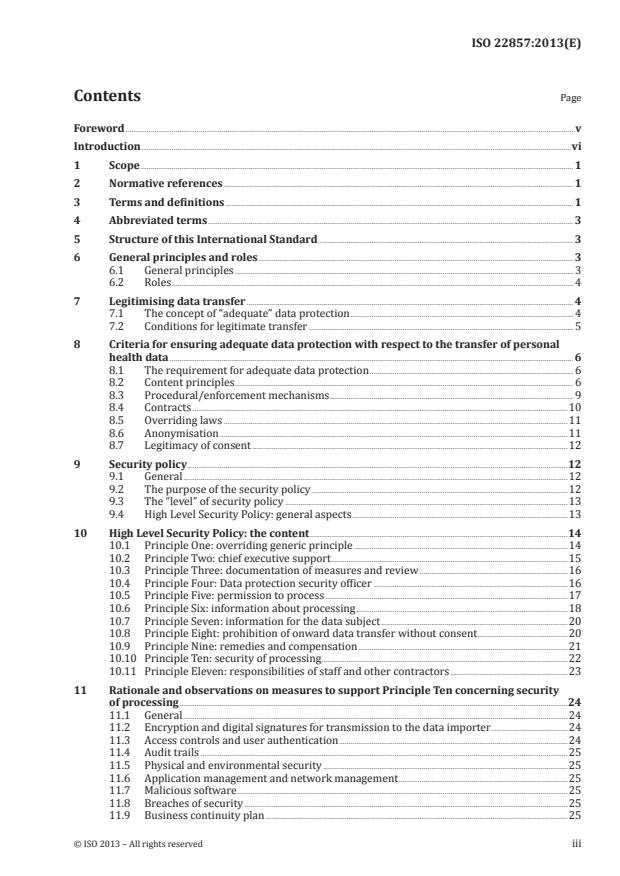
Contents Page
Foreword .v
Introduction .vi
1 Scope . 1
2 Normative references . 1
3 Terms and definitions . 1
4 Abbreviated terms . 3
5 Structure of this International Standard . 3
6 General principles and roles . 3
6.1 General principles . 3
6.2 Roles . 4
7 Legitimising data transfer . 4
7.1 The concept of “adequate” data protection . 4
7.2 Conditions for legitimate transfer . 5
8 Criteria for ensuring adequate data protection with respect to the transfer of personal
health data . 6
8.1 The requirement for adequate data protection . 6
8.2 Content principles . 6
8.3 Procedural/enforcement mechanisms. 9
8.4 Contracts .10
8.5 Overriding laws .11
8.6 Anonymisation .11
8.7 Legitimacy of consent .12
9 Security policy .12
9.1 General .12
9.2 The purpose of the security policy .12
9.3 The “level” of security policy .13
9.4 High Level Security Policy: general aspects .13
10 High Level Security Policy: the content .14
10.1 Principle One: overriding generic principle .14
10.2 Principle Two: chief executive support .15
10.3 Principle Three: documentation of measures and review .16
10.4 Principle Four: Data protection security officer .16
10.5 Principle Five: permission to process .17
10.6 Principle Six: information about processing .18
10.7 Principle Seven: information for the data subject .20
10.8 Principle Eight: prohibition of onward data transfer without consent .20
10.9 Principle Nine: remedies and compensation .21
10.10 Principle Ten: security of processing .22
10.11 Principle Eleven: responsibilities of staff and other contractors .23
11 Rationale and observations on measures to support Principle Ten concerning security
of processing .24
11.1 General .24
11.2 Encryption and digital signatures for transmission to the data importer .24
11.3 Access controls and user authentication .24
11.4 Audit trails .25
11.5 Physical and environmental security .25
11.6 Application management and network management .25
11.7 Malicious software .25
11.8 Breaches of security .25
11.9 Business continuity plan .25
11.10 Handling very sensitive data .26
11.11 Standards .26
12 Personal health data in non-electronic form .26
Annex A (informative) Key primary international documents on data protection .27
Annex B (informative) National documented requirements and legal provisions in a range
of countries .32
Annex C (informative) Exemplar contract clauses: Controller to controller .37
Annex D (informative) Exemplar contract clauses: Controller to processor .44
Annex E (informative) Handling very sensitive personal health data .53
Bibliography .55
iv © ISO 2013 – All rights reserved
Foreword
ISO (the International Organization for Standardization) is a worldwide federation of national standards
bodies (ISO member bodies). The work of preparing International Standards is normally carried out
through ISO technical committees. Each member body interested in a subject for which a technical
committee has been established has the right to be represented on that committee. International
organizations, governmental and non-governmental, in liaison with ISO, also take part in the work.
ISO collaborates closely with the International Electrotechnical Commission (IEC) on all matters of
electrotechnical standardization.
The procedures used to develop this document and those intended for its further maintenance are
described in the ISO/IEC Directives, Part 1. In particular the different approval criteria needed for the
different types of ISO documents should be noted. This document was drafted in accordance with the
editorial rules of the ISO/IEC Directives, Part 2 (see www.iso.org/directives).
Attention is drawn to the possibility that some of the elements of this document may be the subject of
patent rights. ISO shall not be held responsible for identifying any or all such patent rights. Details of
any patent rights identified during the development of the document will be in the Introduction and/or
on the ISO list of patent declarations received (see www.iso.org/patents).
Any trade name used in this document is information given for the convenience of users and does not
constitute an endorsement.
For an explanation on the meaning of ISO specific terms and expressions related to conformity
assessment, as well as information about ISO’s adherence to the WTO principles in the Technical Barriers
to Trade (TBT) see the following URL: Foreword - Supplementary information
The committee responsible for this document is ISO/TC 215, Health informatics.
This second edition replaces the first edition (IO 22857:2004), which has been technically revised.
Introduction
In the health context, information about individuals needs to be collected, stored and processed for
many purposes, the main being
— direct delivery of care e.g. patient records;
— insurance;
— clinical research; and
— population health.
[15]
A classification of purposes for processing personal health information is given in ISO/TS 14265 .
The data required depends on the purpose. In the context of identification of individuals, data may be
needed
— to allow an individual to be readily and uniquely identified (e.g. a combination of name, address, age,
sex, identification number);
— to confirm that two data sets belong to the same individual without any need to identify the
individual himself (e.g. for record linkage and/or longitudinal statistics); and
— for any purpose, but where identifiable data are not required, the objective should be to prevent
such identification of the individual.
In all of these circumstances data about individuals are now, and will increasingly in the future,
be transmitted across national/jurisdictional borders or be deliberately made accessible to
countries/jurisdictions other than where they are collected or stored. Data may be collected in one
country/jurisdiction and stored in another, be manipulated in a third, and be accessible from many
countries/jurisdictions or even globally. The key requirement is that
— all this processing should be carried out in a fashion that is consistent with the purposes and
consents of the original data collection and, in particular,
— all disclosures of personal health data should be to appropriate individuals or organisations within
the boundaries of these purposes and consents.
International health-related applications may require personal health data to be transmitted from
one nation to another across national borders. That is very evident in telemedicine or when data are
electronically dispatched for example in an email or as a data file to be added to an international
database. It also occurs, but less obviously, when a database in one country/jurisdiction is viewed
from another for example over the Internet. That application may appear passive but the very act of
viewing involves disclosure of that data and is deemed ‘processing’. Moreover it requires a download
that may be automatically placed in a cache and held there until ‘emptied’ - this also is processing and
involves a particular security hazard. The same circumstances may arise when data are passed across
jurisdictional boundaries.
There is a wide range of organisations that might be involved in receipt of personal health data from
another country/jurisdiction, for example:
— healthcare establishments such as hospitals;
— research databanks held in one country but both fed and accessed in others;
— contractors remotely maintaining health care systems in other countries;
— organisations holding educational databases containing, for example, radiological images with
diagnoses and case notes;
— companies holding banks of medical records for patients from different countries/jurisdictions;
vi © ISO 2013 – All rights reserved
— organisations involved in international or cross-jurisdictional health-related e-commerce such as
e-pharmacy.
In all applications involving personal health data there can be a potential threat to the privacy of an
individual. That threat and its extent will depend on:
— the level to which data are protected from unauthorised access in storage or transmission;
— the number of persons who have authorized access;
— the nature of the personal health data;
— the level of difficulty in identifying an individual if access to the data are obtained.
Wherever health data are collected, stored, processed or published (including electronically on the
Internet) the potential threat to privacy needs to be assessed and appropriate protective measures
taken. Some form of risk analysis will be necessary to ascertain the required level of security measures.
In addition to the standards bodies ISO, IEC, CEN and CENELEC, there are four major trans-national
bodies that have produced internationally authoritative documents relating to security and data
protection in the context of trans-border flows:
— the Organization for Economic Co-operation and Development (OECD);
— the Council of Europe;
— the United Nations (UN);
— the European Union (EU).
The primary documents from these bodies are:
[1]
— OECD “Guidelines on the Protection of Privacy and Trans-border flows of Personal Data” ;
[2]
— OECD “Guidelines for the Security of information Systems” ;
— Council of Europe “Convention for the Protection of individuals with regard to Automatic Processing
[3]
of Personal Data” No. 108;
[4]
— “Council of Europe Recommendation R(97)5 on the Protection of Medical Data” ;
[5]
— UN General Assembly “Guidelines for the Regulation of Computerised Personal Data Files” ;
— EU Data Protection Directive on the protection of individuals with regard to the processing of
[6]
personal data and free movement of that data.
Annex A provides a brief summary of the key aspects of these documents.
[7]
The means and extent of the protection afforded to personal health data varies from nation to nation
and jurisdiction to jurisdiction. In some countries there is nation-wide privacy legislation, in others
legislative provisions may be at a state level or equivalent. In a number of countries legislation may not
exist although various codes of practice or equivalent will probably be in place and/or ‘medical’ laws
may exist which lay down a duty on medical practitioners to safeguard confidentiality, integrity and
availability.
Although privacy legislation in different parts of the world may mention personal health data, frequently
there is no legislation specific to health except perhaps in relation to government agencies and/or
medical research.
Annex B comprises a brief outline of the key national standards or other documented requirements and
of the legislative position concerning data protection in a range of countries.
Personal health data can be extremely sensitive in nature and thus there is extensive guidance and
standards available both nationally and internationally on various administrative and technical
‘security measures’ for the protection of personal health data .
This International Standard seeks to draw on, and harmonize, data protection requirements relating
to the transfer of personal health data across international boundaries as given in authoritative
international documents. It also seeks to take into account a range of national requirements so as
to avoid, as far as practicable, conflict between the requirements of this International Standard and
national specifications.
This International Standard applies, however, solely to transfer of personal health data across
national/jurisdictional borders. It explicitly does not seek to specify national or specific jurisdictional
data protection requirements. The creation of a set of requirements aimed at being acceptable to all
countries/jurisdictions, whether they be transmitting or receiving personal health data to/from other
countries/jurisdictions, inevitably means adopting the most stringent of requirements. This means that
organisations in some countries/jurisdictions would need to apply extra or more severe data protection
requirements when transmitting to, or receiving personal health data from, other countries/jurisdictions
than might be necessary for handling such data within their own boundaries. Although that might be
the case, that does not mean that those extra or more severe requirements must be applied to internal
national/jurisdictional applications.
This International Standard does not specify whether consent should be implicit or explicit or whether
or not it should be in writing or equivalent. Neither does it deal with what measures should be taken
where the data subject is unable to give meaningful consent for whatever reason. Such matters may be
specified in the regulations of the country/jurisdiction of the data exporter or be a matter of custom
or culture in that country/jurisdiction. The consideration that ideally applies to these aspects is that
consent is given according to the expectations which a data subject would have in giving that consent in
the context of any regulations, customs or cultures that apply to the data subject.
viii © ISO 2013 – All rights reserved
INTERNATIONAL STANDARD ISO 22857:2013(E)
Health informatics — Guidelines on data protection to
facilitate trans-border flows of personal health data
1 Scope
This International Standard provides guidance on data protection requirements to facilitate the transfer
of personal health data across national or jurisdictional borders.
It does not require the harmonization of existing national or jurisdictional standards, legislation or
regulations. It is normative only in respect of international or trans-jurisdictional exchange of personal
health data. However it can be informative with respect to the protection of health information within
national/jurisdictional boundaries and provide assistance to national or jurisdictional bodies involved
in the development and implementation of data protection principles.
This International Standard covers both the data protection principles that apply to international or
trans-jurisdictional transfers and the security policy which an organization adopts to ensure compliance
with those principles.
Where a multilateral treaty between a number of countries has been agreed (e.g. the EU Data Protection
Directive), the terms of that treaty will take precedence.
This International Standard aims to facilitate international and trans-jurisdictional health-related
applications involving the transfer of personal health data. It seeks to provide the means by which health
data relating to data subjects, such as patients, will be adequately protected when sent to, and processed
in, another country/jurisdiction.
This International Standard does not provide definitive legal advice but comprises guidance. When
applying the guidance to a particular application, legal advice appropriate to that application can be
sought.
National privacy and data protection requirements vary substantially and can change relatively quickly.
Whereas this International Standard in general encompasses the more stringent of international and
national requirements it nevertheless comprises a minimum. Some countries/jurisdictions may have
some more stringent and particular requirements.
2 Normative references
This International Standard does not contain normative references.
3 Terms and definitions
For the purposes of this document, the following terms and definitions apply.
NOTE Throughout the text, the word “he” should be understood to mean “he or she” and the word “his” to
mean “his or her”.
3.1
application
process involving international/jurisdictional data transfer to which this International Standard is
being applied unless obviously to the contrary
3.2
Commission
European Commission unless obviously otherwise
3.3
controller
natural or legal person, public authority, agency or any other body which alone or jointly with others
determines the purposes and means of the processing of personal data
3.4
data subject
identified or identifiable natural person, which is the subject of personal data
3.5
data subject’s consent
any freely given specific and informed indication of his wishes by which the data subject signifies his
agreement to personal data relating to him being processed
3.6
EU Directive
[6]
EU Data Protection Directive unless stated otherwise
3.7
identifiable person
one who can be identified, directly or indirectly, in particular by reference to an identification number
or one or more factors specific to his physical, physiological, mental, economic, cultural or social identity
3.8
participants
data exporters and data importers
3.9
personal data
any information relating to an identified or identifiable natural person
3.10
personal health data
any personal data relevant to the health of an identified or identifiable natural person
3.11
primary controller
controller who is the data exporter responsible for all matters relating to ensuring consent of the data
subject to the transfer of his personal health data to another country/jurisdiction
3.12
processor
natural or legal person, public authority, agency or any other body which processes personal data on
behalf of the controller
3.13
processing of personal data (processing)
any operation or set of operations which is performed upon personal data, whether or not by automatic
means, such as collection, recording, organization, storage, adaptation or alteration, retrieval,
consultation, use, disclosure by transmission, dissemination or otherwise making available, alignment
or combination, blocking, erasure or destruction
3.14
data importer
natural or legal person, public authority, agency or any other body located in one country/jurisdiction
which receives data from a data exporter in another country/jurisdiction
3.15
data exporter
natural or legal person, public authority, agency or any other body located in one country/jurisdiction
which sends data to a data importer in another country/jurisdiction
2 © ISO 2013 – All rights reserved
3.16
data protection security officer
officer appointed by the controller to ensure, in an independent manner, compliance with the HLSP and
the measures that support it
Note 1 to entry: The term “data protection security officer” used in this document covers roles such as “data
protection officer” and “information security officer” found in specific organizations.
4 Abbreviated terms
The following abbreviated terms are used
EEA European Economic Area
EU European Union
HLSP High Level Security Policy
OECD Organization for Economic Co-operation and Development
UN United Nations
5 Structure of this International Standard
This International Standard is structured as follows:
— Clause 6 lists some general principles reflecting those in international documents on this subject
and deals with the main roles of data importers and exporters, and data controllers and processors.
— Clause 7 introduces, in general, the two main requirements for a transfer of personal health data
to be legitimate in the context of this International Standard and on which the remainder of the
International Standard is based; namely consent and adequacy of data protection.
— Clause 8 deals in detail with these two main general requirements, lays down all the criteria for
adequacy and takes further the concept of consent.
— Clause 9 requires the data importer to have a high level data protection policy in place and explains
what is meant in this International Standard by “high level”.
— Clause 10 lays down the detailed requirements for a high level policy which will ensure the criteria
for adequacy of data protection are actually ensured.
— Clause 11 provides detailed requirements for those aspects of a data importer’s policy which relate
to the administrative and technical means for ensuring security of data processing.
— Clause 12 deals with personal health data in non-electronic forms.
6 General principles and roles
6.1 General principles
The general principles are as follows:
— Participants shall protect the fundamental rights and freedoms of natural persons regarding their
rights to privacy with respect to the processing of personal health data.
— The responsibilities and accountability of participants shall be explicit and transparent to data
subjects.
— Consistent with maintaining security, data subjects shall be able to gain appropriate knowledge of,
and be informed about, the existence and general extent of measures, practices and procedures for
the security of the application involved in the processing of personal health data relating to them.
— The application and the security of the application shall respect the rights and legitimate interests
of all affected parties.
— Security levels, costs, measures, practices and procedures shall be appropriate and proportionate
to the value and degree of reliance on the application and the severity, probability and extent of
potential harm to a data subject.
— Measures, practices and procedures for the security of an application shall be coordinated and
integrated with each other and with other measures, practices and procedures of the participants
in the application so as to create a coherent system of security.
— Participants shall act in a timely coordinated manner to prevent and respond to breaches of security
regarding the application.
— The security measures relating to the application shall be reassessed periodically.
— The security of the application shall be compatible with the legitimate use and flow of data and
information in a democratic society.
6.2 Roles
6.2.1 Data exporters and data importers
An exchange of personal health data across an international or jurisdictional border involves a ‘data
exporter’ responsible for transmitting the data from one country/jurisdiction and a ‘data importer’
which receives the data in another country/jurisdiction. Each has obligations to the other.
A ‘data exporter’ shall not transfer data to a ‘data importer’ unless the ‘importer’ complies with the
relevant parts of this International Standard.
A ‘data importer’ shall not participate in an application unless the ‘data exporter’ complies with the
relevant parts of this International Standard.
6.2.2 Controllers and processors
A ‘data controller’ has the responsibility to determine the purpose and means of processing whereas a
‘processor’ processes the data on behalf of a controller and according to instructions from a controller
(see definitions). Each participant in an application shall be designated either as a ‘controller’ or as a
‘processor’.
NOTE Since control of data may be transferred to another jurisdiction the ‘data controller” and ‘data exporter’
may be the same entity as may be the ‘data controller’ and ‘data importer’.
7 Legitimising data transfer
7.1 The concept of “adequate” data protection
This International Standard is based on the concept of ensuring “adequate” data protection in
transferring personal health data across national or jurisdictional borders. It is the responsibility of the
data exporter to ensure adequacy of data protection implemented by the importer.
While “adequate” protection includes satisfactory administrative and technical security measures for
the protection of data, it encompasses other substantial matters.
4 © ISO 2013 – All rights reserved
A data subject will expect that the rights he has come to expect regarding his personal health data
will be respected by any importer when such data are transferred to another country/jurisdiction.
The extent and nature of the rights which a data subject will have come to expect will depend on the
country/jurisdiction in which he resides and its culture. If it is known or suspected that such rights
might not be respected by a data importer, the data subject will expect to be fully informed so as to be
able to consent or otherwise to a transfer proceeding. On the other hand a data subject will, in some
circumstances, expect data to be transferred even where data protection may not be “adequate” in the
terms of this International Standard (e.g. where his vital interests are concerned in a health emergency).
Data subjects will expect personal health data to be protected during the process of transfer and for
a data importer to have “adequate” safeguards in place when it is received. Those safeguards would
include administrative security and technical measures to encompass for example access controls, data
integrity, audit trails, data accuracy etc. They will also expect the importing organization to have staff
competent and trained in the handling of personal health data. The expectation will be that the data
importer will have in place a security policy covering such matters.
Data subjects will additionally expect to know what is happening to their data, to have access to it if
necessary and to have the opportunity to address any perceived inaccuracies.
A data subject will expect to have given consent to a transfer and to have been fully informed on matters
relevant to that consent.
Finally, data subjects will expect to be able to make a complaint if the terms under which a transfer
has taken place seem to have been breached and for such a complaint to be investigated impartially
and, if necessary, by an independent body. Where the data subject suffers damage through a breach in
conditions they will expect to be able to pursue redress in a defined and fair manner.
This International Standard addresses all these matters under the umbrella of ensuring “adequate” data
protection. It details the criteria for ensuring “adequate” data protection (Clause 8) and the content
of a high level security policy which a data importer would be expected to implement to ensure that
“adequacy” of data protection was in practice ensured (Clauses 9, 10 and 11).
7.2 Conditions for legitimate transfer
7.2.1 Consent as a condition of transfer
Personal health data shall not be transferred unless the data subject has unambiguously given his
consent excepting where the transfer is deemed necessary by the controller to protect the vital interest
of the data subject, or where permitted by law. This fact should be made known to individuals and
citizens in both a general and a specific way.
[16]
Principles and data requirements for consent are given in ISO/DTS 17975.
7.2.2 Conditions for transfer
In addition to unambiguous consent, personal health data shall not be transferred to a data importer
unless either the importer ensures an adequate level of protection (see Clause 8) or one of the following
conditions apply:
a) the data subject has given his consent unambiguously to the proposed transfer in the knowledge
of the inadequacies that exist (note that although 7.2.1 requires consent in all circumstances, the
requirement here is that such consent must be with the knowledge of the inadequacies that cause
the participants to resort to this condition - see also 8.7); or
b) the transfer is necessary for the performance of a contract between the data subject and the controller
or the implementation of pre-contractual measures taken in response to the data subject’s request;
or
c) the transfer is necessary for the conclusion or performance of a contract concluded in the interest of
the data subject between the controller and another party; or
d) the transfer is necessary or legally required on important public interest grounds, or for the
establishment, exercise or defence of legal claims; or
e) the transfer is necessary in order to protect the vital interests of the data subject; or
f) the transfer is made from a register which according to laws or regulations is intended to provide
information to the public and which is open to consultation either by the public in general or by any
person who can demonstrate legitimate interest, to the extent that the conditions laid down in law
for consultation are fulfilled in the particular case; or
g) where the controller adduces sufficient guarantees through appropriate contractual clauses
examples of which are given in Annexes C and D.
NOTE Subclause 8.4 makes it a requirement that in all cases “the application shall be governed by a
contract between the participants” but is essentially silent on the form that such a contract should take.
However where (g) above applies, particular attention needs to be paid to the contract to ensure it covers any
inadequacies in data protection which would otherwise apply such as in matters of redress, investigation of
complaints etc. It is for this reason that the examples in Annexes C and D are given.
8 Criteria for ensuring adequate data protection with respect to the transfer of
personal health data
8.1 The requirement for adequate data protection
A controller shall not transfer personal health data to a data importer unless the importer provides
adequate data protection. There are two essential elements of adequacy.
— Content principles: The adequacy of the data protection provisions in the processing of the personal
health data by the data importer and the obligations placed on those responsible for them.
— Procedural/enforcement requirements: The means for ensuring that such provisions are
followed in practice and for ensuring the rights of data subjects.
8.2 Content principles
8.2.1 General
The content principles are given in 8.2.2 to 8.2.7.
8.2.2 The purpose limitation, data quality and proportionality principle
In the context of the application and subject to the allowable exemptions given in 8.2.8, personal health
data shall be
a) processed fairly and lawfully;
b) transferred for specified, explicit and legitimate purposes and not further processed in a way
incompatible with those purposes;
c) adequate, relevant and not excessive in relation to the purposes for which they are transferred
and/or further processed;
d) accurate and, where necessary, kept up to date. Every reasonable step must be taken to ensure
that data which are inaccurate or incomplete, having regard to the purposes for which they were
transferred or for which they are further processed, are erased or rectified;
e) kept in a form which permits identification of data subjects for no longer than is necessary for the
purposes for which the data were transferred or for which they are further processed. Participants
may agree to personal health data being stored for longer periods for historical, statistical or
6 © ISO 2013 – All rights reserved
scientific use provided such use does not impact on the data subject. However the data subject shall
be informed of any such agreement.
8.2.3 The transparency principle
In the context of the application and subject to the exemptions in 8.2.8 the data subject shall be provided
with the following information:
a) the identity of the data exporter and the data importer and of his representative, if any;
b) the purposes of the processing for which the data are to be transferred;
c) the existence of the rights of access to, and the right to rectify, any data in the application which
relates to him;
d) liabilities, remedies and sanctions in respect to any breaches of his rights;
e) the retention period of the data particularly relating to medico-legal requirements and any policy
regarding the death of a data subject;
f) any matter which may affect his giving of consent to the transfer;
g) any other information which this International Standard specifies.
8.2.4 The rights of access, rectification and opposition principle
In the context of the application, and subject to the exemptions in 8.2.8, the data subject shall have the
following rights:
a) to obtain without constraint at reasonable intervals and without excessive delay or expense, as
specified or determined by the applicable (possibly legal) authority
− confirmation as to whether or not data relating to him are being processed and information at
least as to the purposes of the processing, the categories of data concerned, and the data importers
or categories of data importer to whom the data are disclosed,
− communication to him in an intelligible form of the data undergoing processing and of any
available information as to their source;
b) as appropriate to have rights to rectification, erasure or blocking of data the processing of which
does not comply with the provisions of this International Standard, in particular because of the
incomplete or inaccurate nature of the data;
c) notification to third parties to whom the data have been disclosed of any rectification, erasure
or blocking carried out in compliance with (b), unless this proves impossible or involves a
disproportionate effort;
d) to object at any time on grounds relating to his particular situation to the processing of data relating
to him. Where there is a justified objection, the processing instigated by the controller shall no
longer involve those data.
8.2.5 Restrictions on onward transfer principle
Further transfers of the personal health data by the importer of the original data transfer shall not
be permitted unless the second data importer (i.e. the importer of the onward transfer) also affords
adequate protection in accordance with 7.2 and other relevant requirements of this International
Standard.
8.2.6 The security principle
Technical and organisational security measures shall be taken by the data importer that are appropriate
to the risks presented by the processing.
8.2.7 Additional principles applying to specific circumstances
Direct marketing: The data subject shall have the right to object, on request and free of charge, to the
processing of personal data relating to him which the participants anticipate being processed for the
purposes of direct marketing, or to be informed before personal data are disclosed for the first time to
other parties or used on their behalf for the purposes of direct marketing, and to be expressly offered
the right to object free of charge to such disclosures or uses. Data subjects shall be informed of this right.
Death of the data subject: The way in which the confidentiality of personal health data is handled after
the death of a data subject may vary from nation to nation and from jurisdiction to jurisdiction (e.g.
while the UK Data Protection Act applies only to living persons, in Canada, section 7.3 of the Pe
...