

ISO 11630:1997
(Main)Cranes — Measurement of wheel alignment
General Information
- Abstract
- Status
- Published
- Publication Date
- 26-Nov-1997
- Technical Committee
- ISO/TC 96/SC 4 - Test methods
- Drafting Committee
- ISO/TC 96/SC 4 - Test methods
- Current Stage
- 9060 - Close of review
- Completion Date
- 03-Jun-2028
Buy Documents
ISO 11630:1997 - Cranes — Measurement of wheel alignment Released:11/27/1997
ISO 11630:1997 - Appareils de levage a charge suspendue — Mesure de l'alignement des galets Released:11/27/1997
Overview
ISO 11630:1997 - Cranes - Measurement of wheel alignment specifies standardized methods for measuring the alignment of crane wheels for four-wheel, rail‑mounted cranes (excluding railway cranes). The standard defines measurement steps, reference geometry and calculation procedures to determine wheel deviations in plan view, elevation profile and vertical position. Procedures are based on optical surveying (theodolite) but permit other methods that provide equivalent measurement accuracy.
Key topics and technical requirements
- Scope: Applies to four‑wheel cranes on rails; procedures for more than four wheels are intended for future editions.
- Reference geometry: Establish a baseline and a geodetic rectangle using a theodolite; the error in laying out rectangle corners shall not exceed 6 seconds of arc.
- Measurement points: Define and record coordinate distances (X, Y in plan; T in elevation; Z for vertical tests) from rectangle sides to wheel reference points.
- Measurement procedures:
- Plan‑view alignment: select baseline, set geodetic rectangle, measure lateral distances to wheels, then compute angular and linear deviations of wheel planes and span.
- Elevation profile: measure vertical offsets from rectangle sides and calculate deviations from vertical.
- Vertical deviations: raise one side of the crane, measure perpendicular wheel‑to‑rail gaps (instrument error ≤ 0.1 mm), calculate deviations from horizontal.
- Calculations: The standard provides formulas to compute wheel misalignment, span deviations and angular deviations (expressed in radians or per thousand) from recorded measurements.
- Accuracy & tolerances: Measurement tolerances and acceptable differences in rectangle side lengths are specified relative to crane span; optical methods are normative but equivalent‑accuracy methods are allowed.
Practical applications and users
ISO 11630 is used to ensure safe, reliable crane operation and to verify compliance with design and test specifications. Typical applications:
- Acceptance testing and commissioning of overhead and gantry cranes
- Periodic inspection and preventive maintenance programs
- Post‑repair verification after axle/wheel or carriage work
- Forensic investigation of misalignment-related failures, rail/wheel wear and ride issues
Primary users:
- Crane manufacturers and OEM test engineers
- Maintenance and inspection teams at industrial sites and ports
- Accredited testing laboratories and certification bodies
- Surveyors and metrology teams performing crane alignment measurements
Related standards
- ISO 4310 - Cranes: test code and procedures (referenced for measurement practice)
- ISO 9373 - Accuracy requirements for measuring parameters during crane testing
- ISO 12488‑1 - Crane and track tolerances (partially cited for related tolerances)
Keywords: ISO 11630, crane wheel alignment, measurement of wheel alignment, geodetic rectangle, theodolite, plan view, elevation profile, rail‑mounted cranes, wheel misalignment, crane inspection.
Buy Documents
ISO 11630:1997 - Cranes — Measurement of wheel alignment Released:11/27/1997
ISO 11630:1997 - Appareils de levage a charge suspendue — Mesure de l'alignement des galets Released:11/27/1997
Frequently Asked Questions
ISO 11630:1997 is a standard published by the International Organization for Standardization (ISO). Its full title is "Cranes — Measurement of wheel alignment". This standard covers: Cranes — Measurement of wheel alignment
Cranes — Measurement of wheel alignment
ISO 11630:1997 is classified under the following ICS (International Classification for Standards) categories: 53.020.20 - Cranes. The ICS classification helps identify the subject area and facilitates finding related standards.
ISO 11630:1997 is available in PDF format for immediate download after purchase. The document can be added to your cart and obtained through the secure checkout process. Digital delivery ensures instant access to the complete standard document.
Standards Content (Sample)
INTERNATIONAL ISO
STANDARD 11630
First edition
1997-12-01
Cranes — Measurement of wheel alignment
Appareils de levage à charge suspendue — Mesure de l'alignement des
galets
A
Reference number
Foreword
ISO (the International Organization for Standardization) is a worldwide
federation of national standards bodies (ISO member bodies). The work of
preparing International Standards is normally carried out through ISO
technical committees. Each member body interested in a subject for which
a technical committee has been established has the right to be represented
on that committee. International organizations, governmental and non-
governmental, in liaison with ISO, also take part in the work. ISO
collaborates closely with the International Electrotechnical Commission
(IEC) on all matters of electrotechnical standardization.
Draft International Standards adopted by the technical committees are
circulated to the member bodies for voting. Publication as an International
Standard requires approval by at least 75 % of the member bodies casting
a vote.
International Standard ISO 11630 was prepared by Technical Committee
ISO/TC 96, Cranes, Subcommittee SC 4, Test methods.
Annex A of this International Standard is for information only.
© ISO 1997
All rights reserved. Unless otherwise specified, no part of this publication may be reproduced
or utilized in any form or by any means, electronic or mechanical, including photocopying and
microfilm, without permission in writing from the publisher.
International Organization for Standardization
Case postale 56 • CH-1211 Genève 20 • Switzerland
Internet central@iso.ch
X.400 c=ch; a=400net; p=iso; o=isocs; s=central
Printed in Switzerland
ii
©
INTERNATIONAL STANDARD ISO ISO 11630:1997(E)
Cranes — Measurement of wheel alignment
1 Scope
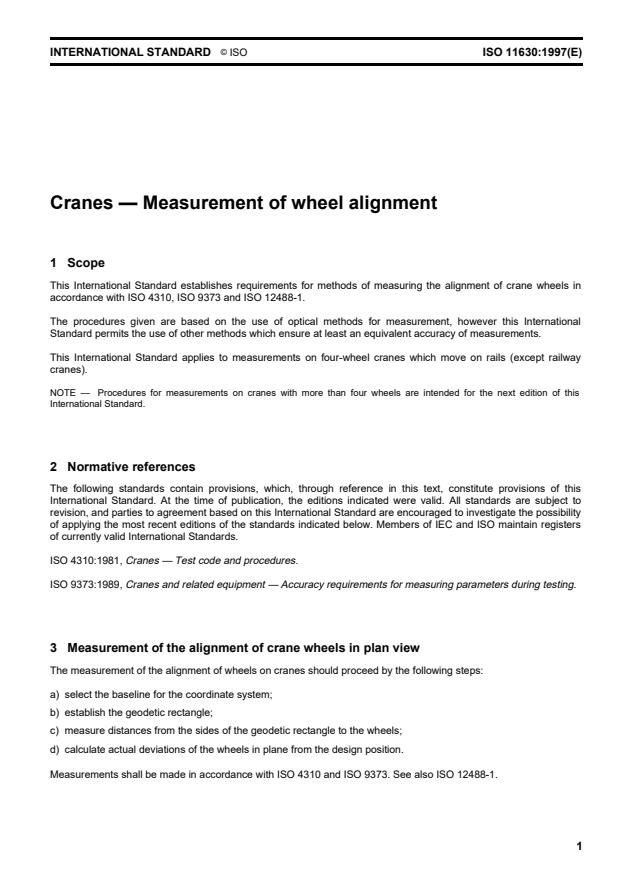
This International Standard establishes requirements for methods of measuring the alignment of crane wheels in
accordance with ISO 4310, ISO 9373 and ISO 12488-1.
The procedures given are based on the use of optical methods for measurement, however this International
Standard permits the use of other methods which ensure at least an equivalent accuracy of measurements.
This International Standard applies to measurements on four-wheel cranes which move on rails (except railway
cranes).
NOTE — Procedures for measurements on cranes with more than four wheels are intended for the next edition of this
International Standard.
2 Normative references
The following standards contain provisions, which, through reference in this text, constitute provisions of this
International Standard. At the time of publication, the editions indicated were valid. All standards are subject to
revision, and parties to agreement based on this International Standard are encouraged to investigate the possibility
of applying the most recent editions of the standards indicated below. Members of IEC and ISO maintain registers
of currently valid International Standards.
ISO 4310:1981, Cranes — Test code and procedures.
ISO 9373:1989, Cranes and related equipment — Accuracy requirements for measuring parameters during testing.
3 Measurement of the alignment of crane wheels in plan view
The measurement of the alignment of wheels on cranes should proceed by the following steps:
a) select the baseline for the coordinate system;
b) establish the geodetic rectangle;
c) measure distances from the sides of the geodetic rectangle to the wheels;
d) calculate actual deviations of the wheels in plane from the design position.
Measurements shall be made in accordance with ISO 4310 and ISO 9373. See also ISO 12488-1.
©
ISO
3.1 Selection of baseline for the coordinate system
To simplify the calculation of deviations, it is necessary to assume a base coordinate system and take
measurements in reference to it.
3.1.1 From two select points on the external surface of the crane end-carriage, erect perpendiculars as shown in
figure 1.
3.1.2 On the perpendicular thus erected from the crane end-carriage, measure off segments Y of equal length.
The theodolite should be positioned so that the direction of the collimating ray passes through the ends of the
segments Y .
3.1.3 Taking the location of the theodolite as point O and arbitrary point of the theodolite collimating ray outside the
crane as point R, then O and R will identify the direction of the x axis and serve as a base to establish the geodetic
rectangle (see figure 1).
3.2 Establishing the geodetic rectangle
3.2.1 Based on the points O and R, the geodetic rectangle OPQR is established using the theodolite. The error in
laying out corners of the rectangle should not exceed 6 seconds of arc.
Identify the vertices P and Q by corresponding points as shown in figure 2.
3.2.2 Measure distances OP, QR, PQ and OR. Differences in the dimensions (OP-QR) and (PQ-OR) shall not
exceed
a) for cranes with span S < 10 m: – 2 mm;
b) for cranes with span 10 m: [2 + 0,1( 10)] mm.
S > – S -
3.3 Measurement of distances from the sides of the geodetic rectangle to the crane wheels
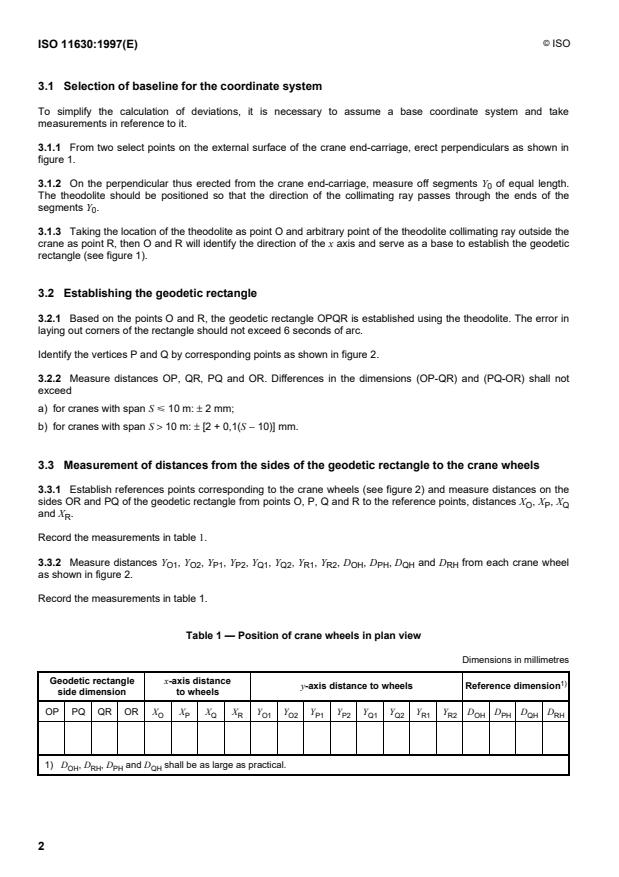
3.3.1 Establish references points corresponding to the crane wheels (see figure 2) and measure distances on the
sides OR and PQ of the geodetic rectangle from points O, P, Q and R to the reference points, distances X , X , X
O P Q
and X .
R
Record the measurements in table 1.
3.3.2 Measure distances Y , Y , Y , Y , Y , Y , Y , Y , D , D , D and D from each crane wheel
O1 O2 P1 P2 Q1 Q2 R1 R2 OH PH QH RH
as shown in figure 2.
Record the measurements in table
...
NORME ISO
INTERNATIONALE 11630
Première édition
1997-12-01
Appareils de levage à charge suspendue —
Mesure de l'alignement des galets
Cranes — Measurement of wheel alignment
A
Numéro de référence
Avant-propos
L'ISO (Organisation internationale de normalisation) est une fédération
mondiale d'organismes nationaux de normalisation (comités membres de
l'ISO). L'élaboration des Normes internationales est en général confiée aux
comités techniques de l'ISO. Chaque comité membre intéressé par une
étude a le droit de faire partie du comité technique créé à cet effet. Les
organisations internationales, gouvernementales et non gouvernementales,
en liaison avec l'ISO participent également aux travaux. L'ISO collabore
étroitement avec la Commission électrotechnique internationale (CEI) en
ce qui concerne la normalisation électrotechnique.
Les projets de Normes internationales adoptés par les comités techniques
sont soumis aux comités membres pour vote. Leur publication comme
Normes internationales requiert l'approbation de 75 % au moins des
comités membres votants.
La Norme internationale ISO 11630 a été élaborée par le comité technique
ISO/TC 96, Appareils de levage à charge suspendue, sous-comité SC 4,
Méthodes d'essais.
L'annexe A de la présente Norme internationale est donnée uniquement à
titre d'information.
© ISO 1997
Droits de reproduction réservés. Sauf prescription différente, aucune partie de cette publi-
cation ne peut être reproduite ni utilisée sous quelque forme que ce soit et par aucun pro-
cédé, électronique ou mécanique, y compris la photocopie et les microfilms, sans l'accord
écrit de l'éditeur.
Organisation internationale de normalisation
Case postale 56 • CH-1211 Genève 20 • Suisse
Internet central@iso.ch
X.400 c=ch; a=400net; p=iso; o=isocs; s=central
Imprimé en Suisse
ii
©
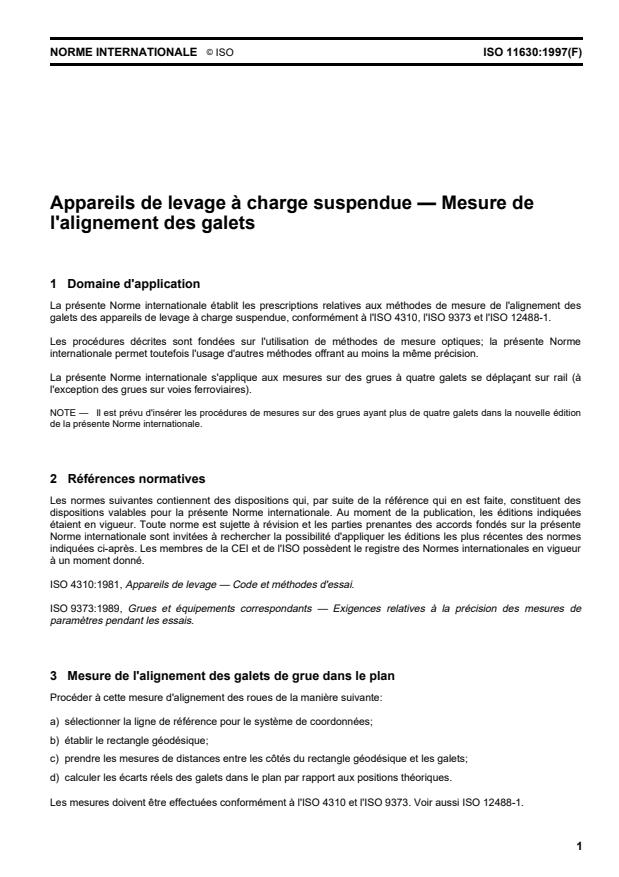
NORME INTERNATIONALE ISO ISO 11630:1997(F)
Appareils de levage à charge suspendue — Mesure de
l'alignement des galets
1 Domaine d'application
La présente Norme internationale établit les prescriptions relatives aux méthodes de mesure de l'alignement des
galets des appareils de levage à charge suspendue, conformément à l'ISO 4310, l'ISO 9373 et l'ISO 12488-1.
Les procédures décrites sont fondées sur l'utilisation de méthodes de mesure optiques; la présente Norme
internationale permet toutefois l'usage d'autres méthodes offrant au moins la même précision.
La présente Norme internationale s'applique aux mesures sur des grues à quatre galets se déplaçant sur rail (à
l'exception des grues sur voies ferroviaires).
NOTE — Il est prévu d'insérer les procédures de mesures sur des grues ayant plus de quatre galets dans la nouvelle édition
de la présente Norme internationale.
2 Références normatives
Les normes suivantes contiennent des dispositions qui, par suite de la référence qui en est faite, constituent des
dispositions valables pour la présente Norme internationale. Au moment de la publication, les éditions indiquées
étaient en vigueur. Toute norme est sujette à révision et les parties prenantes des accords fondés sur la présente
Norme internationale sont invitées à rechercher la possibilité d'appliquer les éditions les plus récentes des normes
indiquées ci-après. Les membres de la CEI et de l'ISO possèdent le registre des Normes internationales en vigueur
à un moment donné.
ISO 4310:1981, Appareils de levage — Code et méthodes d'essai.
ISO 9373:1989, Grues et équipements correspondants — Exigences relatives à la précision des mesures de
paramètres pendant les essais.
3 Mesure de l'alignement des galets de grue dans le plan
Procéder à cette mesure d'alignement des roues de la manière suivante:
a) sélectionner la ligne de référence pour le système de coordonnées;
b) établir le rectangle géodésique;
c) prendre les mesures de distances entre les côtés du rectangle géodésique et les galets;
d) calculer les écarts réels des galets dans le plan par rapport aux positions théoriques.
Les mesures doivent être effectuées conformément à l'ISO 4310 et l'ISO 9373. Voir aussi ISO 12488-1.
©
ISO
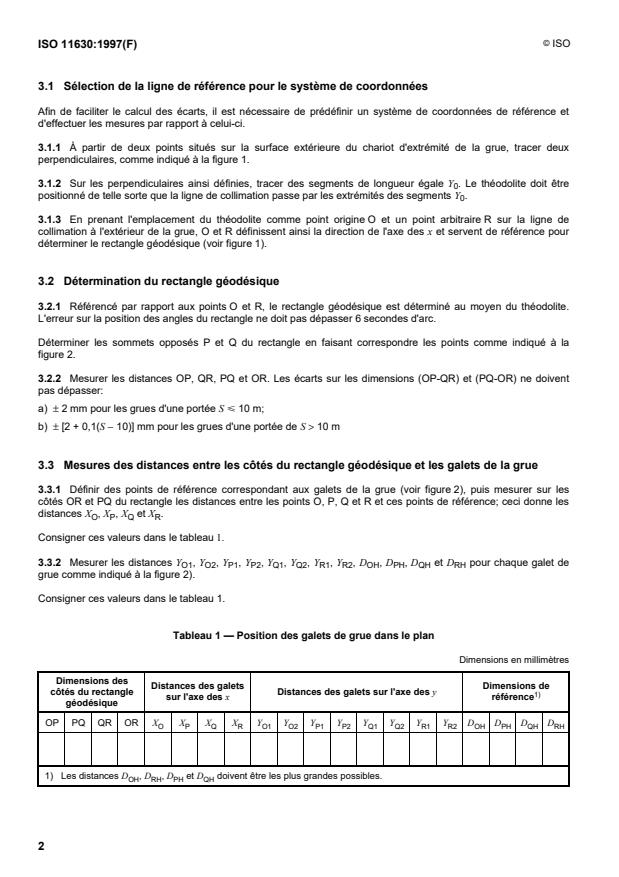
3.1 Sélection de la ligne de référence pour le système de coordonnées
Afin de faciliter le calcul des écarts, il est nécessaire de prédéfinir un système de coordonnées de référence et
d'effectuer les mesures par rapport à celui-ci.
3.1.1 À partir de deux points situés sur la surface extérieure du chariot d'extrémité de la grue, tracer deux
perpendiculaires, comme indiqué à la figure 1.
3.1.2 Sur les perpendiculaires ainsi définies, tracer des segments de longueur égale Y . Le théodolite doit être
positionné de telle sorte que la ligne de collimation passe par les extrémités des segments Y .
3.1.3 En prenant l'emplacement du théodolite comme point origine O et un point arbitraire R sur la ligne de
collimation à l'extérieur de la grue, O et R définissent ainsi la direction de l'axe des x et servent de référence pour
déterminer le rectangle géodésique (voir figure 1).
3.2 Détermination du rectangle géodésique
3.2.1 Référencé par rapport aux points O et R, le rectangle géodésique est déterminé au moyen du théodolite.
L'erreur sur la position des angles du rectangle ne doit pas dépasser 6 secondes d'arc.
Déterminer les sommets opposés P et Q du rectangle en faisant correspondre les points comme indiqué à la
figure 2.
3.2.2 Mesurer les distances OP, QR, PQ et OR. Les écarts sur les dimensions (OP-QR) et (PQ-OR) ne doivent
pas dépasser:
a) – 2 mm pour les grues d'une portée S < 10 m;
b) [2 + 0,1( 10)] mm pour les grues d'une portée de 10 m
– S - S >
3.3 Mesures des distances entre les côtés du rectangle géodésique et les galets de la grue
3.3.1 Définir des points de référence correspondant aux galets de la grue (voir figure 2), puis mesurer sur les
côtés OR et PQ du rectangle les distances entre les points O, P, Q et R et ces points de référence; ceci donne les
distances X , X , X et X .
O P Q R
Consigner ces valeurs dans le tableau 1.
3.3.2 Mesurer les distances Y , Y , Y , Y , Y , Y , Y , Y , D , D , D et D pour chaque galet de
O1 O2 P1 P2 Q1 Q2 R1
...