

ISO/IEC 17345:2006
(Main)Information technology — Data Interchange on 130 mm Rewritable and Write Once Read Many Ultra Density Optical (UDO) Disk Cartridges — Capacity: 30 Gbytes per Cartridge — First Generation
General Information
- Abstract
ISO/IEC 17345:2006 specifies the mechanical, physical, and optical characteristics of a 130 mm optical disk cartridge (ODC) that employs thermo-optical Phase Change effects to enable data interchange between such disks. It specifies two types: Type RW (Rewritable) provides for data to be written read and erased many times over the recording surfaces of the disk. Type WORM (Write Once Read Many) provides for data once written to be read a multiplicity of times. This type uses a Write Once Read Many times recording material (written marks cannot be erased and attempted modifications of the written marks are detectable). Multisession (incremental write operations) recording may be performed on Type WORM disks.
- Status
- Published
- Publication Date
- 27-Nov-2006
- Current Stage
- 9093 - International Standard confirmed
- Start Date
- 21-Aug-2020
- Completion Date
- 29-Aug-2026
Buy Documents

ISO/IEC 17345:2006 - Information technology — Data Interchange on 130 mm Rewritable and Write Once Read Many Ultra Density Optical (UDO) Disk Cartridges — Capacity: 30 Gbytes per Cartridge — First Generation Released:11/28/2006
Overview
ISO/IEC 17345:2006 defines the mechanical, physical and optical characteristics for 130 mm Ultra Density Optical (UDO) disk cartridges - first generation, 30 Gbytes per cartridge. It specifies two media types: Type RW (Rewritable) for multiple write/erase cycles and Type WORM (Write Once Read Many) where written marks cannot be erased and attempted modifications are detectable. The standard enables reliable data interchange between compliant disks and drives, including support for multisession (incremental) recording on WORM media.
Key topics and technical requirements
The standard covers detailed requirements necessary for interoperability, including:
- Mechanical and physical characteristics of the 130 mm optical disk cartridge (case and disk dimensions, clamping, drop and ESD tests)
- Optical and reference drive specifications (optical beam, read channel, tracking, rotation)
- Track, sector and format definitions (track pitch, physical track numbers, sector layout, headers, sync, data fields)
- Recording and encoding rules (recording codes, preformatted headers, data fields)
- Formatted and user zone layout (formatted zones, user areas, defect management area, disk definition structures)
- Defect management for RW and WORM (initialization, certification, primary/secondary defect lists)
- Embossed information and signal characteristics (groove/land signals, wobble, mirror area signals)
- Testing methods and environmental requirements (temperature shock, safety, flammability, test patterns) These topics ensure consistent interchangeability and predictable performance across compliant drives and media.
Applications
ISO/IEC 17345:2006 is intended for use where durable, high-density optical storage and standardized interchange are required:
- Long-term archival storage and digital preservation
- Secure, tamper-evident retention using WORM media for regulatory compliance
- Backup and offline storage in data centers and enterprise IT environments
- Interchangeable media for media manufacturers and optical drive designers
- Libraries, archives, broadcast and government agencies needing consistent physical/media formats
Who uses this standard
- Optical disk and cartridge manufacturers (media production)
- Drive and firmware engineers (drive-reference implementations)
- Systems integrators and IT procurement (specifying archival media)
- Archivists, compliance officers and IT auditors (retention & verification)
- Test labs and certification bodies (conformance testing)
Related standards
For broader context, consult other ISO/IEC optical storage standards and ISO catalogues for successive UDO generations or complementary media formats (e.g., DVD/Blu‑ray related standards). Always reference the official ISO/IEC publication for normative details and conformance criteria.
Keywords: ISO/IEC 17345:2006, UDO, Ultra Density Optical, 130 mm optical disk cartridge, 30 Gbytes, Rewritable, WORM, data interchange, optical media standard.
Relations
- Effective Date
- 15-Apr-2008
Buy Documents
ISO/IEC 17345:2006 - Information technology — Data Interchange on 130 mm Rewritable and Write Once Read Many Ultra Density Optical (UDO) Disk Cartridges — Capacity: 30 Gbytes per Cartridge — First Generation Released:11/28/2006
Get Certified
Connect with accredited certification bodies for this standard

BSI Group
BSI (British Standards Institution) is the business standards company that helps organizations make excellence a habit.

NYCE
Mexican standards and certification body.
Sponsored listings
Frequently Asked Questions
ISO/IEC 17345:2006 is a standard published by the International Organization for Standardization (ISO). Its full title is "Information technology — Data Interchange on 130 mm Rewritable and Write Once Read Many Ultra Density Optical (UDO) Disk Cartridges — Capacity: 30 Gbytes per Cartridge — First Generation". This standard covers: ISO/IEC 17345:2006 specifies the mechanical, physical, and optical characteristics of a 130 mm optical disk cartridge (ODC) that employs thermo-optical Phase Change effects to enable data interchange between such disks. It specifies two types: Type RW (Rewritable) provides for data to be written read and erased many times over the recording surfaces of the disk. Type WORM (Write Once Read Many) provides for data once written to be read a multiplicity of times. This type uses a Write Once Read Many times recording material (written marks cannot be erased and attempted modifications of the written marks are detectable). Multisession (incremental write operations) recording may be performed on Type WORM disks.
ISO/IEC 17345:2006 specifies the mechanical, physical, and optical characteristics of a 130 mm optical disk cartridge (ODC) that employs thermo-optical Phase Change effects to enable data interchange between such disks. It specifies two types: Type RW (Rewritable) provides for data to be written read and erased many times over the recording surfaces of the disk. Type WORM (Write Once Read Many) provides for data once written to be read a multiplicity of times. This type uses a Write Once Read Many times recording material (written marks cannot be erased and attempted modifications of the written marks are detectable). Multisession (incremental write operations) recording may be performed on Type WORM disks.
ISO/IEC 17345:2006 is classified under the following ICS (International Classification for Standards) categories: 35.220.30 - Optical storage devices. The ICS classification helps identify the subject area and facilitates finding related standards.
ISO/IEC 17345:2006 has the following relationships with other standards: It is inter standard links to ISO/IEC 17345:2005. Understanding these relationships helps ensure you are using the most current and applicable version of the standard.
ISO/IEC 17345:2006 is available in PDF format for immediate download after purchase. The document can be added to your cart and obtained through the secure checkout process. Digital delivery ensures instant access to the complete standard document.
Standards Content (Sample)
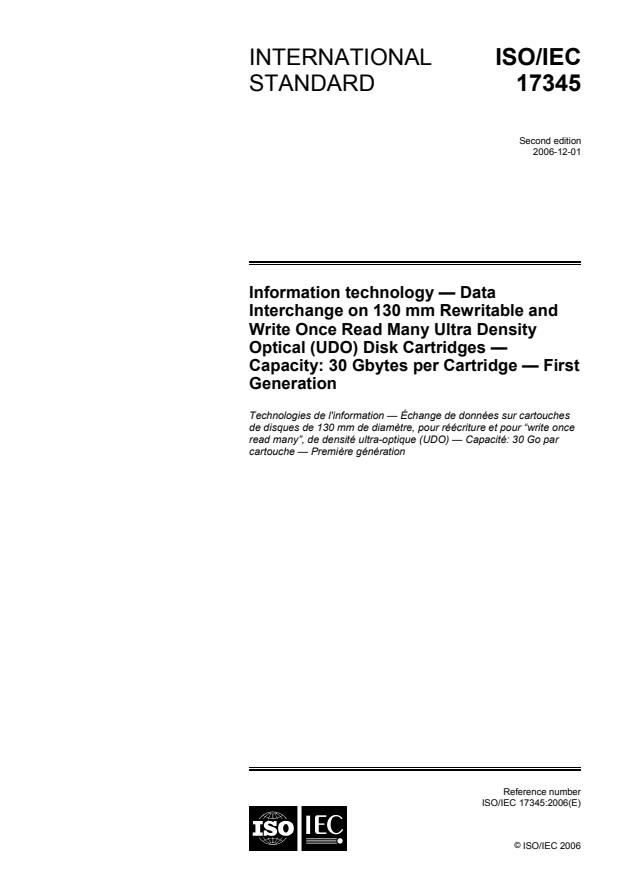
INTERNATIONAL ISO/IEC
STANDARD 17345
Second edition
2006-12-01
Information technology — Data
Interchange on 130 mm Rewritable and
Write Once Read Many Ultra Density
Optical (UDO) Disk Cartridges —
Capacity: 30 Gbytes per Cartridge — First
Generation
Technologies de l'information — Échange de données sur cartouches
de disques de 130 mm de diamètre, pour réécriture et pour “write once
read many”, de densité ultra-optique (UDO) — Capacité: 30 Go par
cartouche — Première génération
Reference number
©
ISO/IEC 2006
PDF disclaimer
This PDF file may contain embedded typefaces. In accordance with Adobe's licensing policy, this file may be printed or viewed but
shall not be edited unless the typefaces which are embedded are licensed to and installed on the computer performing the editing. In
downloading this file, parties accept therein the responsibility of not infringing Adobe's licensing policy. The ISO Central Secretariat
accepts no liability in this area.
Adobe is a trademark of Adobe Systems Incorporated.
Details of the software products used to create this PDF file can be found in the General Info relative to the file; the PDF-creation
parameters were optimized for printing. Every care has been taken to ensure that the file is suitable for use by ISO member bodies. In
the unlikely event that a problem relating to it is found, please inform the Central Secretariat at the address given below.
© ISO/IEC 2006
All rights reserved. Unless otherwise specified, no part of this publication may be reproduced or utilized in any form or by any means,
electronic or mechanical, including photocopying and microfilm, without permission in writing from either ISO at the address below or
ISO's member body in the country of the requester.
ISO copyright office
Case postale 56 • CH-1211 Geneva 20
Tel. + 41 22 749 01 11
Fax + 41 22 749 09 47
E-mail copyright@iso.org
Web www.iso.org
Published in Switzerland
ii © ISO/IEC 2006 – All rights reserved
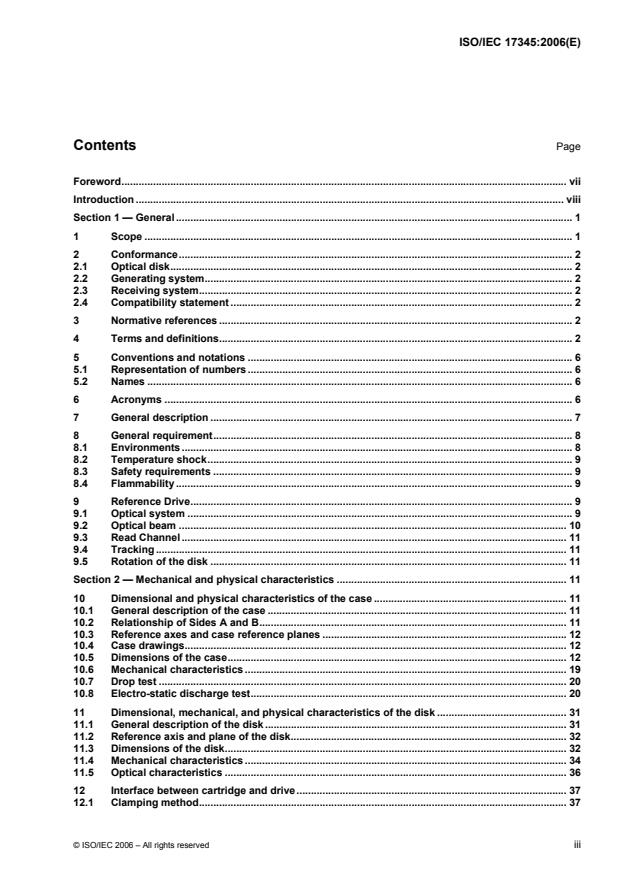
Contents Page
Foreword. vii
Introduction . viii
Section 1 — General. 1
1 Scope . 1
2 Conformance. 2
2.1 Optical disk. 2
2.2 Generating system. 2
2.3 Receiving system. 2
2.4 Compatibility statement . 2
3 Normative references . 2
4 Terms and definitions. 2
5 Conventions and notations . 6
5.1 Representation of numbers . 6
5.2 Names . 6
6 Acronyms . 6
7 General description . 7
8 General requirement. 8
8.1 Environments . 8
8.2 Temperature shock. 9
8.3 Safety requirements . 9
8.4 Flammability . 9
9 Reference Drive. 9
9.1 Optical system . 9
9.2 Optical beam . 10
9.3 Read Channel . 11
9.4 Tracking . 11
9.5 Rotation of the disk . 11
Section 2 — Mechanical and physical characteristics . 11
10 Dimensional and physical characteristics of the case . 11
10.1 General description of the case . 11
10.2 Relationship of Sides A and B. 11
10.3 Reference axes and case reference planes . 12
10.4 Case drawings. 12
10.5 Dimensions of the case. 12
10.6 Mechanical characteristics . 19
10.7 Drop test . 20
10.8 Electro-static discharge test. 20
11 Dimensional, mechanical, and physical characteristics of the disk . 31
11.1 General description of the disk . 31
11.2 Reference axis and plane of the disk. 32
11.3 Dimensions of the disk. 32
11.4 Mechanical characteristics . 34
11.5 Optical characteristics . 36
12 Interface between cartridge and drive. 37
12.1 Clamping method. 37
© ISO/IEC 2006 – All rights reserved iii
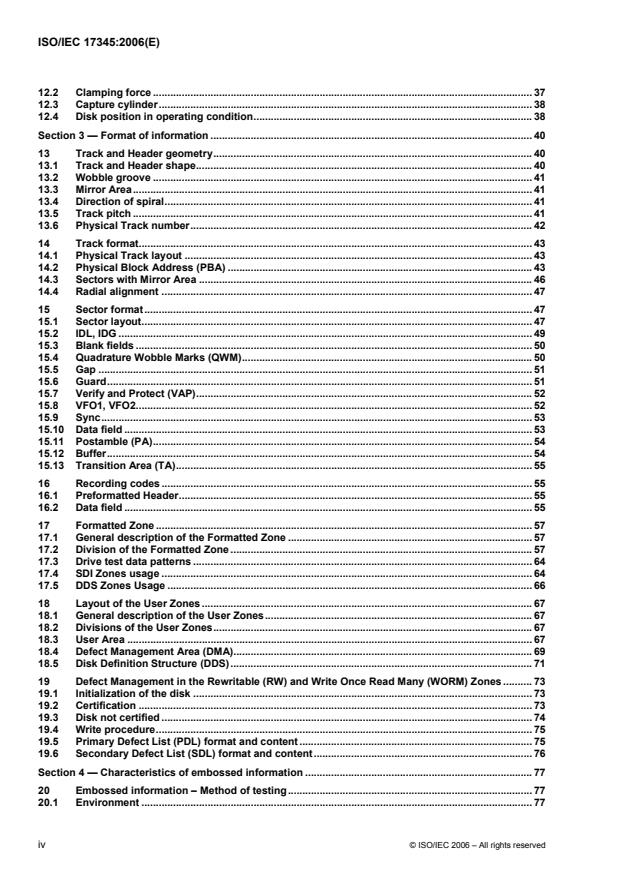
12.2 Clamping force . 37
12.3 Capture cylinder. 38
12.4 Disk position in operating condition. 38
Section 3 — Format of information . 40
13 Track and Header geometry. 40
13.1 Track and Header shape. 40
13.2 Wobble groove . 41
13.3 Mirror Area. 41
13.4 Direction of spiral. 41
13.5 Track pitch . 41
13.6 Physical Track number. 42
14 Track format. 43
14.1 Physical Track layout . 43
14.2 Physical Block Address (PBA) . 43
14.3 Sectors with Mirror Area . 46
14.4 Radial alignment . 47
15 Sector format. 47
15.1 Sector layout. 47
15.2 IDL, IDG . 49
15.3 Blank fields . 50
15.4 Quadrature Wobble Marks (QWM). 50
15.5 Gap . 51
15.6 Guard. 51
15.7 Verify and Protect (VAP). 52
15.8 VFO1, VFO2. 52
15.9 Sync. 53
15.10 Data field . 53
15.11 Postamble (PA). 54
15.12 Buffer. 54
15.13 Transition Area (TA). 55
16 Recording codes . 55
16.1 Preformatted Header. 55
16.2 Data field . 55
17 Formatted Zone . 57
17.1 General description of the Formatted Zone . 57
17.2 Division of the Formatted Zone . 57
17.3 Drive test data patterns . 64
17.4 SDI Zones usage . 64
17.5 DDS Zones Usage . 66
18 Layout of the User Zones . 67
18.1 General description of the User Zones. 67
18.2 Divisions of the User Zones. 67
18.3 User Area . 67
18.4 Defect Management Area (DMA). 69
18.5 Disk Definition Structure (DDS). 71
19 Defect Management in the Rewritable (RW) and Write Once Read Many (WORM) Zones . 73
19.1 Initialization of the disk . 73
19.2 Certification . 73
19.3 Disk not certified . 74
19.4 Write procedure. 75
19.5 Primary Defect List (PDL) format and content. 75
19.6 Secondary Defect List (SDL) format and content. 76
Section 4 — Characteristics of embossed information . 77
20 Embossed information – Method of testing. 77
20.1 Environment . 77
iv © ISO/IEC 2006 – All rights reserved
20.2 Use of the Reference Drive . 77
20.3 Definition of signals. 78
21 Signals from grooves and lands . 79
21.1 Ratio of groove to land signal . 79
21.2 Ratio of groove/land to Mirror Area signal. 79
21.3 Divided push-pull signal . 80
21.4 Wobble signal. 80
21.5 Phase depth. 81
21.6 Track location. 81
22 Signals from Headers. 81
22.1 Reference reflectance I . 81
top
22.2 Address Mark and ID signals. 81
22.3 QWM signals . 82
22.4 Timing mean and jitter. 83
Section 5 — Characteristics of the recording layer . 83
23 Method of testing. 83
23.1 Environment . 83
23.2 Reference Drive. 83
23.3 Write conditions. 84
23.4 Erase power for Type RW media. 86
23.5 Read power damage. 86
24 Phase Change characteristics. 86
24.1 Mark polarity. 86
24.2 Rewrite cycles for Type RW media . 86
25 Write characteristics. 86
25.1 Resolution . 86
25.2 Narrow-Band Signal-to-Noise Ratio (NBSNR) . 87
25.3 Cross-talk ratio. 88
25.4 Timing mean. 88
25.5 Timing jitter . 89
25.6 Asymmetry . 89
26 Erase power determination for Type RW media. 89
26.1 Cross-Erase for Type RW Media . 90
Section 6 — Characteristics of user data. 91
27 User Data – Method of testing . 91
27.1 Environment . 91
27.2 Reference Drive. 91
28 Minimum quality of a sector . 92
28.1 Headers ID . 92
28.2 User-written data. 93
28.3 Wobble signal. 93
29 Data interchange requirements. 93
29.1 Tracking . 93
29.2 User-written data. 93
29.3 Quality of disk . 93
Annex A (normative) Air cleanliness class 100 000 . 94
Annex B (normative) Edge distortion test . 96
Annex C (normative) Compliance test . 98
Annex D (normative) Cartridge electro-static discharge test. 101
Annex E (normative) Test method for measuring the adsorbent force of the hub . 102
Annex F (normative) CRC for ID fields. 104
© ISO/IEC 2006 – All rights reserved v
Annex G (normative) Data field scrambler implementation. 105
Annex H (normative) Interleave, CRC, ECC, Resync, and Reference for the Data field. 107
Annex I (normative) Drive Information Record (DIR) usage . 112
Annex J (normative) Determination of the Resync and Reference patterns. 114
Annex K (normative) Specific Disk Information. 116
Annex L (normative) Read Channel for measuring analog signals and jitter . 132
Annex M (normative) Timing mean and timing jitter measuring procedure. 133
Annex N (normative) Implementation Independent Mark Quality Determination (IIMQD) for the
interchange of recorded media. 134
Annex O (normative) Definition of the write pulse shape . 136
Annex P (normative) Asymmetry measuring definition . 137
Annex Q (normative) Enhanced Selective Inter-Symbol Interference Cancellation (ESISIC)
algorithm. 138
Annex R (normative) Requirements for interchange. 140
Annex S (informative) Office environment. 142
Annex T (informative) Derivation of the operating climatic environment. 143
Annex U (informative) Transportation . 148
Annex V (informative) Track deviation measurement. 149
Annex W (informative) Measurement of the vertical birefringence of the cover layer. 153
Annex X (informative) Quadrature Wobble offset control . 154
Annex Y (informative) Start Position Shift (SPS) implementation. 157
Annex Z (informative) Sector retirement guidelines . 158
Annex AA (informative) Guidelines for the use of Type WORM ODCs . 159
Annex BB (informative) Media type identification in existing and future standards. 160
Annex CC (informative) Laser power calibration for evaluation of media power parameters . 161
vi © ISO/IEC 2006 – All rights reserved
Foreword
ISO (the International Organization for Standardization) and IEC (the International Electrotechnical
Commission) form the specialized system for worldwide standardization. National bodies that are members of
ISO or IEC participate in the development of International Standards through technical committees
established by the respective organization to deal with particular fields of technical activity. ISO and IEC
technical committees collaborate in fields of mutual interest. Other international organizations, governmental
and non-governmental, in liaison with ISO and IEC, also take part in the work. In the field of information
technology, ISO and IEC have established a joint technical committee, ISO/IEC JTC 1.
International Standards are drafted in accordance with the rules given in the ISO/IEC Directives, Part 2.
The main task of the joint technical committee is to prepare International Standards. Draft International
Standards adopted by the joint technical committee are circulated to national bodies for voting. Publication as
an International Standard requires approval by at least 75 % of the national bodies casting a vote.
Attention is drawn to the possibility that some of the elements of this document may be the subject of patent
rights. ISO and IEC shall not be held responsible for identifying any or all such patent rights.
ISO/IEC 17345 was prepared by Ecma TC 31 (as ECMA-350) and was adopted, under a special “fast-track
procedure”, by Joint Technical Committee ISO/IEC JTC 1, Information technology, in parallel with its approval
by national bodies of ISO and IEC.
This second edition cancels and replaces the first edition (ISO/IEC 17345:2005), which has been technically
revised.
© ISO/IEC 2006 – All rights reserved vii
Introduction
Ecma Technical Committee TC 31 was established in 1984 for the standardization of Optical Disks and
Optical Disk Cartridges (ODC). Since its establishment, the Committee has made major contributions to
ISO/IEC JTC 1/SC 23 toward the development of International Standards for optical disks with a diameter of
80 mm, 90 mm, 120 mm, 130 mm, 300 mm and 356 mm. Numerous standards have been developed by
TC 31 and published by Ecma, almost all of which have also been adopted by ISO/IEC under the fast-track
procedure as International Standards. The following International Standards for 130 mm disks have been
published by Ecma and adopted by ISO/IEC JTC 1: ISO/IEC 11560:1992, ISO/IEC 13481:1993,
ISO/IEC 13549:1993, ISO/IEC 13842:1995, ISO/IEC 15486:1998, ISO/IEC 18093:1999, ISO/IEC 22092:2002.
This International Standard specifies two types of double-sided ODCs — Rewritable (Type RW) and Write
Once Read Many (Type WORM), both using thermo-optical Phase Change effects.
viii © ISO/IEC 2006 – All rights reserved
INTERNATIONAL STANDARD ISO/IEC 17345:2006(E)
Information technology — Data Interchange on 130 mm
Rewritable and Write Once Read Many Ultra Density Optical
(UDO) Disk Cartridges — Capacity: 30 Gbytes per Cartridge —
First Generation
Section 1 — General
1 Scope
This International Standard specifies the mechanical, physical, and optical characteristics of a 130 mm optical
disk cartridge (ODC) that employs thermo-optical Phase Change effects to enable data interchange between
such disks.
This International Standard specifies two types:
- Type RW (Rewritable) provides for data to be written read and erased many times over the recording
surfaces of the disk.
- Type WORM (Write Once Read Many) provides for data once written to be read a multiplicity of times.
This type uses a Write Once Read Many times recording material (written marks cannot be erased and
attempted modifications of the written marks are detectable). Multisession (incremental write operations)
recording may be performed on Type WORM disks.
The disk is two-sided with a nominal capacity of 15,0 Gbytes per side and the cartridge (two sides) provides a
nominal capacity of 30,0 Gbytes.
This International Standard specifies:
- the conditions for conformance testing and the Reference Drive;
- the environments in which the cartridges are to be operated and stored;
- the mechanical, physical and dimensional characteristics of the cartridge so as to provide mechanical
interchangeability between data processing systems;
- the format of the information on the disk, both embossed and user-written, including the physical
disposition of the tracks and sectors, the error correction codes, the modulation methods used;
- the characteristics of the embossed information on the disk;
- the thermo-optical characteristics of the disk, enabling processing systems to write data onto the disk;
and
- the minimum quality of user-written data on the disk, enabling data processing systems to read data from
the disk.
This International Standard provides for interchange between optical disk drives. Together with a standard for
volume and file structure, it provides for full data interchange between data processing systems.
© ISO/IEC 2006 – All rights reserved 1
2 Conformance
2.1 Optical disk
An ODC shall be in conformance with this International Standard if it meets all mandatory requirements
specified therein.
A claim of conformance with this International Standard shall specify the Type, RW, WORM, implemented.
2.2 Generating system
A claim of conformance with this International Standard shall specify which Type(s) is (are) supported. A
system generating an ODC for interchange shall be in conformance with this International Standard if it meets
the mandatory requirements of this International Standard for the Type(s) supported.
2.3 Receiving system
A claim of conformance with this International Standard shall specify which Type(s) is (are) supported.
A system receiving an ODC for interchange shall be in conformance with this International Standard if it is
able to process any recording made on the cartridge according to 2.1 on the Type(s) specified.
2.4 Compatibility statement
A claim of conformance with this International Standard shall include a statement listing any other Optical Disk
Cartridge Standard supported by the system for which conformance is claimed. This statement shall specify
the number of the Standard(s), including, where appropriate, the ODC Type(s), and whether support includes
reading only or both reading and writing.
3 Normative references
The following referenced documents are indispensable for the application of this document. For dated
references, only the edition cited applies. For undated references, the latest edition of the referenced
document (including any amendments) applies.
ECMA-287 (2002), Safety of electronic equipment
4 Terms and definitions
For the purposes of this document the following terms and definitions apply.
4.1
asymmetry
deviation between the centre levels of signals generated by two distinct repeating mark and space length
patterns
4.2
band
annular area on the disk having a constant clock frequency
4.3
case
housing for an optical disk that protects the disk and facilitates disk interchange
2 © ISO/IEC 2006 – All rights reserved
4.4
Case Reference Plane
plane defined for each side of the case, to which the dimensions of the case are referred
4.5
channel bit
elements by which, after modulation, the binary values ZERO and ONE are represented by marks and spaces
on the disk
4.6
clamping zone
annular part of the disk within which the clamping force is applied by the clamping device
4.7
cover layer
transparent layer of the disk through which the optical beam accesses the recording layer
4.8
Cyclic Redundancy Code
CRC
method for detecting errors in data
4.9
data field
subdivision of a sector intended for the recording of user data
4.10
Defect Management
method for handling the defective areas on the disk
4.11
Disk Reference Plane
plane defined by the perfectly flat annular surface of an ideal spindle onto which the clamping zone of the disk
is clamped, and which is normal to the axis of rotation
4.12
entrance surface
surface of the disk onto which the optical beam first impinges
4.13
Error Correction Code
ECC
error-detecting code designed to correct certain kinds of errors in data
4.14
field
subdivision of a sector
4.15
format
arrangement or layout of information on the disk
NOTE The annular area on the disk bearing the format is the formatted zone.
4.16
hub
central feature on the disk, which interacts with the spindle of the disk drive to provide radial centring and the
clamping force
© ISO/IEC 2006 – All rights reserved 3
4.17
interleaving
process of allocating the physical sequence of units of data so as to render the data more immune to burst
errors
4.18
land and groove
trench-like feature of the disk, applied before the recording of any information, and used to define the track
location
NOTE The land is located nearer to the entrance surface than the groove with which it is paired to form a Physical
Track. Recording is performed on both the land and groove.
4.19
mark
feature of the recording layer which takes the form of a pit, change in the reflectivity, or any other type or form
that can be sensed by the optical system
NOTE The pattern of marks represents the data on the disk.
4.20
Mirror Area
area in which there is no embossed information, neither preformatted headers or grooves
4.21
optical disk
disk that will accept and retain information in the form of marks in a recording layer, that can be read with an
optical beam
4.22
optical disk cartridge
ODC
device consisting of a case containing an optical disk
4.23
Phase Change
physical effect by which the area of a recording layer irradiated by a laser beam is heated so as to change
from an amorphous state to a crystalline state and vice versa
4.24
Physical Block Address
PBA
numbering system of the data sectors defined to constitute a uniquely addressable sector location to the
recording system
4.25
Physical Track
one revolution (360°) of adjacent groove-land pair
4.26
read power
optical power, incident at the entrance surface of the disk, used when reading
4.27
recording layer
layer of the disk on, or in, which data is written during manufacture and/or use
NOTE The recording layer may actually consist of a multiple layer stack of different materials or composite materials.
4 © ISO/IEC 2006 – All rights reserved
4.28
Recording Track
one revolution (360°) of either a land feature or groove feature of the disk (Land Recording Track or Groove
Recording Track) where recording may be performed
4.29
Reed-Solomon code
error detection and/or correction code which is particularly suited to the correction of errors which occur in
bursts or are strongly correlated
4.30
sector
smallest addressable part of a track in the formatted area of the disk
4.31
space
area between marks along the track
4.32
spindle
part of the disk drive which contacts the disk and/or hub
4.33
substrate
layer of the disk provided for mechanical support of the recording layer
4.34
track
path which is followed by the focus of the optical beam during exactly one revolution of the disk
4.35
track pitch
distance between Land Recording Track centrelines and adjacent Groove Recording Track centrelines,
measured in the radial direction
4.36
User Area
area of the disk intended for the recording of user data
4.37
wobble
periodic radial deviation of the track (groove or land) from the average centreline that is used as a
supplemental timing signal
4.38
write-inhibit hole
hole in the case which, when detected by the drive to be open, inhibits write operations
4.39
zone
annular area of the disk
© ISO/IEC 2006 – All rights reserved 5
5 Conventions and notations
5.1 Representation of numbers
A measured value is rounded off to the least significant digit of the corresponding specified value. For instance,
it implies that a specified value of 1,26 with a positive tolerance of + 0,01 and a negative tolerance of - 0,02
allows a range of measured values from 1,235 to 1,275.
Numbers in decimal notations are represented by the digits 0 to 9.
Numbers in hexadecimal notation are represented by the hexadecimal digits 0 to 9 and A to F in parentheses.
The setting of bits is denoted by ZERO and ONE.
Numbers in binary notations and bit patterns are represented by strings of digits 0 and 1, with the most
significant bit shown to the left.
Negative values of numbers in binary notation are given as Two’s complement.
In each field the data is recorded so that the most significant byte (MSB), identified as Byte 0, is recorded first
and the least significant byte (LSB) last. In a field of 8n bits, bit b shall be the most significant bit (msb)
(8n-1)
and bit b the least significant bit (lsb). Bit b is recorded first.
0 (8n-1)
A binary digit which can be set indifferently to ZERO or to ONE is represented by “x”.
5.2 Names
The names of entities, e.g. specific tracks, fields, areas, zones, etc. are given a capital initial.
6 Acronyms
AM Address Mark
CRC Cyclic Redundancy Code
DDS Disk Definition Structure
DIR Drive Information Record
DMA Defect Management Area
ECC Error Correction Code
ESISIC Enhanced Selective Inter-Symbol Interference Cancellation
ID Identifier
LBA Logical Block Address
LSB Least Significant Byte
lsb least significant bit
MSB Most Significant Byte
msb most significant bit
NA Numerical Aperture
NBSNR Narrow-Band Signal-to-Noise Ratio
NRZ Non Return to Zero
ODC Optical Disk Cartridge
6 © ISO/IEC 2006 – All rights reserved
PA Postamble
PBA Physical Block Address
PDL Primary Defect List
PLL Phase Locked Loop
PSA Primary Spares Area
QWM Quadrature Wobble Marks
QWMG Quadrature Wobble Marks on Groove
QWML Quadrature Wobble Marks on Land
RESYNC Re-synchronization
RFO Read Focus Offset
RLL Run-Length Limited (code)
RW Rewritable
SCSI Small Computer System Interface
SDI Specific Disk Information
SDL Secondary Defect List
SPS Start Position Shift
SSA Secondary Spares Area
STOB Six Time Oversampled Bi-Phase
SYNC Synchronization
TA Transition Area
TIA Time Interval Analyzer
UDO Ultra Density Optical (disk)
VAP Verify and Protect
VFO Variable Frequency Oscillator
WORM Write Once Read Many
ZCAV Zoned Constant Angular Velocity
7 General description
The optical disk cartridge, which is the subject of this International Standard, consists of a case containing an
optical disk.
The case is a protective enclosure for the disk. It has access windows covered by two shutters. One of the
windows is automatically uncovered by the drive when the cartridge is inserted into it.
The optical disk is made from two sides that are assembled together. Each side consists of a Phase Change
recording layer placed between the substrate and the cover layer. The substrates of each side are bonded
together.
The optical disk is recordable on both sides. Data can be written onto the disk as marks with Phase Change
characteristics variations in the recording layer, using a focused optical beam. Data can be read by the optical
beam using the change in reflectivity and diffraction between mark and space in the recording layer. The
beam accesses the recording layer through the transparent cover layer of the disk.
Part of the disk contains read-only data in the form of pre-embossed pits. This data can be read using the
diffraction of the optical beam by the embossed pits.
© ISO/IEC 2006 – All rights reserved 7
8 Gen
...