


ISO/IEC 17345:2005
(Main)Information technology — Data interchange on 130 mm rewritable and write once read many ultra density optical (UDO) disk cartridges — Capacity: 30 Gbytes per cartridge (first generation)
Information technology — Data interchange on 130 mm rewritable and write once read many ultra density optical (UDO) disk cartridges — Capacity: 30 Gbytes per cartridge (first generation)
ISO/IEC 17345:2005 specifies the mechanical, physical and optical characteristics of a 130 mm optical disk cartridge (ODC) that employs thermo-optical Phase Change effects to enable data interchange between such disks. ISO/IEC 17345:2005 specifies two types: Type RW (rewritable) provides for data to be written read and erased many times over the recording surfaces of the disk. Type WORM (write once read many) provides for data once written to be read many times. This type uses a write once read many times recording material. (Written marks cannot be erased and attempted modifications of the written marks are detectable.) Multisession (incremental write operations) recording may be performed on type WORM disks. The disk is two-sided with a nominal capacity of 15,0 GB per side and the cartridge (two sides) provides a nominal capacity of 30,0 GB. ISO/IEC 17345:2005 specifies: the conditions for conformance testing and the Reference Drive; the environments in which the cartridges are to be operated and stored; the mechanical, physical and dimensional characteristics of the cartridge so as to provide mechanical interchangeability between data processing systems; the format of the information on the disk, both embossed and user-written, including the physical disposition of the tracks and sectors, the error correction codes and the modulation methods used; the characteristics of the embossed information on the disk; the thermo-optical characteristics of the disk, enabling processing systems to write data onto the disk; and the minimum quality of user-written data on the disk, enabling data processing systems to read data from the disk. ISO/IEC 17345:2005 provides for interchange between optical disk drives. Together with a standard for volume and file structure, it provides for full data interchange between data processing systems.
Technologies de l'information — Échange de données sur cartouches de disques de 130 mmde diamètre, de densité ultra-optique (UDO), pour réécriture et pour <<write once read many>> — Capacité: 30 Go par cartouche (première génération)
General Information
- Status
- Withdrawn
- Publication Date
- 01-Feb-2005
- Withdrawal Date
- 01-Feb-2005
- Current Stage
- 9599 - Withdrawal of International Standard
- Start Date
- 28-Nov-2006
- Completion Date
- 14-Feb-2026
Relations
- Effective Date
- 15-Apr-2008
Get Certified
Connect with accredited certification bodies for this standard

BSI Group
BSI (British Standards Institution) is the business standards company that helps organizations make excellence a habit.

NYCE
Mexican standards and certification body.
Sponsored listings
Frequently Asked Questions
ISO/IEC 17345:2005 is a standard published by the International Organization for Standardization (ISO). Its full title is "Information technology — Data interchange on 130 mm rewritable and write once read many ultra density optical (UDO) disk cartridges — Capacity: 30 Gbytes per cartridge (first generation)". This standard covers: ISO/IEC 17345:2005 specifies the mechanical, physical and optical characteristics of a 130 mm optical disk cartridge (ODC) that employs thermo-optical Phase Change effects to enable data interchange between such disks. ISO/IEC 17345:2005 specifies two types: Type RW (rewritable) provides for data to be written read and erased many times over the recording surfaces of the disk. Type WORM (write once read many) provides for data once written to be read many times. This type uses a write once read many times recording material. (Written marks cannot be erased and attempted modifications of the written marks are detectable.) Multisession (incremental write operations) recording may be performed on type WORM disks. The disk is two-sided with a nominal capacity of 15,0 GB per side and the cartridge (two sides) provides a nominal capacity of 30,0 GB. ISO/IEC 17345:2005 specifies: the conditions for conformance testing and the Reference Drive; the environments in which the cartridges are to be operated and stored; the mechanical, physical and dimensional characteristics of the cartridge so as to provide mechanical interchangeability between data processing systems; the format of the information on the disk, both embossed and user-written, including the physical disposition of the tracks and sectors, the error correction codes and the modulation methods used; the characteristics of the embossed information on the disk; the thermo-optical characteristics of the disk, enabling processing systems to write data onto the disk; and the minimum quality of user-written data on the disk, enabling data processing systems to read data from the disk. ISO/IEC 17345:2005 provides for interchange between optical disk drives. Together with a standard for volume and file structure, it provides for full data interchange between data processing systems.
ISO/IEC 17345:2005 specifies the mechanical, physical and optical characteristics of a 130 mm optical disk cartridge (ODC) that employs thermo-optical Phase Change effects to enable data interchange between such disks. ISO/IEC 17345:2005 specifies two types: Type RW (rewritable) provides for data to be written read and erased many times over the recording surfaces of the disk. Type WORM (write once read many) provides for data once written to be read many times. This type uses a write once read many times recording material. (Written marks cannot be erased and attempted modifications of the written marks are detectable.) Multisession (incremental write operations) recording may be performed on type WORM disks. The disk is two-sided with a nominal capacity of 15,0 GB per side and the cartridge (two sides) provides a nominal capacity of 30,0 GB. ISO/IEC 17345:2005 specifies: the conditions for conformance testing and the Reference Drive; the environments in which the cartridges are to be operated and stored; the mechanical, physical and dimensional characteristics of the cartridge so as to provide mechanical interchangeability between data processing systems; the format of the information on the disk, both embossed and user-written, including the physical disposition of the tracks and sectors, the error correction codes and the modulation methods used; the characteristics of the embossed information on the disk; the thermo-optical characteristics of the disk, enabling processing systems to write data onto the disk; and the minimum quality of user-written data on the disk, enabling data processing systems to read data from the disk. ISO/IEC 17345:2005 provides for interchange between optical disk drives. Together with a standard for volume and file structure, it provides for full data interchange between data processing systems.
ISO/IEC 17345:2005 is classified under the following ICS (International Classification for Standards) categories: 35.220.30 - Optical storage devices. The ICS classification helps identify the subject area and facilitates finding related standards.
ISO/IEC 17345:2005 has the following relationships with other standards: It is inter standard links to ISO/IEC 17345:2006. Understanding these relationships helps ensure you are using the most current and applicable version of the standard.
ISO/IEC 17345:2005 is available in PDF format for immediate download after purchase. The document can be added to your cart and obtained through the secure checkout process. Digital delivery ensures instant access to the complete standard document.
Standards Content (Sample)
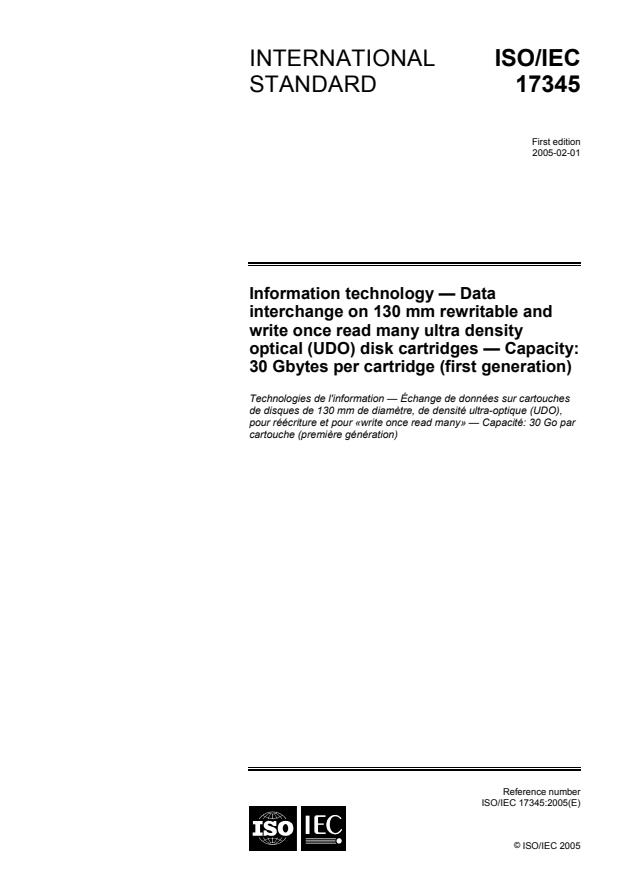
INTERNATIONAL ISO/IEC
STANDARD 17345
First edition
2005-02-01
Information technology — Data
interchange on 130 mm rewritable and
write once read many ultra density
optical (UDO) disk cartridges — Capacity:
30 Gbytes per cartridge (first generation)
Technologies de l'information — Échange de données sur cartouches
de disques de 130 mm de diamètre, de densité ultra-optique (UDO),
pour réécriture et pour «write once read many» — Capacité: 30 Go par
cartouche (première génération)
Reference number
©
ISO/IEC 2005
PDF disclaimer
This PDF file may contain embedded typefaces. In accordance with Adobe's licensing policy, this file may be printed or viewed but
shall not be edited unless the typefaces which are embedded are licensed to and installed on the computer performing the editing. In
downloading this file, parties accept therein the responsibility of not infringing Adobe's licensing policy. The ISO Central Secretariat
accepts no liability in this area.
Adobe is a trademark of Adobe Systems Incorporated.
Details of the software products used to create this PDF file can be found in the General Info relative to the file; the PDF-creation
parameters were optimized for printing. Every care has been taken to ensure that the file is suitable for use by ISO member bodies. In
the unlikely event that a problem relating to it is found, please inform the Central Secretariat at the address given below.
© ISO/IEC 2005
All rights reserved. Unless otherwise specified, no part of this publication may be reproduced or utilized in any form or by any means,
electronic or mechanical, including photocopying and microfilm, without permission in writing from either ISO at the address below or
ISO's member body in the country of the requester.
ISO copyright office
Case postale 56 • CH-1211 Geneva 20
Tel. + 41 22 749 01 11
Fax + 41 22 749 09 47
E-mail copyright@iso.org
Web www.iso.org
Published in Switzerland
ii © ISO/IEC 2005 — All rights reserved
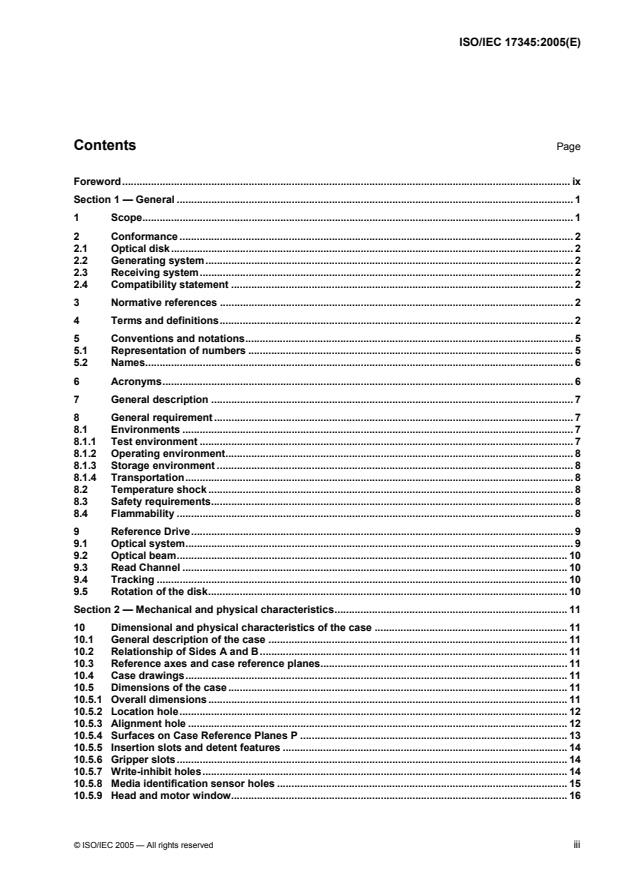
Contents Page
Foreword. ix
Section 1 — General . 1
1 Scope. 1
2 Conformance . 2
2.1 Optical disk. 2
2.2 Generating system. 2
2.3 Receiving system. 2
2.4 Compatibility statement . 2
3 Normative references . 2
4 Terms and definitions. 2
5 Conventions and notations. 5
5.1 Representation of numbers . 5
5.2 Names. 6
6 Acronyms. 6
7 General description . 7
8 General requirement . 7
8.1 Environments . 7
8.1.1 Test environment . 7
8.1.2 Operating environment. 8
8.1.3 Storage environment . 8
8.1.4 Transportation. 8
8.2 Temperature shock . 8
8.3 Safety requirements. 8
8.4 Flammability . 8
9 Reference Drive. 9
9.1 Optical system. 9
9.2 Optical beam. 10
9.3 Read Channel . 10
9.4 Tracking . 10
9.5 Rotation of the disk. 10
Section 2 — Mechanical and physical characteristics. 11
10 Dimensional and physical characteristics of the case . 11
10.1 General description of the case . 11
10.2 Relationship of Sides A and B. 11
10.3 Reference axes and case reference planes. 11
10.4 Case drawings. 11
10.5 Dimensions of the case. 11
10.5.1 Overall dimensions . 11
10.5.2 Location hole. 12
10.5.3 Alignment hole . 12
10.5.4 Surfaces on Case Reference Planes P .13
10.5.5 Insertion slots and detent features . 14
10.5.6 Gripper slots. 14
10.5.7 Write-inhibit holes. 14
10.5.8 Media identification sensor holes . 15
10.5.9 Head and motor window. 16
© ISO/IEC 2005 — All rights reserved iii
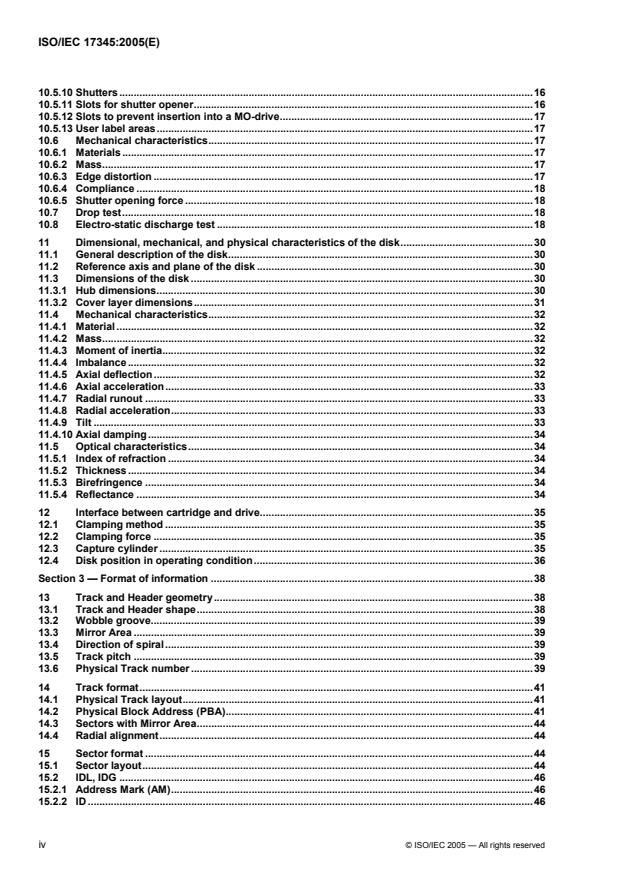
10.5.10 Shutters .16
10.5.11 Slots for shutter opener.16
10.5.12 Slots to prevent insertion into a MO-drive.17
10.5.13 User label areas.17
10.6 Mechanical characteristics.17
10.6.1 Materials .17
10.6.2 Mass.17
10.6.3 Edge distortion .17
10.6.4 Compliance .18
10.6.5 Shutter opening force .18
10.7 Drop test.18
10.8 Electro-static discharge test .18
11 Dimensional, mechanical, and physical characteristics of the disk.30
11.1 General description of the disk.30
11.2 Reference axis and plane of the disk .30
11.3 Dimensions of the disk .30
11.3.1 Hub dimensions.30
11.3.2 Cover layer dimensions.31
11.4 Mechanical characteristics.32
11.4.1 Material .32
11.4.2 Mass.32
11.4.3 Moment of inertia.32
11.4.4 Imbalance .32
11.4.5 Axial deflection.32
11.4.6 Axial acceleration.33
11.4.7 Radial runout .33
11.4.8 Radial acceleration.33
11.4.9 Tilt .33
11.4.10 Axial damping.34
11.5 Optical characteristics.34
11.5.1 Index of refraction .34
11.5.2 Thickness .34
11.5.3 Birefringence .34
11.5.4 Reflectance .34
12 Interface between cartridge and drive.35
12.1 Clamping method .35
12.2 Clamping force .35
12.3 Capture cylinder .35
12.4 Disk position in operating condition.36
Section 3 — Format of information .38
13 Track and Header geometry.38
13.1 Track and Header shape.38
13.2 Wobble groove.39
13.3 Mirror Area .39
13.4 Direction of spiral.39
13.5 Track pitch .39
13.6 Physical Track number .39
14 Track format.41
14.1 Physical Track layout.41
14.2 Physical Block Address (PBA).41
14.3 Sectors with Mirror Area.44
14.4 Radial alignment.44
15 Sector format .44
15.1 Sector layout.44
15.2 IDL, IDG .46
15.2.1 Address Mark (AM).46
15.2.2 ID .46
iv © ISO/IEC 2005 — All rights reserved
15.3 Blank field . 47
15.4 Quadrature Wobble Marks (QWM). 47
15.5 Gap . 47
15.6 Guard. 48
15.7 Verify and Protect (VAP). 48
15.8 VFO1, VFO2 . 49
15.9 Sync. 49
15.10 Data field . 49
15.10.1 User data bytes . 50
15.10.2 CRC and ECC bytes . 50
15.10.3 Control bytes . 50
15.10.4 Resync bytes . 50
15.10.5 Reference byte . 50
15.11 Postamble (PA). 50
15.12 Buffer. 50
15.13 Transition Area (TA). 50
16 Recording codes . 51
16.1 Preformatted Header. 51
16.2 Data field . 51
17 Formatted Zone . 52
17.1 General description of the Formatted Zone . 52
17.2 Division of the Formatted Zone . 52
17.2.1 Lead-in Zone. 56
17.2.2 Read Focus Offset (RFO) Zones. 56
17.2.3 Read Reference Zones . 56
17.2.4 Manufacturer Zones. 57
17.2.5 SDI Zones. 57
17.2.6 DDS Zones . 57
17.2.7 PDL3 Zone. 58
17.2.8 Write Power Calibration Zone. 58
17.2.9 User Zones. 58
17.2.10 Lead-out Zone . 58
17.3 Drive test data patterns . 58
17.4 SDI Zones usage . 59
17.4.1 SDI amendment . 59
17.4.2 LBA Control bytes in SDI sectors . 60
17.4.3 Parametric conditions . 60
17.4.4 Specific Disk Information. 60
17.5 DDS Zones Usage . 60
17.5.1 DDS Amendment. 61
17.5.2 LBA Control bytes in DDS sectors. 62
17.5.3 DDS information. 62
18 Layout of the User Zones. 62
18.1 General description of the User Zones. 62
18.2 Divisions of the User Zones. 62
18.3 User Area . 62
18.4 Defect Management Area (DMA) . 65
18.4.1 Primary Defect List (PDL) Areas. 65
18.4.2 Secondary Defect List (SDL) Area. 65
18.4.3 SDL Duplicate Pages (SDLDP) Area . 65
18.4.4 Primary Spares Area (PSA). 65
18.4.5 Secondary Spares Area (SSA). 66
18.5 Disk Definition Structure (DDS). 66
19 Defect Management in the Rewritable (RW) and Write Once Read Many (WORM) Zones . 68
19.1 Initialization of the disk . 68
19.2 Certification . 68
19.2.1 Slipping Algorithm. 68
19.2.2 Linear Replacement Algorithm. 69
© ISO/IEC 2005 — All rights reserved v
19.3 Disk not certified .69
19.4 Write procedure.69
19.5 Primary Defect List (PDL) format and content .70
19.6 Secondary Defect List (SDL) format and content .71
Section 4 — Characteristics of embossed information.73
20 Embossed information — Method of testing.73
20.1 Environment.73
20.2 Use of the Reference Drive.73
20.2.1 Optics and mechanics .73
20.2.2 Read power .73
20.2.3 Read Channel.73
20.2.4 Tracking.73
20.2.5 Axial focus offset optimization .73
20.3 Definition of signals .73
21 Signals from grooves and lands.75
21.1 Ratio of groove to land signal.75
21.2 Ratio of groove/land to Mirror Area signal .75
21.3 Push-pull signal.75
21.4 Divided push-pull signal.75
21.5 Wobble signal .75
21.6 Phase depth .76
21.7 Track location .76
22 Signals from Headers .76
22.1 Reference reflectance I .76
top
22.2 Address Mark and ID signals .77
22.3 QWM signals.77
22.4 Timing mean and jitter .77
Section 5 — Characteristics of the recording layer.78
23 Method of testing.78
23.1 Environment.78
23.2 Reference Drive .78
23.2.1 Optics and mechanics .78
23.2.2 Read power .78
23.2.3 Read Channel.78
23.2.4 Tracking.78
23.2.5 Signal detection for testing purposes.78
23.3 Write conditions .79
23.3.1 Write pulse and power waveform .79
23.3.2 Write pulse power.79
23.3.3 Write pulse timing .79
23.3.4 Write pulse power and pulse timing determination.79
23.4 Erase power for Type RW media .80
23.5 Read power damage.80
24 Phase Change characteristics .80
24.1 Mark polarity .80
24.2 Rewrite cycles for Type RW media.80
25 Write characteristics .81
25.1 Resolution .81
25.2 Narrow-Band Signal-to-Noise Ratio (NBSNR) .81
25.3 Cross-talk ratio .82
25.4 Timing mean .82
25.4.1 Timing mean for 2T marks and spaces.82
25.4.2 Timing mean for 3T to 9T marks and spaces .82
25.5 Timing jitter.82
25.5.1 Timing jitter for 2T marks and spaces.83
25.5.2 Timing jitter for 3T to 9T marks and spaces.83
vi © ISO/IEC 2005 — All rights reserved
25.6 Asymmetry. 83
25.6.1 Asymmetry (3T-2T). 83
25.6.2 Asymmetry (9T-3T). 83
26 Erase power determination for Type RW media . 83
26.1 Cross-Erase for Type RW Media . 83
Section 6 — Characteristics of user data . 85
27 User Data – Method of testing . 85
27.1 Environment . 85
27.2 Reference Drive. 85
27.2.1 Optics and mechanics. 85
27.2.2 Read power. 85
27.2.3 Read Channel . 85
27.2.4 Mark quality . 85
27.2.5 Channel bit clock . 86
27.2.6 Binary-to-digital converters . 86
27.2.7 Error correction. 86
27.2.8 Tracking . 86
28 Minimum quality of a sector. 86
28.1 Headers ID. 86
28.2 User-written data. 86
28.2.1 Recording field . 86
28.2.2 Byte errors . 87
28.2.3 Timing mean . 87
28.2.4 Timing jitter. 87
28.2.5 Asymmetry. 87
28.3 Wobble signal. 87
29 Data interchange requirements . 87
29.1 Tracking . 87
29.2 User-written data. 87
29.3 Quality of disk . 87
Annex A (normative) Air cleanliness class 100 000. 88
Annex B (normative) Edge distortion test . 90
Annex C (normative) Compliance test . 92
Annex D (normative) Cartridge electro-static discharge test . 95
Annex E (normative) Test method for measuring the adsorbent force of the hub. 96
Annex F (normative) CRC for ID fields . 98
Annex G (normative) Data field scrambler implementation. 99
Annex H (normative) Interleave, CRC, ECC, Resync, and Reference for the Data field. 101
Annex I (normative) Drive Information Record (DIR) usage . 106
Annex J (normative) Determination of the Resync and Reference patterns. 108
Annex K (normative) Specific Disk Information. 110
Annex L (normative) Read Channel for measuring analog signals and jitter . 123
Annex M (normative) Timing mean and timing jitter measuring procedure . 124
Annex N (normative) Implementation Independent Mark Quality Determination (IIMQD) for the
interchange of recorded media . 125
Annex O (normative) Definition of the write pulse shape . 127
Annex P (normative) Asymmetry measuring definition . 128
© ISO/IEC 2005 — All rights reserved vii
Annex Q (normative) Enhanced Selective Inter-Symbol Interference Cancellation (ESISIC)
algorithm .129
Annex R (normative) Requirements for interchange .131
Annex S (informative) Office environment .133
Annex T (informative) Derivation of the operating climatic environment .134
Annex U (informative) Transportation .139
Annex V (informative) Track deviation measurement.140
Annex W (informative) Measurement of the vertical birefringence of the cover layer .144
Annex X (informative) Quadrature Wobble offset control .145
Annex Y (informative) Start Position Shift (SPS) implementation .148
Annex Z (informative) Sector retirement guidelines .149
Annex AA (informative) Guidelines for the use of Type WORM ODCs .150
Annex BB (informative) Media type identification in existing and future standards .151
Annex CC (informative) Laser power calibration for evaluation of media power parameters.152
viii © ISO/IEC 2005 — All rights reserved
Foreword
ISO (the International Organization for Standardization) and IEC (the International Electrotechnical
Commission) form the specialized system for worldwide standardization. National bodies that are members of
ISO or IEC participa
...
Questions, Comments and Discussion
Ask us and Technical Secretary will try to provide an answer. You can facilitate discussion about the standard in here.
Loading comments...