

ISO 3073:1975
(Main)Wool — Determination of acid content
General Information
- Abstract
The method is applicable to undyed wool in any form, for example loose fibre, sliver, yarn or fabric. It is also applicable to dyed wool when the amount of dye extracted during the test does not interfere with the determination of the end-point of the titration. The determined value is expressed as a percentage by mass.
- Status
- Published
- Publication Date
- 30-Nov-1975
- Technical Committee
- ISO/TC 38/SC 23 - Fibres and yarns
- Drafting Committee
- ISO/TC 38/SC 23 - Fibres and yarns
- Current Stage
- 9093 - International Standard confirmed
- Start Date
- 06-May-2025
- Completion Date
- 29-Aug-2026
Buy Documents

ISO 3073:1975 - Wool -- Determination of acid content
ISO 3073:1975 - Wool — Determination of acid content/1/1975
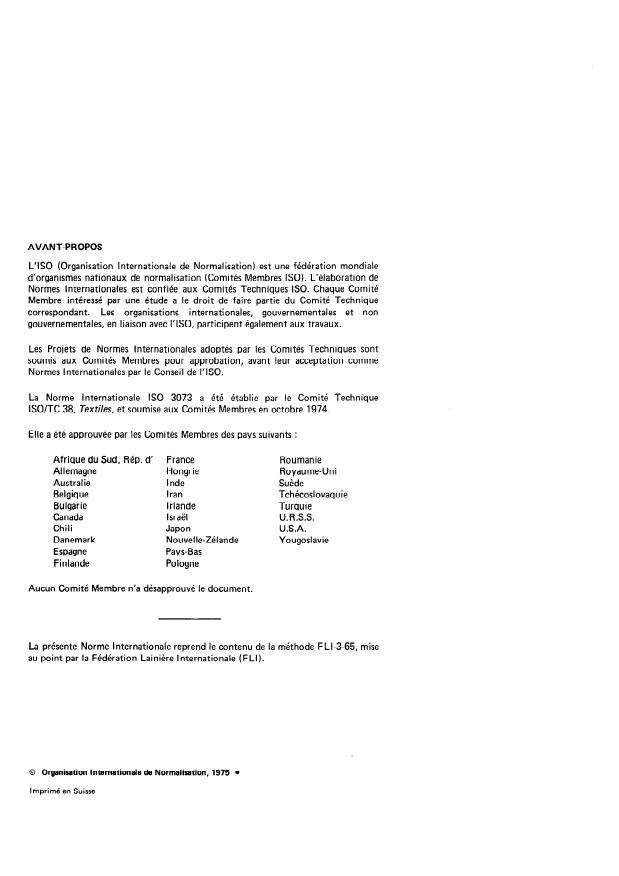


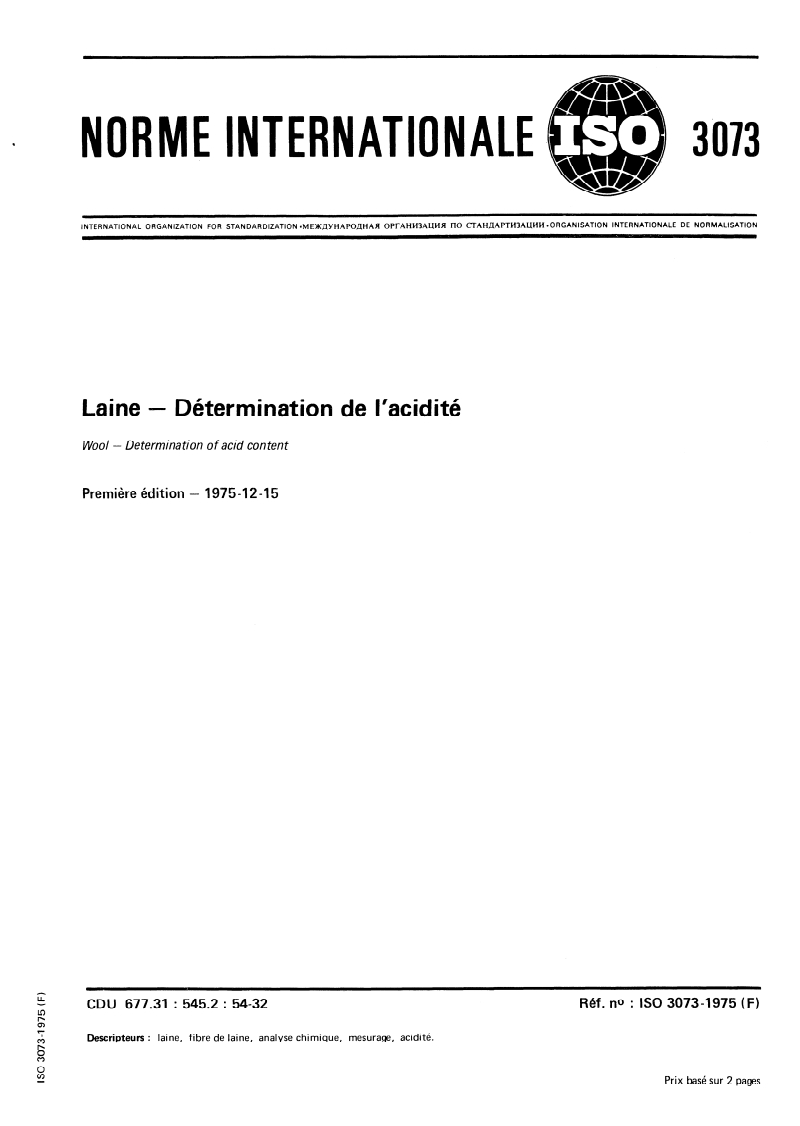
ISO 3073:1975 - Laine -- Détermination de l'acidité
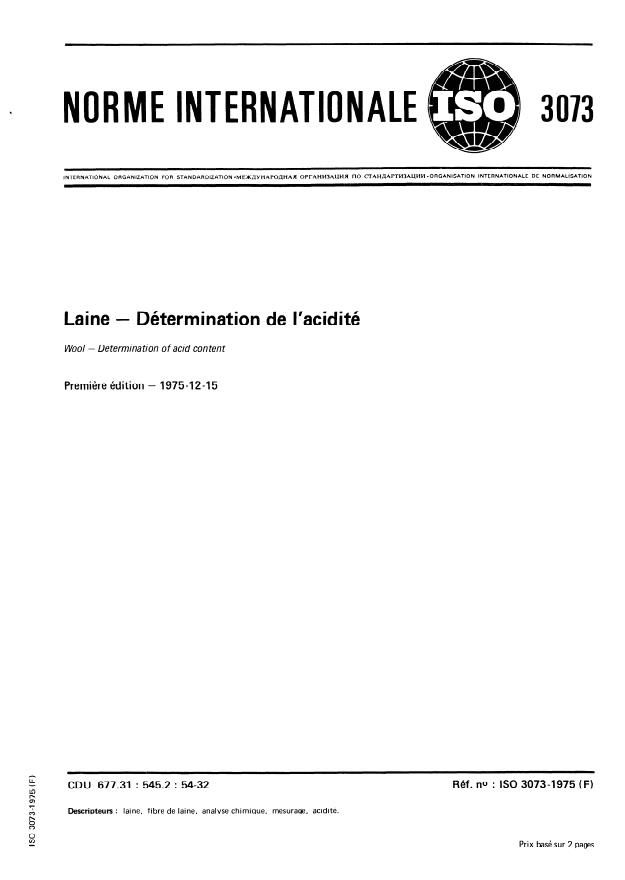
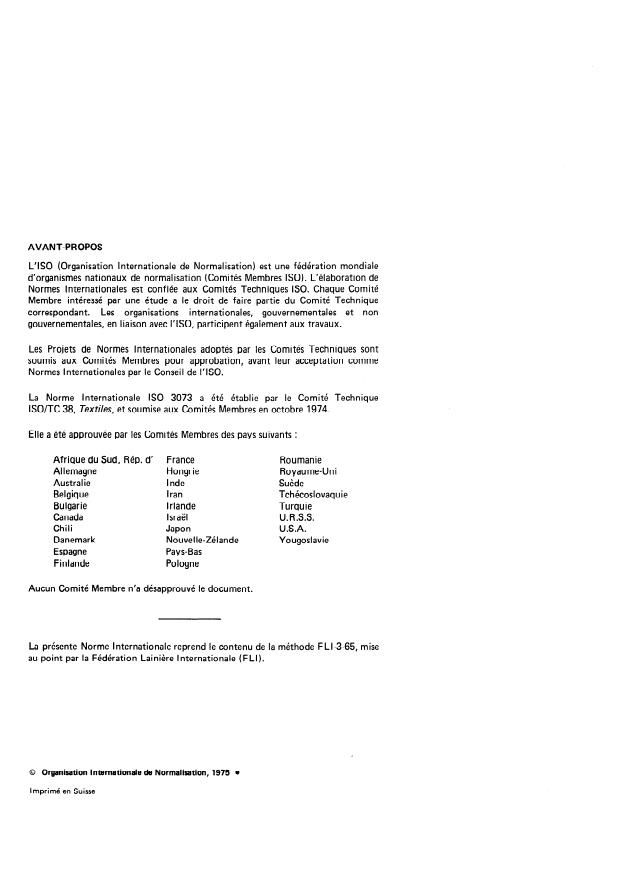
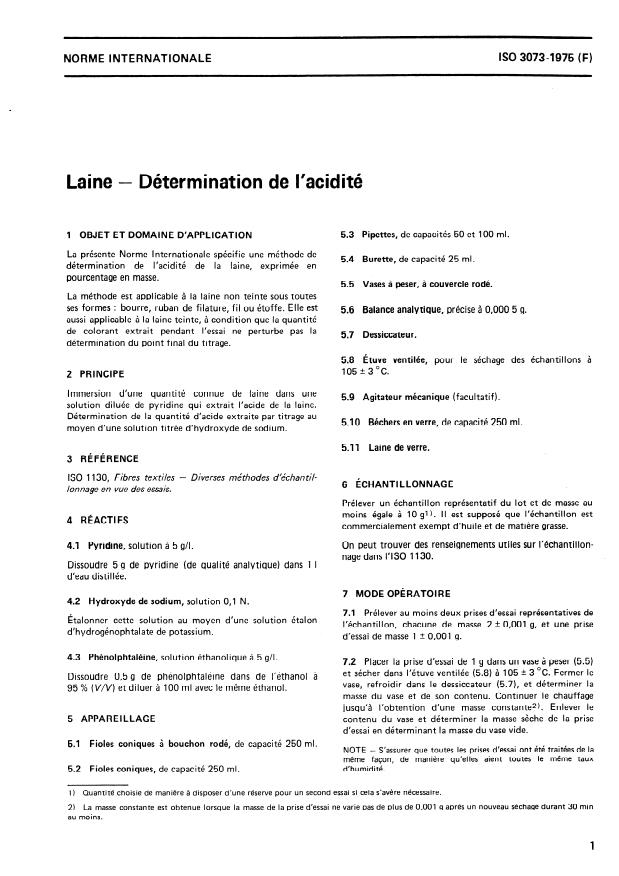

ISO 3073:1975 - Laine -- Détermination de l'acidité
ISO 3073:1975 - Laine — Détermination de l'acidité/1/1975
ISO 3073:1975 - Laine — Détermination de l'acidité/1/1975
Overview
ISO 3073:1975 - Wool - Determination of acid content specifies a chemical test method to quantify the acid content of wool. The method is applicable to undyed wool in any form (loose fibre, sliver, yarn or fabric) and may be used for dyed wool provided that dye extracted during the test does not interfere with titration end‑point detection. Results are reported as a percentage by mass of the dry sample.
Key topics and technical requirements
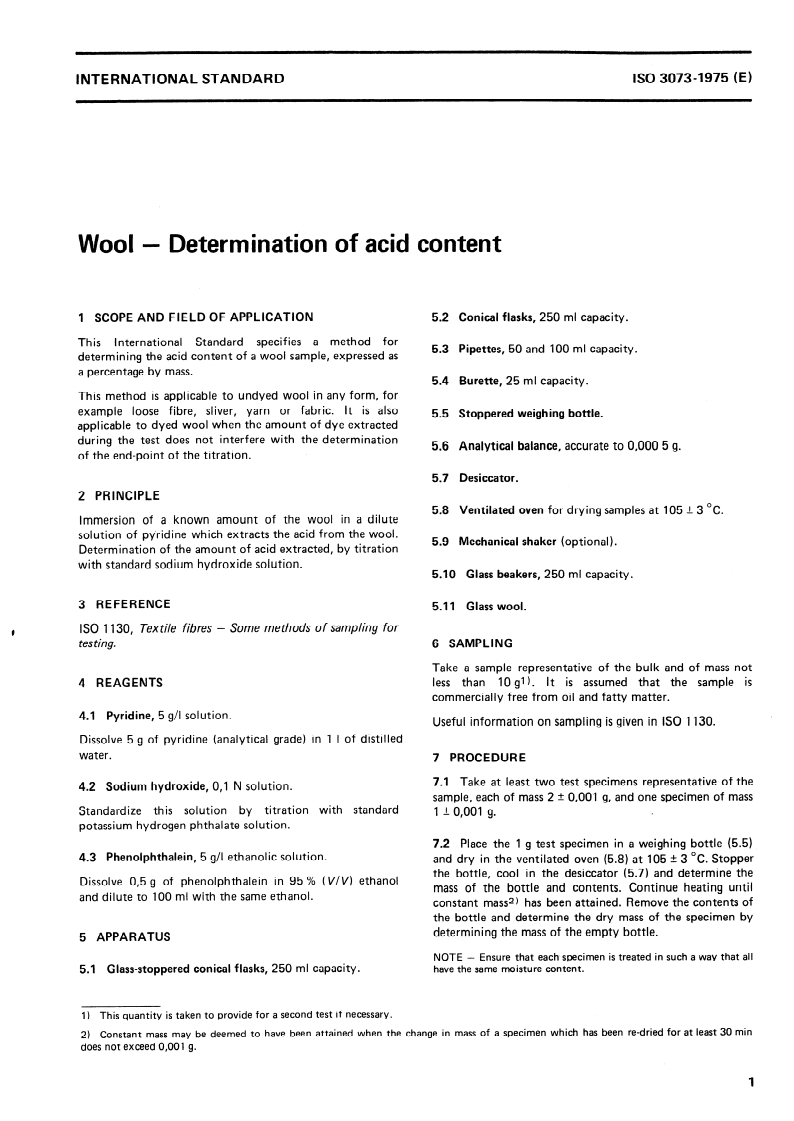
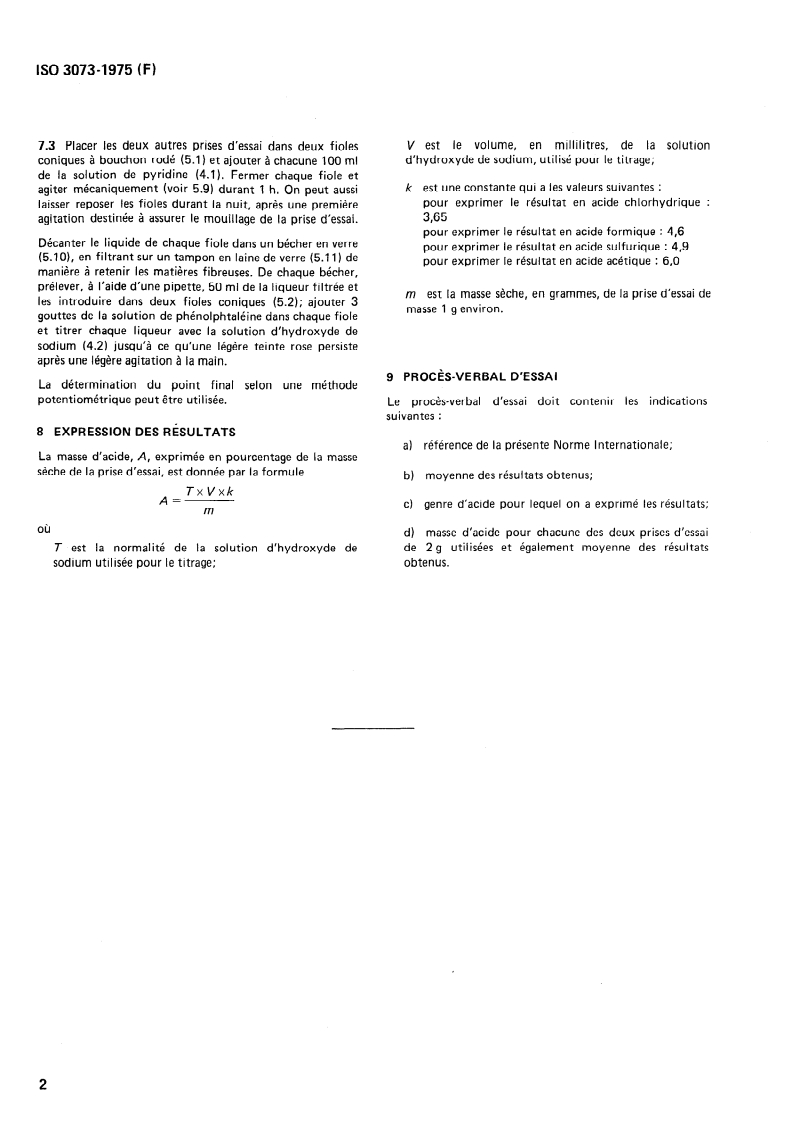
- Principle: acids are extracted from a known mass of wool using a dilute pyridine solution; the extracted acid is determined by titration with standardized 0.1 N sodium hydroxide.
- Reagents: pyridine solution (5 g/L), NaOH 0.1 N (standardized against potassium hydrogen phthalate), phenolphthalein indicator (ethanolic solution).
- Apparatus: conical flasks with ground stoppers (250 ml), pipettes (50 and 100 ml), burette (25 ml), analytical balance (precision 0.0005 g), ventilated oven for drying at 105 ± 3 °C, desiccator, glass beakers, glass‑wool filter.
- Sampling and sample size: follow ISO 1130 for representative sampling; the standard calls for at least two test portions of approximately 2.000 g (±0.001 g) and one 1.000 g portion for moisture/dry mass determination.
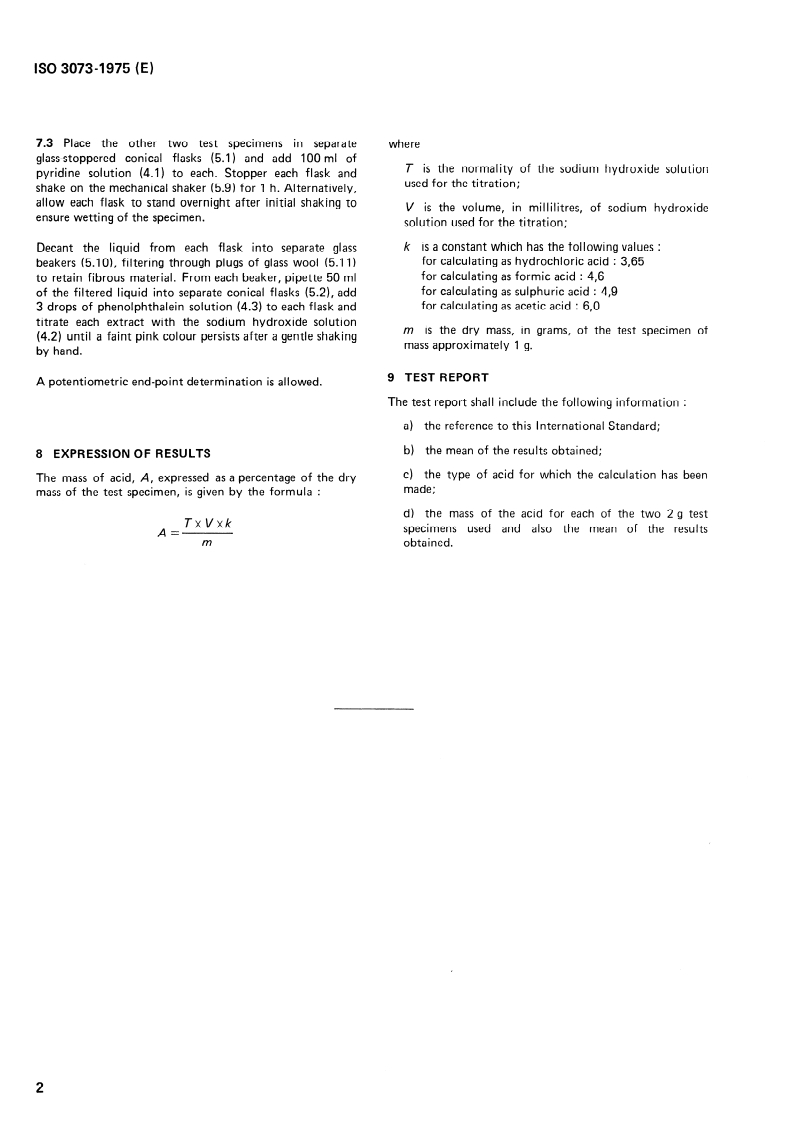
- Procedure highlights: dry and determine the dry mass; extract each test portion with 100 ml pyridine solution (mechanical agitation for 1 hour or overnight after initial wetting); decant and filter; pipette 50 ml aliquots and titrate with NaOH using phenolphthalein to a faint persistent pink.
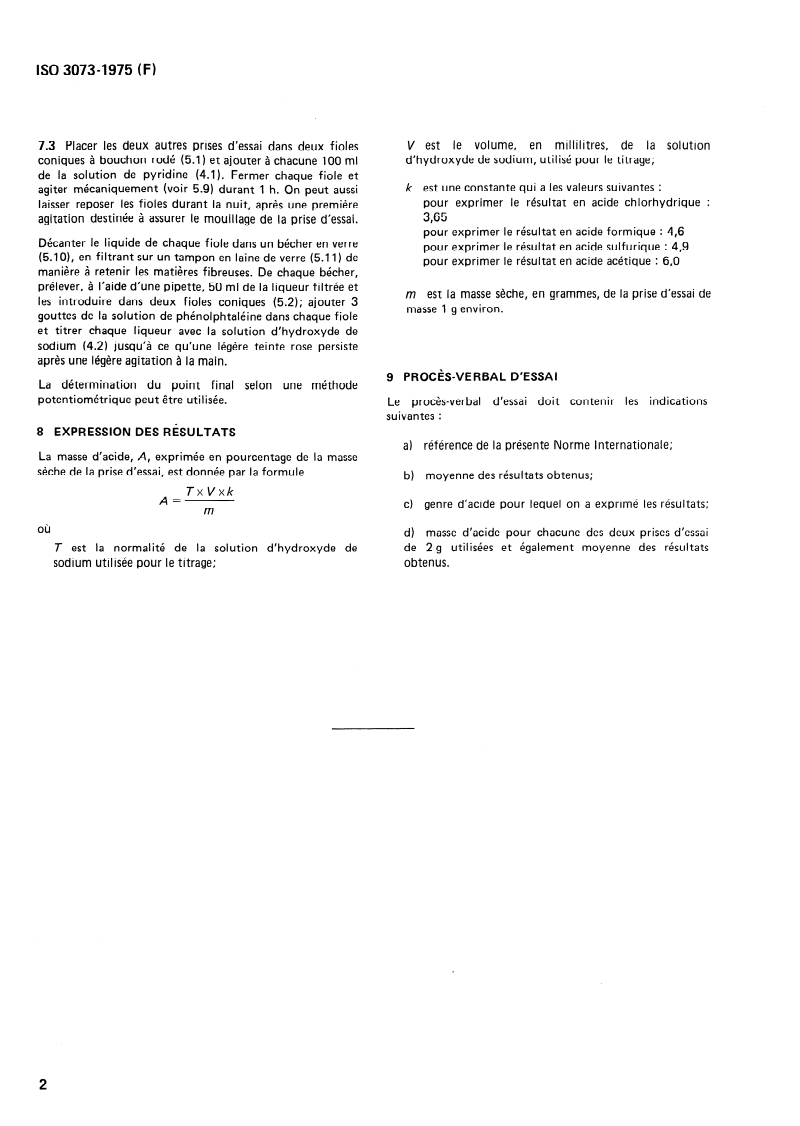
- Expression of results: results are calculated from titration normality and titrant volume, expressed as percentage by mass of the dry sample. The standard provides conversion constants (k) to report results as equivalents of common acids (example values: HCl 3.65; formic 4.6; H2SO4 4.9; acetic 6.0).
- Quality notes: average of duplicate determinations is used; potentiometric end‑point determination may be used as an alternative.
Applications and users
- Textile testing laboratories performing routine quality control on raw and processed wool.
- Wool processors and scouring plants assessing acidity related to processing chemistry or contamination.
- Research and development groups studying fibre chemistry, dyeing interactions, or finishing treatments.
- Regulatory and standards bodies requiring documented measurement methods for specification compliance.
Related standards
- ISO 1130 (textile sampling procedures) - referenced for representative sampling.
- ISO 3073 derives from the Fédération Lainière Internationale method (FLI‑3‑65); see local standards bodies for any updated or successor methods.
Keywords: ISO 3073, wool acid content, acid determination in wool, pyridine extraction, titration method, textile testing, wool quality control.
Buy Documents
ISO 3073:1975 - Wool -- Determination of acid content
ISO 3073:1975 - Wool — Determination of acid content/1/1975
ISO 3073:1975 - Laine -- Détermination de l'acidité
ISO 3073:1975 - Laine -- Détermination de l'acidité
ISO 3073:1975 - Laine — Détermination de l'acidité/1/1975
ISO 3073:1975 - Laine — Détermination de l'acidité/1/1975
Get Certified
Connect with accredited certification bodies for this standard

Control Union Certifications
Global certification for agriculture and sustainability.

Hohenstein Institut
Textile testing and certification.

Bureau Veritas Bangladesh
Bureau Veritas certification services in Bangladesh.
Sponsored listings
Frequently Asked Questions
ISO 3073:1975 is a standard published by the International Organization for Standardization (ISO). Its full title is "Wool — Determination of acid content". This standard covers: The method is applicable to undyed wool in any form, for example loose fibre, sliver, yarn or fabric. It is also applicable to dyed wool when the amount of dye extracted during the test does not interfere with the determination of the end-point of the titration. The determined value is expressed as a percentage by mass.
The method is applicable to undyed wool in any form, for example loose fibre, sliver, yarn or fabric. It is also applicable to dyed wool when the amount of dye extracted during the test does not interfere with the determination of the end-point of the titration. The determined value is expressed as a percentage by mass.
ISO 3073:1975 is classified under the following ICS (International Classification for Standards) categories: 59.080.01 - Textiles in general. The ICS classification helps identify the subject area and facilitates finding related standards.
ISO 3073:1975 is available in PDF format for immediate download after purchase. The document can be added to your cart and obtained through the secure checkout process. Digital delivery ensures instant access to the complete standard document.
Standards Content (Sample)
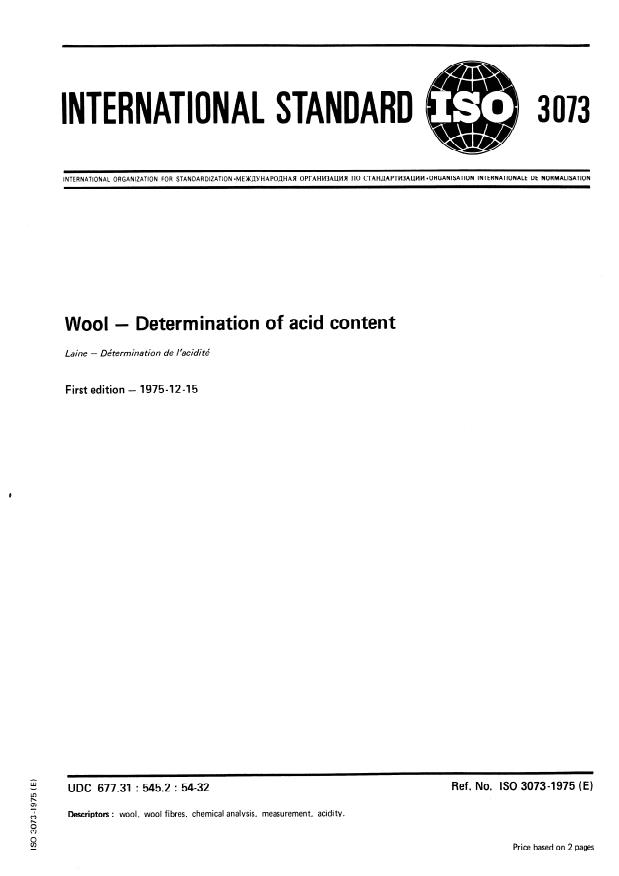
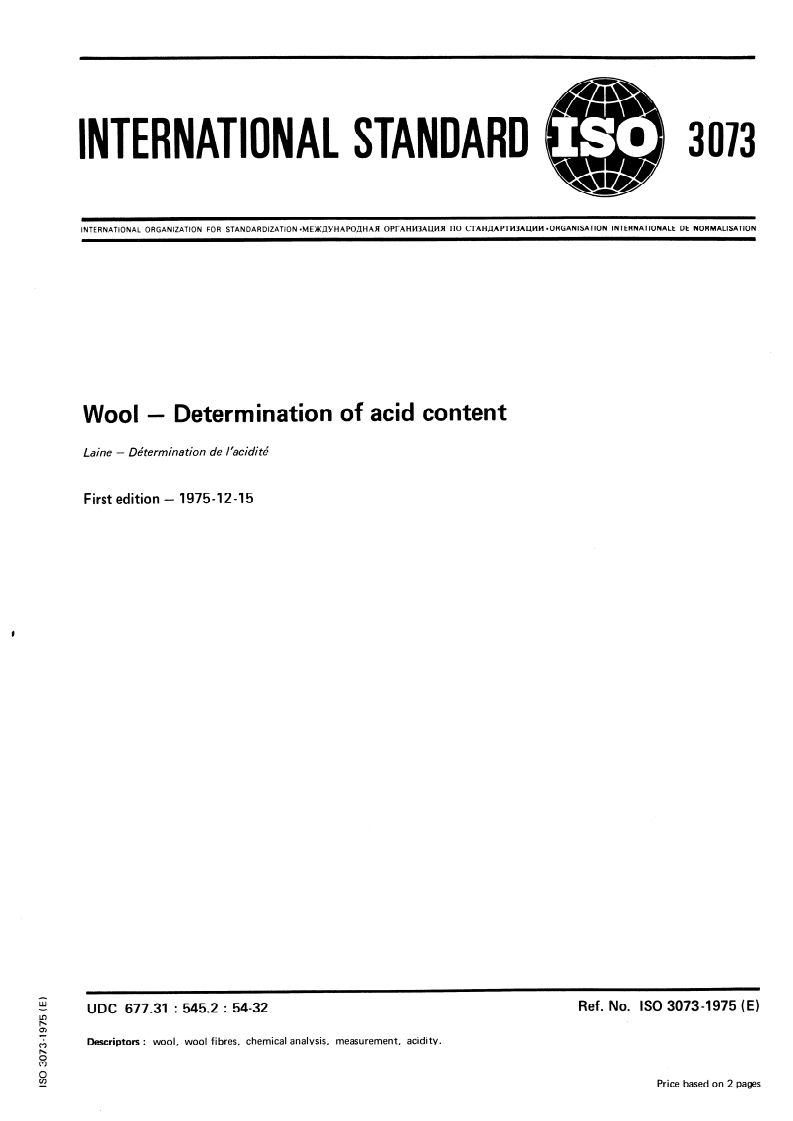
INTERNATIONAL STANDARD
INTERNATIONAL ORGANIZATION FOR STANDARDIZATION l MEXAYHAPOfiHAfl OPI-AHM3ALJMfl I-IO C-I-AH&4PTW3ALWf.ORGANISATION INTERNATIONALE DE NORMALISATION
Wool- Determination of acid content
Laine - Determination de l’aciditb
First edition - 1975-12-15
Ref. No. ISO 3073-1975 (E)
UDC 677.31 : 545.2 : 54-32
wool, woot fibres, Chemical analysis, measurement, acidity.
Descriptors :
Price based on 2 pages
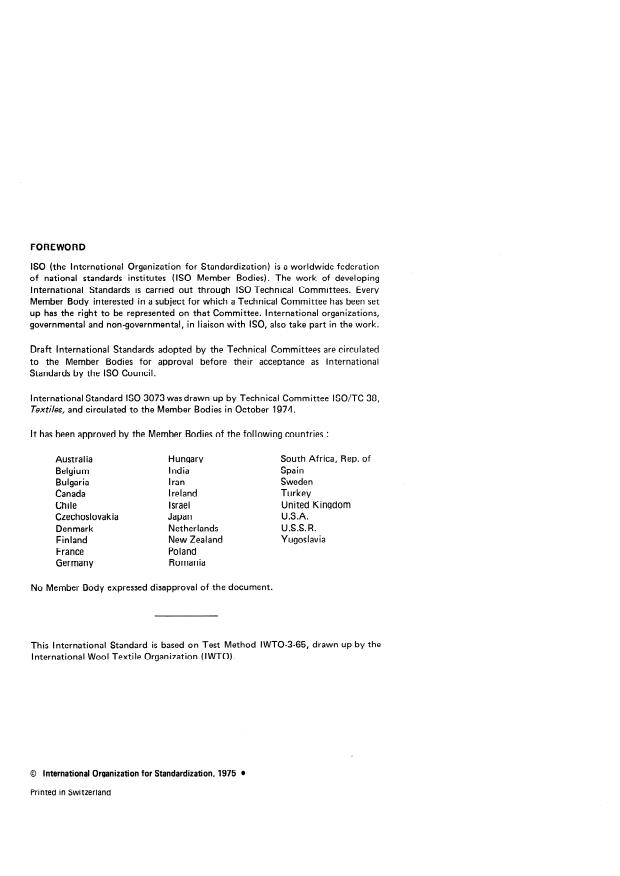
FOREWORD
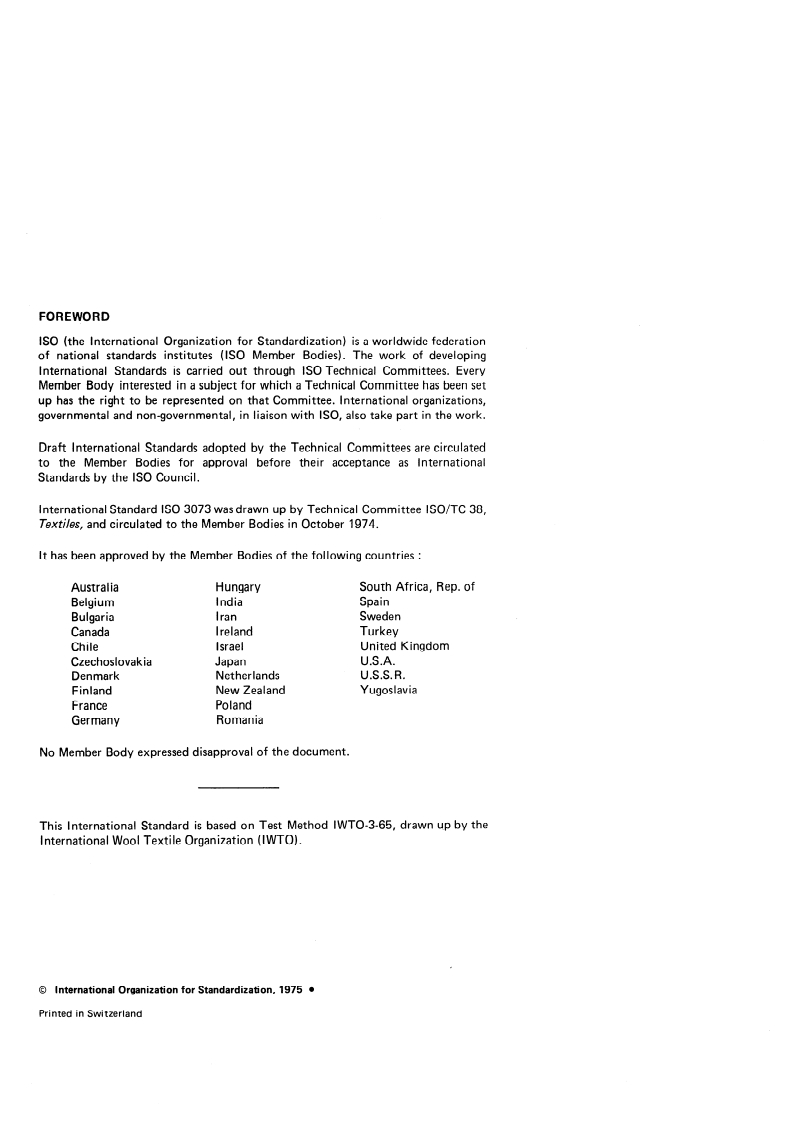
ISO (the International Organization for Standardization) is a worldwide federation
of national Standards institutes (ISO Member Bodies). The work of developing
International Standards is carried out through ISO Technical Committees. Every
Member Body interested in a subject for which a Technical Committee has been set
up has the right to be represented on that Committee. International organizations,
governmental and non-governmental, in liaison with ISO, also take part in the work.
Draft International Standards adopted by the Technical Committees are circulated
to the Member Bodies for approval before their acceptance as International
Standards by the ISO Council.
International Standard ISO 3073 was drawn up by Technical Committee ISO/TC 38,
Textiles, and circulated to the Member Bodies in October 1974.
lt has been approved by the Member Bodies of the following countries :
Australia Hungary South Africa, Rep. of
Belgium I ndia Spain
Bulgaria Iran Sweden
Canada I reland Turkey
Chile Israel United Kingdom
Czechoslovakia Japan U.S.A.
Denmark Netherlands U.S.S. R.
Finland New Zealand Yugoslavia
France Poland
Germany Romania
No Member Body expressed disapproval of the document.
This International Standard is based on Test Method IWTO-3-65, drawn u.p by the
International Wool Textile Organization (IWTO).
0 International Organkation for Standardkation, 1975 l
Pri nted in Swi tzerland
ISO 3073-1975 (EI
INTERNATIONAL STANDARD
Wo01 - Determination of acid content
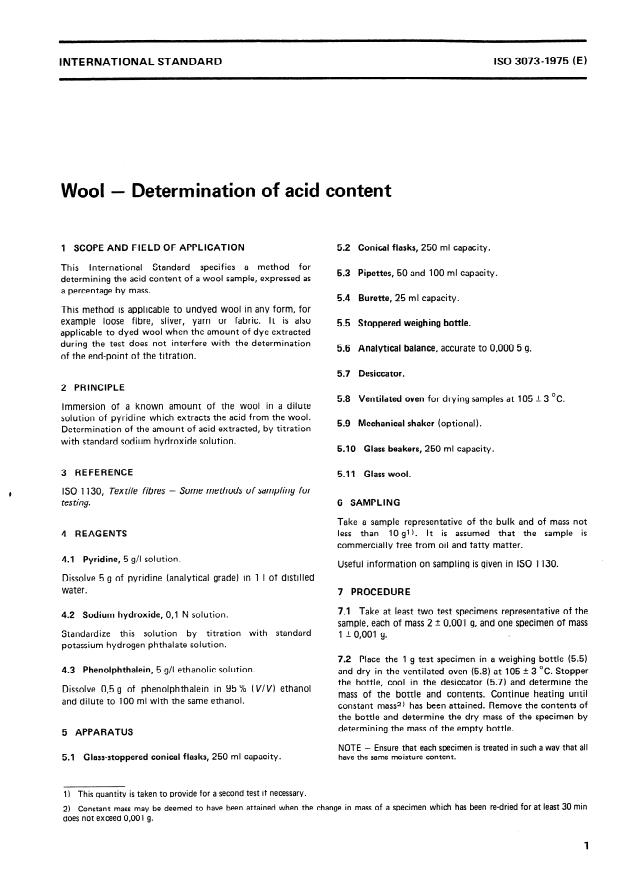
1 SCOPE AND FIELD OF APPLICATION 5.2 Conical flasks, 250 ml capacity.
This International Standard specifies a method for
Pipettes, 50 and 100 ml capacity.
5.3
determining the acid content of a wo01 Sample, expressed as
a percentage by mass.
5.4 Burette, 25 ml capacity.
This method is applicable to undyed wool in any form, for
example Ioose fibre, sliver, yarn or fabric. It is also
Stoppered weighing bottle.
5.5
applicable to dyed wool when the amount of dye extracted
during the test does not interfere with the determination
Analytical balance, accurate to 0,000 5 g.
5.6
of the end-point of the titration.
5.7 Desiccator.
2 PRINCIPLE
Ventilated oven for drying samples at 105 ? 3 “C.
5.8
Immersion of a known amount of the wool in a dilute
Solution of pyridine which extracts the acid from the wool.
5.9 Mechanical shaker (optional).
Determination of the amount of acid extracted, by titration
with Standard sodium hydroxide Solution.
5.10 Glass beakers, 250 ml capacity.
3 REFERENCE
5.11 Glass wool.
Some methods of sampiing for
ISO 1130, Textile fibres -
tes ting.
6 SAMPLING
Take a Sample representative of the bulk and of mass not
4 REAGENTS less than IO gl ). lt is assumed that the Sample is
commercially free
...
INTERNATIONAL STANDARD
INTERNATIONAL ORGANIZATION FOR STANDARDIZATION l MEXAYHAPOfiHAfl OPI-AHM3ALJMfl I-IO C-I-AH&4PTW3ALWf.ORGANISATION INTERNATIONALE DE NORMALISATION
Wool- Determination of acid content
Laine - Determination de l’aciditb
First edition - 1975-12-15
Ref. No. ISO 3073-1975 (E)
UDC 677.31 : 545.2 : 54-32
wool, woot fibres, Chemical analysis, measurement, acidity.
Descriptors :
Price based on 2 pages
FOREWORD
ISO (the International Organization for Standardization) is a worldwide federation
of national Standards institutes (ISO Member Bodies). The work of developing
International Standards is carried out through ISO Technical Committees. Every
Member Body interested in a subject for which a Technical Committee has been set
up has the right to be represented on that Committee. International organizations,
governmental and non-governmental, in liaison with ISO, also take part in the work.
Draft International Standards adopted by the Technical Committees are circulated
to the Member Bodies for approval before their acceptance as International
Standards by the ISO Council.
International Standard ISO 3073 was drawn up by Technical Committee ISO/TC 38,
Textiles, and circulated to the Member Bodies in October 1974.
lt has been approved by the Member Bodies of the following countries :
Australia Hungary South Africa, Rep. of
Belgium I ndia Spain
Bulgaria Iran Sweden
Canada I reland Turkey
Chile Israel United Kingdom
Czechoslovakia Japan U.S.A.
Denmark Netherlands U.S.S. R.
Finland New Zealand Yugoslavia
France Poland
Germany Romania
No Member Body expressed disapproval of the document.
This International Standard is based on Test Method IWTO-3-65, drawn u.p by the
International Wool Textile Organization (IWTO).
0 International Organkation for Standardkation, 1975 l
Pri nted in Swi tzerland
ISO 3073-1975 (EI
INTERNATIONAL STANDARD
Wo01 - Determination of acid content
1 SCOPE AND FIELD OF APPLICATION 5.2 Conical flasks, 250 ml capacity.
This International Standard specifies a method for
Pipettes, 50 and 100 ml capacity.
5.3
determining the acid content of a wo01 Sample, expressed as
a percentage by mass.
5.4 Burette, 25 ml capacity.
This method is applicable to undyed wool in any form, for
example Ioose fibre, sliver, yarn or fabric. It is also
Stoppered weighing bottle.
5.5
applicable to dyed wool when the amount of dye extracted
during the test does not interfere with the determination
Analytical balance, accurate to 0,000 5 g.
5.6
of the end-point of the titration.
5.7 Desiccator.
2 PRINCIPLE
Ventilated oven for drying samples at 105 ? 3 “C.
5.8
Immersion of a known amount of the wool in a dilute
Solution of pyridine which extracts the acid from the wool.
5.9 Mechanical shaker (optional).
Determination of the amount of acid extracted, by titration
with Standard sodium hydroxide Solution.
5.10 Glass beakers, 250 ml capacity.
3 REFERENCE
5.11 Glass wool.
Some methods of sampiing for
ISO 1130, Textile fibres -
tes ting.
6 SAMPLING
Take a Sample representative of the bulk and of mass not
4 REAGENTS less than IO gl ). lt is assumed that the Sample is
commercially free
...
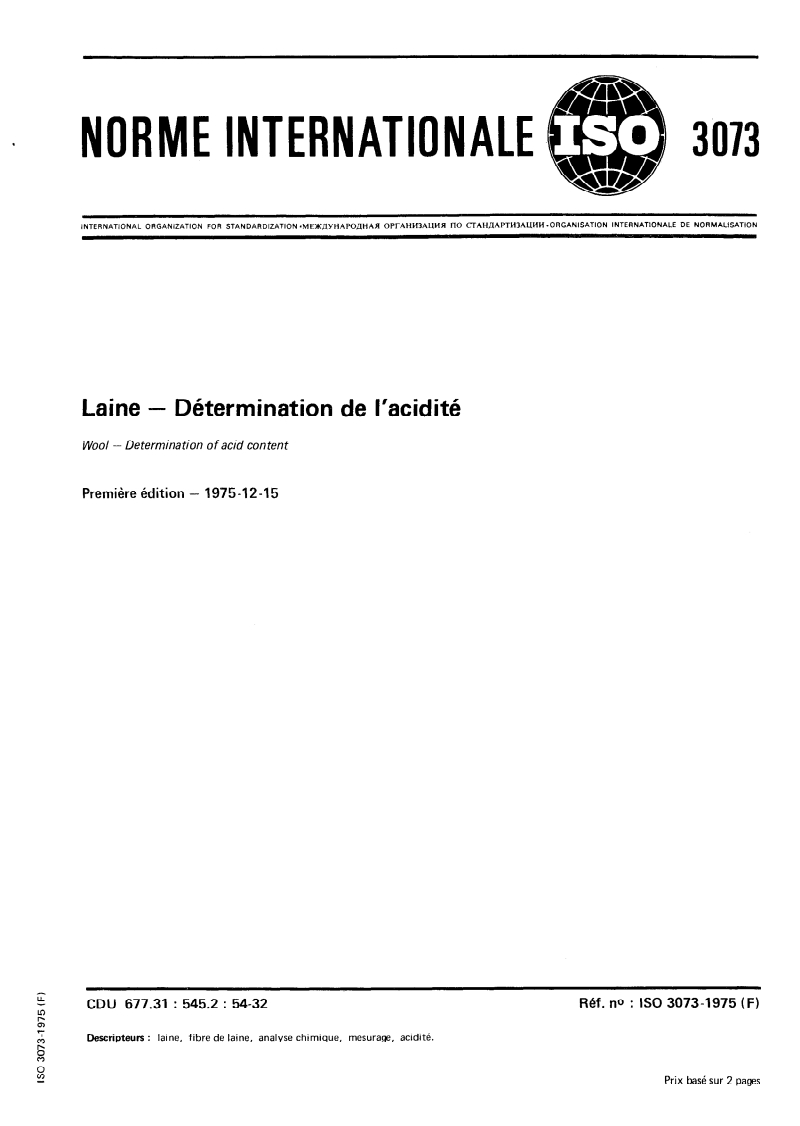
NORME INTERNATIONALE
INTERNATIONAL ORGANIZATION FOR STANDARDIZATION l MEXfiYHAPOAHAfl OPI-AHM3ALWJI n0 CTAHAAPTM3ALWi ~ORGANISATION INTERNATIONALE DE NORMALISATION
Laine - Détermination de l’acidité
Wool - Determina tien of acid content
Première édition - 1975-12-15
iî
Y
Réf. no : ISO 3073-1975 ( F)
CDU 677.31 : 545.2 : 54-32
Descripteurs : laine, fibre de laine, analyse chimique, mesurage, acidité.
Prix basé sur 2 pages
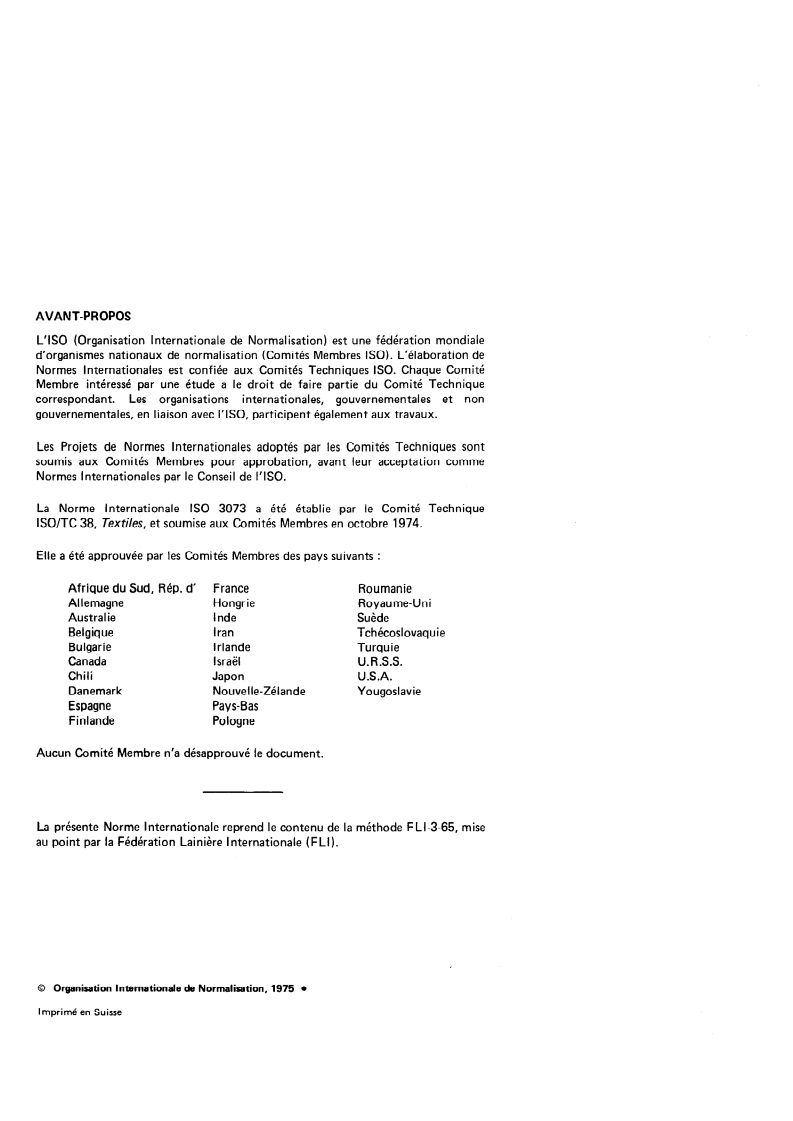
AVANT-PROPOS
L’ISO (Organisation Internationale de Normalisation) est une fédération mondiale
d’organismes nationaux de normalisation (Comités Membres ISO). L’élaboration de
Normes Internationales est confiée aux Comités Techniques ISO. Chaque Comité
Membre intéressé par une étude a le droit de faire partie du Comité Technique
correspondant.
Les organisations internationales, gouvernementales et non
gouvernementales, en liaison avec I’ISO, participent également aux travaux.
Les Projets de Normes Internationales adoptés par les Comités Techniques sont
soumis aux Comités Membres pour approbation, avant leur acceptation comme
Normes Internationales par le Conseil de I’ISO.
La Norme Internationale ISO 3073 a été établie par le Comité Technique
ISO/TC 38, Textiles, et soumise aux Comités Membres en octobre 1974.
Elle a été approuvée par les Comités Membres des pays suivants :
Afrique du Sud, Rép. d’
France Roumanie
Allemagne Hongrie
Royaume-Uni
Australie Inde
Suède
Belgique Iran Tchécoslovaquie
Bulgarie Irlande
Turquie
Canada Israël
U.R.S.S.
Chili Japon U.S.A.
Danemark Nouvelle-Zélande Yougoslavie
Espagne Pays-Bas
Finlande Pologne
Aucun Comité Membre n’a désapprouvé le document.
présente Norme Internationale reprend le contenu
La de la méthode F LI -3-65, mise
au point par la Fédération Lainière Internationale (FL $1).
0 Organisation Internationale de Normalisation, 1975 l
Imprimé en Suisse
ISO 30734975 (F)
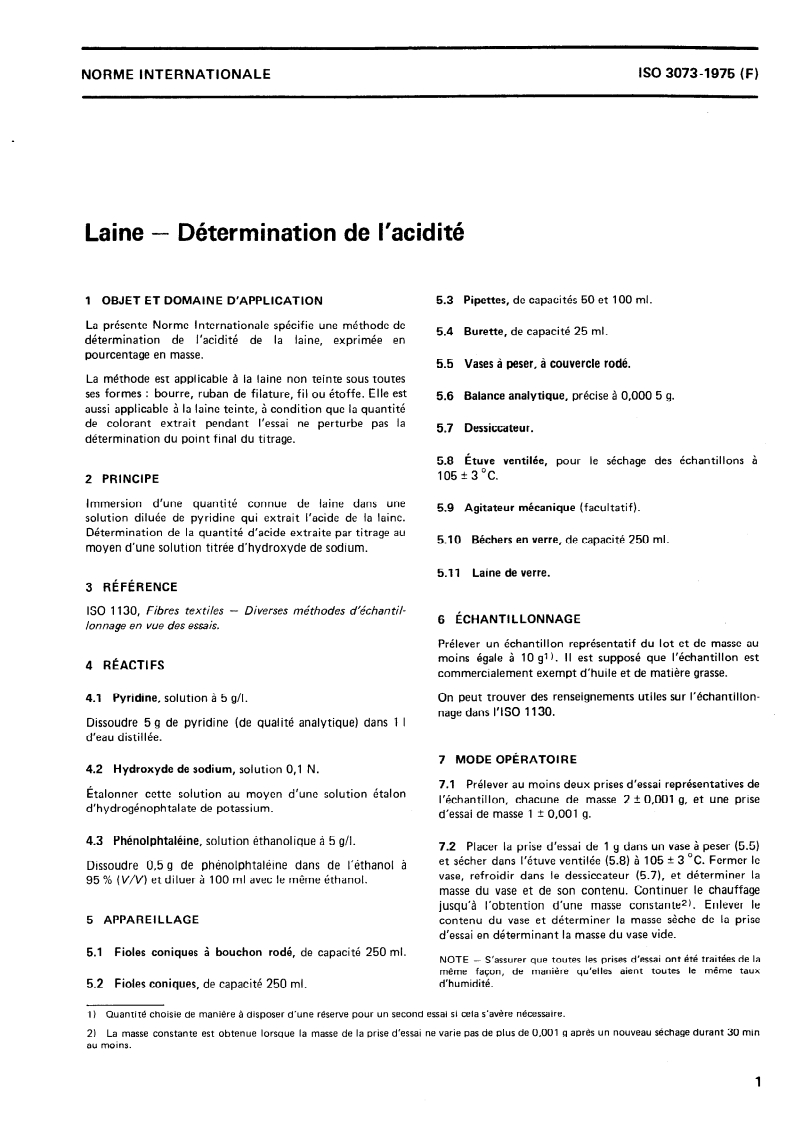
NORME INTERNATIONALE
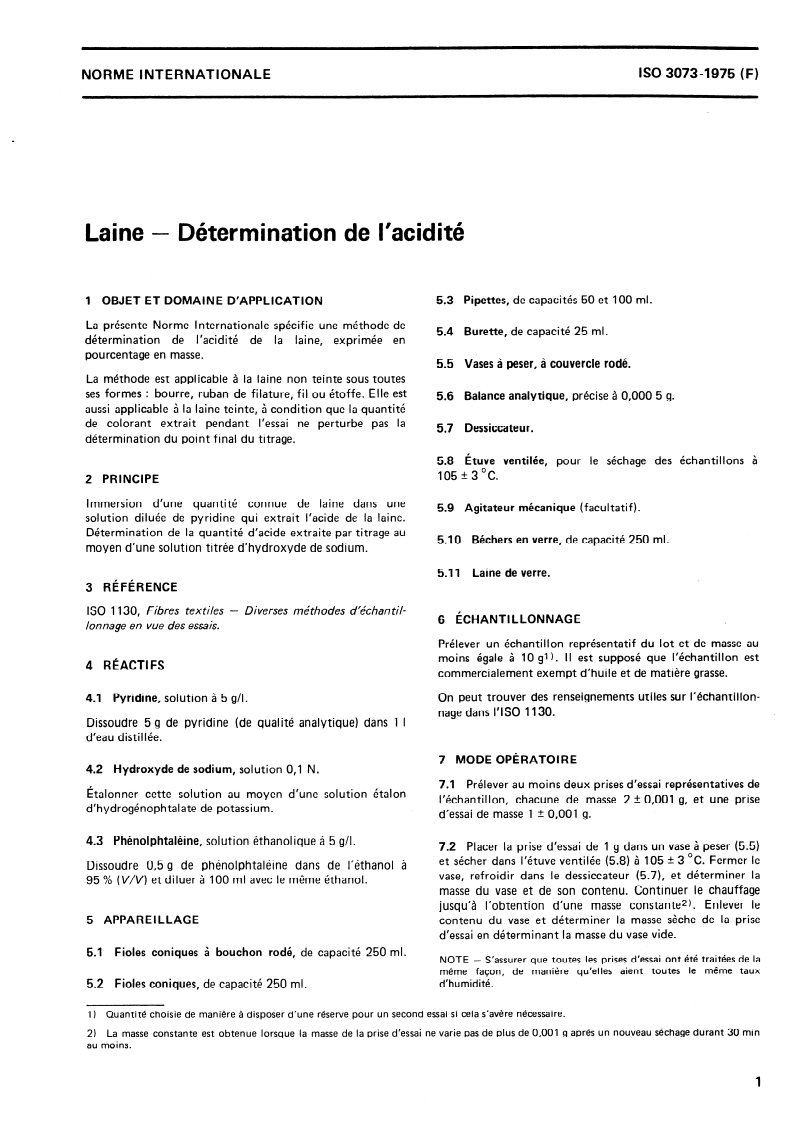
Laine - Détermination de l’acidité
Pipettes, de capacités 50 et 100 ml.
1 OBJET ET DOMAINE D’APPLICATION 5.3
La présente Norme Internationale spécifie une méthode de
5.4 Burette, de capacité 25 ml.
détermination de l’acidité de la laine, exprimée en
pourcentage en masse.
5.5 Vases à peser, à couvercle rodé.
La méthode est applicable à la laine non teinte sous toutes
ses formes : bourre, ruban de filature, fil ou étoffe. Elle est
5.6 Balance analytique, précise à 0,000 5 g.
aussi applicable à la laine teinte, à condition que la quantité
de colorant extrait pendant l’essai ne perturbe pas la
5.7 Dessiccateur.
détermination du point final du titrage.
5.8 Étuve ventilée, pour le séchage des échantillons à
105rr3”c.
2 PRINCIPE
Immersion d’une quantité connue de laine dans une
5.9 Agitateur mécanique (facultatif).
solution diluée de pyridine qui extrait l’acide de la laine.
Détermination de la quantité d’acide extraite par titrage au
5.1Q Béchers en verre, de capacité 250 ml.
moyen d’une solution titrée d’hydroxyde de sodium.
5.11 Laine de verre.
3 RÉFÉRENCE
ISO 1130, Fibres textiles - Diverses méthodes d’échan til-
6 ÉCHANTILLONNAGE
lonnage en vue des essais.
Prélever un échantillon représentatif du lot et de masse au
moins égale à 10 gi 1. II est supposé que l’échantillon est
4 RÉACTIFS
commercialement exempt d’huile et de matière grasse.
4.1 Pyridine, solution à 5 g/l. On peut trouver des renseignements utiles sur I’échantillon-
nage dans I’ISO 1130.
Dissoudre 5 g de pyridine (de qualité analytique) dans
...
NORME INTERNATIONALE
INTERNATIONAL ORGANIZATION FOR STANDARDIZATION l MEXfiYHAPOAHAfl OPI-AHM3ALWJI n0 CTAHAAPTM3ALWi ~ORGANISATION INTERNATIONALE DE NORMALISATION
Laine - Détermination de l’acidité
Wool - Determina tien of acid content
Première édition - 1975-12-15
iî
Y
Réf. no : ISO 3073-1975 ( F)
CDU 677.31 : 545.2 : 54-32
Descripteurs : laine, fibre de laine, analyse chimique, mesurage, acidité.
Prix basé sur 2 pages
AVANT-PROPOS
L’ISO (Organisation Internationale de Normalisation) est une fédération mondiale
d’organismes nationaux de normalisation (Comités Membres ISO). L’élaboration de
Normes Internationales est confiée aux Comités Techniques ISO. Chaque Comité
Membre intéressé par une étude a le droit de faire partie du Comité Technique
correspondant.
Les organisations internationales, gouvernementales et non
gouvernementales, en liaison avec I’ISO, participent également aux travaux.
Les Projets de Normes Internationales adoptés par les Comités Techniques sont
soumis aux Comités Membres pour approbation, avant leur acceptation comme
Normes Internationales par le Conseil de I’ISO.
La Norme Internationale ISO 3073 a été établie par le Comité Technique
ISO/TC 38, Textiles, et soumise aux Comités Membres en octobre 1974.
Elle a été approuvée par les Comités Membres des pays suivants :
Afrique du Sud, Rép. d’
France Roumanie
Allemagne Hongrie
Royaume-Uni
Australie Inde
Suède
Belgique Iran Tchécoslovaquie
Bulgarie Irlande
Turquie
Canada Israël
U.R.S.S.
Chili Japon U.S.A.
Danemark Nouvelle-Zélande Yougoslavie
Espagne Pays-Bas
Finlande Pologne
Aucun Comité Membre n’a désapprouvé le document.
présente Norme Internationale reprend le contenu
La de la méthode F LI -3-65, mise
au point par la Fédération Lainière Internationale (FL $1).
0 Organisation Internationale de Normalisation, 1975 l
Imprimé en Suisse
ISO 30734975 (F)
NORME INTERNATIONALE
Laine - Détermination de l’acidité
Pipettes, de capacités 50 et 100 ml.
1 OBJET ET DOMAINE D’APPLICATION 5.3
La présente Norme Internationale spécifie une méthode de
5.4 Burette, de capacité 25 ml.
détermination de l’acidité de la laine, exprimée en
pourcentage en masse.
5.5 Vases à peser, à couvercle rodé.
La méthode est applicable à la laine non teinte sous toutes
ses formes : bourre, ruban de filature, fil ou étoffe. Elle est
5.6 Balance analytique, précise à 0,000 5 g.
aussi applicable à la laine teinte, à condition que la quantité
de colorant extrait pendant l’essai ne perturbe pas la
5.7 Dessiccateur.
détermination du point final du titrage.
5.8 Étuve ventilée, pour le séchage des échantillons à
105rr3”c.
2 PRINCIPE
Immersion d’une quantité connue de laine dans une
5.9 Agitateur mécanique (facultatif).
solution diluée de pyridine qui extrait l’acide de la laine.
Détermination de la quantité d’acide extraite par titrage au
5.1Q Béchers en verre, de capacité 250 ml.
moyen d’une solution titrée d’hydroxyde de sodium.
5.11 Laine de verre.
3 RÉFÉRENCE
ISO 1130, Fibres textiles - Diverses méthodes d’échan til-
6 ÉCHANTILLONNAGE
lonnage en vue des essais.
Prélever un échantillon représentatif du lot et de masse au
moins égale à 10 gi 1. II est supposé que l’échantillon est
4 RÉACTIFS
commercialement exempt d’huile et de matière grasse.
4.1 Pyridine, solution à 5 g/l. On peut trouver des renseignements utiles sur I’échantillon-
nage dans I’ISO 1130.
Dissoudre 5 g de pyridine (de qualité analytique) dans
...
NORME INTERNATIONALE
INTERNATIONAL ORGANIZATION FOR STANDARDIZATION l MEXfiYHAPOAHAfl OPI-AHM3ALWJI n0 CTAHAAPTM3ALWi ~ORGANISATION INTERNATIONALE DE NORMALISATION
Laine - Détermination de l’acidité
Wool - Determina tien of acid content
Première édition - 1975-12-15
iî
Y
Réf. no : ISO 3073-1975 ( F)
CDU 677.31 : 545.2 : 54-32
Descripteurs : laine, fibre de laine, analyse chimique, mesurage, acidité.
Prix basé sur 2 pages
AVANT-PROPOS
L’ISO (Organisation Internationale de Normalisation) est une fédération mondiale
d’organismes nationaux de normalisation (Comités Membres ISO). L’élaboration de
Normes Internationales est confiée aux Comités Techniques ISO. Chaque Comité
Membre intéressé par une étude a le droit de faire partie du Comité Technique
correspondant.
Les organisations internationales, gouvernementales et non
gouvernementales, en liaison avec I’ISO, participent également aux travaux.
Les Projets de Normes Internationales adoptés par les Comités Techniques sont
soumis aux Comités Membres pour approbation, avant leur acceptation comme
Normes Internationales par le Conseil de I’ISO.
La Norme Internationale ISO 3073 a été établie par le Comité Technique
ISO/TC 38, Textiles, et soumise aux Comités Membres en octobre 1974.
Elle a été approuvée par les Comités Membres des pays suivants :
Afrique du Sud, Rép. d’
France Roumanie
Allemagne Hongrie
Royaume-Uni
Australie Inde
Suède
Belgique Iran Tchécoslovaquie
Bulgarie Irlande
Turquie
Canada Israël
U.R.S.S.
Chili Japon U.S.A.
Danemark Nouvelle-Zélande Yougoslavie
Espagne Pays-Bas
Finlande Pologne
Aucun Comité Membre n’a désapprouvé le document.
présente Norme Internationale reprend le contenu
La de la méthode F LI -3-65, mise
au point par la Fédération Lainière Internationale (FL $1).
0 Organisation Internationale de Normalisation, 1975 l
Imprimé en Suisse
ISO 30734975 (F)
NORME INTERNATIONALE
Laine - Détermination de l’acidité
Pipettes, de capacités 50 et 100 ml.
1 OBJET ET DOMAINE D’APPLICATION 5.3
La présente Norme Internationale spécifie une méthode de
5.4 Burette, de capacité 25 ml.
détermination de l’acidité de la laine, exprimée en
pourcentage en masse.
5.5 Vases à peser, à couvercle rodé.
La méthode est applicable à la laine non teinte sous toutes
ses formes : bourre, ruban de filature, fil ou étoffe. Elle est
5.6 Balance analytique, précise à 0,000 5 g.
aussi applicable à la laine teinte, à condition que la quantité
de colorant extrait pendant l’essai ne perturbe pas la
5.7 Dessiccateur.
détermination du point final du titrage.
5.8 Étuve ventilée, pour le séchage des échantillons à
105rr3”c.
2 PRINCIPE
Immersion d’une quantité connue de laine dans une
5.9 Agitateur mécanique (facultatif).
solution diluée de pyridine qui extrait l’acide de la laine.
Détermination de la quantité d’acide extraite par titrage au
5.1Q Béchers en verre, de capacité 250 ml.
moyen d’une solution titrée d’hydroxyde de sodium.
5.11 Laine de verre.
3 RÉFÉRENCE
ISO 1130, Fibres textiles - Diverses méthodes d’échan til-
6 ÉCHANTILLONNAGE
lonnage en vue des essais.
Prélever un échantillon représentatif du lot et de masse au
moins égale à 10 gi 1. II est supposé que l’échantillon est
4 RÉACTIFS
commercialement exempt d’huile et de matière grasse.
4.1 Pyridine, solution à 5 g/l. On peut trouver des renseignements utiles sur I’échantillon-
nage dans I’ISO 1130.
Dissoudre 5 g de pyridine (de qualité analytique) dans
...
NORME INTERNATIONALE
INTERNATIONAL ORGANIZATION FOR STANDARDIZATION l MEXfiYHAPOAHAfl OPI-AHM3ALWJI n0 CTAHAAPTM3ALWi ~ORGANISATION INTERNATIONALE DE NORMALISATION
Laine - Détermination de l’acidité
Wool - Determina tien of acid content
Première édition - 1975-12-15
iî
Y
Réf. no : ISO 3073-1975 ( F)
CDU 677.31 : 545.2 : 54-32
Descripteurs : laine, fibre de laine, analyse chimique, mesurage, acidité.
Prix basé sur 2 pages
AVANT-PROPOS
L’ISO (Organisation Internationale de Normalisation) est une fédération mondiale
d’organismes nationaux de normalisation (Comités Membres ISO). L’élaboration de
Normes Internationales est confiée aux Comités Techniques ISO. Chaque Comité
Membre intéressé par une étude a le droit de faire partie du Comité Technique
correspondant.
Les organisations internationales, gouvernementales et non
gouvernementales, en liaison avec I’ISO, participent également aux travaux.
Les Projets de Normes Internationales adoptés par les Comités Techniques sont
soumis aux Comités Membres pour approbation, avant leur acceptation comme
Normes Internationales par le Conseil de I’ISO.
La Norme Internationale ISO 3073 a été établie par le Comité Technique
ISO/TC 38, Textiles, et soumise aux Comités Membres en octobre 1974.
Elle a été approuvée par les Comités Membres des pays suivants :
Afrique du Sud, Rép. d’
France Roumanie
Allemagne Hongrie
Royaume-Uni
Australie Inde
Suède
Belgique Iran Tchécoslovaquie
Bulgarie Irlande
Turquie
Canada Israël
U.R.S.S.
Chili Japon U.S.A.
Danemark Nouvelle-Zélande Yougoslavie
Espagne Pays-Bas
Finlande Pologne
Aucun Comité Membre n’a désapprouvé le document.
présente Norme Internationale reprend le contenu
La de la méthode F LI -3-65, mise
au point par la Fédération Lainière Internationale (FL $1).
0 Organisation Internationale de Normalisation, 1975 l
Imprimé en Suisse
ISO 30734975 (F)
NORME INTERNATIONALE
Laine - Détermination de l’acidité
Pipettes, de capacités 50 et 100 ml.
1 OBJET ET DOMAINE D’APPLICATION 5.3
La présente Norme Internationale spécifie une méthode de
5.4 Burette, de capacité 25 ml.
détermination de l’acidité de la laine, exprimée en
pourcentage en masse.
5.5 Vases à peser, à couvercle rodé.
La méthode est applicable à la laine non teinte sous toutes
ses formes : bourre, ruban de filature, fil ou étoffe. Elle est
5.6 Balance analytique, précise à 0,000 5 g.
aussi applicable à la laine teinte, à condition que la quantité
de colorant extrait pendant l’essai ne perturbe pas la
5.7 Dessiccateur.
détermination du point final du titrage.
5.8 Étuve ventilée, pour le séchage des échantillons à
105rr3”c.
2 PRINCIPE
Immersion d’une quantité connue de laine dans une
5.9 Agitateur mécanique (facultatif).
solution diluée de pyridine qui extrait l’acide de la laine.
Détermination de la quantité d’acide extraite par titrage au
5.1Q Béchers en verre, de capacité 250 ml.
moyen d’une solution titrée d’hydroxyde de sodium.
5.11 Laine de verre.
3 RÉFÉRENCE
ISO 1130, Fibres textiles - Diverses méthodes d’échan til-
6 ÉCHANTILLONNAGE
lonnage en vue des essais.
Prélever un échantillon représentatif du lot et de masse au
moins égale à 10 gi 1. II est supposé que l’échantillon est
4 RÉACTIFS
commercialement exempt d’huile et de matière grasse.
4.1 Pyridine, solution à 5 g/l. On peut trouver des renseignements utiles sur I’échantillon-
nage dans I’ISO 1130.
Dissoudre 5 g de pyridine (de qualité analytique) dans
...