

ISO 2597-1:2006
(Main)Iron ores — Determination of total iron content — Part 1: Titrimetric method after tin(II) chloride reduction
General Information
- Abstract
ISO 2597-1:2006 specifies a titrimetric method for the determination of the total iron content of iron ores, using potassium dichromate after reduction of the trivalent iron by tin(II) chloride. The method is applicable to total iron contents between 30 % (mass fraction) and 72 % (mass fraction) in natural iron ores, iron ore concentrates and agglomerates, including sinter products.
- Status
- Published
- Publication Date
- 26-Apr-2006
- Technical Committee
- ISO/TC 102/SC 2 - Chemical analysis
- Drafting Committee
- ISO/TC 102/SC 2 - Chemical analysis
- Current Stage
- 9060 - Close of review
- Completion Date
- 02-Dec-2030
Overview
ISO 2597-1:2006 - Iron ores - Determination of total iron content - Part 1: Titrimetric method after tin(II) chloride reduction - specifies a standardized laboratory titrimetric procedure to determine total iron content in iron ores, concentrates and agglomerates. The method uses tin(II) chloride to reduce Fe(III) and potassium dichromate for titration. It is applicable to samples with total iron between 30% and 72% (mass fraction) and includes requirements for sample preparation, reagents, apparatus, and quality control.
Key topics and technical requirements
- Principle: Reduction of trivalent iron with tin(II) chloride, oxidation of excess reductant (e.g., with mercury(II) chloride), titration of ferrous iron with potassium dichromate using sodium diphenylaminesulfonate indicator.
- Scope and applicability: Natural iron ores, concentrates and sinter products with 30–72% total Fe.
- Sampling & sample prep:
- Laboratory sample particle size: typically minus 100 µm; use minus 160 µm for ores with significant combined water or oxidizable compounds.
- Test portion: approximately 0.4 g (slightly less for very high-Fe samples).
- Hygroscopic moisture determination per ISO 2596 is required for certain sample types.
- Reagents & apparatus: Lists analytical-grade reagents (hydrochloric, sulfuric, hydrofluoric acids; tin(II) chloride; potassium dichromate standard solution) and common lab equipment (burettes, pipettes, crucibles, muffle furnace).
- Procedure controls: Duplicate independent determinations, blank and check tests, decomposition routes depending on trace elements (e.g., vanadium), and instructions for calculation and expression of results.
- Quality and precision: Sections on repeatability, between-laboratory precision and statistical treatment of analytical values.
- Safety & waste: Warning about hazardous materials and an Annex (C) suggesting mercury removal from waste solutions.
Applications
- Routine QA/QC analysis in mining and mineral processing laboratories to verify ore grade and concentrate quality.
- Metallurgical input for blast-furnace feed grading, sinter plant control and material accounting.
- Regulatory and contractual testing where standardized, comparable total-iron values are required.
- Research labs validating analytical methods for iron-bearing materials.
Who uses this standard
- Analytical chemists and laboratory technicians in the iron and steel industry
- Mine laboratories and ore beneficiation plants
- Quality assurance managers and metallurgists
- Third-party testing and certification bodies
- Standards organizations and method developers
Related standards
- ISO 2597-2: Titrimetric method after titanium(III) chloride reduction
- ISO 2597-3: Calculation method
- ISO 9507: Titanium(III) chloride reduction methods (alternative, mercury-free)
- ISO 3082, ISO 2596, ISO 7764, ISO 3696 and glassware standards (ISO 385/648/1042) - referenced for sampling, moisture determination, sample prep, water quality and apparatus.
Keywords: ISO 2597-1:2006, iron ores, total iron determination, titrimetric method, tin(II) chloride reduction, potassium dichromate, laboratory analysis, ore sampling, QA/QC.
Relations
- Effective Date
- 15-Apr-2008
Get Certified
Connect with accredited certification bodies for this standard

Bureau Veritas Chile
Bureau Veritas certification services in Chile.
Bureau Veritas Peru
Bureau Veritas certification services in Peru.
BVQI Peru
Bureau Veritas certification in Peru.
Sponsored listings
Frequently Asked Questions
ISO 2597-1:2006 is a standard published by the International Organization for Standardization (ISO). Its full title is "Iron ores — Determination of total iron content — Part 1: Titrimetric method after tin(II) chloride reduction". This standard covers: ISO 2597-1:2006 specifies a titrimetric method for the determination of the total iron content of iron ores, using potassium dichromate after reduction of the trivalent iron by tin(II) chloride. The method is applicable to total iron contents between 30 % (mass fraction) and 72 % (mass fraction) in natural iron ores, iron ore concentrates and agglomerates, including sinter products.
ISO 2597-1:2006 specifies a titrimetric method for the determination of the total iron content of iron ores, using potassium dichromate after reduction of the trivalent iron by tin(II) chloride. The method is applicable to total iron contents between 30 % (mass fraction) and 72 % (mass fraction) in natural iron ores, iron ore concentrates and agglomerates, including sinter products.
ISO 2597-1:2006 is classified under the following ICS (International Classification for Standards) categories: 73.060.10 - Iron ores. The ICS classification helps identify the subject area and facilitates finding related standards.
ISO 2597-1:2006 has the following relationships with other standards: It is inter standard links to ISO 2597-1:1994. Understanding these relationships helps ensure you are using the most current and applicable version of the standard.
ISO 2597-1:2006 is available in PDF format for immediate download after purchase. The document can be added to your cart and obtained through the secure checkout process. Digital delivery ensures instant access to the complete standard document.
Standards Content (Sample)
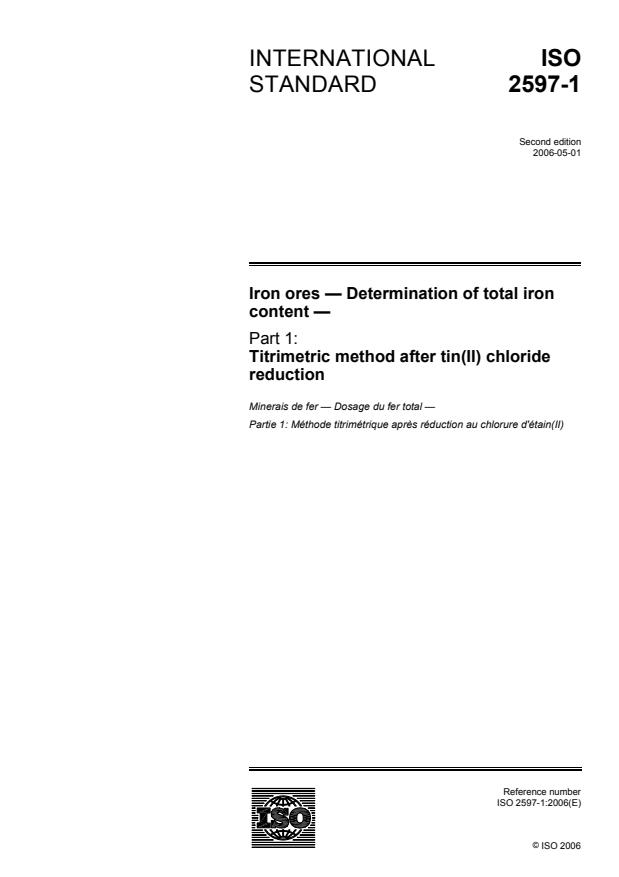
INTERNATIONAL ISO
STANDARD 2597-1
Second edition
2006-05-01
Iron ores — Determination of total iron
content —
Part 1:
Titrimetric method after tin(II) chloride
reduction
Minerais de fer — Dosage du fer total —
Partie 1: Méthode titrimétrique après réduction au chlorure d'étain(II)
Reference number
©
ISO 2006
PDF disclaimer
This PDF file may contain embedded typefaces. In accordance with Adobe's licensing policy, this file may be printed or viewed but
shall not be edited unless the typefaces which are embedded are licensed to and installed on the computer performing the editing. In
downloading this file, parties accept therein the responsibility of not infringing Adobe's licensing policy. The ISO Central Secretariat
accepts no liability in this area.
Adobe is a trademark of Adobe Systems Incorporated.
Details of the software products used to create this PDF file can be found in the General Info relative to the file; the PDF-creation
parameters were optimized for printing. Every care has been taken to ensure that the file is suitable for use by ISO member bodies. In
the unlikely event that a problem relating to it is found, please inform the Central Secretariat at the address given below.
© ISO 2006
All rights reserved. Unless otherwise specified, no part of this publication may be reproduced or utilized in any form or by any means,
electronic or mechanical, including photocopying and microfilm, without permission in writing from either ISO at the address below or
ISO's member body in the country of the requester.
ISO copyright office
Case postale 56 • CH-1211 Geneva 20
Tel. + 41 22 749 01 11
Fax + 41 22 749 09 47
E-mail copyright@iso.org
Web www.iso.org
Published in Switzerland
ii © ISO 2006 – All rights reserved
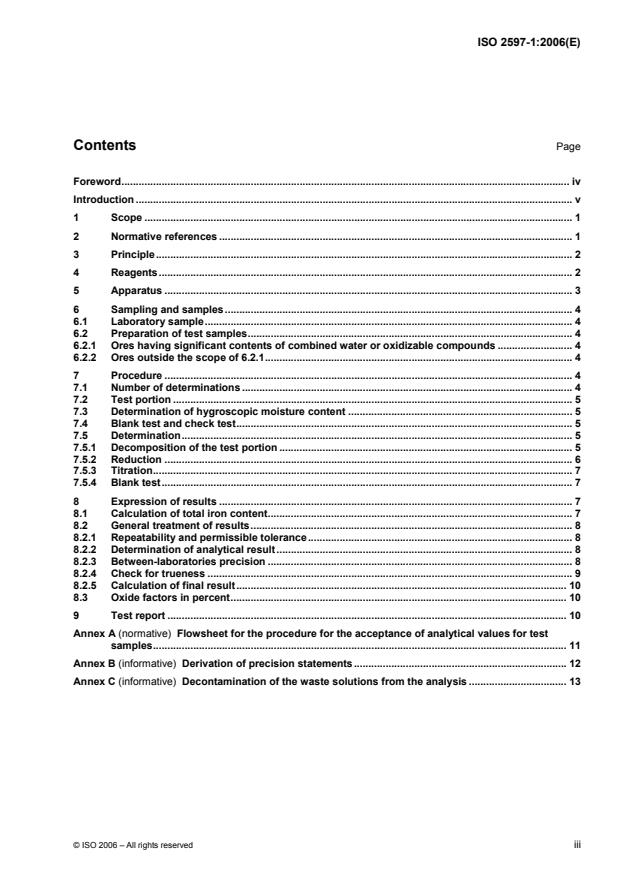
Contents Page
Foreword. iv
Introduction . v
1 Scope . 1
2 Normative references . 1
3 Principle. 2
4 Reagents. 2
5 Apparatus . 3
6 Sampling and samples. 4
6.1 Laboratory sample. 4
6.2 Preparation of test samples. 4
6.2.1 Ores having significant contents of combined water or oxidizable compounds . 4
6.2.2 Ores outside the scope of 6.2.1. 4
7 Procedure . 4
7.1 Number of determinations . 4
7.2 Test portion . 5
7.3 Determination of hygroscopic moisture content . 5
7.4 Blank test and check test. 5
7.5 Determination. 5
7.5.1 Decomposition of the test portion . 5
7.5.2 Reduction . 6
7.5.3 Titration. 7
7.5.4 Blank test. 7
8 Expression of results . 7
8.1 Calculation of total iron content. 7
8.2 General treatment of results. 8
8.2.1 Repeatability and permissible tolerance. 8
8.2.2 Determination of analytical result. 8
8.2.3 Between-laboratories precision . 8
8.2.4 Check for trueness . 9
8.2.5 Calculation of final result. 10
8.3 Oxide factors in percent. 10
9 Test report . 10
Annex A (normative) Flowsheet for the procedure for the acceptance of analytical values for test
samples. 11
Annex B (informative) Derivation of precision statements. 12
Annex C (informative) Decontamination of the waste solutions from the analysis . 13
Foreword
ISO (the International Organization for Standardization) is a worldwide federation of national standards bodies
(ISO member bodies). The work of preparing International Standards is normally carried out through ISO
technical committees. Each member body interested in a subject for which a technical committee has been
established has the right to be represented on that committee. International organizations, governmental and
non-governmental, in liaison with ISO, also take part in the work. ISO collaborates closely with the
International Electrotechnical Commission (IEC) on all matters of electrotechnical standardization.
International Standards are drafted in accordance with the rules given in the ISO/IEC Directives, Part 2.
The main task of technical committees is to prepare International Standards. Draft International Standards
adopted by the technical committees are circulated to the member bodies for voting. Publication as an
International Standard requires approval by at least 75 % of the member bodies casting a vote.
Attention is drawn to the possibility that some of the elements of this document may be the subject of patent
rights. ISO shall not be held responsible for identifying any or all such patent rights.
ISO 2597-1 was prepared by Technical Committee ISO/TC 102, Iron ore and direct reduced iron,
Subcommittee SC 2, Chemical analysis.
This second edition cancels and replaces the first edition (ISO 2597-1:1994), which has been editorially
revised.
ISO 2597 consists of the following parts, under the general title Iron ores — Determination of total iron
content:
⎯ Part 1: Titrimetric method after tin(II) chloride reduction
⎯ Part 2: Titrimetric method after titanium(III) chloride reduction
⎯ Part 3: Calculation method
iv © ISO 2006 – All rights reserved
Introduction
This part of ISO 2597 has been updated to correct errors in the presentation of statistical information in the
previous edition.
This is considered to be an editorial revision.
INTERNATIONAL STANDARD ISO 2597-1:2006(E)
Iron ores — Determination of total iron content —
Part 1:
Titrimetric method after tin(II) chloride reduction
WARNING — This part of ISO 2597 may involve hazardous materials, operations and equipment. This
part of ISO 2597 does not purport to address all of the safety issues associated with its use. It is the
responsibility of the user to establish appropriate health and safety practices and determine the
applicability of regulatory limitations prior to use.
1 Scope
This part of ISO 2597 specifies a titrimetric method for the determination of the total iron content of iron ores,
using potassium dichromate after reduction of the trivalent iron by tin(II) chloride.
The method is applicable to total iron contents between 30 % (mass fraction) and 72 % (mass fraction) in
natural iron ores, iron ore concentrates and agglomerates, including sinter products.
NOTE An equivalent International Standard that does not use mercury(II) chloride is ISO 9507:1990, Iron ores —
Determination of total iron content — Titanium(III) chloride reduction methods.
A suggested procedure for removal of mercury from the waste solutions before discharge to effluent drains is
given in Annex C.
2 Normative references
The following referenced documents are indispensable for the application of this document. For dated
references, only the edition cited applies. For undated references, the latest edition of the referenced
document (including any amendments) applies.
ISO 385, Laboratory glassware — Burettes
ISO 648, Laboratory glassware — One-mark pipettes
ISO 1042, Laboratory glassware — One-mark volumetric flasks
ISO 2596, Iron ores — Determination of hygroscopic moisture in analytical samples — Gravimetric, Karl
Fischer and mass-loss methods
ISO 3082, Iron ores — Sampling and sample preparation procedures
ISO 3696, Water for analytical laboratory use — Specification and test methods
ISO 7764, Iron ores — Preparation of predried test samples for chemical analysis
3 Principle
The test portion is decomposed by one of the following methods:
a) For samples containing not more than 0,05 % (mass fraction) vanadium, 0,1 % (mass fraction)
molybdenum or 0,1 % (mass fraction) copper: treatment with hydrochloric acid, the residue being filtered
off and ignited, treatment with hydrofluoric and sulfuric acids to remove silica, and fusion with potassium
pyrosulfate.
The melt is dissolved in hydrochloric acid, iron is precipitated with ammonia solution, the precipitate is
re-dissolved in hydrochloric acid and this solution is added to the main solution.
b) For samples containing more than 0,05 % (mass fraction) vanadium: fusion with alkali, the melt being
leached with water and filtered, the filtrate being discarded. The residue is dissolved in hydrochloric acid.
Trivalent iron in the solution is reduced using tin(II) chloride. Excess reductant is oxidized with mercury(II)
chloride.
The reduced iron is titrated with potassium dichromate solution, using sodium diphenylaminesulfonate as the
indicator.
4 Reagents
During the analysis, use only reagents of recognized analytical grade, and only water that complies with
grade 2 of ISO 3696.
4.1 Hydrochloric acid, ρ = 1,16 g/ml to 1,19 g/ml.
4.2 Hydrochloric acid, ρ = 1,16 g/ml to 1,19 g/ml, diluted 1 + 1.
4.3 Hydrochloric acid, ρ = 1,16 g/ml to 1,19 g/ml, diluted 1 + 2.
4.4 Hydrochloric acid, ρ = 1,16 g/ml to 1,19 g/ml, diluted 1 + 10.
4.5 Hydrochloric acid, ρ = 1,16 g/ml to 1,19 g/ml, diluted 1 + 50.
4.6 Sulfuric acid, ρ = 1,84 g/ml.
4.7 Sulfuric acid, ρ = 1,84 g/ml, diluted 1 + 1.
4.8 Hydrofluoric acid, ρ = 1,13 g/ml, [40 % (mass fraction)], or ρ = 1,19 g/ml, [48 % (mass fraction)].
4.9 Orthophosphoric acid, ρ = 1,7 g/ml.
4.10 Ammonia solution, ρ = 0,90 g/ml.
4.11 Sodium carbonate (Na CO ), anhydrous powder.
2 3
Heat for 30 min at 500 °C, or confirm that the water content is not more than 1 % (mass fraction) (by heating a
test portion for 30 min at 500 °C and measuring the loss in mass).
4.12 Sodium peroxide (Na O ), dry powder.
2 2
Store this reagent in a dry environment and do not use after it has begun to agglomerate.
4.13 Potassium pyrosulfate (K S O ), fine powder.
2 2 7
2 © ISO 2006 – All rights reserved
4.14 Sulfuric acid-orthophosphoric acid mixture.
Cautiously pour 150 ml of sulfuric acid (4.6) into about 300 ml of water while stirring, cool in a water bath or
running water, add 150 ml of orthophosphoric acid (4.9) and dilute to 1 litre with water.
4.15 Sodium hydroxide, 20 g/l solution.
4.16 Tin(II) chloride, 100 g/l solution.
Dissolve 100 g of crystalline tin(II) chloride dihydrate (SnCl ·2H O) in 200 ml of hydrochloric acid (4.1) by
2 2
heating the solution in a water bath.
Cool the solution and dilute to 1 litre with water.
Store this solution in a brown glass bottle with the addition of a small quantity of granular or mossy tin metal.
NOTE The tin(II) chloride solution may be prepared in 250 ml lots.
4.17 Mercury(II) chloride (HgCl ), 50 g/l solution.
4.18 Potassium permanganate (KMnO ), 30 g/l solution.
4.19 Iron standard solution, 0,1 mol/l.
Weigh, to the nearest 0,002 g, 5,58 g of pure iron [minimum purity 99,9 % (mass fraction)] into a 500 ml
conical flask and place a small filter funnel in the neck. Add 75 ml of hydrochloric acid (4.2) in small
increments and heat until the iron has dissolved. Cool and oxidize with 5 ml of hydrogen peroxide [30 %
(volume fraction)] added in small portions. Heat to boiling and boil to decompose the excess hydrogen
peroxide and to remove chlorine. Transfer to a 1 000 ml one-mark volumetric flask, dilute to volume with water
and mix.
1,00 ml of this solution is equivalent to 1,00 ml of potassium dichromate standard volumetric solution.
4.20 Potassium dichromate, standard volumetric solution, c(K Cr O ) = 0,016 67 mol/l.
2 2 7
Pulverize about 6 g of potassium dichromate standard reagent [minimum purity 99,9 % (mass fraction)] in an
agate mortar, dry in an air bath at 140 °C to 150 °C for 2 h, and cool to room temperature in a desiccator.
Dissolve 4,904 g of this dried and pulverized potassium dichromate in water and dilute the solution to exactly
1 000 ml.
Record, on the stock bottle, the temperature at which this dilution was made (t ).
4.21 Sodium diphenylaminesulfonate, solution.
Dissolve 0,2 g of powdered sodium diphenylaminesulfonate (C H NHC H SO Na) in a small volume of water
6 5 6 4 3
and dilute to 100 ml.
Store this solution in a brown glass bottle.
5 Apparatus
Ordinary laboratory apparatus, including burettes, one-mark pipettes and one-mark volumetric flasks
complying with the specifications of ISO 385, ISO 648 or ISO 1042, respectively (unless otherwise indicated),
and the following.
5.1 Zirconium, vitreous carbon or alkali-resistant sintered alumina crucibles, of capacity 25 ml to
30 ml.
5.2 Platinum crucibles, of capacity 25 ml to 30 ml.
5.3 Porcelain crucibles, of capacity 25 ml to 30 ml.
5.4 Weighing spatula, of non-magnetic material or demagnetized stainless steel.
5.5 Muffle furnace, capable of being maintained at between 500 °C ± 10 °C and 800 °C ± 10 °C.
6 Sampling and samples
6.1 Laboratory sample
For the analysis, use a laboratory sample of minus 100 µm particle size which has been taken and prepared
in accordance with ISO 3082. In the case of ores having significant contents of combined water or oxidizable
compounds, use a particle size of minus 160 µm.
NOTE A guideline on significant contents of combined water and oxidizable compounds is incorporated in ISO 7764.
If the determination of total iron relates to a reducibility test, prepare the laboratory sample by crushing and
pulverizing, to less than 100 µm particle size, the whole of one of the reducibility test portions which has been
reserved for chemical analysis. In the case of ores having significant contents of combined water or oxidizable
compounds, use a particle size of minus 160 µm.
6.2 Preparation of test samples
Depending on the ore type, proceed in accordance with either 6.2.1 or 6.2.2.
6.2.1 Ores having significant contents of combined water or oxidizable compounds
Prepare an air-equilibrated test sample, in accordance with ISO 2596, with the following types of ores:
a) natural or processed ores in which the content of combined water is higher than 2,5 % (mass fraction);
b) processed ores containing metallic iron;
c) natural or processed ores in which the sulfur content is higher than 0,2 % (mass fraction).
6.2.2 Ores outside the scope of 6.2.1
Prepare a predried test sample as follows.
Thoroughly mix the laboratory sample and, taking multiple increments, extract a test sample in such a way
that it is representative of the whole contents of the container. Dry the test sample at 105 °C ± 2 °C, as
specified in ISO 7764. (This is the predried test sample.)
7 Procedure
7.1 Number of determinations
Carry out the analysis at least in duplicate in accordance with Annex A, independently, on one test
sample (6.2).
NOTE The expression “independently” means that the second and any subsequent result is not affected by the
previous result(s). For this particular analytical method, this condition implies that the repetition of the procedure is carried
out either by the same operator at a different time, or by a different operator, including appropriate recalibration in either
case.
4 © ISO 2006 – All rights reserved
7.2 Test portion
Taki
...