


ISO 8267-2:2019
(Main)Aircraft — Tow bar attachment fittings interface requirements — Part 2: Regional aircraft
Aircraft — Tow bar attachment fittings interface requirements — Part 2: Regional aircraft
This document specifies the interface requirements for tow bar attachment fittings on the nose gear (when towing operations are performed from the nose gear) of conventional tricycle type landing gears of commercial civil transport aircraft. Its purpose is to achieve tow bar attachment fittings interface standardization by aircraft mass category (which determines tow bar forces) in order to ensure that a single type of tow bar with a standard connection can be used for all aircraft types within or near that mass category, so as to assist operators and airport handling companies in reducing the number of different tow bar types used. This document is applicable to all new models of regional aircraft within the specified maximum ramp mass range which enter service or are designed after its date of publication. It does not apply to previously in service regional aircraft models, which present a considerable variety of tow bar attachment fittings. However, a simple retrofit modification is described that may make certain in-service fittings compatible with a tow bar head in conformity with this document, where deemed appropriate in order to facilitate operation of such aircraft types at airports. This document is applicable to regional commercial transport aircraft airworthiness certified under FAR/EASA-CS Parts 25 with a maximum ramp mass of ≤ 50 000 kg (110,000 lb). It does not apply to — aircraft airworthiness certified under FAR/EASA-CS Parts 23 as commuter category aeroplanes, and — aircraft airworthiness certified under FAR/EASA-CS Parts 25 but with a maximum ramp mass of > 50 000 kg (110,000 lb), which are covered by ISO 8267‑1. Where a family of existing or contemplated aircraft types bridges two mass categories, use a single tow bar attachment fitting interface for all of them, and consider the use of the standard dimensions for the higher mass category, be it part of this document or ISO 8267‑1, throughout the family. NOTE As far as practical, this document was defined in order to be compatible with as many existing aircraft types as possible in the mass category concerned.
Aéronefs — Exigences d'interface des ferrures d'attache de barre de tractage — Partie 2: Aéronefs régionaux
General Information
- Status
- Withdrawn
- Publication Date
- 19-Sep-2019
- Technical Committee
- ISO/TC 20/SC 9 - Air cargo and ground equipment
- Drafting Committee
- ISO/TC 20/SC 9 - Air cargo and ground equipment
- Current Stage
- 9599 - Withdrawal of International Standard
- Start Date
- 06-Dec-2023
- Completion Date
- 14-Feb-2026
Relations
- Effective Date
- 09-Feb-2026
- Effective Date
- 06-Jun-2022
- Effective Date
- 13-Aug-2016
Buy Documents
ISO 8267-2:2019 - Aircraft -- Tow bar attachment fittings interface requirements
ISO 8267-2:2019 - Aircraft — Tow bar attachment fittings interface requirements — Part 2: Regional aircraft Released:9/20/2019
Get Certified
Connect with accredited certification bodies for this standard

DEKRA North America
DEKRA certification services in North America.

Eagle Registrations Inc.
American certification body for aerospace and defense.

Element Materials Technology
Materials testing and product certification.
Sponsored listings
Frequently Asked Questions
ISO 8267-2:2019 is a standard published by the International Organization for Standardization (ISO). Its full title is "Aircraft — Tow bar attachment fittings interface requirements — Part 2: Regional aircraft". This standard covers: This document specifies the interface requirements for tow bar attachment fittings on the nose gear (when towing operations are performed from the nose gear) of conventional tricycle type landing gears of commercial civil transport aircraft. Its purpose is to achieve tow bar attachment fittings interface standardization by aircraft mass category (which determines tow bar forces) in order to ensure that a single type of tow bar with a standard connection can be used for all aircraft types within or near that mass category, so as to assist operators and airport handling companies in reducing the number of different tow bar types used. This document is applicable to all new models of regional aircraft within the specified maximum ramp mass range which enter service or are designed after its date of publication. It does not apply to previously in service regional aircraft models, which present a considerable variety of tow bar attachment fittings. However, a simple retrofit modification is described that may make certain in-service fittings compatible with a tow bar head in conformity with this document, where deemed appropriate in order to facilitate operation of such aircraft types at airports. This document is applicable to regional commercial transport aircraft airworthiness certified under FAR/EASA-CS Parts 25 with a maximum ramp mass of ≤ 50 000 kg (110,000 lb). It does not apply to — aircraft airworthiness certified under FAR/EASA-CS Parts 23 as commuter category aeroplanes, and — aircraft airworthiness certified under FAR/EASA-CS Parts 25 but with a maximum ramp mass of > 50 000 kg (110,000 lb), which are covered by ISO 8267‑1. Where a family of existing or contemplated aircraft types bridges two mass categories, use a single tow bar attachment fitting interface for all of them, and consider the use of the standard dimensions for the higher mass category, be it part of this document or ISO 8267‑1, throughout the family. NOTE As far as practical, this document was defined in order to be compatible with as many existing aircraft types as possible in the mass category concerned.
This document specifies the interface requirements for tow bar attachment fittings on the nose gear (when towing operations are performed from the nose gear) of conventional tricycle type landing gears of commercial civil transport aircraft. Its purpose is to achieve tow bar attachment fittings interface standardization by aircraft mass category (which determines tow bar forces) in order to ensure that a single type of tow bar with a standard connection can be used for all aircraft types within or near that mass category, so as to assist operators and airport handling companies in reducing the number of different tow bar types used. This document is applicable to all new models of regional aircraft within the specified maximum ramp mass range which enter service or are designed after its date of publication. It does not apply to previously in service regional aircraft models, which present a considerable variety of tow bar attachment fittings. However, a simple retrofit modification is described that may make certain in-service fittings compatible with a tow bar head in conformity with this document, where deemed appropriate in order to facilitate operation of such aircraft types at airports. This document is applicable to regional commercial transport aircraft airworthiness certified under FAR/EASA-CS Parts 25 with a maximum ramp mass of ≤ 50 000 kg (110,000 lb). It does not apply to — aircraft airworthiness certified under FAR/EASA-CS Parts 23 as commuter category aeroplanes, and — aircraft airworthiness certified under FAR/EASA-CS Parts 25 but with a maximum ramp mass of > 50 000 kg (110,000 lb), which are covered by ISO 8267‑1. Where a family of existing or contemplated aircraft types bridges two mass categories, use a single tow bar attachment fitting interface for all of them, and consider the use of the standard dimensions for the higher mass category, be it part of this document or ISO 8267‑1, throughout the family. NOTE As far as practical, this document was defined in order to be compatible with as many existing aircraft types as possible in the mass category concerned.
ISO 8267-2:2019 is classified under the following ICS (International Classification for Standards) categories: 49.100 - Ground service and maintenance equipment. The ICS classification helps identify the subject area and facilitates finding related standards.
ISO 8267-2:2019 has the following relationships with other standards: It is inter standard links to EN 12312-7:2020, ISO 8267-2:2023, ISO 8267-2:2015. Understanding these relationships helps ensure you are using the most current and applicable version of the standard.
ISO 8267-2:2019 is available in PDF format for immediate download after purchase. The document can be added to your cart and obtained through the secure checkout process. Digital delivery ensures instant access to the complete standard document.
Standards Content (Sample)
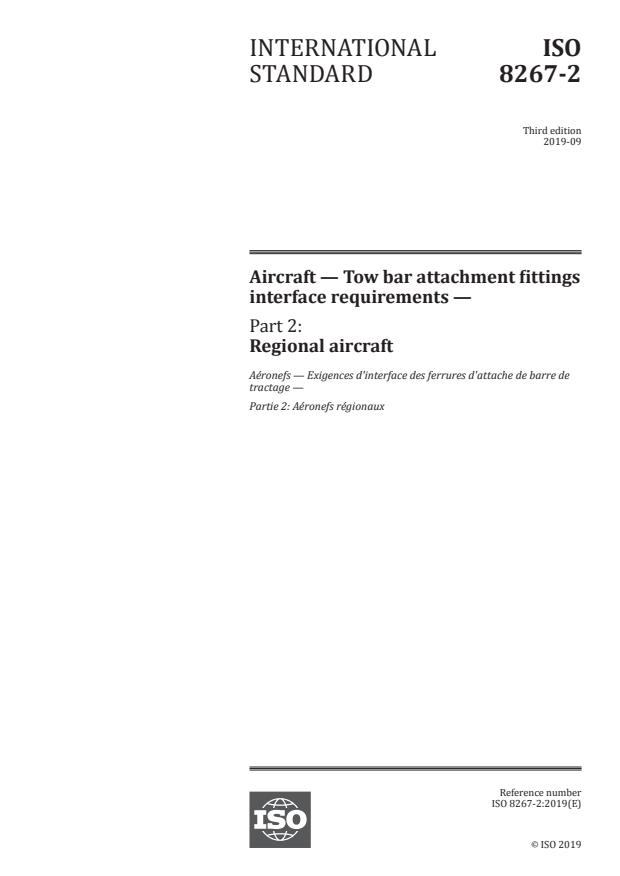
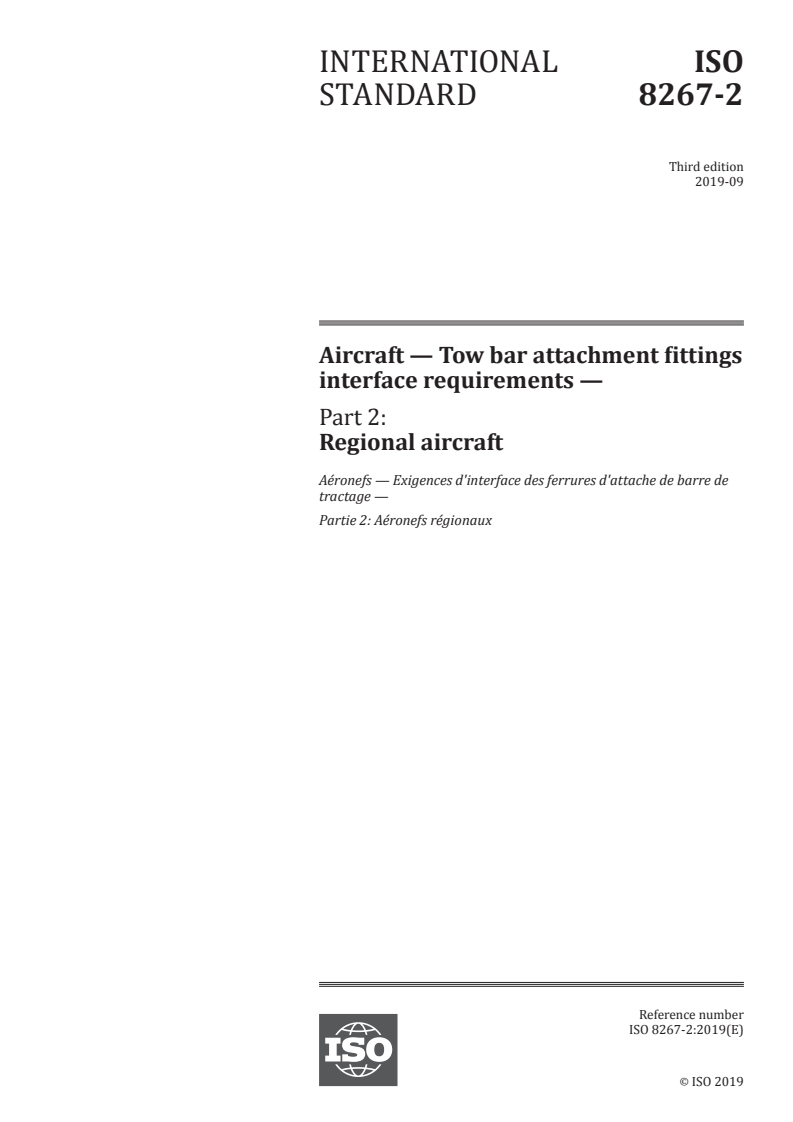
INTERNATIONAL ISO
STANDARD 8267-2
Third edition
2019-09
Aircraft — Tow bar attachment fittings
interface requirements —
Part 2:
Regional aircraft
Aéronefs — Exigences d'interface des ferrures d'attache de barre de
tractage —
Partie 2: Aéronefs régionaux
Reference number
©
ISO 2019
© ISO 2019
All rights reserved. Unless otherwise specified, or required in the context of its implementation, no part of this publication may
be reproduced or utilized otherwise in any form or by any means, electronic or mechanical, including photocopying, or posting
on the internet or an intranet, without prior written permission. Permission can be requested from either ISO at the address
below or ISO’s member body in the country of the requester.
ISO copyright office
CP 401 • Ch. de Blandonnet 8
CH-1214 Vernier, Geneva
Phone: +41 22 749 01 11
Fax: +41 22 749 09 47
Email: copyright@iso.org
Website: www.iso.org
Published in Switzerland
ii © ISO 2019 – All rights reserved
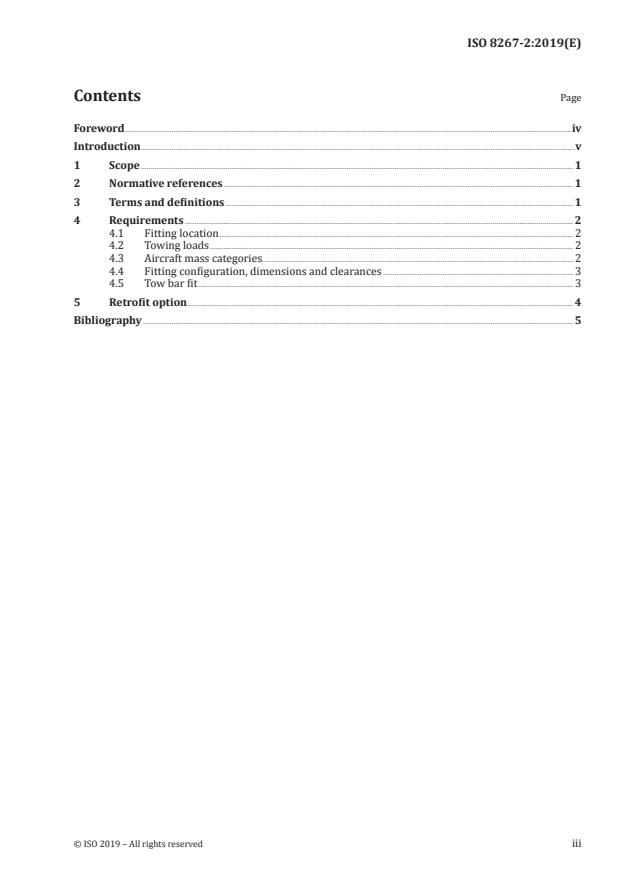
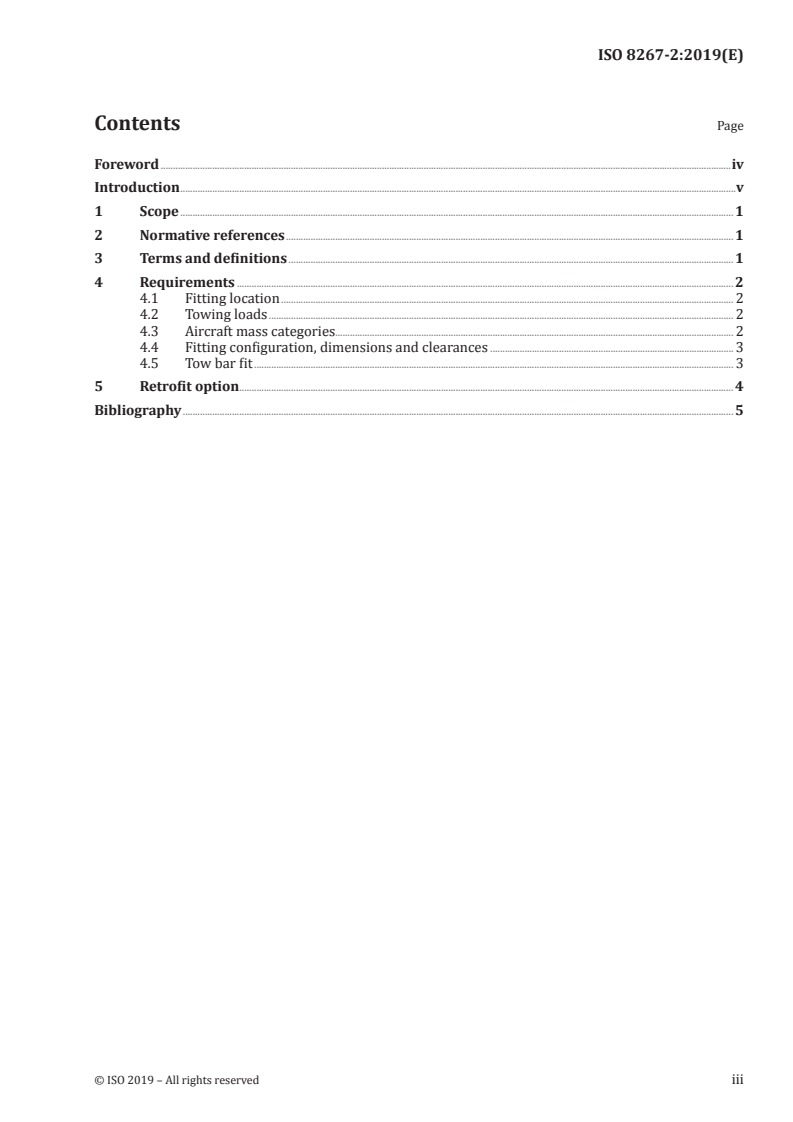
Contents Page
Foreword .iv
Introduction .v
1 Scope . 1
2 Normative references . 1
3 Terms and definitions . 1
4 Requirements . 2
4.1 Fitting location . 2
4.2 Towing loads . 2
4.3 Aircraft mass categories. 2
4.4 Fitting configuration, dimensions and clearances . 3
4.5 Tow bar fit . 3
5 Retrofit option . 4
Bibliography . 5
Foreword
ISO (the International Organization for Standardization) is a worldwide federation of national standards
bodies (ISO member bodies). The work of preparing International Standards is normally carried out
through ISO technical committees. Each member body interested in a subject for which a technical
committee has been established has the right to be represented on that committee. International
organizations, governmental and non-governmental, in liaison with ISO, also take part in the work.
ISO collaborates closely with the International Electrotechnical Commission (IEC) on all matters of
electrotechnical standardization.
The procedures used to develop this document and those intended for its further maintenance are
described in the ISO/IEC Directives, Part 1. In particular, the different approval criteria needed for the
different types of ISO documents should be noted. This document was drafted in accordance with the
editorial rules of the ISO/IEC Directives, Part 2 (see www .iso .org/directives).
Attention is drawn to the possibility that some of the elements of this document may be the subject of
patent rights. ISO shall not be held responsible for identifying any or all such patent rights. Details of
any patent rights identified during the development of the document will be in the Introduction and/or
on the ISO list of patent declarations received (see www .iso .org/patents).
Any trade name used in this document is information given for the convenience of users and does not
constitute an endorsement.
For an explanation of the voluntary nature of standards, the meaning of ISO specific terms and
expressions related to conformity assessment, as well as information about ISO's adherence to the
World Trade Organization (WTO) principles in the Technical Barriers to Trade (TBT) see www .iso
.org/iso/foreword .html.
The committee responsible for this document is ISO/TC 20, Aircraft and space vehicles, Subcommittee
SC 9, Air cargo and ground equipment.
This third edition cancels and replaces the second edition (ISO 8267-2:2015), which has been technically
revised with the following change:
— the normative references have been updated.
A list of all parts in the ISO 8267 series can be found on the ISO website.
Any feedback or questions on this document should be directed to the user’s national standards body. A
complete listing of these bodies can be found at www .iso .org/members .html.
iv © ISO 2019 – All rights reserved
Introduction
The aim of this document is to standardize regional aircraft tow bar attachment fittings according
to aircraft mass category (which determines tow bar forces), so that one tow bar can be used for all
aircraft within that mass category.
Throughout this document, the minimum essential criteria are identified by the use of the key-word
“shall”. Recommended criteria are identified by the use of the key-word “should” and, while not
mandatory, are considered to be of primary importance in providing safe aircraft towing arrangements.
Deviation from recommended criteria should only occur after careful consideration, extensive testing,
and thorough service evaluation have shown alternative methods to be satisfactory.
INTERNATIONAL STANDARD ISO 8267-2:2019(E)
Aircraft — Tow bar attachment fittings interface
requirements —
Part 2:
Regional aircraft
1 Scope
This document specifies the interface requirements for tow bar
...
INTERNATIONAL ISO
STANDARD 8267-2
Third edition
2019-09
Aircraft — Tow bar attachment fittings
interface requirements —
Part 2:
Regional aircraft
Aéronefs — Exigences d'interface des ferrures d'attache de barre de
tractage —
Partie 2: Aéronefs régionaux
Reference number
©
ISO 2019
© ISO 2019
All rights reserved. Unless otherwise specified, or required in the context of its implementation, no part of this publication may
be reproduced or utilized otherwise in any form or by any means, electronic or mechanical, including photocopying, or posting
on the internet or an intranet, without prior written permission. Permission can be requested from either ISO at the address
below or ISO’s member body in the country of the requester.
ISO copyright office
CP 401 • Ch. de Blandonnet 8
CH-1214 Vernier, Geneva
Phone: +41 22 749 01 11
Fax: +41 22 749 09 47
Email: copyright@iso.org
Website: www.iso.org
Published in Switzerland
ii © ISO 2019 – All rights reserved
Contents Page
Foreword .iv
Introduction .v
1 Scope . 1
2 Normative references . 1
3 Terms and definitions . 1
4 Requirements . 2
4.1 Fitting location . 2
4.2 Towing loads . 2
4.3 Aircraft mass categories. 2
4.4 Fitting configuration, dimensions and clearances . 3
4.5 Tow bar fit . 3
5 Retrofit option . 4
Bibliography . 5
Foreword
ISO (the International Organization for Standardization) is a worldwide federation of national standards
bodies (ISO member bodies). The work of preparing International Standards is normally carried out
through ISO technical committees. Each member body interested in a subject for which a technical
committee has been established has the right to be represented on that committee. International
organizations, governmental and non-governmental, in liaison with ISO, also take part in the work.
ISO collaborates closely with the International Electrotechnical Commission (IEC) on all matters of
electrotechnical standardization.
The procedures used to develop this document and those intended for its further maintenance are
described in the ISO/IEC Directives, Part 1. In particular, the different approval criteria needed for the
different types of ISO documents should be noted. This document was drafted in accordance with the
editorial rules of the ISO/IEC Directives, Part 2 (see www .iso .org/directives).
Attention is drawn to the possibility that some of the elements of this document may be the subject of
patent rights. ISO shall not be held responsible for identifying any or all such patent rights. Details of
any patent rights identified during the development of the document will be in the Introduction and/or
on the ISO list of patent declarations received (see www .iso .org/patents).
Any trade name used in this document is information given for the convenience of users and does not
constitute an endorsement.
For an explanation of the voluntary nature of standards, the meaning of ISO specific terms and
expressions related to conformity assessment, as well as information about ISO's adherence to the
World Trade Organization (WTO) principles in the Technical Barriers to Trade (TBT) see www .iso
.org/iso/foreword .html.
The committee responsible for this document is ISO/TC 20, Aircraft and space vehicles, Subcommittee
SC 9, Air cargo and ground equipment.
This third edition cancels and replaces the second edition (ISO 8267-2:2015), which has been technically
revised with the following change:
— the normative references have been updated.
A list of all parts in the ISO 8267 series can be found on the ISO website.
Any feedback or questions on this document should be directed to the user’s national standards body. A
complete listing of these bodies can be found at www .iso .org/members .html.
iv © ISO 2019 – All rights reserved
Introduction
The aim of this document is to standardize regional aircraft tow bar attachment fittings according
to aircraft mass category (which determines tow bar forces), so that one tow bar can be used for all
aircraft within that mass category.
Throughout this document, the minimum essential criteria are identified by the use of the key-word
“shall”. Recommended criteria are identified by the use of the key-word “should” and, while not
mandatory, are considered to be of primary importance in providing safe aircraft towing arrangements.
Deviation from recommended criteria should only occur after careful consideration, extensive testing,
and thorough service evaluation have shown alternative methods to be satisfactory.
INTERNATIONAL STANDARD ISO 8267-2:2019(E)
Aircraft — Tow bar attachment fittings interface
requirements —
Part 2:
Regional aircraft
1 Scope
This document specifies the interface requirements for tow bar
...
Questions, Comments and Discussion
Ask us and Technical Secretary will try to provide an answer. You can facilitate discussion about the standard in here.
Loading comments...