

ISO 25256
(Main)Road sweepers — Performance requirements and test methods
- Abstract
This ISO Standard applies to surface cleaning machines for outdoor applications in public areas, roads, airports and industrial complexes. Surface cleaning machines in terms of this standard, are self-propelled, truck mounted, attached sweeping equipment or pedestrian controlled. This ISO Standard deals with the performance and functional characteristics and the test methods applied to the sweeping equipment when used as intended and under the conditions foreseen by the manufacturer. This ISO Standard does not include carrier vehicles (e.g. trucks). These are covered in national standards or directives for vehicles. This ISO Standard does not cover noise emission or any overload protection as these are covered by regulatory requirements. This document does not apply to: — cleaning machines for winter maintenance; — cleaning machines for indoor applications; — front mounted road cleaning attachments which can be coupled to tractors and other machinery; — machines or components that are specifically; — designed for cleaning tram lines and rail tracks; — industrial sweepers.
- Status
- Not Published
- Technical Committee
- ISO/TC 195/SC 2 - Road operation machinery and associated equipment
- Drafting Committee
- ISO/TC 195/SC 2/WG 2 - Sweeper
- Current Stage
- 6000 - International Standard under publication - 60 Publication
- Start Date
- 12-Nov-2026
Buy Documents
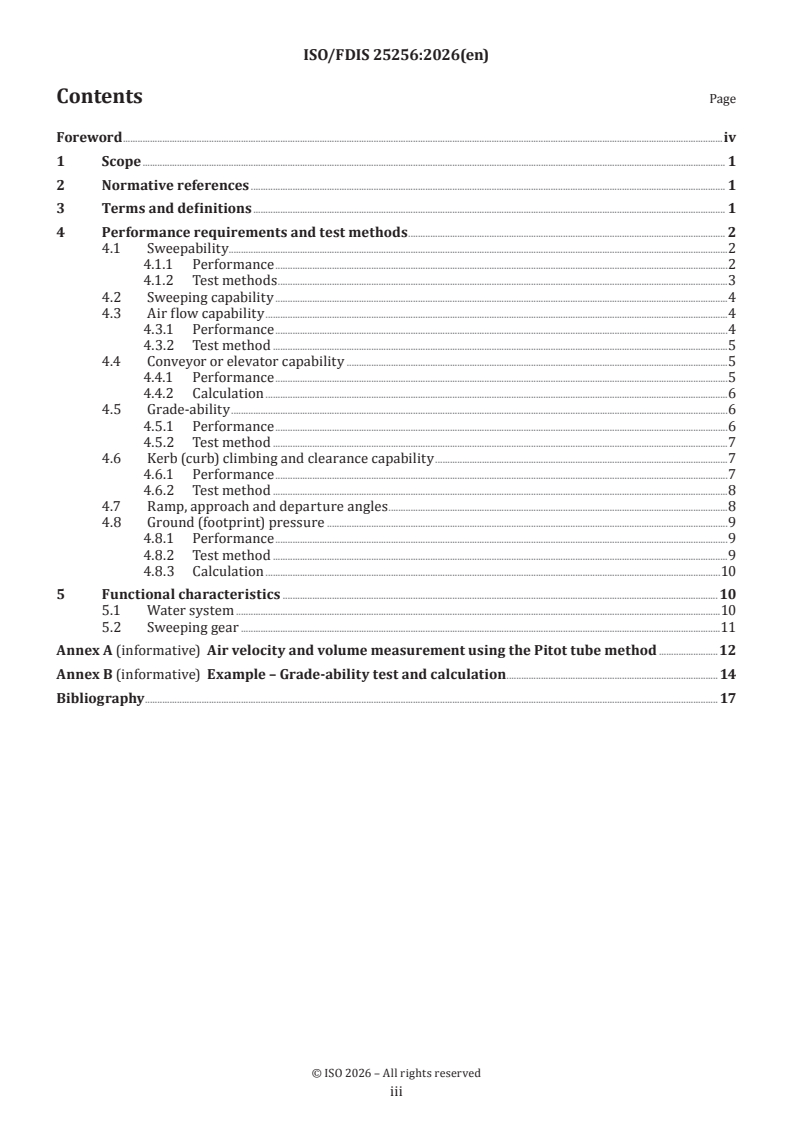

ISO/FDIS 25256 - Road sweepers — Performance requirements and test methods
REDLINE ISO/FDIS 25256 - Road sweepers — Performance requirements and test methods
ISO 25256 from ISO specifies performance requirements, functional characteristics and test methods for road sweepers used outdoors in public areas, roads, airports and industrial complexes. It is aimed at self-propelled, truck mounted, attached sweeping equipment and pedestrian controlled machines, and it gives a common basis for declaring and checking cleaning performance, mobility and key operating features.
What does ISO 25256 specify?
ISO 25256 covers the sweeping equipment itself when used as intended and under the conditions foreseen by the manufacturer. The scope keeps carrier vehicles such as trucks outside the document, and it also excludes noise emission and overload protection because those are handled by regulatory requirements.
The document is organized into five clauses plus two informative annexes:
- Clause 1 - Scope
- Clause 2 - Normative references
- Clause 3 - Terms and definitions
- Clause 4 - Performance requirements and test methods
- Clause 5 - Functional characteristics
| Annex | What it covers |
|---|---|
| Annex A | Air velocity and volume measurement using the Pitot tube method |
| Annex B | Example grade-ability test and calculation |
The exclusions in the scope matter in practice because they tell a purchaser or test lab which machines belong under ISO 25256 and which need another specification. For example, winter maintenance machines, indoor cleaners, front mounted attachments for tractors and machinery, machines designed for tram lines and rail tracks, and industrial sweepers are outside this document.
What are the key requirements of ISO 25256?
ISO 25256 focuses on how a sweeper is declared and how its main operating performances are checked. Clause 4 gives the technical measures that matter most for procurement, type testing and product claims, while Clause 5 adds a small set of functional checks for water handling and sweeping gear.
Cleaning performance and declared capability
Clause 4.1 defines sweepability as the sweeping speed derived from a test method and asks the declaration to state which method was used. Two alternative methods are given:
- Method A uses a dry test material on a dry smooth paved surface and treats the result as the speed at which the machine collects at least 90 % of the material.
- Method B uses standard soil on asphalt or concrete, defines the spread area, the cleaning speed tolerance and the recovery criterion, and requires the remaining soil to be measured.
In practice, this gives manufacturers and test labs two different ways to show how fast the sweeper can clean under controlled conditions. The note on Method A says it typically does not apply to the Japanese market, while Method B typically applies there.
Clause 4.2 defines sweeping capability as a theoretical value calculated from sweeping path width and declared maximum sweeping speed. This helps buyers compare machines on paper when they need a simple capacity figure in m²/h.
Air and mechanical transport systems
Clause 4.3 covers air flow capability for sweepers that use pneumatic means to move debris to the hopper. The declaration has to state the model or type, the air volume flow at standard conditions of 20 °C and 101.3 kPa, and the settings and running speeds used.
This matters because air flow performance depends on duct velocity, pressure and temperature, so the standard fixes the conditions for comparison. Annex A gives a Pitot tube method for measuring duct velocity and converting it to standard conditions, including a suggested test log.
Clause 4.4 covers conveyor or elevator capability for machines that use mechanical transfer to move debris. The document uses a calculated maximum loading capability based on catchment dimensions, discharge rate and elevator angle, and it requires those declared values to be identified as theoretical.
Mobility, clearance and ground contact
Clause 4.5 covers grade-ability and allows calculation, practical testing, or both. The declaration is tied to the maximum permitted mass and to the ability to start, stop, bring the machine to rest and hold it in forward and reverse directions.
Annex B gives an example of a tow-test setup and the calculation approach. In practice, this tells a buyer whether the machine can work safely on slopes and whether the service brake and park brake capability are part of the claimed performance.
Clause 4.6 covers kerb (curb) climbing and clearance capability. The result is the maximum step height the sweeper can mount from a static position at alternate approach angles of 30° and 60°, with the machine loaded to maximum permitted mass and fitted with new tyres at the recommended pressure.
Clause 4.7 covers ramp, approach and departure angles and uses the ISO 612 definitions. The angles are declared with sweeping gear stowed and at maximum permissible mass, with any structural limit identified.
Clause 4.8 covers ground (footprint) pressure. The standard requires the pressure to be based on the wheel or tyre that creates the greatest pressure, with tyre footprint measurement on a paper sheet and calculation from loaded force and contact area.
Functional characteristics
Clause 5 adds two practical functional checks:
- The water system must keep working when impurities are present in the water, and it must be able to drain fully to reduce freezing risk.
- The sweeping gear, when active in working positions, shall deflect on impact with solid obstacles.
These points matter because they address day-to-day operability, not just laboratory performance. They help users think about water contamination, cold-weather use and how the machine behaves when it meets an obstacle.
What terms does ISO 25256 define?
ISO 25256 defines several terms that control how the performance claims are understood.
- Performance - obligations verified by specified tests or calculations, and theoretical values must be identified as such.
- Functional characteristics - operational requirements of a system or mechanism.
- Test method - the procedure used to achieve the performance criteria.
- Calculation - the equation and method used to determine a numerical performance value.
- Theoretical value - a value derived from drawings, calculations, or both, rather than from a physical test.
- Maximum sweeping speed - the speed declared by the manufacturer for a foreseen sweeping application or test.
- Prime mover - the internal combustion engine, electric motor or hybrid drive system that supplies the main power for work and travel mode functions.
- Carrier vehicle - the base vehicle onto which the sweeper equipment is mounted.
These definitions matter because the standard separates measured performance from calculated claims, and it makes clear when a value is theoretical rather than test-based.
Who uses ISO 25256?
ISO 25256 is used by manufacturers of road sweepers and surface cleaning machines, by test laboratories, and by technical staff who need to declare or verify performance. It is also relevant to buyers, quality managers and fleet operators who compare machines for public area cleaning, road maintenance, airport operations and industrial complex cleaning.
The standard is most useful when a user needs to compare sweeping performance, slope capability, clearance, air handling or footprint pressure in a structured way. It also helps when preparing product data, test reports or procurement specifications.
Which standards are used with ISO 25256?
ISO 25256 cites three normative references that support its technical measurements:
- ISO 536:2019 - provides the paper and board grammage reference used for the footprint test sheet in the ground pressure method.
- ISO 612:1978 - provides road vehicle dimension terms and the definitions used for ramp, approach and departure angles.
- ISO 24147 - provides road operation machinery and associated equipment terms, including the sweeping path width used in the sweeping capability calculation.
These references give ISO 25256 its measurement language and some of its calculation inputs, so users should read them together when they need to apply the document in testing or product declaration.
What does the ISO 25256 document contain?
ISO 25256 contains a compact set of performance clauses, measurement methods and declaration requirements for road sweepers. The main technical content is in Clause 4, which covers sweepability, sweeping capability, air flow capability, conveyor or elevator capability, grade-ability, kerb climbing, ramp and departure angles, and ground pressure.
The document also contains two informative annexes that support testing and calculation. Annex A gives a Pitot tube method for duct velocity and air volume flow, while Annex B gives an example of grade-ability testing with towing and braking calculations.
Several parts of the document are procedure-based rather than descriptive. It includes test set-ups, calculation formulas, measurement conditions, a figure for footprint evaluation, and a test log for air flow measurements, which makes it suitable for laboratory work, type testing and performance declaration.
Buy Documents
ISO/FDIS 25256 - Road sweepers — Performance requirements and test methods
REDLINE ISO/FDIS 25256 - Road sweepers — Performance requirements and test methods
Get Certified
Connect with accredited certification bodies for this standard

TÜV Rheinland
TÜV Rheinland is a leading international provider of technical services.

TÜV SÜD
TÜV SÜD is a trusted partner of choice for safety, security and sustainability solutions.

DEKRA Certification Inc.
DEKRA US certification services.
Sponsored listings
Frequently Asked Questions
ISO 25256 is a draft published by the International Organization for Standardization (ISO). Its full title is "Road sweepers — Performance requirements and test methods". This standard covers: This ISO Standard applies to surface cleaning machines for outdoor applications in public areas, roads, airports and industrial complexes. Surface cleaning machines in terms of this standard, are self-propelled, truck mounted, attached sweeping equipment or pedestrian controlled. This ISO Standard deals with the performance and functional characteristics and the test methods applied to the sweeping equipment when used as intended and under the conditions foreseen by the manufacturer. This ISO Standard does not include carrier vehicles (e.g. trucks). These are covered in national standards or directives for vehicles. This ISO Standard does not cover noise emission or any overload protection as these are covered by regulatory requirements. This document does not apply to: — cleaning machines for winter maintenance; — cleaning machines for indoor applications; — front mounted road cleaning attachments which can be coupled to tractors and other machinery; — machines or components that are specifically; — designed for cleaning tram lines and rail tracks; — industrial sweepers.
This ISO Standard applies to surface cleaning machines for outdoor applications in public areas, roads, airports and industrial complexes. Surface cleaning machines in terms of this standard, are self-propelled, truck mounted, attached sweeping equipment or pedestrian controlled. This ISO Standard deals with the performance and functional characteristics and the test methods applied to the sweeping equipment when used as intended and under the conditions foreseen by the manufacturer. This ISO Standard does not include carrier vehicles (e.g. trucks). These are covered in national standards or directives for vehicles. This ISO Standard does not cover noise emission or any overload protection as these are covered by regulatory requirements. This document does not apply to: — cleaning machines for winter maintenance; — cleaning machines for indoor applications; — front mounted road cleaning attachments which can be coupled to tractors and other machinery; — machines or components that are specifically; — designed for cleaning tram lines and rail tracks; — industrial sweepers.
ISO 25256 is classified under the following ICS (International Classification for Standards) categories: 43.160 - Special purpose vehicles. The ICS classification helps identify the subject area and facilitates finding related standards.
ISO 25256 is available in PDF format for immediate download after purchase. The document can be added to your cart and obtained through the secure checkout process. Digital delivery ensures instant access to the complete standard document.
Standards Content (Sample)
Contents
- 1 Scope
- 2 Normative references
- 3 Terms and definitions
- 3.1 performance
- 3.2 functional characteristic
- 3.3 test method
- 3.4 calculation
- 3.5 theoretical value
- 3.6 maximum sweeping speed
- 3.7 prime mover
- 3.8 carrier vehicle
- 3.9 ground (footprint) pressure
- 4 Performance requirements and test methods
- 4.1 Sweepability
- 4.2 Sweeping capability
- 4.3 Air flow capability
- 4.4 Conveyor or elevator capability
- 4.5 Grade-ability
- 4.6 Kerb (curb) climbing and clearance capability
- 4.7 Ramp, approach and departure angles
- 4.8 Ground (footprint) pressure
- 5 Functional characteristics
- 5.1 Water system
- 5.2 Sweeping gear
- Annex A
- Annex B
- Bibliography
1 Scope
This document specifies the performance requirements, functional characteristics and test methods for the sweeping equipment when used as intended and under the conditions foreseen by the manufacturer. This document applies to surface cleaning machines for outdoor applications in public areas, roads, airports and industrial complexes, which are self-propelled, truck mounted, attached sweeping equipment or pedestrian controlled.
This document does not include carrier vehicles (e.g. trucks). This document does not cover noise emission or any overload protection. This document does not apply to:
- cleaning machines for winter maintenance;
- cleaning machines for indoor applications;
- front mounted road cleaning attachments which can be coupled to tractors and other machinery;
- machines or components that are specifically designed for cleaning tram lines and rail tracks;
- industrial sweepers.
2 Normative references
The following documents are referred to in the text in such a way that some or all of their content constitutes requirements of this document. For dated references, only the edition cited applies. For undated references, the latest edition of the referenced document (including any amendments) applies. ISO 536, Paper and board — Determination of grammage ISO 612, Road vehicles — Dimensions of motor vehicles and towed vehicles — Terms and definitions ISO 24147, Road operation machinery and associated equipment — Sweepers — Commercial specifications
3 Terms and definitions
For the purposes of this document, the terms and definitions given in ISO 24147, ISO 612 and the following apply.
ISO and IEC maintain terminology databases for use in standardization at the following addresses:
- ISO Online browsing platform: available at https:// www .iso .org/ obp
- IEC Electropedia: available at https:// www .electropedia .org/
ISO/FDIS 25256:2026(en)
3.1 performance
obligations verified either by specified tests or calculations (3.4) Note 1 to entry: Additionally, performance may be stated as a value resulting from a calculation with no associated test conducted, in which case the declaration shall be disclosed as a theoretical value (3.5).
3.2 functional characteristic
operational requirement of a system or a mechanism
3.3 test method
procedure to achieve the performance (3.1) criteria
3.4 calculation
equation and method to determine a performance (3.1) numerical value
3.5 theoretical value
value derived from either drawings or from calculations (3.4), or both Note 1 to entry: The value shall declare the absolute performance (3.1) criteria, the criterion used in the calculation would be those advertised in the manufacturer’s published data. As this value is purely theoretical, it is unlikely to be achieved in use.
3.6 maximum sweeping speed
speed declared by the manufacturer related to either a foreseen sweeping application or test, or both Note 1 to entry: The maximum sweeping speed is expressed in m/s or km/h.
3.7 prime mover
internal combustion engine (diesel/petrol/gas), electric motor or hybrid drive system providing the principal power sources for work and travel mode functions Note 1 to entry: Some sweepers may employ separate prime movers for propulsion and for driving the sweeping mechanisms.
3.8 carrier vehicle
base vehicle on to which the sweeper equipment is mounted Note 1 to entry: The sweeper equipment may be in some cases powered by the carrier vehicle prime mover (3.7) via power-take-off facilities or similar means.
3.9 ground (footprint) pressure
contact pressure exerted by the sweeper in a static condition on a smooth paved surface
4 Performance requirements and test methods
4.1 Sweepability
4.1.1 Performance
The sweepability is the sweeping speed as derived from the test method described in 4.1.2 or 4.1.3 in km/h.
ISO/FDIS 25256:2026(en)
4.1.2 Test methods
4.1.2.1 General
The performance declaration shall clarify which test method was used.
4.1.2.2 Test method A
The sweepability shall be derived from a sweeping test, where a test material, composing a dry mixture by weight of 65 % washed sand (< 2 mm), 15 % gravel/grit (2 mm to 8 mm) and 20 % calcium carbonate, shall
be spread at a rate of 700 g/m on to a dry smooth paved test surface in a zone extending at least 25 m long and by 60 % of the sweeper’s maximum sweeping width wide (this sweeping width would be the same value as used for the calculation in 4.1). The maximum sweeping speed is the speed where the sweeper collects at least 90 % of the test material; the performance assessment may be judged visually. NOTE This test method typically does not apply to the Japanese market.
4.1.2.3 Test method B
4.1.2.3.1 Test conditions 3 3 - Spread material: standard soil (specific gravity 1,24 g/cm to 1,34 g/cm ). - Measurement distance: 100 m or more.
- Test road surface: asphalt pavement or concrete pavement with a slope of less than 2 %.
- Spreading width: 80 % of the maximum cleaning width of the sweeper.
- Spreading length: 20 m (cleaning speed less than 25 km/h), 50 m (cleaning speed 25 km/h and over).
- Spreading amount: 0,1 kg/m .
- Cleaning conditions: no watering.
For accurate collection of the remaining soil, watering on the road surface shall be avoided. The particle size accumulation curve of soil for road cleaning vehicle performance tests and the mass fraction of soil that passed through the sieve are shown in Figure 1. Key X particle size in mm Y passing mass fraction in % Figure 1 — Accumulation curve for standard soil particle size NOTE The standard soil particle size can be obtained within the particle size range as shown in Figure 1.
ISO/FDIS 25256:2026(en) 4.1.2.3.2 Test method - Spread standard soil evenly on the road surface.
- Start measurement to clean up the spread soil.
- Measure the time required for the sweeper to pass through the soil spread area.
- Measure the time required for the sweeper to pass through the course.
- Calculate the cleaning speed. The cleaning speed shall be within ±5 % tolerance of the aimed speed.
- Collect remaining soil with a broom and measure its mass.
- Measure the sweepability when cleaning at the maximum cleaning speed of the sweeper.
- Cleaning speed should be kept as constant as possible during this test.
- The broom used for collection shall be made from natural materials with bristle diameters of 0,5 mm or less and bristle lengths of 100 mm or more.
- Verify that the retrieval rate is equal to 95 % or more. It is proved by the fact that the mass of remaining soil is less than 5 % of the initial spread soil. If the result does not pass the criteria, adjust the cleaning equipment, or reduce the cleaning speed and repeat this procedure. NOTE This test method typically applies to the Japanese market.
4.2 Sweeping capability
The theoretical sweeping capability is derived from a calculation of the product of the sweeping path width (as defined in ISO 24147) and the manufacturer’s declared maximum sweeping speed. The theoretical
sweeping capability is expressed in m /h.
4.3 Air flow capability
4.3.1 Performance
Sweepers that use pneumatic means to collect and transport swept debris to the collection hopper require sufficient air velocity within the duct communicating with the pick-up device and hopper for satisfactory conveyance. Air movement is usually performed by an exhausting means, e.g. by a fan extracting air from the hopper. The air velocity within the duct and its cross-sectional area has a direct correlation with the volume of air movement. The air velocity within the duct shall be expressed in m/s. The volume of air movement
within the duct shall be expressed in m /s, calculated as the product of the average velocity and the duct’s
cross section expressed in m .
The air temperature, atmospheric pressure and the depression within the duct all affect the air density and flow characteristic; hence, any declared values shall be expressed in standard conditions of 20 °C and at 101,3 kPa atmospheric pressure.
The effects of changes in relative humidity also affect air density, but as the effect is minimal, variance affects can be disregarded. Performance shall be advertised at 50 % relative humidity so that tests are conducted in dry weather conditions. Tests shall not be conducted in adverse weather conditions. The following information shall accompany the air flow capability declaration:
- sweeper – model/type;
- declaration expressed in m /s at 20 °C and at 101,3 kPa atmospheric pressure;
- settings and running speeds.
ISO/FDIS 25256:2026(en)
4.3.2 Test method
The average air velocity within the duct may be measured using suitable means. Prior to any test, the machine shall be inspected to ensure that it is in good working order, clean and that either any filters or communicating ductwork, or both are free of restrictions and or blockages. During tests, the machine shall be set up in accordance with the manufactures recommended settings. In addition, a record of these settings and running speeds shall accompany the performance results.
Annex A describes a technique to measure duct velocity using the Pitot tube method.
...
Contents
- 1 Scope
- 2 Normative references
- 3 Terms and definitions
- 4 Performance requirements and test methods
- 4.1 Sweepability
- 4.2 Sweeping capability
- 4.3 Air flow capability
- 4.4 Conveyor or elevator capability
- 4.5 Grade-ability
- 4.6 Kerb (curb) climbing and clearance capability
- 4.7 Ramp, approach and departure angles
- 4.8 Ground (footprint) pressure
- 5 Functional characteristics
- 5.1 Water system
- 5.2 Sweeping gear
- Annex A
- Annex B
- Bibliography
1 Scope
This document specifies the performance requirements, functional characteristics and test methods for the sweeping equipment when used as intended and under the conditions foreseen by the manufacturer. This document applies to surface cleaning machines for outdoor applications in public areas, roads, airports and industrial complexes, which are self-propelled, truck mounted, attached sweeping equipment or pedestrian controlled.
This document does not include carrier vehicles (e.g. trucks). This document does not cover noise emission or any overload protection. This document does not apply to:
- — cleaning machines for winter maintenance;
- — cleaning machines for indoor applications;
- — front mounted road cleaning attachments which can be coupled to tractors and other machinery;
- — machines or components that are specifically designed for cleaning tram lines and rail tracks;
- — industrial sweepers.
2 Normative references
The following documents are referred to in the text in such a way that some or all of their content constitutes requirements of this document. For dated references, only the edition cited applies. For undated references, the latest edition of the referenced document (including any amendments) applies. ISO 536:2019, Paper and board — Determination of grammage ISO 612:1978, Road vehicles — Dimensions of motor vehicles and towed vehicles — Terms and definitions ISO 24147, Road operation machinery and associated equipment — Sweepers — Commercial specifications
3 Terms and definitions
For the purposes of this document, the terms and definitions given in ISO 24147, ISO 612 and the following apply.
ISO and IEC maintain terminology databases for use in standardization at the following addresses:
- — ISO Online browsing platform: available at https://www.iso.org/obp
- — IEC Electropedia: available at https://www.electropedia.org/
ISO/FDIS 25256:2026(en) 3.1 3.1 performance obligations verified either by specified tests or calculations (3.4) Note 1 to entry: Additionally, performance may be stated as a value resulting from a calculation with no associated test conducted, in which case, the declaration shall be disclosed as a theoretical value (3.5.). 3.2 3.2 functional characteristicscharacteristic operational requirementsrequirement of a system or a mechanism 3.3 3.3 test method procedure to achieve the performance (3.1(3.1)) criteria 3.4 3.4 calculation equation and method to determine a performance (3.1(3.1)) numerical value 3.5 3.5 theoretical value value derived from either drawings or from calculations (3.4,), or both Note 1 to entry: The value shall declare the absolute performance (3.1(3.1)) criteria, the criterion used in the calculation would be those advertised in the manufacturer'smanufacturer’s published data. As this value is purely theoretical, it is unlikely to be achieved in use.
3.6 3.6 maximum sweeping speed speed declared by the manufacturer related to either a foreseen sweeping application or test, or both Note 1 to entry: The maximum sweeping speed is expressed in m/s or km/h. 3.7 3.7 prime mover internal combustion engine (diesel/petrol/gas), electric motor or hybrid drive system providing the principal power sources for work and travel mode functions Note 1 to entry: Some sweepers may employ separate prime movers for propulsion and for driving the sweeping mechanisms.
3.8 3.8 carrier vehicle base vehicle on to which the sweeper equipment is mounted Note 1 to entry: The sweeper equipment may be in some cases powered by the carrier vehicle prime mover (3.7(3.10)) via power-take-off facilities or similar means.
3.9 3.9 ground (footprint) pressure contact pressure exerted by the sweeper in a static condition on a smooth paved surface.
ISO/DISFDIS 25256:2026(en)
4 Performance requirements and test methods
4.1 Sweepability
4.1.1 Performance
The sweepability is the sweeping speed as derived from the test method described in 4.1.24.1.2 or 4.1.3 in km/h.
4.1.2 Test methods
4.1.2.1 General
The performance declaration shall clarify which test method was used.
4.1.2.2 Test method A
The sweepability shall be derived from a sweeping test, where a test material, composing a dry mixture by weight of 65 % washed sand (< 2 mm), 15 % gravel/grit (2 mm to 8 mm) and 20 % calcium carbonate, shall
be spread at a rate of 700 g/m on to a dry smooth paved test surface in a zone extending at least 25 m long and by 60 % of the sweeper’s maximum sweeping width wide (this sweeping width would be the same value as used for the calculation in 4.14.1).). The maximum sweeping speed is the speed where the sweeper collects at least 90 % of the test material; the performance assessment may be judged visually. NOTE This test method typically does not apply to the Japanese market.
4.1.2.3 Test method B
4.1.2.3.1 Test conditions 3 3 - — Spread material: standard soil (specific gravity 1,24 g/cm to 1,34 g/cm ). - — Measurement distance: 100 m or more.
- — Test road surface: asphalt pavement or concrete pavement with a slope of less than 2 %.
- — Spreading width: 80 % of the maximum cleaning width of the sweeper.
- — Spreading length: 20 m (cleaning speed less than 25 km/h), 50 m (cleaning speed 25 km/h and over).
- — Spreading amount: 0,1 kg/m .
- — Cleaning conditions: no watering.
For accurate collection of the remaining soil, watering on the road surface shall be avoided. The particle size accumulation curve of soil for road cleaning vehicle performance tests and the mass fraction of soil that passed through the sieve are shown in Figure 1Figure 1..
ISO/FDIS 25256:2026(en)
ISO/DISFDIS 25256:2026(en)
Key X particle size in mm Y passing mass fraction in % Figure 1 — Accumulation curve for standard soil particle size NOTE The standard soil particle size can be obtained within the particle size range as shown in Figure 1Figure 1.. 4.1.2.3.2 Test method - — Spread standard soil evenly on the road surface.
- — Start measurement to clean up the spread soil.
- — Measure the time required for the sweeper to pass through the soil spread area.
- — Measure the time required for the sweeper to pass through the course.
- — Calculate the cleaning speed. The cleaning speed shall be within ±5 % tolerance of the aimed speed.
- — Collect remaining soil with a broom and measure its mass.
- — Measure the sweepability when cleaning at the maximum cleaning speed of the sweeper.
- — cleaningCleaning speed should be kept as constant as possible during this test.
- — The broom used for collection shall be made from natural materials with bristle diameters of 0,5 mm or less and bristle lengths of 100 mm or more.
- — Verify that the retrieval rate is equal to 95 % or more. It is proved by the fact that the mass of remaining soil is less than 5 % of the initial spread soil. If the result does not pass the criteria, adjust the cleaning equipment, or reduce the cleaning speed and repeat this procedure. NOTE This test method typically applies to the Japanese market.
4.2 Sweeping capability
The theoretical sweeping capability is derived from a calculation of the product of the sweeping path width (as defined in ISO 24147) and the manufacturer’s declared maximum sweeping speed. The theoretical
sweeping capability is expressed in m /h.
ISO/FDIS 25256:2026(en)
4.3 Air flow capability
4.3.1 Performance
Sweepers that use pneumatic means to collect and transport swept debris to the collection hopper require sufficient air velocity within the duct communicating with the pick-up device and hopper for satisfactory conveyance. Air movement is usually performed by an exhausting means, e.g. by a fan extracting air from the hopper. The air velocity within the duct and its cross-sectional area has a direct correlation with the volume of air movement. The air velocity within the duct shall be expressed in m/s. The volume of air movement
within the duct shall be expressed in m /s, calculated as the product of the average velocity and the duct’s
cross section expressed in m .
The air temperature, atmospheric pressure and the depression within the duct all affect the air density and flow characteristic; hence, any declared values shall be expressed in standard conditions of 20 °C and at 101,3 kPa atmospheric pressure.
The effects of changes in relative humidity also affect air density, but as the effect is minimal, variance affects can be disregarded. Performance shall be advertised at 50 % relative humidity so that tests are conducted in dry weather conditions. Tests shall not be conducted in adverse weather conditions. The following information shall accompany the air flow capability declaration:
- — sweeper – model/type;
- — declaration expressed in m /s at 20 °C and at 101,3 kPa atmospheric pressure;
- — settings and running speeds.
4.3.2 Test method
The average air velocity within the duct may be measured using suitable means. Prior to any test, the machine shall be inspected to ensure that it is in good working order, clean and that either any filters or communicating ductwork, or both are free of restrictions and or blockages. During tests, the machine shall be set up in accordance with the manufactures recommended settings. In addition, a record of these settings and running speeds shall accompany the performance results.
Annex AAnnex A describes a technique to measure duct velocity using the Pitot tube method.
...