

ISO 11949:2016
(Main)Cold-reduced tinmill products — Electrolytic tinplate
General Information
- Abstract
ISO 11949:2016 specifies requirements for single and double cold-reduced low-carbon mild steel electrolytic tinplate in the form of sheets or coils. Single cold-reduced tinplate is generally specified in nominal thicknesses that are multiples of 0,005 mm, from 0,150 mm up to and including 0,600 mm. Double cold-reduced tinplate is generally specified in nominal thicknesses that are multiples of 0,005 mm, from 0,100 mm up to and including 0,360 mm. ISO 11949:2016 applies to coils and sheets cut from coils in nominal minimum rolling widths of 600 mm.[1] [1] Nominal minimum rolling widths of 500 mm may be applied by agreement between the purchaser and the manufacturer.
- Status
- Withdrawn
- Publication Date
- 06-Mar-2016
- Technical Committee
- ISO/TC 17/SC 9 - Tinplate and blackplate
- Drafting Committee
- ISO/TC 17/SC 9 - Tinplate and blackplate
- Current Stage
- 9599 - Withdrawal of International Standard
- Start Date
- 22-Apr-2026
- Completion Date
- 29-Aug-2026
Overview - ISO 11949:2016 (Cold‑reduced electrolytic tinplate)
ISO 11949:2016 specifies requirements for single and double cold‑reduced low‑carbon mild steel electrolytic tinplate supplied as sheets or coils. The standard covers nominal thickness ranges (single: 0.150–0.600 mm; double: 0.100–0.360 mm) and applies to coils and cut sheets with nominal minimum rolling widths of 600 mm (500 mm by agreement). It defines product characteristics, manufacturing features, testing and inspection, and delivery documentation for electrolytic tinplate.
Key topics and technical requirements
- Product scope and designation
- Single and double cold‑reduced tinplate identified by steel grade, annealing type and coating details.
- Thickness and width limits
- Thickness increments generally in multiples of 0.005 mm; nominal minimum rolling width 600 mm (or 500 mm by agreement).
- Manufacturing features
- Definitions and requirements for cold reduction, annealing methods (batch/box annealed BA and continuously annealed CA), temper rolling and finishes.
- Surface finishes
- Classified as bright, stone, silver or matt depending on temper‑mill roll texture and whether the tin coating is flow‑melted.
- Tin coating mass
- Requirements and measurement methods for tin coating mass and differential coating (one side heavier than the other).
- Mechanical and performance properties
- Hardness and tensile property requirements (Rockwell/Tensile specifications referenced); routine tests such as springback for proof strength.
- Dimensional tolerances and shape
- Tolerances on thickness, width, length, feather edge, flatness, edge camber and bow.
- Inspection, sampling and test methods
- Sampling, testing and retest procedures; specific test methods for tin coating mass, hardness and tensile tests are referenced.
- Marking, packaging and dispatch
- Requirements for marking differentially coated material, inspection documents and packing.
Practical applications and users
ISO 11949:2016 is used by:
- Steel producers and tinplate mills to specify production, inspection and delivery of electrolytic tinplate.
- Purchasers and specifiers (manufacturers using tinplate for further processing) to define required gauge, finish, coating mass and mechanical properties.
- Quality & testing laboratories that perform hardness, tensile and coating mass measurements and verify conformity.
- Converters and fabricators who cut, form or lacquer tinplate sheets and coils and require clear acceptance criteria.
Typical applications include any industry requiring consistent, coated mild steel sheet or coil for further processing (packaging, lacquering, forming), where tight control of coating and mechanical properties is essential.
Related standards
- ISO 11951 (cold‑reduced blackplate for tinplate production)
- ISO 404 (general technical delivery conditions)
- ISO 6508‑1 (Rockwell hardness test)
- ISO 6892‑1 (tensile testing)
- ISO 10474 (inspection documents)
- ISO 4288, ISO/TR 9769 (surface texture and analysis methods)
Keywords: ISO 11949:2016, electrolytic tinplate, cold‑reduced tinplate, tin coating mass, tinplate sheets, tinplate coils, tinplate standards, tinplate specifications.
Relations
- Effective Date
- 25-Aug-2026
- Effective Date
- 25-Aug-2026
- Effective Date
- 06-Jun-2022
- Effective Date
- 06-Jun-2022
- Effective Date
- 29-Jan-2011
Get Certified
Connect with accredited certification bodies for this standard

Element Materials Technology
Materials testing and product certification.

Inštitut za kovinske materiale in tehnologije
Institute of Metals and Technology. Materials testing, metallurgical analysis, NDT.
Sponsored listings
Frequently Asked Questions
ISO 11949:2016 is a standard published by the International Organization for Standardization (ISO). Its full title is "Cold-reduced tinmill products — Electrolytic tinplate". This standard covers: ISO 11949:2016 specifies requirements for single and double cold-reduced low-carbon mild steel electrolytic tinplate in the form of sheets or coils. Single cold-reduced tinplate is generally specified in nominal thicknesses that are multiples of 0,005 mm, from 0,150 mm up to and including 0,600 mm. Double cold-reduced tinplate is generally specified in nominal thicknesses that are multiples of 0,005 mm, from 0,100 mm up to and including 0,360 mm. ISO 11949:2016 applies to coils and sheets cut from coils in nominal minimum rolling widths of 600 mm.[1] [1] Nominal minimum rolling widths of 500 mm may be applied by agreement between the purchaser and the manufacturer.
ISO 11949:2016 specifies requirements for single and double cold-reduced low-carbon mild steel electrolytic tinplate in the form of sheets or coils. Single cold-reduced tinplate is generally specified in nominal thicknesses that are multiples of 0,005 mm, from 0,150 mm up to and including 0,600 mm. Double cold-reduced tinplate is generally specified in nominal thicknesses that are multiples of 0,005 mm, from 0,100 mm up to and including 0,360 mm. ISO 11949:2016 applies to coils and sheets cut from coils in nominal minimum rolling widths of 600 mm.[1] [1] Nominal minimum rolling widths of 500 mm may be applied by agreement between the purchaser and the manufacturer.
ISO 11949:2016 is classified under the following ICS (International Classification for Standards) categories: 77.140.50 - Flat steel products and semi-products. The ICS classification helps identify the subject area and facilitates finding related standards.
ISO 11949:2016 has the following relationships with other standards: It is inter standard links to EN ISO 1514:2016, EN ISO 1514:2024, ISO 80601-2-56:2017, ISO 11949:2026, ISO 11949:1995. Understanding these relationships helps ensure you are using the most current and applicable version of the standard.
ISO 11949:2016 is available in PDF format for immediate download after purchase. The document can be added to your cart and obtained through the secure checkout process. Digital delivery ensures instant access to the complete standard document.
Standards Content (Sample)
INTERNATIONAL ISO
STANDARD 11949
Second edition
2016-03-01
Cold-reduced tinmill products —
Electrolytic tinplate
Aciers pour emballage laminés à froid — Fer blanc électrolytique
Reference number
©
ISO 2016
© ISO 2016, Published in Switzerland
All rights reserved. Unless otherwise specified, no part of this publication may be reproduced or utilized otherwise in any form
or by any means, electronic or mechanical, including photocopying, or posting on the internet or an intranet, without prior
written permission. Permission can be requested from either ISO at the address below or ISO’s member body in the country of
the requester.
ISO copyright office
Ch. de Blandonnet 8 • CP 401
CH-1214 Vernier, Geneva, Switzerland
Tel. +41 22 749 01 11
Fax +41 22 749 09 47
copyright@iso.org
www.iso.org
ii © ISO 2016 – All rights reserved
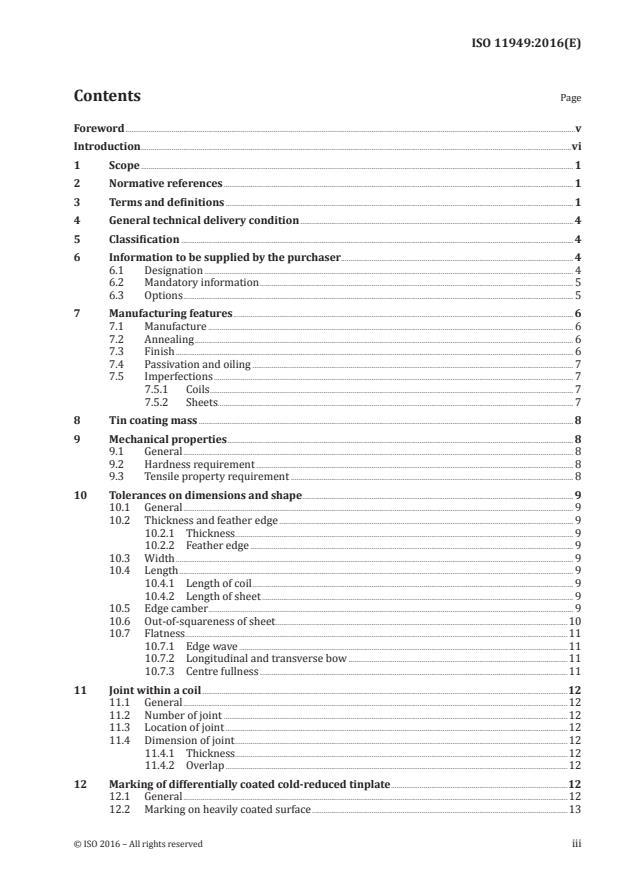
Contents Page
Foreword .v
Introduction .vi
1 Scope . 1
2 Normative references . 1
3 Terms and definitions . 1
4 General technical delivery condition . 4
5 Classification . 4
6 Information to be supplied by the purchaser. 4
6.1 Designation . 4
6.2 Mandatory information . 5
6.3 Options . 5
7 Manufacturing features . 6
7.1 Manufacture . 6
7.2 Annealing . 6
7.3 Finish . 6
7.4 Passivation and oiling . 7
7.5 Imperfections . 7
7.5.1 Coils . 7
7.5.2 Sheets . . . 7
8 Tin coating mass . 8
9 Mechanical properties . 8
9.1 General . 8
9.2 Hardness requirement . 8
9.3 Tensile property requirement . 8
10 Tolerances on dimensions and shape . 9
10.1 General . 9
10.2 Thickness and feather edge . 9
10.2.1 Thickness . 9
10.2.2 Feather edge . 9
10.3 Width . 9
10.4 Length . 9
10.4.1 Length of coil . 9
10.4.2 Length of sheet . 9
10.5 Edge camber . 9
10.6 Out-of-squareness of sheet .10
10.7 Flatness .11
10.7.1 Edge wave .11
10.7.2 Longitudinal and transverse bow .11
10.7.3 Centre fullness .11
11 Joint within a coil .12
11.1 General .12
11.2 Number of joint .12
11.3 Location of joint .12
11.4 Dimension of joint .12
11.4.1 Thickness .12
11.4.2 Overlap .12
12 Marking of differentially coated cold-reduced tinplate .12
12.1 General .12
12.2 Marking on heavily coated surface .13
12.3 Marking on lightly coated surface .13
12.4 Marking designation .13
13 Sampling .13
14 Test method .13
14.1 Tin coating mass .13
14.1.1 Test piece .13
14.1.2 Method of determination .14
14.2 Hardness test .14
14.2.1 Test piece .14
14.2.2 Test method .15
14.3 Tensile test .15
14.3.1 Test piece .15
14.3.2 Test method .15
14.4 Flatness test .15
14.4.1 General.15
14.4.2 Edge wave .15
14.4.3 Longitudinal or transverse bow .16
14.4.4 Centre fullness .16
15 Retests .18
16 Inspection document .18
17 Dispatch and packaging .18
17.1 Coils .18
17.2 Sheets .19
17.3 Labelling .19
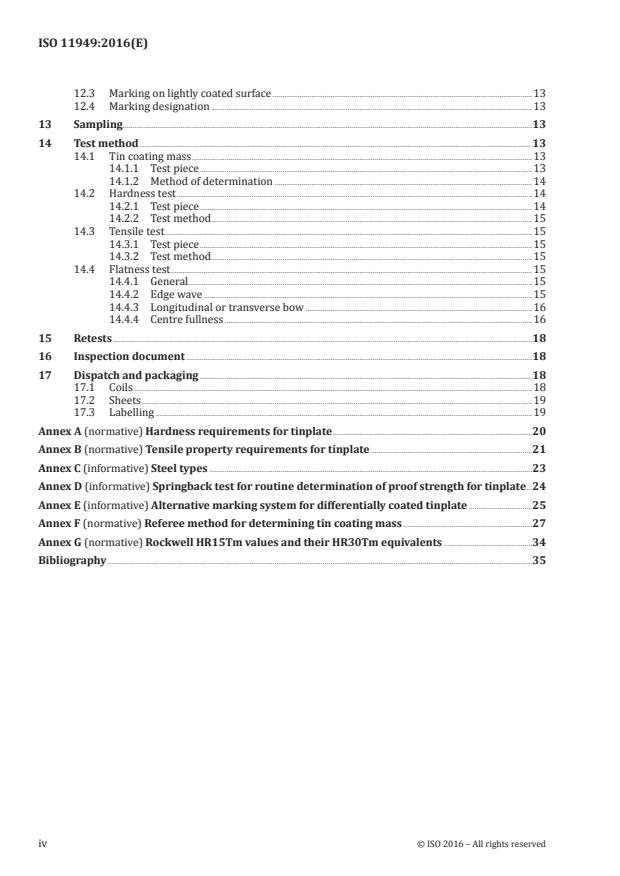
Annex A (normative) Hardness requirements for tinplate .20
Annex B (normative) Tensile property requirements for tinplate .21
Annex C (informative) Steel types .23
Annex D (informative) Springback test for routine determination of proof strength for tinplate .24
Annex E (informative) Alternative marking system for differentially coated tinplate .25
Annex F (normative) Referee method for determining tin coating mass .27
Annex G (normative) Rockwell HR15Tm values and their HR30Tm equivalents .34
Bibliography .35
iv © ISO 2016 – All rights reserved
Foreword
ISO (the International Organization for Standardization) is a worldwide federation of national standards
bodies (ISO member bodies). The work of preparing International Standards is normally carried out
through ISO technical committees. Each member body interested in a subject for which a technical
committee has been established has the right to be represented on that committee. International
organizations, governmental and non-governmental, in liaison with ISO, also take part in the work.
ISO collaborates closely with the International Electrotechnical Commission (IEC) on all matters of
electrotechnical standardization.
The procedures used to develop this document and those intended for its further maintenance are
described in the ISO/IEC Directives, Part 1. In particular the different approval criteria needed for the
different types of ISO documents should be noted. This document was drafted in accordance with the
editorial rules of the ISO/IEC Directives, Part 2 (see www.iso.org/directives).
Attention is drawn to the possibility that some of the elements of this document may be the subject of
patent rights. ISO shall not be held responsible for identifying any or all such patent rights. Details of
any patent rights identified during the development of the document will be in the Introduction and/or
on the ISO list of patent declarations received (see www.iso.org/patents).
Any trade name used in this document is information given for the convenience of users and does not
constitute an endorsement.
For an explanation on the meaning of ISO specific terms and expressions related to conformity
assessment, as well as information about ISO’s adherence to the WTO principles in the Technical
Barriers to Trade (TBT) see the following URL: Foreword - Supplementary information
The committee responsible for this document is ISO/TC 17, Steel, Subcommittee SC 9, Tinplate and
blackplate.
This second edition cancels and replaces the first edition (ISO 11949:1995), which has been technically
revised.
Introduction
Selling of packaging steels is today a worldwide business. Therefore, revision of this International
Standard was expected earlier since the last edition dated from 1995. Because of the long period
between revisions, harmonization became difficult. In some regions, the properties of the packaging
steels are determined by the hardness test whereas in other regions, a decade ago, the hardness
test was replaced by the tensile test. Since the latest available techniques should be reflected in this
International Standard, the possibility of using the tensile test as the reference test for determining the
mechanical properties should be considered during the next revision of this International Standard.
vi © ISO 2016 – All rights reserved
INTERNATIONAL STANDARD ISO 11949:2016(E)
Cold-reduced tinmill products — Electrolytic tinplate
1 Scope
This International Standard specifies requirements for single and double cold-reduced low-carbon mild
steel electrolytic tinplate in the form of sheets or coils.
Single cold-reduced tinplate is generally specified in nominal thicknesses that are multiples of
0,005 mm, from 0,150 mm up to and including 0,600 mm. Double cold-reduced tinplate is generally
specified in nominal thicknesses that are multiples of 0,005 mm, from 0,100 mm up to and including
0,360 mm.
This International Standard applies to coils and sheets cut from coils in nominal minimum rolling
1)
widths of 600 mm.
2 Normative references
The following documents, in whole or in part, are normatively referenced in this document and are
indispensable for its application. For dated references, only the edition cited applies. For undated
references, the latest edition of the referenced document (including any amendments) applies.
ISO 404, Steel and steel products — General technical delivery requirements
ISO 4288, Geometrical Product Specifications (GPS) — Surface texture: Profile method — Rules and
procedures for the assessment of surface texture
ISO 6508-1, Metallic materials — Rockwell hardness test — Part 1: Test method
2)
ISO 6892-1:— , Metallic materials — Tensile testing — Part 1: Method of test at room temperature
ISO 10474, Steel and steel products — Inspection documents
3 Terms and definitions
For the purposes of this document, the following terms and definitions apply.
3.1
blackplate
cold-reduced low-carbon mild steel, applied for manufacturing electrolytic tinplate
[1]
Note 1 to entry: See ISO 11951.
3.2
electrolytic tinplate
cold-reduced low-carbon steel sheet or coil coated on both surfaces with tin that is applied in a
continuous electrolytic operation
3.3
differentially coated electrolytic tinplate
cold-reduced electrolytic tinplate, one surface of which carries a heavier tin coating than the other
1) Nominal minimum rolling widths of 500 mm may be applied by agreement between the purchaser and the
manufacturer.
2) To be published (Revision of ISO 6892-1:2009)
3.4
single cold-reduced
description of product in which the blackplate has been reduced to the desired thickness in a cold-
reduction mill and subsequently annealed and temper rolled
3.5
double cold-reduced
description of product in which the blackplate has had a second major reduction after annealing
3.6
standard grade tinplate sheet
product in sheet form which is confirmed to be suitable, under normal conditions of storage, for
established lacquering and printing over the entire sheet and is
a) free from surface imperfections which render the material unsuitable for the intended use and
b) free from damage which render the material unsuitable for the intended use
Note 1 to entry: The standard material is compliant with the requirements as specified in this International
Standard.
3.7
batch annealed
box annealed
BA
annealed by the process in which the cold-reduced strip is annealed in coil form, within a protective
atmosphere, for a predetermined time-temperature cycle
3.8
continuously annealed
CA
annealed by the process in which cold-reduced coils are unwound and annealed in strip form within a
protective atmosphere
3.9
finish
surface appearance of tinplate, determined by the surface roughness, Ra, of the steel base together with
the conditioning of the tin coating which can be either flow-melted or unflow-melted
3.9.1
smooth finish
finish of blackplate resulting from the use of temper-mill work rolls that have been ground to a low
roughness
Note 1 to entry: This finish is used for the production of bright finish tinplate.
3.9.2
bright finish
finish on flow-melted tinplate using the smooth finish blackplate
3.9.3
stone finish
finish on flow-melted tinplate characterized by a directional pattern, resulting from the use of final-mill
work rolls that have been ground to a higher level of roughness than those used for the smooth finish
3.9.4
silver finish
finish resulting from the use of temper-mill work rolls with dull surface textured by shot blast, electro
discharge texturing (EDT), electron beam texturing (EBT) or another suitable method, together with a
flow-melted tin coating
2 © ISO 2016 – All rights reserved
3.9.5
matt finish
finish resulting from the use of temper-mill work rolls with dull surface textured by shot blast, electro
discharge texturing (EDT), electron beam texturing (EBT) or another suitable method, together with
an unflow-melted tin coating
3.10
coil
rolled flat strip product which is wound into regularly superimposed laps so as to form a coil with
almost flat sides
3.11
longitudinal bow
line bow
residual curvature in the strip remaining along the direction of rolling
3.12
transverse bow
cross bow
mode of curvature in the sheet such that the distance between its edges parallel to the direction of
rolling is less than the sheet width
3.13
centre fullness
centre buckle
full centre
intermittent vertical displacement or wave in the strip occurring other than at the edges
Note 1 to entry: See Figure 8.
3.14
edge wave
intermittent vertical displacement occurring at the strip edge when the strip is laid on a flat surface
3.15
feather edge
transverse thickness profile
variation in thickness, characterized by a reduction in thickness close to the edges, at right angles to
the direction of rolling
3.16
edge camber
deviation of edge of coil/sheet from a straight line forming its chord
3.17
burr
metal displaced beyond the plane of the surface of the strip by shearing action
3.18
rolling width
width of the rolled strip perpendicular to the direction of rolling
3.19
pallet
base platform on which a coil is placed to facilitate ready transportation
3.20
stillage platform
base platform on which sheets are stacked to facilitate packing and ready transportation
3.21
consignment
quantity of material of the same specification made available for dispatch at the same time
3.22
bulk package
bulk
packaging unit comprising a stillage platform, the sheets and packaging material
3.23
line inspection
final inspection of the finished product performed by instruments and/or visual examination at normal
production-line speeds
3.24
anvil effect
effect that a hard anvil can produce on the numerical hardness value obtained when a hardness test is
performed on very thin sheet supported on such an anvil
4 General technical delivery condition
In cases where the technical delivery condition is not specified in this International Standard, then
ISO 404 shall apply.
5 Classification
Steel grades for this International Standard are generally classified as non-alloy quality steels.
6 Information to be supplied by the purchaser
6.1 Designation
For the purposes of this International Standard, tinplate is designated in terms of a steel grade
classification based either on the Rockwell HR30Tm hardness values or on the tensile properties. For
the hardness requirements, the steel grade designations are given in Table A.1 for single cold-reduced
tinplate and in Table A.2 for double cold-reduced tinplate. For the tensile properties requirements, the
steel grade designations are given in Table B.1.
Tinplate covered by this International Standard shall be designated by the following characteristics in
the given sequence:
a) a reference to this International Standard, i.e. ISO 11949;
b) the steel grade designation in accordance with Table A.1, Table A.2 or Table B.1;
c) the type of annealing used by the manufacturer (see 7.2);
d) the type of finish (see 7.3);
e) the coating masses and their combinations, D or S(for differentially coated), together with numbers
representing the nominal coating mass on top/bottom surface (see Clause 12);
f) the dimensions, in millimetres:
— for coils, thickness × width;
— for sheets, thickness × width × length.
By agreement, the symbol “× C” after width may be designated for coils.
4 © ISO 2016 – All rights reserved
By agreement, the symbol “w” may be designated after the number for the width to indicate that the
number is the dimension perpendicular to the direction of rolling.
EXAMPLE
Single cold-reduced tinplate sheet, in accordance with this International Standard, steel grade T61, continuously
annealed (CA), stone finish, equally coated with a coating mass of 2,8 g/m , with a thickness of 0,220 mm, a
width of 800 mm and a length of 900 mm shall be designated:
ISO 11949 - T61 CA - stone - 2,8/2,8 - 0,220 × 800 × 900
Double cold-reduced tinplate coil, in accordance with this International Standard, steel grade T75, continuously
2 2
annealed (CA), stone finish, differentially coated with coating masses of 8,4 g/m and 5,6 g/m , with marking on
5,6 g/m side, with a thickness of 0,180 mm and a width of 750 mm shall be designated:
ISO 11949 - T75 CA - stone - 8,4/D5,6 - 0,180 × 750
Tinplate coil, in accordance with this International Standard, steel grade TH415, continuously annealed (CA),
2 2 2
stone finish (ST), differentially coated with a coating mass of 2,8 g/m and 5,6 g/m , with marking on 5,6 g/m
side, with a thickness of 0,200 mm, a width of 750 mm shall be designated:
ISO 11949 - TH415 CA - ST - 2,8/D5,6 - 0,200 × 750 × C
Tinplate sheet, in accordance with this International Standard, steel grade TS520, batch annealed (BA), stone
2 2 2
finish, differentially coated with coating masses of 5,6 g/m and 8,4 g/m , with single line marked on 5,6 g/m
side, with a thickness of 0,140 mm, a dimension perpendicular to the direction of rolling of 844 mm and a length
of 755 mm shall be designated:
ISO 11949 - TS520 BA - stone - S5,6/8,4 - 0,140 × 844w × 755
6.2 Mandatory information
The following information shall be given in the enquiry and order to assist the manufacturer in
supplying the correct material:
a) the designation as given in 6.1;
b) the quantity, expressed on an area or mass basis, e.g. 50 tons of sheets, 100 tons of coils;
c) marking requirements for differentially coated tinplate (see Clause 12);
d) the minimum and the maximum coil weight, the minimum and the maximum coil outer diameter,
the coil internal diameter, the core vertical or horizontal and the direction of winding (see 17.1);
e) the maximum weight of bulk package;
f) other inspection document than that specified by the manufacturer (see Clause 16);
g) end use;
h) any further special requirements.
NOTE Appropriate steel grade is suitable for shaping operations such as stamping, drawing, folding, beading
and bending, and assembly work such as joint forming, soldering and welding. The end use is important when the
steel grade is selected.
6.3 Options
In addition to the information in 6.2, the purchaser may wish to provide additional information to the
manufacturer to ensure that the order requirements are consistent with the end use of the product.
The purchaser shall inform the manufacturer of any modifications to his/her fabrication operations
that will significantly affect the way in which the tinplate is used.
NOTE When ordering double cold-reduced tinplate, the purpose of manufacture for which the material is
intended is generally stated. It is noted that double cold-reduced tinplate is relatively less ductile than single
cold-reduced tinplate and has very distinct directional properties, so for some uses, for example for built-up
can bodies, the direction of rolling is usually stated. When double cold-reduced tinplate is used for built-up can
bodies, the direction of rolling is around the circumference of the can so as to minimize the hazard of flange
cracking.
7 Manufacturing features
7.1 Manufacture
Continuously cast, fully-killed steel is applied except when otherwise specified. The examples of the
steel types of tinplate are shown in Annex C.
The steel type of tinplate shall be designed to secure food safety when tinplate is used for food
application. The purchasers should be aware of existing national regulations which may impose
limitations on some elements.
The purity of tin used to produce the coating shall be not less than 99,85 %(mass fraction).
The manufacturing method of tinplate is left to the discretion of the manufacturer and is not specified
in this International Standard.
7.2 Annealing
Annealing of tinplate shall be either batch annealing (BA) or continuous annealing(CA) and shall be
specified by the purchaser at the time of enquiry and order.
7.3 Finish
Tinplate is usually available in the finishes as indicated in Table 1. The type of finish is designated either
by the tinplate finish or the code shown in Table 1.
Table 1 — Typical finishes for tinplate
Blackplate
bc
Surface roughness
Tinplate Flow-melt-
a
Code
finish ed
Finish Ra
µm
Bright BT Smooth ≤0,35 Yes
Fine stone FS Fine stone 0,25 – 0,45 Yes
Stone ST Stone 0,35 – 0,60 Yes
Silver AM Matt Yes
≥0,90
Matt MM Matt No
a
By agreement between the purchaser and the manufacturer, another code system may be applied.
b
Values of surface roughness in this table are not mandatory. The values are given for reference in
order to classify the finishes.
c
The measurement of surface roughness is in accordance with ISO 4288.
NOTE 1 The appearance is governed by the following:
a) the surface characteristics of the blackplate principally result from controlled preparation of the work rolls
used during the final stages of temper rolling;
6 © ISO 2016 – All rights reserved
b) the mass of the coating applied;
c) whether the tin layer is flow-melted or unflow-melted.
NOTE 2 Double cold-reduced tinplate is usually supplied with a stone finish and a flow-melted tin coating.
7.4 Passivation and oiling
The surface of electrolytic tinplate is normally subjected to a passivation treatment and to oiling.
Passivation, produced either by a chemical or an electrochemical treatment, gives a surface with an
improved resistance to oxidation and improved suitability for lacquering and printing. Unless otherwise
agreed at the time of ordering, the usual passivation procedure is a cathodic treatment in an acidic
chromate solution. The typical range of this passivation is generally up to 10 mg/m for each side.
Under normal conditions of transport and storage, electrolytic tinplate shall be suitable for surface
treatments such as established lacquering and printing operations.
Tinplate coils and sheets are supplied with an oil coating. The oil shall be one that is recognized (i.e. by
the relevant national or international authority) as being suitable for food packaging. Unless otherwise
agreed at the time of ordering, the kind of oil is at the discretion of the manufacturer.
NOTE 1 For the oil, dioctyl sebacate (DOS) is usually used.
NOTE 2 For measuring chromium of passivation film, the diphenylcarbazide method or the X-ray flourescence
spectrometric method is usually applied. When the X-ray method is applied, it is necessary to consider the
influence of chromium in base metal.
7.5 Imperfections
7.5.1 Coils
The manufacturer is expected to employ his/her normal quality control and line inspection procedures
to ensure that the tinplate manufactured is in accordance with the requirements of this International
Standard.
However, the production of tinplate coils in continuous-strip mill operations does not afford the
opportunity for removal of all tinplate that do not comply with the requirements of this International
Standard.
At the time of shearing, sheets not conforming to the standard grade shall be set aside by the purchaser
or his/her agent.
The quantity of sheets complying with this International Standard shall be at least 90 % of any one coil.
List items a) and b) in 3.6 cannot be verified by specific tests. Accordingly, those items are recommended
to be the subject of a special agreement between the purchaser and the manufacturer.
In processing tinplate coil, when the purchaser (or his/her agent) encounters recurring imperfections
which in his/her opinion seem excessive, it is essential, where practicable, that he/she stops processing
the coil and advises the manufacturer.
The purchaser is expected to have adequate handling, roller levelling and shearing equipment
and inspection facilities to segregate the sheets not conforming to the standard grade, and to take
reasonable care during these operations.
7.5.2 Sheets
Sheets shall not contain any imperfections as defined in 3.6.
8 Tin coating mass
The nominal coating mass, on each surface, shall be expressed in grams per square metre. The lowest
value specified in this International Standard shall be 1,0 g/m on each surface, and no upper limit
2 2 2 2 2
is specified. Values of preferred coating masses are 1,0 g/m , 1,4 g/m , 2,0 g/m , 2,8 g/m , 4,0 g/m ,
2 2 2 2
5,0 g/m , 5,6 g/m , 8,4 g/m and 11,2 g/m .
Whatever the coating mass used, the coating mass for sample average and for individual sample shall
not be less than the minimum coating mass indicated in Table 2. The coating mass for sample average
is the average of three measurements on each sheet selected. The mass per unit area for equally and
differentially coated tinplate is determined on test pieces taken from samples selected in accordance
with Clause 13 and tested in accordance with 14.1.
Table 2 — Minimum tin coating masses
Range of
Minimum coating mass Minimum coating mass
nominal coating
for sample average for individual sample
mass, m, on each surface
2 2 2
g/m g/m g/m
1,0 ≤ m < 2,8 0,80 × m 0,64 × m
2,8 ≤ m < 5,6 0,87 × m 0,70 × m
5,6 ≤ m 0,90 × m 0,72 × m
NOTE The minimum coating mass for sample average and for individual sample shall be rounded to the
unit of 0,1 g/m .
9 Mechanical properties
9.1 General
For the purposes of this International Standard, tinplates are classified into steel grades based on either
Rockwell HR30Tm hardness values or tensile properties. The purchaser shall indicate the specification
either by hardness requirement or by tensile properties requirement, but not for both, when ordering
the material.
When ordering the material for applications such as drawn cans, DWI cans, twist off caps, etc., it is
recommended to indicate the specification according to the tensile property requirement.
Other mechanical properties might significantly influence the performance of tinplate in processing,
and the subsequent intended end use might vary depending on the steel type and the method of casting,
annealing and temper rolling employed.
At the time of enquiry and order it shall be agreed that properties of steel grade are to be verified either
by the hardness test or by the tensile test.
9.2 Hardness requirement
The hardness values for tinplate shall be as given in Table A.1 and Table A.2, when tested as described
in 14.2.
9.3 Tensile property requirement
The proof strength, R , for tinplate shall be as given in Table B.1, when tested as described in 14.3.
p0,2
For routine testing, the proof strength may be determined using the springback test as described in
Annex D. However, in cases of dispute, the method described in 14.3 shall be applied.
8 © ISO 2016 – All rights reserved
10 Tolerances on dimensions and shape
10.1 General
Tolerances on dimensions (i.e. thickness, width and length) and shape (i.e. edge camber, out-
of-squareness and flatness) are specified in 10.2 to 10.7, together with appropriate methods of
measurement.
10.2 Thickness and feather edge
10.2.1 Thickness
Nominal thickness shall be a multiple of 0,005 mm. Nominal thickness other than multiple of 0,005 mm
may be specified by agreement between the purchaser and the manufacturer. Thickness out of the
nominal thickness range may be specified by agreement between the purchaser and the manufacturer.
The thickness of tinplate shall not deviate from the ordered nominal thickness by more than +5, −8 % at
any point except within 10 mm from the trimmed-edge.
The thickness shall be measured using a hand-operated, spring-loaded micrometer to an accuracy of
0,001 mm.
It is recommended that the micrometer should have a ball-ended shank and a curved-surface base anvil.
10.2.2 Feather edge
For both sheet and coil, the thickness when measured at a distance of 10 mm from the mill trimmed
edge shall not deviate from the actual centre thickness by more than −6 %.
10.3 Width
The width of tinplate shall be measured to the nearest 0,5 mm at right angles to the direction of rolling.
For the products of this International Standard which are delivered with trimmed-edge, the measured
width shall not deviate from the ordered width by more than +3, −0 mm.
10.4 Length
10.4.1 Length of coil
The difference between the actual length and the manufacturer’s indicated length, measured on any
single coil, shall not exceed by more than ±3 %, unless otherwise agreed.
10.4.2 Length of sheet
The length of sheet shall be measured to the nearest 0,5 mm. The measured length shall not deviate by
more than +3, −0 mm from the ordered length.
10.5 Edge camber
Edge camber is the maximum deviation (in the plane of the sheet) of an edge from a straight line forming
a chord to its extremities (see Figures 1 and 2).
The edge camber, E, expressed as a percentage of the chord length, is calculated using Formula (1):
D
E =×100 (1)
L
where
D is the deviation from a straight line, in millimetres;
L is the length of chord, in millimetres.
For coils, the edge camber, measured over a distance (chord length) of 1 000 mm, shall not exceed 0,1 %
(i.e. 1 mm).
Dimensions in millimetres
Key
W width
D deviation from a straight line
Figure 1 — Edge camber of coil
For sheets, the edge camber, measured over a chord length, shall not exceed 0,1 %.
L
Key
D deviation from a straight line
L length of chord
W Width
Figure 2 — Edge camber of sheet
10.6 Out-of-squareness of sheet
Out-of-squareness is the deviation of an edge from a straight line drawn at a right angle to the other
edge of the sheet, touching one corner and extending to the opposite edge (see Figure 3).
10 © ISO 2016 – All rights reserved
D W
D
W
The out-of-squareness, O , expressed as a percentage, is calculated using Formula (2):
s
A
O =×100 (2)
s
B
where
A is the deviation;
B is the length or width of the sheet measured at a right angle to an edge.
For each sheet in the sample, the out-of-squareness shall not exceed 0,20 %.
B
Key
A deviation
B length or width of the sheet measured at a right angle to an edge
Figure 3 — Out-of-squareness of sheet
10.7 Flatness
10.7.1 Edge wave
The height of edge wave, h , at any point shall not exceed 2,5 mm, when tested as described in
ew
14.4.2. No more than six waves in excess of 1,5 mm shall be present over a cut length of 1 m for coil or
proportional for sheet.
10.7.2 Longitudinal and transverse bow
Bow may be either convex or concave face uppermost on the bulk package. The normal convention is to
express convex bow uppermost as a positive (+) value and concave bow as a negative (−) value.
The individual values of both longitudinal and transverse bow in levelled condition shall not exceed
30 mm, when tested as described in 14.4.3. Where both convex and concave bow are present in the
same coil, the sum of the maximum values of each, ignoring the sign (±), shall not exceed 30 mm. In
case of unlevelled sheet from coil before cutting, the requirement of bow may be agreed between the
purchaser and the manufacturer.
10.7.3 Centre fullness
Centre fullness shall be determined by either the direct method as described in 14.4.4.1 or the indirect
method as described in 14.4.4.2. The selection of the method is at the discretion of the manufacturer.
In case of the direct method, the height of centre fullness, h , shall not exceed 5 mm when tested as
cf
described in 14.4.4.1. In case of the indirect method, the height of
...