

ISO 3575:2025
(Main)Continuous hot-dip zinc-coated and zinc-iron alloy-coated carbon steel sheet of commercial and drawing qualities
General Information
- Abstract
This document specifies the requirements for steel sheet, in coils and cut lengths, metallic-coated by the continuous hot-dip process, with zinc and zinc-iron alloy coatings. The product is intended for applications requiring corrosion resistance, formability and paintability. The steel sheet is produced in a number of designations, coating masses, surface treatments and coating conditions designed to be compatible with differing application requirements. This document does not cover steel designated as structural quality, which are covered in ISO 4998.[1]
- Status
- Published
- Publication Date
- 31-Mar-2025
- Technical Committee
- ISO/TC 17/SC 12 - Continuous mill flat rolled products
- Drafting Committee
- ISO/TC 17/SC 12 - Continuous mill flat rolled products
- Current Stage
- 6060 - International Standard published
- Start Date
- 01-Apr-2025
- Due Date
- 16-Mar-2026
- Completion Date
- 01-Apr-2025
Overview
ISO 3575:2025 specifies requirements for continuous hot-dip zinc-coated and zinc‑iron alloy‑coated carbon steel sheet supplied in coils and cut lengths. The standard covers products intended for applications that require corrosion resistance, formability, and paintability. It defines product designations, coating masses and finishes, surface treatments and testing & inspection regimes for commercial and drawing qualities (not structural steels covered by ISO 4998).
Keywords: ISO 3575:2025, hot-dip zinc-coated, zinc-iron alloy-coated, carbon steel sheet, coating mass, formability, paintability, corrosion resistance.
Key Topics and Technical Requirements
- Scope and product types: Continuous hot-dip zinc-coated and zinc-iron alloy-coated sheet for commercial, drawing, deep-drawing and interstitial-free qualities.
- Dimensions and tolerances: Coil and cut-length dimensional and shape tolerances are specified to ensure interchangeability and fit for fabrication.
- Conditions of manufacture:
- Steelmaking and chemical composition controls (heat and product analysis).
- Mechanical properties and fabrication quality designations (commercial, drawing, deep drawing, IF steel).
- Coating requirements:
- Coating mass classes and notation (new coating mass designations such as Z080, Z120, Z140, Z220, ZF080, ZF120 added in this edition).
- Coating adherence and coating condition (zinc vs zinc‑iron alloy).
- Surface treatments and finish: Mill passivation, mill phosphating, oiling and painting compatibility for improved paintability and handling.
- Weldability and forming characteristics required for fabrication and assembly.
- Sampling, test methods and inspection:
- Tensile and bend tests (reference to ISO 6892‑1, ISO 7438).
- Coating mass measurement methods (ISO 1460, ISO 2178, ISO 3497).
- Coating adherence and spot tests (single-spot, triple-spot).
- Designation, marking and purchaser information: Standardized naming and information to be supplied by purchaser; requirements for coil size and marking.
Practical Applications and Users
ISO 3575:2025 is used by:
- Steel producers and continuous hot-dip coating lines to define product supply and quality.
- Automotive, household appliance and furniture manufacturers for corrosion‑protected, formable sheet.
- OEMs and fabricators specifying materials for stamping, drawing and painted components.
- Paint shops, coating applicators and contract manufacturers concerned with paintability and surface pre-treatment.
- Inspection bodies and testing laboratories performing conformity checks.
Benefits include predictable corrosion performance, consistent forming behavior and assurance of paint adhesion for downstream manufacturing.
Related Standards
- ISO 4998 - structural quality steels (not covered by ISO 3575)
- ISO 1460, ISO 2178, ISO 3497 - coating measurement methods
- ISO 6892-1 - tensile testing
- ISO 7438 - bend test
- ISO 16163 - continuously hot-dipped coated steel sheet tolerances
For procurement or technical implementation, refer to the full ISO 3575:2025 document from ISO or your national standards body.
Relations
- Effective Date
- 18-Mar-2023
Get Certified
Connect with accredited certification bodies for this standard

Element Materials Technology
Materials testing and product certification.

Inštitut za kovinske materiale in tehnologije
Institute of Metals and Technology. Materials testing, metallurgical analysis, NDT.
Sponsored listings
Frequently Asked Questions
ISO 3575:2025 is a standard published by the International Organization for Standardization (ISO). Its full title is "Continuous hot-dip zinc-coated and zinc-iron alloy-coated carbon steel sheet of commercial and drawing qualities". This standard covers: This document specifies the requirements for steel sheet, in coils and cut lengths, metallic-coated by the continuous hot-dip process, with zinc and zinc-iron alloy coatings. The product is intended for applications requiring corrosion resistance, formability and paintability. The steel sheet is produced in a number of designations, coating masses, surface treatments and coating conditions designed to be compatible with differing application requirements. This document does not cover steel designated as structural quality, which are covered in ISO 4998.[1]
This document specifies the requirements for steel sheet, in coils and cut lengths, metallic-coated by the continuous hot-dip process, with zinc and zinc-iron alloy coatings. The product is intended for applications requiring corrosion resistance, formability and paintability. The steel sheet is produced in a number of designations, coating masses, surface treatments and coating conditions designed to be compatible with differing application requirements. This document does not cover steel designated as structural quality, which are covered in ISO 4998.[1]
ISO 3575:2025 is classified under the following ICS (International Classification for Standards) categories: 77.140.50 - Flat steel products and semi-products. The ICS classification helps identify the subject area and facilitates finding related standards.
ISO 3575:2025 has the following relationships with other standards: It is inter standard links to ISO 3575:2016. Understanding these relationships helps ensure you are using the most current and applicable version of the standard.
ISO 3575:2025 is available in PDF format for immediate download after purchase. The document can be added to your cart and obtained through the secure checkout process. Digital delivery ensures instant access to the complete standard document.
Standards Content (Sample)
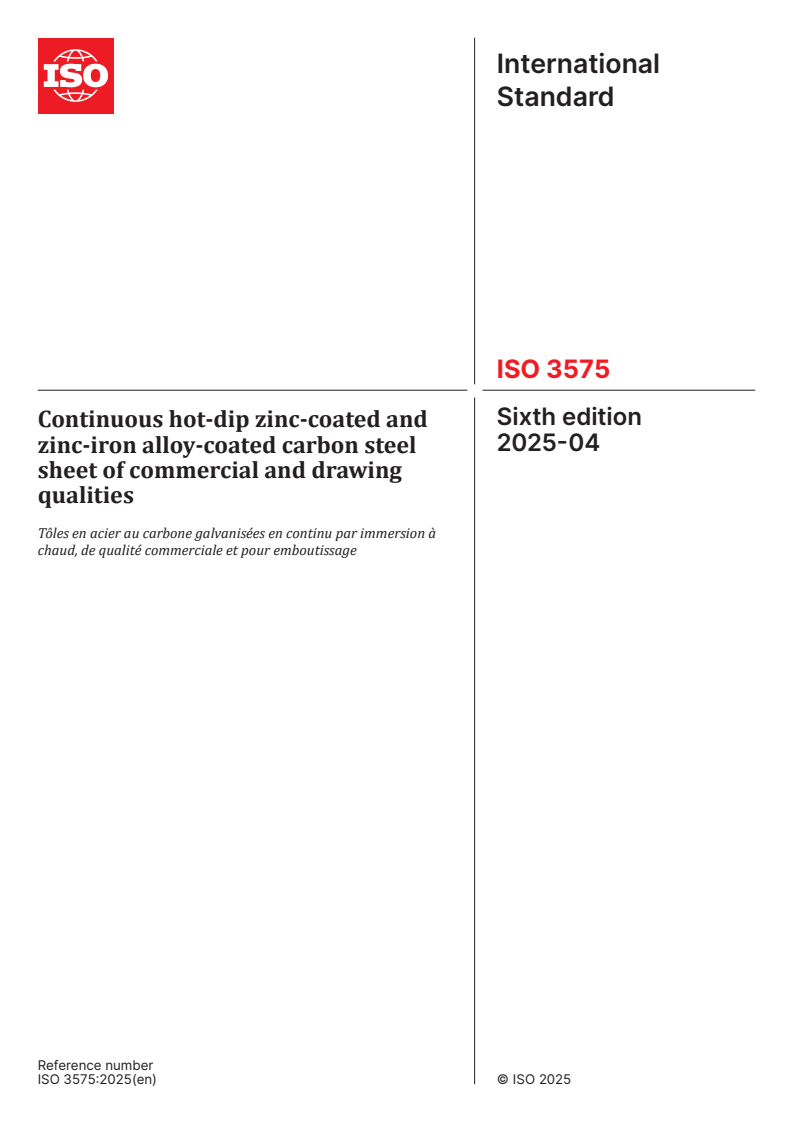
International
Standard
ISO 3575
Sixth edition
Continuous hot-dip zinc-coated and
2025-04
zinc-iron alloy-coated carbon steel
sheet of commercial and drawing
qualities
Tôles en acier au carbone galvanisées en continu par immersion à
chaud, de qualité commerciale et pour emboutissage
Reference number
© ISO 2025
All rights reserved. Unless otherwise specified, or required in the context of its implementation, no part of this publication may
be reproduced or utilized otherwise in any form or by any means, electronic or mechanical, including photocopying, or posting on
the internet or an intranet, without prior written permission. Permission can be requested from either ISO at the address below
or ISO’s member body in the country of the requester.
ISO copyright office
CP 401 • Ch. de Blandonnet 8
CH-1214 Vernier, Geneva
Phone: +41 22 749 01 11
Email: copyright@iso.org
Website: www.iso.org
Published in Switzerland
ii
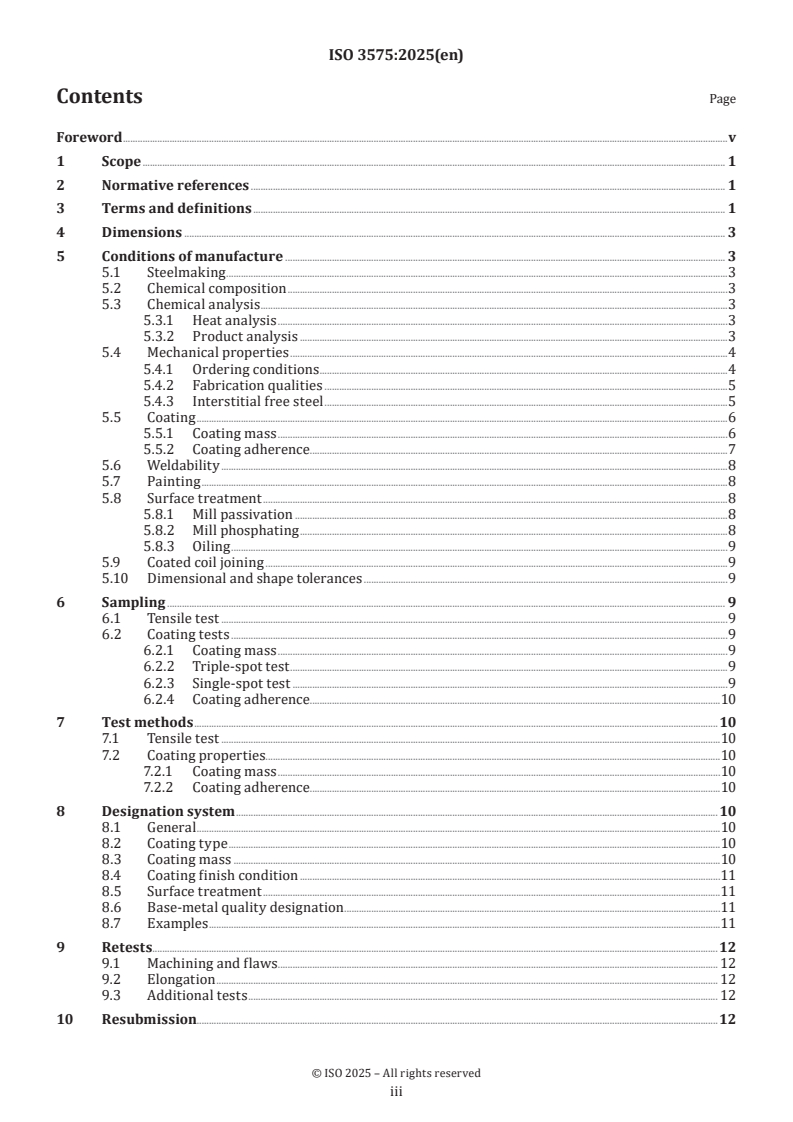
Contents Page
Foreword .v
1 Scope . 1
2 Normative references . 1
3 Terms and definitions . 1
4 Dimensions . 3
5 Conditions of manufacture . 3
5.1 Steelmaking .3
5.2 Chemical composition .3
5.3 Chemical analysis .3
5.3.1 Heat analysis .3
5.3.2 Product analysis .3
5.4 Mechanical properties .4
5.4.1 Ordering conditions .4
5.4.2 Fabrication qualities .5
5.4.3 Interstitial free steel .5
5.5 Coating .6
5.5.1 Coating mass .6
5.5.2 Coating adherence.7
5.6 Weldability .8
5.7 Painting .8
5.8 Surface treatment .8
5.8.1 Mill passivation .8
5.8.2 Mill phosphating .8
5.8.3 Oiling .9
5.9 Coated coil joining .9
5.10 Dimensional and shape tolerances .9
6 Sampling . 9
6.1 Tensile test .9
6.2 Coating tests .9
6.2.1 Coating mass .9
6.2.2 Triple-spot test .9
6.2.3 Single-spot test .9
6.2.4 Coating adherence.10
7 Test methods . 10
7.1 Tensile test .10
7.2 Coating properties.10
7.2.1 Coating mass .10
7.2.2 Coating adherence.10
8 Designation system . 10
8.1 General .10
8.2 Coating type .10
8.3 Coating mass .10
8.4 Coating finish condition .11
8.5 Surface treatment .11
8.6 Base-metal quality designation .11
8.7 Examples .11
9 Retests .12
9.1 Machining and flaws . . 12
9.2 Elongation . 12
9.3 Additional tests . 12
10 Resubmission.12
iii
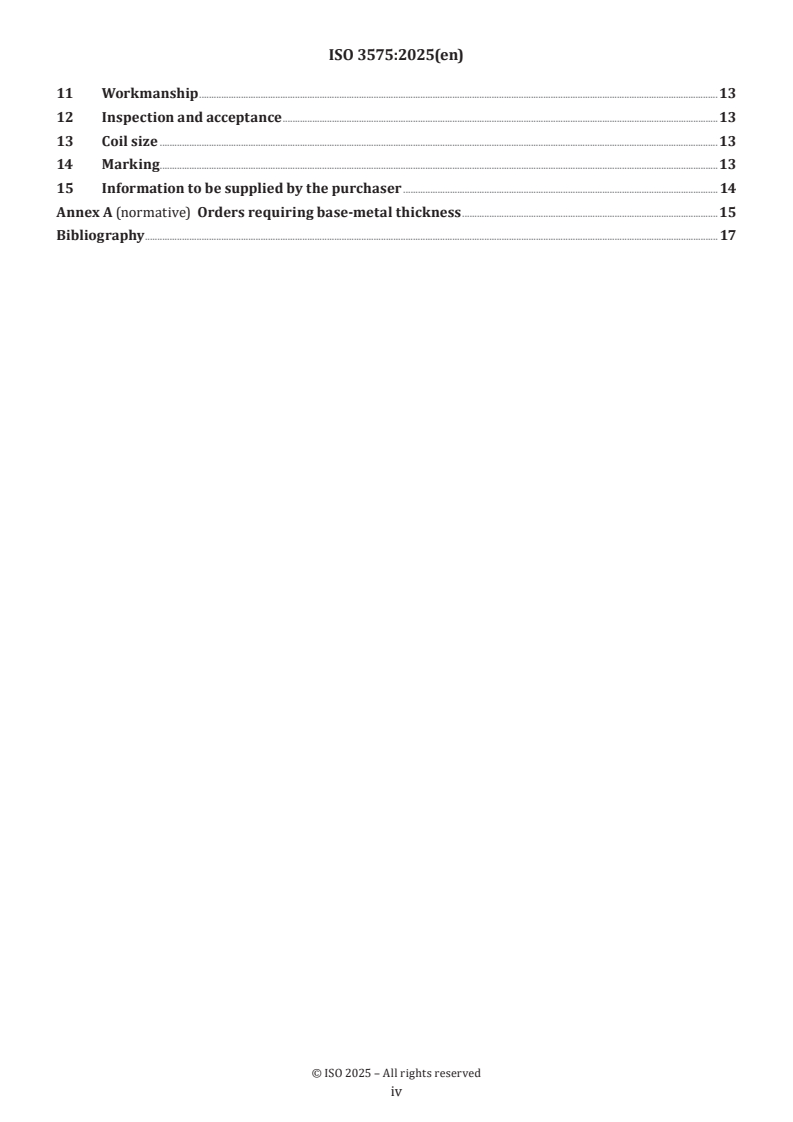
11 Workmanship .13
12 Inspection and acceptance .13
13 Coil size .13
14 Marking . .13
15 Information to be supplied by the purchaser . 14
Annex A (normative) Orders requiring base-metal thickness .15
Bibliography . 17
iv
Foreword
ISO (the International Organization for Standardization) is a worldwide federation of national standards
bodies (ISO member bodies). The work of preparing International Standards is normally carried out through
ISO technical committees. Each member body interested in a subject for which a technical committee
has been established has the right to be represented on that committee. International organizations,
governmental and non-governmental, in liaison with ISO, also take part in the work. ISO collaborates closely
with the International Electrotechnical Commission (IEC) on all matters of electrotechnical standardization.
The procedures used to develop this document and those intended for its further maintenance are described
in the ISO/IEC Directives, Part 1. In particular, the different approval criteria needed for the different types
of ISO document should be noted. This document was drafted in accordance with the editorial rules of the
ISO/IEC Directives, Part 2 (see www.iso.org/directives).
ISO draws attention to the possibility that the implementation of this document may involve the use of (a)
patent(s). ISO takes no position concerning the evidence, validity or applicability of any claimed patent
rights in respect thereof. As of the date of publication of this document, ISO had not received notice of (a)
patent(s) which may be required to implement this document. However, implementers are cautioned that
this may not represent the latest information, which may be obtained from the patent database available at
www.iso.org/patents. ISO shall not be held responsible for identifying any or all such patent rights.
Any trade name used in this document is information given for the convenience of users and does not
constitute an endorsement.
For an explanation of the voluntary nature of standards, the meaning of ISO specific terms and expressions
related to conformity assessment, as well as information about ISO's adherence to the World Trade
Organization (WTO) principles in the Technical Barriers to Trade (TBT), see www.iso.org/iso/foreword.html.
This document was prepared by Technical Committee ISO/TC 17, Steel, Subcommittee SC 12, Continuous mill
flat rolled products.
This sixth edition cancels and replaces the fifth edition (ISO 3575:2016), which has been technically revised.
The main changes are as follows:
— the terms and definitions have been updated;
— coating mass designations “Z080”, “Z120”, “Z140”, “Z220”, “ZF080” and “ZF120” have been added.
Any feedback or questions on this document should be directed to the user’s national standards body. A
complete listing of these bodies can be found at www.iso.org/members.html.
v
International Standard ISO 3575:2025(en)
Continuous hot-dip zinc-coated and zinc-iron alloy-coated
carbon steel sheet of commercial and drawing qualities
1 Scope
This document specifies the requirements for steel sheet, in coils and cut lengths, metallic-coated by the
continuous hot-dip process, with zinc and zinc-iron alloy coatings.
The product is intended for applications requiring corrosion resistance, formability and paintability.
The steel sheet is produced in a number of designations, coating masses, surface treatments and coating
conditions designed to be compatible with differing application requirements.
[1]
This document does not cover steel designated as structural quality, which are covered in ISO 4998.
2 Normative references
The following documents are referred to in the text in such a way that some or all of their content constitutes
requirements of this document. For dated references, only the edition cited applies. For undated references,
the latest edition of the referenced document (including any amendments) applies.
ISO 1460, Metallic coatings — Hot dip galvanized coatings on ferrous materials — Gravimetric determination of
the mass per unit area
ISO 2178, Non-magnetic coatings on magnetic substrates — Measurement of coating thickness — Magnetic method
ISO 3497, Metallic coatings — Measurement of coating thickness — X-ray spectrometric methods
ISO 6892-1, Metallic materials — Tensile testing — Part 1: Method of test at room temperature
ISO 7438, Metallic materials — Bend test
ISO 16163, Continuously hot-dipped coated steel sheet products — Dimensional and shape tolerances
3 Terms and definitions
For the purposes of this document, the following terms and definitions apply.
ISO and IEC maintain terminological databases for use in standardization at the following addresses:
— ISO Online browsing platform: available at https:// www .iso .org/ obp
— IEC Electropedia: available at https:// www .electropedia .org/
3.1
commercial
base-metal quality intended for general fabricating purposes where sheet is used in the flat condition, or for
bending or moderate forming
3.2
drawing
base-metal quality intended for parts where drawing or severe forming may be involved
3.3
deep drawing
base-metal quality intended for parts where severe forming or severe drawing may be involved
3.4
deep drawing aluminium killed
base-metal quality intended for fabricating parts where particularly severe drawing or forming may be
involved
3.5
extra-deep drawing stabilized
base-metal quality intended for applications where maximum formability is required by applying interstitial-
free steel
3.6
interstitial-free steel
IF steel
extra-low-carbon steel in which all interstitial elements are stabilized with titanium and/or equivalent
elements
Note 1 to entry: Interstitial-free steel is sometimes referred to as stabilized steel.
3.7
zinc-coated steel sheet
product obtained by hot-dip coating of cold-reduced sheet coils or hot-rolled descaled sheet coils on a
continuous zinc-coating line
3.8
zinc-iron alloy-coated steel sheet
product obtained by heating after processing the zinc-coated steel sheet so that the coating formed on the
base metal is composed of zinc-iron alloys
Note 1 to entry: This product, designated ZF, is not spangled, is normally dull in appearance and, for some applications,
can be suitable for immediate painting without further treatment, except normal cleaning. Zinc-iron alloy coatings can
powder during severe forming.
3.9
differential coating
coating deliberately produced to have a different coating mass on each surface
3.10
breakage allowance
agreed upon level of acceptable die breakage not subject to claim
3.11
normal coating
coating formed as a result of unrestricted growth of zinc crystals during normal solidification
Note 1 to entry: This coating has a metallic lustre and is the type normally furnished for a wide variety of applications.
It can be furnished S (normal coating, with skin pass) or N (normal coating, no skin pass); however, it can be variable in
appearance and not suitable for decorative painting.
3.12
minimized spangle
finish obtained by restricting normal spangle formation during the solidification of the zinc
Note 1 to entry: This product can have some lack of uniformity in surface appearance within a coil, or from coil to coil.
3.13
skin pass
light cold-rolling of the product
Note 1 to entry: The purpose of the skin passing is one or more of the following: to minimize the appearance of coil
breaks, stretcher strains and fluting; to control the shape; and to obtain the required surface finish.
Note 2 to entry: Some increase in hardness and some loss in ductility will result from skin passing.
3.14
lot
specified quantity of steel sheet of the same designation rolled to the same thickness and coating condition
3.15
coating mass
total amount of coating on both sides of the sheet, expressed in grams per square metre (g/m ) of sheet
4 Dimensions
4.1 Zinc-coated and zinc-iron alloy-coated steel sheet is produced in thicknesses from 0,25 mm to 5 mm
inclusive after coating, and in widths of 600 mm and over in coils and cut lengths. Zinc-coated and zinc-iron
alloy-coated steel sheet less than 600 mm wide, slit from wide sheet, is considered as sheet.
4.2 The thickness of zinc-coated and zinc-iron alloy-coated steel sheet may be specified as a combination
of the base-metal and metallic coating, or as the base-metal alone. The purchaser shall indicate on the order
which method of specifying thickness is required. In the event that the purchaser does not indicate any
preference, the thickness as a combination of the base-metal and coating will be provided. Annex A describes
the requirements for specifying the thickness of the base-metal alone.
5 Conditions of manufacture
5.1 Steelmaking
Unless otherwise agreed by the interested parties, the processes used in making the steel and in
manufacturing zinc-coated and zinc-iron alloy-coated steel sheet are left to the discretion of the
manufacturer. On request, the purchaser shall be informed of the steelmaking process being used.
5.2 Chemical composition
The chemical composition (heat analysis) shall conform to the requirements given in Tables 1 and 2.
5.3 Chemical analysis
5.3.1 Heat analysis
An analysis of each heat shall be made by the manufacturer in order to determine compliance with the
requirements given in Tables 1 and 2. On request, a report of the heat analysis shall be made available to the
purchaser or the purchaser’s representative. Each of the elements listed in Tables 1 and 2 shall be included
in the report of the heat analysis. When the amount of copper, nickel, chromium or molybdenum present is
less than 0,02 %, the analysis may be reported as “<0,02 %”.
5.3.2 Product analysis
A product analysis may be made by the purchaser in order to verify the specified analysis of the product
and shall take into consideration any normal heterogeneity. The product analysis tolerances shall be in
accordance with Tables 2 and 3.
Table 1 — Chemical composition (heat analysis)
Mass fractions in percent
Base-metal quality C Mn P S Ti
Designation Name max. max. max. max. max.
01 Commercial 0,15 0,60 0,05 0,035 —
a
02 Drawing 0,10 0,50 0,04 0,035 —
a
03 Deep drawing 0,08 0,45 0,03 0,030 —
Deep drawing —
a
04 0,06 0,45 0,03 0,030
aluminium killed
Extra-deep drawing
a
05 0,02 0,25 0,02 0,020 0,15
stabilized
a Interstitial-free steel may be applied (see 5.4.3).
Table 2 — Limits on additional chemical elements
Mass fractions in percent
a a a,b a,b c c,d c
Cu Ni Cr Mo Nb V Ti
Element
max. max. max. max. max. max. max.
Heat analysis 0,20 0,20 0,15 0,06 0,008 0,008 0,008
Product
0,23 0,23 0,19 0,07 0,018 0,018 0,018
analysis
a The sum of copper, nickel, chromium and molybdenum shall not exceed 0,50 % on heat analysis. When one or more of these
elements are specified, the sum does not apply, in which case, only the individual limits on the remaining elements apply.
b The sum of chromium and molybdenum shall not exceed 0,16 % on heat analysis. When one or more of these elements are
specified, the sum does not apply, in which case, only the individual limits on the remaining elements apply.
c For interstitial-free steels only, the value of 0,15 % titanium, and 0,10 %
...