

ISO 23145-1:2007
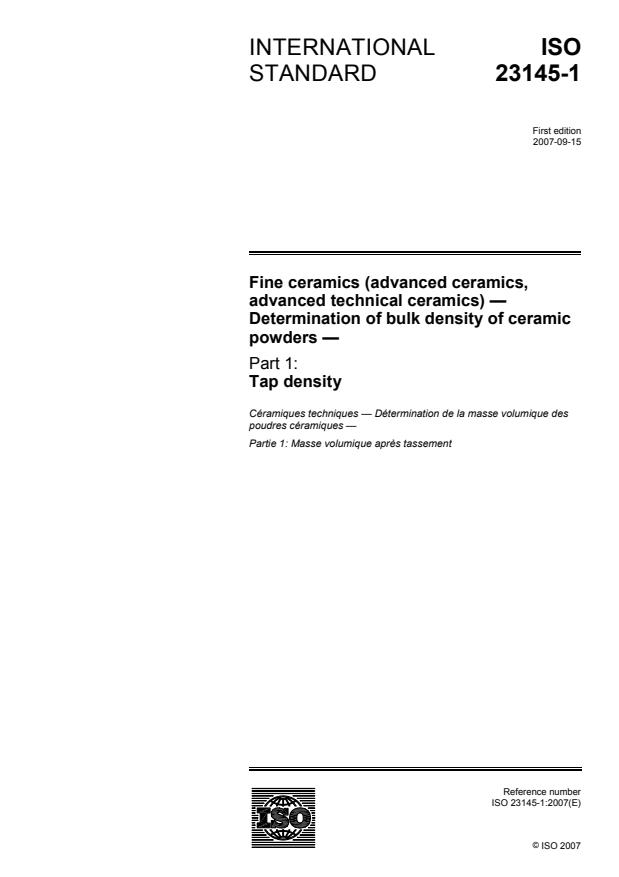
(Main)Fine ceramics (advanced ceramics, advanced technical ceramics) — Determination of bulk density of ceramic powders — Part 1: Tap density
General Information
- Abstract
ISO 23145-1:2007 specifies a procedure to determine the tap density of granulated or ungranulated ceramic powders by a constant-volume measuring method.
- Status
- Published
- Publication Date
- 12-Sep-2007
- Technical Committee
- ISO/TC 206 - Fine ceramics
- Drafting Committee
- ISO/TC 206/WG 2 - Powders
- Current Stage
- 9093 - International Standard confirmed
- Start Date
- 13-Apr-2024
- Completion Date
- 29-Aug-2026
Buy Documents
ISO 23145-1:2007 - Fine ceramics (advanced ceramics, advanced technical ceramics) — Determination of bulk density of ceramic powders — Part 1: Tap density Released:9/13/2007
ISO 23145-1:2007 - Céramiques techniques — Détermination de la masse volumique en vrac des poudres céramiques — Partie 1: Masse volumique apres tassement Released:10/22/2015
Overview
ISO 23145-1:2007 defines a standardized constant-volume method for determining the tap density (bulk density after tapping) of granulated or ungranulated fine ceramic powders (advanced/technical ceramics). The procedure yields a reproducible measure of the mass per unit volume of a powder after it has been allowed to settle and then compacted by a defined tapping routine.
Key topics and requirements
- Scope: Tap density measurement of ceramic powders using a constant-volume measuring method (Part 1 of ISO 23145).
- Apparatus:
- Stainless-steel cylindrical container of about 100 cm3 with diameter/height ratio ≈ 1.
- Ring to increase container height (example dimensions given: ring 50 mm, container ~50 mm diameter × 51 mm height).
- Sieve per ISO 565 with 0.71 mm opening.
- Balance precision 0.1 g (use 0.01 g for very fluffy powders such as aerosil).
- Tap/tamping device with stroke (10 ± 1) mm and frequency < 180 blows/min.
- Procedure highlights:
- Weigh empty container; fill with sieved powder and tamp with 1 000 blows while maintaining a powder overfill 20–30 mm above container.
- Remove ring, level excess powder with a straightedge, and weigh.
- Repeat with 100 blows to check repeatability; difference between the two measured masses must be ≤ 0.3 % (if not, repeat 100‑blow step).
- Perform three test runs and report the average tap density.
- Pre‑treatment: Drying is permitted when required - (110 ± 10) °C for ≥1 h, cooled in a desiccator; do not dry powders containing volatiles. Desired drying endpoint: mass loss < 0.1 %/30 min (if used).
- Calculation: Tap density = (mass of powder after tamping) / (volume of container). Units reported as g/cm3 or kg/m3.
- Test report requirements: Identification, test date, operator, sample description (material, manufacturer, lot), pre‑treatment, results and observations.
Applications and users
ISO 23145-1 is used for consistent powder characterization and quality control in ceramics manufacturing, R&D and materials laboratories. Typical users:
- Materials and process engineers
- Ceramic powder manufacturers and suppliers
- Quality control and testing laboratories
- R&D groups developing formulations, compaction and sintering processes
Related standards
- ISO 23145-2 (bulk density without tapping)
- ISO 3953, EN 725-8, JIS R 1628, ASTM B527 (related methods for bulk/tap density of powders)
Keywords: ISO 23145-1, tap density, bulk density, ceramic powders, fine ceramics, constant‑volume method, tap tester, powder characterization, powder testing.
Buy Documents
ISO 23145-1:2007 - Fine ceramics (advanced ceramics, advanced technical ceramics) — Determination of bulk density of ceramic powders — Part 1: Tap density Released:9/13/2007
ISO 23145-1:2007 - Céramiques techniques — Détermination de la masse volumique en vrac des poudres céramiques — Partie 1: Masse volumique apres tassement Released:10/22/2015
Frequently Asked Questions
ISO 23145-1:2007 is a standard published by the International Organization for Standardization (ISO). Its full title is "Fine ceramics (advanced ceramics, advanced technical ceramics) — Determination of bulk density of ceramic powders — Part 1: Tap density". This standard covers: ISO 23145-1:2007 specifies a procedure to determine the tap density of granulated or ungranulated ceramic powders by a constant-volume measuring method.
ISO 23145-1:2007 specifies a procedure to determine the tap density of granulated or ungranulated ceramic powders by a constant-volume measuring method.
ISO 23145-1:2007 is classified under the following ICS (International Classification for Standards) categories: 81.060.30 - Advanced ceramics. The ICS classification helps identify the subject area and facilitates finding related standards.
ISO 23145-1:2007 is available in PDF format for immediate download after purchase. The document can be added to your cart and obtained through the secure checkout process. Digital delivery ensures instant access to the complete standard document.
Standards Content (Sample)
INTERNATIONAL ISO
STANDARD 23145-1
First edition
2007-09-15
Fine ceramics (advanced ceramics,
advanced technical ceramics) —
Determination of bulk density of ceramic
powders —
Part 1:
Tap density
Céramiques techniques — Détermination de la masse volumique des
poudres céramiques —
Partie 1: Masse volumique après tassement
Reference number
©
ISO 2007
PDF disclaimer
This PDF file may contain embedded typefaces. In accordance with Adobe's licensing policy, this file may be printed or viewed but
shall not be edited unless the typefaces which are embedded are licensed to and installed on the computer performing the editing. In
downloading this file, parties accept therein the responsibility of not infringing Adobe's licensing policy. The ISO Central Secretariat
accepts no liability in this area.
Adobe is a trademark of Adobe Systems Incorporated.
Details of the software products used to create this PDF file can be found in the General Info relative to the file; the PDF-creation
parameters were optimized for printing. Every care has been taken to ensure that the file is suitable for use by ISO member bodies. In
the unlikely event that a problem relating to it is found, please inform the Central Secretariat at the address given below.
© ISO 2007
All rights reserved. Unless otherwise specified, no part of this publication may be reproduced or utilized in any form or by any means,
electronic or mechanical, including photocopying and microfilm, without permission in writing from either ISO at the address below or
ISO's member body in the country of the requester.
ISO copyright office
Case postale 56 • CH-1211 Geneva 20
Tel. + 41 22 749 01 11
Fax + 41 22 749 09 47
E-mail copyright@iso.org
Web www.iso.org
Published in Switzerland
ii © ISO 2007 – All rights reserved
Contents Page
Foreword. iv
1 Scope . 1
2 Normative references . 1
3 Principle. 1
4 Apparatus . 1
5 Sampling. 4
6 Procedure . 4
7 Calculation. 5
8 Test report . 5
Bibliography . 6
Foreword
ISO (the International Organization for Standardization) is a worldwide federation of national standards bodies
(ISO member bodies). The work of preparing International Standards is normally carried out through ISO
technical committees. Each member body interested in a subject for which a technical committee has been
established has the right to be represented on that committee. International organizations, governmental and
non-governmental, in liaison with ISO, also take part in the work. ISO collaborates closely with the
International Electrotechnical Commission (IEC) on all matters of electrotechnical standardization.
International Standards are drafted in accordance with the rules given in the ISO/IEC Directives, Part 2.
The main task of technical committees is to prepare International Standards. Draft International Standards
adopted by the technical committees are circulated to the member bodies for voting. Publication as an
International Standard requires approval by at least 75 % of the member bodies casting a vote.
Attention is drawn to the possibility that some of the elements of this document may be the subject of patent
rights. ISO shall not be held responsible for identifying any or all such patent rights.
ISO 23145-1 was prepared by Technical Committee ISO/TC 206, Fine ceramics.
ISO 23145 consists of the following parts, under the general title Fine ceramics (advanced ceramics,
advanced technical ceramics) — Determination of bulk density of ceramic powders:
⎯ Part 1: Tap density
⎯ Part 2: Untapped density
iv © ISO 2007 – All rights reserved
INTERNATIONAL STANDARD ISO 23145-1:2007(E)
Fine ceramics (advanced ceramics, advanced technical
ceramics) — Determination of bulk density of ceramic
powders —
Part 1:
Tap density
1 Scope
This part of ISO 23145 specifies a procedure to determine the tap density of granulated or ungranulated
ceramic powders by a constant-volume measuring method.
2 Normative references
The following referenced documents are indispensable for the application of this document. For dated
references, only the edition cited applies. For undated references, the latest edition of the referenced
document (including any amendments) applies.
ISO 565:1990, Test sieves — Metal wire cloth, perforated metal plate and electroformed sheet — Nominal
sizes of openings
3 Principle
The mass of a known volume of the powder is determined after allowing it to fall freely into a stat
...
NORME ISO
INTERNATIONALE 23145-1
Première édition
2007-09-15
Céramiques techniques —
Détermination de la masse volumique
en vrac des poudres céramiques —
Partie 1:
Masse volumique après tassement
Fine ceramics (advanced ceramics, advanced technical ceramics) —
Determination of bulk density of ceramic powders —
Part 1: Tap density
Numéro de référence
©
ISO 2007
DOCUMENT PROTÉGÉ PAR COPYRIGHT
© ISO 2007, Publié en Suisse
Droits de reproduction réservés. Sauf indication contraire, aucune partie de cette publication ne peut être reproduite ni utilisée
sous quelque forme que ce soit et par aucun procédé, électronique ou mécanique, y compris la photocopie, l’affichage sur
l’internet ou sur un Intranet, sans autorisation écrite préalable. Les demandes d’autorisation peuvent être adressées à l’ISO à
l’adresse ci-après ou au comité membre de l’ISO dans le pays du demandeur.
ISO copyright office
Ch. de Blandonnet 8 • CP 401
CH-1214 Vernier, Geneva, Switzerland
Tel. +41 22 749 01 11
Fax +41 22 749 09 47
copyright@iso.org
www.iso.org
ii © ISO 2007 – Tous droits réservés
Sommaire Page
Avant-propos .iv
1 Domaine d’application . 1
2 Références normatives . 1
3 Principe . 1
4 Appareillage . 1
5 Échantillonnage . 3
6 Mode opératoire. 4
7 Calcul . 5
8 Rapport d’essai . 5
Bibliographie . 6
Avant-propos
L’ISO (Organisation internationale de normalisation) est une fédération mondiale d’organismes
nationaux de normalisation (comités membres de l’ISO). L’élaboration des Normes internationales est
en général confiée aux comités techniques de l’ISO. Chaque comité membre intéressé par une étude
a le droit de faire partie du comité technique créé à cet effet. Les organisations internationales,
gouvernementales et non gouvernementales, en liaison avec l’ISO participent également aux travaux.
L’ISO collabore étroitement avec la Commission électrotechnique internationale (IEC) en ce qui
concerne la normalisation électrotechnique.
Les procédures utilisées pour élaborer le présent document et celles destinées à sa mise à jour sont
décrites dans les Directives ISO/IEC, Partie 1. Il convient, en particulier de prendre note des différents
critères d’approbation requis pour les différents types de documents ISO. Le présent document a été
rédigé conformément aux règles de rédaction données dans les Directives ISO/IEC, Partie 2 (voir www.
iso.org/directives).
L’attention est appelée sur le fait que certains des éléments du présent document peuvent faire l’objet de
droits de propriété intellectuelle ou de droits analogues. L’ISO ne saurait être tenue pour responsable
de ne pas avoir identifié de tels droits de propriété et averti de leur existence. Les détails concernant
les références aux droits de propriété intellectuelle ou autres droits analogues identifiés lors de
l’élaboration du document sont indiqués dans l’Introduction et/ou dans la liste des déclarations de
brevets reçues par l’ISO (voir www.iso.org/brevets).
Les appellations commerciales éventuellement mentionnées dans le présent document sont données
pour information, par souci de commodité, à l’intention des utilisateurs et ne sauraient constituer
un engagement.
Pour une explication de la signification des termes et expressions spécifiques de l’ISO liés à
l’évaluation de la conformité, ou pour toute information au sujet de l’adhésion de l’ISO aux principes
de l’OMC concernant les obstacles techniques au commerce (OTC), voir le lien suivant: Avant-propos —
Informations supplémentaires.
L’ISO 23145-1 a été élaborée par le comité technique ISO/TC 206, Céramiques techniques, en collaboration
avec le comité technique CEN/TC 184.
L’ISO 23145 comprend les parties suivantes, présentées sous le titre général Céramiques techniques —
Détermination de la masse volumique des poudres céramiques:
— Partie 1: Masse volumique après tassement
— Partie 2: Masse volumique sans tassement
iv © ISO 2007 – Tous droits réservés
NORME INTERNATIONALE ISO 23145-1:2007(F)
Céramiques techniques — Détermination de la masse
volumique en vrac des poudres céramiques —
Partie 1:
Masse volumique après tassement
1 Domaine d’application
La présente partie de l’ISO 23145 spécifie un mode opératoire permettant de déterminer la masse
volumique après tassement des poudres céramiques granulées ou non-granulées à l’aide d’une méthode
de mesurage à volume constant.
2 Références normatives
Les documents ci-après sont des références normatives indispensables à l’application du présent
document. Pour les références datées, seule l’édition citée s’applique. Pour les références non datées, la
dernière édition du document de référence s’applique (y compris l
...