


ISO/IEC 13239:2000
(Main)Information technology — Telecommunications and information exchange between systems — High-level data link control (HDLC) procedures
Information technology — Telecommunications and information exchange between systems — High-level data link control (HDLC) procedures
Technologies de l'information — Télécommunications et échange d'information entre systèmes — Procédures de commande de liaison de données à haut niveau (HDLC)
General Information
- Status
- Withdrawn
- Publication Date
- 23-Feb-2000
- Withdrawal Date
- 23-Feb-2000
- Current Stage
- 9599 - Withdrawal of International Standard
- Start Date
- 22-Aug-2002
- Completion Date
- 14-Feb-2026
Relations
- Effective Date
- 15-Apr-2008
- Effective Date
- 15-Apr-2008


Get Certified
Connect with accredited certification bodies for this standard

BSI Group
BSI (British Standards Institution) is the business standards company that helps organizations make excellence a habit.

NYCE
Mexican standards and certification body.
Sponsored listings
Frequently Asked Questions
ISO/IEC 13239:2000 is a standard published by the International Organization for Standardization (ISO). Its full title is "Information technology — Telecommunications and information exchange between systems — High-level data link control (HDLC) procedures". This standard covers: Information technology — Telecommunications and information exchange between systems — High-level data link control (HDLC) procedures
Information technology — Telecommunications and information exchange between systems — High-level data link control (HDLC) procedures
ISO/IEC 13239:2000 is classified under the following ICS (International Classification for Standards) categories: 35.100.20 - Data link layer. The ICS classification helps identify the subject area and facilitates finding related standards.
ISO/IEC 13239:2000 has the following relationships with other standards: It is inter standard links to ISO/IEC 13239:1997, ISO/IEC 13239:2002. Understanding these relationships helps ensure you are using the most current and applicable version of the standard.
ISO/IEC 13239:2000 is available in PDF format for immediate download after purchase. The document can be added to your cart and obtained through the secure checkout process. Digital delivery ensures instant access to the complete standard document.
Standards Content (Sample)
INTERNATIONAL ISO/IEC
STANDARD 13239
Second edition
2000-03-01
Information technology —
Telecommunications and information
exchange between systems — High-level
data link control (HDLC) procedures
Technologies de l'information — Télécommunications et échange
d'information entre systèmes — Procédures de commande de liaison de
données à haut niveau (HDLC)
Reference number
©
ISO/IEC 2000
PDF disclaimer
This PDF file may contain embedded typefaces. In accordance with Adobe's licensing policy, this file may be printed or viewed but shall not
be edited unless the typefaces which are embedded are licensed to and installed on the computer performing the editing. In downloading
this file, parties accept therein the responsibility of not infringing Adobe's licensing policy. The ISO Central Secretariat accepts no liability in
this area.
Adobe is a trademark of Adobe Systems Incorporated.
Details of the software products used to create this PDF file can be found in the General Info relative to the file; the PDF-creation
parameters were optimized for printing. Every care has been taken to ensure that the file is suitable for use by ISO member bodies. In the
unlikely event that a problem relating to it is found, please inform the Central Secretariat at the address given below.
© ISO/IEC 2000
All rights reserved. Unless otherwise specified, no part of this publication may be reproduced or utilized in any form or by any means, electronic
or mechanical, including photocopying and microfilm, without permission in writing from either ISO at the address below or ISO's member body
in the country of the requester.
ISO copyright office
Case postale 56 � CH-1211 Geneva 20
Tel. + 41 22 749 01 11
Fax + 41 22 734 10 79
E-mail copyright@iso.ch
Web www.iso.ch
Printed in Switzerland
© ISO/IEC 2000 – All rights reserved
ii
Page
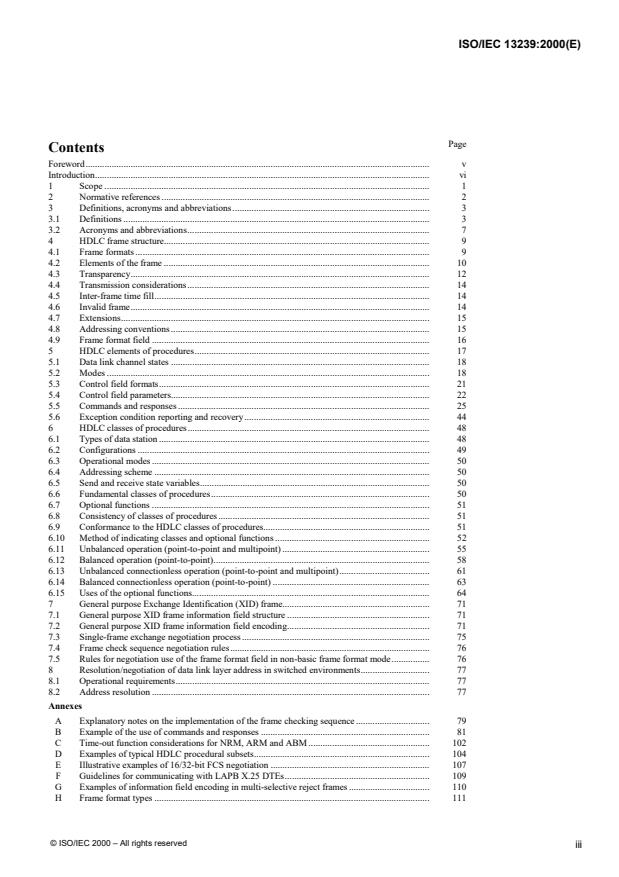
Contents
Foreword. v
Introduction. vi
1 Scope . 1
2 Normative references . 2
3 Definitions, acronyms and abbreviations . 3
3.1 Definitions . 3
3.2 Acronyms and abbreviations. 7
4 HDLC frame structure. 9
4.1 Frame formats . 9
4.2 Elements of the frame . 10
4.3 Transparency. 12
4.4 Transmission considerations. 14
4.5 Inter-frame time fill. 14
4.6 Invalid frame. 14
4.7 Extensions. 15
4.8 Addressing conventions. 15
4.9 Frame format field . 16
5 HDLC elements of procedures. 17
5.1 Data link channel states . 18
5.2 Modes . 18
5.3 Control field formats. 21
5.4 Control field parameters. 22
5.5 Commands and responses . 25
5.6 Exception condition reporting and recovery. 44
6 HDLC classes of procedures. 48
6.1 Types of data station . 48
6.2 Configurations . 49
6.3 Operational modes . 50
6.4 Addressing scheme . 50
6.5 Send and receive state variables.50
6.6 Fundamental classes of procedures. 50
6.7 Optional functions . 51
6.8 Consistency of classes of procedures . 51
6.9 Conformance to the HDLC classes of procedures. 51
6.10 Method of indicating classes and optional functions . 52
6.11 Unbalanced operation (point-to-point and multipoint) . 55
6.12 Balanced operation (point-to-point).58
6.13 Unbalanced connectionless operation (point-to-point and multipoint). 61
6.14 Balanced connectionless operation (point-to-point) . 63
6.15 Uses of the optional functions. 64
7 General purpose Exchange Identification (XID) frame. 71
7.1 General purpose XID frame information field structure . 71
7.2 General purpose XID frame information field encoding. 71
7.3 Single-frame exchange negotiation process . 75
7.4 Frame check sequence negotiation rules. 76
7.5 Rules for negotiation use of the frame format field in non-basic frame format mode. 76
8 Resolution/negotiation of data link layer address in switched environments. 77
8.1 Operational requirements. 77
8.2 Address resolution . 77
Annexes
A Explanatory notes on the implementation of the frame checking sequence . 79
B Example of the use of commands and responses . 81
C Time-out function considerations for NRM, ARM and ABM . 102
D Examples of typical HDLC procedural subsets. 104
E Illustrative examples of 16/32-bit FCS negotiation . 107
F Guidelines for communicating with LAPB X.25 DTEs. 109
G Examples of information field encoding in multi-selective reject frames . 110
H Frame format types . 111
© ISO/IEC 2000 – All rights reserved
iii
Foreword
ISO (the International Organization for Standardization) and IEC (the International Electrotechnical Commission) form the
specialized system for worldwide standardization. National bodies that are members of ISO or IEC participate in the
development of International Standards through technical committees established by the respective organization to deal with
particular fields of technical activity. ISO and IEC technical committees collaborate in fields of mutual interest. Other
international organizations, governmental and non-governmental, in liaison with ISO and IEC, also take part in the work.
International Standards are drafted in accordance with the rules given in the ISO/IEC Directives, Part 3.
In the field of information technology, ISO and IEC have established a joint technical committee, ISO/IEC JTC 1. Draft
International Standards adopted by the joint technical committee are circulated to national bodies for voting. Publication as an
International Standard requires approval by at least 75 % of the national bodies casting a vote.
Attention is drawn to the possibility that some of the elements of this International Standard may be the subject of patent rights.
ISO and IEC shall not be held responsible for identifying any or all such patent rights.
International Standard ISO/IEC 13239 was prepared by Joint Technical Committee ISO/IEC JTC 1, Information technology,
Subcommittee SC 6, Telecommunications and information exchange between systems.
This second edition cancels and replaces the first edition (ISO/IEC 13239:1997), which has been technically revised.
Annex H forms a normative part of this International Standard. Annexes A to G are for information only.
© ISO/IEC 2000 – All rights reserved
iv
Introduction
This International Standard is a composition of the following HDLC-related International Standard
and approved Amendments:
� ISO/IEC 13239: 1997
Information technology � Telecommunications and information exchange between systems �
High-level data link control (HDLC) procedures
� ISOIEC 13239: 1997/DAM1
Information technology � Telecommunications and information exchange between systems �
High-level data link control (HDLC) procedures � Amendment 1: Non-basic frame formats �
General
� ISOIEC 13239: 1997/DAM2
Information technology � Telecommunications and information exchange between systems �
High-level data link control (HDLC) procedures � Amendment 2: Non-basic frame formats �
Provision for multiple address fields
� ISOIEC 13239: 1997/DAM3
Information technology � Telecommunications and information exchange between systems �
High-level data link control (HDLC) procedures� Amendment 3: Provision for 8-bit FCS
� ISOIEC 13239: 1997/DAM4
Information technology � Telecommunications and information exchange between systems �
High-level data link control (HDLC) procedures� Amendment 4: Frame format field
� ISOIEC 13239: 1997/DAM5
Information technology � Telecommunications and information exchange between systems �
High-level data link control (HDLC) procedures� Amendment 5: Intra-frame timeout
� ISOIEC 13239: 1997/DAM6
Information technology � Telecommunications and information exchange between systems �
High-level data link control (HDLC) procedures� Amendment 6: Header check sequence
High-level data link control (HDLC) procedures are designed to permit synchronous or start/stop,
code-transparent data transmission. The normal cycle of the code-transparent data communication
between two data stations consists of the transfer of frames containing information from the data
source to the data sink acknowledged by a frame in the opposite direction. Generally, until the data
station comprising the data source receives an acknowledgement, it holds the original information in
memory in case the need should arise for retransmissions.
In those situations that require it, data sequence integrity between the data source and the data sink is
effected by means of a numbering scheme, which is cyclic within a specified modulus and measured
in terms of frames. An independent numbering scheme is used for each data source/data sink
combination on the data link.
The acknowledgement function is accomplished by the data sink informing the data source of the
next expected sequence number. This can be done in a separate frame, not containing information,
or within the control field of a frame containing information.
HDLC procedures are applicable to unbalanced data links and to balanced data links.
© ISO/IEC 2000 – All rights reserved
v
Unbalanced data links
An unbalanced data link involves two or more participating data stations. For control purposes, one
data station on the data link assumes responsibility for the organization of data flow and for
unrecoverable data link level error conditions. The data station assuming these responsibilities is
known as the primary station in unbalanced connection-mode data links and as the control station in
unbalanced connectionless-mode data links, and the frames it transmits are referred to as command
frames. The other data stations on the data link are known as the secondary stations in unbalanced
connection-mode data links and as the tributary stations in unbalanced connectionless-mode data
links, and the frames they transmit are referred to as response frames.
For the transfer of data between the primary/control station and the secondary/tributary stations, two
cases of data link control are considered (see figures A and B). In the first case, the data station
comprising the data source performs a primary/control station data link control function and controls
the data station comprising the data sink that is associated with a secondary/tributary station data link
control function, by select-type commands.
In the second case, the data station comprising the data sink performs a primary/control station data
link control function and controls the data station comprising the data source that is associated with a
secondary/tributary station data link control function, by poll-type commands.
The information flows from the data source to the data sink, and the acknowledgements are always
transmitted in the opposite direction.
These two cases of data link control may be combined so that the data link becomes capable of two-
way alternate communication, or two-way simultaneous communication.
Select/information
Primary/
Secondary/
Control Tributary
station
station
Acknowledgement
Data source Data sink
Figure A���� Unbalanced data link functions (case 1)
Poll/acknowledgement
Primary/
Secondary/
Control
Tributary
station station
Information
Data sink Data source
Figure B���� Unbalanced data link functions (case 2)
Balanced data links
A balanced data link involves only two participating data stations. For control purposes, each data
station assumes responsibility for the organization of its data flow and for unrecoverable data link
level error conditions associated with the transmissions that it originates. Each data station is known
as a combined station in balanced connection-mode data links and as a peer station in balanced
connectionless-mode data links and is capable of transmitting and receiving both command and
response frames.
For the transfer of data between combined/peer stations, the data link control functions illustrated in
figure C are utilized. The data source in each combined/peer station controls the data sink in the
other combined/peer station by the use of select-type commands. The information flows from the
data source to the data sink, and the acknowledgements are always transmitted in the opposite
direction. The poll-type commands may be used by each combined/peer station to solicit
acknowledgements and status responses from the other combined/peer station.
© ISO/IEC 2000 – All rights reserved
vi
Select/information/acknowledgement/poll
Combined/ Combined/
Peer Peer
station station
Select/information/acknowledgement/poll
Data sink/data source Data sink/data source
Figure C���� Balanced data link functions
Data link configurations
HDLC classes of procedures describe methods of data link operation which permit synchronous or
start/stop, code-transparent data transmission between data stations in a variety of logical and
physical configurations. The classes are defined in a consistent manner within the framework of an
overall HDLC architecture. One of the purposes of this International Standard is to maintain
maximum compatibility between the basic types of procedures, unbalanced, balanced and
connectionless, as this is particularly desirable for data stations with configurable capability, which
may have the characteristics of a primary, secondary, combined, control, tributary, or peer station, as
required for a specific instance of communication.
Five fundamental classes of procedures (two unbalanced, one balanced, and two connectionless) are
defined herein. The unbalanced classes apply to both point-to-point and multipoint configurations
(as illustrated in figure D using the primary/secondary nomenclature) over either dedicated or
switched data transmission facilities. A characteristic of the unbalanced classes is the existence of a
single primary station at one end of the data link plus one or more secondary stations at the other
end(s) of the data link. The primary station alone is responsible for data link management, hence the
designation "unbalanced" classes of procedures.
Primary/
Control
station
Secondary/ Secondary/
Tributary Tributary
station station
A N
Figure D�� Unbalanced data link configuration
��
The unbalanced connectionless class applies to point-to-point configurations over either dedicated or
switched data transmission facilities, or to multipoint configurations over dedicated data transmission
facilities (as illustrated in figure D using the control/tributary nomenclature). A characteristic of the
unbalanced connectionless class is the existence of a single control station at one end of the data link
plus one or more tributary stations at the other end(s) of the data link. The control station is
responsible for determining when a tributary station is permitted to send. Neither the control station
nor the tributary station(s) support any form of connection establishment/termination procedures,
flow control procedures, data transfer acknowledgement procedures, or error recorvery procedures,
hence the designation “connectionless” class of procedures.
The balanced class applies to point-to-point configurations (as illustrated in figure E using the
combined nomenclature) over either dedicated or switched data transmission facilities. A
characteristic of the balanced class is the existence of two data stations, called combined stations, on
a logical data link, that may share equally in the responsibility for data link management, hence the
designation "balanced" class of procedures.
© ISO/IEC 2000 – All rights reserved
vii
I
Combined/ Combined/
Peer Peer
station station
A B
Figure E�� Balanced data link configuration
��
The balanced connectionless class applies to point-to-point configurations over either dedicated or
switched data transmission facilities (as illustrated in figure E using the peer nomenclature). A
characteristic of the balanced connectionless class is the existence of two data stations, called peer
stations, on a data link, that are each independently in control of when they can send. Neither peer
station supports any form of connection establishment/termination procedures, flow control
procedures, data transfer acknowledgement procedures, or error recovery procedures, hence the
designation "connectionless" class of procedures.
For each class of procedures, a method of operation is specified in terms of the capabilities of the
basic repertoire of commands and responses that are found in that class.
A variety of optional functions are also listed. Procedural descriptions for the use of the optional
functions are defined.
It is recognized that it is possible to construct symmetrical configurations for operation on a single
data circuit from the unbalanced classes of procedures which are defined in this International
Standard. For example, the combination of two unbalanced procedures (with I frame flow as
commands only) in opposite directions would create a symmetrical point-to-point configuration (as
illustrated in figure F).
Primary Secondary
station station
I
1 1
I
I
I
Secondary Primary
I
I
station station
2 2
Figure F���� Symmetrical data link configuration
These HDLC procedures define the exchange identification (XID) command/response frame as an
optional function for exchange of data link information (identification, parameters, functional
capability, etc.). The content and format for a general purpose XID frame information field is
defined.
These HDLC procedures also specify the parameters and procedures which may be employed by two
data stations to mutually determine the data link layer addresses to be used, prior to logical data link
establishment.
© ISO/IEC 2000 – All rights reserved
viii
INTERNATIONAL STANDARD ISO/IEC 13239:2000(E)
Information technology — Telecommunications and information
exchange between systems — High-level data link control (HDLC)
procedures
1Scope
This International Standard specifies the frame structures, the elements of procedures, the classes of procedures, the content
and format of the general purpose Exchange Identification (XID) frame, and a means for resolution/negotiation of a data link
layer address in switched environments for data communication systems using bit-oriented high-level data link control
(HDLC) procedures.
NOTE� The use of the phrase “bit-oriented”, referring to the HDLC control procedures, pertains to the allocation of a non-integral number
of bits to various subfields used for HDLC control purposes. However, the frame as an entirety may be constructed from octet-oriented units
(e.g., start-stop mode) for transmission purposes.
The frame structure portion defines the relative positions of the various components of the basic frame format and the non-
basic frame format. The mechanisms used to achieve bit pattern independence (transparency), where and when required,
within the frame are also defined. In addition, three frame checking sequences (FCS) are specified; the rules for address field
extension are defined; and the addressing conventions available are described.
The elements of procedures portion specifies elements of data link control procedures for synchronous or start/stop, code-
transparent data transmission using independent frame numbering in both directions.
These HDLC elements of procedures are defined specifically in terms of the actions that occur on receipt of commands at a
secondary station, a tributary station, a peer station, or a combined station.
This International Standard is intended to cover a wide range of applications; for example one-way, two-way alternate or
two-way simultaneous data communication between data stations which are usually buffered, including operations on
different types of data circuits; for example multipoint/point-to-point, duplex/half-duplex, switched/non-switched,
synchronous/start-stop, etc.
The defined elements of procedures are to be considered as a common basis for establishing different types of data link
control procedures. This International Standard does not define any single system and should not be regarded as a
specification for a data communication system. Not all of the commands or responses are required for any particular system
implementation.
The classes of procedures portion describes the HDLC unbalanced classes of procedures, the HDLC balanced class of
procedures, and the HDLC connectionless classes of procedures for synchronous or start/stop data transmission.
For the unbalanced classes, the data link consists of a primary station plus one or more secondary stations and operates in
either the normal response mode or the asynchronous response mode in a point-to-point or multipoint configuration. For the
balanced class, the data link consists of two combined stations and operates in the asynchronous balanced mode in a point-to-
point configuration. For the unbalanced connectionless class, the data link consists of a control station plus one or more
tributary stations and operates in the unbalanced connectionless-mode in a point-to-point or multipoint configuration. For the
balanced connectionless class, the data link consists of two peer stations and operates in the balanced connectionless-mode in
a point-to-point configuration. In each class, a basic repertoire of commands and responses is defined, but the capability of
the data link may be modified by the use of optional functions.
Balanced operation is intended for use in circumstances which require equal control at either end of the data link.
Operational requirements are covered in accordance with the overall HDLC architecture.
The content and format of the Exchange Identification (XID) frame portion builds on the fact that the principal use of the
XID frame is to exchange data link information between two or more HDLC stations. For the purpose of this International
Standard, data link information shall include any and all essential operational characteristics such as identification,
authentication and/or selection of optional functions and facilities concerning each station. This International Standard
defines a single-exchange negotiation procedure for establishing operational characteristics when either one or more stations
are capable of providing multiple selections.
© ISO/IEC 2000 – All rights reserved
This International Standard provides a means for exchanging the necessary information to establish, at a minimum, a data
link connection between two correspondents wishing to communicate. It describes a general purpose XID frame information
field content and format for that purpose.
It defines encoding for information related to the basic HDLC standards only. Mechanisms are provided to permit the general
purpose XID frame information field to be used to negotiate private parameters in a single XID exchange simultaneously
with negotiation of the defined basic parameters.
This International Standard does not limit or restrict the use of the XID frame information field from defining other standard
formats for use in specific applications.
The following are examples of potential uses of the XID command/response frame interchange:
a) Identification of the calling and called stations when using circuit switched networks (including switched network
backup applications).
b) Identification of stations operating on non-switched networks requiring identification at start-up.
c) The XID command frame with an individual, group or all-station address may be used to solicit XID response
frame(s) from other station(s) on the data link, prior to or following data link establishment.
d) Negotiation of the Frame Check Sequence (FCS) to be used for subsequent information interchange, by stations that
support both 16-bit FCS and 32-bit FCS capabilities.
e) Convey higher layer information that may be required prior to data link establishment.
f) Transmission of an XID response frame at any respond opportunity to request an XID exchange to modify some of
the operational parameters (for example, window size) following data link establishment.
g) Negotiation of the number of protected bits in the frame when an Unnumbered Information with Header check (UIH)
frame is used.
The means for resolution/negotiation of a data link layer address in switched environments portion is applicable to data
stations employing HDLC balanced classes of procedures which provide the XID command/response capability with the two
specific parameter fields, identified below. It is used to select a pair of operational link addresses when preassigned, system
designated addresses are not known on an a priori basis; e.g., switched circuited data links. Additional XID frame functions
(including the exchange of operational parameters, command/response support, higher layer information, etc.) may be
accomplished in conjunction with data link layer address determination or following address determination, with additional
XID frame exchanges.
NOTE� Address resolution procedures for situations where the remote DTE does not support XID frames, the "all-station" address, or
complete address support capabilities as defined in clause 8 below are not within the scope of this International Standard.
2 Normative references
The following normative documents contain provisions which, through reference in this text, constitute provisions of this
International Standard. For dated references, subsequent amendments to, or revisions of, any of these publications do not
apply. However, parties to agreements based on this International Standard are encouraged to investigate the possibility of
applying the most recent editions of the normative documents indicated below. For undated references, the latest edition of
the normative document referred to applies. Members of ISO and IEC maintain registers of currently valid International
Standards.
ISO/IEC 646 : 1991, Information technology� ISO 7-bit coded character set for information interchange.
ISO/IEC 2382-9 : 1995, Information technology� Vocabulary�Part 9: Data communication.
ISO 7478 : 1987, Information processing systems� Data communication� Multilink procedures.
ISO/IEC 7498-1 : 1994, Information technology� Open Systems Interconnection � Basic Reference Model: The Basic
Model.
ISO/IEC 7776 : 1995, Information technology� Telecommunications and information exchange between systems� High-
level data link control procedures� Description of the X.25 LAPB-compatible DTE data link procedures.
ISO/IEC TR 10171 : 1994, Information technology� Telecommunications and information exchange between systems�
List of standard data link layer protocols that utilize high-level data link control (HDLC) classes of procedures and list of
standardized XID format identifiers and private parameter set of identification values.
© ISO/IEC 2000 – All rights reserved
3 Definitions, acronyms and abbreviations
3.1 Definitions
For the purposes of this International Standard, the following definitions apply.
3.1.1
abort
a function invoked by a sending primary, secondary, combined, control, tributary or peer station causing the recipient to
discard (and ignore) all bit sequences transmitted by the sender since the preceding flag sequence
3.1.2
accept
the condition assumed by a data station (primary, secondary, combined, control, tributary or peer station) upon accepting a
correctly received frame for processing
3.1.3
address field (A)
the sequence of eight (or any multiple of eight, if extended) bits identifying the secondary/combined or tributary/peer station
sending (or designated to receive) the frame
3.1.4
address field extension
enlarging the address field to include more addressing information
3.1.5
address resolution/negotiation
procedure for exchanging/determining the data link layer identity of each data link layer entity
3.1.6
basic status
a secondary/combined or tributary/peer station's capability to send or receive a frame containing an information field
3.1.7
centralized control
a control in which all the primary or control station functions of the data link are centralized in one data station
3.1.8
combined station
that part of a data station that supports the combined station control functions of the data link
NOTE� The combined station generates commands and responses for transmission and interprets received commands and responses.
Specific responsibilities assigned to a combined station include:
a) initialization of control signal interchange;
b) organization of data flow;
c) interpretation of received commands and generation of appropriate responses; and
d) actions regarding error control and error recovery functions at the data link layer.
3.1.9
command
in data communication, an instruction represented in the control field of a frame and transmitted by the
primary/combined/control/peer station, which causes the addressed secondary/combined/tributary/peer station to execute a
specific data link control function
3.1.10
command frame
a) All frames transmitted by a primary/control station.
b) Those frames transmitted by a combined/peer station that contain the address of the other combined/peer station.
3.1.11
contention mode
a mode of transmission in which a transmitter can send on its own initiative
© ISO/IEC 2000 – All rights reserved
3.1.12
control escape (CE)
the unique sequence of eight bits (10111110) employed to indicate the following octet has been modified according to the
transparency algorithm for start/stop transmission environments
3.1.13
control field (C)
the sequence of eight (or 16/32/64, if extended) bits immediately following the address field of a frame
NOTE� The content of the control field is interpreted by:
a) the receiving secondary/combined/tributary/peer station, designated by the address field, as a command instructing the performance
of some specific function; and
b) the receiving primary/combined/control/peer station as a response from the secondary/combined/tributary/peer station, designated
by the address field, to one or more commands.
3.1.14
control field extension
enlarging the control field to include additional control information
3.1.15
control station
the data station that supports the control station control functions of the data link
NOTE� The control station generates command for transmission and interprets received responses. Specific responsibilities assigned to
the control station include:
a) initialization of control signal interchange, and
b) organization of data flow.
3.1.16
data communication
see ISO/IEC 2382-9, term 09.01.03
3.1.17
data link
see ISO/IEC 2382-9, term 09.04.08
3.1.18
data link connection
see ISO/IEC 7498-1 : 1994
3.1.19
data link layer
the conceptual layer of control or processing logic existing in the hierarchical structure of a data station (primary, secondary,
combined, control, tributary or peer station) that is responsible for maintaining control of the data link
NOTE� The data link layer functions provide an interface between the data station higher layer logic and the data link. These functions
include:
a) transparency;
b) address/control field interpretation;
c) command/response generation, transmission and interpretation; and
d) frame check sequence computation and interpretation.
3.1.20
data transmission
see ISO/IEC 2382-9, term 09.01.02
3.1.21
duplex transmission
see ISO/IEC 2382-9, term 09.03.01
3.1.22
exception condition
the condition assumed by a secondary/combined station upon receipt of a frame which it cannot execute due either to a
transmission error or to an internal processing malfunction
© ISO/IEC 2000 – All rights reserved
3.1.23
flag sequence (F)
the unique sequence of eight bits (01111110) employed to delimit the opening and closing of a frame
3.1.24
format identifier
designator of one of 128 different standardized formats or one of 128 user-defined formats of the Exchange Identification
(XID) frame information field
3.1.25
frame
the sequence of address, control, information, and FCS fields, bracketed by opening and closing flag sequences
NOTE� A valid frame is at least 24 bits in length and contains an address field, a control field and a frame check sequence. A frame may
or may not include an information field.
3.1.26
frame check sequence (FCS)
the field immediately preceding the closing flag sequence of a frame, containing the bit sequence that provides for the
detection of transmission errors by the receiver
3.1.27
frame format identifier
an optional field in non-basic frame format mode that identifies the format of the frame
3.1.28
group identifier
classifier of data link layer characteristics or parameters by function (for example, address resolution, parameter negotiation,
user data)
3.1.29
half-duplex transmission
see ISO/IEC 2382-9, term 09.03.02
3.1.30
header check sequence (HCS)
a check sequence using one of the standard 8, 16, or 32 bit polynomials that is computed over the fields between the opening
flag sequence and the HCS field
3.1.31
HDLC-based protocol
a protocol which is a subset of the elements and classes of procedure and optional functions defined in the HDLC standard,
and adopted as a standard by ISO or a recognized international standards body (e.g., ITU-T)
3.1.32
higher layer
the conceptual layer of control or processing logic existing in the hierarchical structure of a data station (primary, secondary,
combined, control, tributary or peer station) that is above the data link layer and upon which the performance of data link
layer functions are dependent; for example device control, buffer allocation, station management, etc.
3.1.33
information field (INFO)
the sequence of bits, occurring between the last bit of the control field and the first bit of the frame check sequence
NOTE� The information field contents of I, UI, and UIH frames are not interpreted at the data link layer.
3.1.34
initiating combined station
a station that sends the initial XID command frame as part of the address resolution process
3.1.35
interframe time fill
the sequence or condition transmitted between frames
© ISO/IEC 2000 – All rights reserved
3.1.36
intraframe time fill
in start/stop transmission, the sequence or condition transmitted within a frame when the next octet is not available for
contiguous transmission immediately following the preceding octet (For synchronous transmission, there is no provision for
intraframe time fill)
3.1.37
invalid frame
a sequence of bits, following the receipt of an apparent opening flag sequence, that either
a) is terminated by an abort sequence; or
b) contains less than 32 bits before an apparent closing flag sequence is detected
3.1.38
layer parameter
the specification of data link layer characteristics and parameters, and their values, available or chosen
3.1.39
non-initiating combined station
a station that waits for the other combined station to send the initial XID command frame as part of the address resolution
process
3.1.40
peer station
the data station that supports the peer station control functions of the data link
NOTE� The peer station generates commands for transmission and interprets received commands and responses.
3.1.41
primary station
the data station that supports the primary station control functions of the data link
NOTE� The primary station generates commands for transmission and interprets received responses. Specific responsibilities assigned to
the primary station include:
a) initialization of control signal interchange;
b) organization of data flow; and
c) actions regarding error control and error recovery functions at the data link layer.
3.1.42
primary/secondary station
the general case where the station may be either a primary station or a secondary station
3.1.43
private parameter
an implementation-specific data link layer parameter not defined in the basic HDLC standards
3.1.44
response
in data communication, a reply represented in the control field of a response frame that advises the
primary/combined/control/peer station with respect to the action taken by the secondary/combined/tributary/peer station to
one or more commands
3.1.45
response frame
a) all frames transmitted by a secondary/tributary station
b) those frames transmitted by a combined/peer station that contain the address of the transmitting combined/peer station
3.1.46
secondary station
the data station that executes data link control functions as instructed by the primary station
NOTE� A secondary station interprets received commands and generates responses for transmission.
© ISO/IEC 2000 – All rights reserved
3.1.47
secondary station status
the current condition of a secondary station with respect to processing the series of commands received from the primary
station
3.1.48
single-exchange negotiation procedure
the initiating station indicates its "menu" of capabilities in its command frame, and the responding station indicates its
choices from the menu in its response frame
3.1.49
tributary station
the data station that executes data link control functions as instructed by the control station
NOTE� The tributary station interprets received commands and generates responses for transmission.
3.1.50
two-way alternate data communication
see ISO/IEC 2382-9, term 09.05.03
3.1.51
two-way simultaneous data communication
see ISO/IEC 2382-9, term 09.05.02
3.1.52
unique identifier
a unique bit/character sequence (for example, global telephone number, station identification, or equivalent) associated with
each station
3.1.53
unnumbered commands
the commands that do not contain sequence numbers in the control field
3.1.54
unnumbered responses
the responses that do not contain sequence numbers in the control field
3.1.55
user data
the information obtained from or delivered to the user of the data link layer
3.2 Acronyms and abbreviations
The following acronyms and abbreviations are used commonly throughout this International Standard.
A Address field
ABM Asynchronous Balanced Mode
ADM Asynchronous Disconnected Mode
ARM Asynchronous Response Mode
B Binary encoded
BAC Balanced operation Asynchronous balanced mode Class
BCC Balanced operation Connectionless-mode Class
BCM Balanced Connectionless Mode
C Control field
CE Control Escape
C/R Command/Response
F Flag sequence
FFinalbit
FI Format Identifier
DC1 Device Control One
DC3 Device Control Three
DCE Data Circuit-terminating Equipment
DISC Disconnect
DM Disconnected Mode
DTE Data Terminal Equipment
© ISO/IEC 2000 – All rights reserved
E bit Encoded
FCS Frame Check Sequence
FRMR FRaMe Reject
GI Group Identifier
GL Group Length
HCS Header Check Sequence
HDLC High-level Data Link Control
I Information frame
IEC International Electrotechnical Commission
IM Initialization Mode
INFO INFOrmation field
ISO International Organization for Standardization
ITU-T International Telecommunications Union� Telecommunication Standardization Sector
LAPB Link Access Procedure Balanced
LSB Least Significant Bit
M Modifier function bit
MSB Most Significant Bit
MT1 Multilink lost frame Timer 1
MT2 Multilink group busy Timer 2
MT3 Multil
...
Questions, Comments and Discussion
Ask us and Technical Secretary will try to provide an answer. You can facilitate discussion about the standard in here.
Loading comments...