

ISO/IEC 30122-2:2017
(Main)Information technology — User interfaces — Voice commands — Part 2: Constructing and testing
General Information
- Abstract
ISO 30122-2:2017 provides the technical criterions and test methods of voice commands and its speech recognition engine. The technical criterions include the phonetic requirements for spoken words or phrases that compose the voice command. The test methods verify whether the voice command or speech recognition engine satisfies the required specifications.
- Status
- Published
- Publication Date
- 08-Feb-2017
- Technical Committee
- ISO/IEC JTC 1/SC 35 - User interfaces
- Drafting Committee
- ISO/IEC JTC 1/SC 35 - User interfaces
- Current Stage
- 9093 - International Standard confirmed
- Start Date
- 16-Dec-2024
- Completion Date
- 29-Aug-2026
Buy Documents
ISO/IEC 30122-2:2017 - Information technology -- User interfaces -- Voice commands
ISO/IEC 30122-2:2017 - Information technology — User interfaces — Voice commands — Part 2: Constructing and testing/9/2017
Overview
ISO/IEC 30122-2:2017 - "Information technology - User interfaces - Voice commands - Part 2: Constructing and testing" specifies technical criteria and test methods for voice commands and the speech recognition engines that recognize them. The standard focuses on the phonetic design of spoken words and phrases used as voice commands and on standardized procedures to verify recognition performance under realistic conditions. Conformity requires meeting all requirements in Clause 5 of the standard.
Key topics and technical requirements
- Phonetic requirements
- Voice command phrases should favor plural words and consist of plural syllables to improve recognizability.
- Pronunciations must be documented using a phonetic markup (e.g., IPA, SAMPA) to reduce ambiguity.
- All significant pronunciation variations (more than two pronunciations) must be registered to the voice command attribute.
- Design principles
- Commands should be easy to pronounce by native speakers and usable by people with speech difficulties.
- Phrase length should be short enough to be spoken in one breath; avoid tongue‑twister combinations.
- Testing speech recognition engines
- Subjects: minimum 10 participants (ideally ≥100) drawn from diverse demographics (age, gender, native language, culture, disabilities, geographic location). Include users with varying experience levels and blind/visually impaired groups as appropriate.
- Samples: at least 10 command samples including frequent, critical, difficult-to-recognize, and random commands.
- Conditions: tests must reflect realistic usage (e.g., in‑car noise levels for navigation systems).
- Procedure: multiple trials per sample per subject; samples may be live or recorded for later processing.
- Metrics: report test conditions and use standard indexes:
- Sentence recognition ratio = (correctly recognized sentences / total tested sentences) × 100%
- Word recognition ratio = (correctly recognized words / total tested words) × 100%
- Word accuracy = ((correctly recognized words − inserted error words) / total tested words) × 100%
Applications
- Design and evaluation of voice user interfaces (VUI) for consumer electronics, automotive systems, smart home devices, and ICT applications.
- Development and QA of speech recognition engines and voice command grammars.
- Accessibility testing for assistive technologies used by people with speech or mobility impairments.
- Procurement and compliance checks where standardized voice command behavior is required.
Who should use this standard
- UX and VUI designers, speech engineers, QA/test laboratories, product managers for voice-enabled products, accessibility specialists, and system integrators.
Related standards
- ISO/IEC 30122-1 - Framework and general guidance for voice commands
- Referenced ergonomics and language resource standards in the ISO 9241 and ISO 246xx series for complementary guidance.
Keywords: ISO/IEC 30122-2:2017, voice commands, speech recognition engine, voice command testing, phonetic requirements, voice user interface (VUI), speech recognition testing.
Relations
- Consolidated By
ISO 7083:2021 - Technical product documentation — Symbols used in technical product documentation — Proportions and dimensions - Effective Date
- 06-Jun-2022
Buy Documents
ISO/IEC 30122-2:2017 - Information technology -- User interfaces -- Voice commands
ISO/IEC 30122-2:2017 - Information technology — User interfaces — Voice commands — Part 2: Constructing and testing/9/2017
Get Certified
Connect with accredited certification bodies for this standard

BSI Group
BSI (British Standards Institution) is the business standards company that helps organizations make excellence a habit.

NYCE
Mexican standards and certification body.
Sponsored listings
Frequently Asked Questions
ISO/IEC 30122-2:2017 is a standard published by the International Organization for Standardization (ISO). Its full title is "Information technology — User interfaces — Voice commands — Part 2: Constructing and testing". This standard covers: ISO 30122-2:2017 provides the technical criterions and test methods of voice commands and its speech recognition engine. The technical criterions include the phonetic requirements for spoken words or phrases that compose the voice command. The test methods verify whether the voice command or speech recognition engine satisfies the required specifications.
ISO 30122-2:2017 provides the technical criterions and test methods of voice commands and its speech recognition engine. The technical criterions include the phonetic requirements for spoken words or phrases that compose the voice command. The test methods verify whether the voice command or speech recognition engine satisfies the required specifications.
ISO/IEC 30122-2:2017 is classified under the following ICS (International Classification for Standards) categories: 35.240.20 - IT applications in office work. The ICS classification helps identify the subject area and facilitates finding related standards.
ISO/IEC 30122-2:2017 has the following relationships with other standards: It is inter standard links to ISO 7083:2021. Understanding these relationships helps ensure you are using the most current and applicable version of the standard.
ISO/IEC 30122-2:2017 is available in PDF format for immediate download after purchase. The document can be added to your cart and obtained through the secure checkout process. Digital delivery ensures instant access to the complete standard document.
Standards Content (Sample)
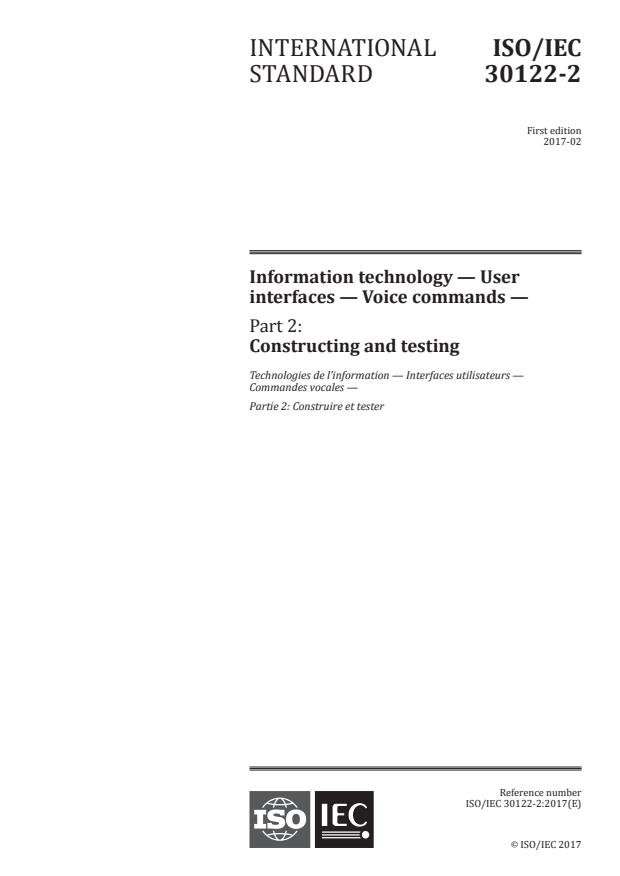
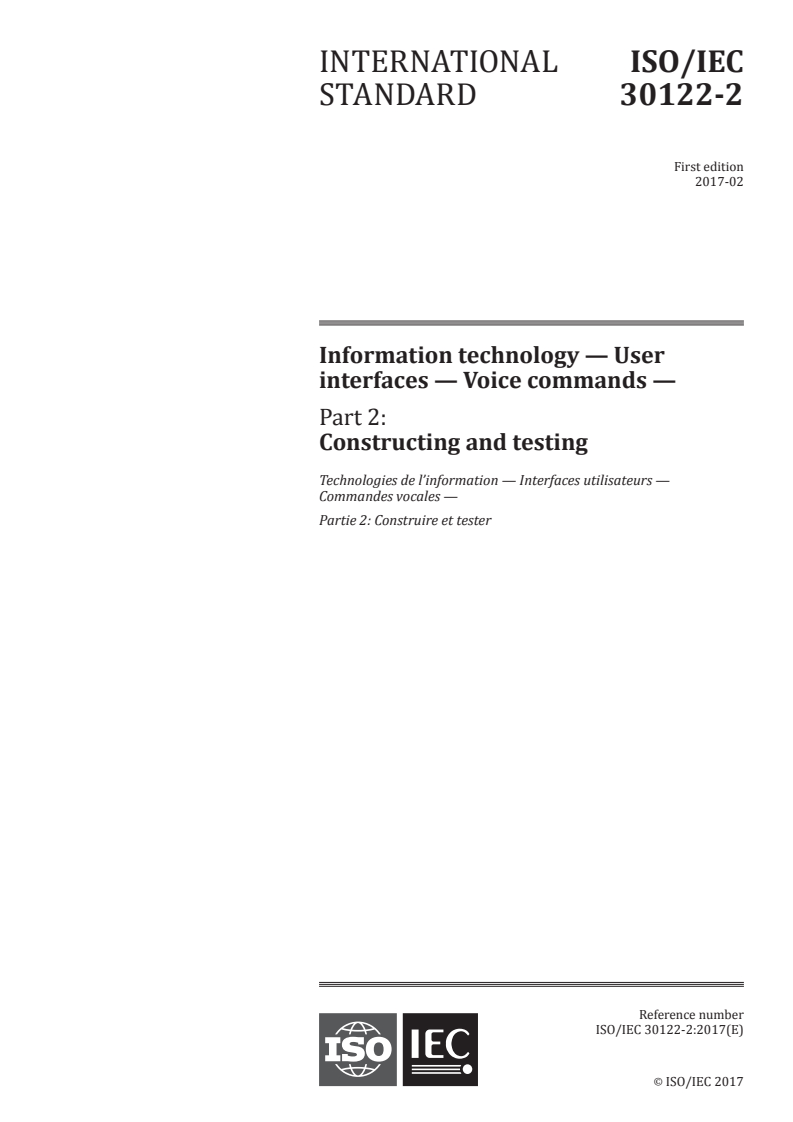
INTERNATIONAL ISO/IEC
STANDARD 30122-2
First edition
2017-02
Information technology — User
interfaces — Voice commands —
Part 2:
Constructing and testing
Technologies de l’information — Interfaces utilisateurs —
Commandes vocales —
Partie 2: Construire et tester
Reference number
©
ISO/IEC 2017
© ISO/IEC 2017, Published in Switzerland
All rights reserved. Unless otherwise specified, no part of this publication may be reproduced or utilized otherwise in any form
or by any means, electronic or mechanical, including photocopying, or posting on the internet or an intranet, without prior
written permission. Permission can be requested from either ISO at the address below or ISO’s member body in the country of
the requester.
ISO copyright office
Ch. de Blandonnet 8 • CP 401
CH-1214 Vernier, Geneva, Switzerland
Tel. +41 22 749 01 11
Fax +41 22 749 09 47
copyright@iso.org
www.iso.org
ii © ISO/IEC 2017 – All rights reserved
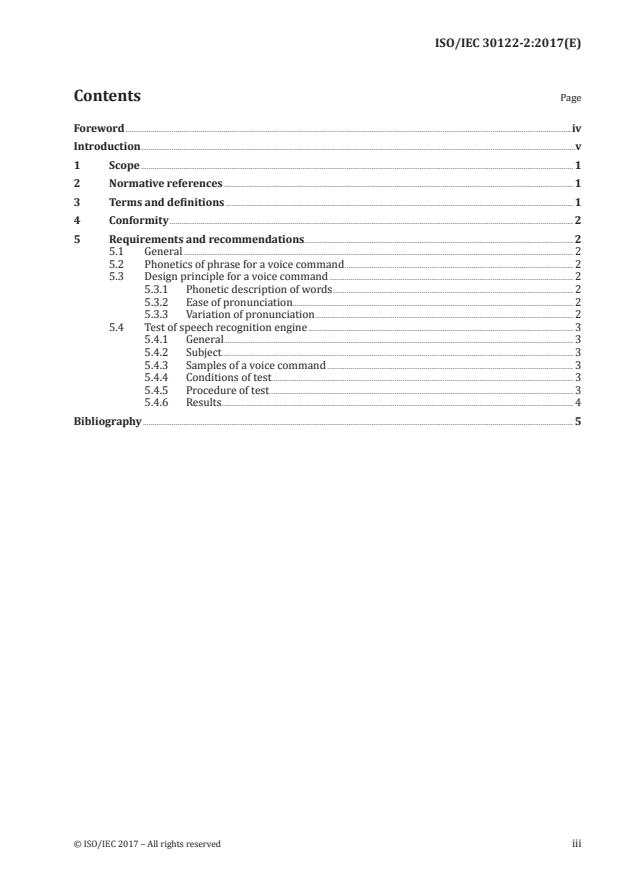
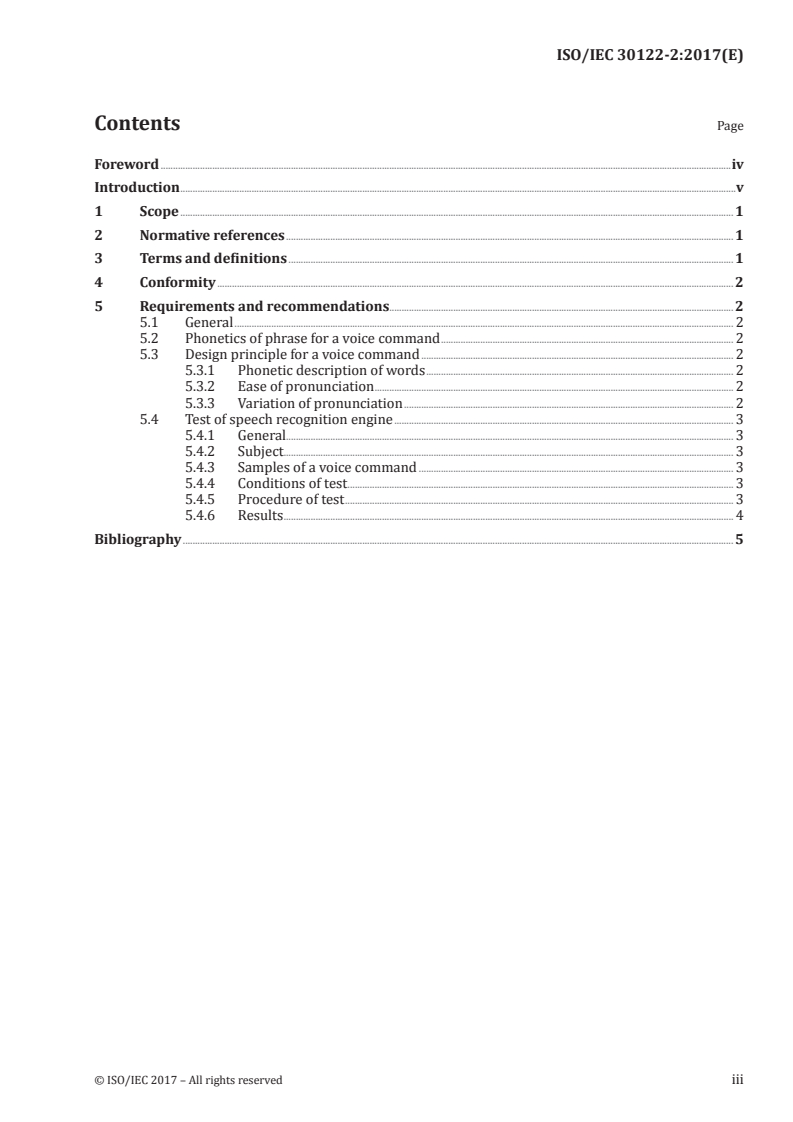
Contents Page
Foreword .iv
Introduction .v
1 Scope . 1
2 Normative references . 1
3 Terms and definitions . 1
4 Conformity . 2
5 Requirements and recommendations. 2
5.1 General . 2
5.2 Phonetics of phrase for a voice command . 2
5.3 Design principle for a voice command . 2
5.3.1 Phonetic description of words . 2
5.3.2 Ease of pronunciation . . 2
5.3.3 Variation of pronunciation . 2
5.4 Test of speech recognition engine . 3
5.4.1 General. 3
5.4.2 Subject. 3
5.4.3 Samples of a voice command . 3
5.4.4 Conditions of test . 3
5.4.5 Procedure of test . 3
5.4.6 Results . 4
Bibliography . 5
© ISO/IEC 2017 – All rights reserved iii
Foreword
ISO (the International Organization for Standardization) and IEC (the International Electrotechnical
Commission) form the specialized system for worldwide standardization. National bodies that are
members of ISO or IEC participate in the development of International Standards through technical
committees established by the respective organization to deal with particular fields of technical
activity. ISO and IEC technical committees collaborate in fields of mutual interest. Other international
organizations, governmental and non-governmental, in liaison with ISO and IEC, also take part in the
work. In the field of information technology, ISO and IEC have established a joint technical committee,
ISO/IEC JTC 1.
The procedures used to develop this document and those intended for its further maintenance are
described in the ISO/IEC Directives, Part 1. In particular the different approval criteria needed for the
different types of ISO documents should be noted. This document was drafted in accordance with the
editorial rules of the ISO/IEC Directives, Part 2 (see www .iso .org/ directives).
Attention is drawn to the possibility that some of the elements of this document may be the subject of
patent rights. ISO shall not be held responsible for identifying any or all such patent rights. Details of
any patent rights identified during the development of the document will be in the Introduction and/or
on the ISO list of patent declarations received (see www .iso .org/ patents).
Any trade name used in this document is information given for the convenience of users and does not
constitute an endorsement.
For an explanation on the meaning of ISO specific terms and expressions related to conformity assessment,
as well as information about ISO’s adherence to the World Trade Organization (WTO) principles in the
Technical Barriers to Trade (TBT) see the following URL: www . i so .org/ iso/ foreword .html.
The committee responsible for this document is ISO/IEC JTC 1, Information technology, Subcommittee
SC 35, User interfaces.
A list of all parts in the ISO/IEC 30122 series can be found on the ISO website.
iv © ISO/IEC 2017 – All rights reserved
Introduction
Voice command is used for controlling ICT devices with the voice and in the language of the user. This
technology is based on speech recognition, with some consideration for language tolerance (different
accents or speech impairment while using a given language). It is also beneficial to the people who are
operating the ICT device when/where they cannot use hands or fingers to operate it.
This document defines the principal standardized voice commands that will be commonly used in
various ICT devices.
© ISO/IEC 2017 – All rights reserved v
-----------
...
INTERNATIONAL ISO/IEC
STANDARD 30122-2
First edition
2017-02
Information technology — User
interfaces — Voice commands —
Part 2:
Constructing and testing
Technologies de l’information — Interfaces utilisateurs —
Commandes vocales —
Partie 2: Construire et tester
Reference number
©
ISO/IEC 2017
© ISO/IEC 2017, Published in Switzerland
All rights reserved. Unless otherwise specified, no part of this publication may be reproduced or utilized otherwise in any form
or by any means, electronic or mechanical, including photocopying, or posting on the internet or an intranet, without prior
written permission. Permission can be requested from either ISO at the address below or ISO’s member body in the country of
the requester.
ISO copyright office
Ch. de Blandonnet 8 • CP 401
CH-1214 Vernier, Geneva, Switzerland
Tel. +41 22 749 01 11
Fax +41 22 749 09 47
copyright@iso.org
www.iso.org
ii © ISO/IEC 2017 – All rights reserved
Contents Page
Foreword .iv
Introduction .v
1 Scope . 1
2 Normative references . 1
3 Terms and definitions . 1
4 Conformity . 2
5 Requirements and recommendations. 2
5.1 General . 2
5.2 Phonetics of phrase for a voice command . 2
5.3 Design principle for a voice command . 2
5.3.1 Phonetic description of words . 2
5.3.2 Ease of pronunciation . . 2
5.3.3 Variation of pronunciation . 2
5.4 Test of speech recognition engine . 3
5.4.1 General. 3
5.4.2 Subject. 3
5.4.3 Samples of a voice command . 3
5.4.4 Conditions of test . 3
5.4.5 Procedure of test . 3
5.4.6 Results . 4
Bibliography . 5
© ISO/IEC 2017 – All rights reserved iii
Foreword
ISO (the International Organization for Standardization) and IEC (the International Electrotechnical
Commission) form the specialized system for worldwide standardization. National bodies that are
members of ISO or IEC participate in the development of International Standards through technical
committees established by the respective organization to deal with particular fields of technical
activity. ISO and IEC technical committees collaborate in fields of mutual interest. Other international
organizations, governmental and non-governmental, in liaison with ISO and IEC, also take part in the
work. In the field of information technology, ISO and IEC have established a joint technical committee,
ISO/IEC JTC 1.
The procedures used to develop this document and those intended for its further maintenance are
described in the ISO/IEC Directives, Part 1. In particular the different approval criteria needed for the
different types of ISO documents should be noted. This document was drafted in accordance with the
editorial rules of the ISO/IEC Directives, Part 2 (see www .iso .org/ directives).
Attention is drawn to the possibility that some of the elements of this document may be the subject of
patent rights. ISO shall not be held responsible for identifying any or all such patent rights. Details of
any patent rights identified during the development of the document will be in the Introduction and/or
on the ISO list of patent declarations received (see www .iso .org/ patents).
Any trade name used in this document is information given for the convenience of users and does not
constitute an endorsement.
For an explanation on the meaning of ISO specific terms and expressions related to conformity assessment,
as well as information about ISO’s adherence to the World Trade Organization (WTO) principles in the
Technical Barriers to Trade (TBT) see the following URL: www . i so .org/ iso/ foreword .html.
The committee responsible for this document is ISO/IEC JTC 1, Information technology, Subcommittee
SC 35, User interfaces.
A list of all parts in the ISO/IEC 30122 series can be found on the ISO website.
iv © ISO/IEC 2017 – All rights reserved
Introduction
Voice command is used for controlling ICT devices with the voice and in the language of the user. This
technology is based on speech recognition, with some consideration for language tolerance (different
accents or speech impairment while using a given language). It is also beneficial to the people who are
operating the ICT device when/where they cannot use hands or fingers to operate it.
This document defines the principal standardized voice commands that will be commonly used in
various ICT devices.
© ISO/IEC 2017 – All rights reserved v
-----------
...