

ISO 11505:2012
(Main)Surface chemical analysis — General procedures for quantitative compositional depth profiling by glow discharge optical emission spectrometry
General Information
- Abstract
ISO 11505:2013 describes a glow discharge optical emission spectrometric (GD-OES) method for the determination of the thickness, mass per unit area and chemical composition of surface layer films. It is limited to a description of general procedures of quantification of GD-OES and is not applicable directly for the quantification of individual materials having various thicknesses and elements to be determined.
- Status
- Withdrawn
- Publication Date
- 11-Dec-2012
- Technical Committee
- ISO/TC 201/SC 8 - Glow discharge spectroscopy
- Drafting Committee
- ISO/TC 201/SC 8 - Glow discharge spectroscopy
- Current Stage
- 9599 - Withdrawal of International Standard
- Start Date
- 19-Jun-2025
- Completion Date
- 29-Aug-2026


Overview
ISO 11505:2012 - titled Surface chemical analysis - General procedures for quantitative compositional depth profiling by glow discharge optical emission spectrometry (GD-OES) - defines general, standardized procedures for quantitative depth profiling of surface films using GD-OES. The standard describes how to determine thickness, mass per unit area, and chemical composition of surface layers by converting time‑resolved emission intensities (intensity vs. sputtering time) into mass fraction vs. depth using calibrated emission yields. It is a general quantification procedure and is not intended as a direct, validated method for every individual material/thickness/analyte combination.
Key topics and technical requirements
- Principle: Continuous cathodic sputtering (DC or RF) with plasma excitation and simultaneous spectrometric detection to produce depth profiles; calibration converts intensity–time profiles to quantitative depth.
- Apparatus: Grimm‑type or similar GD source coupled to a simultaneous optical spectrometer (sequential monochromators are not suitable). Hollow anode inner diameters typically range 1–8 mm; 2 mm, 4 mm and 8 mm are common.
- Power supplies: Both DC and RF operation are covered. RF can sputter insulating specimens (polymers, oxides); DC is simpler to measure/control.
- Instrument settings: Guidance on setting discharge parameters, pressure control, and mode of operation; note that emission yield varies with current, voltage and pressure.
- Data acquisition: Time‑resolved digital readout required. Recommended speed: ≥500 measurements/s per spectral channel (≥50/s acceptable for many applications).
- Calibration & validation: Procedures for calibration specimens, validation specimens, sputtering rate determination, emission intensity measurement, calibration equation calculation, validation, drift correction and verification.
- Spectral line selection: Advice on choosing lines to avoid self‑absorption and spectral interferences (Annex B lists suggested lines).
- Annexes: Annex A (calculation of calibration constants and quantitative evaluation) and Annex B (suggested spectral lines).
Practical applications
- Quantitative compositional depth profiling of metallic and coated surfaces, thin films, and layered materials.
- Determination of coating thickness, total coating mass per unit area, and depth distribution of elements in surface layers.
- Useful in quality control, failure analysis, coating development, surface engineering and R&D where depth‑resolved chemical composition is required.
Who should use ISO 11505:2012
- Surface analytical laboratories applying GD‑OES for quantitative depth profiling.
- Instrument manufacturers implementing quantification software and recommended operating modes.
- Quality managers and materials engineers needing standardized procedures for comparative measurements.
- Researchers developing validated, material-specific ISO methods (note: individual methods must specify analyte scope and validate via interlaboratory tests).
Related standards
- ISO 14707 - Introduction to use of GD‑OES (referenced normatively).
- ISO 14284 - Sampling and preparation for chemical composition of steel and iron (referenced).
Keywords: ISO 11505:2012, GD‑OES, glow discharge optical emission spectrometry, depth profiling, surface chemical analysis, calibration, sputtering rate, spectral lines, DC, RF.
Relations
- Effective Date
- 28-Oct-2023
Get Certified
Connect with accredited certification bodies for this standard

ECOCERT
Organic and sustainability certification.

Eurofins Food Testing Global
Global leader in food, environment, and pharmaceutical product testing.

Intertek Bangladesh
Intertek certification and testing services in Bangladesh.
Sponsored listings
Frequently Asked Questions
ISO 11505:2012 is a standard published by the International Organization for Standardization (ISO). Its full title is "Surface chemical analysis — General procedures for quantitative compositional depth profiling by glow discharge optical emission spectrometry". This standard covers: ISO 11505:2013 describes a glow discharge optical emission spectrometric (GD-OES) method for the determination of the thickness, mass per unit area and chemical composition of surface layer films. It is limited to a description of general procedures of quantification of GD-OES and is not applicable directly for the quantification of individual materials having various thicknesses and elements to be determined.
ISO 11505:2013 describes a glow discharge optical emission spectrometric (GD-OES) method for the determination of the thickness, mass per unit area and chemical composition of surface layer films. It is limited to a description of general procedures of quantification of GD-OES and is not applicable directly for the quantification of individual materials having various thicknesses and elements to be determined.
ISO 11505:2012 is classified under the following ICS (International Classification for Standards) categories: 71.040.40 - Chemical analysis. The ICS classification helps identify the subject area and facilitates finding related standards.
ISO 11505:2012 has the following relationships with other standards: It is inter standard links to ISO 11505:2025. Understanding these relationships helps ensure you are using the most current and applicable version of the standard.
ISO 11505:2012 is available in PDF format for immediate download after purchase. The document can be added to your cart and obtained through the secure checkout process. Digital delivery ensures instant access to the complete standard document.
Standards Content (Sample)
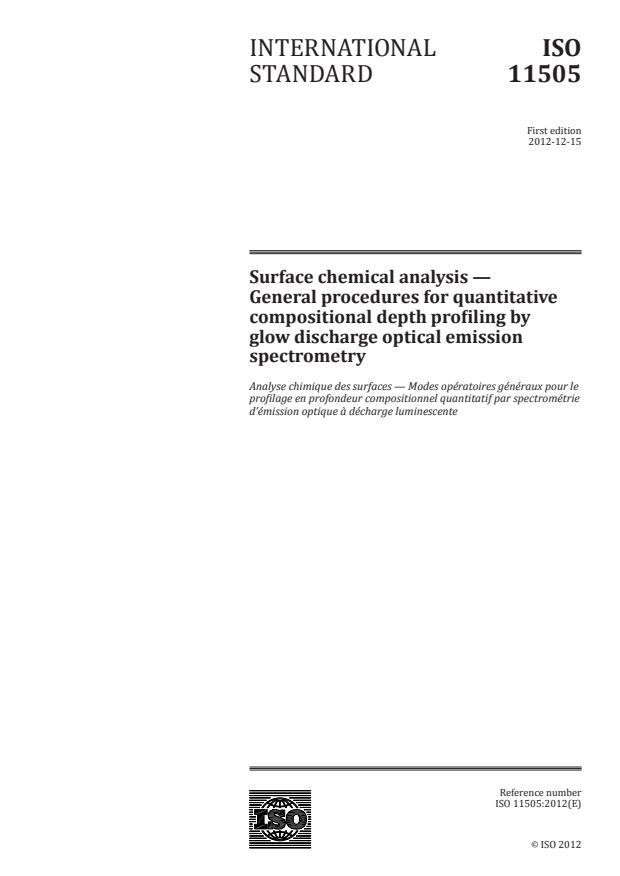
INTERNATIONAL ISO
STANDARD 11505
First edition
2012-12-15
Surface chemical analysis —
General procedures for quantitative
compositional depth profiling by
glow discharge optical emission
spectrometry
Analyse chimique des surfaces — Modes opératoires généraux pour le
profilage en profondeur compositionnel quantitatif par spectrométrie
d’émission optique à décharge luminescente
Reference number
©
ISO 2012
© ISO 2012
All rights reserved. Unless otherwise specified, no part of this publication may be reproduced or utilized in any form or by any
means, electronic or mechanical, including photocopying and microfilm, without permission in writing from either ISO at the
address below or ISO’s member body in the country of the requester.
ISO copyright office
Case postale 56 • CH-1211 Geneva 20
Tel. + 41 22 749 01 11
Fax + 41 22 749 09 47
E-mail copyright@iso.org
Web www.iso.org
Published in Switzerland
ii © ISO 2012 – All rights reserved
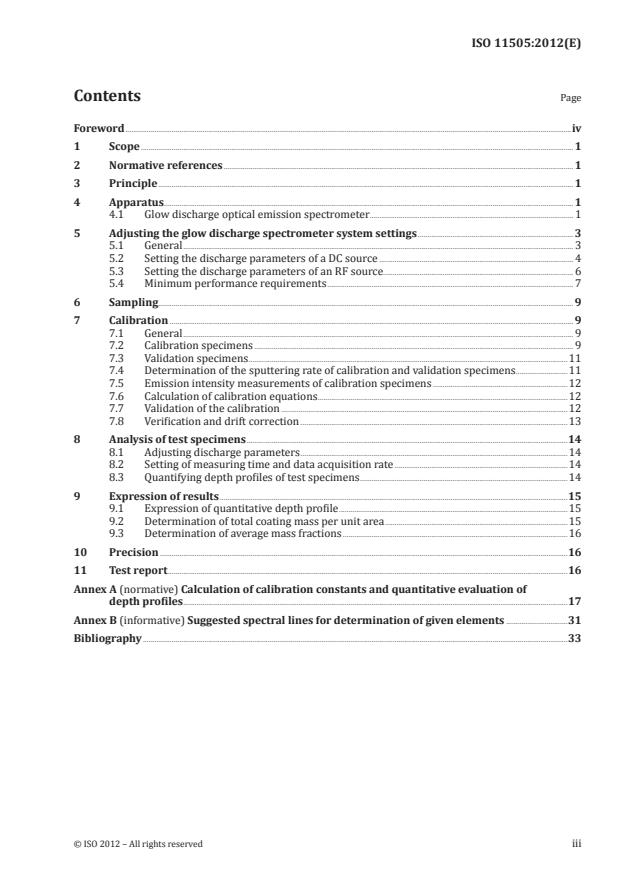
Contents Page
Foreword .iv
1 Scope . 1
2 Normative references . 1
3 Principle . 1
4 Apparatus . 1
4.1 Glow discharge optical emission spectrometer. 1
5 Adjusting the glow discharge spectrometer system settings . 3
5.1 General . 3
5.2 Setting the discharge parameters of a DC source . 4
5.3 Setting the discharge parameters of an RF source . . 6
5.4 Minimum performance requirements . 7
6 Sampling . 9
7 Calibration . 9
7.1 General . 9
7.2 Calibration specimens . 9
7.3 Validation specimens .11
7.4 Determination of the sputtering rate of calibration and validation specimens .11
7.5 Emission intensity measurements of calibration specimens .12
7.6 Calculation of calibration equations .12
7.7 Validation of the calibration .12
7.8 Verification and drift correction .13
8 Analysis of test specimens .14
8.1 Adjusting discharge parameters .14
8.2 Setting of measuring time and data acquisition rate .14
8.3 Quantifying depth profiles of test specimens .14
9 Expression of results .15
9.1 Expression of quantitative depth profile .15
9.2 Determination of total coating mass per unit area .15
9.3 Determination of average mass fractions .16
10 Precision .16
11 Test report .16
Annex A (normative) Calculation of calibration constants and quantitative evaluation of
depth profiles .17
Annex B (informative) Suggested spectral lines for determination of given elements .31
Bibliography .33
Foreword
ISO (the International Organization for Standardization) is a worldwide federation of national standards
bodies (ISO member bodies). The work of preparing International Standards is normally carried out
through ISO technical committees. Each member body interested in a subject for which a technical
committee has been established has the right to be represented on that committee. International
organizations, governmental and non-governmental, in liaison with ISO, also take part in the work.
ISO collaborates closely with the International Electrotechnical Commission (IEC) on all matters of
electrotechnical standardization.
International Standards are drafted in accordance with the rules given in the ISO/IEC Directives, Part 2.
The main task of technical committees is to prepare International Standards. Draft International
Standards adopted by the technical committees are circulated to the member bodies for voting.
Publication as an International Standard requires approval by at least 75 % of the member bodies
casting a vote.
Attention is drawn to the possibility that some of the elements of this document may be the subject of
patent rights. ISO shall not be held responsible for identifying any or all such patent rights.
ISO 11505 was prepared by Technical Committee ISO/TC 201, Surface chemical analysis, Subcommittee
SC 8, Glow discharge spectroscopy.
iv © ISO 2012 – All rights reserved
INTERNATIONAL STANDARD ISO 11505:2012(E)
Surface chemical analysis — General procedures for
quantitative compositional depth profiling by glow
discharge optical emission spectrometry
1 Scope
This International Standard describes a glow discharge optical emission spectrometric (GD-OES) method
for the determination of the thickness, mass per unit area and chemical composition of surface layer films.
It is limited to a description of general procedures of quantification of GD-OES and is not applicable directly
for the quantification of individual materials having various thicknesses and elements to be determined.
NOTE Any individual standard for a test material will have to specify a scope of a thickness of the surface
layer as well as analyte elements, and include results of interlaboratory tests for validation of the methods.
2 Normative references
The following documents, in whole or in part, are normatively referenced in this document and are
indispensable for its application. For dated references, only the edition cited applies. For undated
references, the latest edition of the referenced document (including any amendments) applies.
ISO 14707, Surface chemical analysis — Glow discharge optical emission spectrometry (GD-OES) —
Introduction to use
ISO 14284, Steel and iron — Sampling and preparation of samples for the determination of chemical composition
3 Principle
The analytical method described here involves the following processes:
a) cathodic sputtering of the surface layer in a direct current or radio frequency glow discharge device;
b) excitation of the analyte atoms and ions in the plasma formed in the glow discharge device;
c) spectrometric measurement of the intensities of characteristic spectral emission lines of the analyte
atoms and ions as a function of sputtering time (qualitative depth profile);
d) conversion of the qualitative depth profile in units of intensity versus time to mass fraction versus
depth by means of calibration functions (quantification).
Calibration of the system is achieved by measurements on calibration specimens of known chemical
composition and measured sputtering rate.
4 Apparatus
4.1 Glow discharge optical emission spectrometer
4.1.1 General
The required instrumentation includes an optical emission spectrometer system consisting of a
[10]
Grimm type or similar glow discharge source (direct current or radio frequency powered) and a
simultaneous optical spectrometer as described in ISO 14707, capable of providing suitable spectral
lines for the analyte elements. Sequential optical spectrometers (monochromators) are not suitable,
since several analytical wavelengths must be measured simultaneously at high data acquisition speed.
The inner diameter of the hollow anode of the glow discharge source should be in the range 1 mm to
8 mm. A cooling device for thin specimens, such as a metal block with circulating cooling liquid, is also
recommended, but not strictly necessary for implementation of the method.
Since the principle of determination is based on continuous sputtering of the surface layer, the spectrometer
shall be equipped with a digital readout system for time-resolved measurement of the emission intensities.
A system capable of a data acquisition speed of at least 500 measurements/second per spectral channel
is recommended, but, for a large number of applications, speeds of > 50 measurements/second per
spectral channel are acceptable.
4.1.2 Selection of spectral lines
For each analyte to be determined, there exist a number of spectral lines which can be used. Suitable
lines shall be selected on the basis of several factors, including the spectral range of the spectrometer
used, the analyte mass fraction range, the sensitivity of the spectral lines and any spectral interference
from other elements present in the test specimens. For applications where several of the analytes of
interest are major elements in the specimens, special attention shall be paid to the occurrence of self-
absorption of certain highly sensitive spectral lines (so-called resonance lines). Self-absorption causes
nonlinear calibration curves at high analyte mass fraction levels, and strongly self-absorbed lines should
therefore be avoided for the determination of major elements. Suggestions concerning suitable spectral
lines are given in Annex B. Spectral lines other than those listed may be used, as long as they have
favourable characteristics.
4.1.3 Selection of glow discharge source type
4.1.3.1 Anode size
Most GD-OES instruments on the market are delivered with options to use various anode diameters,
with 2 mm, 4 mm and 8 mm being the most common. Some older instruments have one anode only,
usually 8 mm, while the most commonly used anode in modern instruments is 4 mm. A larger anode
requires larger specimens and higher power during analysis; therefore the specimen is heated to a
greater extent. On the other hand, a larger anode gives rise to a plasma of larger volume that emits more
light, resulting in lower detection limits (i.e. higher analytical sensitivity). Furthermore, a larger anode
helps to mask inhomogeneity within a surface layer. This may or may not be an advantage, depending
on the application. In a large number of applications, the 4 mm anode is a good compromise. However, in
surface analysis applications it is rather common to encounter problems of overheating of the specimens
due to, e.g. surface layers of poor heat conductivity and/or very thin specimens. In such cases, the smaller
2 mm anode is preferable, even if there is some loss of analytical sensitivity.
4.1.3.2 Type of power supply
The glow discharge source can be either a type powered by a direct current (DC) power supply or a radio
frequency (RF) type. The most important difference is that the RF type can sputter both conductive and
non-conductive specimens; hence this is the only type that can be used for, e.g. polymer coatings and
insulating oxide layers. On the other hand, it is technically simpler to measure and control the electrical
source parameters (voltage, current, power) of a DC type. Several commercially available GD-OES
systems can be delivered with the option to switch between DC and RF operation, but RF-only systems
also exist. In short, there are a very large number of applications where DC or RF sources can be used
and several where only an RF source can be used.
2 © ISO 2012 – All rights reserved
4.1.3.3 Mode of operation
Both DC and RF sources can be operated in several different modes with respect to the control of the
electrical parameters (current, voltage, power) and the pressure. There are several reasons for this:
— “historical” reasons (older instruments have simpler but functional power supplies, while the
technology has evolved so that newer models have more precise and easier-to-operate source control);
— different manufacturers have chosen different solutions for source control;
— there are some application-related issues where a particular mode of operation is to be preferred.
This International Standard gives instructions for optimizing the source parameters based on several
available modes of operation. The most important reason for this is to make these instructions
comprehensive so as to include several types of instrument. In most applications, there is no major
difference between these modes in terms of analytical performance, but there are other differences
in terms of practicality and ease of operation. For instance, a system equipped with active pressure
regulation will automatically be adjusted to the same electrical source parameters every time a
particular analytical method is used. Without this technology, some manual adjustment of the pressure
to achieve the desired electrical source parameters is normally required.
[11][12]
NOTE It should be noted in this context that what is known as the emission yield forms the basis for
calibration and quantification as described in this International Standard. The emission yield has been found to
[17]
vary with the current, the voltage and, to a lesser extent, the pressure . It is impossible in practice to maintain
all three parameters constant for all test specimens, due to variations in the electrical characteristics of different
materials. In several instrument types, the electrical source parameters (the plasma impedance) can therefore be
maintained constant by means of automatic systems that vary the pressure during analysis. Alternatively, there
[17]
exist methods to correct for impedance variations by means of empirically derived functions , and this type of
correction is implemented in the software of commercially available GD-OES systems.
5 Adjusting the glow discharge spectrometer system settings
5.1 General
Follow the manufacturer’s instructions or locally documented procedures for preparing the
instrument for use.
RF sources differ from DC sources in the respect that for several instrument models, only the applied
(forward) RF power can be measured, not the actual power developed in the glow discharge plasma. The
applied RF power is normally in the range 10–100 W, but it must be noted that the RF power losses in
connectors, cables, etc. vary considerably between different instrument models. Typical power losses are in
the range 10–50 % of the applied power. Furthermore, the possibilities to measure the additional electrical
parameters voltage and current in the plasma are more or less restricted due to technical difficulties with
RF systems, and several existing instrument models can only measure the applied RF power.
There is no difference between DC and RF concerning the possibilities to measure the pressure. However,
there are large pressures differentials in a Grimm type source, and pressure readings obtained depend on
the location of the pressure gauge. Some instrument models have a pressure gauge attached to measure
the actual pressure in the plasma, while others have a pressure gauge located on a “low pressure” side
of the source closer to the pump. Therefore, the pressure readings can, for several instruments, just
be used to adjust the source parameters of that particular instrument, not as a measure of the actual
operating pressure in the plasma.
For the optical system, the most important preparation step is to check that the entrance slit to the
spectrometer is correctly adjusted, following the procedure given by the instrument manufacturer.
This ensures that the emission intensities are measured on the peaks of the spectral lines for optimum
signal-to-background ratio. For further information, see ISO 14707.
The most important step in developing a method for a particular application is to optimize the parameters
of the glow discharge source. The source parameters shall be chosen to achieve three aims:
a) adequate sputtering of the test specimen, to reduce the analysis time without overheating the specimen;
b) good crater shape, for good depth resolution;
c) constant excitation conditions in calibration and analysis, for optimum accuracy.
Trade-offs are often necessary among the three specified aims. More detailed instructions on how to
adjust the source parameters are given in 5.2 and 5.3.
The settings of the high voltage for the detectors depend on the source parameters, but the procedure
is the same for all modes of operation of the source. This procedure is therefore only described for the
first mode of operation.
Similarly, the steps to adjust and optimize the source settings in terms of signal stability and sputter
crater shape are also similar in principle for all modes of operation. Therefore, these procedures are
only described in detail for the first mode of operation.
5.2 Setting the discharge parameters of a DC source
5.2.1 Constant applied current and voltage
5.2.1.1 General
The two control parameters are the applied current and the applied voltage. Set the power supply for the
glow discharge source to constant-current/constant-voltage operation. Then set the current and voltage
to the typical values recommended by the manufacturer. If no recommended values are available, set
the voltage to 700 V and the current to a value in the range of 5 mA to 10 mA for a 2 mm or 2,5 mm
anode, 15 mA to 30 mA for a 4 mm anode or 40 mA to 100 mA for a 7 mm or 8 mm anode. If no previous
knowledge of the optimum current is available, it is recommended to start with a value somewhere in
the middle of the recommended range.
5.2.1.2 Setting the high voltage of the detectors
Select test specimens with surface layers of all types to be determined. For all test specimens, run the
source while observing the output signals from the detectors for the analyte atoms. Adjust the high
voltage of the detectors in such a way that sufficient sensitivity is ensured at the lowest analyte mass
fraction without saturation of the detector system at the highest analyte mass fraction.
5.2.1.3 Adjusting the discharge parameters
For each type of test specimen, carry out a full depth profile measurement, sputtering it in the glow
discharge for a sufficiently long time to remove the surface layers completely and continue well into
the base material. By observing the emission intensities as a function of sputtering time (often referred
to as the qualitative depth profile), verify that the selected source settings give stable emission signals
throughout the depth profile and into the substrate. If this is found not to be the case, reduce one of the
control parameters by a small amount and sputter through the surface layers again. If the stability is still
unsatisfactory, reduce the other control parameter by a small amount and repeat the measurements. If
found necessary, repeat this procedure for a number of control parameter combinations until stable
emission conditions are obtained.
NOTE Unstable emission signals could indicate thermal instability in the specimen surface layers; specimen
cooling is beneficial in this regard.
4 © ISO 2012 – All rights reserved
5.2.1.4 Optimizing the crater shape
If a suitable profilometer device is available, adopt the following procedure. Sputter a specimen with a
surface layer typical of the test specimens to be analysed to a depth of about 10 µm to 20 µm, but still
inside the surface layer. This is only possible for applications where surface layers of such thickness are
available. If no such specimen is available, use a steel or brass specimen. Measure the crater shape by
means of the profilometer device. Repeat this procedure a few times using slightly different values of
one of the control parameters. Select the conditions that give an optimally flat-bottomed crater. These
conditions are then used during calibration and analysis, provided that the stability of the emission
conditions obtained in step 5.1.1.3 is not compromised. In some cases, there is a certain trade-off
between these two requirements.
5.2.2 Constant applied current and pressure
The two control parameters are the applied current and the pressure. Set the power supply for the glow
discharge source to constant current operation. Then set the current to a typical value recommended
by the manufacturer. If no recommended values are available, set the current to a value in the range of
5 mA to 10 mA for a 2 mm or 2,5 mm anode, 15 mA to 30 mA for a 4 mm anode or 40 mA to 100 mA for a
7 mm or 8 mm anode. If no previous knowledge of the optimum current is available, it is recommended
to start with a value somewhere in the middle of the recommended range. Sputter a typical coated test
specimen, and adjust the pressure until a voltage of approximately 700 V is attained in the surface layer.
Set the high voltage of the detectors as described in 5.2.1.2.
Adjust the discharge parameters as described in 5.2.1.3, adjusting first the current and, if necessary,
the pressure.
Optimize the crater shape as described in 5.2.1.4 by adjusting the control parameters. These conditions
are then used during calibration and analysis.
Before sputtering a new specimen type, make a test run in order to ensure that the voltage has not
changed by more than 5 % from the previously selected value. If this is the case, readjust the pressure
until the correct value is attained.
5.2.2.1 Constant applied voltage and pressure
The two control parameters are applied voltage and pressure. Set the power supply for the glow
discharge source to constant voltage operation. First set the voltage to a typical value recommended
by the manufacturer. If no recommended values are available, set the voltage to 700 V. Sputter a typical
coated test sample, and adjust the pressure until a current is attained in the range of 5 mA to 10 mA for a
2 mm or 2,5 mm anode, 15 mA to 30 mA for a 4 mm anode, 40 mA to 100 mA for a 7 mm or 8 mm anode in
the surface layers. If no previous knowledge about the optimum current is available, it is recommended
to start with a value somewhere in the middle of the recommended range.
Set the high voltage of the detectors as described in 5.2.1.2.
Adjust the discharge parameters as described in 5.2.1.3, adjusting first the voltage and if necessary
the pressure.
Optimize the crater shape as described in 5.2.1.4 by adjusting the control parameters. These conditions
are then used during calibration and analysis.
Before sputtering a new sample type, make a test run in order to ensure that the current is not altered
more than 5 % from the previously selected value. If this is the case, readjust the pressure until the
correct value is attained.
5.3 Setting the discharge parameters of an RF source
5.3.1 Constant applied power and pressure
The two control parameters are the applied power and the pressure. First set the applied power (forward
power) and adjust the source pressure to the values suggested by the manufacturer. If recommended
values are not available, set the applied power and pressure to somewhere in the middle of the ranges
available for the instrument used. Measure the penetration rate (i.e. depth per unit time) on an iron or
steel specimen, adjusting the power to give a penetration rate of about 2 µm/min to 3 µm/min.
Set the high voltage of the detectors as described in 5.2.1.2.
Adjust the discharge parameters as described in 5.2.1.3, adjusting first the applied power and, if
necessary, the pressure.
Optimize the crater shape as described in 5.2.1.4 by adjusting the control parameters.
Remeasure the penetration rate on the iron or steel specimen and adjust the applied power, if necessary,
to return to about 2 µm/min to 3 µm/min. Repeat the cycle of power and pressure adjustment until no
significant change is noted in the penetration rate or crater shape. Note the power and pressure used in
units provided for the instrument type. These conditions are then used during calibration and analysis.
5.3.2 Constant applied power and DC bias voltage
The two control parameters are the applied power and the DC bias voltage. First set the applied power
and adjust the source pressure to attain a DC bias typical of the values suggested by the manufacturer.
If recommended values are not available, set the applied power and DC bias voltage to somewhere in the
middle of the range commonly used for depth profiling of metal specimens. On instruments equipped
with active pressure control, this can be achieved automatically. Measure the penetration rate (i.e.
depth per unit time) on an iron or steel specimen, adjusting the power to give a penetration rate of about
2 µm/min to 3 µm/min. Note that this procedure is only applicable to conducting surface layers, since
the DC bias voltage cannot be measured for a specimen with a non-conducting surface layer.
Set the high voltage of the detectors as described in 5.2.1.2.
Adjust the discharge parameters as described in 5.2.1.3, adjusting first the applied power and, if
necessary, the DC bias voltage.
Optimize the crater shape as described in 5.2.1.4 by adjusting the control parameters.
Remeasure the penetration rate on the iron or steel specimen and adjust the applied power, if necessary,
to return to about 2 µm/min to 3 µm/min. Repeat the cycle of power and DC bias voltage adjustment
until no significant change is noted in the penetration rate or in the crater shape. If this is not the case,
readjust the DC bias voltage until the correct value is attained. Note the power and DC bias voltage used
in units provided for the instrument. These conditions are then used during calibration and analysis.
5.3.3 Constant effective power and RF voltage
The two control parameters are the effective power and the RF voltage. Constant effective power is
defined here as the applied power minus the reflected power and the “blind power” measured with the
specimen in place but without plasma (vacuum conditions). The RF voltage is defined here as the RMS
voltage at the coupling electrode (see note below).
Set the power supply for the glow discharge source to constant effective power/constant RF voltage
operation. First set the power to a typical value recommended by the manufacturer. If no recommended
values are available, set the RF voltage to 700 V and the power to a value in the range of 10 W to 15 W
for a 4 mm anode, 5 W to 10 W for a 2 mm anode, to give an example. If no previous knowledge of the
optimum power is available, it is recommended to start with a value somewhere in the middle of the
recommended range.
6 © ISO 2012 – All rights reserved
Set the high voltage of the detectors as described in 5.2.1.2.
Adjust the discharge parameters as described in 5.2.1.3, adjusting first the effective power and, if
necessary, the RF voltage.
Optimize the crater shape as described in 5.2.1.4 by adjusting the control parameters. Select the
conditions that give an optimally flat-bottomed crater. These conditions are then used during calibration
and analysis.
NOTE In order to determine the RF RMS voltage it is essential to include the offset caused by the DC bias
voltage, which is not possible to measure at the coupling electrode when non-conductors are sputtered. However,
when only thin (<100 µm) non-conductive layers on a conductive specimen are analysed, the offset can be
estimated and the amplitude of the RF voltage multiplied by 1,22 can be used as a good estimate of the RMS
[18] [19]
voltage . For thick non-conductors more complex calculations must be carried out . However, analysis of
thick non-conductors is outside the scope of this International Standard.
5.4 Minimum performance requirements
5.4.1 General
The instrument needs to conform to the performance specifications given in 5.4.2 and 5.4.3 below.
NOTE Setting up for analysis commonly requires an iterative approach to the adjustment of the various
instrumental parameters described in this International Standard.
5.4.2 Minimum repeatability
The following test shall be performed in order to check that the instrument is functioning properly in
terms of repeatability.
Perform 10 measurements of the emission intensity on a homogeneous bulk specimen with a content of
the analyte exceeding a mass fraction of 1 %. The glow discharge conditions shall be those selected for
analysis. These measurements shall be performed using a discharge stabilization time (often referred
to as “preburn”) of at least 50 s and a data acquisition time in the range 5 s to 30 s. Each measurement
shall be located on a newly prepared surface of the specimen. Calculate the relative standard deviation
of the 10 measurements. The relative standard deviation shall conform to any requirements and/or
specifications relevant to the intended use.
NOTE Typical relative standard deviations determined in this way are 2 % or less.
5.4.3 Detection limit
5.4.3.1 General
Detection limits are instrument-dependent and matrix-dependent. Consequently, the detection limit for
a given analyte cannot be uniquely determined for every available instrument or for the full range of
surface layers considered here. For the purposes of this International Standard, the detection limit for
each analyte will be acceptable if it is equal to or less than one-fifth of the lowest expected mass fraction
in the surface layer to be analysed.
5.4.3.2 SNR method
The first method is often called the SNR (signal-to-noise ratio) method. In order to evaluate the detection
limit for a given analyte, the following steps are to be performed.
a) Select a bulk specimen to be used as a blank. The composition of the specimen should preferably
be similar, in terms of the elemental composition of the matrix, to that of the surface layers to be
analysed. Further, the specimen shall be known to contain less than 1 µg/g of the analyte.
b) Perform 10 replicate burns on the blank. For each burn, acquire the emission intensity at the
analytical wavelength for 10 s. These are the background emission intensity measurements. The
glow discharge conditions used should preferably be the same as those that will be used in the
analysis of the coated specimens. For each measurement, the blank shall be preburned at these
conditions for a sufficient length of time to achieve stable signals prior to the quantification of the
emission intensity. Use an unsputtered area of the surface of the blank for each individual burn.
c) Compute the detection limit, expressed as a mass fraction, using the following equation:
3×σ
DL= (1)
S
where
DL is the detection limit;
σ is the standard deviation of the background intensity measurements performed in step 2;
S is the analytical sensitivity derived from the instrument calibration, expressed in the appro-
priate units (the ratio of intensity to mass fraction).
If the detection limit calculated is unacceptable, the test shall be repeated. If the second value calculated
is also unacceptable, then the cause shall be investigated and corrected prior to analysing specimens.
5.4.3.3 SBR-RSDB method
The second method, which does not require a blank, is often called the SBR–RSDB (signal-to-background-
ratio–relative-standard-deviation-of-the-background) method, performed as follows.
a) Select a bulk specimen which has a matrix composition that is similar to that of the surface layers
to be analysed and in which the mass fraction of the analyte is greater than 0,1 % and accurately
known. If an analytical transition that is prone to self-absorption (see 4.1.2) is to be used, the mass
fraction of the analyte should preferably not exceed 1 %.
b) Perform three replicate burns on the chosen specimen. For each burn, integrate the emission
intensity at the analytical wavelength for 10 s. The glow discharge conditions used shall be similar to
those that will be used in the analysis of the coated specimens. For each measurement, the specimen
shall be preburned at these conditions for a sufficient length of time to achieve stable signals prior
to the quantification of the emission intensity. Use a freshly prepared area of the surface of the
specimen for each individual burn. Average the three replicate emission intensities.
c) Select a peak-free region of the emission spectrum within 0,2 nm of the analytical peak. Perform
10 replicate burns on the chosen specimen. For each burn, integrate the intensity at the peak-free
region for 10 s. These are the measurements of the background intensity. The glow discharge
conditions and preburn shall be the same as those used in step 2. Once again, use a freshly prepared
area of the surface of the specimen for each individual burn. Compute the average and the relative
standard deviation of the 10 replicate measurements.
d) Calculate the detection limit using the following equation:
3××w σ 100
()
AeR l,B
DL= (2)
()II− I
BB
where
8 © ISO 2012 – All rights reserved
DL is the detection limit;
w is the mass fraction of the analyte in the specimen;
A
σ is the relative standard deviation of the background from step 3, expressed as a percentage;
Rel,B
I is the average background intensity from step 3;
B
I is the average peak intensity from step 2.
If the detection limit calculated is unacceptable, then the test shall be repeated. If the second value calculated
is also unacceptable, then the cause shall be investigated and corrected prior to analysing specimens.
6 Sampling
Carry out sampling in accordance with ISO 14284 and/or relevant national/International Standards,
as appropriate. If no such standards are available, follow the instructions from the manufacturer of
the coated material or another appropriate procedure. The edges of a coated strip should preferably
be avoided. The size of the test specimens taken shall be suitable for the glow discharge source used.
Typically, round or rectangular specimens with sizes (diameter, width and/or length) of 20 mm to 100 mm
are suitable. This is due to the fact that diameter of the sealing O-ring of the source typically is in the
range 8–20 mm, and it is desirable to have sufficient area to make at least two replicate measurements
on each specimen.
Rinse the surface of the specimen with an appropriate solvent (e.g. high-purity acetone or ethanol) to
remove oils. Blow the surface dry with a stream of inert gas (argon or nitrogen) or clean, oil-free air,
being careful not to touch the surface with the gas delivery tube. The wetted surface may be lightly
wiped with a wetted, soft, lint-free cloth or paper to facilitate the removal of oils. After wiping, flush the
surface with solvent and dry as described above.
7 Calibration
7.1 General
Calibration of the system consists of determining, for each analyte and spectral line, the calibration
equation as described in either Clause A.3 or Clause A.4. In order to carry out the calibration, it is
necessary to know both the chemical composition and the sputtering rates (mass loss rates) of the
calibration specimens. The software of all commercially available spectrometers is designed to create
several dedicated calibrations for different applications. A combination of a set of spectrometer system
settings and a set of calibration equations valid at these settings is usually called an analytical method.
7.2 Calibration specimens
7.2.1 General
Whenever possible, spectrometric calibration specimens issued as CRMs (certified reference materials)
shall be used, but RMs (reference materials) are also acceptable. Due to the quantification being based
on emission yields, the calibration specimens need not be very similar to the surface layer materials
in composition but they shall have sputtering rates which are well determined and reproducible. In
particular, specimens of very low melting point (Zn, Sn, Pb) are not recommended, due to difficulties in
obtaining reproducible and stable sputtering rates. Furthermore, high-purity metals are not necessary
in order to calibrate correctly for high mass fractions, but are valuable for the determination of the
spectral backgrounds. The following considerations are the most important in the selection of the
calibration specimens:
a) it is recommended to use at least five calibration specimens for each analyte, covering a range from
zero to the highest mass fraction to be determined;
b) the specimens should be homogeneous to the extent that the mass sputtered during a calibration
measurement is representative of the given composition.
Based on these general provisions, the types of calibration specimen described in 7.2.2 to 7.2.7 are
suggested. Additional calibration specimens of other alloy types containing the analytes of interest for
the intended applications may also be used.
NOTE 1 A reference material (RM) is a material, sufficiently homogeneous and stable with respect to one or
more specified properties, which has been established to be fit for its intended use in a measurement process.
NOTE 2 A certified reference material (CRM) is a reference material, characterized by a metrologically valid
procedure for one or more specified properties, accompanied by a certificate that provides the value of the
specified property, its associated uncertainty and a statement of metrological traceability. A standard reference
Material (SRM) is a CRM issued by NIST, the US National Institute of Standards and Technology.
7.2.2 Low-alloy iron or steel specimens
Use steel specimens with iron mass fractions that are greater than 98 %. The iron mass fraction for a
given specimen can be determined with sufficient accuracy by subtracting the sum of the mass fractions
for all other known elements from 100 %. Note that if any significant impurities are not measured then the
calculated iron mass fraction will be higher than the true value. Low alloy steel is recommended because
there is an abundance of such CRM’s available, and they are often certified for a large number of elements.
7.2.3 Stainless-steel specimens
Use stainless-steel specimens with nickel mass fractions in the range 10 % to 40 %, chromium mass
fractions in the range 10 % to 40 %, molybdenum mass fractions in the range 0,5 % to 10 % and
manganese mass fractions in the range 0,1 % to 3 %, in such a composition that leave Fe at > 30 %.
Stainless steel is recommended because there is an abundance of such CRMs available, and they are
often certified for a large number of elements
7.2.4 High-oxygen specimens
Use oxide or oxide-based specimens with oxygen mass fractions that are greater than 10 %. Whenever
possible, use specimens with the same type of oxide as in the specimens to be analysed.
7.2.5 High-carbon specimens
Use cast-iron and/or tungsten carbide specimens with carbon mass fractions in the range 2 % to 10 %.
Silicon carbide also works quite well and its carbon content is about 30 %.
7.2.6 High-nitrogen specimens
Use nitride or nitride-based specimens with nitrogen mass fractions that are greater than 2 %.
7.2.7 High-purity copper specimens
Use a high-purity copper specimen for which the total of the mass fractions of all other analytes is less
than 0,001 %. This specimen can also be used to determine zero points for all analytes except copper.
10 © ISO 2012 – All rights reserved
7.2.8 High-purity zinc specimens
Use a high-purity zinc specimen for which the total of the mass fractions of all other analytes is less than
0,001 %. This specimen is mainly to be used to determine zero points for all analytes except zinc. It is
suitable for this purpose due to the fact that zinc has an emission spectrum with very few spectral lines.
7.3 Validation specimens
Validation (see 7.7) specimens shall be prepared in order to check the accuracy of the analytical results.
These specimens can also be used as additional calibration specimens
...