

ISO/IEC 29109-4:2010
(Main)Information technology — Conformance testing methodology for biometric data interchange formats defined in ISO/IEC 19794 — Part 4: Finger image data
General Information
- Abstract
ISO/IEC 29109-4:2010 specifies elements of conformance testing methodology, test assertions, and test procedures as applicable to ISO/IEC 19794-4. ISO/IEC 29109-4:2010 establishes test assertions of the structure of the finger image data format as specified in ISO/IEC 19794-4:2005 (Type A Level 1 as defined in ISO/IEC 29109-1:2009), test asssertions of internal consistency by checking the types of values that may be contained within each field (Type A Level 2 as defined in ISO/IEC 29109-1:2009), tests of semantic assertions (Type A Level 3 as defined in ISO/IEC 29109-1:2009). ISO/IEC 29109-4:2010 does not establish tests of conformance of CBEFF structures required by ISO/IEC 19794-4:2005, tests of other characteristics of biometric products or other types of testing of biometric products (e.g. acceptance, performance, robustness, security), tests of conformance of systems that do not produce ISO/IEC 19794-4:2005 records.
- Status
- Published
- Publication Date
- 21-Apr-2010
- Technical Committee
- ISO/IEC JTC 1/SC 37 - Biometrics
- Drafting Committee
- ISO/IEC JTC 1/SC 37/WG 3 - Biometric data interchange formats
- Current Stage
- 9020 - International Standard under periodical review
- Start Date
- 15-Jul-2026
- Completion Date
- 15-Jul-2026
Overview
ISO/IEC 29109-4:2010 defines a conformance testing methodology for biometric data interchange of finger image records as specified in ISO/IEC 19794-4:2005. It establishes how to test the binary structure, internal consistency and semantic correctness of finger image data records (Type A Level 1–3 test assertions) so implementers and testing laboratories can verify that products produce compliant finger image interchange records.
Key topics and requirements
- Conformance testing scope: Focuses on the finger image data format defined in ISO/IEC 19794-4 and on test methodology elements from ISO/IEC 29109-1:2009 (Clauses 6–8).
- Test assertion levels:
- Level 1 (Structure): Verifies binary record layout and mandatory fields (e.g., format identifier, version, record length).
- Level 2 (Internal consistency): Checks field value types and ranges (for example, pixel depth field, number of images, resolution units).
- Level 3 (Semantic assertions): Evaluates meaning and correctness of content (image orientation, scanning order, grayscale encoding).
- Concrete record checks: Includes validation of format identifier (e.g., "FIR" + null), version encoding, record-length calculations, and pixel encoding rules for uncompressed and compressed grayscale images. It also references checks for pixel representation (8-bit and higher precision) and scanning/imaging metadata (resolution, capture device ID, acquisition level).
- What is excluded: ISO/IEC 29109-4:2010 does not define tests for CBEFF structure conformance, performance/acceptance/robustness/security testing of biometric products, nor tests for systems that do not produce ISO/IEC 19794-4 records.
Applications
- Ensures interoperability of biometric components that exchange finger image data.
- Provides a standardized basis for developing conformance test suites and automated test tools for finger image records.
- Used in certification and validation programs to verify that vendor implementations correctly produce ISO/IEC 19794-4 compliant records.
- Useful when integrating fingerprint scanners, image capture devices, middleware and enrollment systems where correct data interchange format matters.
Who uses this standard
- Testing laboratories and certification bodies creating conformance test suites.
- Biometric product vendors and developers validating record output.
- System integrators and procurement teams assessing vendor claims.
- Standards implementers preparing an Implementation Conformance Statement (ICS) for ISO/IEC 19794-4 support.
Related standards
- ISO/IEC 19794-4:2005 - Biometric data interchange formats - Part 4: Finger image data (base format).
- ISO/IEC 29109-1:2009 - Generalized conformance testing methodology for ISO/IEC 19794.
- Other parts of ISO/IEC 29109 cover different biometric modalities (finger minutiae, face, iris, etc.).
Keywords: ISO/IEC 29109-4:2010, biometric data interchange, finger image data, conformance testing, ISO/IEC 19794-4, CBEFF, test assertions, conformance test suites.
Get Certified
Connect with accredited certification bodies for this standard

BSI Group
BSI (British Standards Institution) is the business standards company that helps organizations make excellence a habit.

NYCE
Mexican standards and certification body.
Sponsored listings
Frequently Asked Questions
ISO/IEC 29109-4:2010 is a standard published by the International Organization for Standardization (ISO). Its full title is "Information technology — Conformance testing methodology for biometric data interchange formats defined in ISO/IEC 19794 — Part 4: Finger image data". This standard covers: ISO/IEC 29109-4:2010 specifies elements of conformance testing methodology, test assertions, and test procedures as applicable to ISO/IEC 19794-4. ISO/IEC 29109-4:2010 establishes test assertions of the structure of the finger image data format as specified in ISO/IEC 19794-4:2005 (Type A Level 1 as defined in ISO/IEC 29109-1:2009), test asssertions of internal consistency by checking the types of values that may be contained within each field (Type A Level 2 as defined in ISO/IEC 29109-1:2009), tests of semantic assertions (Type A Level 3 as defined in ISO/IEC 29109-1:2009). ISO/IEC 29109-4:2010 does not establish tests of conformance of CBEFF structures required by ISO/IEC 19794-4:2005, tests of other characteristics of biometric products or other types of testing of biometric products (e.g. acceptance, performance, robustness, security), tests of conformance of systems that do not produce ISO/IEC 19794-4:2005 records.
ISO/IEC 29109-4:2010 specifies elements of conformance testing methodology, test assertions, and test procedures as applicable to ISO/IEC 19794-4. ISO/IEC 29109-4:2010 establishes test assertions of the structure of the finger image data format as specified in ISO/IEC 19794-4:2005 (Type A Level 1 as defined in ISO/IEC 29109-1:2009), test asssertions of internal consistency by checking the types of values that may be contained within each field (Type A Level 2 as defined in ISO/IEC 29109-1:2009), tests of semantic assertions (Type A Level 3 as defined in ISO/IEC 29109-1:2009). ISO/IEC 29109-4:2010 does not establish tests of conformance of CBEFF structures required by ISO/IEC 19794-4:2005, tests of other characteristics of biometric products or other types of testing of biometric products (e.g. acceptance, performance, robustness, security), tests of conformance of systems that do not produce ISO/IEC 19794-4:2005 records.
ISO/IEC 29109-4:2010 is classified under the following ICS (International Classification for Standards) categories: 35.040 - Information coding; 35.240.15 - Identification cards. Chip cards. Biometrics. The ICS classification helps identify the subject area and facilitates finding related standards.
ISO/IEC 29109-4:2010 is available in PDF format for immediate download after purchase. The document can be added to your cart and obtained through the secure checkout process. Digital delivery ensures instant access to the complete standard document.
Standards Content (Sample)
INTERNATIONAL ISO/IEC
STANDARD 29109-4
First edition
2010-05-01
Information technology — Conformance
testing methodology for biometric data
interchange formats defined
in ISO/IEC 19794 —
Part 4:
Finger image data
Technologies de l'information — Méthodologie d'essai de conformité
pour les formats d'interéchange de données biométriques définis
dans l'ISO/CEI 19794 —
Partie 4: Données d'image du doigt
Reference number
©
ISO/IEC 2010
PDF disclaimer
This PDF file may contain embedded typefaces. In accordance with Adobe's licensing policy, this file may be printed or viewed but
shall not be edited unless the typefaces which are embedded are licensed to and installed on the computer performing the editing. In
downloading this file, parties accept therein the responsibility of not infringing Adobe's licensing policy. The ISO Central Secretariat
accepts no liability in this area.
Adobe is a trademark of Adobe Systems Incorporated.
Details of the software products used to create this PDF file can be found in the General Info relative to the file; the PDF-creation
parameters were optimized for printing. Every care has been taken to ensure that the file is suitable for use by ISO member bodies. In
the unlikely event that a problem relating to it is found, please inform the Central Secretariat at the address given below.
© ISO/IEC 2010
All rights reserved. Unless otherwise specified, no part of this publication may be reproduced or utilized in any form or by any means,
electronic or mechanical, including photocopying and microfilm, without permission in writing from either ISO at the address below or
ISO's member body in the country of the requester.
ISO copyright office
Case postale 56 • CH-1211 Geneva 20
Tel. + 41 22 749 01 11
Fax + 41 22 749 09 47
E-mail copyright@iso.org
Web www.iso.org
Published in Switzerland
ii © ISO/IEC 2010 – All rights reserved
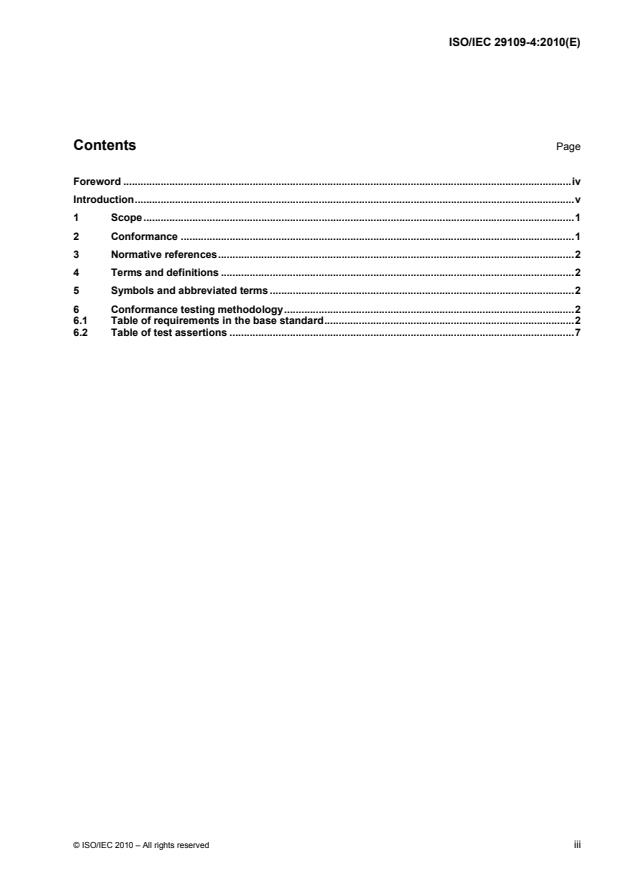
Contents Page
Foreword .iv
Introduction.v
1 Scope.1
2 Conformance .1
3 Normative references.2
4 Terms and definitions .2
5 Symbols and abbreviated terms .2
6 Conformance testing methodology.2
6.1 Table of requirements in the base standard.2
6.2 Table of test assertions .7
© ISO/IEC 2010 – All rights reserved iii
Foreword
ISO (the International Organization for Standardization) and IEC (the International Electrotechnical
Commission) form the specialized system for worldwide standardization. National bodies that are members of
ISO or IEC participate in the development of International Standards through technical committees
established by the respective organization to deal with particular fields of technical activity. ISO and IEC
technical committees collaborate in fields of mutual interest. Other international organizations, governmental
and non-governmental, in liaison with ISO and IEC, also take part in the work. In the field of information
technology, ISO and IEC have established a joint technical committee, ISO/IEC JTC 1.
International Standards are drafted in accordance with the rules given in the ISO/IEC Directives, Part 2.
The main task of the joint technical committee is to prepare International Standards. Draft International
Standards adopted by the joint technical committee are circulated to national bodies for voting. Publication as
an International Standard requires approval by at least 75 % of the national bodies casting a vote.
Attention is drawn to the possibility that some of the elements of this document may be the subject of patent
rights. ISO and IEC shall not be held responsible for identifying any or all such patent rights.
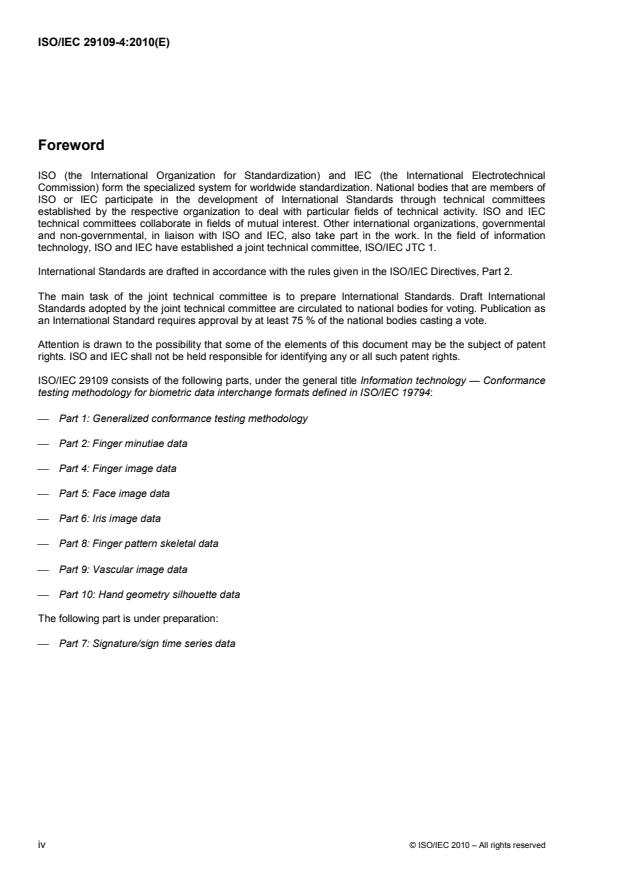
ISO/IEC 29109 consists of the following parts, under the general title Information technology — Conformance
testing methodology for biometric data interchange formats defined in ISO/IEC 19794:
⎯ Part 1: Generalized conformance testing methodology
⎯ Part 2: Finger minutiae data
⎯ Part 4: Finger image data
⎯ Part 5: Face image data
⎯ Part 6: Iris image data
⎯ Part 8: Finger pattern skeletal data
⎯ Part 9: Vascular image data
⎯ Part 10: Hand geometry silhouette data
The following part is under preparation:
⎯ Part 7: Signature/sign time series data
iv © ISO/IEC 2010 – All rights reserved
Introduction
ISO/IEC 19794-4:2005 specifies a data record interchange format for recording, storing, and transmitting one
or more finger images within a common biometric exchange formats framework (CBEFF) data structure. Each
image is accompanied by image-specific metadata contained in a header record. This part of ISO/IEC 29109
establishes tests for checking the correctness of the binary record.
The objective of ISO/IEC 19794-4:2005 cannot be completely achieved until biometric products can be tested
to determine whether they conform to those specifications. Conforming implementations are a necessary
prerequisite for achieving interoperability among implementations; therefore there is a need for a standardized
conformance testing methodology, test assertions, and test procedures as applicable to specific modalities
addressed by each part of ISO/IEC 19794. The test assertions will cover, as far as practical, the
ISO/IEC 19794 requirements (covering the most critical features), so that the conformity results produced by
the test suites will reflect the real degree of conformity of the implementations to ISO/IEC 19794 data
interchange format records. This is the motivation for the development of this conformance testing
methodology.
This part of ISO/IEC 29109 supports those applications that require use of finger image data according to
ISO/IEC 19794-4:2005. It defines a testing methodology to ensure conformance of a vendor's application or
service to ISO/IEC 19794-4:2005. Thus this part of ISO/IEC 29109 is intended to
⎯ establish elements of the conformance testing methodology framework that are specific to the finger and
palm image-based data record requirements of ISO/IEC 19794-4:2005 conformance testing,
⎯ define requirements and guidelines for specifying conformance test suites and related test methods for
measuring conformity of products and services to the finger image data record requirements of
ISO/IEC 19794-4:2005, and
⎯ define testing and reporting procedures to be followed before, during, and after conformance testing.
This part of ISO/IEC 29109 is applicable to the development and use of conformity test method specifications,
conformity test suites for ISO/IEC 19794-4:2005 records, and conformance testing programs for
ISO/IEC 19794-4:2005 conformant products. It is intended primarily for use by testing organizations, but may
be applied by developers and users of test method specifications and test method implementations. The table
of test assertions (Clause 6.2, Table 2) specifies test assertions for the conformance requirements of
ISO/IEC 19794-4:2005.
© ISO/IEC 2010 – All rights reserved v
INTERNATIONAL STANDARD ISO/IEC 29109-4:2010(E)
Information technology — Conformance testing methodology
for biometric data interchange formats defined
in ISO/IEC 19794 —
Part 4:
Finger image data
1 Scope
This part of ISO/IEC 29109 specifies elements of conformance testing methodology, test assertions, and test
procedures as applicable to ISO/IEC 19794-4.
It establishes
⎯ test assertions of the structure of the finger image data format as specified in ISO/IEC 19794-4:2005
(Type A Level 1 as defined in ISO/IEC 29109-1:2009),
⎯ test asssertions of internal consistency by checking the types of values that may be contained within each
field (Type A Level 2 as defined in ISO/IEC 29109-1:2009),
⎯ tests of semantic assertions (Type A Level 3 as defined in ISO/IEC 29109-1:2009).
It does not establish
⎯ tests of conformance of CBEFF structures required by ISO/IEC 19794-4:2005,
⎯ tests of other characteristics of biometric products or other types of testing of biometric products (e.g.
acceptance, performance, robustness, security),
⎯ tests of conformance of systems that do not produce ISO/IEC 19794-4:2005 records.
2 Conformance
Biometric data interchange format conformance tests conform to this part of ISO/IEC 29109 if they satisfy all
of the normative requirements related to Clause 6. Specifically, they shall use the test methodology specified
in Clauses 6, 7 and 8 of ISO/IEC 29109-1:2009, and all Level 1 and Level 2 tests shall use the assertions
defined in Table 2 of this part of ISO/IEC 29109.
Implementations of ISO/IEC19794-4:2005 tested according to the methodology specified shall be able to
claim conformance only to those biometric data record (BDB) requirements specified in
ISO/IEC 19794-4:2005 that are tested by the test methods established by this methodology.
Implementations of ISO/IEC 19794-4:2005 do not necessarily need to conform to all possible aspects of
ISO/IEC 19794-4:2005, but only to those ISO/IEC 19794-4:2005 requirements that are claimed to be
supported by the implementation in an implementation conformance statement (ICS), filled out in accordance
with Clause 8 of ISO/IEC 29109-1:2009 and Table 1 of this part of ISO/IEC 29109.
© ISO/IEC 2010 – All rights reserved 1
3 Normative references
The following referenced documents are indispensable for the application of this document. For dated
references, only the edition cited applies. For undated references, the latest edition of the referenced
document (including any amendments) applies.
ISO/IEC 19794-4:2005, Information technology — Biometric data interchange formats — Part 4: Finger image
data
ISO/IEC 29109-1:2009, Information technology — Conformance testing methodology for biometric data
interchange formats defined in ISO/IEC 19794 — Part 1: Generalized conformance testing methodology
4 Terms and definitions
For the purposes of this document, the terms and definitions given in ISO/IEC 29109-1 apply.
5 Symbols and abbreviated terms
For the purposes of this document, the symbols and abbreviated terms given in ISO/IEC 29109-1 apply.
6 Conformance testing methodology
The testing methodology specified in Clauses 6, 7 and 8 of ISO/IEC 29109-1:2009 shall apply. The content of
the tables below is based on the conformance testing methodology outlined in ISO/IEC 29109-1:2009 and
shall only be used in the context of that testing methodology.
6.1 Table of requirements in the base standard
The normative requirements of ISO/IEC 19794-4:2005 are listed in Table 1. The supplier of the IUT can
explain which optional components of the standard are supported and the testing laboratory can note the
results of the test.
Table 1 — Requirements of the base standard (ISO/IEC 19794-4:2005)
Require- Reference
IUT Supported Test
ment in base Requirement summary Level Status
support range result
identifier standard
Information contained in a transaction
R-1 4.15 3C O-1 N/A N/A
shall be applicable to a single subject.
Each item of information, field, or logical
R-2 6.1 record shall contain one or more bytes of 3C O-1 N/A N/A
data.
The order for transmission shall also be
R-3 6.1 the most significant byte first and least 3C O-1 N/A N/A
significant byte last.
Within a byte, the order of transmission
R-4 6.1 shall be the most significant bit first and 3C O-1 N/A N/A
the least significant bit last.
Each image as presented in accordance
with this format standard shall appear to
R-5 6.2 have been captured in an upright position 3C O-1 N/A N/A
and approximately centered horizontally
in the field of view.
2 © ISO/IEC 2010 – All rights reserved
Table 1 (continued)
Require- Reference
IUT Supported Test
ment in base Requirement summary Level Status
support range result
identifier standard
The recorded image data shall appear to
be the result of a scanning of a
R-6 6.2 3C O-1 N/A N/A
conventional inked impression of a
fingerprint.
The scanning sequence (and recorded
data) shall appear to have been from left-
R-7 6.2 3C O-1 N/A N/A
to-right, progressing from top-to-bottom
of the fingerprint or palm print.
For the purpose of describing the position
of each pixel within an image to be
R-8 6.2 3C O-1 N/A N/A
exchanged, a pair of reference axes shall
be used.
The origin of the axes, pixel location
R-9 6.2 (0,0), shall be located at the upper left- 3C O-1 N/A N/A
hand corner of each image.
The x-coordinate (horizontal) position
R-10 6.2 shall increase positively from the origin to 3C O-1 N/A N/A
the right side of the image.
The y-coordinate (vertical) position shall
R-11 6.2 increase positively from the origin to the 3C O-1 N/A N/A
bottom of the image.
For all quality levels, the finger image
shall be represented using square pixels,
R-12 7.2 3C O-1 N/A N/A
in which the horizontal and vertical
dimensions of the pixels are equal.
The grayscale precision of the pixel data
shall be specified in terms of the pixel
R-13 7.3 3C O-1 N/A N/A
depth or the number of bits used to
represent the grayscale value of a pixel.
For grayscale data, the minimum value
R-14 7.3 that can be assigned to a “black” pixel 3C O-1 N/A N/A
shall be zero.
The maximum value that can be
assigned to a “white” pixel shall be the
R-15 7.3 3C O-1 N/A N/A
grayscale value with all of its bits of
precision set to “1”.
The image data portion of a record for an
R-16 7.4 uncompressed grayscale image shall 3C O-1 N/A N/A
contain a set of raw pixel information.
Using a pixel depth of 8 bits (256
R-17 7.4 grayscale levels) each pixel shall be 2 M
contained in a single byte.
Increased precision for pixel values
greater than 255 shall use two unsigned
R-18 7.4 3C O-1 N/A N/A
bytes to hold up to sixteen-bit pixels with
values in the range of 0-65635.
The encoding of a compressed grayscale
7.4, Tables 2 image shall be the output of the
R-19 2 M N/A
and 3 appropriate grayscale compression
algorithm specified.
© ISO/IEC 2010 – All rights reserved 3
Table 1 (continued)
Require- Reference
IUT Supported Test
ment in base Requirement summary Level Status
support range result
identifier standard
Upon decompression the grayscale value
for each pixel shall be represented in the
R-20 7.4 3C O-1 N/A N/A
same manner as pixels in an
uncompressed image.
The image grayscale shall be encoded
using the agreed precision necessary to
R-21 7.5 3C O-1 N/A N/A
meet the dynamic range requirement for
a specific application.
Grayscale fingerprint image areas to be
captured shall be acquired by an image
R-22 7.6 3C O-1 N/A N/A
capture device operating at a specific
scanning resolution.
Each record shall pertain to a single
R-23 8.1 3C O-1 N/A N/A
subject.
Each record shall contain an image
record (consisting of one or more views)
R-24 8.1 3C O-1 N/A N/A
for each of one or more fingers, multiple
fingers (single image records), or palms.
The biometric data record specified in
this standard shall be embedded in a
R-25 8.1 N/A N/A N/A N/A
CBEFF-compliant structure in the CBEFF
biometric data block (BDB).
The CBEFF BDB_biometric organization
shall be assigned by the International
R-26 8.1 N/A N/A N/A N/A
Biometric Industry Association (IBIA) to
JTC 1 SC 37 shall be used.
This code shall be included in the CBEFF
R-27 8.1 N/A N/A N/A N/A
Header.
The associated sixteen-bit CBEFF
BDB_format code shall have a value of
R-28 8.1 N/A N/A N/A N/A
0x0007. The BDB_PID recorded shall be
defined by CBEFF.
The BDB_PID recorded shall be defined
R-28 8.1 N/A N/A N/A N/A
by CBEFF.
The Format identifier for the finger image
8.2.2, standard record shall consist of the three
R-30 1 M N/A
Table 2 ASCII characters "FIR" followed by the
null character (0x0).
The number for the version of this
8.2.3,
R-31 standard used for constructing the image 1 M N/A
Table 2
record shall be placed in four bytes.
This version number shall consist of three
8.2.3,
R-32 ASCII numerals followed by a zero byte 1 M N/A
Table 2
as a null string terminator.
Upon approval of this specification, the
8.2.3,
version number shall be “010” –.
R-33 1 M N/A
Table 2
Version 1 revision 0.
The combined length in bytes for the
8.2.4,
R-34 entire record shall be recorded in these 1 M
Table 2
six bytes.
4 © ISO/IEC 2010 – All rights reserved
Table 1 (continued)
Require- Reference
IUT Supported Test
ment in base Requirement summary Level Status
support range result
identifier standard
This count [the value of the record length]
shall be the sum of the lengths of all
8.2.4,
R-35 finger records (including all finger 2 M
Table 2
headers), the views for each finger,
multiple finger record, and palms.
8.2.5,
R-36 Capture device ID. 1, 3B M
Table 2
8.2.6, This two-byte field shall specify the image
R-37 Tables 1 acquisition setting level chosen from 1,2 M
and 2 Table 1.
The value used shall indicate the level at
which all of the minimum acquisition
R-38 8.2.6 3C O-1 N/A N/A
parameters were satisfied during the
image.
The number of finger or palm images
8.2.7,
R-39 included in the record shall be recorded 1,2 M
Table 2
in one byte.
This field shall specify the units used to
8.2.8, 1,2 M
R-40 describe the scanning and image
Table 2 3C O-1
resolutions of the image.
8.2.9, This 2-byte field shall specify the rounded
2 M
R-41 Tables 1 scanning resolution used in the horizontal
3C O-1
and 2 direction.
8.2.10, This 2-byte field shall specify the rounded
2 M
R-42 Tables 1 scanning resolution used in the vertical
3C O-1
and 2 direc
...