


ISO/IEC 19784-1:2006
(Main)Information technology — Biometric application programming interface — Part 1: BioAPI specification
Information technology — Biometric application programming interface — Part 1: BioAPI specification
ISO/IEC 19784-1:2006 provides a defined interface that allows a software application to communicate with (utilize the services of) one or more biometric technologies. It includes a high-level generic biometric authentication model suited to a broad range of biometrically enabled applications and to most forms of biometric technology. An architectural model is described which enables components of a biometric system to be provided by different vendors, and to interwork through fully-defined Application Programming Interfaces (APIs), corresponding Service Provider Interfaces (SPIs), and associated data structures. ISO/IEC 19784-1:2006 covers the basic biometric functions of enrollment, verification and identification, and includes a database interface to allow an application to manage the storage of biometric records. Conformance requirements are identified and informative annexes, including sample code, are provided. ISO/IEC 19784-1:2006 specifies a biometric data structure which is compatible with ISO/IEC 19785 and 19794.
Technologies de l'information — Interface de programmation d'applications biométriques — Partie 1: Spécifications BioAPI
General Information
- Status
- Withdrawn
- Publication Date
- 26-Apr-2006
- Withdrawal Date
- 26-Apr-2006
- Technical Committee
- ISO/IEC JTC 1/SC 37 - Biometrics
- Drafting Committee
- ISO/IEC JTC 1/SC 37 - Biometrics
- Current Stage
- 9599 - Withdrawal of International Standard
- Start Date
- 23-Mar-2018
- Completion Date
- 14-Feb-2026
Relations
- Effective Date
- 06-Jun-2022
- Effective Date
- 06-Jun-2022
- Effective Date
- 06-Jun-2022
- Effective Date
- 27-Feb-2016
- Effective Date
- 15-Apr-2008
- Effective Date
- 15-Apr-2008
- Effective Date
- 15-Apr-2008
Get Certified
Connect with accredited certification bodies for this standard

BSI Group
BSI (British Standards Institution) is the business standards company that helps organizations make excellence a habit.

NYCE
Mexican standards and certification body.
Sponsored listings
Frequently Asked Questions
ISO/IEC 19784-1:2006 is a standard published by the International Organization for Standardization (ISO). Its full title is "Information technology — Biometric application programming interface — Part 1: BioAPI specification". This standard covers: ISO/IEC 19784-1:2006 provides a defined interface that allows a software application to communicate with (utilize the services of) one or more biometric technologies. It includes a high-level generic biometric authentication model suited to a broad range of biometrically enabled applications and to most forms of biometric technology. An architectural model is described which enables components of a biometric system to be provided by different vendors, and to interwork through fully-defined Application Programming Interfaces (APIs), corresponding Service Provider Interfaces (SPIs), and associated data structures. ISO/IEC 19784-1:2006 covers the basic biometric functions of enrollment, verification and identification, and includes a database interface to allow an application to manage the storage of biometric records. Conformance requirements are identified and informative annexes, including sample code, are provided. ISO/IEC 19784-1:2006 specifies a biometric data structure which is compatible with ISO/IEC 19785 and 19794.
ISO/IEC 19784-1:2006 provides a defined interface that allows a software application to communicate with (utilize the services of) one or more biometric technologies. It includes a high-level generic biometric authentication model suited to a broad range of biometrically enabled applications and to most forms of biometric technology. An architectural model is described which enables components of a biometric system to be provided by different vendors, and to interwork through fully-defined Application Programming Interfaces (APIs), corresponding Service Provider Interfaces (SPIs), and associated data structures. ISO/IEC 19784-1:2006 covers the basic biometric functions of enrollment, verification and identification, and includes a database interface to allow an application to manage the storage of biometric records. Conformance requirements are identified and informative annexes, including sample code, are provided. ISO/IEC 19784-1:2006 specifies a biometric data structure which is compatible with ISO/IEC 19785 and 19794.
ISO/IEC 19784-1:2006 is classified under the following ICS (International Classification for Standards) categories: 35.040 - Information coding; 35.240.15 - Identification cards. Chip cards. Biometrics. The ICS classification helps identify the subject area and facilitates finding related standards.
ISO/IEC 19784-1:2006 has the following relationships with other standards: It is inter standard links to ISO/IEC 19784-1:2006/Amd 2:2009, ISO/IEC 19784-1:2006/Amd 3:2010, ISO/IEC 19784-1:2006/Amd 1:2007, ISO/IEC 19784-1:2018; is excused to ISO/IEC 19784-1:2006/Amd 2:2009, ISO/IEC 19784-1:2006/Amd 1:2007, ISO/IEC 19784-1:2006/Amd 3:2010. Understanding these relationships helps ensure you are using the most current and applicable version of the standard.
ISO/IEC 19784-1:2006 is available in PDF format for immediate download after purchase. The document can be added to your cart and obtained through the secure checkout process. Digital delivery ensures instant access to the complete standard document.
Standards Content (Sample)
INTERNATIONAL ISO/IEC
STANDARD 19784-1
First edition
2006-05-01
Information technology — Biometric
application programming interface —
Part 1:
BioAPI specification
Technologies de l'information — Interface de programmation
d'applications biométriques —
Partie 1: Spécifications BioAPI
Reference number
©
ISO/IEC 2006
PDF disclaimer
This PDF file may contain embedded typefaces. In accordance with Adobe's licensing policy, this file may be printed or viewed but
shall not be edited unless the typefaces which are embedded are licensed to and installed on the computer performing the editing. In
downloading this file, parties accept therein the responsibility of not infringing Adobe's licensing policy. The ISO Central Secretariat
accepts no liability in this area.
Adobe is a trademark of Adobe Systems Incorporated.
Details of the software products used to create this PDF file can be found in the General Info relative to the file; the PDF-creation
parameters were optimized for printing. Every care has been taken to ensure that the file is suitable for use by ISO member bodies. In
the unlikely event that a problem relating to it is found, please inform the Central Secretariat at the address given below.
© ISO/IEC 2006
All rights reserved. Unless otherwise specified, no part of this publication may be reproduced or utilized in any form or by any means,
electronic or mechanical, including photocopying and microfilm, without permission in writing from either ISO at the address below or
ISO's member body in the country of the requester.
ISO copyright office
Case postale 56 • CH-1211 Geneva 20
Tel. + 41 22 749 01 11
Fax + 41 22 749 09 47
E-mail copyright@iso.org
Web www.iso.org
Published in Switzerland
ii © ISO/IEC 2006 – All rights reserved
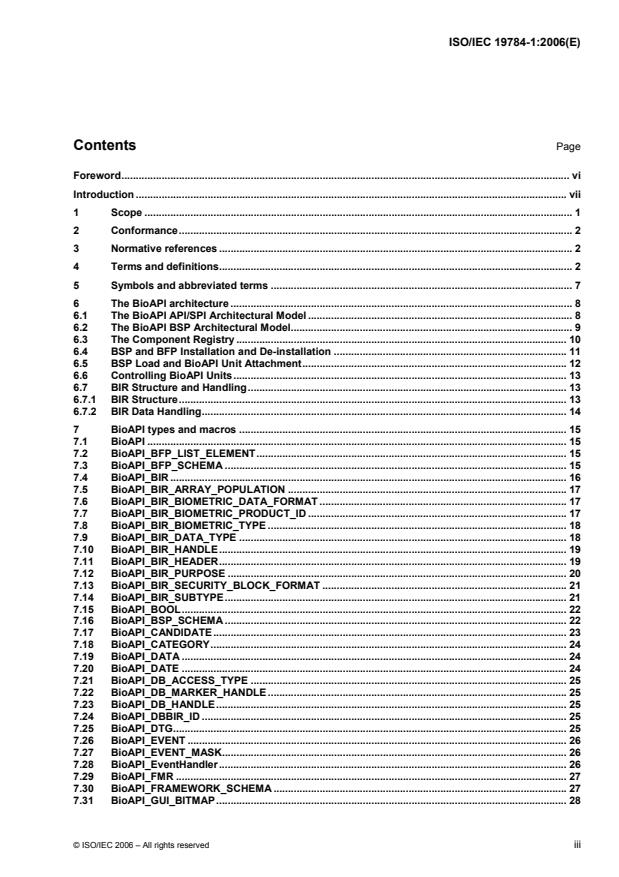
Contents Page
Foreword. vi
Introduction . vii
1 Scope . 1
2 Conformance. 2
3 Normative references . 2
4 Terms and definitions. 2
5 Symbols and abbreviated terms . 7
6 The BioAPI architecture . 8
6.1 The BioAPI API/SPI Architectural Model . 8
6.2 The BioAPI BSP Architectural Model. 9
6.3 The Component Registry . 10
6.4 BSP and BFP Installation and De-installation . 11
6.5 BSP Load and BioAPI Unit Attachment. 12
6.6 Controlling BioAPI Units. 13
6.7 BIR Structure and Handling. 13
6.7.1 BIR Structure. 13
6.7.2 BIR Data Handling. 14
7 BioAPI types and macros . 15
7.1 BioAPI . 15
7.2 BioAPI_BFP_LIST_ELEMENT. 15
7.3 BioAPI_BFP_SCHEMA . 15
7.4 BioAPI_BIR . 16
7.5 BioAPI_BIR_ARRAY_POPULATION . 17
7.6 BioAPI_BIR_BIOMETRIC_DATA_FORMAT . 17
7.7 BioAPI_BIR_BIOMETRIC_PRODUCT_ID . 17
7.8 BioAPI_BIR_BIOMETRIC_TYPE . 18
7.9 BioAPI_BIR_DATA_TYPE . 18
7.10 BioAPI_BIR_HANDLE. 19
7.11 BioAPI_BIR_HEADER. 19
7.12 BioAPI_BIR_PURPOSE . 20
7.13 BioAPI_BIR_SECURITY_BLOCK_FORMAT . 21
7.14 BioAPI_BIR_SUBTYPE. 21
7.15 BioAPI_BOOL. 22
7.16 BioAPI_BSP_SCHEMA . 22
7.17 BioAPI_CANDIDATE. 23
7.18 BioAPI_CATEGORY. 24
7.19 BioAPI_DATA . 24
7.20 BioAPI_DATE . 24
7.21 BioAPI_DB_ACCESS_TYPE . 25
7.22 BioAPI_DB_MARKER_HANDLE . 25
7.23 BioAPI_DB_HANDLE. 25
7.24 BioAPI_DBBIR_ID . 25
7.25 BioAPI_DTG. 25
7.26 BioAPI_EVENT . 26
7.27 BioAPI_EVENT_MASK. 26
7.28 BioAPI_EventHandler. 26
7.29 BioAPI_FMR . 27
7.30 BioAPI_FRAMEWORK_SCHEMA . 27
7.31 BioAPI_GUI_BITMAP. 28
© ISO/IEC 2006 – All rights reserved iii
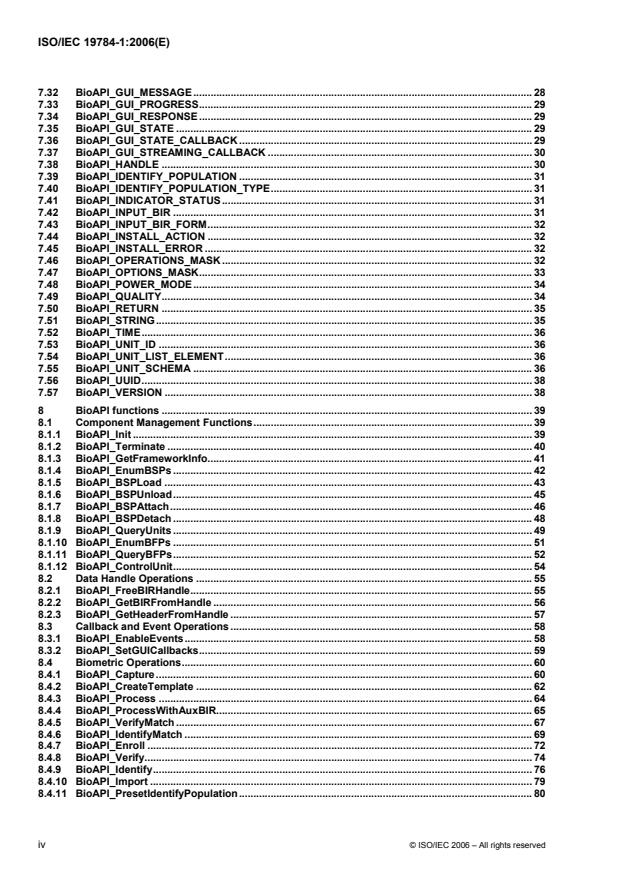
7.32 BioAPI_GUI_MESSAGE . 28
7.33 BioAPI_GUI_PROGRESS. 29
7.34 BioAPI_GUI_RESPONSE . 29
7.35 BioAPI_GUI_STATE . 29
7.36 BioAPI_GUI_STATE_CALLBACK . 29
7.37 BioAPI_GUI_STREAMING_CALLBACK . 30
7.38 BioAPI_HANDLE . 30
7.39 BioAPI_IDENTIFY_POPULATION .31
7.40 BioAPI_IDENTIFY_POPULATION_TYPE. 31
7.41 BioAPI_INDICATOR_STATUS. 31
7.42 BioAPI_INPUT_BIR . 31
7.43 BioAPI_INPUT_BIR_FORM. 32
7.44 BioAPI_INSTALL_ACTION . 32
7.45 BioAPI_INSTALL_ERROR . 32
7.46 BioAPI_OPERATIONS_MASK. 32
7.47 BioAPI_OPTIONS_MASK. 33
7.48 BioAPI_POWER_MODE. 34
7.49 BioAPI_QUALITY. 34
7.50 BioAPI_RETURN . 35
7.51 BioAPI_STRING. 35
7.52 BioAPI_TIME. 36
7.53 BioAPI_UNIT_ID . 36
7.54 BioAPI_UNIT_LIST_ELEMENT. 36
7.55 BioAPI_UNIT_SCHEMA . 36
7.56 BioAPI_UUID. 38
7.57 BioAPI_VERSION . 38
8 BioAPI functions . 39
8.1 Component Management Functions. 39
8.1.1 BioAPI_Init . 39
8.1.2 BioAPI_Terminate . 40
8.1.3 BioAPI_GetFrameworkInfo. 41
8.1.4 BioAPI_EnumBSPs . 42
8.1.5 BioAPI_BSPLoad . 43
8.1.6 BioAPI_BSPUnload. 45
8.1.7 BioAPI_BSPAttach. 46
8.1.8 BioAPI_BSPDetach . 48
8.1.9 BioAPI_QueryUnits . 49
8.1.10 BioAPI_EnumBFPs . 51
8.1.11 BioAPI_QueryBFPs. 52
8.1.12 BioAPI_ControlUnit. 54
8.2 Data Handle Operations . 55
8.2.1 BioAPI_FreeBIRHandle. 55
8.2.2 BioAPI_GetBIRFromHandle . 56
8.2.3 BioAPI_GetHeaderFromHandle . 57
8.3 Callback and Event Operations . 58
8.3.1 BioAPI_EnableEvents. 58
8.3.2 BioAPI_SetGUICallbacks. 59
8.4 Biometric Operations. 60
8.4.1 BioAPI_Capture. 60
8.4.2 BioAPI_CreateTemplate . 62
8.4.3 BioAPI_Process . 64
8.4.4 BioAPI_ProcessWithAuxBIR. 65
8.4.5 BioAPI_VerifyMatch . 67
8.4.6 BioAPI_IdentifyMatch . 69
8.4.7 BioAPI_Enroll . 72
8.4.8 BioAPI_Verify. 74
8.4.9 BioAPI_Identify. 76
8.4.10 BioAPI_Import . 79
8.4.11 BioAPI_PresetIdentifyPopulation. 80
iv © ISO/IEC 2006 – All rights reserved
8.5 Database Operations. 81
8.5.1 BioAPI_DbOpen . 81
8.5.2 BioAPI_DbClose. 83
8.5.3 BioAPI_DbCreate . 84
8.5.4 BioAPI_DbDelete. 85
8.5.5 BioAPI_DbSetMarker. 86
8.5.6 BioAPI_DbFreeMarker. 87
8.5.7 BioAPI_DbStoreBIR. 88
8.5.8 BioAPI_DbGetBIR . 89
8.5.9 BioAPI_DbGetNextBIR . 90
8.5.10 BioAPI_DbDeleteBIR . 91
8.6 BioAPI Unit operations. 92
8.6.1 BioAPI_SetPowerMode . 92
8.6.2 BioAPI_SetIndicatorStatus . 93
8.6.3 BioAPI_GetIndicatorStatus. 94
8.6.4 BioAPI_CalibrateSensor . 95
8.7 Utility Functions. 96
8.7.1 BioAPI_Cancel . 96
8.7.2 BioAPI_Free. 97
9 BioAPI Service Provider Interface. 98
9.1 Summary. 98
9.2 Type Definitions for Biometric Service Providers. 98
9.2.1 BioSPI_EventHandler . 98
9.2.2 BioSPI_BFP_ENUMERATION_HANDLER. 99
9.2.3 BioSPI_MEMORY_FREE_HANDLER. 100
9.3 Biometric Service Provider Operations. 101
9.3.1 SPI Component Management Operations. 101
9.3.2 SPI Data Handle Operations . 107
9.3.3 SPI Callback and Event Operations. 108
9.3.4 SPI Biometric Operations . 109
9.3.5 SPI Database Operations . 112
9.3.6 SPI BioAPI Unit operations. 114
9.3.7 SPI Utility Functions. 115
10 Component registry interface. 116
10.1 BioAPI Registry Schema. 116
10.1.1 Framework Schema. 116
10.1.2 BSP Schema. 117
10.1.3 BFP Schema . 118
10.2 Component registry functions . 119
10.2.1 BioAPI_Util_InstallBSP. 119
10.2.2 BioAPI_Util_InstallBFP. 120
11 BioAPI error handling. 121
11.1 Error Values and Error Codes Scheme . 121
11.2 Error Codes and Error Value Enumeration . 121
11.2.1 BioAPI Error Value Constants. 121
11.2.2 Implementation-Specific Error Codes . 121
11.2.3 General Error Codes. 121
11.2.4 Component Management Error Codes. 123
11.2.5 Database Error Values. 124
11.2.6 Location Error Values. 125
11.2.7 Quality Error Codes. 127
Annex A (normative) Conformance. 128
Annex B (normative) CBEFF Patron Format Specification: BioAPI patron format . 140
Annex C (informative) Specification overview . 145
Annex D (informative) Calling sequence examples and sample code. 154
Bibliography . 167
© ISO/IEC 2006 – All rights reserved v
Foreword
ISO (the International Organization for Standardization) and IEC (the International Electrotechnical
Commission) form the specialized system for worldwide standardization. National bodies that are members of
ISO or IEC participate in the development of International Standards through technical committees
established by the respective organization to deal with particular fields of technical activity. ISO and
IEC technical committees collaborate in fields of mutual interest. Other international organizations,
governmental and non-governmental, in liaison with ISO and IEC, also take part in the work. In the field of
information technology, ISO and IEC have established a joint technical committee, ISO/IEC JTC 1.
International Standards are drafted in accordance with the rules given in the ISO/IEC Directives, Part 2.
The main task of the joint technical committee is to prepare International Standards. Draft International
Standards adopted by the joint technical committee are circulated to national bodies for voting. Publication as
an International Standard requires approval by at least 75 % of the national bodies casting a vote.
Attention is drawn to the possibility that some of the elements of this document may be the subject of patent
rights. ISO and IEC shall not be held responsible for identifying any or all such patent rights.
ISO/IEC 19784-1 was prepared by Joint Technical Committee ISO/IEC JTC 1, Information technology,
Subcommittee SC 37, Biometrics.
ISO/IEC 19784 consists of the following parts, under the general title Information technology — Biometric
application programming interface:
⎯ Part 1: BioAPI specification
⎯ Part 2: Biometric archive function provider interface
This is the first ISO/IEC standard on BioAPI. Previous versions were published by ANSI and the BioAPI
Consortium. As the last official non-ISO release was designated Version 1.1, this ISO/IEC 19784-1 version is
designated Version 2.0. This is to distinguish the versions of BioAPI products in the marketplace.
vi © ISO/IEC 2006 – All rights reserved
Introduction
This part of ISO/IEC 19784, the BioAPI specification, provides a high-level generic biometric authentication
model suited to most forms of biometric technology. No explicit support for multimodal biometrics is currently
provided.
An architectural model is described which enables components of a biometric system to be provided by
different vendors, and to interwork through fully-defined Application Programming Interfaces (APIs).
A key feature of the architecture is the BioAPI Framework, which supports calls by one or more application
components (provided by different vendors, and potentially running concurrently) using the BioAPI API
specification. The BioAPI Framework provides this support by invoking (through a Service Provider Interface,
SPI) one or more biometric service provider (BSP) components (provided by different vendors, and potentially
running concurrently) which can be dynamically loaded and invoked as required by an application component.
At the lowest level there is hardware or software that performs biometric functions such as capture, matching,
or archiving. These parts of the architecture are called BioAPI Units, and can be integral to a BSP or can be
supplied as part of a separate BioAPI Function Provider (BFP) component.
Interactions (through the BioAPI Framework) can occur between BSPs from different vendors provided data
structures used to record information from the BioAPI Units they access conform to other International
Standards, and in particular to ISO/IEC 19794 [5].
The final component of the BioAPI architecture is the recognition that a BSP can provide its biometric services
either:
a) by the use of BioAPI Units that are integral to (that is, directly managed by) the BSP, or
b) by invoking, through the BioAPI Function Provider Interface (FPI), one or more BFP components
(provided by different vendors) that manage BioAPI Units that are integral to the BFP.
NOTE: A BioAPI Unit may consist of software only, or a combination of software and hardware (e.g., a biometric
sensor, archive, or algorithm).
For each type of BioAPI Unit supported by a BSP (or BFP) there may be one or more BioAPI Units of that type
which can be dynamically inserted and removed from the system. Insertion and removal generates events that
can be signalled (through the BSP and the BioAPI Framework) to an application.
The BioAPI specification covers the basic biometric functions of Enrollment, Verification, and Identification
(see Annex C), and includes a database interface to allow an application to manage the storage of biometric
records through an archive BioAPI Unit managed by a BSP or BFP. This provides for optimum performance
(e.g., when performing the biometric Identification function within a large population) of the archiving and
biometric search processes.
The interface to the application provides primitives that allow it to manage the capture of biometric samples
from a biometric sensor by accessing the corresponding BioAPI Unit, and the use of those biometric samples
for Enrollment (storage in an application-controlled or BSP-controlled BIR database), and subsequent
Verification or Identification against those stored records.
This part of ISO/IEC 19784 also specifies the content of a biometric component registry (information about the
biometric components that have been installed on the biometric system). It also provides a component registry
interface for the management and inspection of that registry.
This part of ISO/IEC 19784 uses the C programming language (see ISO/IEC 9899) to specify the data
structures and function calls that form the BioAPI interfaces.
© ISO/IEC 2006 – All rights reserved vii
Clause 6 describes the BioAPI architectural model and its components, and the interfaces that are specified
between these components.
Clause 7 defines the data structures used in the BioAPI.
Clause 8 defines the function calls initiated by an application and supported by a conforming BioAPI
Framework that are either handled internally by the BioAPI Framework (for example enumeration of installed
BioAPI components) or mapped to a function provided by a BSP.
Clause 9 defines the function calls supported by a conforming BSP (and invoked by the BioAPI Framework in
response to a call from a biometric application).
Clause 10 specifies the form of the biometric component registry and the component registry interface.
Clause 11 defines the handling of events and error returns.
Annex A is normative, and specifies details of conformance requirements and proformas that can be used by
the vendor of a BioAPI Biometric Application, Framework, or BSP component to identify those functions and
biometric record formats that must be supported.
NOTE: A future International Standard (ISO/IEC 24709) will address conformance testing for this BioAPI
specification. [7]
Annex B is normative, and specifies the BioAPI biometric information record (BIR) as a CBEFF Patron Format
in accordance with ISO/IEC 19785-1. It provides a description of the biometric record specified in this part of
ISO/IEC 19784, together with the platform-independent bit-pattern representation of such a record for storage
and transfer.
Annex C is informative, and provides a general tutorial on a number of aspects of the BioAPI specification.
Annex D is informative, and provides example code to illustrate calling sequences and to provide
implementation guidance.
viii © ISO/IEC 2006 – All rights reserved
INTERNATIONAL STANDARD ISO/IEC 19784-1:2006(E)
Information technology — Biometric application programming
interface —
Part 1:
BioAPI specification
1 Scope
This part of ISO/IEC 19784 defines the Application Programming Interface (API) and Service Provider
Interface (SPI) for standard interfaces within a biometric system that support the provision of that biometric
system using components from multiple vendors. It provides interworking between such components through
adherence to this part of ISO/IEC 19784 and to other International Standards.
The BioAPI specification is applicable to a broad range of biometric technology types. It is also applicable to a
wide variety of biometrically enabled applications, from personal devices, through network security
applications, to large complex identification systems.
This part of ISO/IEC 19784 supports an architecture in which a BioAPI Framework supports multiple
simultaneous biometric applications (provided by different vendors), using multiple dynamically installed and
loaded (or unloaded) biometric service provider (BSP) components and BioAPI Units (provided by other
different vendors), possibly using one of an alternative set of BioAPI Function Provider (BFP) components
(provided by other vendors) or by direct management of BioAPI Units.
NOTE: Where BioAPI Units are provided by a different vendor fom a BSP, a standardised BioAPI Function Provider
Interface (FPI) may be needed. This is outside the scope of this part of ISO/IEC 19784, but is specified by later parts
for the different categories of FPI.
This part of ISO/IEC 19784 is not required (and should normally not be referenced) when a complete
biometric system is being procured from a single vendor, particularly if the addition or interchange of biometric
hardware, services, or applications is not a feature of that biometric system. (Such systems are sometimes
referred to as "embedded systems".) Standardisation of such systems is not in the scope of this part of
ISO/IEC 19784.
It is not in the scope of this part of ISO/IEC 19784 to define security requirements for biometric applications
and biometric service providers.
NOTE: ISO 19092 provides guidelines on security aspects of biometric systems. [3]
The performance of biometric systems (particularly in relation to searches of a large population to provide the
biometric identification capability) is not in the scope of this part of ISO/IEC 19784. Trade-offs between
interoperability and performance are not in the scope of this part of ISO/IEC 19784.
This part of ISO/IEC 19784 specifies a version of the BioAPI specification that is defined to have a version
number described as Major 2, Minor 0, or version 2.0.
NOTE: Earlier versions of the BioAPI specification were not International Standards.
© ISO/IEC 2006 — All rights reserved 1
2 Conformance
2.1 Annex A specifies the conformance requirements for BioAPI components claiming conformance to this
part of ISO/IEC 19784.
2.2 This part of ISO/IEC 19784 uses the C programming language (see ISO/IEC 9899) to specify the
interfaces that it defines. A BioAPI component can conform to this part of ISO/IEC 19784 by the provision or
use of that interface with languages other than the C programming language, provided that the component on
the other side of such an interface can use the interface through the detailed C programming language
specification given in this part of ISO/IEC 19784. (See also clause 7.1.)
3 Normative references
The following referenced documents are indispensable for the application of this document. For dated
references, only the edition cited applies. For undated references, the latest edition of the referenced
document (including any amendments) applies.
ISO/IEC 9834-8, Information technology — Open Systems Interconnection — Procedures for the operation of
OSI Registration Authorities: Generation and registration of Universally Unique Identifiers (UUIDs) and their
use as ASN.1 Object Identifier components
ISO/IEC 9899:1999, Programming Languages — C
ISO/IEC 10646:2003, Information technology — Universal Multiple-Octet Coded Character Set (UCS)
ISO/IEC 19785-1, Information technology — Common Biometric Exchange Formats Framework — Part 1:
Data element specification
ISO/IEC 19785-2, Information technology — Common Biometric Exchange Formats Framework — Part 2:
Procedures for the operation of the Biometric Registration Authority
4 Terms and definitions
For the purposes of this document, the following terms and definitions apply.
NOTE: Function names and data element names are not included here, but are defined within the body of this part of
ISO/IEC 19784.
4.1
adaptation
template adaptation
use of a BIR produced from a newly captured and verified biometric sample to automatically update or refresh
a reference template
NOTE: This procedure is used to minimize the effects of template aging.
4.2
attach session
temporary association between an application, a single BSP, and a set of BioAPI Units that are managed
either directly or indirectly by that BSP
2 © ISO/IEC 2006 — All rights reserved
4.3
BioAPI component
component of the BioAPI architecture with a defined interface that can be supplied by a separate vendor and
which is subject to conformance testing
NOTE: BioAPI components include BioAPI applications, the BioAPI Framework, BSPs, and BFPs.
4.4
BioAPI Function Provider
BFP
component that manages one or more BioAPI Units of a specific category
NOTE 1: Interfaces to BioAPI Function Providers are standardized in subsequent parts of ISO/IEC 19784.
NOTE 2: BFPs are categorized according to the categories of BioAPI Units that they manage (see clause 6.2.4).
4.5
BioAPI Unit
abstraction of a hardware or software resource that is directly managed by a BSP or BFP
NOTE: BioAPI Units are categorized (see clause 6.2.2) and include sensor units, archive units, matching algorithm
units and processing algorithm units.
4.6
biometric (adj.)
pertaining to the field of biometrics
4.7
biometric data block
BDB
block of data with a defined format that contains one or more biometric samples or biometric templates
NOTE 1: ISO/IEC 19784 does not support BDB formats that are not an integral multiple of eight bits.
NOTE 2: There is no requirement that a BDB format be self-delimiting.
NOTE 3: Each part of ISO/IEC 19794 standardises one or more BDB formats. Vendor specific formats can also be
specified and identified.
NOTE 4: Within BioAPI, the BDB is “opaque” to the application and is therefore sometimes referred to as an opaque
biometric data block.
4.8
biometric information record
BIR
data structure containing one or more BDBs, together with information identifying the BDB formats, and
possibly further information such as whether a BDB is signed or encrypted (see ISO/IEC 19785-1)
NOTE: This part of ISO/IEC 19784 defines a BIR format (see clause 7.4) that supports only a single BDB.
ISO/IEC 19785-1 defines a more general BIR format that supports multiple BDBs within the BIR, and the above
definition is used in common by the two International Standards. When the term BIR is used in this part of
ISO/IEC 19784, it normally refers to the specific BIR format defined by BioAPI (see Annex B), not to an arbitrary BIR.
The term BioAPI BIR is used where clarity is needed.
4.8.1
reference BIR
BIR whose BDB(s) contain one or more biometric templates
4.8.2
sample BIR
BIR whose BDB(s) contain only biometric samples that are not templates
© ISO/IEC 2006 — All rights reserved 3
4.9
biometric sample
information obtained from a biometric sensor, either directly or after further processing
NOTE: See also raw biometric sample, intermediate biometric sample, and processed biometric sample.
4.9.1
biometric template
biometric sample or combination of biometric samples that is suitable for storage as a reference for future
comparison
4.9.2
intermediate biometric sample
biometric sample obtained by processing a raw biometric sample, intended for further processing
4.9.3
processed biometric sample
biometric sample suitable for comparison
4.9.4
raw biometric sample
biometric sample obtained directly from a biometric sensor
NOTE: The formats for raw biometric samples are not currently standardised, and depend on the nature of the
biometric device and the vendor of that device. They may in the future be standardised as part of the
standardisation of specific biometric devices.
4.9.5
reference template
biometric template that has been stored
4.10
biometric sensor
biometric hardware used to capture raw biometric samples from a subject
NOTE: The term ‘biometric device’ is used interchangeably with this term.
4.11
biometric service provider
BSP
component that provides biometric services to an application through a defined interface by managing one or
more BioAPI Units directly, or through interfaces to BioAPI Function Providers
4.12
biometrics (noun)
automated recognition of individuals based on their behavioural and biological characteristics
4.13
callback
mechanism by which a component that exposes an API invokes a function within a component that uses that
API, where the address of that function has been previously passed as an input parameter of an API function
call
NOTE: This mechanism enables a BioAPI component to communicate with another BioAPI component other than by
invoking an API function, usually in response to an event or interrupt.
4.14
component registry
information maintained by the BioAPI Framework concerning the BioAPI components that are available on a
biometric system
4 © ISO/IEC 2006 — All rights reserved
4.15
encrypt
encryption
(reversible) transformation of data by a cryptographic algorithm to produce ciphertext; that is, to hide the
information content (protect the confidentiality) of the data
NOTE 1: Encryption algorithms consist of two processes: encryption (or encipherment) which transforms plaintext
into ciphertext, and decryption (or decipherment) which transforms cip
...
Questions, Comments and Discussion
Ask us and Technical Secretary will try to provide an answer. You can facilitate discussion about the standard in here.
Loading comments...