


ISO/TS 16782:2016
(Main)Clinical laboratory testing — Criteria for acceptable lots of dehydrated Mueller-Hinton agar and broth for antimicrobial susceptibility testing
Clinical laboratory testing — Criteria for acceptable lots of dehydrated Mueller-Hinton agar and broth for antimicrobial susceptibility testing
ISO/TS 16782:2016 provides a standard description of the physical properties of dehydrated Mueller-Hinton broth (dMHB) and Mueller-Hinton agar (dMHA) and performance criteria by which manufacturers can assess the performance characteristics of their production lots of dMHA and dMHB. Production lots of broth or agar can then be utilized by all users, including in vitro susceptibility testing device manufacturers, as the test medium for performance of antimicrobial susceptibility testing. ISO/TS 16782:2016 does not address supplements (e.g. blood or blood products) that are added to the medium to support growth of fastidious bacteria[3][4][5][6]. Those additives are provided after the dehydrated medium is prepared in its liquid state as a final product and fall outside of the scope of this Technical Specification. Although dMHA can be used for determination of MICs using the agar dilution method[4][6] or the gradient diffusion method, ISO/TS 16782:2016 only includes performance testing of dMHA using disc diffusion methodology as described by the Clinical and Laboratory Standards Institute (CLSI)[5] and European Committee on Antimicrobial Susceptibility Testing (EUCAST)[3].
Détermination de la sensibilité aux antibiotiques — Critères d'acceptabilité pour les lots d'agar déshydraté et de bouillon Mueller-Hinton pour déterminer la sensibilité aux antibiotiques
General Information
Relations
Standards Content (Sample)
TECHNICAL ISO/TS
SPECIFICATION 16782
First edition
2016-10-15
Clinical laboratory testing — Criteria
for acceptable lots of dehydrated
Mueller-Hinton agar and broth for
antimicrobial susceptibility testing
Détermination de la sensibilité aux antibiotiques — Critères
d’acceptabilité pour les lots d’agar déshydraté et de bouillon Mueller-
Hinton pour déterminer la sensibilité aux antibiotiques
Reference number
©
ISO 2016
© ISO 2016, Published in Switzerland
All rights reserved. Unless otherwise specified, no part of this publication may be reproduced or utilized otherwise in any form
or by any means, electronic or mechanical, including photocopying, or posting on the internet or an intranet, without prior
written permission. Permission can be requested from either ISO at the address below or ISO’s member body in the country of
the requester.
ISO copyright office
Ch. de Blandonnet 8 • CP 401
CH-1214 Vernier, Geneva, Switzerland
Tel. +41 22 749 01 11
Fax +41 22 749 09 47
copyright@iso.org
www.iso.org
ii © ISO 2016 – All rights reserved
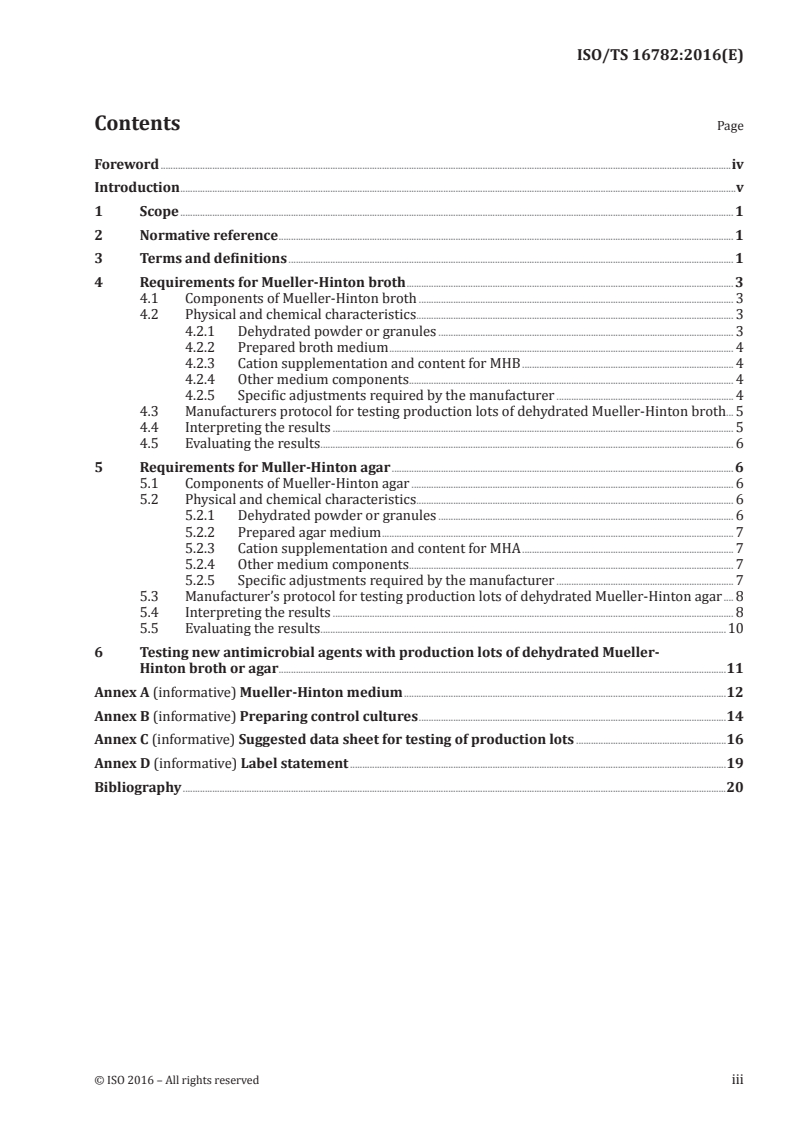
Contents Page
Foreword .iv
Introduction .v
1 Scope . 1
2 Normative reference . 1
3 Terms and definitions . 1
4 Requirements for Mueller-Hinton broth . 3
4.1 Components of Mueller-Hinton broth . 3
4.2 Physical and chemical characteristics . 3
4.2.1 Dehydrated powder or granules . 3
4.2.2 Prepared broth medium . 4
4.2.3 Cation supplementation and content for MHB . 4
4.2.4 Other medium components . . 4
4.2.5 Specific adjustments required by the manufacturer . 4
4.3 Manufacturers protocol for testing production lots of dehydrated Mueller-Hinton broth . 5
4.4 Interpreting the results . 5
4.5 Evaluating the results . 6
5 Requirements for Muller-Hinton agar . 6
5.1 Components of Mueller-Hinton agar . 6
5.2 Physical and chemical characteristics . 6
5.2.1 Dehydrated powder or granules . 6
5.2.2 Prepared agar medium . 7
5.2.3 Cation supplementation and content for MHA . 7
5.2.4 Other medium components . . 7
5.2.5 Specific adjustments required by the manufacturer . 7
5.3 Manufacturer’s protocol for testing production lots of dehydrated Mueller-Hinton agar . 8
5.4 Interpreting the results . 8
5.5 Evaluating the results .10
6 Testing new antimicrobial agents with production lots of dehydrated Mueller-
Hinton broth or agar .11
Annex A (informative) Mueller-Hinton medium .12
Annex B (informative) Preparing control cultures .14
Annex C (informative) Suggested data sheet for testing of production lots .16
Annex D (informative) Label statement .19
Bibliography .20
Foreword
ISO (the International Organization for Standardization) is a worldwide federation of national standards
bodies (ISO member bodies). The work of preparing Technical Specifications is normally carried out
through ISO technical committees. Each member body interested in a subject for which a technical
committee has been established has the right to be represented on that committee. International
organizations, governmental and non-governmental, in liaison with ISO, also take part in the work.
ISO collaborates closely with the International Electrotechnical Commission (IEC) on all matters of
electrotechnical standardization.
The procedures used to develop this document and those intended for its further maintenance are
described in the ISO/IEC Directives, Part 1. In particular the different approval criteria needed for the
different types of ISO documents should be noted. This document was drafted in accordance with the
editorial rules of the ISO/IEC Directives, Part 2 (see www.iso.org/directives).
Attention is drawn to the possibility that some of the elements of this document may be the subject of
patent rights. ISO shall not be held responsible for identifying any or all such patent rights. Details of
any patent rights identified during the development of the document will be in the Introduction and/or
on the ISO list of patent declarations received (see www.iso.org/patents).
Any trade name used in this document is information given for the convenience of users and does not
constitute an endorsement.
For an explanation on the meaning of ISO specific terms and expressions related to conformity
assessment, as well as information about ISO’s adherence to the WTO principles in the Technical
Barriers to Trade (TBT) see the following URL: Foreword - Supplementary information
The committee responsible for this document is ISO/TC 212, Clinical laboratory testing and in vitro
diagnostic test systems.
iv © ISO 2016 – All rights reserved
Introduction
Historically, although various media have been recommended for susceptibility testing, Mueller-
Hinton broth (MHB) has been selected as the medium for the reference broth microdilution minimum
inhibitory concentration (MIC) method (ISO 20776-1) and Mueller-Hinton agar (MHA) is most widely
used for disc diffusion testing of rapidly growing bacteria.
Mueller-Hinton medium provides satisfactory growth of most non-fastidious pathogens, acceptable
batch-to-batch reproducibility, low sulfonamide, trimethoprim, and tetracycline inhibitors and a large
amount of data has been collected from antimicrobial susceptibility tests with this medium over several
decades.
This International Standard is the result of an effort to establish a standard description and protocol by
which manufacturers of dehydrated Mueller-Hinton agar (dMHA) and broth (dMHB) may determine its
acceptable performance characteristics.
The results of testing conform to defined quality control limit ranges for each combination of
antimicrobial agent and quality control strains. Each production lot is tested at least against these
combinations of antimicrobial agents and quality control strains.
This Technical Specification has been developed in part based upon two Clinical and Laboratory
[1]
Standards Institute (CLSI) documents, CLSI M6-A2 (protocols for evaluating dehydrated Mueller-
[2]
Hinton agar) and CLSI M32-P (evaluation of lots of dehydrated Mueller-Hinton broth for antimicrobial
[1]
susceptibility testing) with permission. Upon publication of ISO 16782, CLSI documents M6-A2 and
[2]
M32-P will no longer be available. Manufacturers can follow ISO 16782 to assess the performance
characteristics of their production lots of dMHA and dMHB.
TECHNICAL SPECIFICATION ISO/TS 16782:2016(E)
Clinical laboratory testing — Criteria for acceptable
lots of dehydrated Mueller-Hinton agar and broth for
antimicrobial susceptibility testing
1 Scope
This Technical Specification provides a standard description of the physical properties of dehydrated
Mueller-Hinton broth (dMHB) and Mueller-Hinton agar (dMHA) and performance criteria by which
manufacturers can assess the performance characteristics of their production lots of dMHA and dMHB.
Production lots of broth or agar can then be utilized by all users, including in vitro susceptibility testing
device manufacturers, as the test medium for performance of antimicrobial susceptibility testing.
This Technical Specification does not address supplements (e.g. blood or blood products) that are
[3][4][5][6]
added to the medium to support growth of fastidious bacteria . Those additives are provided
after the dehydrated medium is prepared in its liquid state as a final product and fall outside of the
scope of this Technical Specification. Although dMHA can be used for determination of MICs using the
[4][6]
agar dilution method or the gradient diffusion method, this Technical Specification only includes
performance testing of dMHA using disc diffusion methodology as described by the Clinical and
[5]
Laboratory Standards Institute (CLSI) and European Committee on Antimicrobial Susceptibility
[3]
Testing (EUCAST) .
2 Normative reference
The following documents, in whole or in part, are normatively referenced in this document and are
indispensable for its application. For dated references, only the edition cited applies. For undated
references, the latest edition of the referenced document (including any amendments) applies.
ISO 20776-1:2006, Clinical laboratory testing and in vitro diagnostic test systems — Susceptibility testing
of infectious agents and evaluation of performance of antimicrobial susceptibility test devices — Part 1:
Reference method for testing the in vitro activity of antimicrobial agents against rapidly growing aerobic
bacteria involved in infectious diseases
CLSI M100, Performance Standards for Antimicrobial Susceptibility Testing; Informational Supplement
3 Terms and definitions
For the purposes of this document, the following terms and definitions apply.
3.1
antimicrobial agent
substance of biological, semi-synthetic or synthetic origin that inhibits the growth of or kills bacteria
and is thus of potential use in the treatment of infections
Note 1 to entry: Disinfectants, antiseptics and preservatives are not included in this definition.
[SOURCE: ISO 20776-1:2006, 2.1]
3.2
antimicrobial disc
small paper disc containing known amounts of antimicrobial agents used for in vitro susceptibility testing
3.3
concentration
amount of an antimicrobial agent in a defined volume of liquid
Note 1 to entry: The concentration is expressed as mg/l.
Note 2 to entry: mg/l = µg/ml but it is not recommended to use the unit µg/ml.
[SOURCE: ISO 20776-1:2006, 2.2.2]
3.4
stock solution
initial solution used for further dilutions
[SOURCE: ISO 20776-1:2006, 2.3]
3.5
minimum inhibitory concentration
MIC
lowest concentration of antimicrobial agent that, under defined in vitro conditions, prevents visible
growth of bacteria within a defined period of time
Note 1 to entry: The MIC is expressed in mg/l.
[SOURCE: ISO 20776-1:2006, 2.4, modified — “lowest concentration that” has been modified to “lowest
concentration of antimicrobial agent that”]
3.6
reference strain
catalogued, characterized microorganism with stable, defined antimicrobial susceptibility phenotype
and/or genotype
Note 1 to entry: Reference strains are kept as stock cultures, from which working cultures are derived. They are
obtained from recognized national culture collections and used for quality control.
[SOURCE: ISO 20776-1:2006, 2.7, modified — “characterized bacteria” has been modified to
“characterized microorganism” and “culture collections” in Note 1 to entry has been modified to
“recognized national culture collections”]
3.7 Susceptibility testing method
3.7.1
broth dilution
technique in which containers are filled with appropriate volumes of broth containing an antimicrobial
agent in incrementally (usually two-fold) increasing concentrations and a defined inoculum
Note 1 to entry: The aim of this method is the determination of the MIC.
[SOURCE: ISO 20776-1:2006, 2.8.1, modified — “an antimicrobial solution, employing incrementally
(usually two-fold) increasing concentrations of the antimicrobial agent and appropriate volumes of
broth with” has been modified to “broth containing an antimicrobial agent in incrementally (usually
two-fold) increasing concentrations and”]
3.7.2
microdilution
performance of broth dilution in microdilution trays with a capacity of 200 µl per well
[SOURCE: ISO 20776-1:2006, 2.8.2, modified — “a capacity of ≤200 μl per well” has been modified to “a
capacity of 200 µl per well”]
2 © ISO 2016 – All rights reserved
3.7.3
disc diffusion
technique in which antimicrobial discs are applied to the surface of an agar medium that has been evenly
inoculated with a defined inoculum and, following incubation under defined conditions, the resulting
size of zones of growth inhibition of the microorganism corresponds to the susceptibility/resistance of
the microorganism to the antimicrobial agent
3.7.4
zone diameter
diameter (in mm) of the zone of growth inhibition around a paper disc containing an antimicrobial
agent of specified amount used in a disc diffusion test
3.8
broth
liquid medium used for the in vitro growth of bacteria
[SOURCE: ISO 20776-1:2006, 2.9, modified — “fluid medium” has been modified to “liquid medium”]
3.9
inoculum
number of viable bacteria in a suspension, calculated with respect to the final volume
Note 1 to entry: The inoculum is expressed as colony-forming units per millilitre (CFU/ml).
[SOURCE: ISO 20776-1:2006, 2.10, modified — “number of bacteria” has been modified to “number of
viable bacteria”]
3.10
dehydrated Mueller-Hinton broth
dMHB
dried bacteriological medium which is used to prepare liquid medium for broth dilution antimicrobial
susceptibility tests
3.11
dehydrated Mueller-Hinton agar
dMHA
dried bacteriological medium which is used to prepare antimicrobial susceptibility testing agar plates
for disc diffusion, gradient diffusion MIC and agar dilution MIC methods
4 Requirements for Mueller-Hinton broth
4.1 Components of Mueller-Hinton broth
Historically, Mueller-Hinton broth medium for antimicrobial susceptibility testing contains
approximately the following components per litre of purified water (adjustments may be needed to
[7]
meet performance criteria) :
— dehydrated infusion from 300 g beef (i.e. 2 g of beef extract powder);
— acid digest of casein 17,5 g;
— starch 1,5 g.
4.2 Physical and chemical characteristics
4.2.1 Dehydrated powder or granules
Colour: beige to light beige.
Uniform, free-flowing, homogeneous and free of extraneous material.
4.2.2 Prepared broth medium
Once hydrated, the final pH measured after autoclaving shall be 7,2 to 7,4 at 25 °C.
The liquid is light straw coloured and clear with no visible precipitate.
4.2.3 Cation supplementation and content for MHB
The broth shall contain sufficient concentrations of cations to provide adequate growth and to permit
the user to determine MIC values (e.g. aminoglycosides and quinolones) for quality control strains
within ranges identified in ISO 20776-1:2006, Table 4 (check the latest version of CLSI and EUCAST
documents for QC ranges). New lots of MHB may require testing for acceptable cation content. For
standard production lots of dMHB, the broth prepared from the dehydrated product shall contain no
greater than 25 mg/l of total calcium and 12,5 mg/l of total magnesium. Manufacturers may choose
to provide commercial lots of dMHB with required concentrations of cations or actual levels less than
20 mg/l of calcium and 10 mg/l of magnesium. In the latter case, the final label shall specify the actual
amounts contained in the lot of broth. For final testing, the prepared MHB shall contain 20 mg/l to
2+ 2+
25 mg/l of Ca and 10 mg/l to 12,5 mg/l of Mg .
While trace amounts of manganese are required for growth, the concentration shall be below 8 mg/l
[8]
to avoid false resistant interpretations with glycylcyclines . This shall be determined by an MIC value
within the acceptable range obtained by testing Escherichia coli WDCM 00013 with tigecycline.
While trace amounts of zinc are required for growth, the concentration of zinc shall be below 3 mg/l
[9]
to avoid false resistance interpretations with imipenem and potentially with other carbapenems.
This shall be determined by an MIC value within the acceptable range obtained by testing Pseudomonas
aeruginosa WDCM 00025 with imipenem.
Cation concentrations of calcium, magnesium, manganese, and zinc shall be determined by inductively
[10]
coupled plasma mass spectrometry (ICP-MS) or flame atomic absorption spectroscopy (FAAS) .
Although ion effects known to affect susceptibility test results for other antimicrobial agents are not
included in this Technical Specification, they shall be considered for MHB dilution susceptibility tests
[11] [12]
by manufacturers at their discretion. Affected agents include daptomycin and polymyxin . When
2+
testing daptomycin, MHB shall be supplemented to a final concentration of 50 mg/l total Ca . Refer
to ISO 20776-1 for appropriate instructions on preparation of media and antimicrobial susceptibility
testing.
4.2.4 Other medium components
The medium shall have a thymidine mass concentration of less than 0,03 mg/l as indicated by an MIC
value of ≤0,5/9,5 mg/l obtained by testing Enterococcus faecalis WDCM 00087 with trimethoprim-
[13]
sulfamethoxazole .
4.2.5 Specific adjustments required by the manufacturer
For antimicrobial agents included in Table 1:
a) incorporation of sodium chloride (2 % m/V NaCl) at a final concentration of 20 g/l in the broth
is required for the detection of methicillin resistance in Staphylococcus spp. when testing with
oxacillin;
b) for broth microdilution testing of tigecycline, when MIC panels are prepared, the medium shall
be prepared fresh on the day of use. The medium shall be no more than 12 h old at the time the
panels are made; however, the panels may then be frozen for later use. For further details, refer to
ISO 20776-1.
Manufacturers may choose to test additional antimicrobial agents and strains, as well as Mueller-
Hinton media supplemented for growth of fastidious strains. The expected performance limits shall be
validated.
4 © ISO 2016 – All rights reserved
For organisms not included in Table 1 (i.e. for extended testing at the discretion of the manufacturer):
c) testing of fastidious organisms such as streptococci and Haemophilus spp. requires the addition of
growth supplements (for example, blood or blood components). If a Mueller-Hinton agar or broth
lot that is found to perform acceptably according to the criteria in this Technical Specification is
to be used for testing fastidious organisms, the resulting MICs or zone diameters after addition of
supplements shall fall within the acceptable quality control ranges published in 20776-1 for the
specific medium and organism tested.
See A.1 for a summary of specific effects on antimicrobial agents.
4.3 Manufacturers protocol for testing production lots of dehydrated Mueller-
Hinton broth
Procedures for preparing microdilution trays and performing the test are described in ISO 20776-1.
Those procedures shall be followed with restrictions noted below.
a) The minimum and maximum concentration of each antimicrobial agent on each tray shall bracket
the quality control limit range by at least two doubling dilutions beyond each limit.
b) As a minimum, test a single microbial inoculum in three separate trays for each of the
microorganism-antimicrobial combinations listed in 4.4. This list of microorganism-antimicrobial
agent combinations represents the minimum requirements for testing and includes agents likely
to detect particular problems with the medium. Other antimicrobial agents may be tested at the
manufacturer’s discretion as needed to ensure consistent performance of the medium. The medium
shall be appropriate for the antimicrobial agents tested.
[6] [4]
c) See ISO 20776-1, CLSI or EUCAST for specific details of quality control strain maintenance. At
least two days before testing, thaw a vial of each of the control cultures that will be needed (see
4.4). Inoculate each culture onto a plate of non-selective nutritive agar medium and incubate it for
18 h to 24 h at 34 °C to 37 °C in ambient air as described in ISO 20776-1. After incubation, check for
purity. The day before the inoculation of the test plates, subculture again to provide fresh colonies
for inoculum preparation. All microorganisms shall be subcultured at least twice from the frozen
state before being used for testing.
d) If frozen trays are used, they shall be allowed to thaw completely at ambient room temperature
(usually takes 1 h to 2 h) before use. Trays shall be used on the same day that they are thawed.
e) Tests shall be set up as described in ISO 20776-1. A single inoculum for each quality control strain
shall be prepared using the colony suspension method. Inoculated microdilution trays should be
incubated for 16 h to 20 h (24 h for oxacillin with Staphylococcus aureus) and read within one hour
of removal from the incubator.
f) Results shall be recorded and maintained according to the manufacturer’s policies for record
retention. A suggested data sheet for this purpose is shown in Annex C.
4.4 Interpreting the results
[14]
The acceptable MIC ranges in Table 1 were obtained with permission from CLSI and EUCAST [http://
[15]
www.eucast.org/ast_of_bacteria/qc_tables/] .
The acceptable ranges are subject to revision. Therefore the latest version of Reference [14] or the
EUCAST Tables shall be checked for possible updates.
See Annex B for alternative numbers for the same control microorganism from different culture
collections.
Table 1 — MIC ranges (mg/l) for control strains
Acceptable range
Quality control strain Antimicrobial agent
mg/l
Ciprofloxacin 0,25–1
Pseudomonas aeruginosa Gentamicin 0,5–2
Imipenem 1–4
WDCM 00025
Piperacillin-tazobactam 1/4–8/4
Ampicillin 2–8
Escherichia coli
Cefotaxime 0,03–0,12
WDCM 00013
Tigecycline 0,03–0,25
Clindamycin 0,06–0,25
Erythromycin 0,25–1
Staphylococcus aureus
Oxacillin 0,12–0,5
WDCM 00131
Tetracycline 0,12–1
Vancomycin 0,5–2
Ampicillin 0,5–2
Enterococcus faecalis
a
Trimethoprim- sulfamethoxazole ≤0,5/9,5
WDCM 00087
Vancomycin 1–4
Staphylococcus aureus
Oxacillin 4–32
WDCM 00211
a
CLSI or EUCAST has not yet established a control range for trimethoprim-sulfamethoxazole. The MIC results for
trimethoprim-sulfamethoxazole shall be
4.5 Evaluating the results
If all performance criteria for all microorganism-antimicrobial agent combinations are within acceptable
ranges listed in 4.4 and all physical and chemical characteristics are met (see 4.2), the manufacturer
may apply the label statement given in Annex D. Manufacturers should attempt to achieve mean MIC
values close to the midpoint of the control ranges. Data shall be maintained on file and results made
available to anyone upon request.
5 Requirements for Muller-Hinton agar
5.1 Components of Mueller-Hinton agar
Historically, Mueller-Hinton agar medium for antimicrobial susceptibility testing contains
approximately (adjustment may be needed to meet performance criteria) the following components per
[7]
litre of purified water :
— dehydrated infusion from 300 g beef (i.e. 2 g of beef extract powder);
— acid digest of casein 17,5 g;
— starch 1,5 g;
— agar 17 g.
5.2 Physical and chemical characteristics
5.2.1 Dehydrated powder or granules
Colour: beige to light beige.
6 © ISO 2016 – All rights reserved
Uniform, free-flowing, homogeneous and free of extraneous material.
5.2.2 Prepared agar medium
The final pH measured after autoclaving and gelling shall be 7,2 to 7,4 at 25 °C.
The gelled medium is light straw coloured and slightly opalescent. The depth of medium in the plate
shall be uniform and within the range of 3,5 mm to 5,0 mm [EUCAST specifies 4 mm ± 0,5 mm and
[6] [1]
CLSI either approximately 4 mm or 4 mm to 5 mm (CLSI document M6 )]. Plates from different
sources might differ in diameter (measured internally at the base of the plate) and the agar volume
required to provide the specified depth is calculated from the formula “3,143 × plate radius (cm)
squared × depth (cm)”. Hence, the acceptable range of depth of the medium for 90 mm, 100 mm and
150 mm internal diameter round plates is achieved with volumes of 23 ml to 31 ml, 28 ml to 39 ml, and
62 ml to 88 ml, respectively. For other plate sizes, the volume of medium required shall be calculated.
5.2.3 Cation supplementation and content for MHA
The agar shall contain sufficient concentrations of cations to provide adequate growth and to permit
the user to determine zone diameters for quality control strains within ranges identified in 5.4.
2+ 2+
The medium shall have Ca and Mg cation concentrations such as to provide zone diameter values
within expected range for Pseudomonas aeruginosa vs aminoglycoside class of anti
...
Questions, Comments and Discussion
Ask us and Technical Secretary will try to provide an answer. You can facilitate discussion about the standard in here.